Triangles
What do the sail on a windsurfing board, a set square
and a warning road sign all have in common? They are
triangular in shape. Triangles come in many different
sizes, but they all have three sides.
A triangle is a type of polygon. Polygons are two-
dimensional (flat) shapes with straight sides. There are
different types of polygon, with different numbers of
sides. A triangle is a polygon with three sides.
The three sides of a triangle are all straight lines. These
lines meet one another at the corners of the triangle, and
create an angle at each of the three corners. The internal
angles are the three angles on the inside of the triangle.
SIDES OF A TRIANGLE
Not all triangles look the same. Triangles have different names
depending on the length of their sides.
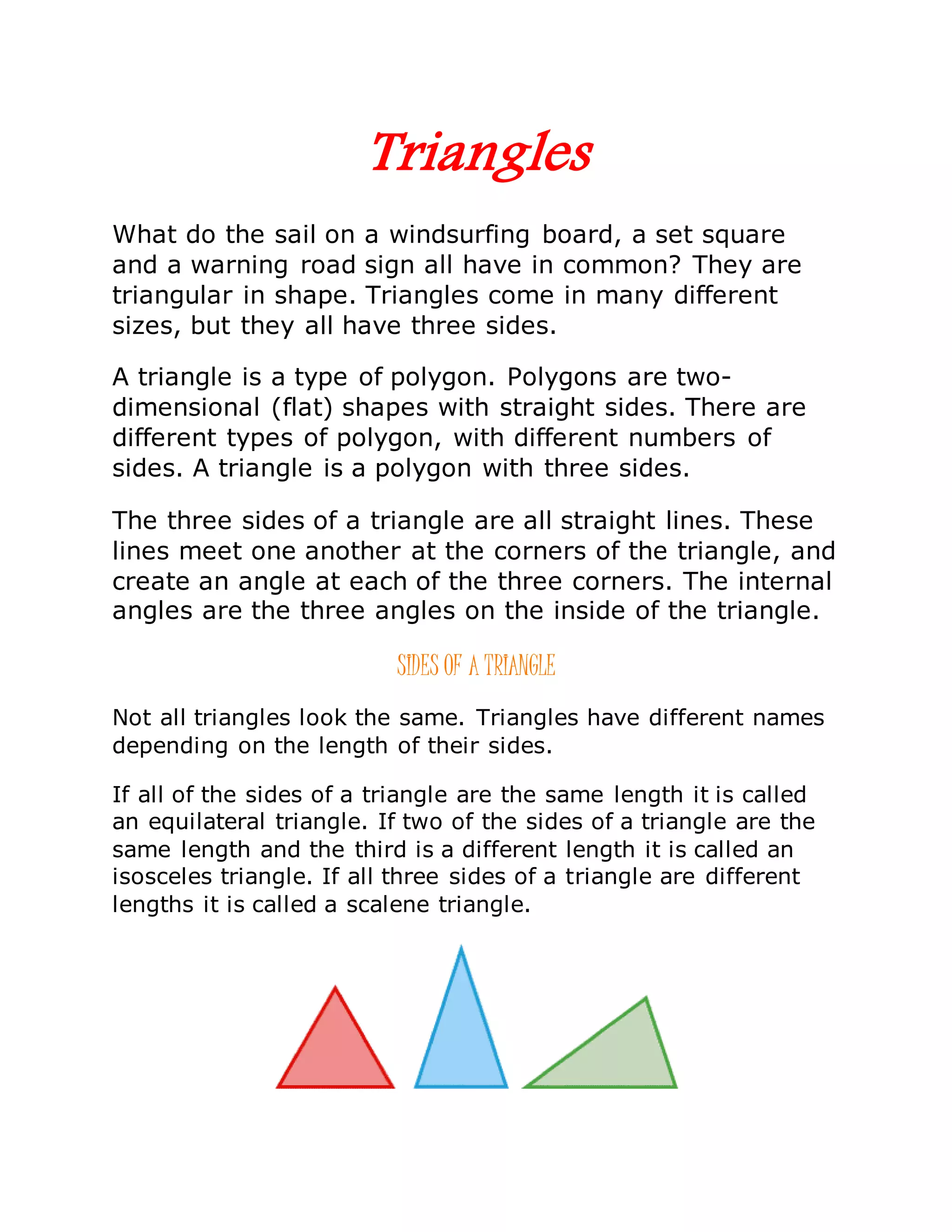
If all of the sides of a triangle are the same length it is called
an equilateral triangle. If two of the sides of a triangle are the
same length and the third is a different length it is called an
isosceles triangle. If all three sides of a triangle are different
lengths it is called a scalene triangle.
In the drawing above, the red triangle is an equilateral triangle,
the blue one is an isosceles triangle and the green one is a
scalene triangle.
ANGLES OF A TRIANGLE
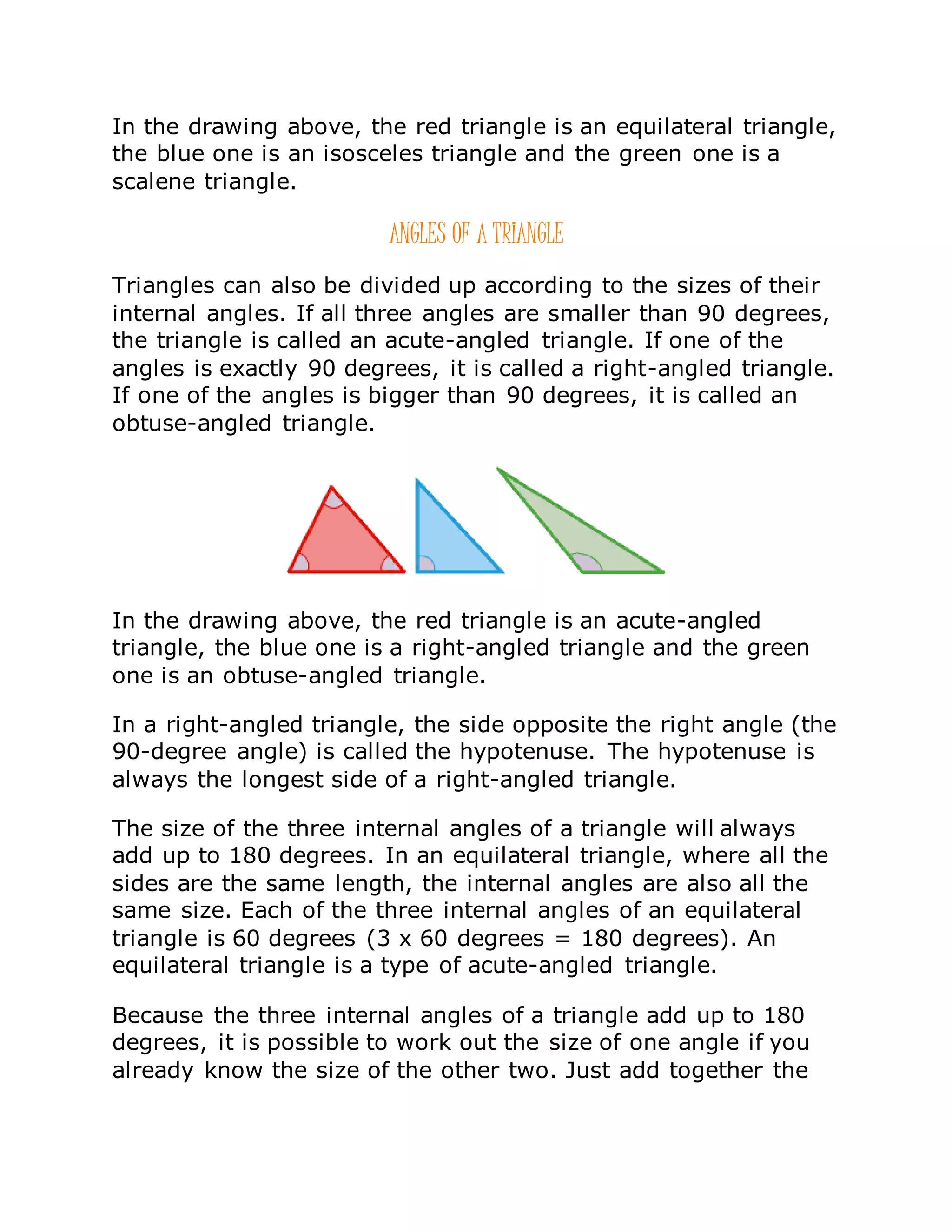
Triangles can also be divided up according to the sizes of their
internal angles. If all three angles are smaller than 90 degrees,
the triangle is called an acute-angled triangle. If one of the
angles is exactly 90 degrees, it is called a right-angled triangle.
If one of the angles is bigger than 90 degrees, it is called an
obtuse-angled triangle.
In the drawing above, the red triangle is an acute-angled
triangle, the blue one is a right-angled triangle and the green
one is an obtuse-angled triangle.
In a right-angled triangle, the side opposite the right angle (the
90-degree angle) is called the hypotenuse. The hypotenuse is
always the longest side of a right-angled triangle.
The size of the three internal angles of a triangle will always
add up to 180 degrees. In an equilateral triangle, where all the
sides are the same length, the internal angles are also all the
same size. Each of the three internal angles of an equilateral
triangle is 60 degrees (3 x 60 degrees = 180 degrees). An
equilateral triangle is a type of acute-angled triangle.
Because the three internal angles of a triangle add up to 180
degrees, it is possible to work out the size of one angle if you
already know the size of the other two. Just add together the
two angles that you know, and then take this total away from
180 degrees. This will give you the size of the third angle.
PYTHAGORAS’ THEOREM
In a right-angled triangle, it is possible to work out the length
of one of the sides if you already know the length of the other
two sides. This is done using Pythagoras’ theorem. This
theorem, or rule, states that the square of the hypotenuse is
equal to the sum of the square of the other two sides. So, if the
hypotenuse is A and the other two sides are B and C, then A2
=
B2
+ C2
.
If you have a right-angled triangle, you can work out the length
of the hypotenuse if you know that the other two sides are 3
centimetres and 4 centimetres long:
(length of the hypotenuse)2
= 32
+ 42
(length of the hypotenuse)2
= 9 + 16
(length of the hypotenuse)2
= 25
So, the length of the hypotenuse = 5
AREA OF A TRIANGLE
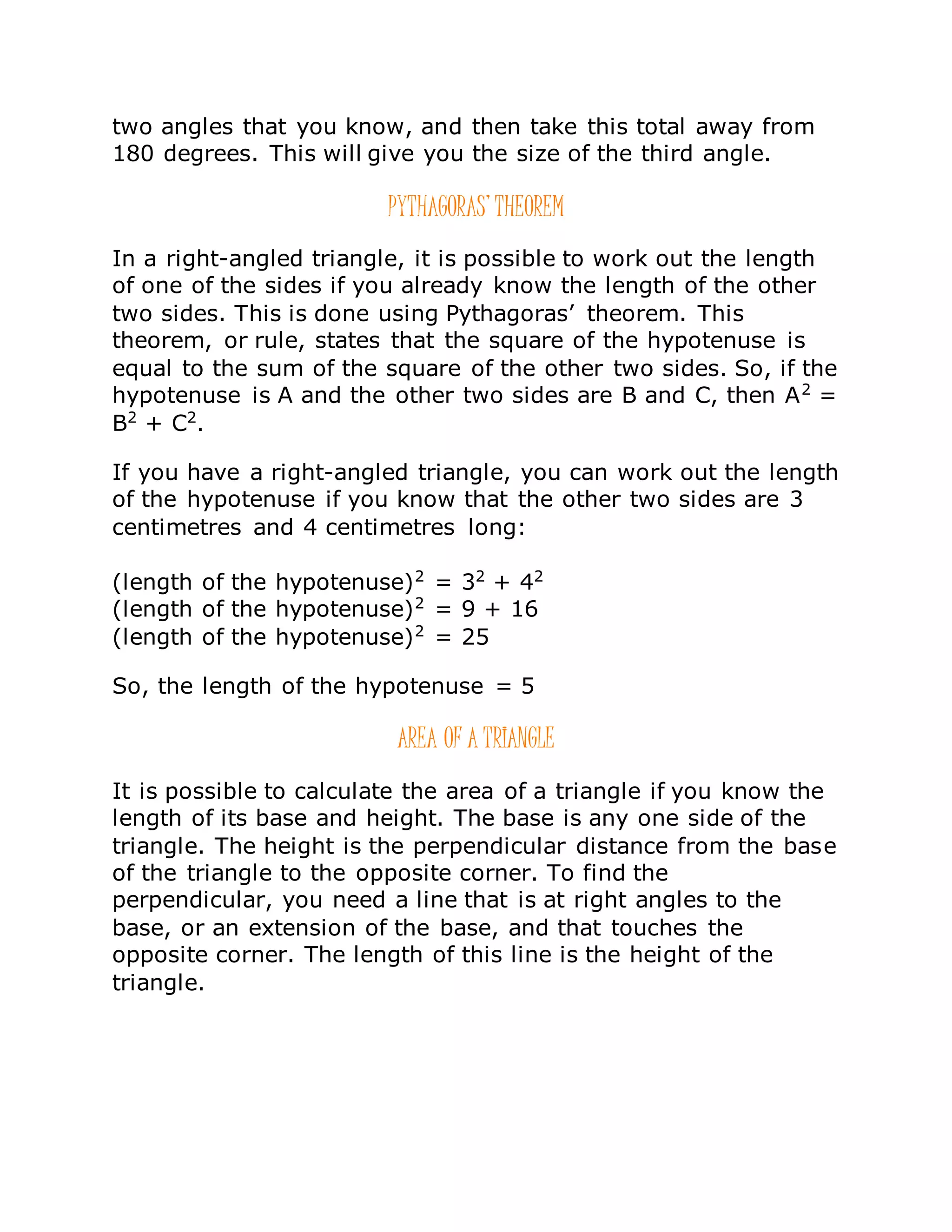
It is possible to calculate the area of a triangle if you know the
length of its base and height. The base is any one side of the
triangle. The height is the perpendicular distance from the base
of the triangle to the opposite corner. To find the
perpendicular, you need a line that is at right angles to the
base, or an extension of the base, and that touches the
opposite corner. The length of this line is the height of the
triangle.
The area of a triangle is:
DRAWING A TRIANGLE
If you know what length you want the three sides to be, it is
possible to draw a triangle using a ruler and compass. You start
by using the ruler to draw a line the length of one of the sides.
If you want a triangle with three sides that are 4 centimetres, 5
centimetres and 6 centimetres long, you could start by using a
ruler to draw a line 6 centimetres long.
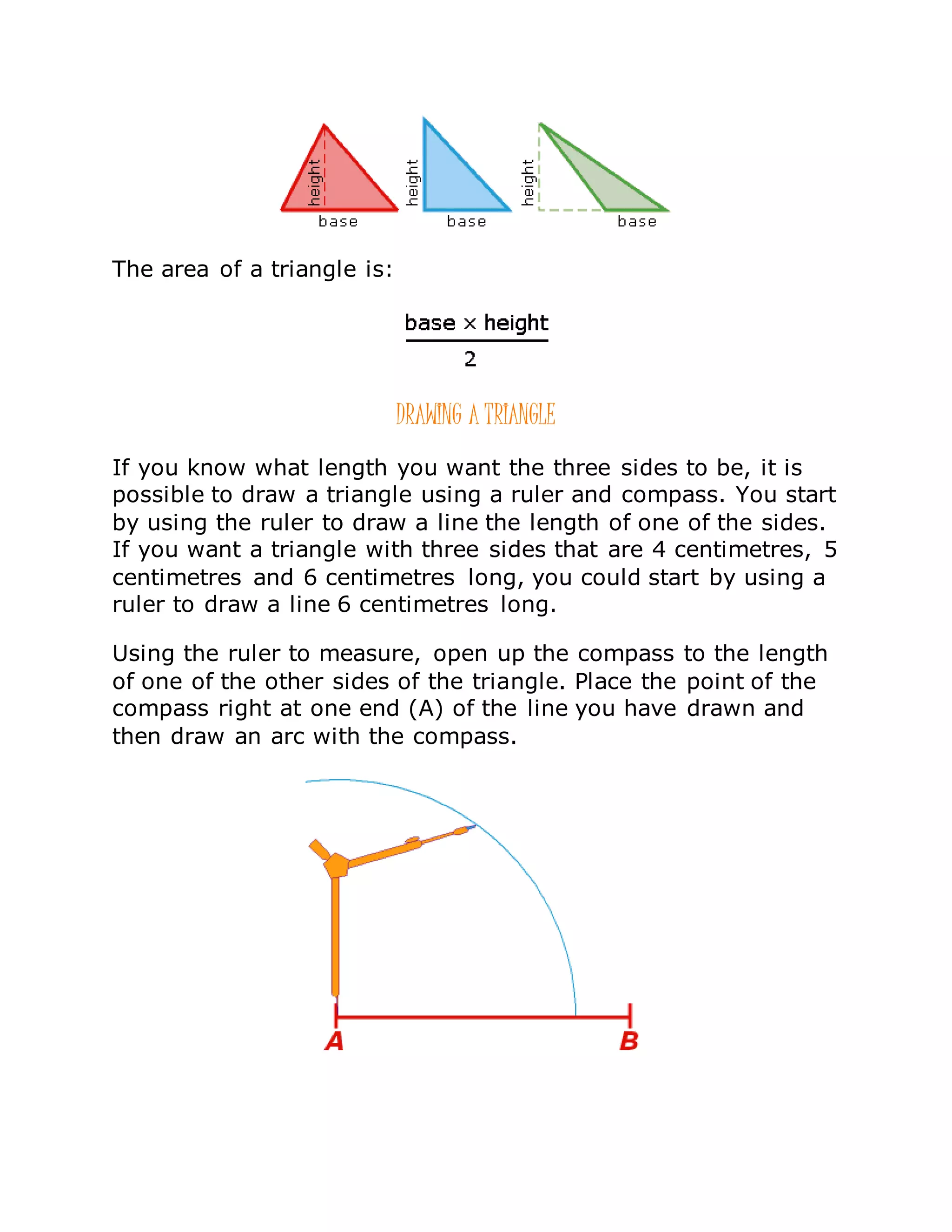
Using the ruler to measure, open up the compass to the length
of one of the other sides of the triangle. Place the point of the
compass right at one end (A) of the line you have drawn and
then draw an arc with the compass.
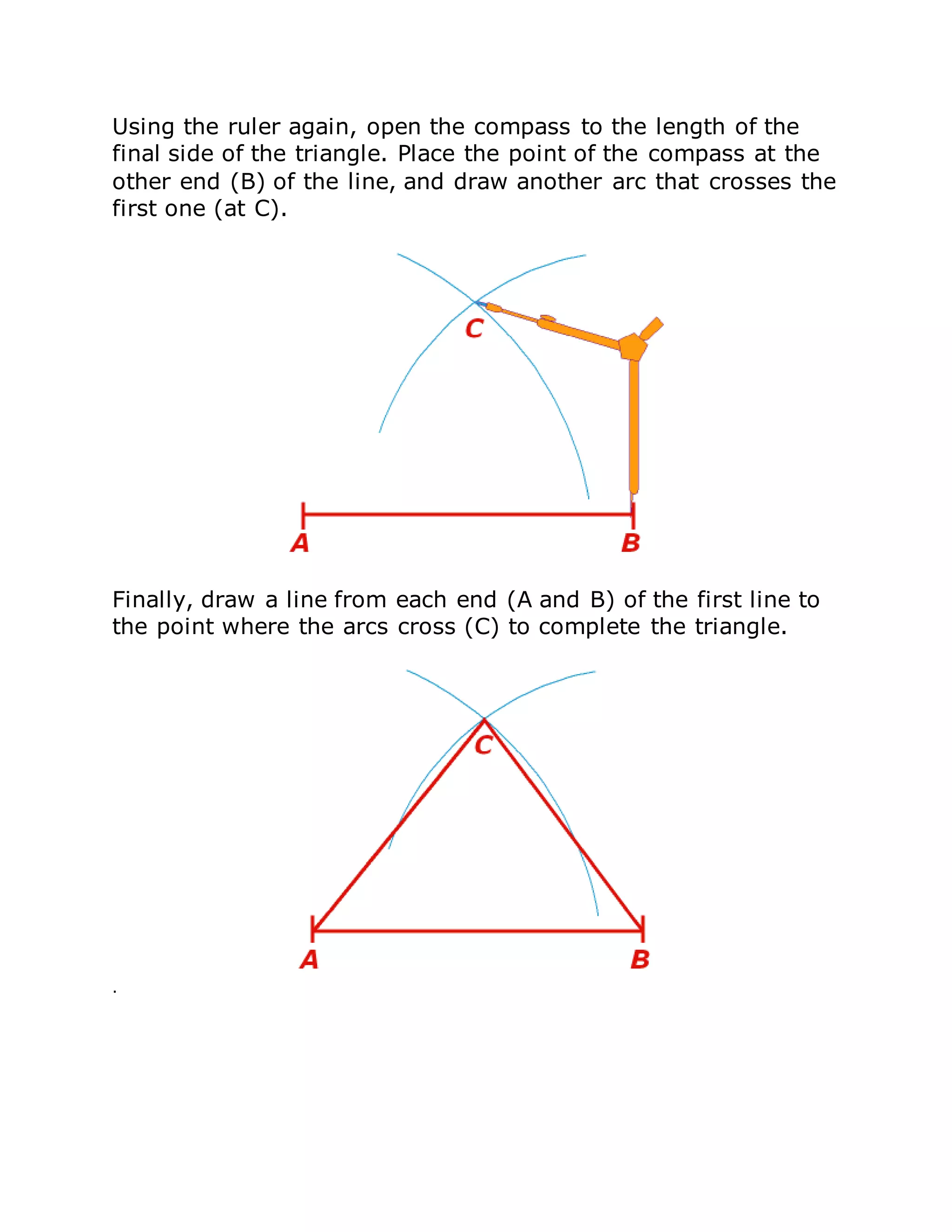
Using the ruler again, open the compass to the length of the
final side of the triangle. Place the point of the compass at the
other end (B) of the line, and draw another arc that crosses the
first one (at C).
Finally, draw a line from each end (A and B) of the first line to
the point where the arcs cross (C) to complete the triangle.
.

Triangle

  • 1.
    Triangles What do thesail on a windsurfing board, a set square and a warning road sign all have in common? They are triangular in shape. Triangles come in many different sizes, but they all have three sides. A triangle is a type of polygon. Polygons are two- dimensional (flat) shapes with straight sides. There are different types of polygon, with different numbers of sides. A triangle is a polygon with three sides. The three sides of a triangle are all straight lines. These lines meet one another at the corners of the triangle, and create an angle at each of the three corners. The internal angles are the three angles on the inside of the triangle. SIDES OF A TRIANGLE Not all triangles look the same. Triangles have different names depending on the length of their sides. If all of the sides of a triangle are the same length it is called an equilateral triangle. If two of the sides of a triangle are the same length and the third is a different length it is called an isosceles triangle. If all three sides of a triangle are different lengths it is called a scalene triangle.
  • 2.
    In the drawingabove, the red triangle is an equilateral triangle, the blue one is an isosceles triangle and the green one is a scalene triangle. ANGLES OF A TRIANGLE Triangles can also be divided up according to the sizes of their internal angles. If all three angles are smaller than 90 degrees, the triangle is called an acute-angled triangle. If one of the angles is exactly 90 degrees, it is called a right-angled triangle. If one of the angles is bigger than 90 degrees, it is called an obtuse-angled triangle. In the drawing above, the red triangle is an acute-angled triangle, the blue one is a right-angled triangle and the green one is an obtuse-angled triangle. In a right-angled triangle, the side opposite the right angle (the 90-degree angle) is called the hypotenuse. The hypotenuse is always the longest side of a right-angled triangle. The size of the three internal angles of a triangle will always add up to 180 degrees. In an equilateral triangle, where all the sides are the same length, the internal angles are also all the same size. Each of the three internal angles of an equilateral triangle is 60 degrees (3 x 60 degrees = 180 degrees). An equilateral triangle is a type of acute-angled triangle. Because the three internal angles of a triangle add up to 180 degrees, it is possible to work out the size of one angle if you already know the size of the other two. Just add together the
  • 3.
    two angles thatyou know, and then take this total away from 180 degrees. This will give you the size of the third angle. PYTHAGORAS’ THEOREM In a right-angled triangle, it is possible to work out the length of one of the sides if you already know the length of the other two sides. This is done using Pythagoras’ theorem. This theorem, or rule, states that the square of the hypotenuse is equal to the sum of the square of the other two sides. So, if the hypotenuse is A and the other two sides are B and C, then A2 = B2 + C2 . If you have a right-angled triangle, you can work out the length of the hypotenuse if you know that the other two sides are 3 centimetres and 4 centimetres long: (length of the hypotenuse)2 = 32 + 42 (length of the hypotenuse)2 = 9 + 16 (length of the hypotenuse)2 = 25 So, the length of the hypotenuse = 5 AREA OF A TRIANGLE It is possible to calculate the area of a triangle if you know the length of its base and height. The base is any one side of the triangle. The height is the perpendicular distance from the base of the triangle to the opposite corner. To find the perpendicular, you need a line that is at right angles to the base, or an extension of the base, and that touches the opposite corner. The length of this line is the height of the triangle.
  • 4.
    The area ofa triangle is: DRAWING A TRIANGLE If you know what length you want the three sides to be, it is possible to draw a triangle using a ruler and compass. You start by using the ruler to draw a line the length of one of the sides. If you want a triangle with three sides that are 4 centimetres, 5 centimetres and 6 centimetres long, you could start by using a ruler to draw a line 6 centimetres long. Using the ruler to measure, open up the compass to the length of one of the other sides of the triangle. Place the point of the compass right at one end (A) of the line you have drawn and then draw an arc with the compass.
  • 5.
    Using the ruleragain, open the compass to the length of the final side of the triangle. Place the point of the compass at the other end (B) of the line, and draw another arc that crosses the first one (at C). Finally, draw a line from each end (A and B) of the first line to the point where the arcs cross (C) to complete the triangle. .