
By
Zubin Poonawalla
INTRODUCTION OF TRANSPORTATION
• Transportation refers to the movement of product from one
location to another as it makes its way from the beginning of
supply chain to the customer.
• Transportation is an important supply chain driver because
products are rarely produced & consumed in the same
location.
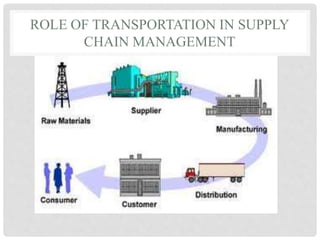
ROLE OF TRANSPORTATION IN SUPPLY
CHAIN MANAGEMENT
KEY DRIVERS
• Shipper:
the party who wants to transport the product from one
place to another place.
• Carrier:
Carrier is company that moves the goods from one place
to another place.
Eg : DHL, FedEx, Delex, BlueDart, DTDC Etc.
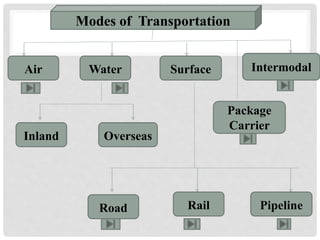
Modes of Transportation
Air Water Surface Intermodal
Package
Carrier
Inland
PipelineRailRoad
Overseas
TRUCK
• Trucking industry is divided into two parts i.e.
TL: Truck Load & LTL: Less than Truck load.
• TL: TL pricing display the economic of scale with respect the
distance travel. TL shipping suited for transportation between
manufacturing facilities & warehouses.
• LTL: LTL operations are priced to encourage shipments in
small lots, usually less than half a TL. LTL shipping is suites
for shipments that are large to be mailed as small packages.
Road Transport Advantages:
It is a relatively cheaper mode of transport as compared to other modes.
 It is a flexible mode of transport as loading & unloading is possible at any destination. It
provides D-2-D service.
 It helps to carry goods from one place to another, in places which are not connected by other
means of transport like hilly areas.
Limitations of Road transport:
Due to limited carrying capacity road transport is not economical for long distance
transportation of goods.
 Transportation of heavy goods or goods in bulk by road involves high cost.
AIR
• Air freighting is commonly used by companies who work with
short lead times, or advanced service levels.
• Air transportation is best suited for small, high- value items or
time sensitive emergency shipments that have to travel a long
distance.
• Air carriers normally move shipments that have high value but
light weight .
Advantages of Air transportation:
o It is the fastest mode of transport.
o It is very useful in transporting goods to the area, which are not accessible by any
other means.
o Reduces lead time.
o Improved service levels
Disadvantages:
o It is relatively more expensive mode of transport.
o It is not suitable for transporting heavy & bulky goods.
oIt is not suitable for short distance travel.
PACKAGE CARRIER
• Package carriers are transportation companies which carry
small packages. Examples: FedEx, UPS, DHL, DTDC, Delex
Etc.
• Package carrier use air, truck & rail to transport the goods.
Packages carriers also provide other value added services that
allow shippers to inventory flow & track order status, shipper
can proactively inform the customer about their packages.
• Package carrier is suited for e- business.
RAIL
• Rail transport uses freight trains for the delivery of
merchandise.
• Rail is suited for bulk shipment of products like fertilizer,
cement, food grains & coal etc. from the production plant to
the warehouses.
Advantages of Rail transportation:
 It is relatively faster than road transport.
 It is suitable for carrying heavy goods in large quantities over long distances.
Cost effective.
Limitations of Rail transportation:
 It is relatively expensive for carrying goods over short distances.
 It is not available in remote parts of the country.
 It provides service according to fixed time schedule & is not flexible for loading or
unloading of goods at any place.
WATER
• Water transport uses ships & large commercial vessels that
carry billions of tons of cargo.
• water transport is used primarily for the movement of large
bulk commodity shipments & it is the cheapest mode for
carrying such load.
• Water transport is particularly effective for significantly
large quantities of goods that are non-perishable in nature &
for cities or states that have water access.
Advantages of water transportation:
 It is a relatively economical mode of transport for bulky & heavy goods.
 The cost of maintaining & constructing routes is very low most of them are naturally
made.
 It promotes international trade.
Disadvantages:
 The depth & navigability of rivers & canals vary, thus, affect operations of different
transport vessels.
 It is a slow moving mode of transport & therefore not suitable for transport of
perishable goods.
It is adversely affected by weather conditions.
 Sea transport requires large investment on ships & their maintenance.
PIPELINE
• Pipeline is used primarily for the transport of crude petroleum,
refined petroleum products & natural gas.
• It include a significant initial fixed cost in setting up the pipeline &
related infrastructure.
• Pipelines are not flexible & this scope is limited with respect to
commodities.
• Unable to transport a variety of materials
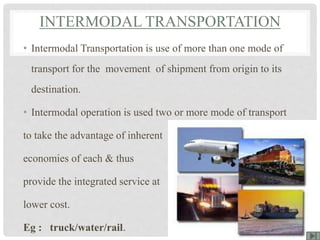
INTERMODAL TRANSPORTATION
• Intermodal Transportation is use of more than one mode of
transport for the movement of shipment from origin to its
destination.
• Intermodal operation is used two or more mode of transport
to take the advantage of inherent
economies of each & thus
provide the integrated service at
lower cost.
Eg : truck/water/rail.
CONCLUSION:
• Therefore transportation plays very important role in the
supply chain to distribute the goods from one place to the
another place or we can say that to the customers.
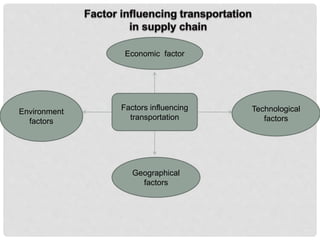
Factors influencing
transportation
Economic factor
Technological
factors
Geographical
factors
Environment
factors
Transportation - Basics

Transportation - Basics

  • 1.
  • 2.
    INTRODUCTION OF TRANSPORTATION •Transportation refers to the movement of product from one location to another as it makes its way from the beginning of supply chain to the customer. • Transportation is an important supply chain driver because products are rarely produced & consumed in the same location.
  • 3.
    ROLE OF TRANSPORTATIONIN SUPPLY CHAIN MANAGEMENT
  • 4.
    KEY DRIVERS • Shipper: theparty who wants to transport the product from one place to another place. • Carrier: Carrier is company that moves the goods from one place to another place. Eg : DHL, FedEx, Delex, BlueDart, DTDC Etc.
  • 5.
    Modes of Transportation AirWater Surface Intermodal Package Carrier Inland PipelineRailRoad Overseas
  • 6.
    TRUCK • Trucking industryis divided into two parts i.e. TL: Truck Load & LTL: Less than Truck load. • TL: TL pricing display the economic of scale with respect the distance travel. TL shipping suited for transportation between manufacturing facilities & warehouses. • LTL: LTL operations are priced to encourage shipments in small lots, usually less than half a TL. LTL shipping is suites for shipments that are large to be mailed as small packages.
  • 7.
    Road Transport Advantages: Itis a relatively cheaper mode of transport as compared to other modes.  It is a flexible mode of transport as loading & unloading is possible at any destination. It provides D-2-D service.  It helps to carry goods from one place to another, in places which are not connected by other means of transport like hilly areas. Limitations of Road transport: Due to limited carrying capacity road transport is not economical for long distance transportation of goods.  Transportation of heavy goods or goods in bulk by road involves high cost.
  • 8.
    AIR • Air freightingis commonly used by companies who work with short lead times, or advanced service levels. • Air transportation is best suited for small, high- value items or time sensitive emergency shipments that have to travel a long distance. • Air carriers normally move shipments that have high value but light weight .
  • 9.
    Advantages of Airtransportation: o It is the fastest mode of transport. o It is very useful in transporting goods to the area, which are not accessible by any other means. o Reduces lead time. o Improved service levels Disadvantages: o It is relatively more expensive mode of transport. o It is not suitable for transporting heavy & bulky goods. oIt is not suitable for short distance travel.
  • 10.
    PACKAGE CARRIER • Packagecarriers are transportation companies which carry small packages. Examples: FedEx, UPS, DHL, DTDC, Delex Etc. • Package carrier use air, truck & rail to transport the goods. Packages carriers also provide other value added services that allow shippers to inventory flow & track order status, shipper can proactively inform the customer about their packages. • Package carrier is suited for e- business.
  • 11.
    RAIL • Rail transportuses freight trains for the delivery of merchandise. • Rail is suited for bulk shipment of products like fertilizer, cement, food grains & coal etc. from the production plant to the warehouses.
  • 12.
    Advantages of Railtransportation:  It is relatively faster than road transport.  It is suitable for carrying heavy goods in large quantities over long distances. Cost effective. Limitations of Rail transportation:  It is relatively expensive for carrying goods over short distances.  It is not available in remote parts of the country.  It provides service according to fixed time schedule & is not flexible for loading or unloading of goods at any place.
  • 13.
    WATER • Water transportuses ships & large commercial vessels that carry billions of tons of cargo. • water transport is used primarily for the movement of large bulk commodity shipments & it is the cheapest mode for carrying such load. • Water transport is particularly effective for significantly large quantities of goods that are non-perishable in nature & for cities or states that have water access.
  • 14.
    Advantages of watertransportation:  It is a relatively economical mode of transport for bulky & heavy goods.  The cost of maintaining & constructing routes is very low most of them are naturally made.  It promotes international trade. Disadvantages:  The depth & navigability of rivers & canals vary, thus, affect operations of different transport vessels.  It is a slow moving mode of transport & therefore not suitable for transport of perishable goods. It is adversely affected by weather conditions.  Sea transport requires large investment on ships & their maintenance.
  • 15.
    PIPELINE • Pipeline isused primarily for the transport of crude petroleum, refined petroleum products & natural gas. • It include a significant initial fixed cost in setting up the pipeline & related infrastructure. • Pipelines are not flexible & this scope is limited with respect to commodities. • Unable to transport a variety of materials
  • 16.
    INTERMODAL TRANSPORTATION • IntermodalTransportation is use of more than one mode of transport for the movement of shipment from origin to its destination. • Intermodal operation is used two or more mode of transport to take the advantage of inherent economies of each & thus provide the integrated service at lower cost. Eg : truck/water/rail.
  • 17.
    CONCLUSION: • Therefore transportationplays very important role in the supply chain to distribute the goods from one place to the another place or we can say that to the customers.
  • 18.