Department of English
Maharaja Krishnakumarsinhji Bhavnagar University
Date: 8 April 2024
Sem 2 | Batch 2023-25
Transcendentalism: A Nature Obsession
Presented by:
Darshan Vagh
Topic :
Transcendentalism:
A Nature Obsession
PERSONAL INFORMATION
Presented By :- Darshan Vagh
Roll No :- 5
Enrollment Number :- 5108230045
Semester :- 2
Paper No :- 108
Paper Name :- The American Literature
Presentation Topic :- Transcendentalism: A Nature Obsession
Submitted To :- Smt. S.B. Gardi, Department of English (MKBU)
Email ID :- darshanvaghc56@gmail.com
Transcendentalism: A Nature Obsession
Transcendentalism was a 19th-century American philosophical movement that
emphasized intuition, individualism, and a deep connection to nature.
Transcendentalist thinkers believed that by communing with nature, we could
experience a higher reality and achieve a deeper understanding of ourselves
and the universe. Nature was central to their philosophy.
● Key figures
❏ Ralph Waldo Emerson
❏ Henry David Thoreau
❏ Margaret Fuller
❏ Lydia Maria Child
❏ Amos Bronson Alcott (Goodman)
The Divine in Nature
● The Over-Soul: Divine Glue of the Universe: Transcendentalism proposes
the Over-Soul, a unifying divine spirit that connects all living things and the
natural world.
● Nature: Pathway to the Divine: By immersing oneself in nature,
Transcendentalists believed they could access the Over-Soul and experience
a deep connection with the divine.
● Beyond Religion: Personal Connection: Transcendentalism emphasized a
personal connection with the divine through nature, bypassing the need for
traditional religious dogma.
(Manzari)
● Nature's Divinity: The beauty and order of nature were seen as expressions
of the Over-Soul, making nature itself a sacred and divine experience.
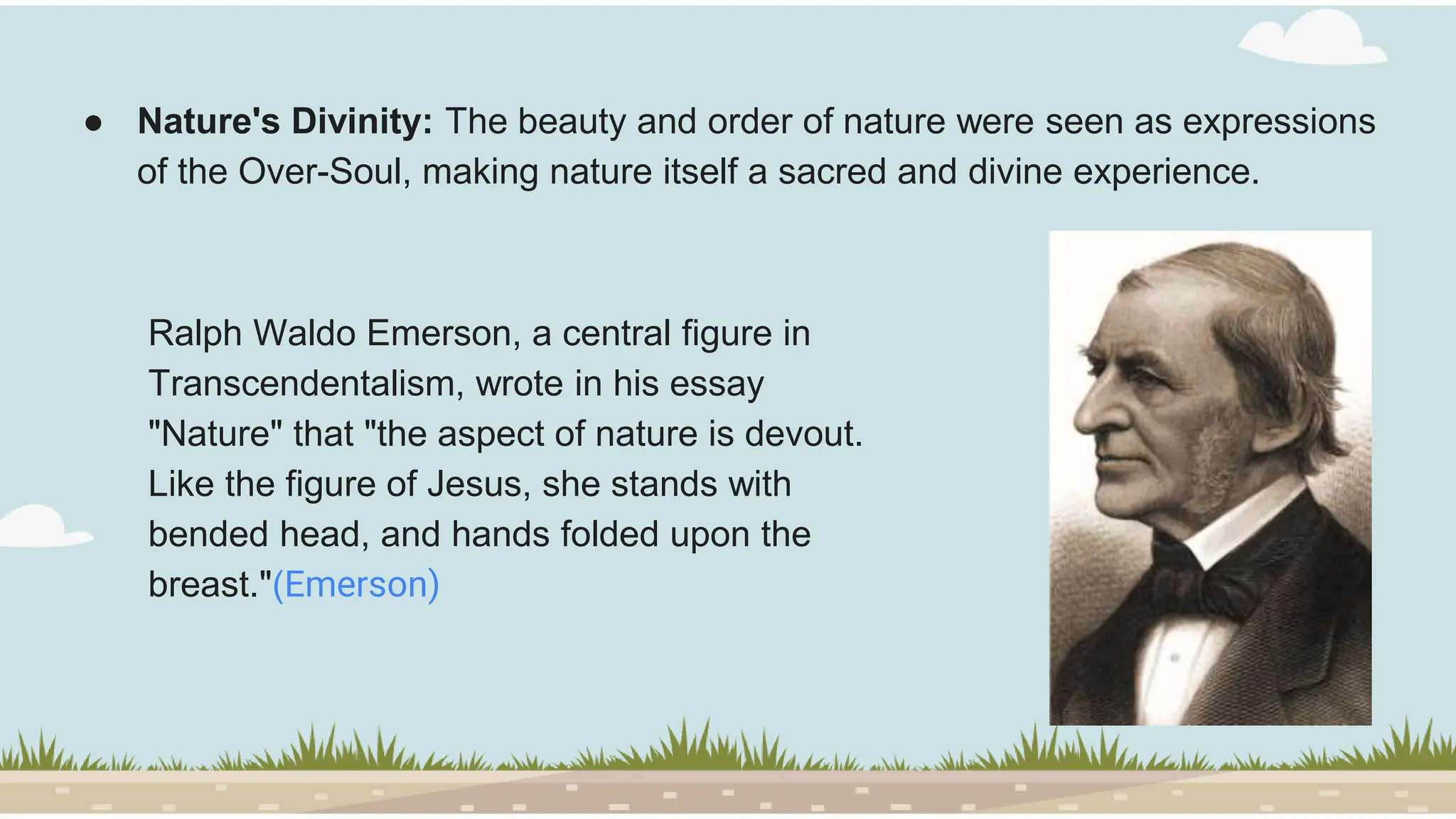
Ralph Waldo Emerson, a central figure in
Transcendentalism, wrote in his essay
"Nature" that "the aspect of nature is devout.
Like the figure of Jesus, she stands with
bended head, and hands folded upon the
breast."(Emerson)
Nature as a Source of Truth
● Transcendentalists believed that nature was a
more reliable source of truth than traditional
institutions like religion or government.
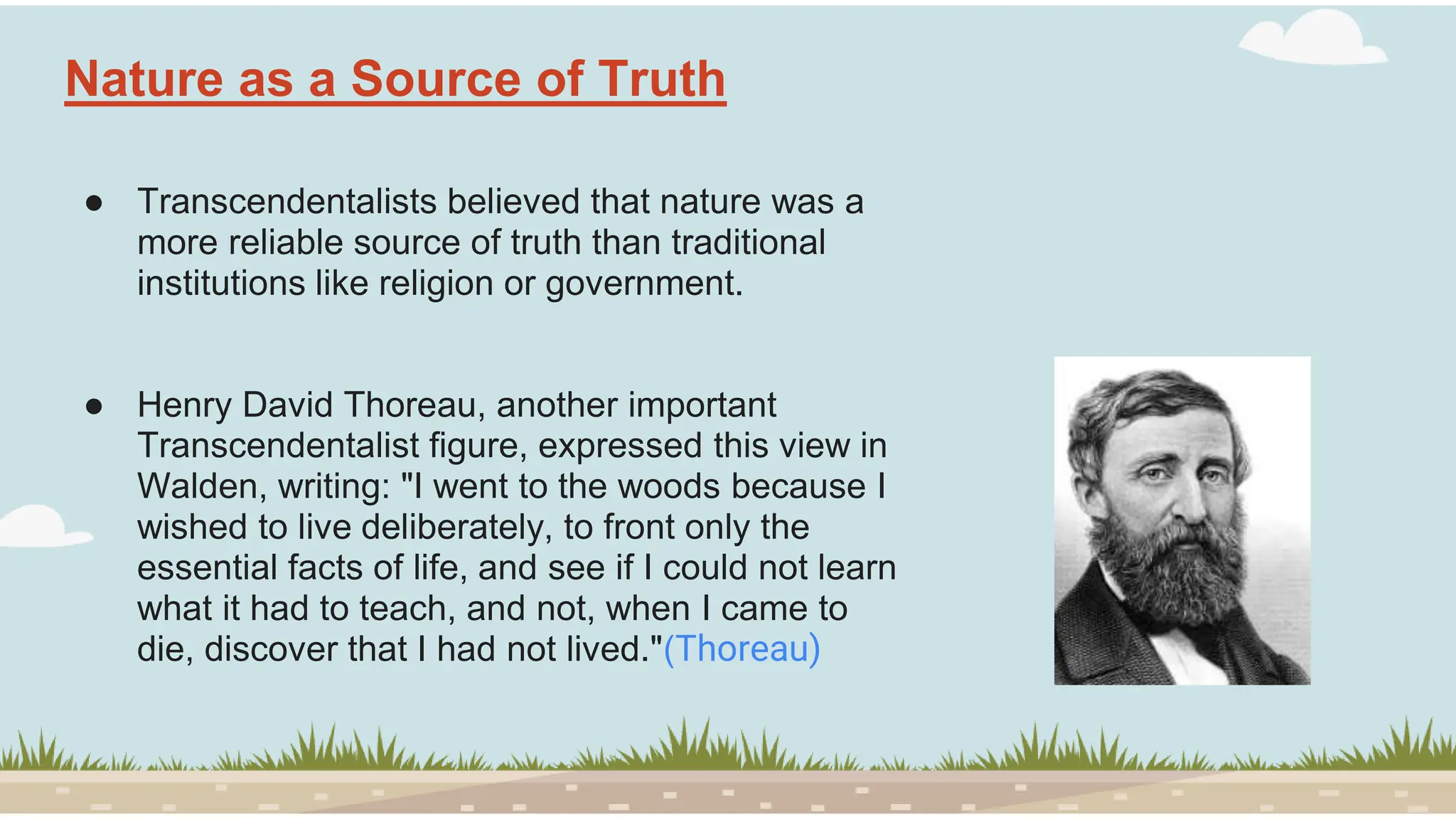
● Henry David Thoreau, another important
Transcendentalist figure, expressed this view in
Walden, writing: "I went to the woods because I
wished to live deliberately, to front only the
essential facts of life, and see if I could not learn
what it had to teach, and not, when I came to
die, discover that I had not lived."(Thoreau)
Nature as a Teacher
● Transcendentalists believed that nature could
teach them important lessons about life.
● According to them Nature could teach them
about self-reliance, simplicity, and the
importance of living in harmony with the natural
world.
● Emerson wrote in "Nature" that "the woods
were made for man, not man for the woods. In
man is all the intelligence of the vegetable and
animal kingdom, and of the new geology. Is it
not the chief use of the outer world to educate
the inner world?"(Emerson)
The Threat of Industrialism
● Transcendentalists were critical of the rise of
industrialism.
● They believed that industrialism was destroying nature
and alienating people from the natural world.
● Thoreau's Walden Pond experiment was a direct
challenge to the values of industrialism. He believed that
a simple life lived in harmony with nature was preferable
to the materialism and consumerism of the industrial
age.
(Chitrakar)
Transcendentalist Authors in Nature
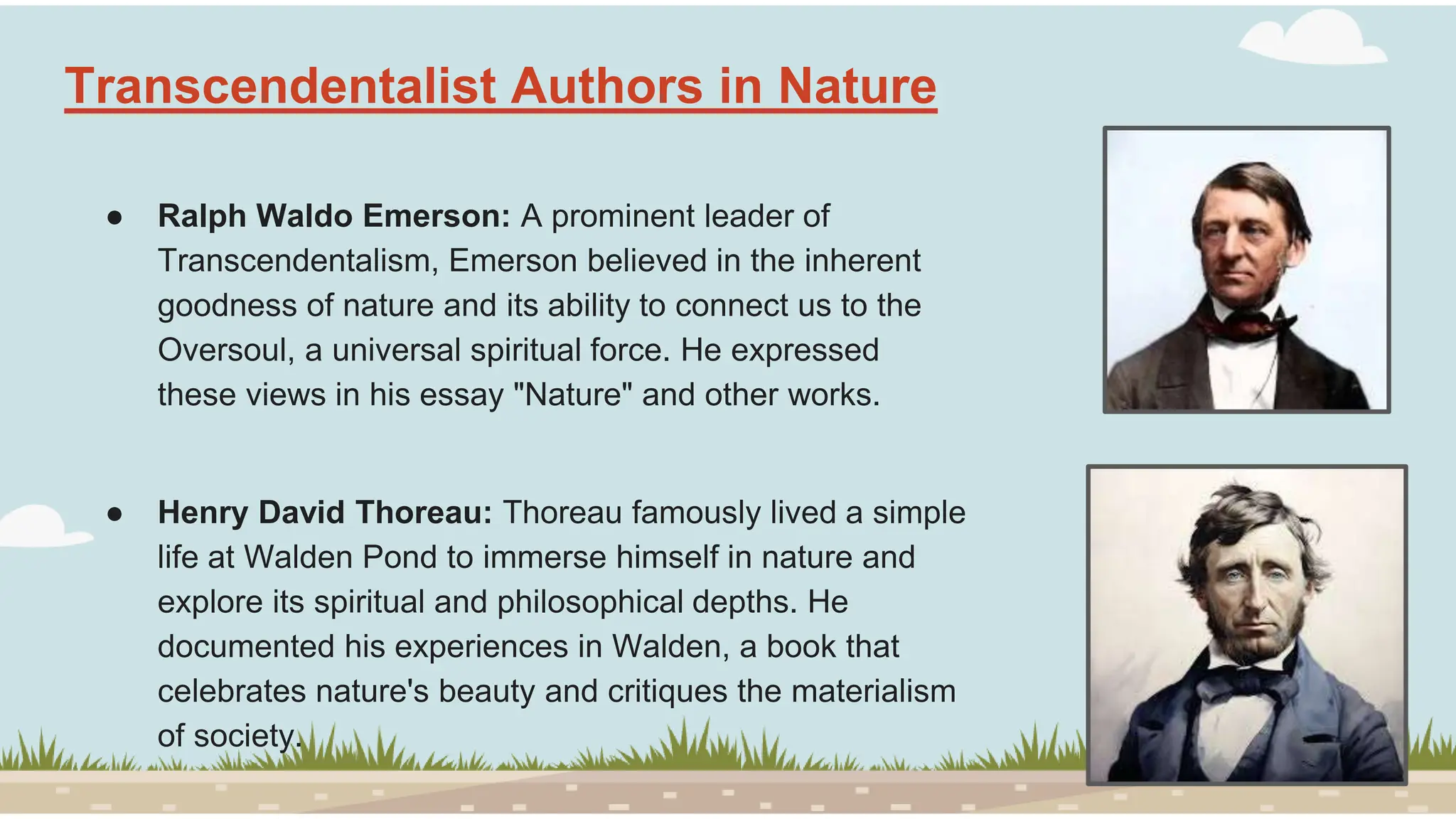
● Ralph Waldo Emerson: A prominent leader of
Transcendentalism, Emerson believed in the inherent
goodness of nature and its ability to connect us to the
Oversoul, a universal spiritual force. He expressed
these views in his essay "Nature" and other works.
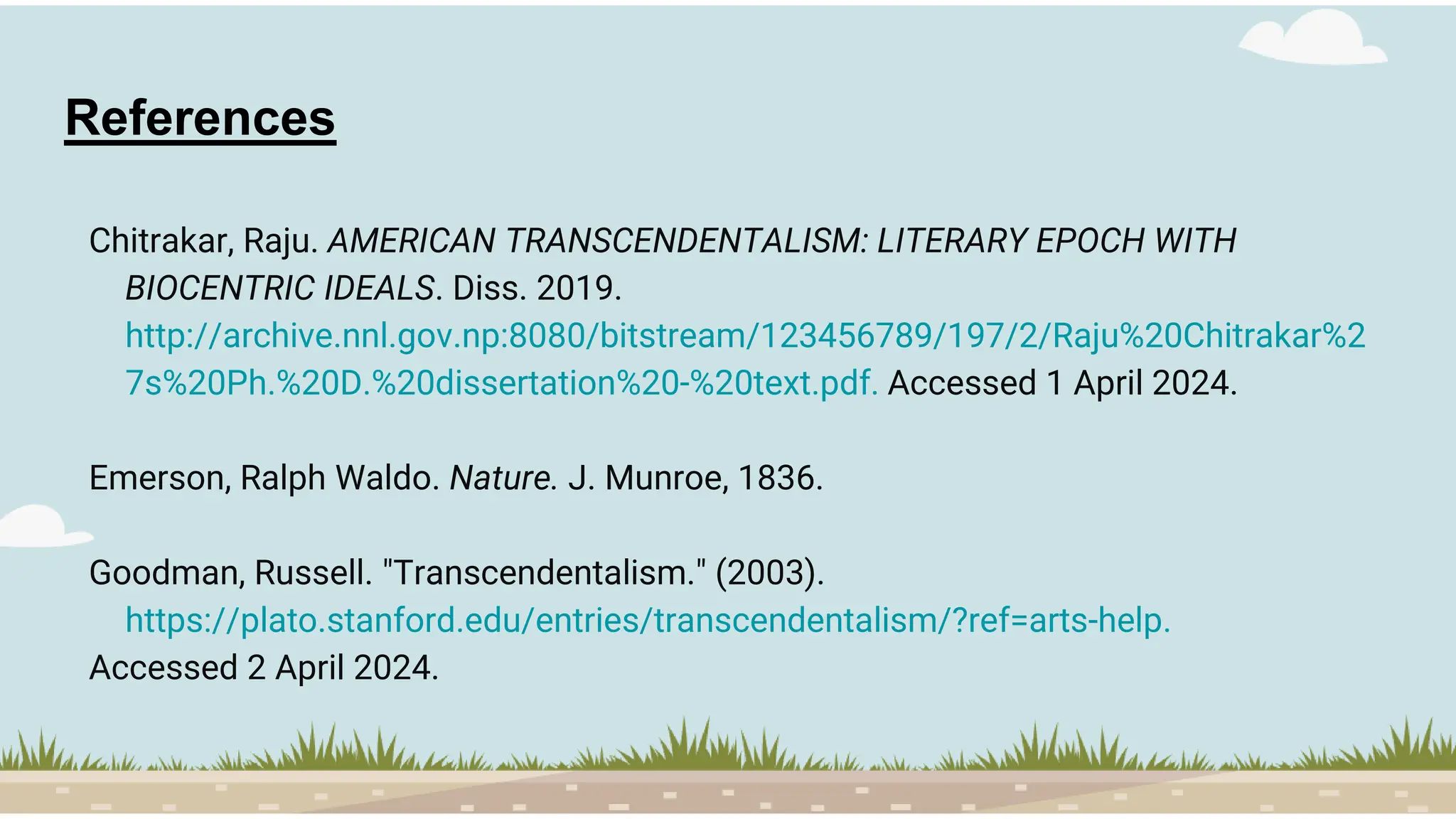
● Henry David Thoreau: Thoreau famously lived a simple
life at Walden Pond to immerse himself in nature and
explore its spiritual and philosophical depths. He
documented his experiences in Walden, a book that
celebrates nature's beauty and critiques the materialism
of society.
● Margaret Fuller: A lesser-known but influential
transcendentalist, Fuller saw nature as a source
of empowerment and individual growth,
particularly for women. She believed that
connecting with nature could help women break
free from societal constraints.
● Walt Whitman: While not a core
transcendentalist, Walt Whitman was heavily
influenced by the movement's ideas about nature.
His poems, such as "Song of Myself" and "Leaves
of Grass," celebrate the interconnectedness of
nature and humanity.
Conclusion
- Transcendentalism deeply values nature, seeing it as a source of wisdom and spiritual
insight.
- Nature is regarded as a teacher, imparting lessons of self-reliance, simplicity, and harmony
with the environment.
- Transcendentalists advocate for a return to a simpler way of life in harmony with nature,
critiquing industrialization for its harm to the environment and human connection to nature.
References
Chitrakar, Raju. AMERICAN TRANSCENDENTALISM: LITERARY EPOCH WITH
BIOCENTRIC IDEALS. Diss. 2019.
http://archive.nnl.gov.np:8080/bitstream/123456789/197/2/Raju%20Chitrakar%2
7s%20Ph.%20D.%20dissertation%20-%20text.pdf. Accessed 1 April 2024.
Emerson, Ralph Waldo. Nature. J. Munroe, 1836.
Goodman, Russell. "Transcendentalism." (2003).
https://plato.stanford.edu/entries/transcendentalism/?ref=arts-help.
Accessed 2 April 2024.
Manzari, Alireza. "Nature in American transcendentalism." English Language and Literature
Studies 2.3 (2012): 61. https://epe.lac-
bac.gc.ca/100/201/300/english_language_literature_studies/2012/ELLS-V2N3-
All.pdf#page=64. Accessed 2 April 2024.
Pawar, Pramod Ambadasrao. "TRANSCENDENTALISM: INDIVIDUAL, GOD AND NATURE."
Epitome: International Journal of Multidisciplinary Research, vol. 5, no. 06, June 2019.
https://www.epitomejournals.com/VolumeArticles/FullTextPDF/454_Research_Paper.pd
f. Accessed 3 April 2024.
Thoreau, Henry David. Walden. Pan Macmillan, 2016.
Transcendentalism- A Nature Obsession.pptx

Transcendentalism- A Nature Obsession.pptx

  • 1.
    Department of English MaharajaKrishnakumarsinhji Bhavnagar University Date: 8 April 2024 Sem 2 | Batch 2023-25 Transcendentalism: A Nature Obsession Presented by: Darshan Vagh Topic :
  • 2.
  • 3.
    PERSONAL INFORMATION Presented By:- Darshan Vagh Roll No :- 5 Enrollment Number :- 5108230045 Semester :- 2 Paper No :- 108 Paper Name :- The American Literature Presentation Topic :- Transcendentalism: A Nature Obsession Submitted To :- Smt. S.B. Gardi, Department of English (MKBU) Email ID :- darshanvaghc56@gmail.com
  • 4.
    Transcendentalism: A NatureObsession Transcendentalism was a 19th-century American philosophical movement that emphasized intuition, individualism, and a deep connection to nature. Transcendentalist thinkers believed that by communing with nature, we could experience a higher reality and achieve a deeper understanding of ourselves and the universe. Nature was central to their philosophy. ● Key figures ❏ Ralph Waldo Emerson ❏ Henry David Thoreau ❏ Margaret Fuller ❏ Lydia Maria Child ❏ Amos Bronson Alcott (Goodman)
  • 5.
    The Divine inNature ● The Over-Soul: Divine Glue of the Universe: Transcendentalism proposes the Over-Soul, a unifying divine spirit that connects all living things and the natural world. ● Nature: Pathway to the Divine: By immersing oneself in nature, Transcendentalists believed they could access the Over-Soul and experience a deep connection with the divine. ● Beyond Religion: Personal Connection: Transcendentalism emphasized a personal connection with the divine through nature, bypassing the need for traditional religious dogma. (Manzari)
  • 6.
    ● Nature's Divinity:The beauty and order of nature were seen as expressions of the Over-Soul, making nature itself a sacred and divine experience. Ralph Waldo Emerson, a central figure in Transcendentalism, wrote in his essay "Nature" that "the aspect of nature is devout. Like the figure of Jesus, she stands with bended head, and hands folded upon the breast."(Emerson)
  • 7.
    Nature as aSource of Truth ● Transcendentalists believed that nature was a more reliable source of truth than traditional institutions like religion or government. ● Henry David Thoreau, another important Transcendentalist figure, expressed this view in Walden, writing: "I went to the woods because I wished to live deliberately, to front only the essential facts of life, and see if I could not learn what it had to teach, and not, when I came to die, discover that I had not lived."(Thoreau)
  • 8.
    Nature as aTeacher ● Transcendentalists believed that nature could teach them important lessons about life. ● According to them Nature could teach them about self-reliance, simplicity, and the importance of living in harmony with the natural world. ● Emerson wrote in "Nature" that "the woods were made for man, not man for the woods. In man is all the intelligence of the vegetable and animal kingdom, and of the new geology. Is it not the chief use of the outer world to educate the inner world?"(Emerson)
  • 9.
    The Threat ofIndustrialism ● Transcendentalists were critical of the rise of industrialism. ● They believed that industrialism was destroying nature and alienating people from the natural world. ● Thoreau's Walden Pond experiment was a direct challenge to the values of industrialism. He believed that a simple life lived in harmony with nature was preferable to the materialism and consumerism of the industrial age. (Chitrakar)
  • 10.
    Transcendentalist Authors inNature ● Ralph Waldo Emerson: A prominent leader of Transcendentalism, Emerson believed in the inherent goodness of nature and its ability to connect us to the Oversoul, a universal spiritual force. He expressed these views in his essay "Nature" and other works. ● Henry David Thoreau: Thoreau famously lived a simple life at Walden Pond to immerse himself in nature and explore its spiritual and philosophical depths. He documented his experiences in Walden, a book that celebrates nature's beauty and critiques the materialism of society.
  • 11.
    ● Margaret Fuller:A lesser-known but influential transcendentalist, Fuller saw nature as a source of empowerment and individual growth, particularly for women. She believed that connecting with nature could help women break free from societal constraints. ● Walt Whitman: While not a core transcendentalist, Walt Whitman was heavily influenced by the movement's ideas about nature. His poems, such as "Song of Myself" and "Leaves of Grass," celebrate the interconnectedness of nature and humanity.
  • 12.
    Conclusion - Transcendentalism deeplyvalues nature, seeing it as a source of wisdom and spiritual insight. - Nature is regarded as a teacher, imparting lessons of self-reliance, simplicity, and harmony with the environment. - Transcendentalists advocate for a return to a simpler way of life in harmony with nature, critiquing industrialization for its harm to the environment and human connection to nature.
  • 13.
    References Chitrakar, Raju. AMERICANTRANSCENDENTALISM: LITERARY EPOCH WITH BIOCENTRIC IDEALS. Diss. 2019. http://archive.nnl.gov.np:8080/bitstream/123456789/197/2/Raju%20Chitrakar%2 7s%20Ph.%20D.%20dissertation%20-%20text.pdf. Accessed 1 April 2024. Emerson, Ralph Waldo. Nature. J. Munroe, 1836. Goodman, Russell. "Transcendentalism." (2003). https://plato.stanford.edu/entries/transcendentalism/?ref=arts-help. Accessed 2 April 2024.
  • 14.
    Manzari, Alireza. "Naturein American transcendentalism." English Language and Literature Studies 2.3 (2012): 61. https://epe.lac- bac.gc.ca/100/201/300/english_language_literature_studies/2012/ELLS-V2N3- All.pdf#page=64. Accessed 2 April 2024. Pawar, Pramod Ambadasrao. "TRANSCENDENTALISM: INDIVIDUAL, GOD AND NATURE." Epitome: International Journal of Multidisciplinary Research, vol. 5, no. 06, June 2019. https://www.epitomejournals.com/VolumeArticles/FullTextPDF/454_Research_Paper.pd f. Accessed 3 April 2024. Thoreau, Henry David. Walden. Pan Macmillan, 2016.