+
Trans* Language:
Queer Labeling Experiences
Across Gender Identities
A First-Year Project by Jo Forrest-Stuart
+ Road Map
Literature Review
Road Map
Operational
Definitions
Rationale
Present Study
Methodology
Analyses
Results
Discussion
Future Research
References
Recap
Questions
Trans*
Language
4. Results
■ Demographics
■ Present Data
■ Present Significant Findings
■ Hypotheses Supported?
5. Discussion
■ Interpret Results
■ Qualitative Response Analyses
■ Limitations
6. Future Research
■ Modifications needed
■ Additional Studies
Presentation Overview
1. Explain Trans* Language
■ Differentiate between:
a. Gender Identity
b. Gender Expression
c. Biological Sex
d. Attraction
■ Define specific terminology
■ What is Trans*?
2. Why Study Trans* Language?
3. Review Literature:
■ Gendered Language
■ Trans*-Focused
■ Trans* Language
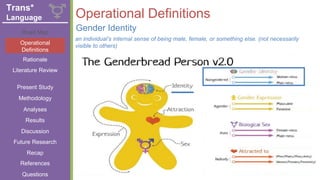
+ Operational Definitions
Gender Identity
Literature Review
Road Map
Operational
Definitions
Rationale
Present Study
Methodology
Analyses
Results
Discussion
Future Research
References
Recap
Questions
Trans*
Language
an individual’s internal sense of being male, female, or something else. (not necessarily
visible to others)
+ Operational Definitions
Gender Expression
Literature Review
Road Map
Operational
Definitions
Rationale
Present Study
Methodology
Analyses
Results
Discussion
Future Research
References
Recap
Questions
Trans*
Language
the way an individual presents gender through actions, dress, and demeanor, and how those
presentations are interpreted based on gender norms.
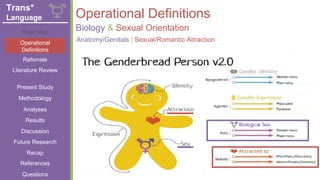
+ Operational Definitions
Biology & Sexual Orientation
Literature Review
Road Map
Operational
Definitions
Rationale
Present Study
Methodology
Analyses
Results
Discussion
Future Research
References
Recap
Questions
Trans*
Language
Anatomy/Genitals | Sexual/Romantic Attraction
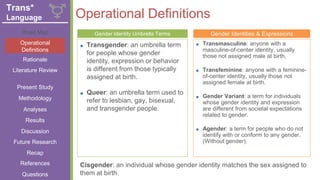
+ Operational Definitions
■ Transgender: an umbrella term
for people whose gender
identity, expression or behavior
is different from those typically
assigned at birth.
■ Queer: an umbrella term used to
refer to lesbian, gay, bisexual,
and transgender people.
■ Transmasculine: anyone with a
masculine-of-center identity, usually
those not assigned male at birth.
■ Transfeminine: anyone with a feminine-
of-center identity, usually those not
assigned female at birth.
■ Gender Variant: a term for individuals
whose gender identity and expression
are different from societal expectations
related to gender.
■ Agender: a term for people who do not
identify with or conform to any gender.
(Without gender).
Gender Identity Umbrella Terms Gender Identities & Expressions
Literature Review
Road Map
Operational
Definitions
Rationale
Present Study
Methodology
Analyses
Results
Discussion
Future Research
References
Recap
Questions
Trans*
Language
Cisgender: an individual whose gender identity matches the sex assigned to
them at birth.
+ Operational Definitions
■ as a prefix has 3 meanings:
■ change (transform)
■ across (transcontinental)
■ beyond or through
(transcutaneous)
Trans
Literature Review
Road Map
Operational
Definitions
Rationale
Present Study
Methodology
Analyses
Results
Discussion
Future Research
References
Recap
Questions
Trans*
Language
Trans*
■ an abbreviated version of
Transgender.
■ considered by some to be more
inclusive of all gender variant
persons under the Transgender
umbrella.
Trans & Trans*
+ Research Rationale
■ lack of consistency across queer theory literature
■ no explicitly defined (nor universally accepted) umbrella term for
the trans* community
■ the existence of cisgender researchers in the realm of trans*-
focused research is problematic.
Why study Trans* Language?
Literature Review
Road Map
Operational
Definitions
Rationale
Present Study
Methodology
Analyses
Results
Discussion
Future Research
References
Recap
Questions
Trans*
Language
+ Literature Review
Gendered Language Research
Literature Review
Road Map
Operational
Definitions
Rationale
Present Study
Methodology
Analyses
Results
Discussion
Future Research
References
Recap
Questions
Trans*
Language
(American Psychological Association, 1980; Hooks, 1994; Alcoff, 1996; McIntosh, 1998; Butler, 2004; Garland-Thompson, 2008;
Nash, 2010; Enke, 2012; Hagen & Galupo, 2014)
■ Generic masculine language (“he” & “man”) in publications
■ Misgendering: presumptively defines and labels
■ “They” as a common third-person singular pronoun
■ Lexical boundaries & limitations based on privilege
■ to avoid unintentional language biases (the –isms)
■ Social location: language transgressions from minority populations to general
population
■ Gender-neutral professional titles
■ e.g., Flight Attendant, Mail Carrier, Police Officer
■ Erasure of gender norms = erasure of identities
“With gender so deeply woven into language, defining what specifically
gendered language is can be difficult” (Hagen & Galupo, 2014).
+ Literature Review
Trans*-Focused Literature
Literature Review
Road Map
Operational
Definitions
Rationale
Present Study
Methodology
Analyses
Results
Discussion
Future Research
References
Recap
Questions
Trans*
Language
(Hirchfeld, 1910, 1923; Cauldwell, 1947, 1953; Benjamin, 1966; Prince, 1979; DSM-III, 1980; Feinberg, 1990; Bradley, 2012)
■ Evolution of the Transgender Umbrella
■ 1910: Transsexual
■ 1960s: Transgenderism emerges
■ Biological sex ≠ gender identity
■ 1980: DSM-III adds transsexualism to disorder list
■ 1990: Transgender as an umbrella term to include
■ transsexuals, gender variant, gender nonconformists
■ 2012: Transgender umbrella problematic
■ Erasure: corrals different identities with different needs into a single sociopolitical grouping
■ Transsexual label reclaimed
■ Gender variant community deviate from “trans-” labeling
+ Literature Review
Trans* Language Research
Literature Review
Road Map
Operational
Definitions
Rationale
Present Study
Methodology
Analyses
Results
Discussion
Future Research
References
Recap
Questions
Trans*
Language
(Alcoff, 1996; Stryker, Currah and Moore, 2008; Enke, 2012; Bradley, 2012; Bender-Baird, 2013)
■ Literature that addresses trans* language disparities:
1. Medically-focused
■ Eg., language barriers in healthcare
2. Transfeminist arguments for feminist publications inclusion
3. Critiques of cisgender bias in queer/women’s literature
4. Non-scholarly social media forums
■ Labeling & Language Evolution Inconsistencies
■ across medical, psycho-social, and pop culture
■ across/between cis* & trans* researchers
■ across the same researcher over time
“Gender and women’s studies scholars regularly request glossaries of trans
terminologies [reflecting] the non-integration of transgender in gender studies
thus far, but perhaps equally [reflecting] the fact that no standard lexicon
exists; vocabularies and uses are invented and just as quickly challenged as we
discover their unintended implications, exclusions, and limitations” (Enke, 2012).
+ Present Study
■ The present study will employ a mixed methods design to
examine the boundaries of trans* labeling and language by
exploring quantitative patterns of responses across gender
identity.
■ Two Overall Research Questions:
1. Is there/can there be a modern umbrella term to generalize the
trans* community?
2. In which context(s) are trans* identity labels acceptable to be
used, and by whom?
Overview
Literature Review
Road Map
Operational
Definitions
Rationale
Present Study
Methodology
Analyses
Results
Discussion
Future Research
References
Recap
Questions
Trans*
Language
+ Methodology
Participants
Literature Review
Road Map
Operational
Definitions
Rationale
Present Study
Methodology
Analyses
Results
Discussion
Future Research
References
Recap
Questions
Trans*
Language
■ N= 532 (completed)
■ Restrictions:
■ age 18+
■ must self-identify as transgender or gender variant
■ Online Snowball Recruitment:
■ Social Psychology Network
■ Psychological Research on the Net
■ Social Media (e.g. Facebook, Tumblr, Twitter)
■ National Transgender Organizations
■ LGBTQ List-Serves
+ Methodology
Procedure
Literature Review
Road Map
Operational
Definitions
Rationale
Present Study
Methodology
Analyses
Results
Discussion
Future Research
References
Recap
Questions
Trans*
Language
■ Survey Monkey: survey method administered online
■ link: www.surveymonkey.com/translanguage
■ January 1, 2014 to January 1, 2015
■ Study Title: “Trans* Language”
■ Informed consent
■ Demographics questionnaire
■ Survey administered
■ Debriefing statement
■ principal investigator’s contact information
■ Participants fully informed as to the nature of the study
■ Anticipated time: 35 minutes
■ Personal identifying information will not be collected from the participants.
■ Data will be recorded and stored electronically
■ VeriSign SSL Certificate: only accessible to principal investigator and faculty mentor.
+ Methodology
■ Participant Gender Identity Measure:
Procedure
Literature Review
Road Map
Operational
Definitions
Rationale
Present Study
Methodology
Analyses
Results
Discussion
Future Research
References
Recap
Questions
Trans*
Language
+ Methodology
■ Research Question 1: Is there/can there be a modern umbrella term
to generalize the trans* community?
Procedure
Literature Review
Road Map
Operational
Definitions
Rationale
Present Study
Methodology
Analyses
Results
Discussion
Future Research
References
Recap
Questions
Trans*
Language
+ Methodology
■ Research Question 2: In which context(s) are trans* identity labels
acceptable to be used, and by whom?
Procedure
Literature Review
Road Map
Operational
Definitions
Rationale
Present Study
Methodology
Analyses
Results
Discussion
Future Research
References
Recap
Questions
Trans*
Language
People conceptualize their gender identity in various ways. Below are terms someone may choose to identify with. Please respond to
the following prompts, indicating your level of familiarity, frequency and acceptability of use.
+ Methodology
■ Additional Qualitative Questions
Procedure
Literature Review
Road Map
Operational
Definitions
Rationale
Present Study
Methodology
Analyses
Results
Discussion
Future Research
References
Recap
Questions
Trans*
Language
+ Analyses
■ Is there/can there be a modern umbrella term to generalize the trans*
community?
■ Design: Chi Square
■ H1: More transfeminine individuals will be in favor of the transgender umbrella than
transmasculine, gender variant, and agender individuals.
■ H2: More transfeminine individuals will be in favor of using an umbrella term than transmasculine,
gender variant, and agender individuals.
Research Question 1
Literature Review
Road Map
Operational
Definitions
Rationale
Present Study
Methodology
Analyses
Results
Discussion
Future Research
References
Recap
Questions
Trans*
Language
Transfeminine Transmasculine Gender Variant Agender
Yes, I prefer the
transgender umbrella
Yes, but I prefer
another term to
transgender umbrella
No, I don’t think there
can be an accurate
umbrella term
+ Analyses
■ In which context(s) are trans* identity labels acceptable to be used,
and by whom?
■ Design A: Paired T-Tests
■ H1: Mean acceptability ratings will be highest in the TRANS* Community.
■ H2: Mean acceptability ratings will be highest for Trans-specific Labels.
Research Question 2
Literature Review
Road Map
Operational
Definitions
Rationale
Present Study
Methodology
Analyses
Results
Discussion
Future Research
References
Recap
Questions
Trans*
Language
Community Comparisons
Trans* Transgender Gender Variant Queer
Trans* vs. LGBQ Community
Trans* vs. Cis* Hetero
Community
LGBQ vs. Cis* Hetero
Community
+ Analyses
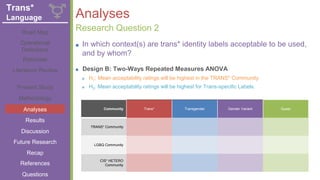
■ In which context(s) are trans* identity labels acceptable to be used,
and by whom?
■ Design B: Two-Ways Repeated Measures ANOVA
■ H1: Mean acceptability ratings will be highest in the TRANS* Community.
■ H2: Mean acceptability ratings will be highest for Trans-specific Labels.
Research Question 2
Literature Review
Road Map
Operational
Definitions
Rationale
Present Study
Methodology
Analyses
Results
Discussion
Future Research
References
Recap
Questions
Trans*
Language
Community Trans* Transgender Gender Variant Queer
TRANS* Community
LGBQ Community
CIS* HETERO
Community
+ Analyses
■ In which context(s) are trans* identity labels acceptable to be used,
and by whom?
■ Design C: Paired T-Tests
■ H3: Mean acceptability ratings for Transgender will be higher than Gender Variant or Queer for LGBQ and Cis*
Hetero Communities, but will be equal to Trans* ratings.
Research Question 2
Literature Review
Road Map
Operational
Definitions
Rationale
Present Study
Methodology
Analyses
Results
Discussion
Future Research
References
Recap
Questions
Trans*
Language
Transgender Comparison:
Trans* Gender Variant Queer
LGBQ Community
CIS* HETERO Community
+ Results
Demographics
Literature Review
Road Map
Operational
Definitions
Rationale
Present Study
Methodology
Analyses
Results
Discussion
Future Research
References
Recap
Questions
Trans*
Language
Race/Ethnicity: 78% Caucasian
Residency: 75% United States
+ Results
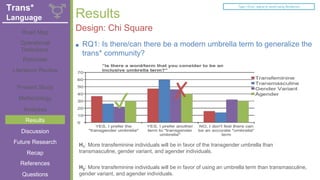
■ RQ1: Is there/can there be a modern umbrella term to generalize the
trans* community?
Design: Chi Square
Literature Review
Road Map
Operational
Definitions
Rationale
Present Study
Methodology
Analyses
Results
Discussion
Future Research
References
Recap
Questions
Trans*
Language
Transfeminine Transmasculine Gender Variant Agender
Yes, I prefer the
transgender umbrella 67
(36.8%)
53
(26.2%)
17
(21.8%)
12
(30.0%)
Yes, but I prefer
another term to
transgender umbrella
86
(47.3%)
121
(59.9%)
36
(46.2%)
16
(40.0%)
No, I don’t think there
can be an accurate
umbrella term
29
(15.9%)
28
(13.9%)
25
(32.1%)
12
(30.0%)
There is a significant difference in umbrella term acceptability across gender identities. X2 (6,
N=502)=23.84, p. < .001. (The computed X2 is greater than the critical value, 16.81 at the .01 level).
Type I Error: adjust to avoid using Bonferroni
+ Results
■ RQ1: Is there/can there be a modern umbrella term to generalize the
trans* community?
Design: Chi Square
Literature Review
Road Map
Operational
Definitions
Rationale
Present Study
Methodology
Analyses
Results
Discussion
Future Research
References
Recap
Questions
Trans*
Language
H1: More transfeminine individuals will be in favor of the transgender umbrella than
transmasculine, gender variant, and agender individuals.
H2: More transfeminine individuals will be in favor of using an umbrella term than transmasculine,
gender variant, and agender individuals.
Type I Error: adjust to avoid using Bonferroni
✓
✗
+ Results
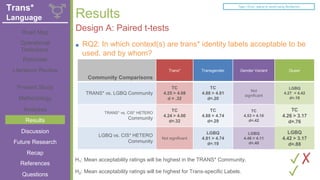
■ RQ2: In which context(s) are trans* identity labels acceptable to be
used, and by whom?
Design A: Paired t-tests
Literature Review
Road Map
Operational
Definitions
Rationale
Present Study
Methodology
Analyses
Results
Discussion
Future Research
References
Recap
Questions
Trans*
Language
Community Comparisons
Trans* Transgender Gender Variant Queer
TRANS* vs. LGBQ Community
TC
4.25 > 4.08
d = .32
TC
4.88 > 4.81
d=.20
Not
significant
LGBQ
4.27 < 4.42
d=.18
TRANS* vs. CIS* HETERO
Community
TC
4.24 > 4.00
d=.32
TC
4.88 > 4.74
d=.29
TC
4.53 > 4.10
d=.42
TC
4.26 > 3.17
d=.76
LGBQ vs. CIS* HETERO
Community
Not significant
LGBQ
4.81 > 4.74
d=.19
LGBQ
4.46 > 4.11
d=.40
LGBQ
4.42 > 3.17
d=.88
H1: Mean acceptability ratings will be highest in the TRANS* Community.
H2: Mean acceptability ratings will be highest for Trans-specific Labels.
✓
✓
✗
Type I Error: adjust to avoid using Bonferroni
+ Results
■ RQ2: In which context(s) are trans* identity labels acceptable to be
used, and by whom?
Design B: 2-Way Repeated Measures ANOVA
Literature Review
Road Map
Operational
Definitions
Rationale
Present Study
Methodology
Analyses
Results
Discussion
Future Research
References
Recap
Questions
Trans*
Language
Community Trans* Transgender Gender Variant Queer
TRANS* Community 4.37 4.89 4.53 4.30
LGBQ Community 4.19 4.83 4.51 4.45
CIS* HETERO
Community
4.09 4.75 4.30 3.13
Significant Interaction Effect of Terms and Community: F(2.75, 364.11)= 35.076, p < .001
H3: Mean acceptability ratings will be highest in the TRANS* Community.
H4: Mean acceptability ratings will be highest for Trans-specific Labels.
✓
✓
✗
Type I Error: adjust to avoid using Bonferroni
Estimated Marginal Means of Label x Community
+ Results
■ RQ2: In which context(s) are trans* identity labels acceptable to be
used, and by whom?
Design B: 2-Way Repeated Measures ANOVA
Literature Review
Road Map
Operational
Definitions
Rationale
Present Study
Methodology
Analyses
Results
Discussion
Future Research
References
Recap
Questions
Trans*
Language
Type I Error: adjust to avoid using Bonferroni
+ Results
■ RQ2: In which context(s) are trans* identity labels acceptable to be
used, and by whom?
Design C: Paired t-tests
Literature Review
Road Map
Operational
Definitions
Rationale
Present Study
Methodology
Analyses
Results
Discussion
Future Research
References
Recap
Questions
Trans*
Language
Transgender Comparison:
Trans* Gender Variant Queer
Queer Community
Transgender
4.80 > 4.08
d = .54
Transgender
4.82 > 4.46
d=.31
Transgender
4.83<4.423
d=.36
Cis* Hetero Community
Transgender
4.73 > 4.00
d=.54
Transgender
4.75 > 4.11
d=.42
Transgender
4.75 > 3.18
d=.94
H5: Mean acceptability ratings for Transgender will be higher than Gender Variant or
Queer for LGBQ and Cis* Hetero Communities, but will be equal to Trans* ratings. ✓✗
Type I Error: adjust to avoid using Bonferroni
+ Discussion
RQ1: Is there/can there be a modern umbrella term to generalize the trans*
community?
Literature Review
Road Map
Operational
Definitions
Rationale
Present Study
Methodology
Analyses
Results
Discussion
Future Research
References
Recap
Questions
Trans*
Language
■ H1: More transfeminine individuals will be in favor of the
transgender umbrella than transmasculine, gender variant, and
agender individuals.
■ H2: More transfeminine individuals will be in favor of using an
umbrella term than transmasculine, gender variant, and agender
individuals.
■ More transmasculine participants were overall in favor of the use of an umbrella
term, with more transfeminine participants specifically favoring transgender as the
designated umbrella term.
■ Qualitative Response Rationale:
■ Tendency for Non-Trans* Communities to conflate “Transgender” with “Transsexual”,
assuming anyone under the umbrella has/desires to alter their bodies.
■ Gender Identity, Gender Expression, and Gender Performance should be more clearly
separated.
■ Cis* people can be Gender Variant in their Expression/Performance, but cannot be
Trans*.
■ i.e., Masculine Women, Feminine Men, Cross-dressers, Drag Kings/Queens.
+ Discussion
RQ2: In which context(s) are trans* identity labels acceptable to be used, and by
whom?
Literature Review
Road Map
Operational
Definitions
Rationale
Present Study
Methodology
Analyses
Results
Discussion
Future Research
References
Recap
Questions
Trans*
Language
■ H1/H3: Mean acceptability ratings will be highest in the TRANS*
Community.
■ Trans*-identified participants rate trans* labeling to be the most
acceptable within their own community across all terms except “Queer”.
■ “Queer” is rated as most acceptable within LGBQ community.
■ Qualitative Response Rationale:
■ “Queer” is a broad umbrella term for the entire LGBTQ community, as it
encompasses both gender identity variance and sexual orientation minorities.
■ “Gender Queer” better applies to the Trans* community
+ Discussion
RQ2: In which context(s) are trans* identity labels acceptable to be used, and by
whom?
Literature Review
Road Map
Operational
Definitions
Rationale
Present Study
Methodology
Analyses
Results
Discussion
Future Research
References
Recap
Questions
Trans*
Language
■ H2/H4: Mean acceptability ratings will be highest for Trans-specific Labels.
■ Across all Communities, “Transgender” is rated the as the most
acceptable label, followed by “Trans*”
■ “Queer” was the least favorable label.
■ Qualitative Response Rationale:
■ Due to it’s historically derogatory connotations, “Queer” is very unpopular with older
Trans* people, and regarded as not appropriate for Cis* Hetero people to use
without permission.
+ Discussion
RQ2: In which context(s) are trans* identity labels acceptable to be used, and by
whom?
Literature Review
Road Map
Operational
Definitions
Rationale
Present Study
Methodology
Analyses
Results
Discussion
Future Research
References
Recap
Questions
Trans*
Language
■ H5: Mean acceptability ratings for Transgender will be higher than Gender Variant or
Queer for LGBQ and Cis* Hetero Communities, but will be equal to Trans* ratings.
■ Across all Communities, “Transgender” is rated the as the most acceptable
label.
■ “Queer” was the least favorable label.
■ Qualitative Response Rationale:
■ Trans*:
■ Asterisk: origin rooted in an attack on trans-women from gender variant/non-binary
community, and has a transmysoginistic connotation. Ultimately used to “exclude”
trans-women.
■ Trans*/Trans: removing the “-gender” suffix allows for inclusion of both sex/gender
variance.
+ Discussion
Limitations
Literature Review
Road Map
Operational
Definitions
Rationale
Present Study
Methodology
Analyses
Results
Discussion
Future Research
References
Recap
Questions
Trans*
Language
■ Uneven Sample Distribution (N = 532)
■ 415 (78%) White
■ 25 Latino
■ 11 Black
■ 6 Asian
■ 1 Native American
■ 412 Transmasculine/Transfeminine
■ 78 Gender Variant
■ 42 Agender
■ 128 (24%) Non-US Residents
■ Online survey = globally accessible
■ Study is not culturally universal
■ 58% Gender Variant/Agender Sample
+ Discussion
■ Vague question wording
■ Who?
■ About Whom?
■ Self-identified first?
Limitations
Literature Review
Road Map
Operational
Definitions
Rationale
Present Study
Methodology
Analyses
Results
Discussion
Future Research
References
Recap
Questions
Trans*
Language
+ Future Research
Modifications & Additional Studies
Literature Review
Road Map
Operational
Definitions
Rationale
Present Study
Methodology
Analyses
Results
Discussion
Future Research
References
Recap
Questions
Trans*
Language
■ US Residency Restrictions
■ Informed consent form
■ Demographics filter
■ Separate study for QPOC
■ Modified labels/wording based on current qualitative data
■ Part of 3-level Tiered Study
■ Pt. 1: Trans*-identified participants
■ Pt. 2: LGBQ-identified participants
■ Pt. 3: Cis* Hetero-identified participants
+ What did we learn today?
Literature Review
Road Map
Operational
Definitions
Rationale
Present Study
Methodology
Analyses
Results
Discussion
Future Research
References
Recap
Questions
Trans*
Language
3. My Study:
■ Umbrella labels can be useful but
problematic.
■ Transgender is still the most widely used
and accepted umbrella term, but there is
growing criticism of it’s
underrepresentation.
■ Trans* is controversial due to it’s
historically transmisogynistic roots
■ Queer is not a favorable umbrella term
regardless of the community it’s being
used to describe, but is better suited for
the entire LGBTQ community and not the
Trans* community.
■ There are a lot of white trans* people
taking only surveys.
1. Trans* Language
■ What is Trans*?
■ Differences between:
a. Gender Identity
b. Gender Expression
c. Biological Sex
d. Attraction
2. Why Study Trans*
Language?
■ No standard lexicon exists
■ Dearth of Trans* Language
Literature
■ Parallels with Gendered
Language Literature
+ References
Alcoff, L. (1996). The Problem in Speaking for Others. New York: Routledge.
Allen, M. (2011). The Death of the Transgender Umbrella from theBilericoProject.org.
American Psychological Association. (1980). Diagnostic and statistical manual of mental disorders (3rd ed.). Washington, DC: Author.
Ansara, G. & Hegarty, P. (2013). Misgendering in English language contexts: Applying non-cisgenderist methods to feminist research. International Journal of Multiple
Research Approaches, 7(2): 160–177.
Bender-Baird, K. "Cisgendered researcher on trans-focused research". Paper presented at the annual meeting of the National Women's Studies Association, Millennium Hotel,
Cincinnati, OH. 2013-12-14 from http://citation.allacademic.com/meta/p230384_index.html
Benjamin, H. (1966). The Transsexual Phenomenon. New York: Sexology Corporation.
Bodine, A. (1975). Androcentrism in prescriptive gram-mar: Singular ‘they’, sex-indefinite ‘he’, and ‘he or she’. Language in Society, 4, 129–146.
Bradley, O. (2012). They Need Labels: Contemporary Institutional and Popular Frameworks for Gender Variance. Antropology Thesis from Georgia State University.
Butler, J. (2004). Undoing Gender. New York: Routledge.
Cauldwell. (1947). What Is Hermaphroditism? New York: Routledge.
Committee on Lesbian and Gay Concern. (1991). Avoiding Heterosexual Bias in Language. American Psychologist, 46, 973-974.
Cromwell, J. (1999). Transmen and FTMS: Identities, bodies, gender, and sexualities. Chicago: University of Illinois Press.
D’Arcy, J. (2012). Gender identity and children who struggle with it. From HuffingtonPost.com
Dargie, E. et al. (2014). Somewhere under the rainbow: Exploring the identities and experiences of trans persons. The Canadian Journal of Human Sexuality, 23(2), 60–74.
Davidson, M. (2007). "Seeking Refuge Under the Umbrella: Inclusion, Exclusion, and Organizing Within the Category Transgender." Sexuality Research & Social Policy, 4.4,
60-80.
Davis, E. C. (2009). Situating “fluidity” (trans) gender identification and the regulation of gender diversity. GLQ: A Journal of Lesbian and Gay Studies, 15, 97–130.
Eckert, P., & McConnell-Ginet, S. (2003). Language and gender. Cambridge, UK: Cambridge University Press.
Enke, A. (Ed.). (2012). Transfeminist perspectives in and beyond transgender and gender studies. Philadelphia, PA: Temple University Press.
Enke. (2014). The Education of Little Cis. In The Transgender Reader 2.
Literature Review
Road Map
Operational
Definitions
Rationale
Present Study
Methodology
Analyses
Results
Discussion
Future Research
References
Recap
Questions
Trans*
Language
+ References
Fassinger, R. E., & Arseneau, J. R. (2007). “I’d rather get wet than be under the umbrella”: Differentiating the experiences and identities of lesbian, gay, bisexual, and
transgender people. Handbook of counseling and psychotherapy with lesbian, gay, bisexual, and Ktrans-gender clients, 19–49.
Feinberg, L. (1990). Transgender Warrior . Boston: Beacon Press.
Galupo, M. P., Bauerband, L. A.*, Gonzalez, K. A.*, Hagen, D. B.*, Hether, S.* & Krum, T.* (2014). Transgender Friendship Experiences: Benefits and barriers of friendships
across gender identity and sexual orientation. Feminism & Psychology, 24(2), 193-215.
Garland-Thompson. (2008). Misfits: A Feminist Materialist Disability Concept
Grant, J. M., Mottet, L. A., Tanis, J., Harrison, J., Herman, J. L., & Keisling, M. (2011). Injustice at every turn: A report of the national transgender discrimination survey.
Washington, DC: National Center for Trans-gender Equality and National Gay and Lesbian Task Force.
Gender Equity Resource Center at University of Berkeley. (2014). Definition of terms. retrieved from: http://geneq.berkeley.edu/lgbt_resources_definiton_of_terms#top
Hagen, D. B.* & Galupo, M. P. (2014). Trans* individuals' experiences of gendered language with healthcare providers: Recommendations for practitioners. International
Journal of Transgenderism, 15, 16-34.
Herek, G. M., Kimmel, D. C., Amaro, H., & Melton, G. B. (1991). Avoiding Heterosexist Bias in Psychological Research. American Psychologist, 46(9), 957-963.
Hill, M.R. & Mays, J. (2014). The Gender Book. Houston, TX: Marshall House Press
Hirchfeld, M. (1910). Transvestites: The Erotic Drive to Cross-Dress [Die Transvestiten]. translated by Michael Lombardi-Nash. Buffalo: Prometheus Books (1991).
Hook, B. (1994). Feminism is for Everybody. New York, NY: Routeledge.
Kirby, A. (2008). What is Trans? Tools for an open dialogue, in WSQ: Women’s Studies Quarterly, 36: 3 & 4, Fall/Winter, pp. 292-293.
Killerman, S. (2014). TRANS*. From ItsPronouncedMetroSexual.com
Koyama. (2003). Transfeminist Manifesto. in Catching a Wave: reclaiming feminism for the 21st century. Northeastern University Press.
Kessler, S. & McKenna, W. (1978). Gender: An Ethnomethodological Approach. New York: Wiley.
Martin. (2013). Dear White People, Stop Appropriating from Black People
McIntosh. (1998). White Privledge: Unpacking the Invisible Backpack. In Multiculturlism. New York.
Munoz, V. & Garrison, E.K. (2008). Transpedagogies: A roundtable dialogue in, WSQ: Women’s Studies Quarterly, 36: 3-4, Fall/Winter, pp. 288-308.
Literature Review
Road Map
Operational
Definitions
Rationale
Present Study
Methodology
Analyses
Results
Discussion
Future Research
References
Recap
Questions
Trans*
Language
+ References
Nadal, K. L., Skolnik, A., & Wong, Y. (2012). Interpersonal and systemic microaggressions toward transgender people: Implications for counseling. Journal of LGBT Issues in
Counseling, 6(1), 55–82.
Namaste, V. (2000). Invisible lives: The erasure of trans-sexual and transgender people. Chicago, IL: Chicago University Press.
Namaste, V. (2009). Undoing theory: The ‘Transgender Question’ and the epistemic violence of Anglo-American feminist theory. Hypatia, 24(3), 11–32.
Nanda, S. (2000). Gender Diversity: Crosscultural Variations. Long Grove, IL: Waveland Press, Inc.
Nash. (2010). Queer Conversations. New York.
National Center for Transgender Equality. (2009). Transgender Terminology. Resources page: transequality.org/resoruces/NCTE_Transterminology.pdf
Prewitt-Freilino, J. L., Caswell, T. A., & Laakso, E. K. (2012). The gendering of language: A comparison of gender equality in countries with gendered, natural gender, and
genderless languages. Sex Roles, 66, 268–281.
Prince. (1979). Charles to Virginia: Sex research as a personl experience. In The Frontiers of Sex Research, ed. Vern Bullough, 167-175, Buffalo, NY: Prometheus Books.
Serano, J. (2007). Whipping girl: A transsexual woman on sexism and the scapegoating of femininity. Emeryville,CA: Seal Press.
Spade, D. (2008). Documenting Gender. Hastings Law Journal, 59, 731-841.
Stryker, S., Currah, P., & Moore, L. J. (2008). Introduction: Trans-, trans, or transgender?. WSQ: Women Studies Quarterly, 36(3), 11–22.
Weatherall, A. (2002). Gender, language, and discourse. New York, NY: Routledge.
Literature Review
Road Map
Operational
Definitions
Rationale
Present Study
Methodology
Analyses
Results
Discussion
Future Research
References
Recap
Questions
Trans*
Language
A Special Thank
You:
• Dr. Paz Galupo
• Brie Hagen
• Eddie Lomash
+ Questions?
Literature Review
Road Map
Operational
Definitions
Rationale
Present Study
Methodology
Analyses
Results
Discussion
Future Research
References
Recap
Questions
Trans*
Language

Trans language for tableau

  • 1.
    + Trans* Language: Queer LabelingExperiences Across Gender Identities A First-Year Project by Jo Forrest-Stuart
  • 2.
    + Road Map LiteratureReview Road Map Operational Definitions Rationale Present Study Methodology Analyses Results Discussion Future Research References Recap Questions Trans* Language 4. Results ■ Demographics ■ Present Data ■ Present Significant Findings ■ Hypotheses Supported? 5. Discussion ■ Interpret Results ■ Qualitative Response Analyses ■ Limitations 6. Future Research ■ Modifications needed ■ Additional Studies Presentation Overview 1. Explain Trans* Language ■ Differentiate between: a. Gender Identity b. Gender Expression c. Biological Sex d. Attraction ■ Define specific terminology ■ What is Trans*? 2. Why Study Trans* Language? 3. Review Literature: ■ Gendered Language ■ Trans*-Focused ■ Trans* Language
  • 3.
    + Operational Definitions GenderIdentity Literature Review Road Map Operational Definitions Rationale Present Study Methodology Analyses Results Discussion Future Research References Recap Questions Trans* Language an individual’s internal sense of being male, female, or something else. (not necessarily visible to others)
  • 4.
    + Operational Definitions GenderExpression Literature Review Road Map Operational Definitions Rationale Present Study Methodology Analyses Results Discussion Future Research References Recap Questions Trans* Language the way an individual presents gender through actions, dress, and demeanor, and how those presentations are interpreted based on gender norms.
  • 5.
    + Operational Definitions Biology& Sexual Orientation Literature Review Road Map Operational Definitions Rationale Present Study Methodology Analyses Results Discussion Future Research References Recap Questions Trans* Language Anatomy/Genitals | Sexual/Romantic Attraction
  • 6.
    + Operational Definitions ■Transgender: an umbrella term for people whose gender identity, expression or behavior is different from those typically assigned at birth. ■ Queer: an umbrella term used to refer to lesbian, gay, bisexual, and transgender people. ■ Transmasculine: anyone with a masculine-of-center identity, usually those not assigned male at birth. ■ Transfeminine: anyone with a feminine- of-center identity, usually those not assigned female at birth. ■ Gender Variant: a term for individuals whose gender identity and expression are different from societal expectations related to gender. ■ Agender: a term for people who do not identify with or conform to any gender. (Without gender). Gender Identity Umbrella Terms Gender Identities & Expressions Literature Review Road Map Operational Definitions Rationale Present Study Methodology Analyses Results Discussion Future Research References Recap Questions Trans* Language Cisgender: an individual whose gender identity matches the sex assigned to them at birth.
  • 7.
    + Operational Definitions ■as a prefix has 3 meanings: ■ change (transform) ■ across (transcontinental) ■ beyond or through (transcutaneous) Trans Literature Review Road Map Operational Definitions Rationale Present Study Methodology Analyses Results Discussion Future Research References Recap Questions Trans* Language Trans* ■ an abbreviated version of Transgender. ■ considered by some to be more inclusive of all gender variant persons under the Transgender umbrella. Trans & Trans*
  • 8.
    + Research Rationale ■lack of consistency across queer theory literature ■ no explicitly defined (nor universally accepted) umbrella term for the trans* community ■ the existence of cisgender researchers in the realm of trans*- focused research is problematic. Why study Trans* Language? Literature Review Road Map Operational Definitions Rationale Present Study Methodology Analyses Results Discussion Future Research References Recap Questions Trans* Language
  • 9.
    + Literature Review GenderedLanguage Research Literature Review Road Map Operational Definitions Rationale Present Study Methodology Analyses Results Discussion Future Research References Recap Questions Trans* Language (American Psychological Association, 1980; Hooks, 1994; Alcoff, 1996; McIntosh, 1998; Butler, 2004; Garland-Thompson, 2008; Nash, 2010; Enke, 2012; Hagen & Galupo, 2014) ■ Generic masculine language (“he” & “man”) in publications ■ Misgendering: presumptively defines and labels ■ “They” as a common third-person singular pronoun ■ Lexical boundaries & limitations based on privilege ■ to avoid unintentional language biases (the –isms) ■ Social location: language transgressions from minority populations to general population ■ Gender-neutral professional titles ■ e.g., Flight Attendant, Mail Carrier, Police Officer ■ Erasure of gender norms = erasure of identities “With gender so deeply woven into language, defining what specifically gendered language is can be difficult” (Hagen & Galupo, 2014).
  • 10.
    + Literature Review Trans*-FocusedLiterature Literature Review Road Map Operational Definitions Rationale Present Study Methodology Analyses Results Discussion Future Research References Recap Questions Trans* Language (Hirchfeld, 1910, 1923; Cauldwell, 1947, 1953; Benjamin, 1966; Prince, 1979; DSM-III, 1980; Feinberg, 1990; Bradley, 2012) ■ Evolution of the Transgender Umbrella ■ 1910: Transsexual ■ 1960s: Transgenderism emerges ■ Biological sex ≠ gender identity ■ 1980: DSM-III adds transsexualism to disorder list ■ 1990: Transgender as an umbrella term to include ■ transsexuals, gender variant, gender nonconformists ■ 2012: Transgender umbrella problematic ■ Erasure: corrals different identities with different needs into a single sociopolitical grouping ■ Transsexual label reclaimed ■ Gender variant community deviate from “trans-” labeling
  • 11.
    + Literature Review Trans*Language Research Literature Review Road Map Operational Definitions Rationale Present Study Methodology Analyses Results Discussion Future Research References Recap Questions Trans* Language (Alcoff, 1996; Stryker, Currah and Moore, 2008; Enke, 2012; Bradley, 2012; Bender-Baird, 2013) ■ Literature that addresses trans* language disparities: 1. Medically-focused ■ Eg., language barriers in healthcare 2. Transfeminist arguments for feminist publications inclusion 3. Critiques of cisgender bias in queer/women’s literature 4. Non-scholarly social media forums ■ Labeling & Language Evolution Inconsistencies ■ across medical, psycho-social, and pop culture ■ across/between cis* & trans* researchers ■ across the same researcher over time “Gender and women’s studies scholars regularly request glossaries of trans terminologies [reflecting] the non-integration of transgender in gender studies thus far, but perhaps equally [reflecting] the fact that no standard lexicon exists; vocabularies and uses are invented and just as quickly challenged as we discover their unintended implications, exclusions, and limitations” (Enke, 2012).
  • 12.
    + Present Study ■The present study will employ a mixed methods design to examine the boundaries of trans* labeling and language by exploring quantitative patterns of responses across gender identity. ■ Two Overall Research Questions: 1. Is there/can there be a modern umbrella term to generalize the trans* community? 2. In which context(s) are trans* identity labels acceptable to be used, and by whom? Overview Literature Review Road Map Operational Definitions Rationale Present Study Methodology Analyses Results Discussion Future Research References Recap Questions Trans* Language
  • 13.
    + Methodology Participants Literature Review RoadMap Operational Definitions Rationale Present Study Methodology Analyses Results Discussion Future Research References Recap Questions Trans* Language ■ N= 532 (completed) ■ Restrictions: ■ age 18+ ■ must self-identify as transgender or gender variant ■ Online Snowball Recruitment: ■ Social Psychology Network ■ Psychological Research on the Net ■ Social Media (e.g. Facebook, Tumblr, Twitter) ■ National Transgender Organizations ■ LGBTQ List-Serves
  • 14.
    + Methodology Procedure Literature Review RoadMap Operational Definitions Rationale Present Study Methodology Analyses Results Discussion Future Research References Recap Questions Trans* Language ■ Survey Monkey: survey method administered online ■ link: www.surveymonkey.com/translanguage ■ January 1, 2014 to January 1, 2015 ■ Study Title: “Trans* Language” ■ Informed consent ■ Demographics questionnaire ■ Survey administered ■ Debriefing statement ■ principal investigator’s contact information ■ Participants fully informed as to the nature of the study ■ Anticipated time: 35 minutes ■ Personal identifying information will not be collected from the participants. ■ Data will be recorded and stored electronically ■ VeriSign SSL Certificate: only accessible to principal investigator and faculty mentor.
  • 15.
    + Methodology ■ ParticipantGender Identity Measure: Procedure Literature Review Road Map Operational Definitions Rationale Present Study Methodology Analyses Results Discussion Future Research References Recap Questions Trans* Language
  • 16.
    + Methodology ■ ResearchQuestion 1: Is there/can there be a modern umbrella term to generalize the trans* community? Procedure Literature Review Road Map Operational Definitions Rationale Present Study Methodology Analyses Results Discussion Future Research References Recap Questions Trans* Language
  • 17.
    + Methodology ■ ResearchQuestion 2: In which context(s) are trans* identity labels acceptable to be used, and by whom? Procedure Literature Review Road Map Operational Definitions Rationale Present Study Methodology Analyses Results Discussion Future Research References Recap Questions Trans* Language People conceptualize their gender identity in various ways. Below are terms someone may choose to identify with. Please respond to the following prompts, indicating your level of familiarity, frequency and acceptability of use.
  • 18.
    + Methodology ■ AdditionalQualitative Questions Procedure Literature Review Road Map Operational Definitions Rationale Present Study Methodology Analyses Results Discussion Future Research References Recap Questions Trans* Language
  • 19.
    + Analyses ■ Isthere/can there be a modern umbrella term to generalize the trans* community? ■ Design: Chi Square ■ H1: More transfeminine individuals will be in favor of the transgender umbrella than transmasculine, gender variant, and agender individuals. ■ H2: More transfeminine individuals will be in favor of using an umbrella term than transmasculine, gender variant, and agender individuals. Research Question 1 Literature Review Road Map Operational Definitions Rationale Present Study Methodology Analyses Results Discussion Future Research References Recap Questions Trans* Language Transfeminine Transmasculine Gender Variant Agender Yes, I prefer the transgender umbrella Yes, but I prefer another term to transgender umbrella No, I don’t think there can be an accurate umbrella term
  • 20.
    + Analyses ■ Inwhich context(s) are trans* identity labels acceptable to be used, and by whom? ■ Design A: Paired T-Tests ■ H1: Mean acceptability ratings will be highest in the TRANS* Community. ■ H2: Mean acceptability ratings will be highest for Trans-specific Labels. Research Question 2 Literature Review Road Map Operational Definitions Rationale Present Study Methodology Analyses Results Discussion Future Research References Recap Questions Trans* Language Community Comparisons Trans* Transgender Gender Variant Queer Trans* vs. LGBQ Community Trans* vs. Cis* Hetero Community LGBQ vs. Cis* Hetero Community
  • 21.
    + Analyses ■ Inwhich context(s) are trans* identity labels acceptable to be used, and by whom? ■ Design B: Two-Ways Repeated Measures ANOVA ■ H1: Mean acceptability ratings will be highest in the TRANS* Community. ■ H2: Mean acceptability ratings will be highest for Trans-specific Labels. Research Question 2 Literature Review Road Map Operational Definitions Rationale Present Study Methodology Analyses Results Discussion Future Research References Recap Questions Trans* Language Community Trans* Transgender Gender Variant Queer TRANS* Community LGBQ Community CIS* HETERO Community
  • 22.
    + Analyses ■ Inwhich context(s) are trans* identity labels acceptable to be used, and by whom? ■ Design C: Paired T-Tests ■ H3: Mean acceptability ratings for Transgender will be higher than Gender Variant or Queer for LGBQ and Cis* Hetero Communities, but will be equal to Trans* ratings. Research Question 2 Literature Review Road Map Operational Definitions Rationale Present Study Methodology Analyses Results Discussion Future Research References Recap Questions Trans* Language Transgender Comparison: Trans* Gender Variant Queer LGBQ Community CIS* HETERO Community
  • 23.
    + Results Demographics Literature Review RoadMap Operational Definitions Rationale Present Study Methodology Analyses Results Discussion Future Research References Recap Questions Trans* Language Race/Ethnicity: 78% Caucasian Residency: 75% United States
  • 24.
    + Results ■ RQ1:Is there/can there be a modern umbrella term to generalize the trans* community? Design: Chi Square Literature Review Road Map Operational Definitions Rationale Present Study Methodology Analyses Results Discussion Future Research References Recap Questions Trans* Language Transfeminine Transmasculine Gender Variant Agender Yes, I prefer the transgender umbrella 67 (36.8%) 53 (26.2%) 17 (21.8%) 12 (30.0%) Yes, but I prefer another term to transgender umbrella 86 (47.3%) 121 (59.9%) 36 (46.2%) 16 (40.0%) No, I don’t think there can be an accurate umbrella term 29 (15.9%) 28 (13.9%) 25 (32.1%) 12 (30.0%) There is a significant difference in umbrella term acceptability across gender identities. X2 (6, N=502)=23.84, p. < .001. (The computed X2 is greater than the critical value, 16.81 at the .01 level). Type I Error: adjust to avoid using Bonferroni
  • 25.
    + Results ■ RQ1:Is there/can there be a modern umbrella term to generalize the trans* community? Design: Chi Square Literature Review Road Map Operational Definitions Rationale Present Study Methodology Analyses Results Discussion Future Research References Recap Questions Trans* Language H1: More transfeminine individuals will be in favor of the transgender umbrella than transmasculine, gender variant, and agender individuals. H2: More transfeminine individuals will be in favor of using an umbrella term than transmasculine, gender variant, and agender individuals. Type I Error: adjust to avoid using Bonferroni ✓ ✗
  • 26.
    + Results ■ RQ2:In which context(s) are trans* identity labels acceptable to be used, and by whom? Design A: Paired t-tests Literature Review Road Map Operational Definitions Rationale Present Study Methodology Analyses Results Discussion Future Research References Recap Questions Trans* Language Community Comparisons Trans* Transgender Gender Variant Queer TRANS* vs. LGBQ Community TC 4.25 > 4.08 d = .32 TC 4.88 > 4.81 d=.20 Not significant LGBQ 4.27 < 4.42 d=.18 TRANS* vs. CIS* HETERO Community TC 4.24 > 4.00 d=.32 TC 4.88 > 4.74 d=.29 TC 4.53 > 4.10 d=.42 TC 4.26 > 3.17 d=.76 LGBQ vs. CIS* HETERO Community Not significant LGBQ 4.81 > 4.74 d=.19 LGBQ 4.46 > 4.11 d=.40 LGBQ 4.42 > 3.17 d=.88 H1: Mean acceptability ratings will be highest in the TRANS* Community. H2: Mean acceptability ratings will be highest for Trans-specific Labels. ✓ ✓ ✗ Type I Error: adjust to avoid using Bonferroni
  • 27.
    + Results ■ RQ2:In which context(s) are trans* identity labels acceptable to be used, and by whom? Design B: 2-Way Repeated Measures ANOVA Literature Review Road Map Operational Definitions Rationale Present Study Methodology Analyses Results Discussion Future Research References Recap Questions Trans* Language Community Trans* Transgender Gender Variant Queer TRANS* Community 4.37 4.89 4.53 4.30 LGBQ Community 4.19 4.83 4.51 4.45 CIS* HETERO Community 4.09 4.75 4.30 3.13 Significant Interaction Effect of Terms and Community: F(2.75, 364.11)= 35.076, p < .001 H3: Mean acceptability ratings will be highest in the TRANS* Community. H4: Mean acceptability ratings will be highest for Trans-specific Labels. ✓ ✓ ✗ Type I Error: adjust to avoid using Bonferroni Estimated Marginal Means of Label x Community
  • 28.
    + Results ■ RQ2:In which context(s) are trans* identity labels acceptable to be used, and by whom? Design B: 2-Way Repeated Measures ANOVA Literature Review Road Map Operational Definitions Rationale Present Study Methodology Analyses Results Discussion Future Research References Recap Questions Trans* Language Type I Error: adjust to avoid using Bonferroni
  • 29.
    + Results ■ RQ2:In which context(s) are trans* identity labels acceptable to be used, and by whom? Design C: Paired t-tests Literature Review Road Map Operational Definitions Rationale Present Study Methodology Analyses Results Discussion Future Research References Recap Questions Trans* Language Transgender Comparison: Trans* Gender Variant Queer Queer Community Transgender 4.80 > 4.08 d = .54 Transgender 4.82 > 4.46 d=.31 Transgender 4.83<4.423 d=.36 Cis* Hetero Community Transgender 4.73 > 4.00 d=.54 Transgender 4.75 > 4.11 d=.42 Transgender 4.75 > 3.18 d=.94 H5: Mean acceptability ratings for Transgender will be higher than Gender Variant or Queer for LGBQ and Cis* Hetero Communities, but will be equal to Trans* ratings. ✓✗ Type I Error: adjust to avoid using Bonferroni
  • 30.
    + Discussion RQ1: Isthere/can there be a modern umbrella term to generalize the trans* community? Literature Review Road Map Operational Definitions Rationale Present Study Methodology Analyses Results Discussion Future Research References Recap Questions Trans* Language ■ H1: More transfeminine individuals will be in favor of the transgender umbrella than transmasculine, gender variant, and agender individuals. ■ H2: More transfeminine individuals will be in favor of using an umbrella term than transmasculine, gender variant, and agender individuals. ■ More transmasculine participants were overall in favor of the use of an umbrella term, with more transfeminine participants specifically favoring transgender as the designated umbrella term. ■ Qualitative Response Rationale: ■ Tendency for Non-Trans* Communities to conflate “Transgender” with “Transsexual”, assuming anyone under the umbrella has/desires to alter their bodies. ■ Gender Identity, Gender Expression, and Gender Performance should be more clearly separated. ■ Cis* people can be Gender Variant in their Expression/Performance, but cannot be Trans*. ■ i.e., Masculine Women, Feminine Men, Cross-dressers, Drag Kings/Queens.
  • 31.
    + Discussion RQ2: Inwhich context(s) are trans* identity labels acceptable to be used, and by whom? Literature Review Road Map Operational Definitions Rationale Present Study Methodology Analyses Results Discussion Future Research References Recap Questions Trans* Language ■ H1/H3: Mean acceptability ratings will be highest in the TRANS* Community. ■ Trans*-identified participants rate trans* labeling to be the most acceptable within their own community across all terms except “Queer”. ■ “Queer” is rated as most acceptable within LGBQ community. ■ Qualitative Response Rationale: ■ “Queer” is a broad umbrella term for the entire LGBTQ community, as it encompasses both gender identity variance and sexual orientation minorities. ■ “Gender Queer” better applies to the Trans* community
  • 32.
    + Discussion RQ2: Inwhich context(s) are trans* identity labels acceptable to be used, and by whom? Literature Review Road Map Operational Definitions Rationale Present Study Methodology Analyses Results Discussion Future Research References Recap Questions Trans* Language ■ H2/H4: Mean acceptability ratings will be highest for Trans-specific Labels. ■ Across all Communities, “Transgender” is rated the as the most acceptable label, followed by “Trans*” ■ “Queer” was the least favorable label. ■ Qualitative Response Rationale: ■ Due to it’s historically derogatory connotations, “Queer” is very unpopular with older Trans* people, and regarded as not appropriate for Cis* Hetero people to use without permission.
  • 33.
    + Discussion RQ2: Inwhich context(s) are trans* identity labels acceptable to be used, and by whom? Literature Review Road Map Operational Definitions Rationale Present Study Methodology Analyses Results Discussion Future Research References Recap Questions Trans* Language ■ H5: Mean acceptability ratings for Transgender will be higher than Gender Variant or Queer for LGBQ and Cis* Hetero Communities, but will be equal to Trans* ratings. ■ Across all Communities, “Transgender” is rated the as the most acceptable label. ■ “Queer” was the least favorable label. ■ Qualitative Response Rationale: ■ Trans*: ■ Asterisk: origin rooted in an attack on trans-women from gender variant/non-binary community, and has a transmysoginistic connotation. Ultimately used to “exclude” trans-women. ■ Trans*/Trans: removing the “-gender” suffix allows for inclusion of both sex/gender variance.
  • 34.
    + Discussion Limitations Literature Review RoadMap Operational Definitions Rationale Present Study Methodology Analyses Results Discussion Future Research References Recap Questions Trans* Language ■ Uneven Sample Distribution (N = 532) ■ 415 (78%) White ■ 25 Latino ■ 11 Black ■ 6 Asian ■ 1 Native American ■ 412 Transmasculine/Transfeminine ■ 78 Gender Variant ■ 42 Agender ■ 128 (24%) Non-US Residents ■ Online survey = globally accessible ■ Study is not culturally universal ■ 58% Gender Variant/Agender Sample
  • 35.
    + Discussion ■ Vaguequestion wording ■ Who? ■ About Whom? ■ Self-identified first? Limitations Literature Review Road Map Operational Definitions Rationale Present Study Methodology Analyses Results Discussion Future Research References Recap Questions Trans* Language
  • 36.
    + Future Research Modifications& Additional Studies Literature Review Road Map Operational Definitions Rationale Present Study Methodology Analyses Results Discussion Future Research References Recap Questions Trans* Language ■ US Residency Restrictions ■ Informed consent form ■ Demographics filter ■ Separate study for QPOC ■ Modified labels/wording based on current qualitative data ■ Part of 3-level Tiered Study ■ Pt. 1: Trans*-identified participants ■ Pt. 2: LGBQ-identified participants ■ Pt. 3: Cis* Hetero-identified participants
  • 37.
    + What didwe learn today? Literature Review Road Map Operational Definitions Rationale Present Study Methodology Analyses Results Discussion Future Research References Recap Questions Trans* Language 3. My Study: ■ Umbrella labels can be useful but problematic. ■ Transgender is still the most widely used and accepted umbrella term, but there is growing criticism of it’s underrepresentation. ■ Trans* is controversial due to it’s historically transmisogynistic roots ■ Queer is not a favorable umbrella term regardless of the community it’s being used to describe, but is better suited for the entire LGBTQ community and not the Trans* community. ■ There are a lot of white trans* people taking only surveys. 1. Trans* Language ■ What is Trans*? ■ Differences between: a. Gender Identity b. Gender Expression c. Biological Sex d. Attraction 2. Why Study Trans* Language? ■ No standard lexicon exists ■ Dearth of Trans* Language Literature ■ Parallels with Gendered Language Literature
  • 38.
    + References Alcoff, L.(1996). The Problem in Speaking for Others. New York: Routledge. Allen, M. (2011). The Death of the Transgender Umbrella from theBilericoProject.org. American Psychological Association. (1980). Diagnostic and statistical manual of mental disorders (3rd ed.). Washington, DC: Author. Ansara, G. & Hegarty, P. (2013). Misgendering in English language contexts: Applying non-cisgenderist methods to feminist research. International Journal of Multiple Research Approaches, 7(2): 160–177. Bender-Baird, K. "Cisgendered researcher on trans-focused research". Paper presented at the annual meeting of the National Women's Studies Association, Millennium Hotel, Cincinnati, OH. 2013-12-14 from http://citation.allacademic.com/meta/p230384_index.html Benjamin, H. (1966). The Transsexual Phenomenon. New York: Sexology Corporation. Bodine, A. (1975). Androcentrism in prescriptive gram-mar: Singular ‘they’, sex-indefinite ‘he’, and ‘he or she’. Language in Society, 4, 129–146. Bradley, O. (2012). They Need Labels: Contemporary Institutional and Popular Frameworks for Gender Variance. Antropology Thesis from Georgia State University. Butler, J. (2004). Undoing Gender. New York: Routledge. Cauldwell. (1947). What Is Hermaphroditism? New York: Routledge. Committee on Lesbian and Gay Concern. (1991). Avoiding Heterosexual Bias in Language. American Psychologist, 46, 973-974. Cromwell, J. (1999). Transmen and FTMS: Identities, bodies, gender, and sexualities. Chicago: University of Illinois Press. D’Arcy, J. (2012). Gender identity and children who struggle with it. From HuffingtonPost.com Dargie, E. et al. (2014). Somewhere under the rainbow: Exploring the identities and experiences of trans persons. The Canadian Journal of Human Sexuality, 23(2), 60–74. Davidson, M. (2007). "Seeking Refuge Under the Umbrella: Inclusion, Exclusion, and Organizing Within the Category Transgender." Sexuality Research & Social Policy, 4.4, 60-80. Davis, E. C. (2009). Situating “fluidity” (trans) gender identification and the regulation of gender diversity. GLQ: A Journal of Lesbian and Gay Studies, 15, 97–130. Eckert, P., & McConnell-Ginet, S. (2003). Language and gender. Cambridge, UK: Cambridge University Press. Enke, A. (Ed.). (2012). Transfeminist perspectives in and beyond transgender and gender studies. Philadelphia, PA: Temple University Press. Enke. (2014). The Education of Little Cis. In The Transgender Reader 2. Literature Review Road Map Operational Definitions Rationale Present Study Methodology Analyses Results Discussion Future Research References Recap Questions Trans* Language
  • 39.
    + References Fassinger, R.E., & Arseneau, J. R. (2007). “I’d rather get wet than be under the umbrella”: Differentiating the experiences and identities of lesbian, gay, bisexual, and transgender people. Handbook of counseling and psychotherapy with lesbian, gay, bisexual, and Ktrans-gender clients, 19–49. Feinberg, L. (1990). Transgender Warrior . Boston: Beacon Press. Galupo, M. P., Bauerband, L. A.*, Gonzalez, K. A.*, Hagen, D. B.*, Hether, S.* & Krum, T.* (2014). Transgender Friendship Experiences: Benefits and barriers of friendships across gender identity and sexual orientation. Feminism & Psychology, 24(2), 193-215. Garland-Thompson. (2008). Misfits: A Feminist Materialist Disability Concept Grant, J. M., Mottet, L. A., Tanis, J., Harrison, J., Herman, J. L., & Keisling, M. (2011). Injustice at every turn: A report of the national transgender discrimination survey. Washington, DC: National Center for Trans-gender Equality and National Gay and Lesbian Task Force. Gender Equity Resource Center at University of Berkeley. (2014). Definition of terms. retrieved from: http://geneq.berkeley.edu/lgbt_resources_definiton_of_terms#top Hagen, D. B.* & Galupo, M. P. (2014). Trans* individuals' experiences of gendered language with healthcare providers: Recommendations for practitioners. International Journal of Transgenderism, 15, 16-34. Herek, G. M., Kimmel, D. C., Amaro, H., & Melton, G. B. (1991). Avoiding Heterosexist Bias in Psychological Research. American Psychologist, 46(9), 957-963. Hill, M.R. & Mays, J. (2014). The Gender Book. Houston, TX: Marshall House Press Hirchfeld, M. (1910). Transvestites: The Erotic Drive to Cross-Dress [Die Transvestiten]. translated by Michael Lombardi-Nash. Buffalo: Prometheus Books (1991). Hook, B. (1994). Feminism is for Everybody. New York, NY: Routeledge. Kirby, A. (2008). What is Trans? Tools for an open dialogue, in WSQ: Women’s Studies Quarterly, 36: 3 & 4, Fall/Winter, pp. 292-293. Killerman, S. (2014). TRANS*. From ItsPronouncedMetroSexual.com Koyama. (2003). Transfeminist Manifesto. in Catching a Wave: reclaiming feminism for the 21st century. Northeastern University Press. Kessler, S. & McKenna, W. (1978). Gender: An Ethnomethodological Approach. New York: Wiley. Martin. (2013). Dear White People, Stop Appropriating from Black People McIntosh. (1998). White Privledge: Unpacking the Invisible Backpack. In Multiculturlism. New York. Munoz, V. & Garrison, E.K. (2008). Transpedagogies: A roundtable dialogue in, WSQ: Women’s Studies Quarterly, 36: 3-4, Fall/Winter, pp. 288-308. Literature Review Road Map Operational Definitions Rationale Present Study Methodology Analyses Results Discussion Future Research References Recap Questions Trans* Language
  • 40.
    + References Nadal, K.L., Skolnik, A., & Wong, Y. (2012). Interpersonal and systemic microaggressions toward transgender people: Implications for counseling. Journal of LGBT Issues in Counseling, 6(1), 55–82. Namaste, V. (2000). Invisible lives: The erasure of trans-sexual and transgender people. Chicago, IL: Chicago University Press. Namaste, V. (2009). Undoing theory: The ‘Transgender Question’ and the epistemic violence of Anglo-American feminist theory. Hypatia, 24(3), 11–32. Nanda, S. (2000). Gender Diversity: Crosscultural Variations. Long Grove, IL: Waveland Press, Inc. Nash. (2010). Queer Conversations. New York. National Center for Transgender Equality. (2009). Transgender Terminology. Resources page: transequality.org/resoruces/NCTE_Transterminology.pdf Prewitt-Freilino, J. L., Caswell, T. A., & Laakso, E. K. (2012). The gendering of language: A comparison of gender equality in countries with gendered, natural gender, and genderless languages. Sex Roles, 66, 268–281. Prince. (1979). Charles to Virginia: Sex research as a personl experience. In The Frontiers of Sex Research, ed. Vern Bullough, 167-175, Buffalo, NY: Prometheus Books. Serano, J. (2007). Whipping girl: A transsexual woman on sexism and the scapegoating of femininity. Emeryville,CA: Seal Press. Spade, D. (2008). Documenting Gender. Hastings Law Journal, 59, 731-841. Stryker, S., Currah, P., & Moore, L. J. (2008). Introduction: Trans-, trans, or transgender?. WSQ: Women Studies Quarterly, 36(3), 11–22. Weatherall, A. (2002). Gender, language, and discourse. New York, NY: Routledge. Literature Review Road Map Operational Definitions Rationale Present Study Methodology Analyses Results Discussion Future Research References Recap Questions Trans* Language A Special Thank You: • Dr. Paz Galupo • Brie Hagen • Eddie Lomash
  • 41.
    + Questions? Literature Review RoadMap Operational Definitions Rationale Present Study Methodology Analyses Results Discussion Future Research References Recap Questions Trans* Language