
Training and
Development
Sittie Pieron Abutazil-Du, RN
MPA Student
Chapter Objectives
 Define training and development (T&D).
 Explain factors influencing T&D
 Describe the T&D process and how training
needs are determined and objectives established.
 What is training?
 Benefits/importance of Training
 Identify the various T&D methods.
Nature of Training And
Development
Training and Development – it is any
attempt to improve current or future
employee’s performance by increasing it’s
ability to perform through learning, usually
by changing the employees attitude or
increasing his or her skills and knowledge.
– Heart of a continuous effort designed to
improve employee competency and
organizational performance
- are planned efforts to facilitate the learning on
job-related behavior on the part of the
employees.
AIMS/OBJECTIVES OF TRAINING &
DEVELOPMENT
• • Develop the competences of employees and
improve their performance;
• Help people to grow within the organization
in order that, as far as possible, its future
needs for human resource can be met from
within
• Reduce the learning time for employees
starting in new jobs on appointment, transfers
or promotion, and ensure that they become
fully competent as quickly and economically
as possible.
Inputs in T&D
1. Skills – the technical know how…
2. Education- theoretical learning in classroom
3. Development -refers to learning opportunities
designed to help employees grow
- Involves learning that goes beyond today's job
– more long-term focus.
4. Ethics-
5. Attitudinal changes
Factors Influencing T&D
• Top managers
• Commitment from specialists and generalists
• Technological advances
• Organizational complexity
• Learning style
The Training and Development (T&D)
Process
1. Assessing training needs
2. Preparing training plan
3. Specifying training objectives
4. Designing the training program(s)
5. Selecting the instructional methods
6. Completing the training plan
7. Implementing the training program
8. Evaluating the training
9. Planning future training
Assessing Training Needs
Conduct a training needs analysis by either one, or
both, of the following
• External approach (company, guests, society)
• Internal approach – using a staff opinion survey
- Request from employee
- Change in agency vision or mission
- Determination through performance
management review
2. Preparing Training Plan
Consider whether to design a long (5-10 years),
medium (3-5 years) or short (1 year) term plan.
• Ask your self “What are we going to achieve in
the time period?”
• Use a holistic approach by using a calendar for
inputting your training activities.
3) Specifying Training Objectives
Training Objectives must be specific & measurable.
Why? Very difficult to measure effectiveness
after course is finished.
– What should trainees be able to accomplish after
participating in the training program?
– What is the desired level of such accomplishment,
according to industry or organizational standards?
– Do you want to develop attitudes, skills, knowledge
or some combination of these three?
4) Designing the
Training Program(s)
1. Program duration
2. Program structure
3. Instruction methods
4. Trainers
qualification
5. Nature of trainees
6. Support resources-
IEC materials,
handouts
7. Training location &
environment
8. Criteria & methods
for assessing
participant learning
and achievement
9. Criteria & methods
for evaluating the
program
5) Selecting Instructional Methods
Note: This is the most important step
On-the job-training (OJT)
– learn while you’re working
Off -the job-training
– In house, training or classroom
– External, consultancies or attending external classes
– Independent bodies, such as government talks
– Distance learning, from books or notes
– Computer-assisted learning
– Interactive-video training
– Video conferencing, same as classroom except
teachers and students are in different locations.
6) Completing the Training Plan
• Target group – assess your audience
• Topic – task, skill or attitude ingredient
• Method – direct (one way communication) or
indirect (discussion, games, experimental
exercises…). Important as evaluation of
trainees usually lies on the perception on what
they did in the training session
• Time – length, period, breaks important to
consider
• Location – away from the office?
7) Implementing the Training
Program
Besides trainers qualifications and experience:
• Participant selection
• Group comfort - physical & psychological
• Trainer enthusiasm & skills
• Effective communication
• Feedback mechanism
• The need to learn new training skills
• Preparation by trainers
8) Evaluating the Training
Three Levels of Evaluation
1. Immediate Feedback
 Survey or interview directly after training
1. Post-Training Test
 Trainee applying learned tasks in workplace?
1. Post-Training Appraisals
 Conducted by immediate supervisors of trainees
9) Planning Future Training
Last step in the training process
• After taking all evaluated comments, trainers
should modify the programs to keep good things
and make suggested improvements
– Remember, even with the same topic for different
trainees, trainers should address many parts of the
training process again and consider new approaches.
T&D Methods
1. Classroom Programs
 Lecture -type
 Continue to be
effective for many
types of employee
training
 May incorporate
some of other
methods
2. Mentoring
 Approach to advising,
coaching, and nurturing, for
creating practical relationship
to enhance individual career,
personal, and professional
growth and development
 Mentor may be located
elsewhere in organization or in
another firm
 Relationship may be formal or
informal
3. Coaching
 Often considered
responsibility of
immediate boss
 Provides assistance
much as a mentor
4. Role Playing
 Respond to specific problems
they may actually encounter in
jobs
 Used to teach such skills as:
 interviewing
 grievance handling
 performance appraisal
reviews
conference leadership
 team problem solving
 communication
5. Simulations
• Training devices that
model the real world or
programs replicating
tasks away from the job
site
6. Distance Learning and
Videoconferencing
 Interactive training
 Used to:
a. increase access to training
b. ensure consistency of
instruction
c. reduce cost of delivering
T&D programs
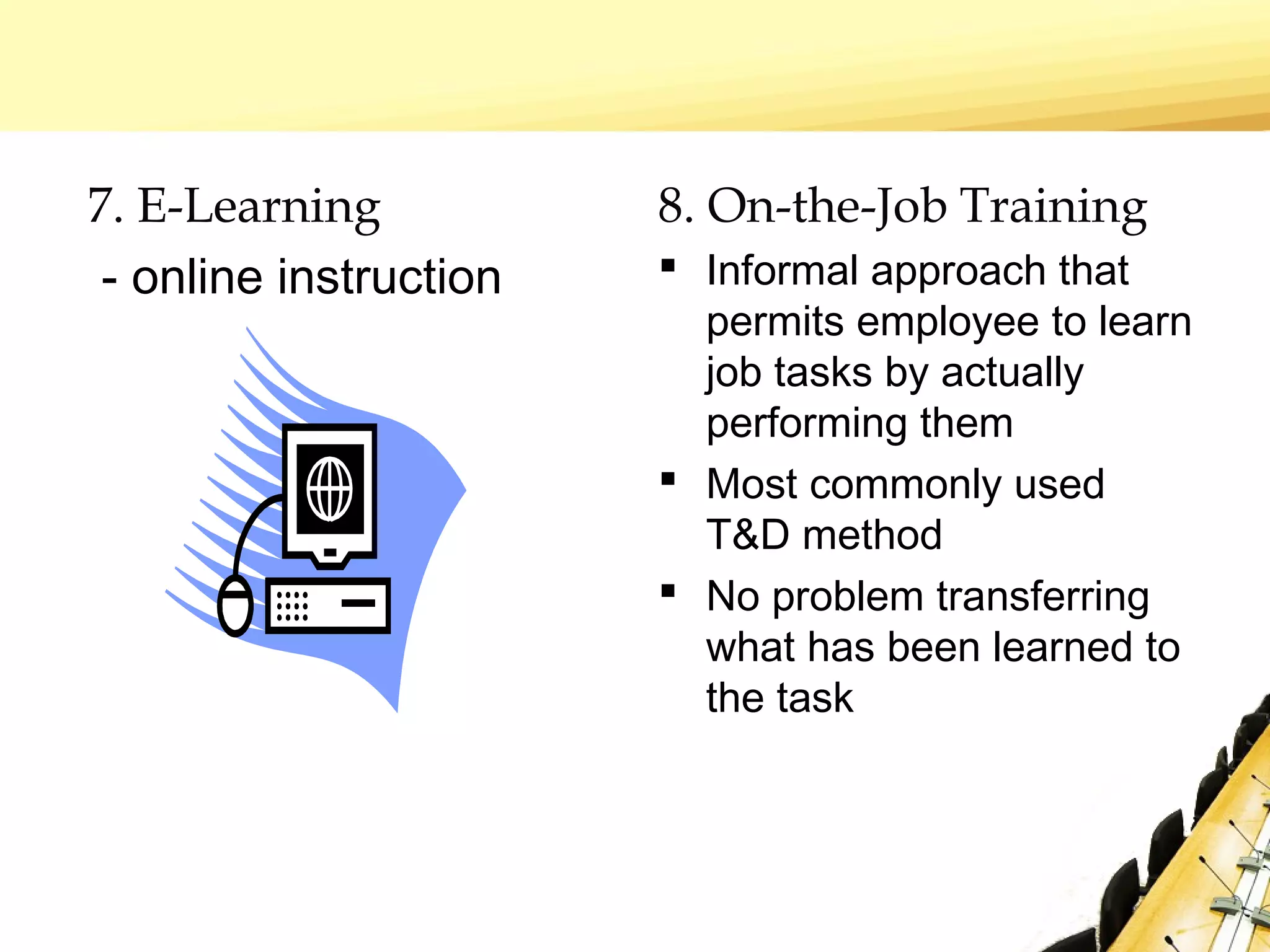
7. E-Learning
- online instruction
8. On-the-Job Training
 Informal approach that
permits employee to learn
job tasks by actually
performing them
 Most commonly used
T&D method
 No problem transferring
what has been learned to
the task
9. Job Rotation
 Employees move
from one job to
another to broaden
experience
 Helps new employees
understand variety of
jobs
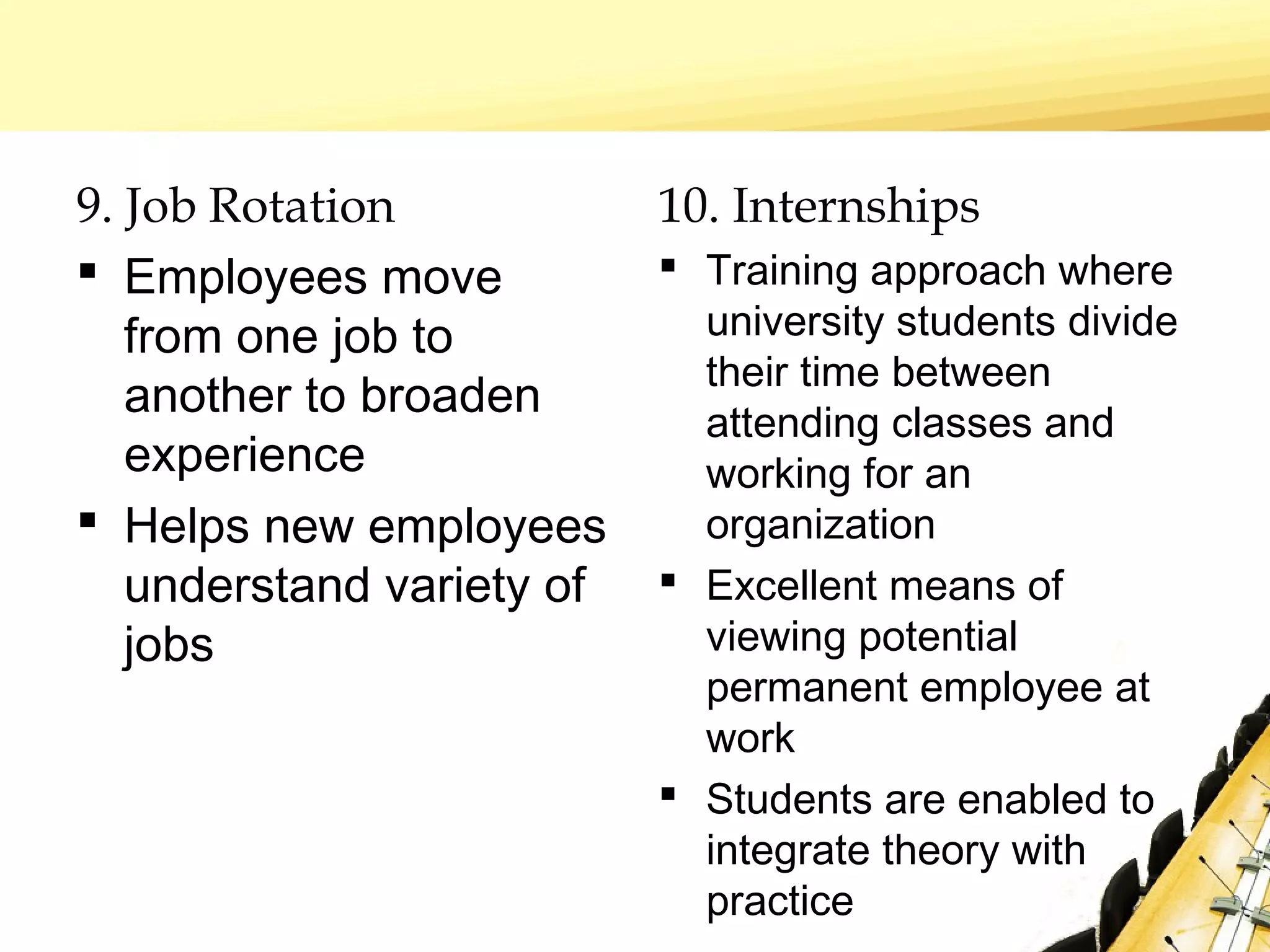
10. Internships
 Training approach where
university students divide
their time between
attending classes and
working for an
organization
 Excellent means of
viewing potential
permanent employee at
work
 Students are enabled to
integrate theory with
practice
What is training?
• Training is a systematic process through which
an organization’s human resources gain
knowledge and develop skills by instruction and
practical activities that result in improved
corporate performance.
Benefits/importance of Training
1. Improving an employee’s performance
2. Developing the group and teams skills needed to achieve
organizational goals
3. Giving employees the needed skills and knowledge to complete
assigned jobs, duties and tasks
4. Motivating employees to achieve higher standards
5. Improving customer service, which leads to customer satisfaction
6. Enhancing employee morale, motivation, and creativity
7. Enabling managers to reach unit goals and objectives
8. Giving employees the tools needed to analyze interpersonal and
situational factors that create obstacles to achieving high
performance
Types of formal training
1. Orientation training
- Geared for the newly hired and reassigned
personnel.
- Designed to give new employees the basic
knowledge, understanding, and skill needed for
successful job performance.
2. Remedial training
- Designed to correct observed deficiences in
employee knowledge, skills, and attitudes.
- Stress reduction, time management, presentation
skill building, computer software, etc.
3. Upgrading or advanced training
- Designed to improve or upgrade individual job
skill and knowledge.
- Programs include computer training, decision
making, employment laws, managing conflict,
conducting performance evaluation,
supervisory responsibilities, resolving
grievances, etc.
References
1. Tanuj Poddar
HR Analyst @ Tata Communications
India
2. Pranav Kumar Ojha
HR Senior Officer , University of Allahabad,
Coal ,India
3. Visit www.slideshare.com website
4. Office of Management & Budget
600 E. Boulevard Avenue, Bismarck, NY
Shukran and
wassalam
Kingsoft Office
Make Presentation much more fun

Training&development

  • 1.
    Training and Development Sittie PieronAbutazil-Du, RN MPA Student
  • 2.
    Chapter Objectives  Definetraining and development (T&D).  Explain factors influencing T&D  Describe the T&D process and how training needs are determined and objectives established.  What is training?  Benefits/importance of Training  Identify the various T&D methods.
  • 3.
    Nature of TrainingAnd Development Training and Development – it is any attempt to improve current or future employee’s performance by increasing it’s ability to perform through learning, usually by changing the employees attitude or increasing his or her skills and knowledge. – Heart of a continuous effort designed to improve employee competency and organizational performance - are planned efforts to facilitate the learning on job-related behavior on the part of the employees.
  • 4.
    AIMS/OBJECTIVES OF TRAINING& DEVELOPMENT • • Develop the competences of employees and improve their performance; • Help people to grow within the organization in order that, as far as possible, its future needs for human resource can be met from within • Reduce the learning time for employees starting in new jobs on appointment, transfers or promotion, and ensure that they become fully competent as quickly and economically as possible.
  • 5.
    Inputs in T&D 1.Skills – the technical know how… 2. Education- theoretical learning in classroom 3. Development -refers to learning opportunities designed to help employees grow - Involves learning that goes beyond today's job – more long-term focus. 4. Ethics- 5. Attitudinal changes
  • 6.
    Factors Influencing T&D •Top managers • Commitment from specialists and generalists • Technological advances • Organizational complexity • Learning style
  • 7.
    The Training andDevelopment (T&D) Process 1. Assessing training needs 2. Preparing training plan 3. Specifying training objectives 4. Designing the training program(s) 5. Selecting the instructional methods 6. Completing the training plan 7. Implementing the training program 8. Evaluating the training 9. Planning future training
  • 8.
    Assessing Training Needs Conducta training needs analysis by either one, or both, of the following • External approach (company, guests, society) • Internal approach – using a staff opinion survey - Request from employee - Change in agency vision or mission - Determination through performance management review
  • 9.
    2. Preparing TrainingPlan Consider whether to design a long (5-10 years), medium (3-5 years) or short (1 year) term plan. • Ask your self “What are we going to achieve in the time period?” • Use a holistic approach by using a calendar for inputting your training activities.
  • 10.
    3) Specifying TrainingObjectives Training Objectives must be specific & measurable. Why? Very difficult to measure effectiveness after course is finished. – What should trainees be able to accomplish after participating in the training program? – What is the desired level of such accomplishment, according to industry or organizational standards? – Do you want to develop attitudes, skills, knowledge or some combination of these three?
  • 11.
    4) Designing the TrainingProgram(s) 1. Program duration 2. Program structure 3. Instruction methods 4. Trainers qualification 5. Nature of trainees 6. Support resources- IEC materials, handouts 7. Training location & environment 8. Criteria & methods for assessing participant learning and achievement 9. Criteria & methods for evaluating the program
  • 12.
    5) Selecting InstructionalMethods Note: This is the most important step On-the job-training (OJT) – learn while you’re working Off -the job-training – In house, training or classroom – External, consultancies or attending external classes – Independent bodies, such as government talks – Distance learning, from books or notes – Computer-assisted learning – Interactive-video training – Video conferencing, same as classroom except teachers and students are in different locations.
  • 13.
    6) Completing theTraining Plan • Target group – assess your audience • Topic – task, skill or attitude ingredient • Method – direct (one way communication) or indirect (discussion, games, experimental exercises…). Important as evaluation of trainees usually lies on the perception on what they did in the training session • Time – length, period, breaks important to consider • Location – away from the office?
  • 14.
    7) Implementing theTraining Program Besides trainers qualifications and experience: • Participant selection • Group comfort - physical & psychological • Trainer enthusiasm & skills • Effective communication • Feedback mechanism • The need to learn new training skills • Preparation by trainers
  • 15.
    8) Evaluating theTraining Three Levels of Evaluation 1. Immediate Feedback  Survey or interview directly after training 1. Post-Training Test  Trainee applying learned tasks in workplace? 1. Post-Training Appraisals  Conducted by immediate supervisors of trainees
  • 16.
    9) Planning FutureTraining Last step in the training process • After taking all evaluated comments, trainers should modify the programs to keep good things and make suggested improvements – Remember, even with the same topic for different trainees, trainers should address many parts of the training process again and consider new approaches.
  • 17.
    T&D Methods 1. ClassroomPrograms  Lecture -type  Continue to be effective for many types of employee training  May incorporate some of other methods 2. Mentoring  Approach to advising, coaching, and nurturing, for creating practical relationship to enhance individual career, personal, and professional growth and development  Mentor may be located elsewhere in organization or in another firm  Relationship may be formal or informal
  • 18.
    3. Coaching  Oftenconsidered responsibility of immediate boss  Provides assistance much as a mentor 4. Role Playing  Respond to specific problems they may actually encounter in jobs  Used to teach such skills as:  interviewing  grievance handling  performance appraisal reviews conference leadership  team problem solving  communication
  • 19.
    5. Simulations • Trainingdevices that model the real world or programs replicating tasks away from the job site 6. Distance Learning and Videoconferencing  Interactive training  Used to: a. increase access to training b. ensure consistency of instruction c. reduce cost of delivering T&D programs
  • 20.
    7. E-Learning - onlineinstruction 8. On-the-Job Training  Informal approach that permits employee to learn job tasks by actually performing them  Most commonly used T&D method  No problem transferring what has been learned to the task
  • 21.
    9. Job Rotation Employees move from one job to another to broaden experience  Helps new employees understand variety of jobs 10. Internships  Training approach where university students divide their time between attending classes and working for an organization  Excellent means of viewing potential permanent employee at work  Students are enabled to integrate theory with practice
  • 22.
    What is training? •Training is a systematic process through which an organization’s human resources gain knowledge and develop skills by instruction and practical activities that result in improved corporate performance.
  • 23.
    Benefits/importance of Training 1.Improving an employee’s performance 2. Developing the group and teams skills needed to achieve organizational goals 3. Giving employees the needed skills and knowledge to complete assigned jobs, duties and tasks 4. Motivating employees to achieve higher standards 5. Improving customer service, which leads to customer satisfaction 6. Enhancing employee morale, motivation, and creativity 7. Enabling managers to reach unit goals and objectives 8. Giving employees the tools needed to analyze interpersonal and situational factors that create obstacles to achieving high performance
  • 24.
    Types of formaltraining 1. Orientation training - Geared for the newly hired and reassigned personnel. - Designed to give new employees the basic knowledge, understanding, and skill needed for successful job performance. 2. Remedial training - Designed to correct observed deficiences in employee knowledge, skills, and attitudes. - Stress reduction, time management, presentation skill building, computer software, etc.
  • 25.
    3. Upgrading oradvanced training - Designed to improve or upgrade individual job skill and knowledge. - Programs include computer training, decision making, employment laws, managing conflict, conducting performance evaluation, supervisory responsibilities, resolving grievances, etc.
  • 26.
    References 1. Tanuj Poddar HRAnalyst @ Tata Communications India 2. Pranav Kumar Ojha HR Senior Officer , University of Allahabad, Coal ,India 3. Visit www.slideshare.com website 4. Office of Management & Budget 600 E. Boulevard Avenue, Bismarck, NY
  • 27.

Editor's Notes

  • #6 Skills – a worker needs skills to operate machines and use other equipments - the technical know how - The employees, particularly the superviosrs and executives, needs interpersonal skills. To understand one’s self and others more better - e.g. listening, persuading, etc. 2. Education – purpose is to teach theoretical concepts and develop a sense of reasoning and judgment. 3. Ethics – study that deals with ideas about what is good and bad behaviour. 4. Attitudinal behavior – attitudes represent feelings and beliefs of individuals towards others. It affects motivation, satisfaction , and job commitment. Negative behavior needs to be converted into positive one.
  • #7 top management support – need their support for the T&D to be successful Commitment from specialists and generalists- need commitment from line managers and the like Technological advances- changes the need for different types of training. For example, the Internet strong influence the way recruiters find people Organizational complexity- interactions between people has become more complicated Learning styles- best time to learn is when the learning will be useful. The Internet has impacted the way training is delivered
  • #8 1. Determine the T&D Needs - Need assessment diagnoses present problems and future challenges organizations, companies and government sectors spends huge amount of money for trainings. 2. . Establish Specific Objectives Desired end results- expected outcomes Clear and concise objectives must be formulated
  • #9 Large amount are wasted if failed to conduct need assessment in an organization. It diagnoses present problems, and future challenges can be met through T&D. Problems of inadequacy in performance due to lack of skills, knowledge can be remedied through training. E.g. basic computer literacy program
  • #12 -we need to address vital issues
  • #19 3. Coaching – a private teacher who gives someone lessons in a particular subject. Trains members makes a decisions about how the team plays during games. 4. role playing
  • #20 5. Simulation: give example on EHCP simulation….on site conduct of program evaluation with tool used specific for the OMS. 6. ConCall --
  • #22 9. Site example: SHUFFLING OF EMPLOYEES (banks) 10. Internship: Medical courses