i
A PRACTICAL TRAINING SEMINAR REPORT
At
BHARAT SANCHAR NIGAM LIMITED
Submitted by
SURAJ SINGH SOLANKI
UNDER THE GUIDANCE OF
MR.AJAY CHOUDHARY
In partial fulfillment for the award of
BACHELOR OF TECHNOLOGY IN
ELECTRONICS AND COMMUNICATION ENGINEERING
FROM
RAJASTHAN TECHNICAL UNIVERSITY
KOTA
DEPARTMENT OF
ELECTRONICS AND COMMUNICATION ENGINEERING
JODHPUR INSTITUTE OF ENGINEERING AND TECHNOLOGY
MOGRA, N. H. 65, PALI ROAD,
JODHPUR-342802
BATCH 2016-17
ii
iii
PREFACE
In this report, there is a brief detail about the BSNL organization structure and their
switching systems in the telephone exchanges. This report is organized into 10 chapters-
Chapter 1 gives an Overview on BSNL Company, their organizational structure,
achievement and contribution to development of telecommunication.
Chapter 2 provides an Overview on telecommunication networks, Telephone exchange
and it's units and switching network implementation.
Chapter 3 deals with the Functions and Organizations of the MDF parts and Leased line
concepts.
Chapter 4 deals with the Multiplexing techniques and PCM principles and Frame
structure in PCM.
Chapter 5 describe about the Optical fiber communication, their architecture and their
classification, DWDM technology.
Chapter 6 gives a basic idea about the Cellular Technology, Frequency reuse concept,
Multiple access techniques which have 2 parts i.e. FDMA and TDMA.
Chapter 7 explains the Global System for Mobile communication (GSM) technology, its
architecture and its features.
Chapter 8 introduces the Broadband network and its technologies, Wi-Fi network, its
working and its benefits & limitations.
Chapter 9 gives an overview on CODE DIVISION MULTIPLE ACCESS (CDMA)
technologies and UMTS Technologies.
Chapter 10 gives an overview on the WI-MAX network and its architecture.
iv
ACKNOWLEDGEMENT
It is with profound gratitude that I express my deep indebtedness to all the employees of
B.S.N.L. without whose support and guidance it would not have been possible for this
training to have materialized and taken a concrete shape.
I would like to make a number of acknowledgements to those who have helped me to
prepare this Seminar.
We are highly grateful to Prof. O. P. VYAS, Dean (Engineering), JIET for proving us
this opportunity to carry out independent study on this topic.
The divine support given by our guide MR.AJAY CHOUDHARY [SDE(INTERNAL)]
and Prof. K. K. ARORA, HOD(M. Tech) & Prof. (Dr.) HEMANT PUROHIT, HOD
(B. Tech) Department of Electronics and Communication Engineering, J.I.E.T, Jodhpur,
without them the work would not possible.
NAME
SURAJ SINGH SOLANKI
ROLL NO
13EJIEC105
v
ABSTRACT
Organizations are made up of people and function through people. Without people,
organizations cannot exist. The resources of men, money, material, machinery, and
mechanism are connected, coordinated and utilized through people. Engineers need to
concentrate more on mechanism and the way in which things have been made. The need
of training arises for doing things yourself, understanding its way.
Practical exposure for doing things makes a person conversant to the technicalities
involved in any job. In view of such benefits, imparting of vocational training has been
made an integral part of any academic structure.
In B.S.N.L., training is given to Engineering Aspirants to secure future in the dynamic
world of telecommunications. Today telecommunication industry is one of the very
fastest growing industries in the world.
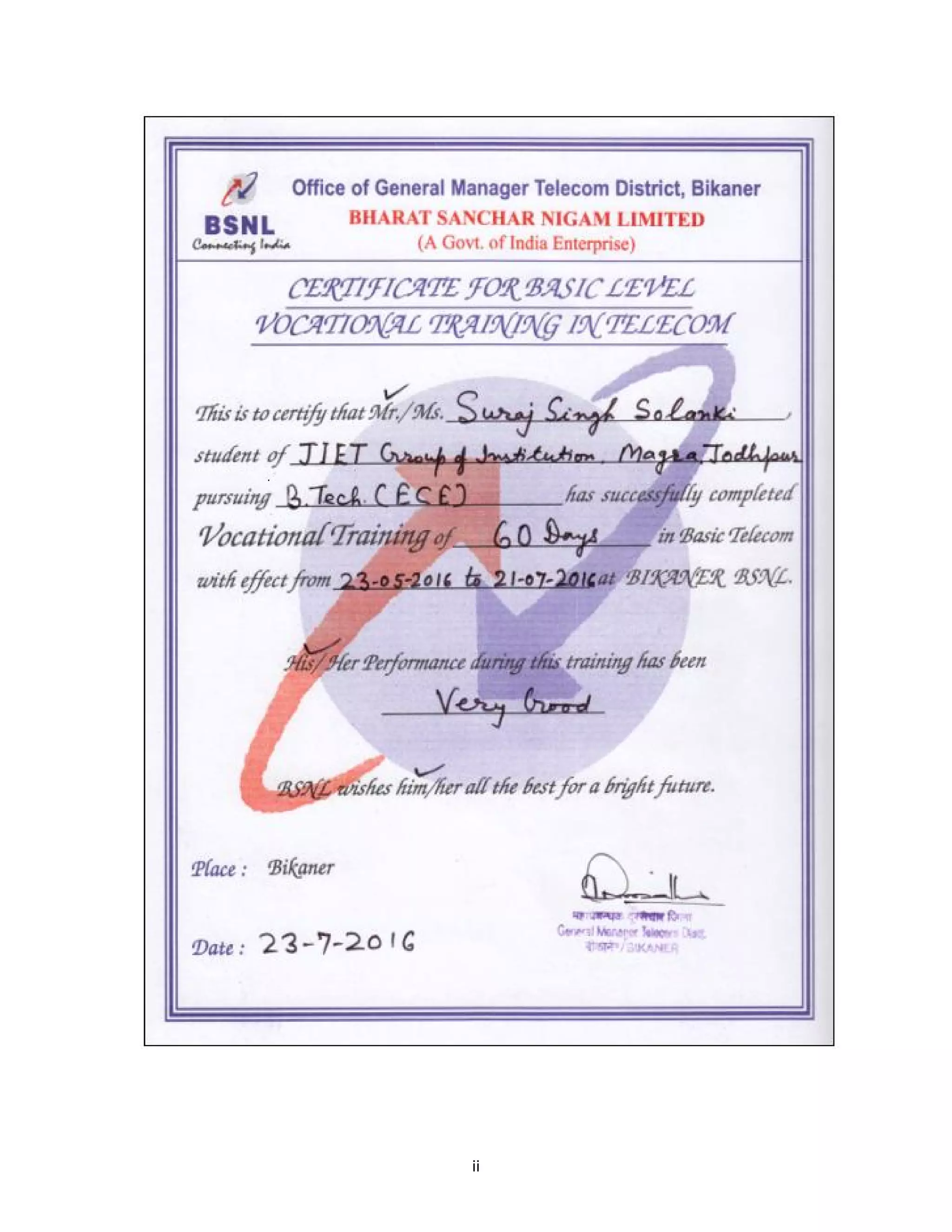
In this order I have taken 60 days BSNL training. In my report I try to introduce
Telephone exchange and its switching system, MDF and Leased line concepts,
Multiplexing and PCM principles, optical fiber communication principles, GSM network
architecture, Broadband and Wi-Fi principles.
vi
LIST OF FIGURES
FIGURE.NO. FIGURE NAME PAGE NO.
Fig. 2.1 Telephone Exchange 4
Fig. 2.2 Power Supply for Telephone Exchange 5
Fig. 2.3 Circuit Switching 7
Fig. 2.4 Packet Switching 8
Fig. 3.1 Main Distribution Frame 10
Fig. 4.1 FDM Principle 12
Fig. 4.2 Time Division Multiplexing 13
Fig. 4.3 Sampling Process 14-15
Fig. 4.4 Quantizing Positive Signal 16
Fig. 4.5 Sampling and combining Channels 17
Fig. 4.6 Structure of frame in PCM 18
Fig. 5.1 Optical Fiber Transmission 19
Fig. 5.2 Propagation of light through fiber 20
Fig. 6.1 Ideal, Actual and Fictitious cell models 24
Fig. 6.2 Common reuse patterns of hexagonal cell structures 24
Fig. 6.3 Illustration of frequency reuse 25
Fig. 6.4 Cell-site antenna tower with various antennas mounted
on it
26
Fig. 6.5 The Concept of FDMA 27
Fig. 6.6 FDMA Bandwidth Structure 27
Fig. 6.7 The Basic structure of an FDMA system 28
Fig. 6.8 The Concept of TDMA 29
Fig. 6.9 Structure of forward and reverse channels in a TDMA
system
29
Fig. 7.1 GSM network Architecture 31
Fig. 8.1 DSL Modulation 38
Fig. 8.2 Multiplexing Voice and Data: DSLAM 40
vii
Fig. 8.3 Wi-Fi Network 41
Fig. 9.1 UMTS network architecture 46
Fig. 9.2 UTRAN architecture 47
Fig. 10.1 WI-MAX Network Architecture 50
viii
LIST OF TABLES
TABLE.NO. TABLE NAME PAGE NO.
8.1 Comparison of the DSLs 39
8.2 Table of Distance Limitations 39-40
ix
TABLE OF CONTENTS
S.NO. CHAPTER NAME PAGE
NO.
Title Page I
Certificate Ii
Preface iii
Acknowledgement Iv
Abstract V
List of Figures vi-vii
List of Tables viii
1. COMPANY OVERVIEW 1
1.1 History 1
1.2 Company Profile,
Organization Structure
1
1.3 Institutional Framework 1-2
1.4 BSNL Contribution to
Development of Telecom
2
1.5 Achievements of BSNL 2
2. OVERVIEW OF TELECOMMUNICATION NETWORKS 3
2.1 Introduction 3
2.2 Public Switch Telephone Network 3
2.2.1 call setup 3
2.3 Telephone Exchange 4
2.4 Units of Telephone Exchange 4-5
2.4.1 Computer unit 5
2.4.2 Power plant 5
2.4.3 Main distribution frame 5
2.5 Implementation of Switching Network 6
2.5.1 Space division switching network 6
x
2.5.2 Time division switching network 6
2.6 Types of Switching 6
2.6.1 Circuit switching 6-7
2.6.2 Packet switching 7-8
3. CONCEPT OF MDF & LEASED LINE 9
3.1 Main Distribution Frame 9
3.2 Functions of MDF 9
3.3 Organization of the MDF Parts 9-10
3.3.1 Horizontal side 9-10
3.3.2 Vertical side 10
3.4 Leased Lines 10-11
3.5 Drawbacks of Traditional Leased Line Circuits 11
4. PCM PRINCIPLES 12
4.1 Multiplexing Techniques 12
4.1.1 Frequency Division Multiplexing (FDM) 12
4.1.2 Time Division Multiplexing (TDM) 12-13
4.2 Pulse Code Modulation 13-17
4.2.1 Filtering 14
4.2.2 Sampling 14-15
4.2.3 Quantization 15-16
4.2.4 Encoding 17
4.3 Structure of Frame in PCM 17-18
5. FIBER OPTIC TRANSMISSION SYSTEM 19
5.1 Introduction 19
5.2 Architecture of Fiber 19-20
5.3 Classification of Optical Fiber 20
5.3.1 Step-index multimode fiber 20
5.3.2 Graded-index multimode fiber 20
5.3.3 Single-mode fiber 20
5.4 Advantages of Fiber Optics 20-21
xi
5.5 Varieties of WDM 21
5.5.1 WDM 21
5.5.2 CWDM 21
5.5.3 DWDM 21
5.6 Dense Wavelength Division Multiplexing 21-22
5.7 Development of DWDM Technology 22-23
6. MOBILE COMMUNICATION PRINCIPLES 24
6.1 Cellular Principles 24
6.2 Frequency Reuse Concept 25
6.3 Characteristics of Cellular Antennas at Cell Site 25-26
6.4 Multiple Access Techniques 26-29
6.4.1 Frequency Division Multiple Access (FDMA) 27-28
6.4.2 Time Division Multiple Access (TDMA) 28-29
7. GLOBAL SYSTEM FOR MOBILE COMMUNICATION
(GSM)
30
7.1 Introduction 30
7.2 Architecture of the GSM network 30-34
7.2.1 Mobile Station (MS) 31-32
7.2.2 Base Station Subsystem (BSS) 32
7.2.3 Network and Switching Subsystem (NSS) 32-34
7.2.4 Gateway MSC 34
7.3 Identifiers Used in GSM Network 34-35
7.3.1 IMEI (International Mobile Equipment Identity) 34
7.3.2 SIM (Subscriber Identity Module) 34
7.3.3 MSISDN (Mobile System ISDN) 34-35
7.3.4 IMSI (International Mobile Subscriber Identity) 35
7.3.5 TMSI (Temporary Mobile Subscriber Identity) 35
7.4 Features of GSM 35
8. BROADBAND AND WI-FI (WIRELESS FIDELITY) 36
8.1 Broadband Network 36
xii
8.2 Services Available Through Broadband 36-37
8.3 Broadband Delivery Technology 37-40
8.3.1 The Misunderstood copper 37
8.3.2 Broadband over copper: the DSLs 37-39
8.3.3 ADSL 39-40
8.3.4 Multiplexing Voice and Data: DSLAM 40
8.4 WI-FI Network 40
8.5 Working of WI-FI Network 41-42
8.6 Benefits of WI-FI 42
8.7 Limitations of WI-FI 42-43
9. CDMA AND UMTS TECHNOLOGY 44
9.1 CDMA Technology 44
9.2 Advantages of CDMA 44
9.3 Disadvantages of CDMA 44
9.4 Difference between CDMA and GSM 44-45
9.5 UMTS Technology (3G) 45
9.6 UMTS Network Architecture 45-47
9.6.1 UTRAN Architecture 46-47
9.6.2 Radio Network Controller (RNC) 47
10. WI-MAX 48
10.1 Wireless Broadband Services 48
10.2 Salient Features of WI-MAX 48-49
10.3 Evolution of Broadband Wireless 49-50
10.3.1 Narrowband Wireless Local loop system 49
10.3.2 First-generation Broadband Systems 49
10.3.3 Second-Generation Broadband Systems 49-50
10.3.4 WI-MAX and other broadband wireless
technologies
50
10.4 WIMAX Network Architecture 50-51
10.4.1 Base Station (BS) 51
xiii
10.4.2 Access Service Network Gateway (ASN-GW) 51
10.4.3 Connectivity Service Network (CSN) 51
11. CONCLUSION 52
12. BIBLIOGRAPHY AND REFERENCES 53
1
CHAPTER-1
COMPANY OVERVIEW
1.1 HISTORY:
The initial phase of telecom reforms began in 1984 with the creation of Center for
Department of Telemetries (C-DOT) for developing indigenous technologies and private
manufacturing of customer premise equipment. Soon after, the Mahanagar Telephone Nigam
Limited (MTNL) and Videsh Sanchar Nigam Limited (VSNL) were set up in 1986.The
Telecom Commission was established in 1989. A crucial aspect of the institutional reform of
the Indian telecom sector was setting up of an independent regulatory body in 1997 – the
Telecom Regulatory Authority of India (TRAI), to assure investors that the sector would be
regulated in a balanced and fair manner. In 2000, DoT corporatized its services wing and
created Bharat Sanchar Nigam Limited.
1.2 COMPANY PROFILE & ORGANISATION STRUCTURE:
Bharat Sanchar Nigam Limited (BSNL) keeps most of India talking. The country's
largest landline company provides local-exchange excess and domestic long distance services
through a network of more than 46 million access lines covering most of India.(It does not
provide service in Delhi & Mumbai).Serving business & individual customers, it also offers
GSM & CDMA based wireless communications ,telegraph, data & Internet services and
managed network services.
The financial status comprise of 48 circles, out of which one circle is audited by them &
remaining 47 circles are audited by branch auditors appointed under section 228 of the
Companies Act,1956 by the Comptroller & Auditor general of India.
1.3 INSTITUTIONAL FRAMEWORK:
It is defined as the system of formal laws, regulations, and procedures, and informal
conventions, customs, and norms, that broaden, mold, and restrain socio-economic activity
and behavior. The country has been divided into units called Circles, Metro Districts,
Secondary Switching Areas (SSA), Long Distance Charging Area (LDCA) and Short
Distance Charging Area (SDCA).
In India, DoT is the nodal agency for taking care of telecom sector on behalf of government.
Its basic functions are:
 Policy Formulation
2
 Review of performance
 Licensing
 Wireless spectrum management
 Administrative monitoring of PSUs
 Research & Development
 Standardization/Validation of Equipment.
1.4 BSNL CONTRIBUTION TO DEVELOPMENT OF TELECOM:
Bharat Sanchar Nigam Limited was formed in year 2000 and took over the service
Providers role from DOT. BSNL’s roadmap for providing customer with access to the latest
telecommunications services without losing sight of universal service access has been by way
of utilizing optimally the existing infrastructure and accelerating advances in technological
component by innovative absorption.
1.5 ACHIEVEMENTS OF BSNL:
 BSNL has a customer base of over 9 crore and is the fourth largest integrated telecom
operator in the country.
 BSNL is the market leader in Broadband, landline and national transmission network.
 BSNL is also the only operator covering over 5 lakh village with telecom
connectivity.
3
CHAPTER-2
OVERVIEW OF TELECOMMUNICATION NETWORKS
2.1 INTRODUCTION:
"Telecommunication" means 'tele' + 'communication', 'tele' means far so
Telecommunication means long distance communication. The telephone is a
telecommunication device that is used to transmit and receive electronically or digitally
encoded speech between two or more people conversing. Most telephones operate through
transmission of electric signals over a complex telephone network which allows almost any
phone user to communicate with almost any other user. The telecommunication links and
switching were mainly designed for voice communication. With the appropriate
attachments/equipments, they can be used to transmit data.
Telecommunication is mainly concerned with the transmission of messages between
two distant points. The signal that contains the messages is usually converted into electrical
waves before transmission. Our voice is an analog signal, which has amplitude and frequency
characteristics.
2.2 PUBLIC SWITCH TELEPHONE NETWORK (PSTN):
PSTN is a telephone subscribers networks which is connected to an automatic public
telephone exchanges interconnected by a transmission circuit.
2.2.1 Call Setup:
 When a subscriber calls to another subscriber first its request goes to the nearest
switching centre that is PSTN (Public Switching Telecommunication Network). Then
it processes the caller and subscriber’s number if it exists in the same BSC then call
setup is completed.
 If subscriber is not in the same BSC (Base Switching Centre) then call transfer to
MSC (Main Switching Centre) then it transfers the call to prior BSC then call setup is
completed.
 If Caller calls to a mobile subscriber then call transfer are done by MTSO (mobile
telephone switching office) now call transfer is done on BTSs (Base Transceiver
Station) and call setup is completed.
4
2.3 TELEPHONE EXCHANGE:
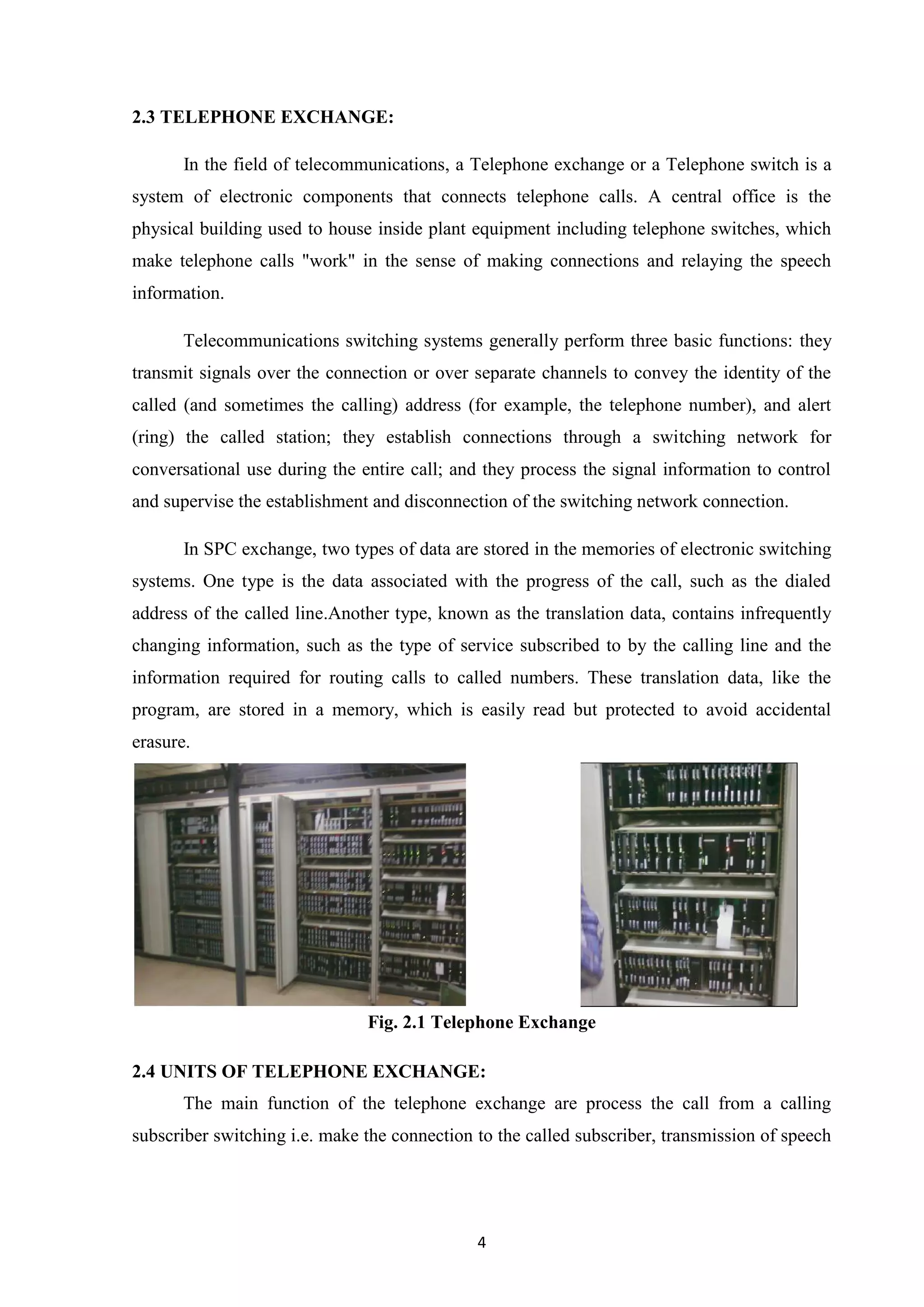
In the field of telecommunications, a Telephone exchange or a Telephone switch is a
system of electronic components that connects telephone calls. A central office is the
physical building used to house inside plant equipment including telephone switches, which
make telephone calls "work" in the sense of making connections and relaying the speech
information.
Telecommunications switching systems generally perform three basic functions: they
transmit signals over the connection or over separate channels to convey the identity of the
called (and sometimes the calling) address (for example, the telephone number), and alert
(ring) the called station; they establish connections through a switching network for
conversational use during the entire call; and they process the signal information to control
and supervise the establishment and disconnection of the switching network connection.
In SPC exchange, two types of data are stored in the memories of electronic switching
systems. One type is the data associated with the progress of the call, such as the dialed
address of the called line.Another type, known as the translation data, contains infrequently
changing information, such as the type of service subscribed to by the calling line and the
information required for routing calls to called numbers. These translation data, like the
program, are stored in a memory, which is easily read but protected to avoid accidental
erasure.
Fig. 2.1 Telephone Exchange
2.4 UNITS OF TELEPHONE EXCHANGE:
The main function of the telephone exchange are process the call from a calling
subscriber switching i.e. make the connection to the called subscriber, transmission of speech
5
and signals between these terminations with reliable accuracy. For smoother working of
exchange, following units are very important-
(i) Computer unit
(ii) Power plant
(iii)MDF
2.4.1 Computer unit:-
It deals with additional services of the exchange to the customers with the help of
computers.
2.4.2 Power plant:-
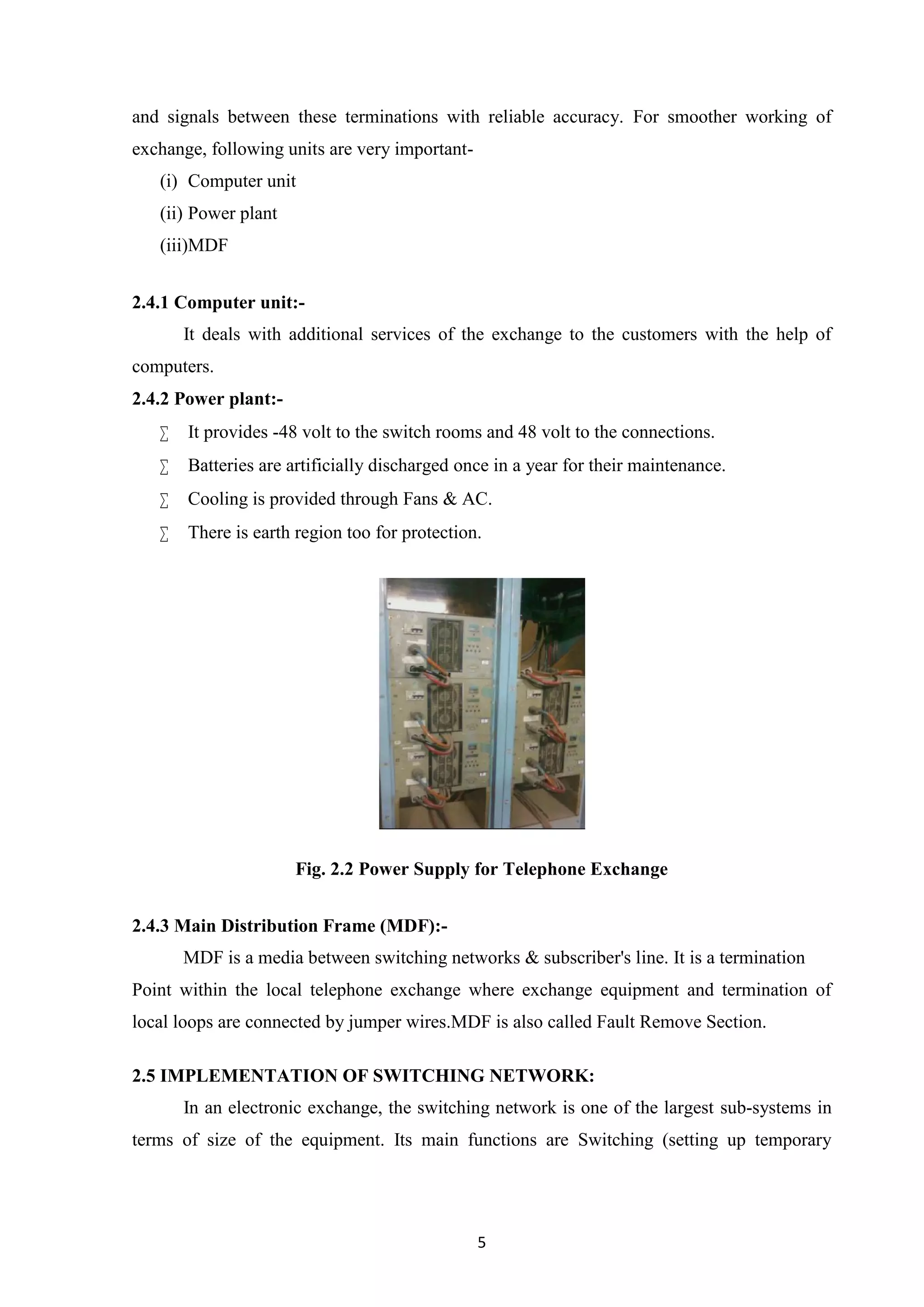
 It provides -48 volt to the switch rooms and 48 volt to the connections.
 Batteries are artificially discharged once in a year for their maintenance.
 Cooling is provided through Fans & AC.
 There is earth region too for protection.
Fig. 2.2 Power Supply for Telephone Exchange
2.4.3 Main Distribution Frame (MDF):-
MDF is a media between switching networks & subscriber's line. It is a termination
Point within the local telephone exchange where exchange equipment and termination of
local loops are connected by jumper wires.MDF is also called Fault Remove Section.
2.5 IMPLEMENTATION OF SWITCHING NETWORK:
In an electronic exchange, the switching network is one of the largest sub-systems in
terms of size of the equipment. Its main functions are Switching (setting up temporary
6
connection between two or more exchange terminations), Transmission of speech and signals
between these terminations, with reliable accuracy.
There are two types of electronic switching system-
(i)Space Division Switching System
(ii)Time Division Switching System
2.5.1 Space Division Switching System:-
In a space Division Switching system, a continuous physical path is set up between
input and output terminations. This path is separate for each connection and is held for the
entire duration of the call. Path for different connections is independent of each other. Once a
continuous path has been established. Signals are interchanged between the two terminations.
Such a switching network can employ either metallic or electronic cross points. Previously,
usage of metallic cross-points using reed relays and all were favored. They have the
advantage of compatibility with the existing line and trunk signaling conditions in the
network.
2.5.2 Time Division Switching System:-
In Time Division Switching, a number of calls share the same path on time division
sharing basis. The path is not separate for each connection, rather, is shared sequentially for a
fraction of a time by different calls. This process is repeated periodically at a suitable high
rate. The repetition rate is 8 KHz, i.e. once every 125 microseconds for transmitting speech
on telephone network, without any appreciable distortion. These samples are time
multiplexed with staggered samples of other speech channels, to enable sharing of one path
by many call.
2.6 TYPES OF SWITCHING:
There are two types of switching-
(i)Circuit Switching
(ii)Packet Switching
2.6.1 Circuit Switching:- Circuit switching is a methodology of implementing a
telecommunications network of in which two network nodes established a dedicated
communication channel (circuit) through the network before the nodes may communicate.
The circuit functions as if the nodes were physically connected as with an electrical circuit.
The defining example of a circuit-switched network is the early analog telephone
network. When a call is made from one telephone to another, switches within the telephone
7
exchanges create a continues wire circuit between the two telephones for as long as the call
lasts. Circuit switching is commonly used for connecting voice circuits. There is a diagram of
Circuit Switching as shown in figure 2.3.
Fig. 2.3 Circuit Switching
2.6.2 Packet Switching:- Packet switching is a digital network transmission process in
which data is broken into suitably sized pieces or blocks for fast and efficient transfer via
different network devices. When a computer attempts to send a file to another computer, the
file is broken into packets so that it can be sent across the network in the most efficient way.
These packets are routed by network devices to the destination. In this switching, path is
shared along computers. Packet switching is used in data/internet connections. There is a
diagram of Packet Switching as shown in figure 2.4.
Fig. 2.4 Packet Switching
8
CHAPTER-3
CONCEPT OF MDF & LEASED LINE
3.1 MAIN DISTRIBUTION FRAME:
MDF is a media between switching networks & subscriber's line. It is a termination
Point within the local telephone exchange where exchange equipment and termination of
local loops are connected by jumper wires. MDF is also called Fault Remove Section.
3.2 FUNCTIONS OF MDF:
 All cable copper wires supplying services through user telephone lines are terminated
and distributed through MDF.
 The most common kind of large MDF is a long steel rack accessible from both sides.
Each jumper is a twisted wire.
 It consists of local connection and broadband connection frames for the main
Exchange area.
 The MDF usually holds central office protective devices including heat coils and
functions as a test point between a line and the office.
 It provides testing of calls.
 It checks whether fault is indoor or external.
 All lines terminate individually.
3.3 ORGANIZATION OF THE MDF PARTS:
The organization of the MDF is divided into two parts-
(i) Horizontal Side
(ii) Vertical Side
3.3.1 Horizontal Side:- It is subdivided into 2 parts i.e. Exchange side & Subscriber side.
(i)Rack- On the rack, the tags are situated. One Rack is having 8 tags. The counting
is done from up(0) to down(7).
(ii)Tag-Each rack consists of 8 tags-
9
1 tag = 4 core
1 core=4 bunch
1 bunch=2 line
(iii)Wedge-If we want to disconnect any two numbers, then we insert a wedge
Between subscriber side and exchange side. Here wedge works as insulator made of
Plastic.
Fig. 3.1 Main Distribution Frame
3.3.2 Vertical Side:- The vertical side is connected to the underground cable. This cable
is having 100 pairs. These pairs is distributed when we allot the telephone to the
Subscriber. Vertical side is again subdivided into 2 parts-One part is connected with
the horizontal side and another with the subscriber line by using 100 pair
Underground cable.
3.4 LEASED LINE:
A leased line is a dedicated telephone connection between two points that is set up
from a company or other organization by a telecommunication common carrier. They can be
used for telephone, data, or Internet services. Businesses use a leased line to connect to
geographically distant offices because it guarantees bandwidth for network traffic. For
example, a bank may use a leased line in order to easily transfer financial information from
one office to another. Customers generally pay a flat monthly rate for the service depending
on the distance between the two points. Leased lines do not have telephone numbers. The
information sent through the leased line travels along dedicated secure channels, eliminating
the congestion that occurs in shared networks.
10
3.5 DRAWBACKS OF TRADITIONAL LEASED LINE CIRCUITS:
1. Limited range of services - Only Plain Leased Line Service, Data cards support
only up to 64 kbps, no support for N x 64 Kbps.
2. From Operator point of view in case of Leased Line Circuit different boxes from
different vendors so difficult to manage & control.
3. No Centralized Monitoring or alarm or performance monitoring.
11
CHAPTER-4
PCM PRINCIPLES
4.1 MULTIPLEXING TECHNIQUES:
There are basically two types of multiplexing techniques-
(i)Frequency Division Multiplexing (FDM)
(ii)Time Division Multiplexing (TDM)
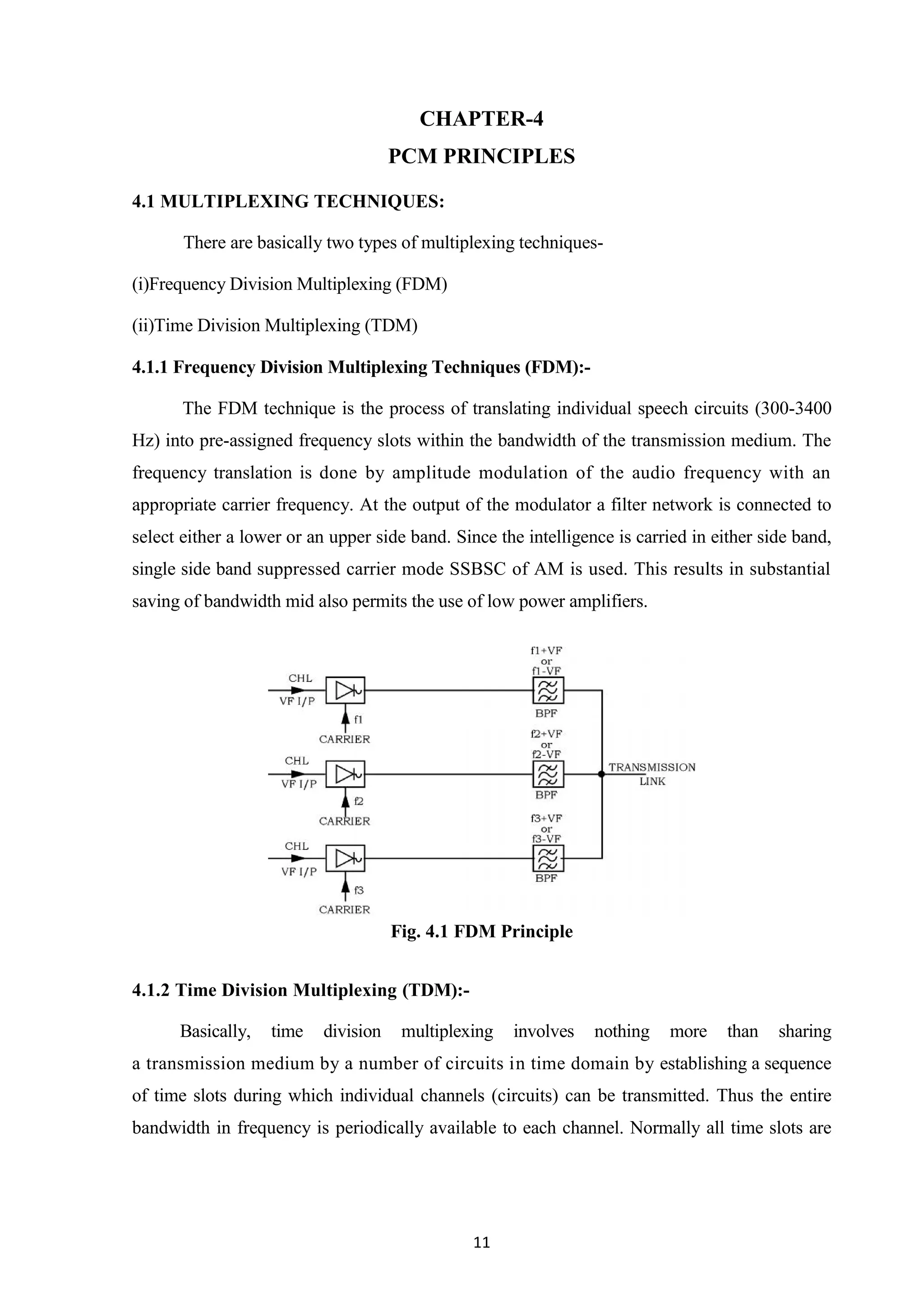
4.1.1 Frequency Division Multiplexing Techniques (FDM):-
The FDM technique is the process of translating individual speech circuits (300-3400
Hz) into pre-assigned frequency slots within the bandwidth of the transmission medium. The
frequency translation is done by amplitude modulation of the audio frequency with an
appropriate carrier frequency. At the output of the modulator a filter network is connected to
select either a lower or an upper side band. Since the intelligence is carried in either side band,
single side band suppressed carrier mode SSBSC of AM is used. This results in substantial
saving of bandwidth mid also permits the use of low power amplifiers.
Fig. 4.1 FDM Principle
4.1.2 Time Division Multiplexing (TDM):-
Basically, time division multiplexing involves nothing more than sharing
a transmission medium by a number of circuits in time domain by establishing a sequence
of time slots during which individual channels (circuits) can be transmitted. Thus the entire
bandwidth in frequency is periodically available to each channel. Normally all time slots are
12
equal in length. Each channel is assigned a time slot with a specific common repetition period
called a frame interval.
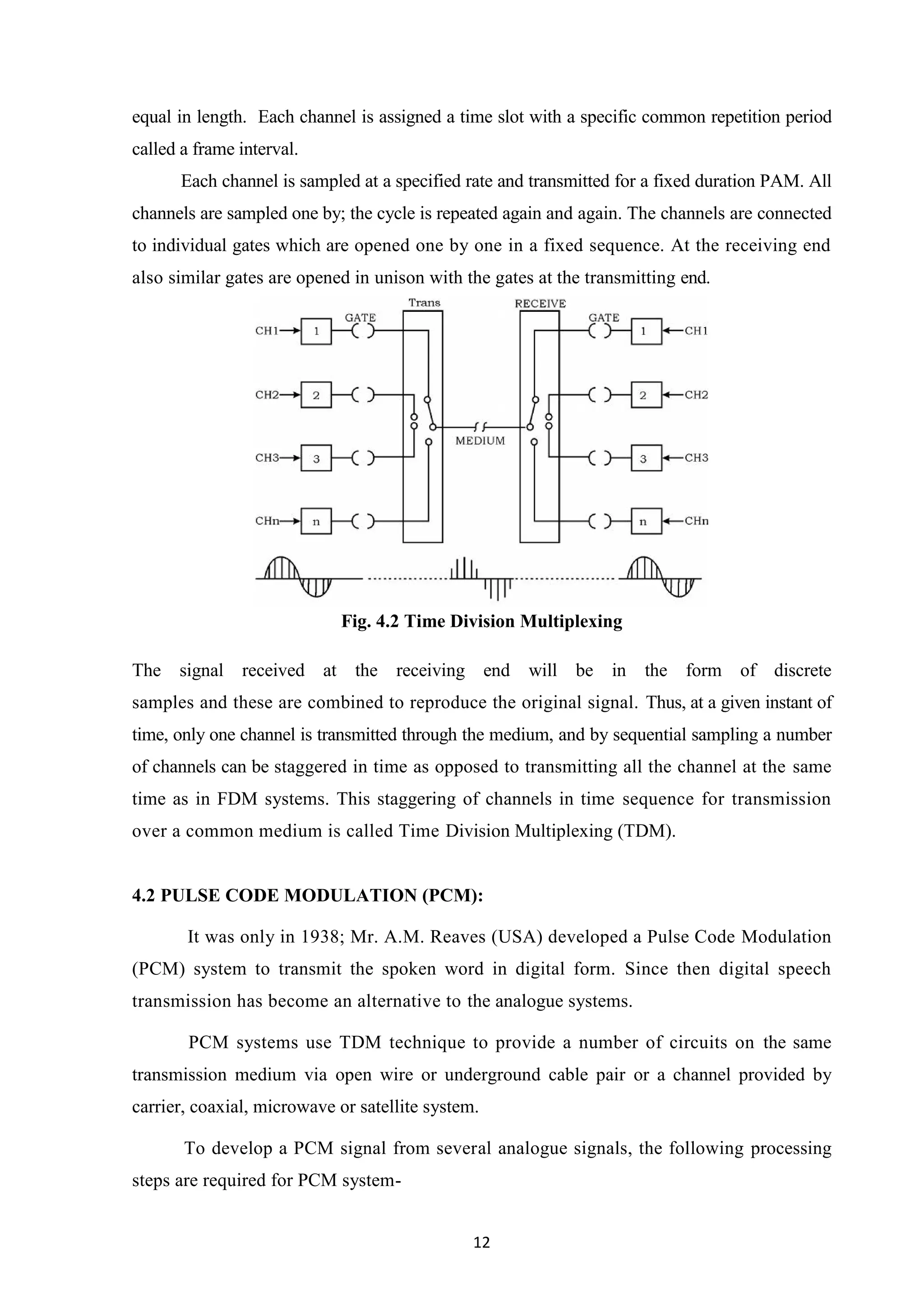
Each channel is sampled at a specified rate and transmitted for a fixed duration PAM. All
channels are sampled one by; the cycle is repeated again and again. The channels are connected
to individual gates which are opened one by one in a fixed sequence. At the receiving end
also similar gates are opened in unison with the gates at the transmitting end.
Fig. 4.2 Time Division Multiplexing
The signal received at the receiving end will be in the form of discrete
samples and these are combined to reproduce the original signal. Thus, at a given instant of
time, only one channel is transmitted through the medium, and by sequential sampling a number
of channels can be staggered in time as opposed to transmitting all the channel at the same
time as in FDM systems. This staggering of channels in time sequence for transmission
over a common medium is called Time Division Multiplexing (TDM).
4.2 PULSE CODE MODULATION (PCM):
It was only in 1938; Mr. A.M. Reaves (USA) developed a Pulse Code Modulation
(PCM) system to transmit the spoken word in digital form. Since then digital speech
transmission has become an alternative to the analogue systems.
PCM systems use TDM technique to provide a number of circuits on the same
transmission medium via open wire or underground cable pair or a channel provided by
carrier, coaxial, microwave or satellite system.
To develop a PCM signal from several analogue signals, the following processing
steps are required for PCM system-
13
• Filtering
• Sampling
• Quantization
• Encoding
4.2.1 Filtering:-
Filters are used to limit the speech signal to the frequency band 300-3400 Hz.
4.2.2 Sampling:-
"If a band limited signal is sampled at regular intervals of time and at a rate equal to or
more than twice the highest signal frequency in the band, then the sample contains all the
information of the original signal." Mathematically, if fH is the highest frequency in the signal
to be sampled then the sampling frequency Fs needs to be greater than 2 fH.
i.e. fs>2 fH
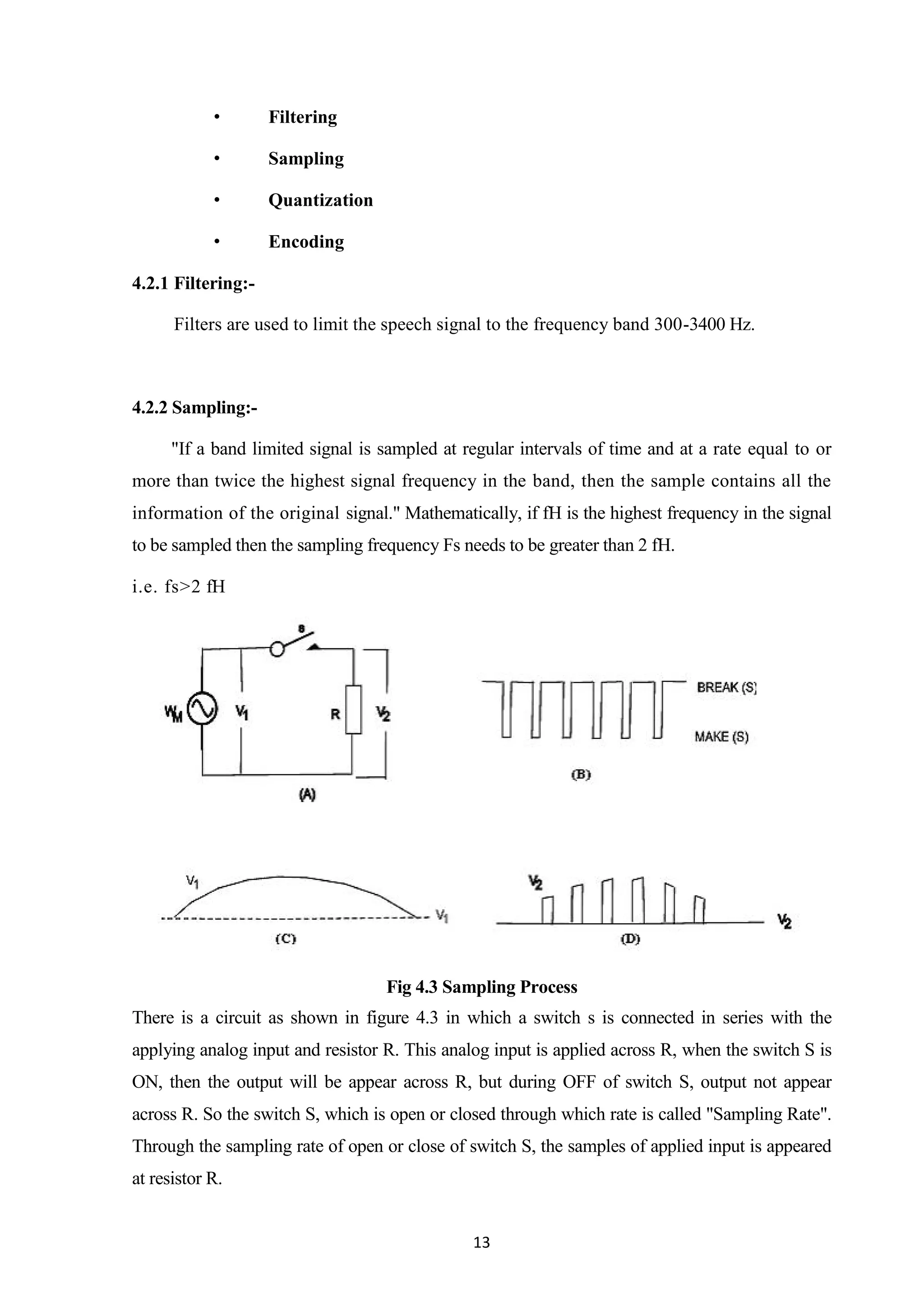
Fig 4.3 Sampling Process
There is a circuit as shown in figure 4.3 in which a switch s is connected in series with the
applying analog input and resistor R. This analog input is applied across R, when the switch S is
ON, then the output will be appear across R, but during OFF of switch S, output not appear
across R. So the switch S, which is open or closed through which rate is called "Sampling Rate".
Through the sampling rate of open or close of switch S, the samples of applied input is appeared
at resistor R.
14
Let us say our voice signals are band limited to 4 KHz and let sampling frequency be 8 KHz.
Time period of sampling Ts = 1 sec
8000
Or Ts = 125 micro seconds
If we have just one channel, then this can be sampled every 125 microseconds and the
resultant samples will represent the original signal. But, if we are to sample N channels one
by one at the rate specified by the sampling theorem, then the time available for sampling each
channel would be equal to Ts/N microseconds.
In a 32 channel PCM system. TS i.e. 125 microseconds are divided into 32 parts. That is
30 time slots are used for 30 speech signals, one time slot for signaling of all the 30
channels, and one time slot for synchronization between Transmitter & Receiver.
The time available per channel would be Ts/N = 125/32 = 3.9 microseconds. Thus in a 30
channel PCM system, time slot is 3.9 microseconds and time period of sampling i.e..the
interval between 2 consecutive samples of a channel is 125 microseconds. This duration i.e. 125
microseconds is called Time Frame.
4.2.3 Quantization:-
In this process, each sample of signal is assigned to the nearest digital level. The
process of measuring the numerical values of the samples and giving them a table value in
a suitable scale is called "Quantizing". Quantizing, in other words, can be defined as a
process of breaking down a continuous amplitude range into a finite number of amplitude
values or steps.
A suitable finite number of discrete values can be used to get an. approximation of the
infinite set. The discrete value of a sample is measured by comparing it with a scale
having a finite number of intervals and identifying the interval in which the sample falls.
The finite number of amplitude intervals is called the "quantizing interval". Thus, quantizing
means to divide the analogue signal's total amplitude range into a number of quantizing
intervals and assigning a level to each. Intervals.
For example, a 1 volt signal can be divided into 10mV ranges like 10-20mV, 30-40mV
and so on. The interval 10-20 mV, may be designated as level 1, 20-30 mV as level 2 etc. For
the purpose of transmission, these levels are given a binary code. This is called encoding. In
15
practical systems-quantizing and encoding are combined processes. For the sake of
understanding, these are treated separately.
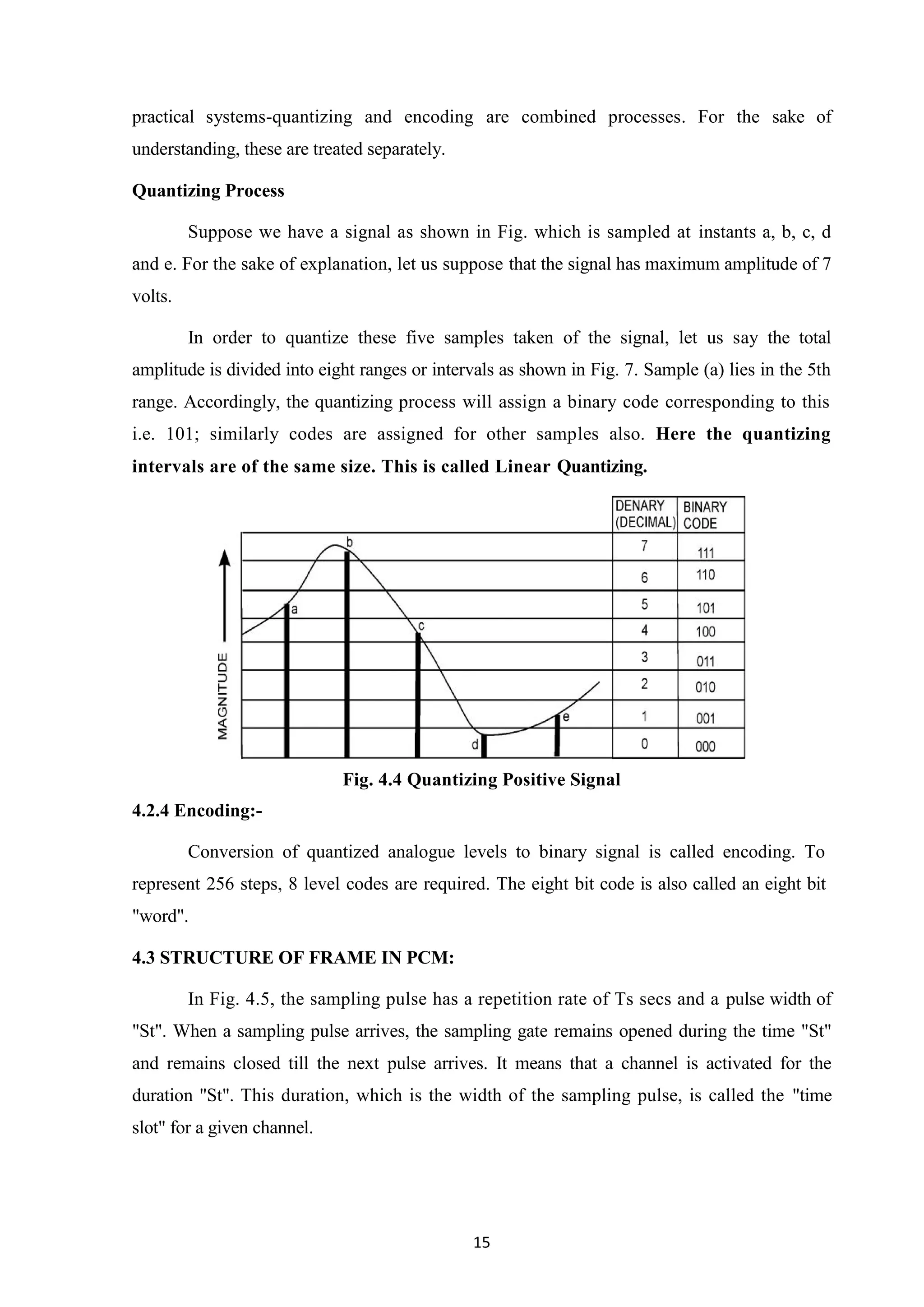
Quantizing Process
Suppose we have a signal as shown in Fig. which is sampled at instants a, b, c, d
and e. For the sake of explanation, let us suppose that the signal has maximum amplitude of 7
volts.
In order to quantize these five samples taken of the signal, let us say the total
amplitude is divided into eight ranges or intervals as shown in Fig. 7. Sample (a) lies in the 5th
range. Accordingly, the quantizing process will assign a binary code corresponding to this
i.e. 101; similarly codes are assigned for other samples also. Here the quantizing
intervals are of the same size. This is called Linear Quantizing.
Fig. 4.4 Quantizing Positive Signal
4.2.4 Encoding:-
Conversion of quantized analogue levels to binary signal is called encoding. To
represent 256 steps, 8 level codes are required. The eight bit code is also called an eight bit
"word".
4.3 STRUCTURE OF FRAME IN PCM:
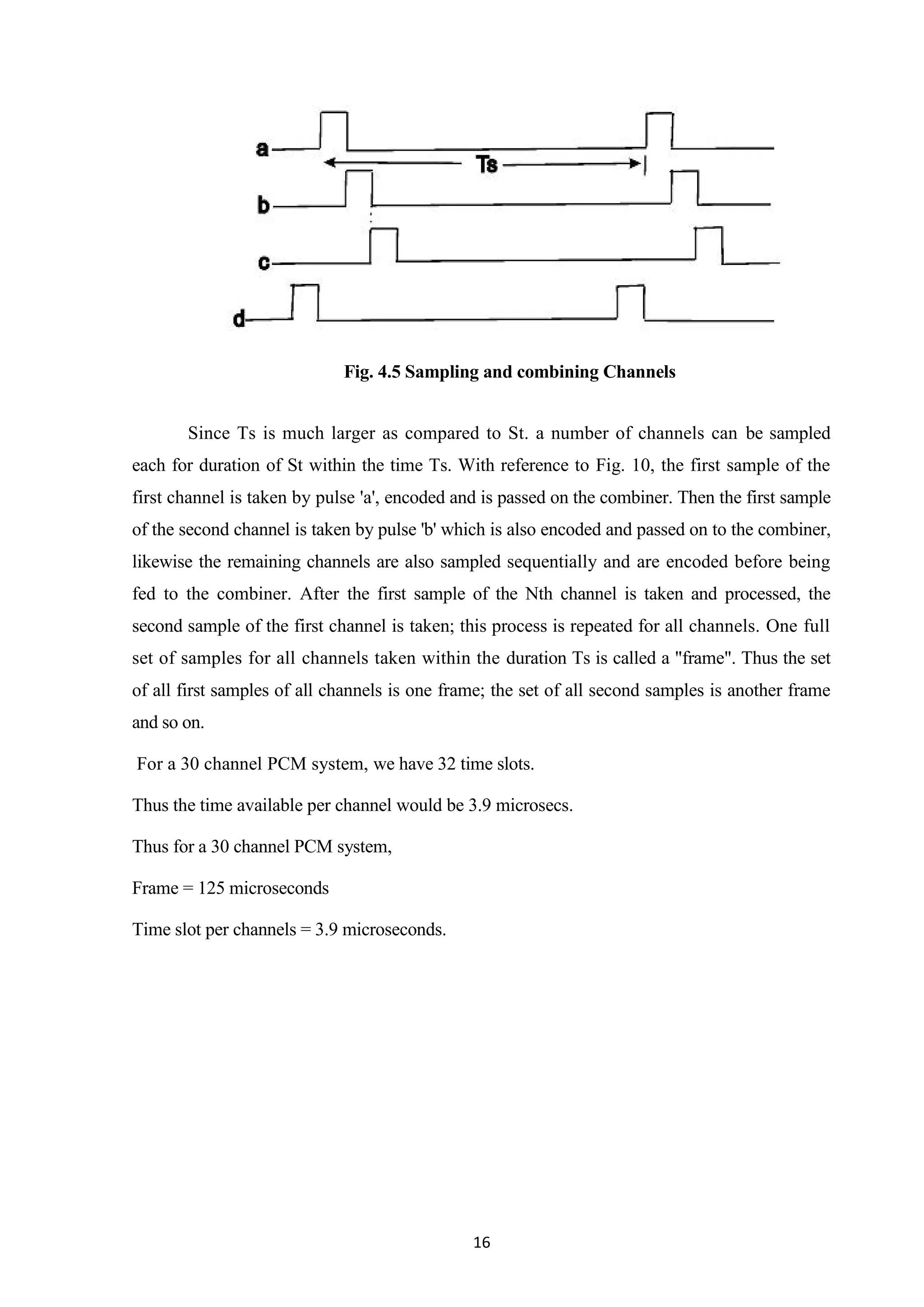
In Fig. 4.5, the sampling pulse has a repetition rate of Ts secs and a pulse width of
"St". When a sampling pulse arrives, the sampling gate remains opened during the time "St"
and remains closed till the next pulse arrives. It means that a channel is activated for the
duration "St". This duration, which is the width of the sampling pulse, is called the "time
slot" for a given channel.
16
Fig. 4.5 Sampling and combining Channels
Since Ts is much larger as compared to St. a number of channels can be sampled
each for duration of St within the time Ts. With reference to Fig. 10, the first sample of the
first channel is taken by pulse 'a', encoded and is passed on the combiner. Then the first sample
of the second channel is taken by pulse 'b' which is also encoded and passed on to the combiner,
likewise the remaining channels are also sampled sequentially and are encoded before being
fed to the combiner. After the first sample of the Nth channel is taken and processed, the
second sample of the first channel is taken; this process is repeated for all channels. One full
set of samples for all channels taken within the duration Ts is called a "frame". Thus the set
of all first samples of all channels is one frame; the set of all second samples is another frame
and so on.
For a 30 channel PCM system, we have 32 time slots.
Thus the time available per channel would be 3.9 microsecs.
Thus for a 30 channel PCM system,
Frame = 125 microseconds
Time slot per channels = 3.9 microseconds.
17
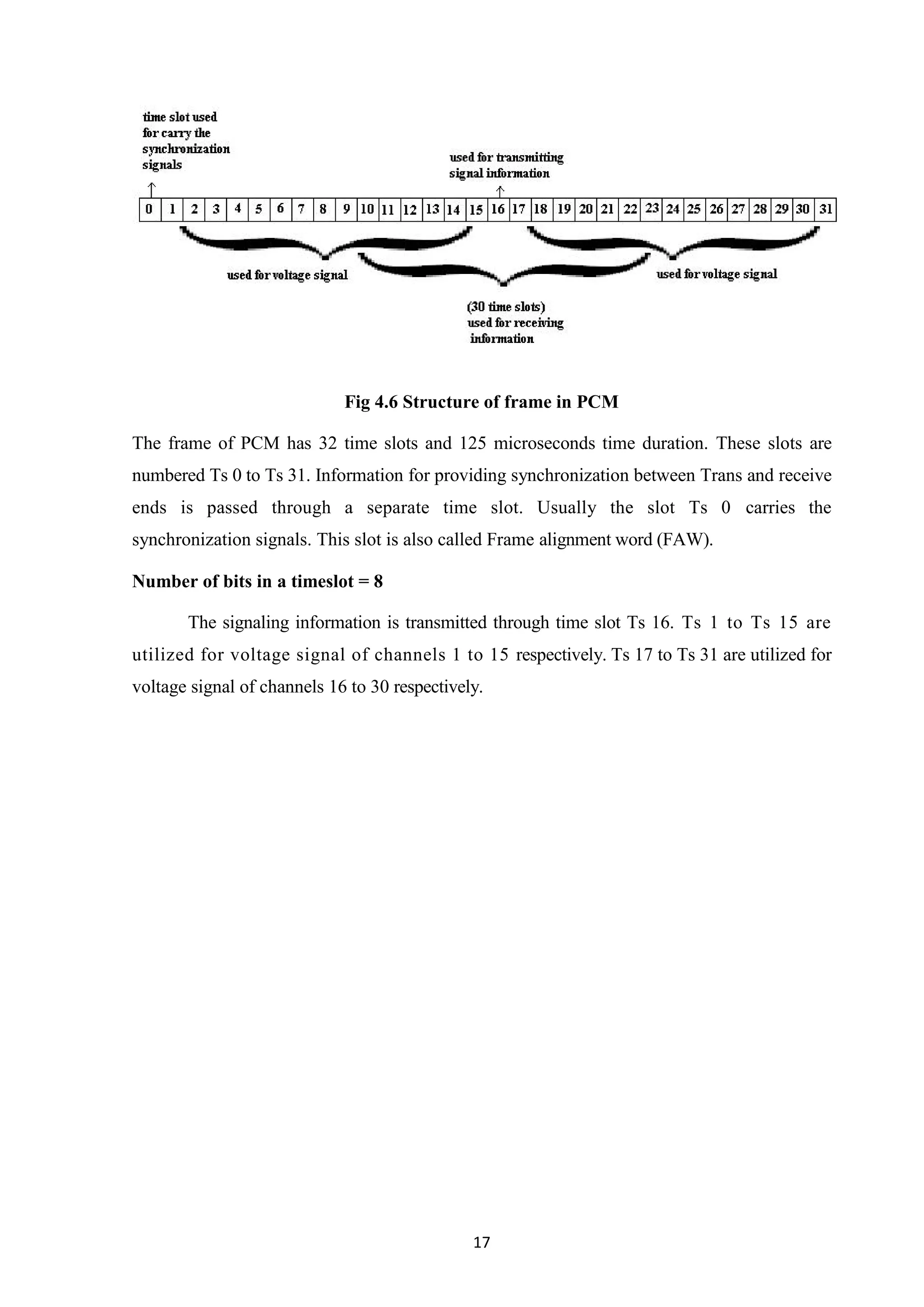
Fig 4.6 Structure of frame in PCM
The frame of PCM has 32 time slots and 125 microseconds time duration. These slots are
numbered Ts 0 to Ts 31. Information for providing synchronization between Trans and receive
ends is passed through a separate time slot. Usually the slot Ts 0 carries the
synchronization signals. This slot is also called Frame alignment word (FAW).
Number of bits in a timeslot = 8
The signaling information is transmitted through time slot Ts 16. Ts 1 to Ts 15 are
utilized for voltage signal of channels 1 to 15 respectively. Ts 17 to Ts 31 are utilized for
voltage signal of channels 16 to 30 respectively.
18
CHAPTER-5
FIBER OPTIC TRANSMISSION SYSTEM
5.1 INTRODUCTION:
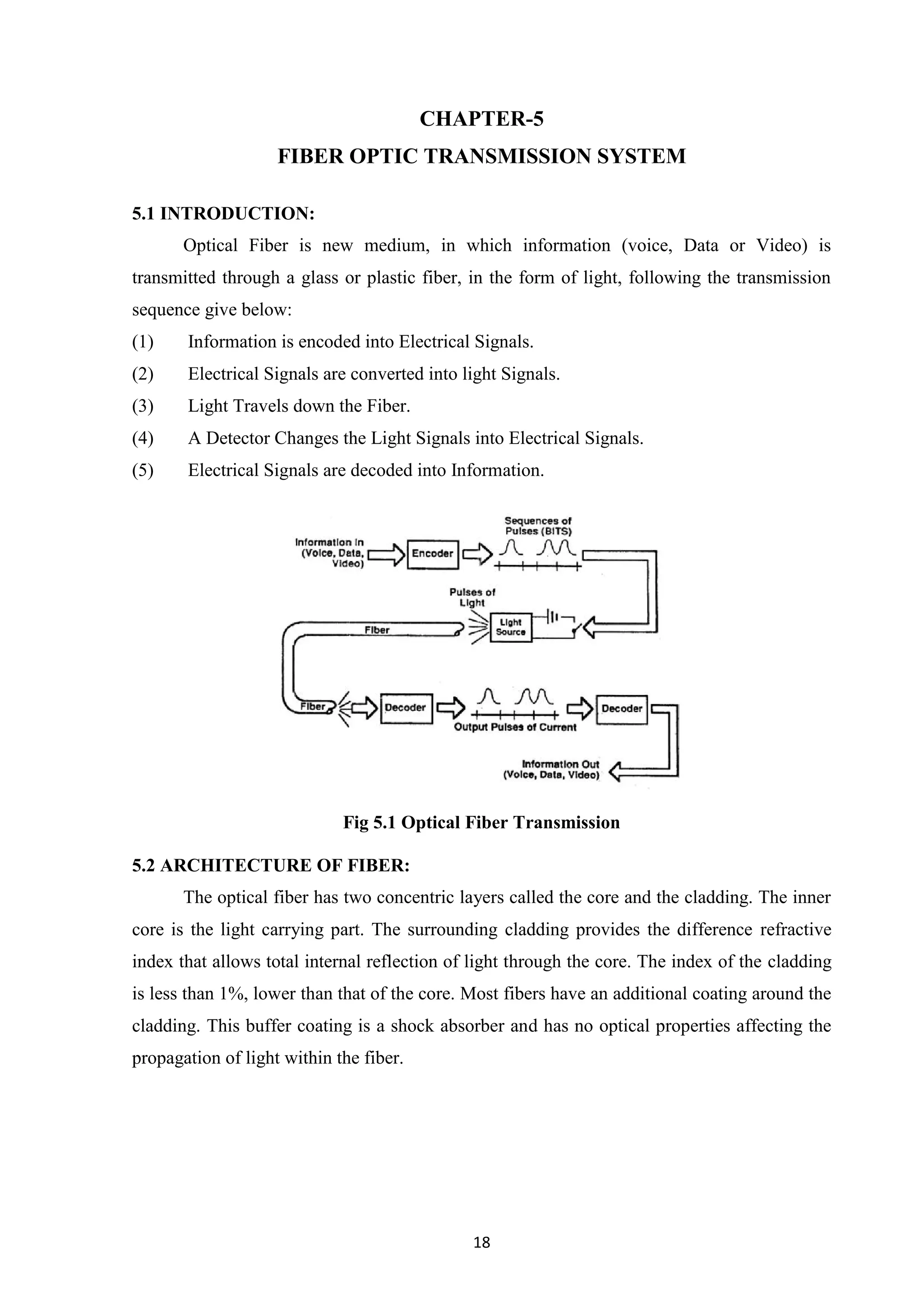
Optical Fiber is new medium, in which information (voice, Data or Video) is
transmitted through a glass or plastic fiber, in the form of light, following the transmission
sequence give below:
(1) Information is encoded into Electrical Signals.
(2) Electrical Signals are converted into light Signals.
(3) Light Travels down the Fiber.
(4) A Detector Changes the Light Signals into Electrical Signals.
(5) Electrical Signals are decoded into Information.
Fig 5.1 Optical Fiber Transmission
5.2 ARCHITECTURE OF FIBER:
The optical fiber has two concentric layers called the core and the cladding. The inner
core is the light carrying part. The surrounding cladding provides the difference refractive
index that allows total internal reflection of light through the core. The index of the cladding
is less than 1%, lower than that of the core. Most fibers have an additional coating around the
cladding. This buffer coating is a shock absorber and has no optical properties affecting the
propagation of light within the fiber.
19
Jacket
Cladding
Core
Cladding
Angle of
reflection
Angle of
incidence
Light at less than
critical angle is
absorbed in jacket
Jacket
Light is propagated by
total internal reflection
Jacket
Cladding
Core
(n2)
(n2)
Fig. Total Internal Reflection in an optical FibreFig. 5.2 Propagation of light through fiber
5.3 CLASSIFICATION OF OPTICAL FIBER:
There are three types of fibers:
(I) Multimode Step Index fiber (Step Index fiber)
(II) Multimode graded Index fiber (Graded Index fiber)
(III) Single- Mode Step Index fiber (Single Mode fiber)
5.3.1 STEP-INDEX MULTIMODE FIBER: It has a large core, up to 100 microns in
diameter. As a result, some of the light rays that make up the digital pulse may travel a direct
route, whereas others zigzag as they bounce off the cladding. This type of fiber is best suited
for transmission over short distances, in an endoscope, for instance.
5.3.2 GRADED-INDEX MULTIMODE FIBER: It contains a core in which the refractive
index diminishes gradually from the center axis out toward the cladding. The higher
refractive index at the center makes the light rays moving down the axis advance more
slowly than those near the cladding. A digital pulse suffers less dispersion.
5.3.3 SINGLE-MODE FIBER: It has a narrow core (eight microns or less), and the index of
refraction between the core and the cladding changes less than it does for multimode fibers.
Light thus travels parallel to the axis, creating little pulse dispersion. Telephone and cable
television networks install millions of kilometers of this fiber every year.
5.4 ADVANTAGES OF FIBRE OPTICS:
• SPEED: Fiber optic networks operate at high speeds - up into the gigabits.
• BANDWIDTH: large carrying capacity.
• DISTANCE: Signals can be transmitted further without needing to be refreshed or
strengthened.
20
• RESISTANCE: Greater resistance to electromagnetic noise such as radios, motors or other
nearby cables.
• MAINTENANCE: Fiber optic cables costs much less to maintain.
5.5 VARIETIES OF WDM: Early WDM systems transported two or four wavelengths that
were widely spaced. WDM and the “follow-on” technologies of CWDM and DWDM have
evolved well beyond this early limitation.
5.5.1 WDM:-
Traditional, passive WDM systems are wide-spread with 2, 4, 8, 12, and 16 channel counts
being the normal deployments. This technique usually has a distance limitation of less than
100 km.
5.5.2 CWDM:-
Today, coarse WDM (CWDM) typically uses 20-nm spacing (3000 GHz) of up to 18
channels. The CWDM Recommendation ITU-T G.694.2 provides a grid of wavelengths for
target distances up to about 50 km on single mode fibers as specified in ITU-T
Recommendations G.652, G.653 and G.655. The CWDM grid is made up of 18 wavelengths
defined within the range 1270 nm to 1610 nm spaced by 20 nm.
5.5.3 DWDM:-
Dense WDM common spacing may be 200, 100, 50, or 25 GHz with channel count reaching
up to 128 or more channels at distances of several thousand kilometers with amplification
and regeneration along such a route.
5.6 DENSE WAVELENGTH DIVISION MULTIPLEXING:
The revolution in high bandwidth applications and the explosive growth of the
Internet, however, have created capacity demands that exceed traditional TDM limits. To
meet growing demands for bandwidth, a technology called Dense Wavelength Division
Multiplexing (DWDM) has been developed that multiplies the capacity of a single fiber.
DWDM systems being deployed today can increase a single fiber’s capacity sixteen fold, to a
through put of 40 GB/s. The emergence of DWDM is one of the most recent and important
phenomena in the development of fiber optic transmission technology. Dense wavelength-
division multiplexing (DWDM) revolutionized transmission technology by increasing the
capacity signal of embedded fiber.
21
One of the major issues in the networking industry today is tremendous demand for
more and more bandwidth. Before the introduction of optical networks, the reduced
availability of fibers became a big problem for the network providers. However, with the
development of optical networks and the use of Dense Wavelength Division Multiplexing
(DWDM) technology, a new and probably, a very crucial milestone is being reached in
network evolution. The existing SONET/SDH network architecture is best suited for voice
traffic rather than today’s high-speed data traffic. To upgrade the system to handle this kind
of traffic is very expensive and hence the need for the development of an intelligent all-
optical network. Such a network will bring intelligence and scalability to the optical domain
by combining the intelligence and functional capability of SONET/SDH, the tremendous
bandwidth of DWDM and innovative networking software to spawn a variety of optical
transport, switching and management related products. In traditional optical fiber networks,
information is transmitted through optical fiber by a single light beam. In a wavelength
division multiplexing (WDM) network, the vast optical bandwidth of a fiber (approximately
30 THz corresponding to the low-loss region in a single mode optical fiber) is carved up into
wavelength channels, each of which carries a data stream individually.
The multiple channels of information (each having a different carrier wavelength) are
transmitted simultaneously over a single fiber. The reason why this can be done is that optical
beams with different wavelengths propagate without interfering with one another. When the
number of wavelength channels is above 20 in a WDM system, it is generally referred to as
Dense WDM or DWDM.
DWDM technology can be applied to different areas in the telecommunication
networks, which includes the backbone networks, the residential access networks, and also
the Local Area Networks (LANs). Among these three areas, developments in the DWDM-
based backbone network are leading the way, followed by the DWDM-based LANs.
5.7 DEVELOPMENT OF DWDM TECHNOLOGY:
Early WDM began in the late 1980s using the two widely spaced wavelengths in the
1310 nm and 1550 nm (or 850 nm and 1310 nm) regions, sometimes called wideband WDM.
The early 1990s saw a second generation of WDM, sometimes called narrowband WDM, in
which two to eight channels were used. These channels interval of about 400 GHz in the
1550-nm window. By the mid-1990s, dense WDM (DWDM) systems were emerging with 16
to 40 channels and spacing from 100 to 200 GHz. By the late 1990s DWDM systems had
evolved to the point where they were capable of 64 to 160 parallel channels, densely packed
22
at 50 or even 25 GHz intervals. As fig. 1 shows, the progression of the technology can be
seen as an increase in the number of wavelengths accompanied by a decrease in the spacing
of the wavelengths. Along with increased density of wavelengths, systems also advanced in
their flexibility of configuration, through add-drop functions, and management capabilities.
23
CHAPTER-6
MOBILE COMMUNICATION PRINCIPLES
6.1 CELLULAR PRINCIPLES:
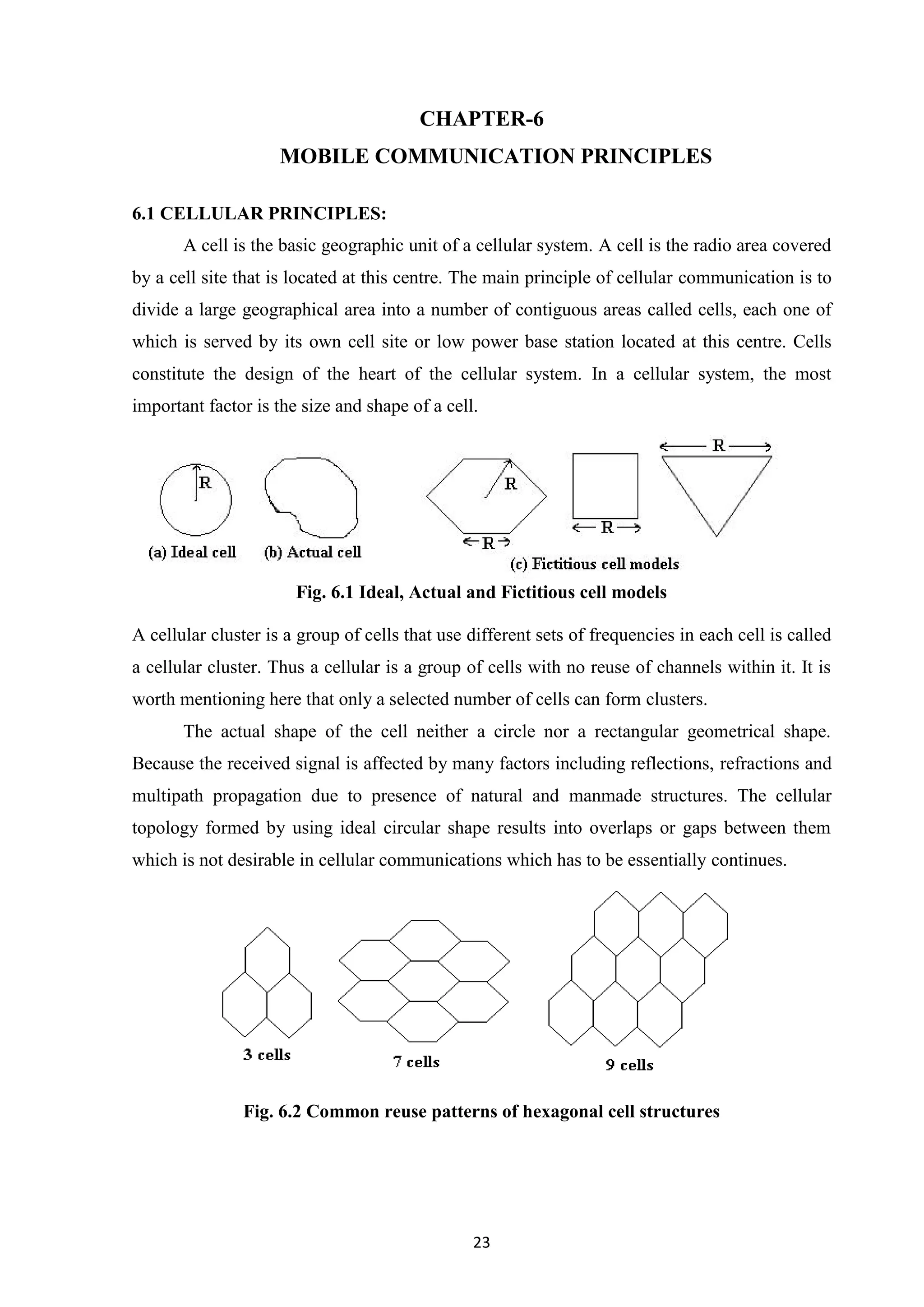
A cell is the basic geographic unit of a cellular system. A cell is the radio area covered
by a cell site that is located at this centre. The main principle of cellular communication is to
divide a large geographical area into a number of contiguous areas called cells, each one of
which is served by its own cell site or low power base station located at this centre. Cells
constitute the design of the heart of the cellular system. In a cellular system, the most
important factor is the size and shape of a cell.
Fig. 6.1 Ideal, Actual and Fictitious cell models
A cellular cluster is a group of cells that use different sets of frequencies in each cell is called
a cellular cluster. Thus a cellular is a group of cells with no reuse of channels within it. It is
worth mentioning here that only a selected number of cells can form clusters.
The actual shape of the cell neither a circle nor a rectangular geometrical shape.
Because the received signal is affected by many factors including reflections, refractions and
multipath propagation due to presence of natural and manmade structures. The cellular
topology formed by using ideal circular shape results into overlaps or gaps between them
which is not desirable in cellular communications which has to be essentially continues.
Fig. 6.2 Common reuse patterns of hexagonal cell structures
24
6.2 FREQUENCY REUSE CONCEPT:
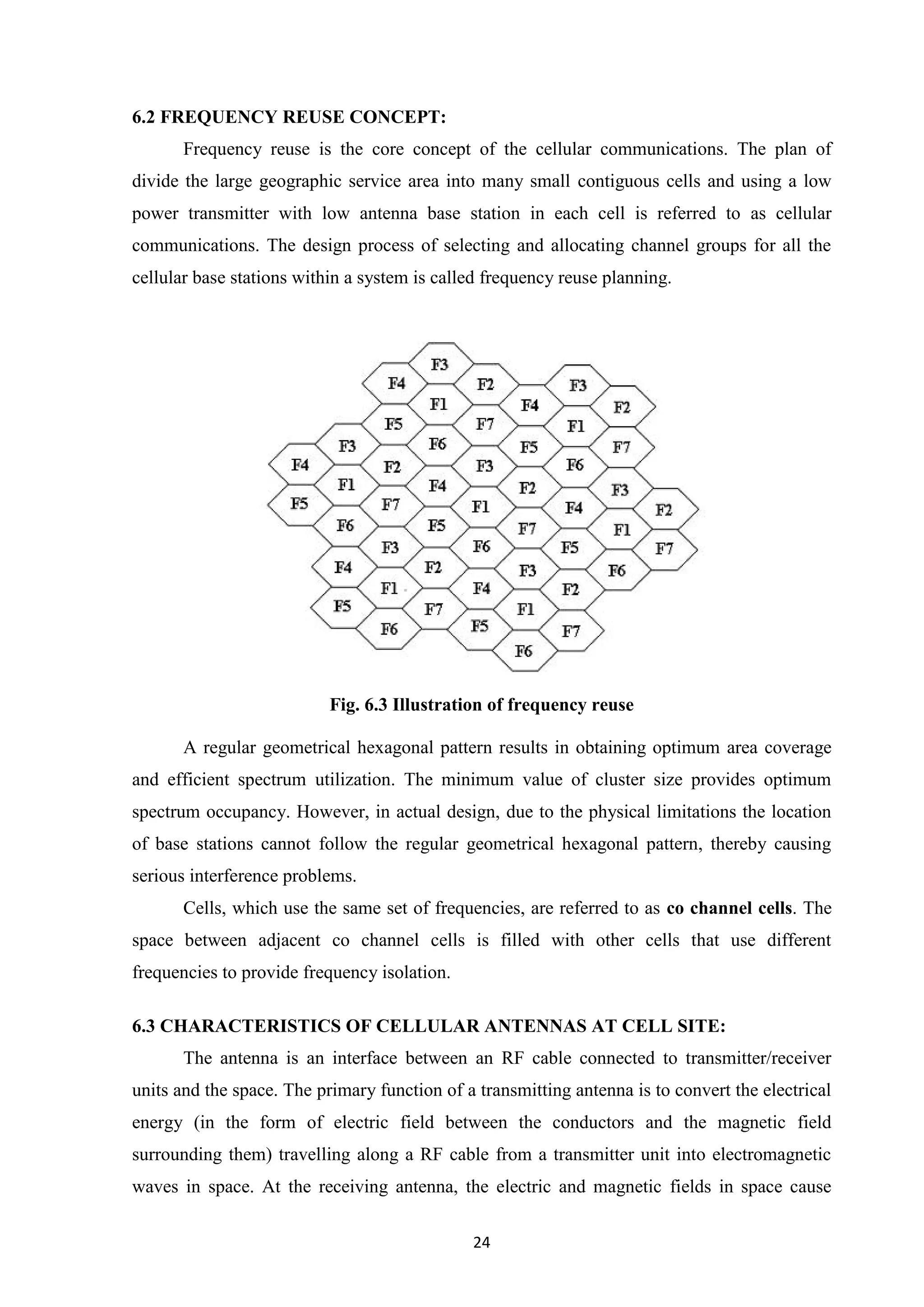
Frequency reuse is the core concept of the cellular communications. The plan of
divide the large geographic service area into many small contiguous cells and using a low
power transmitter with low antenna base station in each cell is referred to as cellular
communications. The design process of selecting and allocating channel groups for all the
cellular base stations within a system is called frequency reuse planning.
Fig. 6.3 Illustration of frequency reuse
A regular geometrical hexagonal pattern results in obtaining optimum area coverage
and efficient spectrum utilization. The minimum value of cluster size provides optimum
spectrum occupancy. However, in actual design, due to the physical limitations the location
of base stations cannot follow the regular geometrical hexagonal pattern, thereby causing
serious interference problems.
Cells, which use the same set of frequencies, are referred to as co channel cells. The
space between adjacent co channel cells is filled with other cells that use different
frequencies to provide frequency isolation.
6.3 CHARACTERISTICS OF CELLULAR ANTENNAS AT CELL SITE:
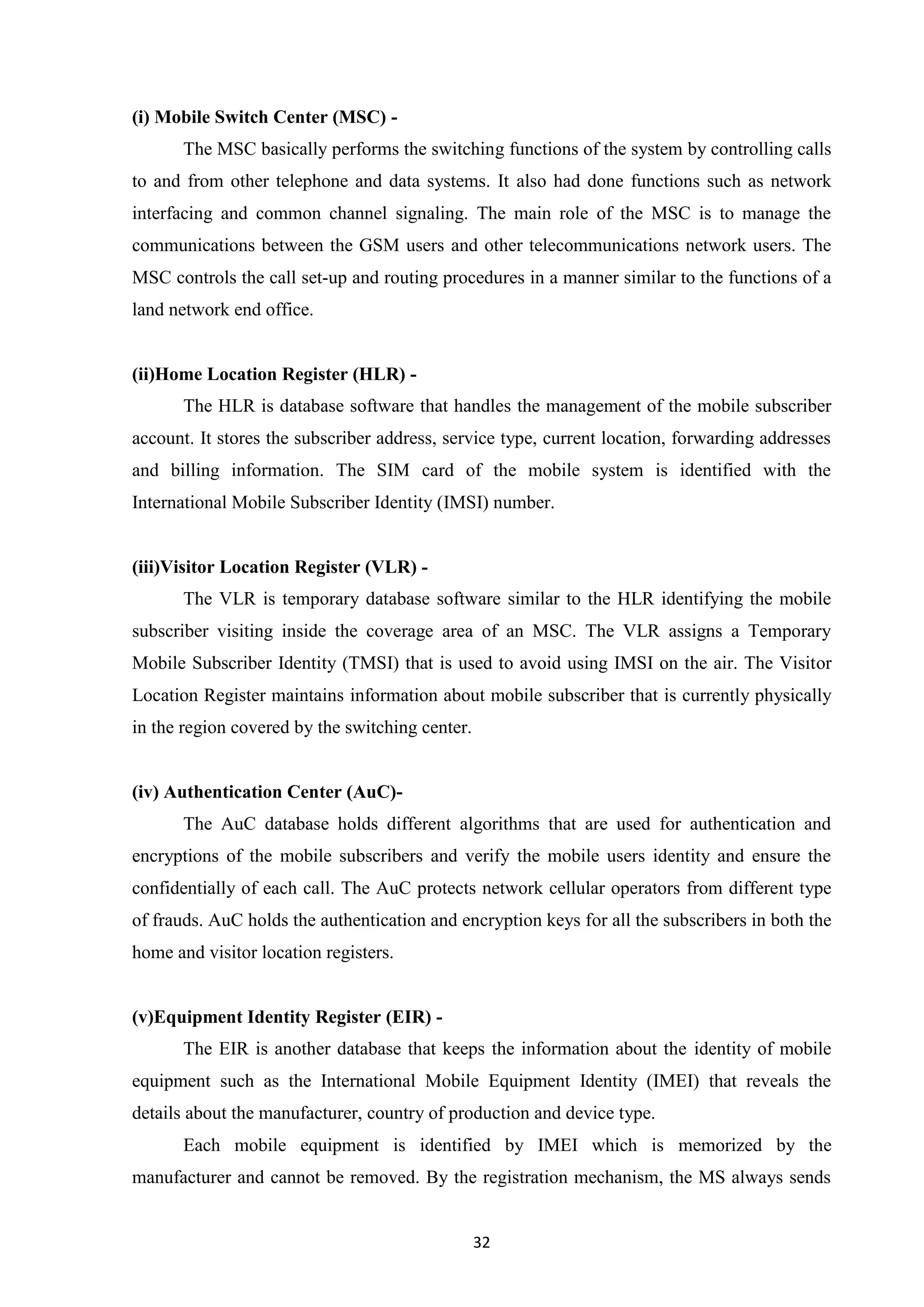
The antenna is an interface between an RF cable connected to transmitter/receiver
units and the space. The primary function of a transmitting antenna is to convert the electrical
energy (in the form of electric field between the conductors and the magnetic field
surrounding them) travelling along a RF cable from a transmitter unit into electromagnetic
waves in space. At the receiving antenna, the electric and magnetic fields in space cause
25
current to flow in the conductors that make up the antenna and some of this energy is thereby
transferred to the RF cable connected to it and the receiver unit.
In general, antennas are passive devices, which mean the power radiated by a
transmitting antenna cannot be greater than the power entering from the transmitter. In fact,
the radiating power is always less than the power at its input because of losses. It should be
recalled that antenna gain in one direction results from a concentration of power and is
accompanied by a loss in other directions. Secondly, antennas are reciprocal devices that are
the same antenna design works equally well as a transmitting or a receiving antenna with the
same amount of gain.
Fig. 6.4 Cell-site antenna tower with various antennas mounted on it
6.4 MULTIPLE ACCESS TECHNIQUES:
The technique of dynamically sharing the finite limited radio spectrum by multiple
users is called Multiple Access Technique.
Generally there are three different types of multiple access technologies. They are
(i) Frequency Division Multiple Access (FDMA)
(ii) Time Division Multiple Access (TDMA)
(iii) Code Division multiple Access (CDMA)
6.4.1 Frequency Division Multiple Access (FDMA):-
FDMA refers to sharing the available radio spectrum by assigning specific frequency
channels to subscriber either on a permanent basis or on a temporary basis. The
differentiation between the carrier frequencies of the forward channels (also called downlink
communication between the cell-site and mobile subscribers) and reverse channels (also
26
called uplink communication between the mobile subscribers and the cell-site) is an
important design parameter related to FDMA technique.
The concept of FDMA is shown in figure 6.5.
Fig. 6.5 the Concept of FDMA
In FDMA, the available radio spectrum is divided into a set of continues frequency
channels labeled1 through N, and the frequency channels are assigned to individual mobile
subscribers on a continues time basis for the duration of a call. FDMA bandwidth structure is
shown in figure 6.6.
Fig. 6.6 FDMA Bandwidth Structure
Figure 6.7 shows the basic structure of a FDMA system, consisting of a cell-site (CS)
and many mobile subscribers. There is a pair of simplex channels for the communication
wireless link between the mobile and the mobile subscribers. The paired channel is called is
called forward channel (downlink) and reverse channel (uplink). A forward channel is used to
transfer data from the cell-site to the mobile subscriber to the cell-site and a reverse channel
is used to transfer data from the mobile subscriber to the cell-site. Different frequency
channel are assigned to different mobile subscribers is assigned different frequency channels
to enable full duplex communication.
27
Fig. 6.7 the Basic structure of an FDMA system
6.4.2 Time Division Multiple Access (TDMA):-
TDMA technique refers to allowing a number of subscribers to access a specified
channel bandwidth on a time share basis. TDMA system divide the carrier channel bandwidth
into time slots, and in each time slot only one subscriber is allowed to either transmit or
receive. TDMA utilizes the digital technology with more efficient and complex strategies of
sharing the available spectrum among a number of subscribers simultaneously. In TDMA
system, numbers of share the same frequency bands share by talking their assigned terms in
time for transmission or reception.
The major advantage of TDMA is the flexibility of its digital format which can be
buffered and multiplexed efficiently, and assignment of time-slots among multiple
subscribers which are readily adaptable to provide different access rates. With TDMA, a
base-station controller assigns time slots to subscriber for the requested service, and an
assigned time slot is held by until it releases it. The receiver synchronizes to the incoming
TDMA signal frame, and extracts the time slot designated for that subscriber. Therefore, the
most critical feature of TDMA operation is time synchronization.
28
Fig. 6.8 the Concept of TDMA
Fig. 6.9 Structure of forward and reverse channels in a TDMA system
29
CHAPTER-7
GLOBAL SYSTEM FOR MOBILE COMMUNICATION (GSM)
7.1 INTRODUCTION:
GSM is a form of multiplexing, which divides the available bandwidth among the
different channels. Most of the times the multiplexing used are either TDM or FDM. GSM is
considered a second generation (2G) mobile phone system. The main features of GSM are-
 Support for voice and data services.
 Better frequency efficiency, smaller cells and more customers per cell.
 High audio quality and reliability for wireless, uninterrupted phone calls at higher
speeds (e.g. from cars, trains) i.e. high transmission quality.
 Authentication via chip card and pin.
 World Wide connectivity.
The frequency allocations in GSM are as follows-
 The band 890-915 MHz and 1710-1785 MHz has been allocated for the uplink
direction (transmitting from the mobile station to the base station.)
 The band 935-960 MHz and 1805-1880 MHz has been allocated for the downlink
direction (transmitting from the base station to the mobile station.)
7.2 ARCHITECTURE OF THE GSM NETWORK:
The GSM network architecture consist of three major subsystem-
(1.) Mobile Station (MS)
(2.) Base Station Subsystem (BSS)
(3.) Network and Switching Subsystem (NSS)
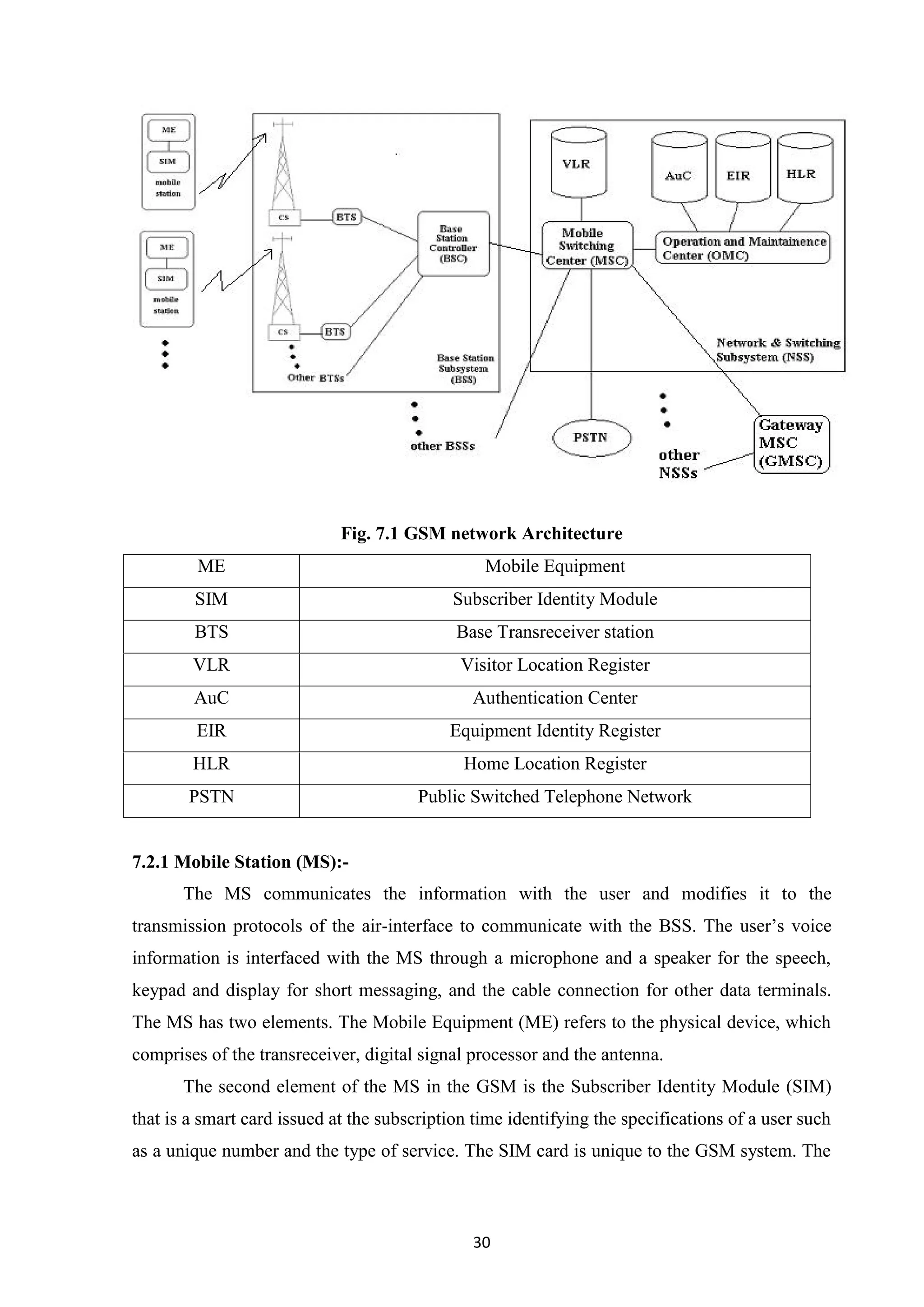
The architecture of GSM as shown in figure 7.1
30
Fig. 7.1 GSM network Architecture
7.2.1 Mobile Station (MS):-
The MS communicates the information with the user and modifies it to the
transmission protocols of the air-interface to communicate with the BSS. The user’s voice
information is interfaced with the MS through a microphone and a speaker for the speech,
keypad and display for short messaging, and the cable connection for other data terminals.
The MS has two elements. The Mobile Equipment (ME) refers to the physical device, which
comprises of the transreceiver, digital signal processor and the antenna.
The second element of the MS in the GSM is the Subscriber Identity Module (SIM)
that is a smart card issued at the subscription time identifying the specifications of a user such
as a unique number and the type of service. The SIM card is unique to the GSM system. The
ME Mobile Equipment
SIM Subscriber Identity Module
BTS Base Transreceiver station
VLR Visitor Location Register
AuC Authentication Center
EIR Equipment Identity Register
HLR Home Location Register
PSTN Public Switched Telephone Network
31
calls in the GSM are directed to the SIM inserted in any mobile phone. Short messages are
also stored in the SIM card.
7.2.2 Base Station Subsystem (BSS):-
The base station subsystem consists-
(i) Base transreceiver station (BTS)
(ii) Base station controller (BSC)
(i) Base transreceiver station (BTS) -
 A Base Transreceiver Station is a piece of equipment that facilitates wireless
communication between user equipment (UE) and a network.
 It encodes, encrypts, modulates and feeds the RF signal to antenna.
 It produces time and frequency synchronization signals.
 It defines a single cell, which can have a radius of between 100 m and 35 Km,
depending on the environment.
(ii) Base station controller (BSC) -
 Its main work is to control several transreceivers.
 Switching between BTSs.
 Managing of network resources.
 Mapping of radio channels.
7.2.3 Network and Switching Subsystem (NSS):-
This subsystem does mainly switching, mobility management, interconnection to
others networks, system control. The NSS consists of -
(i)Mobile Switch Center (MSS)
(ii)Home Location Register (HLR)
(iii)Visitor Location Register (VLR)
(iv)Authentication Center (AuC)
(v)Equipment Identity Register (EIR)
32
(i) Mobile Switch Center (MSC) -
The MSC basically performs the switching functions of the system by controlling calls
to and from other telephone and data systems. It also had done functions such as network
interfacing and common channel signaling. The main role of the MSC is to manage the
communications between the GSM users and other telecommunications network users. The
MSC controls the call set-up and routing procedures in a manner similar to the functions of a
land network end office.
(ii)Home Location Register (HLR) -
The HLR is database software that handles the management of the mobile subscriber
account. It stores the subscriber address, service type, current location, forwarding addresses
and billing information. The SIM card of the mobile system is identified with the
International Mobile Subscriber Identity (IMSI) number.
(iii)Visitor Location Register (VLR) -
The VLR is temporary database software similar to the HLR identifying the mobile
subscriber visiting inside the coverage area of an MSC. The VLR assigns a Temporary
Mobile Subscriber Identity (TMSI) that is used to avoid using IMSI on the air. The Visitor
Location Register maintains information about mobile subscriber that is currently physically
in the region covered by the switching center.
(iv) Authentication Center (AuC)-
The AuC database holds different algorithms that are used for authentication and
encryptions of the mobile subscribers and verify the mobile users identity and ensure the
confidentially of each call. The AuC protects network cellular operators from different type
of frauds. AuC holds the authentication and encryption keys for all the subscribers in both the
home and visitor location registers.
(v)Equipment Identity Register (EIR) -
The EIR is another database that keeps the information about the identity of mobile
equipment such as the International Mobile Equipment Identity (IMEI) that reveals the
details about the manufacturer, country of production and device type.
Each mobile equipment is identified by IMEI which is memorized by the
manufacturer and cannot be removed. By the registration mechanism, the MS always sends
33
the IMEI to the network, so that the EIR can memorize and assigns them to three different
lists-
WHITE LIST contains the IMEI of the phones who are allowed to enter in the
network.
BLACK LIST contains the IMEI of the phones who are not allowed to enter in the
network, for example when mobile phone is stolen then for not to use the mobile for illegal
work by thief it's IMEI number comes in black list.
GREY LIST contains the IMEI of the phones momentarily not allowed to enter in the
network, for example because the software version is too old or because they are in repair.
7.2.4 Gateway MSC:-
The GMSC is used to connect the one network of the MSC of the mobile subscriber to
the other network of the MSC of the mobile subscriber. The all MSCs of the each network is
linked with the GMSC.
7.3 IDENTIFIERS USED IN GSM SYSTEM:
7.3.1 IMEI (International Mobile Equipment Identity) -
The IMEI number is usually 15 digits or less. This IMEI number is the identification
of our mobile equipment. IMEI which is memorized by the manufacturer and cannot be
removed. By the registration mechanism, the MS always sends the IMEI to the network, so
that the EIR can memorize and assigns them to three different lists White list, black list and
grey list.
7.3.2 SIM (Subscriber Identity Module) -
The SIM card is the Heart of the GSM mobile phone. The SIM card has a flash
memory in which the mobile number of the other subscribers and messages is stored. It gives
the identification to the subscriber of the particular network.
7.3.3 MSISDN (Mobile System ISDN) -
MSISDN is the number that identifies a particular MS's subscriber. The GSM actually
does not identify a particular mobile phone, but a particular HLR. It is the responsibility of
the HLR to contact the mobile phone.
7.3.4 IMSI (International Mobile Subscriber Identity) -
34
The SIM card of the mobile system is identified with the International Mobile
Subscriber Identity (IMSI) number. Through IMSI number, the mobile subscriber is
identified by MSC and then call is switches.
7.3.5 TMSI (Temporary Mobile Subscriber Identity) -
It is same as the IMSI but there is a difference between the IMSI and TMSI number is
that the TMSI number is assigned to person for the security of information sent without
changing its IMSI number.
7.4 FEATURES OF GSM:
 GSM is already used worldwide with over 450 million subscribers.
 International roaming permits subscribers to use one phone throughout Western
Europe. CDMA will work in Asia, but not France, Germany, the U.K. and other
popular European destinations.
 GSM is mature, having started in the mid-80s. This maturity means a more stable
network with robust features. CDMA is still building its network.
 The availability of Subscriber Identity Modules, which are smart cards that provide
secure data encryption give GSM m-commerce advantages.
35
CHAPTER-8
BROADBAND AND WI-FI (WIRELESS FIDELITY)
8.1 BROADBAND NETWORK:
Broadband is often called high speed internet, because it usually has a high rate of data
transmission. In general, any connection to the customer of 256 Kbit/s or more is considered
broadband. In India, TRAI has defined broadband as any connectivity delivered to the end
user at a bandwidth greater that 256 kbps.
8.2 SERVICES AVAILABLE THROUGH BROADBAND:
 High speed Internet Access: This is the always-on Internet access service with speed
ranging from 256 kbps to 8 Mbps.
 Bandwidth on Demand: This will facilitate customer to change bandwidth as per his
/ her requirement. For example a customer with 256 kbps can change to 1 Mbps
during the video Conferencing session.
 Multicasting: This is to provide video multicast services, video-on-demand etc. for
application in distance education, telemedicine etc.
 Dial VPN Service: This service allows remote users to access their private network
securely over the NIB-II infrastructure.
 Video and Audio Conferencing.
 Content based Services: Like Video on Demand, Interactive Gaming, Live and time
shifted TV
 Video on Demand: Customers can view any movie of their choice from a pool of
movies stored in a central server. The movies can be viewed either on a TV or a PC.
 Audio on Demand: It is a similar service where person can listen to any music of his
choice.
36
8.3 BROADBAND DELIVERY TECHNOLOGIES:
While telecom companies have adequate high speed OFC infrastructure to connect
their Exchanges and switches, the same does not hold good with the legacy fixed line
customers who are connected, however adequately for voice communication, by good old
copper. How to deliver the broadband content over this seemingly low bandwidth medium
was the question till recently, when advanced Line coding and compression technologies
‘solved’ the problem.
8.3.1 The Misunderstood copper:-
It has been the general perception that copper is ‘no good’ for anything other than
speech communications of the analog variety. However, the blame for the low bandwidth
rests with the telephone system rather than with the medium. The telephone system filters
the voice to a range of 400 Hz to 3.4 KHz, thereby rendering the local lead useless for even
good quality sound transmission.
When data transmission was attempted over non-exchange lines using traditional line
coding mechanisms like AMI (Alternate Mark Inversion), a good bandwidth could not be
achieved because these mechanisms ‘corrupt’ the spectrum and cause interference between
the pairs in a copper cable bundle. To overcome this, alternative technologies were devised
which performed the line coding and transmission in such a way that the interference was
minimized, thereby enabling much higher frequencies to be transmitted. And the mother of
all technologies was DSL.
8.3.2 Broadband over copper: the DSLs:-
DSL stands for Digital Subscriber Loop.
The figure 8.1 shows how DSL modulates the Line Spectrum. Data Signal is sent at a
frequency higher that the Voice (3.4 KHz) frequency.
37
madhavanmurali@bsnl.in 8
DSL ‘Modulation’
Fig. 8.1 DSL Modulation
There are various technologies spawned off from DSL which perform to different
expectations:
 DSL: Digital Subscriber Line
 SDSL: Single Line Digital Subscriber Line
 ADSL: Asymmetric Digital Subscriber Line
 HDSL: High data rate Digital Subscriber Line
 VDSL : Very High data rate Digital Subscriber Line
 IDSL: ISDN Digital Subscriber Line
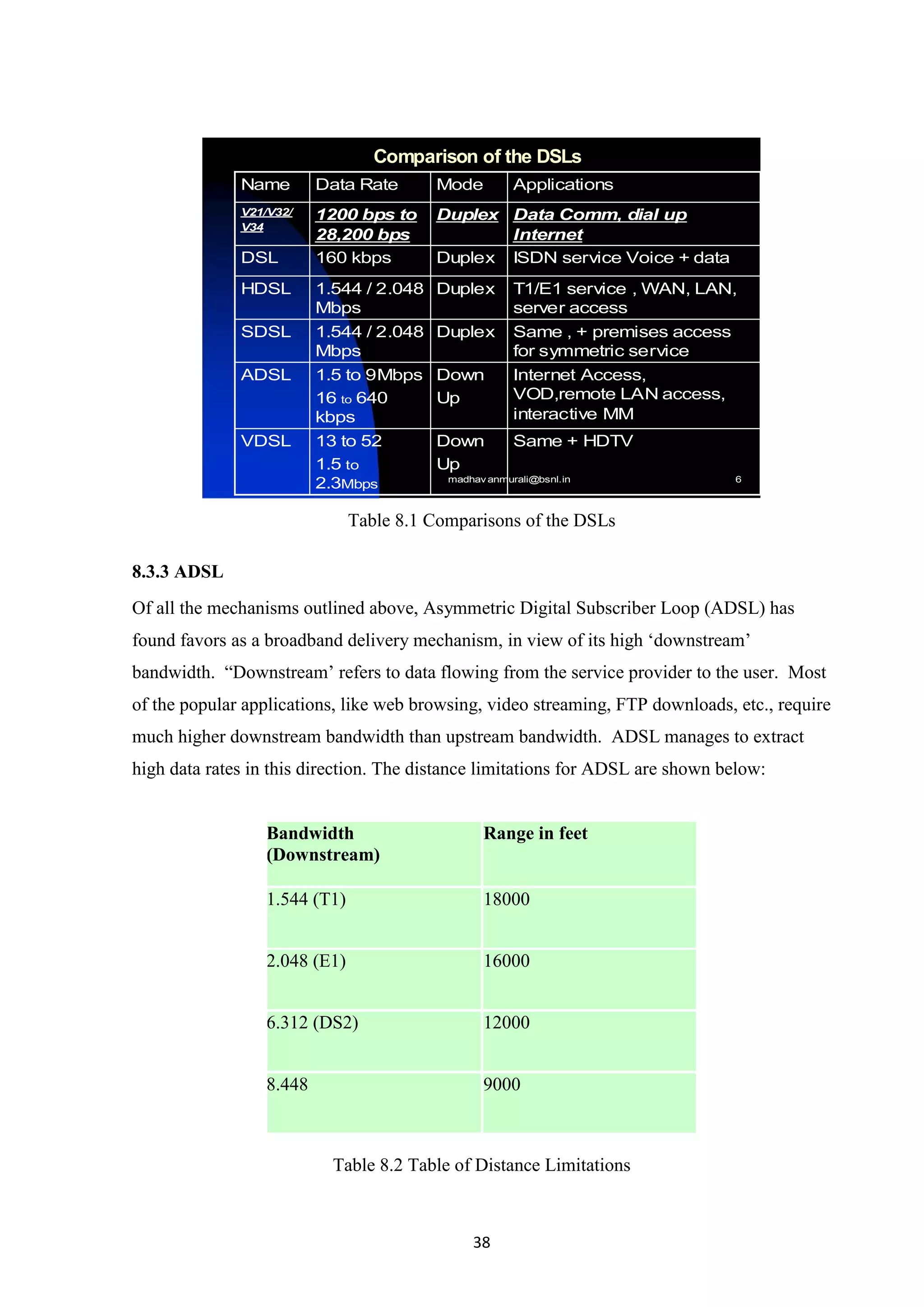
These technologies offer differing bandwidths over different distances. The table below
shows a comparison of their capabilities:
38
madhavanmurali@bsnl.in 6
Comparison of the DSLs
Same + HDTVDown
Up
13 to 52
1.5 to
2.3Mbps
VDSL
Internet Access,
VOD,remote LAN access,
interactive MM
Down
Up
1.5 to 9Mbps
16 to 640
kbps
ADSL
Same , + premises access
for symmetric service
Duplex1.544 / 2.048
Mbps
SDSL
T1/E1 service , WAN, LAN,
server access
Duplex1.544 / 2.048
Mbps
HDSL
ISDN service Voice + dataDuplex160 kbpsDSL
Data Comm, dial up
Internet
Duplex1200 bps to
28,200 bps
V21/V32/
V34
ApplicationsModeData RateName
Table 8.1 Comparisons of the DSLs
8.3.3 ADSL
Of all the mechanisms outlined above, Asymmetric Digital Subscriber Loop (ADSL) has
found favors as a broadband delivery mechanism, in view of its high ‘downstream’
bandwidth. “Downstream’ refers to data flowing from the service provider to the user. Most
of the popular applications, like web browsing, video streaming, FTP downloads, etc., require
much higher downstream bandwidth than upstream bandwidth. ADSL manages to extract
high data rates in this direction. The distance limitations for ADSL are shown below:
Bandwidth
(Downstream)
Range in feet
1.544 (T1) 18000
2.048 (E1) 16000
6.312 (DS2) 12000
8.448 9000
Table 8.2 Table of Distance Limitations
39
With all the local telecom companies edging closer to the customer with their distributed
access mechanisms like DLCs and RSUs, the above distances lie well within the range of
most customer premises, and thus broadband delivery can be quite effective, with a richer
user experience.
8.3.4 Multiplexing Voice and Data: DSLAM
The DSL Access Multiplexer, popularly known as DSLAM, is employed by the
Telecom Companies to code the subscriber line with the broadband data content. Once the
ADSL copper line reaches the customer, some customer premises equipment (CPE) has to be
employed to separate the voice and data signals.
Fig. 8.2 Multiplexing Voice and Data: DSLAM
In many cases the Splitter function is combined within the DSL Modem CPE equipment,
which is also known sometimes as a ‘Set-top Box’.
8.4 WI-FI NETWORK:
A Wi-Fi network provides the features and benefits of traditional LAN technologies
such as Ethernet and Token Ring without the limitations of wires or cables. It provides the
final few meters of connectivity between a wired network and the mobile user. WIFI is a
wireless LAN Technology to deliver wireless broad band speeds up to 54 Mbps to Laptops,
PCs, PDAs, dual mode Wi-Fi enabled phones etc.
8.5 WORKING OF WI-FI NETWORK:
In a typical Wi-Fi configuration, a transmitter/receiver (transceiver) device, called the
Access Point (AP), connects to the wired network from a fixed location using standard
cabling. A wireless Access Point combines router and bridging functions, it bridges network
40
traffic, usually from Ethernet to the airwaves, where it routes to computers with wireless
adapters. The AP can reside at any node of the wired network and acts as a gateway for
wireless data to be routed onto the wired network. It supports only 10 to 30 mobile devices
per Access Point (AP) depending on the network traffic. Like a cellular system, the Wi-Fi is
capable of roaming from the AP and re-connecting to the network through another AP. Like a
cellular phone system, the wireless LAN is capable of roaming from the AP and re-
connecting to the network through other APs residing at other points on the wired network.
This can allow the wired LAN to be extended to cover a much larger area than the existing
coverage by the use of multiple APs such as in a campus environment. It may be used as a
standalone network anywhere to link multiple computers together without having to build or
extend a wired network.
Fig. 8.3 Wi-Fi Network
End users access the Wi-Fi network through Wi-Fi adapters, which are implemented as
cards in desktop computers, or integrated within hand-held computers. Wi-Fi wireless LAN
adapters provide an interface between the client Network Operating System (NOS) and the
airwaves via an antenna.
8.6 BENEFITS OF WI-FI:
41
Wi-Fi offers the following productivity, conveniences, and cost advantages over
traditional wired networks:
 Mobility: Wi-Fi systems can provide LAN users with access to real-time information
anywhere in their organization.
 Installation Speed and Simplicity: Installing a Wi-Fi system can be fast and easy and
can eliminate the need to pull cable through walls and ceilings.
 Installation Flexibility: Wireless technology allows the network to go where wire
cannot go.
 Reduced Cost-of-Ownership: While the initial investment required for Wi-Fi
hardware can be higher than the cost of wired LAN hardware, overall installation
expenses and life-cycle costs can be significantly lower.
 Scalability: Wi-Fi systems can be configured in a variety of topologies to meet the
needs of specific applications and installations. Configurations are easily changed and
range from peer-to-peer networks suitable for a small number of users to full
infrastructure networks of thousands of users that allows roaming over a broad area.
 It offers much high speed up to 54 Mbps which is very much greater than other
wireless access technologies like CORDECT, GSM and CDMA.
8.7 LIMITATIONS OF WI-FI:
 Coverage: A single Access Point can cover, at best, a radius of only about 60 meters.
For 10 square kms area roughly 650 Access Points are required, where as CDMA
2000 1xEV-DO requires just 09 sites.
 Roaming: It lacks roaming between different networks hence wide spread coverage by
one service provider is not possible, which is the key to success of wireless
technology.
 Backhaul: Backhaul directly affects data rate service. Wi-Fi real world data rates are at
least half of the their theoretical peak rates due to factors such as signal strength,
interference and radio overhead .Backhaul reduces the remaining throughput further.
 Interference: Wi-Fi uses unlicensed spectrum, which mean no regulator recourse
against interference. The most popular type of Wi-Fi, ‘802.11’b uses.
42
43
CHAPTER-9
CDMA AND UMTS (3G) TECHNOLOGY
9.1 CDMA TECHNOLOGY:
Code Division Multiple Access (CDMA) consistently provides better capacity for
voice and data communications that other commercial mobile technologies, allowing more
subscribers to connect at any given time, and it is the common platform on which 3G
technologies are built.
CDMA is a spread spectrum technology, allowing many users to occupy the same time and
frequency allocations in a given band/space. As it name implies, CDMA assigns unique
codes to each communication to differentiate it from others in the same spectrum resources,
CDMA enables many more people to share the airwaves at the same time than do alternative
technologies.
9.2 ADVANTAGES OF CDMA:
 Increased cellular communications security.
 Simultaneous conversations
 Increased efficiency, meaning that the carrier can serve more subscribers.
 Smaller phones
 Low power requirements and little cell-to-cell coordination needed by operators.
 Extended reach-beneficial to rural users situated far from cells.
9.3 DISADVANTAGES OF CDMA:
 Due to its proprietary nature, all of CDMA’s flaws are not known to the engineering
community.
 CDMA is relatively new, and the network is not as mature as GSM.
 CDMA cannot offer international roaming, a large GSM advantage.
9.4 DIFFERENCE BETWEEN CDMA AND GSM:
 The GSM stands for global system for mobile communication and CDMA for code
division multiple accesses.
44
 GSM is a form of multiplexing, which divides the available bandwidth among the
different channels. Most of the times the multiplexing used are either TDM (Time
Division Multiplexing) or FDM (Frequency Division Multiplexing). On the other
hand CDMA is a type of multiple access scheme (which means allotting the given
bandwidth to multiple users) and makes use of spread spectrum technique which is
essentially increasing the size of spectrum.
 In CDMA each user is provided a unique code and all the conversations between 2
users are coded. This provides a greater level of security to CDMA users than the
GSM ones.
9.5 UMTS TECHNOLOGY (3G):
Third-generation mobile wireless systems are often referred to as Universal Mobile
Telecommunication Systems (UMTS). The term UMTS includes all aspects of the system,
including the physical layer, network planning and architecture, protocols, services and
application. The objective of UMTS system is to integrate all forms of mobile
communications, including terrestrial, satellite and indoor communications. Consequently,
UMTS must support a number of different air interfaces. The frequency band used in UMTS
is 1885 MHz - 2025 MHz and 2110 MHz - 2200 MHz It has high-frequency spectrum
efficiency. It has Radio-resource flexibility to multiple networks and traffic types within a
frequency band; radio-bearer capabilities of up to 2 Mbps data rates. UMTS is low cost of
services and user devices; flexible personalization, and easy to use.
9.6 UMTS NETWORK ARCHITECTURE:
The UMTS network architecture is partly based on existing 2G network components
and some new 3G network components. It inherits the basic functional elements from the
GSM architecture on the core network (CN) side. The MS of GSM is referred as User
Equipment (UE) in UMTS. The MSC has quite similar functions both in GSM and UMTS.
Instead of circuit-switched services for packet data, a new packet node SGSN is introduced.
This SGSN is capable of supporting data rates up to 2 Mbps. The core network elements are
connected to the radio network via the Iu interface, which is very similar to the A- interface
used in GSM. The major chances in the UMTS architecture are in the Radio Access Network
(RAN), which is also called UMTS terrestrial RAN (UTRAN). There is a totally new
interface called Iur , which connects 2 neighboring Radio Network Controllers (RNCs). BSs
are connected to the RNC via the Iub interface.
45
Fig. 9.1 UMTS network architecture
9.6.1 UTRAN Architecture:- UTRAN consists of a set of Radio Network Subsystem
(RNSs). The RNS has two main elements: Node B and a radio network controller (RNC).
The RNS is responsible for the radio resources and transmission/reception in a set of cells.
An RNC is responsible for the allocation of all radio resources and use of the serving RNS.
The responsibilities of the RNC include-
 Radio resource management.
 Serving RNS relocation.
 Frame Synchronization.
 Macro diversity combining.
46
 Intra-UTRAN hand-off.
 Splitting of the Iub data streams.
 Outer loop power control.
 UMTS Radio Link Control (RLC) sub layers function execution.
9.6.2 Radio Network Controller (RNC): The RNC is responsible for control of the radio
resources in its area. One RNC controls multiple nodes Bs. The RNC in UMTS networks
provides function equivalent to the Base Station Controller (BSC) functions in GPS
networks.
Node B is responsible for air interface processing and some radio-resource management
functions.
Fig. 9.2 UTRAN architecture
47
CHAPTER-10
WI-MAX
10.1 WIRELESS BROADBAND SERVICES:
There are two fundamentally different types of broadband wireless services. The first
type attempts to provide a set of services similar to that of the traditional fixed-line
broadband but using wireless as the medium of transmission. This type, called fixed wireless
broadband, can be thought of as a competitive alternative to DSL or cable modem. The
second type of broadband wireless, called mobile broadband, offers the additional
functionality of portability, nomadicity and mobility.
WI-MAX is an acronym that stands for World-wide Interoperability for Microwave
Access and this technology is designed to accommodate both fixed and mobile broadband
applications.
10.2 SALIENT FEATURES OF WIMAX:
 OFDM-based physical layer.
 Very high peak data rates.
 Scalable bandwidth and data rate support.
 Adaptive modulation and coding (AMC).
 Link-layer retransmissions.
 Support for TDD and FDD OFDMA.
 Flexible and dynamic per user resource allocation.
 Support for advanced antenna techniques.
 Quality-of-service support.
 Robust security.
48
 Support for mobility.
 IP-based architecture.
10.3 EVOLUTION OF BROADBAND WIRELESS:
10.3.1 Narrowband Wireless Local loop system: The first application for which a wireless
alternative was developed and deployed was voice telephony. These systems, called wireless
local-loop (WLL). WLL systems based on the digital-enhanced cordless telephony (DECT)
and code division multiple access (CDMA) standards continue to be deployed in these
markets. During the same time, several small start-up companies focused solely on
providing Internet-access services using wireless, antennas to be installed at the customer
premises. These early systems typically offered speeds up to a few hundred kilobits per
second. Later evolutions of license-exempt systems were able to provide higher speeds.
10.3.2 First-generation Broadband Systems: As DSL and cable modems began to be
deployed, wireless systems had to evolve to support much higher speeds to be competitive.
Very high speed systems, called local multipoint distribution systems (LMDS), supporting up
to several hundreds of megabits per second, were developed.
In the late 1990s, one of the more important deployments of wireless broadband happened in
the so-called multi channel multipoint distribution services (MMDS) band at 2.5GHz. The
MMDS band was historically used to provide wireless cable broadcast video services,
especially in rural areas where cable TV services were not available. The first generations of
these fixed broadband wireless solutions were deployed using the same towers that served
wireless cable subscribers. These towers were typically several hundred feet tall and enabled
LOS coverage to distances up to 35 miles, using high-power transmitter.
The advent of satellite TV ruined the wireless cable business, and operators were looking for
alternative ways to use this spectrum. A few operators began to offer one-way wireless
Internet-access service, using telephone line as the return path.
10.3.3 Second-Generation Broadband Systems: Second-generation broadband wireless
systems were able to overcome the LOS issue and to provide more capacity. This was done
through the use of a cellular architecture and implementation of advanced-signal processing
techniques to improve the link and system performance under multi path conditions. Many
solved the NLOS problem by using such techniques as orthogonal frequency division
multiplexing (OFDM), code division multiple access (CDMA), and multi antenna processing.
49
10.3.4 WIMAX AND OTHER BROADBAND WIRELESS TECHNOLOGIES:
WIMAX is not the only solution for delivering broadband wireless services. WiMAX
occupies a somewhat middle ground between Wi-Fi and 3G technologies when compared in
the key dimensions of data rate, coverage, QoS, mobility, and price.
10.4 WIMAX NETWORK ARCHITECTURE:
The overall network may be logically divided into three parts:
1. Mobile Stations (MS) used by the end user to access the network.
2. The access service network (ASN), which comprises one or more base stations and one or
more ASN gateways that form the radio access network at the edge.
3. Connectivity service network (CSN), which provides IP connectivity and all the IP core
network functions.
Fig 10.1 WI-MAX Network Architecture
50
10.4.1 Base Station (BS): The BS is responsible for providing the air interface to the MSS.
Additional functions that may be part of the BS are micro mobility management functions,
such as handoff triggering and tunnel establishment, radio resource management, QoS policy
enforcement, traffic classification, DHCP (Dynamic Host Control Protocol) proxy, key
management, session management, and multicast group management.
10.4.2 Access Service Network Gateway (ASN-GW): The ASN gateway typically acts as a
layer 2 traffic aggregation points within an ASN. Additional functions that may be part of the
ASN gateway include intra-ASN location management and paging, radio resource
management and admission control, caching of subscriber profiles and encryption keys, AAA
client functionality, establishment and management of mobility tunnel with base stations,
QoS and policy enforcement, and foreign agent functionality for mobile IP, and routing to the
selected CSN.
10.4.3 Connectivity Service Network (CSN): The CSN provides connectivity to the
Internet, ASP, other public networks, and corporate networks. The CSN is owned by the NSP
and includes AAA servers that support authentication for the devices, users, and specific
services. The CSN also provides per user policy management of QoS and security. The CSN
is also responsible for IP address management, support for roaming between different NSPs,
location management between ASNs, and mobility and roaming between ASNs, subscriber
billing and inter operator settlement, inter-CSN tunneling to support roaming between
different NSPs.
51
CONCLUSION
Engineering student will have to serve in the public and private sector industries and
workshop based training and teaching in classroom has its own limitation. The lack of expo
sure to real life, material express and functioning of industrial organization is the measure
hindrance in the student employment.
In the open economy era of fast modernization and tough competition, technical industries
should procedure pass out as near to job function as possible.
Practical training is one of the major steps in this direction. I did my training from BSNL,
Bikaner, which is one of the best known communication service provider companies of India.
The training helps me in gaining in depth knowledge of the working of telephone exchange,
various technologies of BSNL GSM, WIMAX, Wi-Fi and optical fiber transmission.
In the end, I hereby conclude that I have successfully completed my industrial training on the
above topics.
52
BIBLIOGRAPHY AND REFERENCES
(I) BIBLIOGRAPHY:
1. Data Communication And Networking- Behrouz A. Foruzan
2. Wireless Communication and Networks-William Stallings
3. Wireless Communications-T L Singal
4. Wireless and Cellular Communication - Sanjay Sharma
(II) REFERENCES:
5. www.bsnl.co.in
6. www.newbsnl.co.in

Training report on bsnl

  • 1.
    i A PRACTICAL TRAININGSEMINAR REPORT At BHARAT SANCHAR NIGAM LIMITED Submitted by SURAJ SINGH SOLANKI UNDER THE GUIDANCE OF MR.AJAY CHOUDHARY In partial fulfillment for the award of BACHELOR OF TECHNOLOGY IN ELECTRONICS AND COMMUNICATION ENGINEERING FROM RAJASTHAN TECHNICAL UNIVERSITY KOTA DEPARTMENT OF ELECTRONICS AND COMMUNICATION ENGINEERING JODHPUR INSTITUTE OF ENGINEERING AND TECHNOLOGY MOGRA, N. H. 65, PALI ROAD, JODHPUR-342802 BATCH 2016-17
  • 2.
  • 3.
    iii PREFACE In this report,there is a brief detail about the BSNL organization structure and their switching systems in the telephone exchanges. This report is organized into 10 chapters- Chapter 1 gives an Overview on BSNL Company, their organizational structure, achievement and contribution to development of telecommunication. Chapter 2 provides an Overview on telecommunication networks, Telephone exchange and it's units and switching network implementation. Chapter 3 deals with the Functions and Organizations of the MDF parts and Leased line concepts. Chapter 4 deals with the Multiplexing techniques and PCM principles and Frame structure in PCM. Chapter 5 describe about the Optical fiber communication, their architecture and their classification, DWDM technology. Chapter 6 gives a basic idea about the Cellular Technology, Frequency reuse concept, Multiple access techniques which have 2 parts i.e. FDMA and TDMA. Chapter 7 explains the Global System for Mobile communication (GSM) technology, its architecture and its features. Chapter 8 introduces the Broadband network and its technologies, Wi-Fi network, its working and its benefits & limitations. Chapter 9 gives an overview on CODE DIVISION MULTIPLE ACCESS (CDMA) technologies and UMTS Technologies. Chapter 10 gives an overview on the WI-MAX network and its architecture.
  • 4.
    iv ACKNOWLEDGEMENT It is withprofound gratitude that I express my deep indebtedness to all the employees of B.S.N.L. without whose support and guidance it would not have been possible for this training to have materialized and taken a concrete shape. I would like to make a number of acknowledgements to those who have helped me to prepare this Seminar. We are highly grateful to Prof. O. P. VYAS, Dean (Engineering), JIET for proving us this opportunity to carry out independent study on this topic. The divine support given by our guide MR.AJAY CHOUDHARY [SDE(INTERNAL)] and Prof. K. K. ARORA, HOD(M. Tech) & Prof. (Dr.) HEMANT PUROHIT, HOD (B. Tech) Department of Electronics and Communication Engineering, J.I.E.T, Jodhpur, without them the work would not possible. NAME SURAJ SINGH SOLANKI ROLL NO 13EJIEC105
  • 5.
    v ABSTRACT Organizations are madeup of people and function through people. Without people, organizations cannot exist. The resources of men, money, material, machinery, and mechanism are connected, coordinated and utilized through people. Engineers need to concentrate more on mechanism and the way in which things have been made. The need of training arises for doing things yourself, understanding its way. Practical exposure for doing things makes a person conversant to the technicalities involved in any job. In view of such benefits, imparting of vocational training has been made an integral part of any academic structure. In B.S.N.L., training is given to Engineering Aspirants to secure future in the dynamic world of telecommunications. Today telecommunication industry is one of the very fastest growing industries in the world. In this order I have taken 60 days BSNL training. In my report I try to introduce Telephone exchange and its switching system, MDF and Leased line concepts, Multiplexing and PCM principles, optical fiber communication principles, GSM network architecture, Broadband and Wi-Fi principles.
  • 6.
    vi LIST OF FIGURES FIGURE.NO.FIGURE NAME PAGE NO. Fig. 2.1 Telephone Exchange 4 Fig. 2.2 Power Supply for Telephone Exchange 5 Fig. 2.3 Circuit Switching 7 Fig. 2.4 Packet Switching 8 Fig. 3.1 Main Distribution Frame 10 Fig. 4.1 FDM Principle 12 Fig. 4.2 Time Division Multiplexing 13 Fig. 4.3 Sampling Process 14-15 Fig. 4.4 Quantizing Positive Signal 16 Fig. 4.5 Sampling and combining Channels 17 Fig. 4.6 Structure of frame in PCM 18 Fig. 5.1 Optical Fiber Transmission 19 Fig. 5.2 Propagation of light through fiber 20 Fig. 6.1 Ideal, Actual and Fictitious cell models 24 Fig. 6.2 Common reuse patterns of hexagonal cell structures 24 Fig. 6.3 Illustration of frequency reuse 25 Fig. 6.4 Cell-site antenna tower with various antennas mounted on it 26 Fig. 6.5 The Concept of FDMA 27 Fig. 6.6 FDMA Bandwidth Structure 27 Fig. 6.7 The Basic structure of an FDMA system 28 Fig. 6.8 The Concept of TDMA 29 Fig. 6.9 Structure of forward and reverse channels in a TDMA system 29 Fig. 7.1 GSM network Architecture 31 Fig. 8.1 DSL Modulation 38 Fig. 8.2 Multiplexing Voice and Data: DSLAM 40
  • 7.
    vii Fig. 8.3 Wi-FiNetwork 41 Fig. 9.1 UMTS network architecture 46 Fig. 9.2 UTRAN architecture 47 Fig. 10.1 WI-MAX Network Architecture 50
  • 8.
    viii LIST OF TABLES TABLE.NO.TABLE NAME PAGE NO. 8.1 Comparison of the DSLs 39 8.2 Table of Distance Limitations 39-40
  • 9.
    ix TABLE OF CONTENTS S.NO.CHAPTER NAME PAGE NO. Title Page I Certificate Ii Preface iii Acknowledgement Iv Abstract V List of Figures vi-vii List of Tables viii 1. COMPANY OVERVIEW 1 1.1 History 1 1.2 Company Profile, Organization Structure 1 1.3 Institutional Framework 1-2 1.4 BSNL Contribution to Development of Telecom 2 1.5 Achievements of BSNL 2 2. OVERVIEW OF TELECOMMUNICATION NETWORKS 3 2.1 Introduction 3 2.2 Public Switch Telephone Network 3 2.2.1 call setup 3 2.3 Telephone Exchange 4 2.4 Units of Telephone Exchange 4-5 2.4.1 Computer unit 5 2.4.2 Power plant 5 2.4.3 Main distribution frame 5 2.5 Implementation of Switching Network 6 2.5.1 Space division switching network 6
  • 10.
    x 2.5.2 Time divisionswitching network 6 2.6 Types of Switching 6 2.6.1 Circuit switching 6-7 2.6.2 Packet switching 7-8 3. CONCEPT OF MDF & LEASED LINE 9 3.1 Main Distribution Frame 9 3.2 Functions of MDF 9 3.3 Organization of the MDF Parts 9-10 3.3.1 Horizontal side 9-10 3.3.2 Vertical side 10 3.4 Leased Lines 10-11 3.5 Drawbacks of Traditional Leased Line Circuits 11 4. PCM PRINCIPLES 12 4.1 Multiplexing Techniques 12 4.1.1 Frequency Division Multiplexing (FDM) 12 4.1.2 Time Division Multiplexing (TDM) 12-13 4.2 Pulse Code Modulation 13-17 4.2.1 Filtering 14 4.2.2 Sampling 14-15 4.2.3 Quantization 15-16 4.2.4 Encoding 17 4.3 Structure of Frame in PCM 17-18 5. FIBER OPTIC TRANSMISSION SYSTEM 19 5.1 Introduction 19 5.2 Architecture of Fiber 19-20 5.3 Classification of Optical Fiber 20 5.3.1 Step-index multimode fiber 20 5.3.2 Graded-index multimode fiber 20 5.3.3 Single-mode fiber 20 5.4 Advantages of Fiber Optics 20-21
  • 11.
    xi 5.5 Varieties ofWDM 21 5.5.1 WDM 21 5.5.2 CWDM 21 5.5.3 DWDM 21 5.6 Dense Wavelength Division Multiplexing 21-22 5.7 Development of DWDM Technology 22-23 6. MOBILE COMMUNICATION PRINCIPLES 24 6.1 Cellular Principles 24 6.2 Frequency Reuse Concept 25 6.3 Characteristics of Cellular Antennas at Cell Site 25-26 6.4 Multiple Access Techniques 26-29 6.4.1 Frequency Division Multiple Access (FDMA) 27-28 6.4.2 Time Division Multiple Access (TDMA) 28-29 7. GLOBAL SYSTEM FOR MOBILE COMMUNICATION (GSM) 30 7.1 Introduction 30 7.2 Architecture of the GSM network 30-34 7.2.1 Mobile Station (MS) 31-32 7.2.2 Base Station Subsystem (BSS) 32 7.2.3 Network and Switching Subsystem (NSS) 32-34 7.2.4 Gateway MSC 34 7.3 Identifiers Used in GSM Network 34-35 7.3.1 IMEI (International Mobile Equipment Identity) 34 7.3.2 SIM (Subscriber Identity Module) 34 7.3.3 MSISDN (Mobile System ISDN) 34-35 7.3.4 IMSI (International Mobile Subscriber Identity) 35 7.3.5 TMSI (Temporary Mobile Subscriber Identity) 35 7.4 Features of GSM 35 8. BROADBAND AND WI-FI (WIRELESS FIDELITY) 36 8.1 Broadband Network 36
  • 12.
    xii 8.2 Services AvailableThrough Broadband 36-37 8.3 Broadband Delivery Technology 37-40 8.3.1 The Misunderstood copper 37 8.3.2 Broadband over copper: the DSLs 37-39 8.3.3 ADSL 39-40 8.3.4 Multiplexing Voice and Data: DSLAM 40 8.4 WI-FI Network 40 8.5 Working of WI-FI Network 41-42 8.6 Benefits of WI-FI 42 8.7 Limitations of WI-FI 42-43 9. CDMA AND UMTS TECHNOLOGY 44 9.1 CDMA Technology 44 9.2 Advantages of CDMA 44 9.3 Disadvantages of CDMA 44 9.4 Difference between CDMA and GSM 44-45 9.5 UMTS Technology (3G) 45 9.6 UMTS Network Architecture 45-47 9.6.1 UTRAN Architecture 46-47 9.6.2 Radio Network Controller (RNC) 47 10. WI-MAX 48 10.1 Wireless Broadband Services 48 10.2 Salient Features of WI-MAX 48-49 10.3 Evolution of Broadband Wireless 49-50 10.3.1 Narrowband Wireless Local loop system 49 10.3.2 First-generation Broadband Systems 49 10.3.3 Second-Generation Broadband Systems 49-50 10.3.4 WI-MAX and other broadband wireless technologies 50 10.4 WIMAX Network Architecture 50-51 10.4.1 Base Station (BS) 51
  • 13.
    xiii 10.4.2 Access ServiceNetwork Gateway (ASN-GW) 51 10.4.3 Connectivity Service Network (CSN) 51 11. CONCLUSION 52 12. BIBLIOGRAPHY AND REFERENCES 53
  • 14.
    1 CHAPTER-1 COMPANY OVERVIEW 1.1 HISTORY: Theinitial phase of telecom reforms began in 1984 with the creation of Center for Department of Telemetries (C-DOT) for developing indigenous technologies and private manufacturing of customer premise equipment. Soon after, the Mahanagar Telephone Nigam Limited (MTNL) and Videsh Sanchar Nigam Limited (VSNL) were set up in 1986.The Telecom Commission was established in 1989. A crucial aspect of the institutional reform of the Indian telecom sector was setting up of an independent regulatory body in 1997 – the Telecom Regulatory Authority of India (TRAI), to assure investors that the sector would be regulated in a balanced and fair manner. In 2000, DoT corporatized its services wing and created Bharat Sanchar Nigam Limited. 1.2 COMPANY PROFILE & ORGANISATION STRUCTURE: Bharat Sanchar Nigam Limited (BSNL) keeps most of India talking. The country's largest landline company provides local-exchange excess and domestic long distance services through a network of more than 46 million access lines covering most of India.(It does not provide service in Delhi & Mumbai).Serving business & individual customers, it also offers GSM & CDMA based wireless communications ,telegraph, data & Internet services and managed network services. The financial status comprise of 48 circles, out of which one circle is audited by them & remaining 47 circles are audited by branch auditors appointed under section 228 of the Companies Act,1956 by the Comptroller & Auditor general of India. 1.3 INSTITUTIONAL FRAMEWORK: It is defined as the system of formal laws, regulations, and procedures, and informal conventions, customs, and norms, that broaden, mold, and restrain socio-economic activity and behavior. The country has been divided into units called Circles, Metro Districts, Secondary Switching Areas (SSA), Long Distance Charging Area (LDCA) and Short Distance Charging Area (SDCA). In India, DoT is the nodal agency for taking care of telecom sector on behalf of government. Its basic functions are:  Policy Formulation
  • 15.
    2  Review ofperformance  Licensing  Wireless spectrum management  Administrative monitoring of PSUs  Research & Development  Standardization/Validation of Equipment. 1.4 BSNL CONTRIBUTION TO DEVELOPMENT OF TELECOM: Bharat Sanchar Nigam Limited was formed in year 2000 and took over the service Providers role from DOT. BSNL’s roadmap for providing customer with access to the latest telecommunications services without losing sight of universal service access has been by way of utilizing optimally the existing infrastructure and accelerating advances in technological component by innovative absorption. 1.5 ACHIEVEMENTS OF BSNL:  BSNL has a customer base of over 9 crore and is the fourth largest integrated telecom operator in the country.  BSNL is the market leader in Broadband, landline and national transmission network.  BSNL is also the only operator covering over 5 lakh village with telecom connectivity.
  • 16.
    3 CHAPTER-2 OVERVIEW OF TELECOMMUNICATIONNETWORKS 2.1 INTRODUCTION: "Telecommunication" means 'tele' + 'communication', 'tele' means far so Telecommunication means long distance communication. The telephone is a telecommunication device that is used to transmit and receive electronically or digitally encoded speech between two or more people conversing. Most telephones operate through transmission of electric signals over a complex telephone network which allows almost any phone user to communicate with almost any other user. The telecommunication links and switching were mainly designed for voice communication. With the appropriate attachments/equipments, they can be used to transmit data. Telecommunication is mainly concerned with the transmission of messages between two distant points. The signal that contains the messages is usually converted into electrical waves before transmission. Our voice is an analog signal, which has amplitude and frequency characteristics. 2.2 PUBLIC SWITCH TELEPHONE NETWORK (PSTN): PSTN is a telephone subscribers networks which is connected to an automatic public telephone exchanges interconnected by a transmission circuit. 2.2.1 Call Setup:  When a subscriber calls to another subscriber first its request goes to the nearest switching centre that is PSTN (Public Switching Telecommunication Network). Then it processes the caller and subscriber’s number if it exists in the same BSC then call setup is completed.  If subscriber is not in the same BSC (Base Switching Centre) then call transfer to MSC (Main Switching Centre) then it transfers the call to prior BSC then call setup is completed.  If Caller calls to a mobile subscriber then call transfer are done by MTSO (mobile telephone switching office) now call transfer is done on BTSs (Base Transceiver Station) and call setup is completed.
  • 17.
    4 2.3 TELEPHONE EXCHANGE: Inthe field of telecommunications, a Telephone exchange or a Telephone switch is a system of electronic components that connects telephone calls. A central office is the physical building used to house inside plant equipment including telephone switches, which make telephone calls "work" in the sense of making connections and relaying the speech information. Telecommunications switching systems generally perform three basic functions: they transmit signals over the connection or over separate channels to convey the identity of the called (and sometimes the calling) address (for example, the telephone number), and alert (ring) the called station; they establish connections through a switching network for conversational use during the entire call; and they process the signal information to control and supervise the establishment and disconnection of the switching network connection. In SPC exchange, two types of data are stored in the memories of electronic switching systems. One type is the data associated with the progress of the call, such as the dialed address of the called line.Another type, known as the translation data, contains infrequently changing information, such as the type of service subscribed to by the calling line and the information required for routing calls to called numbers. These translation data, like the program, are stored in a memory, which is easily read but protected to avoid accidental erasure. Fig. 2.1 Telephone Exchange 2.4 UNITS OF TELEPHONE EXCHANGE: The main function of the telephone exchange are process the call from a calling subscriber switching i.e. make the connection to the called subscriber, transmission of speech
  • 18.
    5 and signals betweenthese terminations with reliable accuracy. For smoother working of exchange, following units are very important- (i) Computer unit (ii) Power plant (iii)MDF 2.4.1 Computer unit:- It deals with additional services of the exchange to the customers with the help of computers. 2.4.2 Power plant:-  It provides -48 volt to the switch rooms and 48 volt to the connections.  Batteries are artificially discharged once in a year for their maintenance.  Cooling is provided through Fans & AC.  There is earth region too for protection. Fig. 2.2 Power Supply for Telephone Exchange 2.4.3 Main Distribution Frame (MDF):- MDF is a media between switching networks & subscriber's line. It is a termination Point within the local telephone exchange where exchange equipment and termination of local loops are connected by jumper wires.MDF is also called Fault Remove Section. 2.5 IMPLEMENTATION OF SWITCHING NETWORK: In an electronic exchange, the switching network is one of the largest sub-systems in terms of size of the equipment. Its main functions are Switching (setting up temporary
  • 19.
    6 connection between twoor more exchange terminations), Transmission of speech and signals between these terminations, with reliable accuracy. There are two types of electronic switching system- (i)Space Division Switching System (ii)Time Division Switching System 2.5.1 Space Division Switching System:- In a space Division Switching system, a continuous physical path is set up between input and output terminations. This path is separate for each connection and is held for the entire duration of the call. Path for different connections is independent of each other. Once a continuous path has been established. Signals are interchanged between the two terminations. Such a switching network can employ either metallic or electronic cross points. Previously, usage of metallic cross-points using reed relays and all were favored. They have the advantage of compatibility with the existing line and trunk signaling conditions in the network. 2.5.2 Time Division Switching System:- In Time Division Switching, a number of calls share the same path on time division sharing basis. The path is not separate for each connection, rather, is shared sequentially for a fraction of a time by different calls. This process is repeated periodically at a suitable high rate. The repetition rate is 8 KHz, i.e. once every 125 microseconds for transmitting speech on telephone network, without any appreciable distortion. These samples are time multiplexed with staggered samples of other speech channels, to enable sharing of one path by many call. 2.6 TYPES OF SWITCHING: There are two types of switching- (i)Circuit Switching (ii)Packet Switching 2.6.1 Circuit Switching:- Circuit switching is a methodology of implementing a telecommunications network of in which two network nodes established a dedicated communication channel (circuit) through the network before the nodes may communicate. The circuit functions as if the nodes were physically connected as with an electrical circuit. The defining example of a circuit-switched network is the early analog telephone network. When a call is made from one telephone to another, switches within the telephone
  • 20.
    7 exchanges create acontinues wire circuit between the two telephones for as long as the call lasts. Circuit switching is commonly used for connecting voice circuits. There is a diagram of Circuit Switching as shown in figure 2.3. Fig. 2.3 Circuit Switching 2.6.2 Packet Switching:- Packet switching is a digital network transmission process in which data is broken into suitably sized pieces or blocks for fast and efficient transfer via different network devices. When a computer attempts to send a file to another computer, the file is broken into packets so that it can be sent across the network in the most efficient way. These packets are routed by network devices to the destination. In this switching, path is shared along computers. Packet switching is used in data/internet connections. There is a diagram of Packet Switching as shown in figure 2.4. Fig. 2.4 Packet Switching
  • 21.
    8 CHAPTER-3 CONCEPT OF MDF& LEASED LINE 3.1 MAIN DISTRIBUTION FRAME: MDF is a media between switching networks & subscriber's line. It is a termination Point within the local telephone exchange where exchange equipment and termination of local loops are connected by jumper wires. MDF is also called Fault Remove Section. 3.2 FUNCTIONS OF MDF:  All cable copper wires supplying services through user telephone lines are terminated and distributed through MDF.  The most common kind of large MDF is a long steel rack accessible from both sides. Each jumper is a twisted wire.  It consists of local connection and broadband connection frames for the main Exchange area.  The MDF usually holds central office protective devices including heat coils and functions as a test point between a line and the office.  It provides testing of calls.  It checks whether fault is indoor or external.  All lines terminate individually. 3.3 ORGANIZATION OF THE MDF PARTS: The organization of the MDF is divided into two parts- (i) Horizontal Side (ii) Vertical Side 3.3.1 Horizontal Side:- It is subdivided into 2 parts i.e. Exchange side & Subscriber side. (i)Rack- On the rack, the tags are situated. One Rack is having 8 tags. The counting is done from up(0) to down(7). (ii)Tag-Each rack consists of 8 tags-
  • 22.
    9 1 tag =4 core 1 core=4 bunch 1 bunch=2 line (iii)Wedge-If we want to disconnect any two numbers, then we insert a wedge Between subscriber side and exchange side. Here wedge works as insulator made of Plastic. Fig. 3.1 Main Distribution Frame 3.3.2 Vertical Side:- The vertical side is connected to the underground cable. This cable is having 100 pairs. These pairs is distributed when we allot the telephone to the Subscriber. Vertical side is again subdivided into 2 parts-One part is connected with the horizontal side and another with the subscriber line by using 100 pair Underground cable. 3.4 LEASED LINE: A leased line is a dedicated telephone connection between two points that is set up from a company or other organization by a telecommunication common carrier. They can be used for telephone, data, or Internet services. Businesses use a leased line to connect to geographically distant offices because it guarantees bandwidth for network traffic. For example, a bank may use a leased line in order to easily transfer financial information from one office to another. Customers generally pay a flat monthly rate for the service depending on the distance between the two points. Leased lines do not have telephone numbers. The information sent through the leased line travels along dedicated secure channels, eliminating the congestion that occurs in shared networks.
  • 23.
    10 3.5 DRAWBACKS OFTRADITIONAL LEASED LINE CIRCUITS: 1. Limited range of services - Only Plain Leased Line Service, Data cards support only up to 64 kbps, no support for N x 64 Kbps. 2. From Operator point of view in case of Leased Line Circuit different boxes from different vendors so difficult to manage & control. 3. No Centralized Monitoring or alarm or performance monitoring.
  • 24.
    11 CHAPTER-4 PCM PRINCIPLES 4.1 MULTIPLEXINGTECHNIQUES: There are basically two types of multiplexing techniques- (i)Frequency Division Multiplexing (FDM) (ii)Time Division Multiplexing (TDM) 4.1.1 Frequency Division Multiplexing Techniques (FDM):- The FDM technique is the process of translating individual speech circuits (300-3400 Hz) into pre-assigned frequency slots within the bandwidth of the transmission medium. The frequency translation is done by amplitude modulation of the audio frequency with an appropriate carrier frequency. At the output of the modulator a filter network is connected to select either a lower or an upper side band. Since the intelligence is carried in either side band, single side band suppressed carrier mode SSBSC of AM is used. This results in substantial saving of bandwidth mid also permits the use of low power amplifiers. Fig. 4.1 FDM Principle 4.1.2 Time Division Multiplexing (TDM):- Basically, time division multiplexing involves nothing more than sharing a transmission medium by a number of circuits in time domain by establishing a sequence of time slots during which individual channels (circuits) can be transmitted. Thus the entire bandwidth in frequency is periodically available to each channel. Normally all time slots are
  • 25.
    12 equal in length.Each channel is assigned a time slot with a specific common repetition period called a frame interval. Each channel is sampled at a specified rate and transmitted for a fixed duration PAM. All channels are sampled one by; the cycle is repeated again and again. The channels are connected to individual gates which are opened one by one in a fixed sequence. At the receiving end also similar gates are opened in unison with the gates at the transmitting end. Fig. 4.2 Time Division Multiplexing The signal received at the receiving end will be in the form of discrete samples and these are combined to reproduce the original signal. Thus, at a given instant of time, only one channel is transmitted through the medium, and by sequential sampling a number of channels can be staggered in time as opposed to transmitting all the channel at the same time as in FDM systems. This staggering of channels in time sequence for transmission over a common medium is called Time Division Multiplexing (TDM). 4.2 PULSE CODE MODULATION (PCM): It was only in 1938; Mr. A.M. Reaves (USA) developed a Pulse Code Modulation (PCM) system to transmit the spoken word in digital form. Since then digital speech transmission has become an alternative to the analogue systems. PCM systems use TDM technique to provide a number of circuits on the same transmission medium via open wire or underground cable pair or a channel provided by carrier, coaxial, microwave or satellite system. To develop a PCM signal from several analogue signals, the following processing steps are required for PCM system-
  • 26.
    13 • Filtering • Sampling •Quantization • Encoding 4.2.1 Filtering:- Filters are used to limit the speech signal to the frequency band 300-3400 Hz. 4.2.2 Sampling:- "If a band limited signal is sampled at regular intervals of time and at a rate equal to or more than twice the highest signal frequency in the band, then the sample contains all the information of the original signal." Mathematically, if fH is the highest frequency in the signal to be sampled then the sampling frequency Fs needs to be greater than 2 fH. i.e. fs>2 fH Fig 4.3 Sampling Process There is a circuit as shown in figure 4.3 in which a switch s is connected in series with the applying analog input and resistor R. This analog input is applied across R, when the switch S is ON, then the output will be appear across R, but during OFF of switch S, output not appear across R. So the switch S, which is open or closed through which rate is called "Sampling Rate". Through the sampling rate of open or close of switch S, the samples of applied input is appeared at resistor R.
  • 27.
    14 Let us sayour voice signals are band limited to 4 KHz and let sampling frequency be 8 KHz. Time period of sampling Ts = 1 sec 8000 Or Ts = 125 micro seconds If we have just one channel, then this can be sampled every 125 microseconds and the resultant samples will represent the original signal. But, if we are to sample N channels one by one at the rate specified by the sampling theorem, then the time available for sampling each channel would be equal to Ts/N microseconds. In a 32 channel PCM system. TS i.e. 125 microseconds are divided into 32 parts. That is 30 time slots are used for 30 speech signals, one time slot for signaling of all the 30 channels, and one time slot for synchronization between Transmitter & Receiver. The time available per channel would be Ts/N = 125/32 = 3.9 microseconds. Thus in a 30 channel PCM system, time slot is 3.9 microseconds and time period of sampling i.e..the interval between 2 consecutive samples of a channel is 125 microseconds. This duration i.e. 125 microseconds is called Time Frame. 4.2.3 Quantization:- In this process, each sample of signal is assigned to the nearest digital level. The process of measuring the numerical values of the samples and giving them a table value in a suitable scale is called "Quantizing". Quantizing, in other words, can be defined as a process of breaking down a continuous amplitude range into a finite number of amplitude values or steps. A suitable finite number of discrete values can be used to get an. approximation of the infinite set. The discrete value of a sample is measured by comparing it with a scale having a finite number of intervals and identifying the interval in which the sample falls. The finite number of amplitude intervals is called the "quantizing interval". Thus, quantizing means to divide the analogue signal's total amplitude range into a number of quantizing intervals and assigning a level to each. Intervals. For example, a 1 volt signal can be divided into 10mV ranges like 10-20mV, 30-40mV and so on. The interval 10-20 mV, may be designated as level 1, 20-30 mV as level 2 etc. For the purpose of transmission, these levels are given a binary code. This is called encoding. In
  • 28.
    15 practical systems-quantizing andencoding are combined processes. For the sake of understanding, these are treated separately. Quantizing Process Suppose we have a signal as shown in Fig. which is sampled at instants a, b, c, d and e. For the sake of explanation, let us suppose that the signal has maximum amplitude of 7 volts. In order to quantize these five samples taken of the signal, let us say the total amplitude is divided into eight ranges or intervals as shown in Fig. 7. Sample (a) lies in the 5th range. Accordingly, the quantizing process will assign a binary code corresponding to this i.e. 101; similarly codes are assigned for other samples also. Here the quantizing intervals are of the same size. This is called Linear Quantizing. Fig. 4.4 Quantizing Positive Signal 4.2.4 Encoding:- Conversion of quantized analogue levels to binary signal is called encoding. To represent 256 steps, 8 level codes are required. The eight bit code is also called an eight bit "word". 4.3 STRUCTURE OF FRAME IN PCM: In Fig. 4.5, the sampling pulse has a repetition rate of Ts secs and a pulse width of "St". When a sampling pulse arrives, the sampling gate remains opened during the time "St" and remains closed till the next pulse arrives. It means that a channel is activated for the duration "St". This duration, which is the width of the sampling pulse, is called the "time slot" for a given channel.
  • 29.
    16 Fig. 4.5 Samplingand combining Channels Since Ts is much larger as compared to St. a number of channels can be sampled each for duration of St within the time Ts. With reference to Fig. 10, the first sample of the first channel is taken by pulse 'a', encoded and is passed on the combiner. Then the first sample of the second channel is taken by pulse 'b' which is also encoded and passed on to the combiner, likewise the remaining channels are also sampled sequentially and are encoded before being fed to the combiner. After the first sample of the Nth channel is taken and processed, the second sample of the first channel is taken; this process is repeated for all channels. One full set of samples for all channels taken within the duration Ts is called a "frame". Thus the set of all first samples of all channels is one frame; the set of all second samples is another frame and so on. For a 30 channel PCM system, we have 32 time slots. Thus the time available per channel would be 3.9 microsecs. Thus for a 30 channel PCM system, Frame = 125 microseconds Time slot per channels = 3.9 microseconds.
  • 30.
    17 Fig 4.6 Structureof frame in PCM The frame of PCM has 32 time slots and 125 microseconds time duration. These slots are numbered Ts 0 to Ts 31. Information for providing synchronization between Trans and receive ends is passed through a separate time slot. Usually the slot Ts 0 carries the synchronization signals. This slot is also called Frame alignment word (FAW). Number of bits in a timeslot = 8 The signaling information is transmitted through time slot Ts 16. Ts 1 to Ts 15 are utilized for voltage signal of channels 1 to 15 respectively. Ts 17 to Ts 31 are utilized for voltage signal of channels 16 to 30 respectively.
  • 31.
    18 CHAPTER-5 FIBER OPTIC TRANSMISSIONSYSTEM 5.1 INTRODUCTION: Optical Fiber is new medium, in which information (voice, Data or Video) is transmitted through a glass or plastic fiber, in the form of light, following the transmission sequence give below: (1) Information is encoded into Electrical Signals. (2) Electrical Signals are converted into light Signals. (3) Light Travels down the Fiber. (4) A Detector Changes the Light Signals into Electrical Signals. (5) Electrical Signals are decoded into Information. Fig 5.1 Optical Fiber Transmission 5.2 ARCHITECTURE OF FIBER: The optical fiber has two concentric layers called the core and the cladding. The inner core is the light carrying part. The surrounding cladding provides the difference refractive index that allows total internal reflection of light through the core. The index of the cladding is less than 1%, lower than that of the core. Most fibers have an additional coating around the cladding. This buffer coating is a shock absorber and has no optical properties affecting the propagation of light within the fiber.
  • 32.
    19 Jacket Cladding Core Cladding Angle of reflection Angle of incidence Lightat less than critical angle is absorbed in jacket Jacket Light is propagated by total internal reflection Jacket Cladding Core (n2) (n2) Fig. Total Internal Reflection in an optical FibreFig. 5.2 Propagation of light through fiber 5.3 CLASSIFICATION OF OPTICAL FIBER: There are three types of fibers: (I) Multimode Step Index fiber (Step Index fiber) (II) Multimode graded Index fiber (Graded Index fiber) (III) Single- Mode Step Index fiber (Single Mode fiber) 5.3.1 STEP-INDEX MULTIMODE FIBER: It has a large core, up to 100 microns in diameter. As a result, some of the light rays that make up the digital pulse may travel a direct route, whereas others zigzag as they bounce off the cladding. This type of fiber is best suited for transmission over short distances, in an endoscope, for instance. 5.3.2 GRADED-INDEX MULTIMODE FIBER: It contains a core in which the refractive index diminishes gradually from the center axis out toward the cladding. The higher refractive index at the center makes the light rays moving down the axis advance more slowly than those near the cladding. A digital pulse suffers less dispersion. 5.3.3 SINGLE-MODE FIBER: It has a narrow core (eight microns or less), and the index of refraction between the core and the cladding changes less than it does for multimode fibers. Light thus travels parallel to the axis, creating little pulse dispersion. Telephone and cable television networks install millions of kilometers of this fiber every year. 5.4 ADVANTAGES OF FIBRE OPTICS: • SPEED: Fiber optic networks operate at high speeds - up into the gigabits. • BANDWIDTH: large carrying capacity. • DISTANCE: Signals can be transmitted further without needing to be refreshed or strengthened.
  • 33.
    20 • RESISTANCE: Greaterresistance to electromagnetic noise such as radios, motors or other nearby cables. • MAINTENANCE: Fiber optic cables costs much less to maintain. 5.5 VARIETIES OF WDM: Early WDM systems transported two or four wavelengths that were widely spaced. WDM and the “follow-on” technologies of CWDM and DWDM have evolved well beyond this early limitation. 5.5.1 WDM:- Traditional, passive WDM systems are wide-spread with 2, 4, 8, 12, and 16 channel counts being the normal deployments. This technique usually has a distance limitation of less than 100 km. 5.5.2 CWDM:- Today, coarse WDM (CWDM) typically uses 20-nm spacing (3000 GHz) of up to 18 channels. The CWDM Recommendation ITU-T G.694.2 provides a grid of wavelengths for target distances up to about 50 km on single mode fibers as specified in ITU-T Recommendations G.652, G.653 and G.655. The CWDM grid is made up of 18 wavelengths defined within the range 1270 nm to 1610 nm spaced by 20 nm. 5.5.3 DWDM:- Dense WDM common spacing may be 200, 100, 50, or 25 GHz with channel count reaching up to 128 or more channels at distances of several thousand kilometers with amplification and regeneration along such a route. 5.6 DENSE WAVELENGTH DIVISION MULTIPLEXING: The revolution in high bandwidth applications and the explosive growth of the Internet, however, have created capacity demands that exceed traditional TDM limits. To meet growing demands for bandwidth, a technology called Dense Wavelength Division Multiplexing (DWDM) has been developed that multiplies the capacity of a single fiber. DWDM systems being deployed today can increase a single fiber’s capacity sixteen fold, to a through put of 40 GB/s. The emergence of DWDM is one of the most recent and important phenomena in the development of fiber optic transmission technology. Dense wavelength- division multiplexing (DWDM) revolutionized transmission technology by increasing the capacity signal of embedded fiber.
  • 34.
    21 One of themajor issues in the networking industry today is tremendous demand for more and more bandwidth. Before the introduction of optical networks, the reduced availability of fibers became a big problem for the network providers. However, with the development of optical networks and the use of Dense Wavelength Division Multiplexing (DWDM) technology, a new and probably, a very crucial milestone is being reached in network evolution. The existing SONET/SDH network architecture is best suited for voice traffic rather than today’s high-speed data traffic. To upgrade the system to handle this kind of traffic is very expensive and hence the need for the development of an intelligent all- optical network. Such a network will bring intelligence and scalability to the optical domain by combining the intelligence and functional capability of SONET/SDH, the tremendous bandwidth of DWDM and innovative networking software to spawn a variety of optical transport, switching and management related products. In traditional optical fiber networks, information is transmitted through optical fiber by a single light beam. In a wavelength division multiplexing (WDM) network, the vast optical bandwidth of a fiber (approximately 30 THz corresponding to the low-loss region in a single mode optical fiber) is carved up into wavelength channels, each of which carries a data stream individually. The multiple channels of information (each having a different carrier wavelength) are transmitted simultaneously over a single fiber. The reason why this can be done is that optical beams with different wavelengths propagate without interfering with one another. When the number of wavelength channels is above 20 in a WDM system, it is generally referred to as Dense WDM or DWDM. DWDM technology can be applied to different areas in the telecommunication networks, which includes the backbone networks, the residential access networks, and also the Local Area Networks (LANs). Among these three areas, developments in the DWDM- based backbone network are leading the way, followed by the DWDM-based LANs. 5.7 DEVELOPMENT OF DWDM TECHNOLOGY: Early WDM began in the late 1980s using the two widely spaced wavelengths in the 1310 nm and 1550 nm (or 850 nm and 1310 nm) regions, sometimes called wideband WDM. The early 1990s saw a second generation of WDM, sometimes called narrowband WDM, in which two to eight channels were used. These channels interval of about 400 GHz in the 1550-nm window. By the mid-1990s, dense WDM (DWDM) systems were emerging with 16 to 40 channels and spacing from 100 to 200 GHz. By the late 1990s DWDM systems had evolved to the point where they were capable of 64 to 160 parallel channels, densely packed
  • 35.
    22 at 50 oreven 25 GHz intervals. As fig. 1 shows, the progression of the technology can be seen as an increase in the number of wavelengths accompanied by a decrease in the spacing of the wavelengths. Along with increased density of wavelengths, systems also advanced in their flexibility of configuration, through add-drop functions, and management capabilities.
  • 36.
    23 CHAPTER-6 MOBILE COMMUNICATION PRINCIPLES 6.1CELLULAR PRINCIPLES: A cell is the basic geographic unit of a cellular system. A cell is the radio area covered by a cell site that is located at this centre. The main principle of cellular communication is to divide a large geographical area into a number of contiguous areas called cells, each one of which is served by its own cell site or low power base station located at this centre. Cells constitute the design of the heart of the cellular system. In a cellular system, the most important factor is the size and shape of a cell. Fig. 6.1 Ideal, Actual and Fictitious cell models A cellular cluster is a group of cells that use different sets of frequencies in each cell is called a cellular cluster. Thus a cellular is a group of cells with no reuse of channels within it. It is worth mentioning here that only a selected number of cells can form clusters. The actual shape of the cell neither a circle nor a rectangular geometrical shape. Because the received signal is affected by many factors including reflections, refractions and multipath propagation due to presence of natural and manmade structures. The cellular topology formed by using ideal circular shape results into overlaps or gaps between them which is not desirable in cellular communications which has to be essentially continues. Fig. 6.2 Common reuse patterns of hexagonal cell structures
  • 37.
    24 6.2 FREQUENCY REUSECONCEPT: Frequency reuse is the core concept of the cellular communications. The plan of divide the large geographic service area into many small contiguous cells and using a low power transmitter with low antenna base station in each cell is referred to as cellular communications. The design process of selecting and allocating channel groups for all the cellular base stations within a system is called frequency reuse planning. Fig. 6.3 Illustration of frequency reuse A regular geometrical hexagonal pattern results in obtaining optimum area coverage and efficient spectrum utilization. The minimum value of cluster size provides optimum spectrum occupancy. However, in actual design, due to the physical limitations the location of base stations cannot follow the regular geometrical hexagonal pattern, thereby causing serious interference problems. Cells, which use the same set of frequencies, are referred to as co channel cells. The space between adjacent co channel cells is filled with other cells that use different frequencies to provide frequency isolation. 6.3 CHARACTERISTICS OF CELLULAR ANTENNAS AT CELL SITE: The antenna is an interface between an RF cable connected to transmitter/receiver units and the space. The primary function of a transmitting antenna is to convert the electrical energy (in the form of electric field between the conductors and the magnetic field surrounding them) travelling along a RF cable from a transmitter unit into electromagnetic waves in space. At the receiving antenna, the electric and magnetic fields in space cause
  • 38.
    25 current to flowin the conductors that make up the antenna and some of this energy is thereby transferred to the RF cable connected to it and the receiver unit. In general, antennas are passive devices, which mean the power radiated by a transmitting antenna cannot be greater than the power entering from the transmitter. In fact, the radiating power is always less than the power at its input because of losses. It should be recalled that antenna gain in one direction results from a concentration of power and is accompanied by a loss in other directions. Secondly, antennas are reciprocal devices that are the same antenna design works equally well as a transmitting or a receiving antenna with the same amount of gain. Fig. 6.4 Cell-site antenna tower with various antennas mounted on it 6.4 MULTIPLE ACCESS TECHNIQUES: The technique of dynamically sharing the finite limited radio spectrum by multiple users is called Multiple Access Technique. Generally there are three different types of multiple access technologies. They are (i) Frequency Division Multiple Access (FDMA) (ii) Time Division Multiple Access (TDMA) (iii) Code Division multiple Access (CDMA) 6.4.1 Frequency Division Multiple Access (FDMA):- FDMA refers to sharing the available radio spectrum by assigning specific frequency channels to subscriber either on a permanent basis or on a temporary basis. The differentiation between the carrier frequencies of the forward channels (also called downlink communication between the cell-site and mobile subscribers) and reverse channels (also
  • 39.
    26 called uplink communicationbetween the mobile subscribers and the cell-site) is an important design parameter related to FDMA technique. The concept of FDMA is shown in figure 6.5. Fig. 6.5 the Concept of FDMA In FDMA, the available radio spectrum is divided into a set of continues frequency channels labeled1 through N, and the frequency channels are assigned to individual mobile subscribers on a continues time basis for the duration of a call. FDMA bandwidth structure is shown in figure 6.6. Fig. 6.6 FDMA Bandwidth Structure Figure 6.7 shows the basic structure of a FDMA system, consisting of a cell-site (CS) and many mobile subscribers. There is a pair of simplex channels for the communication wireless link between the mobile and the mobile subscribers. The paired channel is called is called forward channel (downlink) and reverse channel (uplink). A forward channel is used to transfer data from the cell-site to the mobile subscriber to the cell-site and a reverse channel is used to transfer data from the mobile subscriber to the cell-site. Different frequency channel are assigned to different mobile subscribers is assigned different frequency channels to enable full duplex communication.
  • 40.
    27 Fig. 6.7 theBasic structure of an FDMA system 6.4.2 Time Division Multiple Access (TDMA):- TDMA technique refers to allowing a number of subscribers to access a specified channel bandwidth on a time share basis. TDMA system divide the carrier channel bandwidth into time slots, and in each time slot only one subscriber is allowed to either transmit or receive. TDMA utilizes the digital technology with more efficient and complex strategies of sharing the available spectrum among a number of subscribers simultaneously. In TDMA system, numbers of share the same frequency bands share by talking their assigned terms in time for transmission or reception. The major advantage of TDMA is the flexibility of its digital format which can be buffered and multiplexed efficiently, and assignment of time-slots among multiple subscribers which are readily adaptable to provide different access rates. With TDMA, a base-station controller assigns time slots to subscriber for the requested service, and an assigned time slot is held by until it releases it. The receiver synchronizes to the incoming TDMA signal frame, and extracts the time slot designated for that subscriber. Therefore, the most critical feature of TDMA operation is time synchronization.
  • 41.
    28 Fig. 6.8 theConcept of TDMA Fig. 6.9 Structure of forward and reverse channels in a TDMA system
  • 42.
    29 CHAPTER-7 GLOBAL SYSTEM FORMOBILE COMMUNICATION (GSM) 7.1 INTRODUCTION: GSM is a form of multiplexing, which divides the available bandwidth among the different channels. Most of the times the multiplexing used are either TDM or FDM. GSM is considered a second generation (2G) mobile phone system. The main features of GSM are-  Support for voice and data services.  Better frequency efficiency, smaller cells and more customers per cell.  High audio quality and reliability for wireless, uninterrupted phone calls at higher speeds (e.g. from cars, trains) i.e. high transmission quality.  Authentication via chip card and pin.  World Wide connectivity. The frequency allocations in GSM are as follows-  The band 890-915 MHz and 1710-1785 MHz has been allocated for the uplink direction (transmitting from the mobile station to the base station.)  The band 935-960 MHz and 1805-1880 MHz has been allocated for the downlink direction (transmitting from the base station to the mobile station.) 7.2 ARCHITECTURE OF THE GSM NETWORK: The GSM network architecture consist of three major subsystem- (1.) Mobile Station (MS) (2.) Base Station Subsystem (BSS) (3.) Network and Switching Subsystem (NSS) The architecture of GSM as shown in figure 7.1
  • 43.
    30 Fig. 7.1 GSMnetwork Architecture 7.2.1 Mobile Station (MS):- The MS communicates the information with the user and modifies it to the transmission protocols of the air-interface to communicate with the BSS. The user’s voice information is interfaced with the MS through a microphone and a speaker for the speech, keypad and display for short messaging, and the cable connection for other data terminals. The MS has two elements. The Mobile Equipment (ME) refers to the physical device, which comprises of the transreceiver, digital signal processor and the antenna. The second element of the MS in the GSM is the Subscriber Identity Module (SIM) that is a smart card issued at the subscription time identifying the specifications of a user such as a unique number and the type of service. The SIM card is unique to the GSM system. The ME Mobile Equipment SIM Subscriber Identity Module BTS Base Transreceiver station VLR Visitor Location Register AuC Authentication Center EIR Equipment Identity Register HLR Home Location Register PSTN Public Switched Telephone Network
  • 44.
    31 calls in theGSM are directed to the SIM inserted in any mobile phone. Short messages are also stored in the SIM card. 7.2.2 Base Station Subsystem (BSS):- The base station subsystem consists- (i) Base transreceiver station (BTS) (ii) Base station controller (BSC) (i) Base transreceiver station (BTS) -  A Base Transreceiver Station is a piece of equipment that facilitates wireless communication between user equipment (UE) and a network.  It encodes, encrypts, modulates and feeds the RF signal to antenna.  It produces time and frequency synchronization signals.  It defines a single cell, which can have a radius of between 100 m and 35 Km, depending on the environment. (ii) Base station controller (BSC) -  Its main work is to control several transreceivers.  Switching between BTSs.  Managing of network resources.  Mapping of radio channels. 7.2.3 Network and Switching Subsystem (NSS):- This subsystem does mainly switching, mobility management, interconnection to others networks, system control. The NSS consists of - (i)Mobile Switch Center (MSS) (ii)Home Location Register (HLR) (iii)Visitor Location Register (VLR) (iv)Authentication Center (AuC) (v)Equipment Identity Register (EIR)
  • 45.
    32 (i) Mobile SwitchCenter (MSC) - The MSC basically performs the switching functions of the system by controlling calls to and from other telephone and data systems. It also had done functions such as network interfacing and common channel signaling. The main role of the MSC is to manage the communications between the GSM users and other telecommunications network users. The MSC controls the call set-up and routing procedures in a manner similar to the functions of a land network end office. (ii)Home Location Register (HLR) - The HLR is database software that handles the management of the mobile subscriber account. It stores the subscriber address, service type, current location, forwarding addresses and billing information. The SIM card of the mobile system is identified with the International Mobile Subscriber Identity (IMSI) number. (iii)Visitor Location Register (VLR) - The VLR is temporary database software similar to the HLR identifying the mobile subscriber visiting inside the coverage area of an MSC. The VLR assigns a Temporary Mobile Subscriber Identity (TMSI) that is used to avoid using IMSI on the air. The Visitor Location Register maintains information about mobile subscriber that is currently physically in the region covered by the switching center. (iv) Authentication Center (AuC)- The AuC database holds different algorithms that are used for authentication and encryptions of the mobile subscribers and verify the mobile users identity and ensure the confidentially of each call. The AuC protects network cellular operators from different type of frauds. AuC holds the authentication and encryption keys for all the subscribers in both the home and visitor location registers. (v)Equipment Identity Register (EIR) - The EIR is another database that keeps the information about the identity of mobile equipment such as the International Mobile Equipment Identity (IMEI) that reveals the details about the manufacturer, country of production and device type. Each mobile equipment is identified by IMEI which is memorized by the manufacturer and cannot be removed. By the registration mechanism, the MS always sends
  • 46.
    33 the IMEI tothe network, so that the EIR can memorize and assigns them to three different lists- WHITE LIST contains the IMEI of the phones who are allowed to enter in the network. BLACK LIST contains the IMEI of the phones who are not allowed to enter in the network, for example when mobile phone is stolen then for not to use the mobile for illegal work by thief it's IMEI number comes in black list. GREY LIST contains the IMEI of the phones momentarily not allowed to enter in the network, for example because the software version is too old or because they are in repair. 7.2.4 Gateway MSC:- The GMSC is used to connect the one network of the MSC of the mobile subscriber to the other network of the MSC of the mobile subscriber. The all MSCs of the each network is linked with the GMSC. 7.3 IDENTIFIERS USED IN GSM SYSTEM: 7.3.1 IMEI (International Mobile Equipment Identity) - The IMEI number is usually 15 digits or less. This IMEI number is the identification of our mobile equipment. IMEI which is memorized by the manufacturer and cannot be removed. By the registration mechanism, the MS always sends the IMEI to the network, so that the EIR can memorize and assigns them to three different lists White list, black list and grey list. 7.3.2 SIM (Subscriber Identity Module) - The SIM card is the Heart of the GSM mobile phone. The SIM card has a flash memory in which the mobile number of the other subscribers and messages is stored. It gives the identification to the subscriber of the particular network. 7.3.3 MSISDN (Mobile System ISDN) - MSISDN is the number that identifies a particular MS's subscriber. The GSM actually does not identify a particular mobile phone, but a particular HLR. It is the responsibility of the HLR to contact the mobile phone. 7.3.4 IMSI (International Mobile Subscriber Identity) -
  • 47.
    34 The SIM cardof the mobile system is identified with the International Mobile Subscriber Identity (IMSI) number. Through IMSI number, the mobile subscriber is identified by MSC and then call is switches. 7.3.5 TMSI (Temporary Mobile Subscriber Identity) - It is same as the IMSI but there is a difference between the IMSI and TMSI number is that the TMSI number is assigned to person for the security of information sent without changing its IMSI number. 7.4 FEATURES OF GSM:  GSM is already used worldwide with over 450 million subscribers.  International roaming permits subscribers to use one phone throughout Western Europe. CDMA will work in Asia, but not France, Germany, the U.K. and other popular European destinations.  GSM is mature, having started in the mid-80s. This maturity means a more stable network with robust features. CDMA is still building its network.  The availability of Subscriber Identity Modules, which are smart cards that provide secure data encryption give GSM m-commerce advantages.
  • 48.
    35 CHAPTER-8 BROADBAND AND WI-FI(WIRELESS FIDELITY) 8.1 BROADBAND NETWORK: Broadband is often called high speed internet, because it usually has a high rate of data transmission. In general, any connection to the customer of 256 Kbit/s or more is considered broadband. In India, TRAI has defined broadband as any connectivity delivered to the end user at a bandwidth greater that 256 kbps. 8.2 SERVICES AVAILABLE THROUGH BROADBAND:  High speed Internet Access: This is the always-on Internet access service with speed ranging from 256 kbps to 8 Mbps.  Bandwidth on Demand: This will facilitate customer to change bandwidth as per his / her requirement. For example a customer with 256 kbps can change to 1 Mbps during the video Conferencing session.  Multicasting: This is to provide video multicast services, video-on-demand etc. for application in distance education, telemedicine etc.  Dial VPN Service: This service allows remote users to access their private network securely over the NIB-II infrastructure.  Video and Audio Conferencing.  Content based Services: Like Video on Demand, Interactive Gaming, Live and time shifted TV  Video on Demand: Customers can view any movie of their choice from a pool of movies stored in a central server. The movies can be viewed either on a TV or a PC.  Audio on Demand: It is a similar service where person can listen to any music of his choice.
  • 49.
    36 8.3 BROADBAND DELIVERYTECHNOLOGIES: While telecom companies have adequate high speed OFC infrastructure to connect their Exchanges and switches, the same does not hold good with the legacy fixed line customers who are connected, however adequately for voice communication, by good old copper. How to deliver the broadband content over this seemingly low bandwidth medium was the question till recently, when advanced Line coding and compression technologies ‘solved’ the problem. 8.3.1 The Misunderstood copper:- It has been the general perception that copper is ‘no good’ for anything other than speech communications of the analog variety. However, the blame for the low bandwidth rests with the telephone system rather than with the medium. The telephone system filters the voice to a range of 400 Hz to 3.4 KHz, thereby rendering the local lead useless for even good quality sound transmission. When data transmission was attempted over non-exchange lines using traditional line coding mechanisms like AMI (Alternate Mark Inversion), a good bandwidth could not be achieved because these mechanisms ‘corrupt’ the spectrum and cause interference between the pairs in a copper cable bundle. To overcome this, alternative technologies were devised which performed the line coding and transmission in such a way that the interference was minimized, thereby enabling much higher frequencies to be transmitted. And the mother of all technologies was DSL. 8.3.2 Broadband over copper: the DSLs:- DSL stands for Digital Subscriber Loop. The figure 8.1 shows how DSL modulates the Line Spectrum. Data Signal is sent at a frequency higher that the Voice (3.4 KHz) frequency.
  • 50.
    37 madhavanmurali@bsnl.in 8 DSL ‘Modulation’ Fig.8.1 DSL Modulation There are various technologies spawned off from DSL which perform to different expectations:  DSL: Digital Subscriber Line  SDSL: Single Line Digital Subscriber Line  ADSL: Asymmetric Digital Subscriber Line  HDSL: High data rate Digital Subscriber Line  VDSL : Very High data rate Digital Subscriber Line  IDSL: ISDN Digital Subscriber Line These technologies offer differing bandwidths over different distances. The table below shows a comparison of their capabilities:
  • 51.
    38 madhavanmurali@bsnl.in 6 Comparison ofthe DSLs Same + HDTVDown Up 13 to 52 1.5 to 2.3Mbps VDSL Internet Access, VOD,remote LAN access, interactive MM Down Up 1.5 to 9Mbps 16 to 640 kbps ADSL Same , + premises access for symmetric service Duplex1.544 / 2.048 Mbps SDSL T1/E1 service , WAN, LAN, server access Duplex1.544 / 2.048 Mbps HDSL ISDN service Voice + dataDuplex160 kbpsDSL Data Comm, dial up Internet Duplex1200 bps to 28,200 bps V21/V32/ V34 ApplicationsModeData RateName Table 8.1 Comparisons of the DSLs 8.3.3 ADSL Of all the mechanisms outlined above, Asymmetric Digital Subscriber Loop (ADSL) has found favors as a broadband delivery mechanism, in view of its high ‘downstream’ bandwidth. “Downstream’ refers to data flowing from the service provider to the user. Most of the popular applications, like web browsing, video streaming, FTP downloads, etc., require much higher downstream bandwidth than upstream bandwidth. ADSL manages to extract high data rates in this direction. The distance limitations for ADSL are shown below: Bandwidth (Downstream) Range in feet 1.544 (T1) 18000 2.048 (E1) 16000 6.312 (DS2) 12000 8.448 9000 Table 8.2 Table of Distance Limitations
  • 52.
    39 With all thelocal telecom companies edging closer to the customer with their distributed access mechanisms like DLCs and RSUs, the above distances lie well within the range of most customer premises, and thus broadband delivery can be quite effective, with a richer user experience. 8.3.4 Multiplexing Voice and Data: DSLAM The DSL Access Multiplexer, popularly known as DSLAM, is employed by the Telecom Companies to code the subscriber line with the broadband data content. Once the ADSL copper line reaches the customer, some customer premises equipment (CPE) has to be employed to separate the voice and data signals. Fig. 8.2 Multiplexing Voice and Data: DSLAM In many cases the Splitter function is combined within the DSL Modem CPE equipment, which is also known sometimes as a ‘Set-top Box’. 8.4 WI-FI NETWORK: A Wi-Fi network provides the features and benefits of traditional LAN technologies such as Ethernet and Token Ring without the limitations of wires or cables. It provides the final few meters of connectivity between a wired network and the mobile user. WIFI is a wireless LAN Technology to deliver wireless broad band speeds up to 54 Mbps to Laptops, PCs, PDAs, dual mode Wi-Fi enabled phones etc. 8.5 WORKING OF WI-FI NETWORK: In a typical Wi-Fi configuration, a transmitter/receiver (transceiver) device, called the Access Point (AP), connects to the wired network from a fixed location using standard cabling. A wireless Access Point combines router and bridging functions, it bridges network
  • 53.
    40 traffic, usually fromEthernet to the airwaves, where it routes to computers with wireless adapters. The AP can reside at any node of the wired network and acts as a gateway for wireless data to be routed onto the wired network. It supports only 10 to 30 mobile devices per Access Point (AP) depending on the network traffic. Like a cellular system, the Wi-Fi is capable of roaming from the AP and re-connecting to the network through another AP. Like a cellular phone system, the wireless LAN is capable of roaming from the AP and re- connecting to the network through other APs residing at other points on the wired network. This can allow the wired LAN to be extended to cover a much larger area than the existing coverage by the use of multiple APs such as in a campus environment. It may be used as a standalone network anywhere to link multiple computers together without having to build or extend a wired network. Fig. 8.3 Wi-Fi Network End users access the Wi-Fi network through Wi-Fi adapters, which are implemented as cards in desktop computers, or integrated within hand-held computers. Wi-Fi wireless LAN adapters provide an interface between the client Network Operating System (NOS) and the airwaves via an antenna. 8.6 BENEFITS OF WI-FI:
  • 54.
    41 Wi-Fi offers thefollowing productivity, conveniences, and cost advantages over traditional wired networks:  Mobility: Wi-Fi systems can provide LAN users with access to real-time information anywhere in their organization.  Installation Speed and Simplicity: Installing a Wi-Fi system can be fast and easy and can eliminate the need to pull cable through walls and ceilings.  Installation Flexibility: Wireless technology allows the network to go where wire cannot go.  Reduced Cost-of-Ownership: While the initial investment required for Wi-Fi hardware can be higher than the cost of wired LAN hardware, overall installation expenses and life-cycle costs can be significantly lower.  Scalability: Wi-Fi systems can be configured in a variety of topologies to meet the needs of specific applications and installations. Configurations are easily changed and range from peer-to-peer networks suitable for a small number of users to full infrastructure networks of thousands of users that allows roaming over a broad area.  It offers much high speed up to 54 Mbps which is very much greater than other wireless access technologies like CORDECT, GSM and CDMA. 8.7 LIMITATIONS OF WI-FI:  Coverage: A single Access Point can cover, at best, a radius of only about 60 meters. For 10 square kms area roughly 650 Access Points are required, where as CDMA 2000 1xEV-DO requires just 09 sites.  Roaming: It lacks roaming between different networks hence wide spread coverage by one service provider is not possible, which is the key to success of wireless technology.  Backhaul: Backhaul directly affects data rate service. Wi-Fi real world data rates are at least half of the their theoretical peak rates due to factors such as signal strength, interference and radio overhead .Backhaul reduces the remaining throughput further.  Interference: Wi-Fi uses unlicensed spectrum, which mean no regulator recourse against interference. The most popular type of Wi-Fi, ‘802.11’b uses.
  • 55.
  • 56.
    43 CHAPTER-9 CDMA AND UMTS(3G) TECHNOLOGY 9.1 CDMA TECHNOLOGY: Code Division Multiple Access (CDMA) consistently provides better capacity for voice and data communications that other commercial mobile technologies, allowing more subscribers to connect at any given time, and it is the common platform on which 3G technologies are built. CDMA is a spread spectrum technology, allowing many users to occupy the same time and frequency allocations in a given band/space. As it name implies, CDMA assigns unique codes to each communication to differentiate it from others in the same spectrum resources, CDMA enables many more people to share the airwaves at the same time than do alternative technologies. 9.2 ADVANTAGES OF CDMA:  Increased cellular communications security.  Simultaneous conversations  Increased efficiency, meaning that the carrier can serve more subscribers.  Smaller phones  Low power requirements and little cell-to-cell coordination needed by operators.  Extended reach-beneficial to rural users situated far from cells. 9.3 DISADVANTAGES OF CDMA:  Due to its proprietary nature, all of CDMA’s flaws are not known to the engineering community.  CDMA is relatively new, and the network is not as mature as GSM.  CDMA cannot offer international roaming, a large GSM advantage. 9.4 DIFFERENCE BETWEEN CDMA AND GSM:  The GSM stands for global system for mobile communication and CDMA for code division multiple accesses.
  • 57.
    44  GSM isa form of multiplexing, which divides the available bandwidth among the different channels. Most of the times the multiplexing used are either TDM (Time Division Multiplexing) or FDM (Frequency Division Multiplexing). On the other hand CDMA is a type of multiple access scheme (which means allotting the given bandwidth to multiple users) and makes use of spread spectrum technique which is essentially increasing the size of spectrum.  In CDMA each user is provided a unique code and all the conversations between 2 users are coded. This provides a greater level of security to CDMA users than the GSM ones. 9.5 UMTS TECHNOLOGY (3G): Third-generation mobile wireless systems are often referred to as Universal Mobile Telecommunication Systems (UMTS). The term UMTS includes all aspects of the system, including the physical layer, network planning and architecture, protocols, services and application. The objective of UMTS system is to integrate all forms of mobile communications, including terrestrial, satellite and indoor communications. Consequently, UMTS must support a number of different air interfaces. The frequency band used in UMTS is 1885 MHz - 2025 MHz and 2110 MHz - 2200 MHz It has high-frequency spectrum efficiency. It has Radio-resource flexibility to multiple networks and traffic types within a frequency band; radio-bearer capabilities of up to 2 Mbps data rates. UMTS is low cost of services and user devices; flexible personalization, and easy to use. 9.6 UMTS NETWORK ARCHITECTURE: The UMTS network architecture is partly based on existing 2G network components and some new 3G network components. It inherits the basic functional elements from the GSM architecture on the core network (CN) side. The MS of GSM is referred as User Equipment (UE) in UMTS. The MSC has quite similar functions both in GSM and UMTS. Instead of circuit-switched services for packet data, a new packet node SGSN is introduced. This SGSN is capable of supporting data rates up to 2 Mbps. The core network elements are connected to the radio network via the Iu interface, which is very similar to the A- interface used in GSM. The major chances in the UMTS architecture are in the Radio Access Network (RAN), which is also called UMTS terrestrial RAN (UTRAN). There is a totally new interface called Iur , which connects 2 neighboring Radio Network Controllers (RNCs). BSs are connected to the RNC via the Iub interface.
  • 58.
    45 Fig. 9.1 UMTSnetwork architecture 9.6.1 UTRAN Architecture:- UTRAN consists of a set of Radio Network Subsystem (RNSs). The RNS has two main elements: Node B and a radio network controller (RNC). The RNS is responsible for the radio resources and transmission/reception in a set of cells. An RNC is responsible for the allocation of all radio resources and use of the serving RNS. The responsibilities of the RNC include-  Radio resource management.  Serving RNS relocation.  Frame Synchronization.  Macro diversity combining.
  • 59.
    46  Intra-UTRAN hand-off. Splitting of the Iub data streams.  Outer loop power control.  UMTS Radio Link Control (RLC) sub layers function execution. 9.6.2 Radio Network Controller (RNC): The RNC is responsible for control of the radio resources in its area. One RNC controls multiple nodes Bs. The RNC in UMTS networks provides function equivalent to the Base Station Controller (BSC) functions in GPS networks. Node B is responsible for air interface processing and some radio-resource management functions. Fig. 9.2 UTRAN architecture
  • 60.
    47 CHAPTER-10 WI-MAX 10.1 WIRELESS BROADBANDSERVICES: There are two fundamentally different types of broadband wireless services. The first type attempts to provide a set of services similar to that of the traditional fixed-line broadband but using wireless as the medium of transmission. This type, called fixed wireless broadband, can be thought of as a competitive alternative to DSL or cable modem. The second type of broadband wireless, called mobile broadband, offers the additional functionality of portability, nomadicity and mobility. WI-MAX is an acronym that stands for World-wide Interoperability for Microwave Access and this technology is designed to accommodate both fixed and mobile broadband applications. 10.2 SALIENT FEATURES OF WIMAX:  OFDM-based physical layer.  Very high peak data rates.  Scalable bandwidth and data rate support.  Adaptive modulation and coding (AMC).  Link-layer retransmissions.  Support for TDD and FDD OFDMA.  Flexible and dynamic per user resource allocation.  Support for advanced antenna techniques.  Quality-of-service support.  Robust security.
  • 61.
    48  Support formobility.  IP-based architecture. 10.3 EVOLUTION OF BROADBAND WIRELESS: 10.3.1 Narrowband Wireless Local loop system: The first application for which a wireless alternative was developed and deployed was voice telephony. These systems, called wireless local-loop (WLL). WLL systems based on the digital-enhanced cordless telephony (DECT) and code division multiple access (CDMA) standards continue to be deployed in these markets. During the same time, several small start-up companies focused solely on providing Internet-access services using wireless, antennas to be installed at the customer premises. These early systems typically offered speeds up to a few hundred kilobits per second. Later evolutions of license-exempt systems were able to provide higher speeds. 10.3.2 First-generation Broadband Systems: As DSL and cable modems began to be deployed, wireless systems had to evolve to support much higher speeds to be competitive. Very high speed systems, called local multipoint distribution systems (LMDS), supporting up to several hundreds of megabits per second, were developed. In the late 1990s, one of the more important deployments of wireless broadband happened in the so-called multi channel multipoint distribution services (MMDS) band at 2.5GHz. The MMDS band was historically used to provide wireless cable broadcast video services, especially in rural areas where cable TV services were not available. The first generations of these fixed broadband wireless solutions were deployed using the same towers that served wireless cable subscribers. These towers were typically several hundred feet tall and enabled LOS coverage to distances up to 35 miles, using high-power transmitter. The advent of satellite TV ruined the wireless cable business, and operators were looking for alternative ways to use this spectrum. A few operators began to offer one-way wireless Internet-access service, using telephone line as the return path. 10.3.3 Second-Generation Broadband Systems: Second-generation broadband wireless systems were able to overcome the LOS issue and to provide more capacity. This was done through the use of a cellular architecture and implementation of advanced-signal processing techniques to improve the link and system performance under multi path conditions. Many solved the NLOS problem by using such techniques as orthogonal frequency division multiplexing (OFDM), code division multiple access (CDMA), and multi antenna processing.
  • 62.
    49 10.3.4 WIMAX ANDOTHER BROADBAND WIRELESS TECHNOLOGIES: WIMAX is not the only solution for delivering broadband wireless services. WiMAX occupies a somewhat middle ground between Wi-Fi and 3G technologies when compared in the key dimensions of data rate, coverage, QoS, mobility, and price. 10.4 WIMAX NETWORK ARCHITECTURE: The overall network may be logically divided into three parts: 1. Mobile Stations (MS) used by the end user to access the network. 2. The access service network (ASN), which comprises one or more base stations and one or more ASN gateways that form the radio access network at the edge. 3. Connectivity service network (CSN), which provides IP connectivity and all the IP core network functions. Fig 10.1 WI-MAX Network Architecture
  • 63.
    50 10.4.1 Base Station(BS): The BS is responsible for providing the air interface to the MSS. Additional functions that may be part of the BS are micro mobility management functions, such as handoff triggering and tunnel establishment, radio resource management, QoS policy enforcement, traffic classification, DHCP (Dynamic Host Control Protocol) proxy, key management, session management, and multicast group management. 10.4.2 Access Service Network Gateway (ASN-GW): The ASN gateway typically acts as a layer 2 traffic aggregation points within an ASN. Additional functions that may be part of the ASN gateway include intra-ASN location management and paging, radio resource management and admission control, caching of subscriber profiles and encryption keys, AAA client functionality, establishment and management of mobility tunnel with base stations, QoS and policy enforcement, and foreign agent functionality for mobile IP, and routing to the selected CSN. 10.4.3 Connectivity Service Network (CSN): The CSN provides connectivity to the Internet, ASP, other public networks, and corporate networks. The CSN is owned by the NSP and includes AAA servers that support authentication for the devices, users, and specific services. The CSN also provides per user policy management of QoS and security. The CSN is also responsible for IP address management, support for roaming between different NSPs, location management between ASNs, and mobility and roaming between ASNs, subscriber billing and inter operator settlement, inter-CSN tunneling to support roaming between different NSPs.
  • 64.
    51 CONCLUSION Engineering student willhave to serve in the public and private sector industries and workshop based training and teaching in classroom has its own limitation. The lack of expo sure to real life, material express and functioning of industrial organization is the measure hindrance in the student employment. In the open economy era of fast modernization and tough competition, technical industries should procedure pass out as near to job function as possible. Practical training is one of the major steps in this direction. I did my training from BSNL, Bikaner, which is one of the best known communication service provider companies of India. The training helps me in gaining in depth knowledge of the working of telephone exchange, various technologies of BSNL GSM, WIMAX, Wi-Fi and optical fiber transmission. In the end, I hereby conclude that I have successfully completed my industrial training on the above topics.
  • 65.
    52 BIBLIOGRAPHY AND REFERENCES (I)BIBLIOGRAPHY: 1. Data Communication And Networking- Behrouz A. Foruzan 2. Wireless Communication and Networks-William Stallings 3. Wireless Communications-T L Singal 4. Wireless and Cellular Communication - Sanjay Sharma (II) REFERENCES: 5. www.bsnl.co.in 6. www.newbsnl.co.in