

Training
Methods


     BY-
     Saumyadip Maiti
     Amity University
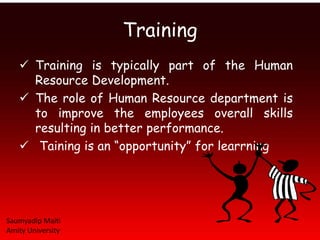
Training
    Training is typically part of the Human
     Resource Development.
    The role of Human Resource department is
     to improve the employees overall skills
     resulting in better performance.
    Taining is an “opportunity” for learrning


Saumyadip Maiti
Amity University
Objectives of Training

    Orienting new employee to the
     organization and their job
    Helping employees perform their
     current jobs & qualify for the
     future jobs.
    Keeping employees informed.
    Providing opportunities for personal
     development

Saumyadip Maiti
Amity University
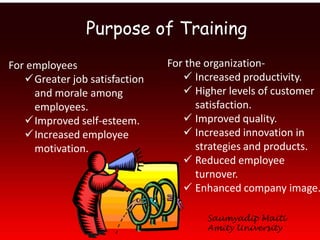
Purpose of Training
For employees                  For the organization-
   Greater job satisfaction       Increased productivity.
     and morale among              Higher levels of customer
     employees.                      satisfaction.
   Improved self-esteem.          Improved quality.
   Increased employee             Increased innovation in
     motivation.                     strategies and products.
                                   Reduced employee
                                     turnover.
                                   Enhanced company image.

                                      Saumyadip Maiti
                                      Amity University
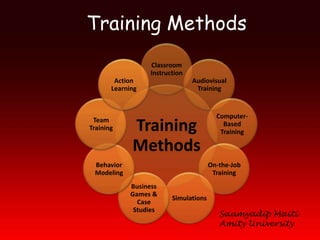
Training Methods
                   Classroom
                   Instruction
        Action                   Audiovisual
       Learning                   Training


                                          Computer-
 Team
Training     Training                       Based
                                           Training

             Methods
 Behavior                               On-the-Job
 Modeling                                Training
             Business
             Games &
                          Simulations
               Case
              Studies
                                           Saumyadip Maiti
                                           Amity University
To be effective, training method
                should
 Motivate the trainee to improve
  performance
 Provide for active participation
  by the trainee
 Encourage positive transfer
  from training to job
 Provide timely feedback on the
  trainee’s performance

                                     Saumyadip Maiti
                                     Amity University
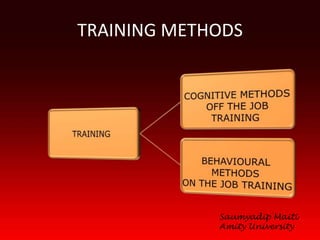
TRAINING METHODS


             Saumyadip Maiti
             Amity University
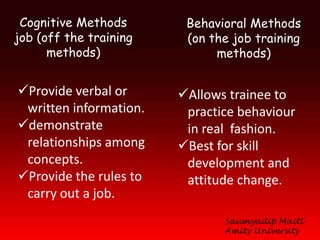
Cognitive Methods       Behavioral Methods
job (off the training    (on the job training
      methods)                methods)


Provide verbal or      Allows trainee to
 written information.    practice behaviour
demonstrate             in real fashion.
 relationships among    Best for skill
 concepts.               development and
Provide the rules to    attitude change.
 carry out a job.
                               Saumyadip Maiti
                               Amity University
COGNITIVE METHODS
    OFF THE JOB TRAINING METHODS
   The Lecture
   Computer Based Training
   Vestibule Training
   Business Games
   Case Studies
   Role Playing


                              Saumyadip Maiti
                              Amity University
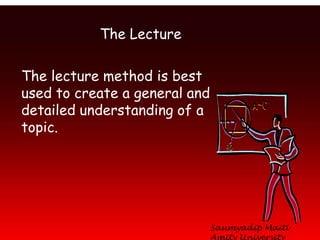
The Lecture

The lecture method is best
used to create a general and
detailed understanding of a
topic.


                               Saumyadip Maiti
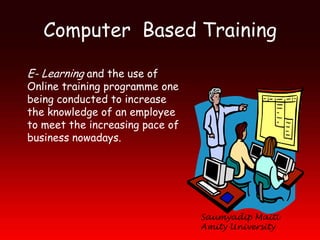
Computer Based Training

E- Learning and the use of
Online training programme one
being conducted to increase
the knowledge of an employee
to meet the increasing pace of
business nowadays.


                                 Saumyadip Maiti
                                 Amity University
Vestibule Training
   Vestibule Training involves the virtual
    duplication of work environment in an
    off-site setting.
   Vestibule Training exercises place the
    trainee in an artificial environment
    that closely imitates actual working
    conditions.


Saumyadip Maiti
Amity University
Business Games
 Indicate the way in an industry, company, or
  sub-unit of company functions.

 In this type of training, participants learn
  how to deal with a variety of issues in a
  simulated business environment.


                                       Saumyadip Maiti
                                       Amity University
Case Studies
 A particular case is given to the trainees on
  a specific topic.

 The trainees are asked to study the topic
  and bring forth suggestions ,flaws etc on the
  given topic.
Role Playing
 The purpose of this method is to give
  participants a chance to experience such
  situations in a controlled setting.
 Trainees are provided with a description of
  the context usually a topic area, a general
  description of a situation, a description of
  their roles, and the problem they each face.
BEHAVIOURAL METHODS ON THE
          JOB TRAINING
 On-the-job training places employees in
  actual work situation and makes them
  immediately productive.
 On-the-job training involve learning by doing,
  relies on demonstration and coaching.
 This form helps particularly to develop the
  occupational skills necessary to manage an
  organization, to fully understand the
  organization’s products and services and how
  they are developed and carried out.
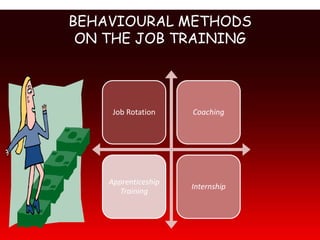
BEHAVIOURAL METHODS
 ON THE JOB TRAINING


     Job Rotation    Coaching


    Apprenticeship
                     Internship
       Training
Job Rotation
Job rotation is the
 systematic movement of
 employees from job to job
 or project to project within
 the organisation.
Excellent job rotation
 program make individuals
 more self-motivated,
 flexible, adaptable,
 innovative, eager to learn
 and able to communicate
 effectively.
Coaching

 Coaching is the process of one-on-one
  guidance and instruction to improve
  knowledge, skills and work performance
  which will give a better response in
  terms of employee performance in
  future.
Apprenticeship Training

 Apprenticeship is another form of on-the-job
  training, is one of the oldest forms of training.
  Apprenticeship are designed to provide
  planned, practical instruction over a
  significant span of time.
Internship

 Internship are opportunities for students
  to get real world experience, often during
  summer vacations as a part of fulfilling
  requirements for degree programs.
  Internship are offered usually by
  organization to college students wanting
  to find work experience. The internship
  offer precious, real life job experience
  and the organization often get skilled,
  highly dedicated service.
THANK YOU

Training methods

  • 1.
    Training Methods BY- Saumyadip Maiti Amity University
  • 2.
    Training  Training is typically part of the Human Resource Development.  The role of Human Resource department is to improve the employees overall skills resulting in better performance.  Taining is an “opportunity” for learrning Saumyadip Maiti Amity University
  • 3.
    Objectives of Training  Orienting new employee to the organization and their job  Helping employees perform their current jobs & qualify for the future jobs.  Keeping employees informed.  Providing opportunities for personal development Saumyadip Maiti Amity University
  • 4.
    Purpose of Training Foremployees For the organization- Greater job satisfaction  Increased productivity. and morale among  Higher levels of customer employees. satisfaction. Improved self-esteem.  Improved quality. Increased employee  Increased innovation in motivation. strategies and products.  Reduced employee turnover.  Enhanced company image. Saumyadip Maiti Amity University
  • 5.
    Training Methods Classroom Instruction Action Audiovisual Learning Training Computer- Team Training Training Based Training Methods Behavior On-the-Job Modeling Training Business Games & Simulations Case Studies Saumyadip Maiti Amity University
  • 6.
    To be effective,training method should  Motivate the trainee to improve performance  Provide for active participation by the trainee  Encourage positive transfer from training to job  Provide timely feedback on the trainee’s performance Saumyadip Maiti Amity University
  • 7.
    TRAINING METHODS Saumyadip Maiti Amity University
  • 8.
    Cognitive Methods Behavioral Methods job (off the training (on the job training methods) methods) Provide verbal or Allows trainee to written information. practice behaviour demonstrate in real fashion. relationships among Best for skill concepts. development and Provide the rules to attitude change. carry out a job. Saumyadip Maiti Amity University
  • 9.
    COGNITIVE METHODS OFF THE JOB TRAINING METHODS  The Lecture  Computer Based Training  Vestibule Training  Business Games  Case Studies  Role Playing Saumyadip Maiti Amity University
  • 10.
    The Lecture The lecturemethod is best used to create a general and detailed understanding of a topic. Saumyadip Maiti
  • 11.
    Computer Based Training E-Learning and the use of Online training programme one being conducted to increase the knowledge of an employee to meet the increasing pace of business nowadays. Saumyadip Maiti Amity University
  • 12.
    Vestibule Training  Vestibule Training involves the virtual duplication of work environment in an off-site setting.  Vestibule Training exercises place the trainee in an artificial environment that closely imitates actual working conditions. Saumyadip Maiti Amity University
  • 13.
    Business Games  Indicatethe way in an industry, company, or sub-unit of company functions.  In this type of training, participants learn how to deal with a variety of issues in a simulated business environment. Saumyadip Maiti Amity University
  • 14.
    Case Studies  Aparticular case is given to the trainees on a specific topic.  The trainees are asked to study the topic and bring forth suggestions ,flaws etc on the given topic.
  • 15.
    Role Playing  Thepurpose of this method is to give participants a chance to experience such situations in a controlled setting.  Trainees are provided with a description of the context usually a topic area, a general description of a situation, a description of their roles, and the problem they each face.
  • 16.
    BEHAVIOURAL METHODS ONTHE JOB TRAINING  On-the-job training places employees in actual work situation and makes them immediately productive.  On-the-job training involve learning by doing, relies on demonstration and coaching.  This form helps particularly to develop the occupational skills necessary to manage an organization, to fully understand the organization’s products and services and how they are developed and carried out.
  • 17.
    BEHAVIOURAL METHODS ONTHE JOB TRAINING Job Rotation Coaching Apprenticeship Internship Training
  • 18.
    Job Rotation Job rotationis the systematic movement of employees from job to job or project to project within the organisation. Excellent job rotation program make individuals more self-motivated, flexible, adaptable, innovative, eager to learn and able to communicate effectively.
  • 19.
    Coaching  Coaching isthe process of one-on-one guidance and instruction to improve knowledge, skills and work performance which will give a better response in terms of employee performance in future.
  • 20.
    Apprenticeship Training  Apprenticeshipis another form of on-the-job training, is one of the oldest forms of training. Apprenticeship are designed to provide planned, practical instruction over a significant span of time.
  • 21.
    Internship  Internship areopportunities for students to get real world experience, often during summer vacations as a part of fulfilling requirements for degree programs. Internship are offered usually by organization to college students wanting to find work experience. The internship offer precious, real life job experience and the organization often get skilled, highly dedicated service.
  • 22.