Training & Development 
Training as a management skill / 
Training and developing your staff 
HRT 382 -Week 4
2 
Topics 
 Why do we Need Training? 
 What is Training & Training Principles? 
 A Systematic Approach to Training 
 A Training Lesson Plan
3 
Your Objectives 
Following this presentation you should be able to 
complete the following objectives: 
1. Describe why training is important and distinguish 
amongst training, education and development 
2. Define the ASK concept, and comment upon the 
relative difficulty in developing people’s attitudes, 
skills and knowledge 
3. List the nine steps in the training process and be able 
to explain each step with reference to hospitality 
examples 
4. Develop an appropriate training lesson plan.
4 
Do Organizations Need 
Training 
 The answer is “YES” 
 However, we must 
know the purpose and 
functions of training 
before we can use it.
5 
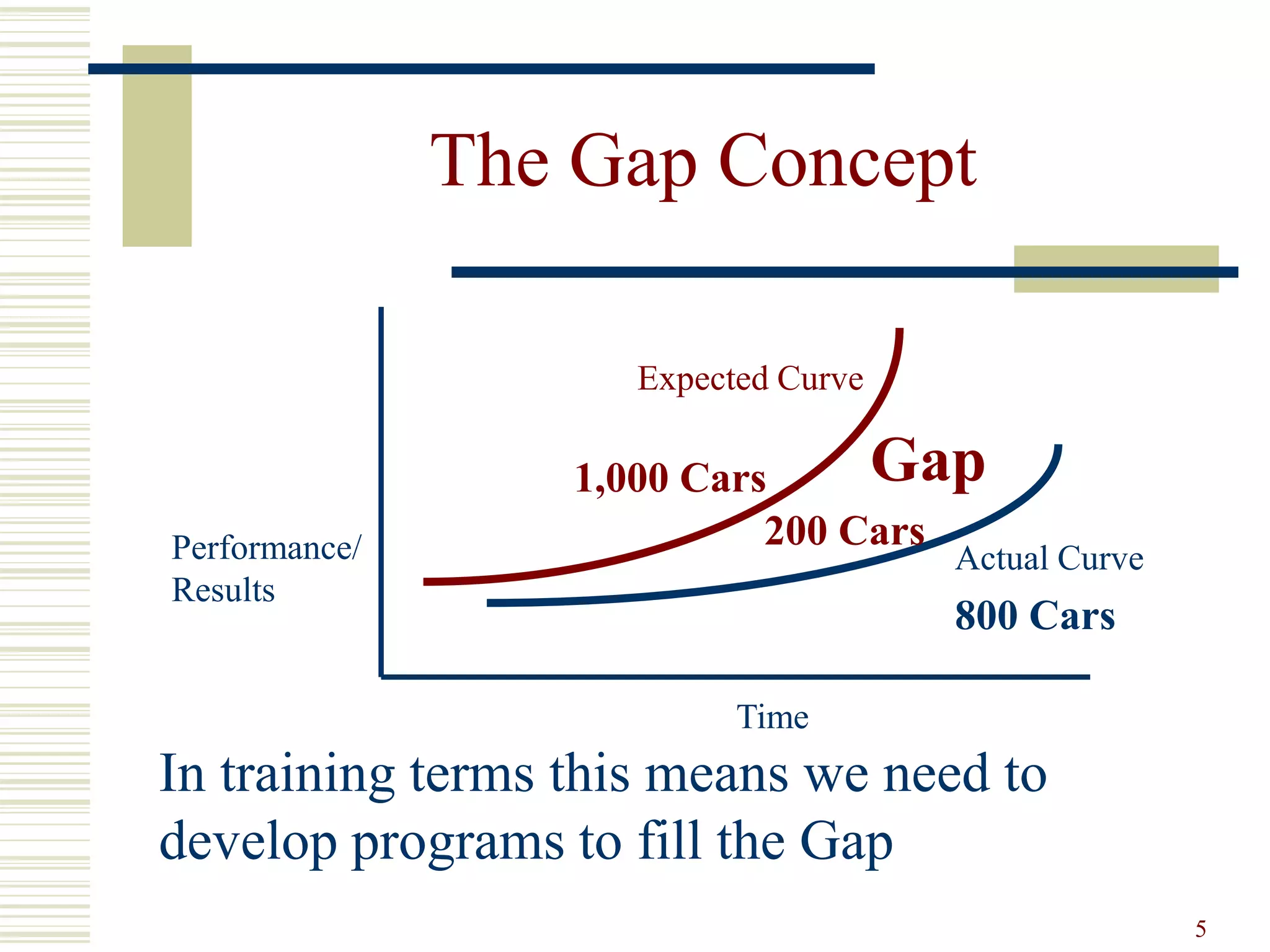
The Gap Concept 
Performance/ 
Results 
Expected Curve 
1,000 Cars 
200 Cars 
Time 
Gap 
Actual Curve 
800 Cars 
In training terms this means we need to 
develop programs to fill the Gap
6 
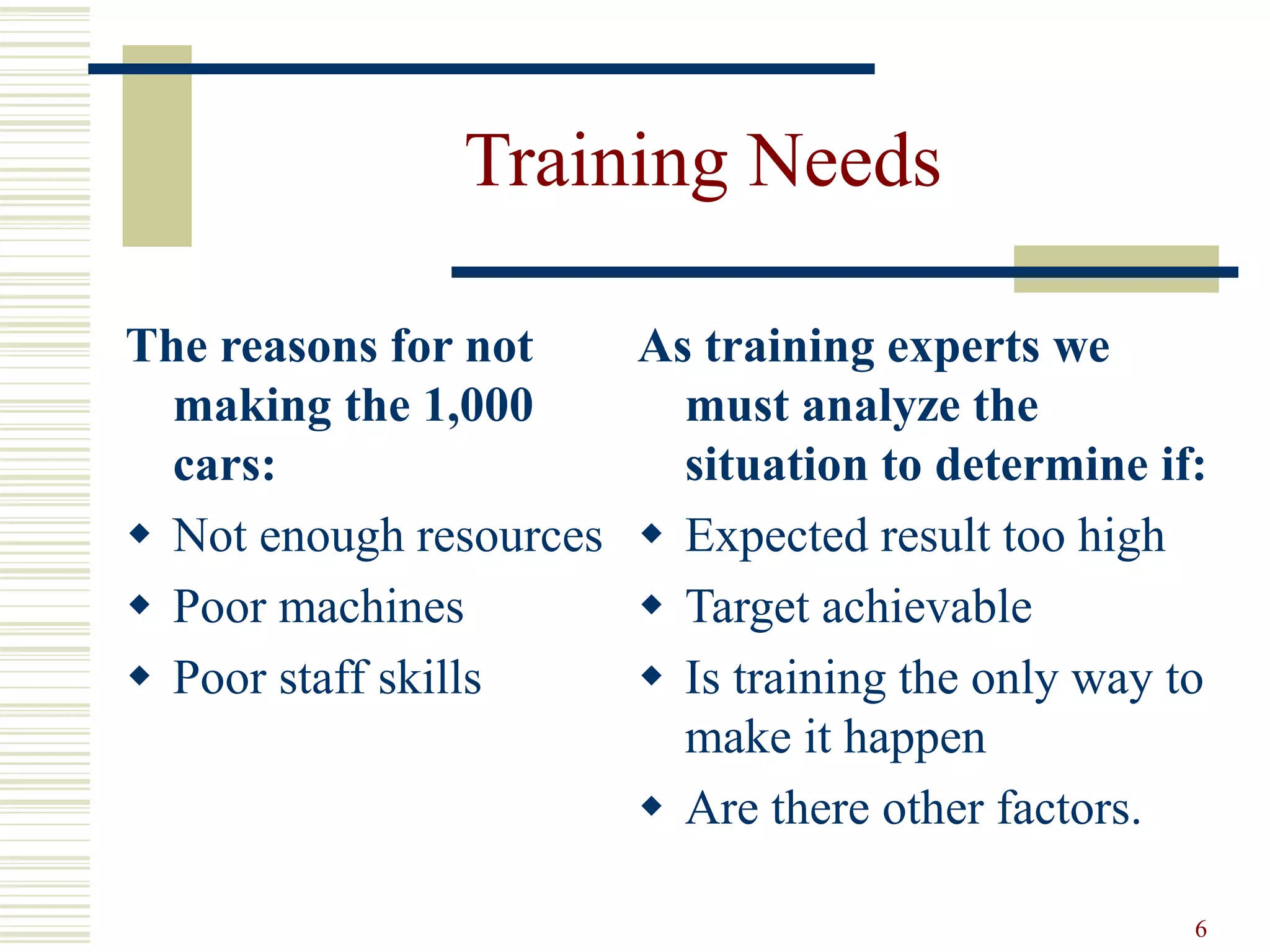
Training Needs 
The reasons for not 
making the 1,000 
cars: 
 Not enough resources 
 Poor machines 
 Poor staff skills 
As training experts we 
must analyze the 
situation to determine if: 
 Expected result too high 
 Target achievable 
 Is training the only way to 
make it happen 
 Are there other factors.
7 
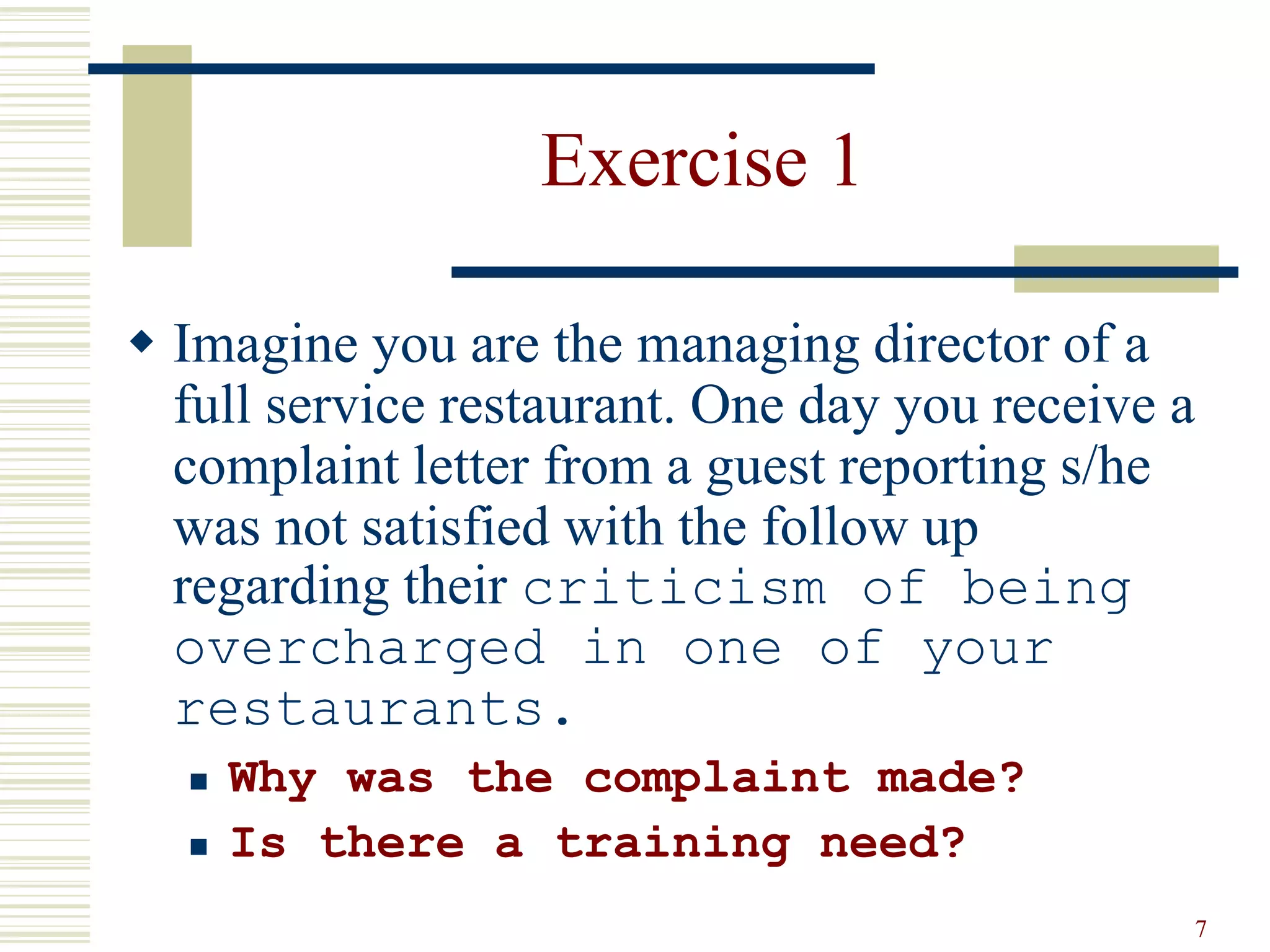
Exercise 1 
 Imagine you are the managing director of a 
full service restaurant. One day you receive a 
complaint letter from a guest reporting s/he 
was not satisfied with the follow up 
regarding their criticism of being 
overcharged in one of your 
restaurants. 
 Why was the complaint made? 
 Is there a training need?
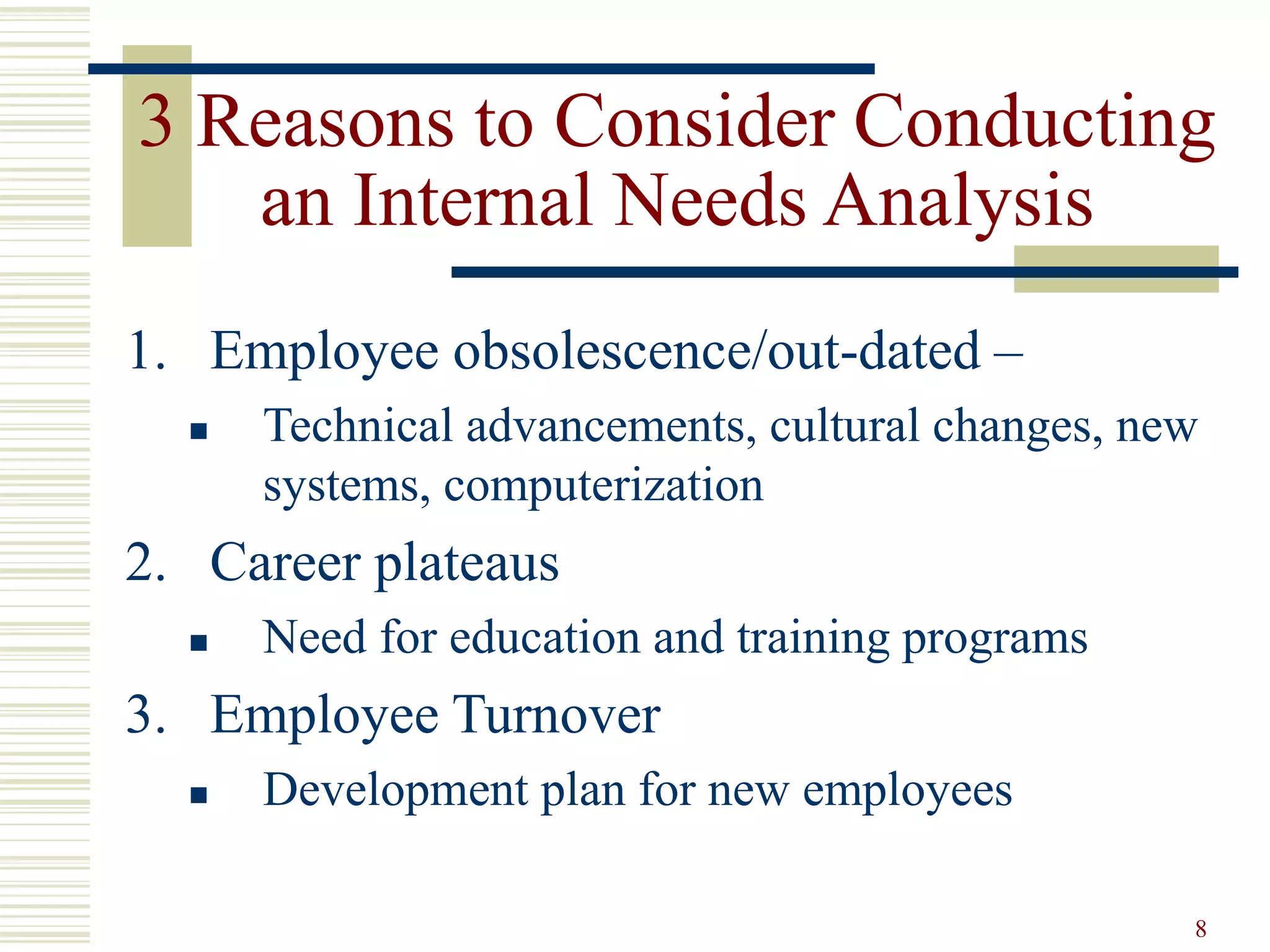
3 Reasons to Consider Conducting 
8 
an Internal Needs Analysis 
1. Employee obsolescence/out-dated – 
 Technical advancements, cultural changes, new 
systems, computerization 
2. Career plateaus 
 Need for education and training programs 
3. Employee Turnover 
 Development plan for new employees
9 
Importance of Training 
 Maintains qualified products / services 
 Achieves high service standards 
 Provides information for new comers 
 Refreshes memory of old employees 
 Achieves learning about new things; technology, 
products / service delivery 
 Reduces mistakes - minimizing costs 
 Opportunity for staff to feedback / suggest improvements 
 Improves communication & relationships - better 
teamwork
10 
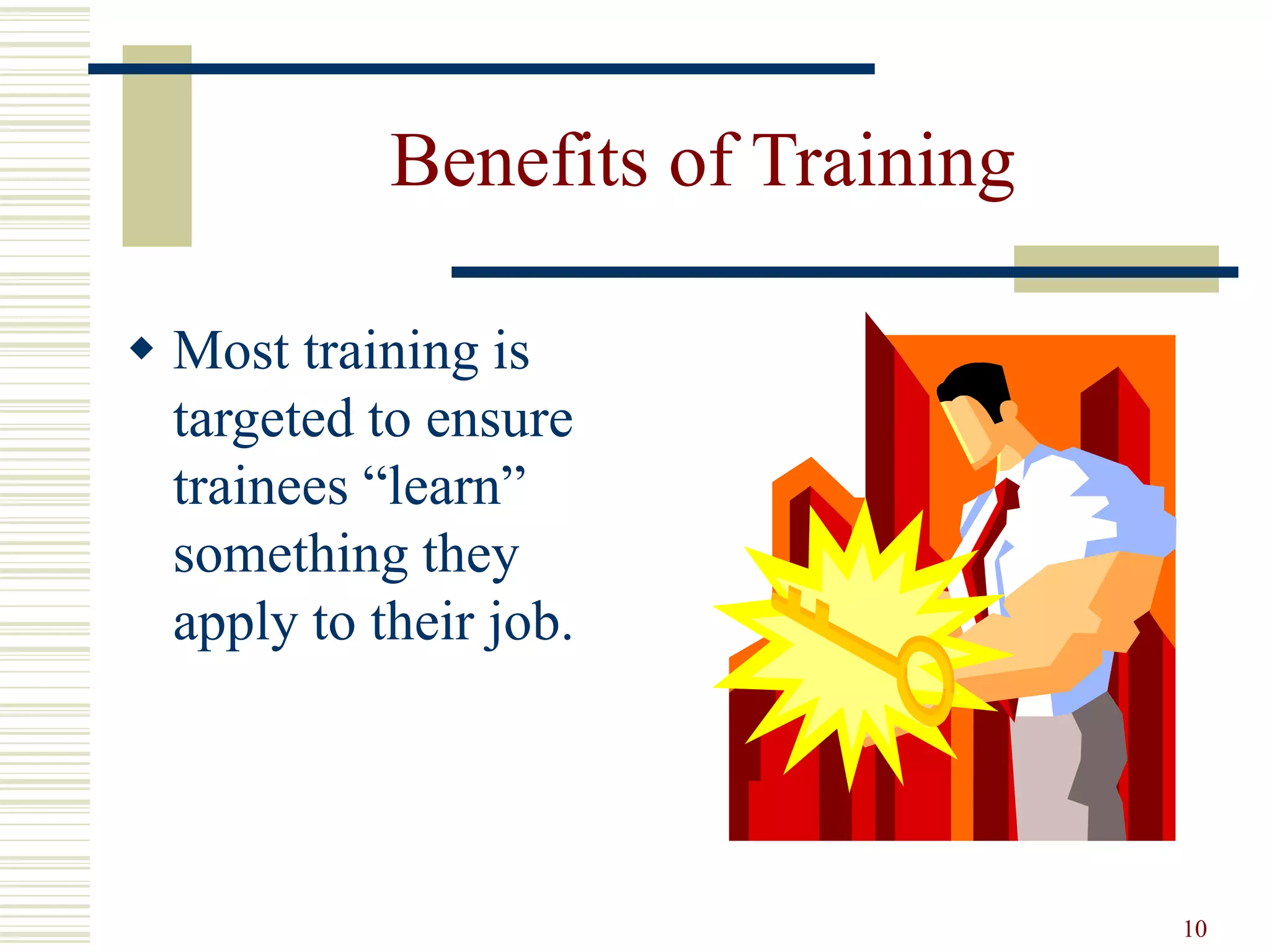
Benefits of Training 
 Most training is 
targeted to ensure 
trainees “learn” 
something they 
apply to their job.
11 
What is Training? 
 Training is a systematic process through 
which an organization’s human resources 
gain knowledge and develop skills by 
instruction and practical activities that result 
in improved corporate performance.
12 
Differences between Training, 
Education & Development 
 Training is short term, task oriented and targeted 
on achieving a change of attitude, skills and 
knowledge in a specific area. It is usually job 
related. 
 Education is a lifetime investment. It tends to be 
initiated by a person in the area of his/her interest 
 Development is a long term investment in human 
resources.
13 
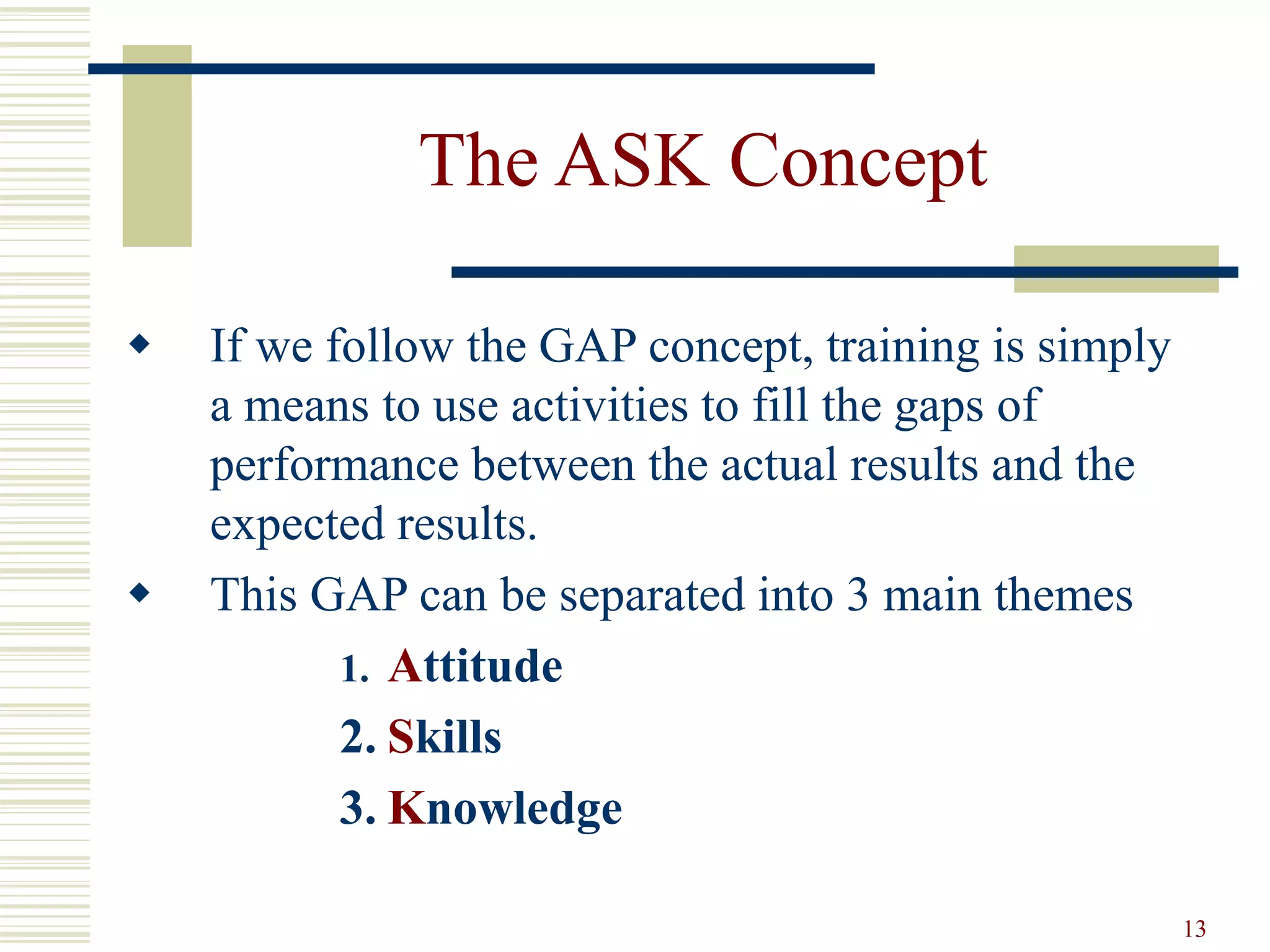
The ASK Concept 
 If we follow the GAP concept, training is simply 
a means to use activities to fill the gaps of 
performance between the actual results and the 
expected results. 
 This GAP can be separated into 3 main themes 
1. Attitude 
2. Skills 
3. Knowledge
14 
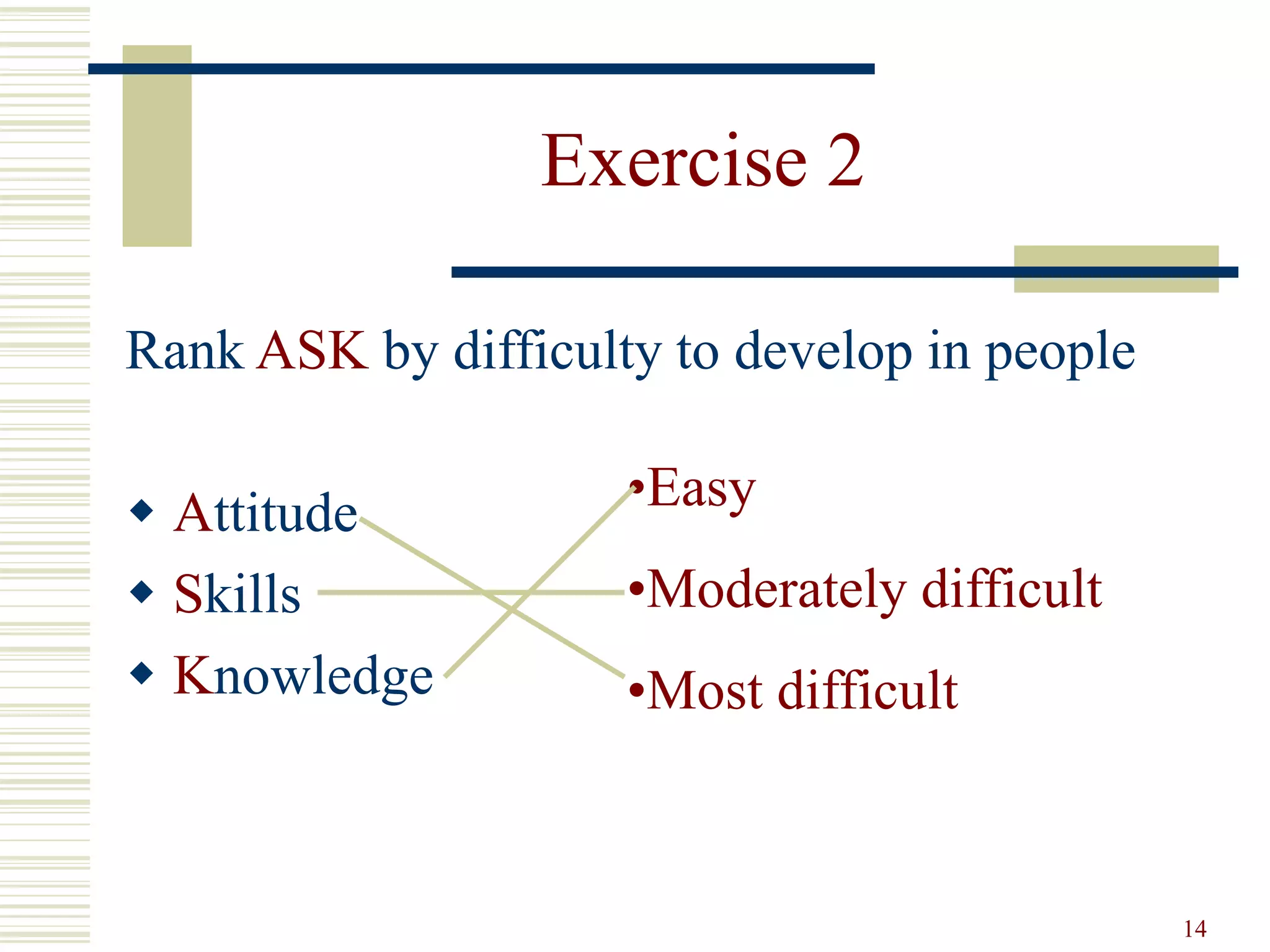
Exercise 2 
Rank ASK by difficulty to develop in people 
 Attitude 
 Skills 
 Knowledge 
•Easy 
•Moderately difficult 
•Most difficult
15 
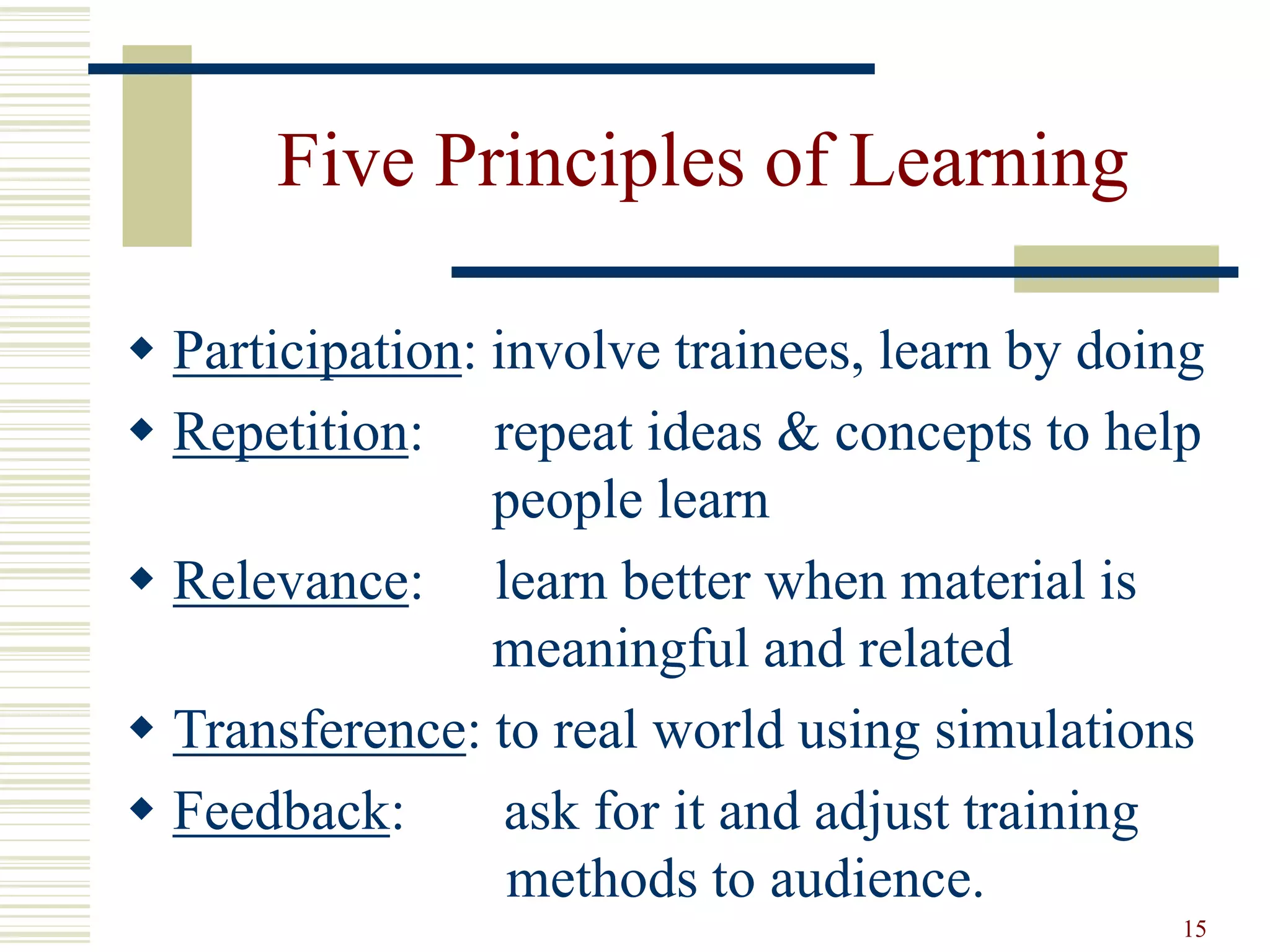
Five Principles of Learning 
 Participation: involve trainees, learn by doing 
 Repetition: repeat ideas & concepts to help 
people learn 
 Relevance: learn better when material is 
meaningful and related 
 Transference: to real world using simulations 
 Feedback: ask for it and adjust training 
methods to audience.
16 
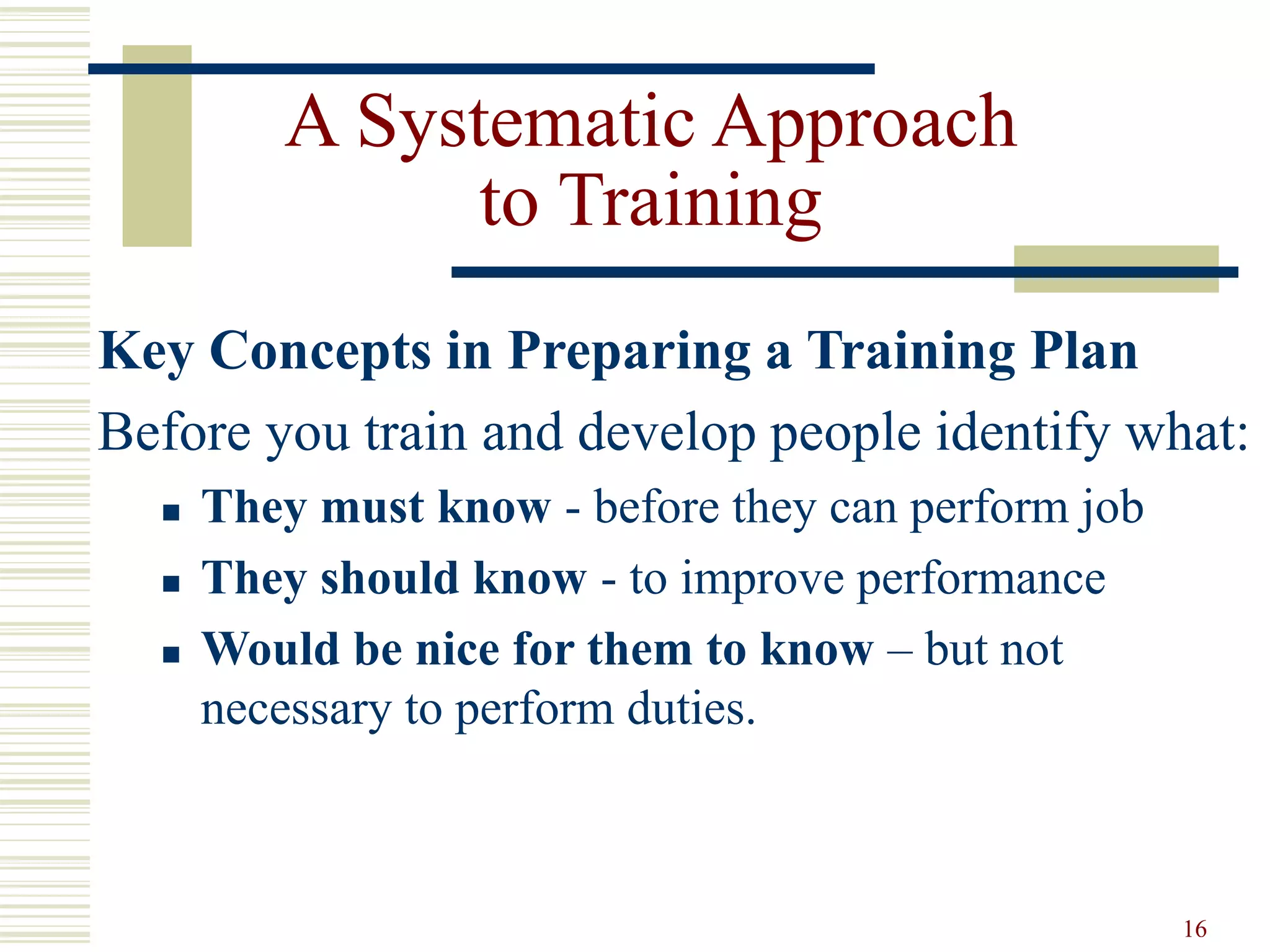
A Systematic Approach 
to Training 
Key Concepts in Preparing a Training Plan 
Before you train and develop people identify what: 
 They must know - before they can perform job 
 They should know - to improve performance 
 Would be nice for them to know – but not 
necessary to perform duties.
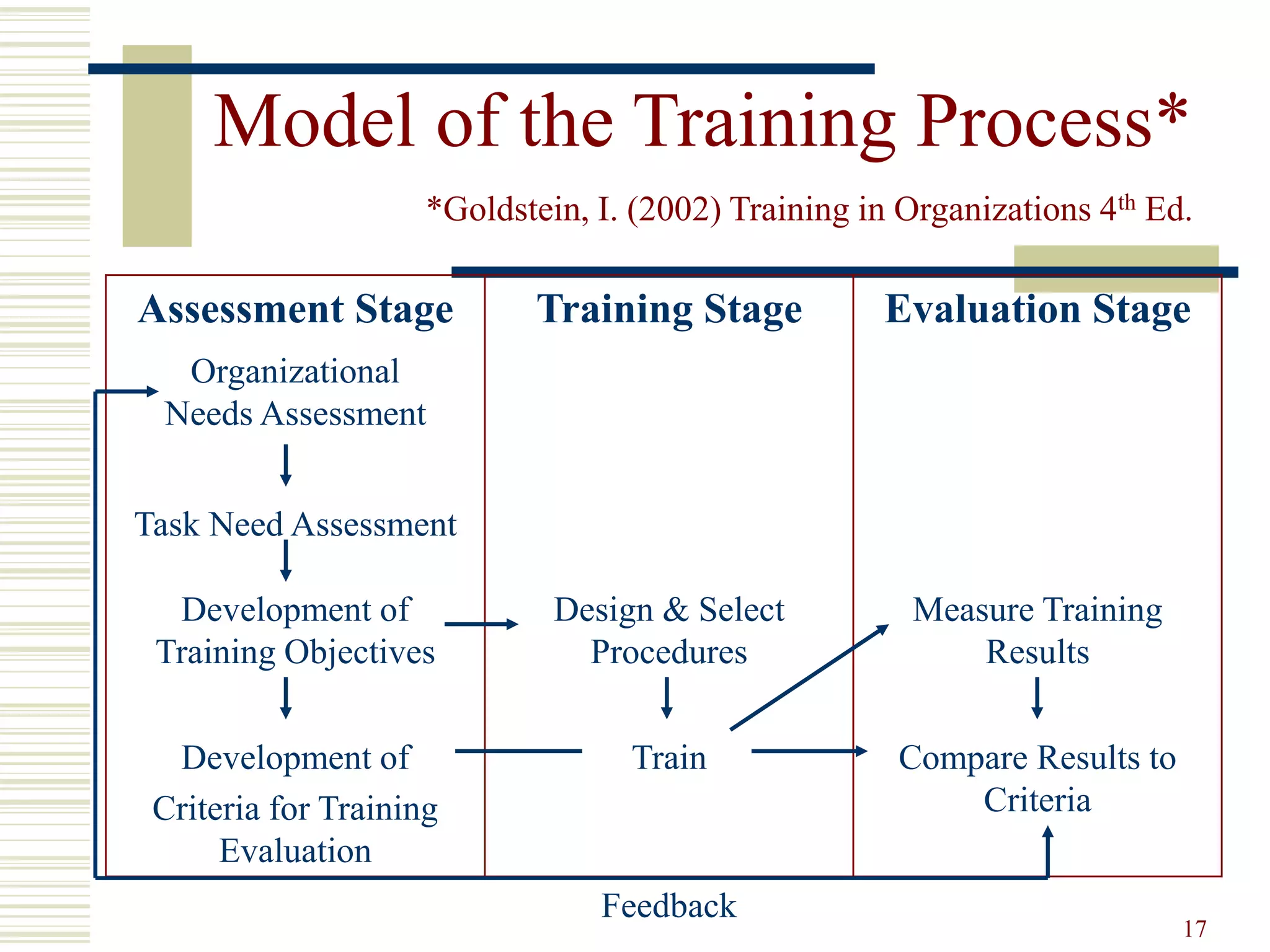
Model of the Training Process* 
*Goldstein, I. (2002) Training in Organizations 4th Ed. 
Assessment Stage Training Stage Evaluation Stage 
17 
Organizational 
Needs Assessment 
Task Need Assessment 
Development of 
Training Objectives 
Design & Select 
Procedures 
Measure Training 
Results 
Development of 
Criteria for Training 
Evaluation 
Train Compare Results to 
Criteria 
Feedback
18 
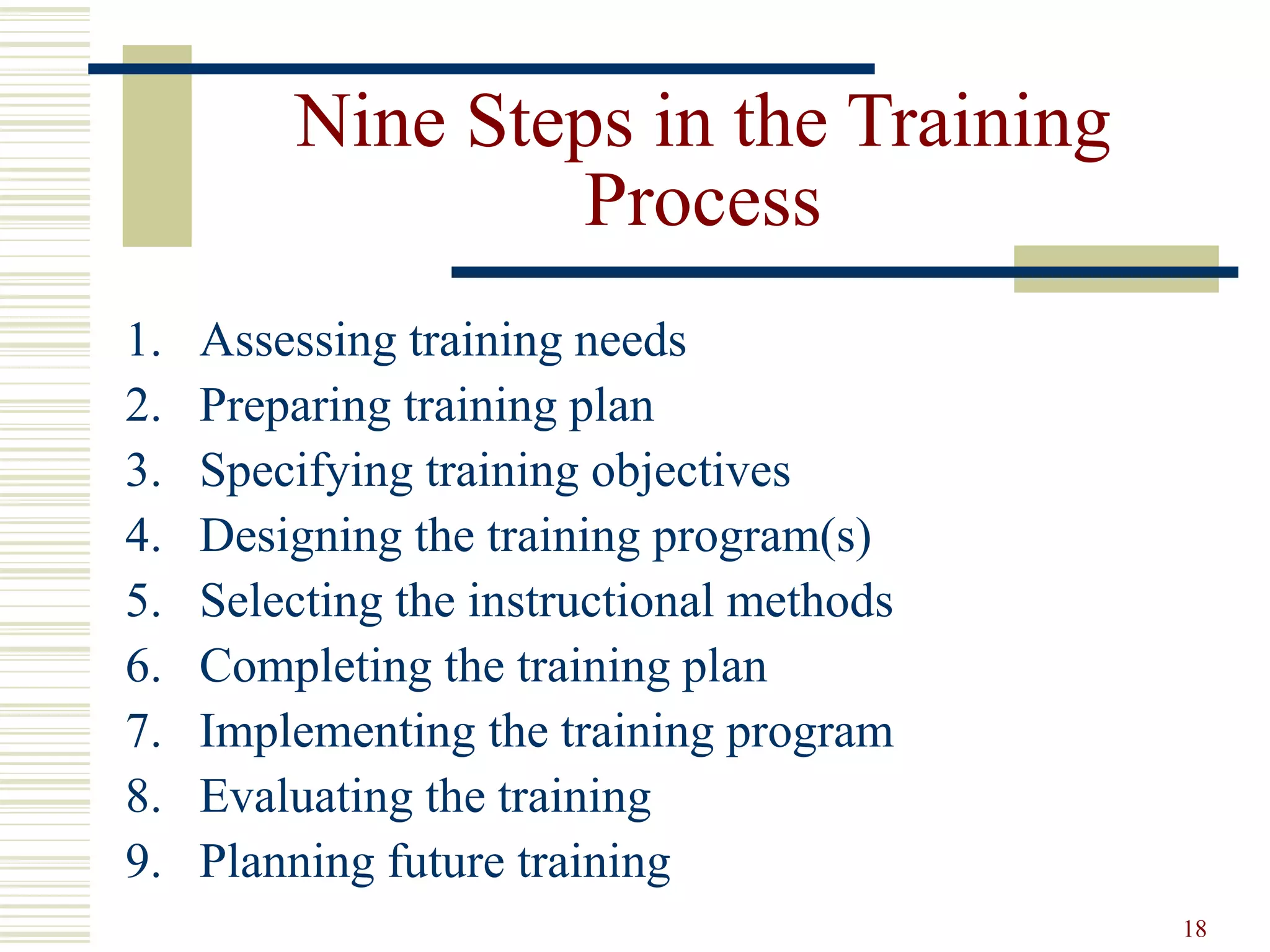
Nine Steps in the Training 
Process 
1. Assessing training needs 
2. Preparing training plan 
3. Specifying training objectives 
4. Designing the training program(s) 
5. Selecting the instructional methods 
6. Completing the training plan 
7. Implementing the training program 
8. Evaluating the training 
9. Planning future training
19 
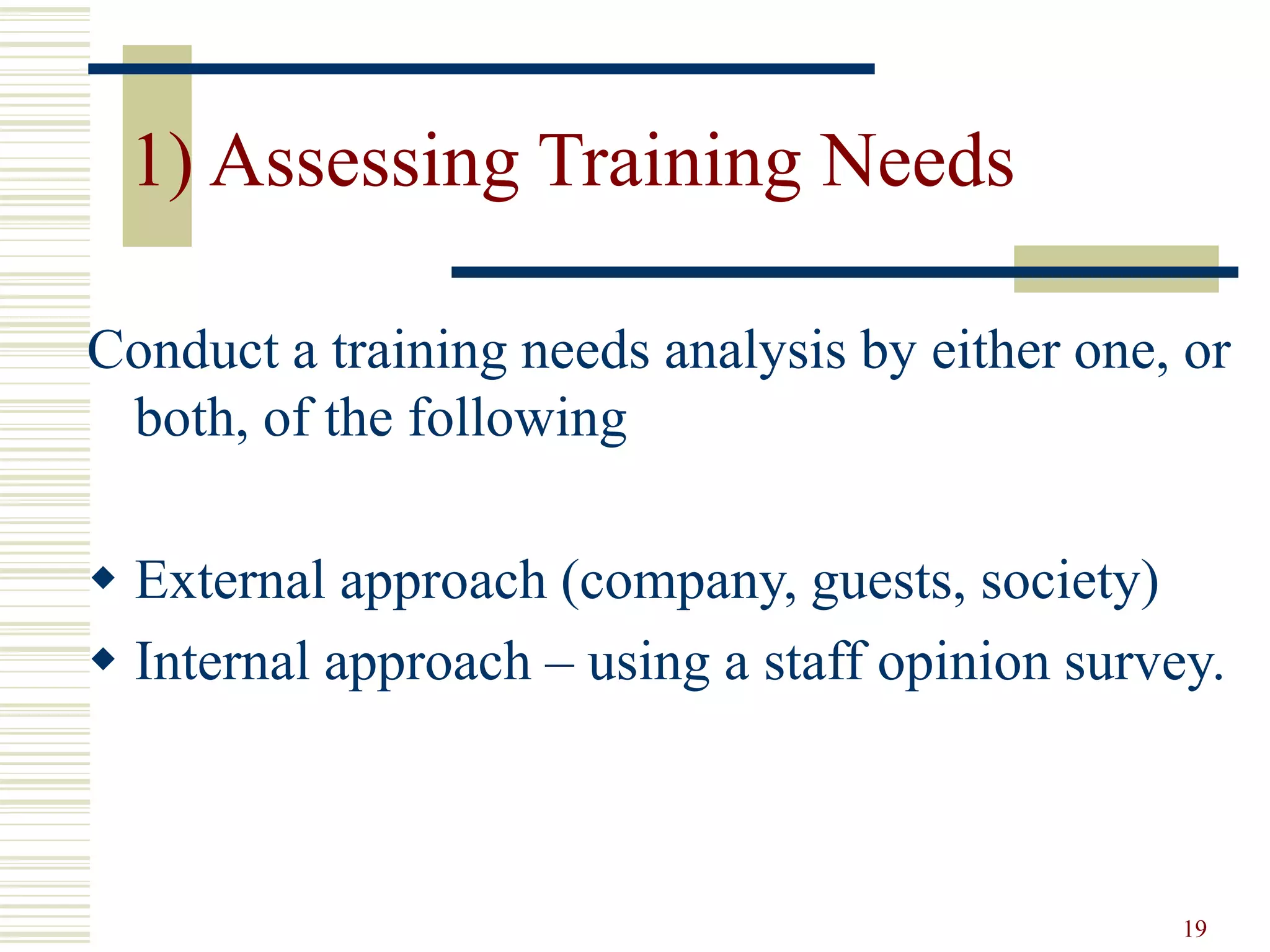
1) Assessing Training Needs 
Conduct a training needs analysis by either one, or 
both, of the following 
 External approach (company, guests, society) 
 Internal approach – using a staff opinion survey.
20 
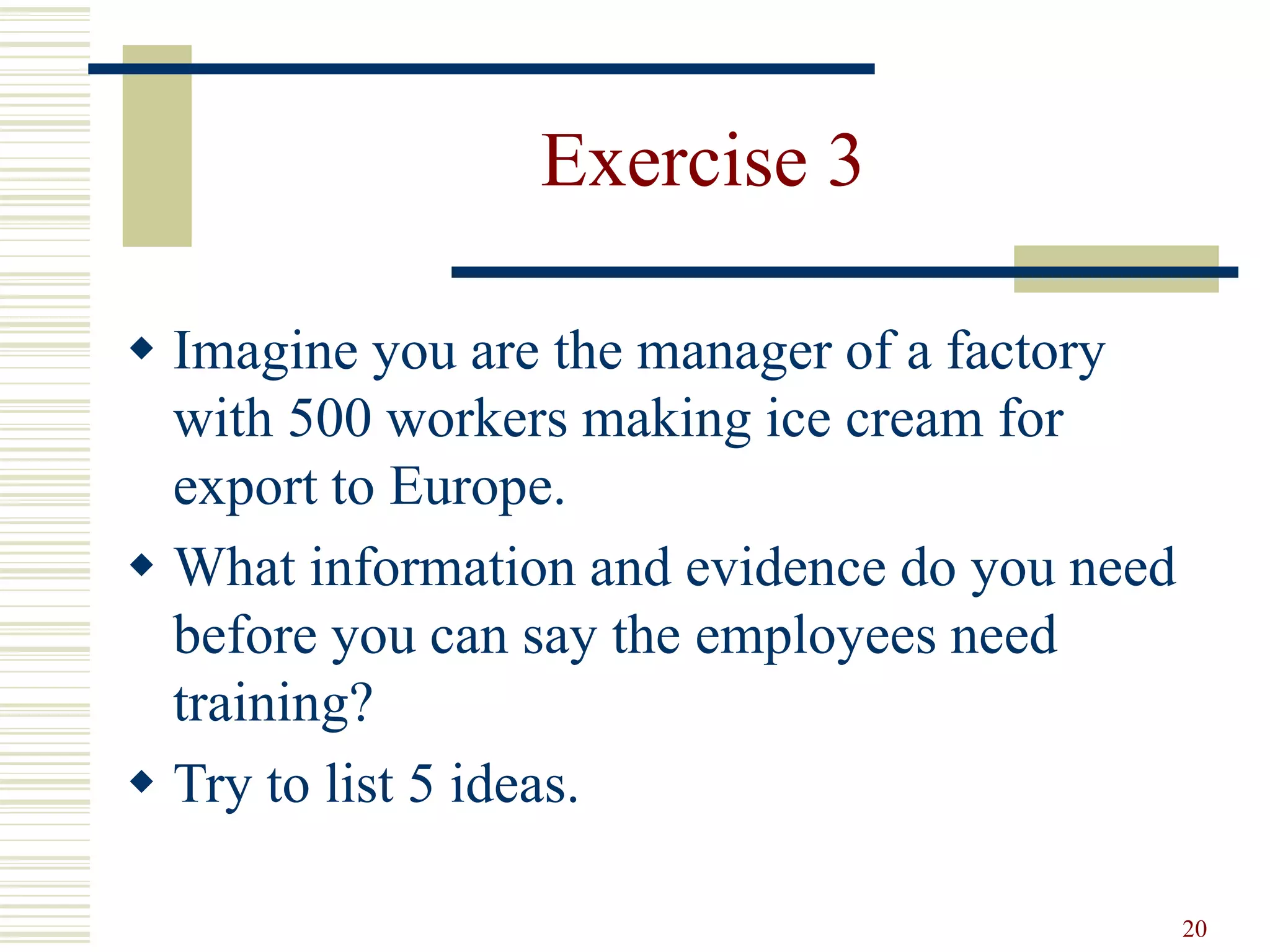
Exercise 3 
 Imagine you are the manager of a factory 
with 500 workers making ice cream for 
export to Europe. 
 What information and evidence do you need 
before you can say the employees need 
training? 
 Try to list 5 ideas.
21 
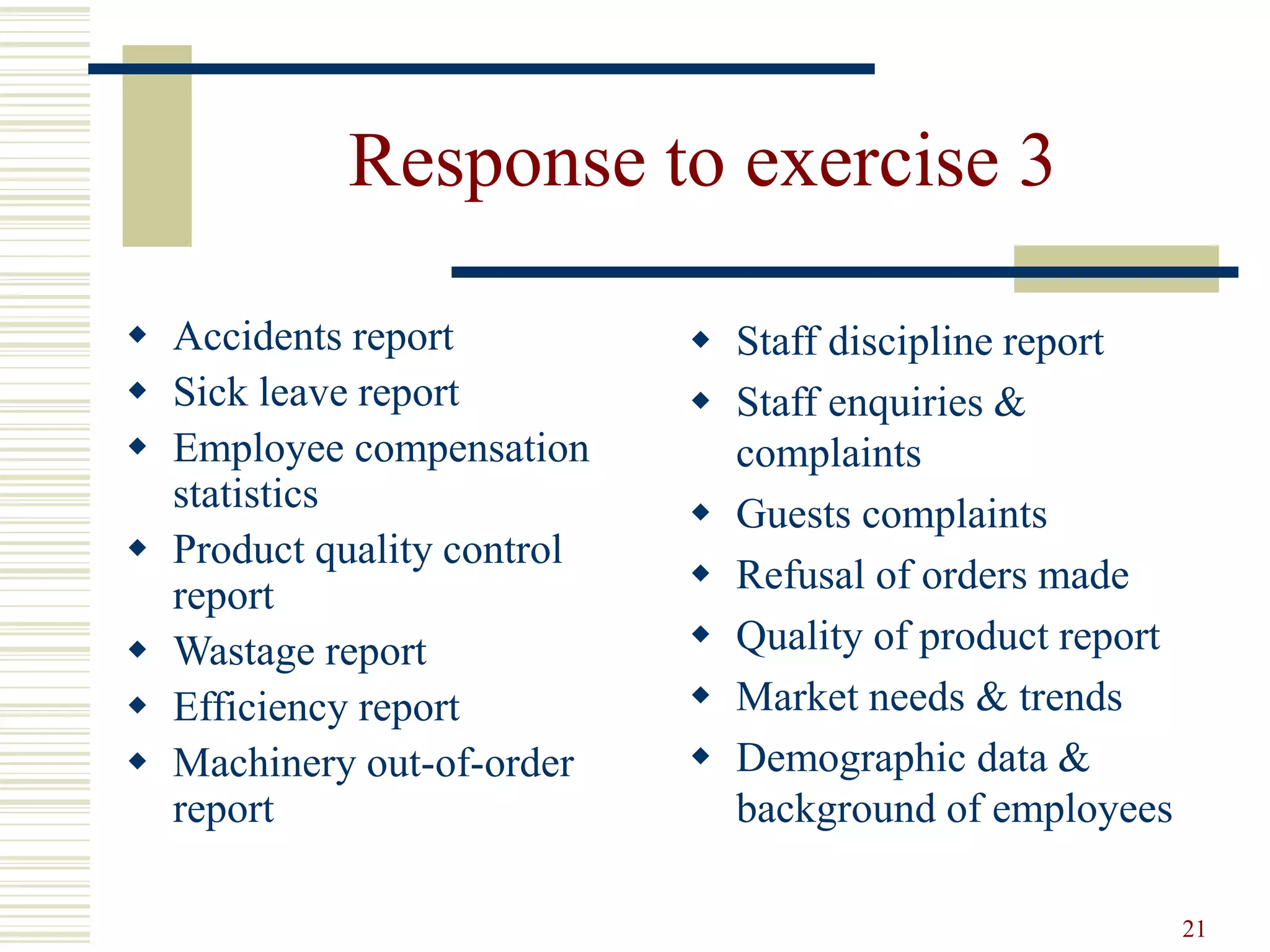
Response to exercise 3 
 Accidents report 
 Sick leave report 
 Employee compensation 
statistics 
 Product quality control 
report 
 Wastage report 
 Efficiency report 
 Machinery out-of-order 
report 
 Staff discipline report 
 Staff enquiries & 
complaints 
 Guests complaints 
 Refusal of orders made 
 Quality of product report 
 Market needs & trends 
 Demographic data & 
background of employees
22 
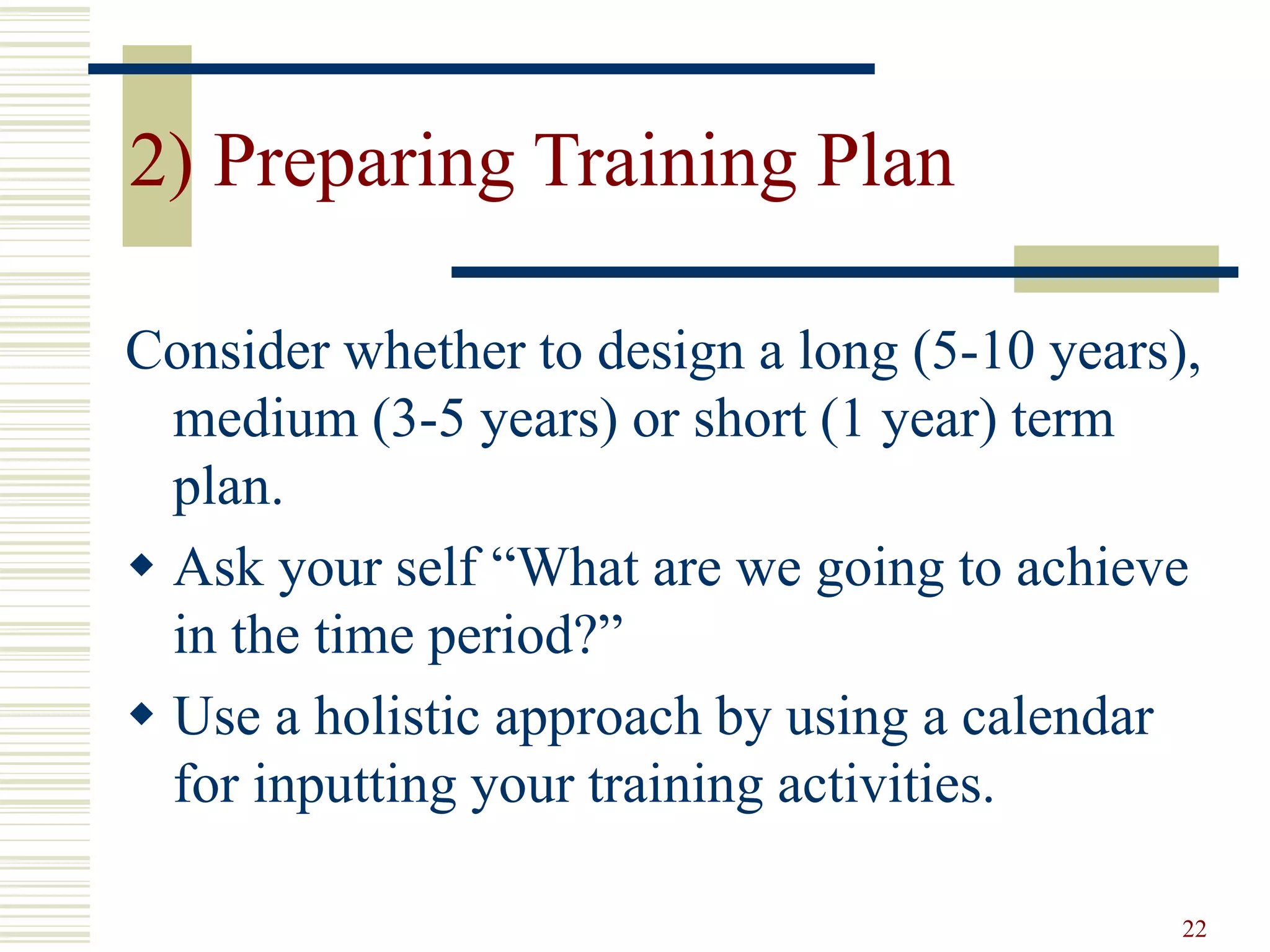
2) Preparing Training Plan 
Consider whether to design a long (5-10 years), 
medium (3-5 years) or short (1 year) term 
plan. 
 Ask your self “What are we going to achieve 
in the time period?” 
 Use a holistic approach by using a calendar 
for inputting your training activities.
23 
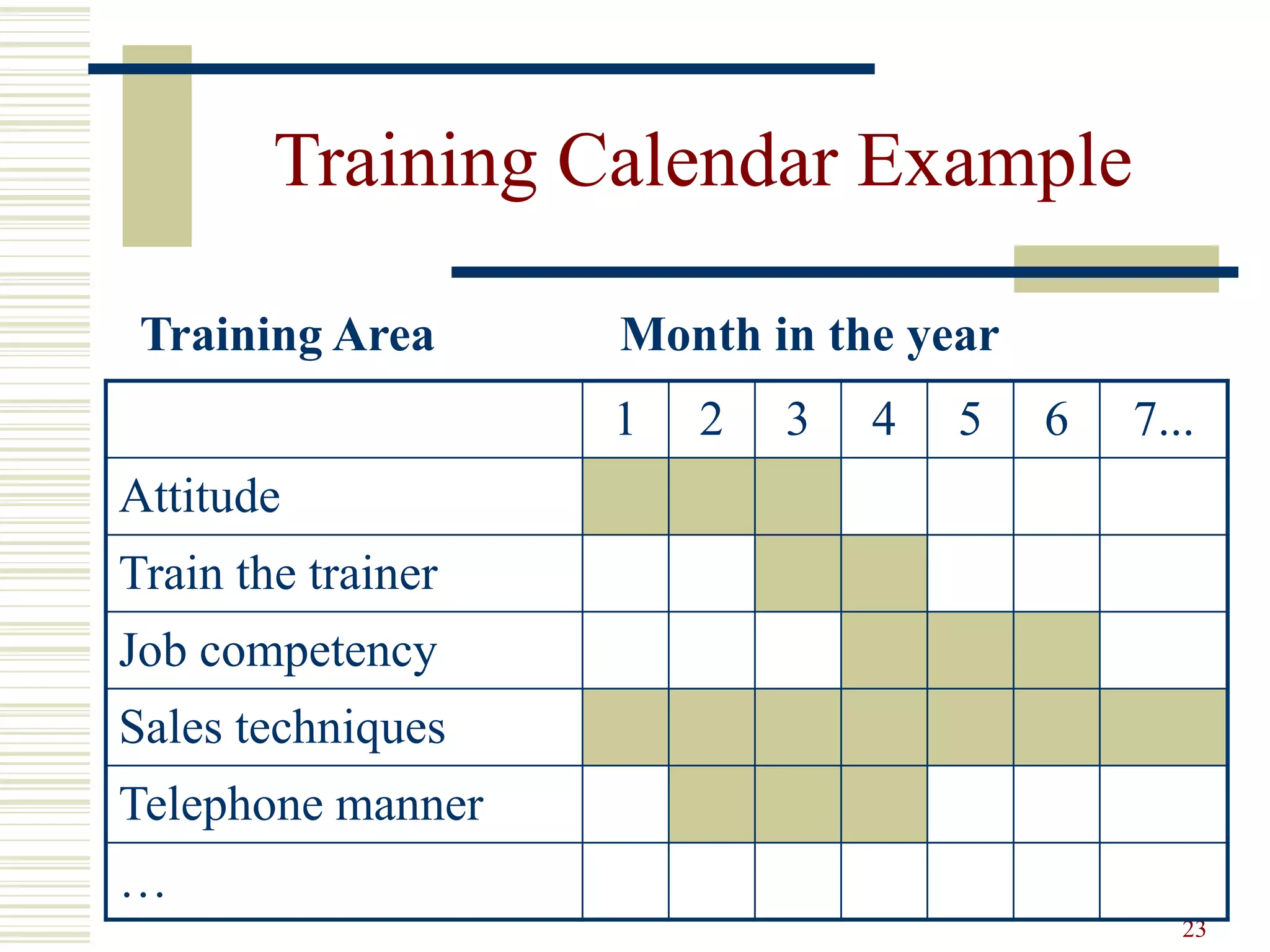
Training Calendar Example 
Training Area Month in the year 
1 2 3 4 5 6 7... 
Attitude 
Train the trainer 
Job competency 
Sales techniques 
Telephone manner 
…
24 
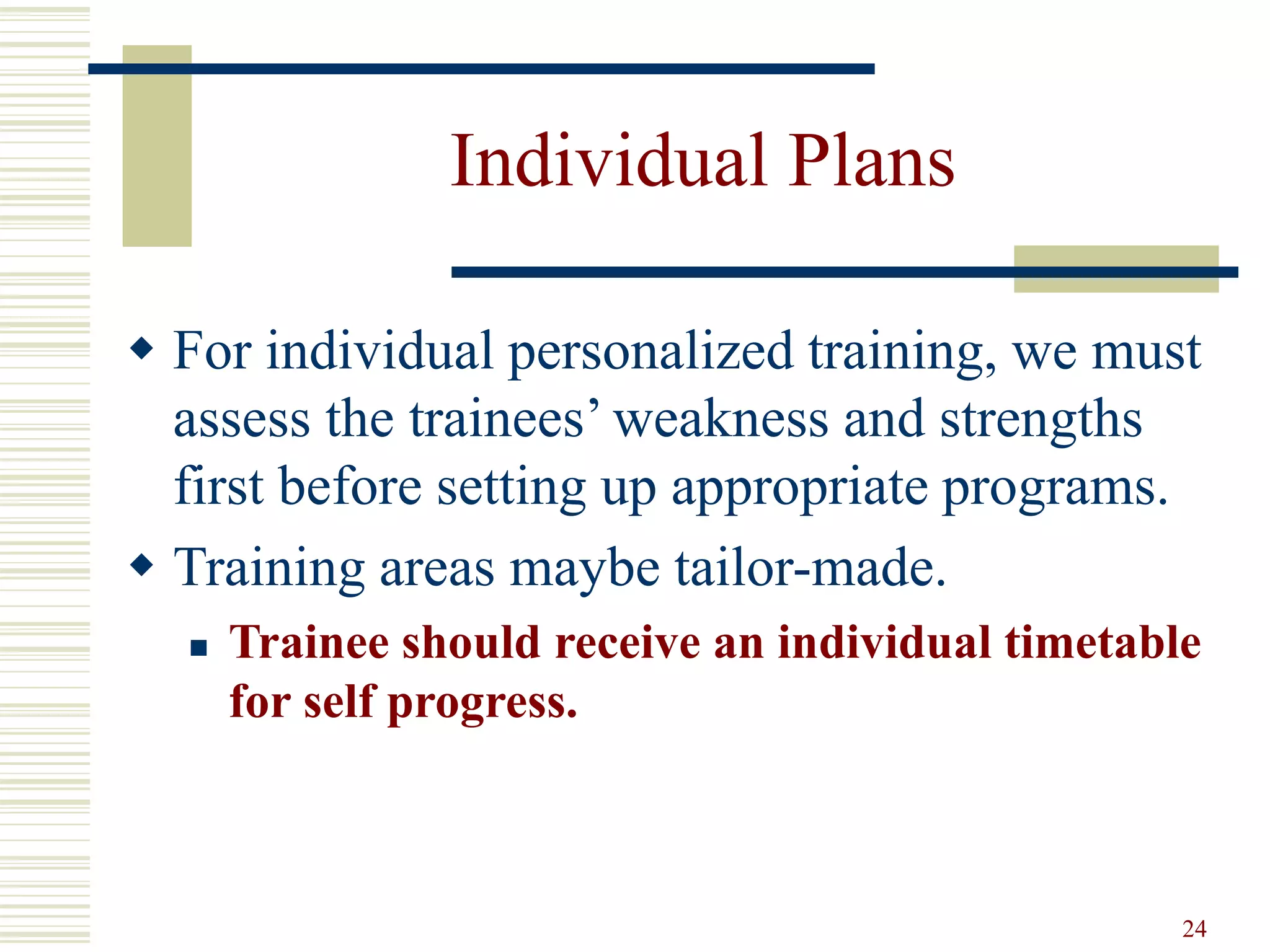
Individual Plans 
 For individual personalized training, we must 
assess the trainees’ weakness and strengths 
first before setting up appropriate programs. 
 Training areas maybe tailor-made. 
 Trainee should receive an individual timetable 
for self progress.
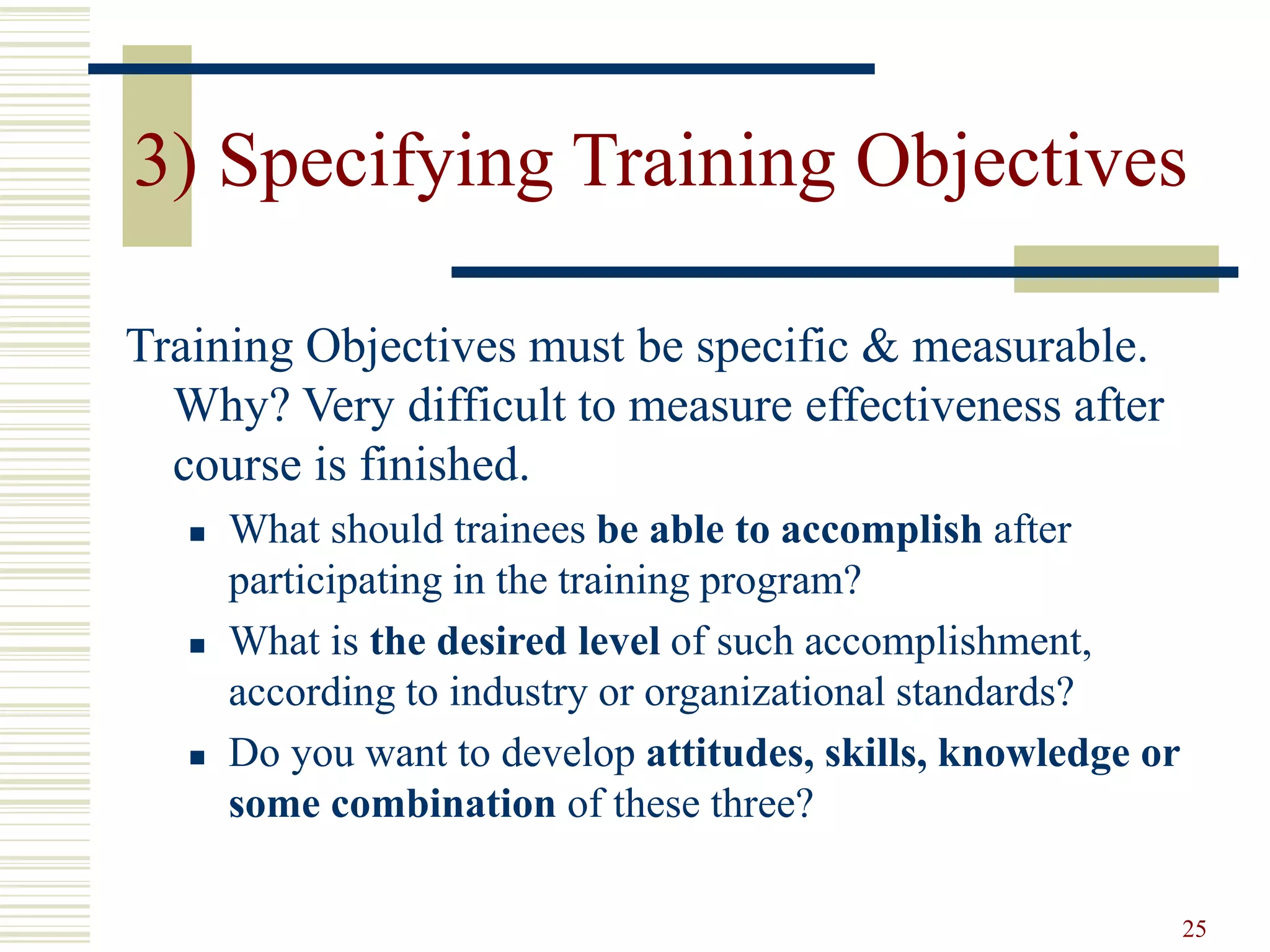
3) Specifying Training Objectives 
25 
Training Objectives must be specific & measurable. 
Why? Very difficult to measure effectiveness after 
course is finished. 
 What should trainees be able to accomplish after 
participating in the training program? 
 What is the desired level of such accomplishment, 
according to industry or organizational standards? 
 Do you want to develop attitudes, skills, knowledge or 
some combination of these three?
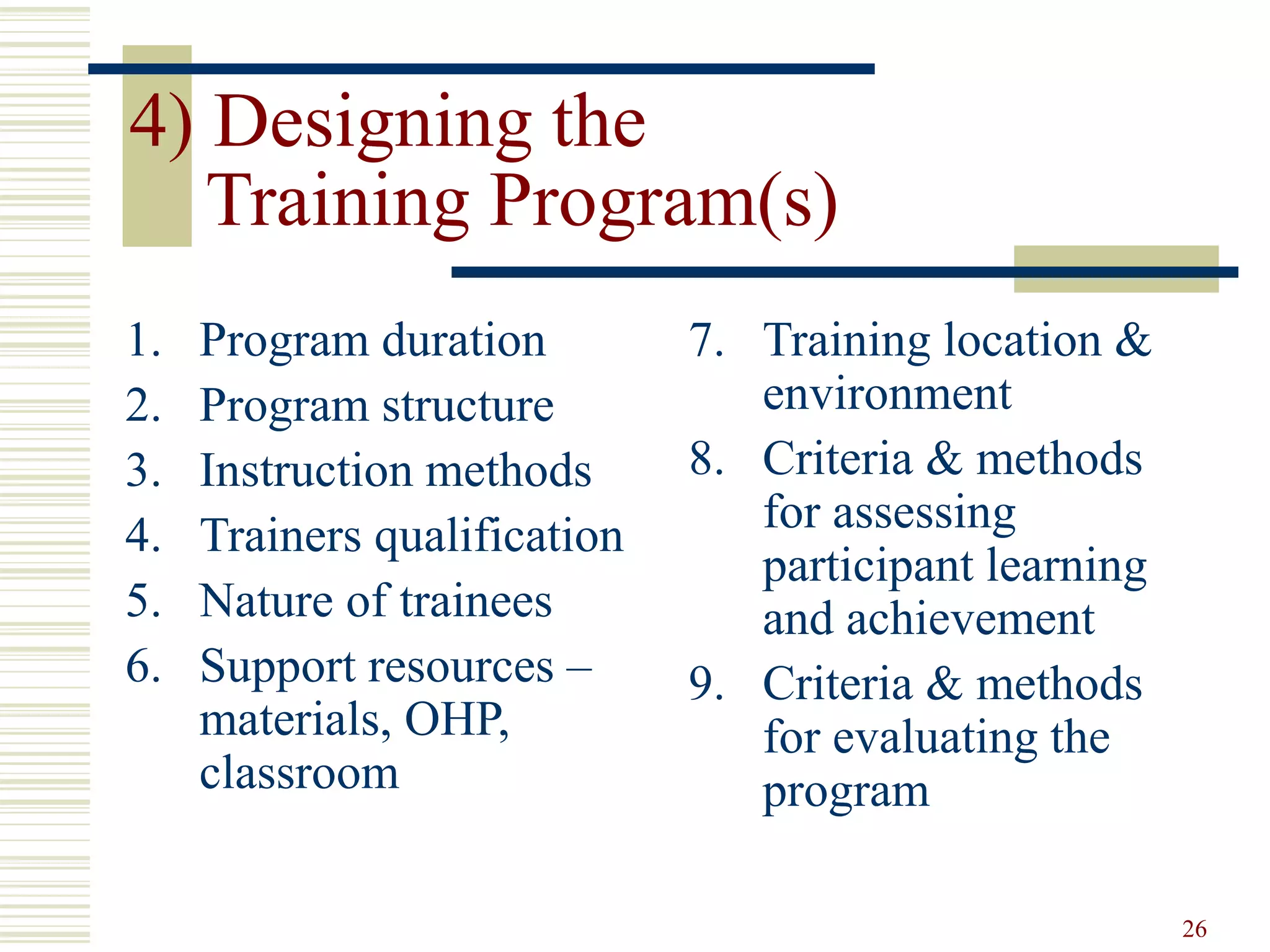
26 
4) Designing the 
Training Program(s) 
1. Program duration 
2. Program structure 
3. Instruction methods 
4. Trainers qualification 
5. Nature of trainees 
6. Support resources – 
materials, OHP, 
classroom 
7. Training location & 
environment 
8. Criteria & methods 
for assessing 
participant learning 
and achievement 
9. Criteria & methods 
for evaluating the 
program
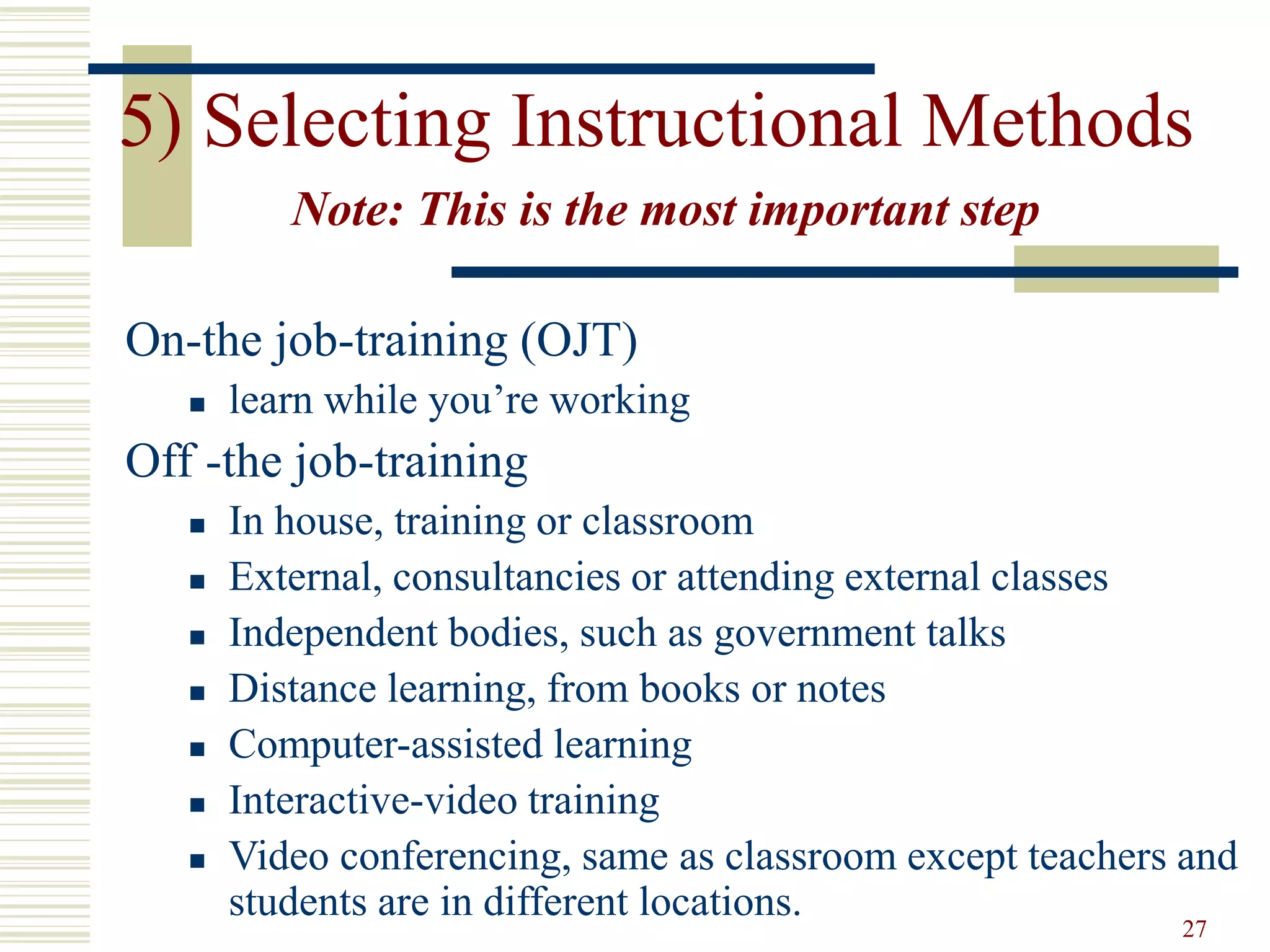
5) Selecting Instructional Methods 
27 
Note: This is the most important step 
On-the job-training (OJT) 
 learn while you’re working 
Off -the job-training 
 In house, training or classroom 
 External, consultancies or attending external classes 
 Independent bodies, such as government talks 
 Distance learning, from books or notes 
 Computer-assisted learning 
 Interactive-video training 
 Video conferencing, same as classroom except teachers and 
students are in different locations.
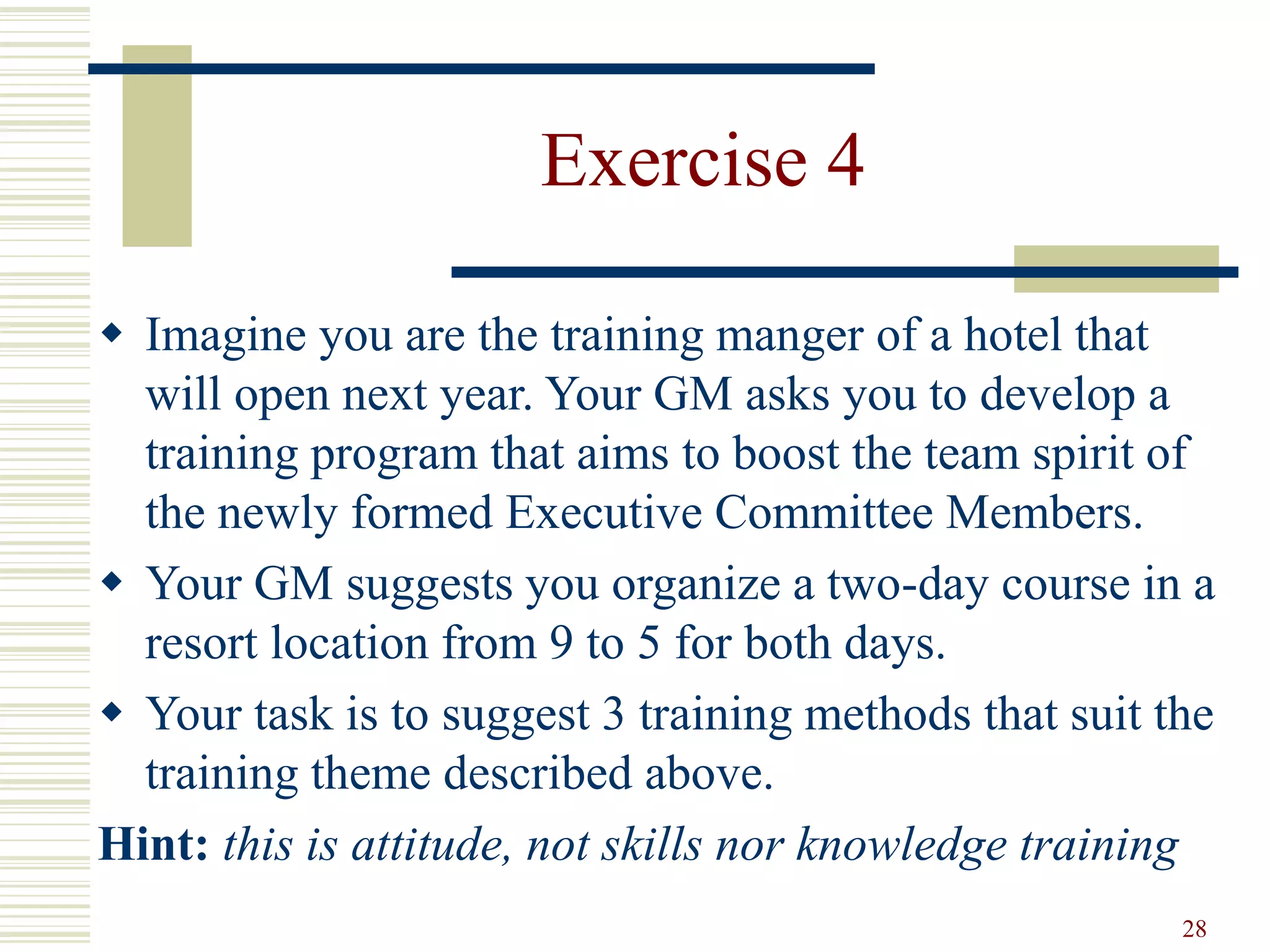
28 
Exercise 4 
 Imagine you are the training manger of a hotel that 
will open next year. Your GM asks you to develop a 
training program that aims to boost the team spirit of 
the newly formed Executive Committee Members. 
 Your GM suggests you organize a two-day course in a 
resort location from 9 to 5 for both days. 
 Your task is to suggest 3 training methods that suit the 
training theme described above. 
Hint: this is attitude, not skills nor knowledge training
29 
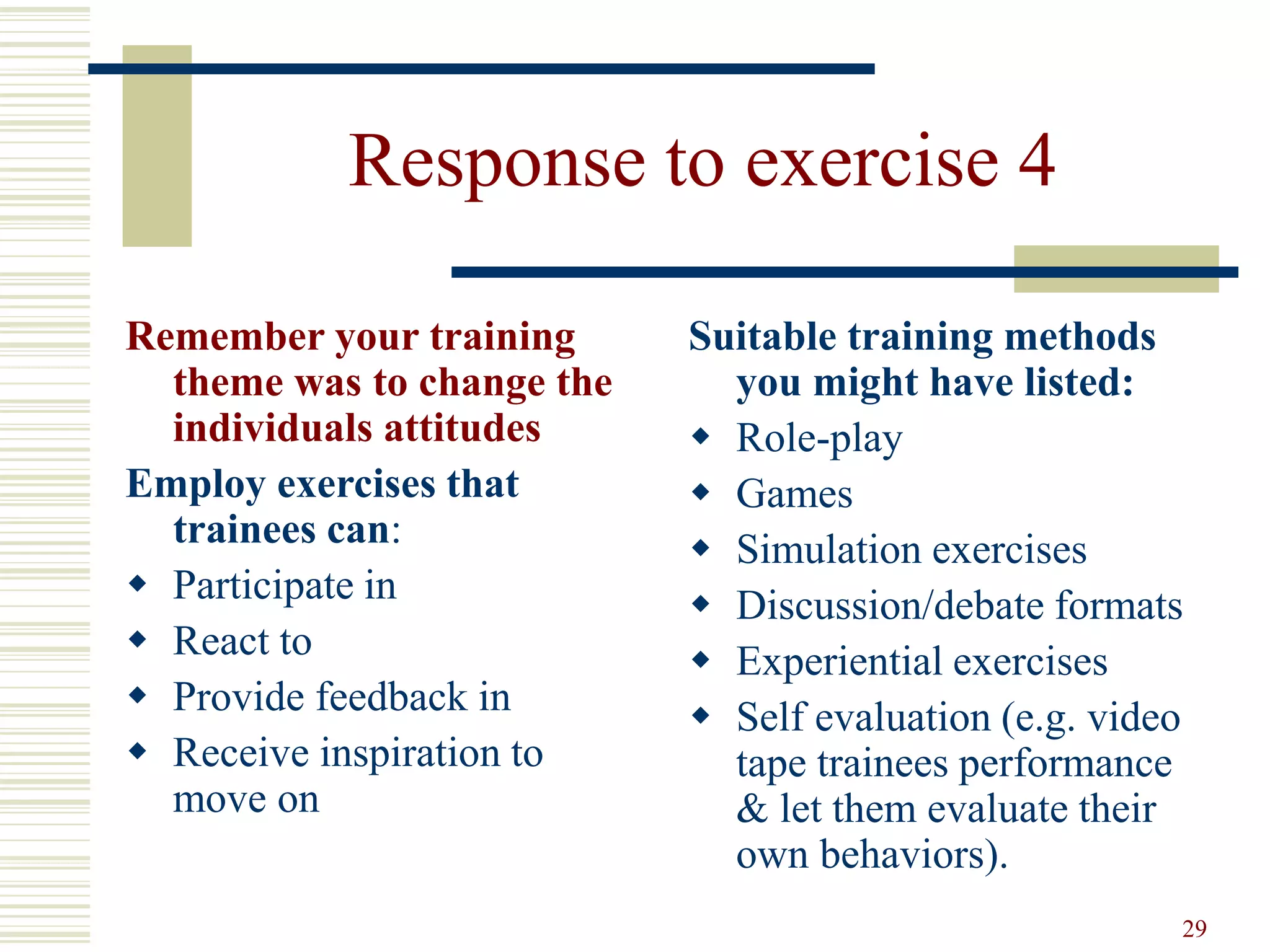
Response to exercise 4 
Remember your training 
theme was to change the 
individuals attitudes 
Employ exercises that 
trainees can: 
 Participate in 
 React to 
 Provide feedback in 
 Receive inspiration to 
move on 
Suitable training methods 
you might have listed: 
 Role-play 
 Games 
 Simulation exercises 
 Discussion/debate formats 
 Experiential exercises 
 Self evaluation (e.g. video 
tape trainees performance 
& let them evaluate their 
own behaviors).
30 
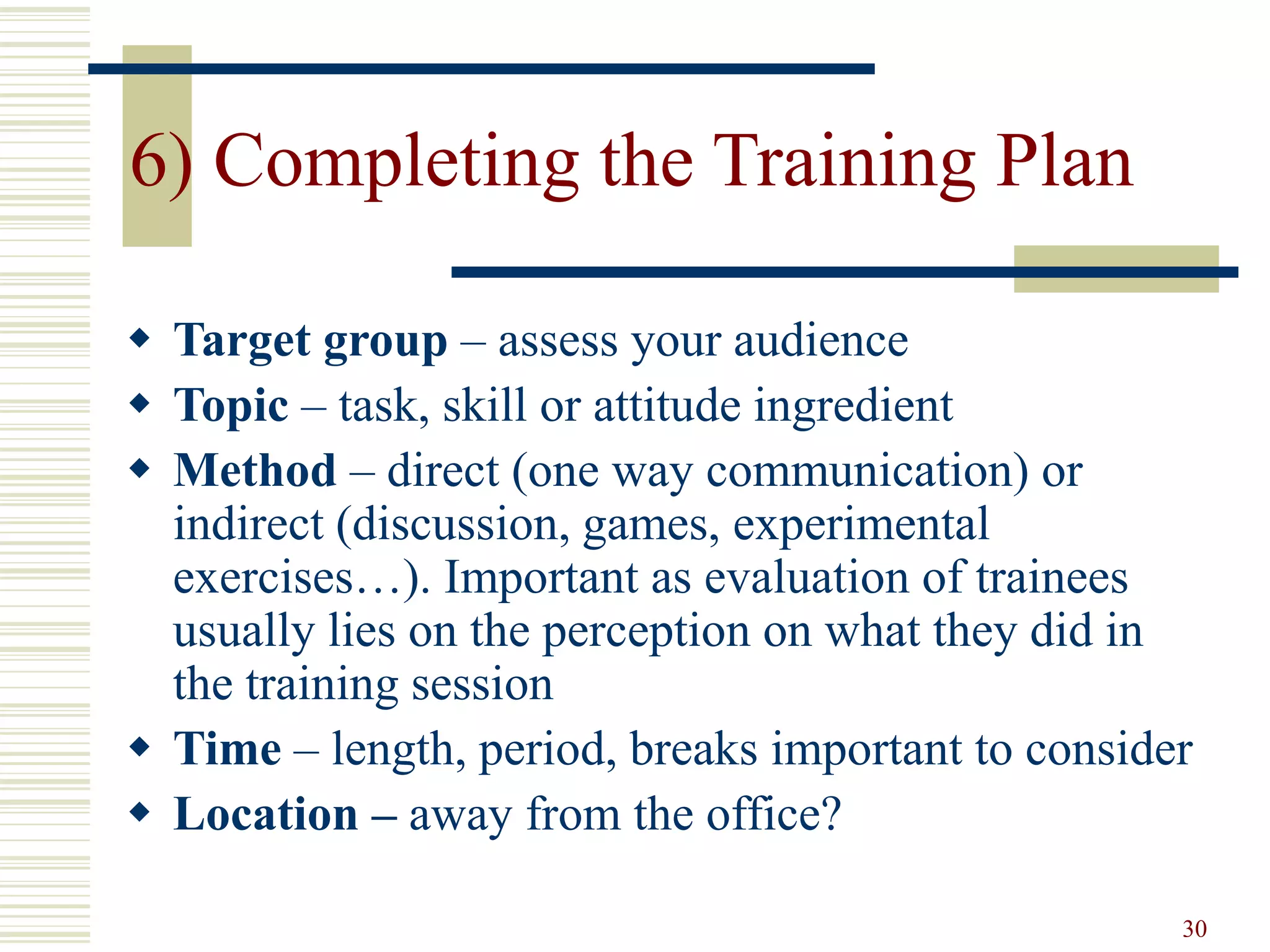
6) Completing the Training Plan 
 Target group – assess your audience 
 Topic – task, skill or attitude ingredient 
 Method – direct (one way communication) or 
indirect (discussion, games, experimental 
exercises…). Important as evaluation of trainees 
usually lies on the perception on what they did in 
the training session 
 Time – length, period, breaks important to consider 
 Location – away from the office?
31 
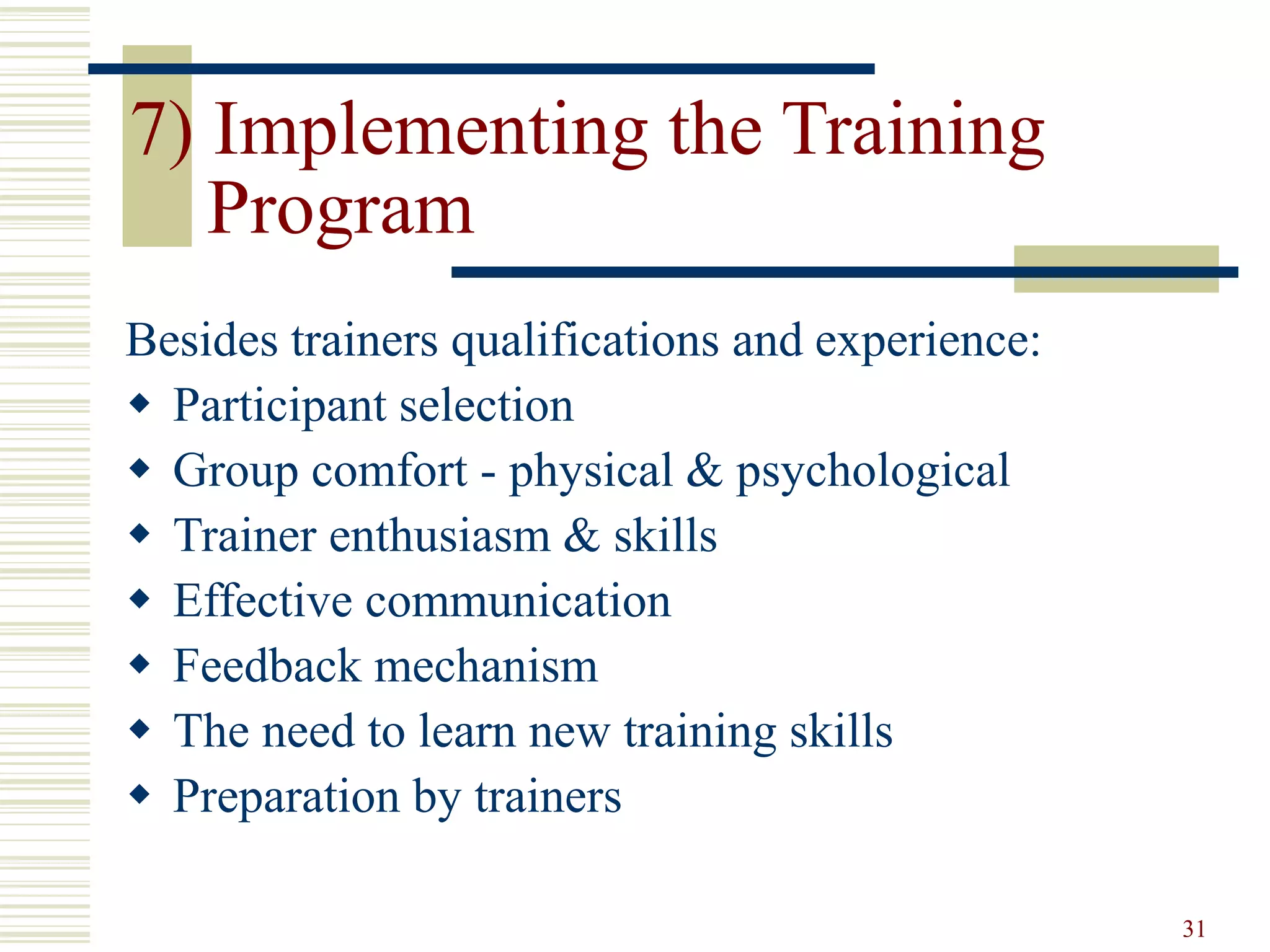
7) Implementing the Training 
Program 
Besides trainers qualifications and experience: 
 Participant selection 
 Group comfort - physical & psychological 
 Trainer enthusiasm & skills 
 Effective communication 
 Feedback mechanism 
 The need to learn new training skills 
 Preparation by trainers
32 
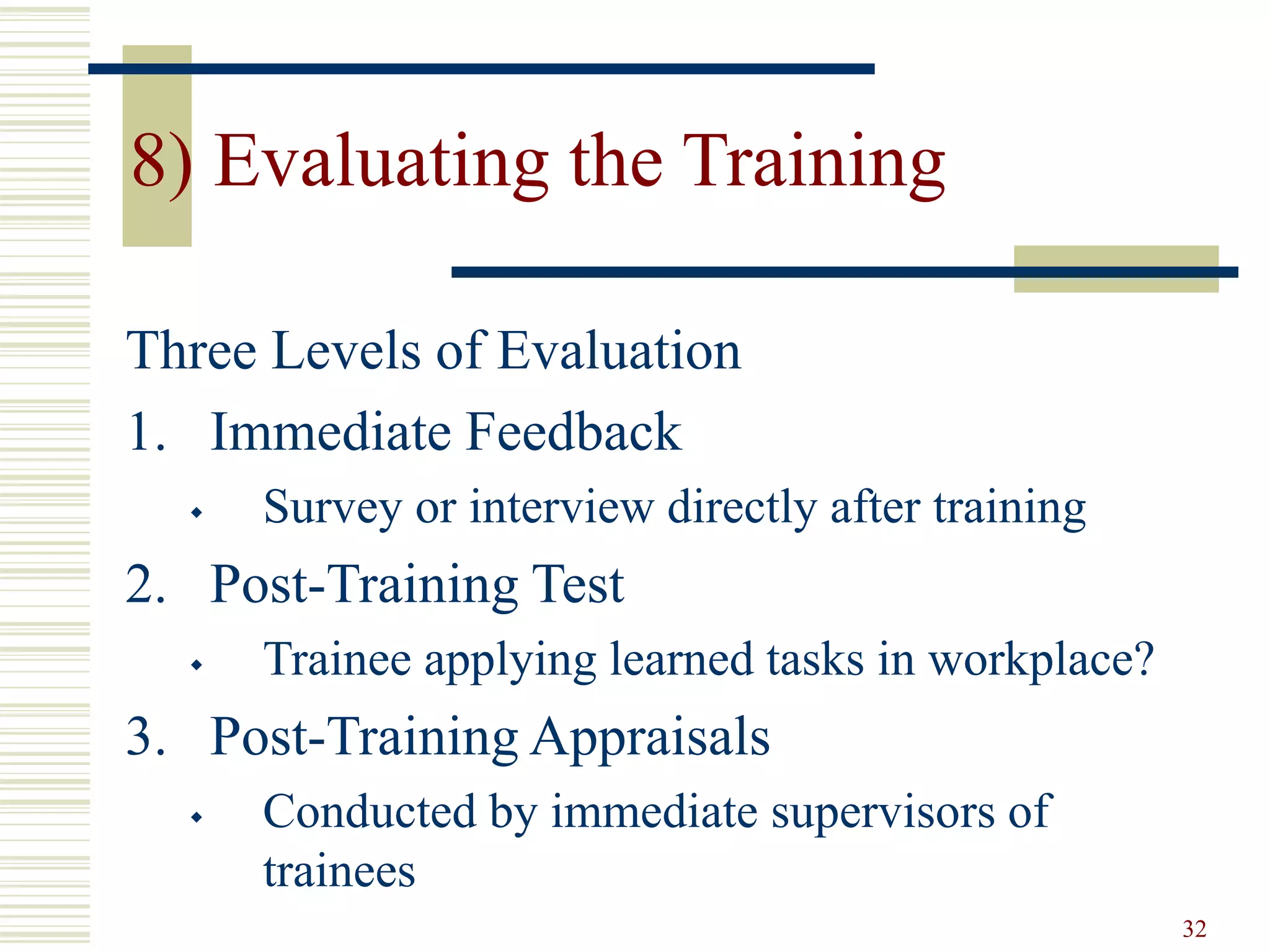
8) Evaluating the Training 
Three Levels of Evaluation 
1. Immediate Feedback 
 Survey or interview directly after training 
2. Post-Training Test 
 Trainee applying learned tasks in workplace? 
3. Post-Training Appraisals 
 Conducted by immediate supervisors of 
trainees
33 
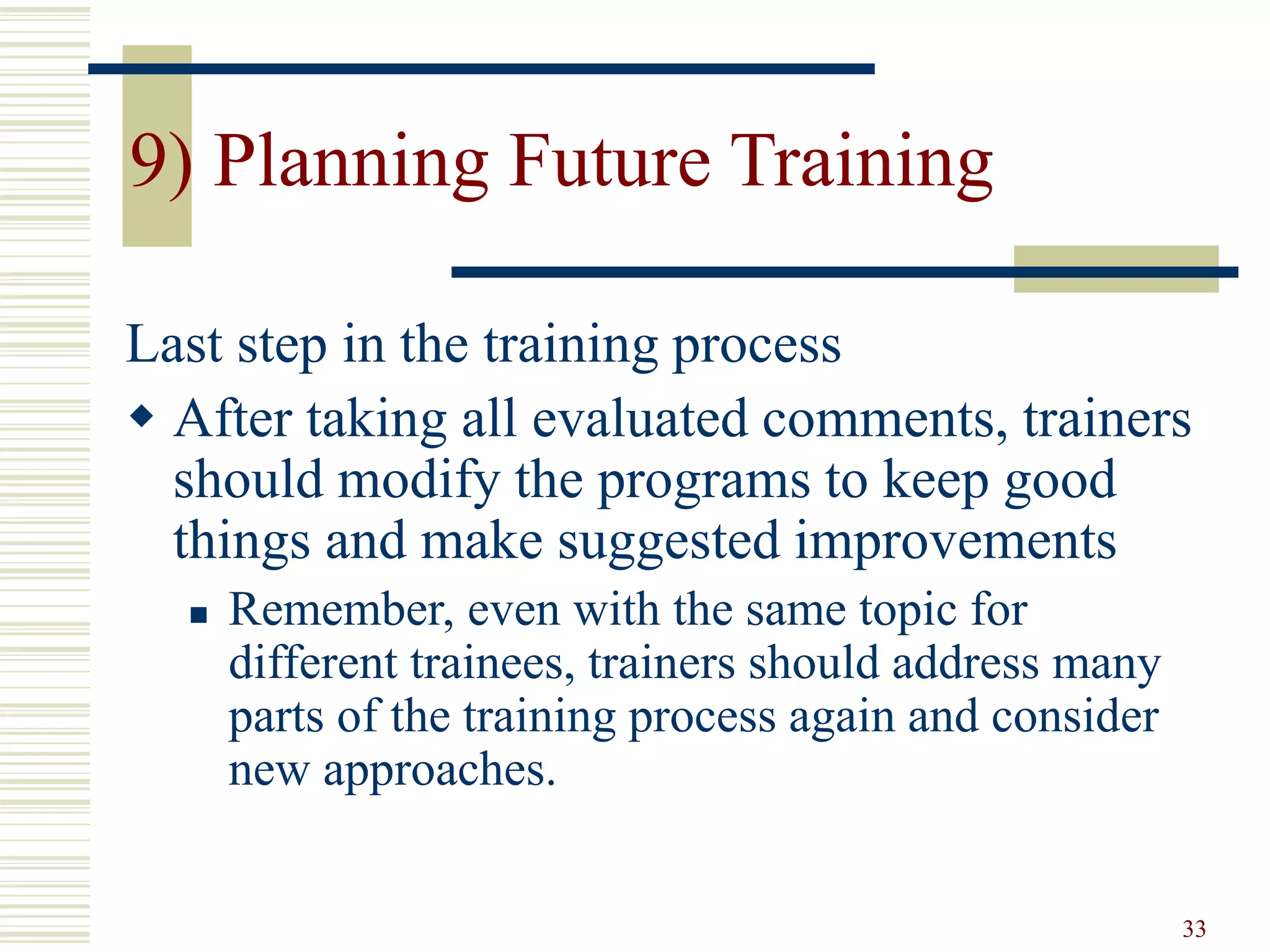
9) Planning Future Training 
Last step in the training process 
 After taking all evaluated comments, trainers 
should modify the programs to keep good 
things and make suggested improvements 
 Remember, even with the same topic for 
different trainees, trainers should address many 
parts of the training process again and consider 
new approaches.
34 
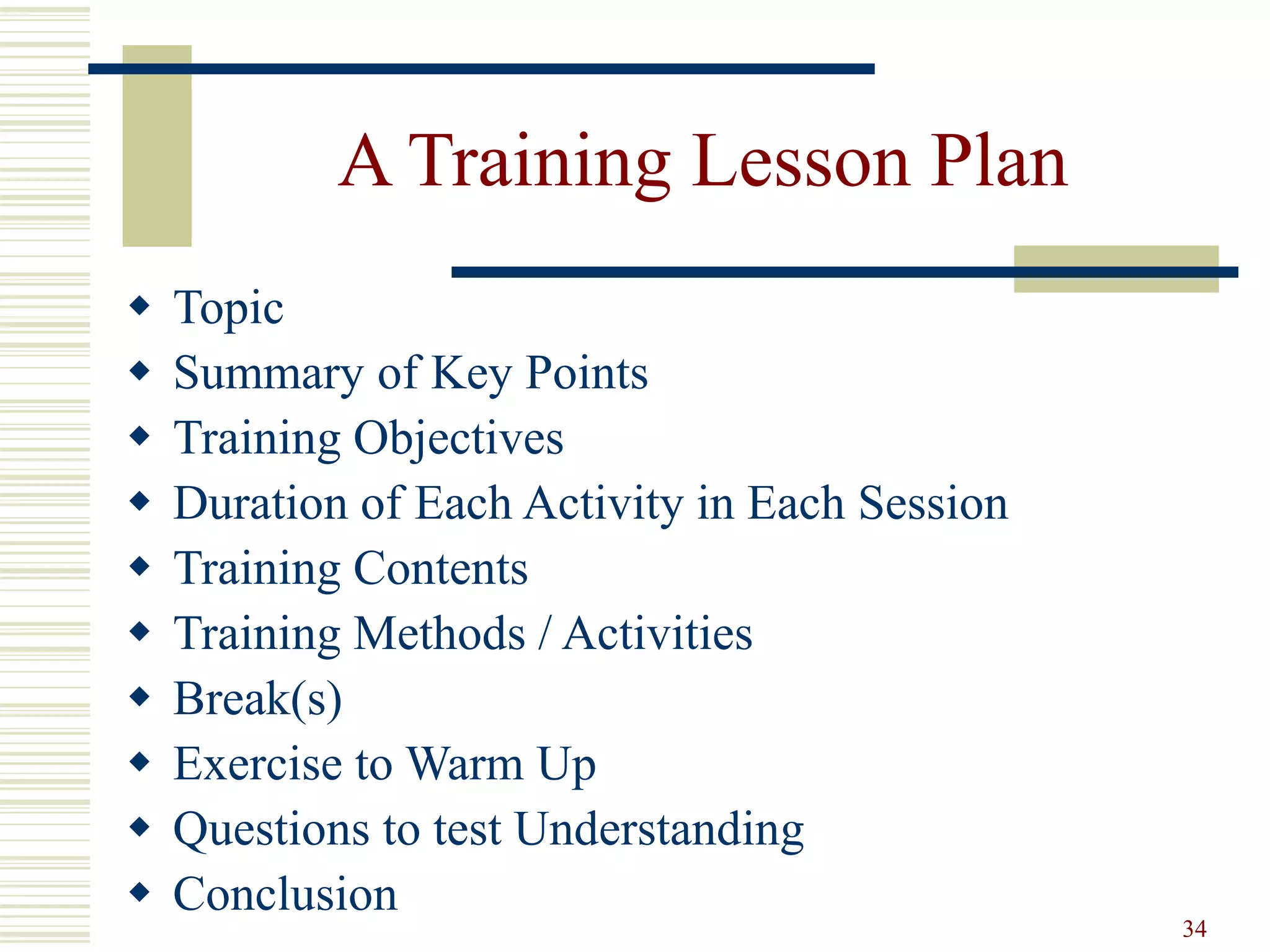
A Training Lesson Plan 
 Topic 
 Summary of Key Points 
 Training Objectives 
 Duration of Each Activity in Each Session 
 Training Contents 
 Training Methods / Activities 
 Break(s) 
 Exercise to Warm Up 
 Questions to test Understanding 
 Conclusion
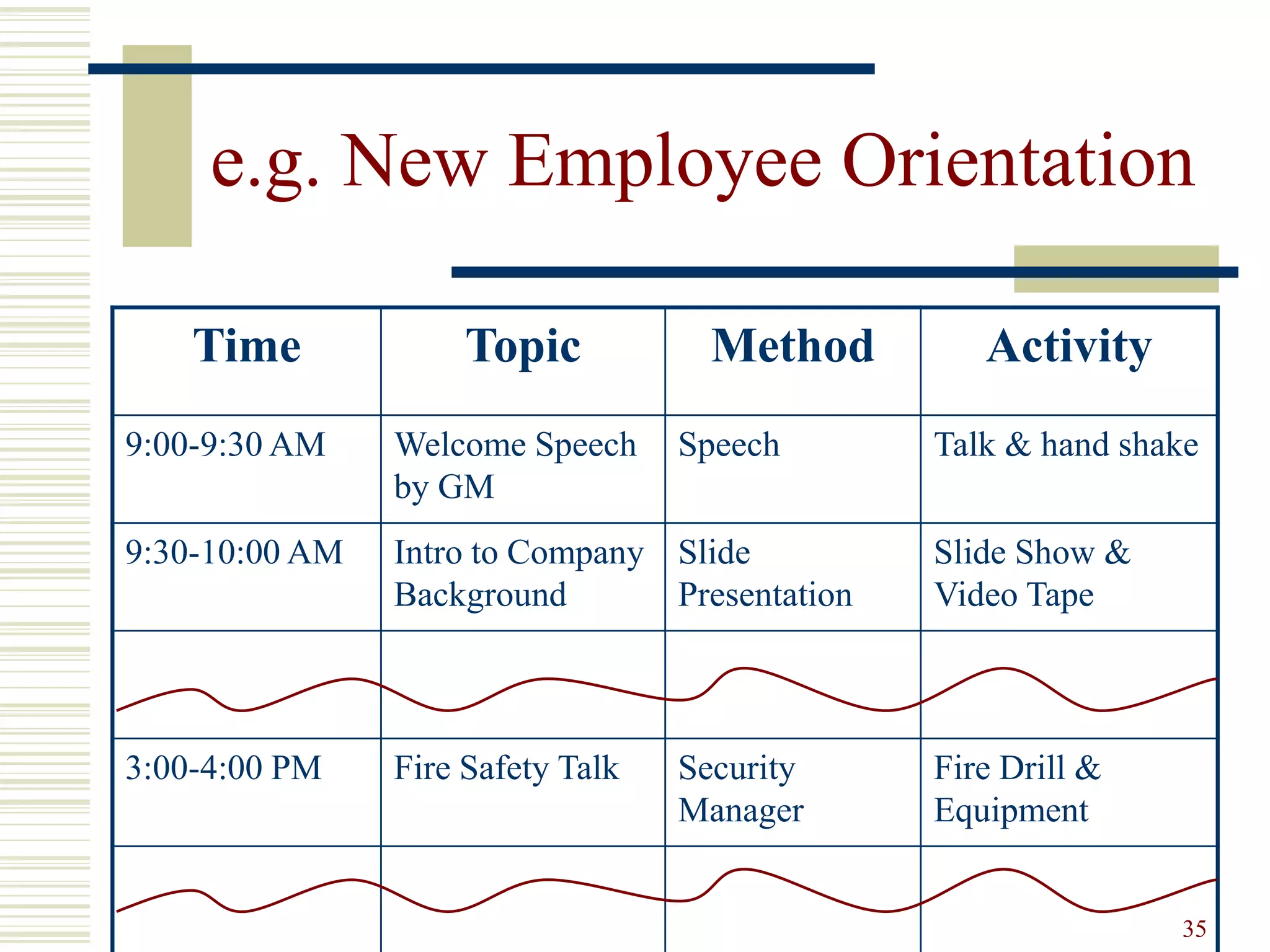
e.g. New Employee Orientation 
35 
Time Topic Method Activity 
9:00-9:30 AM Welcome Speech 
by GM 
Speech Talk & hand shake 
9:30-10:00 AM Intro to Company 
Background 
Slide 
Presentation 
Slide Show & 
Video Tape 
3:00-4:00 PM Fire Safety Talk Security 
Manager 
Fire Drill & 
Equipment
36 
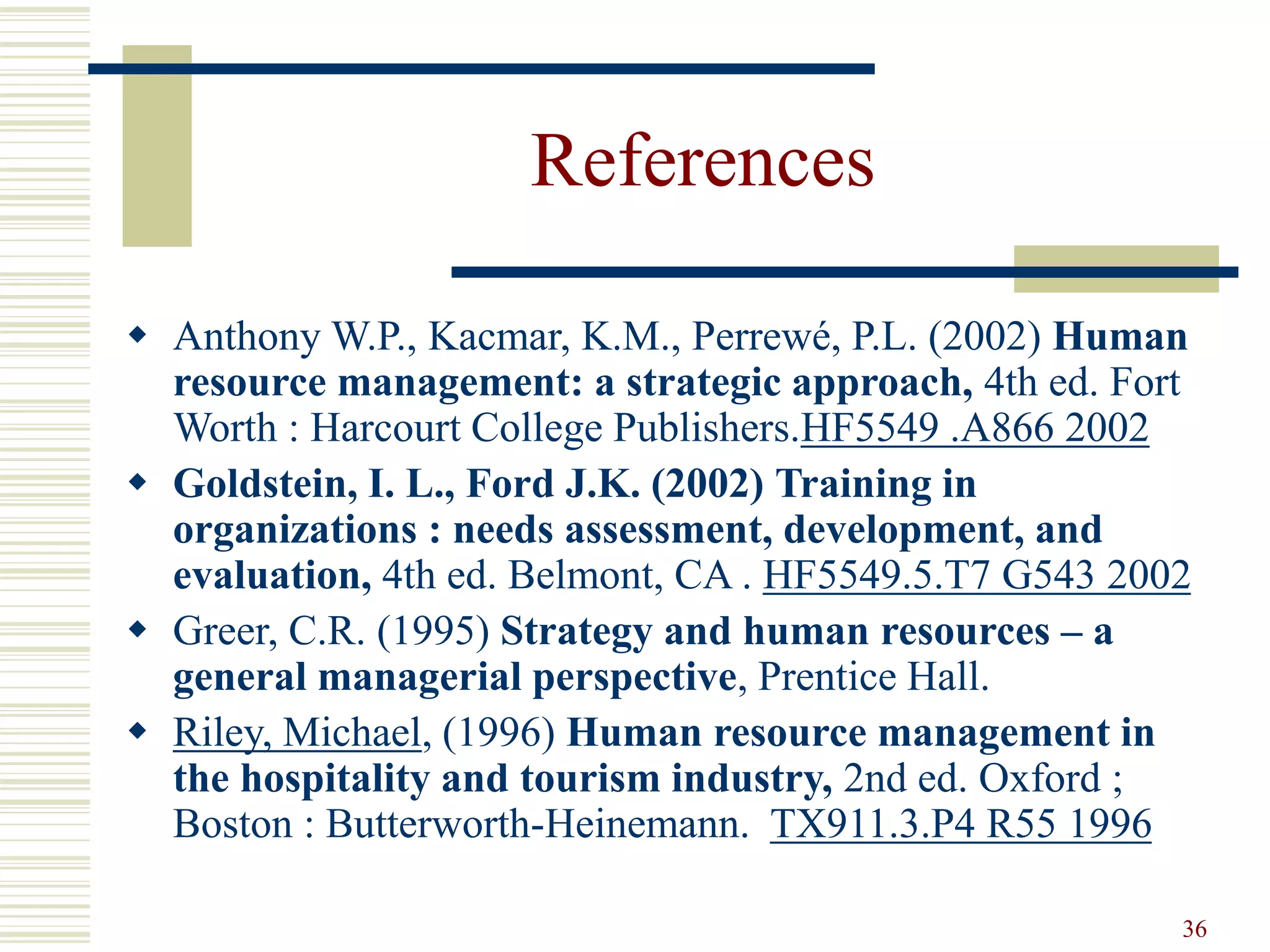
References 
 Anthony W.P., Kacmar, K.M., Perrewé, P.L. (2002) Human 
resource management: a strategic approach, 4th ed. Fort 
Worth : Harcourt College Publishers.HF5549 .A866 2002 
 Goldstein, I. L., Ford J.K. (2002) Training in 
organizations : needs assessment, development, and 
evaluation, 4th ed. Belmont, CA . HF5549.5.T7 G543 2002 
 Greer, C.R. (1995) Strategy and human resources – a 
general managerial perspective, Prentice Hall. 
 Riley, Michael, (1996) Human resource management in 
the hospitality and tourism industry, 2nd ed. Oxford ; 
Boston : Butterworth-Heinemann. TX911.3.P4 R55 1996

Training development382

  • 1.
    Training & Development Training as a management skill / Training and developing your staff HRT 382 -Week 4
  • 2.
    2 Topics Why do we Need Training?  What is Training & Training Principles?  A Systematic Approach to Training  A Training Lesson Plan
  • 3.
    3 Your Objectives Following this presentation you should be able to complete the following objectives: 1. Describe why training is important and distinguish amongst training, education and development 2. Define the ASK concept, and comment upon the relative difficulty in developing people’s attitudes, skills and knowledge 3. List the nine steps in the training process and be able to explain each step with reference to hospitality examples 4. Develop an appropriate training lesson plan.
  • 4.
    4 Do OrganizationsNeed Training  The answer is “YES”  However, we must know the purpose and functions of training before we can use it.
  • 5.
    5 The GapConcept Performance/ Results Expected Curve 1,000 Cars 200 Cars Time Gap Actual Curve 800 Cars In training terms this means we need to develop programs to fill the Gap
  • 6.
    6 Training Needs The reasons for not making the 1,000 cars:  Not enough resources  Poor machines  Poor staff skills As training experts we must analyze the situation to determine if:  Expected result too high  Target achievable  Is training the only way to make it happen  Are there other factors.
  • 7.
    7 Exercise 1  Imagine you are the managing director of a full service restaurant. One day you receive a complaint letter from a guest reporting s/he was not satisfied with the follow up regarding their criticism of being overcharged in one of your restaurants.  Why was the complaint made?  Is there a training need?
  • 8.
    3 Reasons toConsider Conducting 8 an Internal Needs Analysis 1. Employee obsolescence/out-dated –  Technical advancements, cultural changes, new systems, computerization 2. Career plateaus  Need for education and training programs 3. Employee Turnover  Development plan for new employees
  • 9.
    9 Importance ofTraining  Maintains qualified products / services  Achieves high service standards  Provides information for new comers  Refreshes memory of old employees  Achieves learning about new things; technology, products / service delivery  Reduces mistakes - minimizing costs  Opportunity for staff to feedback / suggest improvements  Improves communication & relationships - better teamwork
  • 10.
    10 Benefits ofTraining  Most training is targeted to ensure trainees “learn” something they apply to their job.
  • 11.
    11 What isTraining?  Training is a systematic process through which an organization’s human resources gain knowledge and develop skills by instruction and practical activities that result in improved corporate performance.
  • 12.
    12 Differences betweenTraining, Education & Development  Training is short term, task oriented and targeted on achieving a change of attitude, skills and knowledge in a specific area. It is usually job related.  Education is a lifetime investment. It tends to be initiated by a person in the area of his/her interest  Development is a long term investment in human resources.
  • 13.
    13 The ASKConcept  If we follow the GAP concept, training is simply a means to use activities to fill the gaps of performance between the actual results and the expected results.  This GAP can be separated into 3 main themes 1. Attitude 2. Skills 3. Knowledge
  • 14.
    14 Exercise 2 Rank ASK by difficulty to develop in people  Attitude  Skills  Knowledge •Easy •Moderately difficult •Most difficult
  • 15.
    15 Five Principlesof Learning  Participation: involve trainees, learn by doing  Repetition: repeat ideas & concepts to help people learn  Relevance: learn better when material is meaningful and related  Transference: to real world using simulations  Feedback: ask for it and adjust training methods to audience.
  • 16.
    16 A SystematicApproach to Training Key Concepts in Preparing a Training Plan Before you train and develop people identify what:  They must know - before they can perform job  They should know - to improve performance  Would be nice for them to know – but not necessary to perform duties.
  • 17.
    Model of theTraining Process* *Goldstein, I. (2002) Training in Organizations 4th Ed. Assessment Stage Training Stage Evaluation Stage 17 Organizational Needs Assessment Task Need Assessment Development of Training Objectives Design & Select Procedures Measure Training Results Development of Criteria for Training Evaluation Train Compare Results to Criteria Feedback
  • 18.
    18 Nine Stepsin the Training Process 1. Assessing training needs 2. Preparing training plan 3. Specifying training objectives 4. Designing the training program(s) 5. Selecting the instructional methods 6. Completing the training plan 7. Implementing the training program 8. Evaluating the training 9. Planning future training
  • 19.
    19 1) AssessingTraining Needs Conduct a training needs analysis by either one, or both, of the following  External approach (company, guests, society)  Internal approach – using a staff opinion survey.
  • 20.
    20 Exercise 3  Imagine you are the manager of a factory with 500 workers making ice cream for export to Europe.  What information and evidence do you need before you can say the employees need training?  Try to list 5 ideas.
  • 21.
    21 Response toexercise 3  Accidents report  Sick leave report  Employee compensation statistics  Product quality control report  Wastage report  Efficiency report  Machinery out-of-order report  Staff discipline report  Staff enquiries & complaints  Guests complaints  Refusal of orders made  Quality of product report  Market needs & trends  Demographic data & background of employees
  • 22.
    22 2) PreparingTraining Plan Consider whether to design a long (5-10 years), medium (3-5 years) or short (1 year) term plan.  Ask your self “What are we going to achieve in the time period?”  Use a holistic approach by using a calendar for inputting your training activities.
  • 23.
    23 Training CalendarExample Training Area Month in the year 1 2 3 4 5 6 7... Attitude Train the trainer Job competency Sales techniques Telephone manner …
  • 24.
    24 Individual Plans  For individual personalized training, we must assess the trainees’ weakness and strengths first before setting up appropriate programs.  Training areas maybe tailor-made.  Trainee should receive an individual timetable for self progress.
  • 25.
    3) Specifying TrainingObjectives 25 Training Objectives must be specific & measurable. Why? Very difficult to measure effectiveness after course is finished.  What should trainees be able to accomplish after participating in the training program?  What is the desired level of such accomplishment, according to industry or organizational standards?  Do you want to develop attitudes, skills, knowledge or some combination of these three?
  • 26.
    26 4) Designingthe Training Program(s) 1. Program duration 2. Program structure 3. Instruction methods 4. Trainers qualification 5. Nature of trainees 6. Support resources – materials, OHP, classroom 7. Training location & environment 8. Criteria & methods for assessing participant learning and achievement 9. Criteria & methods for evaluating the program
  • 27.
    5) Selecting InstructionalMethods 27 Note: This is the most important step On-the job-training (OJT)  learn while you’re working Off -the job-training  In house, training or classroom  External, consultancies or attending external classes  Independent bodies, such as government talks  Distance learning, from books or notes  Computer-assisted learning  Interactive-video training  Video conferencing, same as classroom except teachers and students are in different locations.
  • 28.
    28 Exercise 4  Imagine you are the training manger of a hotel that will open next year. Your GM asks you to develop a training program that aims to boost the team spirit of the newly formed Executive Committee Members.  Your GM suggests you organize a two-day course in a resort location from 9 to 5 for both days.  Your task is to suggest 3 training methods that suit the training theme described above. Hint: this is attitude, not skills nor knowledge training
  • 29.
    29 Response toexercise 4 Remember your training theme was to change the individuals attitudes Employ exercises that trainees can:  Participate in  React to  Provide feedback in  Receive inspiration to move on Suitable training methods you might have listed:  Role-play  Games  Simulation exercises  Discussion/debate formats  Experiential exercises  Self evaluation (e.g. video tape trainees performance & let them evaluate their own behaviors).
  • 30.
    30 6) Completingthe Training Plan  Target group – assess your audience  Topic – task, skill or attitude ingredient  Method – direct (one way communication) or indirect (discussion, games, experimental exercises…). Important as evaluation of trainees usually lies on the perception on what they did in the training session  Time – length, period, breaks important to consider  Location – away from the office?
  • 31.
    31 7) Implementingthe Training Program Besides trainers qualifications and experience:  Participant selection  Group comfort - physical & psychological  Trainer enthusiasm & skills  Effective communication  Feedback mechanism  The need to learn new training skills  Preparation by trainers
  • 32.
    32 8) Evaluatingthe Training Three Levels of Evaluation 1. Immediate Feedback  Survey or interview directly after training 2. Post-Training Test  Trainee applying learned tasks in workplace? 3. Post-Training Appraisals  Conducted by immediate supervisors of trainees
  • 33.
    33 9) PlanningFuture Training Last step in the training process  After taking all evaluated comments, trainers should modify the programs to keep good things and make suggested improvements  Remember, even with the same topic for different trainees, trainers should address many parts of the training process again and consider new approaches.
  • 34.
    34 A TrainingLesson Plan  Topic  Summary of Key Points  Training Objectives  Duration of Each Activity in Each Session  Training Contents  Training Methods / Activities  Break(s)  Exercise to Warm Up  Questions to test Understanding  Conclusion
  • 35.
    e.g. New EmployeeOrientation 35 Time Topic Method Activity 9:00-9:30 AM Welcome Speech by GM Speech Talk & hand shake 9:30-10:00 AM Intro to Company Background Slide Presentation Slide Show & Video Tape 3:00-4:00 PM Fire Safety Talk Security Manager Fire Drill & Equipment
  • 36.
    36 References Anthony W.P., Kacmar, K.M., Perrewé, P.L. (2002) Human resource management: a strategic approach, 4th ed. Fort Worth : Harcourt College Publishers.HF5549 .A866 2002  Goldstein, I. L., Ford J.K. (2002) Training in organizations : needs assessment, development, and evaluation, 4th ed. Belmont, CA . HF5549.5.T7 G543 2002  Greer, C.R. (1995) Strategy and human resources – a general managerial perspective, Prentice Hall.  Riley, Michael, (1996) Human resource management in the hospitality and tourism industry, 2nd ed. Oxford ; Boston : Butterworth-Heinemann. TX911.3.P4 R55 1996