Traffic Environment
Interaction
Noise Pollution .
Vehicular Emission.
Pollution Mitigation Measures.
Noise Pollution Noise is unjustifiable interference and imposition upon human comfort,
health and the quality of life.
 In contrast to occupational noise (associated with industrial work
situations), the disturbance noises often described as the environmental
noise to which people are subjected outside their place of work.This type of
noise is very subjective in its effects.
 On the other hand, environmental noise is causing increasing concern and
disturbance to more and more people, in sharp contrast to the industrial
noise which affects a relatively limited number of people.
Vehicle Noise :-
 The control of road vehicle noise as it affects the external observer (i.e., a person outside the
vehicle and not its occupant) is a subject of legislation.
 Although there is not much legislative control of the interior noise in the vehicles, such
control is important too, since high noise levels are both objectionable and tiring to the
majority of drivers and passengers.
 It is quite possible, by a suitable use of sound-absorbing materials, and isolation and
suppression of vibration sources, to design and produce a vehicle which is extremely quiet
for its occupants, but still has excessive airborne exhaust noise, engine noise, or even road
noise to the exterior listener.
 In general, however, one may expect that reduction of exhaust noise to low enough levels (so
that it is masked by the engine noise) will meet all legal requirements.
 It is usually possible to achieve such a degree of silencing without any appreciable reduction
in power.
 The only exception where practical difficulties may arise in this approach is the case of some
sports cars with small ground clearance
Methods of Analyzing Vehicle Noise:-
 The number of methods used for noise and vibration analysis of road vehicles is quite large.
The automobile industry frequently employs special instruments to investigate specific
noise sources, e.g., tyre thump meters.
 Some of the test and evaluation methods used for the analysis of road vehicle noise are listed
in Table 1, but this list is not exhaustive.
 On the other hand, every automobile manufacturer may not employ such an extensive range
of testing and measurement equipment.
Sources of Vehicle
Noise:-
 The engine is the main source of
noise in road vehicles.
 Engine noise consists of intake
noise, exhaust noise and the noise
produced in the engine itself.
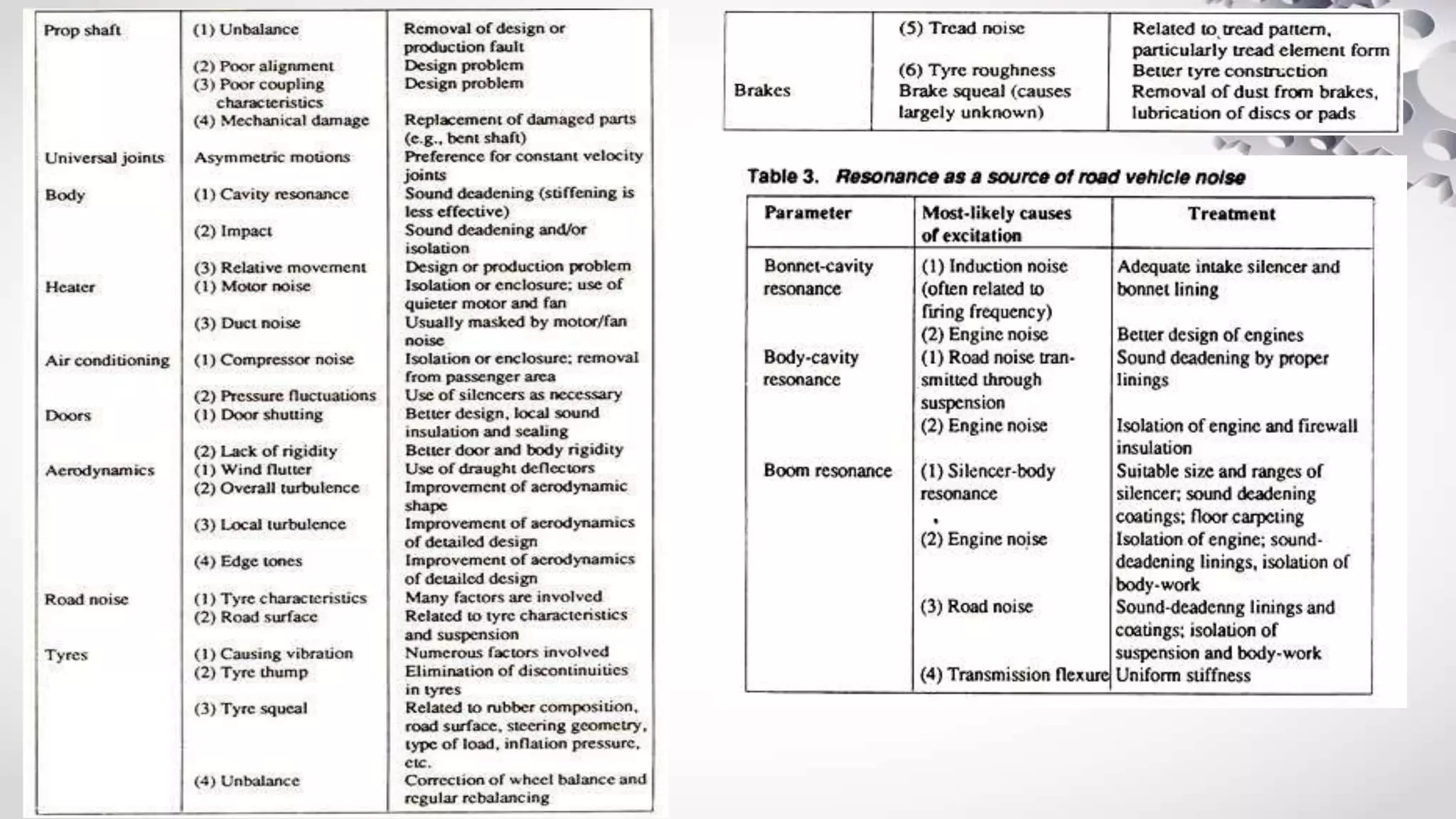
 Other sources of road vehicle noise
and vibrations, along with their
cause and treatment are
summarized in Table 2.
 Some of the producers of noise in vehicles can be treated at the source by balancing, damping,
silencing, etc. The effect of the remaining noise and vibrations can be reduced, on the other hand, by
isolation and damping, as far as is practicable. It may be noted here that isolation is effective for
transmitted noise, while damping reduces radiated noise.
Engine Noise:-
Engine is the main source of noise in road vehicles.
 The effects of engine noise may be reduced by isolation. This is done by setting the engine unit on
resilient mounts.
 Unfortunately, complete isolation by this method is impossible.Since no straightforward solutions may
be available.
 The design is subsequently adjusted or modified as required in the light of experimental testing and
final evaluation under true road conditions.
 The purpose of damping engine vibrations to a suitable degree by resilient mounting is to inhibit the
transmission of engine noise to other parts of the vehicle, and also to eliminate the effects of
suspension “shake” which can be feedback through the engine mounts.
 It is essential to maintain satisfactory isolation over a wide range of engine speeds, road speeds and
operating conditions.
 Now a days, conversion “kits” are also available for reducing the noise produced by bonnet-cavity
resonance.
Vehicular Emission:- The pollutants emitted by an automotive engine during the combustion process are known as Vehicle
Emission. Mainly 4 components are emitted.
 They are – Carbon Dioxide (CO2), Carbon monoxide (CO) and Nitrogen Oxide (NO2) and Particulate
Matter or Soot (very small particles black in color emitted by a diesel engine).
 The Carbon Monoxide (CO) is produced because of incomplete combustion; when there is not enough
oxygen to burn fuel.
 This gas doesn’t have an odor, color or taste and hence; it's hard to detect. It causes fatal air poisoning and
is mostly responsible for seizure, coma, and fatality in humans.
 The combustion process produces the Nitrogen Oxide (NO2). At very high temperatures, especially in a
diesel engine’s combustion chamber; the nitrogen in the air reacts with the oxygen and forms nitrogen
oxide. NO2 is toxic in nature. It can cause a decrease in the functioning of the lungs and increase the risk of
respiratory disease.
 Particulate Matter: It consists of the substance or particles very minute in size; which exists in the earth’s
atmosphere. Soot is one of the substances; which enter the atmosphere as a result of the burning of fossil
fuels such as – wood, coal, and petroleum – mainly diesel. It is harmful to humans and causes chronic lung
disease, lung cancer, influenza, and asthma. It also increases the risk of coronary artery disease in humans.
Soot (black smoke) is the most visible among the pollutants and hence gets the most attention.
Types of emissions:-
 Hydrocarbons (HC) - A class of burned or partially burned fuel, hydrocarbons are toxins. Hydrocarbons
are a major contributor to smog, which can be a major problem in urban areas.
 Prolonged exposure to hydrocarbons contributes to asthma, liver disease, lung disease, and cancer.
 Regulations governing hydrocarbons vary according to type of engine and jurisdiction; in some cases,
"non-methane hydrocarbons" are regulated, while in other cases, "total hydrocarbons" are regulated.
 Methane is not directly toxic, but is more difficult to break down in fuel vent lines and a charcoal canister
is meant to collect and contain fuel vapors and route them either back to the fuel tank or, after the engine
is started and warmed up, into the air intake to be burned in the engine.
 NOx - Generated when nitrogen in the air reacts with oxygen at the high temperature and pressure inside
the engine.
 NOx is a precursor to smog and acid rain. NOx is the sum of NO and NO2 , NO2 is extremely reactive.
 NOx production is increased when an engine runs at its most efficient (i.e. hottest) operating point, so
there tends to be a natural tradeoff between efficiency and control of NOx emissions.
 Carbon monoxide (CO) - A product of incomplete combustion, inhaled carbon monoxide reduces the
blood's ability to carry oxygen; overexposure (carbon monoxide poisoning) may be fatal.
 Particulate matter – Soot or smoke made up of particles in the micrometre size range: Particulate matter
causes negative health effects, including but not limited to respiratory disease and cancer. Very fine
particulate matter has been linked to cardiovascular disease.
 Sulfur oxide (SOx) - A general term for oxides of sulfur, which are emitted from motor vehicles burning
fuel containing sulfur. Reducing the level of fuel sulfur reduces the level of Sulfur oxide emitted from the
tailpipe.
 Volatile organic compounds (VOCs) - Organic compounds which typically have a boiling point less than or
equal to 250 °C; for example chlorofluorocarbons (CFCs) and formaldehyde. Volatile organic compounds
are a subsection of Hydrocarbons that are mentioned separately because of their dangers to public health.
The Reasons:-
 The reasons is that there is not much awareness among the people who are using some form of an
automotive product.
 Majority of the problem is with old vehicles. Older diesel vehicles, tractors, and generators operated in the
country do not conform to the basic emission norms.
 Most of them will fail the basic test to control the vehicular emission; if tested for ‘Pollution Under Control’
(PUC).
 They don't carry out the periodic maintenance such as changing engine oil, air filter consistently. This
results in an unhealthy engine and it emits black smoke (soot).
 Congested/dense city areas also contribute to this problem as there is not enough oxygen for complete
burning of fuel.
 Traffic snarls & bumper-to-bumper traffic add to the woes.
 In heavy traffic, the vehicle’s engines mostly run at idle to slow speed range; which requires rich air-fuel
mixture for burning. This leads to more emission.
 Loose dust and sand particles choke the engine’s air filters frequently; disallowing enough air to come in.
This causes incomplete burning of the fuel causing higher emissions.
 A poorly-maintained fuel-system / unhealthy engine will always release more harmful emission.
 Poor quality and adulterated fuel do not burn completely. If the diesel is mixed with substances such as
kerosene or similar chemicals, it does not burn cleanly enough.
 This not only chokes the injectors but also causes extensive damage to the fuel system.
 The quality/grade of the fuel available in most parts of India; is not yet at par with international standards.
Effects of Vehicular Emission:-Car pollutants cause immediate and long-term effects on the environment. Car exhausts emit a wide range of
gases and solid matter, causing global warming, acid rain, and harming the environment and human health.
Engine noise and fuel spills also cause pollution. Cars, trucks and other forms of transportation are the single
largest contributor to air pollution in the environment, but car owners can reduce their vehicle's effects on
the environment.
 Global Warming
 Car pollution is one of the major causes of global warming.
 Cars and trucks emit carbon dioxide and other greenhouse gases, which contribute one-fifth of the United
States' total global warming pollution. Greenhouse gases trap heat in the atmosphere, which causes
worldwide temperatures to rise.
 Without greenhouse gases, the Earth would be covered in ice, but burning excessive amounts of fossil
fuels, such as gasoline and diesel, has caused an increase of 0.6 degrees Celsius, or 1 degree F, in global
temperatures since pre-industrial times, and this will continue to rise over the coming decades.
 Warmer global temperatures affect farming, wildlife, sea levels and natural landscapes.
 Air, Soil and Water
 The effects of car pollution are widespread, affecting air, soil and water quality.
 Nitrous oxide contributes to the depletion of the ozone layer, which shields the Earth from harmful
ultraviolet radiation from the sun.
 Sulfur dioxide and nitrogen dioxide mix with rainwater to create acid rain, which damages crops, forests
and other vegetation and buildings.
 Oil and fuel spills from cars and trucks seep into the soil near highways, and discarded fuel and
particulates from vehicle emissions contaminate lakes, rivers and wetlands.
 Human Health
 Particulate matter, hydrocarbons, carbon monoxide and other car pollutants harm human health.
 Diesel engines emit high levels of particulate matter, which is airborne particles of soot and metal. These
cause skin and eye irritation and allergies, and very fine particles lodge deep in lungs, where they cause
respiratory problems.
 Hydrocarbons react with nitrogen dioxide and sunlight and form ozone, which is beneficial in the upper
atmosphere but harmful at ground level. Ozone inflames lungs, causing chest pains and coughing and
making it difficult to breathe.
 Carbon monoxide, another exhaust gas, is particularly dangerous to infants and people suffering from
heart disease because it interferes with the blood's ability to transport oxygen.
 Other car pollutants that harm human health include sulfur dioxide, benzene and formaldehyde. Noise
from cars is also harmful, damaging hearing and causing psychological ill-health.
VEHICULAR EMISSIONS MITIGATION:-
 Emissions control:
 Engine efficiency has been steadily
improved with improved engine
design, more precise ignition timing
and electronic ignition, more precise
fuel metering, and computerized
engine management.
 Advances in engine and vehicle
technology continually reduce the
toxicity of exhaust leaving the engine,
but these alone have generally been
proved insufficient to meet
emissions goals. Therefore,
technologies to detoxify the exhaust
are an essential part of emissions
control.
VEHICULAR EMISSIONS MITIGATION:-
 Air injection:
 One of the first-developed exhaust
emission control systems is
secondary air injection. Originally,
this system was used to inject air
into the engine's exhaust ports to
provide oxygen so unburned and
partially burned hydrocarbons in the
exhaust would finish burning.
 Air injection is now used to support
the catalytic converter's oxidation
reaction, and to reduce emissions
when an engine is started from cold
 After a cold start, an engine needs an
air-fuel mixture richer than what it
needs at operating temperature, and
the catalytic converter does not
function efficiently until it has
reached its own operating
temperature.
 The air injected upstream of the
converter supports combustion in
the exhaust headpipe, which speeds
catalyst warmup and reduces the
amount of unburned hydrocarbon
emitted from the tailpipe.
VEHICULAR EMISSIONS MITIGATION:-
 Exhaust gas circulation:
 In the United States and Canada,
many engines in 1973 and newer
vehicles (1972 and newer in
California) have a system that routes
a metered amount of exhaust into the
intake tract under particular
operating conditions.
 Exhaust neither burns nor supports
combustion, so it dilutes the air/fuel
charge to reduce peak combustion
chamber temperatures. This, in turn,
reduces the formation of NOx.
 Catalytic converter:
 The catalytic converter is a device
placed in the exhaust pipe, which
converts hydrocarbons, carbon
monoxide, and NOx into less harmful
gases by using a combination of
platinum, palladium and rhodium as
catalysts.
NOISE POLLUTION MITIGATION:-
 LAND USE PLANNING:
 One important planning tool to
minimize the impact of
environmental noise is to ensure
compatibility of different uses
adjacent to each other.
 Outline Zoning Plans (OZPs) are
drawn under the Town Planning
Ordinance to govern land uses for
different purposes.
NOISE POLLUTION MITIGATION:-
• ARCHITECTURAL FEATURES:
• Certain architectural features such as
fins and balcony can help reduce
impact of road traffic noise on
residential buildings.
NOISE POLLUTION MITIGATION:-
 Common methods:
 Clean vehicle and fuel technologies
provide us with an affordable,
available means of reducing
transportation-related air pollution
and climate change emissions.
 These include fuel-efficient vehicles
that use less oil; cleaner fuels that
produce fewer emissions; and
electric cars and trucks that can
entirely remove tailpipe emissions
 Strong federal and state policies also
help. Vehicle emission standards
have helped cut pollution from cars
and trucks by about 90 percent since
1998, with further improvements
coming from the Tier 3 standards.
 Future emissions reductions from
trucks and other freight sources are
essential for meeting air quality
standards and protecting the health
of those who live and work close to
ports, rail yards.
THANK YOU
SUBMITTED BY:
ARYAN SHARMA(1714026)
ANIMESH DHARA(1714013)
CHARANJIV SINGH(1714033)

Traffic Environment Interaction

  • 1.
  • 2.
    Noise Pollution . VehicularEmission. Pollution Mitigation Measures.
  • 3.
    Noise Pollution Noiseis unjustifiable interference and imposition upon human comfort, health and the quality of life.  In contrast to occupational noise (associated with industrial work situations), the disturbance noises often described as the environmental noise to which people are subjected outside their place of work.This type of noise is very subjective in its effects.  On the other hand, environmental noise is causing increasing concern and disturbance to more and more people, in sharp contrast to the industrial noise which affects a relatively limited number of people.
  • 4.
    Vehicle Noise :- The control of road vehicle noise as it affects the external observer (i.e., a person outside the vehicle and not its occupant) is a subject of legislation.  Although there is not much legislative control of the interior noise in the vehicles, such control is important too, since high noise levels are both objectionable and tiring to the majority of drivers and passengers.  It is quite possible, by a suitable use of sound-absorbing materials, and isolation and suppression of vibration sources, to design and produce a vehicle which is extremely quiet for its occupants, but still has excessive airborne exhaust noise, engine noise, or even road noise to the exterior listener.  In general, however, one may expect that reduction of exhaust noise to low enough levels (so that it is masked by the engine noise) will meet all legal requirements.
  • 5.
     It isusually possible to achieve such a degree of silencing without any appreciable reduction in power.  The only exception where practical difficulties may arise in this approach is the case of some sports cars with small ground clearance Methods of Analyzing Vehicle Noise:-  The number of methods used for noise and vibration analysis of road vehicles is quite large. The automobile industry frequently employs special instruments to investigate specific noise sources, e.g., tyre thump meters.  Some of the test and evaluation methods used for the analysis of road vehicle noise are listed in Table 1, but this list is not exhaustive.  On the other hand, every automobile manufacturer may not employ such an extensive range of testing and measurement equipment.
  • 7.
    Sources of Vehicle Noise:- The engine is the main source of noise in road vehicles.  Engine noise consists of intake noise, exhaust noise and the noise produced in the engine itself.  Other sources of road vehicle noise and vibrations, along with their cause and treatment are summarized in Table 2.
  • 9.
     Some ofthe producers of noise in vehicles can be treated at the source by balancing, damping, silencing, etc. The effect of the remaining noise and vibrations can be reduced, on the other hand, by isolation and damping, as far as is practicable. It may be noted here that isolation is effective for transmitted noise, while damping reduces radiated noise. Engine Noise:- Engine is the main source of noise in road vehicles.  The effects of engine noise may be reduced by isolation. This is done by setting the engine unit on resilient mounts.  Unfortunately, complete isolation by this method is impossible.Since no straightforward solutions may be available.  The design is subsequently adjusted or modified as required in the light of experimental testing and final evaluation under true road conditions.  The purpose of damping engine vibrations to a suitable degree by resilient mounting is to inhibit the transmission of engine noise to other parts of the vehicle, and also to eliminate the effects of suspension “shake” which can be feedback through the engine mounts.  It is essential to maintain satisfactory isolation over a wide range of engine speeds, road speeds and operating conditions.  Now a days, conversion “kits” are also available for reducing the noise produced by bonnet-cavity resonance.
  • 10.
    Vehicular Emission:- Thepollutants emitted by an automotive engine during the combustion process are known as Vehicle Emission. Mainly 4 components are emitted.  They are – Carbon Dioxide (CO2), Carbon monoxide (CO) and Nitrogen Oxide (NO2) and Particulate Matter or Soot (very small particles black in color emitted by a diesel engine).  The Carbon Monoxide (CO) is produced because of incomplete combustion; when there is not enough oxygen to burn fuel.  This gas doesn’t have an odor, color or taste and hence; it's hard to detect. It causes fatal air poisoning and is mostly responsible for seizure, coma, and fatality in humans.  The combustion process produces the Nitrogen Oxide (NO2). At very high temperatures, especially in a diesel engine’s combustion chamber; the nitrogen in the air reacts with the oxygen and forms nitrogen oxide. NO2 is toxic in nature. It can cause a decrease in the functioning of the lungs and increase the risk of respiratory disease.  Particulate Matter: It consists of the substance or particles very minute in size; which exists in the earth’s atmosphere. Soot is one of the substances; which enter the atmosphere as a result of the burning of fossil fuels such as – wood, coal, and petroleum – mainly diesel. It is harmful to humans and causes chronic lung disease, lung cancer, influenza, and asthma. It also increases the risk of coronary artery disease in humans. Soot (black smoke) is the most visible among the pollutants and hence gets the most attention.
  • 11.
    Types of emissions:- Hydrocarbons (HC) - A class of burned or partially burned fuel, hydrocarbons are toxins. Hydrocarbons are a major contributor to smog, which can be a major problem in urban areas.  Prolonged exposure to hydrocarbons contributes to asthma, liver disease, lung disease, and cancer.  Regulations governing hydrocarbons vary according to type of engine and jurisdiction; in some cases, "non-methane hydrocarbons" are regulated, while in other cases, "total hydrocarbons" are regulated.  Methane is not directly toxic, but is more difficult to break down in fuel vent lines and a charcoal canister is meant to collect and contain fuel vapors and route them either back to the fuel tank or, after the engine is started and warmed up, into the air intake to be burned in the engine.  NOx - Generated when nitrogen in the air reacts with oxygen at the high temperature and pressure inside the engine.  NOx is a precursor to smog and acid rain. NOx is the sum of NO and NO2 , NO2 is extremely reactive.  NOx production is increased when an engine runs at its most efficient (i.e. hottest) operating point, so there tends to be a natural tradeoff between efficiency and control of NOx emissions.
  • 12.
     Carbon monoxide(CO) - A product of incomplete combustion, inhaled carbon monoxide reduces the blood's ability to carry oxygen; overexposure (carbon monoxide poisoning) may be fatal.  Particulate matter – Soot or smoke made up of particles in the micrometre size range: Particulate matter causes negative health effects, including but not limited to respiratory disease and cancer. Very fine particulate matter has been linked to cardiovascular disease.  Sulfur oxide (SOx) - A general term for oxides of sulfur, which are emitted from motor vehicles burning fuel containing sulfur. Reducing the level of fuel sulfur reduces the level of Sulfur oxide emitted from the tailpipe.  Volatile organic compounds (VOCs) - Organic compounds which typically have a boiling point less than or equal to 250 °C; for example chlorofluorocarbons (CFCs) and formaldehyde. Volatile organic compounds are a subsection of Hydrocarbons that are mentioned separately because of their dangers to public health. The Reasons:-  The reasons is that there is not much awareness among the people who are using some form of an automotive product.  Majority of the problem is with old vehicles. Older diesel vehicles, tractors, and generators operated in the country do not conform to the basic emission norms.  Most of them will fail the basic test to control the vehicular emission; if tested for ‘Pollution Under Control’ (PUC).  They don't carry out the periodic maintenance such as changing engine oil, air filter consistently. This results in an unhealthy engine and it emits black smoke (soot).
  • 13.
     Congested/dense cityareas also contribute to this problem as there is not enough oxygen for complete burning of fuel.  Traffic snarls & bumper-to-bumper traffic add to the woes.  In heavy traffic, the vehicle’s engines mostly run at idle to slow speed range; which requires rich air-fuel mixture for burning. This leads to more emission.  Loose dust and sand particles choke the engine’s air filters frequently; disallowing enough air to come in. This causes incomplete burning of the fuel causing higher emissions.  A poorly-maintained fuel-system / unhealthy engine will always release more harmful emission.  Poor quality and adulterated fuel do not burn completely. If the diesel is mixed with substances such as kerosene or similar chemicals, it does not burn cleanly enough.  This not only chokes the injectors but also causes extensive damage to the fuel system.  The quality/grade of the fuel available in most parts of India; is not yet at par with international standards.
  • 14.
    Effects of VehicularEmission:-Car pollutants cause immediate and long-term effects on the environment. Car exhausts emit a wide range of gases and solid matter, causing global warming, acid rain, and harming the environment and human health. Engine noise and fuel spills also cause pollution. Cars, trucks and other forms of transportation are the single largest contributor to air pollution in the environment, but car owners can reduce their vehicle's effects on the environment.  Global Warming  Car pollution is one of the major causes of global warming.  Cars and trucks emit carbon dioxide and other greenhouse gases, which contribute one-fifth of the United States' total global warming pollution. Greenhouse gases trap heat in the atmosphere, which causes worldwide temperatures to rise.  Without greenhouse gases, the Earth would be covered in ice, but burning excessive amounts of fossil fuels, such as gasoline and diesel, has caused an increase of 0.6 degrees Celsius, or 1 degree F, in global temperatures since pre-industrial times, and this will continue to rise over the coming decades.  Warmer global temperatures affect farming, wildlife, sea levels and natural landscapes.  Air, Soil and Water  The effects of car pollution are widespread, affecting air, soil and water quality.  Nitrous oxide contributes to the depletion of the ozone layer, which shields the Earth from harmful ultraviolet radiation from the sun.
  • 15.
     Sulfur dioxideand nitrogen dioxide mix with rainwater to create acid rain, which damages crops, forests and other vegetation and buildings.  Oil and fuel spills from cars and trucks seep into the soil near highways, and discarded fuel and particulates from vehicle emissions contaminate lakes, rivers and wetlands.  Human Health  Particulate matter, hydrocarbons, carbon monoxide and other car pollutants harm human health.  Diesel engines emit high levels of particulate matter, which is airborne particles of soot and metal. These cause skin and eye irritation and allergies, and very fine particles lodge deep in lungs, where they cause respiratory problems.  Hydrocarbons react with nitrogen dioxide and sunlight and form ozone, which is beneficial in the upper atmosphere but harmful at ground level. Ozone inflames lungs, causing chest pains and coughing and making it difficult to breathe.  Carbon monoxide, another exhaust gas, is particularly dangerous to infants and people suffering from heart disease because it interferes with the blood's ability to transport oxygen.  Other car pollutants that harm human health include sulfur dioxide, benzene and formaldehyde. Noise from cars is also harmful, damaging hearing and causing psychological ill-health.
  • 16.
    VEHICULAR EMISSIONS MITIGATION:- Emissions control:  Engine efficiency has been steadily improved with improved engine design, more precise ignition timing and electronic ignition, more precise fuel metering, and computerized engine management.  Advances in engine and vehicle technology continually reduce the toxicity of exhaust leaving the engine, but these alone have generally been proved insufficient to meet emissions goals. Therefore, technologies to detoxify the exhaust are an essential part of emissions control.
  • 17.
    VEHICULAR EMISSIONS MITIGATION:- Air injection:  One of the first-developed exhaust emission control systems is secondary air injection. Originally, this system was used to inject air into the engine's exhaust ports to provide oxygen so unburned and partially burned hydrocarbons in the exhaust would finish burning.  Air injection is now used to support the catalytic converter's oxidation reaction, and to reduce emissions when an engine is started from cold  After a cold start, an engine needs an air-fuel mixture richer than what it needs at operating temperature, and the catalytic converter does not function efficiently until it has reached its own operating temperature.  The air injected upstream of the converter supports combustion in the exhaust headpipe, which speeds catalyst warmup and reduces the amount of unburned hydrocarbon emitted from the tailpipe.
  • 18.
    VEHICULAR EMISSIONS MITIGATION:- Exhaust gas circulation:  In the United States and Canada, many engines in 1973 and newer vehicles (1972 and newer in California) have a system that routes a metered amount of exhaust into the intake tract under particular operating conditions.  Exhaust neither burns nor supports combustion, so it dilutes the air/fuel charge to reduce peak combustion chamber temperatures. This, in turn, reduces the formation of NOx.  Catalytic converter:  The catalytic converter is a device placed in the exhaust pipe, which converts hydrocarbons, carbon monoxide, and NOx into less harmful gases by using a combination of platinum, palladium and rhodium as catalysts.
  • 19.
    NOISE POLLUTION MITIGATION:- LAND USE PLANNING:  One important planning tool to minimize the impact of environmental noise is to ensure compatibility of different uses adjacent to each other.  Outline Zoning Plans (OZPs) are drawn under the Town Planning Ordinance to govern land uses for different purposes.
  • 20.
    NOISE POLLUTION MITIGATION:- •ARCHITECTURAL FEATURES: • Certain architectural features such as fins and balcony can help reduce impact of road traffic noise on residential buildings.
  • 21.
    NOISE POLLUTION MITIGATION:- Common methods:  Clean vehicle and fuel technologies provide us with an affordable, available means of reducing transportation-related air pollution and climate change emissions.  These include fuel-efficient vehicles that use less oil; cleaner fuels that produce fewer emissions; and electric cars and trucks that can entirely remove tailpipe emissions  Strong federal and state policies also help. Vehicle emission standards have helped cut pollution from cars and trucks by about 90 percent since 1998, with further improvements coming from the Tier 3 standards.  Future emissions reductions from trucks and other freight sources are essential for meeting air quality standards and protecting the health of those who live and work close to ports, rail yards.
  • 22.
    THANK YOU SUBMITTED BY: ARYANSHARMA(1714026) ANIMESH DHARA(1714013) CHARANJIV SINGH(1714033)