Trademarks
 
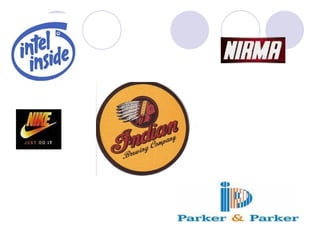
Trademark “ A trademark is a sign that individualizes the goods of a given enterprise and distinguishes them from the goods of its competitors ” A trademark may consist of words, designs, letters, numerals or packaging, slogans,  symbols, etc
A brand includes a name, logo, slogan, and/or design scheme associated with a product or service. A brand is a symbolic embodiment of all the information connected to the product and serves to create associations and expectations around it. A brand often includes a logo, fonts, color schemes, symbols, and sound, which may be developed to represent implicit values, ideas, and even
Different  categories service mark is similar to a trademark, differing only in that the latter protects goods, while the former protects services. Generally speaking the term trademarks includes both trademark and service marks
Examples of the sort of signs there are word marks, consisting of words, letters, numerals, abbreviations or names for instance, surnames.
New genres of Trademark Holograms If you look at a credit card for instance, you will see a small image that changes according to the angle from which you look at it  Sound mark an advertising jingle can serve as a trademark Scent mark
Characteristics of Trademark Distinctive  Apple” is a very distinctive trademark for a computer, because it has absolutely nothing to do with computers, it would not be distinctive for actual apples  Non-deceptive.
Functions of Trademark Informative Distinctiveness  Differentiate
Trademark riddle Do you think the made- up word, "FRUMATO", would make a good trademark for a drink made from a mixture of fruit juice and tomato juice?
Collective mark and certification  mark  Some countries provide for the registration of collective and certification marks, which are used to indicate the affiliation of enterprises using the mark, or which refer to identifiable standards met by the products for which a mark is used. Collective marks usually belong to a group or association of enterprises. Their use is reserved to the members of the group or association. A collective mark therefore distinguishes the goods or services of members of the association from those of other undertakings. The function of the collective mark is to inform the public about certain particular features of the product for which the collective mark is used. An enterprise which uses the collective mark may, in addition, use its own trademark. Example: in an association of architects or engineers, a member may use the logo of the association as well as the logo of the enterprise.
Collective mark and certification  mark There may be occasions when both copyright and trademark protection are desired with respect to the same business endeavor. For example, a marketing campaign for a new product may introduce a new slogan for use with the product, which also appears in advertisements for the product. However, copyright and trademark protection will cover different things. The advertisement's text and graphics, as published in a particular vehicle, will be covered by copyright - but this will not protect the slogan as such. The slogan may be protected by trademark law, but this will not cover the rest of the advertisement. If you want both forms of protection, you will have to perform both types of registration.
Dual  registration under special cases  There may be occasions when both copyright and trademark protection are desired with respect to the same business endeavor. For example, a marketing campaign for a new product may introduce a new slogan for use with the product, which also appears in advertisements for the product. However, copyright and trademark protection will cover different things. The advertisement's text and graphics, as published in a particular vehicle, will be covered by copyright - but this will not protect the slogan as such. The slogan may be protected by trademark law, but this will not cover the rest of the advertisement. If you want both forms of protection, you will have to perform both types of registration.
Registration of Trademark The most common way of protecting a trademark is to have it registered in the Trademark Register, and a great many countries make this a condition of trademark protection. It must first be registered, and once it has been registered it is protected, and its owner is entitled to prohibit others from using it. Registration is not the only way of protecting a trademark,  however: unregistered trademarks are also protected in some countries but it is a less reliable form of protection. This is because an unregistered trademark is not protected until it has acquired sufficient distinctiveness and a reputation in the marketplace, which can take considerable time after the initial launch.
An unregistered trademark that has been around a long time and everyone knows it, it would in some countries qualify for a measure of protection That’s right. However, if you start marketing your products under a new trademark that nobody knows, that trademark will be very vulnerable. It is possible to call on the protection conferred by the laws on unfair  competition, but there too the most important thing is that the mark must have acquired a reputation.
The Madrid system for the international registration of marks (the Madrid system) established in 1891 functions under the Madrid Agreement (1891), and the Madrid Protocol (1989). It is administered by the International Bureau of WIPO located in Geneva, Switzerland.
Trademark protection in India The penalty for selling or providing services using a false trademark is a minimum of six months and maximum of three years and with fine not less than Rupees fifty thousand but which may extend to Rupees two lakh.
The legal requirements to register a trade mark under the Legislation are: The selected mark should be capable of being represented graphically (that is in the paper form).  It should be capable of distinguishing the goods or services of one undertaking from those of others.
Term of registration of a trademark is ten years, which may be renewed for a further period of ten years on payment of prescribed renewal fees.  Non-user of a registered trademark for a continuous period of five years is a ground for cancellation of registration of such trademark at the behest of any aggrieved party.
Indian trademark law allows filing of a trademark application in India on an ‘intent-to-use’ basis. However the registered proprietor of the trademark in India has to commence use of the mark within 5 years and 3 months of the date of registration. Otherwise the registered trademark is open to invalidation proceedings.
CAN A REGISTERED TRADEMARK BE REMOVED FROM THE REGISTER  It can be removed on application to the Registrar on prescribed form on the ground that the mark is wrongly remaining on the register. The Registrar also can suo moto issue Notice for removal of a registered trade mark. Non use of a registered trademark for continuous period of 5 years is also a ground of removal.  CAN I APPLY FOR A DESIGN/LOGO REGISTRATION FOR SAME GOODS AND SERVICES IN BLACK & WHITE AS WELL AS COLOR Yes. You can do so in one application as India recognizes the system of series application. WHAT RECOURSE I HAVE IF A COMPETITOR HAS ALREADY REGISTERED MY MARK IN INDIA  The Indian trademark law provides for invalidation proceedings and you have the right to initiate a cancellation action should a competitor have registered your trademark in India. You also have the right to initiate either a civil or a criminal action against any party that is violating your mark in India. WHO CAN USE SYMBOL ® IN INDIA  Only the proprietor of a trademark whose trademark has been registered in India can use the symbol ® in India. Using the symbol ® unless your mark has been registered in India is unlawful.
 
when can the symbol ™ be used in india  Using this symbol with your trademark simply implies that you claim to be the proprietor of the trademark. There is no prohibition on the use of the symbol ™ in India.
Lay out Designs of Integrated Circuits  Lay out Designs of Integrated Circuits -  Under the agreement, members provide protection to the layout-designs (topographies) of integrated circuits. Members shall consider unlawful the following acts if performed without the authorization of the right holder:- importing, selling, or otherwise distributing for commercial purposes a protected layout-design, an integrated circuit in which a protected layout-design is incorporated, or an article incorporating such an integrated circuit only in so far as it continues to contain an unlawfully reproduced layout-design.

trademarks

  • 1.
  • 2.
  • 3.
    Trademark “ Atrademark is a sign that individualizes the goods of a given enterprise and distinguishes them from the goods of its competitors ” A trademark may consist of words, designs, letters, numerals or packaging, slogans, symbols, etc
  • 4.
    A brand includesa name, logo, slogan, and/or design scheme associated with a product or service. A brand is a symbolic embodiment of all the information connected to the product and serves to create associations and expectations around it. A brand often includes a logo, fonts, color schemes, symbols, and sound, which may be developed to represent implicit values, ideas, and even
  • 5.
    Different categoriesservice mark is similar to a trademark, differing only in that the latter protects goods, while the former protects services. Generally speaking the term trademarks includes both trademark and service marks
  • 6.
    Examples of thesort of signs there are word marks, consisting of words, letters, numerals, abbreviations or names for instance, surnames.
  • 7.
    New genres ofTrademark Holograms If you look at a credit card for instance, you will see a small image that changes according to the angle from which you look at it Sound mark an advertising jingle can serve as a trademark Scent mark
  • 8.
    Characteristics of TrademarkDistinctive Apple” is a very distinctive trademark for a computer, because it has absolutely nothing to do with computers, it would not be distinctive for actual apples Non-deceptive.
  • 9.
    Functions of TrademarkInformative Distinctiveness Differentiate
  • 10.
    Trademark riddle Doyou think the made- up word, "FRUMATO", would make a good trademark for a drink made from a mixture of fruit juice and tomato juice?
  • 11.
    Collective mark andcertification mark Some countries provide for the registration of collective and certification marks, which are used to indicate the affiliation of enterprises using the mark, or which refer to identifiable standards met by the products for which a mark is used. Collective marks usually belong to a group or association of enterprises. Their use is reserved to the members of the group or association. A collective mark therefore distinguishes the goods or services of members of the association from those of other undertakings. The function of the collective mark is to inform the public about certain particular features of the product for which the collective mark is used. An enterprise which uses the collective mark may, in addition, use its own trademark. Example: in an association of architects or engineers, a member may use the logo of the association as well as the logo of the enterprise.
  • 12.
    Collective mark andcertification mark There may be occasions when both copyright and trademark protection are desired with respect to the same business endeavor. For example, a marketing campaign for a new product may introduce a new slogan for use with the product, which also appears in advertisements for the product. However, copyright and trademark protection will cover different things. The advertisement's text and graphics, as published in a particular vehicle, will be covered by copyright - but this will not protect the slogan as such. The slogan may be protected by trademark law, but this will not cover the rest of the advertisement. If you want both forms of protection, you will have to perform both types of registration.
  • 13.
    Dual registrationunder special cases There may be occasions when both copyright and trademark protection are desired with respect to the same business endeavor. For example, a marketing campaign for a new product may introduce a new slogan for use with the product, which also appears in advertisements for the product. However, copyright and trademark protection will cover different things. The advertisement's text and graphics, as published in a particular vehicle, will be covered by copyright - but this will not protect the slogan as such. The slogan may be protected by trademark law, but this will not cover the rest of the advertisement. If you want both forms of protection, you will have to perform both types of registration.
  • 14.
    Registration of TrademarkThe most common way of protecting a trademark is to have it registered in the Trademark Register, and a great many countries make this a condition of trademark protection. It must first be registered, and once it has been registered it is protected, and its owner is entitled to prohibit others from using it. Registration is not the only way of protecting a trademark, however: unregistered trademarks are also protected in some countries but it is a less reliable form of protection. This is because an unregistered trademark is not protected until it has acquired sufficient distinctiveness and a reputation in the marketplace, which can take considerable time after the initial launch.
  • 15.
    An unregistered trademarkthat has been around a long time and everyone knows it, it would in some countries qualify for a measure of protection That’s right. However, if you start marketing your products under a new trademark that nobody knows, that trademark will be very vulnerable. It is possible to call on the protection conferred by the laws on unfair competition, but there too the most important thing is that the mark must have acquired a reputation.
  • 16.
    The Madrid systemfor the international registration of marks (the Madrid system) established in 1891 functions under the Madrid Agreement (1891), and the Madrid Protocol (1989). It is administered by the International Bureau of WIPO located in Geneva, Switzerland.
  • 17.
    Trademark protection inIndia The penalty for selling or providing services using a false trademark is a minimum of six months and maximum of three years and with fine not less than Rupees fifty thousand but which may extend to Rupees two lakh.
  • 18.
    The legal requirementsto register a trade mark under the Legislation are: The selected mark should be capable of being represented graphically (that is in the paper form). It should be capable of distinguishing the goods or services of one undertaking from those of others.
  • 19.
    Term of registrationof a trademark is ten years, which may be renewed for a further period of ten years on payment of prescribed renewal fees. Non-user of a registered trademark for a continuous period of five years is a ground for cancellation of registration of such trademark at the behest of any aggrieved party.
  • 20.
    Indian trademark lawallows filing of a trademark application in India on an ‘intent-to-use’ basis. However the registered proprietor of the trademark in India has to commence use of the mark within 5 years and 3 months of the date of registration. Otherwise the registered trademark is open to invalidation proceedings.
  • 21.
    CAN A REGISTEREDTRADEMARK BE REMOVED FROM THE REGISTER It can be removed on application to the Registrar on prescribed form on the ground that the mark is wrongly remaining on the register. The Registrar also can suo moto issue Notice for removal of a registered trade mark. Non use of a registered trademark for continuous period of 5 years is also a ground of removal. CAN I APPLY FOR A DESIGN/LOGO REGISTRATION FOR SAME GOODS AND SERVICES IN BLACK & WHITE AS WELL AS COLOR Yes. You can do so in one application as India recognizes the system of series application. WHAT RECOURSE I HAVE IF A COMPETITOR HAS ALREADY REGISTERED MY MARK IN INDIA The Indian trademark law provides for invalidation proceedings and you have the right to initiate a cancellation action should a competitor have registered your trademark in India. You also have the right to initiate either a civil or a criminal action against any party that is violating your mark in India. WHO CAN USE SYMBOL ® IN INDIA Only the proprietor of a trademark whose trademark has been registered in India can use the symbol ® in India. Using the symbol ® unless your mark has been registered in India is unlawful.
  • 22.
  • 23.
    when can thesymbol ™ be used in india Using this symbol with your trademark simply implies that you claim to be the proprietor of the trademark. There is no prohibition on the use of the symbol ™ in India.
  • 24.
    Lay out Designsof Integrated Circuits Lay out Designs of Integrated Circuits - Under the agreement, members provide protection to the layout-designs (topographies) of integrated circuits. Members shall consider unlawful the following acts if performed without the authorization of the right holder:- importing, selling, or otherwise distributing for commercial purposes a protected layout-design, an integrated circuit in which a protected layout-design is incorporated, or an article incorporating such an integrated circuit only in so far as it continues to contain an unlawfully reproduced layout-design.