Principles of siphonic roof drainage systems
                                     Marc Buitenhuis

    Hydraulic research engineer Akatherm International BV, Panningen, The Netherlands

                                          17-08-2008

Abstract

In this article it has been illustrated that a siphonic roof drainage system with a single roof
outlet is reasonably well understood. The governing equations are presented.
The basic design of the system can be determined using single phase flow theory assuming
full bore flow of the system.
The start up and two phase flow functioning of the system are more complex.
In a multiple roof outlet siphonic system the interaction between the roof outlets makes it very
complex and only skilled people can design a well functioning system.


   1. Introduction                                 explained to give a basis for the principles
   1. Introduction?                                of a multiple roof outlet system.

For drainage of large roof areas a siphonic            2. Principle of syphonic roof
system is a well acknowledged cost saving                 drainage
solution. The principle of expelling air
from the system means that only water is           The principle in syphonic roof drainage is
being transported at high speed making use         the full bore flow of the system. One thus
of the suction pressure created behind the         has to obtain and maintain a full bore flow
full bore water column. The high speed full        for optimal functioning of the system.
bore flow makes smaller pipe dimensions            The full bore flow is initiated by the
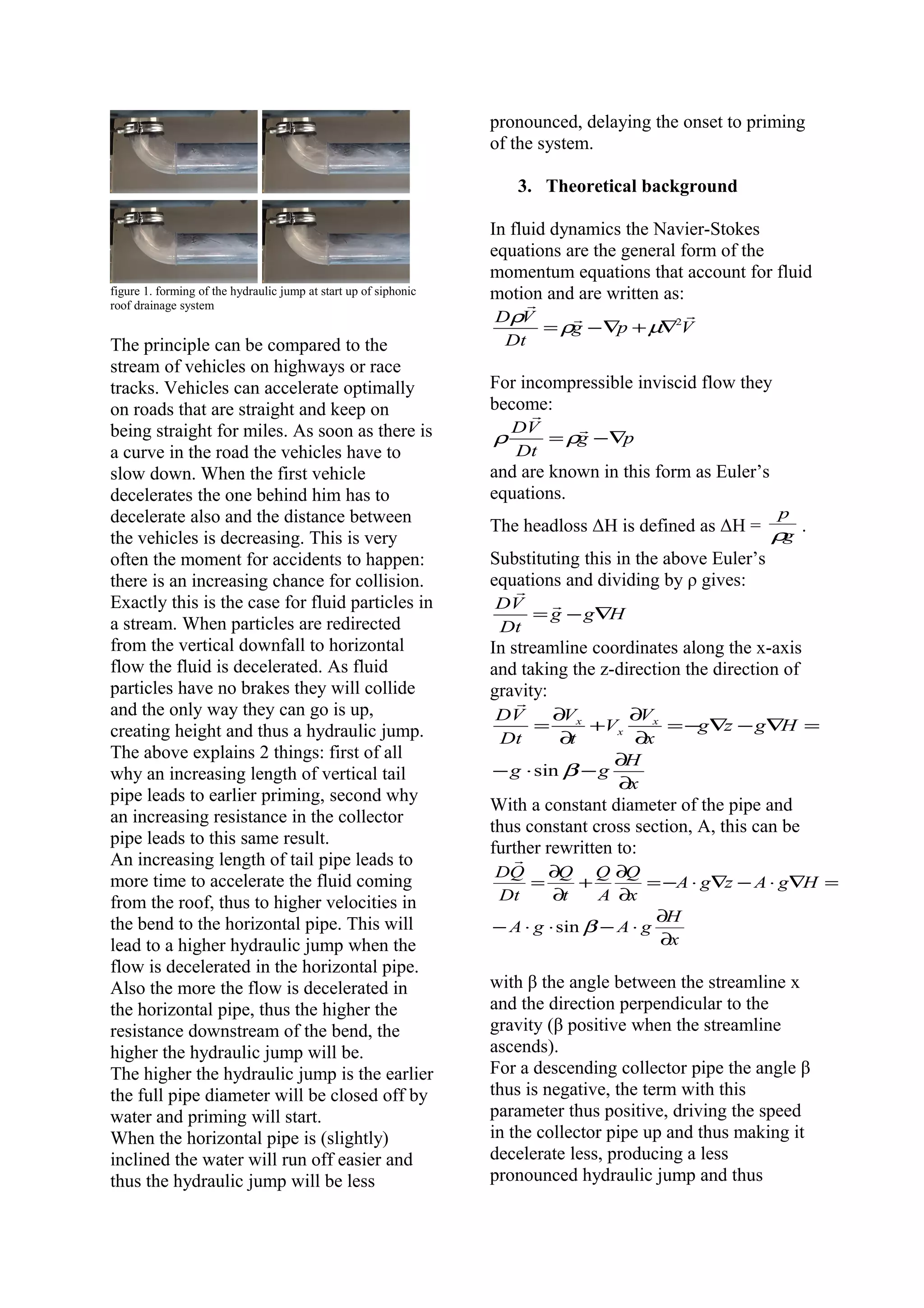
than in conventional systems possible.             hydraulic jump (see figure 1) at the
Also the elimination of multiple downpipes         entrance of the horizontal part of tail pipe
and a lot of piping in the groundwork mean         or collector pipe of the system. The shape
a large cost saving and more architectural         of the hydraulic jump depends on 2
freedom for the building design.                   parameter:
The only disadvantage is that one has to           • the velocity of the flow streaming into
have a better technical background to be           the horizontal pipe
able to properly design a siphonic system.         • and the resistance of the pipe beyond
A multiple roof outlet siphonic system is a        the entrance of the collector pipe.
complex system that needs to be carefully
optimized to function properly.
In this article the theory of a single roof
outlet siphonic roof drainage will be
pronounced, delaying the onset to priming
                                                                  of the system.

                                                                      3. Theoretical background

                                                                  In fluid dynamics the Navier-Stokes
                                                                  equations are the general form of the
                                                                  momentum equations that account for fluid
figure 1. forming of the hydraulic jump at start up of siphonic   motion and are written as:
                                                                        
roof drainage system
                                                                   DρV                      
                                                                          = ρg − ∇p + µ∇2V
The principle can be compared to the                                Dt
stream of vehicles on highways or race
tracks. Vehicles can accelerate optimally                         For incompressible inviscid flow they
on roads that are straight and keep on                            become:
                                                                        
being straight for miles. As soon as there is                         DV    
                                                                  ρ      = ρg − ∇p
a curve in the road the vehicles have to                              Dt
slow down. When the first vehicle                                 and are known in this form as Euler’s
decelerates the one behind him has to                             equations.
decelerate also and the distance between                                                                  p
                                                                  The headloss ΔH is defined as ΔH = ρ . g
the vehicles is decreasing. This is very
often the moment for accidents to happen:                         Substituting this in the above Euler’s
there is an increasing chance for collision.                      equations and dividing by ρ gives:
                                                                     
Exactly this is the case for fluid particles in                   DV   
                                                                     = g − g∇H
a stream. When particles are redirected                           Dt
from the vertical downfall to horizontal                          In streamline coordinates along the x-axis
flow the fluid is decelerated. As fluid                           and taking the z-direction the direction of
particles have no brakes they will collide                        gravity:
                                                                     
and the only way they can go is up,                               DV      ∂Vx      ∂Vx
creating height and thus a hydraulic jump.                              =      +Vx     = −g∇ − g∇ =
                                                                                            z    H
                                                                  Dt       ∂t       ∂x
The above explains 2 things: first of all                                         ∂H
why an increasing length of vertical tail                         − g ⋅ sin β − g
                                                                                  ∂x
pipe leads to earlier priming, second why
                                                                  With a constant diameter of the pipe and
an increasing resistance in the collector
                                                                  thus constant cross section, A, this can be
pipe leads to this same result.
                                                                  further rewritten to:
An increasing length of tail pipe leads to                            
                                                                  DQ ∂Q Q ∂Q
more time to accelerate the fluid coming                               =       +         = −A ⋅ g∇z − A ⋅ g∇H =
from the roof, thus to higher velocities in                       Dt       ∂t    A ∂x
the bend to the horizontal pipe. This will                                                ∂H
                                                                  − A ⋅ g ⋅ sin β − A ⋅ g
lead to a higher hydraulic jump when the                                                  ∂x
flow is decelerated in the horizontal pipe.
Also the more the flow is decelerated in                          with β the angle between the streamline x
the horizontal pipe, thus the higher the                          and the direction perpendicular to the
resistance downstream of the bend, the                            gravity (β positive when the streamline
higher the hydraulic jump will be.                                ascends).
The higher the hydraulic jump is the earlier                      For a descending collector pipe the angle β
the full pipe diameter will be closed off by                      thus is negative, the term with this
water and priming will start.                                     parameter thus positive, driving the speed
When the horizontal pipe is (slightly)                            in the collector pipe up and thus making it
inclined the water will run off easier and                        decelerate less, producing a less
thus the hydraulic jump will be less                              pronounced hydraulic jump and thus
delaying priming (full bore flow) in the         The basic design of the system can be
system.                                          determined using single phase flow theory
                                                 assuming full bore flow of the system.
In a steady incompressible inviscid full         The start up and two phase flow
bore flow integration of Euler’s equations       functioning of the system are more
over a streamline gives the well known           complex.
Bernoulli equation:                              In a multiple roof outlet siphonic system
p            V2                                  the interaction between the roof outlets
    + gz +      = const
ρ            2                                   makes it very complex and only skilled
This equation is often referred to to easily     people can design a well functioning
explain the principle of siphonic roof           system.
drainage.
                                                    5. References
The head loss in pipe systems consists of
losses due to the friction coefficient of the    - Robert W. Fox, Alan T. McDonald,
pipe walls, losses due to the fittings (bends,   Introduction to fluid mechanics, third
knees, T-pieces and the roof outlet) and         edition, 1985, School of Mechanical
losses due to the additional roughness           Engineering Purdue University, John
caused by welding of pipes and                   Wiley & Sons
fittings.The head loss due to friction along     - Scott Arthur, John A. Swaffield, Siphonic
the pipe walls can be described by the           roof drainage: current understanding, 2001,
equation:                                        Water research group, Department of civil
        L Vx2                                    and offshore engineering, Heriot-Watt
H = f                                            University, Edinburg, Scotland (UK)
        D 2g
                                                 - G.B. Wright, S. Arthur, J.A. Swaffield,
with f the friction factor. For the
                                                 Numerical simulation of the dynamic
determination of the friction factor the
                                                 operation of multi-outlet siphonic roof
Colebrook-White equation is most widely
                                                 drainage systems, 2005, Drainage and
applied:
                                                 water supply research group, School of the
 1          k        2.51                    build environment, Heriot-Watt University,
    = 0.25log s +
               3.7 D Re f
                                 
                                 
  f        
                                
                                                Edinburg, Scotland (UK)
with ks the equivalent sand grain                - Scott Arthur, The priming focused design
roughness. A good estimation for f is:           of siphonic roof drainage, drainage
                                  −2             research group, School of the built
             k         5.74                  environment, Heriot-Watt University,
 f 0 = 0.25log s + 0.9 
             3.7 D Re                        Edinburg, Scotland (UK)
The head losses of fittings and roof outlets     - S. Arthur, G.B. Wright, Siphonic roof
can be approximated in a similar way by:         drainage systems – priming focused
                                                 design, 2006, School of the built
        Vx2    L V2
H =ξ        = f e x                              environment, Heriot-Watt University,
        2g      D 2g
                                                 Edinburg, Scotland (UK)
with ξ a coefficient specific for each fitting   - S. Arthur, J.A. Swaffield, Siphonic roof
of a certain diameter and Le an equivalent       drainage system analysis utilizing unsteady
length of pipe.                                  flow theory, 2000, Department of building
                                                 engineering and surveying, Heriot-Watt
    4. Conclusions                               University, Edinburg, Scotland (UK)
In this article it has been illustrated that a
siphonic roof drainage system with a single
roof outlet is reasonably well understood.
The governing equations are presented.

Tp6 principles of siphonic roof drainage systems(dr)

  • 1.
    Principles of siphonicroof drainage systems Marc Buitenhuis Hydraulic research engineer Akatherm International BV, Panningen, The Netherlands 17-08-2008 Abstract In this article it has been illustrated that a siphonic roof drainage system with a single roof outlet is reasonably well understood. The governing equations are presented. The basic design of the system can be determined using single phase flow theory assuming full bore flow of the system. The start up and two phase flow functioning of the system are more complex. In a multiple roof outlet siphonic system the interaction between the roof outlets makes it very complex and only skilled people can design a well functioning system. 1. Introduction explained to give a basis for the principles 1. Introduction? of a multiple roof outlet system. For drainage of large roof areas a siphonic 2. Principle of syphonic roof system is a well acknowledged cost saving drainage solution. The principle of expelling air from the system means that only water is The principle in syphonic roof drainage is being transported at high speed making use the full bore flow of the system. One thus of the suction pressure created behind the has to obtain and maintain a full bore flow full bore water column. The high speed full for optimal functioning of the system. bore flow makes smaller pipe dimensions The full bore flow is initiated by the than in conventional systems possible. hydraulic jump (see figure 1) at the Also the elimination of multiple downpipes entrance of the horizontal part of tail pipe and a lot of piping in the groundwork mean or collector pipe of the system. The shape a large cost saving and more architectural of the hydraulic jump depends on 2 freedom for the building design. parameter: The only disadvantage is that one has to • the velocity of the flow streaming into have a better technical background to be the horizontal pipe able to properly design a siphonic system. • and the resistance of the pipe beyond A multiple roof outlet siphonic system is a the entrance of the collector pipe. complex system that needs to be carefully optimized to function properly. In this article the theory of a single roof outlet siphonic roof drainage will be
  • 2.
    pronounced, delaying theonset to priming of the system. 3. Theoretical background In fluid dynamics the Navier-Stokes equations are the general form of the momentum equations that account for fluid figure 1. forming of the hydraulic jump at start up of siphonic motion and are written as:  roof drainage system DρV   = ρg − ∇p + µ∇2V The principle can be compared to the Dt stream of vehicles on highways or race tracks. Vehicles can accelerate optimally For incompressible inviscid flow they on roads that are straight and keep on become:  being straight for miles. As soon as there is DV  ρ = ρg − ∇p a curve in the road the vehicles have to Dt slow down. When the first vehicle and are known in this form as Euler’s decelerates the one behind him has to equations. decelerate also and the distance between p The headloss ΔH is defined as ΔH = ρ . g the vehicles is decreasing. This is very often the moment for accidents to happen: Substituting this in the above Euler’s there is an increasing chance for collision. equations and dividing by ρ gives:  Exactly this is the case for fluid particles in DV  = g − g∇H a stream. When particles are redirected Dt from the vertical downfall to horizontal In streamline coordinates along the x-axis flow the fluid is decelerated. As fluid and taking the z-direction the direction of particles have no brakes they will collide gravity:  and the only way they can go is up, DV ∂Vx ∂Vx creating height and thus a hydraulic jump. = +Vx = −g∇ − g∇ = z H Dt ∂t ∂x The above explains 2 things: first of all ∂H why an increasing length of vertical tail − g ⋅ sin β − g ∂x pipe leads to earlier priming, second why With a constant diameter of the pipe and an increasing resistance in the collector thus constant cross section, A, this can be pipe leads to this same result. further rewritten to: An increasing length of tail pipe leads to  DQ ∂Q Q ∂Q more time to accelerate the fluid coming = + = −A ⋅ g∇z − A ⋅ g∇H = from the roof, thus to higher velocities in Dt ∂t A ∂x the bend to the horizontal pipe. This will ∂H − A ⋅ g ⋅ sin β − A ⋅ g lead to a higher hydraulic jump when the ∂x flow is decelerated in the horizontal pipe. Also the more the flow is decelerated in with β the angle between the streamline x the horizontal pipe, thus the higher the and the direction perpendicular to the resistance downstream of the bend, the gravity (β positive when the streamline higher the hydraulic jump will be. ascends). The higher the hydraulic jump is the earlier For a descending collector pipe the angle β the full pipe diameter will be closed off by thus is negative, the term with this water and priming will start. parameter thus positive, driving the speed When the horizontal pipe is (slightly) in the collector pipe up and thus making it inclined the water will run off easier and decelerate less, producing a less thus the hydraulic jump will be less pronounced hydraulic jump and thus
  • 3.
    delaying priming (fullbore flow) in the The basic design of the system can be system. determined using single phase flow theory assuming full bore flow of the system. In a steady incompressible inviscid full The start up and two phase flow bore flow integration of Euler’s equations functioning of the system are more over a streamline gives the well known complex. Bernoulli equation: In a multiple roof outlet siphonic system p V2 the interaction between the roof outlets + gz + = const ρ 2 makes it very complex and only skilled This equation is often referred to to easily people can design a well functioning explain the principle of siphonic roof system. drainage. 5. References The head loss in pipe systems consists of losses due to the friction coefficient of the - Robert W. Fox, Alan T. McDonald, pipe walls, losses due to the fittings (bends, Introduction to fluid mechanics, third knees, T-pieces and the roof outlet) and edition, 1985, School of Mechanical losses due to the additional roughness Engineering Purdue University, John caused by welding of pipes and Wiley & Sons fittings.The head loss due to friction along - Scott Arthur, John A. Swaffield, Siphonic the pipe walls can be described by the roof drainage: current understanding, 2001, equation: Water research group, Department of civil L Vx2 and offshore engineering, Heriot-Watt H = f University, Edinburg, Scotland (UK) D 2g - G.B. Wright, S. Arthur, J.A. Swaffield, with f the friction factor. For the Numerical simulation of the dynamic determination of the friction factor the operation of multi-outlet siphonic roof Colebrook-White equation is most widely drainage systems, 2005, Drainage and applied: water supply research group, School of the 1   k 2.51  build environment, Heriot-Watt University, = 0.25log s +  3.7 D Re f   f      Edinburg, Scotland (UK) with ks the equivalent sand grain - Scott Arthur, The priming focused design roughness. A good estimation for f is: of siphonic roof drainage, drainage −2 research group, School of the built   k 5.74  environment, Heriot-Watt University, f 0 = 0.25log s + 0.9    3.7 D Re  Edinburg, Scotland (UK) The head losses of fittings and roof outlets - S. Arthur, G.B. Wright, Siphonic roof can be approximated in a similar way by: drainage systems – priming focused design, 2006, School of the built Vx2 L V2 H =ξ = f e x environment, Heriot-Watt University, 2g D 2g Edinburg, Scotland (UK) with ξ a coefficient specific for each fitting - S. Arthur, J.A. Swaffield, Siphonic roof of a certain diameter and Le an equivalent drainage system analysis utilizing unsteady length of pipe. flow theory, 2000, Department of building engineering and surveying, Heriot-Watt 4. Conclusions University, Edinburg, Scotland (UK) In this article it has been illustrated that a siphonic roof drainage system with a single roof outlet is reasonably well understood. The governing equations are presented.