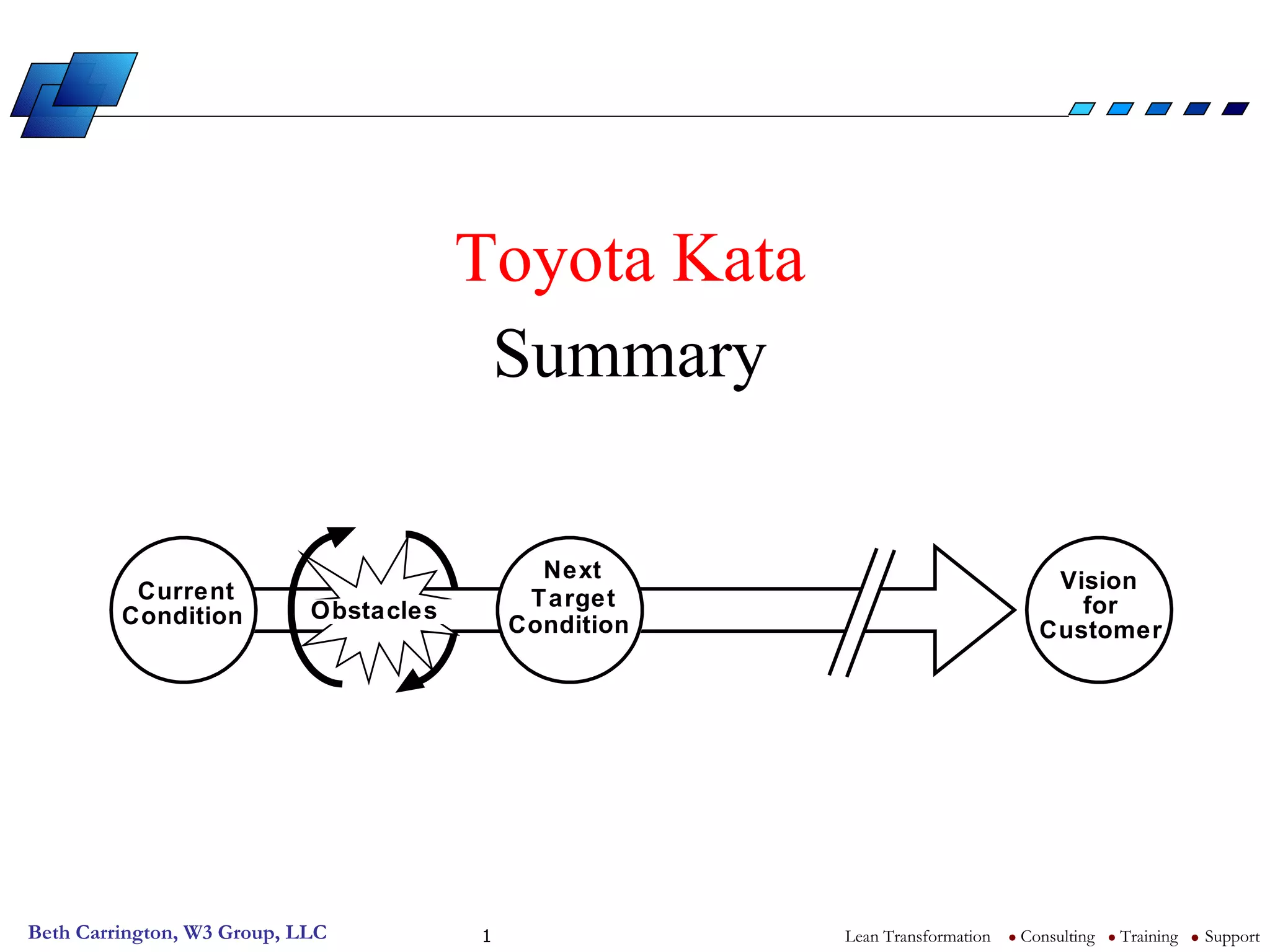
Toyota Kata Summary
Learning and Practicing TK This is not an implementation process, as in a tool of lean.  It is a way of changing behavior. Establishing new behaviors takes practice and coaching.
Setting a Target Condition Setting a goal or a target alone is not the same as describing a  target condition . Not a laundry list of improvement opportunities.  Not debate on which item on the list is more important. Not the results of a waste walk.
Everyone’s attention turns  But… we don’t know up front how we’ll get there! Toyota Kata, page 107
Small /Frequent PDCA Cycles  Scientific method:  Hypothesis & test Risk of failure low due to small (but frequent) steps Learning is maximized Quick cycles; see the effects real-time Always brings us back to reflect on our new current condition
“ Coaching Cycles” The five questions are asked in a specific order  - it is a mini kata, a practice, a routine. It’s the practice that builds new patterns, sets new behavior. Toyota Kata, page 247
Coaching It’s about developing people, not just solving the problem or overcoming the obstacle. Let the learner reach his own conclusion, under coaching guidance… the conclusions we reach ourselves are more convincing than the ones someone else proposes.  Everyone needs a coach to guide them.  Without coaching input we can lose our way, practicing and practicing but not practicing the desired kata, or doing it incorrectly.
Conclusion Toyota Kata  is a management system,  leading/coaching others to drive continuous improvement and the achievement of challenging objectives in all aspects of an organization.

Toyota Kata Summary

  • 1.
  • 2.
    Learning and PracticingTK This is not an implementation process, as in a tool of lean. It is a way of changing behavior. Establishing new behaviors takes practice and coaching.
  • 3.
    Setting a TargetCondition Setting a goal or a target alone is not the same as describing a target condition . Not a laundry list of improvement opportunities. Not debate on which item on the list is more important. Not the results of a waste walk.
  • 4.
    Everyone’s attention turns But… we don’t know up front how we’ll get there! Toyota Kata, page 107
  • 5.
    Small /Frequent PDCACycles Scientific method: Hypothesis & test Risk of failure low due to small (but frequent) steps Learning is maximized Quick cycles; see the effects real-time Always brings us back to reflect on our new current condition
  • 6.
    “ Coaching Cycles”The five questions are asked in a specific order - it is a mini kata, a practice, a routine. It’s the practice that builds new patterns, sets new behavior. Toyota Kata, page 247
  • 7.
    Coaching It’s aboutdeveloping people, not just solving the problem or overcoming the obstacle. Let the learner reach his own conclusion, under coaching guidance… the conclusions we reach ourselves are more convincing than the ones someone else proposes. Everyone needs a coach to guide them. Without coaching input we can lose our way, practicing and practicing but not practicing the desired kata, or doing it incorrectly.
  • 8.
    Conclusion Toyota Kata is a management system, leading/coaching others to drive continuous improvement and the achievement of challenging objectives in all aspects of an organization.