
SCENARIO-BUILDING METHODS AND
US SCENARIOS
Donna A. Messner, PhD and Adrian Towse
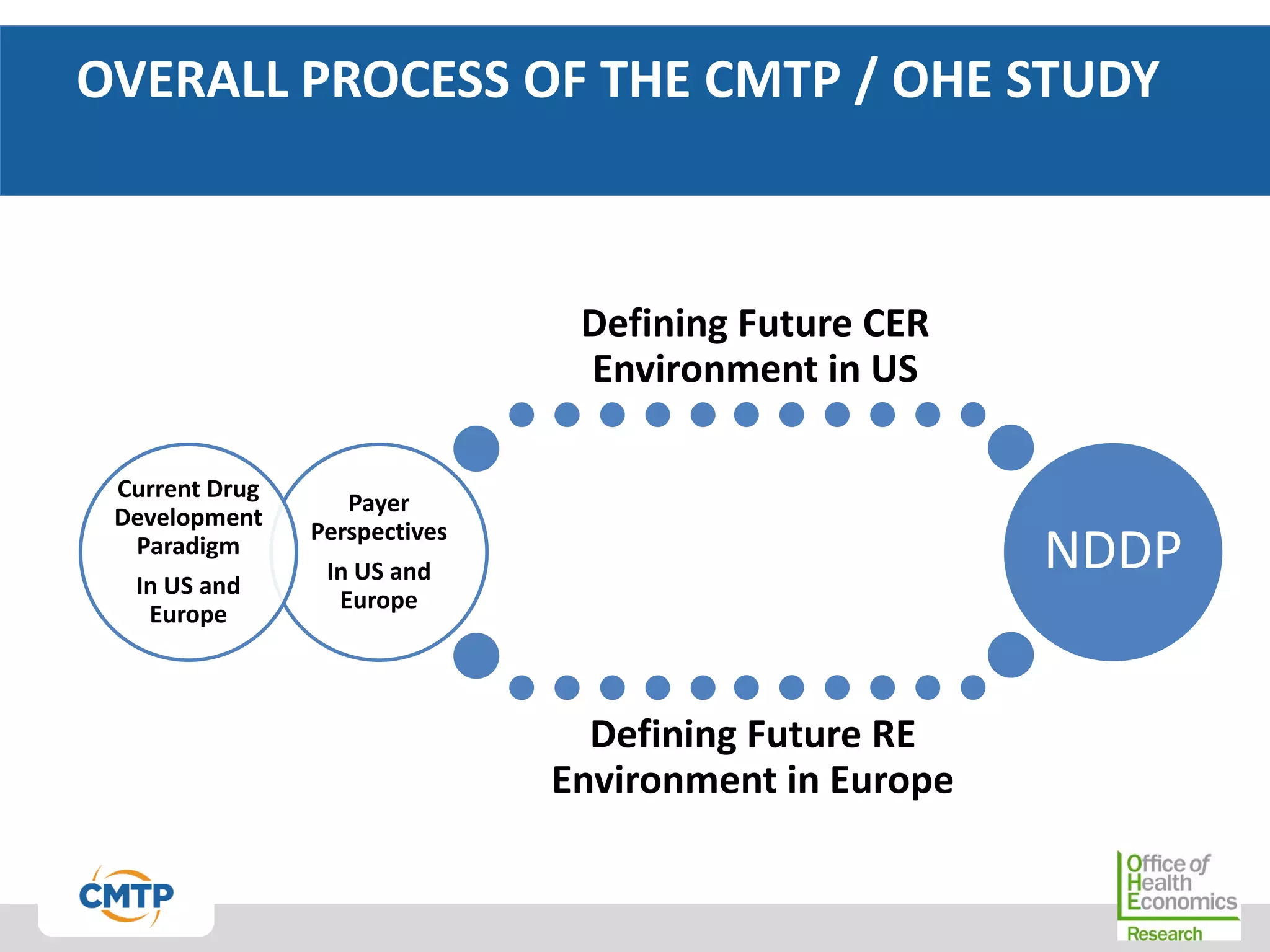
OVERALL PROCESS OF THE CMTP / OHE STUDY
NDDP
Defining Future CER
Environment in US
Defining Future RE
Environment in Europe
Payer
Perspectives
In US and
Europe
Current Drug
Development
Paradigm
In US and
Europe
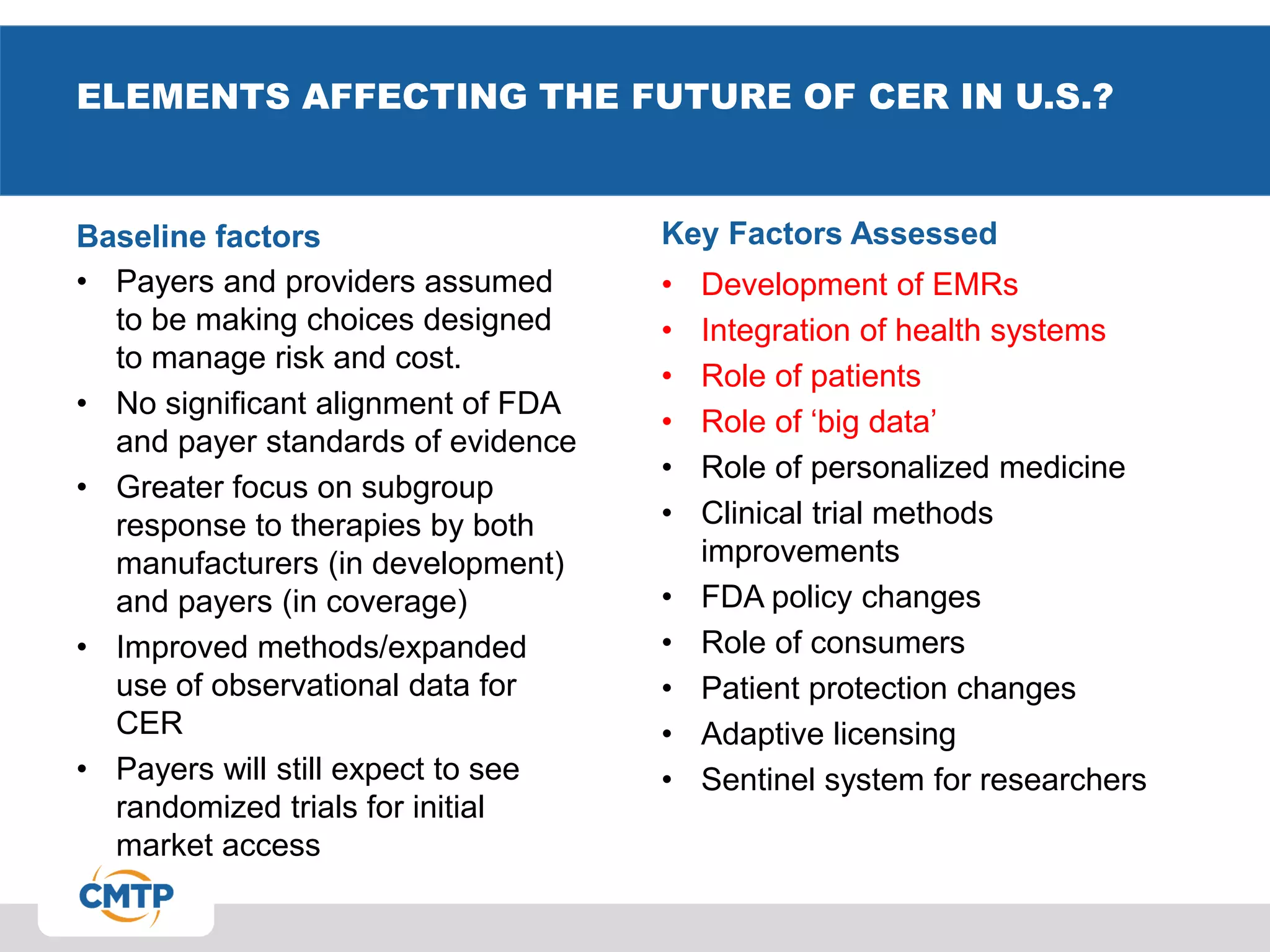
ELEMENTS AFFECTING THE FUTURE OF CER IN U.S.?
Baseline factors
• Payers and providers assumed
to be making choices designed
to manage risk and cost.
• No significant alignment of FDA
and payer standards of evidence
• Greater focus on subgroup
response to therapies by both
manufacturers (in development)
and payers (in coverage)
• Improved methods/expanded
use of observational data for
CER
• Payers will still expect to see
randomized trials for initial
market access
Key Factors Assessed
• Development of EMRs
• Integration of health systems
• Role of patients
• Role of ‘big data’
• Role of personalized medicine
• Clinical trial methods
improvements
• FDA policy changes
• Role of consumers
• Patient protection changes
• Adaptive licensing
• Sentinel system for researchers
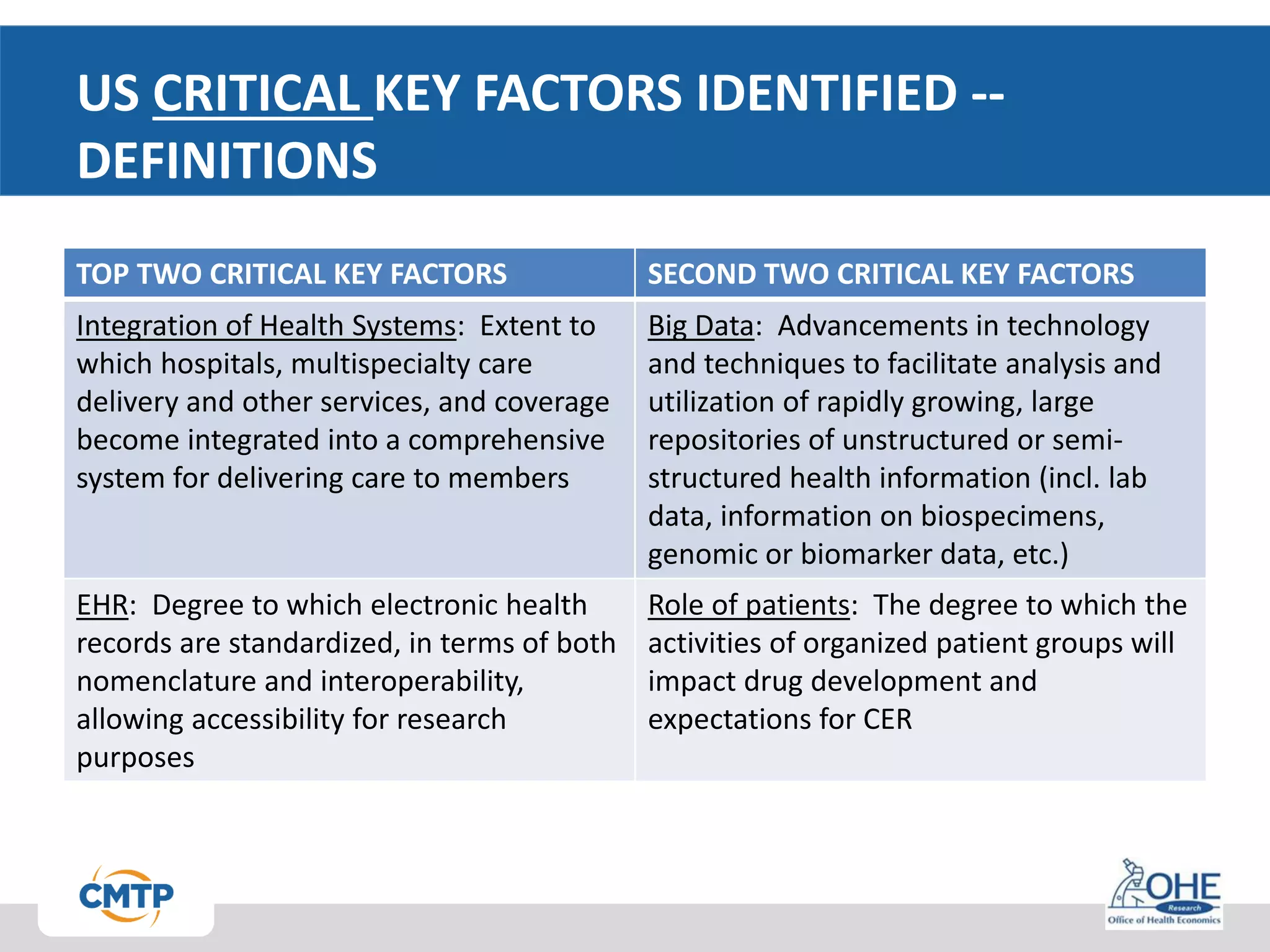
US CRITICAL KEY FACTORS IDENTIFIED --
DEFINITIONS
TOP TWO CRITICAL KEY FACTORS SECOND TWO CRITICAL KEY FACTORS
Integration of Health Systems: Extent to
which hospitals, multispecialty care
delivery and other services, and coverage
become integrated into a comprehensive
system for delivering care to members
Big Data: Advancements in technology
and techniques to facilitate analysis and
utilization of rapidly growing, large
repositories of unstructured or semi-
structured health information (incl. lab
data, information on biospecimens,
genomic or biomarker data, etc.)
EHR: Degree to which electronic health
records are standardized, in terms of both
nomenclature and interoperability,
allowing accessibility for research
purposes
Role of patients: The degree to which the
activities of organized patient groups will
impact drug development and
expectations for CER
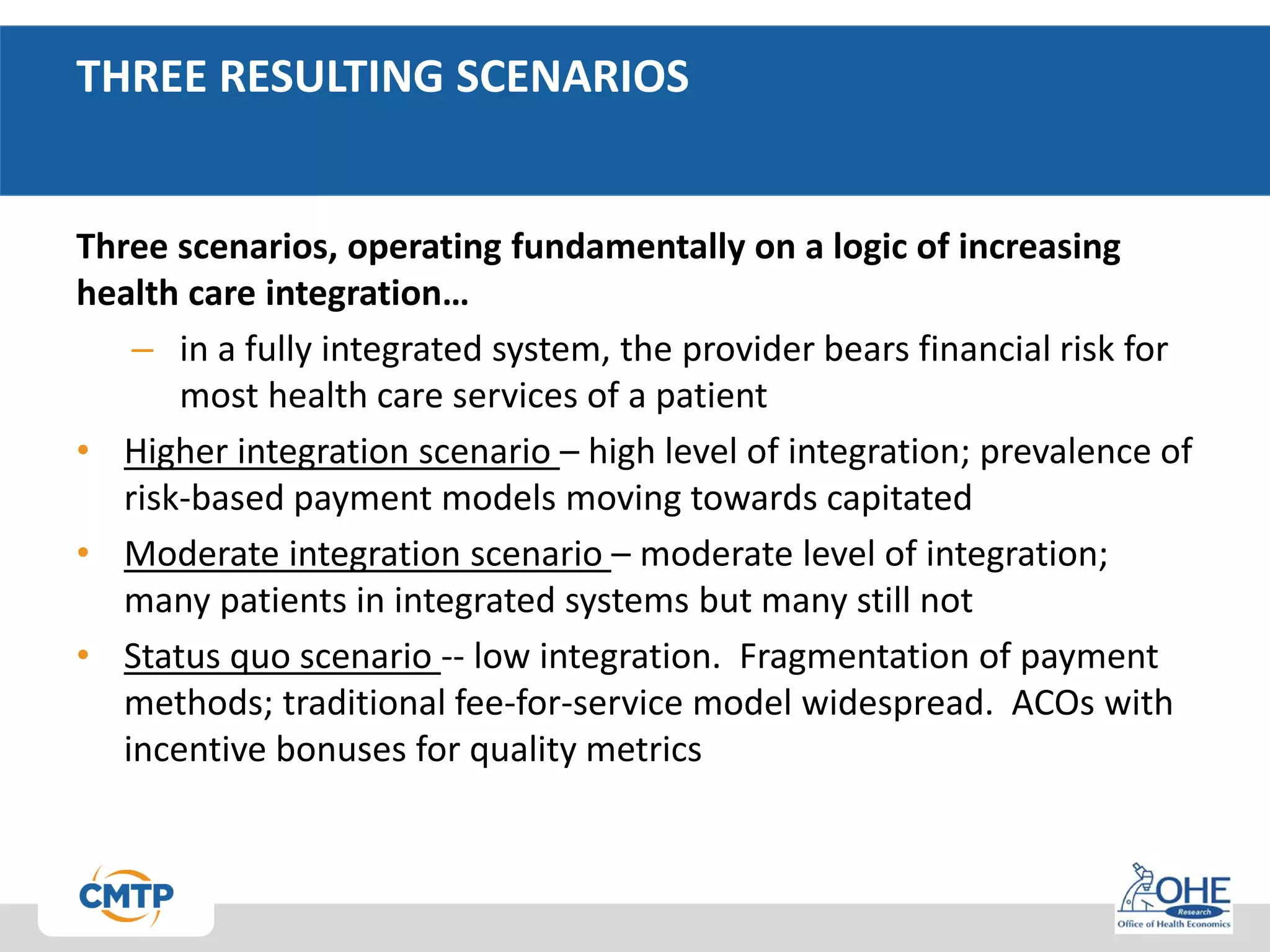
THREE RESULTING SCENARIOS
Three scenarios, operating fundamentally on a logic of increasing
health care integration…
– in a fully integrated system, the provider bears financial risk for
most health care services of a patient
• Higher integration scenario – high level of integration; prevalence of
risk-based payment models moving towards capitated
• Moderate integration scenario – moderate level of integration;
many patients in integrated systems but many still not
• Status quo scenario -- low integration. Fragmentation of payment
methods; traditional fee-for-service model widespread. ACOs with
incentive bonuses for quality metrics
MODERATE INTEGRATION SCENARIO “MOST LIKELY”
• Integration: Pop in integrated systems doubled (others in fragmented sys)
– Within integrated systems, risk for care shifted to HC system away from
traditional payers
– More incentive to look at the long-term outcomes and costs for drugs;
but ability to use their own data is partial
– Contracting with ACOs largely on quality metrics; includes measures of
cost
• EMR: Some interoperability in large systems or states; more
standardization, but records of a many patients still not captured
• Big Data: Many data sources still poor quality, but increased opportunities
• Patient role: Organized patient groups build networks (PCORI PPRN)
– work with investigators, statisticians to mitigate bias;
– collect relevant clinical and patient-reported outcomes from a high
proportion of their memberships;
– embed clinical trials within registries (especially in the rare disease
space)
ADDITIONAL FINDINGS: US
ACCOUNTABLE CARE ORGANIZATIONS
1. Drug Utilization and Resource Use: Risk-adjusted per member per month
payments will grow resulting in better understanding of drug utilization and
resource use
2. Performance Metrics: There will be a shift from using simple measures such as
proportion of generics prescribed to sophisticated measures that encompass cost
and measures of adherence
3. Tiering, Utilization Management & Coverage Policy: Most ACOs will adhere to PBM
or payer medical policies when claims are submitted
4. Care Pathways: Uncovered products might be absorbed by ACOs using their own
care pathway if these show a potential to contribute to overall cost savings
5. CER
• Data-rich environment will enable comparisons of different interventions in different
populations
• Ability of ACOs to evaluate drug effectiveness depends on partnerships with PBMs
• It will be difficult for smaller ACOs to invest in research but would focus on data
improvements and quality metrics to demonstrate quality and effectiveness of their
organizations.
7
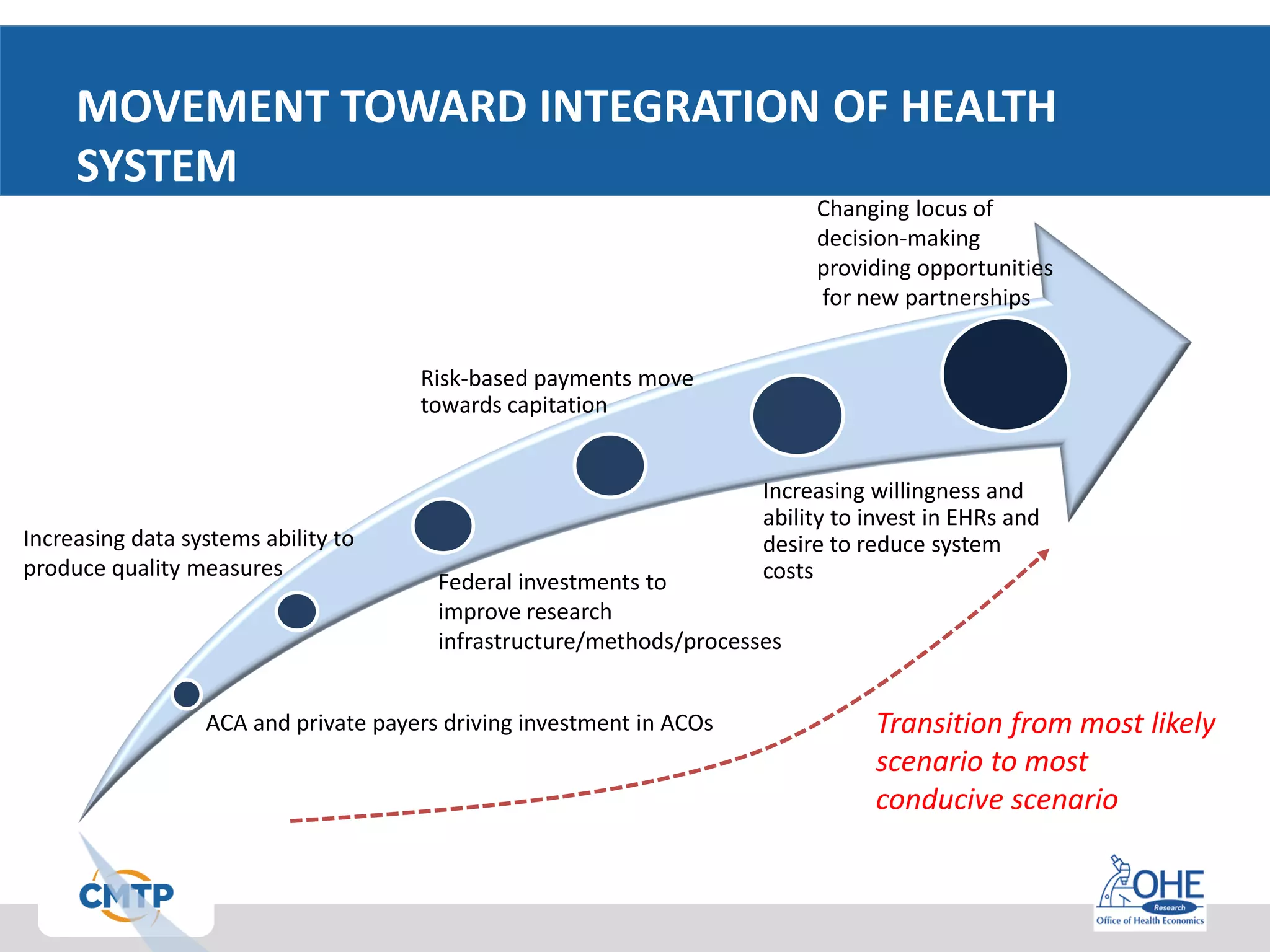
MOVEMENT TOWARD INTEGRATION OF HEALTH
SYSTEM
ACA and private payers driving investment in ACOs
Increasing data systems ability to
produce quality measures
Federal investments to
improve research
infrastructure/methods/processes
Risk-based payments move
towards capitation
Increasing willingness and
ability to invest in EHRs and
desire to reduce system
costs
Changing locus of
decision-making
providing opportunities
for new partnerships
Transition from most likely
scenario to most
conducive scenario

Towse future of CER in US

  • 1.
    SCENARIO-BUILDING METHODS AND USSCENARIOS Donna A. Messner, PhD and Adrian Towse
  • 2.
    OVERALL PROCESS OFTHE CMTP / OHE STUDY NDDP Defining Future CER Environment in US Defining Future RE Environment in Europe Payer Perspectives In US and Europe Current Drug Development Paradigm In US and Europe
  • 3.
    ELEMENTS AFFECTING THEFUTURE OF CER IN U.S.? Baseline factors • Payers and providers assumed to be making choices designed to manage risk and cost. • No significant alignment of FDA and payer standards of evidence • Greater focus on subgroup response to therapies by both manufacturers (in development) and payers (in coverage) • Improved methods/expanded use of observational data for CER • Payers will still expect to see randomized trials for initial market access Key Factors Assessed • Development of EMRs • Integration of health systems • Role of patients • Role of ‘big data’ • Role of personalized medicine • Clinical trial methods improvements • FDA policy changes • Role of consumers • Patient protection changes • Adaptive licensing • Sentinel system for researchers
  • 4.
    US CRITICAL KEYFACTORS IDENTIFIED -- DEFINITIONS TOP TWO CRITICAL KEY FACTORS SECOND TWO CRITICAL KEY FACTORS Integration of Health Systems: Extent to which hospitals, multispecialty care delivery and other services, and coverage become integrated into a comprehensive system for delivering care to members Big Data: Advancements in technology and techniques to facilitate analysis and utilization of rapidly growing, large repositories of unstructured or semi- structured health information (incl. lab data, information on biospecimens, genomic or biomarker data, etc.) EHR: Degree to which electronic health records are standardized, in terms of both nomenclature and interoperability, allowing accessibility for research purposes Role of patients: The degree to which the activities of organized patient groups will impact drug development and expectations for CER
  • 5.
    THREE RESULTING SCENARIOS Threescenarios, operating fundamentally on a logic of increasing health care integration… – in a fully integrated system, the provider bears financial risk for most health care services of a patient • Higher integration scenario – high level of integration; prevalence of risk-based payment models moving towards capitated • Moderate integration scenario – moderate level of integration; many patients in integrated systems but many still not • Status quo scenario -- low integration. Fragmentation of payment methods; traditional fee-for-service model widespread. ACOs with incentive bonuses for quality metrics
  • 6.
    MODERATE INTEGRATION SCENARIO“MOST LIKELY” • Integration: Pop in integrated systems doubled (others in fragmented sys) – Within integrated systems, risk for care shifted to HC system away from traditional payers – More incentive to look at the long-term outcomes and costs for drugs; but ability to use their own data is partial – Contracting with ACOs largely on quality metrics; includes measures of cost • EMR: Some interoperability in large systems or states; more standardization, but records of a many patients still not captured • Big Data: Many data sources still poor quality, but increased opportunities • Patient role: Organized patient groups build networks (PCORI PPRN) – work with investigators, statisticians to mitigate bias; – collect relevant clinical and patient-reported outcomes from a high proportion of their memberships; – embed clinical trials within registries (especially in the rare disease space)
  • 7.
    ADDITIONAL FINDINGS: US ACCOUNTABLECARE ORGANIZATIONS 1. Drug Utilization and Resource Use: Risk-adjusted per member per month payments will grow resulting in better understanding of drug utilization and resource use 2. Performance Metrics: There will be a shift from using simple measures such as proportion of generics prescribed to sophisticated measures that encompass cost and measures of adherence 3. Tiering, Utilization Management & Coverage Policy: Most ACOs will adhere to PBM or payer medical policies when claims are submitted 4. Care Pathways: Uncovered products might be absorbed by ACOs using their own care pathway if these show a potential to contribute to overall cost savings 5. CER • Data-rich environment will enable comparisons of different interventions in different populations • Ability of ACOs to evaluate drug effectiveness depends on partnerships with PBMs • It will be difficult for smaller ACOs to invest in research but would focus on data improvements and quality metrics to demonstrate quality and effectiveness of their organizations. 7
  • 8.
    MOVEMENT TOWARD INTEGRATIONOF HEALTH SYSTEM ACA and private payers driving investment in ACOs Increasing data systems ability to produce quality measures Federal investments to improve research infrastructure/methods/processes Risk-based payments move towards capitation Increasing willingness and ability to invest in EHRs and desire to reduce system costs Changing locus of decision-making providing opportunities for new partnerships Transition from most likely scenario to most conducive scenario