How to EffectivelyUse Competitor Price
Trackers: Operational Guidance and Benefits
Introductio
n
In the dynamic landscape of eCommerce, pricing strategy stands paramount, especially for digital
storefronts. Modern consumers are discerning, often prioritizing price comparison as a pivotal step before
purchasing. The allure of securing the best deals and most competitive prices drives this behavior.
Consequently, a significant portion of online shoppers actively engage in price monitoring across various
platforms. Recognizing this trend, online retailers must adeptly employ competitor price trackers to stay
ahead.
By leveraging retail data scraping techniques, businesses can collect comprehensive retail data, offering
insights into the broader market's pricing landscape. Such price intelligence empowers retailers to craft a
robust pricing strategy, bolstering sales, enhancing profit margins, and fostering customer loyalty.
Moreover, a data-driven eCommerce pricing approach ensures competitiveness, with dynamic pricing
becoming increasingly prevalent.
In essence, utilizing a competent competitor price tracker facilitates effective pricing optimization and
solidifies a retailer's position in the fiercely competitive eCommerce arena.
How to Use Zomato API to Scrape Restaurant
Data – A Detailed Guide
In the dynamic world of digital gastronomy, where culinary delights and dining experiences are
increasingly explored and celebrated online, the demand for up-to-date restaurant data is
insatiable. As food enthusiasts and businesses seek the latest insights into menus, reviews, and
more, the Zomato API emerges as a powerful tool for scraping this invaluable information.
Introduction
Our comprehensive guide delves into the intricate art of utilizing the Zomato API to scrape
restaurant data. Whether you're a restaurateur striving to understand your competitors, a food
blogger searching for fresh content, or a data enthusiast eager to explore culinary trends, this
guide will serve as your compass in the world of data extraction.
We will navigate through the intricacies of Zomato Scraper, uncovering its capabilities to provide
you with rich, real-time restaurant data. From scraping restaurant details to accessing customer
reviews, our detailed guide ensures that you harness the full potential of this resource.
What are Datasets? - A Comprehensive Guide
This blog will provide a comprehensive overview of datasets, including their definition, different
types of datasets, and strategies for maximizing the value of data.
What is a Dataset?
Extracting Information from TripAdvisor: A
Guide to Scraping Data from Hotels and
Restaurants
Introduction
Leveraging the appropriate API makes scraping TripAdvisor on a large scale a straightforward task.
You don't need to possess advanced computer skills to achieve this. Our comprehensive, step-by-
step guide is designed to walk you through extracting data from TripAdvisor using a user-friendly
web scraping tool.
TripAdvisor stands out as a powerhouse with an extensive database comprising over 8 million
locations, 1 billion reviews, and support for 29 languages. As of 2022, when the cumulative reviews
surpassed the one billion mark, it became evident that TripAdvisor's meticulous gaze would soon
cover every restaurant, hotel, vacation rental, or attraction listing.
Amidst TripAdvisor's vast sea of information lies a treasure trove awaiting extraction, analysis, and
innovative presentation. For those in the tourism, hospitality, or travel sectors, harnessing
TripAdvisor data proves invaluable for monitoring competitors and supporting strategic business
decisions. The TripAdvisor Scraper facilitates seamless and rapid web scraping, offering the most
straightforward route to consistently obtaining data at scale. This article delves into the myriad
benefits of scraping TripAdvisor, shedding light on how this process can be initiated, including
exploring the initial steps involving API utilization. Dive into the realm of data-driven insights with
TripAdvisor scraping.
Unlocking the Potential: The
Advantages of Scraping TripAdvisor
Data
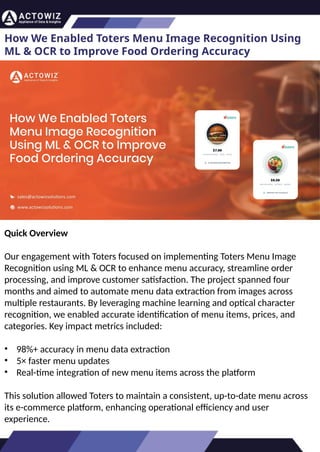
Quick Overview
Our engagement with Toters focused on implementing Toters Menu Image
Recognition using ML & OCR to enhance menu accuracy, streamline order
processing, and improve customer satisfaction. The project spanned four
months and aimed to automate menu data extraction from images across
multiple restaurants. By leveraging machine learning and optical character
recognition, we enabled accurate identification of menu items, prices, and
categories. Key impact metrics included:
• 98%+ accuracy in menu data extraction
• 5× faster menu updates
• Real-time integration of new menu items across the platform
This solution allowed Toters to maintain a consistent, up-to-date menu across
its e-commerce platform, enhancing operational efficiency and user
experience.
How We Enabled Toters Menu Image Recognition Using
ML & OCR to Improve Food Ordering Accuracy
2.
How to EffectivelyUse Competitor Price
Trackers: Operational Guidance and Benefits
Introductio
n
In the dynamic landscape of eCommerce, pricing strategy stands paramount, especially for digital
storefronts. Modern consumers are discerning, often prioritizing price comparison as a pivotal step before
purchasing. The allure of securing the best deals and most competitive prices drives this behavior.
Consequently, a significant portion of online shoppers actively engage in price monitoring across various
platforms. Recognizing this trend, online retailers must adeptly employ competitor price trackers to stay
ahead.
By leveraging retail data scraping techniques, businesses can collect comprehensive retail data, offering
insights into the broader market's pricing landscape. Such price intelligence empowers retailers to craft a
robust pricing strategy, bolstering sales, enhancing profit margins, and fostering customer loyalty.
Moreover, a data-driven eCommerce pricing approach ensures competitiveness, with dynamic pricing
becoming increasingly prevalent.
In essence, utilizing a competent competitor price tracker facilitates effective pricing optimization and
solidifies a retailer's position in the fiercely competitive eCommerce arena.
How to Use Zomato API to Scrape Restaurant
Data – A Detailed Guide
In the dynamic world of digital gastronomy, where culinary delights and dining experiences are
increasingly explored and celebrated online, the demand for up-to-date restaurant data is
insatiable. As food enthusiasts and businesses seek the latest insights into menus, reviews, and
more, the Zomato API emerges as a powerful tool for scraping this invaluable information.
Introduction
Our comprehensive guide delves into the intricate art of utilizing the Zomato API to scrape
restaurant data. Whether you're a restaurateur striving to understand your competitors, a food
blogger searching for fresh content, or a data enthusiast eager to explore culinary trends, this
guide will serve as your compass in the world of data extraction.
We will navigate through the intricacies of Zomato Scraper, uncovering its capabilities to provide
you with rich, real-time restaurant data. From scraping restaurant details to accessing customer
reviews, our detailed guide ensures that you harness the full potential of this resource.
What are Datasets? - A Comprehensive Guide
This blog will provide a comprehensive overview of datasets, including their definition, different
types of datasets, and strategies for maximizing the value of data.
What is a Dataset?
Extracting Information from TripAdvisor: A
Guide to Scraping Data from Hotels and
Restaurants
Introduction
Leveraging the appropriate API makes scraping TripAdvisor on a large scale a straightforward task.
You don't need to possess advanced computer skills to achieve this. Our comprehensive, step-by-
step guide is designed to walk you through extracting data from TripAdvisor using a user-friendly
web scraping tool.
TripAdvisor stands out as a powerhouse with an extensive database comprising over 8 million
locations, 1 billion reviews, and support for 29 languages. As of 2022, when the cumulative reviews
surpassed the one billion mark, it became evident that TripAdvisor's meticulous gaze would soon
cover every restaurant, hotel, vacation rental, or attraction listing.
Amidst TripAdvisor's vast sea of information lies a treasure trove awaiting extraction, analysis, and
innovative presentation. For those in the tourism, hospitality, or travel sectors, harnessing
TripAdvisor data proves invaluable for monitoring competitors and supporting strategic business
decisions. The TripAdvisor Scraper facilitates seamless and rapid web scraping, offering the most
straightforward route to consistently obtaining data at scale. This article delves into the myriad
benefits of scraping TripAdvisor, shedding light on how this process can be initiated, including
exploring the initial steps involving API utilization. Dive into the realm of data-driven insights with
TripAdvisor scraping.
Unlocking the Potential: The
Advantages of Scraping TripAdvisor
Data
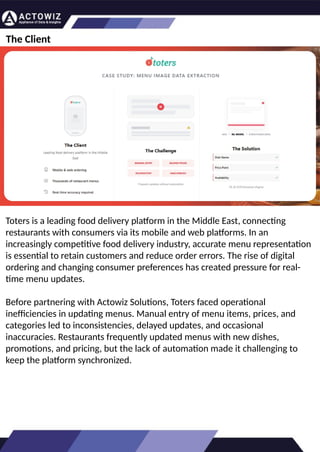
The Client
Toters is a leading food delivery platform in the Middle East, connecting
restaurants with consumers via its mobile and web platforms. In an
increasingly competitive food delivery industry, accurate menu representation
is essential to retain customers and reduce order errors. The rise of digital
ordering and changing consumer preferences has created pressure for real-
time menu updates.
Before partnering with Actowiz Solutions, Toters faced operational
inefficiencies in updating menus. Manual entry of menu items, prices, and
categories led to inconsistencies, delayed updates, and occasional
inaccuracies. Restaurants frequently updated menus with new dishes,
promotions, and pricing, but the lack of automation made it challenging to
keep the platform synchronized.
3.
How to EffectivelyUse Competitor Price
Trackers: Operational Guidance and Benefits
Introductio
n
In the dynamic landscape of eCommerce, pricing strategy stands paramount, especially for digital
storefronts. Modern consumers are discerning, often prioritizing price comparison as a pivotal step before
purchasing. The allure of securing the best deals and most competitive prices drives this behavior.
Consequently, a significant portion of online shoppers actively engage in price monitoring across various
platforms. Recognizing this trend, online retailers must adeptly employ competitor price trackers to stay
ahead.
By leveraging retail data scraping techniques, businesses can collect comprehensive retail data, offering
insights into the broader market's pricing landscape. Such price intelligence empowers retailers to craft a
robust pricing strategy, bolstering sales, enhancing profit margins, and fostering customer loyalty.
Moreover, a data-driven eCommerce pricing approach ensures competitiveness, with dynamic pricing
becoming increasingly prevalent.
In essence, utilizing a competent competitor price tracker facilitates effective pricing optimization and
solidifies a retailer's position in the fiercely competitive eCommerce arena.
How to Use Zomato API to Scrape Restaurant
Data – A Detailed Guide
In the dynamic world of digital gastronomy, where culinary delights and dining experiences are
increasingly explored and celebrated online, the demand for up-to-date restaurant data is
insatiable. As food enthusiasts and businesses seek the latest insights into menus, reviews, and
more, the Zomato API emerges as a powerful tool for scraping this invaluable information.
Introduction
Our comprehensive guide delves into the intricate art of utilizing the Zomato API to scrape
restaurant data. Whether you're a restaurateur striving to understand your competitors, a food
blogger searching for fresh content, or a data enthusiast eager to explore culinary trends, this
guide will serve as your compass in the world of data extraction.
We will navigate through the intricacies of Zomato Scraper, uncovering its capabilities to provide
you with rich, real-time restaurant data. From scraping restaurant details to accessing customer
reviews, our detailed guide ensures that you harness the full potential of this resource.
What are Datasets? - A Comprehensive Guide
This blog will provide a comprehensive overview of datasets, including their definition, different
types of datasets, and strategies for maximizing the value of data.
What is a Dataset?
Extracting Information from TripAdvisor: A
Guide to Scraping Data from Hotels and
Restaurants
Introduction
Leveraging the appropriate API makes scraping TripAdvisor on a large scale a straightforward task.
You don't need to possess advanced computer skills to achieve this. Our comprehensive, step-by-
step guide is designed to walk you through extracting data from TripAdvisor using a user-friendly
web scraping tool.
TripAdvisor stands out as a powerhouse with an extensive database comprising over 8 million
locations, 1 billion reviews, and support for 29 languages. As of 2022, when the cumulative reviews
surpassed the one billion mark, it became evident that TripAdvisor's meticulous gaze would soon
cover every restaurant, hotel, vacation rental, or attraction listing.
Amidst TripAdvisor's vast sea of information lies a treasure trove awaiting extraction, analysis, and
innovative presentation. For those in the tourism, hospitality, or travel sectors, harnessing
TripAdvisor data proves invaluable for monitoring competitors and supporting strategic business
decisions. The TripAdvisor Scraper facilitates seamless and rapid web scraping, offering the most
straightforward route to consistently obtaining data at scale. This article delves into the myriad
benefits of scraping TripAdvisor, shedding light on how this process can be initiated, including
exploring the initial steps involving API utilization. Dive into the realm of data-driven insights with
TripAdvisor scraping.
Unlocking the Potential: The
Advantages of Scraping TripAdvisor
Data
Through Menu Image Data Extract for Toters, our team implemented a
solution to automatically capture menu information from restaurant images.
This approach eliminated manual errors, reduced the time required for
updates, and ensured that customers had access to accurate menu
information in real time. It set the foundation for smarter analytics, faster
operational workflows, and improved customer satisfaction across the Toters
platform.
Goals & Objectives
Goals
The business goal was to enhance order accuracy, streamline menu updates,
and scale menu management efficiently. By implementing Menu image
processing for Toters using AI, the client aimed to reduce operational
bottlenecks and improve customer experience.
Objectives
• Automate extraction of menu items, prices, and categories from images
• Integrate data into Toters’ backend systems for real-time updates
• Standardize menu structure across multiple restaurants
• Enable analytics on menu trends and popular dishes
KPIs
• Menu extraction accuracy: 98%+
• Time to update new menu items: reduced from 3 days to 6 hours
• Number of restaurants integrated per week: 50+
• Reduction in customer complaints due to incorrect orders: 85%
Our approach ensured a measurable improvement in speed, accuracy, and
operational efficiency, aligning technical objectives with Toters’ business goals.
4.
How to EffectivelyUse Competitor Price
Trackers: Operational Guidance and Benefits
Introductio
n
In the dynamic landscape of eCommerce, pricing strategy stands paramount, especially for digital
storefronts. Modern consumers are discerning, often prioritizing price comparison as a pivotal step before
purchasing. The allure of securing the best deals and most competitive prices drives this behavior.
Consequently, a significant portion of online shoppers actively engage in price monitoring across various
platforms. Recognizing this trend, online retailers must adeptly employ competitor price trackers to stay
ahead.
By leveraging retail data scraping techniques, businesses can collect comprehensive retail data, offering
insights into the broader market's pricing landscape. Such price intelligence empowers retailers to craft a
robust pricing strategy, bolstering sales, enhancing profit margins, and fostering customer loyalty.
Moreover, a data-driven eCommerce pricing approach ensures competitiveness, with dynamic pricing
becoming increasingly prevalent.
In essence, utilizing a competent competitor price tracker facilitates effective pricing optimization and
solidifies a retailer's position in the fiercely competitive eCommerce arena.
How to Use Zomato API to Scrape Restaurant
Data – A Detailed Guide
In the dynamic world of digital gastronomy, where culinary delights and dining experiences are
increasingly explored and celebrated online, the demand for up-to-date restaurant data is
insatiable. As food enthusiasts and businesses seek the latest insights into menus, reviews, and
more, the Zomato API emerges as a powerful tool for scraping this invaluable information.
Introduction
Our comprehensive guide delves into the intricate art of utilizing the Zomato API to scrape
restaurant data. Whether you're a restaurateur striving to understand your competitors, a food
blogger searching for fresh content, or a data enthusiast eager to explore culinary trends, this
guide will serve as your compass in the world of data extraction.
We will navigate through the intricacies of Zomato Scraper, uncovering its capabilities to provide
you with rich, real-time restaurant data. From scraping restaurant details to accessing customer
reviews, our detailed guide ensures that you harness the full potential of this resource.
What are Datasets? - A Comprehensive Guide
This blog will provide a comprehensive overview of datasets, including their definition, different
types of datasets, and strategies for maximizing the value of data.
What is a Dataset?
Extracting Information from TripAdvisor: A
Guide to Scraping Data from Hotels and
Restaurants
Introduction
Leveraging the appropriate API makes scraping TripAdvisor on a large scale a straightforward task.
You don't need to possess advanced computer skills to achieve this. Our comprehensive, step-by-
step guide is designed to walk you through extracting data from TripAdvisor using a user-friendly
web scraping tool.
TripAdvisor stands out as a powerhouse with an extensive database comprising over 8 million
locations, 1 billion reviews, and support for 29 languages. As of 2022, when the cumulative reviews
surpassed the one billion mark, it became evident that TripAdvisor's meticulous gaze would soon
cover every restaurant, hotel, vacation rental, or attraction listing.
Amidst TripAdvisor's vast sea of information lies a treasure trove awaiting extraction, analysis, and
innovative presentation. For those in the tourism, hospitality, or travel sectors, harnessing
TripAdvisor data proves invaluable for monitoring competitors and supporting strategic business
decisions. The TripAdvisor Scraper facilitates seamless and rapid web scraping, offering the most
straightforward route to consistently obtaining data at scale. This article delves into the myriad
benefits of scraping TripAdvisor, shedding light on how this process can be initiated, including
exploring the initial steps involving API utilization. Dive into the realm of data-driven insights with
TripAdvisor scraping.
Unlocking the Potential: The
Advantages of Scraping TripAdvisor
Data
The Core Challenge
Prior to our solution, Toters struggled with several operational challenges.
Manual menu updates caused OCR-powered menu Data extraction for Toters
to be slow and error-prone. Restaurants submitted menus in various formats
—images, PDFs, or scanned files—making standardization difficult.
High variability in fonts, languages, and menu layouts led to inconsistent data
extraction. Errors in prices, dish names, or categories directly impacted
customer satisfaction and generated complaints. Frequent menu updates
meant manual processes could not keep pace with the speed of the food
delivery market.
Additionally, there was no centralized system for tracking menu changes or
performing analytics on menu performance. Toters needed a solution that
could extract structured data automatically, normalize it, and integrate it into
their platform efficiently.
The lack of automation and inconsistent data impacted operational speed,
order accuracy, and analytics capabilities. Our goal was to resolve these pain
points with a robust, AI-driven solution that ensured reliable OCR-powered
menu Data extraction for Toters, enabling real-time updates and accurate
menu representation across all restaurants.
Our Solution
We implemented a ML-based menu structure recognition solution in multiple
phases to address Toters’ challenges.
Phase 1 – Requirement Analysis & Data Collection:
We analyzed restaurant menus to understand variability in layout, fonts, and
languages. This phase helped define the scope of Toters Menu Image
Recognition using ML & OCR.
5.
How to EffectivelyUse Competitor Price
Trackers: Operational Guidance and Benefits
Introductio
n
In the dynamic landscape of eCommerce, pricing strategy stands paramount, especially for digital
storefronts. Modern consumers are discerning, often prioritizing price comparison as a pivotal step before
purchasing. The allure of securing the best deals and most competitive prices drives this behavior.
Consequently, a significant portion of online shoppers actively engage in price monitoring across various
platforms. Recognizing this trend, online retailers must adeptly employ competitor price trackers to stay
ahead.
By leveraging retail data scraping techniques, businesses can collect comprehensive retail data, offering
insights into the broader market's pricing landscape. Such price intelligence empowers retailers to craft a
robust pricing strategy, bolstering sales, enhancing profit margins, and fostering customer loyalty.
Moreover, a data-driven eCommerce pricing approach ensures competitiveness, with dynamic pricing
becoming increasingly prevalent.
In essence, utilizing a competent competitor price tracker facilitates effective pricing optimization and
solidifies a retailer's position in the fiercely competitive eCommerce arena.
How to Use Zomato API to Scrape Restaurant
Data – A Detailed Guide
In the dynamic world of digital gastronomy, where culinary delights and dining experiences are
increasingly explored and celebrated online, the demand for up-to-date restaurant data is
insatiable. As food enthusiasts and businesses seek the latest insights into menus, reviews, and
more, the Zomato API emerges as a powerful tool for scraping this invaluable information.
Introduction
Our comprehensive guide delves into the intricate art of utilizing the Zomato API to scrape
restaurant data. Whether you're a restaurateur striving to understand your competitors, a food
blogger searching for fresh content, or a data enthusiast eager to explore culinary trends, this
guide will serve as your compass in the world of data extraction.
We will navigate through the intricacies of Zomato Scraper, uncovering its capabilities to provide
you with rich, real-time restaurant data. From scraping restaurant details to accessing customer
reviews, our detailed guide ensures that you harness the full potential of this resource.
What are Datasets? - A Comprehensive Guide
This blog will provide a comprehensive overview of datasets, including their definition, different
types of datasets, and strategies for maximizing the value of data.
What is a Dataset?
Extracting Information from TripAdvisor: A
Guide to Scraping Data from Hotels and
Restaurants
Introduction
Leveraging the appropriate API makes scraping TripAdvisor on a large scale a straightforward task.
You don't need to possess advanced computer skills to achieve this. Our comprehensive, step-by-
step guide is designed to walk you through extracting data from TripAdvisor using a user-friendly
web scraping tool.
TripAdvisor stands out as a powerhouse with an extensive database comprising over 8 million
locations, 1 billion reviews, and support for 29 languages. As of 2022, when the cumulative reviews
surpassed the one billion mark, it became evident that TripAdvisor's meticulous gaze would soon
cover every restaurant, hotel, vacation rental, or attraction listing.
Amidst TripAdvisor's vast sea of information lies a treasure trove awaiting extraction, analysis, and
innovative presentation. For those in the tourism, hospitality, or travel sectors, harnessing
TripAdvisor data proves invaluable for monitoring competitors and supporting strategic business
decisions. The TripAdvisor Scraper facilitates seamless and rapid web scraping, offering the most
straightforward route to consistently obtaining data at scale. This article delves into the myriad
benefits of scraping TripAdvisor, shedding light on how this process can be initiated, including
exploring the initial steps involving API utilization. Dive into the realm of data-driven insights with
TripAdvisor scraping.
Unlocking the Potential: The
Advantages of Scraping TripAdvisor
Data
Phase 2 – ML Model Development:
Custom machine learning models were trained to recognize text, dish
categories, prices, and special instructions from menu images. OCR was
enhanced with deep learning techniques to handle diverse fonts and layouts.
Phase 3 – Data Normalization:
Extracted data was structured into a standardized format for integration into
Toters’ backend. Dish names, prices, and categories were cleaned and
normalized to ensure consistency across restaurants.
Phase 4 – Real-Time Integration:
Automated pipelines pushed processed data into Toters’ platform, enabling
real-time menu updates. Alerts were configured for new dishes, promotions,
and price changes.
Phase 5 – Analytics & Reporting:
The extracted data powered analytics dashboards, highlighting popular dishes,
trending categories, and menu performance metrics.
Phase 6 – Continuous Improvement:
Models were continuously retrained using new menu images, improving
accuracy over time. Feedback loops ensured that anomalies were quickly
corrected.
By implementing ML-based menu structure recognition, we enabled Toters to
reduce manual effort, maintain accurate menus, and enhance operational
speed, delivering measurable improvements in order accuracy and customer
satisfaction.
6.
How to EffectivelyUse Competitor Price
Trackers: Operational Guidance and Benefits
Introductio
n
In the dynamic landscape of eCommerce, pricing strategy stands paramount, especially for digital
storefronts. Modern consumers are discerning, often prioritizing price comparison as a pivotal step before
purchasing. The allure of securing the best deals and most competitive prices drives this behavior.
Consequently, a significant portion of online shoppers actively engage in price monitoring across various
platforms. Recognizing this trend, online retailers must adeptly employ competitor price trackers to stay
ahead.
By leveraging retail data scraping techniques, businesses can collect comprehensive retail data, offering
insights into the broader market's pricing landscape. Such price intelligence empowers retailers to craft a
robust pricing strategy, bolstering sales, enhancing profit margins, and fostering customer loyalty.
Moreover, a data-driven eCommerce pricing approach ensures competitiveness, with dynamic pricing
becoming increasingly prevalent.
In essence, utilizing a competent competitor price tracker facilitates effective pricing optimization and
solidifies a retailer's position in the fiercely competitive eCommerce arena.
How to Use Zomato API to Scrape Restaurant
Data – A Detailed Guide
In the dynamic world of digital gastronomy, where culinary delights and dining experiences are
increasingly explored and celebrated online, the demand for up-to-date restaurant data is
insatiable. As food enthusiasts and businesses seek the latest insights into menus, reviews, and
more, the Zomato API emerges as a powerful tool for scraping this invaluable information.
Introduction
Our comprehensive guide delves into the intricate art of utilizing the Zomato API to scrape
restaurant data. Whether you're a restaurateur striving to understand your competitors, a food
blogger searching for fresh content, or a data enthusiast eager to explore culinary trends, this
guide will serve as your compass in the world of data extraction.
We will navigate through the intricacies of Zomato Scraper, uncovering its capabilities to provide
you with rich, real-time restaurant data. From scraping restaurant details to accessing customer
reviews, our detailed guide ensures that you harness the full potential of this resource.
What are Datasets? - A Comprehensive Guide
This blog will provide a comprehensive overview of datasets, including their definition, different
types of datasets, and strategies for maximizing the value of data.
What is a Dataset?
Extracting Information from TripAdvisor: A
Guide to Scraping Data from Hotels and
Restaurants
Introduction
Leveraging the appropriate API makes scraping TripAdvisor on a large scale a straightforward task.
You don't need to possess advanced computer skills to achieve this. Our comprehensive, step-by-
step guide is designed to walk you through extracting data from TripAdvisor using a user-friendly
web scraping tool.
TripAdvisor stands out as a powerhouse with an extensive database comprising over 8 million
locations, 1 billion reviews, and support for 29 languages. As of 2022, when the cumulative reviews
surpassed the one billion mark, it became evident that TripAdvisor's meticulous gaze would soon
cover every restaurant, hotel, vacation rental, or attraction listing.
Amidst TripAdvisor's vast sea of information lies a treasure trove awaiting extraction, analysis, and
innovative presentation. For those in the tourism, hospitality, or travel sectors, harnessing
TripAdvisor data proves invaluable for monitoring competitors and supporting strategic business
decisions. The TripAdvisor Scraper facilitates seamless and rapid web scraping, offering the most
straightforward route to consistently obtaining data at scale. This article delves into the myriad
benefits of scraping TripAdvisor, shedding light on how this process can be initiated, including
exploring the initial steps involving API utilization. Dive into the realm of data-driven insights with
TripAdvisor scraping.
Unlocking the Potential: The
Advantages of Scraping TripAdvisor
Data
Results & Key Metrics
Key Performance Metrics
• Menu extraction accuracy: 98.7%
• Average time to update menus: reduced from 72 hours to 6 hours
• Number of restaurants automated per week: 50+
• Reduction in order errors: 85%
• Real-time menu updates delivered for: 1,000+ dishes
Results Narrative
The implementation allowed Toters to Extract Toters Food Delivery Data
efficiently from images, PDFs, and scanned menus. Real-time integration
ensured that customers always saw accurate menus, reducing complaints and
increasing satisfaction. Analytics on dish popularity and pricing trends
provided actionable insights for restaurants and the platform. The automated
process scaled seamlessly across hundreds of restaurants, enabling rapid
onboarding and continuous menu updates. Overall, Toters achieved faster
operational workflows, improved accuracy, and better data-driven decision-
making, enhancing its competitive edge in the food delivery market.
What Made Product Data Scrape Different?
Our solution leveraged Scrape Restaurant Menu Data, Toters Menu Image
Recognition using ML & OCR with proprietary machine learning frameworks
and automated pipelines. Unlike traditional manual processes, our approach
handled thousands of menu images daily, normalized diverse layouts, and
integrated data into backend systems in real time. Smart automation reduced
human intervention, ensured accuracy, and scaled easily across hundreds of
restaurants. The combination of ML-based recognition, OCR enhancements,
and continuous retraining made the solution innovative, enabling Toters to
maintain accurate menus, improve order accuracy, and gain actionable
insights for data-driven operational and strategic decisions.
7.
How to EffectivelyUse Competitor Price
Trackers: Operational Guidance and Benefits
Introductio
n
In the dynamic landscape of eCommerce, pricing strategy stands paramount, especially for digital
storefronts. Modern consumers are discerning, often prioritizing price comparison as a pivotal step before
purchasing. The allure of securing the best deals and most competitive prices drives this behavior.
Consequently, a significant portion of online shoppers actively engage in price monitoring across various
platforms. Recognizing this trend, online retailers must adeptly employ competitor price trackers to stay
ahead.
By leveraging retail data scraping techniques, businesses can collect comprehensive retail data, offering
insights into the broader market's pricing landscape. Such price intelligence empowers retailers to craft a
robust pricing strategy, bolstering sales, enhancing profit margins, and fostering customer loyalty.
Moreover, a data-driven eCommerce pricing approach ensures competitiveness, with dynamic pricing
becoming increasingly prevalent.
In essence, utilizing a competent competitor price tracker facilitates effective pricing optimization and
solidifies a retailer's position in the fiercely competitive eCommerce arena.
How to Use Zomato API to Scrape Restaurant
Data – A Detailed Guide
In the dynamic world of digital gastronomy, where culinary delights and dining experiences are
increasingly explored and celebrated online, the demand for up-to-date restaurant data is
insatiable. As food enthusiasts and businesses seek the latest insights into menus, reviews, and
more, the Zomato API emerges as a powerful tool for scraping this invaluable information.
Introduction
Our comprehensive guide delves into the intricate art of utilizing the Zomato API to scrape
restaurant data. Whether you're a restaurateur striving to understand your competitors, a food
blogger searching for fresh content, or a data enthusiast eager to explore culinary trends, this
guide will serve as your compass in the world of data extraction.
We will navigate through the intricacies of Zomato Scraper, uncovering its capabilities to provide
you with rich, real-time restaurant data. From scraping restaurant details to accessing customer
reviews, our detailed guide ensures that you harness the full potential of this resource.
What are Datasets? - A Comprehensive Guide
This blog will provide a comprehensive overview of datasets, including their definition, different
types of datasets, and strategies for maximizing the value of data.
What is a Dataset?
Extracting Information from TripAdvisor: A
Guide to Scraping Data from Hotels and
Restaurants
Introduction
Leveraging the appropriate API makes scraping TripAdvisor on a large scale a straightforward task.
You don't need to possess advanced computer skills to achieve this. Our comprehensive, step-by-
step guide is designed to walk you through extracting data from TripAdvisor using a user-friendly
web scraping tool.
TripAdvisor stands out as a powerhouse with an extensive database comprising over 8 million
locations, 1 billion reviews, and support for 29 languages. As of 2022, when the cumulative reviews
surpassed the one billion mark, it became evident that TripAdvisor's meticulous gaze would soon
cover every restaurant, hotel, vacation rental, or attraction listing.
Amidst TripAdvisor's vast sea of information lies a treasure trove awaiting extraction, analysis, and
innovative presentation. For those in the tourism, hospitality, or travel sectors, harnessing
TripAdvisor data proves invaluable for monitoring competitors and supporting strategic business
decisions. The TripAdvisor Scraper facilitates seamless and rapid web scraping, offering the most
straightforward route to consistently obtaining data at scale. This article delves into the myriad
benefits of scraping TripAdvisor, shedding light on how this process can be initiated, including
exploring the initial steps involving API utilization. Dive into the realm of data-driven insights with
TripAdvisor scraping.
Unlocking the Potential: The
Advantages of Scraping TripAdvisor
Data
Client Feedback
"Working with Actowiz Solutions on Toters Menu Image Recognition using ML
& OCR has transformed how we manage menus. The automated system
extracts menu items, prices, and categories accurately, saving us hours of
manual work each week. Our platform now updates menus in real time,
reducing errors and improving customer satisfaction. The analytics dashboards
provide insights into popular dishes and trends, helping us make informed
decisions. The team’s expertise in AI, OCR, and automation was evident
throughout the project. This solution has given Toters a significant operational
and competitive advantage in the food delivery market."
— Head of Technology, Toters
Conclusion
Implementing Web scraping API, Custom Datasets, and instant data scraper
technologies enabled Toters to automate menu data extraction, improve
accuracy, and streamline operations. By leveraging ML and OCR, the platform
now provides real-time updates, reducing errors and enhancing customer
experience. Restaurants benefit from accurate representation of menu items,
prices, and categories, while Toters gains actionable analytics on trends and
dish popularity. This project demonstrates the power of AI-driven data
solutions in the food delivery sector. Actowiz Solutions continues to support
Toters’ innovation journey, ensuring scalable, accurate, and efficient menu
management across the platform.
8.
How to EffectivelyUse Competitor Price
Trackers: Operational Guidance and Benefits
Introductio
n
In the dynamic landscape of eCommerce, pricing strategy stands paramount, especially for digital
storefronts. Modern consumers are discerning, often prioritizing price comparison as a pivotal step before
purchasing. The allure of securing the best deals and most competitive prices drives this behavior.
Consequently, a significant portion of online shoppers actively engage in price monitoring across various
platforms. Recognizing this trend, online retailers must adeptly employ competitor price trackers to stay
ahead.
By leveraging retail data scraping techniques, businesses can collect comprehensive retail data, offering
insights into the broader market's pricing landscape. Such price intelligence empowers retailers to craft a
robust pricing strategy, bolstering sales, enhancing profit margins, and fostering customer loyalty.
Moreover, a data-driven eCommerce pricing approach ensures competitiveness, with dynamic pricing
becoming increasingly prevalent.
In essence, utilizing a competent competitor price tracker facilitates effective pricing optimization and
solidifies a retailer's position in the fiercely competitive eCommerce arena.
How to Use Zomato API to Scrape Restaurant
Data – A Detailed Guide
In the dynamic world of digital gastronomy, where culinary delights and dining experiences are
increasingly explored and celebrated online, the demand for up-to-date restaurant data is
insatiable. As food enthusiasts and businesses seek the latest insights into menus, reviews, and
more, the Zomato API emerges as a powerful tool for scraping this invaluable information.
Introduction
Our comprehensive guide delves into the intricate art of utilizing the Zomato API to scrape
restaurant data. Whether you're a restaurateur striving to understand your competitors, a food
blogger searching for fresh content, or a data enthusiast eager to explore culinary trends, this
guide will serve as your compass in the world of data extraction.
We will navigate through the intricacies of Zomato Scraper, uncovering its capabilities to provide
you with rich, real-time restaurant data. From scraping restaurant details to accessing customer
reviews, our detailed guide ensures that you harness the full potential of this resource.
What are Datasets? - A Comprehensive Guide
This blog will provide a comprehensive overview of datasets, including their definition, different
types of datasets, and strategies for maximizing the value of data.
What is a Dataset?
Extracting Information from TripAdvisor: A
Guide to Scraping Data from Hotels and
Restaurants
Introduction
Leveraging the appropriate API makes scraping TripAdvisor on a large scale a straightforward task.
You don't need to possess advanced computer skills to achieve this. Our comprehensive, step-by-
step guide is designed to walk you through extracting data from TripAdvisor using a user-friendly
web scraping tool.
TripAdvisor stands out as a powerhouse with an extensive database comprising over 8 million
locations, 1 billion reviews, and support for 29 languages. As of 2022, when the cumulative reviews
surpassed the one billion mark, it became evident that TripAdvisor's meticulous gaze would soon
cover every restaurant, hotel, vacation rental, or attraction listing.
Amidst TripAdvisor's vast sea of information lies a treasure trove awaiting extraction, analysis, and
innovative presentation. For those in the tourism, hospitality, or travel sectors, harnessing
TripAdvisor data proves invaluable for monitoring competitors and supporting strategic business
decisions. The TripAdvisor Scraper facilitates seamless and rapid web scraping, offering the most
straightforward route to consistently obtaining data at scale. This article delves into the myriad
benefits of scraping TripAdvisor, shedding light on how this process can be initiated, including
exploring the initial steps involving API utilization. Dive into the realm of data-driven insights with
TripAdvisor scraping.
Unlocking the Potential: The
Advantages of Scraping TripAdvisor
Data
FAQs
Q1: How does the menu image recognition work?
The system uses ML and OCR to extract text, prices, and categories
from restaurant menu images, PDFs, or scans, then normalizes the
data for integration.
Q2: Can it handle multiple languages and fonts?
Yes, models are trained on diverse layouts, languages, and font styles
to ensure high accuracy across restaurants.
Q3: How fast is menu updating?
Menus are updated in real time, reducing previous delays from 72
hours to under 6 hours.
Q4: Is manual intervention required?
Minimal intervention is needed; the automated pipeline handles
extraction, normalization, and integration efficiently.
Q5: Can this be extended to other food delivery platforms?
Yes, the framework is scalable and can integrate other restaurant
platforms, enabling wider Toters Menu Image Recognition using ML &
OCR coverage.
9.
How to EffectivelyUse Competitor Price
Trackers: Operational Guidance and Benefits
Introductio
n
In the dynamic landscape of eCommerce, pricing strategy stands paramount, especially for digital
storefronts. Modern consumers are discerning, often prioritizing price comparison as a pivotal step before
purchasing. The allure of securing the best deals and most competitive prices drives this behavior.
Consequently, a significant portion of online shoppers actively engage in price monitoring across various
platforms. Recognizing this trend, online retailers must adeptly employ competitor price trackers to stay
ahead.
By leveraging retail data scraping techniques, businesses can collect comprehensive retail data, offering
insights into the broader market's pricing landscape. Such price intelligence empowers retailers to craft a
robust pricing strategy, bolstering sales, enhancing profit margins, and fostering customer loyalty.
Moreover, a data-driven eCommerce pricing approach ensures competitiveness, with dynamic pricing
becoming increasingly prevalent.
In essence, utilizing a competent competitor price tracker facilitates effective pricing optimization and
solidifies a retailer's position in the fiercely competitive eCommerce arena.
How to Use Zomato API to Scrape Restaurant
Data – A Detailed Guide
In the dynamic world of digital gastronomy, where culinary delights and dining experiences are
increasingly explored and celebrated online, the demand for up-to-date restaurant data is
insatiable. As food enthusiasts and businesses seek the latest insights into menus, reviews, and
more, the Zomato API emerges as a powerful tool for scraping this invaluable information.
Introduction
Our comprehensive guide delves into the intricate art of utilizing the Zomato API to scrape
restaurant data. Whether you're a restaurateur striving to understand your competitors, a food
blogger searching for fresh content, or a data enthusiast eager to explore culinary trends, this
guide will serve as your compass in the world of data extraction.
We will navigate through the intricacies of Zomato Scraper, uncovering its capabilities to provide
you with rich, real-time restaurant data. From scraping restaurant details to accessing customer
reviews, our detailed guide ensures that you harness the full potential of this resource.
What are Datasets? - A Comprehensive Guide
This blog will provide a comprehensive overview of datasets, including their definition, different
types of datasets, and strategies for maximizing the value of data.
What is a Dataset?


![5G Explained! A High Level Overview [Introduction]](https://cdn.slidesharecdn.com/ss_thumbnails/5gexplainedahighleveloverview-260119165306-cc137a3e-thumbnail.jpg?width=640&height=640&fit=bounds)


