TSLB3483 STORYTELLING IN THE
ESL PRIMARY CLASSROOM
TYPES, FEATURES AND BENEFITS OF STORYTELLING
Learning Outcomes Success Criteria
At the end of the lesson, you will be able to:
• identify types of stories
• compare the differences between serious
storytelling and entertaining storytelling
I can…
• List the key features of oral, visual, written
and digital stories
• Distinguish the difference between
storytelling and entertaining storytelling
STORYTELLING
Storytelling is an ancient art, used to better understand the world we inhabit. Ancient
civilizations would seek out storytellers, works of visual art, and written fables to
witness tales of hard times and happy endings.
STORYTELLERS
• Professional storytellers were often people who traveled from town to
town. Because they were very good at telling stories, they could receive
of value in exchange for the stories they would tell.
• Every storyteller was different. Some storytellers could also sing or play a
recite poetry. Each one had their own style.
https://donwinn.blog/2014/02/20/medieval-storytelling-the-spoken-word/
STORYTELLING
Storytelling is ………………… and is as …………………. as humankind. Before there
was writing, there was storytelling. It occurs in every ……………….. and from
every……………... . It exists (and existed) to ……………., to ………………, and to
promulgate ……………… traditions and ……………… .
Storytelling is universal and is as ancient as humankind. Before there
was writing, there was storytelling. It occurs in every culture and
from every age. It exists (and existed) to entertain, to inform, and to
promulgate cultural traditions and values.
TYPES OF
STORIES
• Oral
• Visual
• Written
• Digital
ORAL STORYTELLING
Oral storytelling is telling a story through voice and gestures.
The oral tradition can take many forms, including epic
poems, chants, rhymes, songs, and more. Not all of these
stories are historically accurate or even true. Truth is less
important than providing cultural cohesion. It can
encompass myths, legends, fables, religion, prayers,
proverbs, and instructions.
https://education.nationalgeographic.org/resource/storytelling-and-cultural-traditions
ORAL STORYTELLING
Sun and the Wind - An Aesop's Fable
https://www.heatherforest.com/attachments/Sun_and_Wind.mp3
Stone Soup- A European Folktale for Young Listeners
• https://www.heatherforest.com/attachments/Stone_Soup_small_file.mp3
(https://www.heatherforest.com/)
ORAL STORYTELLING
Hikaye - Palestine
https://ich.unesco.org/en/RL/palestinian-hikaye-00124
Narrative Songs: Cats in a Cradle Harry Chapin
https://youtu.be/XIIxlgESRWk
Narrative Poem: The Raven Edgar Allan Poe
The Raven by Edgar Allan Poe | Poetry Foundation
Narrative Limericks
https://www.rd.com/list/funny-limericks/
Story Riddles
An old man wanted to leave all of his money to one of his three sons, but he didn't know which one he should give it to. He gave each of them a few
coins and told them to buy something that would be able to fill their living room. The first man bought straw, but there was not enough to fill the room.
The second bought some sticks, but they still did not fill the room. The third man bought two things that filled the room, so he obtained his father's
fortune. What were the two things that the man bought? The wise son bought a candle and a box of matches. After lighting the candle, the light filled the
entire room.
Read more: https://www.riddlesandanswers.com/v/233698/an-old-man-wanted-to-leave-all-of-his-money-to-one-of-his-three-sons-but-he-didnt-know-
which-one-h/#ixzz7bTkPJ8eu
READING
Oral traditions and expressions including language as a vehicle of the
intangible cultural heritage
https://ich.unesco.org/en/oral-traditions-and-expressions-00053
WRITTEN STORYTELLING
• As long as there have been written words, there have been written stories. As
societies developed alphabets, oral and visual forms of storytelling were
transcribed into written short stories and epics.
• A classic example: Aesop’s fables, which have their origins in the oral tradition but
were collected and transcribed centuries later.
• The invention of the printing press ushered in an era of mass communication, in
which different forms of story types—from fairy tales to newspapers to novels—
reached global audiences and altered the history of storytelling forever.
VISUAL
STORYTELLING
• Cave drawings/paintings
VISUAL
STORYTELLING
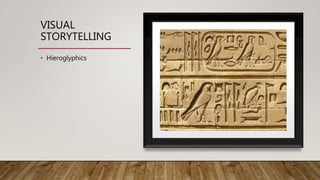
• Hieroglyphics
VISUAL
STORYTELLING
• Modern mediums of film
and television
VISUAL STORYTELLING
So, you wanna tell a “visual story.”
• Should you take a photo?
• Curate a photo gallery?
• Make a GIF?
• Edit a video? Illustrate it? Animate it? Put a map on it?
It’s hard to know when to do what!
https://training.npr.org/2015/09/23/so-you-wanna-tell-a-visual-story-where-do-you-even-begin/
VISUAL STORYTELLING
Visual storytelling is a visual narrative that is told or displayed
through the use of visual media. Visual stories may be displayed in
different visual formats, including:
• Video
• Illustration
• Photography
https://skedsocial.com/blog/visual-storytelling-examples/
VISUAL STORYTELLING
These forms of visual media are often complemented with enhanced graphics, music, and
forms of audio. Other forms of visual storytelling include:
• Bar graphs
• Column charts
• Area charts
• Short and long videos in the form of explainers or documentaries
• Instagram posts
https://skedsocial.com/blog/visual-storytelling-examples/
DIGITAL STORYTELLING
Telling stories with digital technologies. Digital stories are narratives built from
the stuff of cyberculture.
(Alexander, B. (2011). Creating Narratives with New Media: The New Digital
Storytelling. California: Praeger)
DIGITAL STORYTELLING
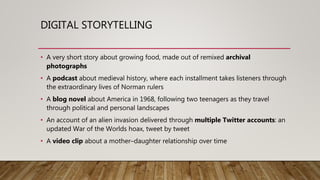
• A very short story about growing food, made out of remixed archival
photographs
• A podcast about medieval history, where each installment takes listeners through
the extraordinary lives of Norman rulers
• A blog novel about America in 1968, following two teenagers as they travel
through political and personal landscapes
• An account of an alien invasion delivered through multiple Twitter accounts: an
updated War of the Worlds hoax, tweet by tweet
• A video clip about a mother–daughter relationship over time
DIGITAL STORYTELLING
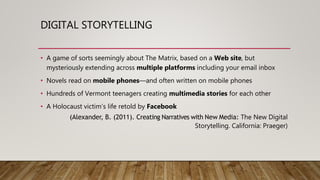
• A game of sorts seemingly about The Matrix, based on a Web site, but
mysteriously extending across multiple platforms including your email inbox
• Novels read on mobile phones—and often written on mobile phones
• Hundreds of Vermont teenagers creating multimedia stories for each other
• A Holocaust victim’s life retold by Facebook
(Alexander, B. (2011). Creating Narratives with New Media: The New Digital
Storytelling. California: Praeger)
READING
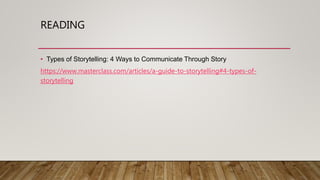
• Types of Storytelling: 4 Ways to Communicate Through Story
https://www.masterclass.com/articles/a-guide-to-storytelling#4-types-of-
storytelling
FEATURES OF
STORYTELLING
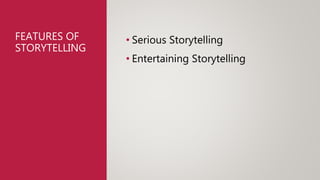
• Serious Storytelling
• Entertaining Storytelling
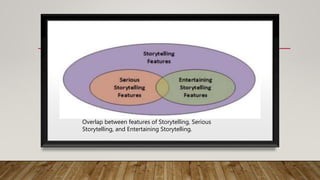
Overlap between features of Storytelling, Serious
Storytelling, and Entertaining Storytelling.
SERIOUS STORYTELLING
Storytelling outside the context of
entertainment, where the narration progresses
as a sequence of patterns impressive in
quality, relates to a serious context, and is a
matter of thoughtful process.
ENTERTAINING STORYLINES
1.Give your story strong dramatic content
2.Vary rhythm and structure in your prose
3.Create believable, memorable characters
4.Make the important story sections
effective
5.Deepen your plot with subplots
ENTERTAINING STORYLINES
6. Make every line of dialogue count
7. Add what makes a good story (immersive
setting)
8. Create conflict and tension
9. Craft beguiling beginnings
10. Deliver knockout endings
https://www.nownovel.com/blog/what-makes-a-good-story/
BENEFITS OF
STORYTELLING
• Improves the four language
skills
• Increases cultural
understanding
• Improves social skills
• Enhances communication skills
IMPROVES THE FOUR LANGUAGE SKILLS
• Storytelling as a pedagogical tool. It can help children in memorizing words
learned (Arietawati, 2011), improve their vocabulary mastery (Widiastika, 2011),
encourage children to learn English (Slattery & Willis, 2001).
• Storytelling is categorized as one of teaching techniques that enable Asian EFL
students in elementary and secondary school to enjoy reading and writing (Paul,
2003).
• Storytelling is important to improve students’ listening and writing skills
(McGrath, 2000). It means that storytelling is a part of literacy practice that may
influence students’ language proficiency.
INCREASES CULTURAL UNDERSTANDING
• Storytelling reflects a culture because stories can be reactions to culture,
sometimes critically, or by conveying a different way of thinking or being.
• Storytelling is a sophisticated form of communication; stories are often used to
convey elements of culture that cannot be described simply.
• Storytelling is used to address issues in society that cannot be discussed directly.
• Storytelling reflects the collective wisdom and formation of a culture.
IMPROVES SOCIAL SKILLS
• Storytelling builds empathy, enabling us to put ourselves in someone else’s
shoes, creating the foundation of social emotional intelligence that is so important
in early education.
• Rahill (2002) examined the effectiveness of a story based program on improving
the quality of social skills and peer interaction skills in children with emotional
disabilities, where the story has been used as a means to explore children’s social
problems in school and improving selection skills and application of strategies for
solving these problems.
ENHANCES COMMUNICATION SKILLS
• Storytelling needs no special equipment beyond the imagination and the power of
listening and speaking to create artistic images.
• As a learning tool, storytelling can encourage students to explore their expressiveness
and can heighten a student's ability to communicate thoughts and feelings in an
articulate, lucid manner.
• These activities benefit the students in not only giving them the art experience but
also in supporting daily life skills.
• As Harriot and Martin (2004) say, oral practice through storytelling increases speech
and oral communication skills related to enunciation and articulation.

TOPIC 1.pptx

  • 1.
    TSLB3483 STORYTELLING INTHE ESL PRIMARY CLASSROOM TYPES, FEATURES AND BENEFITS OF STORYTELLING
  • 2.
    Learning Outcomes SuccessCriteria At the end of the lesson, you will be able to: • identify types of stories • compare the differences between serious storytelling and entertaining storytelling I can… • List the key features of oral, visual, written and digital stories • Distinguish the difference between storytelling and entertaining storytelling
  • 3.
    STORYTELLING Storytelling is anancient art, used to better understand the world we inhabit. Ancient civilizations would seek out storytellers, works of visual art, and written fables to witness tales of hard times and happy endings.
  • 4.
    STORYTELLERS • Professional storytellerswere often people who traveled from town to town. Because they were very good at telling stories, they could receive of value in exchange for the stories they would tell. • Every storyteller was different. Some storytellers could also sing or play a recite poetry. Each one had their own style. https://donwinn.blog/2014/02/20/medieval-storytelling-the-spoken-word/
  • 5.
    STORYTELLING Storytelling is …………………and is as …………………. as humankind. Before there was writing, there was storytelling. It occurs in every ……………….. and from every……………... . It exists (and existed) to ……………., to ………………, and to promulgate ……………… traditions and ……………… . Storytelling is universal and is as ancient as humankind. Before there was writing, there was storytelling. It occurs in every culture and from every age. It exists (and existed) to entertain, to inform, and to promulgate cultural traditions and values.
  • 6.
    TYPES OF STORIES • Oral •Visual • Written • Digital
  • 7.
    ORAL STORYTELLING Oral storytellingis telling a story through voice and gestures. The oral tradition can take many forms, including epic poems, chants, rhymes, songs, and more. Not all of these stories are historically accurate or even true. Truth is less important than providing cultural cohesion. It can encompass myths, legends, fables, religion, prayers, proverbs, and instructions. https://education.nationalgeographic.org/resource/storytelling-and-cultural-traditions
  • 8.
    ORAL STORYTELLING Sun andthe Wind - An Aesop's Fable https://www.heatherforest.com/attachments/Sun_and_Wind.mp3 Stone Soup- A European Folktale for Young Listeners • https://www.heatherforest.com/attachments/Stone_Soup_small_file.mp3 (https://www.heatherforest.com/)
  • 9.
    ORAL STORYTELLING Hikaye -Palestine https://ich.unesco.org/en/RL/palestinian-hikaye-00124 Narrative Songs: Cats in a Cradle Harry Chapin https://youtu.be/XIIxlgESRWk Narrative Poem: The Raven Edgar Allan Poe The Raven by Edgar Allan Poe | Poetry Foundation Narrative Limericks https://www.rd.com/list/funny-limericks/ Story Riddles An old man wanted to leave all of his money to one of his three sons, but he didn't know which one he should give it to. He gave each of them a few coins and told them to buy something that would be able to fill their living room. The first man bought straw, but there was not enough to fill the room. The second bought some sticks, but they still did not fill the room. The third man bought two things that filled the room, so he obtained his father's fortune. What were the two things that the man bought? The wise son bought a candle and a box of matches. After lighting the candle, the light filled the entire room. Read more: https://www.riddlesandanswers.com/v/233698/an-old-man-wanted-to-leave-all-of-his-money-to-one-of-his-three-sons-but-he-didnt-know- which-one-h/#ixzz7bTkPJ8eu
  • 10.
    READING Oral traditions andexpressions including language as a vehicle of the intangible cultural heritage https://ich.unesco.org/en/oral-traditions-and-expressions-00053
  • 11.
    WRITTEN STORYTELLING • Aslong as there have been written words, there have been written stories. As societies developed alphabets, oral and visual forms of storytelling were transcribed into written short stories and epics. • A classic example: Aesop’s fables, which have their origins in the oral tradition but were collected and transcribed centuries later. • The invention of the printing press ushered in an era of mass communication, in which different forms of story types—from fairy tales to newspapers to novels— reached global audiences and altered the history of storytelling forever.
  • 12.
  • 13.
  • 14.
  • 15.
    VISUAL STORYTELLING So, youwanna tell a “visual story.” • Should you take a photo? • Curate a photo gallery? • Make a GIF? • Edit a video? Illustrate it? Animate it? Put a map on it? It’s hard to know when to do what! https://training.npr.org/2015/09/23/so-you-wanna-tell-a-visual-story-where-do-you-even-begin/
  • 16.
    VISUAL STORYTELLING Visual storytellingis a visual narrative that is told or displayed through the use of visual media. Visual stories may be displayed in different visual formats, including: • Video • Illustration • Photography https://skedsocial.com/blog/visual-storytelling-examples/
  • 17.
    VISUAL STORYTELLING These formsof visual media are often complemented with enhanced graphics, music, and forms of audio. Other forms of visual storytelling include: • Bar graphs • Column charts • Area charts • Short and long videos in the form of explainers or documentaries • Instagram posts https://skedsocial.com/blog/visual-storytelling-examples/
  • 18.
    DIGITAL STORYTELLING Telling storieswith digital technologies. Digital stories are narratives built from the stuff of cyberculture. (Alexander, B. (2011). Creating Narratives with New Media: The New Digital Storytelling. California: Praeger)
  • 19.
    DIGITAL STORYTELLING • Avery short story about growing food, made out of remixed archival photographs • A podcast about medieval history, where each installment takes listeners through the extraordinary lives of Norman rulers • A blog novel about America in 1968, following two teenagers as they travel through political and personal landscapes • An account of an alien invasion delivered through multiple Twitter accounts: an updated War of the Worlds hoax, tweet by tweet • A video clip about a mother–daughter relationship over time
  • 20.
    DIGITAL STORYTELLING • Agame of sorts seemingly about The Matrix, based on a Web site, but mysteriously extending across multiple platforms including your email inbox • Novels read on mobile phones—and often written on mobile phones • Hundreds of Vermont teenagers creating multimedia stories for each other • A Holocaust victim’s life retold by Facebook (Alexander, B. (2011). Creating Narratives with New Media: The New Digital Storytelling. California: Praeger)
  • 21.
    READING • Types ofStorytelling: 4 Ways to Communicate Through Story https://www.masterclass.com/articles/a-guide-to-storytelling#4-types-of- storytelling
  • 22.
    FEATURES OF STORYTELLING • SeriousStorytelling • Entertaining Storytelling
  • 23.
    Overlap between featuresof Storytelling, Serious Storytelling, and Entertaining Storytelling.
  • 24.
    SERIOUS STORYTELLING Storytelling outsidethe context of entertainment, where the narration progresses as a sequence of patterns impressive in quality, relates to a serious context, and is a matter of thoughtful process.
  • 25.
    ENTERTAINING STORYLINES 1.Give yourstory strong dramatic content 2.Vary rhythm and structure in your prose 3.Create believable, memorable characters 4.Make the important story sections effective 5.Deepen your plot with subplots
  • 26.
    ENTERTAINING STORYLINES 6. Makeevery line of dialogue count 7. Add what makes a good story (immersive setting) 8. Create conflict and tension 9. Craft beguiling beginnings 10. Deliver knockout endings https://www.nownovel.com/blog/what-makes-a-good-story/
  • 27.
    BENEFITS OF STORYTELLING • Improvesthe four language skills • Increases cultural understanding • Improves social skills • Enhances communication skills
  • 28.
    IMPROVES THE FOURLANGUAGE SKILLS • Storytelling as a pedagogical tool. It can help children in memorizing words learned (Arietawati, 2011), improve their vocabulary mastery (Widiastika, 2011), encourage children to learn English (Slattery & Willis, 2001). • Storytelling is categorized as one of teaching techniques that enable Asian EFL students in elementary and secondary school to enjoy reading and writing (Paul, 2003). • Storytelling is important to improve students’ listening and writing skills (McGrath, 2000). It means that storytelling is a part of literacy practice that may influence students’ language proficiency.
  • 29.
    INCREASES CULTURAL UNDERSTANDING •Storytelling reflects a culture because stories can be reactions to culture, sometimes critically, or by conveying a different way of thinking or being. • Storytelling is a sophisticated form of communication; stories are often used to convey elements of culture that cannot be described simply. • Storytelling is used to address issues in society that cannot be discussed directly. • Storytelling reflects the collective wisdom and formation of a culture.
  • 30.
    IMPROVES SOCIAL SKILLS •Storytelling builds empathy, enabling us to put ourselves in someone else’s shoes, creating the foundation of social emotional intelligence that is so important in early education. • Rahill (2002) examined the effectiveness of a story based program on improving the quality of social skills and peer interaction skills in children with emotional disabilities, where the story has been used as a means to explore children’s social problems in school and improving selection skills and application of strategies for solving these problems.
  • 31.
    ENHANCES COMMUNICATION SKILLS •Storytelling needs no special equipment beyond the imagination and the power of listening and speaking to create artistic images. • As a learning tool, storytelling can encourage students to explore their expressiveness and can heighten a student's ability to communicate thoughts and feelings in an articulate, lucid manner. • These activities benefit the students in not only giving them the art experience but also in supporting daily life skills. • As Harriot and Martin (2004) say, oral practice through storytelling increases speech and oral communication skills related to enunciation and articulation.