DANILO F. MARIBAO
PALIPARAN III SENIOR HIGH SCHOOL
DASMARINAS CITY, CAVITE
SCIENTIFIC
METHOD AND ITS
APPLICATIONS
1. Group the class into 10 groups
2. Each group must appoint for a leader and
secretary.
3. Once you hear “what is your score” the group
must announce their score.
4. The first group who announce their score will
get an additional points.
5. Highest score gets 10pts- 8 pts- 6 pts- 4 pts.-
2 pts
ACTIVITY
By Group: Discuss among the group the
following:
• Identify and describe one social problem.
• Find solutions to the problem.
• What factors you consider in solving the
problem.
• Discuss to the class.
ANALYSIS
1. If poverty is a problem, what is your solution
to solve it?
2. What is the positive and negative results
from the problems?
HOW IS THE SCIENTIFIC METHOD USED IN CONDUCTING
RESEARCH?
The scientific method refers to a standardized set
techniques for building scientific knowledge, such as
how to make valid observations, how to interpret
results and to generalize results.
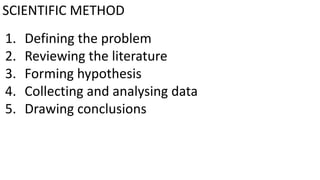
SCIENTIFIC METHOD
1. Defining the problem
2. Reviewing the literature
3. Forming hypothesis
4. Collecting and analysing data
5. Drawing conclusions
STAGES OF THE RESEARCH PROCESS
Defining the Research problem
• What are the variables or the units
of analysis being studied.
• What is the frame or period of the
study.
Review the Related literature
• What has already been written
about the topic?
• What are the research gaps?
Formulate Hypothesis
• What are the specific parameters of the
research problem?
• What are the means of manipulating the
variable and / or measuring the result of
the study?
Prepare the Research Design
• Is the Research going to be
descriptive, exploratory, or
experimental?
• How should the sample be selected
from the population?
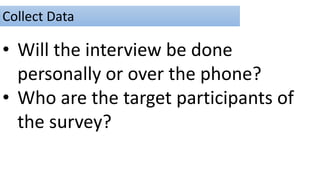
Collect Data
• Will the interview be done
personally or over the phone?
• Who are the target participants of
the survey?
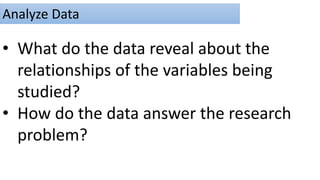
Analyze Data
• What do the data reveal about the
relationships of the variables being
studied?
• How do the data answer the research
problem?
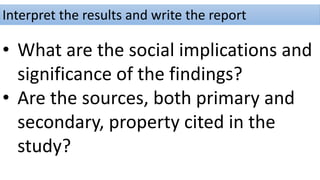
Interpret the results and write the report
• What are the social implications and
significance of the findings?
• Are the sources, both primary and
secondary, property cited in the
study?
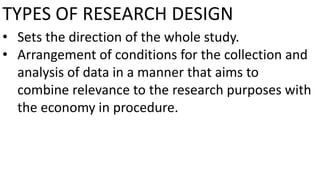
TYPES OF RESEARCH DESIGN
• Sets the direction of the whole study.
• Arrangement of conditions for the collection and
analysis of data in a manner that aims to
combine relevance to the research purposes with
the economy in procedure.
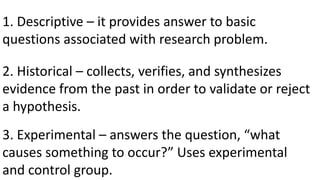
1. Descriptive – it provides answer to basic
questions associated with research problem.
2. Historical – collects, verifies, and synthesizes
evidence from the past in order to validate or reject
a hypothesis.
3. Experimental – answers the question, “what
causes something to occur?” Uses experimental
and control group.
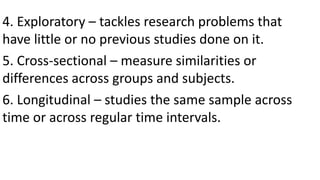
4. Exploratory – tackles research problems that
have little or no previous studies done on it.
5. Cross-sectional – measure similarities or
differences across groups and subjects.
6. Longitudinal – studies the same sample across
time or across regular time intervals.
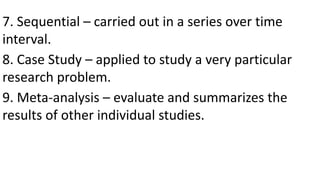
7. Sequential – carried out in a series over time
interval.
8. Case Study – applied to study a very particular
research problem.
9. Meta-analysis – evaluate and summarizes the
results of other individual studies.
Topic 1 1 - diss-scientific method

Topic 1 1 - diss-scientific method

  • 1.
    DANILO F. MARIBAO PALIPARANIII SENIOR HIGH SCHOOL DASMARINAS CITY, CAVITE SCIENTIFIC METHOD AND ITS APPLICATIONS
  • 2.
    1. Group theclass into 10 groups 2. Each group must appoint for a leader and secretary. 3. Once you hear “what is your score” the group must announce their score. 4. The first group who announce their score will get an additional points. 5. Highest score gets 10pts- 8 pts- 6 pts- 4 pts.- 2 pts
  • 4.
    ACTIVITY By Group: Discussamong the group the following: • Identify and describe one social problem. • Find solutions to the problem. • What factors you consider in solving the problem. • Discuss to the class.
  • 5.
    ANALYSIS 1. If povertyis a problem, what is your solution to solve it? 2. What is the positive and negative results from the problems?
  • 6.
    HOW IS THESCIENTIFIC METHOD USED IN CONDUCTING RESEARCH? The scientific method refers to a standardized set techniques for building scientific knowledge, such as how to make valid observations, how to interpret results and to generalize results.
  • 7.
    SCIENTIFIC METHOD 1. Definingthe problem 2. Reviewing the literature 3. Forming hypothesis 4. Collecting and analysing data 5. Drawing conclusions
  • 8.
    STAGES OF THERESEARCH PROCESS Defining the Research problem • What are the variables or the units of analysis being studied. • What is the frame or period of the study.
  • 9.
    Review the Relatedliterature • What has already been written about the topic? • What are the research gaps?
  • 10.
    Formulate Hypothesis • Whatare the specific parameters of the research problem? • What are the means of manipulating the variable and / or measuring the result of the study?
  • 11.
    Prepare the ResearchDesign • Is the Research going to be descriptive, exploratory, or experimental? • How should the sample be selected from the population?
  • 12.
    Collect Data • Willthe interview be done personally or over the phone? • Who are the target participants of the survey?
  • 13.
    Analyze Data • Whatdo the data reveal about the relationships of the variables being studied? • How do the data answer the research problem?
  • 14.
    Interpret the resultsand write the report • What are the social implications and significance of the findings? • Are the sources, both primary and secondary, property cited in the study?
  • 15.
    TYPES OF RESEARCHDESIGN • Sets the direction of the whole study. • Arrangement of conditions for the collection and analysis of data in a manner that aims to combine relevance to the research purposes with the economy in procedure.
  • 16.
    1. Descriptive –it provides answer to basic questions associated with research problem. 2. Historical – collects, verifies, and synthesizes evidence from the past in order to validate or reject a hypothesis. 3. Experimental – answers the question, “what causes something to occur?” Uses experimental and control group.
  • 17.
    4. Exploratory –tackles research problems that have little or no previous studies done on it. 5. Cross-sectional – measure similarities or differences across groups and subjects. 6. Longitudinal – studies the same sample across time or across regular time intervals.
  • 18.
    7. Sequential –carried out in a series over time interval. 8. Case Study – applied to study a very particular research problem. 9. Meta-analysis – evaluate and summarizes the results of other individual studies.