TOP 10 PHP
FRAMEWORKS
IN 2021
PHP is an open-source, server-side scripting language for the development of web
applications. It is also known as Hypertext Preprocessor. PHP is one of the
programming languages which is developed with built-in web capabilities.
Over time, the complexity of websites has been increased. The task of web
development is more tedious as developers have to start every time from
scratch. Software frameworks thus help in getting a foundation to build an application.
PHP has many popular frameworks for the solution of these problems in web
development. Before getting into the list of top PHP frameworks, let’s have one short
introduction to PHP frameworks.
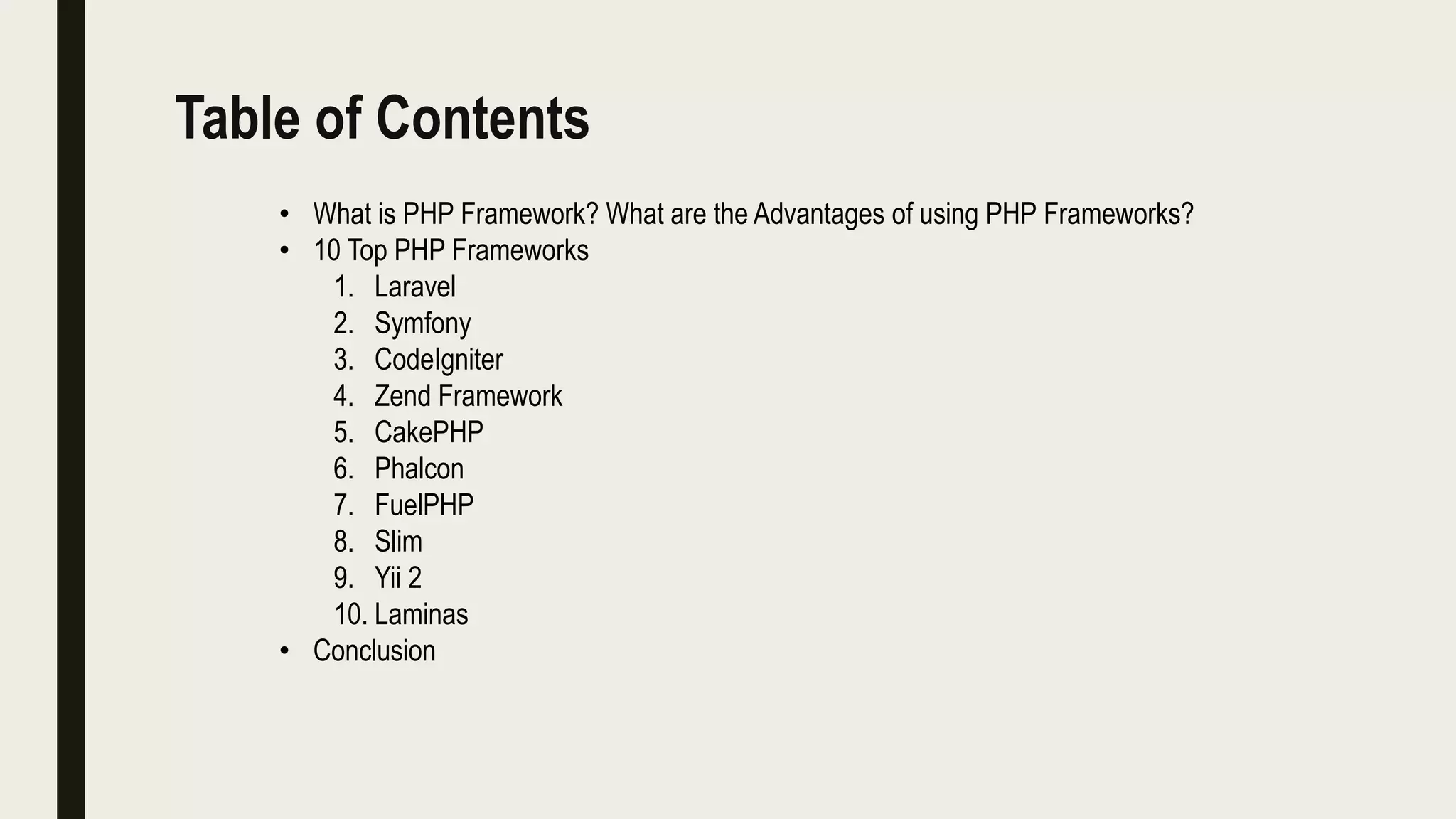
Table of Contents
• What is PHP Framework? What are the Advantages of using PHP Frameworks?
• 10 Top PHP Frameworks
1. Laravel
2. Symfony
3. CodeIgniter
4. Zend Framework
5. CakePHP
6. Phalcon
7. FuelPHP
8. Slim
9. Yii 2
10. Laminas
• Conclusion
What is PHP Framework? What are the
Advantages of using PHP Frameworks?
■ PHP Frameworks provides a platform to create Web applications. It is the abstraction to provide generic
functionality that could be changed by additional reusable user-written code in programming
selectively. The frameworks make swift development a real thing. PHP frameworks give a basic
structure to streamline the development of web applications.
■ PHP frameworks offer interesting benefits, such as:
• Minimal Code
• Libraries
• Fast Development
• Maintainability
• More efficient work with databases
• Cross-Platform & Stability
• CMS support
1. LARAVEL
■ Laravel was released in 2011, and it is one of the viral frameworks of PHP. It is an open-source
PHP framework. Laravel simplifies the tasks like caching, routing, security and authentication.
■ Features:
• Laravel’s core functionality can be extended using add-ons.
• It has built-in functions for handling user management, caching, routing, and much more.
• Laravel can integrate with third-party libraries and platforms such as AWS.
• The framework has elegant syntax
■ Pros:
• Laravel is used to make robust applications with complex server-side.
• It produces fast and secure web applications.
• Laravel allows customization of applications according to the developer’s requirement.
• The queue management is the best among all PHP frameworks.
■ Cons:
• There are no built-in interface generators.
• Laravel is a relatively new framework so that it can experience bugs.
2. SYMFONY
■ Symfony was developed back in 2005; it is one of the earliest PHP frameworks. It is also known
as an extensive PHP MVC framework, and it follows all PHP standards.
■ Features:
• Symfony is capable of built-in testing functionalities.
• The platform has excellent documentation for easy learning.
• It shows flexibility for setting up individual components.
■ Pros:
• Symfony offers fast development as it contains reusable components and less memory
consumption.
• Symfony is used for interoperability.
• The flexibility of the frameworks allows easy integration with other projects.
• It has built-in support for functional and acceptance tests.
■ Cons:
• Symfony is not for beginners; it is hard to understand.
• It uses resource-intensive ORM.
3. CODEIGNITER
■ CodeIgniter is a lightweight framework. It offers easy installation along with minimal configuration
prerequisites. It contains dedicated hosting platforms and is highly suited for dynamic websites.
■ Features:
• Symfony is capable of easy database handling.
• This framework allows the creation of own libraries, API’s ana packages as it is extendable.
• It contains form and data validation functionalities.
4. ZEND FRAMEWORK
■ Zend is built on agile methodology. It is one object-oriented framework. Zend has components for
the creation of web applications with better functionalities. It has extendable nature, thus allows to
add functionalities according to their projects.
■ Features:
• Zend framework is based on agile methodology.
• This framework supports many input data types, and it is HTML5 compliant.
5. CAKEPHP
■ CakePHP was developed in 2005. It is an open-source platform and still a very popular PHP
framework despite being a decade-old. CakePHP is one of the up-to-date frameworks. It allows
the development of simple but attractive applications with its expansible architecture.
■ Features:
• CakePHP contains a wide range of components.
• It uses CakePHP conventions to code faster and better.
• It includes class inheritance, fast builds, and validation.
6. PHALCON
■ Phalcon is a full-stack PHP framework. It was introduced in 2012 and was initially written in C and
C++ languages. It is preferred because of C-extension because no pre-learning of C language
before using it.
■ Features:
• Phalcon is one blazing fast framework.
• Phalcon contains many interesting features like caching, asset management, and universal
autoloader.
• It consumes very low memory space
7. FUELPHP
■ FuelPHP is a flexible and extendable framework of PHP. The first version of the framework was
introduced in 2014. The framework displays more than one page at a time as it supports both
MVC and HMVC architecture. It is a security-focused framework.
■ Features:
• The framework has good complete support for HMVC.
• The command-line utility is unique in FuelPHP.
• FuelPHP is capable of delivering end-to-end web solutions.
CONCLUSION:
PHP frameworks are there to simplify the development process. In the article, we have covered 10 top
PHP frameworks with their brief details. We can not decide on one best framework as the features of
web development change with time very quickly. Moreover, the decision of one best PHP framework
depends upon a developer’s preferences and project requirements.
For complete article, visit this link.
Thank you 

Top 10 php frameworks in 2021

  • 1.
  • 2.
    PHP is anopen-source, server-side scripting language for the development of web applications. It is also known as Hypertext Preprocessor. PHP is one of the programming languages which is developed with built-in web capabilities. Over time, the complexity of websites has been increased. The task of web development is more tedious as developers have to start every time from scratch. Software frameworks thus help in getting a foundation to build an application. PHP has many popular frameworks for the solution of these problems in web development. Before getting into the list of top PHP frameworks, let’s have one short introduction to PHP frameworks.
  • 3.
    Table of Contents •What is PHP Framework? What are the Advantages of using PHP Frameworks? • 10 Top PHP Frameworks 1. Laravel 2. Symfony 3. CodeIgniter 4. Zend Framework 5. CakePHP 6. Phalcon 7. FuelPHP 8. Slim 9. Yii 2 10. Laminas • Conclusion
  • 4.
    What is PHPFramework? What are the Advantages of using PHP Frameworks? ■ PHP Frameworks provides a platform to create Web applications. It is the abstraction to provide generic functionality that could be changed by additional reusable user-written code in programming selectively. The frameworks make swift development a real thing. PHP frameworks give a basic structure to streamline the development of web applications. ■ PHP frameworks offer interesting benefits, such as: • Minimal Code • Libraries • Fast Development • Maintainability • More efficient work with databases • Cross-Platform & Stability • CMS support
  • 5.
    1. LARAVEL ■ Laravelwas released in 2011, and it is one of the viral frameworks of PHP. It is an open-source PHP framework. Laravel simplifies the tasks like caching, routing, security and authentication. ■ Features: • Laravel’s core functionality can be extended using add-ons. • It has built-in functions for handling user management, caching, routing, and much more. • Laravel can integrate with third-party libraries and platforms such as AWS. • The framework has elegant syntax
  • 6.
    ■ Pros: • Laravelis used to make robust applications with complex server-side. • It produces fast and secure web applications. • Laravel allows customization of applications according to the developer’s requirement. • The queue management is the best among all PHP frameworks. ■ Cons: • There are no built-in interface generators. • Laravel is a relatively new framework so that it can experience bugs.
  • 7.
    2. SYMFONY ■ Symfonywas developed back in 2005; it is one of the earliest PHP frameworks. It is also known as an extensive PHP MVC framework, and it follows all PHP standards. ■ Features: • Symfony is capable of built-in testing functionalities. • The platform has excellent documentation for easy learning. • It shows flexibility for setting up individual components.
  • 8.
    ■ Pros: • Symfonyoffers fast development as it contains reusable components and less memory consumption. • Symfony is used for interoperability. • The flexibility of the frameworks allows easy integration with other projects. • It has built-in support for functional and acceptance tests. ■ Cons: • Symfony is not for beginners; it is hard to understand. • It uses resource-intensive ORM.
  • 9.
    3. CODEIGNITER ■ CodeIgniteris a lightweight framework. It offers easy installation along with minimal configuration prerequisites. It contains dedicated hosting platforms and is highly suited for dynamic websites. ■ Features: • Symfony is capable of easy database handling. • This framework allows the creation of own libraries, API’s ana packages as it is extendable. • It contains form and data validation functionalities.
  • 10.
    4. ZEND FRAMEWORK ■Zend is built on agile methodology. It is one object-oriented framework. Zend has components for the creation of web applications with better functionalities. It has extendable nature, thus allows to add functionalities according to their projects. ■ Features: • Zend framework is based on agile methodology. • This framework supports many input data types, and it is HTML5 compliant.
  • 11.
    5. CAKEPHP ■ CakePHPwas developed in 2005. It is an open-source platform and still a very popular PHP framework despite being a decade-old. CakePHP is one of the up-to-date frameworks. It allows the development of simple but attractive applications with its expansible architecture. ■ Features: • CakePHP contains a wide range of components. • It uses CakePHP conventions to code faster and better. • It includes class inheritance, fast builds, and validation.
  • 12.
    6. PHALCON ■ Phalconis a full-stack PHP framework. It was introduced in 2012 and was initially written in C and C++ languages. It is preferred because of C-extension because no pre-learning of C language before using it. ■ Features: • Phalcon is one blazing fast framework. • Phalcon contains many interesting features like caching, asset management, and universal autoloader. • It consumes very low memory space
  • 13.
    7. FUELPHP ■ FuelPHPis a flexible and extendable framework of PHP. The first version of the framework was introduced in 2014. The framework displays more than one page at a time as it supports both MVC and HMVC architecture. It is a security-focused framework. ■ Features: • The framework has good complete support for HMVC. • The command-line utility is unique in FuelPHP. • FuelPHP is capable of delivering end-to-end web solutions.
  • 14.
    CONCLUSION: PHP frameworks arethere to simplify the development process. In the article, we have covered 10 top PHP frameworks with their brief details. We can not decide on one best framework as the features of web development change with time very quickly. Moreover, the decision of one best PHP framework depends upon a developer’s preferences and project requirements. For complete article, visit this link.
  • 15.