S U VA R N A G A N V I R
P R O F E S S O R
D V V P F ’ S C O L L G E O F P H Y S I O T H E R A P Y, A H M E D N A G A R
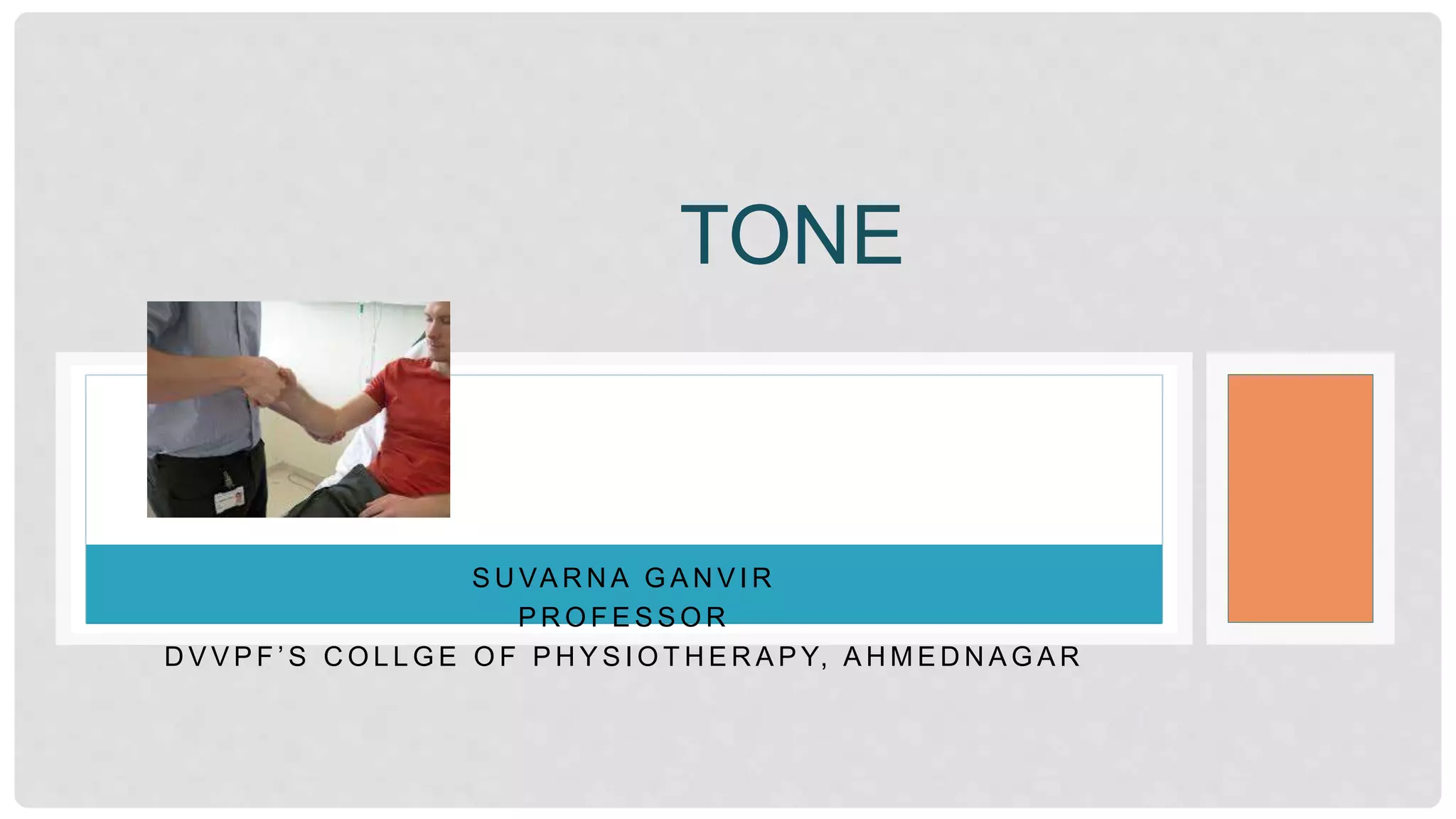
TONE
OBJECTIVES
• Introduction
• Abnormal Tone- Spasticity
Rigidity
Hypotonia
Dystonia
Decerebrate Rigidity
Decorticate Rigidity
• Examination of tone
• Modified Ashworth Scale
• Typical patterns in UMN lesion
INTRODUCTION
• Definition: Resistance of muscle to passive elongation or stretch when an
individual attempts to maintain muscle relaxation.
• Factors 1. Physical Inertia
2. Intrinsic mechanical elastic stiffness
3. Reflex muscle contraction ( tonic stretch reflex)
• TONAL ABNORMALITIES -
Hypotonia
 Hypertonia-Spasticity and Rigidity
 Dystonia
 Decerebrate and Decorticate Rigidity
ABNORMAL TONE
SPASTICITY
• Hypertonic motor disorder
• Velocity dependent
• Clasp- knife response
• Chronic spasticity- abnormal posture, deformity, disability
• Injury to pyramidal tract- UMN lesion
• Loss of inhibitory control over lower motor neurons
• Results in disordered spinal segmental reflexes
• Increased alpha motorneurone excitability
• Sign and symptoms-
 hyperactive stretch reflexes
 Involuntary flexor and extensor spasms
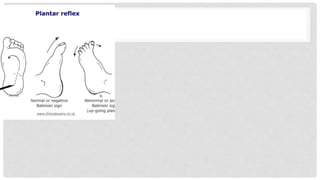
 Babinski’s sign positive –Abnormal plantar reflex
 Exaggerated deep tendon reflexes
 Loss of precise autonomic control
 Clonus- cyclic, spasmodic alteration of muscle
contraction relaxation in response to muscle stretch of
a spastic muscle. Common in plantar flexors…
RIGIDITY
• Hypertonic state
• Increased uniform resistance that persists throughout the whole ROM
(leadpipe)
• Cause- lesion of the basal ganglia system ( Parkinson’s disease)
• Stiffness, inflexibility, Significant functional limitation.
• Due to excessive supraspinal drive (UMN facilitation)
• Spinal reflex mechanisms are normal.
• Cogwheel- Hypertonic state with superimposed rachetlike jerkiness,
commonly in UE movement e.g Elbow flexion/ extension)
HYPOTONIA
• Flaccidity- Absent muscular tone
• Resistance to passive movement is diminished
• Stretch reflexes are dampened or absent, limbs are floppy
• Occurs in Lower Motor Neuron Lesion- affection of ant horn cell and
peripheral nerves
• Symptoms- Decreased or absent reflexes, paresis or paralysis, muscle
fasciculation and fibrillation, muscle atrophy.
• Temporary states of flaccidity or hypotonia- Spinal Shock/ cerebral
Shock depending upon location of lesion.
DYSTONIA
• Hyperkinetic movement disorder characterized by disordered tone and
involuntary movements involving large portion of the body.
• Movements are similar to athetoid movements with typical
twisting/writhing motions.
• Dystonic Posturing- sustained abnormal postures due to co-contraction of
muscles.
• Result from a CNS lesion (Basal Ganglia).
• Focal Dystonia- Affects only one part of the body e.g spasmodic torticollis.
• Segmental Dystonia- Affects two or more adjacent areas e.g dystonic
posturing of arms.
DECEREBRATE RIGIDITY
• Abnormal Extensor Response - refers to sustained
contraction and posturing of the trunk and lower limbs in a
position of full extension.
• Indicative of corticospinal brainstem lesion between superior
colliculus and vestibular nucleus.
• Elbows- extended, Shoulders- adducted, Forearm- pronated,
wrist and fingers- flexed, lower limb- stiff extension and
plantarflexion.
DECORTICATE RIGIDITY
• Abnormal Flexor Response -refers to sustained
contraction and posturing of upper limbs in flexion and
lower limbs in extension.
• Is indicative of corticospinal tract lesion at the level of
diencephalon
• Elbows, wrist and fingers- flexion, Shoulder- adducted,
lower limb- Extension, I.R and plantarflexed.
EXAMINATION OF TONE
• Consists of
 Initial Observation of resting posture and palpation
 Passive motion testing
 Active motion testing
• Tone is variable in nature. Hence depends on
following factors
 Volitional effort and movement
 Stress and anxiety
 Position and interaction of tonic reflexes
 Medications
 General health
 Environmental temperature
 State of CNS arousal and alertness
 Urinary bladder status
 Fever and infection
 Metabolic and or electrolyte imbalance
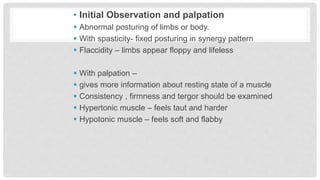
• Initial Observation and palpation
 Abnormal posturing of limbs or body.
 With spasticity- fixed posturing in synergy pattern
 Flaccidity – limbs appear floppy and lifeless
 With palpation –
 gives more information about resting state of a muscle
 Consistency , firmness and tergor should be examined
 Hypertonic muscle – feels taut and harder
 Hypotonic muscle – feels soft and flabby
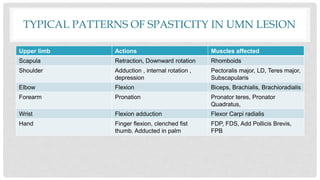
TYPICAL PATTERNS OF SPASTICITY IN UMN LESION
Upper limb Actions Muscles affected
Scapula Retraction, Downward rotation Rhomboids
Shoulder Adduction , internal rotation ,
depression
Pectoralis major, LD, Teres major,
Subscapularis
Elbow Flexion Biceps, Brachialis, Brachioradialis
Forearm Pronation Pronator teres, Pronator
Quadratus,
Wrist Flexion adduction Flexor Carpi radialis
Hand Finger flexion, clenched fist
thumb. Adducted in palm
FDP, FDS, Add Pollicis Brevis,
FPB
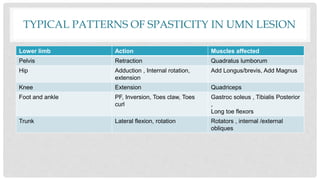
TYPICAL PATTERNS OF SPASTICITY IN UMN LESION
Lower limb Action Muscles affected
Pelvis Retraction Quadratus lumborum
Hip Adduction , Internal rotation,
extension
Add Longus/brevis, Add Magnus
Knee Extension Quadriceps
Foot and ankle PF, Inversion, Toes claw, Toes
curl
Gastroc soleus , Tibialis Posterior
,
Long toe flexors
Trunk Lateral flexion, rotation Rotators , internal /external
obliques
• Passive motion testing :
• Responsivness of muscle to stretch
• Patient is instructed to relax , maintain firm and constant
manual contact
• Normal tone- limb moves easily and therapist is able to alter
direction and speed without feeling abnormal resistance.
• Hypertonic muscle- stiff feeling, resistant to movement,
• Hypotonic mucscle- heavy feeling and unresponsive
• Increasing the speed of movement – increases the resistance
in case of hypertonic muscle.
• Clonus- maintained quick stretch stimulus
• Begin tone assessment with normal side
• Comparison between upper and lower limbs and also
between right and left side.
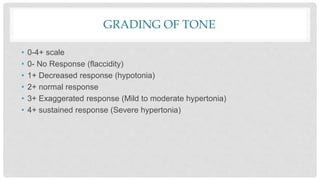
GRADING OF TONE
• 0-4+ scale
• 0- No Response (flaccidity)
• 1+ Decreased response (hypotonia)
• 2+ normal response
• 3+ Exaggerated response (Mild to moderate hypertonia)
• 4+ sustained response (Severe hypertonia)
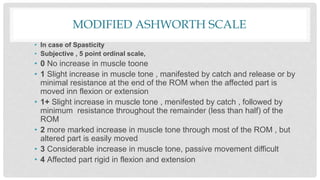
MODIFIED ASHWORTH SCALE
• In case of Spasticity
• Subjective , 5 point ordinal scale,
• 0 No increase in muscle toone
• 1 Slight increase in muscle tone , manifested by catch and release or by
minimal resistance at the end of the ROM when the affected part is
moved inn flexion or extension
• 1+ Slight increase in muscle tone , menifested by catch , followed by
minimum resistance throughout the remainder (less than half) of the
ROM
• 2 more marked increase in muscle tone through most of the ROM , but
altered part is easily moved
• 3 Considerable increase in muscle tone, passive movement difficult
• 4 Affected part rigid in flexion and extension
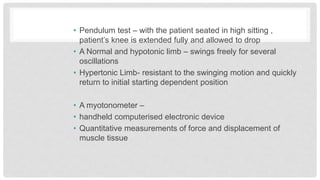
• Pendulum test – with the patient seated in high sitting ,
patient’s knee is extended fully and allowed to drop
• A Normal and hypotonic limb – swings freely for several
oscillations
• Hypertonic Limb- resistant to the swinging motion and quickly
return to initial starting dependent position
• A myotonometer –
• handheld computerised electronic device
• Quantitative measurements of force and displacement of
muscle tissue
SUMMARY
• Introduction
• Abnormal Tone- Spasticity
Rigidity
Hypotonia
Dystonia
Decerebrate Rigidity
Decorticate Rigidity
• Examination of tone
• Modified Ashworth Scale
REFERENCE
• Physical Rehabilitation by Susan B O’Sullivan – 5th Edition
Tone

Tone

  • 1.
    S U VAR N A G A N V I R P R O F E S S O R D V V P F ’ S C O L L G E O F P H Y S I O T H E R A P Y, A H M E D N A G A R TONE
  • 2.
    OBJECTIVES • Introduction • AbnormalTone- Spasticity Rigidity Hypotonia Dystonia Decerebrate Rigidity Decorticate Rigidity • Examination of tone • Modified Ashworth Scale • Typical patterns in UMN lesion
  • 3.
    INTRODUCTION • Definition: Resistanceof muscle to passive elongation or stretch when an individual attempts to maintain muscle relaxation. • Factors 1. Physical Inertia 2. Intrinsic mechanical elastic stiffness 3. Reflex muscle contraction ( tonic stretch reflex) • TONAL ABNORMALITIES - Hypotonia  Hypertonia-Spasticity and Rigidity  Dystonia  Decerebrate and Decorticate Rigidity
  • 4.
    ABNORMAL TONE SPASTICITY • Hypertonicmotor disorder • Velocity dependent • Clasp- knife response • Chronic spasticity- abnormal posture, deformity, disability • Injury to pyramidal tract- UMN lesion • Loss of inhibitory control over lower motor neurons • Results in disordered spinal segmental reflexes • Increased alpha motorneurone excitability
  • 5.
    • Sign andsymptoms-  hyperactive stretch reflexes  Involuntary flexor and extensor spasms  Babinski’s sign positive –Abnormal plantar reflex  Exaggerated deep tendon reflexes  Loss of precise autonomic control  Clonus- cyclic, spasmodic alteration of muscle contraction relaxation in response to muscle stretch of a spastic muscle. Common in plantar flexors…
  • 7.
    RIGIDITY • Hypertonic state •Increased uniform resistance that persists throughout the whole ROM (leadpipe) • Cause- lesion of the basal ganglia system ( Parkinson’s disease) • Stiffness, inflexibility, Significant functional limitation. • Due to excessive supraspinal drive (UMN facilitation) • Spinal reflex mechanisms are normal. • Cogwheel- Hypertonic state with superimposed rachetlike jerkiness, commonly in UE movement e.g Elbow flexion/ extension)
  • 8.
    HYPOTONIA • Flaccidity- Absentmuscular tone • Resistance to passive movement is diminished • Stretch reflexes are dampened or absent, limbs are floppy • Occurs in Lower Motor Neuron Lesion- affection of ant horn cell and peripheral nerves • Symptoms- Decreased or absent reflexes, paresis or paralysis, muscle fasciculation and fibrillation, muscle atrophy. • Temporary states of flaccidity or hypotonia- Spinal Shock/ cerebral Shock depending upon location of lesion.
  • 9.
    DYSTONIA • Hyperkinetic movementdisorder characterized by disordered tone and involuntary movements involving large portion of the body. • Movements are similar to athetoid movements with typical twisting/writhing motions. • Dystonic Posturing- sustained abnormal postures due to co-contraction of muscles. • Result from a CNS lesion (Basal Ganglia). • Focal Dystonia- Affects only one part of the body e.g spasmodic torticollis. • Segmental Dystonia- Affects two or more adjacent areas e.g dystonic posturing of arms.
  • 10.
    DECEREBRATE RIGIDITY • AbnormalExtensor Response - refers to sustained contraction and posturing of the trunk and lower limbs in a position of full extension. • Indicative of corticospinal brainstem lesion between superior colliculus and vestibular nucleus. • Elbows- extended, Shoulders- adducted, Forearm- pronated, wrist and fingers- flexed, lower limb- stiff extension and plantarflexion.
  • 11.
    DECORTICATE RIGIDITY • AbnormalFlexor Response -refers to sustained contraction and posturing of upper limbs in flexion and lower limbs in extension. • Is indicative of corticospinal tract lesion at the level of diencephalon • Elbows, wrist and fingers- flexion, Shoulder- adducted, lower limb- Extension, I.R and plantarflexed.
  • 12.
    EXAMINATION OF TONE •Consists of  Initial Observation of resting posture and palpation  Passive motion testing  Active motion testing
  • 13.
    • Tone isvariable in nature. Hence depends on following factors  Volitional effort and movement  Stress and anxiety  Position and interaction of tonic reflexes  Medications  General health  Environmental temperature  State of CNS arousal and alertness  Urinary bladder status  Fever and infection  Metabolic and or electrolyte imbalance
  • 14.
    • Initial Observationand palpation  Abnormal posturing of limbs or body.  With spasticity- fixed posturing in synergy pattern  Flaccidity – limbs appear floppy and lifeless  With palpation –  gives more information about resting state of a muscle  Consistency , firmness and tergor should be examined  Hypertonic muscle – feels taut and harder  Hypotonic muscle – feels soft and flabby
  • 15.
    TYPICAL PATTERNS OFSPASTICITY IN UMN LESION Upper limb Actions Muscles affected Scapula Retraction, Downward rotation Rhomboids Shoulder Adduction , internal rotation , depression Pectoralis major, LD, Teres major, Subscapularis Elbow Flexion Biceps, Brachialis, Brachioradialis Forearm Pronation Pronator teres, Pronator Quadratus, Wrist Flexion adduction Flexor Carpi radialis Hand Finger flexion, clenched fist thumb. Adducted in palm FDP, FDS, Add Pollicis Brevis, FPB
  • 16.
    TYPICAL PATTERNS OFSPASTICITY IN UMN LESION Lower limb Action Muscles affected Pelvis Retraction Quadratus lumborum Hip Adduction , Internal rotation, extension Add Longus/brevis, Add Magnus Knee Extension Quadriceps Foot and ankle PF, Inversion, Toes claw, Toes curl Gastroc soleus , Tibialis Posterior , Long toe flexors Trunk Lateral flexion, rotation Rotators , internal /external obliques
  • 17.
    • Passive motiontesting : • Responsivness of muscle to stretch • Patient is instructed to relax , maintain firm and constant manual contact • Normal tone- limb moves easily and therapist is able to alter direction and speed without feeling abnormal resistance. • Hypertonic muscle- stiff feeling, resistant to movement, • Hypotonic mucscle- heavy feeling and unresponsive • Increasing the speed of movement – increases the resistance in case of hypertonic muscle. • Clonus- maintained quick stretch stimulus • Begin tone assessment with normal side • Comparison between upper and lower limbs and also between right and left side.
  • 18.
    GRADING OF TONE •0-4+ scale • 0- No Response (flaccidity) • 1+ Decreased response (hypotonia) • 2+ normal response • 3+ Exaggerated response (Mild to moderate hypertonia) • 4+ sustained response (Severe hypertonia)
  • 19.
    MODIFIED ASHWORTH SCALE •In case of Spasticity • Subjective , 5 point ordinal scale, • 0 No increase in muscle toone • 1 Slight increase in muscle tone , manifested by catch and release or by minimal resistance at the end of the ROM when the affected part is moved inn flexion or extension • 1+ Slight increase in muscle tone , menifested by catch , followed by minimum resistance throughout the remainder (less than half) of the ROM • 2 more marked increase in muscle tone through most of the ROM , but altered part is easily moved • 3 Considerable increase in muscle tone, passive movement difficult • 4 Affected part rigid in flexion and extension
  • 20.
    • Pendulum test– with the patient seated in high sitting , patient’s knee is extended fully and allowed to drop • A Normal and hypotonic limb – swings freely for several oscillations • Hypertonic Limb- resistant to the swinging motion and quickly return to initial starting dependent position • A myotonometer – • handheld computerised electronic device • Quantitative measurements of force and displacement of muscle tissue
  • 21.
    SUMMARY • Introduction • AbnormalTone- Spasticity Rigidity Hypotonia Dystonia Decerebrate Rigidity Decorticate Rigidity • Examination of tone • Modified Ashworth Scale
  • 22.
    REFERENCE • Physical Rehabilitationby Susan B O’Sullivan – 5th Edition