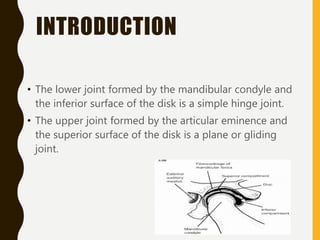
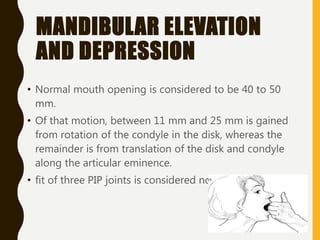
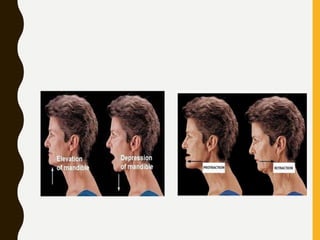
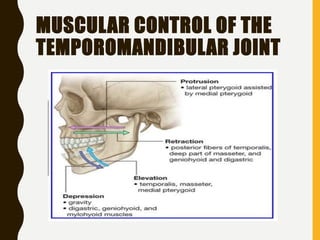
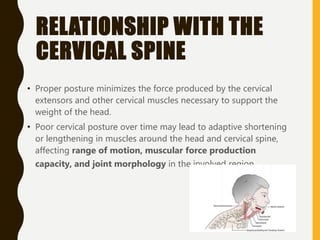
The temporomandibular joint (TMJ) is structurally unique, with the mandible articulating with the temporal bone at each end. Each TMJ contains an articular disk that separates it into an upper and lower joint. The lower joint functions as a hinge joint while the upper joint functions as a gliding joint. The TMJ is involved in important functions like chewing, swallowing, and speech. Dysfunctions can be caused by trauma, poor posture, or oral habits and include conditions like inflammation, disk displacement, and degeneration. Proper cervical posture and dentition are important for optimal TMJ function.