Sketch
Presenter Name
Time Tracking Payroll Software
Enhancing Workforce Management and Payroll Accuracy
Agenda
1. Introduction
2. What is Time Tracking Payroll
Software?
3. Benefits of Time Tracking
Payroll Software
4. Key Features
5. Best Practices
6. Conclusion
2
• Introduction
• What is Time Tracking Payroll Software
• Benefits of Time Tracking Payroll Software
• Key features
• Best practices
• Conclusion
Introduction
1. Financial Accuracy:
• Ensures precise payment for hours worked.
• Minimizes wage calculation errors and helps control costs.
2. Legal Compliance:
• Adheres to labor laws, avoiding legal penalties.
• Maintains proper records for regulatory compliance.
3. Efficiency:
• Streamlines payroll processing, saving time.
• Automates tasks, reducing administrative burden.
4. Employee Satisfaction:
• Builds trust with timely, accurate payments.
• Reduces disputes and enhances morale.
Time tracking and payroll
management are critical
components of effective workforce
management.
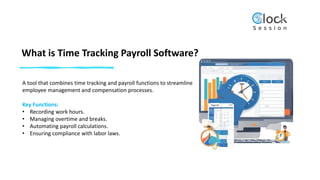
What is Time Tracking Payroll Software?
A tool that combines time tracking and payroll functions to streamline
employee management and compensation processes.
Key Functions:
• Recording work hours.
• Managing overtime and breaks.
• Automating payroll calculations.
• Ensuring compliance with labor laws.
Benefits of Time Tracking Payroll Software
• Efficiency: Automates time-consuming payroll processes.
• Accuracy: Reduces errors in time tracking and payroll calculations.
• Compliance: Ensures adherence to labor regulations.
• Cost Savings: Minimizes overpayments and time theft.
• Employee Satisfaction: Provides transparency and timely payments.
Key features
•Automated Time Tracking:
•Clock-in/clock-out systems.
•Mobile time tracking.
•Payroll Processing:
•Automatic payroll runs.
•Tax calculations and deductions.
• Integration:
• Sync with HR and accounting software.
• API integrations.
• Reporting and Analytics:
• Customizable reports.
• Insights on workforce productivity.
Best Practices
1. Regular Updates: Keep software updated to benefit from new features and security patches.
2. Employee Engagement: Encourage employee participation and feedback.
3. Clear Policies: Define clear policies for time tracking and payroll.
4. Data Security: Ensure robust security measures to protect sensitive information.
5. Continuous Improvement: Regularly review and improve processes.
Conclusion
Choosing the right time tracking payroll software and implementing it effectively is crucial
for enhancing workforce management and ensuring accurate payroll processing. By
carefully assessing business needs, selecting software with comprehensive features, and
providing thorough training and support, organizations can streamline operations,
improve compliance, and boost employee satisfaction. A well-executed implementation
plan ensures seamless integration and maximizes the software's benefits, ultimately
leading to significant cost savings and informed decision-making.
Thank You
support@clocksession.com
+1-8057763451
www.clocksession.com

Time Tracking Payroll Software - ClockSession.pptx

  • 1.
    Sketch Presenter Name Time TrackingPayroll Software Enhancing Workforce Management and Payroll Accuracy
  • 2.
    Agenda 1. Introduction 2. Whatis Time Tracking Payroll Software? 3. Benefits of Time Tracking Payroll Software 4. Key Features 5. Best Practices 6. Conclusion 2 • Introduction • What is Time Tracking Payroll Software • Benefits of Time Tracking Payroll Software • Key features • Best practices • Conclusion
  • 3.
    Introduction 1. Financial Accuracy: •Ensures precise payment for hours worked. • Minimizes wage calculation errors and helps control costs. 2. Legal Compliance: • Adheres to labor laws, avoiding legal penalties. • Maintains proper records for regulatory compliance. 3. Efficiency: • Streamlines payroll processing, saving time. • Automates tasks, reducing administrative burden. 4. Employee Satisfaction: • Builds trust with timely, accurate payments. • Reduces disputes and enhances morale. Time tracking and payroll management are critical components of effective workforce management.
  • 4.
    What is TimeTracking Payroll Software? A tool that combines time tracking and payroll functions to streamline employee management and compensation processes. Key Functions: • Recording work hours. • Managing overtime and breaks. • Automating payroll calculations. • Ensuring compliance with labor laws.
  • 5.
    Benefits of TimeTracking Payroll Software • Efficiency: Automates time-consuming payroll processes. • Accuracy: Reduces errors in time tracking and payroll calculations. • Compliance: Ensures adherence to labor regulations. • Cost Savings: Minimizes overpayments and time theft. • Employee Satisfaction: Provides transparency and timely payments.
  • 6.
    Key features •Automated TimeTracking: •Clock-in/clock-out systems. •Mobile time tracking. •Payroll Processing: •Automatic payroll runs. •Tax calculations and deductions. • Integration: • Sync with HR and accounting software. • API integrations. • Reporting and Analytics: • Customizable reports. • Insights on workforce productivity.
  • 7.
    Best Practices 1. RegularUpdates: Keep software updated to benefit from new features and security patches. 2. Employee Engagement: Encourage employee participation and feedback. 3. Clear Policies: Define clear policies for time tracking and payroll. 4. Data Security: Ensure robust security measures to protect sensitive information. 5. Continuous Improvement: Regularly review and improve processes.
  • 8.
    Conclusion Choosing the righttime tracking payroll software and implementing it effectively is crucial for enhancing workforce management and ensuring accurate payroll processing. By carefully assessing business needs, selecting software with comprehensive features, and providing thorough training and support, organizations can streamline operations, improve compliance, and boost employee satisfaction. A well-executed implementation plan ensures seamless integration and maximizes the software's benefits, ultimately leading to significant cost savings and informed decision-making.
  • 9.