“Open means many things … open can mean open
enrollment [e.g. MOOCs]; that you break down the
barrier of who can take or can’t take a class. An
entirely different kind of open is around open source
and open to innovate on. To share... That’s more an
intellectual properly thing: the ability to share and the
intellectual enterprise.
And then I think, much like in the open source
movement, there’s also a … there’s a lot of confusion
around the word open and also a lot people, when
things are free, they conflate that with open. And so
I thinkthat the short answer is that open means many
different things to many different people…”
Richard Baraniuk
Professor of Electrical and Computer Engineering and Founder/Director
of OpenStax College and OpenStax CNX (formerly Connexions)
What does
openness
mean to you?
OpenStax College is based
at Rice University, Houston
and produce peer reviewed
open textbooks
Find out more:
http://openstaxcollege.org
Photo Credit: By Nicole Allen (SPARC) [CC BY 4.0 via Wikimedia
Commons]
http://commons.wikimedia.org/wiki/File%3ARichard_Baraniuk_at_the_S
PARC_2014_OA_Meeting_-_DSC00777_(cropped).JPG
Quotation from video produced by the OER Research Hub [CC BY 4.0
via YouTube]
“What does openness mean to you?” (Connexions Conference, April
2013) #oerrhub
http://youtu.be/TDRQIBZh7IQ
“Openness means that I’m willing to share and others are willing
to share. And that as much as we possibly can, we take our
egos out of this and we work collaboratively for the end all.
Which in an educational setting the end all is student learning.
So, I got involved with OER because of cost savings for
students, and I’m still strongly there with cost savings for
students, but what I’ve found is the unintended consequence
… was that student learning improved because of the fact that
others could repurpose, others could use. We’re now studying
success rates; I am making no claims at all about success rates
going up with openness… [But] what I do know is that they have
not gone down…
But the openness part … I think it’s a trend of faculty
starting to collaborate more … Community College faculty tend
to work in silos, we don’t have that many grants, most of us
don’t publish. So we just go in and we teach, we do our stuff
and then we go back. What I’ve seen is that more faculty are
willing to share materials … we’re able to work together for
improvements… I’ve seen departments get together and write
the textbooks for their students, and so they all have ownership
in this and when you’re all vested in this then you all want to
use it.”
Barbara Illowsky
Co-author of open textbook Collaborative Statistics and Professor of Math
and Statistics at De Anza Community College, California
What does
openness mean
to you?
Photo Credit: http://faculty.deanza.edu/illowskybarbara/
Quotation from an interview conducted in November 2013 by Beck Pitt
for the OER Research Hub [CC BY 4.0]
https://methylatedorange.wordpress.com/2014/01/07/its-a-wild-ride-
barbara-illowsky-on-the-journey-of-collaborative-statistics/
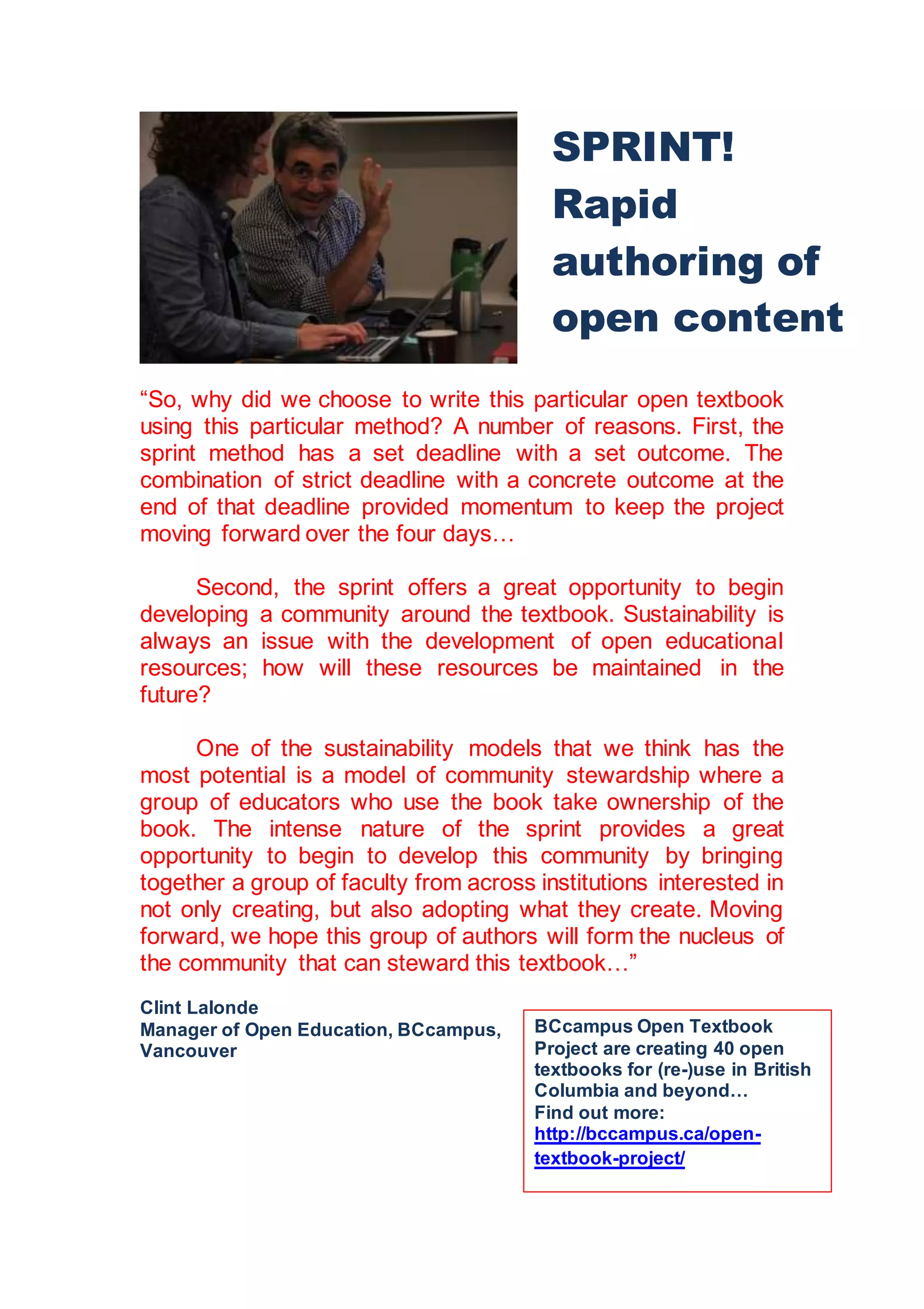
“So, why did we choose to write this particular open textbook
using this particular method? A number of reasons. First, the
sprint method has a set deadline with a set outcome. The
combination of strict deadline with a concrete outcome at the
end of that deadline provided momentum to keep the project
moving forward over the four days…
Second, the sprint offers a great opportunity to begin
developing a community around the textbook. Sustainability is
always an issue with the development of open educational
resources; how will these resources be maintained in the
future?
One of the sustainability models that we think has the
most potential is a model of community stewardship where a
group of educators who use the book take ownership of the
book. The intense nature of the sprint provides a great
opportunity to begin to develop this community by bringing
together a group of faculty from across institutions interested in
not only creating, but also adopting what they create. Moving
forward, we hope this group of authors will form the nucleus of
the community that can steward this textbook…”
Clint Lalonde
Manager of Open Education, BCcampus,
Vancouver
SPRINT!
Rapid
authoring of
open content
BCcampus Open Textbook
Project are creating 40 open
textbooks for (re-)use in British
Columbia and beyond…
Find out more:
http://bccampus.ca/open-
textbook-project/
Photo Credit: CC-BY 4.0 Adam Hyde, Booksprints
http://tinyurl.com/lnom3h4
Clint Lalonde (right) with Amanda Coolidge
Quotation from Clint’s blog post Clint Lalonde (BCcampus): Reflections
on an Open Textbook Sprint [CC BY 4.0]
http://oerresearchhub.org/2014/07/02/clint-lalonde-bccampus-
reflections-on-an-open-textbook-sprint/
“It is a dark June morning in Montevideo, and as usual he does
not know which bus to catch. Signposts are not very helpful,
particularly if you are young and a newcomer to the capital city.
Locals and bus drivers usually tell him where to get off the bus,
but sometimes they forget. He used to write down addresses
and bus numbers on small pieces of paper, which he was used
to lose. This morning he lost those little pieces of paper again.
It was enough. He decided he would do something about it.
Later, at night, he went online and found some data published
about Montevideo’s public transport system, and also
geographical datasets. Things startedto get in motion. A couple
of weeks later, working mostly in his free time, he designed an
application that would help everyone with a smart phone to
figure out how to navigate the city public transport system. Later
on, he teamed up with friends who were experts in design and
usability and in two months, a beautiful and usable open data
application named GxBus was born. There were no authorities
involved, no access to information requests, just a[n] Issue,
creativity and a public dataset. More than 11500 users have
registered so far and 5500 installation are still active in Ios and
Android…”
Open Cities: The case of Montevideo (p.4)
Catching a
Bus in
Montevideo,
Uruguay
Find out more about GxBus:
https://youtu.be/P6h9YXU6ZLs
Open Cities: The case of Montevideo (Scrolini, F. 2014)
Report available:
http://www.opendataresearch.org/content/2014/662/open-cities-case-
montevideo (via Open Data Research Network. Accessed: 16 March 2015)
[CC BY SA 2.5 South Africa License]
Photo Credit: Public Domain via Wikipedia
http://en.wikipedia.org/wiki/Montevideo (accessed: 16 March 2015)
DID YOU KNOW?
“Montevideo was the first city in
Latin America to establish an
open government data policy…”
Read more in this Open Data Research Network blog
post: http://tinyurl.com/muz36v8
“Al Jazeera: Sharing Content for a
Richer Understanding of Global
News”
“In 2009, Al Jazeera launched the world’s first repository of broadcast-
quality video footage released under a Creative Commons license. The
news network made select video footage available for free under CC BY
to be downloaded, shared, remixed, subtitled and even rebroadcast by
users and TV stations across the world, under the condition that they
attribute the material to Al Jazeera.
“A large part of embracing free culture is accepting the fact that you are
forsaking control in exchange for something greater – the empowerment
of the creative community,” says Mohamed Nanabhay, head of online at
Al Jazeera English. Soon after the network posted the first CC videos,
“surprising and delightful” things started happening. “Educators,
filmmakers, videogame developers, aid agencies and music video
producers all used and built upon our footage,” says Nanabhay.
While the content has proven valuable to others, what has its openness
meant for Al Jazeera? Nanabhay says that increasing the availability and
usability of Al Jazeera’s content has resulted in more viewers, especially
ones from parts of the world that aren’t able to watch the network’s
programming on TV. The numbers have been impressive. According to
Nanabhay, traffic on Al Jazeera’s CC video repository increased 723
percent after footage of the Egyptian uprising was made available under
Creative Commons.”
“Al Jazeera: Sharing Content for a Richer Understanding of Global
News”
Creative Commons: The Power of Open
For more great examples of where
Creative Commons licensing has made
a difference check out Creative
Commons: The Power of Open:
http://thepowerofopen.org/
Quotation from “Al Jazeera: Sharing Content for a Richer Understanding
of Global News” in Creative Commons: The Power of Open
[CC-BY 3.0]
http://thepowerofopen.org/
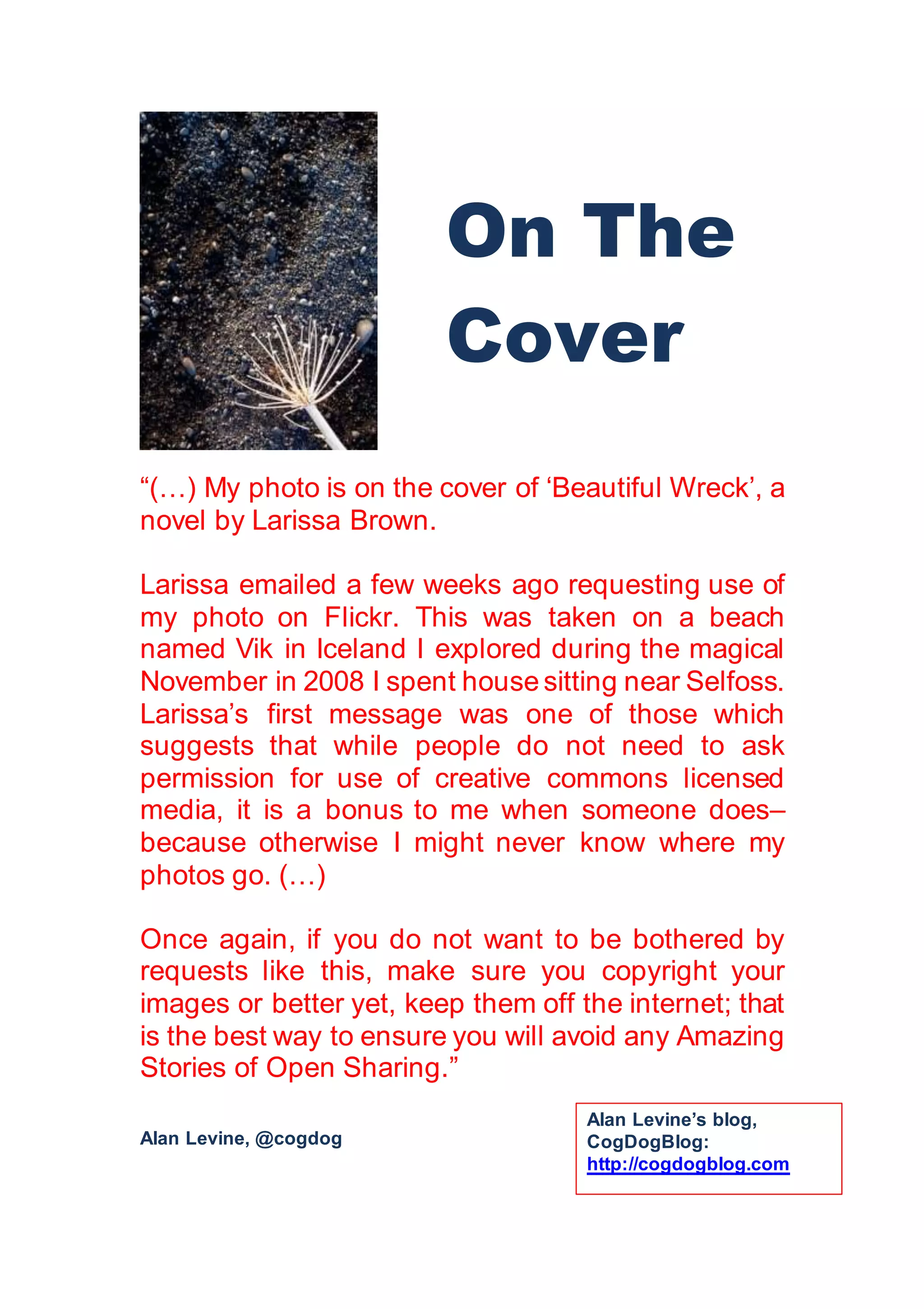
“(…) My photo is on the cover of ‘Beautiful Wreck’, a
novel by Larissa Brown.
Larissa emailed a few weeks ago requesting use of
my photo on Flickr. This was taken on a beach
named Vik in Iceland I explored during the magical
November in 2008 I spent house sitting near Selfoss.
Larissa’s first message was one of those which
suggests that while people do not need to ask
permission for use of creative commons licensed
media, it is a bonus to me when someone does–
because otherwise I might never know where my
photos go. (…)
Once again, if you do not want to be bothered by
requests like this, make sure you copyright your
images or better yet, keep them off the internet; that
is the best way to ensure you will avoid any Amazing
Stories of Open Sharing.”
Alan Levine, @cogdog
On The
Cover
Alan Levine’s blog,
CogDogBlog:
http://cogdogblog.com
Photo Credit: Thoughts on a Black Sand Beach, by Alan Levine [CC BY-
SA 2.0] https://flic.kr/p/5DNzxB
Edited text from Alan’s blog post ‘On The Cover’ [CC BY-SA 3.0]
http://cogdogblog.com/2014/05/14/on-the-cover/
Statistics 2600 at Byron High
School
“Open Source Course:
In most courses, teachers use a reference textbook
combined with their own material to teach. In some
courses, teachers or teacher teams develop their own
materials instead of a textbook, but those materials are
usually private or unable to be shared openly due to
copyright restrictions connected to how they were made.
This course has been fully developed from scratch without
such restrictions and is released free on the web for any
teacher or student to use or remix. As a result, I do not treat
this curriculum as "mine" -- it belongs to the class and to the
world. This also means that I encourage and expect you to
contribute to its development and improvement. This
occurs in a significant way through the "Course
Improvement (CI)" project where, in teams, you either build
a new learning module or target an existing module for
major improvements. This also occurs in small ways
though day-to-day feedback, generating new ideas, and
improving practice problems and solutions.”
Andy Pethan, Math educator at Byron High School, Minnesota, US
Byron High School:
http://www.byronhs.new.rschooltoday.com
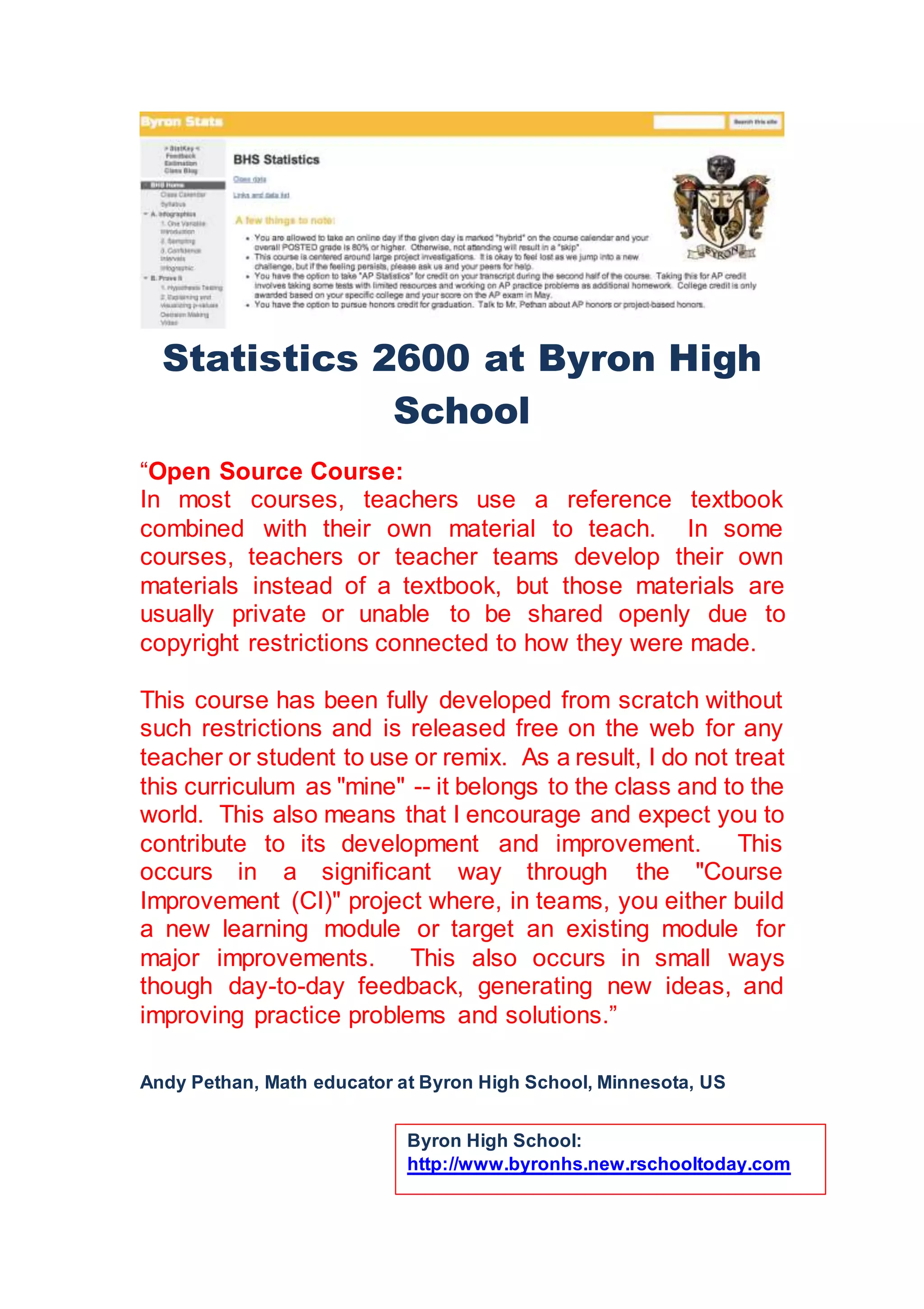
Image Credit: Screenshot of BHS Statistics 2600 Course homepage,
https://sites.google.com/a/byron.k12.mn.us/stats7g/
Extract from BHS Statistics 2600 Course Syllabus [CC BY-SA 3.0]
https://sites.google.com/a/byron.k12.mn.us/stats4g/home/syllabus
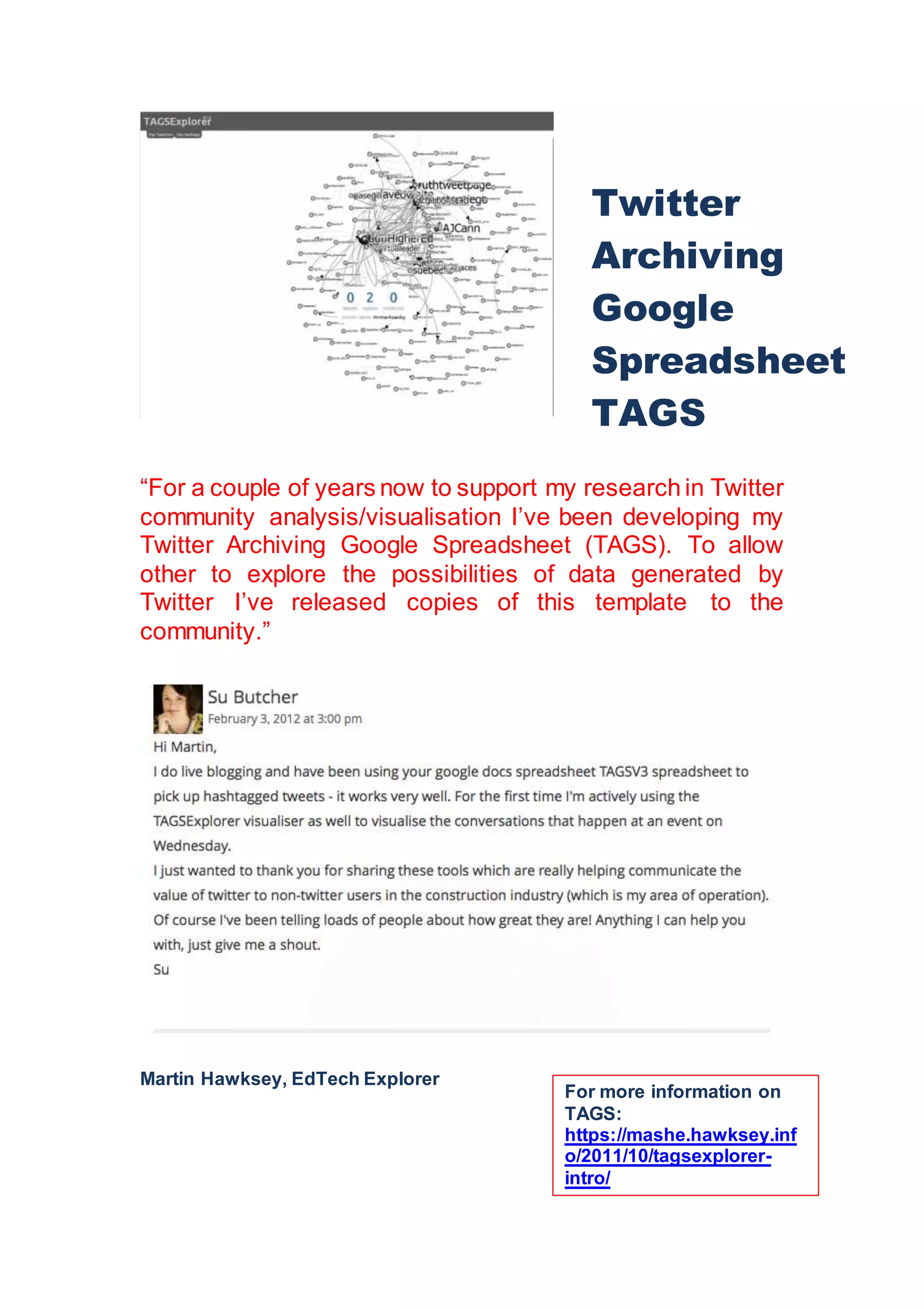
“For a couple of years now to support my research in Twitter
community analysis/visualisation I’ve been developing my
Twitter Archiving Google Spreadsheet (TAGS). To allow
other to explore the possibilities of data generated by
Twitter I’ve released copies of this template to the
community.”
Martin Hawksey, EdTech Explorer
Twitter
Archiving
Google
Spreadsheet
TAGS
For more information on
TAGS:
https://mashe.hawksey.inf
o/2011/10/tagsexplorer-
intro/
Image Credit: TAGSExplorer ALT-C 2014, by Martin Hawksey [CC BY 3.0]
https://mashe.hawksey.info/2011/10/tagsexplorer-intro/
Text from Martin Hawksey’s blog post ‘Twitter Archiving Google
Spreadsheet TAGS v5’ [CC BY 3.0]
https://mashe.hawksey.info/2013/02/twitter-archive-tagsv5/
and comment by Su Butcher on Martin’s post ‘Twitter Archiving Google
Spreadsheet TAGS v3’ [CC BY 3.0]
https://mashe.hawksey.info/2012/01/twitter-archive-tagsv3/
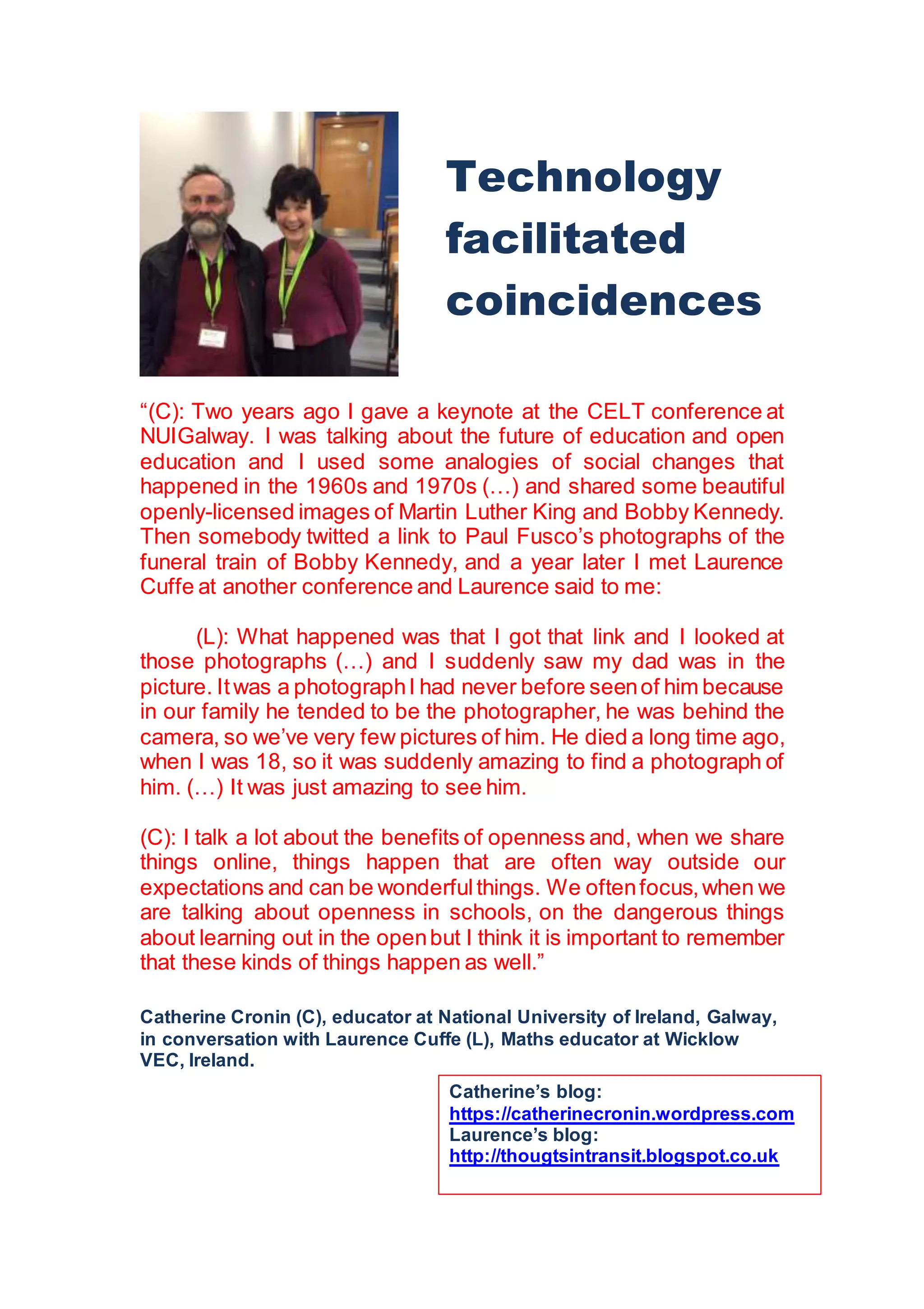
“(C): Two years ago I gave a keynote at the CELT conference at
NUIGalway. I was talking about the future of education and open
education and I used some analogies of social changes that
happened in the 1960s and 1970s (…) and shared some beautiful
openly-licensed images of Martin Luther King and Bobby Kennedy.
Then somebody twitted a link to Paul Fusco’s photographs of the
funeral train of Bobby Kennedy, and a year later I met Laurence
Cuffe at another conference and Laurence said to me:
(L): What happened was that I got that link and I looked at
those photographs (…) and I suddenly saw my dad was in the
picture. Itwas a photographI had never before seenof him because
in our family he tended to be the photographer, he was behind the
camera, so we’ve very few pictures of him. He died a long time ago,
when I was 18, so it was suddenly amazing to find a photograph of
him. (…) It was just amazing to see him.
(C): I talk a lot about the benefits of openness and, when we share
things online, things happen that are often way outside our
expectations and can be wonderfulthings. We oftenfocus,when we
are talking about openness in schools, on the dangerous things
about learning out in the openbut I think it is important to remember
that these kinds of things happen as well.”
Catherine Cronin (C), educator at National University of Ireland, Galway,
in conversation with Laurence Cuffe (L), Maths educator at Wicklow
VEC, Ireland.
Technology
facilitated
coincidences
Catherine’s blog:
https://catherinecronin.wordpress.com
Laurence’s blog:
http://thougtsintransit.blogspot.co.uk
Edited transcript from audio produced by Dave and Finn from the Youth
Media Team at CESI Conference, Galway 2014 [CC BY-SA 4.0 via
AudioBoom] “Technology Facilitated Coincidences”
https://audioboom.com/boos/1959015-technology-facillitated-
coincidences?utm_campaign=Listly&utm_medium=list&utm_source=lis
tly
TellMeScotland
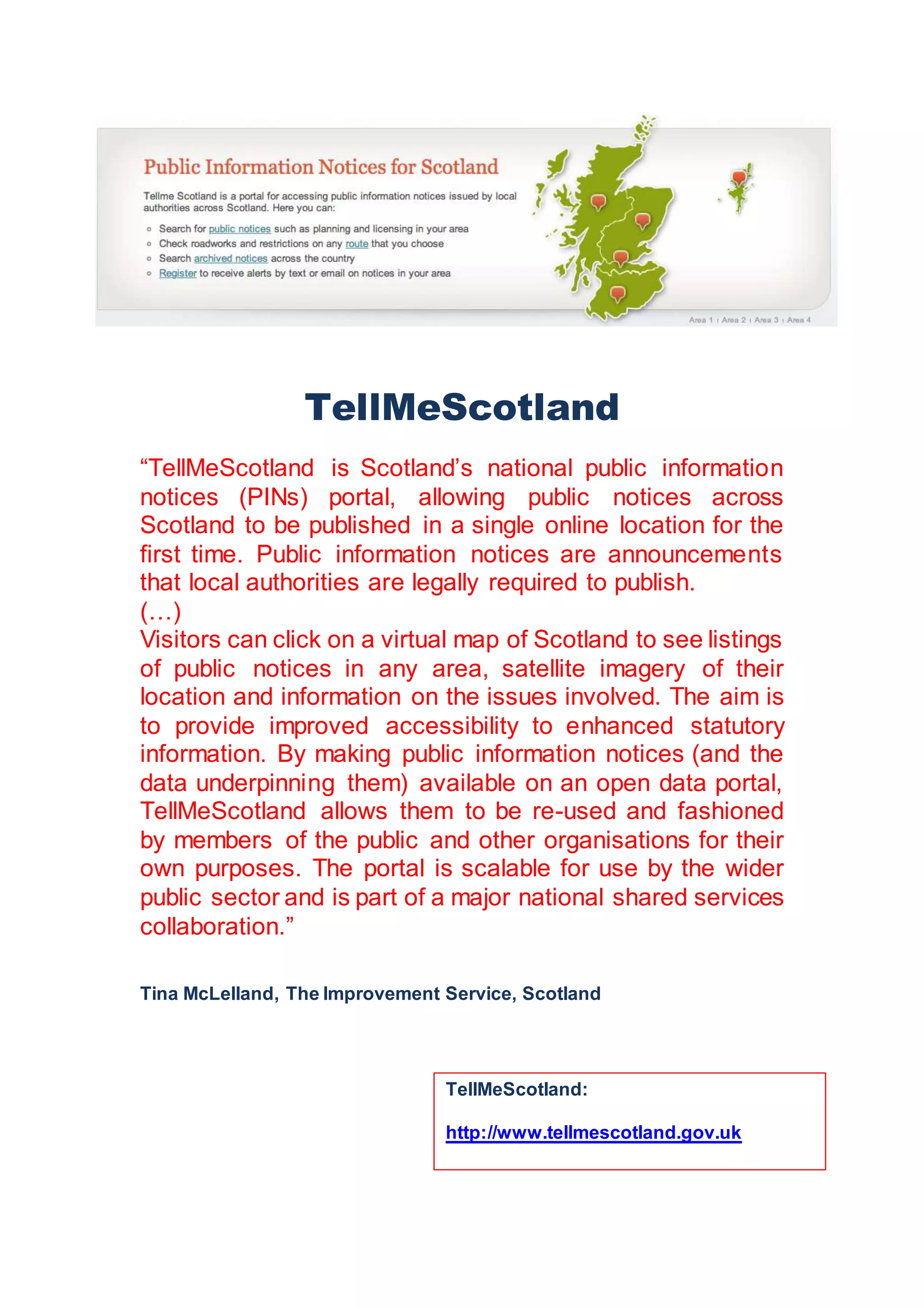
“TellMeScotland is Scotland’s national public information
notices (PINs) portal, allowing public notices across
Scotland to be published in a single online location for the
first time. Public information notices are announcements
that local authorities are legally required to publish.
(…)
Visitors can click on a virtual map of Scotland to see listings
of public notices in any area, satellite imagery of their
location and information on the issues involved. The aim is
to provide improved accessibility to enhanced statutory
information. By making public information notices (and the
data underpinning them) available on an open data portal,
TellMeScotland allows them to be re-used and fashioned
by members of the public and other organisations for their
own purposes. The portal is scalable for use by the wider
public sector and is part of a major national shared services
collaboration.”
Tina McLelland, The Improvement Service, Scotland
TellMeScotland:
http://www.tellmescotland.gov.uk
Image Credit: Screenshot of TellMeScotland homepage,
http://www.tellmescotland.gov.uk
Extract from blog post ‘Introducing TellMeScotland, Scotland’s open
data portal for public information notices’ by Lee Bunce, Open
Knowledge Scotland [CC BY]
http://scot.okfn.org/2013/08/29/introducing-tellmescotland-scotlands-
open-data-portal-for-public-information-notices/

Thinking About Open: "What is Open?"

  • 1.
    “Open means manythings … open can mean open enrollment [e.g. MOOCs]; that you break down the barrier of who can take or can’t take a class. An entirely different kind of open is around open source and open to innovate on. To share... That’s more an intellectual properly thing: the ability to share and the intellectual enterprise. And then I think, much like in the open source movement, there’s also a … there’s a lot of confusion around the word open and also a lot people, when things are free, they conflate that with open. And so I thinkthat the short answer is that open means many different things to many different people…” Richard Baraniuk Professor of Electrical and Computer Engineering and Founder/Director of OpenStax College and OpenStax CNX (formerly Connexions) What does openness mean to you? OpenStax College is based at Rice University, Houston and produce peer reviewed open textbooks Find out more: http://openstaxcollege.org
  • 2.
    Photo Credit: ByNicole Allen (SPARC) [CC BY 4.0 via Wikimedia Commons] http://commons.wikimedia.org/wiki/File%3ARichard_Baraniuk_at_the_S PARC_2014_OA_Meeting_-_DSC00777_(cropped).JPG Quotation from video produced by the OER Research Hub [CC BY 4.0 via YouTube] “What does openness mean to you?” (Connexions Conference, April 2013) #oerrhub http://youtu.be/TDRQIBZh7IQ
  • 3.
    “Openness means thatI’m willing to share and others are willing to share. And that as much as we possibly can, we take our egos out of this and we work collaboratively for the end all. Which in an educational setting the end all is student learning. So, I got involved with OER because of cost savings for students, and I’m still strongly there with cost savings for students, but what I’ve found is the unintended consequence … was that student learning improved because of the fact that others could repurpose, others could use. We’re now studying success rates; I am making no claims at all about success rates going up with openness… [But] what I do know is that they have not gone down… But the openness part … I think it’s a trend of faculty starting to collaborate more … Community College faculty tend to work in silos, we don’t have that many grants, most of us don’t publish. So we just go in and we teach, we do our stuff and then we go back. What I’ve seen is that more faculty are willing to share materials … we’re able to work together for improvements… I’ve seen departments get together and write the textbooks for their students, and so they all have ownership in this and when you’re all vested in this then you all want to use it.” Barbara Illowsky Co-author of open textbook Collaborative Statistics and Professor of Math and Statistics at De Anza Community College, California What does openness mean to you?
  • 4.
    Photo Credit: http://faculty.deanza.edu/illowskybarbara/ Quotationfrom an interview conducted in November 2013 by Beck Pitt for the OER Research Hub [CC BY 4.0] https://methylatedorange.wordpress.com/2014/01/07/its-a-wild-ride- barbara-illowsky-on-the-journey-of-collaborative-statistics/
  • 5.
    “So, why didwe choose to write this particular open textbook using this particular method? A number of reasons. First, the sprint method has a set deadline with a set outcome. The combination of strict deadline with a concrete outcome at the end of that deadline provided momentum to keep the project moving forward over the four days… Second, the sprint offers a great opportunity to begin developing a community around the textbook. Sustainability is always an issue with the development of open educational resources; how will these resources be maintained in the future? One of the sustainability models that we think has the most potential is a model of community stewardship where a group of educators who use the book take ownership of the book. The intense nature of the sprint provides a great opportunity to begin to develop this community by bringing together a group of faculty from across institutions interested in not only creating, but also adopting what they create. Moving forward, we hope this group of authors will form the nucleus of the community that can steward this textbook…” Clint Lalonde Manager of Open Education, BCcampus, Vancouver SPRINT! Rapid authoring of open content BCcampus Open Textbook Project are creating 40 open textbooks for (re-)use in British Columbia and beyond… Find out more: http://bccampus.ca/open- textbook-project/
  • 6.
    Photo Credit: CC-BY4.0 Adam Hyde, Booksprints http://tinyurl.com/lnom3h4 Clint Lalonde (right) with Amanda Coolidge Quotation from Clint’s blog post Clint Lalonde (BCcampus): Reflections on an Open Textbook Sprint [CC BY 4.0] http://oerresearchhub.org/2014/07/02/clint-lalonde-bccampus- reflections-on-an-open-textbook-sprint/
  • 7.
    “It is adark June morning in Montevideo, and as usual he does not know which bus to catch. Signposts are not very helpful, particularly if you are young and a newcomer to the capital city. Locals and bus drivers usually tell him where to get off the bus, but sometimes they forget. He used to write down addresses and bus numbers on small pieces of paper, which he was used to lose. This morning he lost those little pieces of paper again. It was enough. He decided he would do something about it. Later, at night, he went online and found some data published about Montevideo’s public transport system, and also geographical datasets. Things startedto get in motion. A couple of weeks later, working mostly in his free time, he designed an application that would help everyone with a smart phone to figure out how to navigate the city public transport system. Later on, he teamed up with friends who were experts in design and usability and in two months, a beautiful and usable open data application named GxBus was born. There were no authorities involved, no access to information requests, just a[n] Issue, creativity and a public dataset. More than 11500 users have registered so far and 5500 installation are still active in Ios and Android…” Open Cities: The case of Montevideo (p.4) Catching a Bus in Montevideo, Uruguay Find out more about GxBus: https://youtu.be/P6h9YXU6ZLs
  • 8.
    Open Cities: Thecase of Montevideo (Scrolini, F. 2014) Report available: http://www.opendataresearch.org/content/2014/662/open-cities-case- montevideo (via Open Data Research Network. Accessed: 16 March 2015) [CC BY SA 2.5 South Africa License] Photo Credit: Public Domain via Wikipedia http://en.wikipedia.org/wiki/Montevideo (accessed: 16 March 2015) DID YOU KNOW? “Montevideo was the first city in Latin America to establish an open government data policy…” Read more in this Open Data Research Network blog post: http://tinyurl.com/muz36v8
  • 9.
    “Al Jazeera: SharingContent for a Richer Understanding of Global News” “In 2009, Al Jazeera launched the world’s first repository of broadcast- quality video footage released under a Creative Commons license. The news network made select video footage available for free under CC BY to be downloaded, shared, remixed, subtitled and even rebroadcast by users and TV stations across the world, under the condition that they attribute the material to Al Jazeera. “A large part of embracing free culture is accepting the fact that you are forsaking control in exchange for something greater – the empowerment of the creative community,” says Mohamed Nanabhay, head of online at Al Jazeera English. Soon after the network posted the first CC videos, “surprising and delightful” things started happening. “Educators, filmmakers, videogame developers, aid agencies and music video producers all used and built upon our footage,” says Nanabhay. While the content has proven valuable to others, what has its openness meant for Al Jazeera? Nanabhay says that increasing the availability and usability of Al Jazeera’s content has resulted in more viewers, especially ones from parts of the world that aren’t able to watch the network’s programming on TV. The numbers have been impressive. According to Nanabhay, traffic on Al Jazeera’s CC video repository increased 723 percent after footage of the Egyptian uprising was made available under Creative Commons.” “Al Jazeera: Sharing Content for a Richer Understanding of Global News” Creative Commons: The Power of Open For more great examples of where Creative Commons licensing has made a difference check out Creative Commons: The Power of Open: http://thepowerofopen.org/
  • 10.
    Quotation from “AlJazeera: Sharing Content for a Richer Understanding of Global News” in Creative Commons: The Power of Open [CC-BY 3.0] http://thepowerofopen.org/
  • 11.
    “(…) My photois on the cover of ‘Beautiful Wreck’, a novel by Larissa Brown. Larissa emailed a few weeks ago requesting use of my photo on Flickr. This was taken on a beach named Vik in Iceland I explored during the magical November in 2008 I spent house sitting near Selfoss. Larissa’s first message was one of those which suggests that while people do not need to ask permission for use of creative commons licensed media, it is a bonus to me when someone does– because otherwise I might never know where my photos go. (…) Once again, if you do not want to be bothered by requests like this, make sure you copyright your images or better yet, keep them off the internet; that is the best way to ensure you will avoid any Amazing Stories of Open Sharing.” Alan Levine, @cogdog On The Cover Alan Levine’s blog, CogDogBlog: http://cogdogblog.com
  • 12.
    Photo Credit: Thoughtson a Black Sand Beach, by Alan Levine [CC BY- SA 2.0] https://flic.kr/p/5DNzxB Edited text from Alan’s blog post ‘On The Cover’ [CC BY-SA 3.0] http://cogdogblog.com/2014/05/14/on-the-cover/
  • 13.
    Statistics 2600 atByron High School “Open Source Course: In most courses, teachers use a reference textbook combined with their own material to teach. In some courses, teachers or teacher teams develop their own materials instead of a textbook, but those materials are usually private or unable to be shared openly due to copyright restrictions connected to how they were made. This course has been fully developed from scratch without such restrictions and is released free on the web for any teacher or student to use or remix. As a result, I do not treat this curriculum as "mine" -- it belongs to the class and to the world. This also means that I encourage and expect you to contribute to its development and improvement. This occurs in a significant way through the "Course Improvement (CI)" project where, in teams, you either build a new learning module or target an existing module for major improvements. This also occurs in small ways though day-to-day feedback, generating new ideas, and improving practice problems and solutions.” Andy Pethan, Math educator at Byron High School, Minnesota, US Byron High School: http://www.byronhs.new.rschooltoday.com
  • 14.
    Image Credit: Screenshotof BHS Statistics 2600 Course homepage, https://sites.google.com/a/byron.k12.mn.us/stats7g/ Extract from BHS Statistics 2600 Course Syllabus [CC BY-SA 3.0] https://sites.google.com/a/byron.k12.mn.us/stats4g/home/syllabus
  • 15.
    “For a coupleof years now to support my research in Twitter community analysis/visualisation I’ve been developing my Twitter Archiving Google Spreadsheet (TAGS). To allow other to explore the possibilities of data generated by Twitter I’ve released copies of this template to the community.” Martin Hawksey, EdTech Explorer Twitter Archiving Google Spreadsheet TAGS For more information on TAGS: https://mashe.hawksey.inf o/2011/10/tagsexplorer- intro/
  • 16.
    Image Credit: TAGSExplorerALT-C 2014, by Martin Hawksey [CC BY 3.0] https://mashe.hawksey.info/2011/10/tagsexplorer-intro/ Text from Martin Hawksey’s blog post ‘Twitter Archiving Google Spreadsheet TAGS v5’ [CC BY 3.0] https://mashe.hawksey.info/2013/02/twitter-archive-tagsv5/ and comment by Su Butcher on Martin’s post ‘Twitter Archiving Google Spreadsheet TAGS v3’ [CC BY 3.0] https://mashe.hawksey.info/2012/01/twitter-archive-tagsv3/
  • 17.
    “(C): Two yearsago I gave a keynote at the CELT conference at NUIGalway. I was talking about the future of education and open education and I used some analogies of social changes that happened in the 1960s and 1970s (…) and shared some beautiful openly-licensed images of Martin Luther King and Bobby Kennedy. Then somebody twitted a link to Paul Fusco’s photographs of the funeral train of Bobby Kennedy, and a year later I met Laurence Cuffe at another conference and Laurence said to me: (L): What happened was that I got that link and I looked at those photographs (…) and I suddenly saw my dad was in the picture. Itwas a photographI had never before seenof him because in our family he tended to be the photographer, he was behind the camera, so we’ve very few pictures of him. He died a long time ago, when I was 18, so it was suddenly amazing to find a photograph of him. (…) It was just amazing to see him. (C): I talk a lot about the benefits of openness and, when we share things online, things happen that are often way outside our expectations and can be wonderfulthings. We oftenfocus,when we are talking about openness in schools, on the dangerous things about learning out in the openbut I think it is important to remember that these kinds of things happen as well.” Catherine Cronin (C), educator at National University of Ireland, Galway, in conversation with Laurence Cuffe (L), Maths educator at Wicklow VEC, Ireland. Technology facilitated coincidences Catherine’s blog: https://catherinecronin.wordpress.com Laurence’s blog: http://thougtsintransit.blogspot.co.uk
  • 18.
    Edited transcript fromaudio produced by Dave and Finn from the Youth Media Team at CESI Conference, Galway 2014 [CC BY-SA 4.0 via AudioBoom] “Technology Facilitated Coincidences” https://audioboom.com/boos/1959015-technology-facillitated- coincidences?utm_campaign=Listly&utm_medium=list&utm_source=lis tly
  • 19.
    TellMeScotland “TellMeScotland is Scotland’snational public information notices (PINs) portal, allowing public notices across Scotland to be published in a single online location for the first time. Public information notices are announcements that local authorities are legally required to publish. (…) Visitors can click on a virtual map of Scotland to see listings of public notices in any area, satellite imagery of their location and information on the issues involved. The aim is to provide improved accessibility to enhanced statutory information. By making public information notices (and the data underpinning them) available on an open data portal, TellMeScotland allows them to be re-used and fashioned by members of the public and other organisations for their own purposes. The portal is scalable for use by the wider public sector and is part of a major national shared services collaboration.” Tina McLelland, The Improvement Service, Scotland TellMeScotland: http://www.tellmescotland.gov.uk
  • 20.
    Image Credit: Screenshotof TellMeScotland homepage, http://www.tellmescotland.gov.uk Extract from blog post ‘Introducing TellMeScotland, Scotland’s open data portal for public information notices’ by Lee Bunce, Open Knowledge Scotland [CC BY] http://scot.okfn.org/2013/08/29/introducing-tellmescotland-scotlands- open-data-portal-for-public-information-notices/