DePauw University
Think Dirty #BuyClean
If it’s on your skin, it’s in your body
Katie Stack, Billy McClamroch, Paige Bixler, Peter Gorman
COMM 325A: Health Campaign Final Paper
Professor Kent Menzel
May 16th, 2016
The primary objective of the Think Dirty #BuyClean campaign is to increase awareness
among DePauw students of the harmful chemicals found in our everyday personal hygiene
products and cosmetics. We believe that building this awareness is increasingly important for
college students who are still relatively new to living on their own and living on a budget.
1
DePauw students in particular have limited options of products on campus and in the
community. We believe that most students buy the cheapest and most convenient products
available to them, without knowing which products contain potentially toxic chemicals. As a
result, we all carry toxic industrial chemicals inside our bodies. Yet, many of the chemicals
found in cosmetics are absorbed by the skin into the body, and can be detected in blood, urine,
and saliva.
Our campaign utilizes the hashtag #BuyClean and was inspired by a free iPhone app
called Think Dirty. Over Winter Break, Katie downloaded the app and scanned all of her
personal care products. In total disbelief, she was confronted with the fact that most of the
products that she had been using for years contained dangerous chemicals that had alarming links
to cancer and reproductive/ developmental health problems. She could not believe that the
general population was unaware of the potential harms. Shockingly, “1 of every 3 women and 1
of every 12 men aged 18-25 years old are exposed to ingredients that are known or probable
human carcinogens through their use of personal care products” (Thornton 2015). Human
carcinogen is a substance capable of causing cancer in living tissue.
The app, which was launched in 2013, was created by Lily Tse to expose the truths of the
beauty industry. In her mission statement on the Think Dirty website, Lily explains that she was
motivated by Annie Leonard’s Story of Cosmetics to “empower and educate consumers on the
cosmetics industry by allowing them to make informed decisions on what products to purchase.”
Lilly notes that she hopes Think Dirty will be more than just an app, and instead lead to a
consumer revolution.
Our campaign is necessary because most DePauw students are uninformed about the
chemicals put in our everyday products. The European Union takes a much stricter stance on
2
regulating hazardous chemicals in products than the FDA. The EU has currently banned 1,328
chemicals from being sold in Europe, but the FDA has only restricted 11 to date. We were
discouraged to learn that one of the ingredients in Cover Girl’s Waterproof Mascara is also in Dr.
Scholl’s wart remover. The EU has banned both products from being sold in Europe because of
their potential long term risks, but they both are very popular in the US.
The Breast Cancer Fund, which recently partnered with Think Dirty, informs readers,
through an online article titled “Chemicals in Cosmetics”, that many ingredients in our products,
“are also used in industrial manufacturing processes to clean industrial equipment, stabilize
pesticides and grease gears” (Bulski 2015). The author of the article adds, “We can all agree that
an ingredient that effectively scours a garage floor may not be the best choice for a facial
cleanser.”
Since the FDA takes such a relaxed position on regulating potentially hazardous
products, independent groups such as the Environmental Working Group have taken on the
challenge of researching harmful products and informing citizens. The Environmental Working
Group states that, “Nearly four hundred products sold in the U.S., such as Crest Whitestrips and
Neutrogena daily face cream, contain chemicals banned in Japan, Canada, and the EU.”
Additionally, “Ninety-eight percent of all products assessed (in the US) contained one or more
ingredients never tested for safety” (Thornton 2015).
To gauge how big of a problem this is on our campus, we decided to scan some of our
roommates’ products with the Think Dirty app. Out of the 14 products scanned, 13 of them had a
9 or a 10 rating on the “Dirty Meter”, meaning the product’s ingredients have potential serious
negative long term health effects. Only one of the roommates’ products tested had a 5 rating on
the app’s meter, indicating that the product’s ingredients have potential moderate negative long-
3
term health effects. We can only imagine how many potentially dangerous products fill the
dorms of our campus, which is why our health campaign is dedicated to a healthier campus
environment.
We believe that as a society, we’ve started watching what we put in our bodies, but we
haven’t started watching what we put on our skin. DePauw University switched to Bon Appetit
partly because Bon Appetit offers local, fresh, and authentic food. Yet, DePauw sells potentially
harmful body washes and deodorants in the Den. Dangerous chemicals in everyday products has
not yet become a topic of local or national criticism, and our group wants to change that. We
believe that we will all be thankful down the road if we start making small consumer changes
with our daily routines. Most people, if they knew that certain products posed serious health
risks, would probably pay a few dollars more to buy cleaner products. Consequently, if enough
people made these small consumer changes, then certain products would no longer be able to
survive on the shelves of our stores.
So how do we get DePauw students to change their consumer habits and buy cleaner
products? Our campaign will target, in general, the DePauw community, specifically college
undergraduate students, ages ranging from 18 to 25 years old in males and females. While
college students are one of the top targeted marketing audiences, they can also be one of the most
difficult to reach because of their fast-paced and simple behaviors/attitudes.Through our
#BuyClean campaign, our group will tackle this challenge by increasing awareness on campus
and encouraging students, through a multimedia approach, to buy clean.
The average female college student uses 12 products containing 168 “unique” ingredients
everyday, while the average male college student uses 6 products containing 85 unique
ingredients everyday. According to the Norwegian Institute of Public Health, “formaldehyde,
4
parabens, sodium lauryl and synthetic fragrance traces were found in 567 out of the 792 cosmetic
products tested that college students use on a daily basis” (Thornton 2015). All of these toxic
traces found in these cosmetic products that college students use - formaldehyde, parabens,
sodium lauryl and synthetic fragrance – are all banned/regulated in the EU, yet not one of these
are banned/regulated by the FDA. It’s become almost the social norm to read a menu that lists
precisely what ingredients are in our foods, but students are nearly never concerned about what
goes on their skin. Earth-to-face beauty products continue to grow in popularity, but college
students aren’t interested in reading labels of every product they use, let alone wanting to know
the correct chemicals/ingredients that are harmful in them.
Marketing to college students poses a special set of challenges. The Millennial generation
is full of college students who are often skeptical, cash-strapped, and their lives are fast-paced,
making it difficult to bring awareness about harmful chemicals and ingredients in the products
they use. A typical college student eats, sleeps, and goes to class, studies and parties on the
weekends. They simply aren’t motivated or invested in looking for the safest product out there
for them. Most college students are living on their own for the first time and have established
their daily shopping routines, not even considering that human carcinogens can be present in the
products they use. Therefore, we must educate college students on the types of ingredients, what
they do, and how they can be harmful to their bodies. They are (1) unaware of all the harmful
toxins and chemicals in these products, and (2) aren’t motivated enough to read the ingredients in
the products they normally buy, so how do we effectively attract and market to college students
at DePauw?
Our campaign will target our audience by having personal testimonies by “real” people
who have experienced issues with cosmetic products such as rashes. Our audience will be more
5
likely to reconsider their purchases if these personal testimonies come from their classmates and
friends. It’s all about targeted marketing strategies and catering to young college students. The
“personal fable” belief that du Pre talks about says that adolescents often believe they are unlike
other people and that others do not understand them. Consequently, they are likely to assume that
health warnings such as toxic chemicals in cosmetic products don’t apply to them, because they
perceive themselves as being young and invincible.
College students, who do not spend time investigating the ingredients of products before
purchasing them, do however spend a great deal of time on social media – sharing and receiving
information from their friends, family, and community. The hot topic currently on social media
is about the burning, red armpit rashes caused by Old Spice scented deodorant. Justin Ko, M.D.,
Director of Medical Dermatology at Stanford Health care says, “the reactions these men are
experiencing can be contact dermatitis, a condition caused by an allergy or irritating substance.
Any deodorant or antiperspirant can trigger a reaction like that because fragrances used in
deodorants have aluminum-based compounds in them” (Eaves 2016). Looking back at an Old
Spice deodorant product, the “drug facts” on the back of the deodorant stick says “aluminum
zirconium trichlorohydrex Gly 17%.” What does this mean? One can guarantee that almost every
college student reading the drug facts of Old Spice wouldn’t have a clue what it means, let alone
know if it is harmful to their bodies or not. This information is especially important for our
campaign because Old Spice deodorant is currently the only deodorant sold to students in the
Den, leaving some students on our campus with only two options: use Old Spice deodorant or
use no deodorant at all.
Our Think Dirty #BuyClean campaign has many messages/goals that we want to display
to the DePauw’s campus. Our overall goal is to overwhelm the campus with the idea of buying
6
clean products. In order to do this we have come up with messages that we believe will be the
most successful for the culture we have here on DePauw’s campus.
We have three main goals for our campaign. The first is to raise awareness among
students of the hazardous chemicals that are in many of their products. Similar to the first goal,
our second goal is to change consumer habits on DePauw’s campus. In order to measure these
first two goals, we will provide a survey before and after our campaign. We believe that doing a
survey before and after will provide us with accurate statistics to let us know the success our
campaign is having. Our third goal for our campaign is to pressure DePauw to sell cleaner
products on campus. We will specifically focus on stores such as the Den, because of how
accessible it is for students to use their student ID swipes to get everyday products. Additionally,
students who do not have cars rely on the Den to buy all of their personal care products. In order
to measure this goal, we plan to take inventory of the campus stores at the end of our campaign
in order to see if they are supplying healthier products. We plan to accomplish these goals
through several messages we will display to our audience.
When selecting channels of communication for the Think Dirty #BuyClean campaign, the
message, audience, and goals of the campaign need to be taken under consideration. Our multi
channel campaign efforts aim to encompass word-of-mouth, iconic verbal messages, print, and
electronic channels of communication to increase awareness among DePauw Students.
Research has shown that organizations that transmit information through multiple devices
have elicited a greater response than those who chose to transmit information via one device
(Berger 577). This process of transmittance is known as communicating through channels. The
channel that is communicated to the public can affect how the message is perceived.
Multichannel approaches are effective because people have different communication patterns
7
and preferences. A multichannel approach will also increase the reach of our messages by
utilizing channels that are receptive of our target audience.
We plan to use the Elaboration Likelihood Model when choosing effective channels. This
model proposes that when we are highly involved with a message, we pay close attention to
details and evaluate their messages thoroughly. High-involvement channels help people pay
closer attention and affects how much they are influenced by the information. The word-of-
mouth communication channel is an effective channel to use because it is highly interactive.
High involvement channels help people pay closer attention and affects how much they are
influenced by the information.
Electronic channels of communication are a second form of the Elaboration Likelihood
Model. According to the Millennial Generation, the U.S. has 21-million college students who are
the tech-savvy trendsetters and who are the largest consumer group in U.S. history (Searcey 1).
Modern day college students grew up with the advent of the Internet. They spend hours at a time
studying online, surfing the net, and socializing with their friends. Since our target audience is
DePauw college students, our campaign will use electronic channels. This is also an effective
channel because it can develop social pressure. Students will make decisions by considering the
interplay of factors such as their environment and social approval.
The third communication channel that our campaign plans to use is iconic verbal
messages because they are specific to our target audience. Theses are bold symbols that we see
everyday. DePauw students often use iconic verbal messages to decorate campus with sidewalk
chalk, paint sheet signs to promote groups and events, or place stickers on water bottles and
laptops to identify with a movement. This is a channel that will be seen frequently, as students
walk to class everyday. We plan to use iconic verbal messages because it has proven receptive to
8
DePauw students in the past. In addition this will be an effective message because DePauw’s
campus is so small and iconic verbal messages are easily disseminated among small audiences.
Lastly, we plan to use printed channels of communication in our campaign. These will be
effective because individuals have the power to go back and reabsorb the message that they
previously received through the word-of-mouth channel. Print media such as the campus
newspaper, posters, and informational bulletins have received student reception in the past.
In addition, we aim to utilize the Diffusion of Innovations Theory in our campaign
efforts. This is the process through which new information is filtered and passed along
throughout a community. Research has shown that community members are opinion leaders who
have credibility from their expertise and social standing. This shows that media messages can
influence people indirectly, whether or not they use the media. The Think Dirty #BuyClean
campaign plans to utilize this theory by incorporating representatives from Greek houses and
groups on campus. This will help instill the social cognitive theory, which states that people
make decisions by considering the interplay of internal factors, such as environment and social
approval. By making these healthy behaviors socially acceptable, our campaign will be able to
change consumer habits of DePauw students.
In order to achieve the Think Dirty #BuyClean campaign goals, channels selected need to
reach as many people in the DePauw community as possible, be specific to our target audience,
and cause students to change their consumer habits for the betterment of their health. By utilizing
a multichannel approach, the elaboration likelihood model, and the diffusion of innovations
theory when selecting the most effect channel to use, there is a greater likelihood of students
encountering the messages directly or indirectly. The mediated channels of print, iconic verbal
messages, and electronic communication will be effective mediums to disseminate information
9
to a large amount of people. However, our interpersonal reinforcement and social pressure
strategies such as using word-of-mouth channels will help achieve our overall goal of stimulating
the target audience to change their behaviors. Next, our health campaign will be discussing the
eight (8) messages that we plan to use to raise awareness among students, change consumer
habits and pressure DePauw to sell cleaner products.
Social Media: Facebook
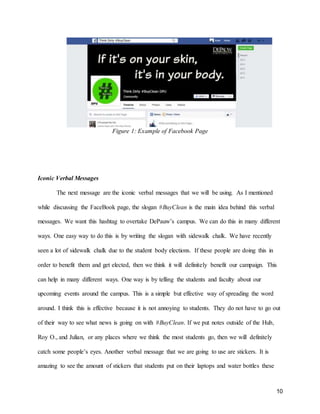
The very first part of our campaign is our FaceBook page. This is where we are going to
first get our ideas out there to the students and faculty of DePauw. We will do this in many ways.
One of the first actions we will do is put videos up on the page of what you can do in order to
change. We will also create an event page. This event page will list out all of the possible events
that are happening on campus relating to Think Dirty #BuyClean. We want to be as open to the
campus so that we can reach out to the most people possible. Another way we are going to try to
make our FaceBook page more popular is by giving the audience rewards and prizes for giving
our campaign some attention. For example, if you go on FaceBook and like our page, then that
person will be given a sticker for their laptop or water bottle. This does not only help the person
who got the sticker, but it also helps our campaign in many ways. It is good advertisement
because that student will have a sticker with them in class or in the library, and other students
will notice it and immediately think what it is all about. This is exactly what we want for our
campaign.
The purpose of this specific FaceBook message is to get the initial word out there for our
campaign. We think that FaceBook is one of the popular social media resources on DePauw’s
campus. Other than Instagram, FaceBook will provide us with a place to launch our ideas and
show the campus the truth behind the products that they use on an everyday basis.
10
Figure 1: Example of Facebook Page
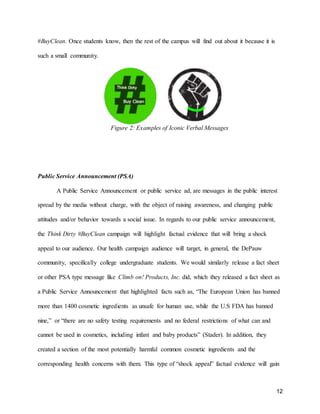
Iconic Verbal Messages
The next message are the iconic verbal messages that we will be using. As I mentioned
while discussing the FaceBook page, the slogan #BuyClean is the main idea behind this verbal
messages. We want this hashtag to overtake DePauw’s campus. We can do this in many different
ways. One easy way to do this is by writing the slogan with sidewalk chalk. We have recently
seen a lot of sidewalk chalk due to the student body elections. If these people are doing this in
order to benefit them and get elected, then we think it will definitely benefit our campaign. This
can help in many different ways. One way is by telling the students and faculty about our
upcoming events around the campus. This is a simple but effective way of spreading the word
around. I think this is effective because it is not annoying to students. They do not have to go out
of their way to see what news is going on with #BuyClean. If we put notes outside of the Hub,
Roy O., and Julian, or any places where we think the most students go, then we will definitely
catch some people’s eyes. Another verbal message that we are going to use are stickers. It is
amazing to see the amount of stickers that students put on their laptops and water bottles these
11
days. And there is no question that when students use their laptops or have their water bottles on
their desk during class that other students get distracted by them. I always catch myself looking
at stickers and trying to figure out what is means or stands for. As I mentioned before, there will
be ways to access a sticker such as liking our FaceBook page, but also we want to give any many
stickers out as possible in order for our campaign to get around campus.
Probably the most important verbal message will be the sheet signs. Sheet signs are
especially popular with sororities and fraternities around campus. Whenever a house has an event
or a message to display to the campus, they most likely will put up a big sheet sign in front of
their house. We want houses to get informed about #BuyClean and so when there is an event,
they will make a sheet sign describing it and having the hashtag placed somewhere on the sign.
Another effective way to get sheet signs involved is by having a competition. We want to
organize a competition between Greek houses and other organizations around campus to see who
can make the best sheet sign on campus involving #BuyClean. The way we will organize and
vote for the winner will be through our FaceBook page. We will put the pictures of every sheet
sign that is in the running on our page. We will let our followers vote on the best one by having
them like the picture of the specific sheet sign. Whoever gets the most likes will win the
competition. The winning house will all get T-shirts and hats that say our slogan, Think Dirty
#BuyClean. This is just another example of how we want the hashtag #BuyClean to be all over
campus.
These messages are specifically attacking the students here at DePauw and trying to
make them actively involved in our campaign. In order for our campaign to be successful, we
need to have the students be informed about our campaign so that they can pass along the idea of
12
#BuyClean. Once students know, then the rest of the campus will find out about it because it is
such a small community.
Figure 2: Examples of Iconic Verbal Messages
Public Service Announcement (PSA)
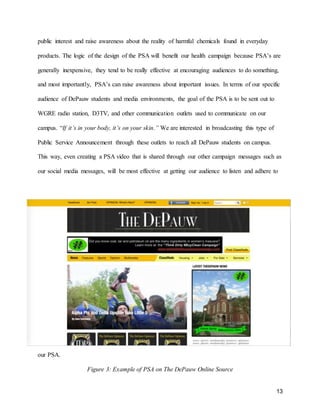
A Public Service Announcement or public service ad, are messages in the public interest
spread by the media without charge, with the object of raising awareness, and changing public
attitudes and/or behavior towards a social issue. In regards to our public service announcement,
the Think Dirty #BuyClean campaign will highlight factual evidence that will bring a shock
appeal to our audience. Our health campaign audience will target, in general, the DePauw
community, specifically college undergraduate students. We would similarly release a fact sheet
or other PSA type message like Climb on! Products, Inc. did, which they released a fact sheet as
a Public Service Announcement that highlighted facts such as, “The European Union has banned
more than 1400 cosmetic ingredients as unsafe for human use, while the U.S FDA has banned
nine,” or “there are no safety testing requirements and no federal restrictions of what can and
cannot be used in cosmetics, including infant and baby products” (Stader). In addition, they
created a section of the most potentially harmful common cosmetic ingredients and the
corresponding health concerns with them. This type of “shock appeal” factual evidence will gain
13
public interest and raise awareness about the reality of harmful chemicals found in everyday
products. The logic of the design of the PSA will benefit our health campaign because PSA’s are
generally inexpensive, they tend to be really effective at encouraging audiences to do something,
and most importantly, PSA’s can raise awareness about important issues. In terms of our specific
audience of DePauw students and media environments, the goal of the PSA is to be sent out to
WGRE radio station, D3TV, and other communication outlets used to communicate on our
campus. “If it’s in your body, it’s on your skin.” We are interested in broadcasting this type of
Public Service Announcement through these outlets to reach all DePauw students on campus.
This way, even creating a PSA video that is shared through our other campaign messages such as
our social media messages, will be most effective at getting our audience to listen and adhere to
our PSA.
Figure 3: Example of PSA on The DePauw Online Source
14
The “Campaign for Safe Cosmetics” coalition, a project of the Breast Cancer Fund,
works to protect the health of consumers, works and the environment through public education
and engagement. The Campaign released a PSA Video about the ugly truth about makeup and
the toxic ingredients in cosmetics. It had approximately 545,000 views and over 4,000 shares.
With this type of public interest that their PSA had, we hope to achieve with ours on DePauw’s
campus. The worthy thing to note is that once the PSA gets into DePauw’s hands, if you will, (or
social media accounts), they are likely to share and talk about the topic, which engages more
interest across other campuses and communities. At some point at the beginning of our
campaign, we want to release the PSA video and broadcast it on WGRE radio station, D3TV, the
DePauw Newspaper, and even the DePauw online blogs/website. This will provide our audience
with factual statistics that will raise public interest about our health campaign. Overall, the goals
of this PSA message is to target our audience, focus on desired media outlets, and gain public
interest, making our Think Dirty #BuyClean health campaign to be in the campus media
spotlight.
Partnership
Another campaign message design for our health campaign is partnering with Greek
houses and other organizations on campus. Our Think Dirty #BuyClean health campaign will
potentially partner with Relay for Life, Timmy Global Health, Environmental Club, the
Women’s Center and most importantly the DePauw Wellness Center/Hendricks Regional Health.
Organizational partnerships are defined as “cooperative, collaborative relationships that exist
between two or more independent organizations to increase administrative efficiency or
programmatic impact through shared, transferred or combined services, resources or programs”
15
(Colby). There are various types of partnerships, such as “cooperation, coordination, or
collaboration. For our health campaign, one of our goals for this message is to have many
organizational partnerships that are a collaboration, meaning expectations and structures are in
place to achieve goals beyond those any individual partner could achieve. When other
organizations on campus share similar missions of trying to achieve the same goals, their
missions and coordinated operations are effective. Relay for Life raises much-needed funds and
awareness to save lives from cancer through their Relay for Life movement, Timmy Global
Health’s mission is to deliver the promise of healthy futures, Environmental Club works to raise
awareness about the environment, and harmful toxic chemicals that destroy it, and the DePauw
Wellness Center tries to reduce healthcare costs and promote wellness for DePauw University
students, faculty, and staff.
The logic of the design of partnering with Greek houses and other organizations is
because there are numerous benefits to partnering with organizations. When having a
collaboration partnership with other organizations, there are new ways to get access to
knowledge, access to people by drawing on a wider pool of networks, effectiveness by creating
more appropriate messages/events, efficiency by reducing costs and delivery systems, and
innovation by developing unexpected or new ways of addressing old issues and evolving
complex challenges. DePauw has rich and long-standing traditions of Fraternity and Sorority
Life on campus and being over 70% Greek, so another ideal partnership that would fit with our
campaign would be to partner with these Greek houses/ organizations. Ideally, we would want to
have a representative that is either passionate or interested in our health campaign to be their
Greek organizations representative, which will help with communication, effectiveness, and
efficacy. End7, a campaign of the Global Network for Neglected Tropical Diseases, brings
16
awareness and fights to end Neglected Tropical Diseases (NTDs) in the world’s poorest
countries. Their campaign solely relies on “campus representatives” to bring public interest to
college campuses. They have one campus representative per college campus which helps spread
their health campaign effectively and efficiently. In a similar style to End7, since we are only
focused on targeting DePauw students at this stage in our campaign, the Greek organizations
representative would act similar to End7 campus representatives, but on a smaller scale. If, and
when, we look at a larger scale, we would hope to have Think Dirty #BuyClean campus
representatives on all college campuses. Nonetheless, the goal of partnering with other
organizations that have similar visions or missions on campus will help us target our audience,
focus on more desired media outlets, and gain even more public interest, making our Think Dirty
#BuyClean health campaign to always be in the campus spotlight.
Social Media: Instagram
One of our campaign messages will take the form of Instagram. Instagram is one of the
most popular social media apps for college students, so we expect this to be a very powerful tool
for our campaign. Similar to how we will use Facebook, we will post information about the
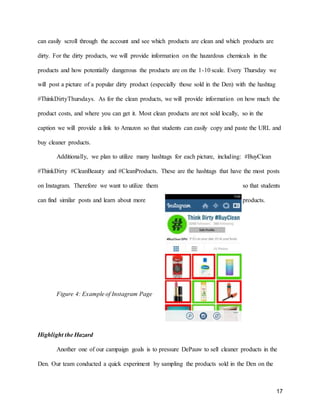
campaign and events on the Instagram account. The name of our account will be BuyCleanDPU,
which will focus the account towards our target market (students on campus). The “about” line
on the account will say “If it’s on your skin, it’s in your body” along with a link to the website
and Facebook page.
One of the main goals of the Instagram account is to persuade students to buy cleaner
products. One way we plan on changing DePauw students’ consumer habits is by posting
pictures of all types of products on the account, using a red border to bring attention to
potentially harmful products, and a green border to feature cleaner products. This way students
17
can easily scroll through the account and see which products are clean and which products are
dirty. For the dirty products, we will provide information on the hazardous chemicals in the
products and how potentially dangerous the products are on the 1-10 scale. Every Thursday we
will post a picture of a popular dirty product (especially those sold in the Den) with the hashtag
#ThinkDirtyThursdays. As for the clean products, we will provide information on how much the
product costs, and where you can get it. Most clean products are not sold locally, so in the
caption we will provide a link to Amazon so that students can easily copy and paste the URL and
buy cleaner products.
Additionally, we plan to utilize many hashtags for each picture, including: #BuyClean
#ThinkDirty #CleanBeauty and #CleanProducts. These are the hashtags that have the most posts
on Instagram. Therefore we want to utilize them so that students
can find similar posts and learn about more products.
Figure 4: Example of Instagram Page
Highlight the Hazard
Another one of our campaign goals is to pressure DePauw to sell cleaner products in the
Den. Our team conducted a quick experiment by sampling the products sold in the Den on the
18
Think Dirty app. All of the products scanned were at least an 8 on the dirty scale (out of 10).
This clearly shows that DePauw needs to provide cleaner product options for students. The
message we are going to use for this campaign comes in the form of a petition. The petition,
which will eventually be sent to DePauw’s administration, will demand that DePauw sell cleaner
products on campus. This is very important for college students who may not have a car to drive
to Wal-Mart and therefore rely on the products sold in the Den.
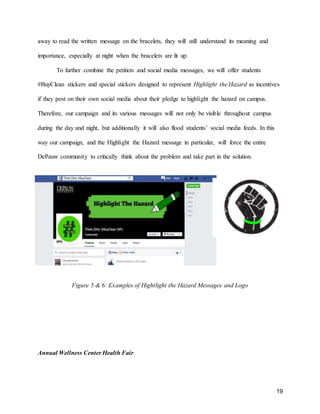
To add more creativity and momentum to the petition and campaign, we will give each
student who signs their signature a glow in the dark green wristband that says Highlight the
Hazard on it. In this way, students will not only see the campaign during the day (through sheet
signs, shirts, water bottles, stickers, etc.), but students will also constantly be reminded of the
campaign during the night when they see the glow in the dark Highlight the Hazard wristbands
floating around campus. This message will also add social pressure to the campaign because
everyone will be able to see who is and who is not wearing the campaign bracelet, and it will get
people to start talking with each other about the campaign. We believe that using the wristbands
in this way will be effective especially because college students love incentives.
There will be many opportunities for students to sign the petition. The petition and
wristbands will be easy to locate at all #BuyClean events, including a table at the Wellness Fair.
Additionally, since our campaign is utilizing representatives from all Greek chapters and campus
organizations, we will have the representatives pass around the petition in their collective houses/
organizations. We will also make a Facebook event for the petition signings, so that students
know when and where they can participate to help make a change.
The Highlight the Hazard wristbands are also an iconic verbal message because the
message carries a lot of meaning in a short and catchy phrase. Even when students are too far
19
away to read the written message on the bracelets, they will still understand its meaning and
importance, especially at night when the bracelets are lit up.
To further combine the petition and social media messages, we will offer students
#BuyClean stickers and special stickers designed to represent Highlight the Hazard as incentives
if they post on their own social media about their pledge to highlight the hazard on campus.
Therefore, our campaign and its various messages will not only be visible throughout campus
during the day and night, but additionally it will also flood students’ social media feeds. In this
way our campaign, and the Highlight the Hazard message in particular, will force the entire
DePauw community to critically think about the problem and take part in the solution.
Figure 5 & 6: Examples of Hightlight the Hazard Messages and Logo
Annual Wellness Center Health Fair
20
The Think Dirty #BuyClean campaign plans to partner with the Annual Wellness Center
Health Fair as one of the word-of-mouth messages. The Health Fair serves as an opportunity for
the DePauw community to better educate themselves on how to live a healthy lifestyle. With this
partnership, the campaign will have a booth at the fair that aims to increase awareness of harmful
chemicals found in everyday products and encourage students to change their consumer habits.
Holding a booth at the Health Fair is an appropriate message because it directly targets DePauw
students.
The booth would provide information on the harmful chemicals found in everyday
products, such as cosmetics, lotions, deodorants, and hair products. Information would be
provided in a physical bulletin that students could take home to read in their spare time. We
would also promote the phone application, Think Dirty, and provide services to teach students
how to use the application when choosing a healthy product to use on their skin or in their hair.
In addition, we would provide opportunities for students to get involved in the campaign.
In the past, the Health Fair has developed incentives to increase the Health Fair
attendance rate. Our campaign would also engage in these incentive practices. The Think Dirty
#BuyClean campaign would offer water bottles and stickers to students that attend the fair.
However, to avoid the target audience strictly coming for the free items, we would have a
practical quiz in order for the students to earn the free products. The campaign members would
set out three everyday products and would ask audience members to rank the products from
being the most clean to the most toxic to the human body. After students respond, the campaign
members would explain why each product is as toxic as it is which is when they would receive
this product. This is a strategy characterized by the Elaboration Likelihood Model because it is
an interactive message. By having students be highly involved in a message, they will pay closer
21
attention to the information being distributed and will help students be better informed about
their health. Additionally, fair attendants would enter a raffle at our campaign booth to win Think
Dirty #Buy Clean t-shirts and hats.
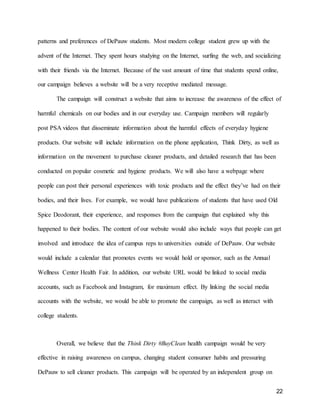
The Annual Wellness Center Health Fair will be promoted through a snapchat geofilter.
For snapchat users, it is popular to use the filters because they can only be deployed in select
locations for a select amount of time. Therefore, we think this will be an effective way to
increase awareness of the event. Our filter would make people’s face look dirty/toxic and would
include the caption, “If it’s on your skin, it’s in your body”. An example of our second geofilter
is shows below. It would include our campaign logo in the right hand corner and our campaign
title, “Think Dirty #BuyClean” at the bottom of the picture. Our overall goal for the Annual
Wellness Center Health Fair would be to increase the awareness of harmful chemicals that we
put on our body and in our hair, as well as encourage students to change their spending habits on
cosmetic and hygiene products.
Figure 7:
Example of Snapchat Geofilter at
Annual Wellness Center Health Fair
Campaign Website
The Think Dirty #BuyClean campaign will develop
another high-involvement message using electronic media. A website will be an effective media
to disseminate information to a large amount of our target audience due to the communication
22
patterns and preferences of DePauw students. Most modern college student grew up with the
advent of the Internet. They spent hours studying on the Internet, surfing the web, and socializing
with their friends via the Internet. Because of the vast amount of time that students spend online,
our campaign believes a website will be a very receptive mediated message.
The campaign will construct a website that aims to increase the awareness of the effect of
harmful chemicals on our bodies and in our everyday use. Campaign members will regularly
post PSA videos that disseminate information about the harmful effects of everyday hygiene
products. Our website will include information on the phone application, Think Dirty, as well as
information on the movement to purchase cleaner products, and detailed research that has been
conducted on popular cosmetic and hygiene products. We will also have a webpage where
people can post their personal experiences with toxic products and the effect they’ve had on their
bodies, and their lives. For example, we would have publications of students that have used Old
Spice Deodorant, their experience, and responses from the campaign that explained why this
happened to their bodies. The content of our website would also include ways that people can get
involved and introduce the idea of campus reps to universities outside of DePauw. Our website
would include a calendar that promotes events we would hold or sponsor, such as the Annual
Wellness Center Health Fair. In addition, our website URL would be linked to social media
accounts, such as Facebook and Instagram, for maximum effect. By linking the social media
accounts with the website, we would be able to promote the campaign, as well as interact with
college students.
Overall, we believe that the Think Dirty #BuyClean health campaign would be very
effective in raising awareness on campus, changing student consumer habits and pressuring
DePauw to sell cleaner products. This campaign will be operated by an independent group on
23
campus, funded by DePauw Student Government, and will encourage summer research and
internships. However, there is only so much we can change when we are focusing just on
DePauw’s small campus. We hope that our campaign will spread to other colleges, empowering
all American college students to fight for cleaner products.
Works Cited
Berger, Jonah and Raghuram Iyengar. "Communication Channels And Word Of Mouth: How
The Medium Shapes The Message." Journal Of Consumer Research 40.3 (2013): 567-
579. Academic Search Premier. Web. 27 Feb. 2014.
Bulski, Colleen. "Chemicals in Cosmetics." Chemicals in Cosmetics. 4 Mar. 2015. Web. 25 Apr.
2016.
Colby, Grant. "Organizational Partnerships." The Community Foundation for Greater
Atlanta -. 19 July 2015. Web. 25 Apr. 2016.
DuPré, Athena. Communicating about Health: Current Issues and Perspectives. New
York: Oxford UP, 2014. Print.
24
Eaves, Ali. "Why Do Some People Say Old Spice Deodorant Is Giving Them Painful
Rashes?" Men's Health. 29 Mar. 2016. Web. 06 Apr. 2016.
Searcey, Dionne. “Marketers are Sizing up the Millennials” New York Times
Stader, Mike. "Protect Your Health: Toxicity." Public Service Announcement. 3 Jan.
2014. Web. 25 Apr. 2016.
Thornton, JW. "Exposures Add up – Survey Results | Skin Deep® Cosmetics Database |
EWG." Skin Deep Exposures Add up Survey Results Comments. 2 Feb. 2015. Web. 06
Apr. 2016.

ThinkDirtyBuyCleanFinalPaper

  • 1.
    DePauw University Think Dirty#BuyClean If it’s on your skin, it’s in your body Katie Stack, Billy McClamroch, Paige Bixler, Peter Gorman COMM 325A: Health Campaign Final Paper Professor Kent Menzel May 16th, 2016 The primary objective of the Think Dirty #BuyClean campaign is to increase awareness among DePauw students of the harmful chemicals found in our everyday personal hygiene products and cosmetics. We believe that building this awareness is increasingly important for college students who are still relatively new to living on their own and living on a budget.
  • 2.
    1 DePauw students inparticular have limited options of products on campus and in the community. We believe that most students buy the cheapest and most convenient products available to them, without knowing which products contain potentially toxic chemicals. As a result, we all carry toxic industrial chemicals inside our bodies. Yet, many of the chemicals found in cosmetics are absorbed by the skin into the body, and can be detected in blood, urine, and saliva. Our campaign utilizes the hashtag #BuyClean and was inspired by a free iPhone app called Think Dirty. Over Winter Break, Katie downloaded the app and scanned all of her personal care products. In total disbelief, she was confronted with the fact that most of the products that she had been using for years contained dangerous chemicals that had alarming links to cancer and reproductive/ developmental health problems. She could not believe that the general population was unaware of the potential harms. Shockingly, “1 of every 3 women and 1 of every 12 men aged 18-25 years old are exposed to ingredients that are known or probable human carcinogens through their use of personal care products” (Thornton 2015). Human carcinogen is a substance capable of causing cancer in living tissue. The app, which was launched in 2013, was created by Lily Tse to expose the truths of the beauty industry. In her mission statement on the Think Dirty website, Lily explains that she was motivated by Annie Leonard’s Story of Cosmetics to “empower and educate consumers on the cosmetics industry by allowing them to make informed decisions on what products to purchase.” Lilly notes that she hopes Think Dirty will be more than just an app, and instead lead to a consumer revolution. Our campaign is necessary because most DePauw students are uninformed about the chemicals put in our everyday products. The European Union takes a much stricter stance on
  • 3.
    2 regulating hazardous chemicalsin products than the FDA. The EU has currently banned 1,328 chemicals from being sold in Europe, but the FDA has only restricted 11 to date. We were discouraged to learn that one of the ingredients in Cover Girl’s Waterproof Mascara is also in Dr. Scholl’s wart remover. The EU has banned both products from being sold in Europe because of their potential long term risks, but they both are very popular in the US. The Breast Cancer Fund, which recently partnered with Think Dirty, informs readers, through an online article titled “Chemicals in Cosmetics”, that many ingredients in our products, “are also used in industrial manufacturing processes to clean industrial equipment, stabilize pesticides and grease gears” (Bulski 2015). The author of the article adds, “We can all agree that an ingredient that effectively scours a garage floor may not be the best choice for a facial cleanser.” Since the FDA takes such a relaxed position on regulating potentially hazardous products, independent groups such as the Environmental Working Group have taken on the challenge of researching harmful products and informing citizens. The Environmental Working Group states that, “Nearly four hundred products sold in the U.S., such as Crest Whitestrips and Neutrogena daily face cream, contain chemicals banned in Japan, Canada, and the EU.” Additionally, “Ninety-eight percent of all products assessed (in the US) contained one or more ingredients never tested for safety” (Thornton 2015). To gauge how big of a problem this is on our campus, we decided to scan some of our roommates’ products with the Think Dirty app. Out of the 14 products scanned, 13 of them had a 9 or a 10 rating on the “Dirty Meter”, meaning the product’s ingredients have potential serious negative long term health effects. Only one of the roommates’ products tested had a 5 rating on the app’s meter, indicating that the product’s ingredients have potential moderate negative long-
  • 4.
    3 term health effects.We can only imagine how many potentially dangerous products fill the dorms of our campus, which is why our health campaign is dedicated to a healthier campus environment. We believe that as a society, we’ve started watching what we put in our bodies, but we haven’t started watching what we put on our skin. DePauw University switched to Bon Appetit partly because Bon Appetit offers local, fresh, and authentic food. Yet, DePauw sells potentially harmful body washes and deodorants in the Den. Dangerous chemicals in everyday products has not yet become a topic of local or national criticism, and our group wants to change that. We believe that we will all be thankful down the road if we start making small consumer changes with our daily routines. Most people, if they knew that certain products posed serious health risks, would probably pay a few dollars more to buy cleaner products. Consequently, if enough people made these small consumer changes, then certain products would no longer be able to survive on the shelves of our stores. So how do we get DePauw students to change their consumer habits and buy cleaner products? Our campaign will target, in general, the DePauw community, specifically college undergraduate students, ages ranging from 18 to 25 years old in males and females. While college students are one of the top targeted marketing audiences, they can also be one of the most difficult to reach because of their fast-paced and simple behaviors/attitudes.Through our #BuyClean campaign, our group will tackle this challenge by increasing awareness on campus and encouraging students, through a multimedia approach, to buy clean. The average female college student uses 12 products containing 168 “unique” ingredients everyday, while the average male college student uses 6 products containing 85 unique ingredients everyday. According to the Norwegian Institute of Public Health, “formaldehyde,
  • 5.
    4 parabens, sodium lauryland synthetic fragrance traces were found in 567 out of the 792 cosmetic products tested that college students use on a daily basis” (Thornton 2015). All of these toxic traces found in these cosmetic products that college students use - formaldehyde, parabens, sodium lauryl and synthetic fragrance – are all banned/regulated in the EU, yet not one of these are banned/regulated by the FDA. It’s become almost the social norm to read a menu that lists precisely what ingredients are in our foods, but students are nearly never concerned about what goes on their skin. Earth-to-face beauty products continue to grow in popularity, but college students aren’t interested in reading labels of every product they use, let alone wanting to know the correct chemicals/ingredients that are harmful in them. Marketing to college students poses a special set of challenges. The Millennial generation is full of college students who are often skeptical, cash-strapped, and their lives are fast-paced, making it difficult to bring awareness about harmful chemicals and ingredients in the products they use. A typical college student eats, sleeps, and goes to class, studies and parties on the weekends. They simply aren’t motivated or invested in looking for the safest product out there for them. Most college students are living on their own for the first time and have established their daily shopping routines, not even considering that human carcinogens can be present in the products they use. Therefore, we must educate college students on the types of ingredients, what they do, and how they can be harmful to their bodies. They are (1) unaware of all the harmful toxins and chemicals in these products, and (2) aren’t motivated enough to read the ingredients in the products they normally buy, so how do we effectively attract and market to college students at DePauw? Our campaign will target our audience by having personal testimonies by “real” people who have experienced issues with cosmetic products such as rashes. Our audience will be more
  • 6.
    5 likely to reconsidertheir purchases if these personal testimonies come from their classmates and friends. It’s all about targeted marketing strategies and catering to young college students. The “personal fable” belief that du Pre talks about says that adolescents often believe they are unlike other people and that others do not understand them. Consequently, they are likely to assume that health warnings such as toxic chemicals in cosmetic products don’t apply to them, because they perceive themselves as being young and invincible. College students, who do not spend time investigating the ingredients of products before purchasing them, do however spend a great deal of time on social media – sharing and receiving information from their friends, family, and community. The hot topic currently on social media is about the burning, red armpit rashes caused by Old Spice scented deodorant. Justin Ko, M.D., Director of Medical Dermatology at Stanford Health care says, “the reactions these men are experiencing can be contact dermatitis, a condition caused by an allergy or irritating substance. Any deodorant or antiperspirant can trigger a reaction like that because fragrances used in deodorants have aluminum-based compounds in them” (Eaves 2016). Looking back at an Old Spice deodorant product, the “drug facts” on the back of the deodorant stick says “aluminum zirconium trichlorohydrex Gly 17%.” What does this mean? One can guarantee that almost every college student reading the drug facts of Old Spice wouldn’t have a clue what it means, let alone know if it is harmful to their bodies or not. This information is especially important for our campaign because Old Spice deodorant is currently the only deodorant sold to students in the Den, leaving some students on our campus with only two options: use Old Spice deodorant or use no deodorant at all. Our Think Dirty #BuyClean campaign has many messages/goals that we want to display to the DePauw’s campus. Our overall goal is to overwhelm the campus with the idea of buying
  • 7.
    6 clean products. Inorder to do this we have come up with messages that we believe will be the most successful for the culture we have here on DePauw’s campus. We have three main goals for our campaign. The first is to raise awareness among students of the hazardous chemicals that are in many of their products. Similar to the first goal, our second goal is to change consumer habits on DePauw’s campus. In order to measure these first two goals, we will provide a survey before and after our campaign. We believe that doing a survey before and after will provide us with accurate statistics to let us know the success our campaign is having. Our third goal for our campaign is to pressure DePauw to sell cleaner products on campus. We will specifically focus on stores such as the Den, because of how accessible it is for students to use their student ID swipes to get everyday products. Additionally, students who do not have cars rely on the Den to buy all of their personal care products. In order to measure this goal, we plan to take inventory of the campus stores at the end of our campaign in order to see if they are supplying healthier products. We plan to accomplish these goals through several messages we will display to our audience. When selecting channels of communication for the Think Dirty #BuyClean campaign, the message, audience, and goals of the campaign need to be taken under consideration. Our multi channel campaign efforts aim to encompass word-of-mouth, iconic verbal messages, print, and electronic channels of communication to increase awareness among DePauw Students. Research has shown that organizations that transmit information through multiple devices have elicited a greater response than those who chose to transmit information via one device (Berger 577). This process of transmittance is known as communicating through channels. The channel that is communicated to the public can affect how the message is perceived. Multichannel approaches are effective because people have different communication patterns
  • 8.
    7 and preferences. Amultichannel approach will also increase the reach of our messages by utilizing channels that are receptive of our target audience. We plan to use the Elaboration Likelihood Model when choosing effective channels. This model proposes that when we are highly involved with a message, we pay close attention to details and evaluate their messages thoroughly. High-involvement channels help people pay closer attention and affects how much they are influenced by the information. The word-of- mouth communication channel is an effective channel to use because it is highly interactive. High involvement channels help people pay closer attention and affects how much they are influenced by the information. Electronic channels of communication are a second form of the Elaboration Likelihood Model. According to the Millennial Generation, the U.S. has 21-million college students who are the tech-savvy trendsetters and who are the largest consumer group in U.S. history (Searcey 1). Modern day college students grew up with the advent of the Internet. They spend hours at a time studying online, surfing the net, and socializing with their friends. Since our target audience is DePauw college students, our campaign will use electronic channels. This is also an effective channel because it can develop social pressure. Students will make decisions by considering the interplay of factors such as their environment and social approval. The third communication channel that our campaign plans to use is iconic verbal messages because they are specific to our target audience. Theses are bold symbols that we see everyday. DePauw students often use iconic verbal messages to decorate campus with sidewalk chalk, paint sheet signs to promote groups and events, or place stickers on water bottles and laptops to identify with a movement. This is a channel that will be seen frequently, as students walk to class everyday. We plan to use iconic verbal messages because it has proven receptive to
  • 9.
    8 DePauw students inthe past. In addition this will be an effective message because DePauw’s campus is so small and iconic verbal messages are easily disseminated among small audiences. Lastly, we plan to use printed channels of communication in our campaign. These will be effective because individuals have the power to go back and reabsorb the message that they previously received through the word-of-mouth channel. Print media such as the campus newspaper, posters, and informational bulletins have received student reception in the past. In addition, we aim to utilize the Diffusion of Innovations Theory in our campaign efforts. This is the process through which new information is filtered and passed along throughout a community. Research has shown that community members are opinion leaders who have credibility from their expertise and social standing. This shows that media messages can influence people indirectly, whether or not they use the media. The Think Dirty #BuyClean campaign plans to utilize this theory by incorporating representatives from Greek houses and groups on campus. This will help instill the social cognitive theory, which states that people make decisions by considering the interplay of internal factors, such as environment and social approval. By making these healthy behaviors socially acceptable, our campaign will be able to change consumer habits of DePauw students. In order to achieve the Think Dirty #BuyClean campaign goals, channels selected need to reach as many people in the DePauw community as possible, be specific to our target audience, and cause students to change their consumer habits for the betterment of their health. By utilizing a multichannel approach, the elaboration likelihood model, and the diffusion of innovations theory when selecting the most effect channel to use, there is a greater likelihood of students encountering the messages directly or indirectly. The mediated channels of print, iconic verbal messages, and electronic communication will be effective mediums to disseminate information
  • 10.
    9 to a largeamount of people. However, our interpersonal reinforcement and social pressure strategies such as using word-of-mouth channels will help achieve our overall goal of stimulating the target audience to change their behaviors. Next, our health campaign will be discussing the eight (8) messages that we plan to use to raise awareness among students, change consumer habits and pressure DePauw to sell cleaner products. Social Media: Facebook The very first part of our campaign is our FaceBook page. This is where we are going to first get our ideas out there to the students and faculty of DePauw. We will do this in many ways. One of the first actions we will do is put videos up on the page of what you can do in order to change. We will also create an event page. This event page will list out all of the possible events that are happening on campus relating to Think Dirty #BuyClean. We want to be as open to the campus so that we can reach out to the most people possible. Another way we are going to try to make our FaceBook page more popular is by giving the audience rewards and prizes for giving our campaign some attention. For example, if you go on FaceBook and like our page, then that person will be given a sticker for their laptop or water bottle. This does not only help the person who got the sticker, but it also helps our campaign in many ways. It is good advertisement because that student will have a sticker with them in class or in the library, and other students will notice it and immediately think what it is all about. This is exactly what we want for our campaign. The purpose of this specific FaceBook message is to get the initial word out there for our campaign. We think that FaceBook is one of the popular social media resources on DePauw’s campus. Other than Instagram, FaceBook will provide us with a place to launch our ideas and show the campus the truth behind the products that they use on an everyday basis.
  • 11.
    10 Figure 1: Exampleof Facebook Page Iconic Verbal Messages The next message are the iconic verbal messages that we will be using. As I mentioned while discussing the FaceBook page, the slogan #BuyClean is the main idea behind this verbal messages. We want this hashtag to overtake DePauw’s campus. We can do this in many different ways. One easy way to do this is by writing the slogan with sidewalk chalk. We have recently seen a lot of sidewalk chalk due to the student body elections. If these people are doing this in order to benefit them and get elected, then we think it will definitely benefit our campaign. This can help in many different ways. One way is by telling the students and faculty about our upcoming events around the campus. This is a simple but effective way of spreading the word around. I think this is effective because it is not annoying to students. They do not have to go out of their way to see what news is going on with #BuyClean. If we put notes outside of the Hub, Roy O., and Julian, or any places where we think the most students go, then we will definitely catch some people’s eyes. Another verbal message that we are going to use are stickers. It is amazing to see the amount of stickers that students put on their laptops and water bottles these
  • 12.
    11 days. And thereis no question that when students use their laptops or have their water bottles on their desk during class that other students get distracted by them. I always catch myself looking at stickers and trying to figure out what is means or stands for. As I mentioned before, there will be ways to access a sticker such as liking our FaceBook page, but also we want to give any many stickers out as possible in order for our campaign to get around campus. Probably the most important verbal message will be the sheet signs. Sheet signs are especially popular with sororities and fraternities around campus. Whenever a house has an event or a message to display to the campus, they most likely will put up a big sheet sign in front of their house. We want houses to get informed about #BuyClean and so when there is an event, they will make a sheet sign describing it and having the hashtag placed somewhere on the sign. Another effective way to get sheet signs involved is by having a competition. We want to organize a competition between Greek houses and other organizations around campus to see who can make the best sheet sign on campus involving #BuyClean. The way we will organize and vote for the winner will be through our FaceBook page. We will put the pictures of every sheet sign that is in the running on our page. We will let our followers vote on the best one by having them like the picture of the specific sheet sign. Whoever gets the most likes will win the competition. The winning house will all get T-shirts and hats that say our slogan, Think Dirty #BuyClean. This is just another example of how we want the hashtag #BuyClean to be all over campus. These messages are specifically attacking the students here at DePauw and trying to make them actively involved in our campaign. In order for our campaign to be successful, we need to have the students be informed about our campaign so that they can pass along the idea of
  • 13.
    12 #BuyClean. Once studentsknow, then the rest of the campus will find out about it because it is such a small community. Figure 2: Examples of Iconic Verbal Messages Public Service Announcement (PSA) A Public Service Announcement or public service ad, are messages in the public interest spread by the media without charge, with the object of raising awareness, and changing public attitudes and/or behavior towards a social issue. In regards to our public service announcement, the Think Dirty #BuyClean campaign will highlight factual evidence that will bring a shock appeal to our audience. Our health campaign audience will target, in general, the DePauw community, specifically college undergraduate students. We would similarly release a fact sheet or other PSA type message like Climb on! Products, Inc. did, which they released a fact sheet as a Public Service Announcement that highlighted facts such as, “The European Union has banned more than 1400 cosmetic ingredients as unsafe for human use, while the U.S FDA has banned nine,” or “there are no safety testing requirements and no federal restrictions of what can and cannot be used in cosmetics, including infant and baby products” (Stader). In addition, they created a section of the most potentially harmful common cosmetic ingredients and the corresponding health concerns with them. This type of “shock appeal” factual evidence will gain
  • 14.
    13 public interest andraise awareness about the reality of harmful chemicals found in everyday products. The logic of the design of the PSA will benefit our health campaign because PSA’s are generally inexpensive, they tend to be really effective at encouraging audiences to do something, and most importantly, PSA’s can raise awareness about important issues. In terms of our specific audience of DePauw students and media environments, the goal of the PSA is to be sent out to WGRE radio station, D3TV, and other communication outlets used to communicate on our campus. “If it’s in your body, it’s on your skin.” We are interested in broadcasting this type of Public Service Announcement through these outlets to reach all DePauw students on campus. This way, even creating a PSA video that is shared through our other campaign messages such as our social media messages, will be most effective at getting our audience to listen and adhere to our PSA. Figure 3: Example of PSA on The DePauw Online Source
  • 15.
    14 The “Campaign forSafe Cosmetics” coalition, a project of the Breast Cancer Fund, works to protect the health of consumers, works and the environment through public education and engagement. The Campaign released a PSA Video about the ugly truth about makeup and the toxic ingredients in cosmetics. It had approximately 545,000 views and over 4,000 shares. With this type of public interest that their PSA had, we hope to achieve with ours on DePauw’s campus. The worthy thing to note is that once the PSA gets into DePauw’s hands, if you will, (or social media accounts), they are likely to share and talk about the topic, which engages more interest across other campuses and communities. At some point at the beginning of our campaign, we want to release the PSA video and broadcast it on WGRE radio station, D3TV, the DePauw Newspaper, and even the DePauw online blogs/website. This will provide our audience with factual statistics that will raise public interest about our health campaign. Overall, the goals of this PSA message is to target our audience, focus on desired media outlets, and gain public interest, making our Think Dirty #BuyClean health campaign to be in the campus media spotlight. Partnership Another campaign message design for our health campaign is partnering with Greek houses and other organizations on campus. Our Think Dirty #BuyClean health campaign will potentially partner with Relay for Life, Timmy Global Health, Environmental Club, the Women’s Center and most importantly the DePauw Wellness Center/Hendricks Regional Health. Organizational partnerships are defined as “cooperative, collaborative relationships that exist between two or more independent organizations to increase administrative efficiency or programmatic impact through shared, transferred or combined services, resources or programs”
  • 16.
    15 (Colby). There arevarious types of partnerships, such as “cooperation, coordination, or collaboration. For our health campaign, one of our goals for this message is to have many organizational partnerships that are a collaboration, meaning expectations and structures are in place to achieve goals beyond those any individual partner could achieve. When other organizations on campus share similar missions of trying to achieve the same goals, their missions and coordinated operations are effective. Relay for Life raises much-needed funds and awareness to save lives from cancer through their Relay for Life movement, Timmy Global Health’s mission is to deliver the promise of healthy futures, Environmental Club works to raise awareness about the environment, and harmful toxic chemicals that destroy it, and the DePauw Wellness Center tries to reduce healthcare costs and promote wellness for DePauw University students, faculty, and staff. The logic of the design of partnering with Greek houses and other organizations is because there are numerous benefits to partnering with organizations. When having a collaboration partnership with other organizations, there are new ways to get access to knowledge, access to people by drawing on a wider pool of networks, effectiveness by creating more appropriate messages/events, efficiency by reducing costs and delivery systems, and innovation by developing unexpected or new ways of addressing old issues and evolving complex challenges. DePauw has rich and long-standing traditions of Fraternity and Sorority Life on campus and being over 70% Greek, so another ideal partnership that would fit with our campaign would be to partner with these Greek houses/ organizations. Ideally, we would want to have a representative that is either passionate or interested in our health campaign to be their Greek organizations representative, which will help with communication, effectiveness, and efficacy. End7, a campaign of the Global Network for Neglected Tropical Diseases, brings
  • 17.
    16 awareness and fightsto end Neglected Tropical Diseases (NTDs) in the world’s poorest countries. Their campaign solely relies on “campus representatives” to bring public interest to college campuses. They have one campus representative per college campus which helps spread their health campaign effectively and efficiently. In a similar style to End7, since we are only focused on targeting DePauw students at this stage in our campaign, the Greek organizations representative would act similar to End7 campus representatives, but on a smaller scale. If, and when, we look at a larger scale, we would hope to have Think Dirty #BuyClean campus representatives on all college campuses. Nonetheless, the goal of partnering with other organizations that have similar visions or missions on campus will help us target our audience, focus on more desired media outlets, and gain even more public interest, making our Think Dirty #BuyClean health campaign to always be in the campus spotlight. Social Media: Instagram One of our campaign messages will take the form of Instagram. Instagram is one of the most popular social media apps for college students, so we expect this to be a very powerful tool for our campaign. Similar to how we will use Facebook, we will post information about the campaign and events on the Instagram account. The name of our account will be BuyCleanDPU, which will focus the account towards our target market (students on campus). The “about” line on the account will say “If it’s on your skin, it’s in your body” along with a link to the website and Facebook page. One of the main goals of the Instagram account is to persuade students to buy cleaner products. One way we plan on changing DePauw students’ consumer habits is by posting pictures of all types of products on the account, using a red border to bring attention to potentially harmful products, and a green border to feature cleaner products. This way students
  • 18.
    17 can easily scrollthrough the account and see which products are clean and which products are dirty. For the dirty products, we will provide information on the hazardous chemicals in the products and how potentially dangerous the products are on the 1-10 scale. Every Thursday we will post a picture of a popular dirty product (especially those sold in the Den) with the hashtag #ThinkDirtyThursdays. As for the clean products, we will provide information on how much the product costs, and where you can get it. Most clean products are not sold locally, so in the caption we will provide a link to Amazon so that students can easily copy and paste the URL and buy cleaner products. Additionally, we plan to utilize many hashtags for each picture, including: #BuyClean #ThinkDirty #CleanBeauty and #CleanProducts. These are the hashtags that have the most posts on Instagram. Therefore we want to utilize them so that students can find similar posts and learn about more products. Figure 4: Example of Instagram Page Highlight the Hazard Another one of our campaign goals is to pressure DePauw to sell cleaner products in the Den. Our team conducted a quick experiment by sampling the products sold in the Den on the
  • 19.
    18 Think Dirty app.All of the products scanned were at least an 8 on the dirty scale (out of 10). This clearly shows that DePauw needs to provide cleaner product options for students. The message we are going to use for this campaign comes in the form of a petition. The petition, which will eventually be sent to DePauw’s administration, will demand that DePauw sell cleaner products on campus. This is very important for college students who may not have a car to drive to Wal-Mart and therefore rely on the products sold in the Den. To add more creativity and momentum to the petition and campaign, we will give each student who signs their signature a glow in the dark green wristband that says Highlight the Hazard on it. In this way, students will not only see the campaign during the day (through sheet signs, shirts, water bottles, stickers, etc.), but students will also constantly be reminded of the campaign during the night when they see the glow in the dark Highlight the Hazard wristbands floating around campus. This message will also add social pressure to the campaign because everyone will be able to see who is and who is not wearing the campaign bracelet, and it will get people to start talking with each other about the campaign. We believe that using the wristbands in this way will be effective especially because college students love incentives. There will be many opportunities for students to sign the petition. The petition and wristbands will be easy to locate at all #BuyClean events, including a table at the Wellness Fair. Additionally, since our campaign is utilizing representatives from all Greek chapters and campus organizations, we will have the representatives pass around the petition in their collective houses/ organizations. We will also make a Facebook event for the petition signings, so that students know when and where they can participate to help make a change. The Highlight the Hazard wristbands are also an iconic verbal message because the message carries a lot of meaning in a short and catchy phrase. Even when students are too far
  • 20.
    19 away to readthe written message on the bracelets, they will still understand its meaning and importance, especially at night when the bracelets are lit up. To further combine the petition and social media messages, we will offer students #BuyClean stickers and special stickers designed to represent Highlight the Hazard as incentives if they post on their own social media about their pledge to highlight the hazard on campus. Therefore, our campaign and its various messages will not only be visible throughout campus during the day and night, but additionally it will also flood students’ social media feeds. In this way our campaign, and the Highlight the Hazard message in particular, will force the entire DePauw community to critically think about the problem and take part in the solution. Figure 5 & 6: Examples of Hightlight the Hazard Messages and Logo Annual Wellness Center Health Fair
  • 21.
    20 The Think Dirty#BuyClean campaign plans to partner with the Annual Wellness Center Health Fair as one of the word-of-mouth messages. The Health Fair serves as an opportunity for the DePauw community to better educate themselves on how to live a healthy lifestyle. With this partnership, the campaign will have a booth at the fair that aims to increase awareness of harmful chemicals found in everyday products and encourage students to change their consumer habits. Holding a booth at the Health Fair is an appropriate message because it directly targets DePauw students. The booth would provide information on the harmful chemicals found in everyday products, such as cosmetics, lotions, deodorants, and hair products. Information would be provided in a physical bulletin that students could take home to read in their spare time. We would also promote the phone application, Think Dirty, and provide services to teach students how to use the application when choosing a healthy product to use on their skin or in their hair. In addition, we would provide opportunities for students to get involved in the campaign. In the past, the Health Fair has developed incentives to increase the Health Fair attendance rate. Our campaign would also engage in these incentive practices. The Think Dirty #BuyClean campaign would offer water bottles and stickers to students that attend the fair. However, to avoid the target audience strictly coming for the free items, we would have a practical quiz in order for the students to earn the free products. The campaign members would set out three everyday products and would ask audience members to rank the products from being the most clean to the most toxic to the human body. After students respond, the campaign members would explain why each product is as toxic as it is which is when they would receive this product. This is a strategy characterized by the Elaboration Likelihood Model because it is an interactive message. By having students be highly involved in a message, they will pay closer
  • 22.
    21 attention to theinformation being distributed and will help students be better informed about their health. Additionally, fair attendants would enter a raffle at our campaign booth to win Think Dirty #Buy Clean t-shirts and hats. The Annual Wellness Center Health Fair will be promoted through a snapchat geofilter. For snapchat users, it is popular to use the filters because they can only be deployed in select locations for a select amount of time. Therefore, we think this will be an effective way to increase awareness of the event. Our filter would make people’s face look dirty/toxic and would include the caption, “If it’s on your skin, it’s in your body”. An example of our second geofilter is shows below. It would include our campaign logo in the right hand corner and our campaign title, “Think Dirty #BuyClean” at the bottom of the picture. Our overall goal for the Annual Wellness Center Health Fair would be to increase the awareness of harmful chemicals that we put on our body and in our hair, as well as encourage students to change their spending habits on cosmetic and hygiene products. Figure 7: Example of Snapchat Geofilter at Annual Wellness Center Health Fair Campaign Website The Think Dirty #BuyClean campaign will develop another high-involvement message using electronic media. A website will be an effective media to disseminate information to a large amount of our target audience due to the communication
  • 23.
    22 patterns and preferencesof DePauw students. Most modern college student grew up with the advent of the Internet. They spent hours studying on the Internet, surfing the web, and socializing with their friends via the Internet. Because of the vast amount of time that students spend online, our campaign believes a website will be a very receptive mediated message. The campaign will construct a website that aims to increase the awareness of the effect of harmful chemicals on our bodies and in our everyday use. Campaign members will regularly post PSA videos that disseminate information about the harmful effects of everyday hygiene products. Our website will include information on the phone application, Think Dirty, as well as information on the movement to purchase cleaner products, and detailed research that has been conducted on popular cosmetic and hygiene products. We will also have a webpage where people can post their personal experiences with toxic products and the effect they’ve had on their bodies, and their lives. For example, we would have publications of students that have used Old Spice Deodorant, their experience, and responses from the campaign that explained why this happened to their bodies. The content of our website would also include ways that people can get involved and introduce the idea of campus reps to universities outside of DePauw. Our website would include a calendar that promotes events we would hold or sponsor, such as the Annual Wellness Center Health Fair. In addition, our website URL would be linked to social media accounts, such as Facebook and Instagram, for maximum effect. By linking the social media accounts with the website, we would be able to promote the campaign, as well as interact with college students. Overall, we believe that the Think Dirty #BuyClean health campaign would be very effective in raising awareness on campus, changing student consumer habits and pressuring DePauw to sell cleaner products. This campaign will be operated by an independent group on
  • 24.
    23 campus, funded byDePauw Student Government, and will encourage summer research and internships. However, there is only so much we can change when we are focusing just on DePauw’s small campus. We hope that our campaign will spread to other colleges, empowering all American college students to fight for cleaner products. Works Cited Berger, Jonah and Raghuram Iyengar. "Communication Channels And Word Of Mouth: How The Medium Shapes The Message." Journal Of Consumer Research 40.3 (2013): 567- 579. Academic Search Premier. Web. 27 Feb. 2014. Bulski, Colleen. "Chemicals in Cosmetics." Chemicals in Cosmetics. 4 Mar. 2015. Web. 25 Apr. 2016. Colby, Grant. "Organizational Partnerships." The Community Foundation for Greater Atlanta -. 19 July 2015. Web. 25 Apr. 2016. DuPré, Athena. Communicating about Health: Current Issues and Perspectives. New York: Oxford UP, 2014. Print.
  • 25.
    24 Eaves, Ali. "WhyDo Some People Say Old Spice Deodorant Is Giving Them Painful Rashes?" Men's Health. 29 Mar. 2016. Web. 06 Apr. 2016. Searcey, Dionne. “Marketers are Sizing up the Millennials” New York Times Stader, Mike. "Protect Your Health: Toxicity." Public Service Announcement. 3 Jan. 2014. Web. 25 Apr. 2016. Thornton, JW. "Exposures Add up – Survey Results | Skin Deep® Cosmetics Database | EWG." Skin Deep Exposures Add up Survey Results Comments. 2 Feb. 2015. Web. 06 Apr. 2016.