S
DRIVING EDUCATION AND PROFESSIONAL USE OF
DIGITAL CURRENCY IN AUSTRALIA
www.thinkbitcoin.com.au
Produced by: Martin Davidson
Email: info@thinkbitcoin.com.au
What are Digital Currencies?
1) Digital currencies, also known as crypto
currencies, are math based computer generated
money.. But what is MONEY?
S Medium of exchange
S Store of value
S Unit of account
2) They are also their own payment networks
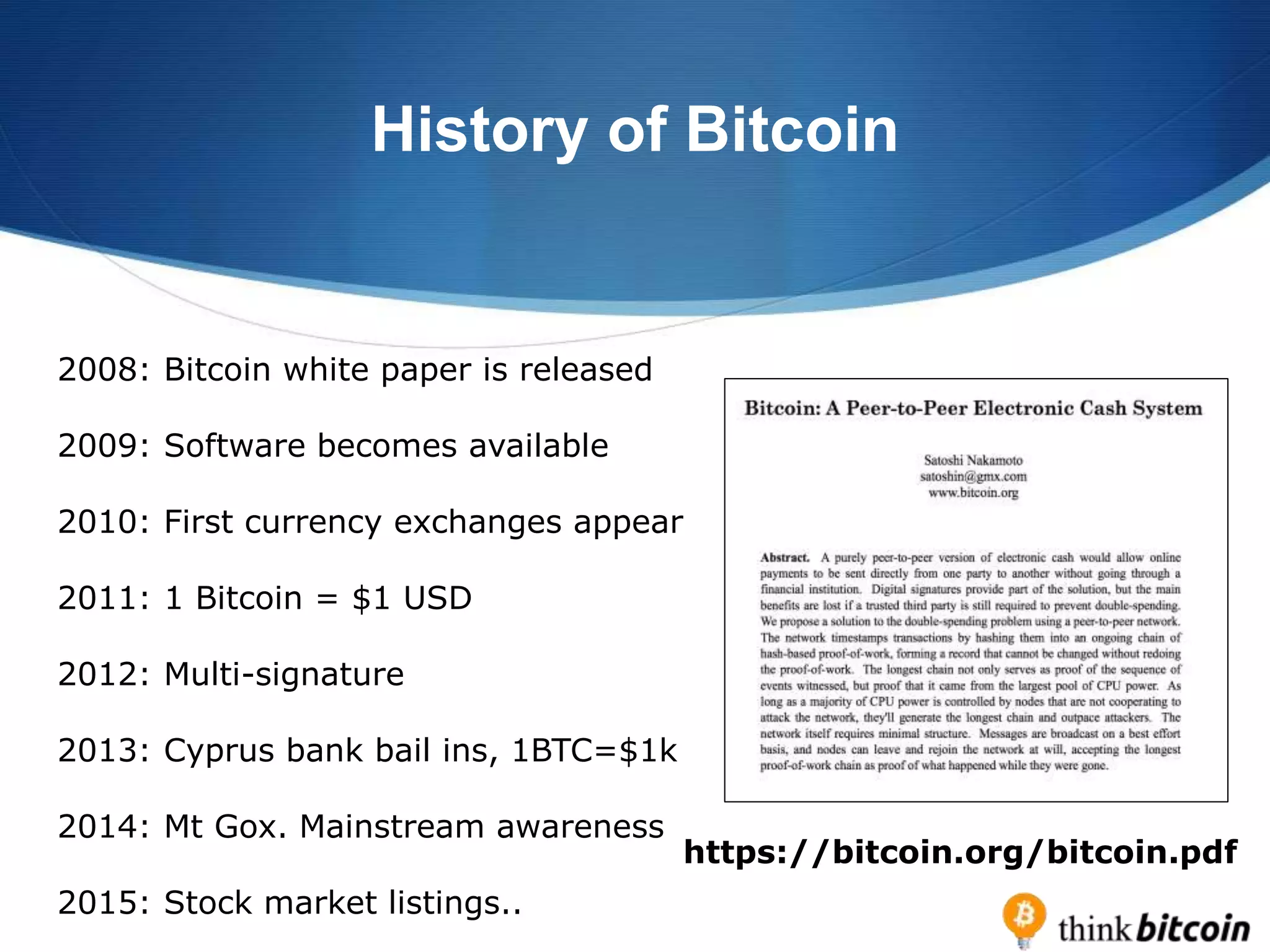
History of Bitcoin
https://bitcoin.org/bitcoin.pdf
2008: Bitcoin white paper is released
2009: Software becomes available
2010: First currency exchanges appear
2011: 1 Bitcoin = $1 USD
2012: Multi-signature
2013: Cyprus bank bail ins, 1BTC=$1k
2014: Mt Gox. Mainstream awareness
2015: Stock market listings..
Some Basic Terms
S bitcoin: Without capitalization, is used to describe bitcoins as a unit of
account
S Bitcoin: With capitalization, is used when describing the concept of
Bitcoin, or the entire network itself
S Address: A location that bitcoins have been sent to and reside at.
Alternatively, can be thought of as an account of sorts that has a balance
of bitcoins
S Blockchain: The complete transaction ledger of the Bitcoin network,
showing how bitcoins have been transferred from one address to another
over time. The blockchain is a public record of all bitcoin transactions in
chronological order
S Transaction: The movement of bitcoins from one address to another
address. In traditional terms, this can be thought of as a payment or
money movement
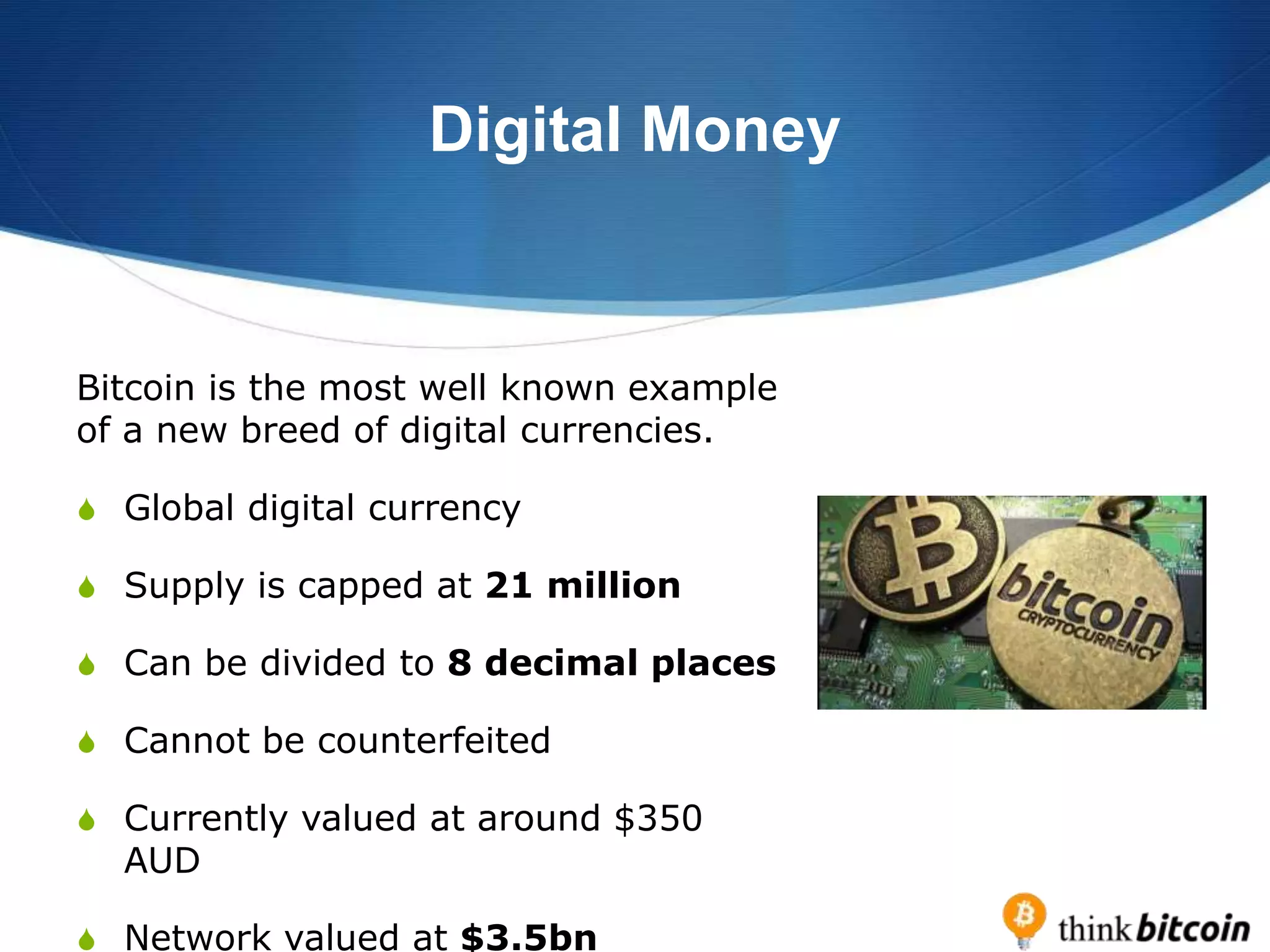
Digital Money
Bitcoin is the most well known example
of a new breed of digital currencies.
S Global digital currency
S Supply is capped at 21 million
S Can be divided to 8 decimal places
S Cannot be counterfeited
S Currently valued at around $350
AUD
S Network valued at $3.5bn
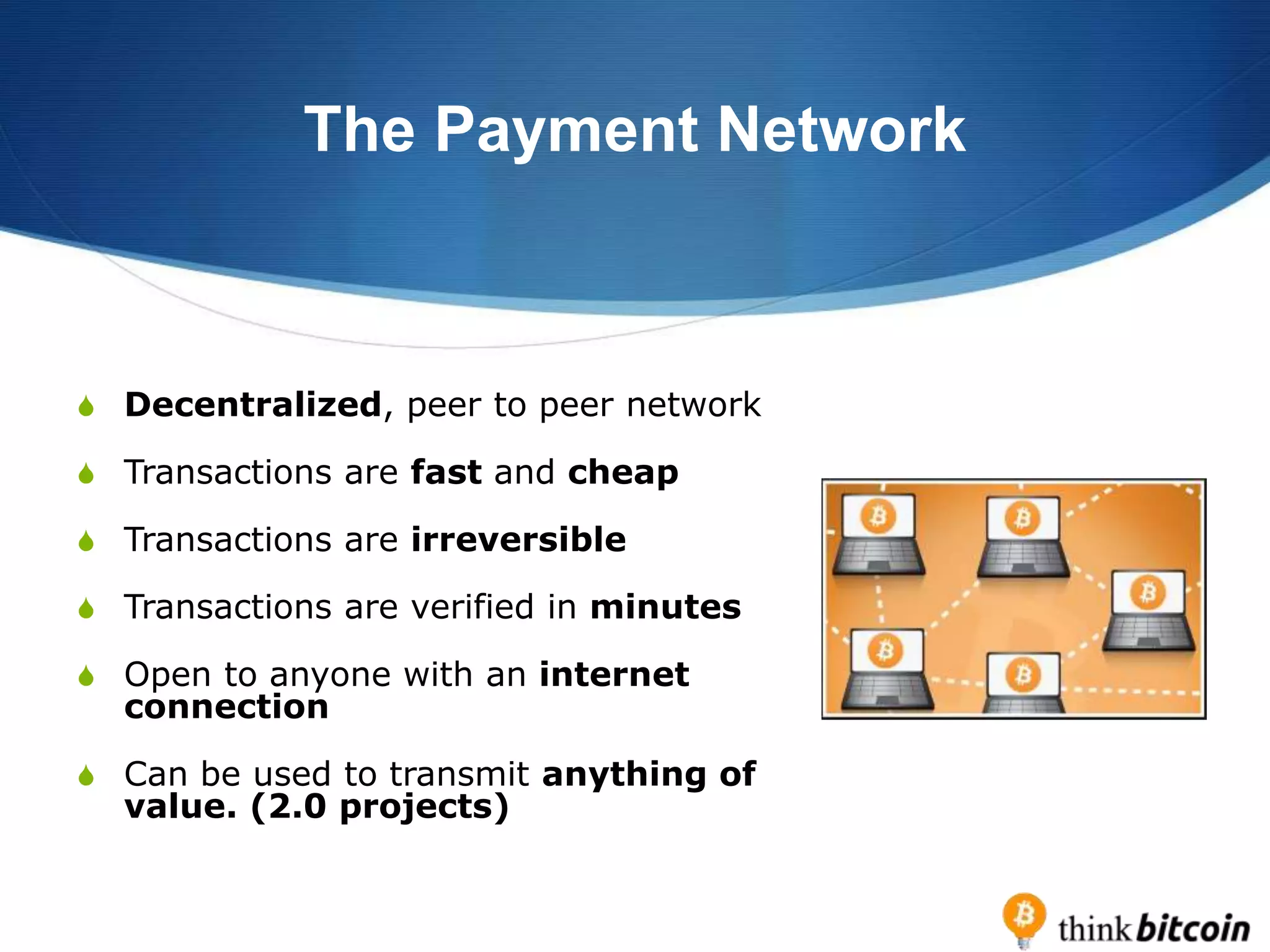
The Payment Network
S Decentralized, peer to peer network
S Transactions are fast and cheap
S Transactions are irreversible
S Transactions are verified in minutes
S Open to anyone with an internet
connection
S Can be used to transmit anything of
value. (2.0 projects)
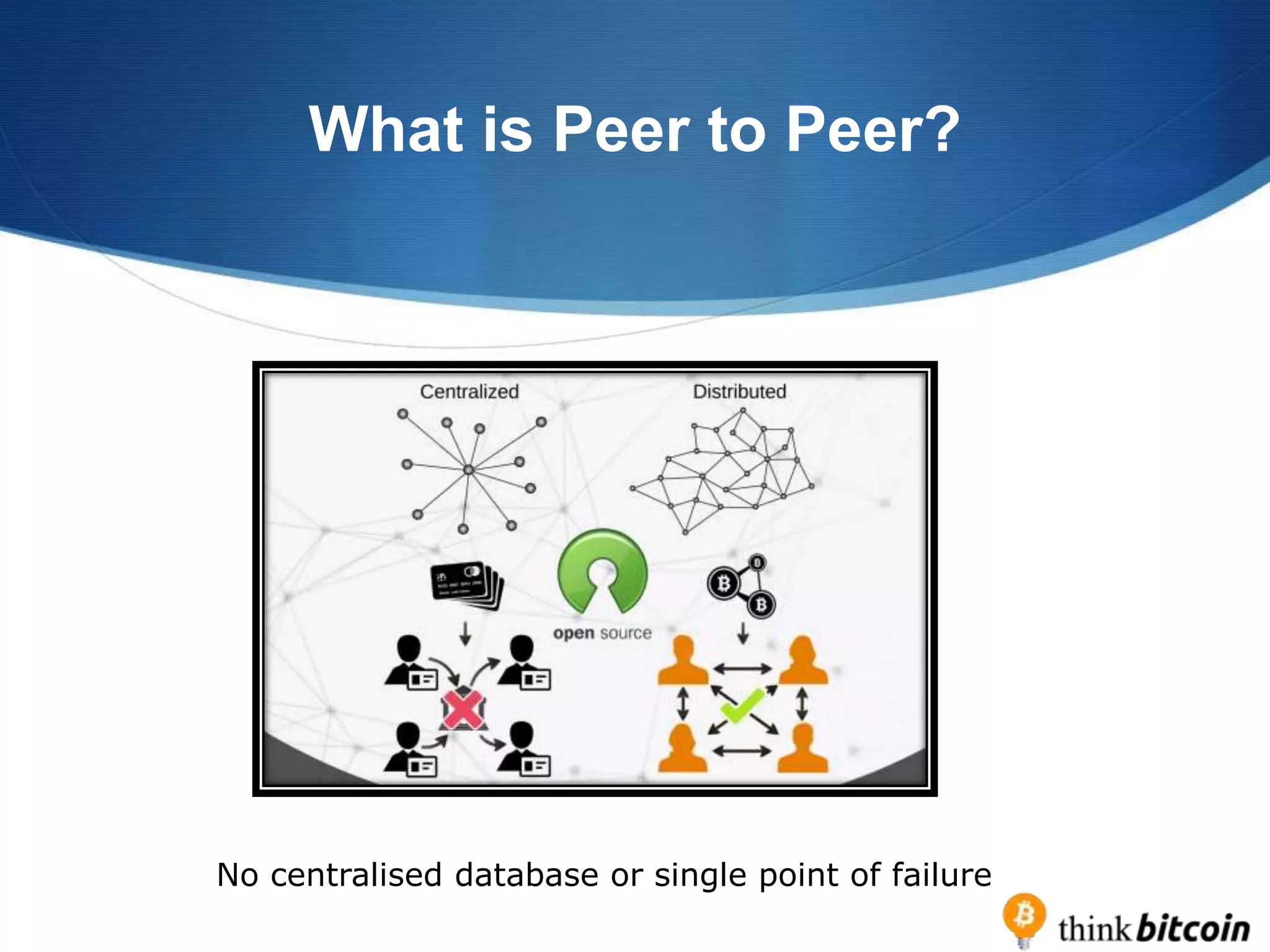
What is Peer to Peer?
No centralised database or single point of failure
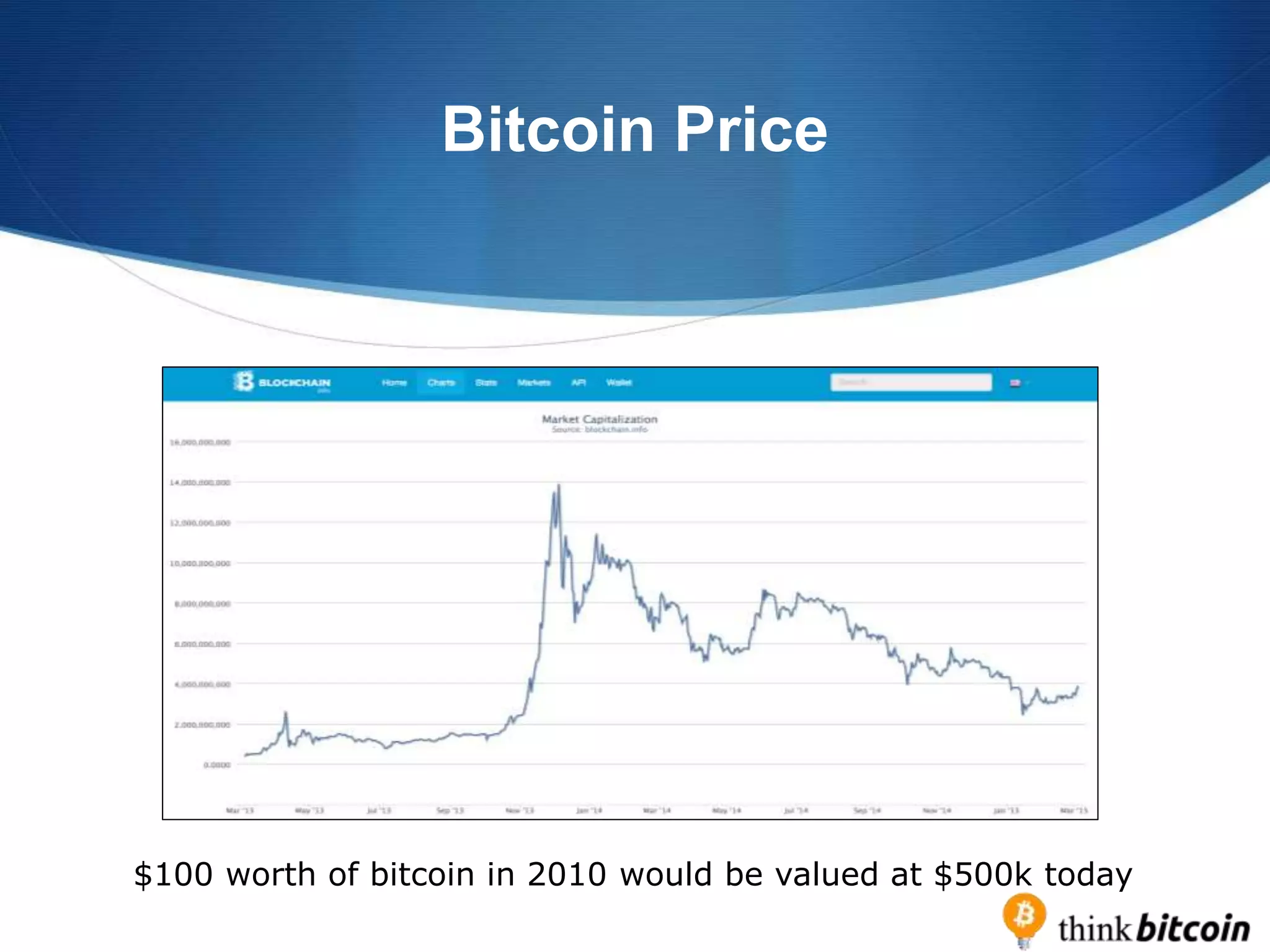
Bitcoin Price
$100 worth of bitcoin in 2010 would be valued at $500k today
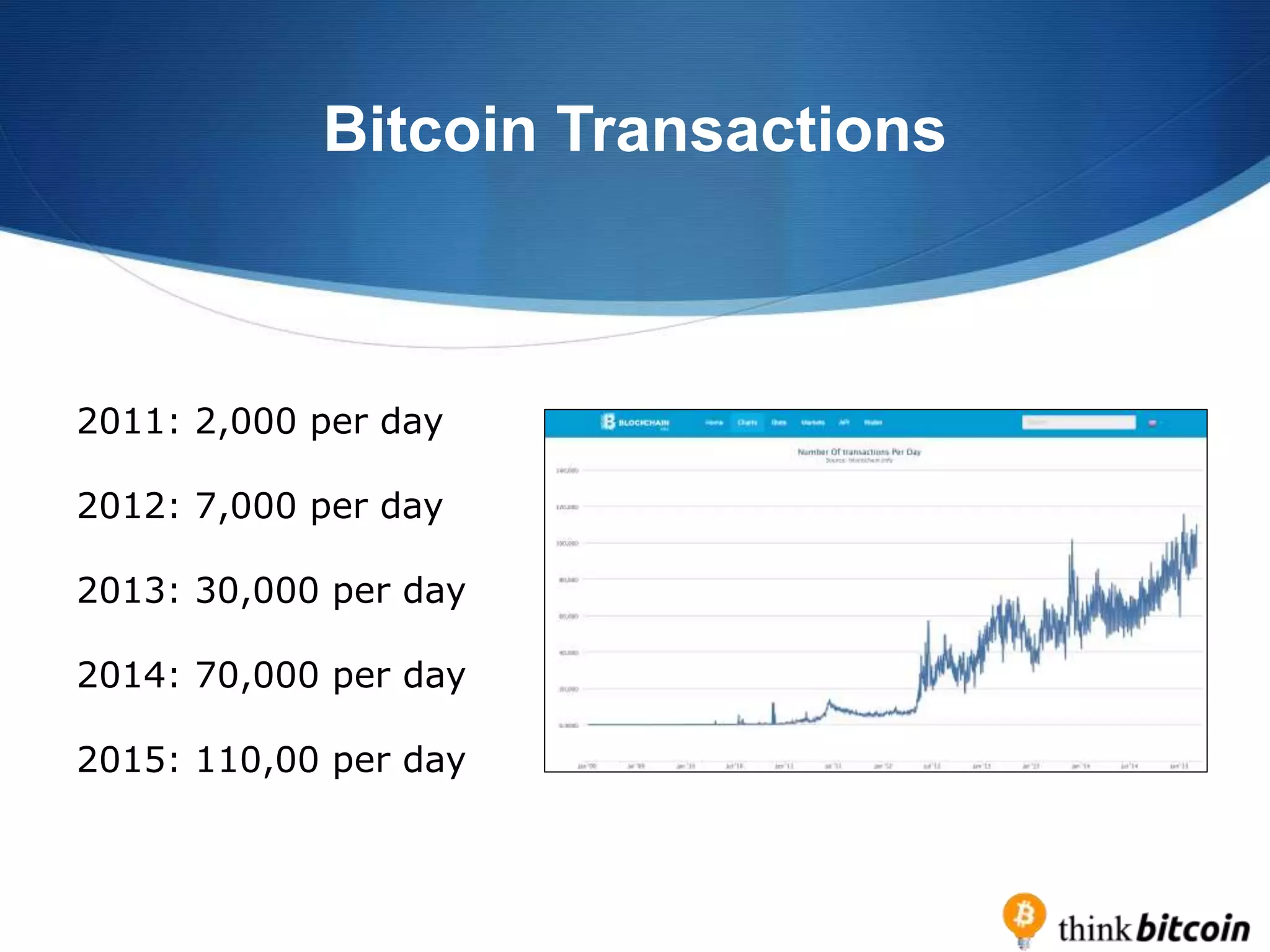
Bitcoin Transactions
2011: 2,000 per day
2012: 7,000 per day
2013: 30,000 per day
2014: 70,000 per day
2015: 110,00 per day
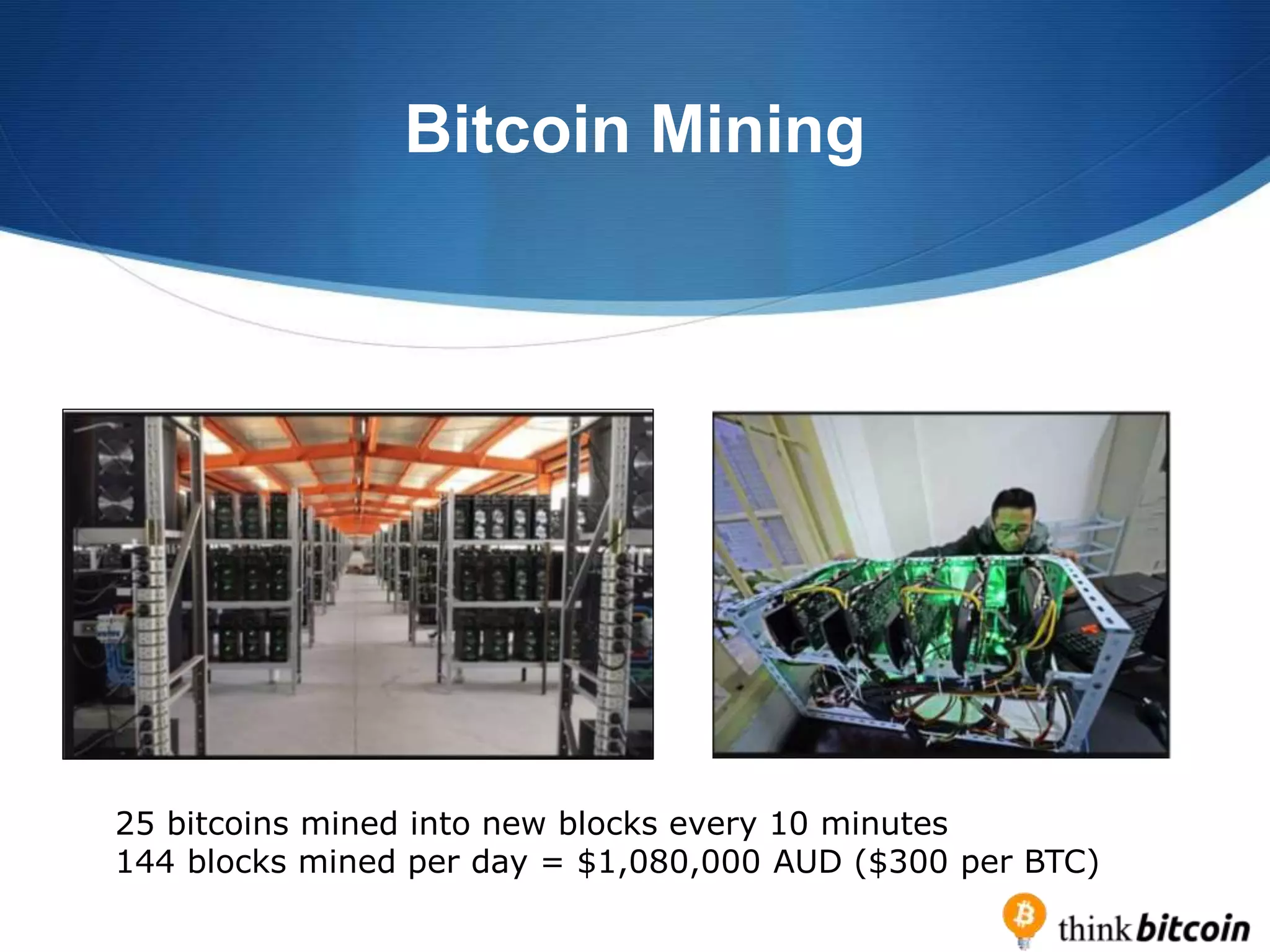
Bitcoin Mining
25 bitcoins mined into new blocks every 10 minutes
144 blocks mined per day = $1,080,000 AUD ($300 per BTC)
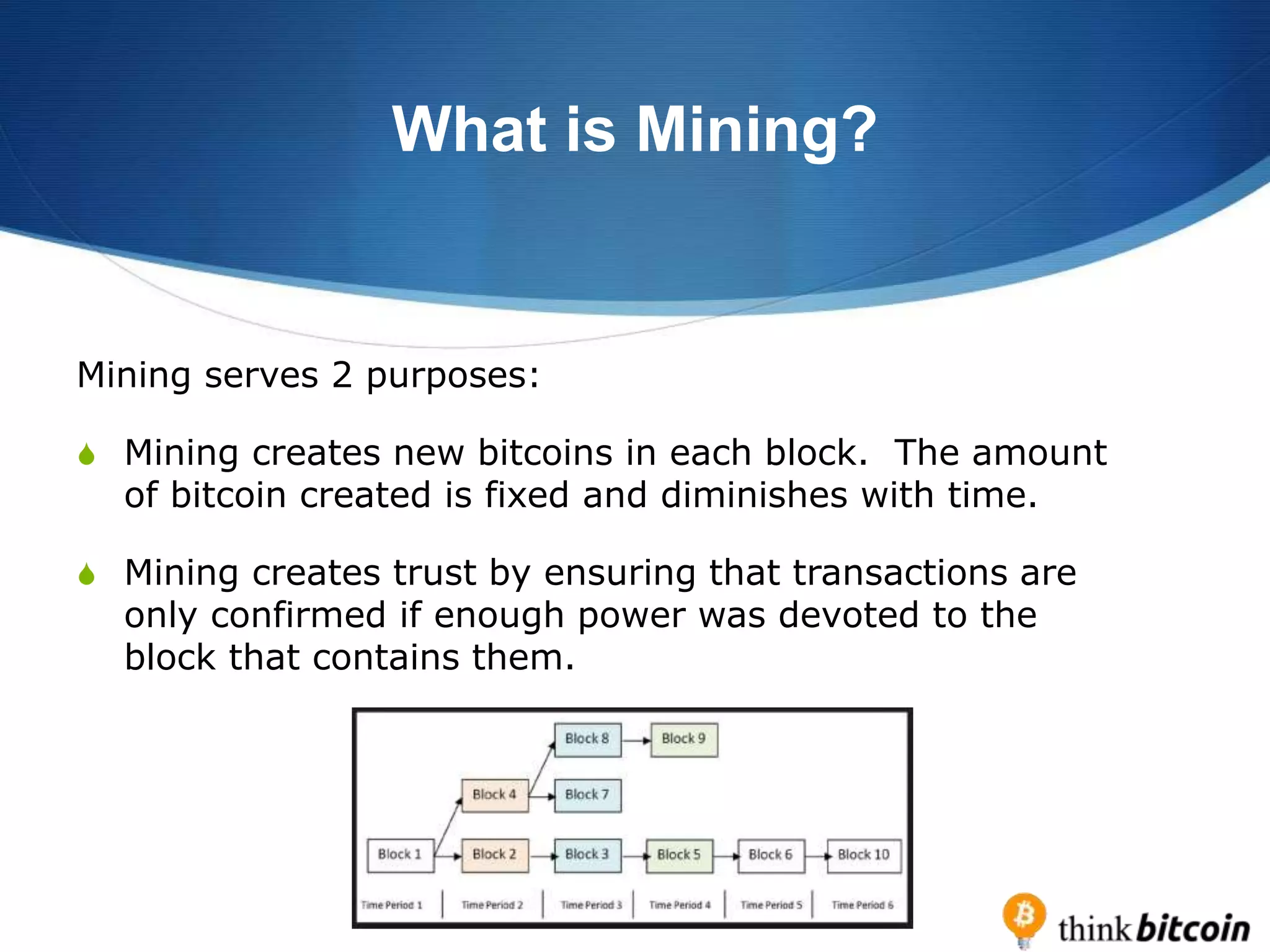
What is Mining?
Mining serves 2 purposes:
S Mining creates new bitcoins in each block. The amount
of bitcoin created is fixed and diminishes with time.
S Mining creates trust by ensuring that transactions are
only confirmed if enough power was devoted to the
block that contains them.
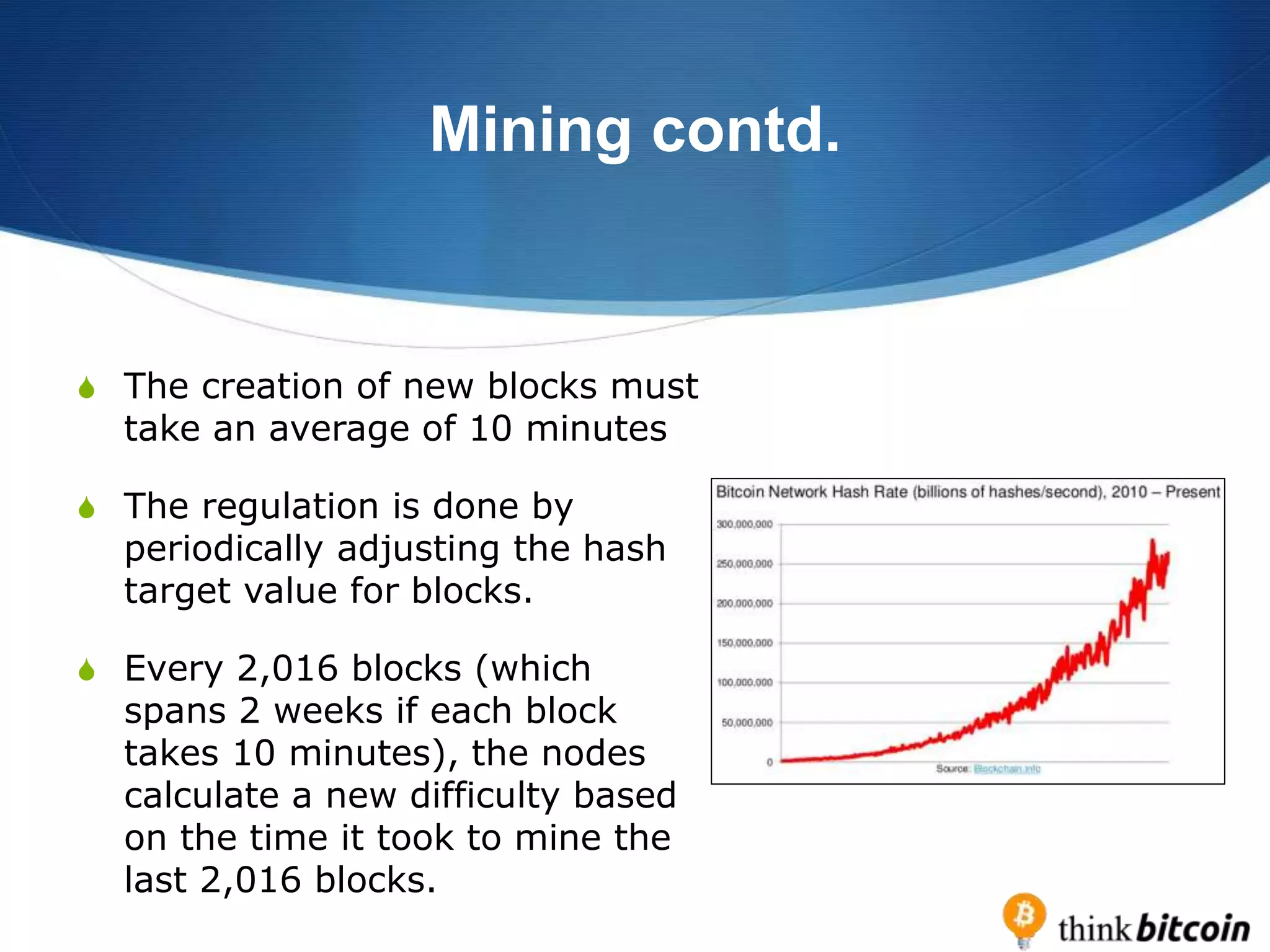
Mining contd.
S The creation of new blocks must
take an average of 10 minutes
S The regulation is done by
periodically adjusting the hash
target value for blocks.
S Every 2,016 blocks (which
spans 2 weeks if each block
takes 10 minutes), the nodes
calculate a new difficulty based
on the time it took to mine the
last 2,016 blocks.
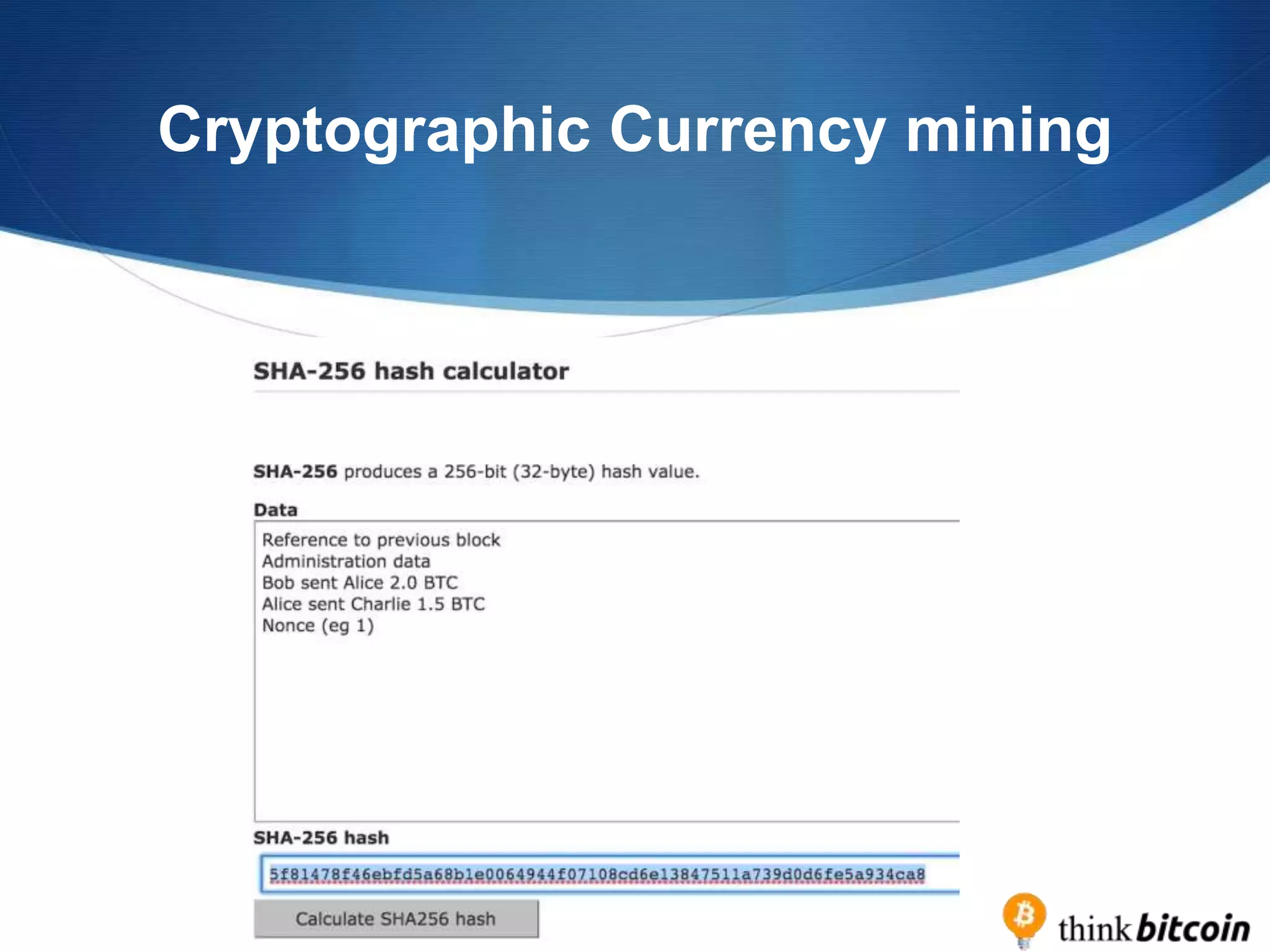
Mining is a 3 step process
S Step 1: Miners create a file that contains (a) the hash of the last
block in the existing blockchain, (b) a block of the new proposed
transactions broadcast in the Bitcoin network and (c) a random
number that the miner guesses (a “nonce”). The combination of (a)
+ (b) + (c) is the data used as the input for Step 2
S Step 2: Miners apply a cryptographic function to the data. The
details of the function (SHA- 256 in the case of Bitcoin). What is
important to understand is that the function does some calculations
on the file/data from Step 1 and produces a random number known
as a “hash”
S Step 3: The hash is reviewed against a desired pattern (in the case
of Bitcoin, how many leading zeros it has, an outcome that is
effectively random). If the hash matches the pattern, the miner has
a correct block and will win an economic prize. If the hash does not
match the pattern, the miner returns to step 1, guessing a new
nonce and repeating the exercise
Cryptographic Currency mining
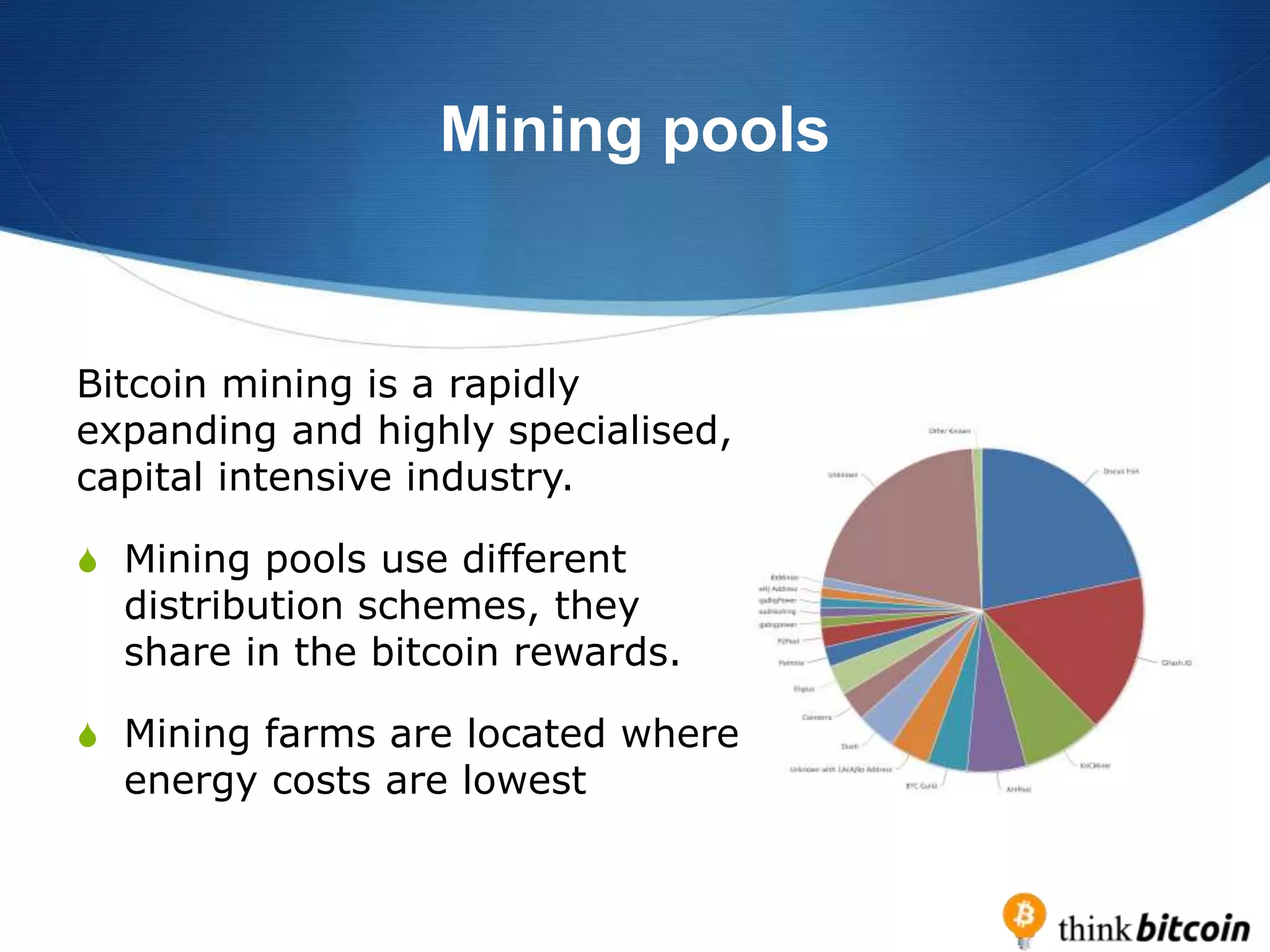
Mining pools
Bitcoin mining is a rapidly
expanding and highly specialised,
capital intensive industry.
S Mining pools use different
distribution schemes, they
share in the bitcoin rewards.
S Mining farms are located where
energy costs are lowest
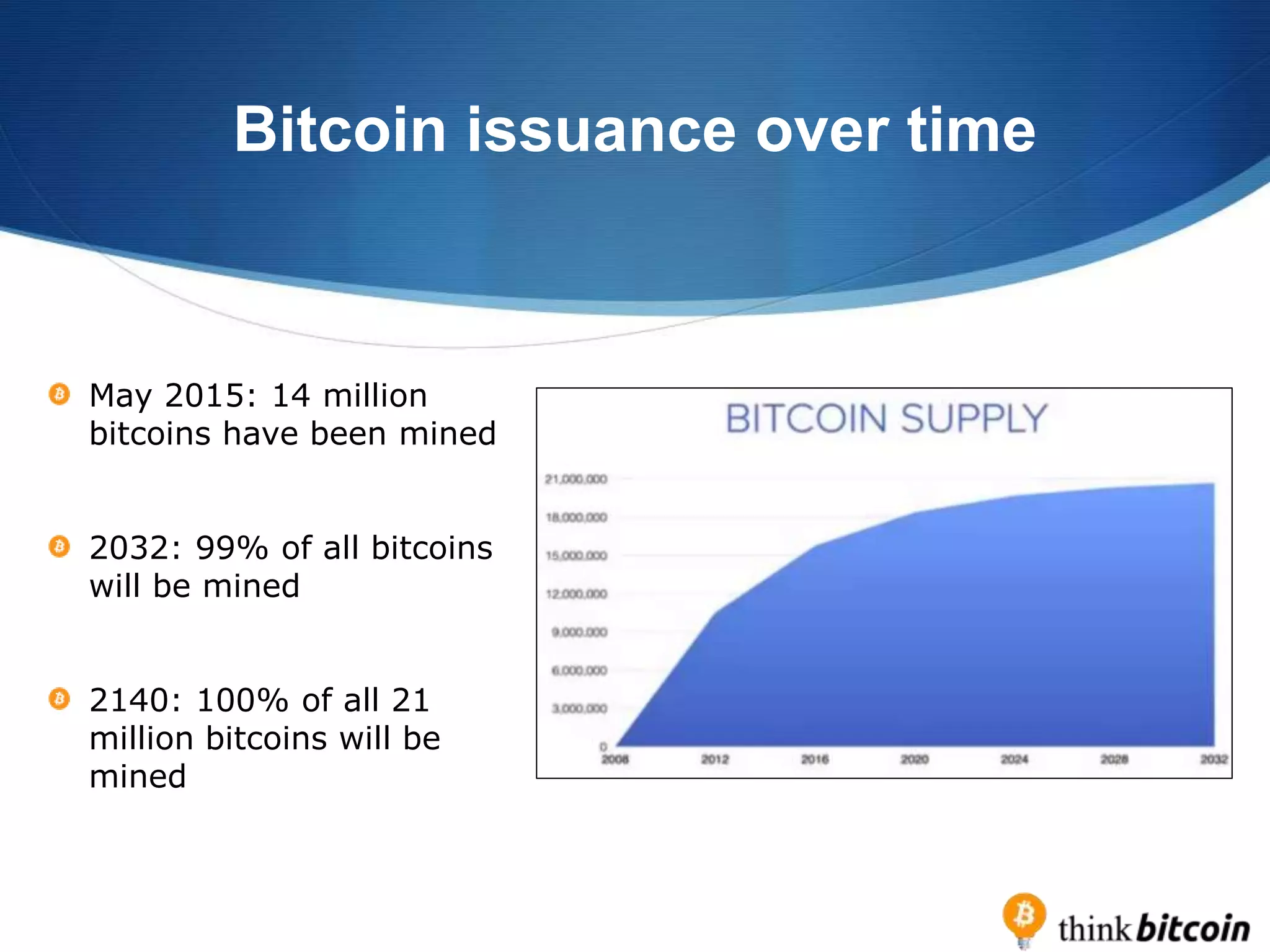
Bitcoin issuance over time
May 2015: 14 million
bitcoins have been mined
2032: 99% of all bitcoins
will be mined
2140: 100% of all 21
million bitcoins will be
mined
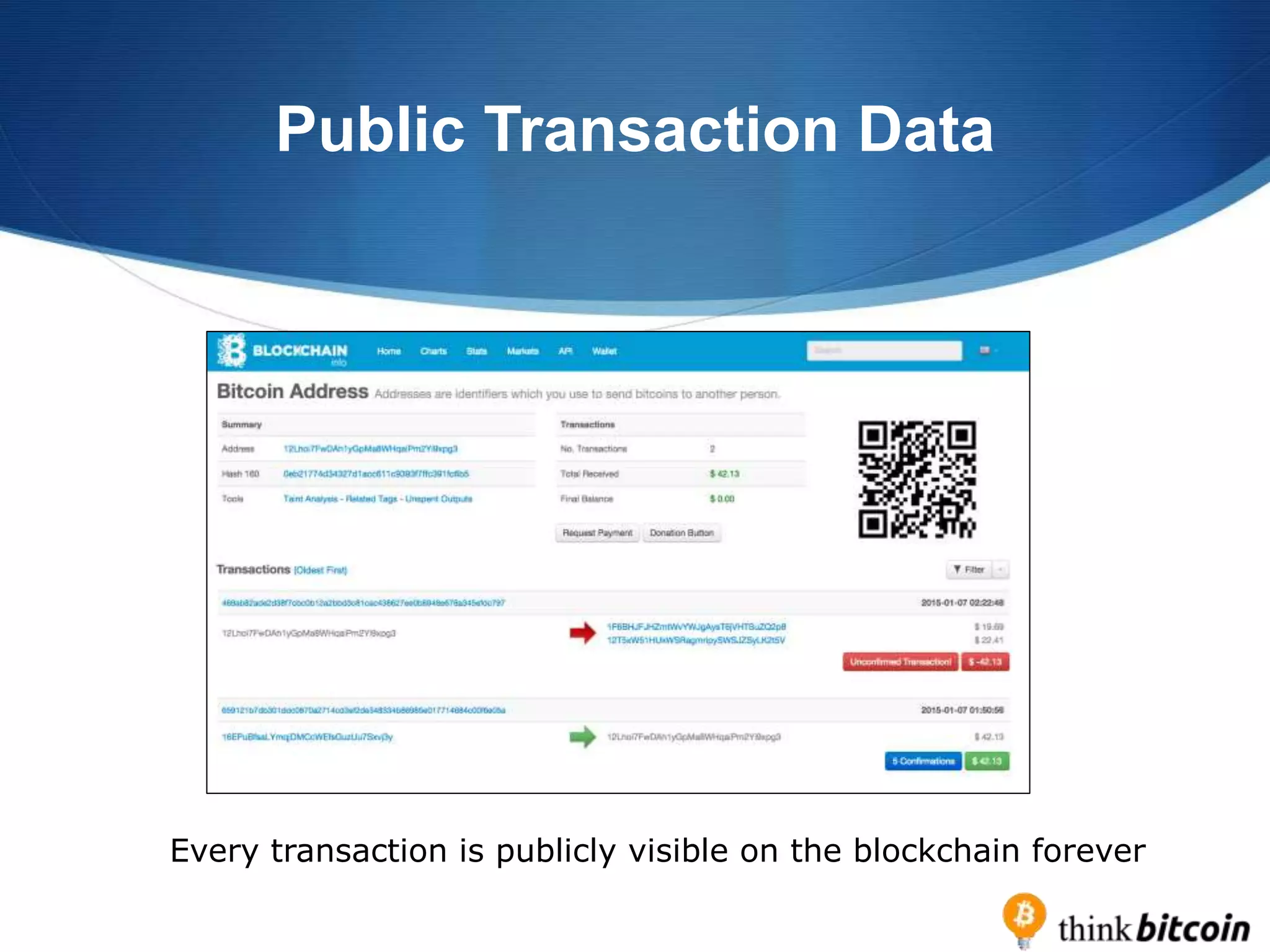
Public Transaction Data
Every transaction is publicly visible on the blockchain forever
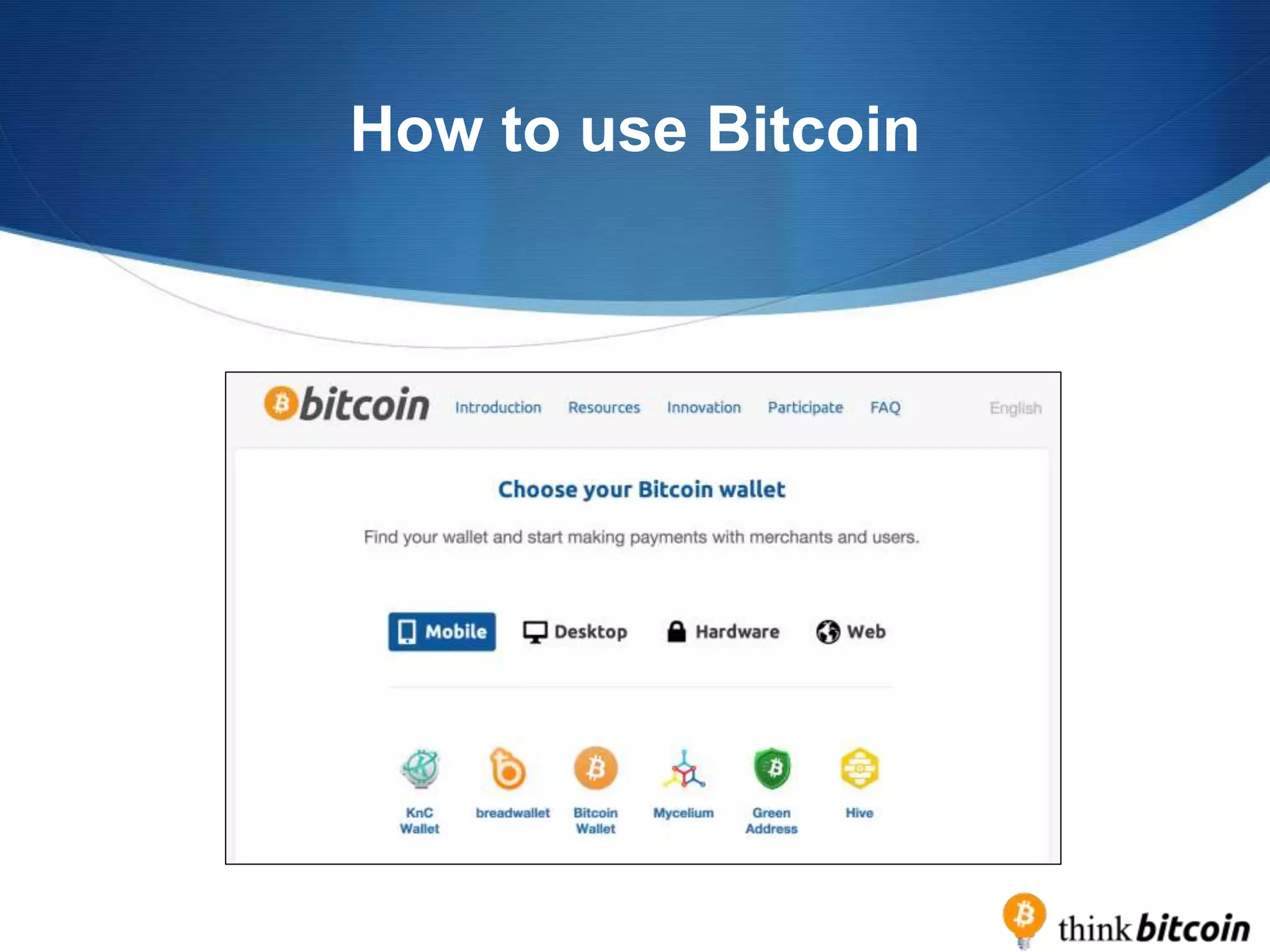
How to use Bitcoin
What’s a Bitcoin Wallet?
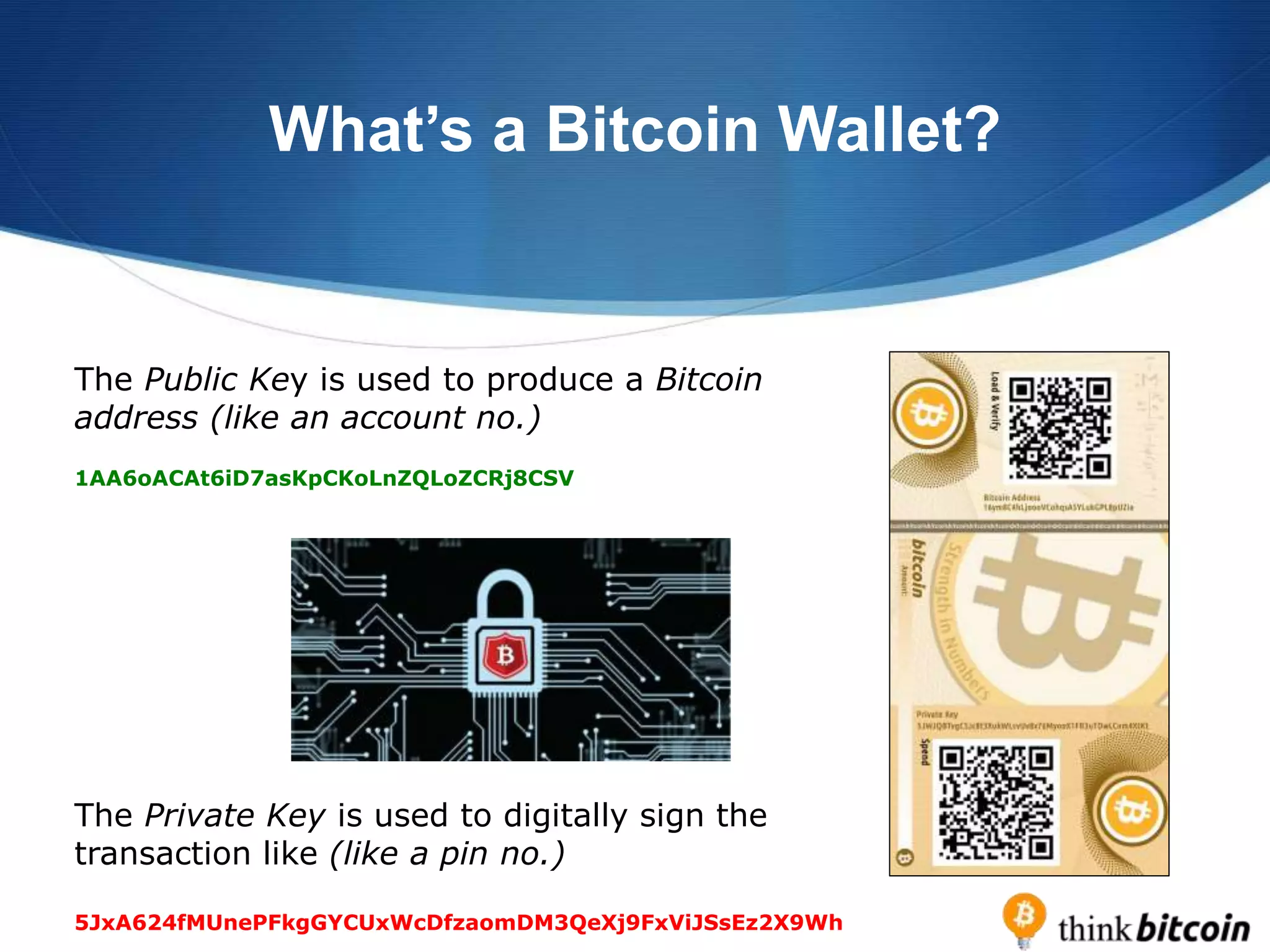
The Public Key is used to produce a Bitcoin
address (like an account no.)
1AA6oACAt6iD7asKpCKoLnZQLoZCRj8CSV
The Private Key is used to digitally sign the
transaction like (like a pin no.)
5JxA624fMUnePFkgGYCUxWcDfzaomDM3QeXj9FxViJSsEz2X9Wh
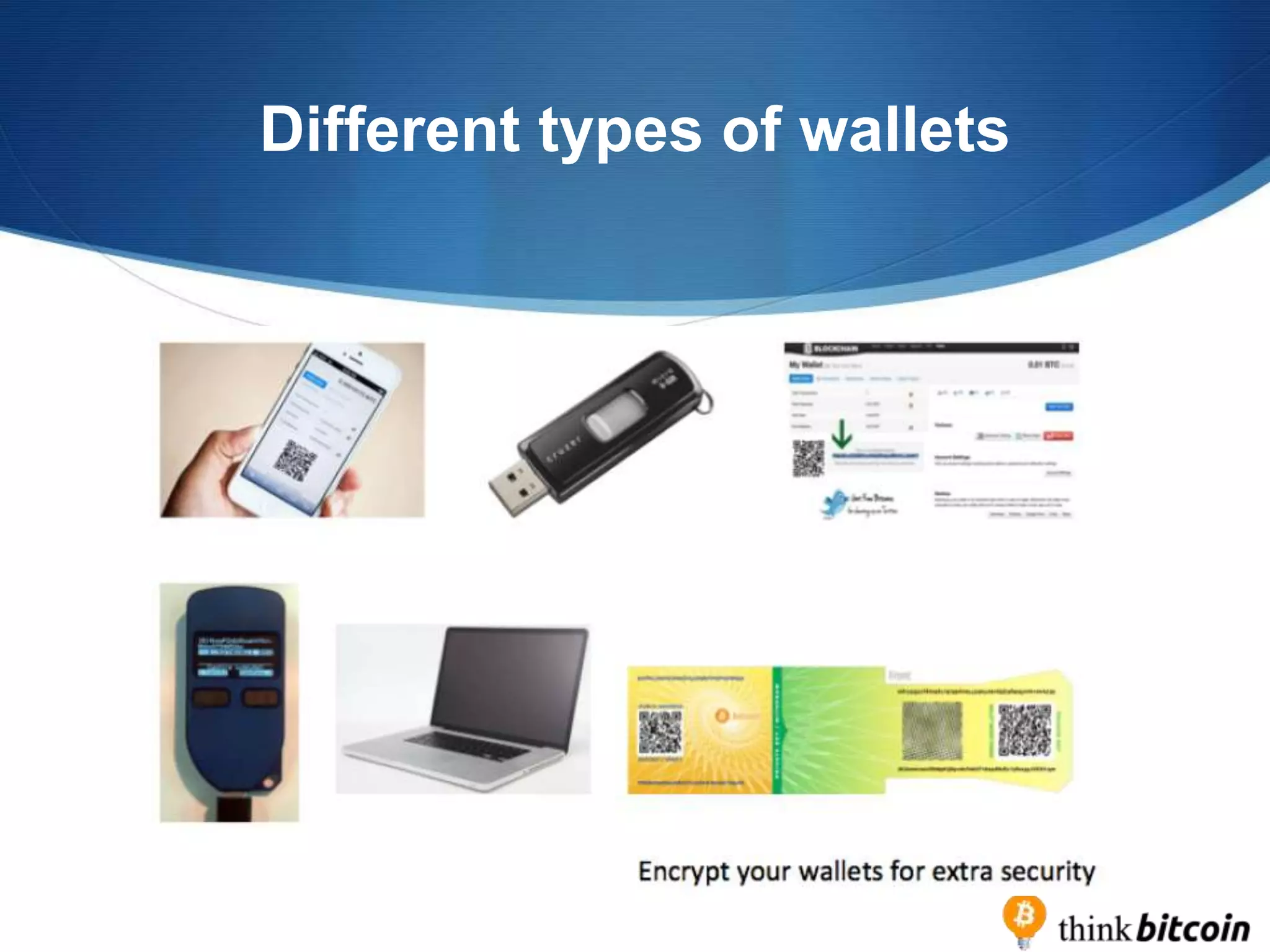
Different types of wallets
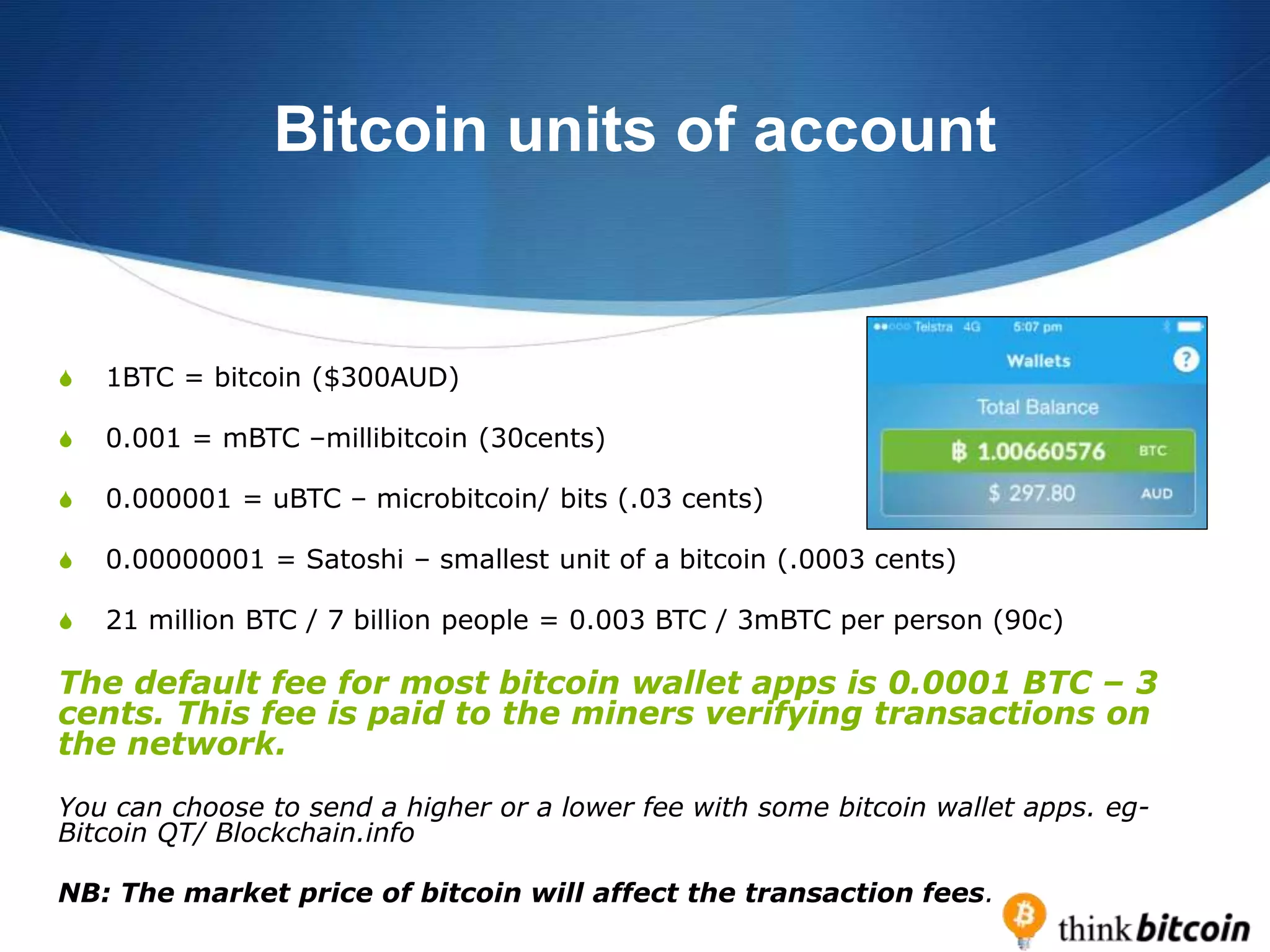
Bitcoin units of account
S 1BTC = bitcoin ($300AUD)
S 0.001 = mBTC –millibitcoin (30cents)
S 0.000001 = uBTC – microbitcoin/ bits (.03 cents)
S 0.00000001 = Satoshi – smallest unit of a bitcoin (.0003 cents)
S 21 million BTC / 7 billion people = 0.003 BTC / 3mBTC per person (90c)
The default fee for most bitcoin wallet apps is 0.0001 BTC – 3
cents. This fee is paid to the miners verifying transactions on
the network.
You can choose to send a higher or a lower fee with some bitcoin wallet apps. eg-
Bitcoin QT/ Blockchain.info
NB: The market price of bitcoin will affect the transaction fees.
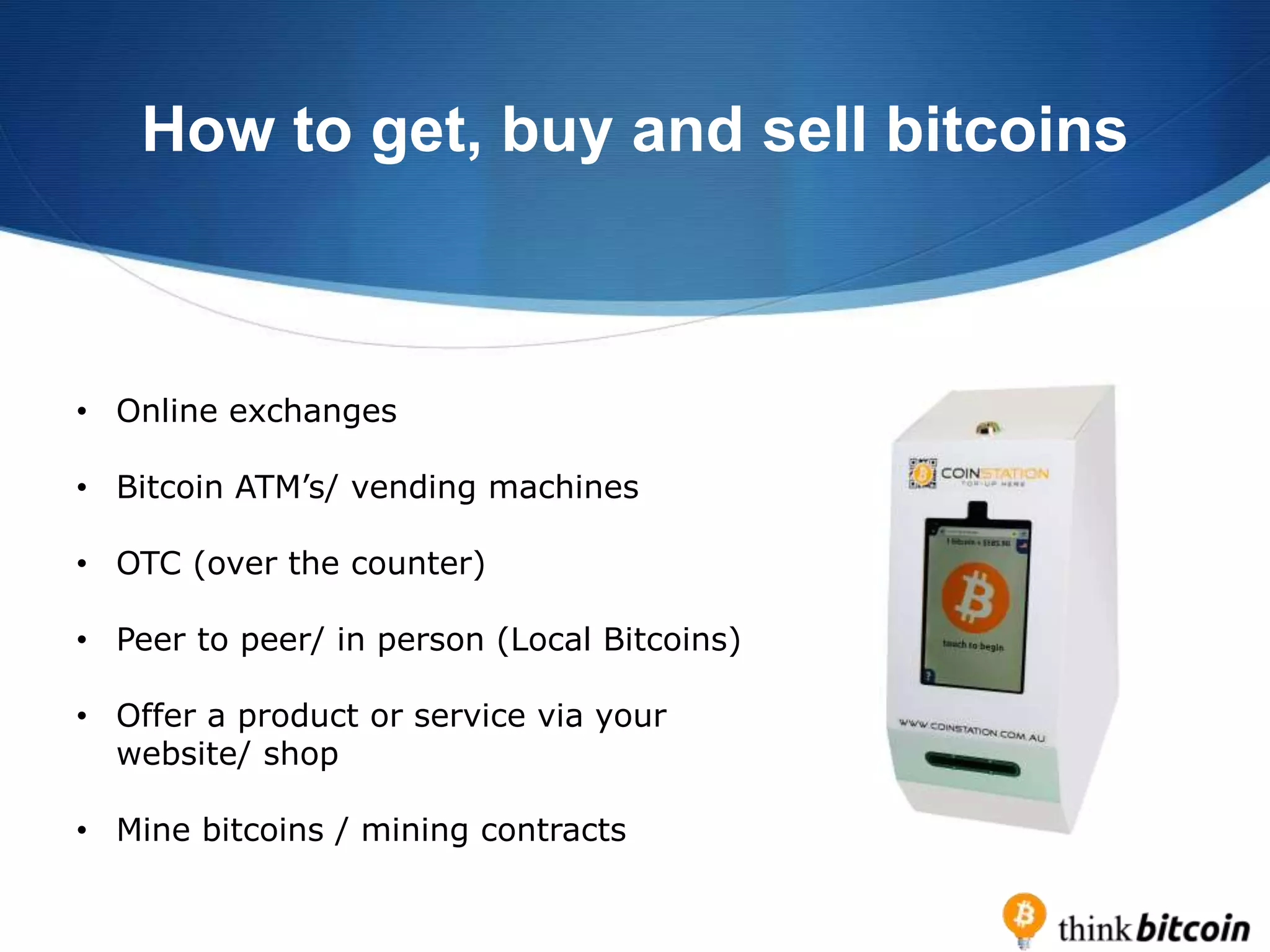
How to get, buy and sell bitcoins
• Online exchanges
• Bitcoin ATM’s/ vending machines
• OTC (over the counter)
• Peer to peer/ in person (Local Bitcoins)
• Offer a product or service via your
website/ shop
• Mine bitcoins / mining contracts
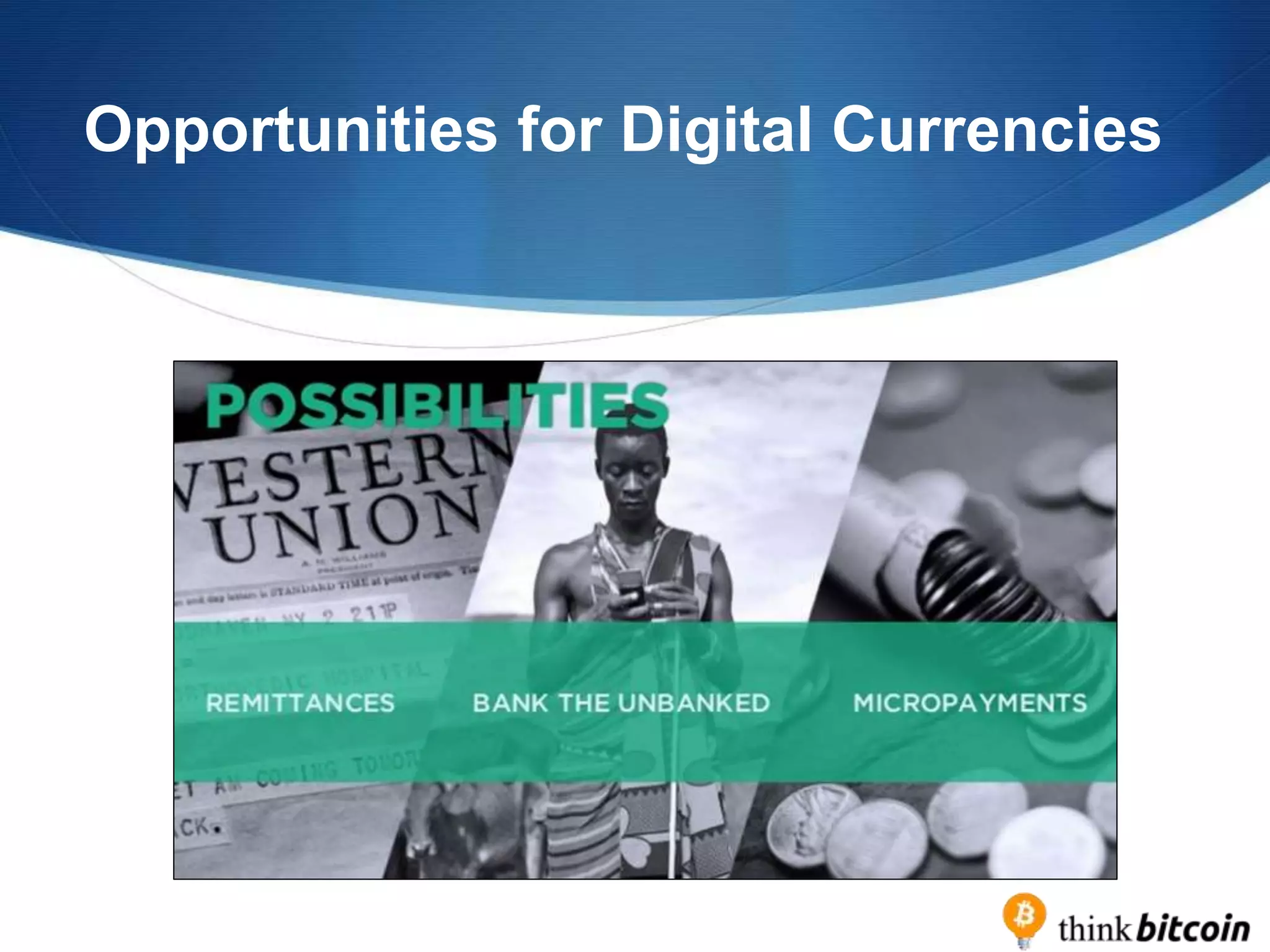
Opportunities for Digital Currencies
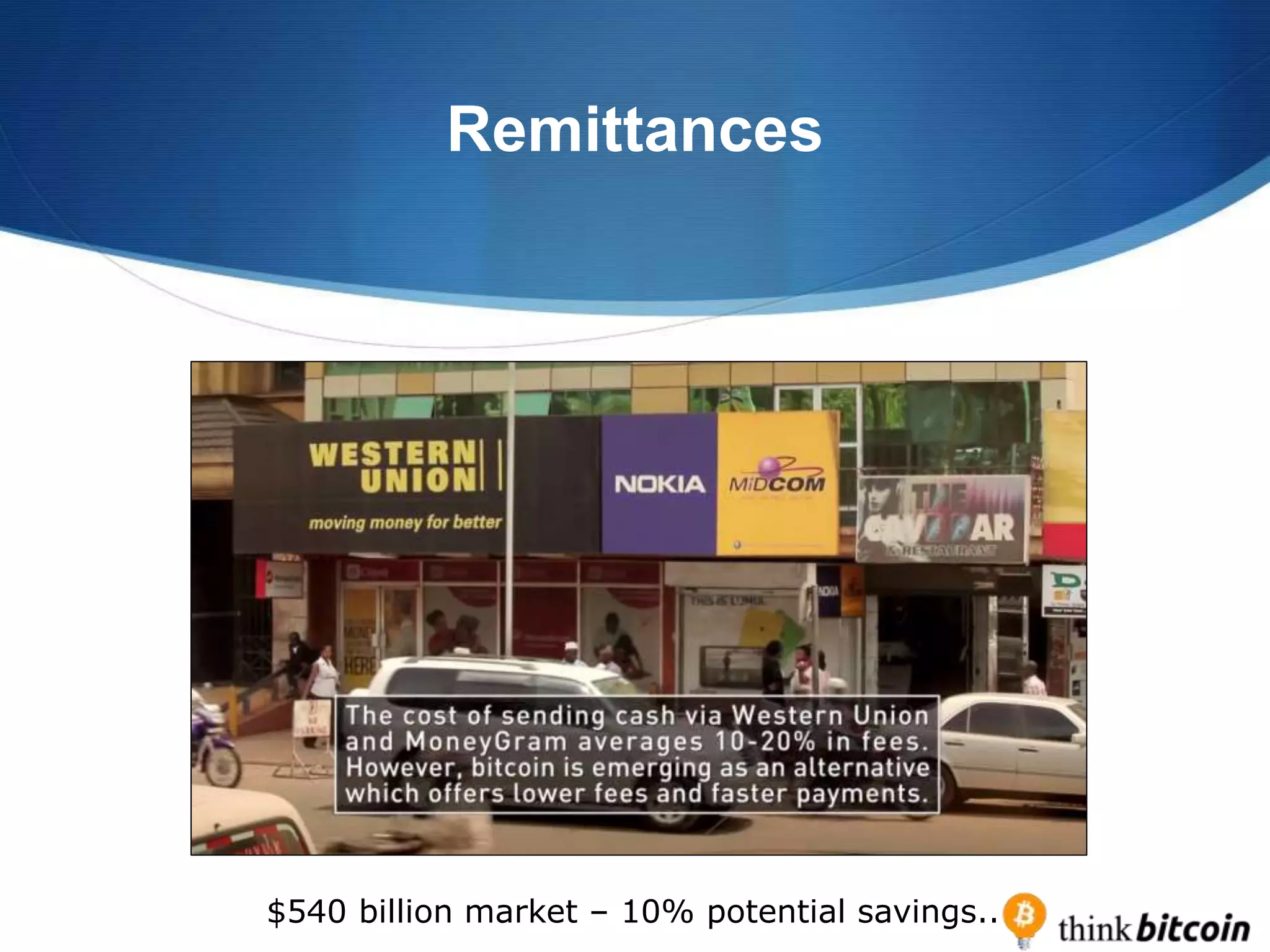
Remittances
$540 billion market – 10% potential savings..
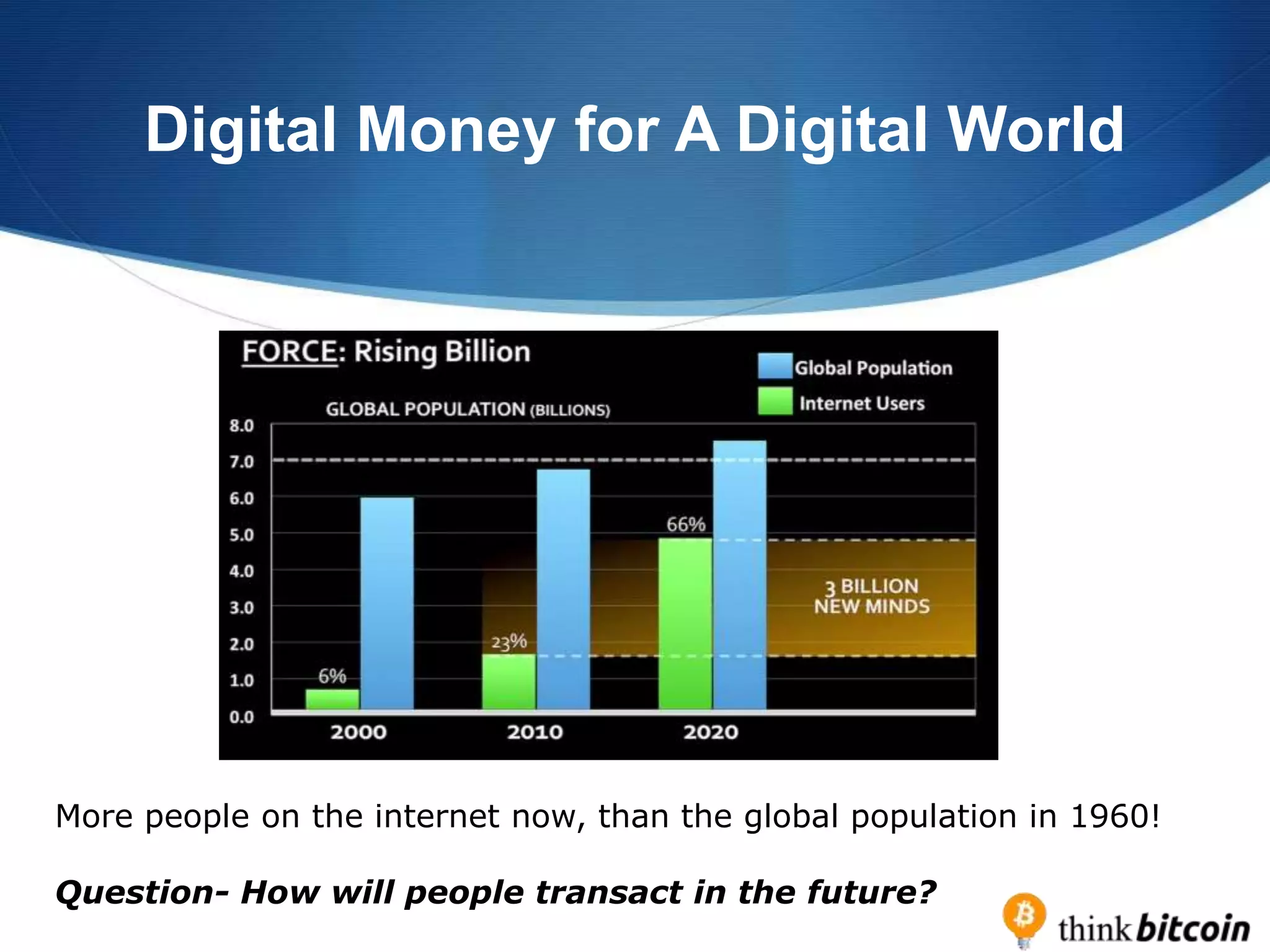
Digital Money for A Digital World
More people on the internet now, than the global population in 1960!
Question- How will people transact in the future?
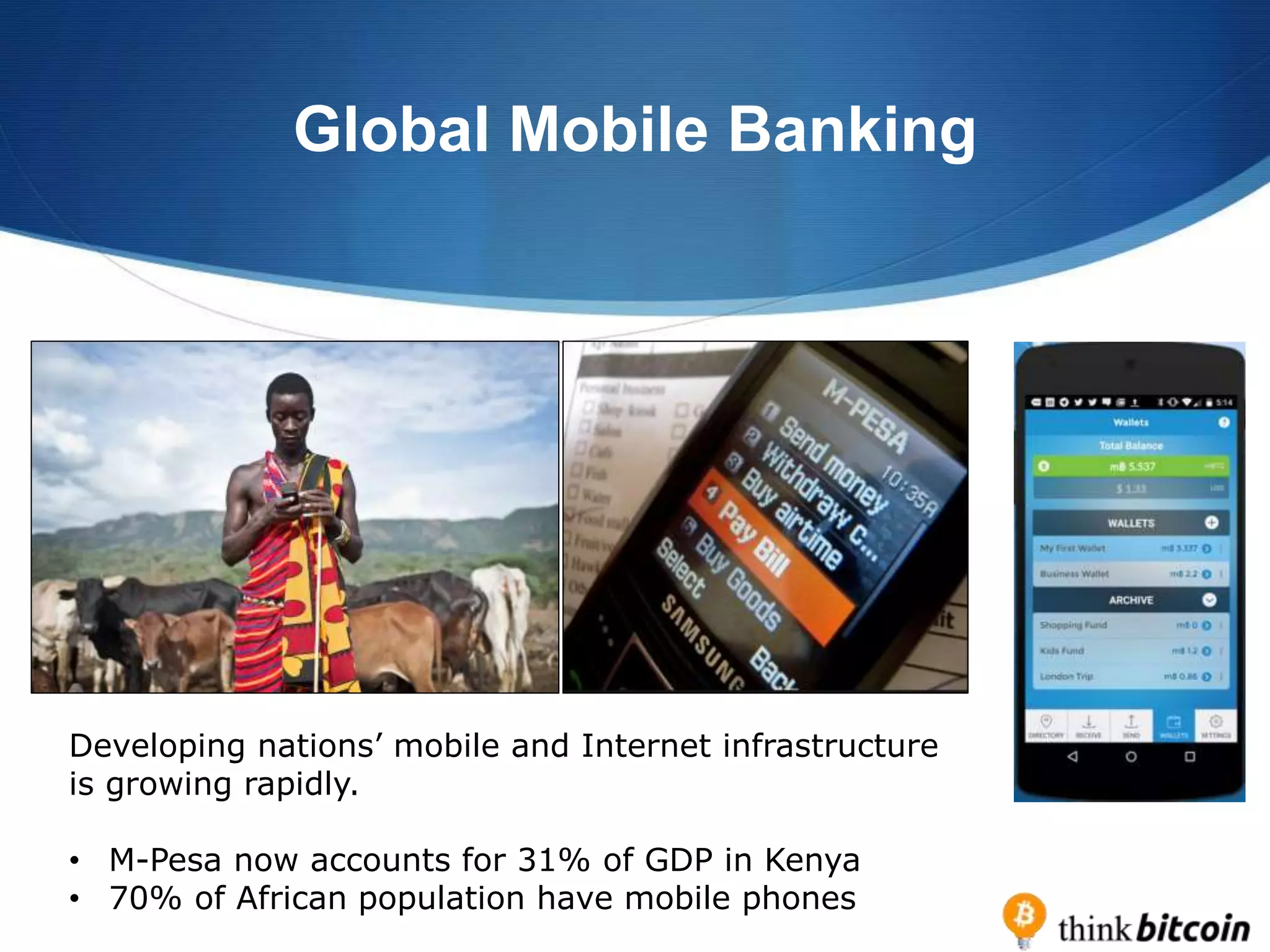
Global Mobile Banking
Developing nations’ mobile and Internet infrastructure
is growing rapidly.
• M-Pesa now accounts for 31% of GDP in Kenya
• 70% of African population have mobile phones
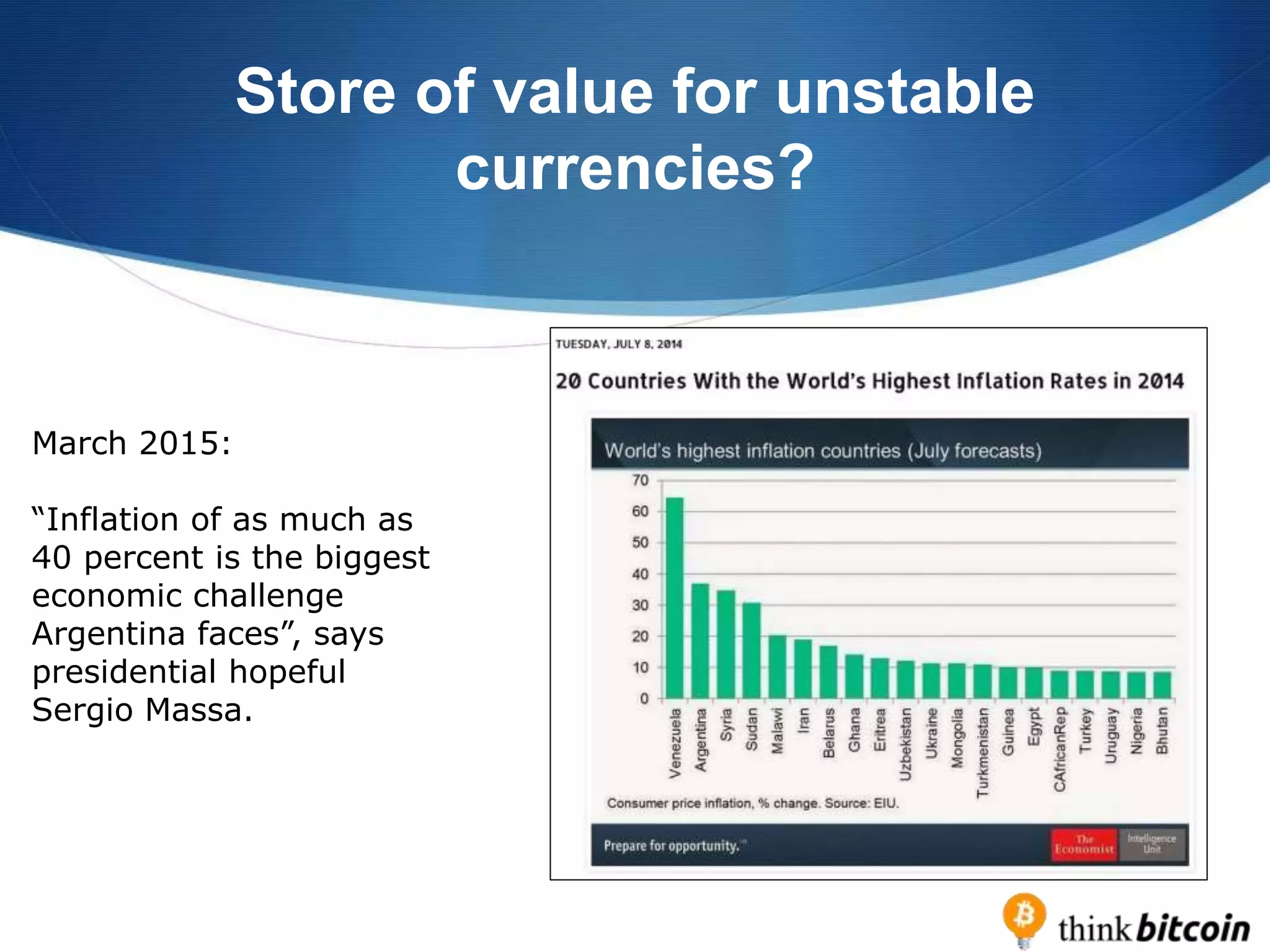
Store of value for unstable
currencies?
March 2015:
“Inflation of as much as
40 percent is the biggest
economic challenge
Argentina faces”, says
presidential hopeful
Sergio Massa.
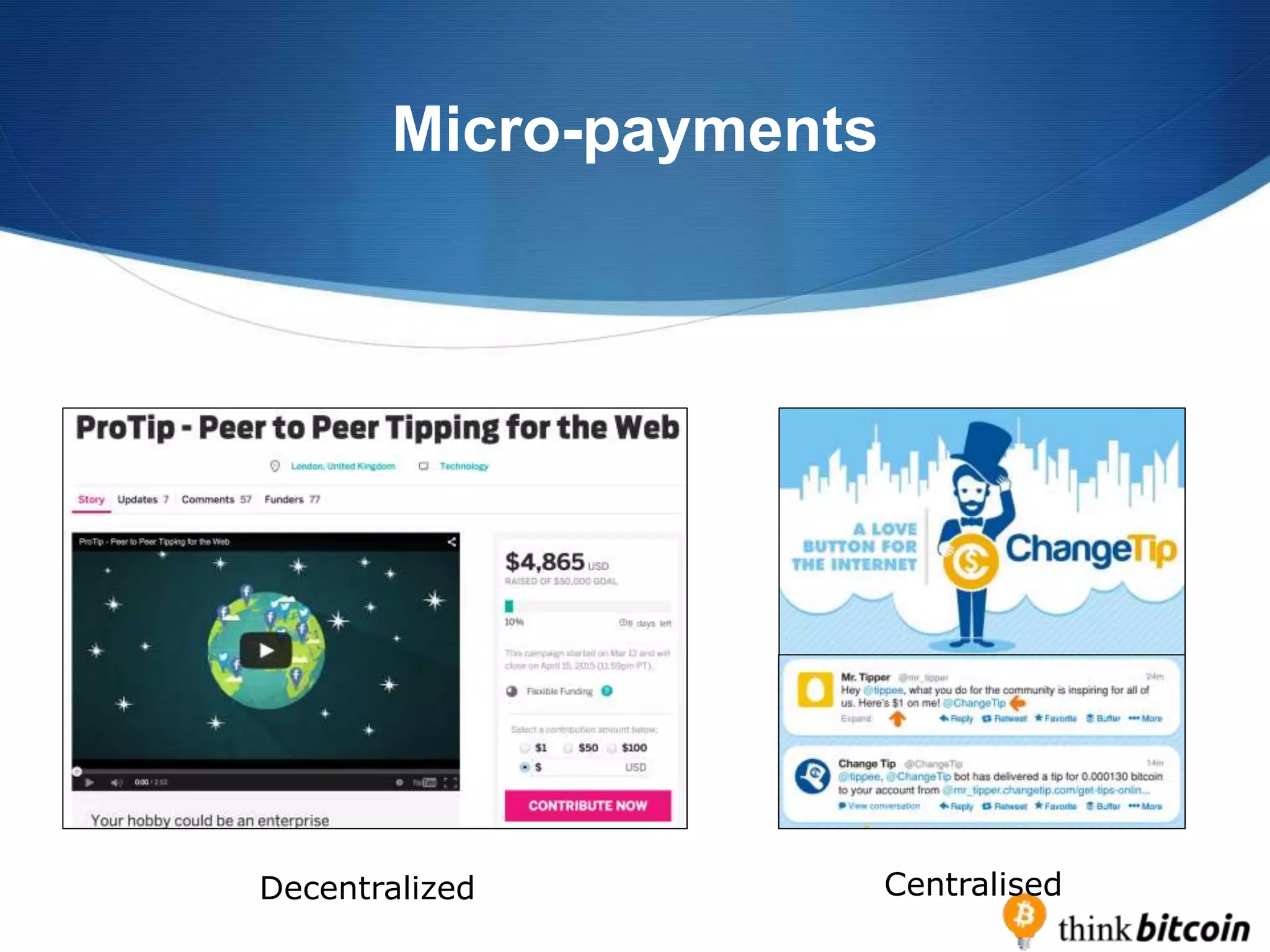
Micro-payments
Decentralized Centralised
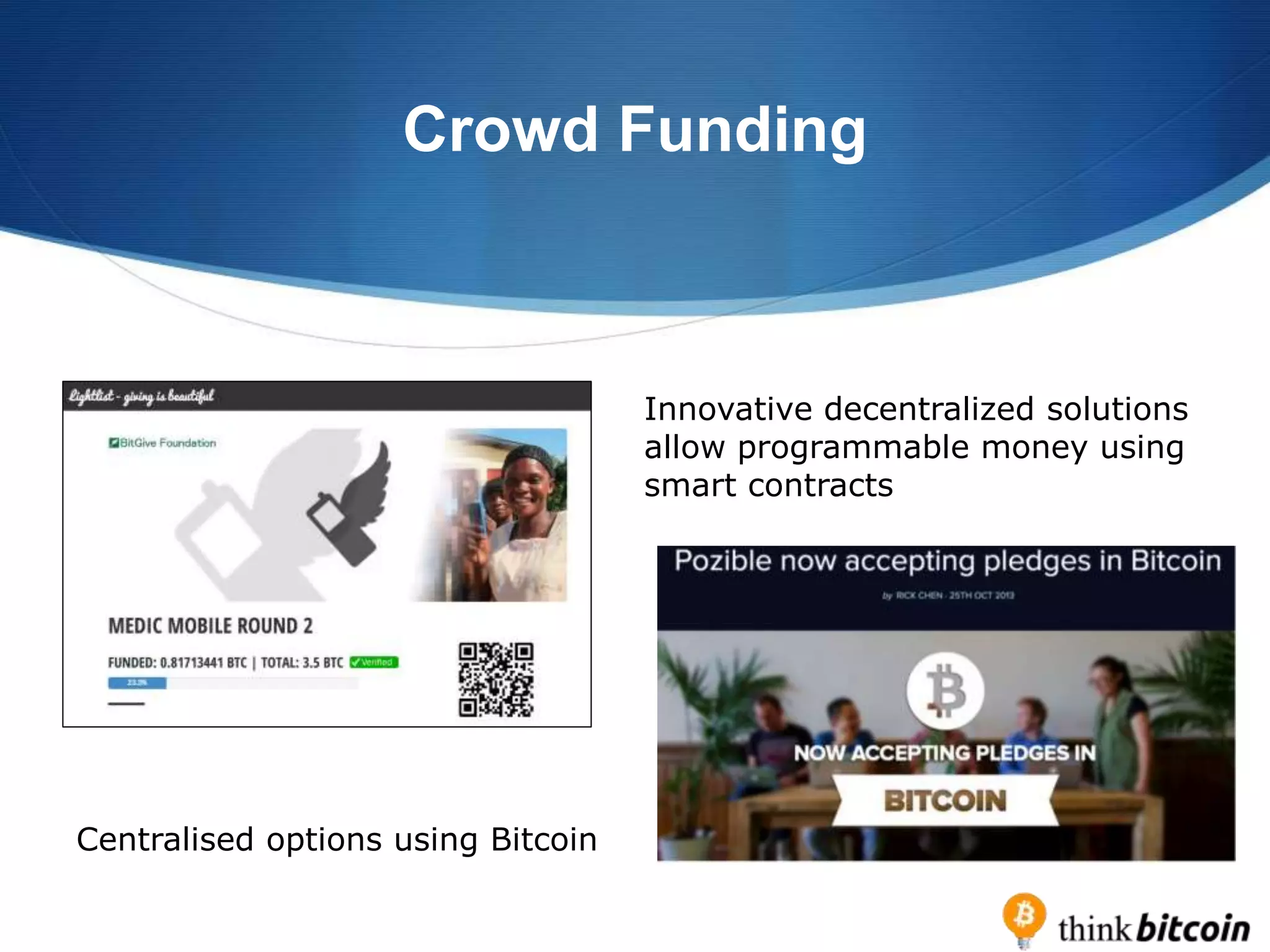
Crowd Funding
Innovative decentralized solutions
allow programmable money using
smart contracts
Centralised options using Bitcoin
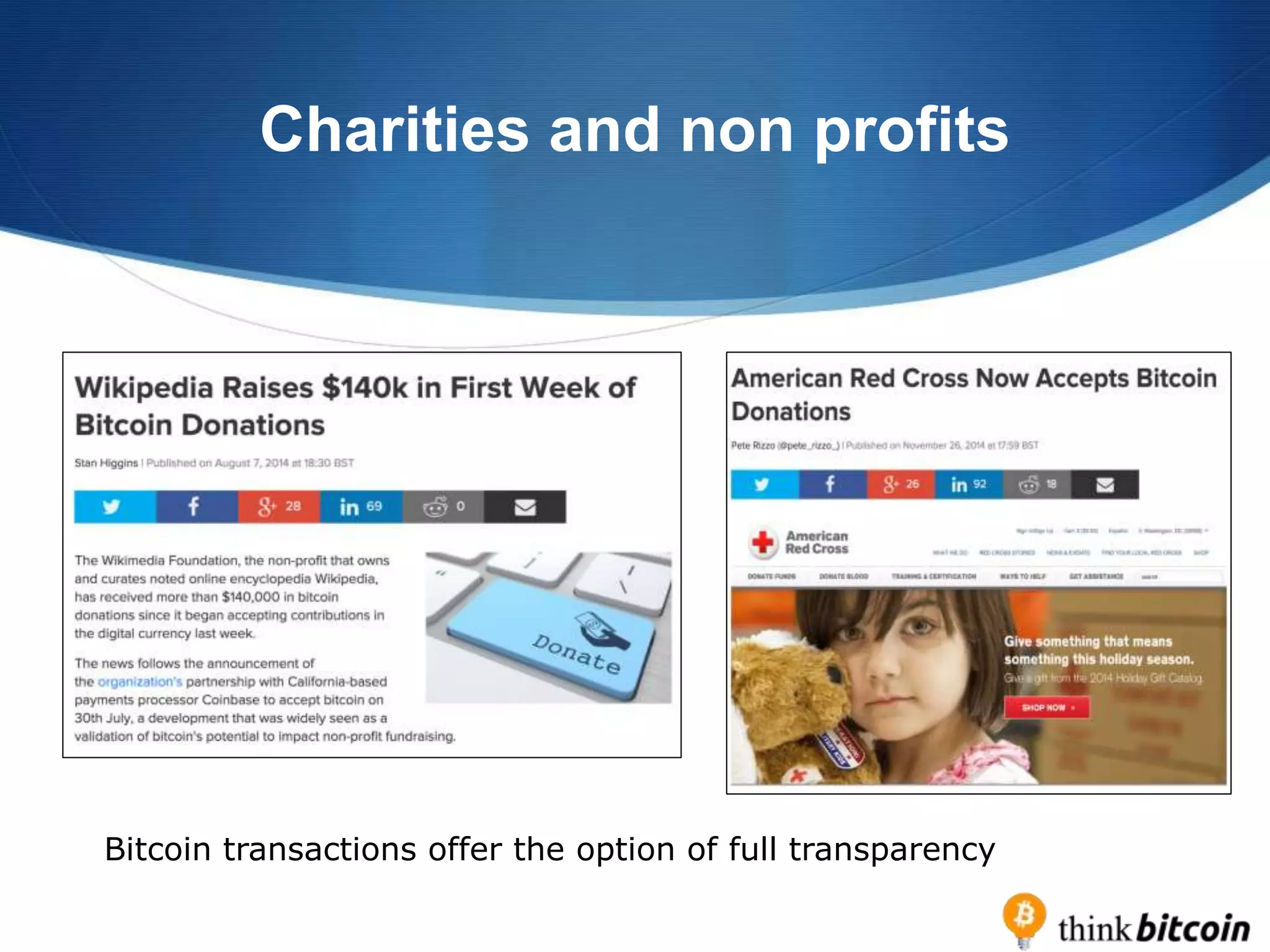
Charities and non profits
Bitcoin transactions offer the option of full transparency
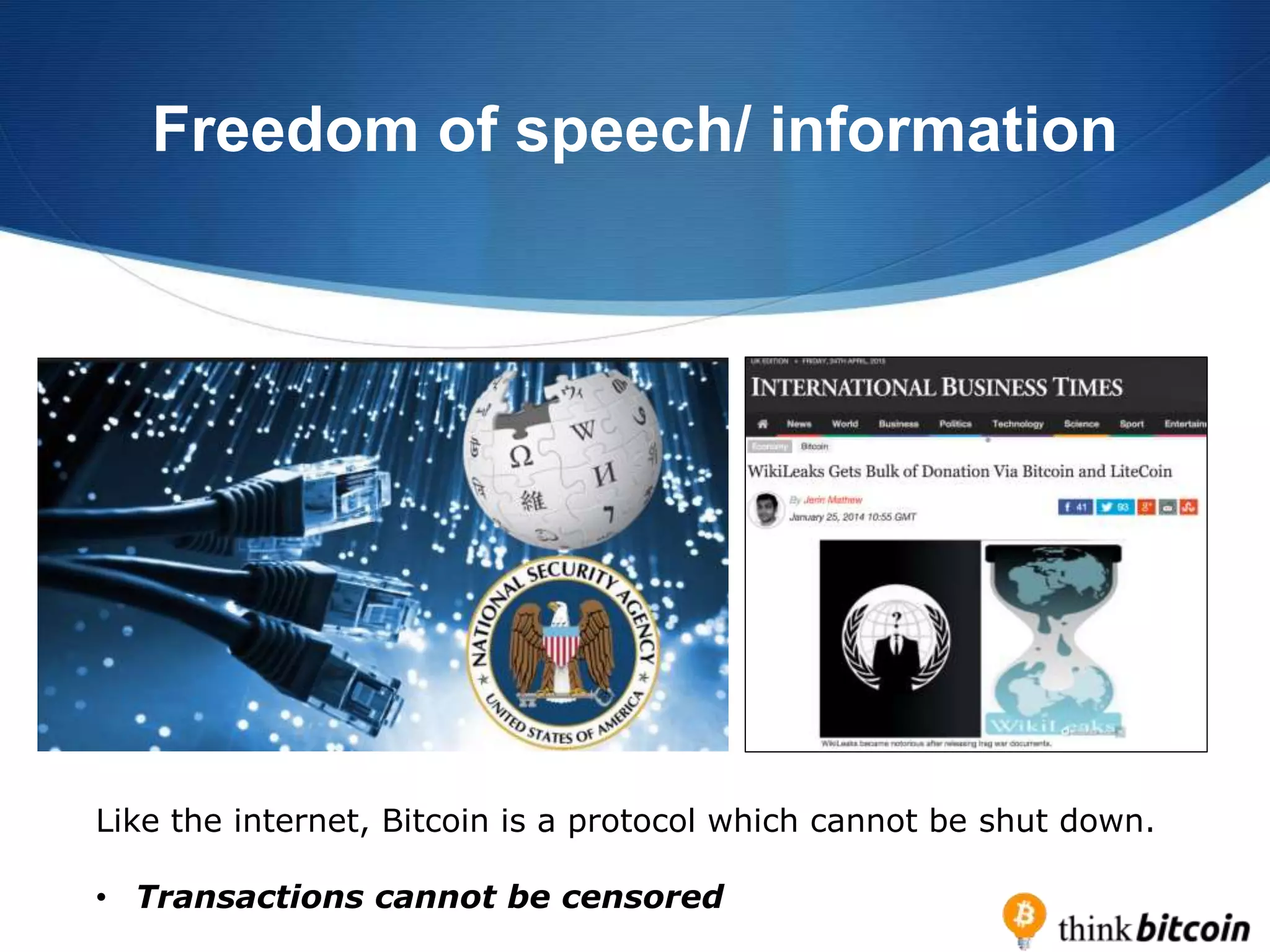
Freedom of speech/ information
Like the internet, Bitcoin is a protocol which cannot be shut down.
• Transactions cannot be censored
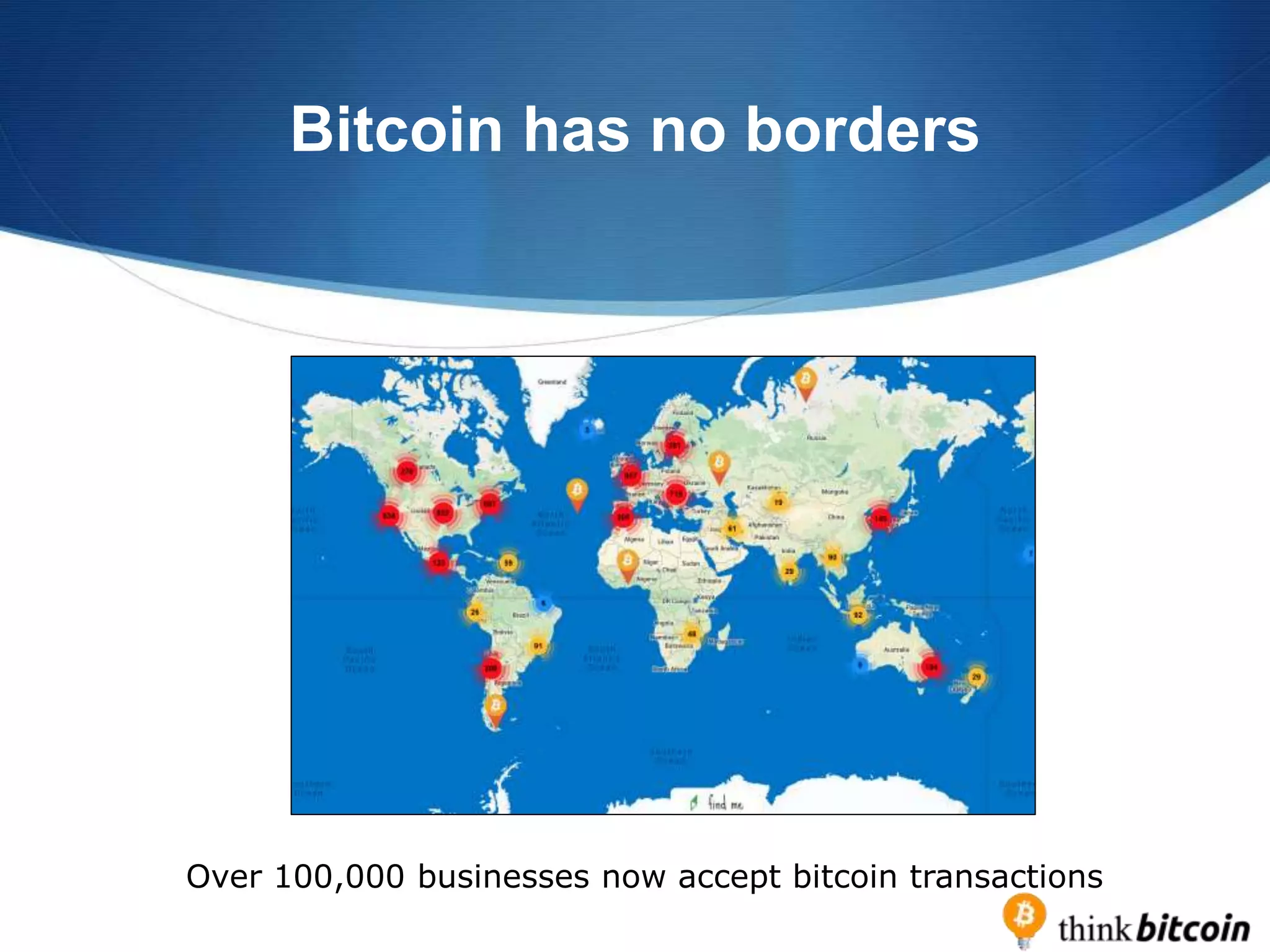
Bitcoin has no borders
Over 100,000 businesses now accept bitcoin transactions
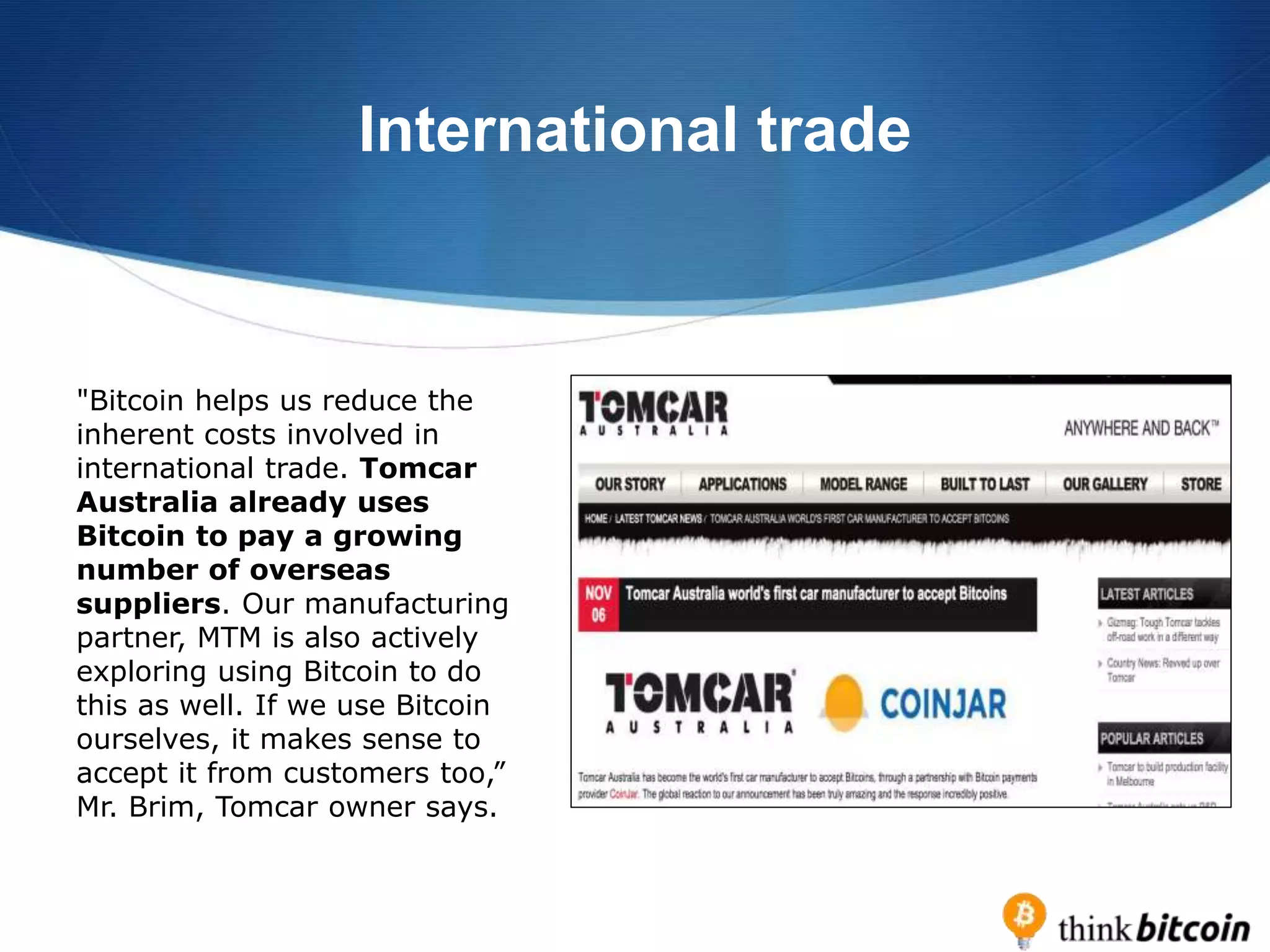
International trade
"Bitcoin helps us reduce the
inherent costs involved in
international trade. Tomcar
Australia already uses
Bitcoin to pay a growing
number of overseas
suppliers. Our manufacturing
partner, MTM is also actively
exploring using Bitcoin to do
this as well. If we use Bitcoin
ourselves, it makes sense to
accept it from customers too,”
Mr. Brim, Tomcar owner says.
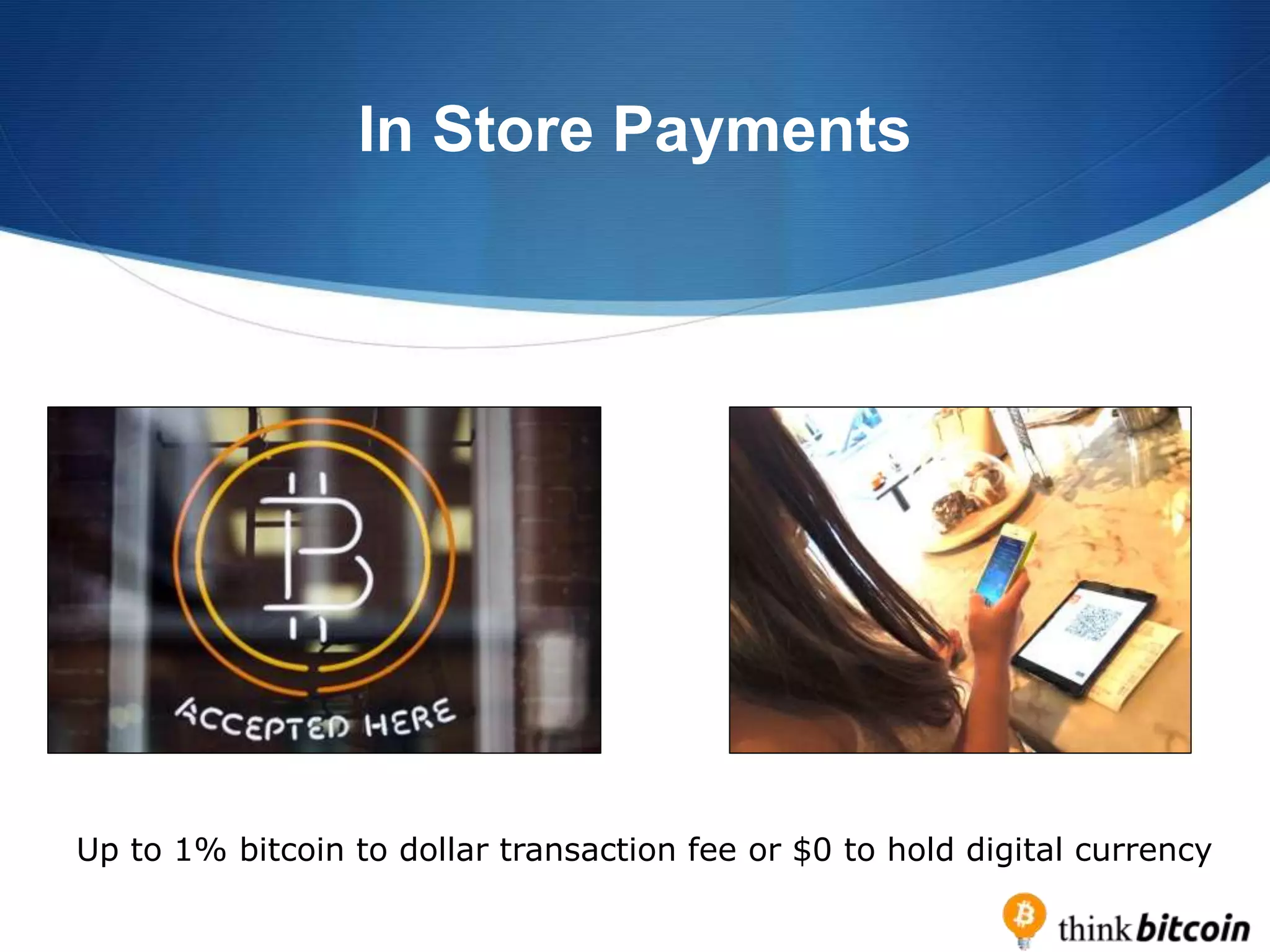
In Store Payments
Up to 1% bitcoin to dollar transaction fee or $0 to hold digital currency
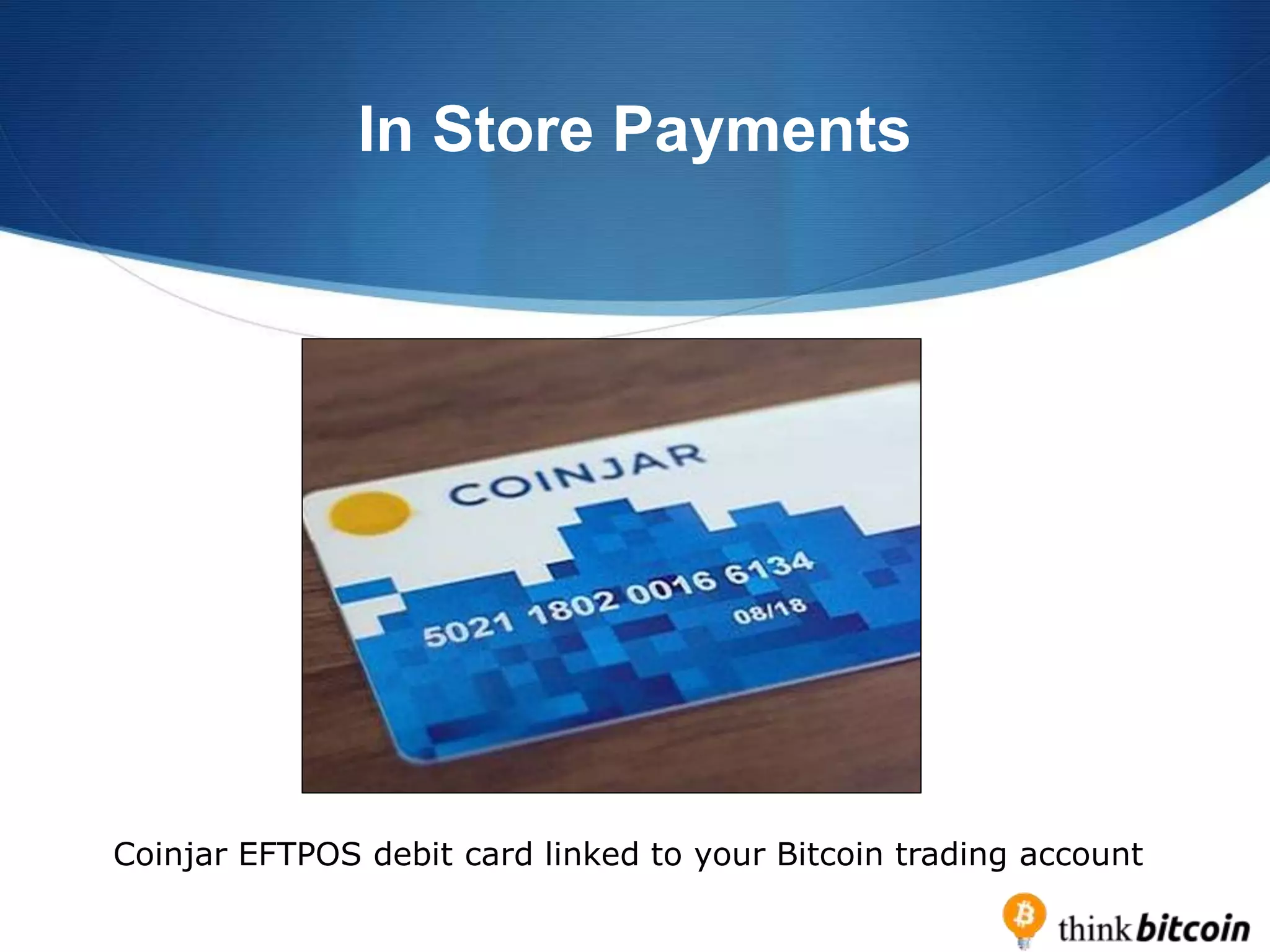
In Store Payments
Coinjar EFTPOS debit card linked to your Bitcoin trading account
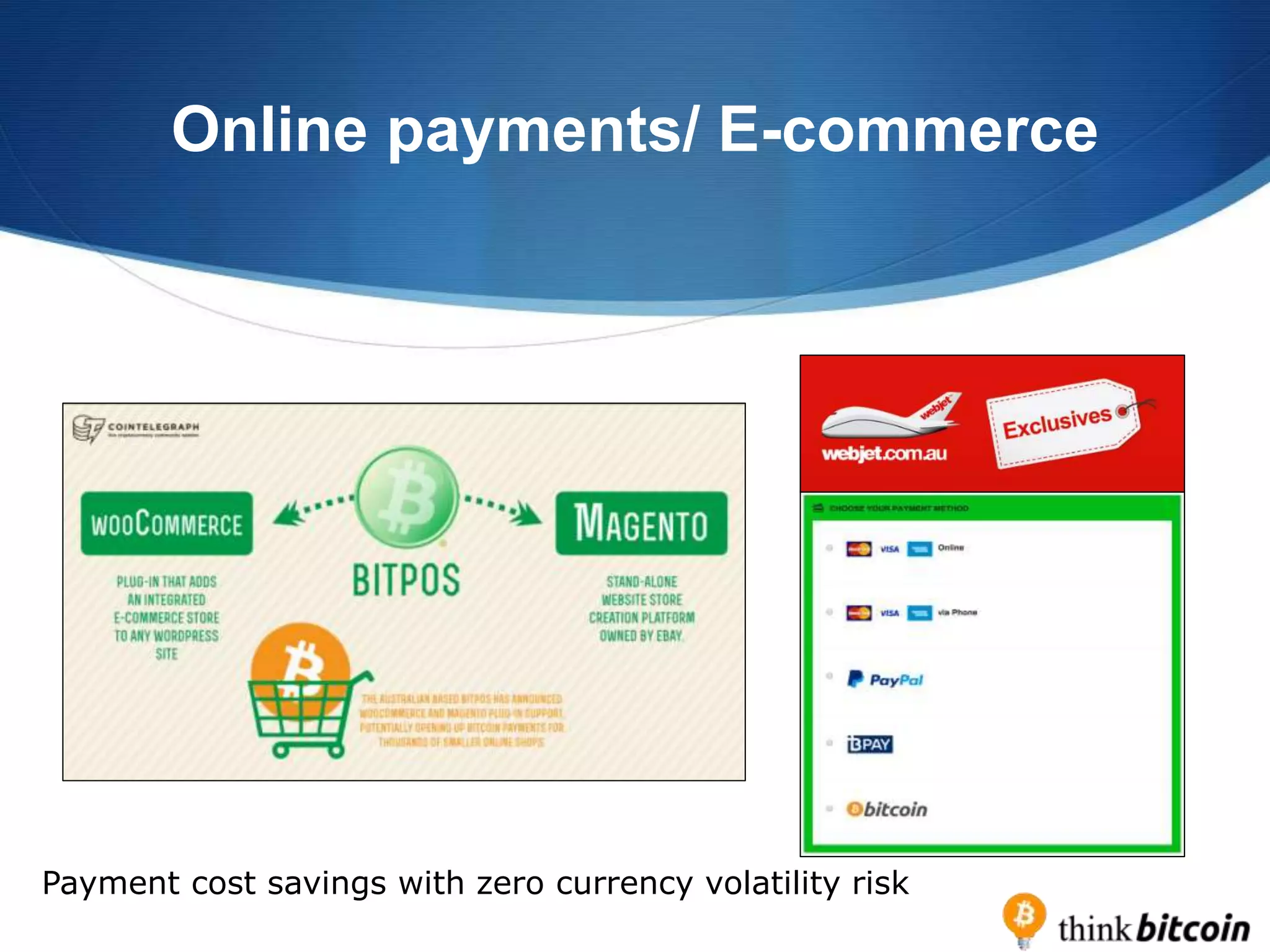
Online payments/ E-commerce
Payment cost savings with zero currency volatility risk
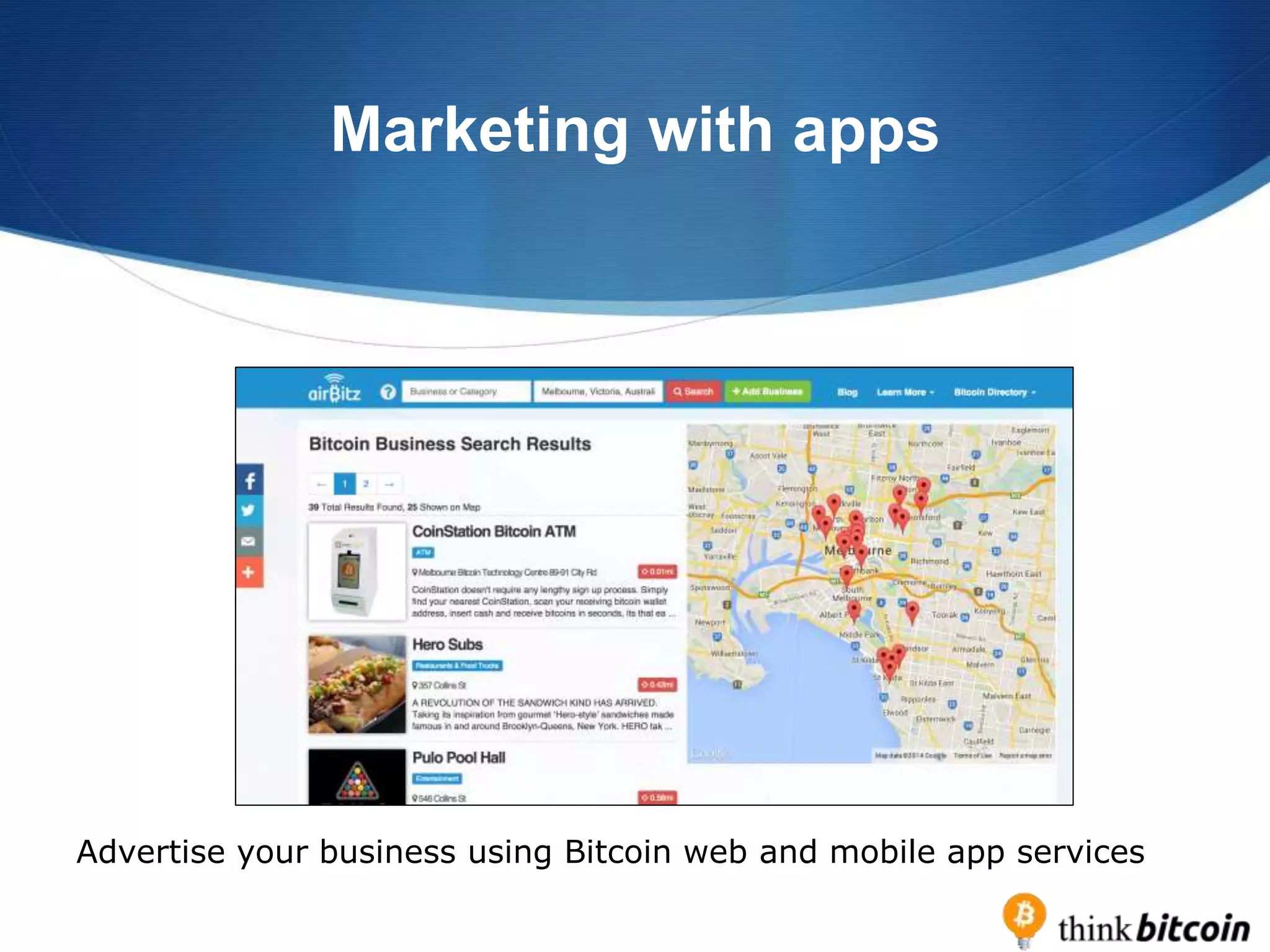
Marketing with apps
Advertise your business using Bitcoin web and mobile app services
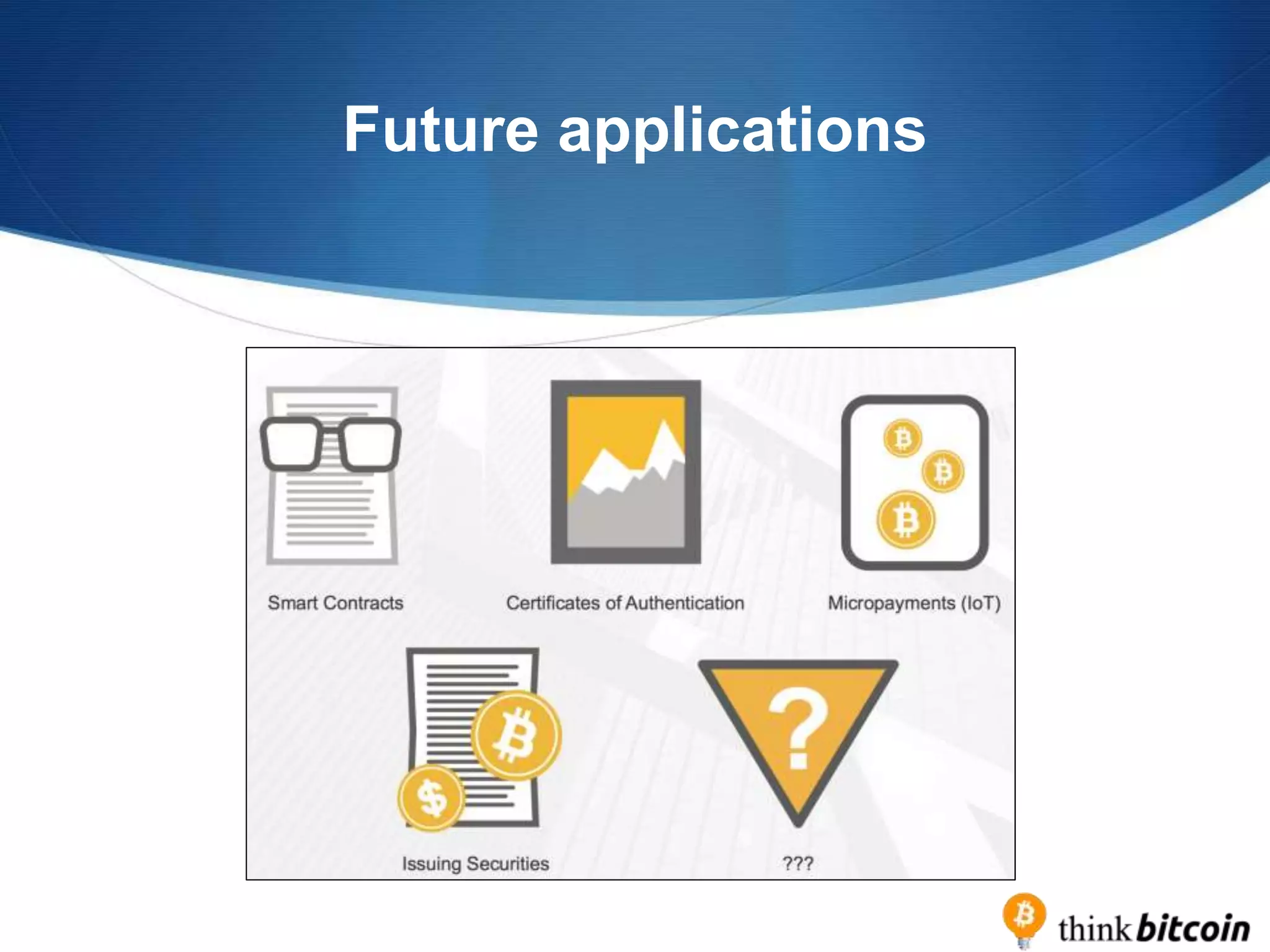
Future applications
Produced by: Martin Davidson
Email: info@thinkbitcoin.com.au

Think bitcoin workshop slideshare

  • 1.
    S DRIVING EDUCATION ANDPROFESSIONAL USE OF DIGITAL CURRENCY IN AUSTRALIA www.thinkbitcoin.com.au Produced by: Martin Davidson Email: info@thinkbitcoin.com.au
  • 2.
    What are DigitalCurrencies? 1) Digital currencies, also known as crypto currencies, are math based computer generated money.. But what is MONEY? S Medium of exchange S Store of value S Unit of account 2) They are also their own payment networks
  • 3.
    History of Bitcoin https://bitcoin.org/bitcoin.pdf 2008:Bitcoin white paper is released 2009: Software becomes available 2010: First currency exchanges appear 2011: 1 Bitcoin = $1 USD 2012: Multi-signature 2013: Cyprus bank bail ins, 1BTC=$1k 2014: Mt Gox. Mainstream awareness 2015: Stock market listings..
  • 4.
    Some Basic Terms Sbitcoin: Without capitalization, is used to describe bitcoins as a unit of account S Bitcoin: With capitalization, is used when describing the concept of Bitcoin, or the entire network itself S Address: A location that bitcoins have been sent to and reside at. Alternatively, can be thought of as an account of sorts that has a balance of bitcoins S Blockchain: The complete transaction ledger of the Bitcoin network, showing how bitcoins have been transferred from one address to another over time. The blockchain is a public record of all bitcoin transactions in chronological order S Transaction: The movement of bitcoins from one address to another address. In traditional terms, this can be thought of as a payment or money movement
  • 5.
    Digital Money Bitcoin isthe most well known example of a new breed of digital currencies. S Global digital currency S Supply is capped at 21 million S Can be divided to 8 decimal places S Cannot be counterfeited S Currently valued at around $350 AUD S Network valued at $3.5bn
  • 6.
    The Payment Network SDecentralized, peer to peer network S Transactions are fast and cheap S Transactions are irreversible S Transactions are verified in minutes S Open to anyone with an internet connection S Can be used to transmit anything of value. (2.0 projects)
  • 7.
    What is Peerto Peer? No centralised database or single point of failure
  • 8.
    Bitcoin Price $100 worthof bitcoin in 2010 would be valued at $500k today
  • 9.
    Bitcoin Transactions 2011: 2,000per day 2012: 7,000 per day 2013: 30,000 per day 2014: 70,000 per day 2015: 110,00 per day
  • 10.
    Bitcoin Mining 25 bitcoinsmined into new blocks every 10 minutes 144 blocks mined per day = $1,080,000 AUD ($300 per BTC)
  • 11.
    What is Mining? Miningserves 2 purposes: S Mining creates new bitcoins in each block. The amount of bitcoin created is fixed and diminishes with time. S Mining creates trust by ensuring that transactions are only confirmed if enough power was devoted to the block that contains them.
  • 12.
    Mining contd. S Thecreation of new blocks must take an average of 10 minutes S The regulation is done by periodically adjusting the hash target value for blocks. S Every 2,016 blocks (which spans 2 weeks if each block takes 10 minutes), the nodes calculate a new difficulty based on the time it took to mine the last 2,016 blocks.
  • 13.
    Mining is a3 step process S Step 1: Miners create a file that contains (a) the hash of the last block in the existing blockchain, (b) a block of the new proposed transactions broadcast in the Bitcoin network and (c) a random number that the miner guesses (a “nonce”). The combination of (a) + (b) + (c) is the data used as the input for Step 2 S Step 2: Miners apply a cryptographic function to the data. The details of the function (SHA- 256 in the case of Bitcoin). What is important to understand is that the function does some calculations on the file/data from Step 1 and produces a random number known as a “hash” S Step 3: The hash is reviewed against a desired pattern (in the case of Bitcoin, how many leading zeros it has, an outcome that is effectively random). If the hash matches the pattern, the miner has a correct block and will win an economic prize. If the hash does not match the pattern, the miner returns to step 1, guessing a new nonce and repeating the exercise
  • 14.
  • 15.
    Mining pools Bitcoin miningis a rapidly expanding and highly specialised, capital intensive industry. S Mining pools use different distribution schemes, they share in the bitcoin rewards. S Mining farms are located where energy costs are lowest
  • 16.
    Bitcoin issuance overtime May 2015: 14 million bitcoins have been mined 2032: 99% of all bitcoins will be mined 2140: 100% of all 21 million bitcoins will be mined
  • 17.
    Public Transaction Data Everytransaction is publicly visible on the blockchain forever
  • 18.
    How to useBitcoin
  • 19.
    What’s a BitcoinWallet? The Public Key is used to produce a Bitcoin address (like an account no.) 1AA6oACAt6iD7asKpCKoLnZQLoZCRj8CSV The Private Key is used to digitally sign the transaction like (like a pin no.) 5JxA624fMUnePFkgGYCUxWcDfzaomDM3QeXj9FxViJSsEz2X9Wh
  • 20.
  • 21.
    Bitcoin units ofaccount S 1BTC = bitcoin ($300AUD) S 0.001 = mBTC –millibitcoin (30cents) S 0.000001 = uBTC – microbitcoin/ bits (.03 cents) S 0.00000001 = Satoshi – smallest unit of a bitcoin (.0003 cents) S 21 million BTC / 7 billion people = 0.003 BTC / 3mBTC per person (90c) The default fee for most bitcoin wallet apps is 0.0001 BTC – 3 cents. This fee is paid to the miners verifying transactions on the network. You can choose to send a higher or a lower fee with some bitcoin wallet apps. eg- Bitcoin QT/ Blockchain.info NB: The market price of bitcoin will affect the transaction fees.
  • 22.
    How to get,buy and sell bitcoins • Online exchanges • Bitcoin ATM’s/ vending machines • OTC (over the counter) • Peer to peer/ in person (Local Bitcoins) • Offer a product or service via your website/ shop • Mine bitcoins / mining contracts
  • 23.
  • 24.
    Remittances $540 billion market– 10% potential savings..
  • 25.
    Digital Money forA Digital World More people on the internet now, than the global population in 1960! Question- How will people transact in the future?
  • 26.
    Global Mobile Banking Developingnations’ mobile and Internet infrastructure is growing rapidly. • M-Pesa now accounts for 31% of GDP in Kenya • 70% of African population have mobile phones
  • 27.
    Store of valuefor unstable currencies? March 2015: “Inflation of as much as 40 percent is the biggest economic challenge Argentina faces”, says presidential hopeful Sergio Massa.
  • 28.
  • 29.
    Crowd Funding Innovative decentralizedsolutions allow programmable money using smart contracts Centralised options using Bitcoin
  • 30.
    Charities and nonprofits Bitcoin transactions offer the option of full transparency
  • 31.
    Freedom of speech/information Like the internet, Bitcoin is a protocol which cannot be shut down. • Transactions cannot be censored
  • 32.
    Bitcoin has noborders Over 100,000 businesses now accept bitcoin transactions
  • 33.
    International trade "Bitcoin helpsus reduce the inherent costs involved in international trade. Tomcar Australia already uses Bitcoin to pay a growing number of overseas suppliers. Our manufacturing partner, MTM is also actively exploring using Bitcoin to do this as well. If we use Bitcoin ourselves, it makes sense to accept it from customers too,” Mr. Brim, Tomcar owner says.
  • 34.
    In Store Payments Upto 1% bitcoin to dollar transaction fee or $0 to hold digital currency
  • 35.
    In Store Payments CoinjarEFTPOS debit card linked to your Bitcoin trading account
  • 36.
    Online payments/ E-commerce Paymentcost savings with zero currency volatility risk
  • 37.
    Marketing with apps Advertiseyour business using Bitcoin web and mobile app services
  • 38.
  • 40.
    Produced by: MartinDavidson Email: info@thinkbitcoin.com.au