PRESENTATION
ABOUT
THEVENIN’S THEOREM ,MESH ANALYSIS,
AND SINE WAVE.
Content of my presentation:
1.Thevenin's Theorem
2.Thevenin's Step
3.Example of Thevenin.
4.what is Mesh analysis.
5.Things you have to remember
for mesh analysis.
6.process of mesh analysis.
7.Example of mesh analysis.
8.Basic about sine Wave.
A French Engineer, ML Thevenin , made one of these quantum leaps in
1893. Thevenin’s Theorem is not by itself an analysis tool, but the basis
for a very useful method of simplifying active circuits and complex
networks because we can solve complex linear circuits and networks
especially electronic networks easily and quickly.
The theorem says that ,”Any combination of voltage sources, current
sources and resister can be simplified by a single voltage source and a
single resister.”
THEVENIN'S THEOREM:
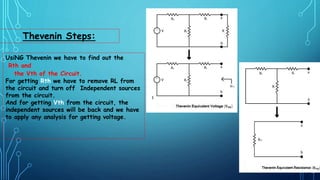
Thevenin Steps:
UsiNG Thevenin we have to find out the
Rth and
the Vth of the Circuit.
For getting Rth we have to remove RL from
the circuit and turn off Independent sources
from the circuit.
And for getting Vth from the circuit, the
independent sources will be back and we have
to apply any analysis for getting voltage.
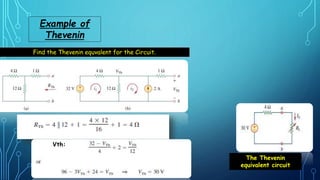
Example of
Thevenin
Find the Thevenin equvalent for the Circuit.
Vth:
The Thevenin
equivalent circuit
• Mesh analysis (or the mesh current method) is a method that is
used to solve planar circuits for the currents (and indirectly the
voltages) at any place in the circuit. Planar circuits are circuits that
can be drawn on a plane surface with no wires crossing each other.
A more general technique, called loop analysis (with the
corresponding network variables called loop currents) can be applied
to any circuit, planar or not. Mesh analysis and loop analysis both
make use of Kirchhoff’s voltage law to arrive at a set of equations
guaranteed to be solvable if the circuit has a solution.Mesh analysis
is usually easier to use when the circuit is planar, compared to loop
analysis.
What is mesh Analysis..
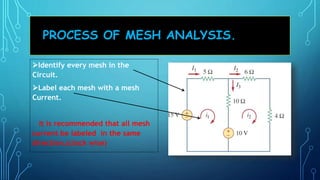
PROCESS OF MESH ANALYSIS.
Identify every mesh in the
Circuit.
Label each mesh with a mesh
Current.
It is recommended that all mesh
current be labeled in the same
direction.(clock wise)
THINGS YOU HAVE TO REMEMBER
FOR MESH ANALYSIS.
VAPPLY KVL TO EACH OF THE N MESHES. USE OHM’S LAW
(V=IR) TO EXPRESS THE VOLTAGES IN TERMS OF THE MESH
CURRENTS.
V SOLVE THE RESULTING N SIMULTANEOUS EQUATIONS TO
GET THE MESH CURRENTS.
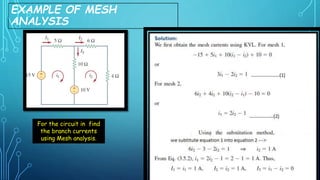
EXAMPLE OF MESH
ANALYSIS
For the circuit in find
the branch currents
using Mesh analysis.
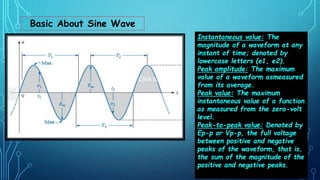
Basic About Sine Wave
Click to add text
Instantaneous value: The
magnitude of a waveform at any
instant of time; denoted by
lowercase letters (e1, e2).
Peak amplitude: The maximum
value of a waveform asmeasured
from its average.
Peak value: The maximum
instantaneous value of a function
as measured from the zero-volt
level.
Peak-to-peak value: Denoted by
Ep-p or Vp-p, the full voltage
between positive and negative
peaks of the waveform, that is,
the sum of the magnitude of the
positive and negative peaks.
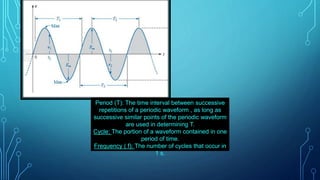
Period (T): The time interval between successive
repetitions of a periodic waveform , as long as
successive similar points of the periodic waveform
are used in determining T.
Cycle: The portion of a waveform contained in one
period of time.
Frequency ( f): The number of cycles that occur in
1 s.
Thevenin's Theorem,Mesh analysis and sine wave Basic

Thevenin's Theorem,Mesh analysis and sine wave Basic

  • 1.
  • 2.
    Content of mypresentation: 1.Thevenin's Theorem 2.Thevenin's Step 3.Example of Thevenin. 4.what is Mesh analysis. 5.Things you have to remember for mesh analysis. 6.process of mesh analysis. 7.Example of mesh analysis. 8.Basic about sine Wave.
  • 3.
    A French Engineer,ML Thevenin , made one of these quantum leaps in 1893. Thevenin’s Theorem is not by itself an analysis tool, but the basis for a very useful method of simplifying active circuits and complex networks because we can solve complex linear circuits and networks especially electronic networks easily and quickly. The theorem says that ,”Any combination of voltage sources, current sources and resister can be simplified by a single voltage source and a single resister.” THEVENIN'S THEOREM:
  • 4.
    Thevenin Steps: UsiNG Theveninwe have to find out the Rth and the Vth of the Circuit. For getting Rth we have to remove RL from the circuit and turn off Independent sources from the circuit. And for getting Vth from the circuit, the independent sources will be back and we have to apply any analysis for getting voltage.
  • 5.
    Example of Thevenin Find theThevenin equvalent for the Circuit. Vth: The Thevenin equivalent circuit
  • 6.
    • Mesh analysis(or the mesh current method) is a method that is used to solve planar circuits for the currents (and indirectly the voltages) at any place in the circuit. Planar circuits are circuits that can be drawn on a plane surface with no wires crossing each other. A more general technique, called loop analysis (with the corresponding network variables called loop currents) can be applied to any circuit, planar or not. Mesh analysis and loop analysis both make use of Kirchhoff’s voltage law to arrive at a set of equations guaranteed to be solvable if the circuit has a solution.Mesh analysis is usually easier to use when the circuit is planar, compared to loop analysis. What is mesh Analysis..
  • 7.
    PROCESS OF MESHANALYSIS. Identify every mesh in the Circuit. Label each mesh with a mesh Current. It is recommended that all mesh current be labeled in the same direction.(clock wise)
  • 8.
    THINGS YOU HAVETO REMEMBER FOR MESH ANALYSIS. VAPPLY KVL TO EACH OF THE N MESHES. USE OHM’S LAW (V=IR) TO EXPRESS THE VOLTAGES IN TERMS OF THE MESH CURRENTS. V SOLVE THE RESULTING N SIMULTANEOUS EQUATIONS TO GET THE MESH CURRENTS.
  • 9.
    EXAMPLE OF MESH ANALYSIS Forthe circuit in find the branch currents using Mesh analysis.
  • 10.
    Basic About SineWave Click to add text Instantaneous value: The magnitude of a waveform at any instant of time; denoted by lowercase letters (e1, e2). Peak amplitude: The maximum value of a waveform asmeasured from its average. Peak value: The maximum instantaneous value of a function as measured from the zero-volt level. Peak-to-peak value: Denoted by Ep-p or Vp-p, the full voltage between positive and negative peaks of the waveform, that is, the sum of the magnitude of the positive and negative peaks.
  • 11.
    Period (T): Thetime interval between successive repetitions of a periodic waveform , as long as successive similar points of the periodic waveform are used in determining T. Cycle: The portion of a waveform contained in one period of time. Frequency ( f): The number of cycles that occur in 1 s.