low-density parity-check codes for the
relay channel
Panagiotis Chatzinikolaou
Telecommunications Division
Technical University of Crete
July 29, 2014
Panagiotis Chatzinikolaou (TUC) ldpc codes for the relay channel July 29, 2014 0 / 42
outline
1 ldpc codes
Introduction
Decoding
Design
Construction
2 bilayer ldpc codes
Relay Channel model
Decoding
Design
Construction
Panagiotis Chatzinikolaou (TUC) ldpc codes for the relay channel July 29, 2014 0 / 42
ldpc codes Introduction
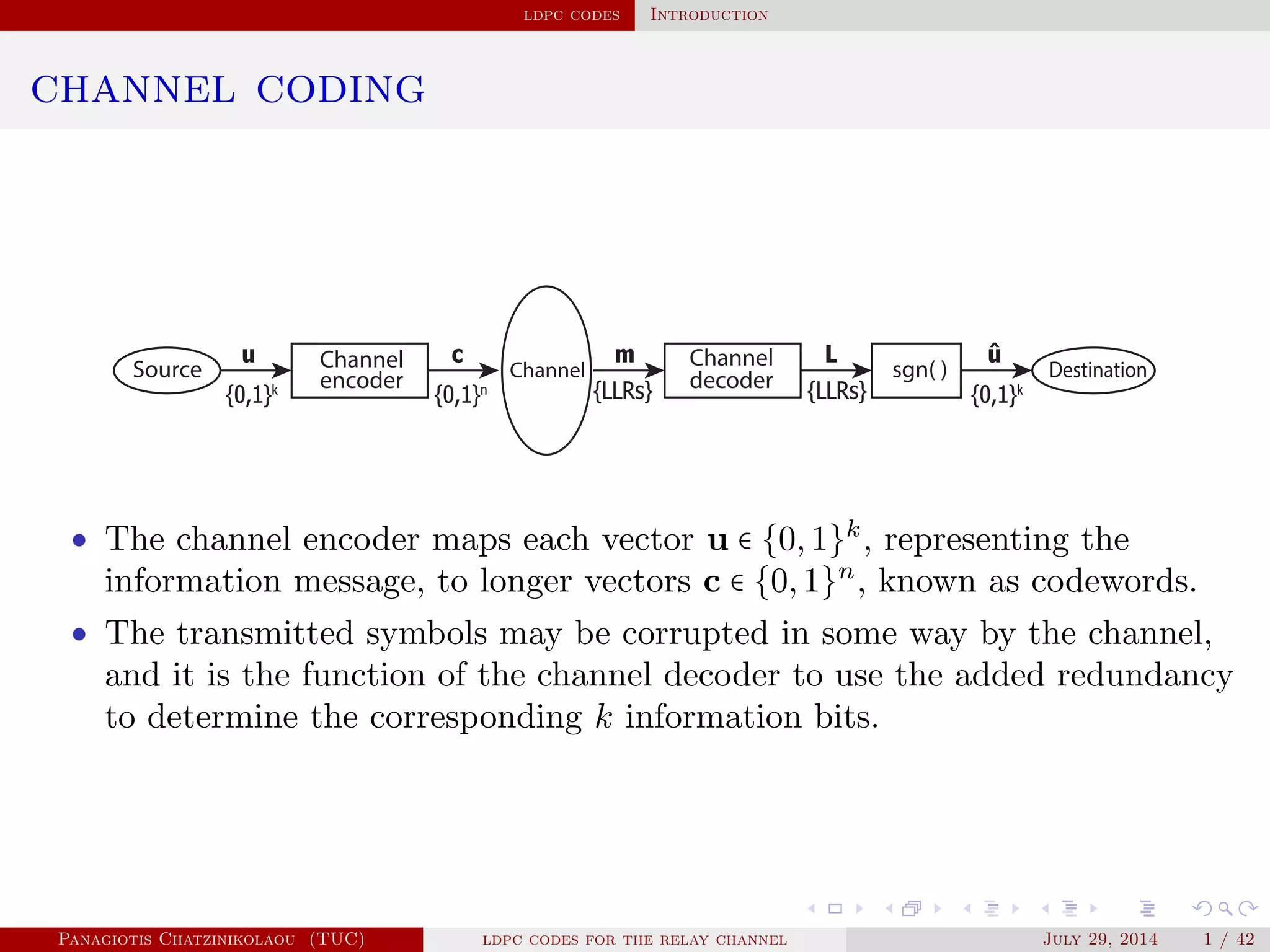
channel coding
Source encoder Channel decoder sgn( ) Destination
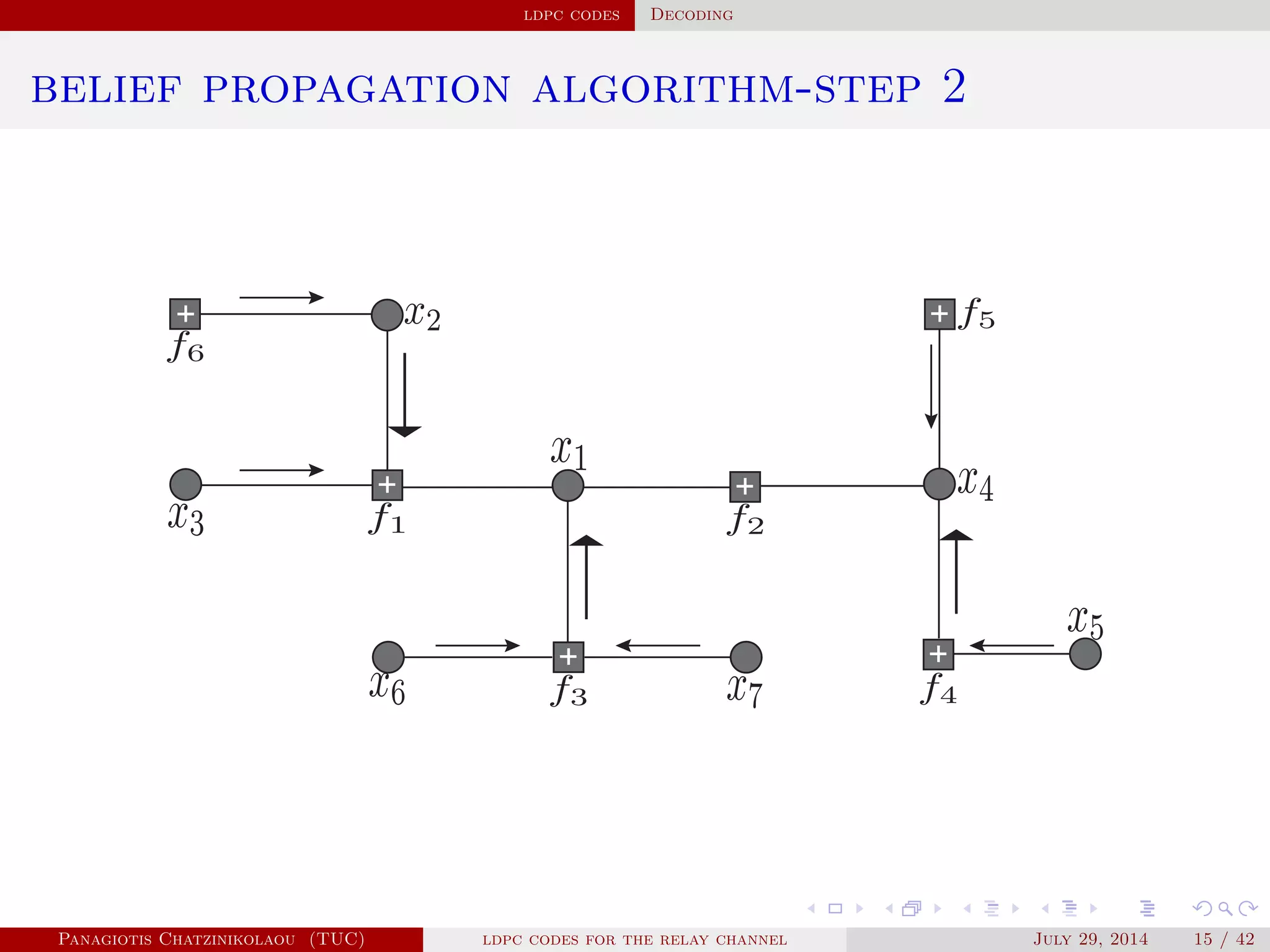
u
{0,1}k
{0,1}n
c m
{LLRs}
L
{LLRs}
ûChannel Channel
{0,1}k
• The channel encoder maps each vector u ∈ {0,1}k
, representing the
information message, to longer vectors c ∈ {0,1}n
, known as codewords.
• The transmitted symbols may be corrupted in some way by the channel,
and it is the function of the channel decoder to use the added redundancy
to determine the corresponding k information bits.
Panagiotis Chatzinikolaou (TUC) ldpc codes for the relay channel July 29, 2014 1 / 42
ldpc codes Introduction
ldpc codes
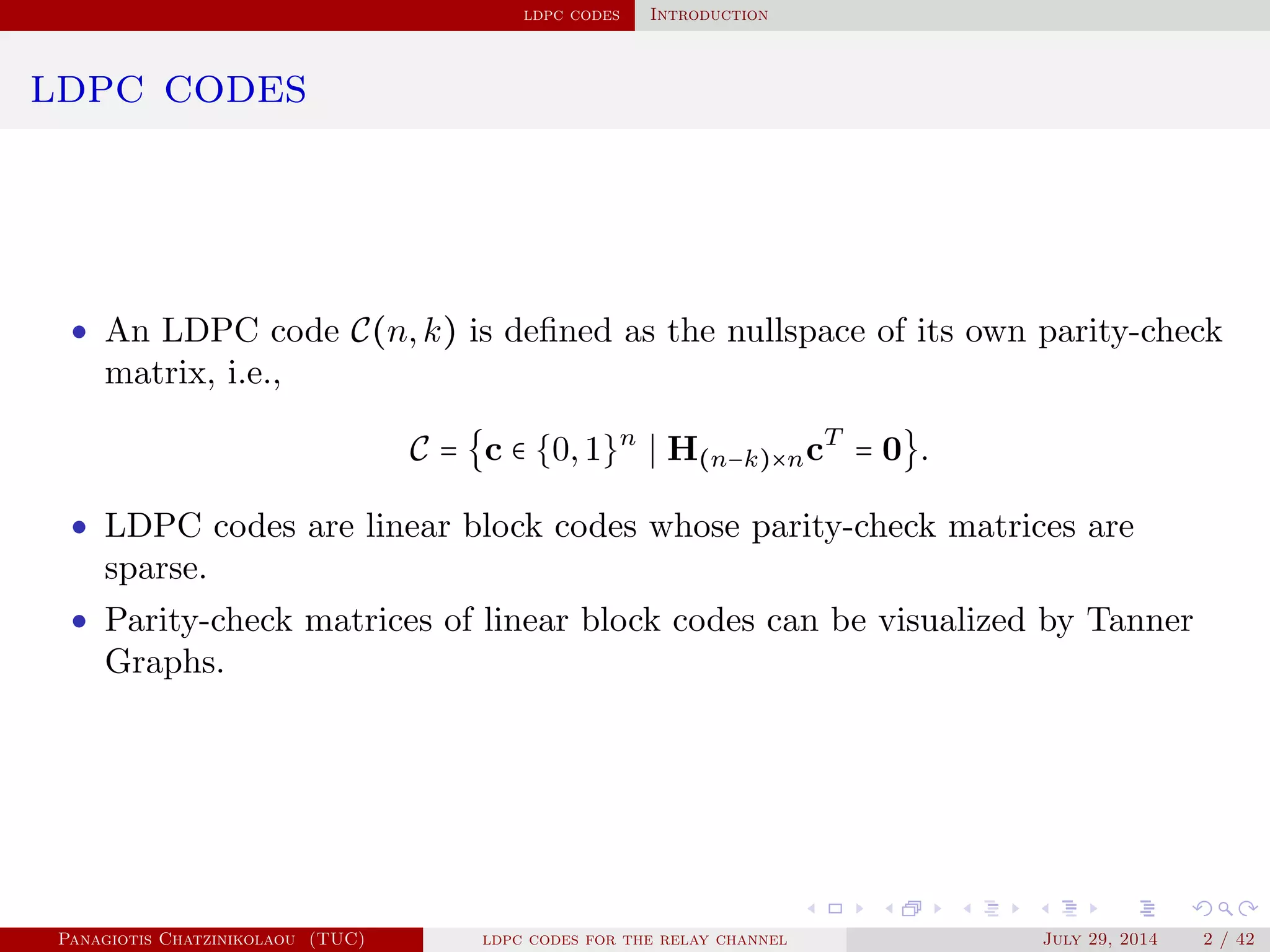
• An LDPC code C(n,k) is defined as the nullspace of its own parity-check
matrix, i.e.,
C = {c ∈ {0,1}n
H(n−k)×ncT
= 0}.
• LDPC codes are linear block codes whose parity-check matrices are
sparse.
• Parity-check matrices of linear block codes can be visualized by Tanner
Graphs.
Panagiotis Chatzinikolaou (TUC) ldpc codes for the relay channel July 29, 2014 2 / 42
ldpc codes Introduction
ldpc codes
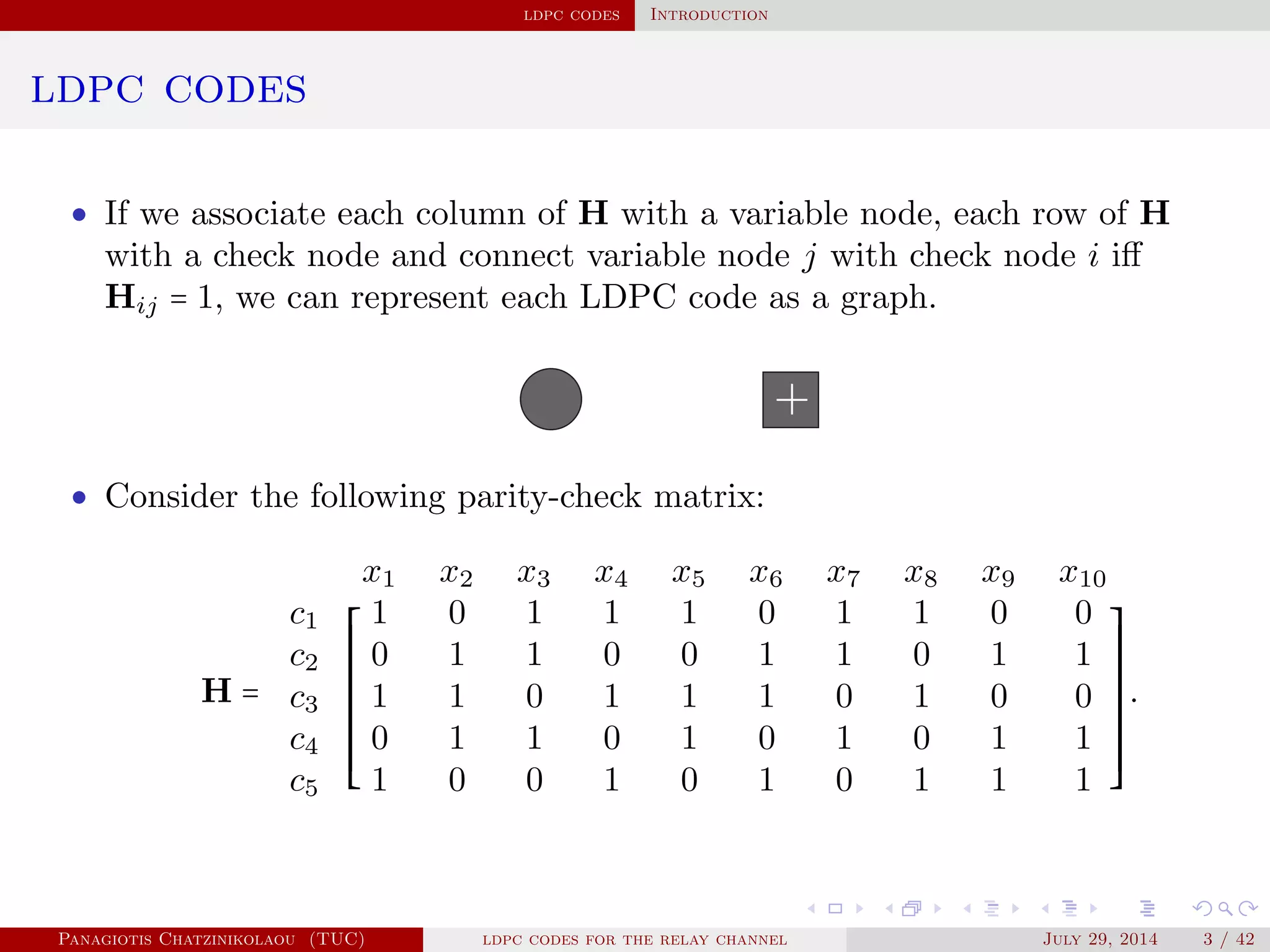
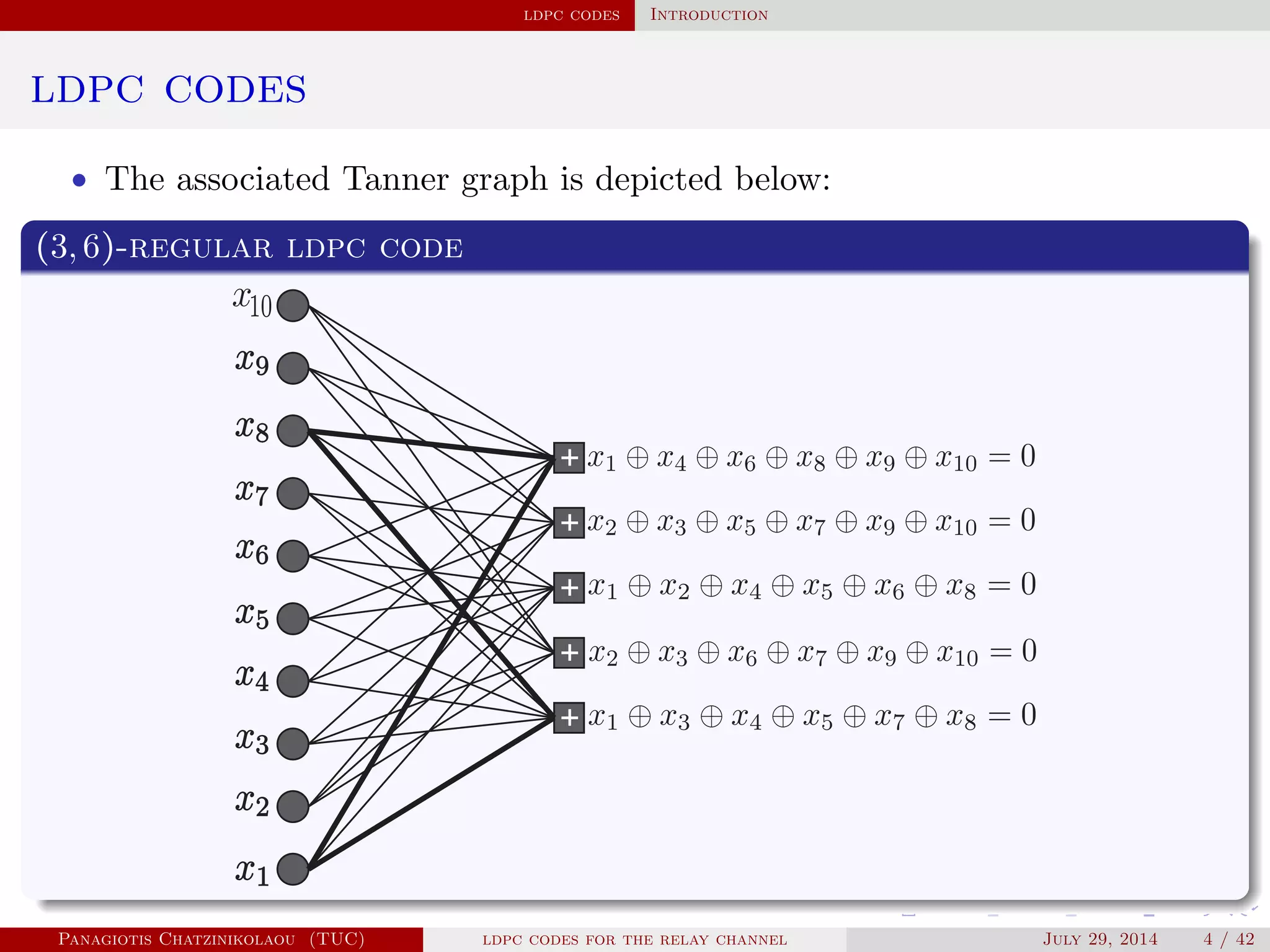
• If we associate each column of H with a variable node, each row of H
with a check node and connect variable node j with check node i iff
Hij = 1, we can represent each LDPC code as a graph.
• Consider the following parity-check matrix:
H =
x1 x2 x3 x4 x5 x6 x7 x8 x9 x10
⎡
⎢
⎢
⎢
⎢
⎢
⎢
⎢
⎢
⎣
⎤
⎥
⎥
⎥
⎥
⎥
⎥
⎥
⎥
⎦
c1 1 0 1 1 1 0 1 1 0 0
c2 0 1 1 0 0 1 1 0 1 1
c3 1 1 0 1 1 1 0 1 0 0
c4 0 1 1 0 1 0 1 0 1 1
c5 1 0 0 1 0 1 0 1 1 1
.
Panagiotis Chatzinikolaou (TUC) ldpc codes for the relay channel July 29, 2014 3 / 42
ldpc codes Introduction
ldpc codes
• The associated Tanner graph is depicted below:
(3,6)-regular ldpc code
Panagiotis Chatzinikolaou (TUC) ldpc codes for the relay channel July 29, 2014 4 / 42
ldpc codes Introduction
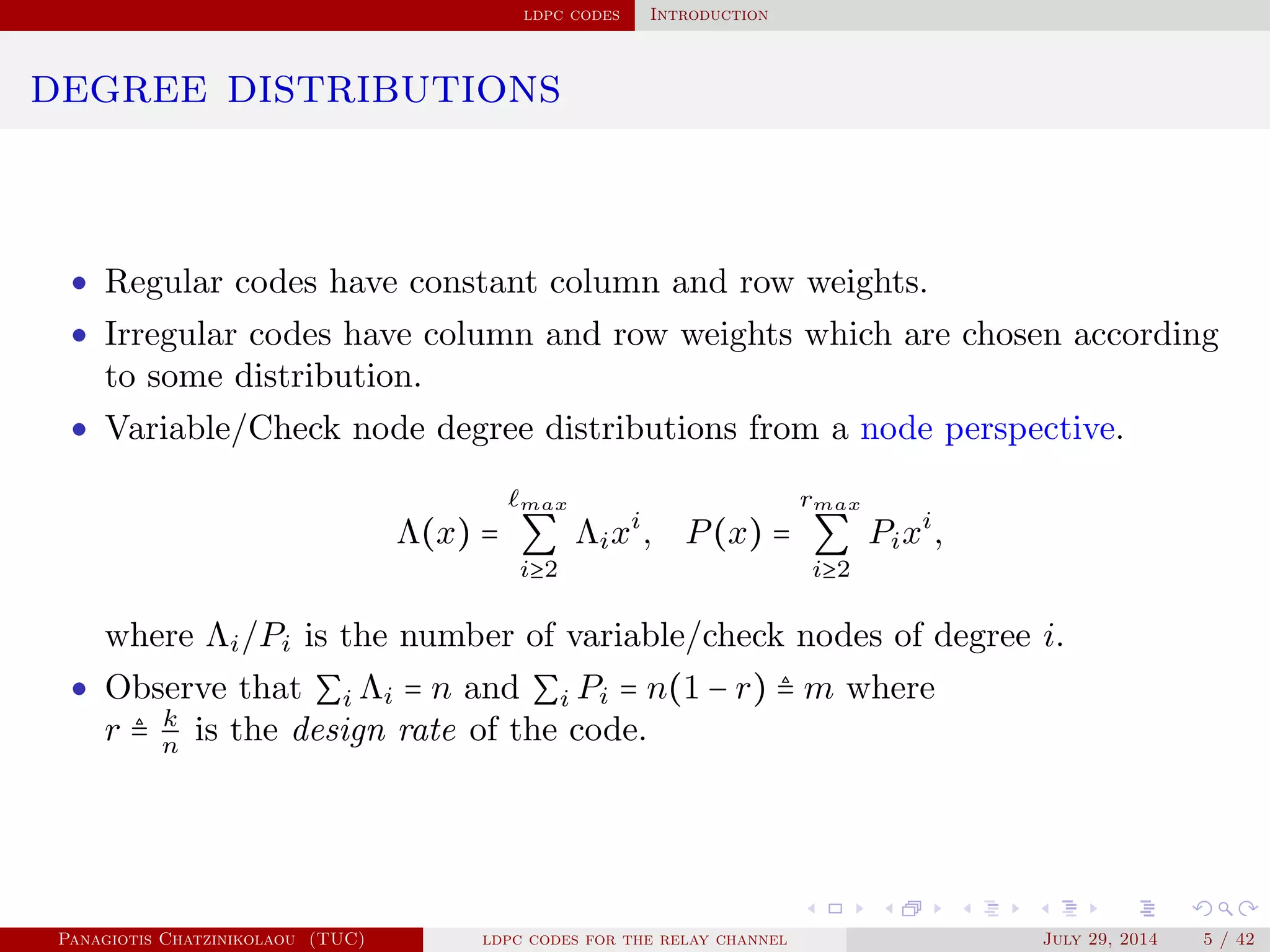
degree distributions
• Regular codes have constant column and row weights.
• Irregular codes have column and row weights which are chosen according
to some distribution.
• Variable/Check node degree distributions from a node perspective.
Λ(x) =
max
∑
i≥2
Λixi
, P(x) =
rmax
∑
i≥2
Pixi
,
where Λi/Pi is the number of variable/check nodes of degree i.
• Observe that ∑i Λi = n and ∑i Pi = n(1 − r) ≜ m where
r ≜ k
n
is the design rate of the code.
Panagiotis Chatzinikolaou (TUC) ldpc codes for the relay channel July 29, 2014 5 / 42
ldpc codes Introduction
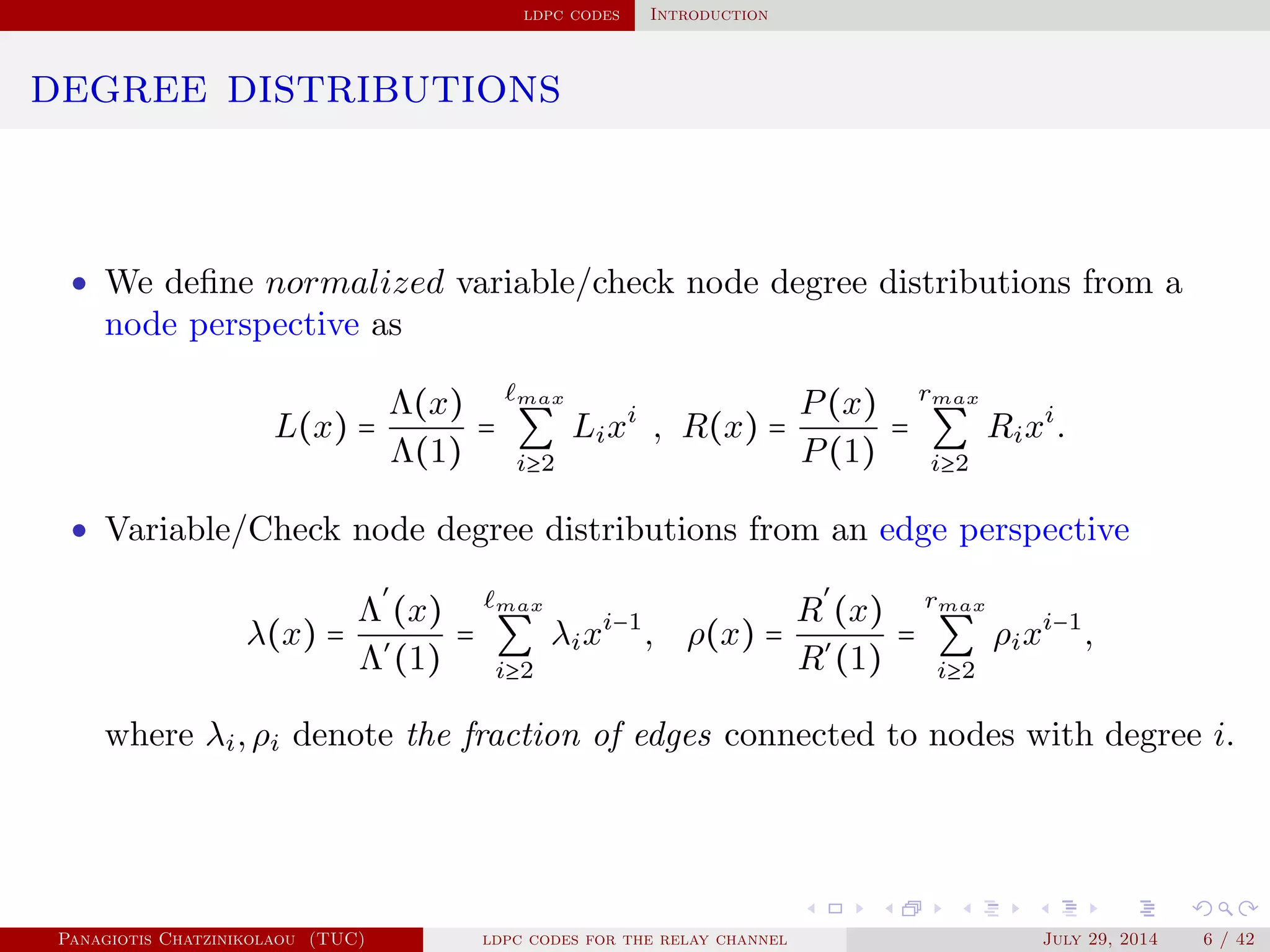
degree distributions
• We define normalized variable/check node degree distributions from a
node perspective as
L(x) =
Λ(x)
Λ(1)
=
max
∑
i≥2
Lixi
, R(x) =
P(x)
P(1)
=
rmax
∑
i≥2
Rixi
.
• Variable/Check node degree distributions from an edge perspective
λ(x) =
Λ
′
(x)
Λ′
(1)
=
max
∑
i≥2
λixi−1
, ρ(x) =
R
′
(x)
R′
(1)
=
rmax
∑
i≥2
ρixi−1
,
where λi,ρi denote the fraction of edges connected to nodes with degree i.
Panagiotis Chatzinikolaou (TUC) ldpc codes for the relay channel July 29, 2014 6 / 42
ldpc codes Introduction
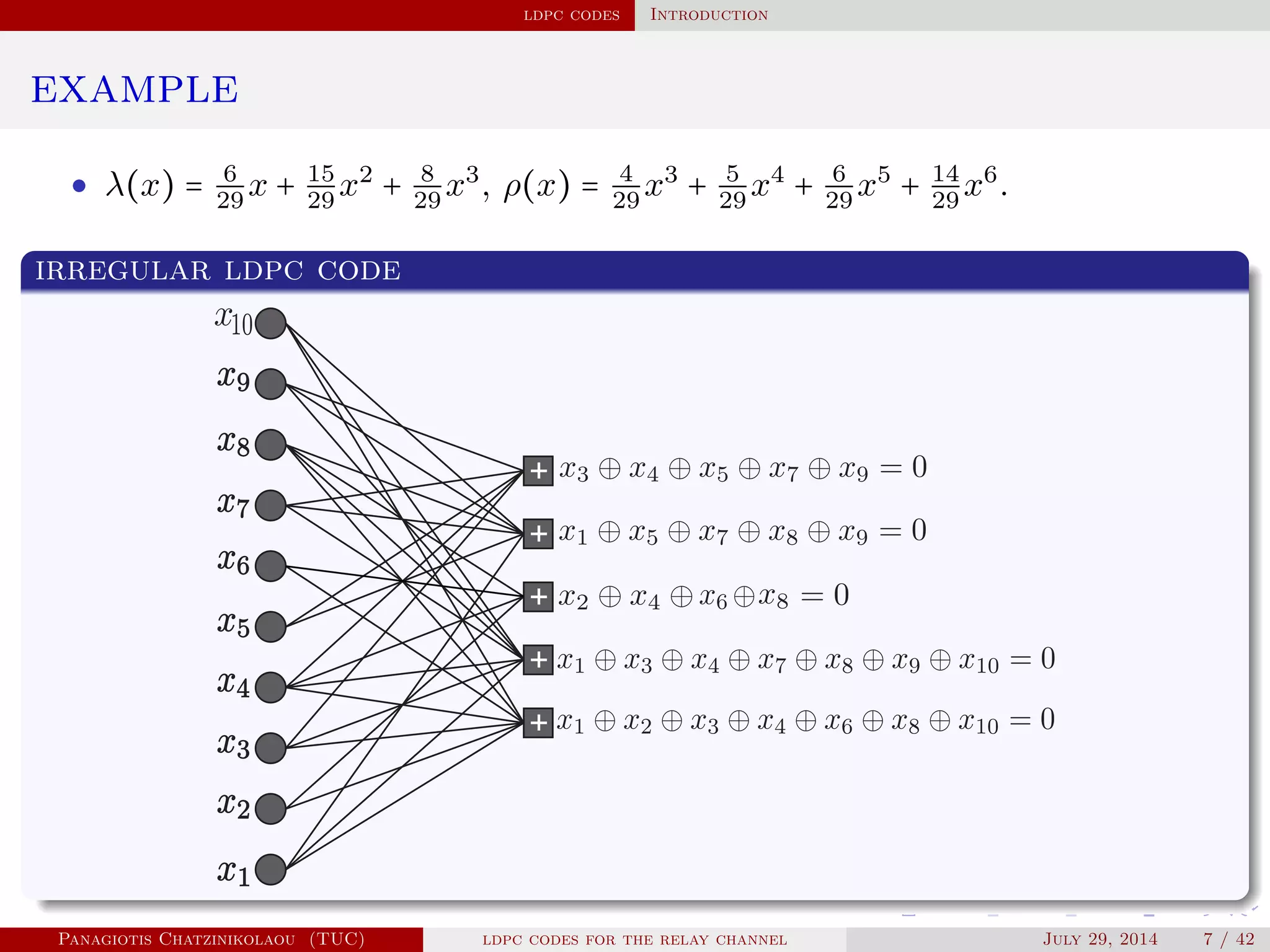
example
• λ(x) = 6
29
x + 15
29
x2
+ 8
29
x3
, ρ(x) = 4
29
x3
+ 5
29
x4
+ 6
29
x5
+ 14
29
x6
.
irregular ldpc code
Panagiotis Chatzinikolaou (TUC) ldpc codes for the relay channel July 29, 2014 7 / 42
ldpc codes Introduction
degree distributions
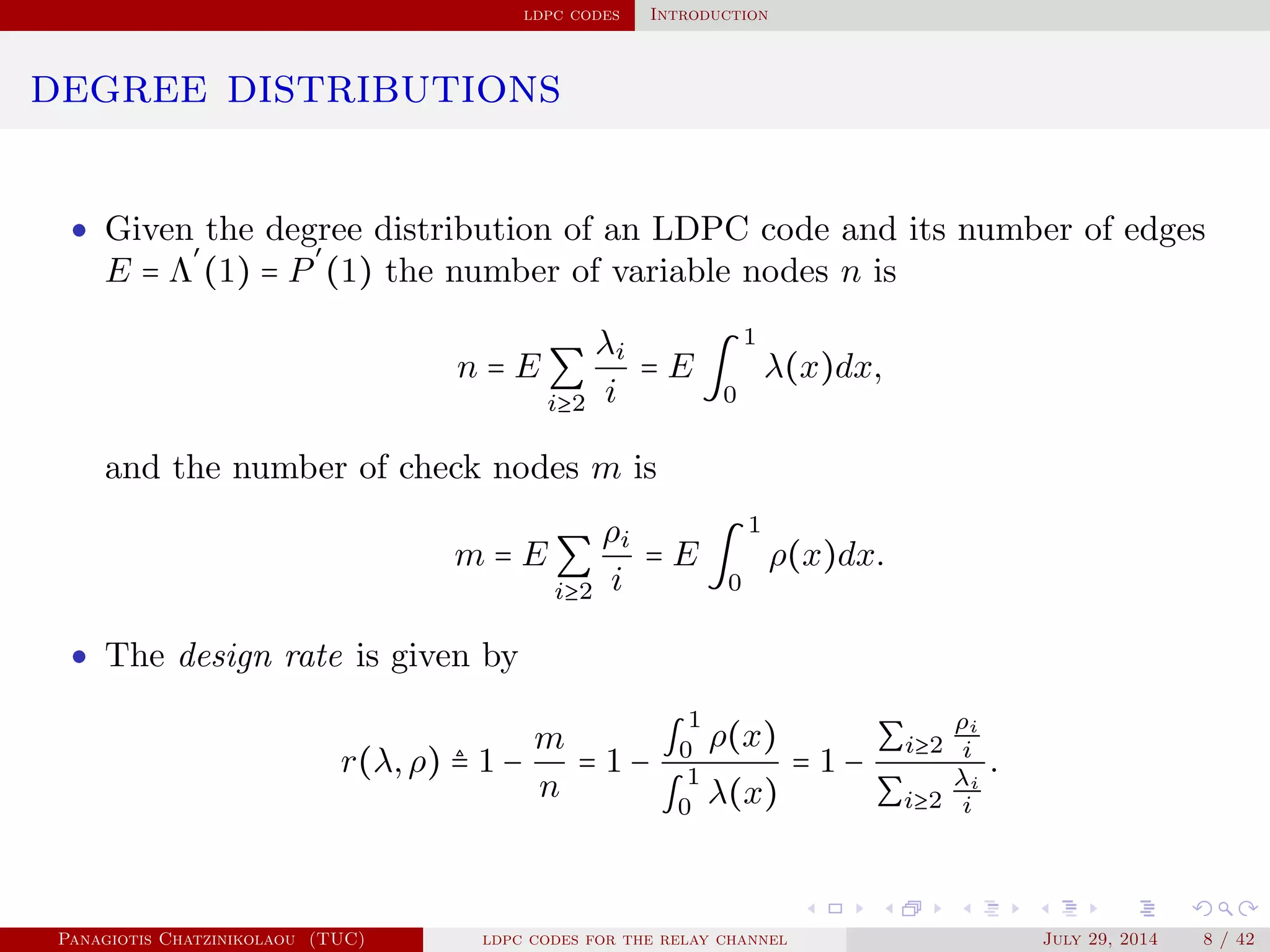
• Given the degree distribution of an LDPC code and its number of edges
E = Λ
′
(1) = P
′
(1) the number of variable nodes n is
n = E ∑
i≥2
λi
i
= E ∫
1
0
λ(x)dx,
and the number of check nodes m is
m = E ∑
i≥2
ρi
i
= E ∫
1
0
ρ(x)dx.
• The design rate is given by
r(λ,ρ) ≜ 1 −
m
n
= 1 −
∫
1
0 ρ(x)
∫
1
0 λ(x)
= 1 −
∑i≥2
ρi
i
∑i≥2
λi
i
.
Panagiotis Chatzinikolaou (TUC) ldpc codes for the relay channel July 29, 2014 8 / 42
ldpc codes Introduction
code ensemble
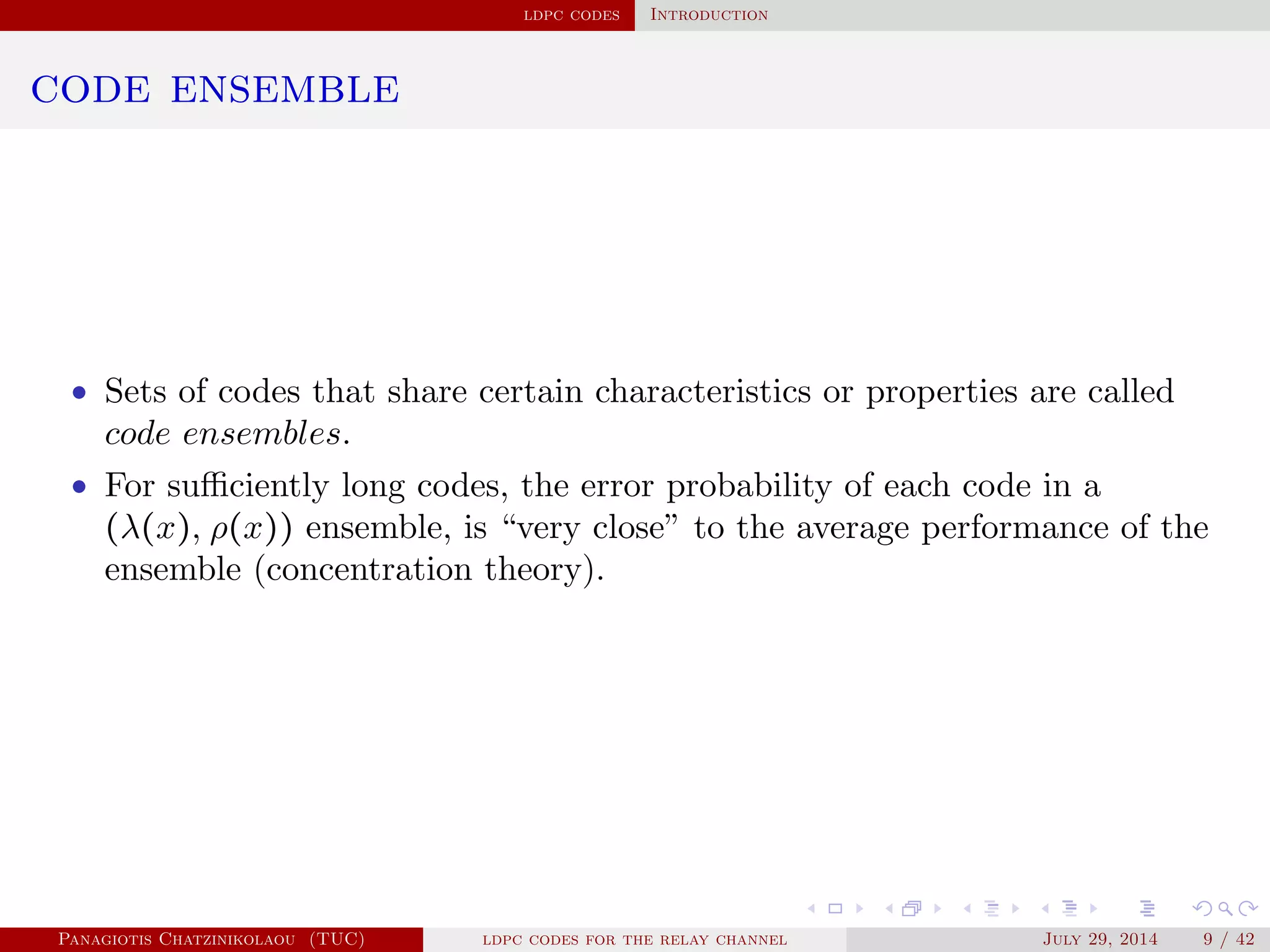
• Sets of codes that share certain characteristics or properties are called
code ensembles.
• For sufficiently long codes, the error probability of each code in a
(λ(x), ρ(x)) ensemble, is “very close” to the average performance of the
ensemble (concentration theory).
Panagiotis Chatzinikolaou (TUC) ldpc codes for the relay channel July 29, 2014 9 / 42
ldpc codes Decoding
factor graphs
• Factor graphs are a way to represent graphically the factorization of a
function.
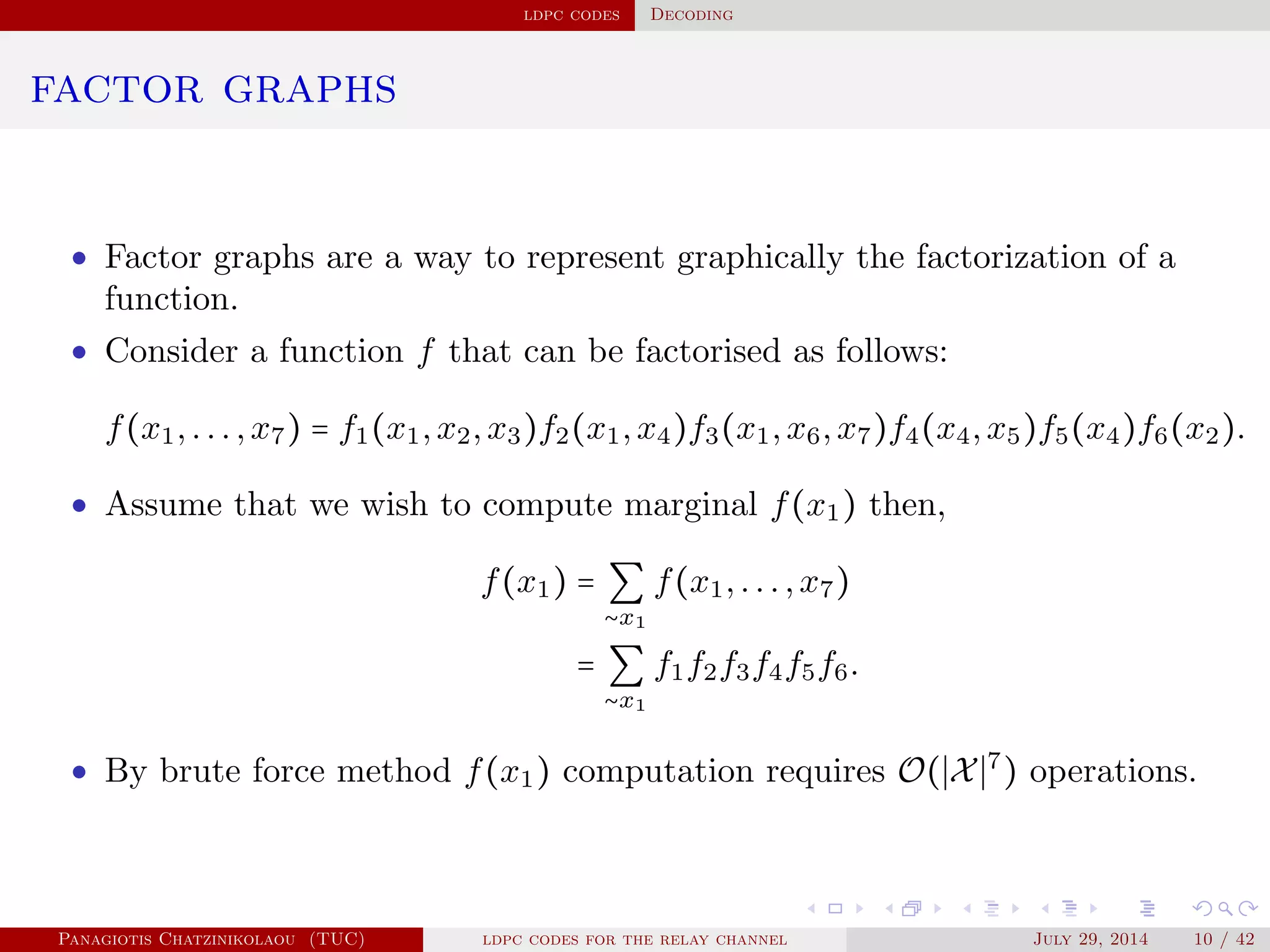
• Consider a function f that can be factorised as follows:
f(x1,...,x7) = f1(x1,x2,x3)f2(x1,x4)f3(x1,x6,x7)f4(x4,x5)f5(x4)f6(x2).
• Assume that we wish to compute marginal f(x1) then,
f(x1) = ∑
∼x1
f(x1,...,x7)
= ∑
∼x1
f1f2f3f4f5f6.
• By brute force method f(x1) computation requires O( X 7
) operations.
Panagiotis Chatzinikolaou (TUC) ldpc codes for the relay channel July 29, 2014 10 / 42
ldpc codes Decoding
factor graphs
• Applying the factorisation and the distributive law we get
f(x1) = ∑
x2,...,x7
f1(x1,x2,x3)f2(x1,x4)f3(x1,x6,x7)f4(x4,x5)f5(x4)f6(x2)
= [∑
x2
(f6(x2)∑
x3
f1(x1,x2,x3))][∑
x4
(f5(x4)f2(x1,x4)
∑
x5
f4(x4,x5))][ ∑
x6,x7
f3(x1,x6,x7)],
reducing complexity to O( X 3
) !
• Likewise for f(xi), i = 2,...,7.
Panagiotis Chatzinikolaou (TUC) ldpc codes for the relay channel July 29, 2014 11 / 42
ldpc codes Decoding
factor graphs
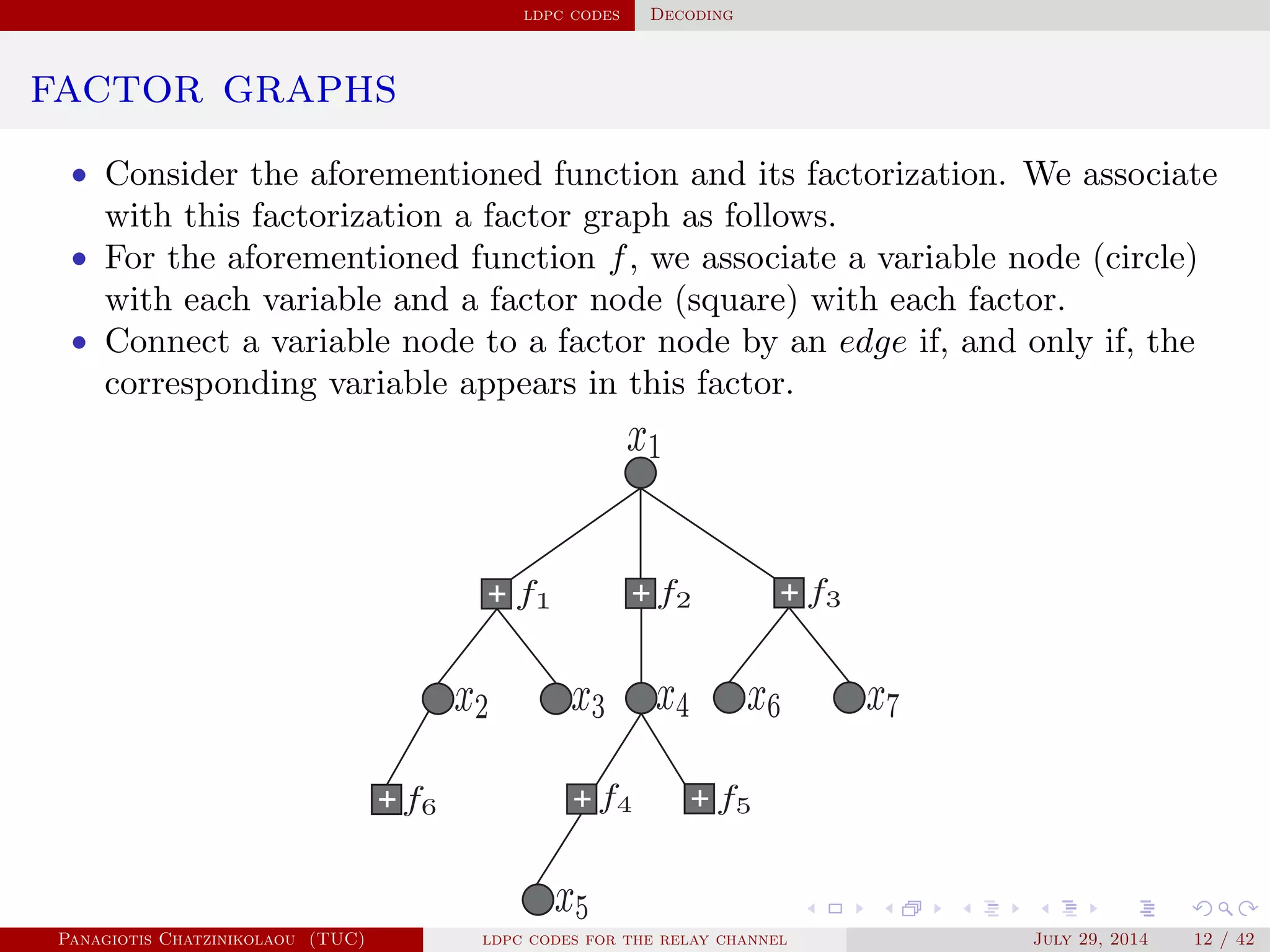
• Consider the aforementioned function and its factorization. We associate
with this factorization a factor graph as follows.
• For the aforementioned function f, we associate a variable node (circle)
with each variable and a factor node (square) with each factor.
• Connect a variable node to a factor node by an edge if, and only if, the
corresponding variable appears in this factor.
Panagiotis Chatzinikolaou (TUC) ldpc codes for the relay channel July 29, 2014 12 / 42
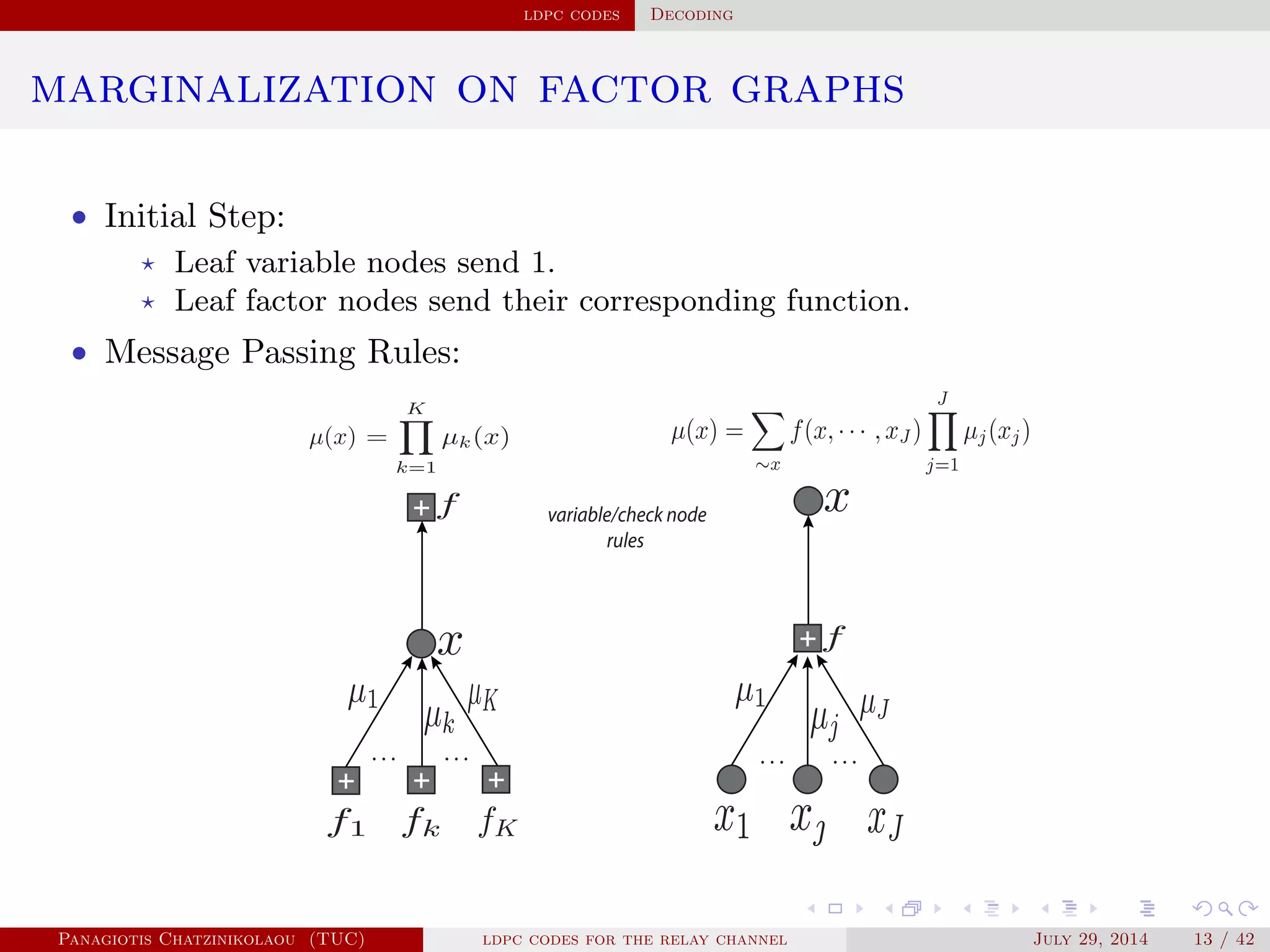
ldpc codes Decoding
marginalization on factor graphs
• Initial Step:
⋆ Leaf variable nodes send 1.
⋆ Leaf factor nodes send their corresponding function.
• Message Passing Rules:
. . . . . . . . . . . .
variable/check node
rules
Panagiotis Chatzinikolaou (TUC) ldpc codes for the relay channel July 29, 2014 13 / 42
ldpc codes Decoding
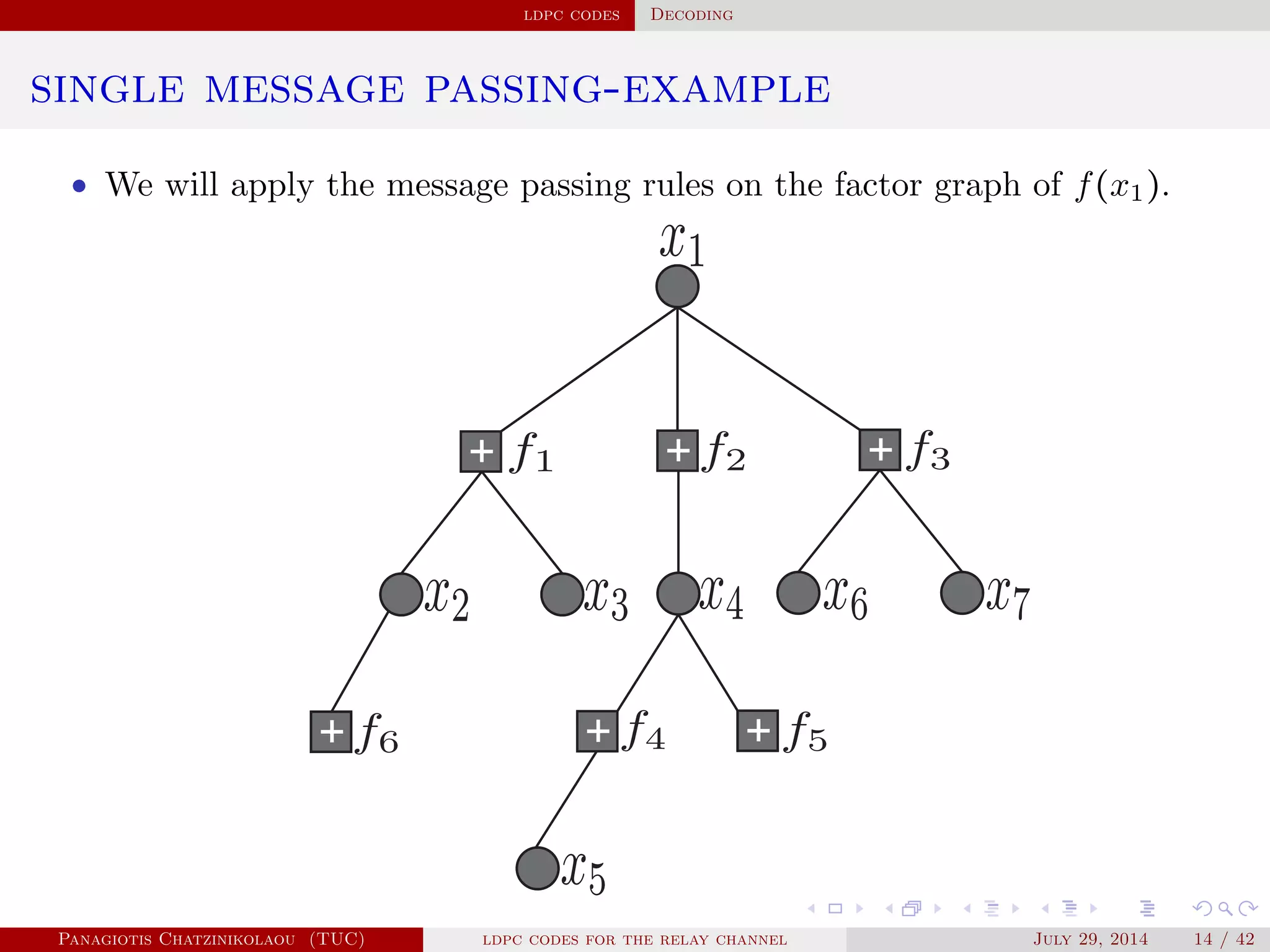
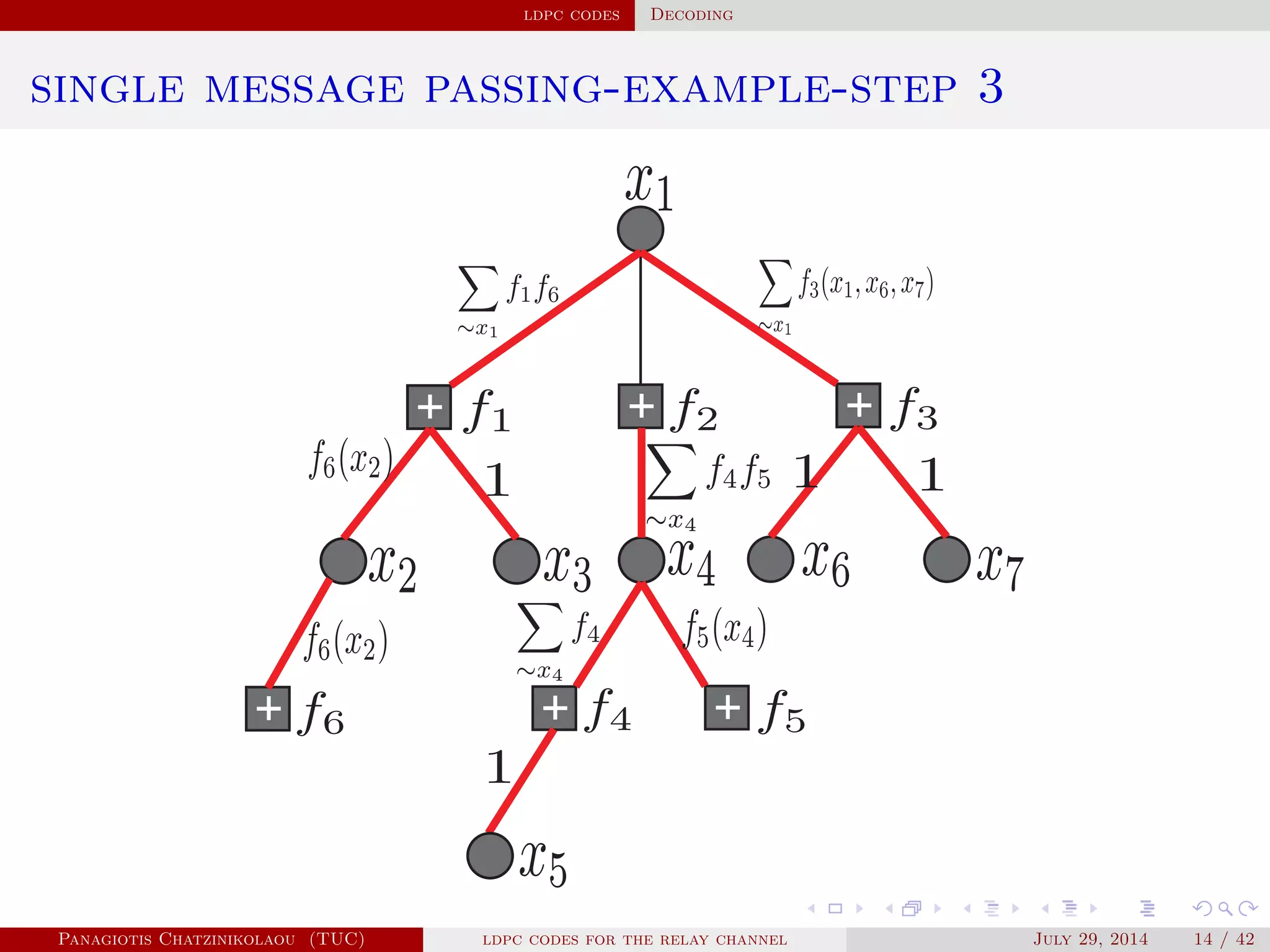
single message passing-example
• We will apply the message passing rules on the factor graph of f(x1).
Panagiotis Chatzinikolaou (TUC) ldpc codes for the relay channel July 29, 2014 14 / 42
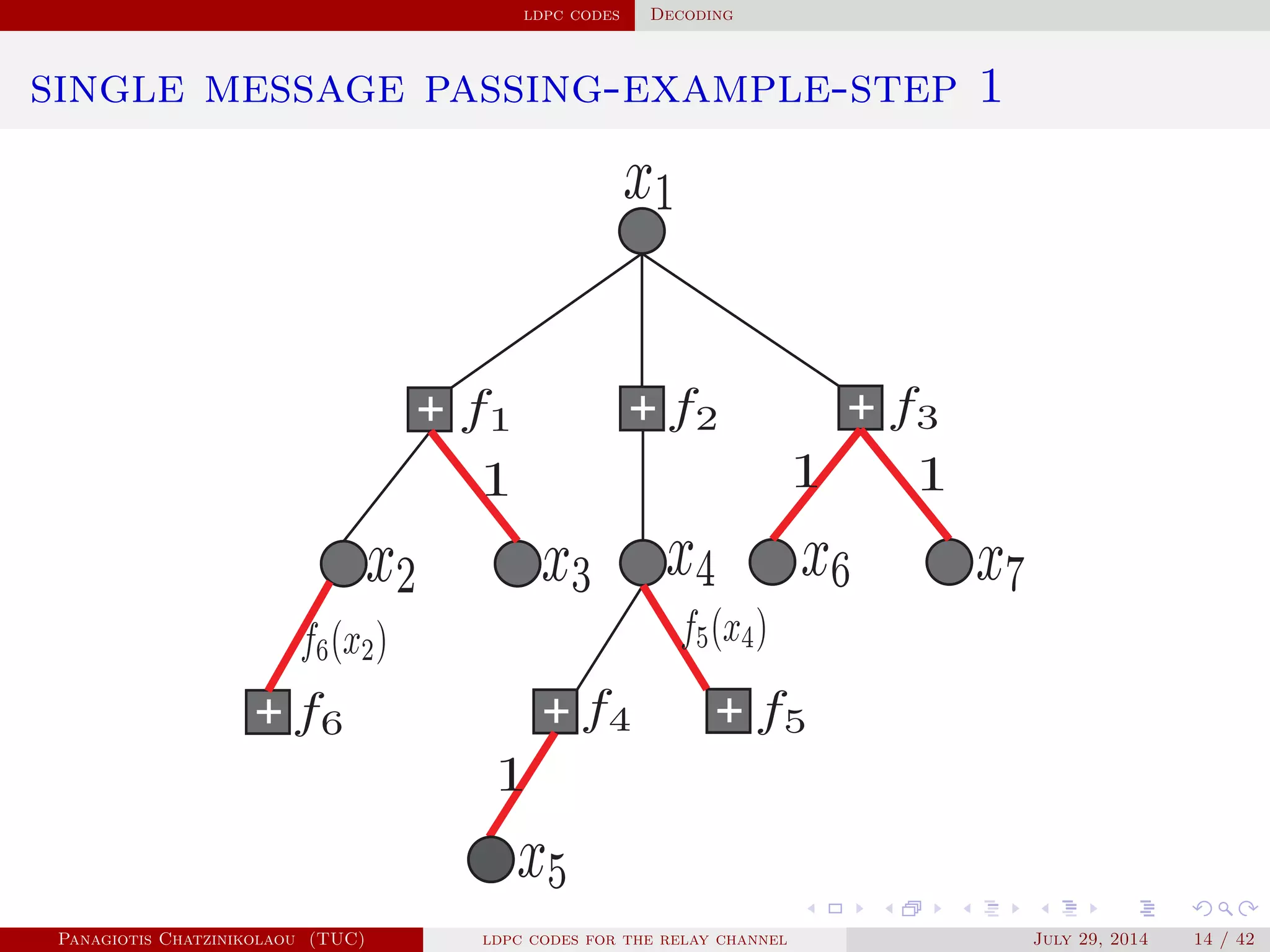
ldpc codes Decoding
single message passing-example-step 1
Panagiotis Chatzinikolaou (TUC) ldpc codes for the relay channel July 29, 2014 14 / 42
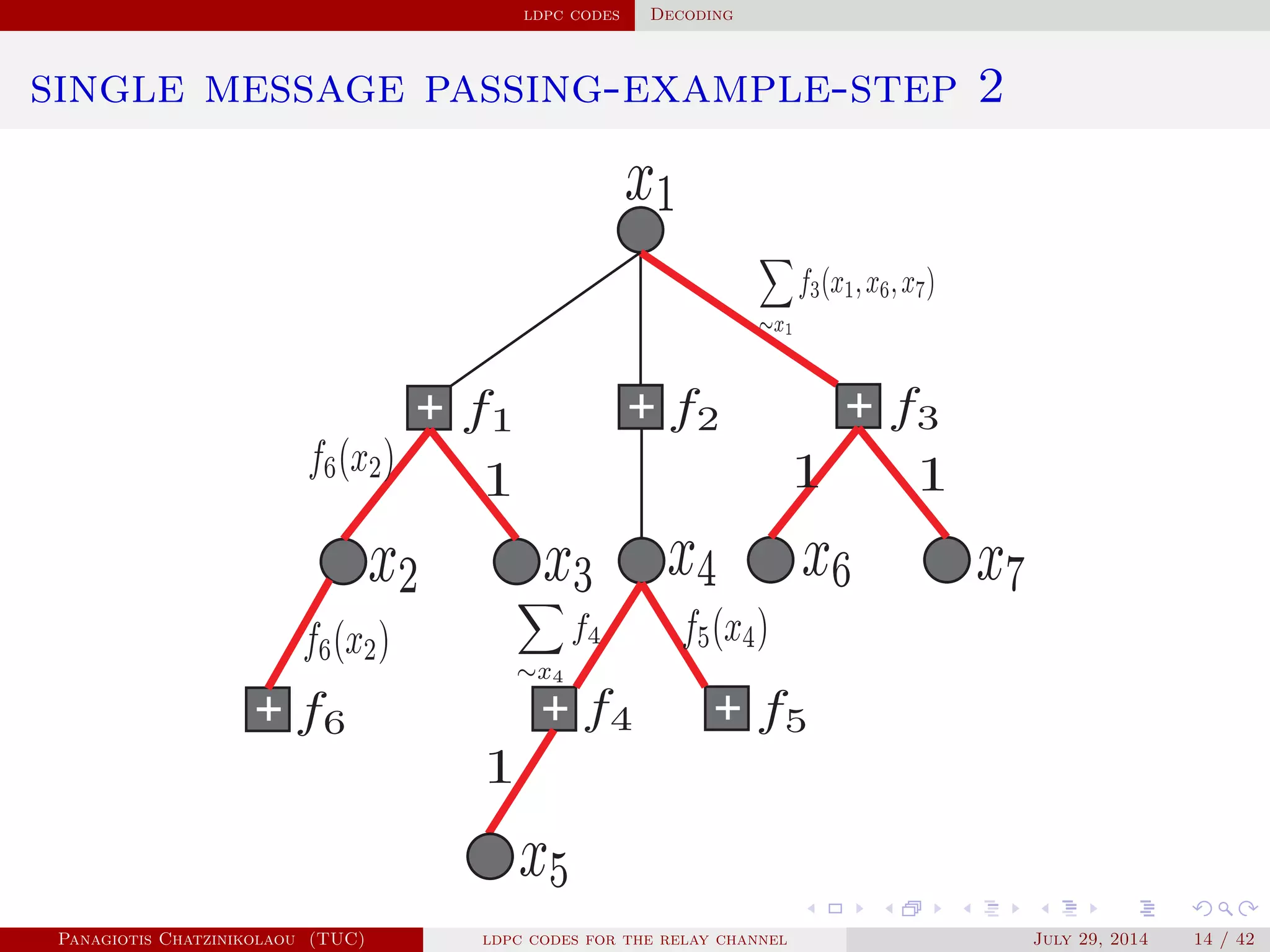
ldpc codes Decoding
single message passing-example-step 2
Panagiotis Chatzinikolaou (TUC) ldpc codes for the relay channel July 29, 2014 14 / 42
ldpc codes Decoding
single message passing-example-step 3
Panagiotis Chatzinikolaou (TUC) ldpc codes for the relay channel July 29, 2014 14 / 42
ldpc codes Decoding
single message passing-example-step 4
Panagiotis Chatzinikolaou (TUC) ldpc codes for the relay channel July 29, 2014 14 / 42
ldpc codes Decoding
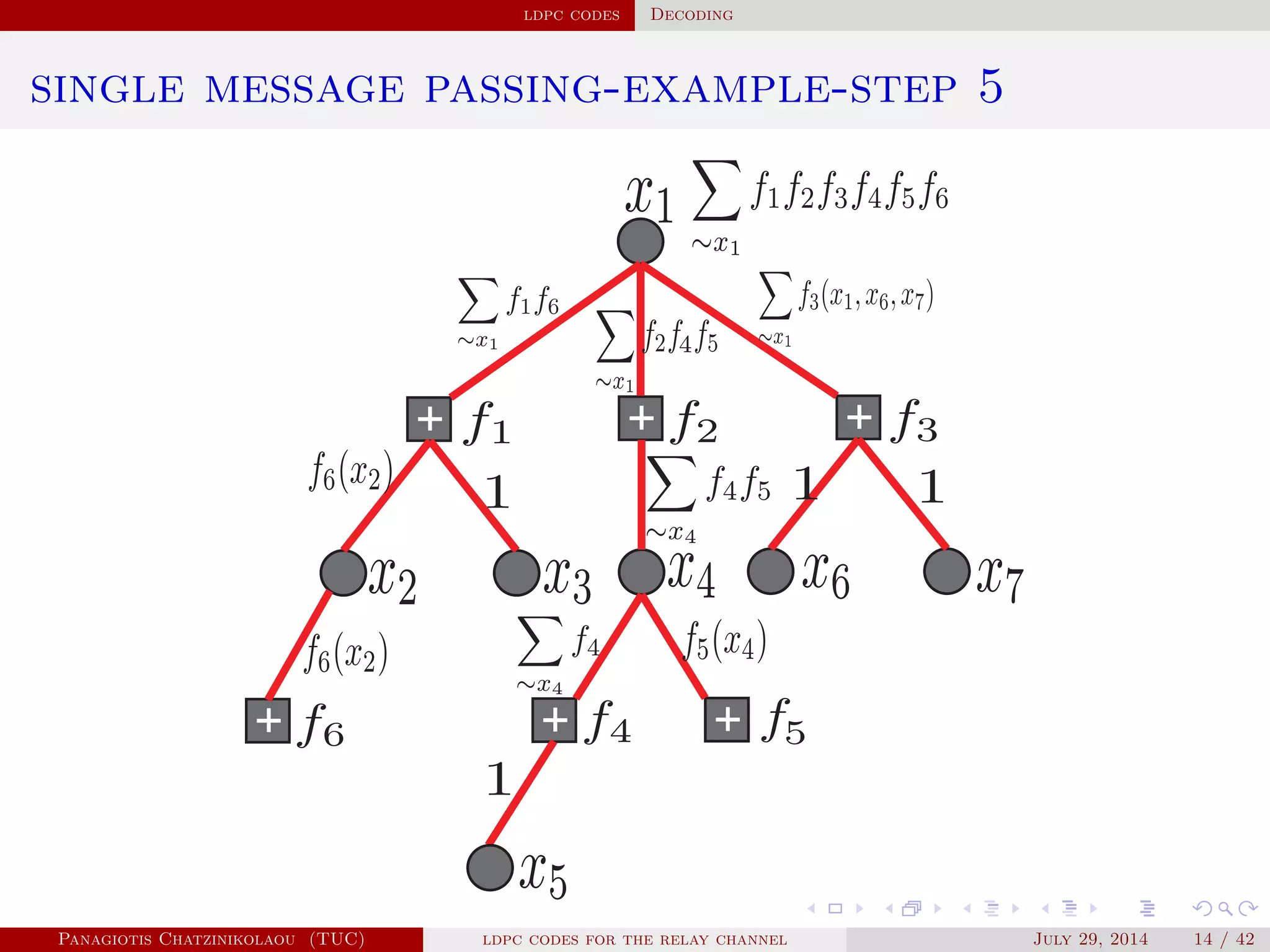
single message passing-example-step 5
Panagiotis Chatzinikolaou (TUC) ldpc codes for the relay channel July 29, 2014 14 / 42
ldpc codes Decoding
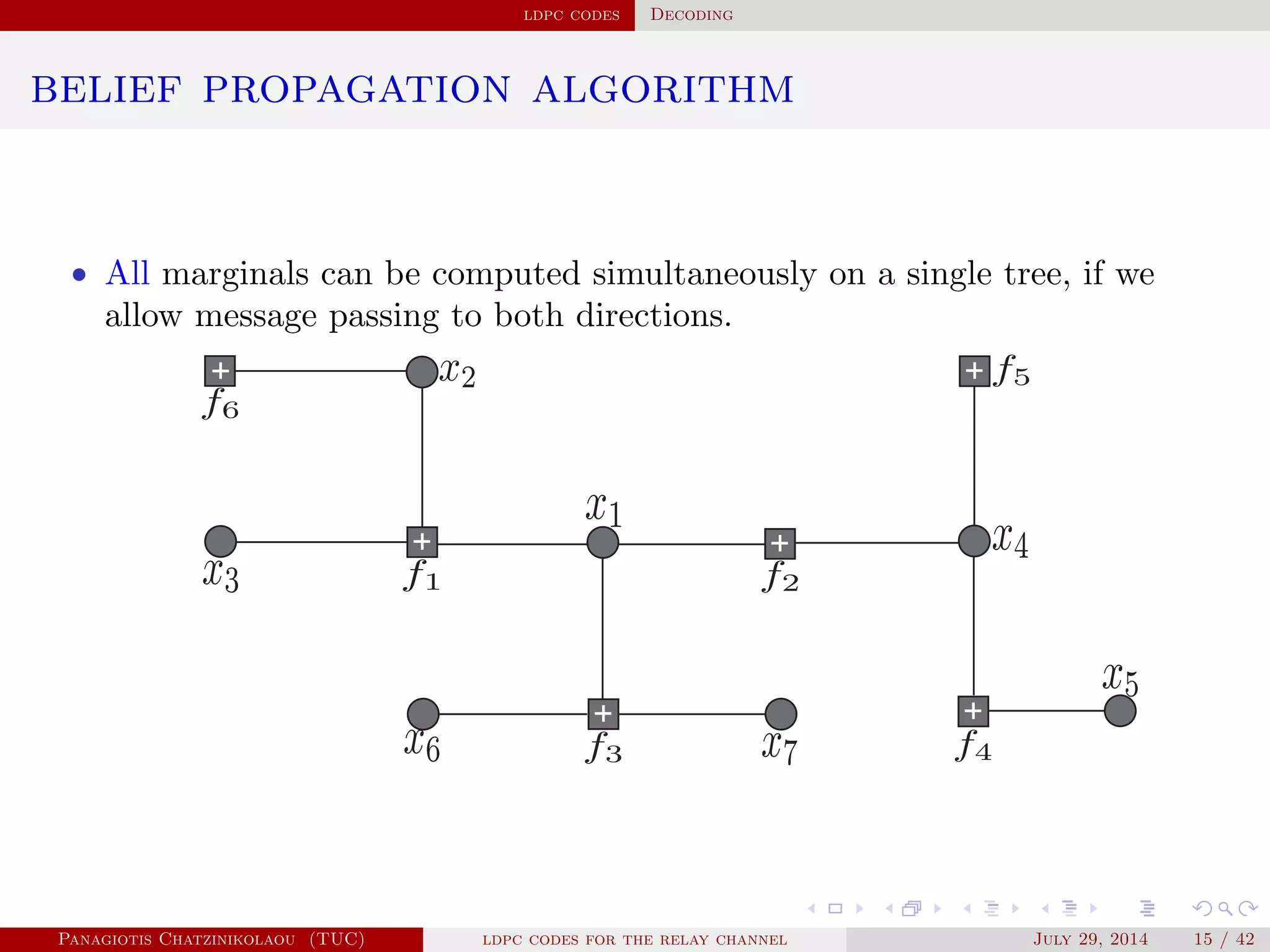
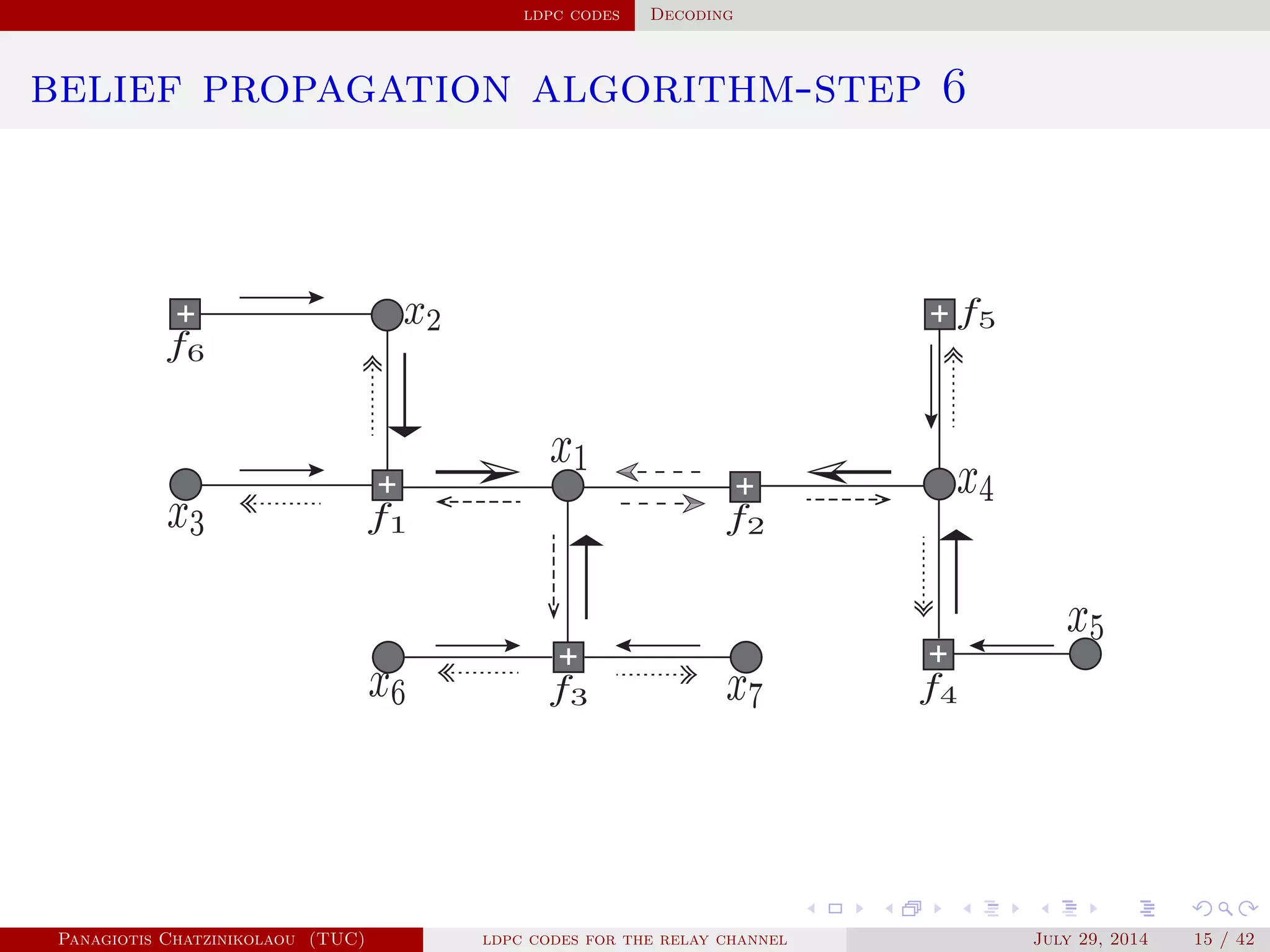
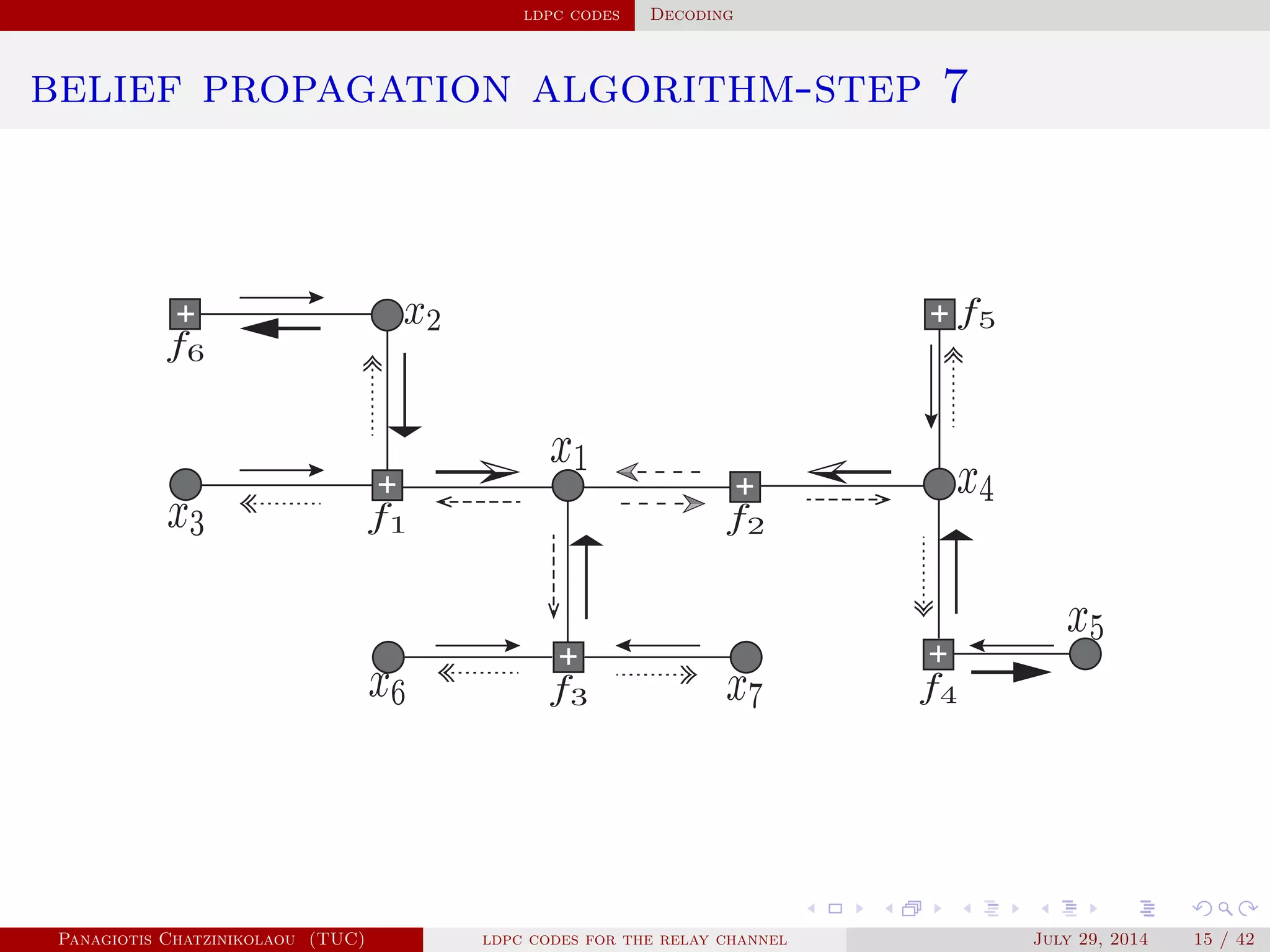
belief propagation algorithm
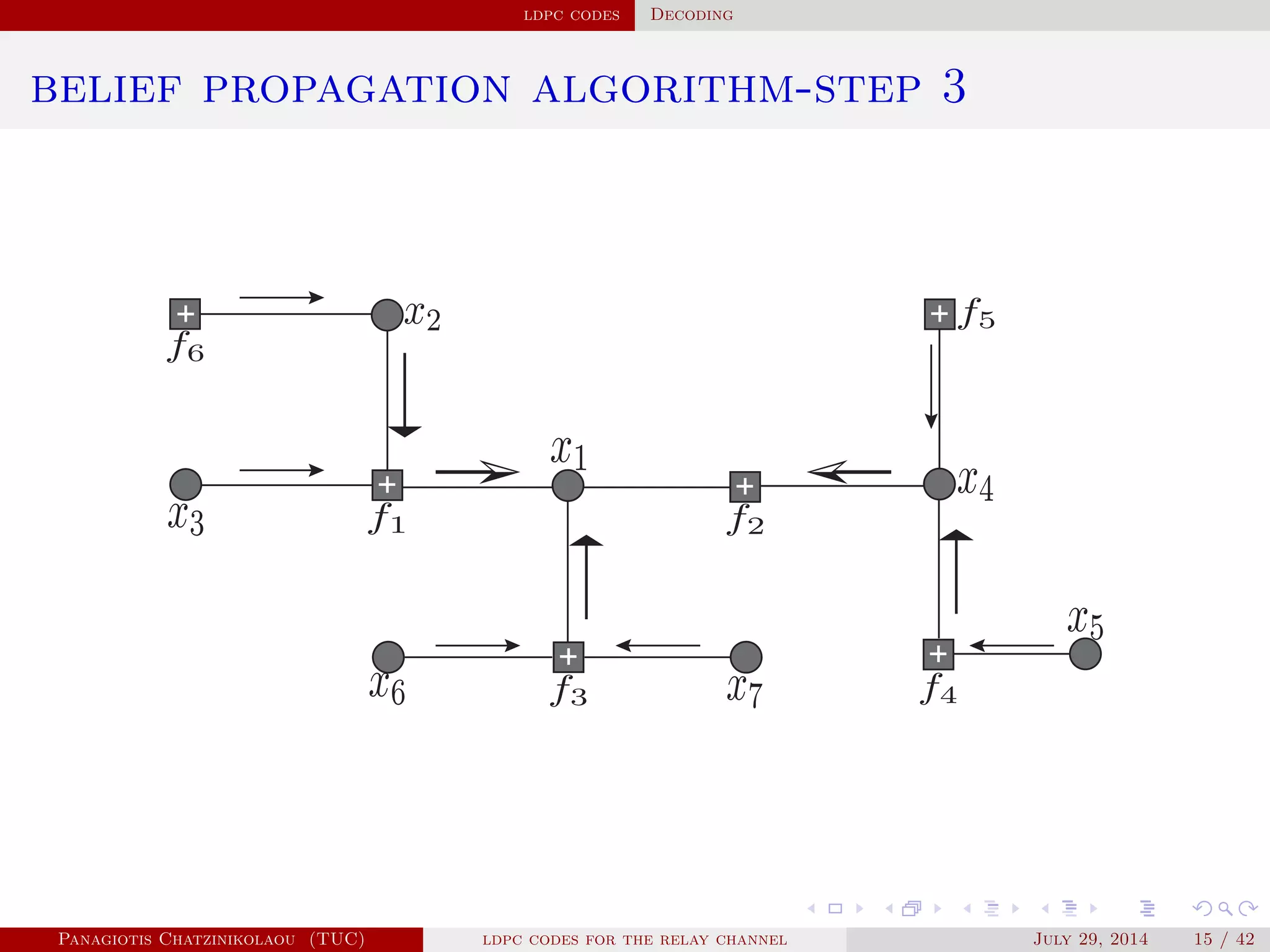
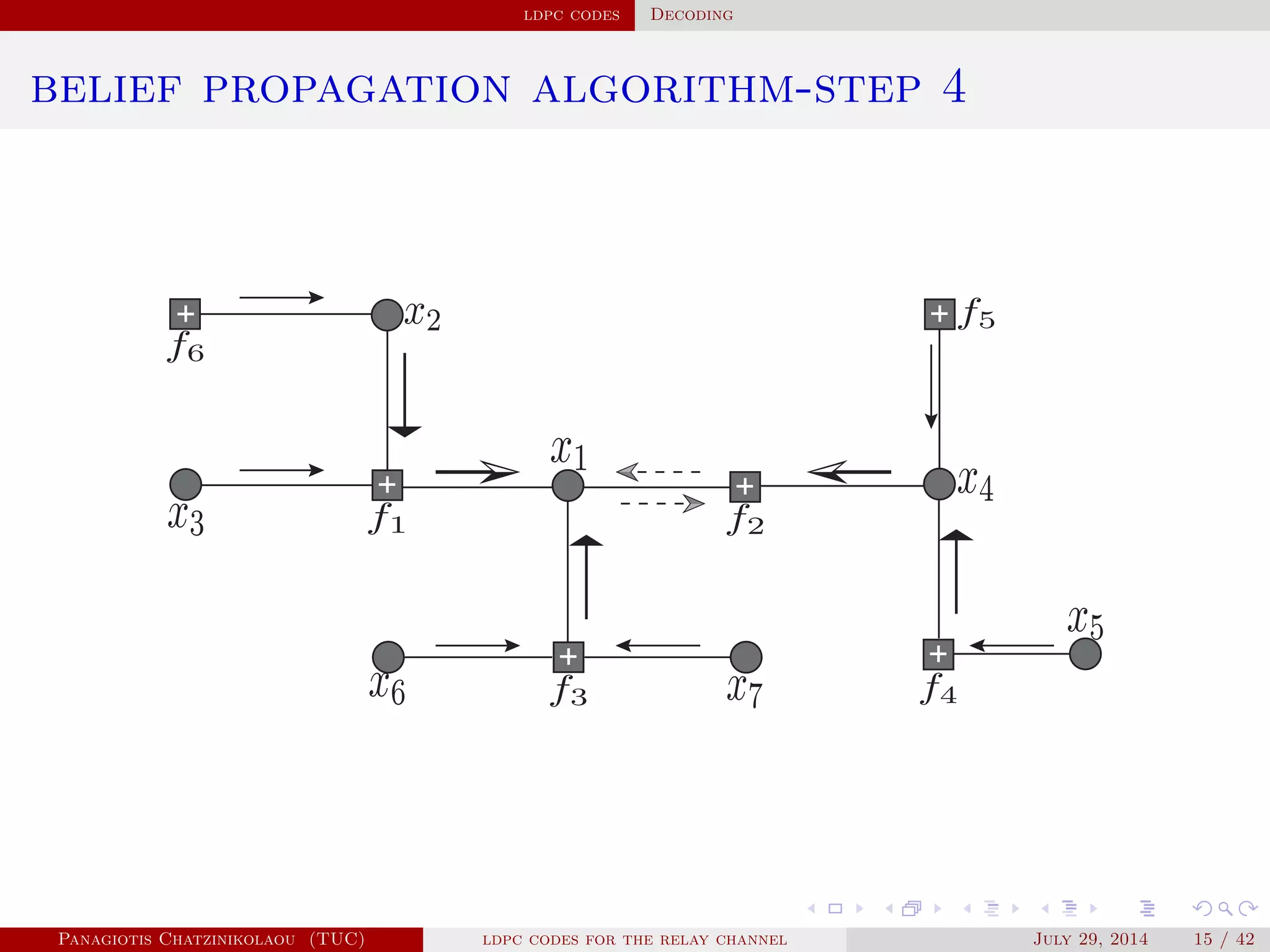
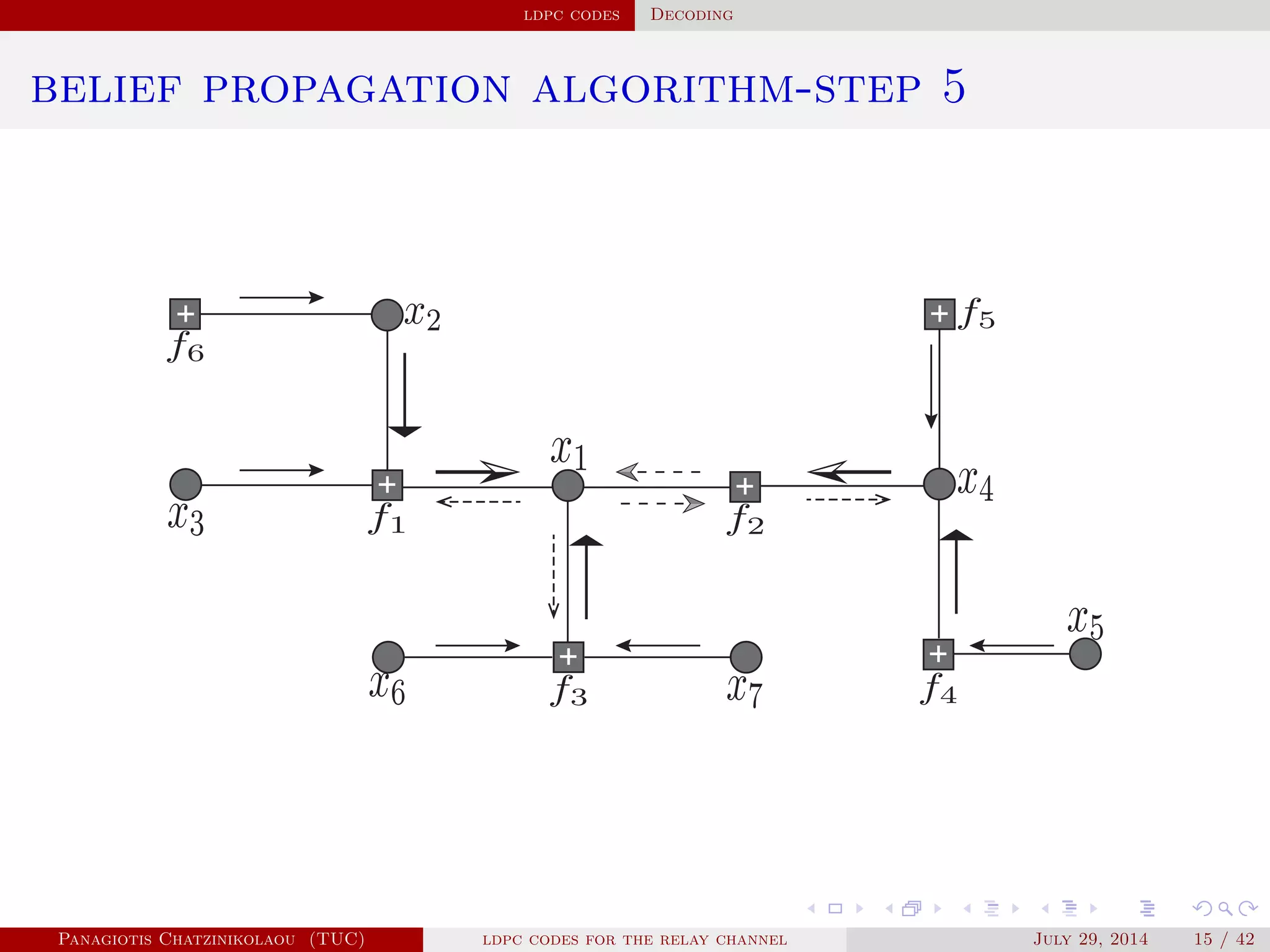
• All marginals can be computed simultaneously on a single tree, if we
allow message passing to both directions.
Panagiotis Chatzinikolaou (TUC) ldpc codes for the relay channel July 29, 2014 15 / 42
ldpc codes Decoding
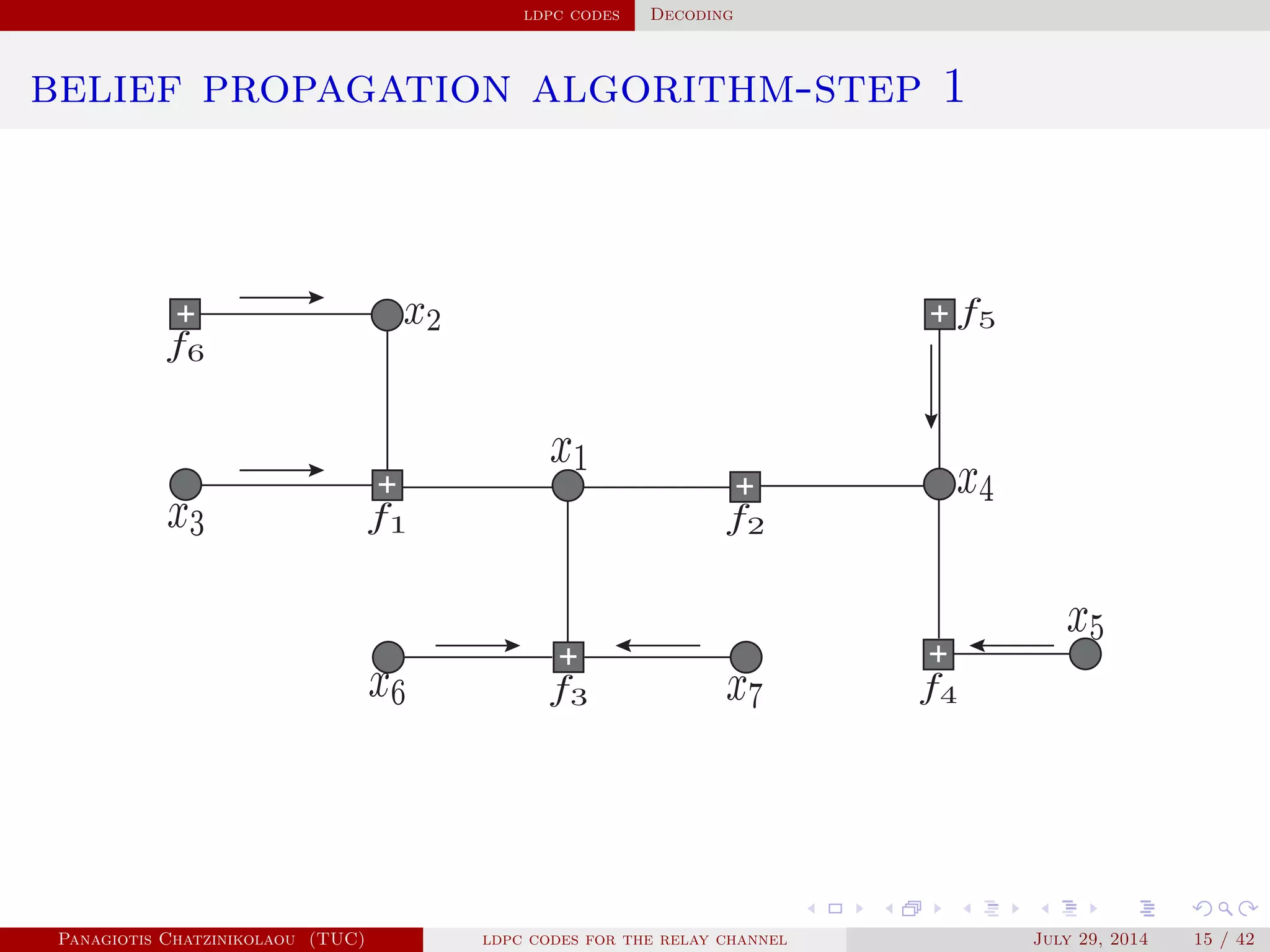
belief propagation algorithm-step 1
Panagiotis Chatzinikolaou (TUC) ldpc codes for the relay channel July 29, 2014 15 / 42
ldpc codes Decoding
belief propagation algorithm-step 2
Panagiotis Chatzinikolaou (TUC) ldpc codes for the relay channel July 29, 2014 15 / 42
ldpc codes Decoding
belief propagation algorithm-step 3
Panagiotis Chatzinikolaou (TUC) ldpc codes for the relay channel July 29, 2014 15 / 42
ldpc codes Decoding
belief propagation algorithm-step 4
Panagiotis Chatzinikolaou (TUC) ldpc codes for the relay channel July 29, 2014 15 / 42
ldpc codes Decoding
belief propagation algorithm-step 5
Panagiotis Chatzinikolaou (TUC) ldpc codes for the relay channel July 29, 2014 15 / 42
ldpc codes Decoding
belief propagation algorithm-step 6
Panagiotis Chatzinikolaou (TUC) ldpc codes for the relay channel July 29, 2014 15 / 42
ldpc codes Decoding
belief propagation algorithm-step 7
Panagiotis Chatzinikolaou (TUC) ldpc codes for the relay channel July 29, 2014 15 / 42
ldpc codes Decoding
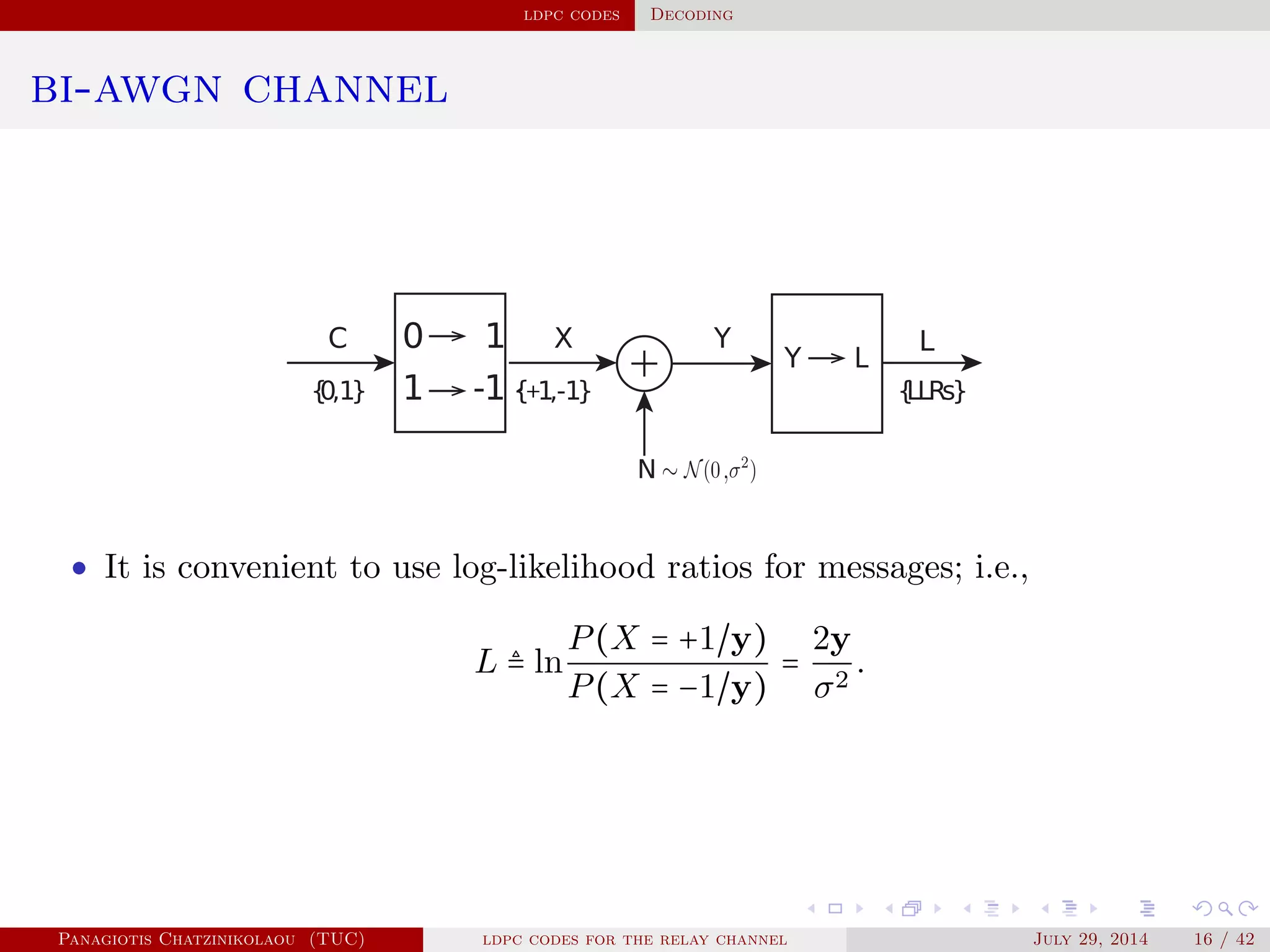
bi-awgn channel
+
• It is convenient to use log-likelihood ratios for messages; i.e.,
L ≜ ln
P(X = +1/y)
P(X = −1/y)
=
2y
σ2
.
Panagiotis Chatzinikolaou (TUC) ldpc codes for the relay channel July 29, 2014 16 / 42
ldpc codes Decoding
map decoding
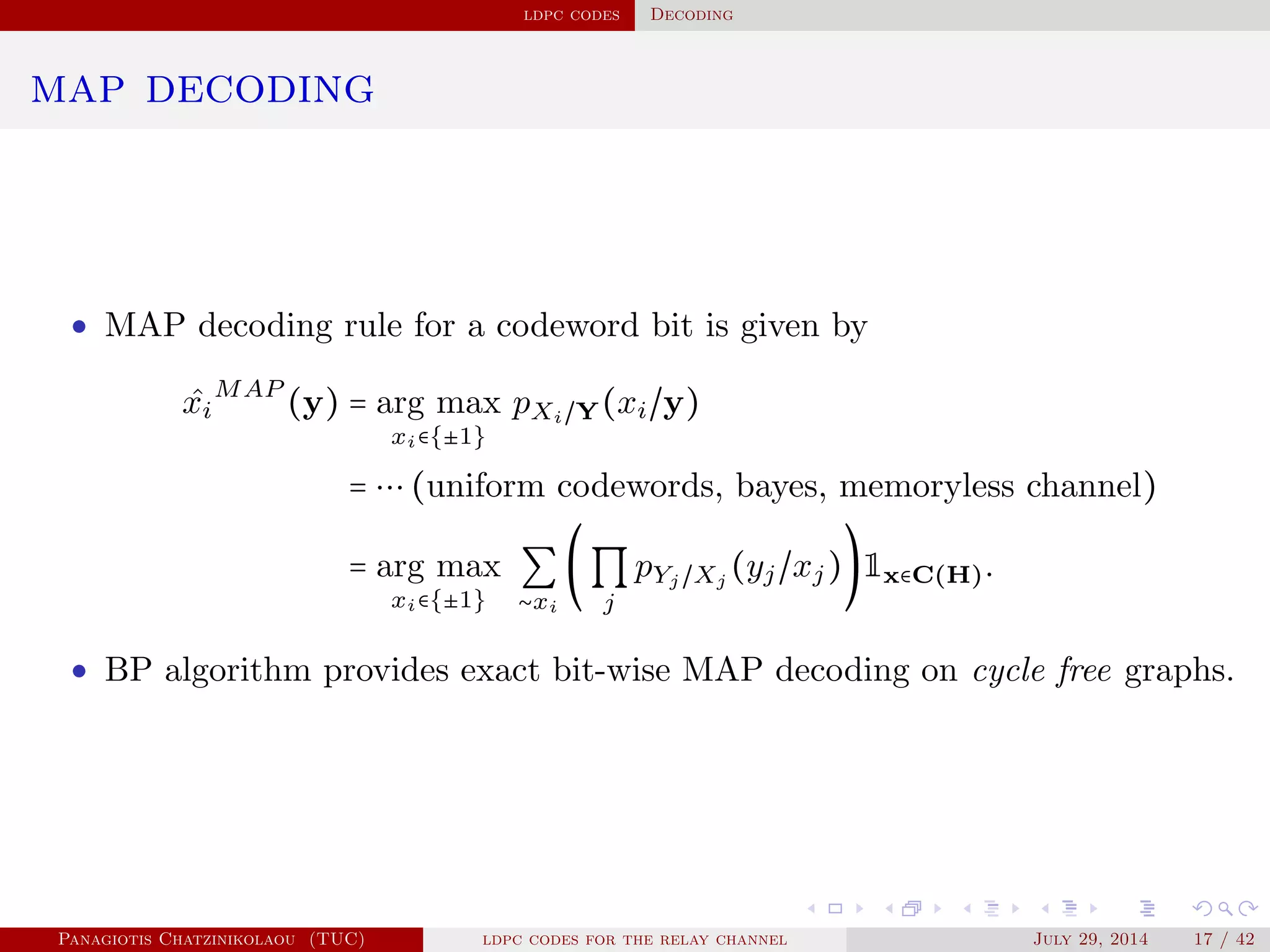
• MAP decoding rule for a codeword bit is given by
ˆxi
MAP
(y) = arg max
xi∈{±1}
pXi/Y(xi/y)
= ⋯ (uniform codewords, bayes, memoryless channel)
= arg max
xi∈{±1}
∑
∼xi
(∏
j
pYj /Xj
(yj/xj))1x∈C(H).
• BP algorithm provides exact bit-wise MAP decoding on cycle free graphs.
Panagiotis Chatzinikolaou (TUC) ldpc codes for the relay channel July 29, 2014 17 / 42
ldpc codes Decoding
belief propagation decoding
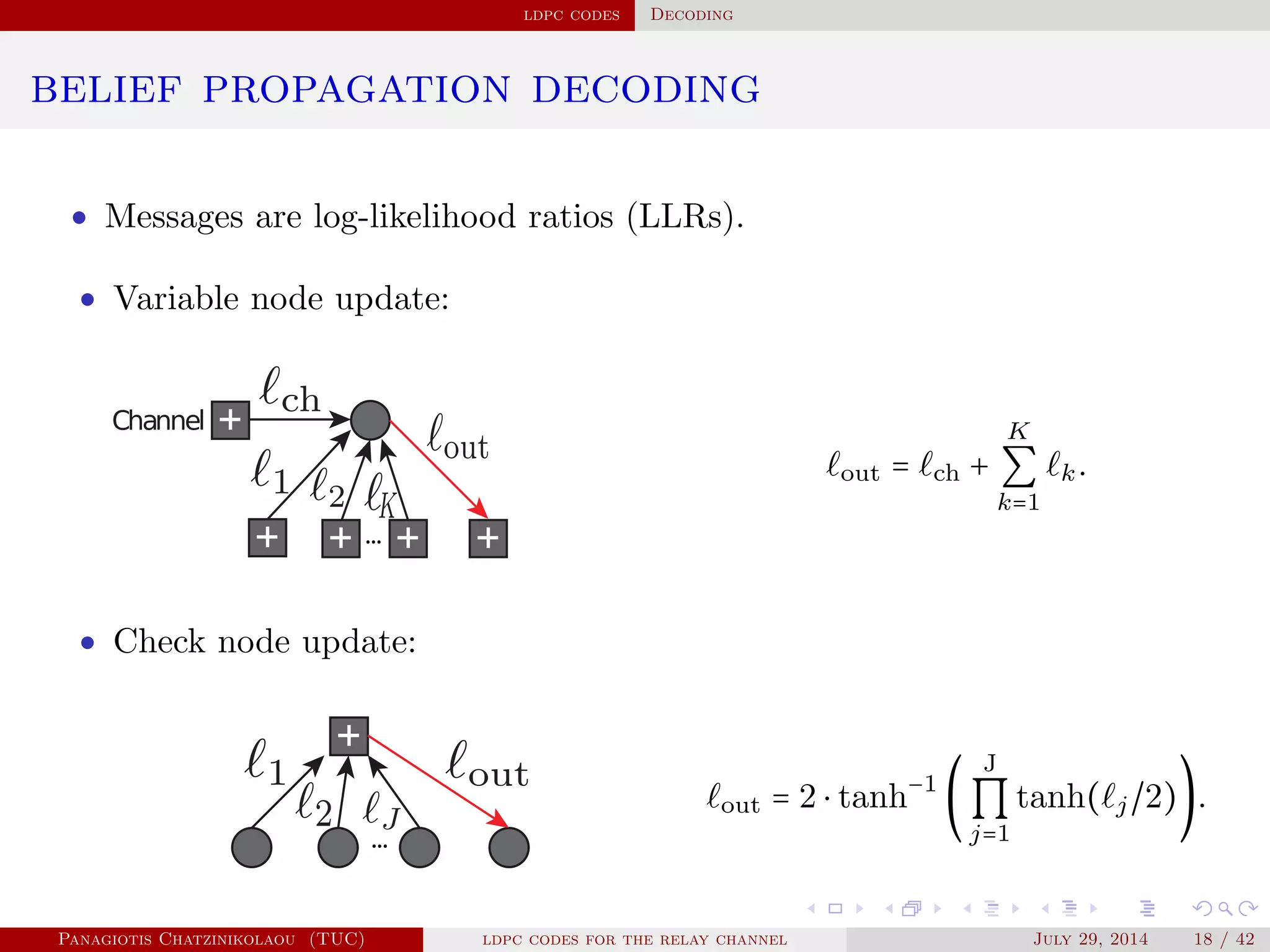
• Messages are log-likelihood ratios (LLRs).
• Variable node update:
...
• Check node update:
...
out = ch +
K
∑
k=1
k.
out = 2 ⋅ tanh−1
(
J
∏
j=1
tanh( j/2)).
Panagiotis Chatzinikolaou (TUC) ldpc codes for the relay channel July 29, 2014 18 / 42
ldpc codes Decoding
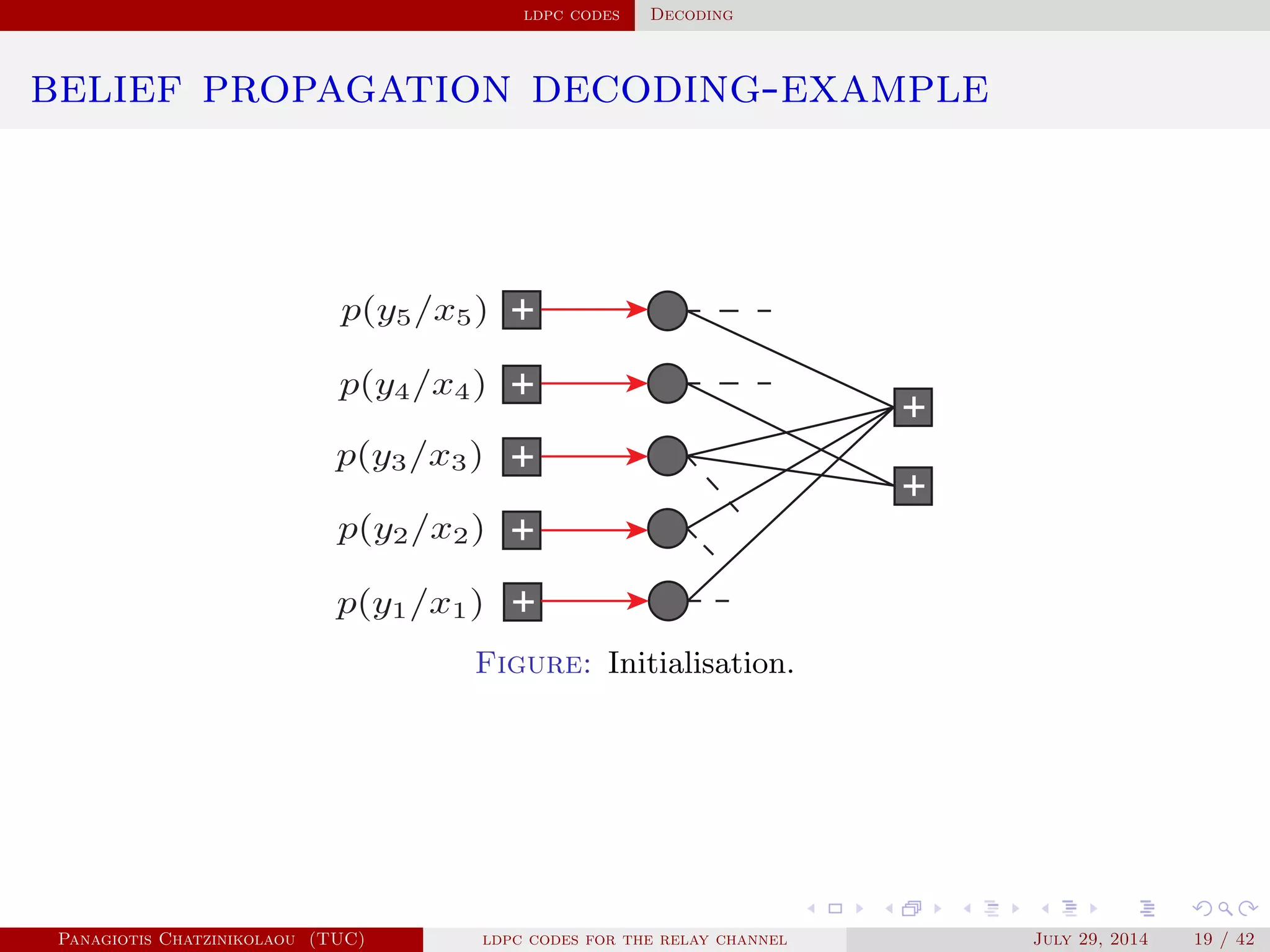
belief propagation decoding-example
Figure: Initialisation.
Panagiotis Chatzinikolaou (TUC) ldpc codes for the relay channel July 29, 2014 19 / 42
ldpc codes Decoding
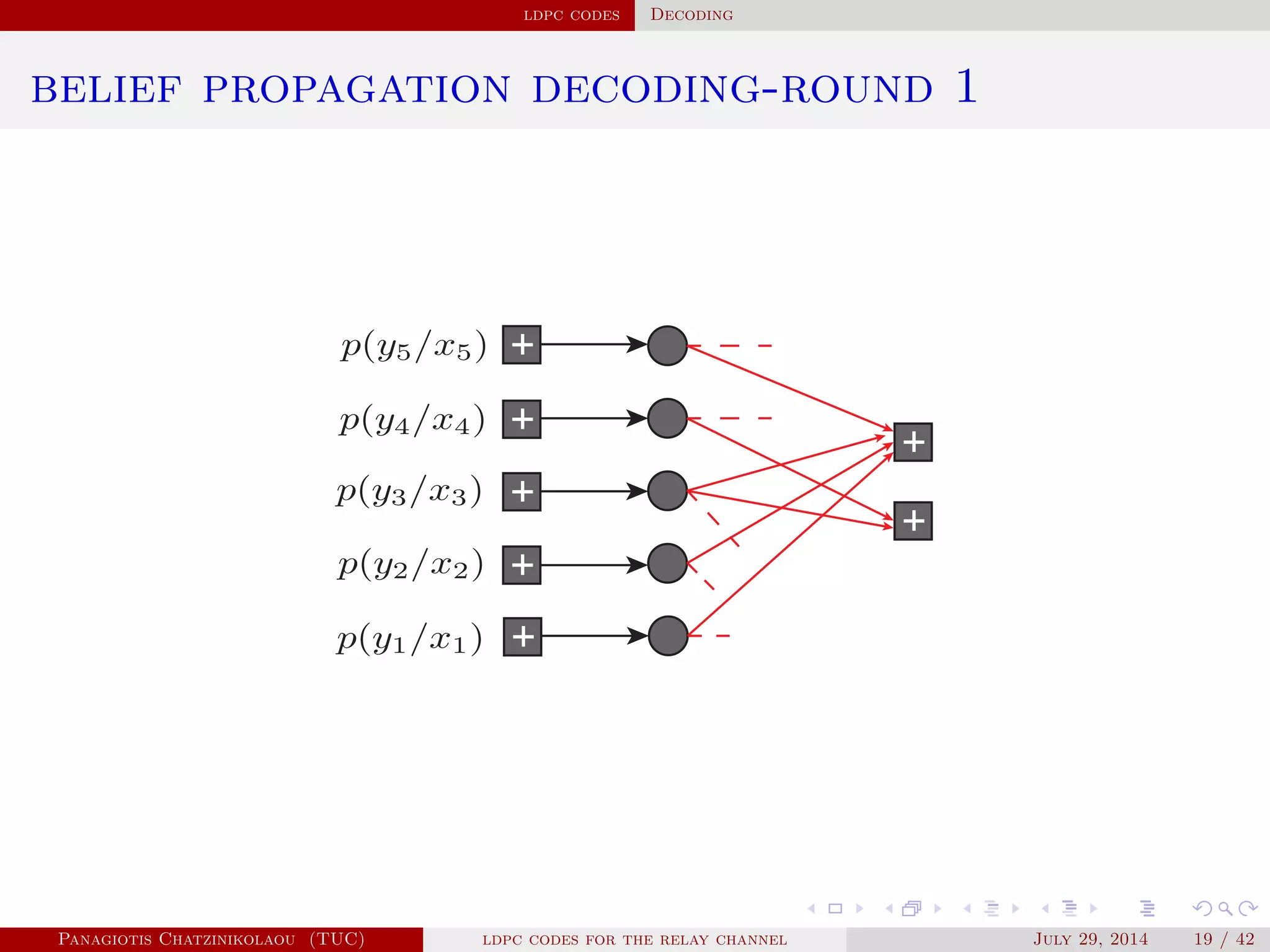
belief propagation decoding-round 1
Panagiotis Chatzinikolaou (TUC) ldpc codes for the relay channel July 29, 2014 19 / 42
ldpc codes Decoding
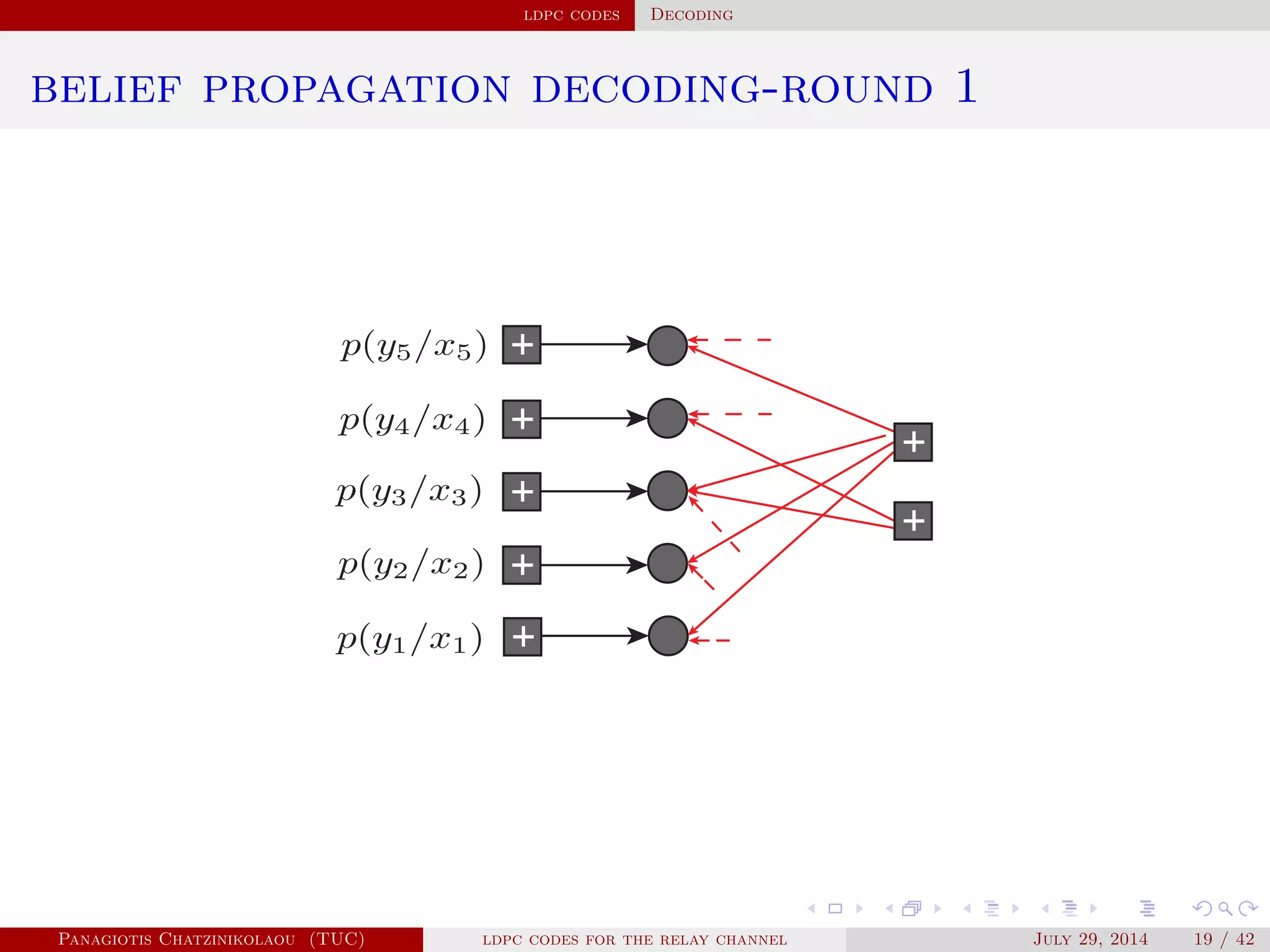
belief propagation decoding-round 1
Panagiotis Chatzinikolaou (TUC) ldpc codes for the relay channel July 29, 2014 19 / 42
ldpc codes Decoding
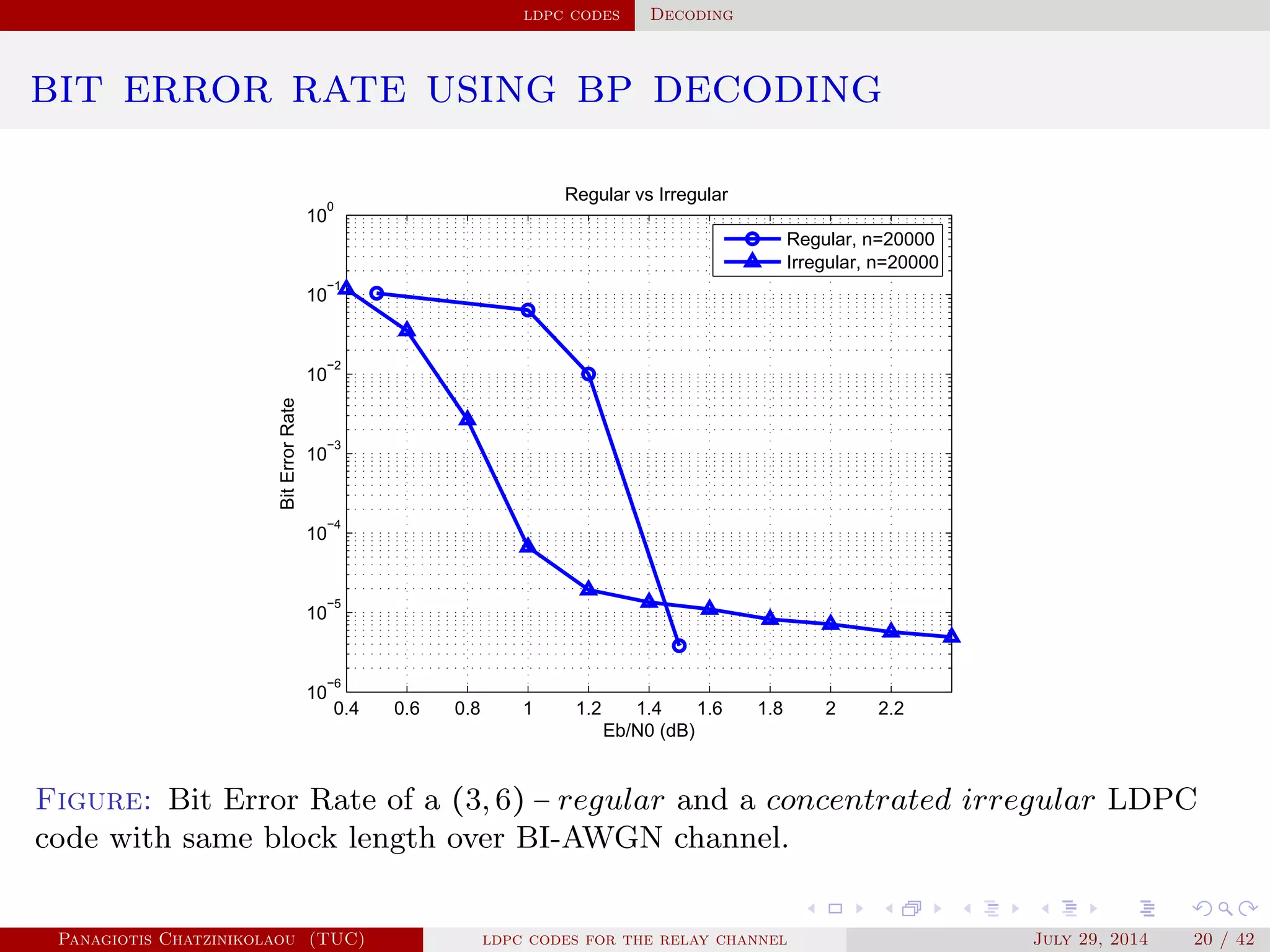
bit error rate using bp decoding
0.4 0.6 0.8 1 1.2 1.4 1.6 1.8 2 2.2
10
−6
10
−5
10
−4
10
−3
10
−2
10
−1
10
0
Eb/N0 (dB)
BitErrorRate
Regular vs Irregular
Regular, n=20000
Irregular, n=20000
Figure: Bit Error Rate of a (3, 6) − regular and a concentrated irregular LDPC
code with same block length over BI-AWGN channel.
Panagiotis Chatzinikolaou (TUC) ldpc codes for the relay channel July 29, 2014 20 / 42
ldpc codes Decoding
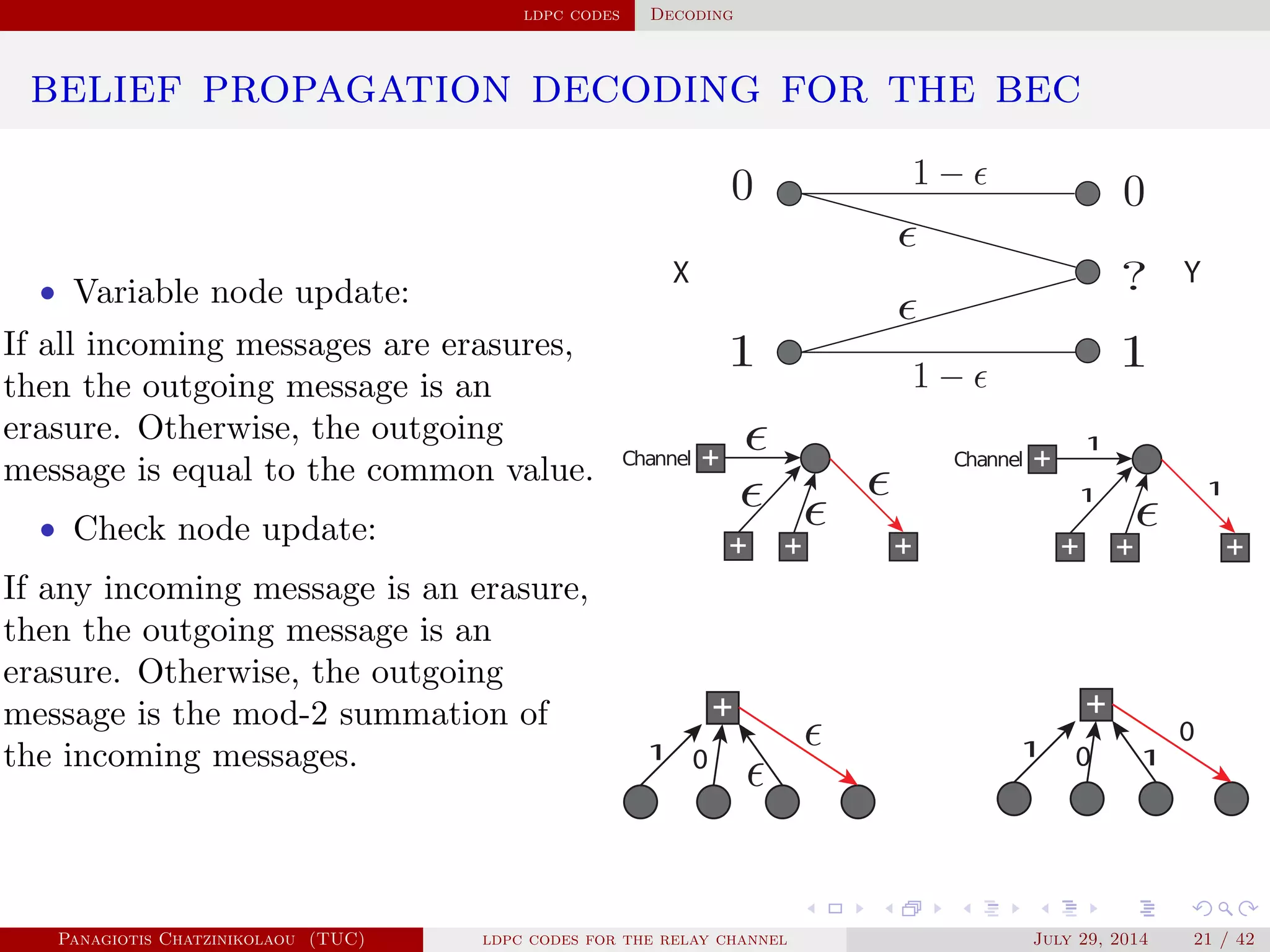
belief propagation decoding for the bec
• Variable node update:
If all incoming messages are erasures,
then the outgoing message is an
erasure. Otherwise, the outgoing
message is equal to the common value.
• Check node update:
If any incoming message is an erasure,
then the outgoing message is an
erasure. Otherwise, the outgoing
message is the mod-2 summation of
the incoming messages.
X Y
1
1
1
1 0 1 0 1
0
Panagiotis Chatzinikolaou (TUC) ldpc codes for the relay channel July 29, 2014 21 / 42
ldpc codes Design
density evolution
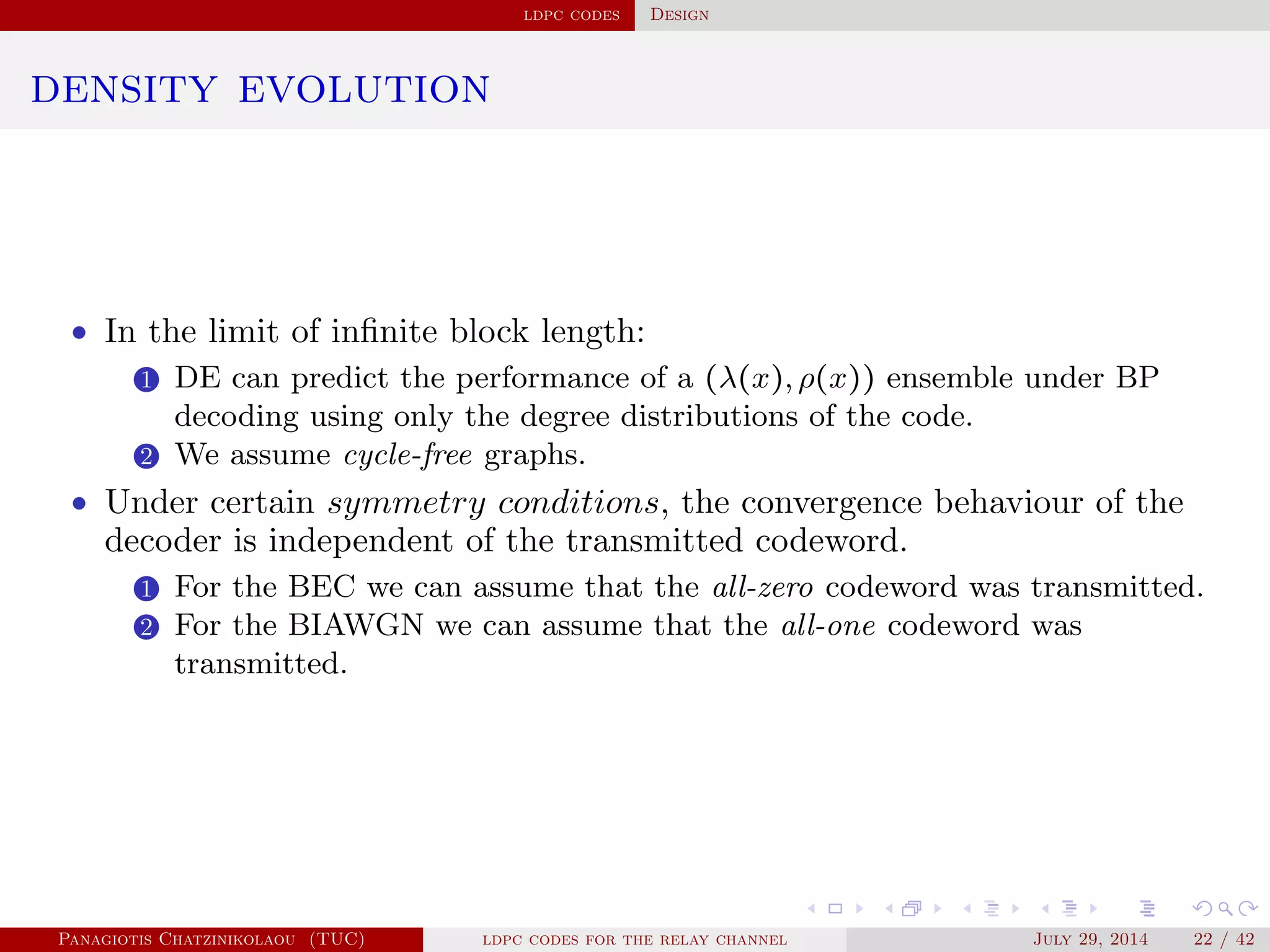
• In the limit of infinite block length:
1 DE can predict the performance of a (λ(x), ρ(x)) ensemble under BP
decoding using only the degree distributions of the code.
2 We assume cycle-free graphs.
• Under certain symmetry conditions, the convergence behaviour of the
decoder is independent of the transmitted codeword.
1 For the BEC we can assume that the all-zero codeword was transmitted.
2 For the BIAWGN we can assume that the all-one codeword was
transmitted.
Panagiotis Chatzinikolaou (TUC) ldpc codes for the relay channel July 29, 2014 22 / 42
ldpc codes Design
density evolution for the bec
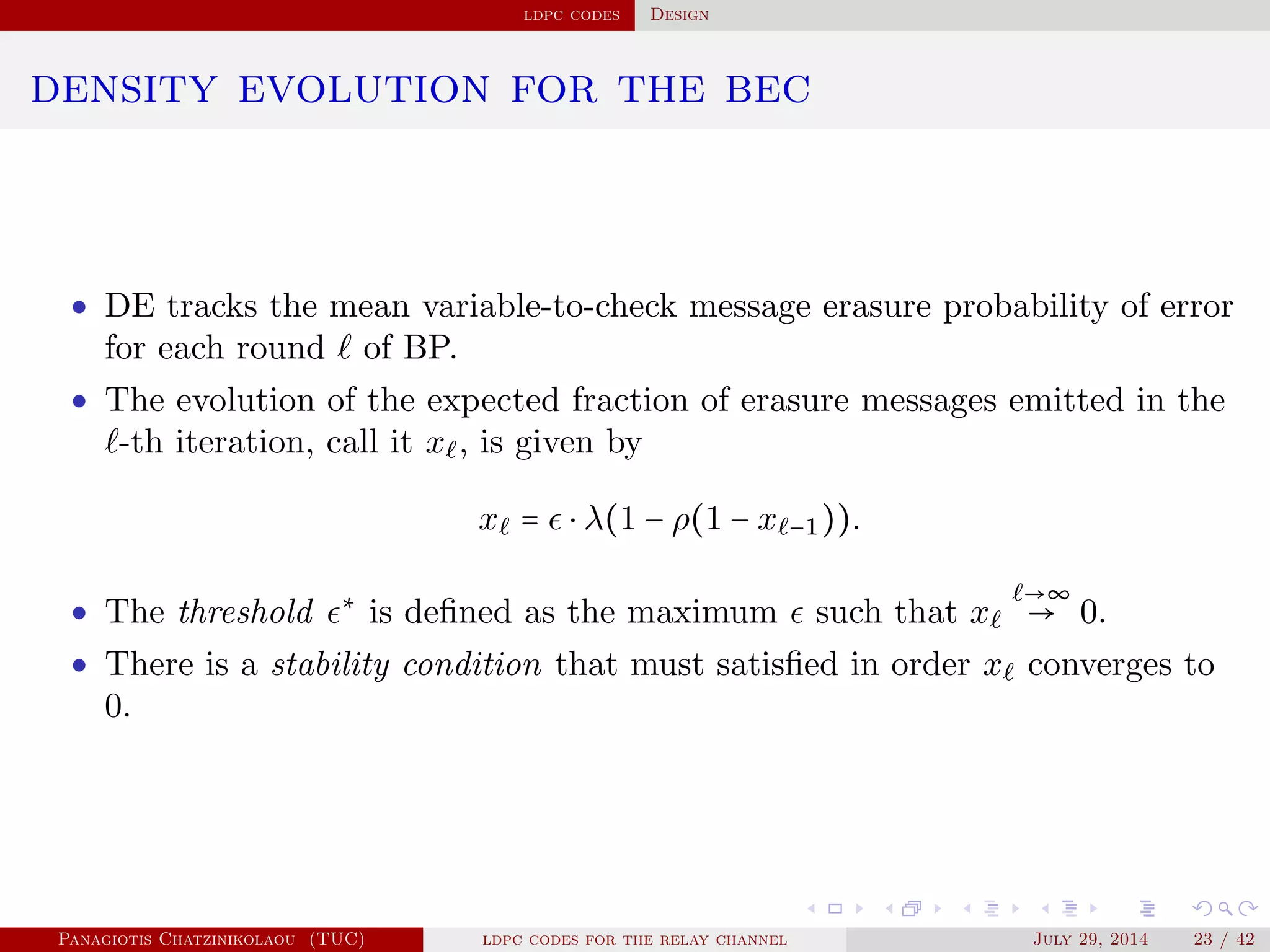
• DE tracks the mean variable-to-check message erasure probability of error
for each round of BP.
• The evolution of the expected fraction of erasure messages emitted in the
-th iteration, call it x , is given by
x = ⋅ λ(1 − ρ(1 − x −1)).
• The threshold ∗
is defined as the maximum such that x
→∞
→ 0.
• There is a stability condition that must satisfied in order x converges to
0.
Panagiotis Chatzinikolaou (TUC) ldpc codes for the relay channel July 29, 2014 23 / 42
ldpc codes Design
density evolution for the bi-awgn channel
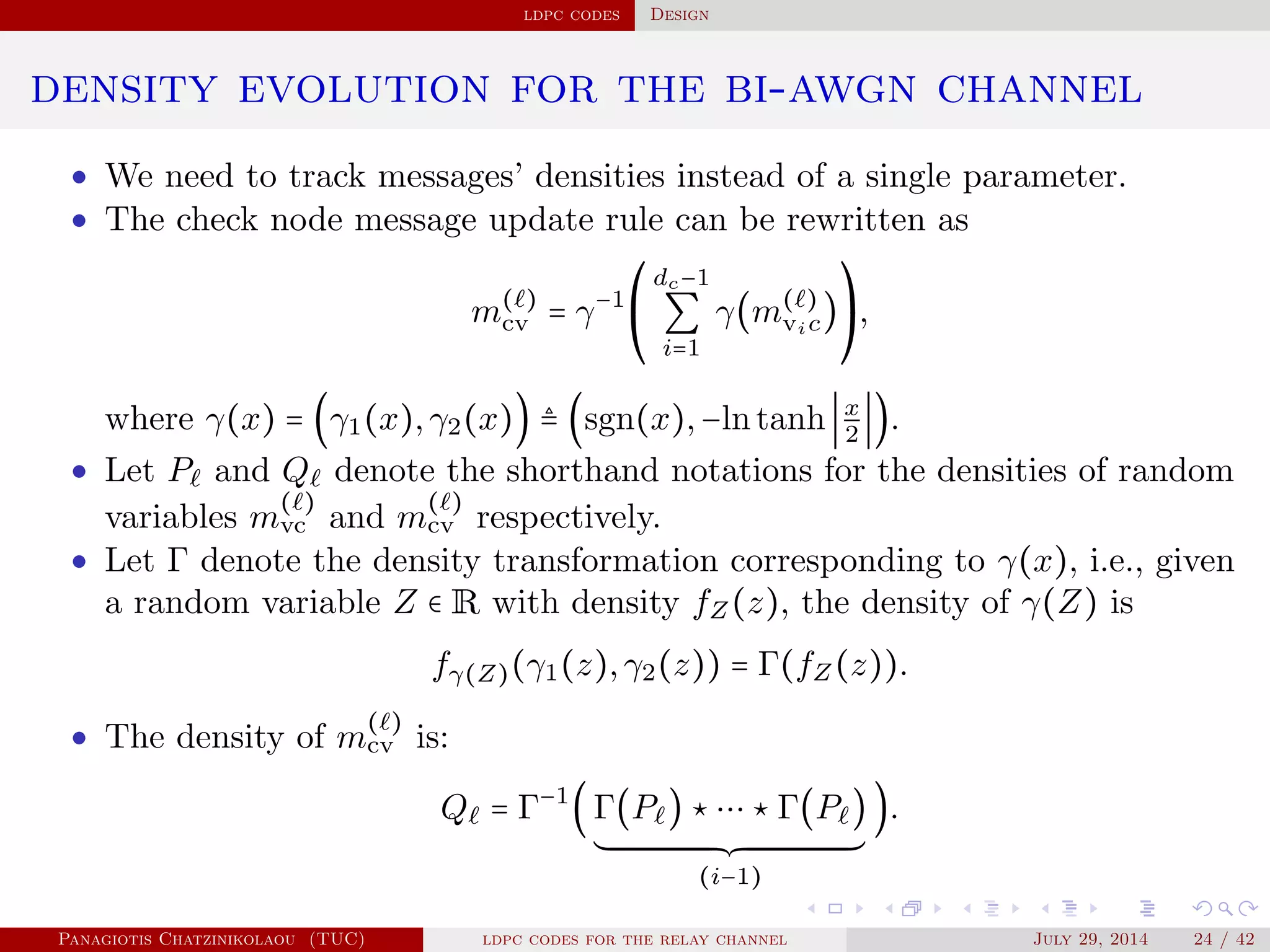
• We need to track messages’ densities instead of a single parameter.
• The check node message update rule can be rewritten as
m( )
cv = γ−1⎛
⎝
dc−1
∑
i=1
γ(m( )
vic)
⎞
⎠
,
where γ(x) = (γ1(x),γ2(x)) ≜ (sgn(x),−lntanh x
2
).
• Let P and Q denote the shorthand notations for the densities of random
variables m
( )
vc and m
( )
cv respectively.
• Let Γ denote the density transformation corresponding to γ(x), i.e., given
a random variable Z ∈ R with density fZ(z), the density of γ(Z) is
fγ(Z)(γ1(z),γ2(z)) = Γ(fZ(z)).
• The density of m
( )
cv is:
Q = Γ−1
(Γ(P ) ⋆ ⋯ ⋆ Γ(P )
(i−1)
).
Panagiotis Chatzinikolaou (TUC) ldpc codes for the relay channel July 29, 2014 24 / 42
ldpc codes Design
density evolution for the bi-awgn channel
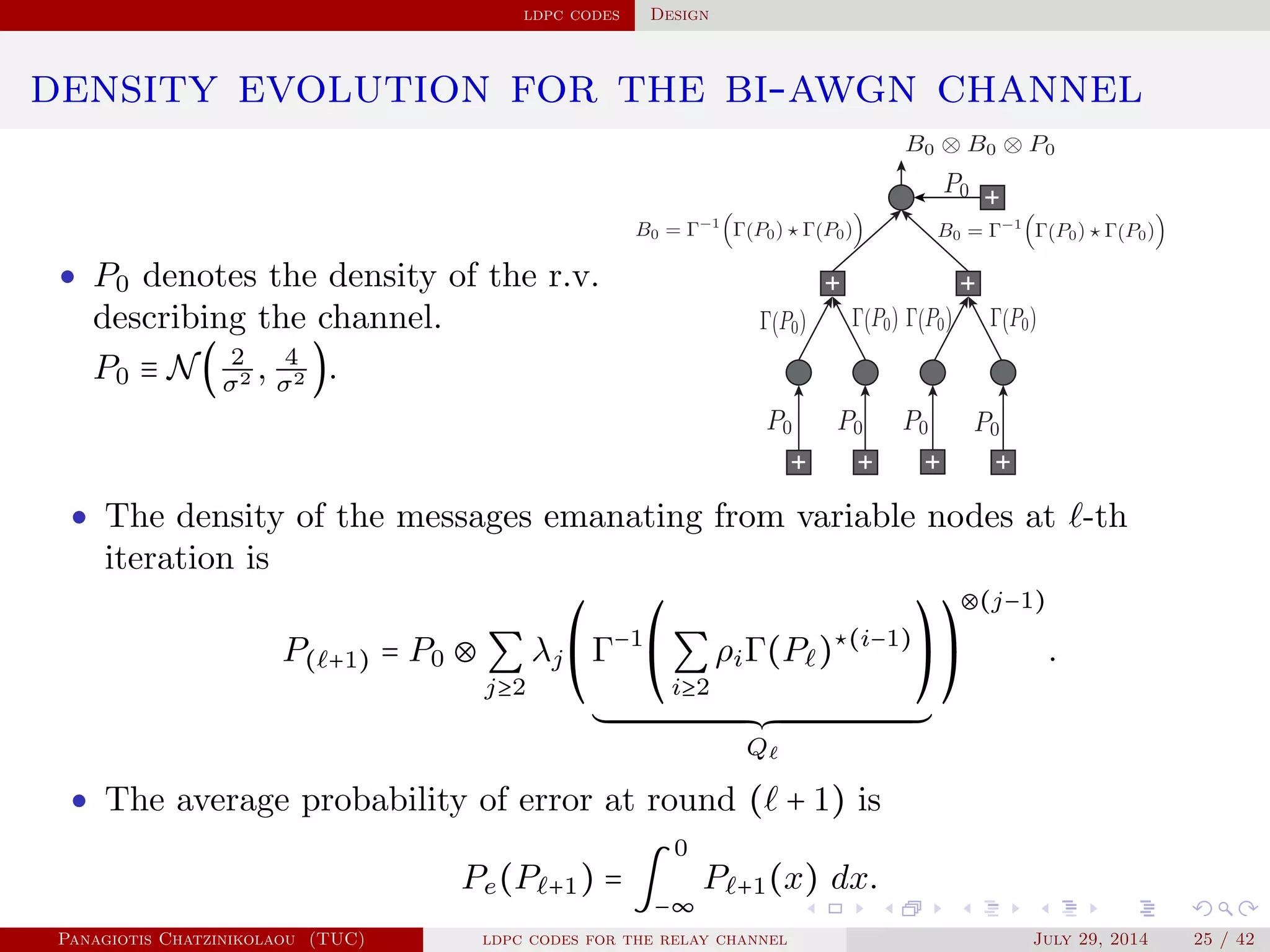
• P0 denotes the density of the r.v.
describing the channel.
P0 ≡ N( 2
σ2 , 4
σ2 ).
• The density of the messages emanating from variable nodes at -th
iteration is
P( +1) = P0 ⊗ ∑
j≥2
λj
⎛
⎝
Γ−1⎛
⎝
∑
i≥2
ρiΓ(P )⋆(i−1)⎞
⎠
Q
⎞
⎠
⊗(j−1)
.
• The average probability of error at round ( + 1) is
Pe(P +1) = ∫
0
−∞
P +1(x) dx.
Panagiotis Chatzinikolaou (TUC) ldpc codes for the relay channel July 29, 2014 25 / 42
ldpc codes Design
design using density evolution
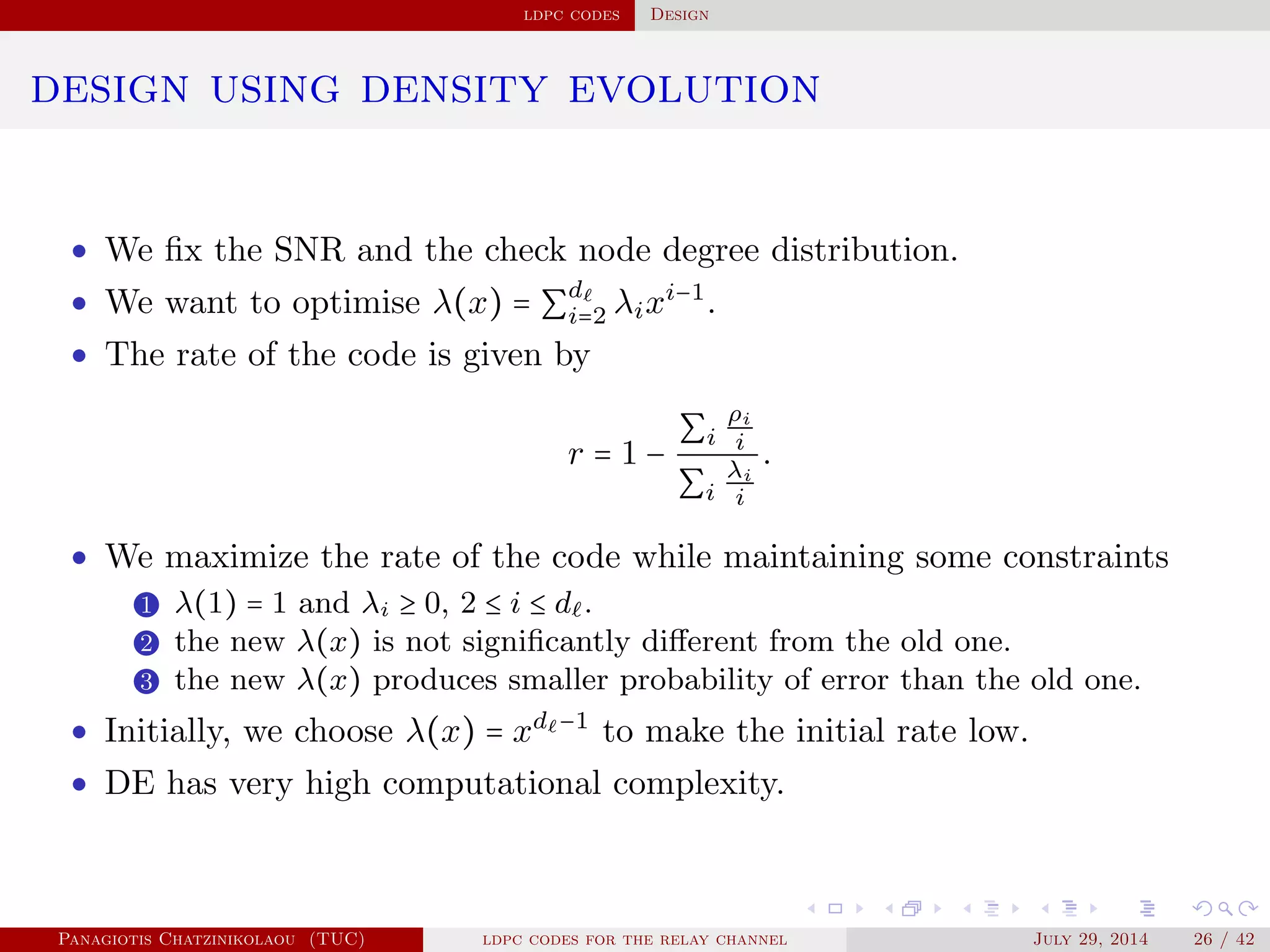
• We fix the SNR and the check node degree distribution.
• We want to optimise λ(x) = ∑
d
i=2 λixi−1
.
• The rate of the code is given by
r = 1 −
∑i
ρi
i
∑i
λi
i
.
• We maximize the rate of the code while maintaining some constraints
1 λ(1) = 1 and λi ≥ 0, 2 ≤ i ≤ d .
2 the new λ(x) is not significantly different from the old one.
3 the new λ(x) produces smaller probability of error than the old one.
• Initially, we choose λ(x) = xd −1
to make the initial rate low.
• DE has very high computational complexity.
Panagiotis Chatzinikolaou (TUC) ldpc codes for the relay channel July 29, 2014 26 / 42
ldpc codes Design
optimised ldpc code
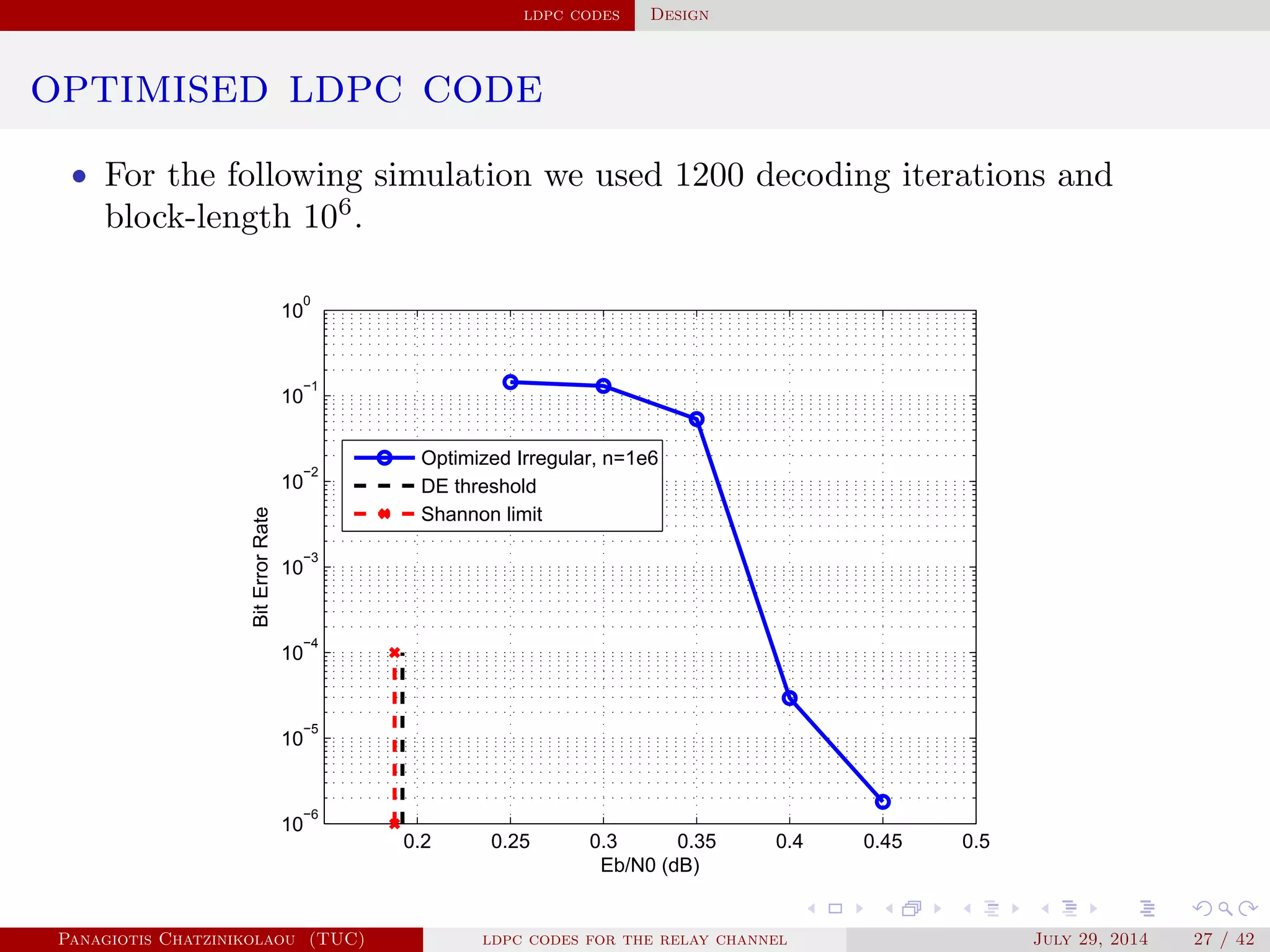
• For the following simulation we used 1200 decoding iterations and
block-length 106
.
0.2 0.25 0.3 0.35 0.4 0.45 0.5
10
−6
10
−5
10
−4
10
−3
10
−2
10
−1
10
0
Eb/N0 (dB)
BitErrorRate
Optimized Irregular, n=1e6
DE threshold
Shannon limit
Panagiotis Chatzinikolaou (TUC) ldpc codes for the relay channel July 29, 2014 27 / 42
ldpc codes Design
gaussian approximation
• We assume that
1 the Tanner graph of the LDPC code is cycle-free;
2 we transmit the all-one codeword;
3 during each iteration, due to 1, the messages are i.i.d. and, more
specifically, they follow the symmetric Gaussian distribution.
• Symmetric Gaussian pdf means that the variance σ2
= 2µ. Hence, we only
need to track the mean of the densities.
• For decoding to converge to a low probability of error, we want µ
( )
v keep
increasing with each iteration.
Panagiotis Chatzinikolaou (TUC) ldpc codes for the relay channel July 29, 2014 28 / 42
ldpc codes Design
gaussian approximation
• At a variable node of degree i:
µ
( )
v,i = µu0 + (i − 1)µ( −1)
u .
• Averaging over λ(x):
µ( )
v = ∑
i≥2
λiµ
( )
v,i .
• At a check node of degree j:
µ
( )
u,j = φ−1⎛
⎝
1 − [1 − φ(µ( )
v )]
j−1⎞
⎠
.
• Averaging over ρ(x):
µ( )
u = ∑
j≥2
ρjµ
( )
u,j.
Panagiotis Chatzinikolaou (TUC) ldpc codes for the relay channel July 29, 2014 29 / 42
ldpc codes Design
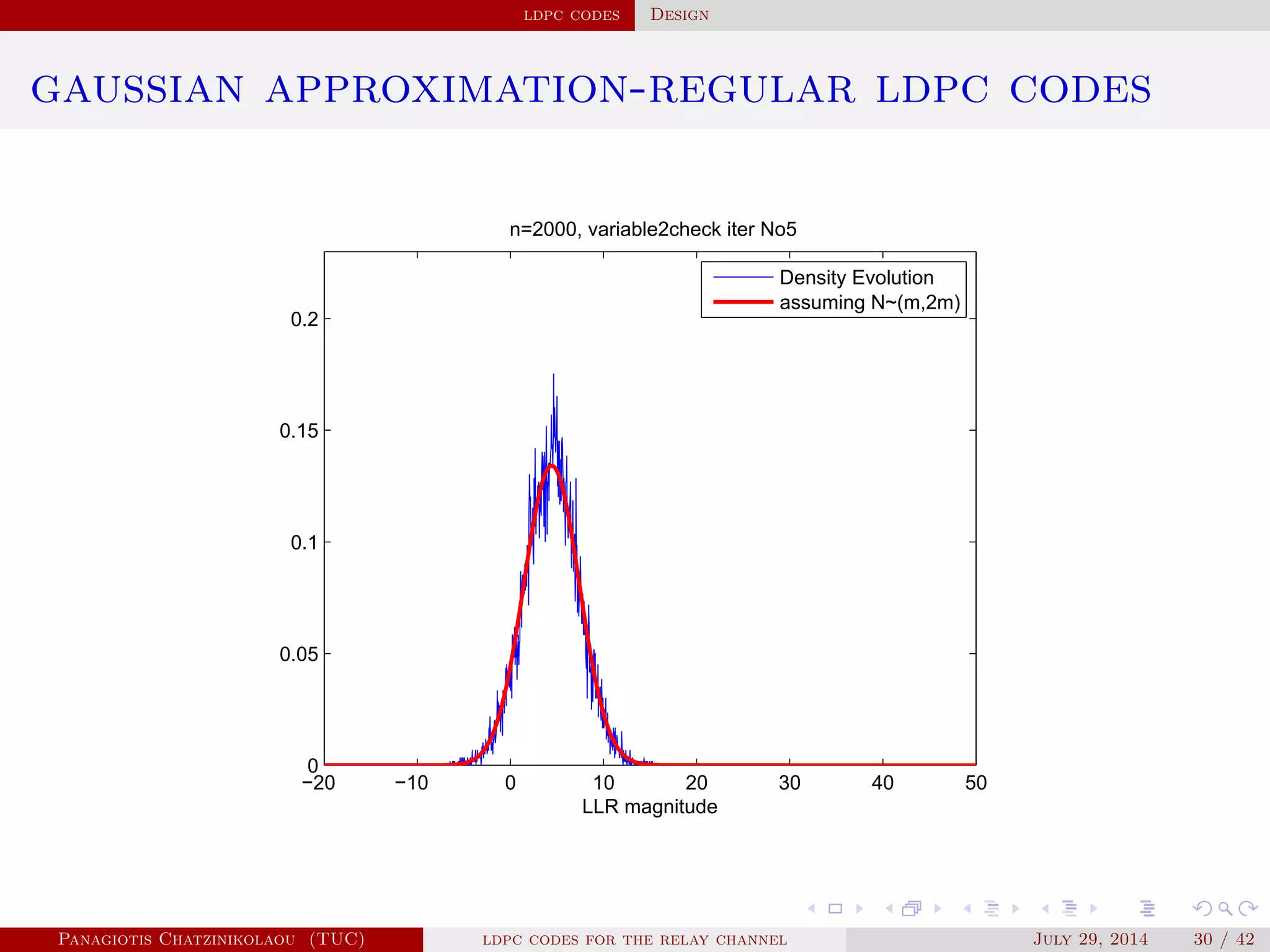
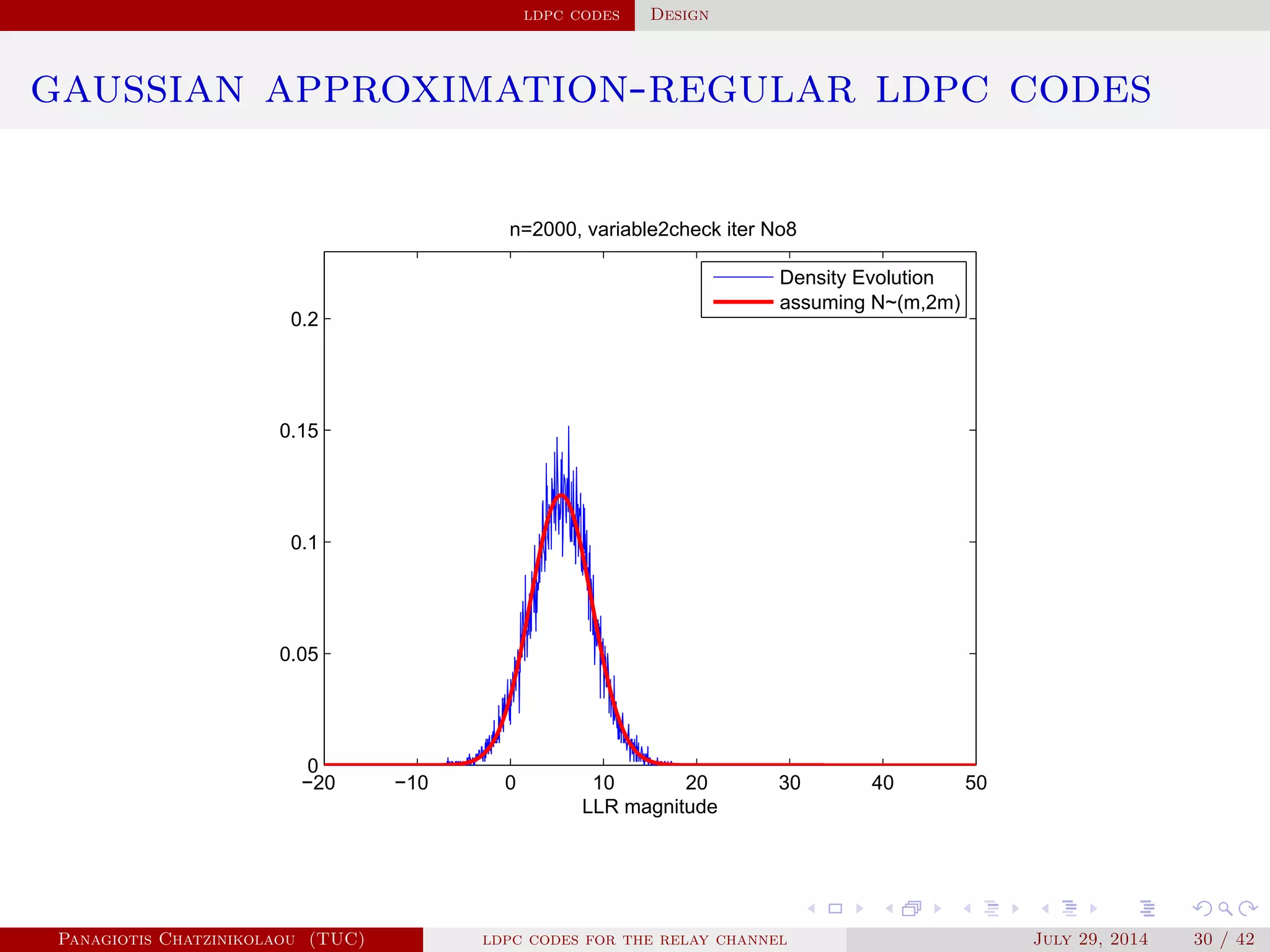
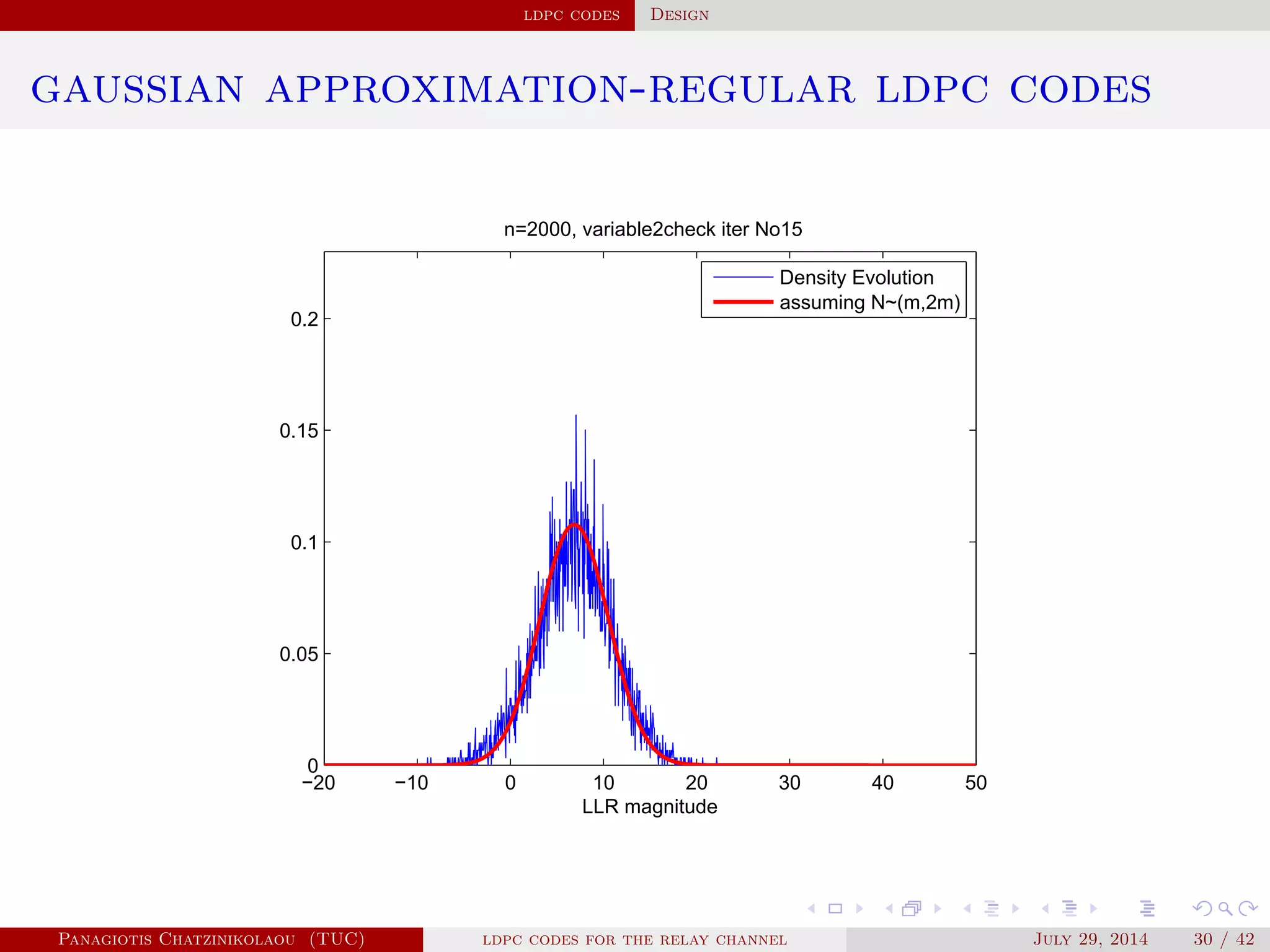
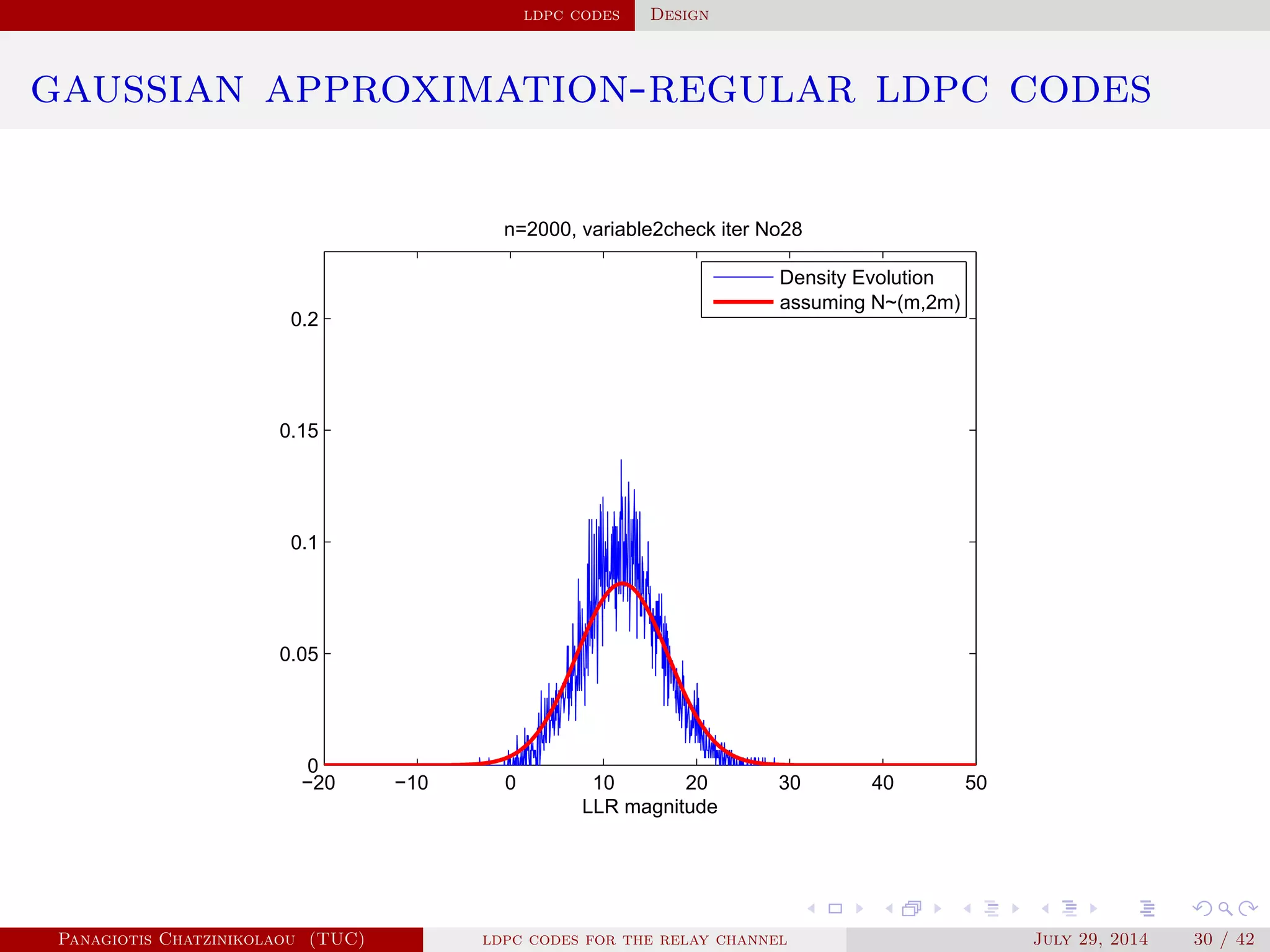
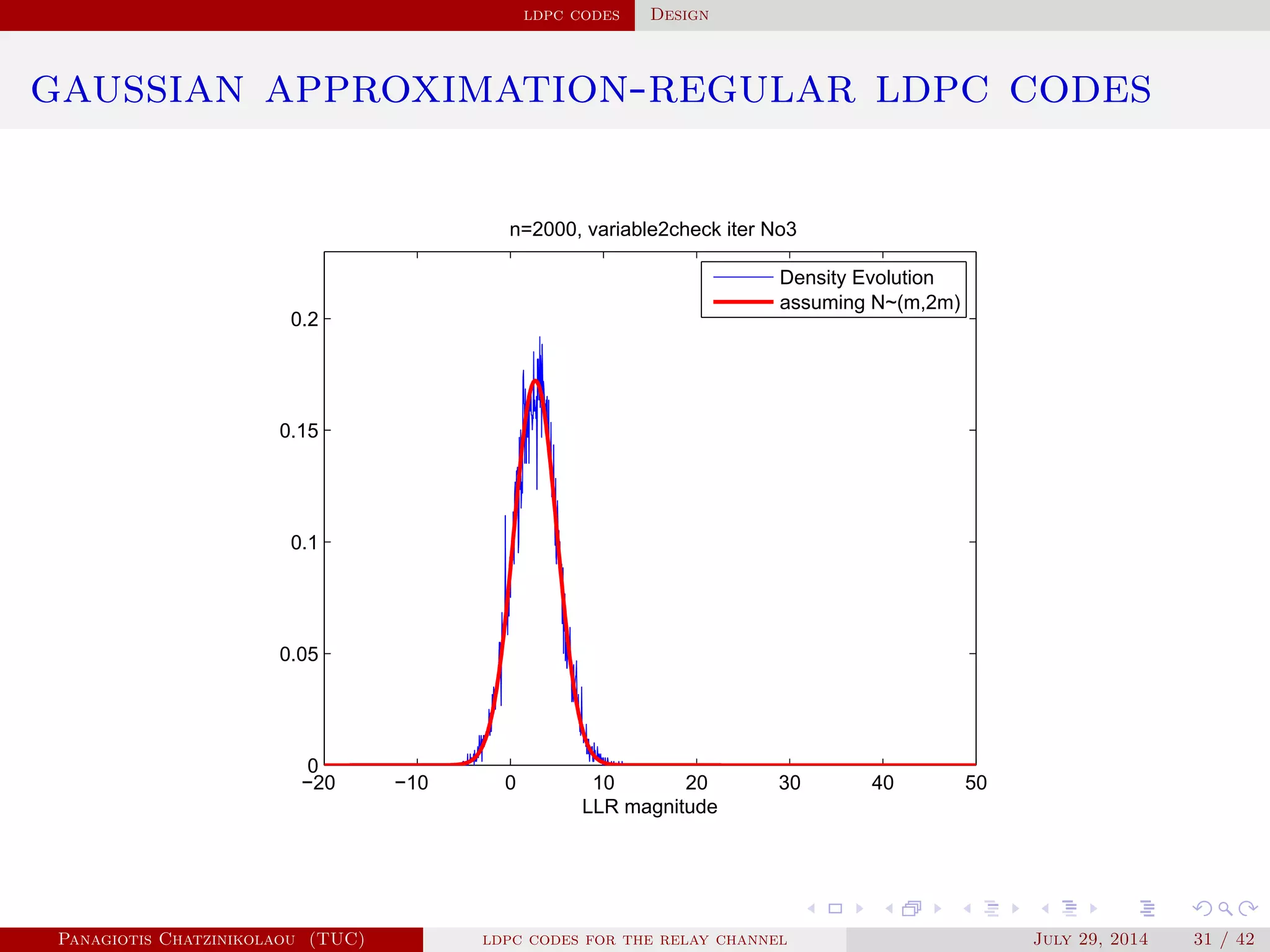
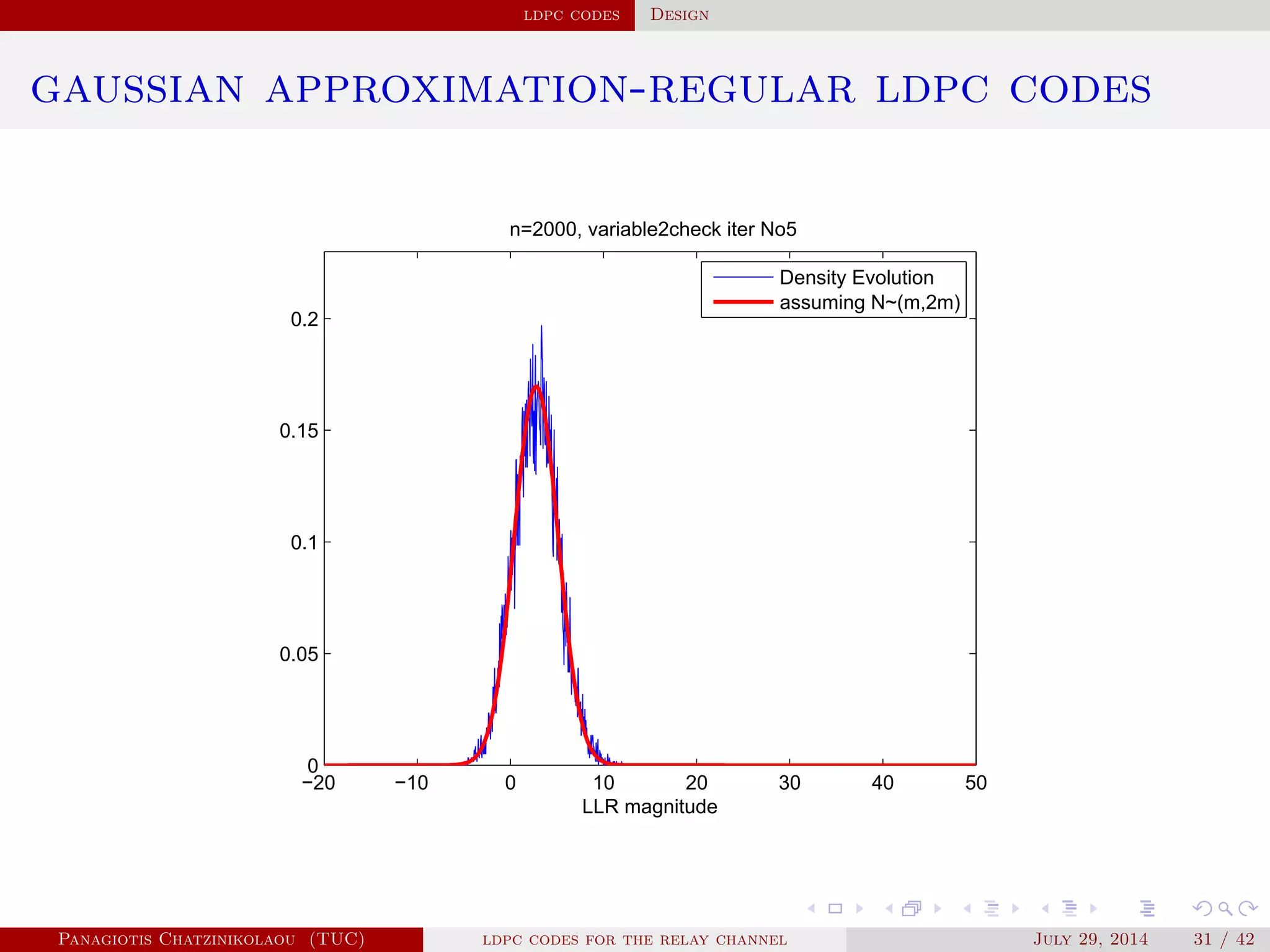
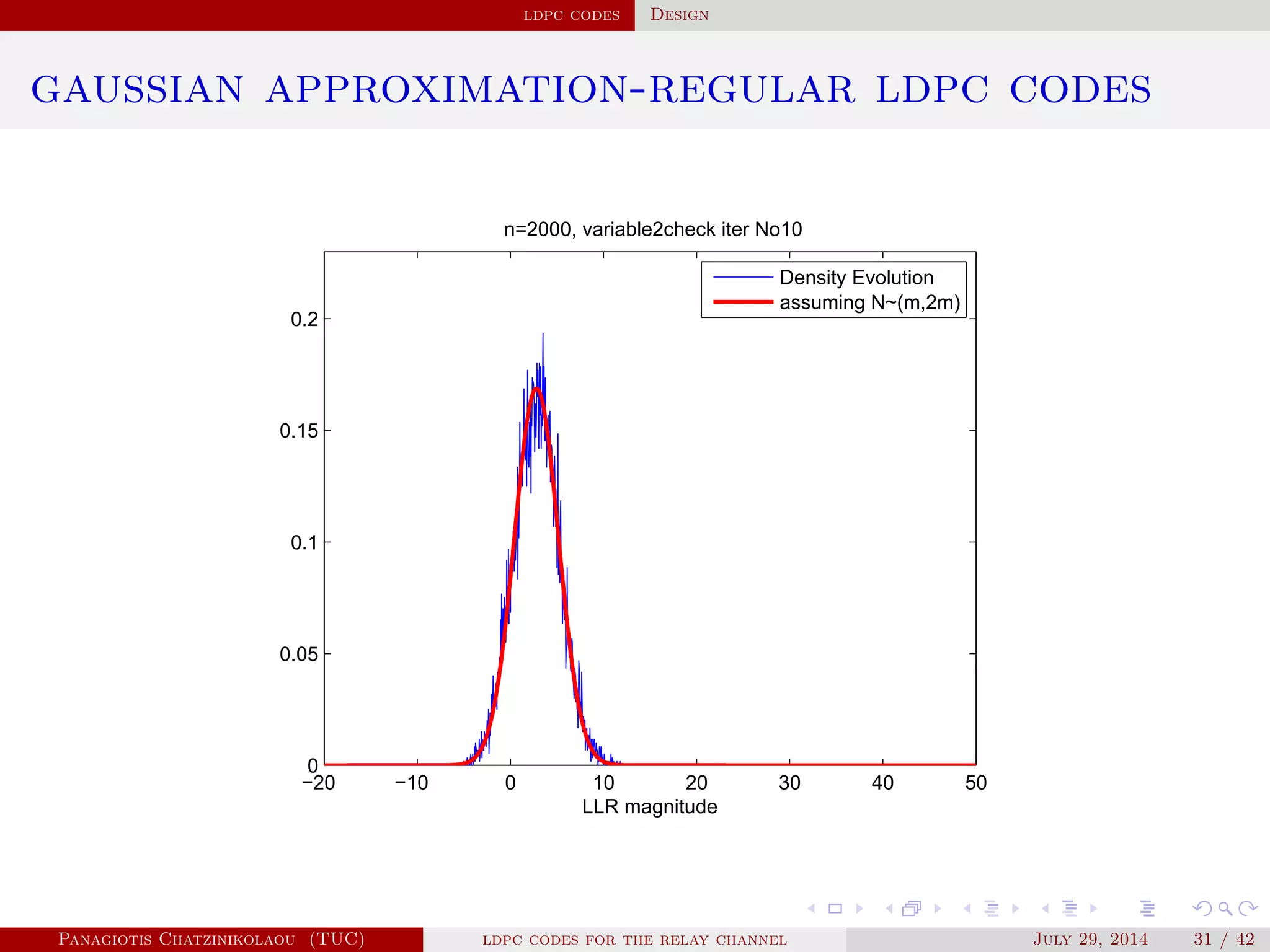
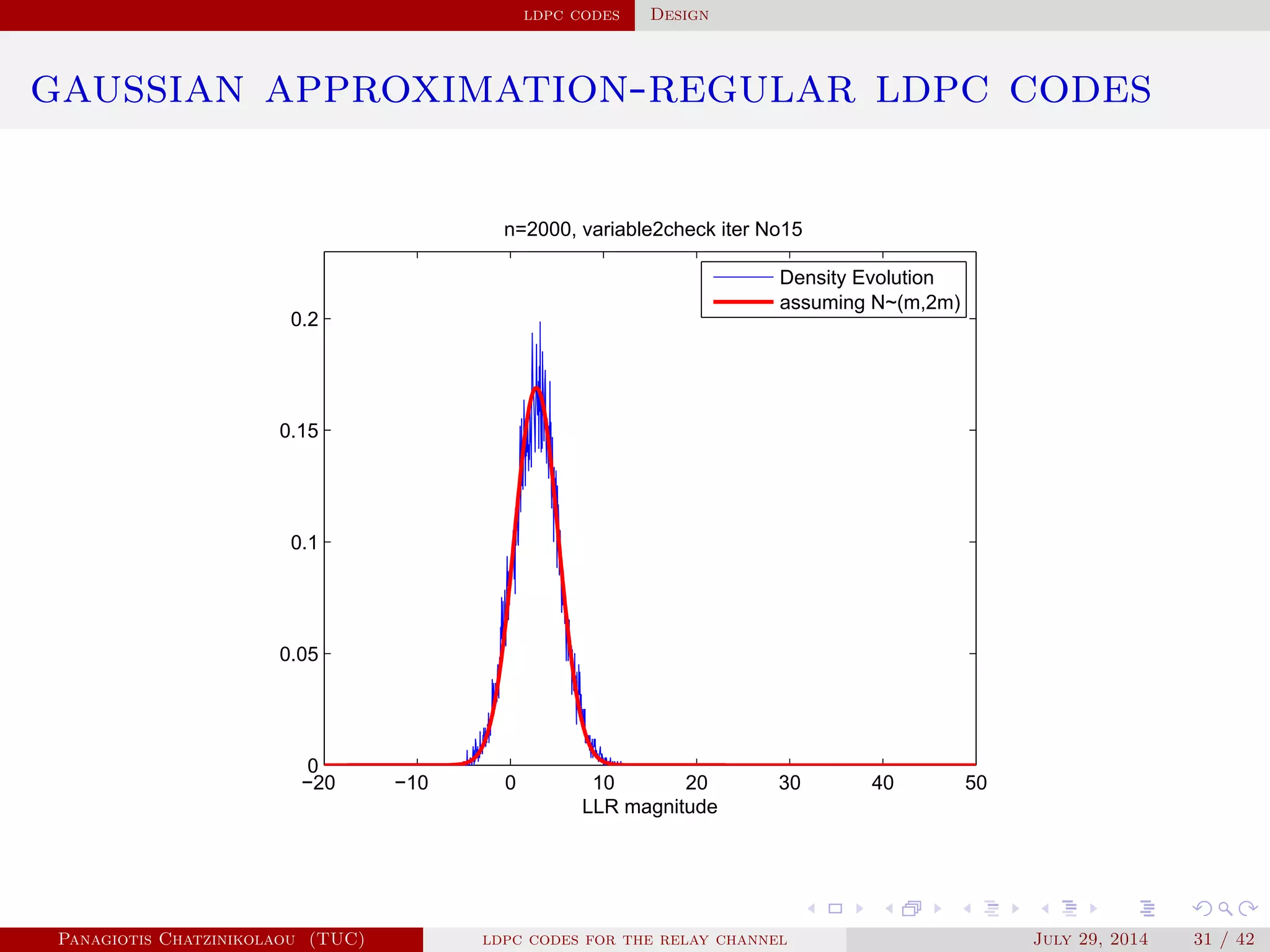
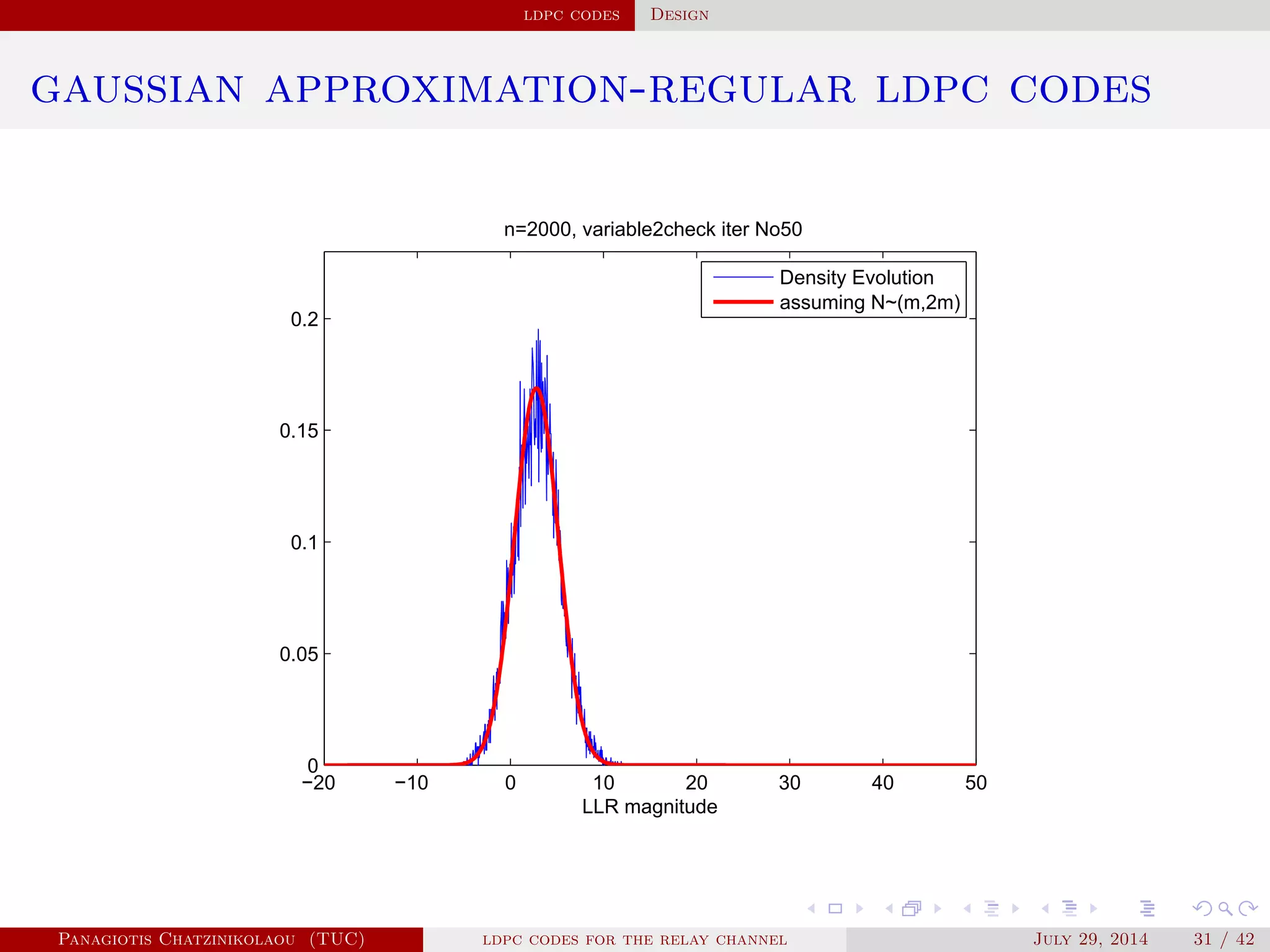
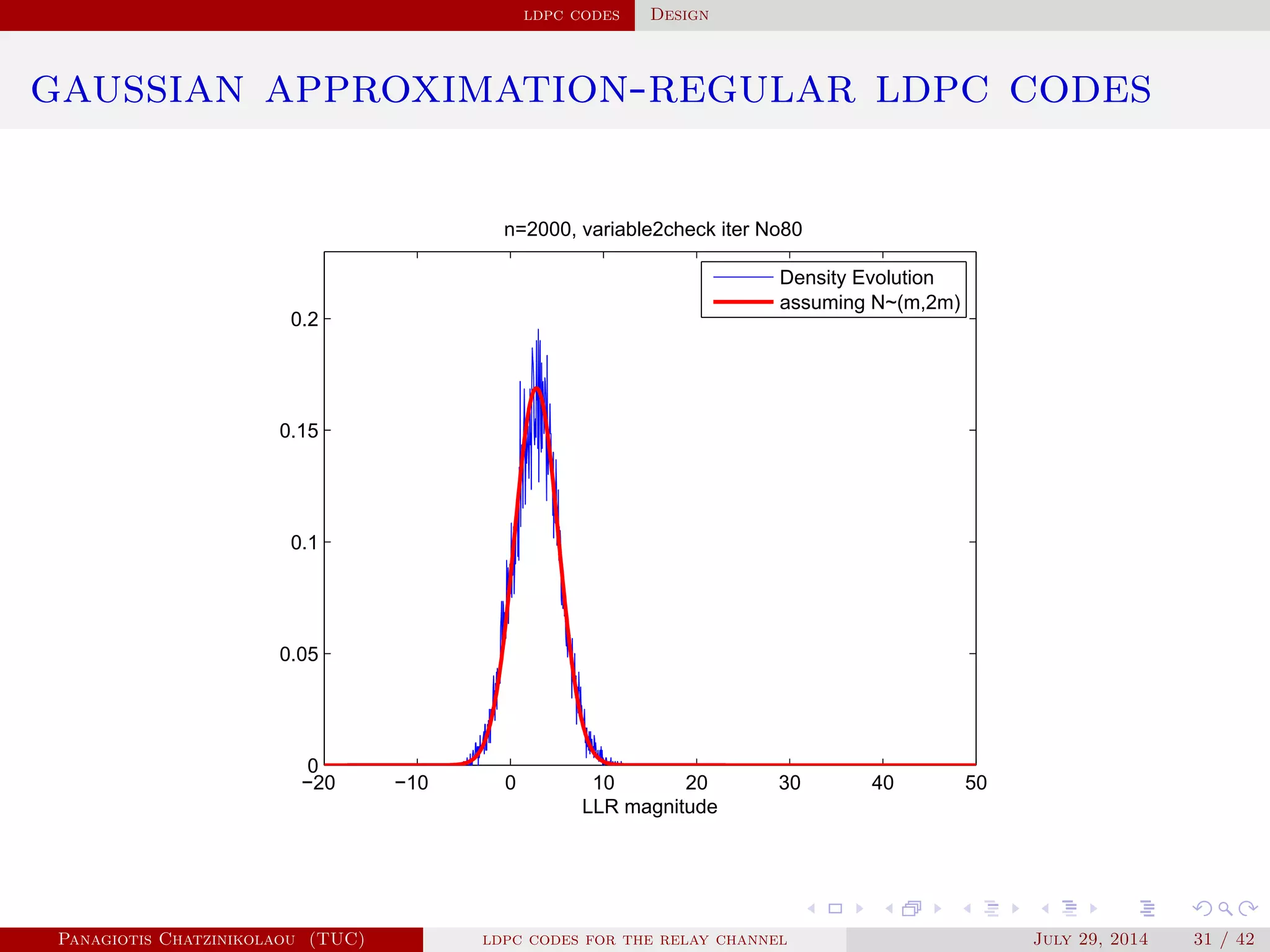
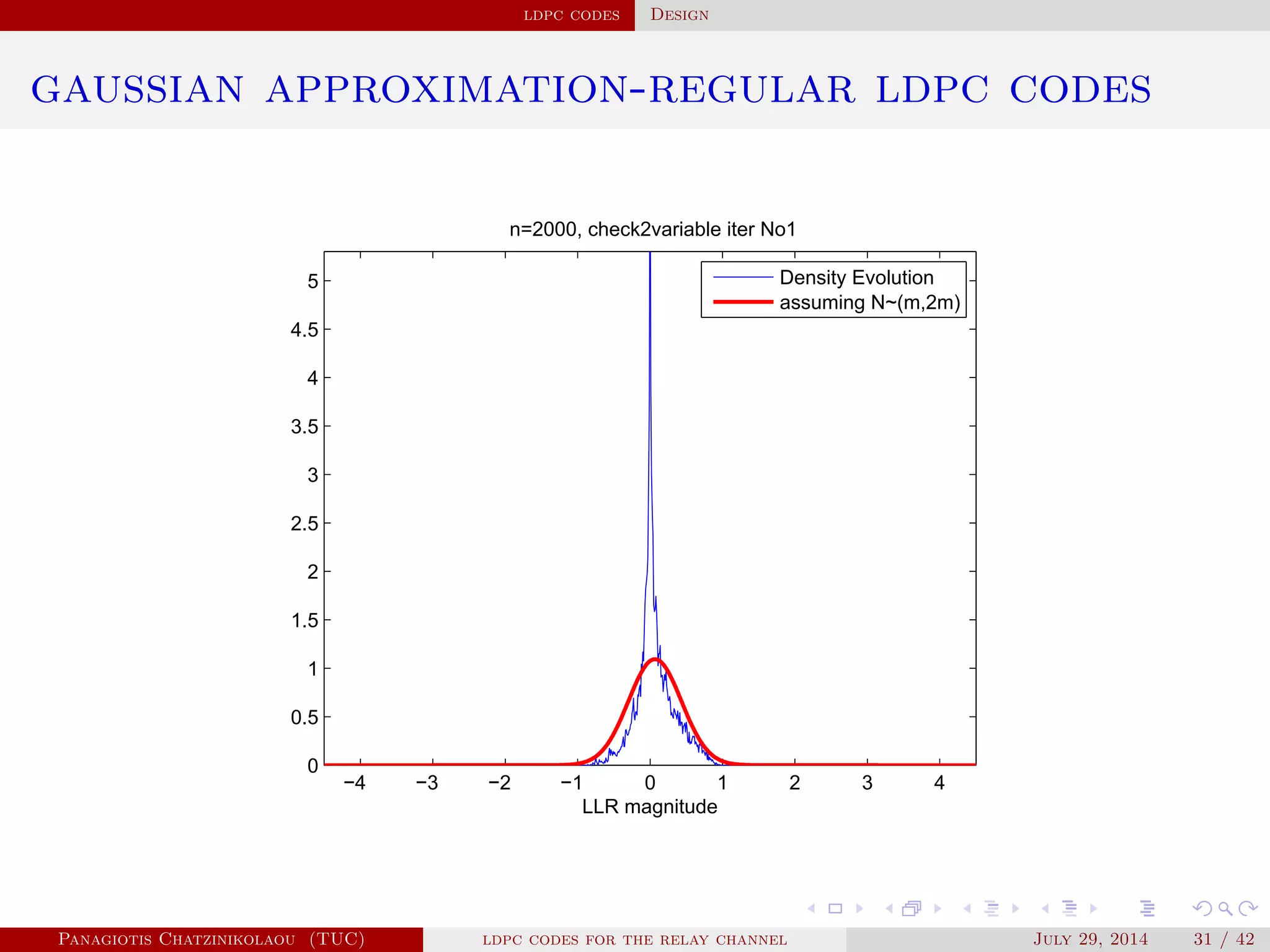
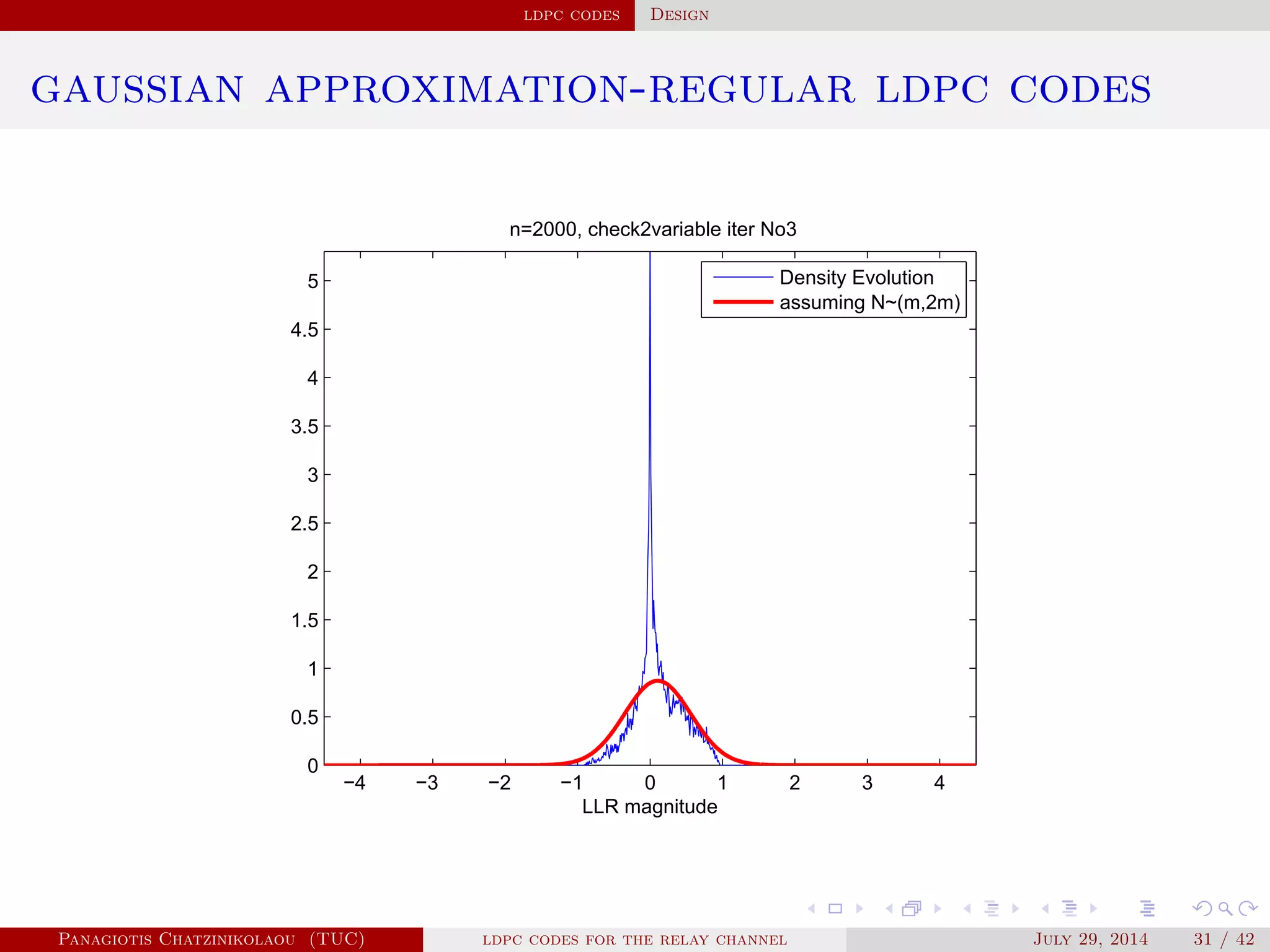
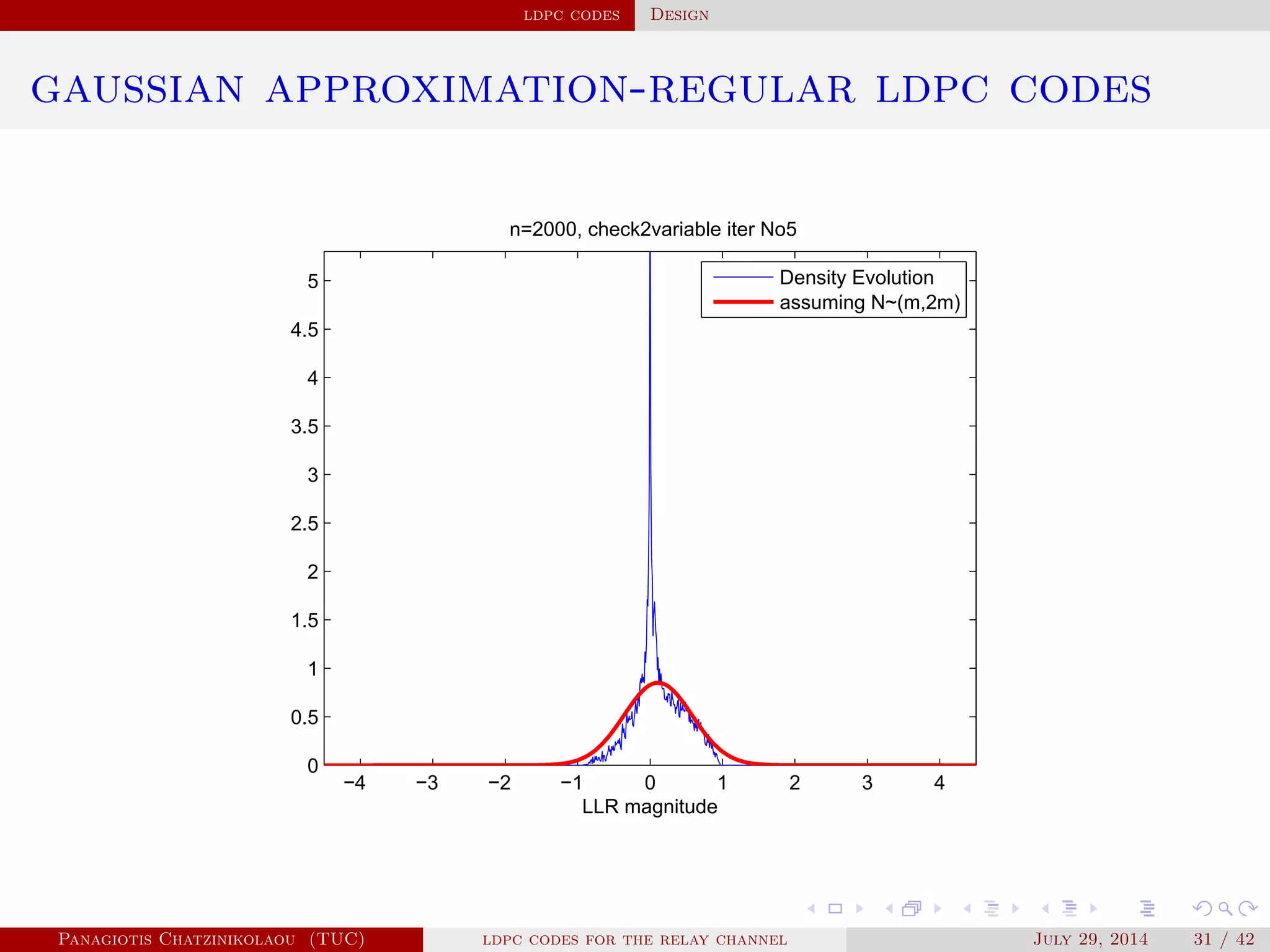
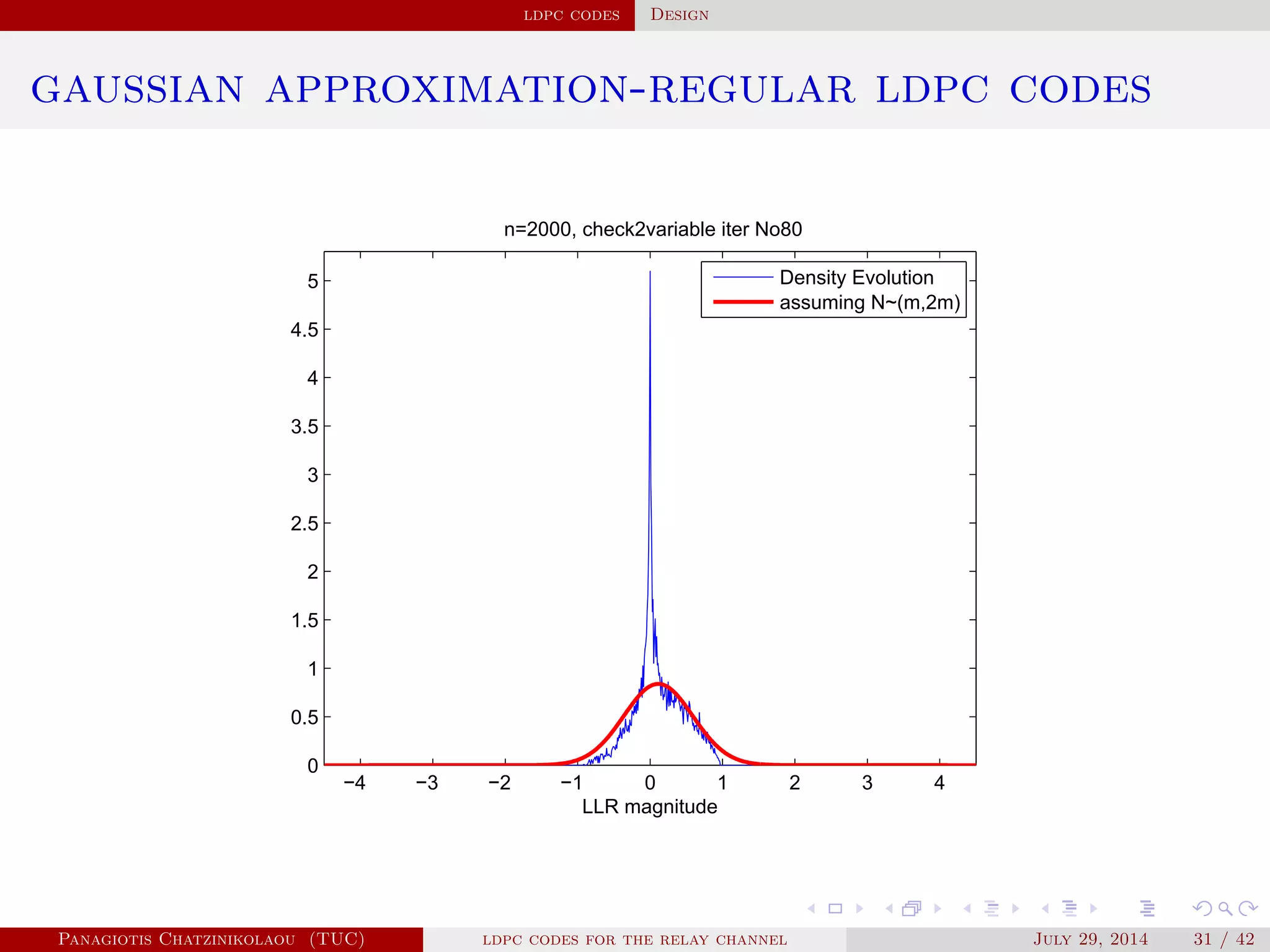
gaussian approximation-regular ldpc codes
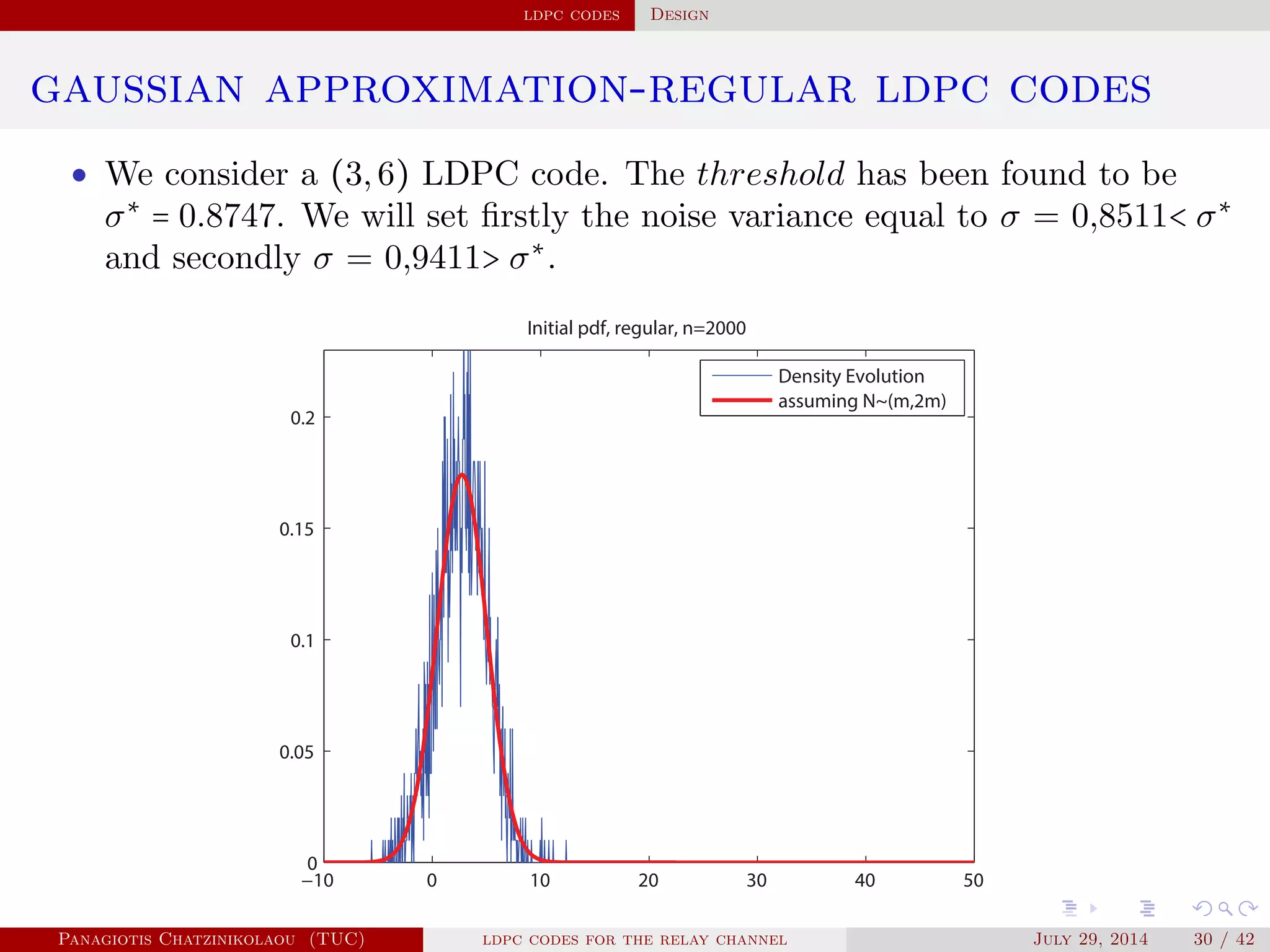
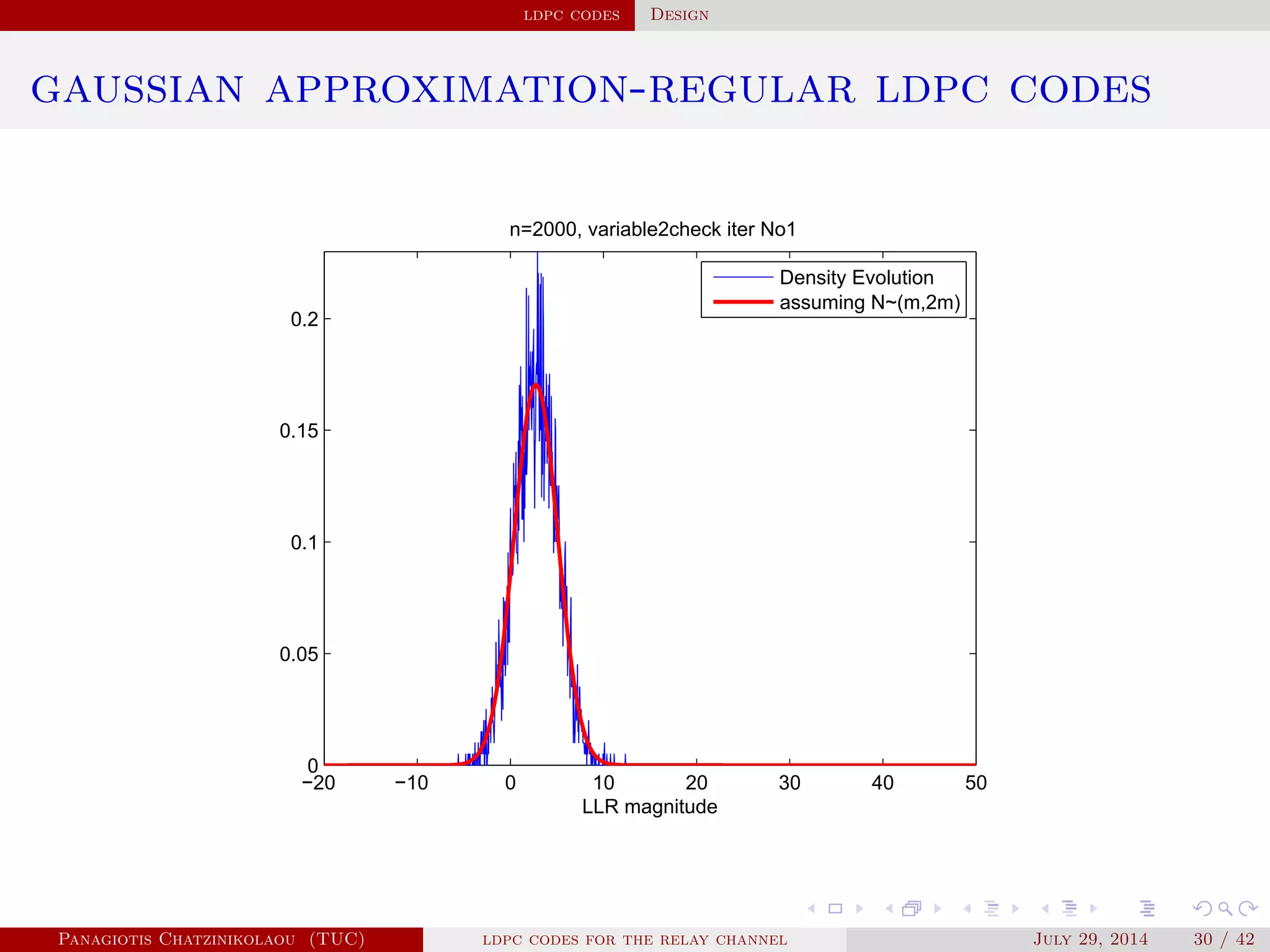
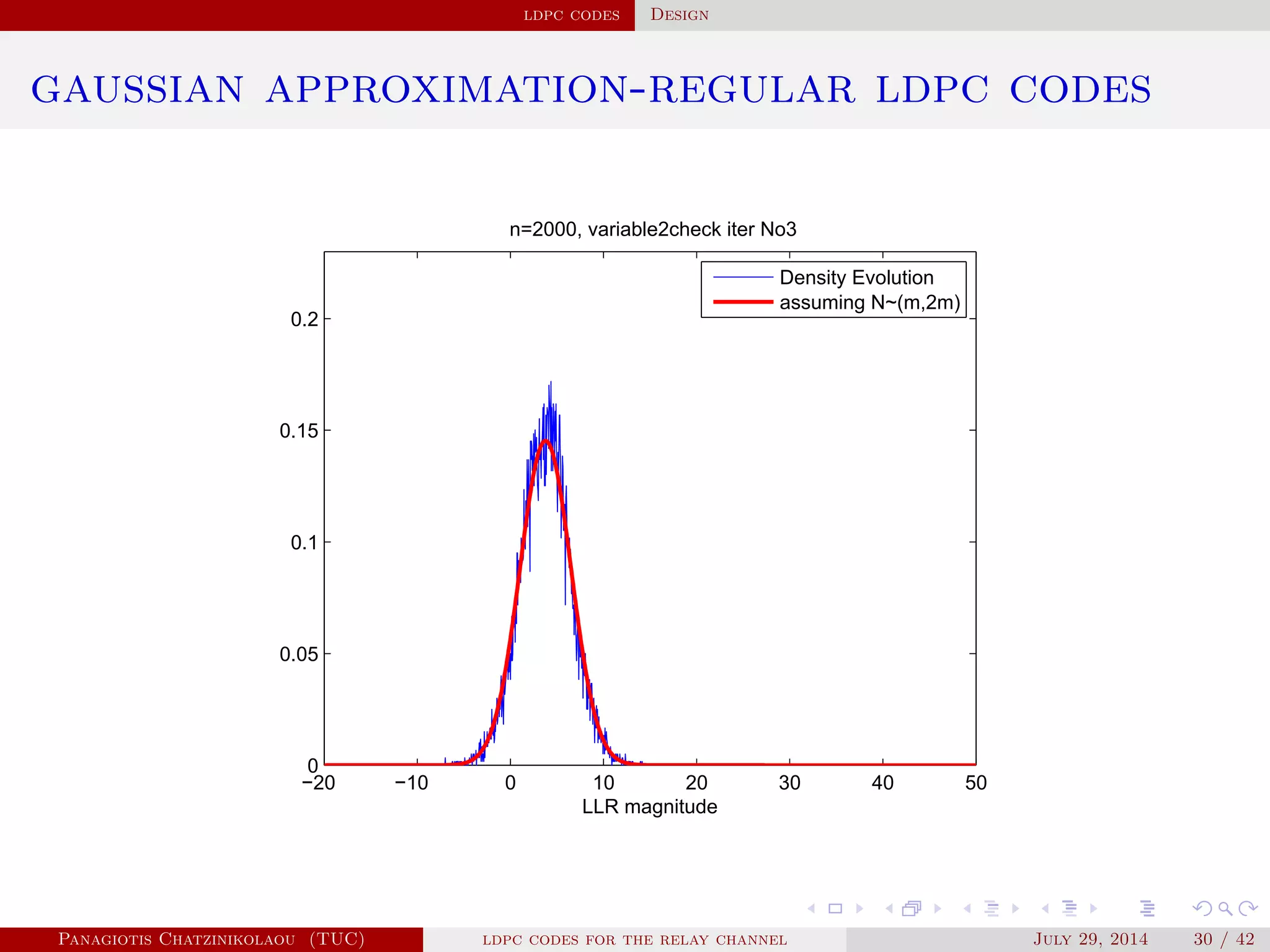
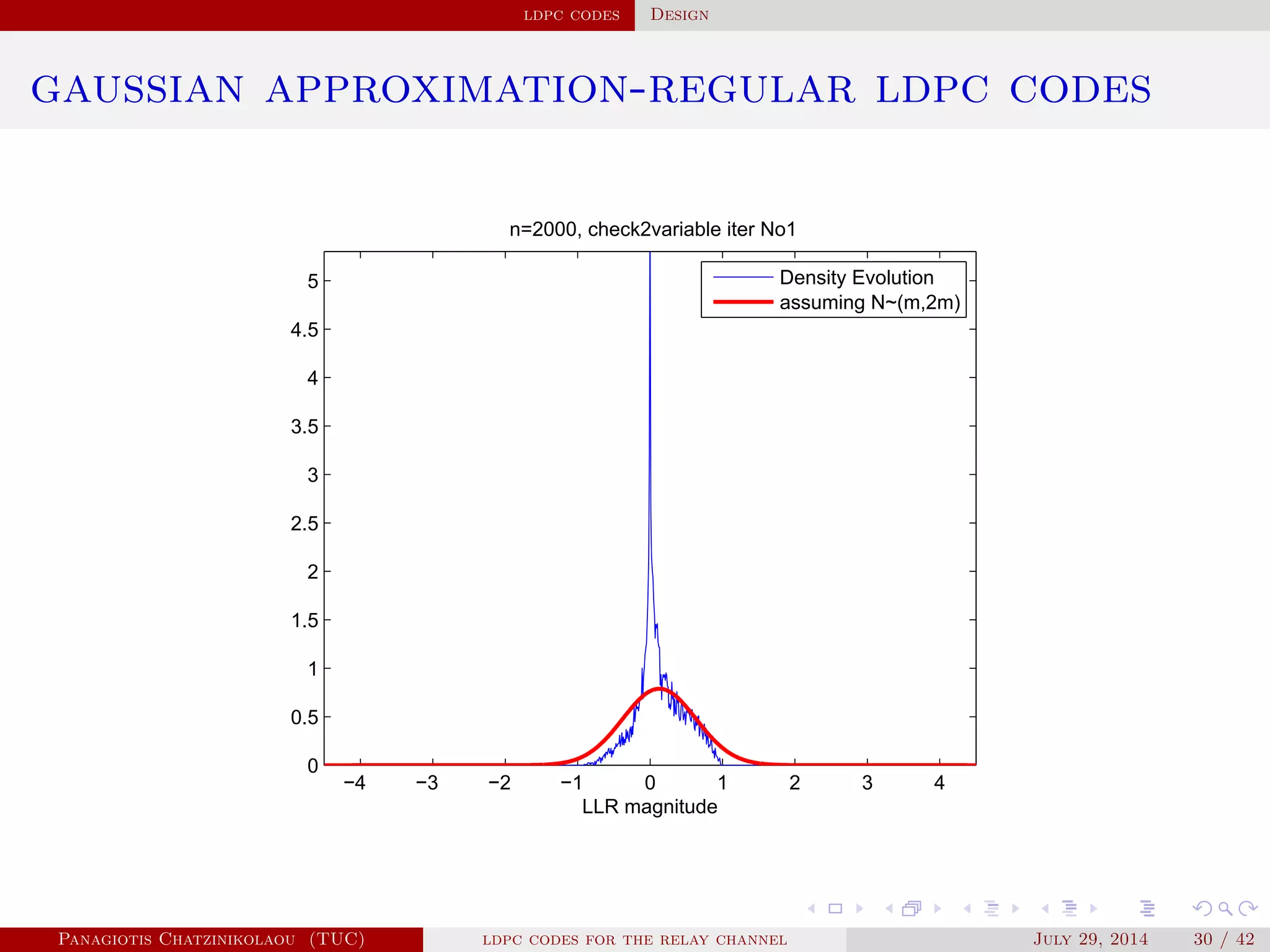
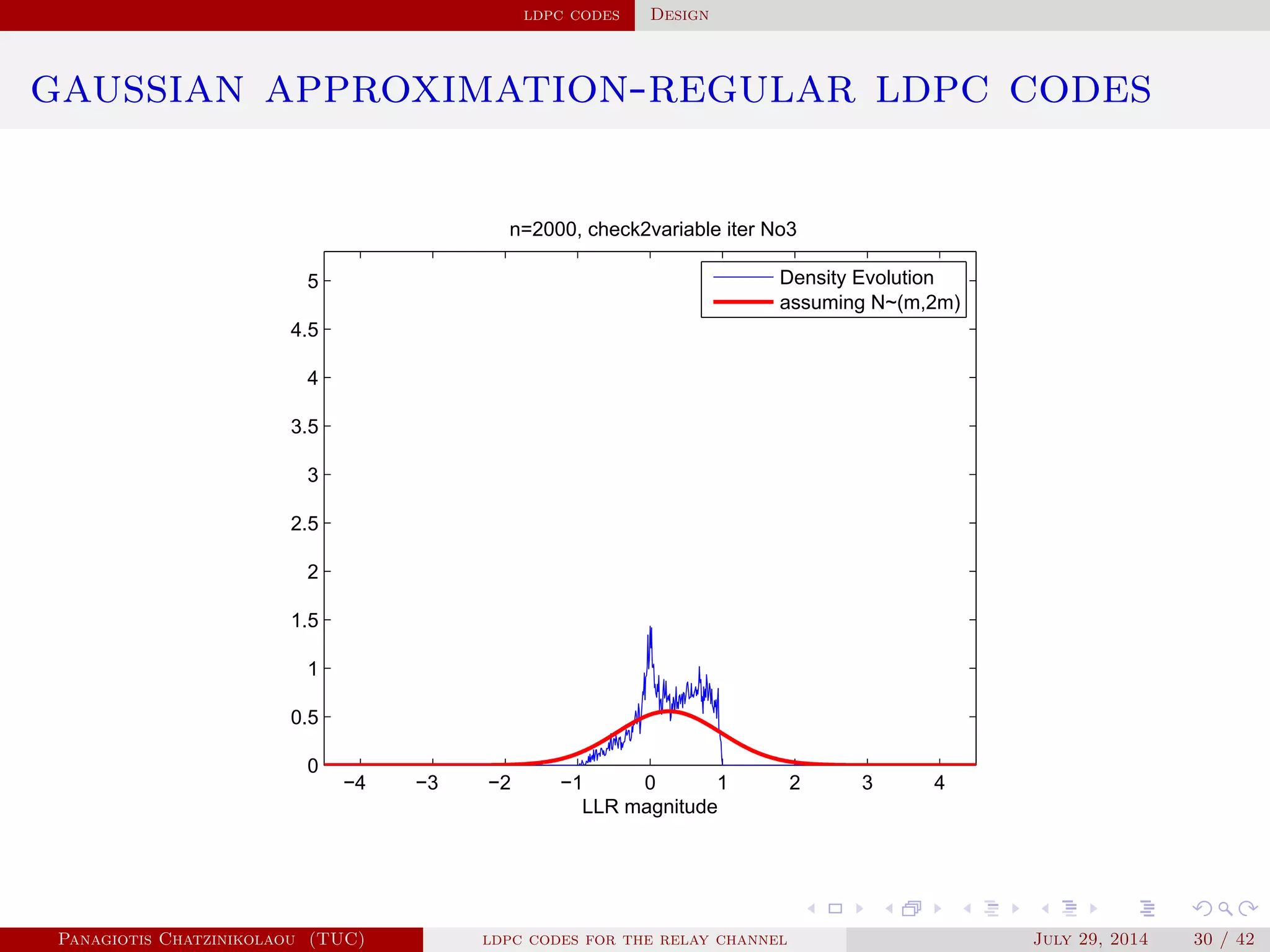
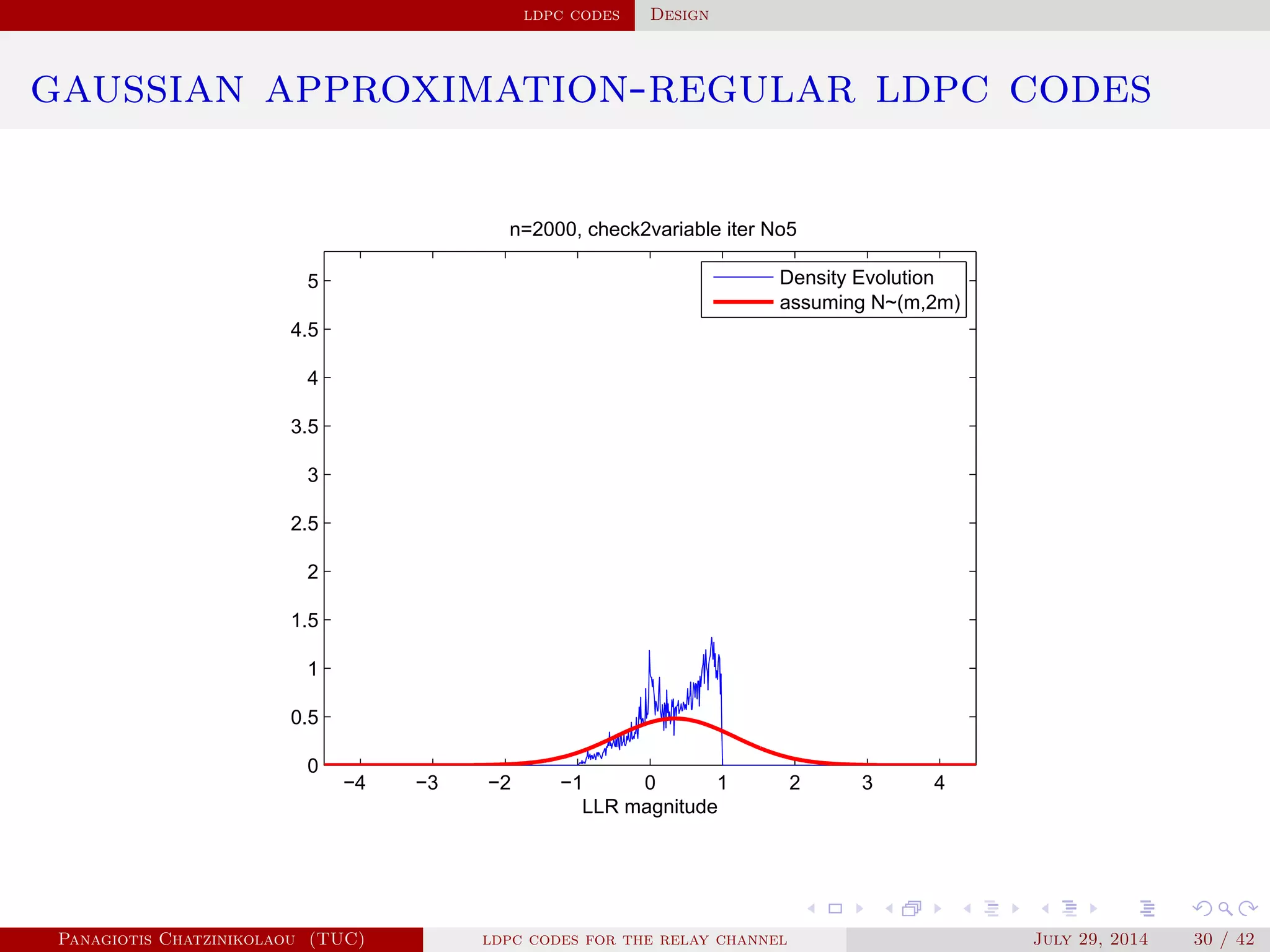
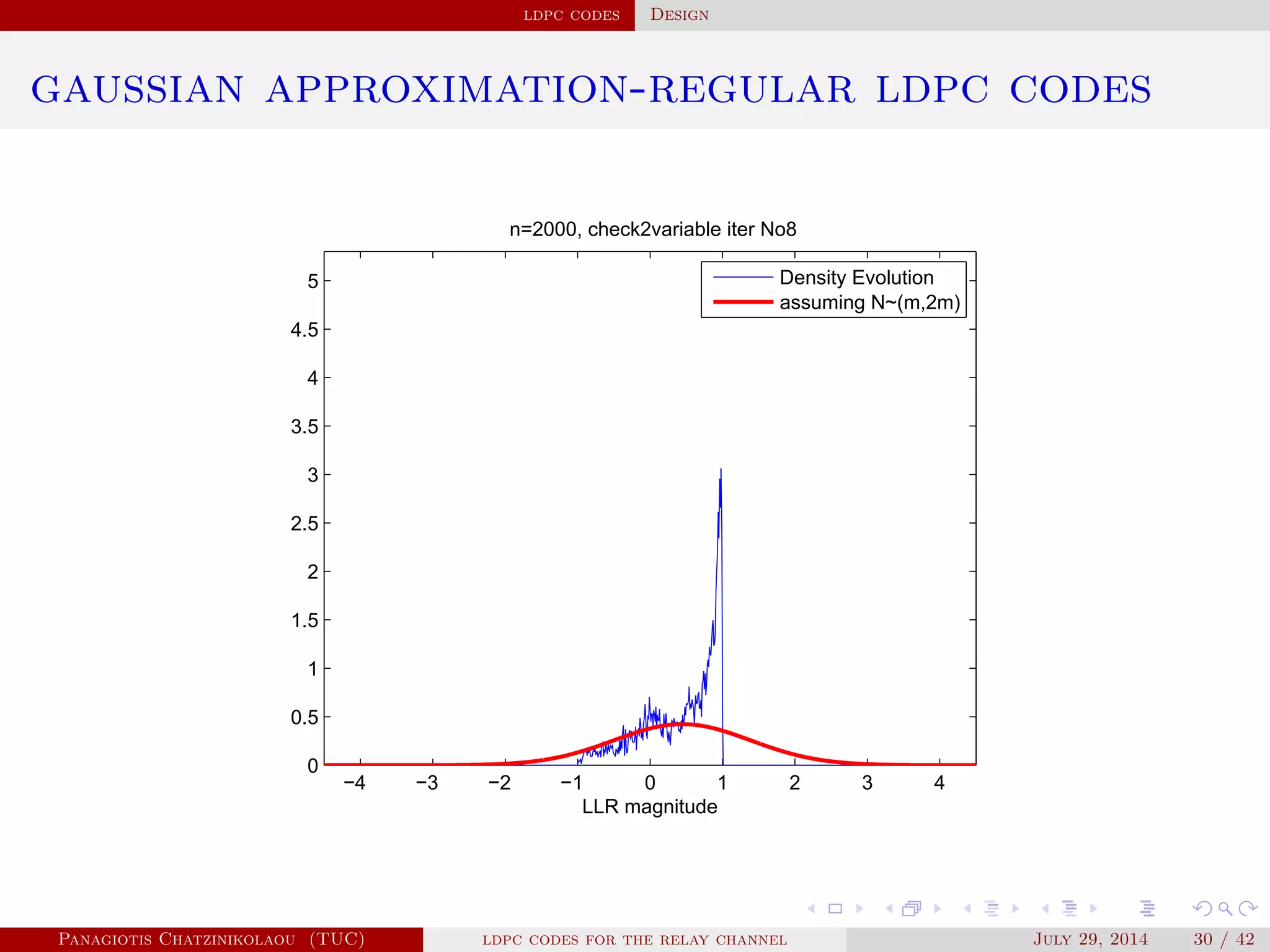
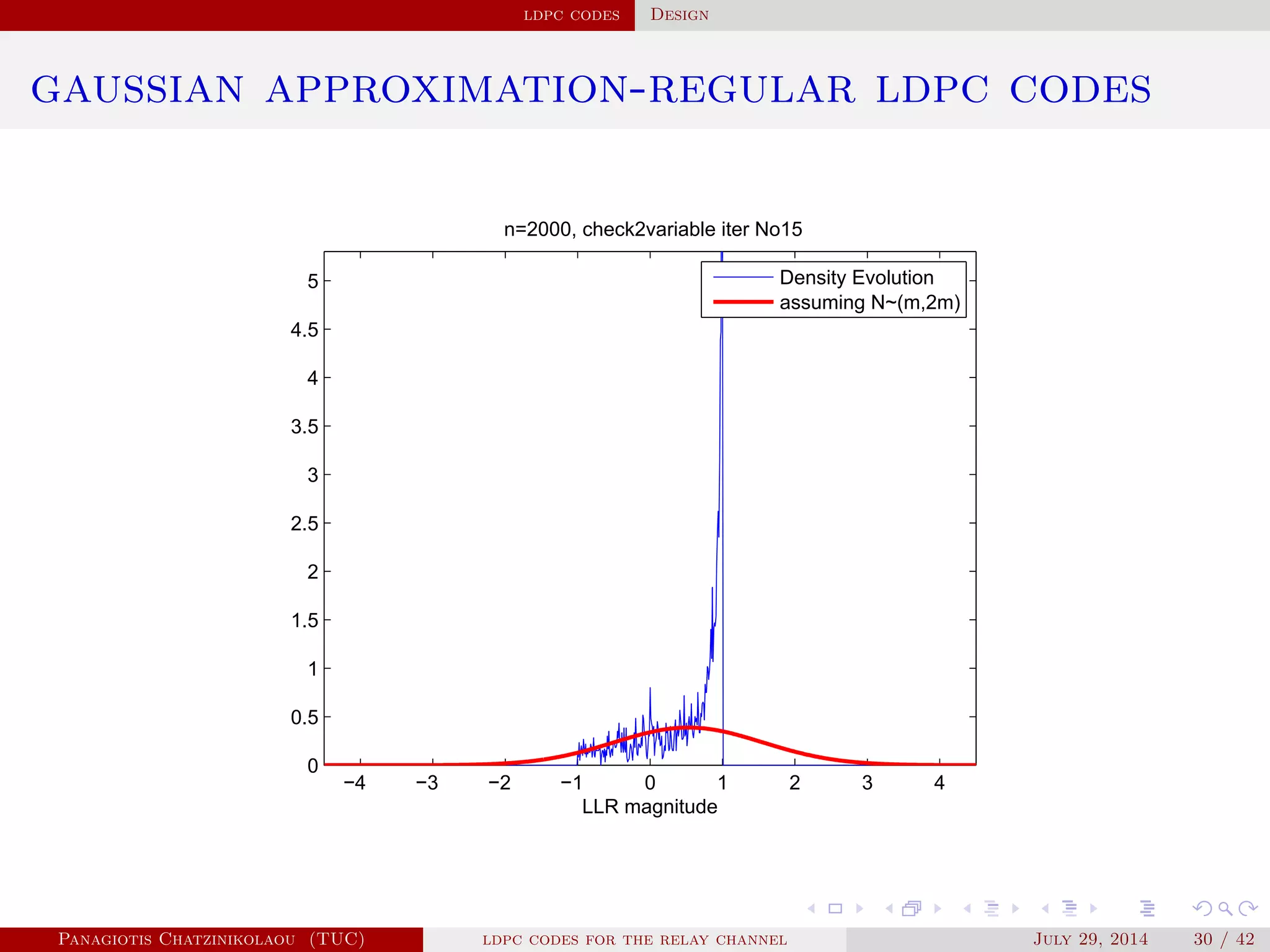
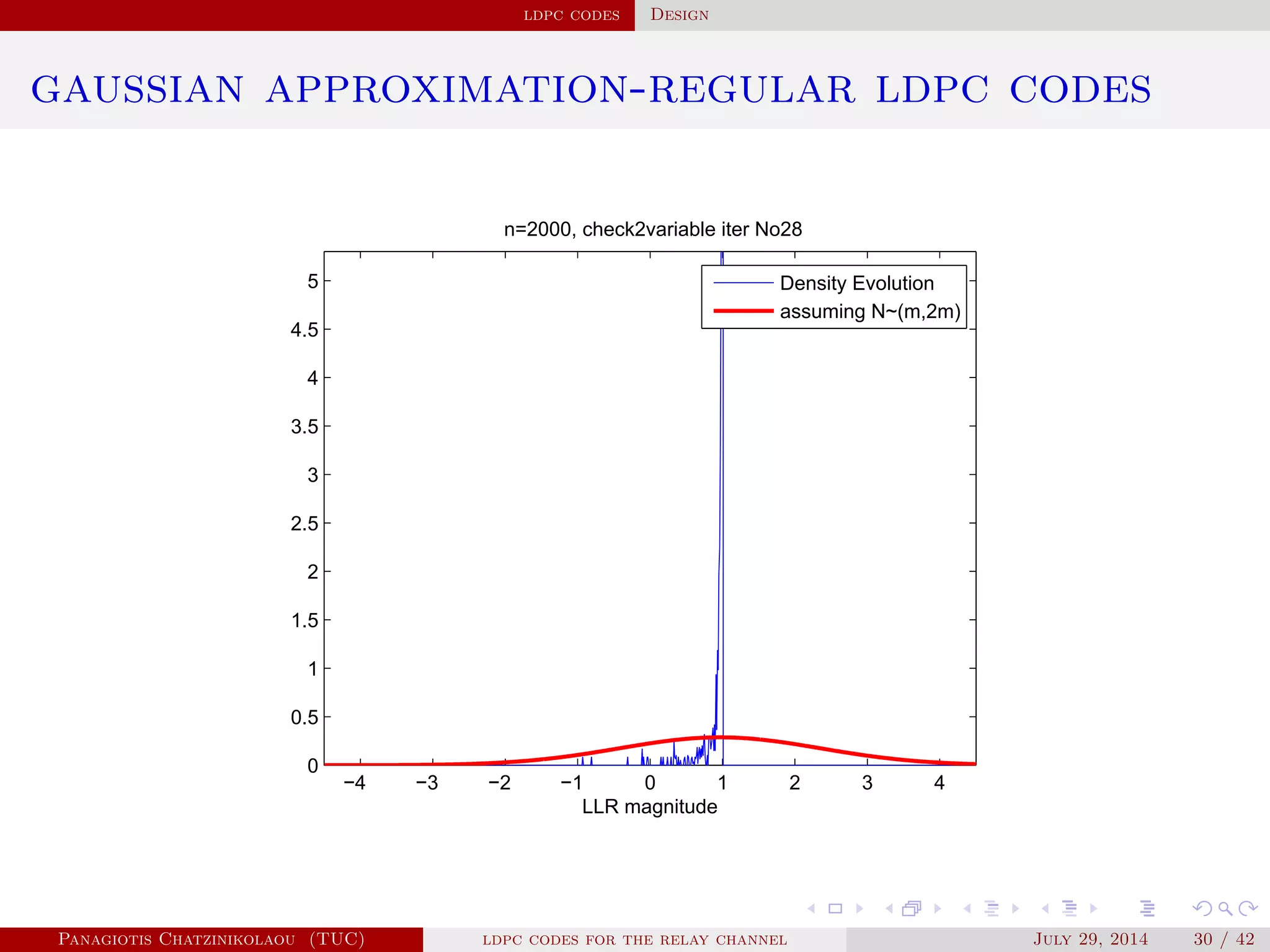
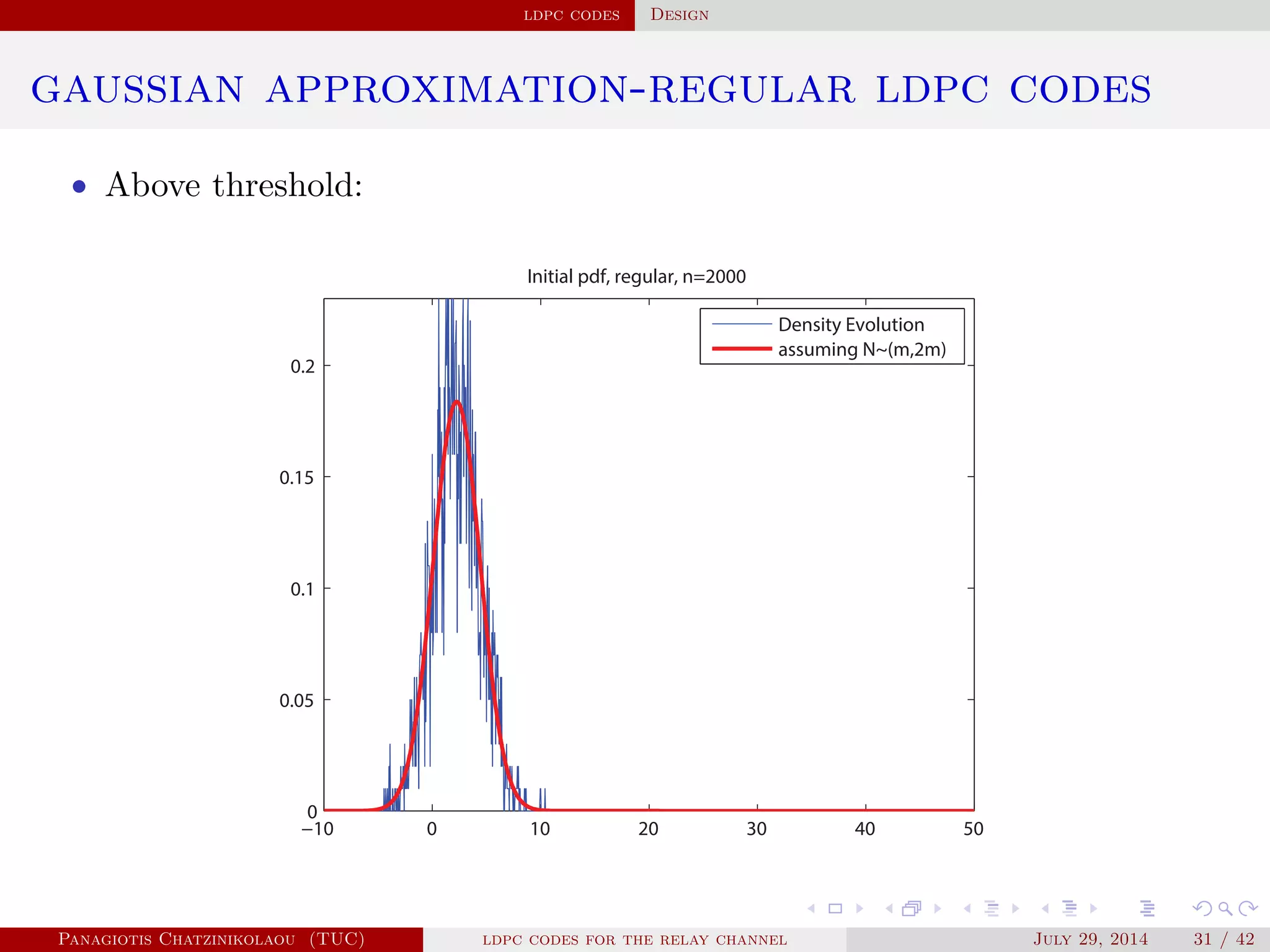
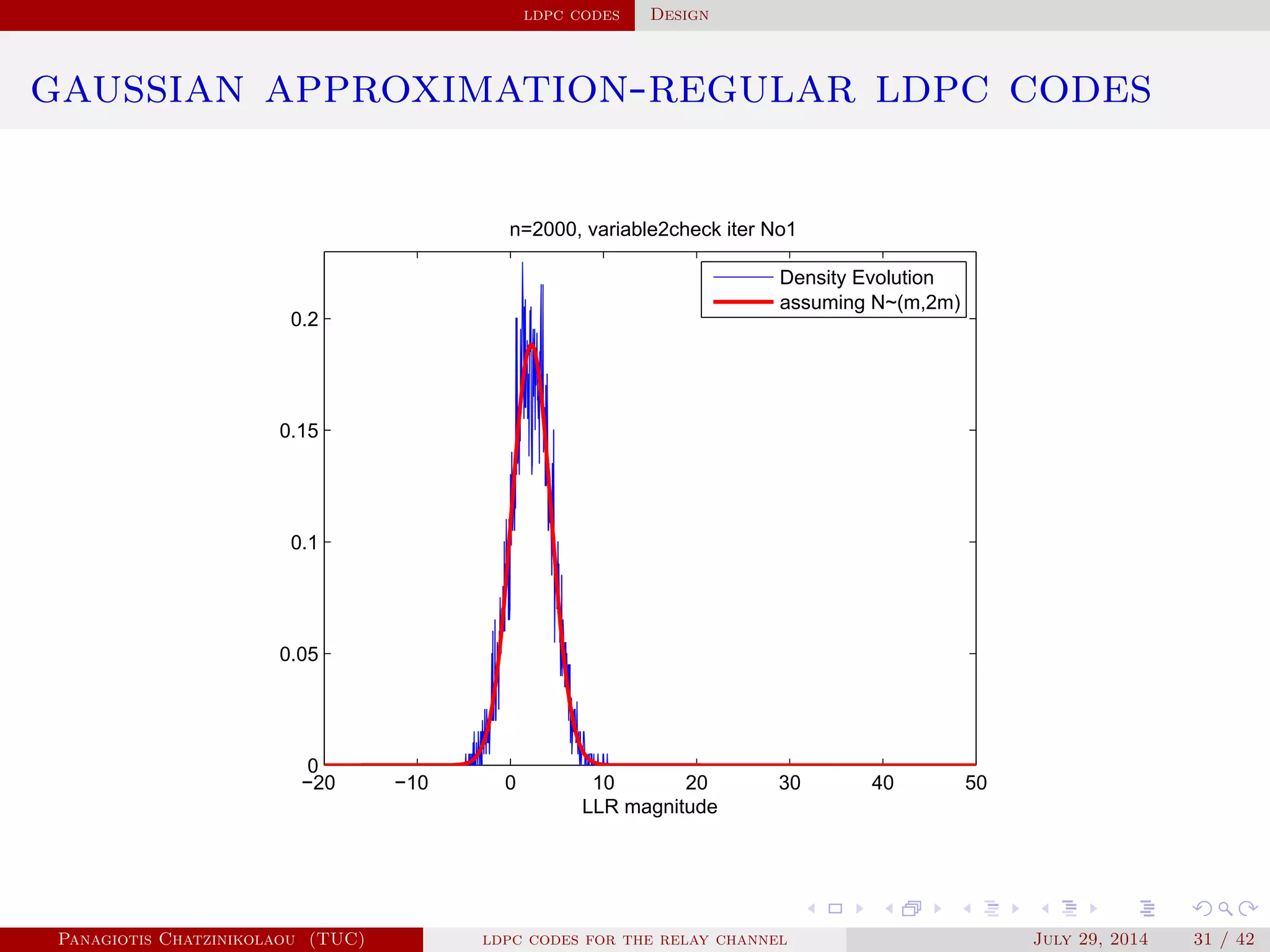
• We consider a (3,6) LDPC code. The threshold has been found to be
σ∗
= 0.8747. We will set firstly the noise variance equal to σ = 0,8511< σ∗
and secondly σ = 0,9411> σ∗
.
−10 0 10 20 30 40 50
0
0.05
0.1
0.15
0.2
Initial pdf, regular, n=2000
Density Evolution
assuming N~(m,2m)
Panagiotis Chatzinikolaou (TUC) ldpc codes for the relay channel July 29, 2014 30 / 42
ldpc codes Design
gaussian approximation-regular ldpc codes
−20 −10 0 10 20 30 40 50
0
0.05
0.1
0.15
0.2
n=2000, variable2check iter No1
LLR magnitude
Density Evolution
assuming N~(m,2m)
Panagiotis Chatzinikolaou (TUC) ldpc codes for the relay channel July 29, 2014 30 / 42
ldpc codes Design
gaussian approximation-regular ldpc codes
−20 −10 0 10 20 30 40 50
0
0.05
0.1
0.15
0.2
n=2000, variable2check iter No3
LLR magnitude
Density Evolution
assuming N~(m,2m)
Panagiotis Chatzinikolaou (TUC) ldpc codes for the relay channel July 29, 2014 30 / 42
ldpc codes Design
gaussian approximation-regular ldpc codes
−20 −10 0 10 20 30 40 50
0
0.05
0.1
0.15
0.2
n=2000, variable2check iter No5
LLR magnitude
Density Evolution
assuming N~(m,2m)
Panagiotis Chatzinikolaou (TUC) ldpc codes for the relay channel July 29, 2014 30 / 42
ldpc codes Design
gaussian approximation-regular ldpc codes
−20 −10 0 10 20 30 40 50
0
0.05
0.1
0.15
0.2
n=2000, variable2check iter No8
LLR magnitude
Density Evolution
assuming N~(m,2m)
Panagiotis Chatzinikolaou (TUC) ldpc codes for the relay channel July 29, 2014 30 / 42
ldpc codes Design
gaussian approximation-regular ldpc codes
−20 −10 0 10 20 30 40 50
0
0.05
0.1
0.15
0.2
n=2000, variable2check iter No15
LLR magnitude
Density Evolution
assuming N~(m,2m)
Panagiotis Chatzinikolaou (TUC) ldpc codes for the relay channel July 29, 2014 30 / 42
ldpc codes Design
gaussian approximation-regular ldpc codes
−20 −10 0 10 20 30 40 50
0
0.05
0.1
0.15
0.2
n=2000, variable2check iter No28
LLR magnitude
Density Evolution
assuming N~(m,2m)
Panagiotis Chatzinikolaou (TUC) ldpc codes for the relay channel July 29, 2014 30 / 42
ldpc codes Design
gaussian approximation-regular ldpc codes
−4 −3 −2 −1 0 1 2 3 4
0
0.5
1
1.5
2
2.5
3
3.5
4
4.5
5
n=2000, check2variable iter No1
LLR magnitude
Density Evolution
assuming N~(m,2m)
Panagiotis Chatzinikolaou (TUC) ldpc codes for the relay channel July 29, 2014 30 / 42
ldpc codes Design
gaussian approximation-regular ldpc codes
−4 −3 −2 −1 0 1 2 3 4
0
0.5
1
1.5
2
2.5
3
3.5
4
4.5
5
n=2000, check2variable iter No3
LLR magnitude
Density Evolution
assuming N~(m,2m)
Panagiotis Chatzinikolaou (TUC) ldpc codes for the relay channel July 29, 2014 30 / 42
ldpc codes Design
gaussian approximation-regular ldpc codes
−4 −3 −2 −1 0 1 2 3 4
0
0.5
1
1.5
2
2.5
3
3.5
4
4.5
5
n=2000, check2variable iter No5
LLR magnitude
Density Evolution
assuming N~(m,2m)
Panagiotis Chatzinikolaou (TUC) ldpc codes for the relay channel July 29, 2014 30 / 42
ldpc codes Design
gaussian approximation-regular ldpc codes
−4 −3 −2 −1 0 1 2 3 4
0
0.5
1
1.5
2
2.5
3
3.5
4
4.5
5
n=2000, check2variable iter No8
LLR magnitude
Density Evolution
assuming N~(m,2m)
Panagiotis Chatzinikolaou (TUC) ldpc codes for the relay channel July 29, 2014 30 / 42
ldpc codes Design
gaussian approximation-regular ldpc codes
−4 −3 −2 −1 0 1 2 3 4
0
0.5
1
1.5
2
2.5
3
3.5
4
4.5
5
n=2000, check2variable iter No15
LLR magnitude
Density Evolution
assuming N~(m,2m)
Panagiotis Chatzinikolaou (TUC) ldpc codes for the relay channel July 29, 2014 30 / 42
ldpc codes Design
gaussian approximation-regular ldpc codes
−4 −3 −2 −1 0 1 2 3 4
0
0.5
1
1.5
2
2.5
3
3.5
4
4.5
5
n=2000, check2variable iter No28
LLR magnitude
Density Evolution
assuming N~(m,2m)
Panagiotis Chatzinikolaou (TUC) ldpc codes for the relay channel July 29, 2014 30 / 42
ldpc codes Design
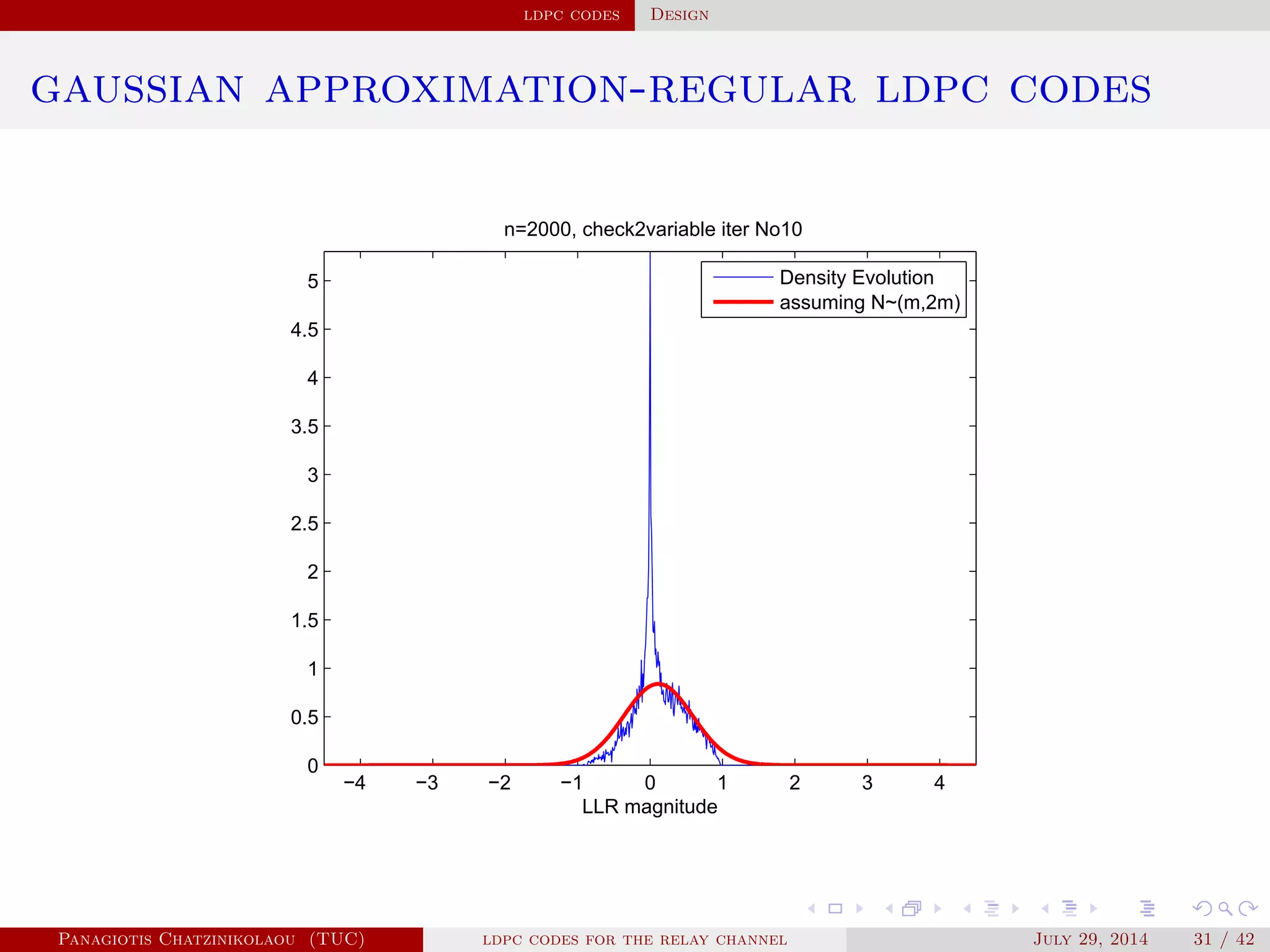
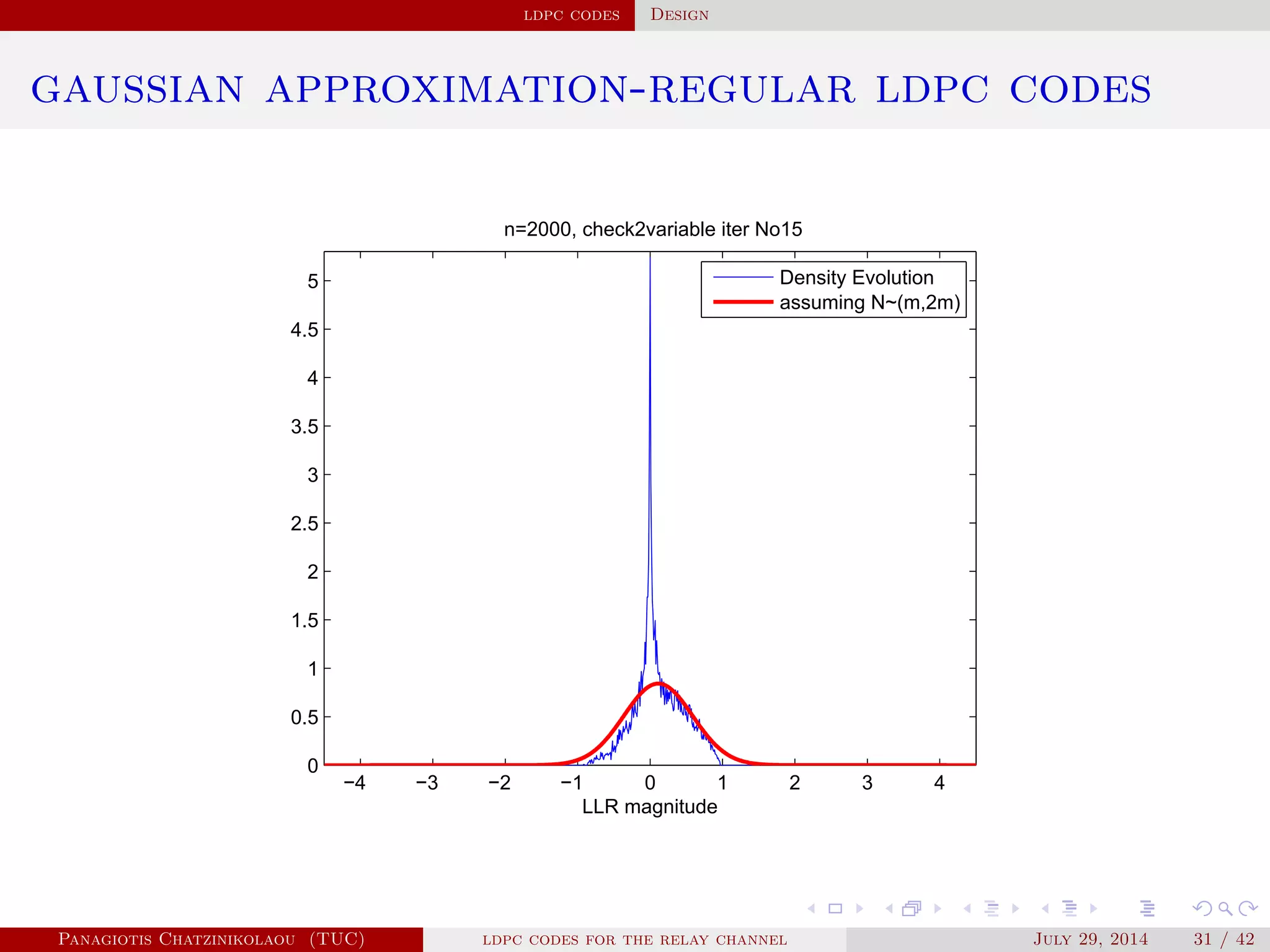
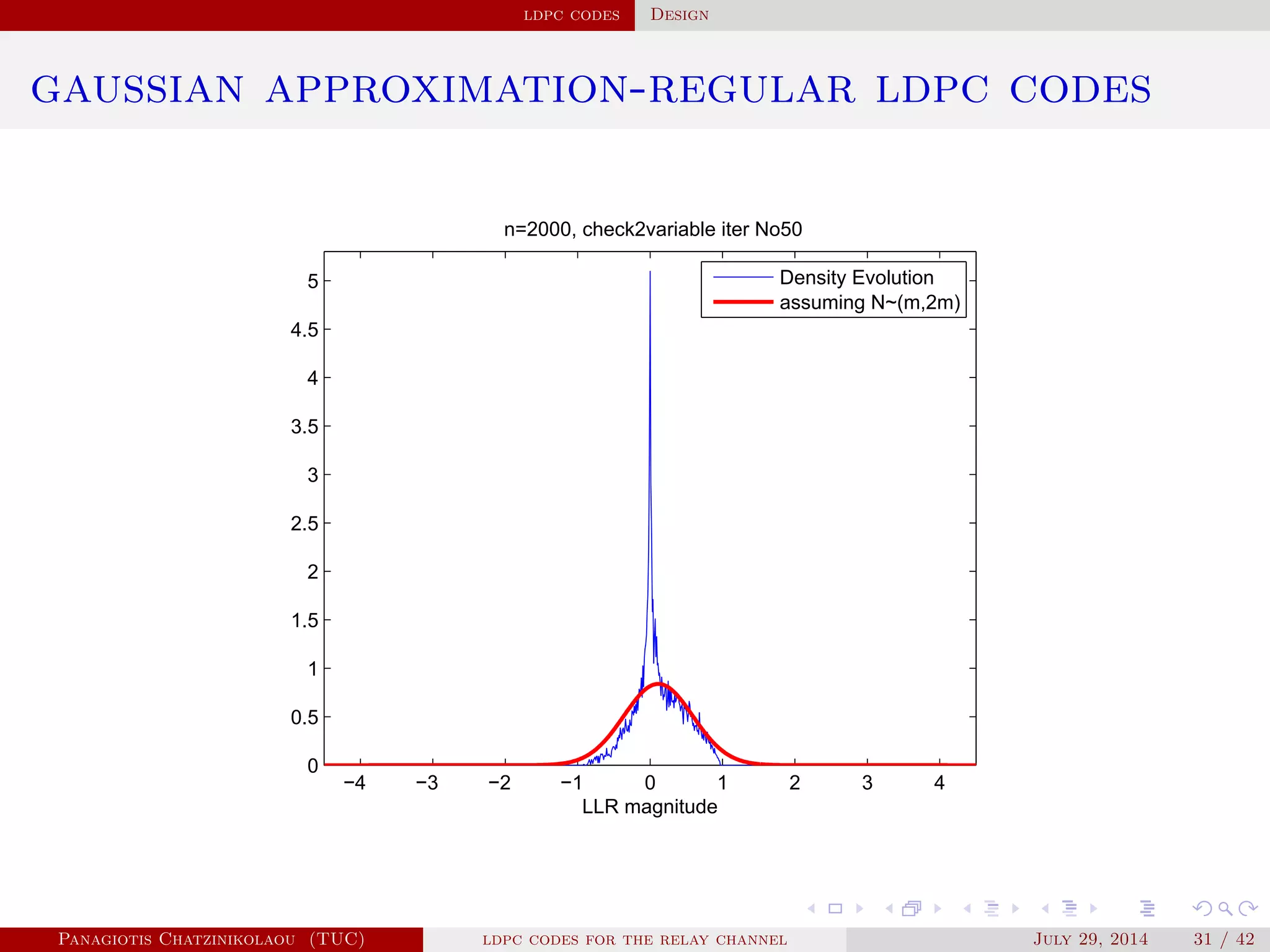
gaussian approximation-regular ldpc codes
• Above threshold:
−10 0 10 20 30 40 50
0
0.05
0.1
0.15
0.2
Initial pdf, regular, n=2000
Density Evolution
assuming N~(m,2m)
Panagiotis Chatzinikolaou (TUC) ldpc codes for the relay channel July 29, 2014 31 / 42
ldpc codes Design
gaussian approximation-regular ldpc codes
−20 −10 0 10 20 30 40 50
0
0.05
0.1
0.15
0.2
n=2000, variable2check iter No1
LLR magnitude
Density Evolution
assuming N~(m,2m)
Panagiotis Chatzinikolaou (TUC) ldpc codes for the relay channel July 29, 2014 31 / 42
ldpc codes Design
gaussian approximation-regular ldpc codes
−20 −10 0 10 20 30 40 50
0
0.05
0.1
0.15
0.2
n=2000, variable2check iter No3
LLR magnitude
Density Evolution
assuming N~(m,2m)
Panagiotis Chatzinikolaou (TUC) ldpc codes for the relay channel July 29, 2014 31 / 42
ldpc codes Design
gaussian approximation-regular ldpc codes
−20 −10 0 10 20 30 40 50
0
0.05
0.1
0.15
0.2
n=2000, variable2check iter No5
LLR magnitude
Density Evolution
assuming N~(m,2m)
Panagiotis Chatzinikolaou (TUC) ldpc codes for the relay channel July 29, 2014 31 / 42
ldpc codes Design
gaussian approximation-regular ldpc codes
−20 −10 0 10 20 30 40 50
0
0.05
0.1
0.15
0.2
n=2000, variable2check iter No10
LLR magnitude
Density Evolution
assuming N~(m,2m)
Panagiotis Chatzinikolaou (TUC) ldpc codes for the relay channel July 29, 2014 31 / 42
ldpc codes Design
gaussian approximation-regular ldpc codes
−20 −10 0 10 20 30 40 50
0
0.05
0.1
0.15
0.2
n=2000, variable2check iter No15
LLR magnitude
Density Evolution
assuming N~(m,2m)
Panagiotis Chatzinikolaou (TUC) ldpc codes for the relay channel July 29, 2014 31 / 42
ldpc codes Design
gaussian approximation-regular ldpc codes
−20 −10 0 10 20 30 40 50
0
0.05
0.1
0.15
0.2
n=2000, variable2check iter No50
LLR magnitude
Density Evolution
assuming N~(m,2m)
Panagiotis Chatzinikolaou (TUC) ldpc codes for the relay channel July 29, 2014 31 / 42
ldpc codes Design
gaussian approximation-regular ldpc codes
−20 −10 0 10 20 30 40 50
0
0.05
0.1
0.15
0.2
n=2000, variable2check iter No80
LLR magnitude
Density Evolution
assuming N~(m,2m)
Panagiotis Chatzinikolaou (TUC) ldpc codes for the relay channel July 29, 2014 31 / 42
ldpc codes Design
gaussian approximation-regular ldpc codes
−4 −3 −2 −1 0 1 2 3 4
0
0.5
1
1.5
2
2.5
3
3.5
4
4.5
5
n=2000, check2variable iter No1
LLR magnitude
Density Evolution
assuming N~(m,2m)
Panagiotis Chatzinikolaou (TUC) ldpc codes for the relay channel July 29, 2014 31 / 42
ldpc codes Design
gaussian approximation-regular ldpc codes
−4 −3 −2 −1 0 1 2 3 4
0
0.5
1
1.5
2
2.5
3
3.5
4
4.5
5
n=2000, check2variable iter No3
LLR magnitude
Density Evolution
assuming N~(m,2m)
Panagiotis Chatzinikolaou (TUC) ldpc codes for the relay channel July 29, 2014 31 / 42
ldpc codes Design
gaussian approximation-regular ldpc codes
−4 −3 −2 −1 0 1 2 3 4
0
0.5
1
1.5
2
2.5
3
3.5
4
4.5
5
n=2000, check2variable iter No5
LLR magnitude
Density Evolution
assuming N~(m,2m)
Panagiotis Chatzinikolaou (TUC) ldpc codes for the relay channel July 29, 2014 31 / 42
ldpc codes Design
gaussian approximation-regular ldpc codes
−4 −3 −2 −1 0 1 2 3 4
0
0.5
1
1.5
2
2.5
3
3.5
4
4.5
5
n=2000, check2variable iter No10
LLR magnitude
Density Evolution
assuming N~(m,2m)
Panagiotis Chatzinikolaou (TUC) ldpc codes for the relay channel July 29, 2014 31 / 42
ldpc codes Design
gaussian approximation-regular ldpc codes
−4 −3 −2 −1 0 1 2 3 4
0
0.5
1
1.5
2
2.5
3
3.5
4
4.5
5
n=2000, check2variable iter No15
LLR magnitude
Density Evolution
assuming N~(m,2m)
Panagiotis Chatzinikolaou (TUC) ldpc codes for the relay channel July 29, 2014 31 / 42
ldpc codes Design
gaussian approximation-regular ldpc codes
−4 −3 −2 −1 0 1 2 3 4
0
0.5
1
1.5
2
2.5
3
3.5
4
4.5
5
n=2000, check2variable iter No50
LLR magnitude
Density Evolution
assuming N~(m,2m)
Panagiotis Chatzinikolaou (TUC) ldpc codes for the relay channel July 29, 2014 31 / 42
ldpc codes Design
gaussian approximation-regular ldpc codes
−4 −3 −2 −1 0 1 2 3 4
0
0.5
1
1.5
2
2.5
3
3.5
4
4.5
5
n=2000, check2variable iter No80
LLR magnitude
Density Evolution
assuming N~(m,2m)
Panagiotis Chatzinikolaou (TUC) ldpc codes for the relay channel July 29, 2014 31 / 42
ldpc codes Design
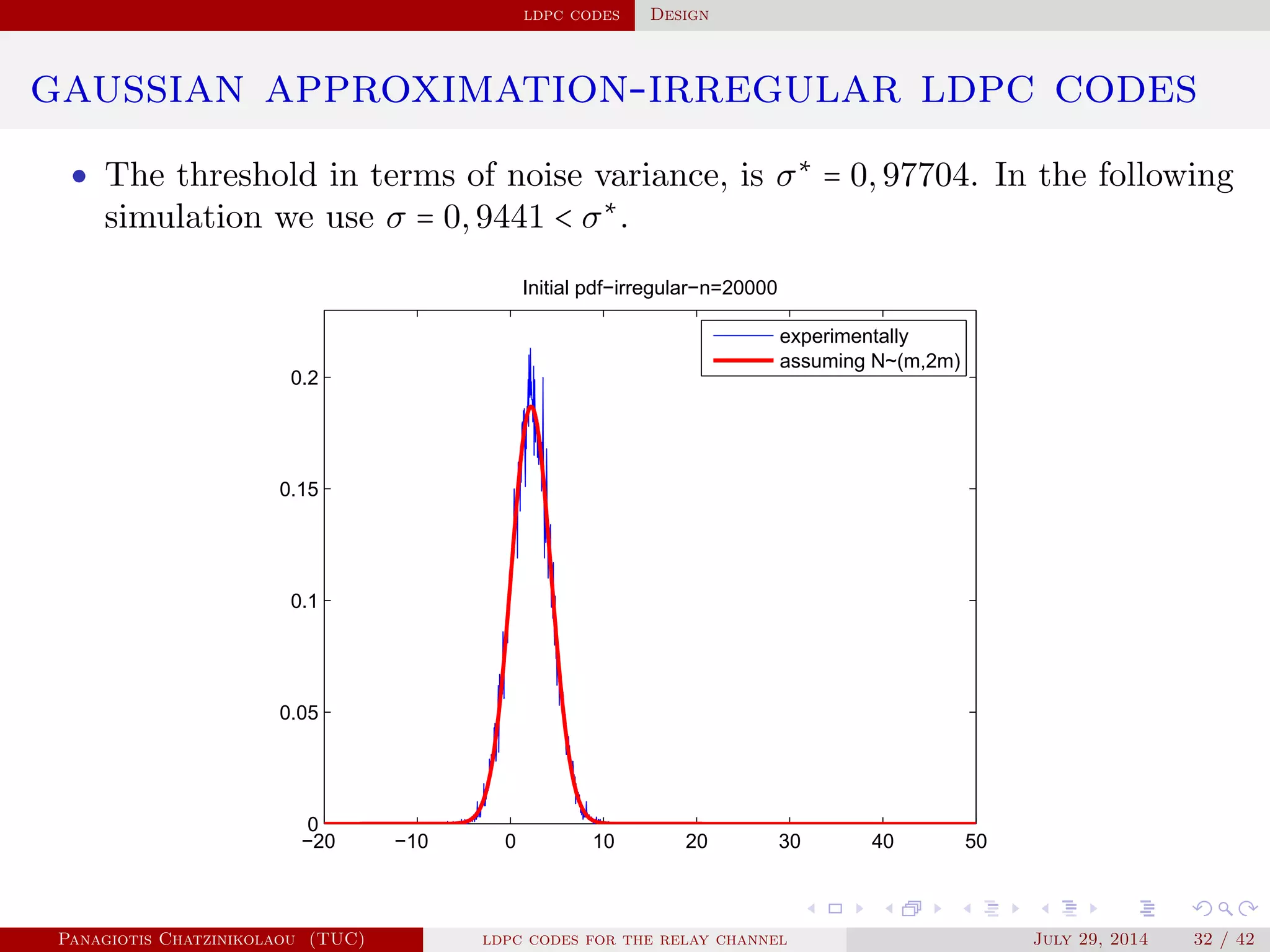
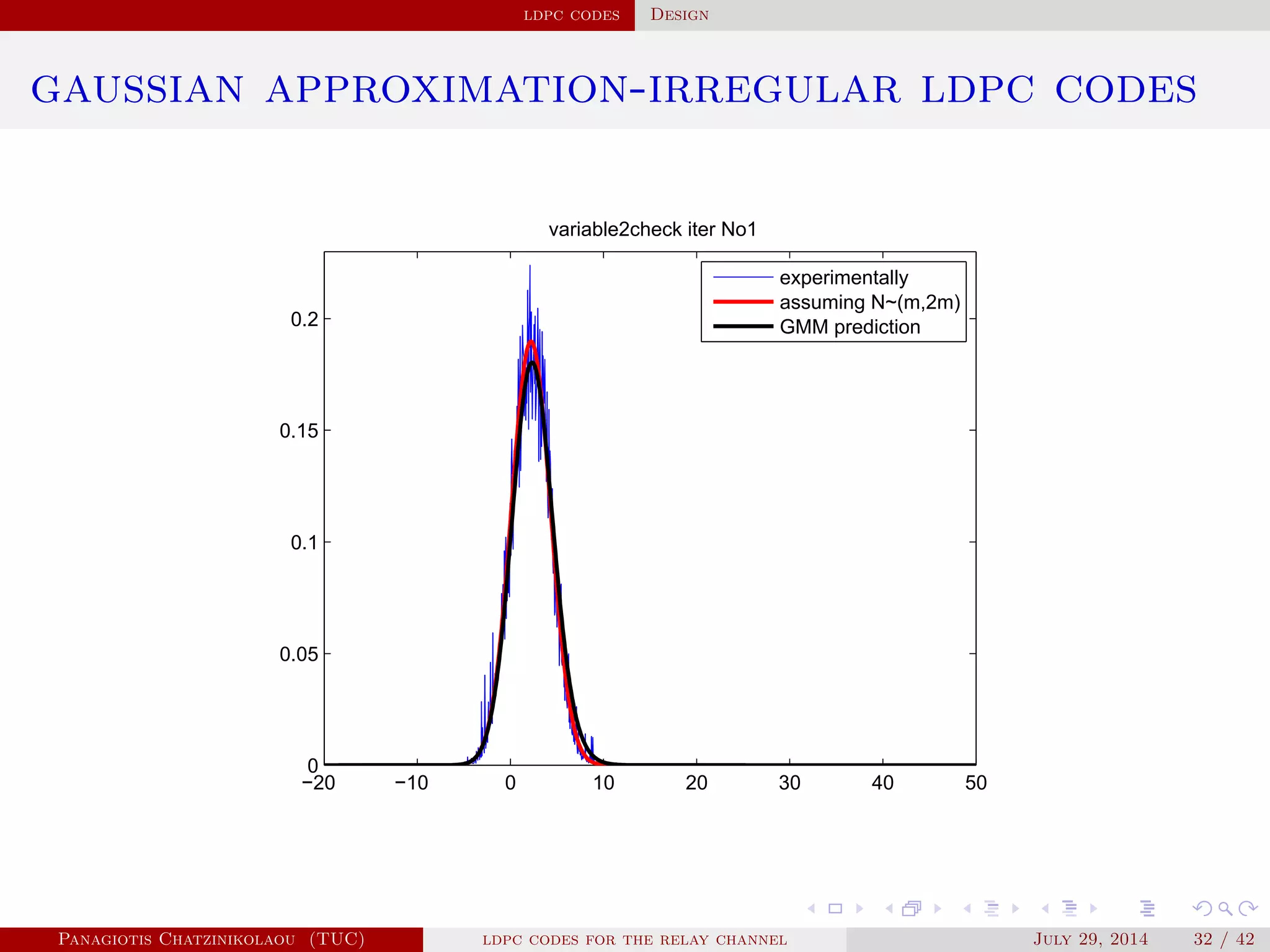
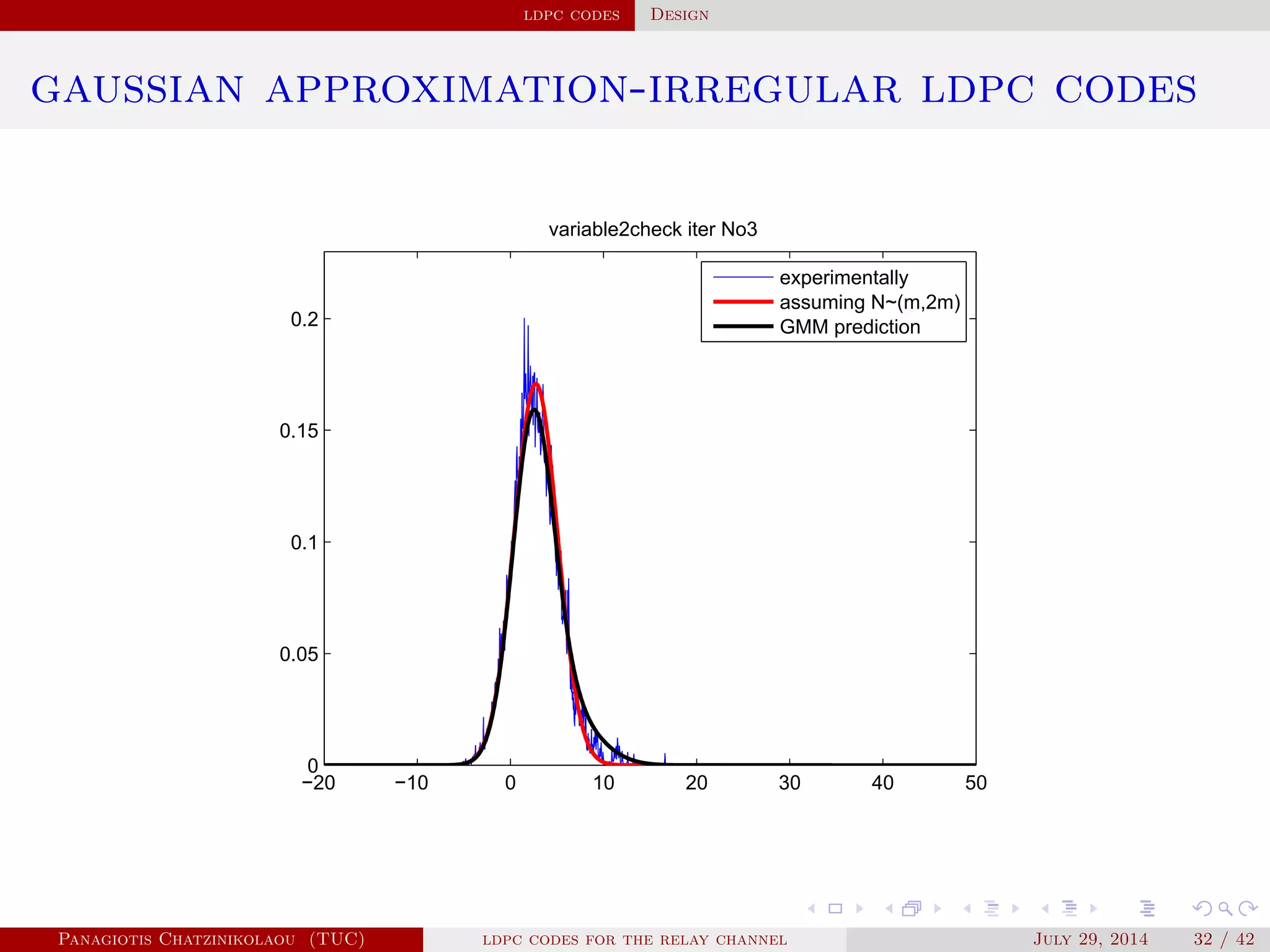
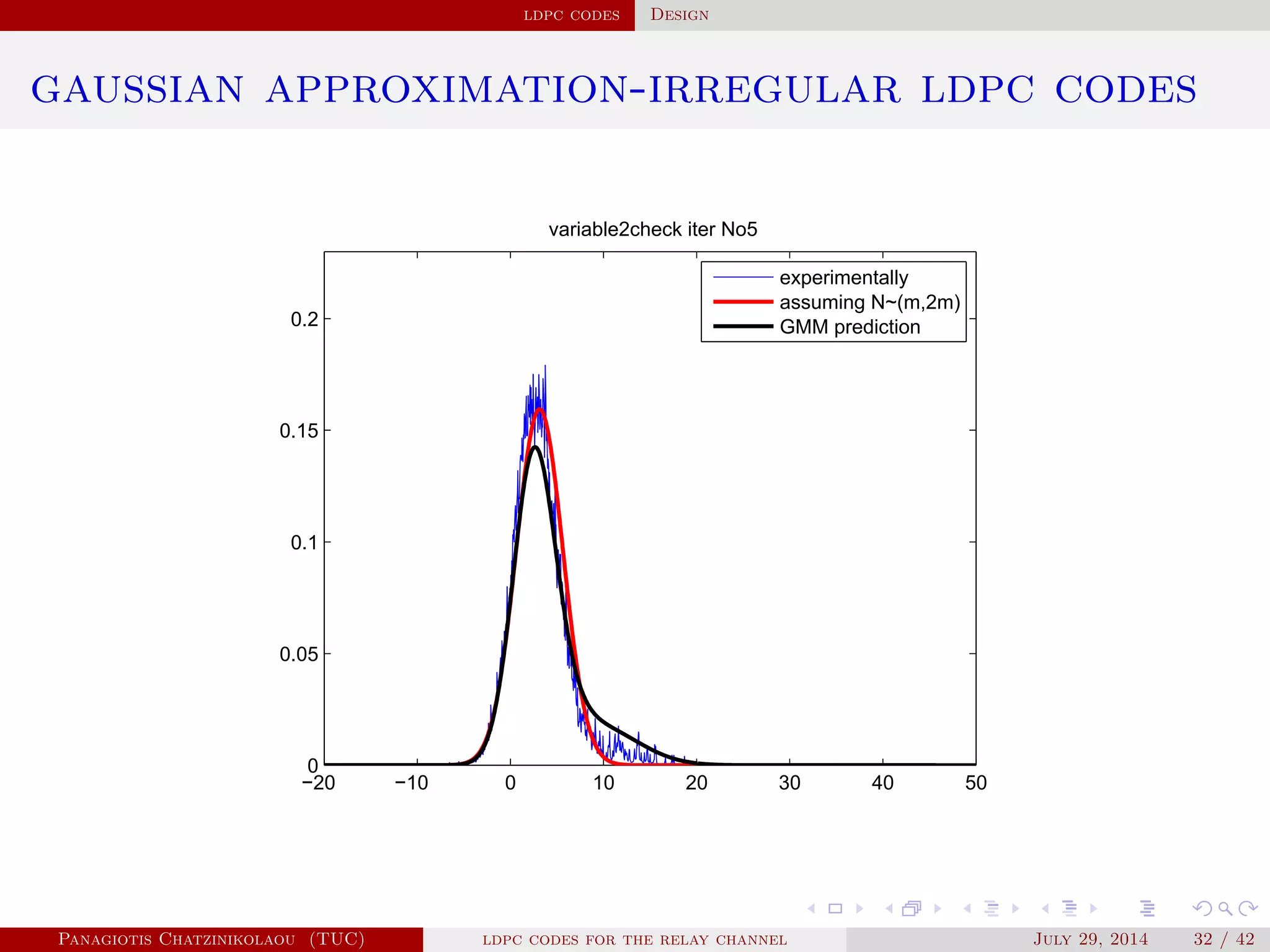
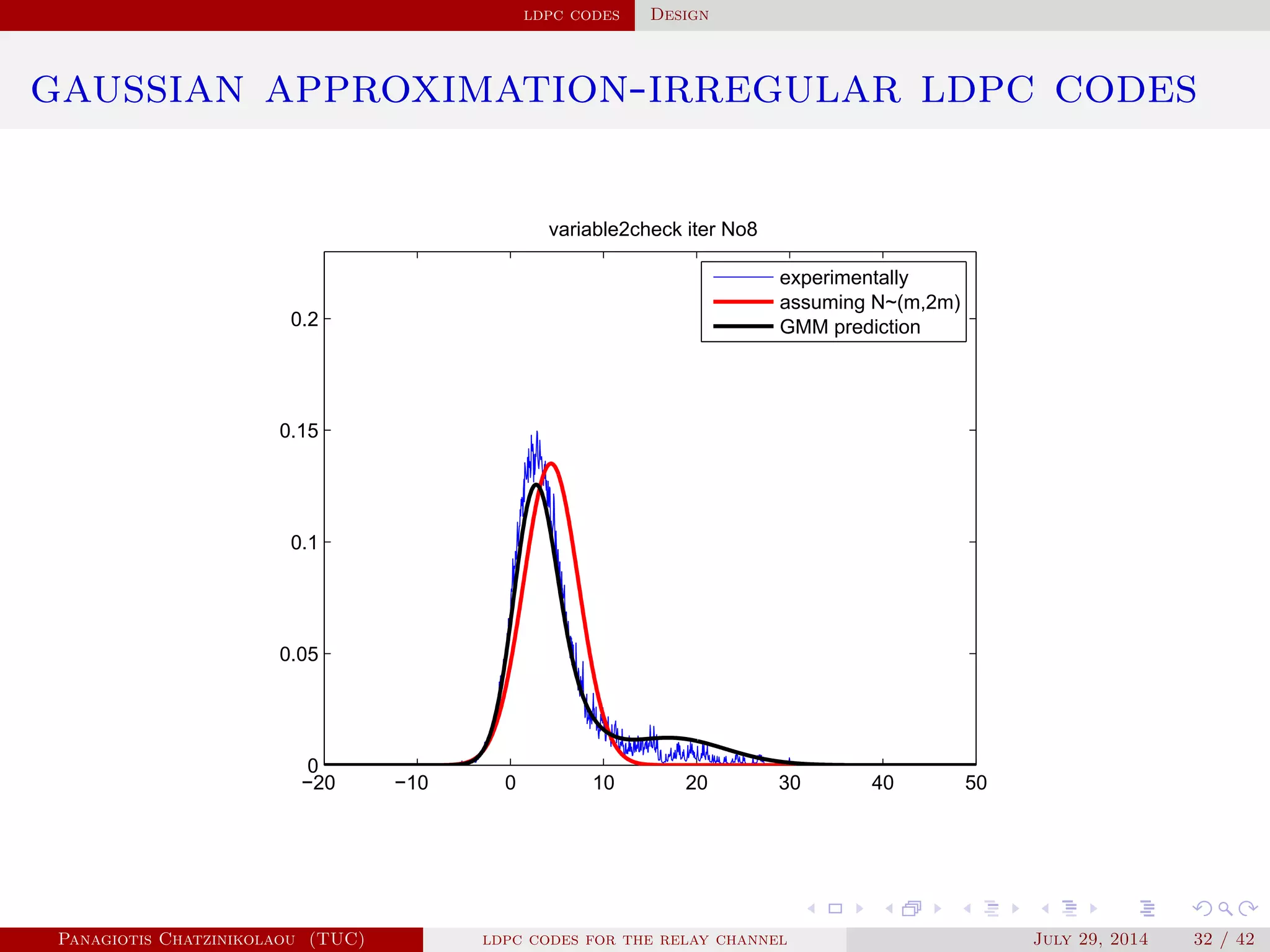
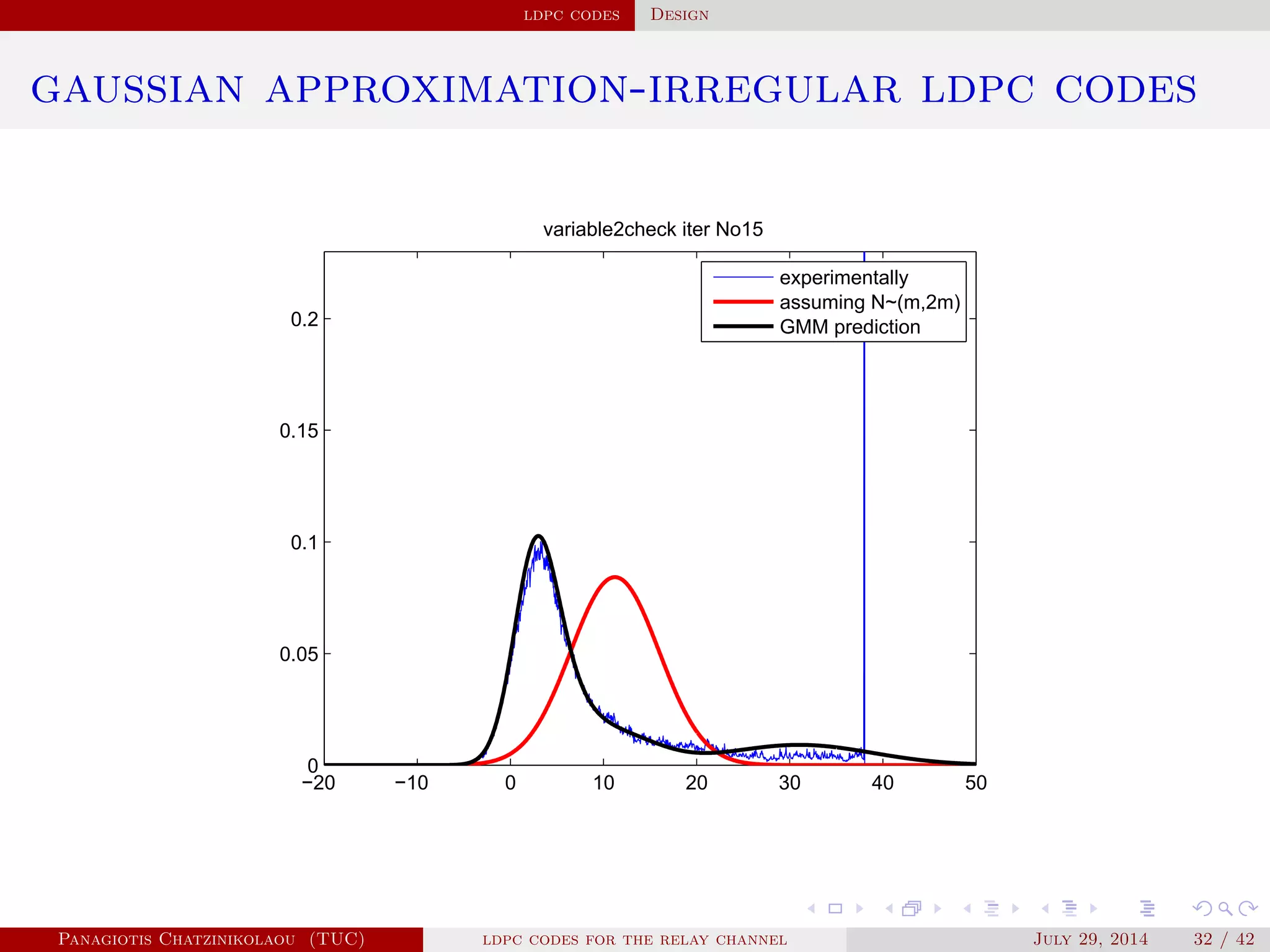
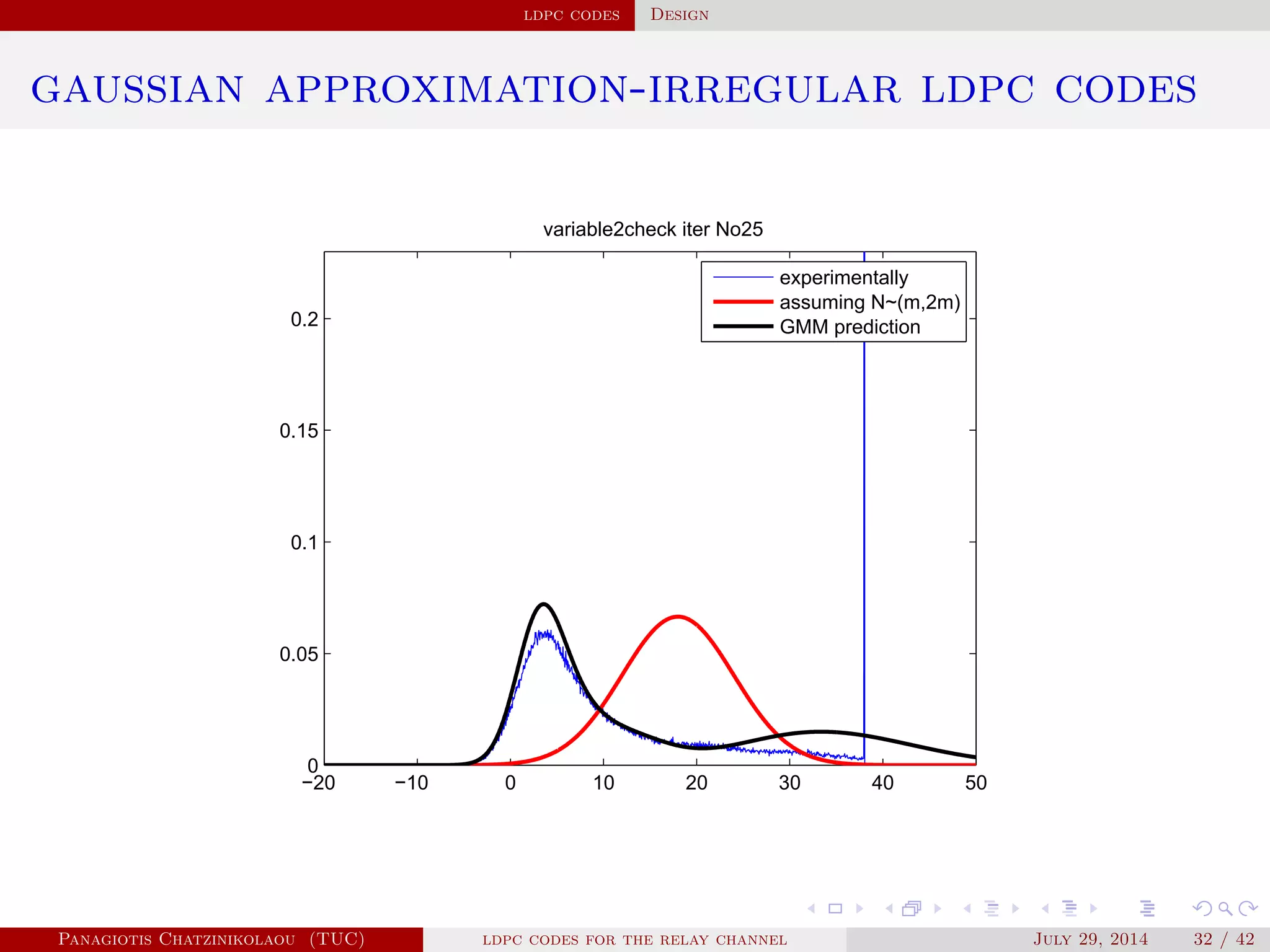
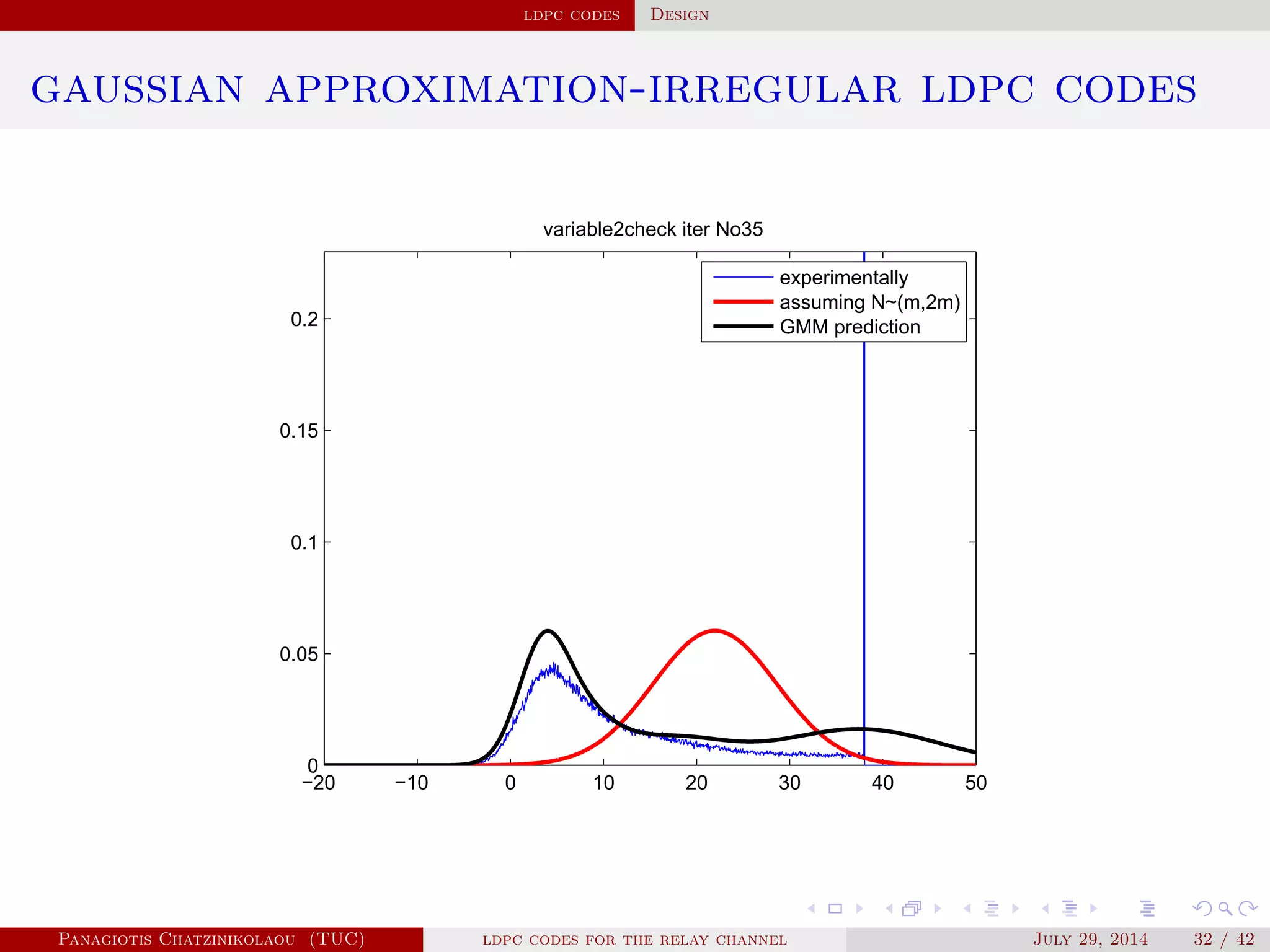
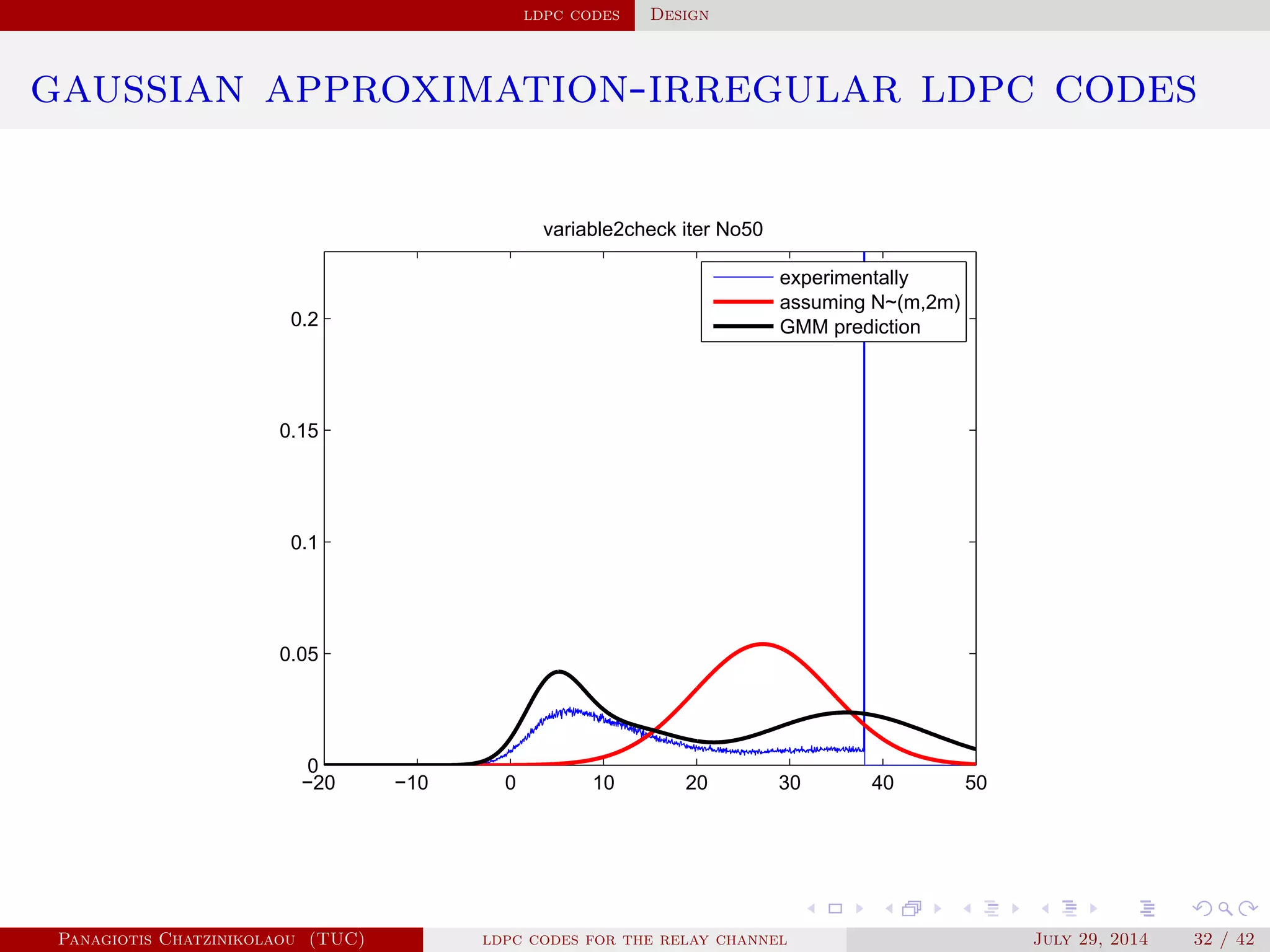
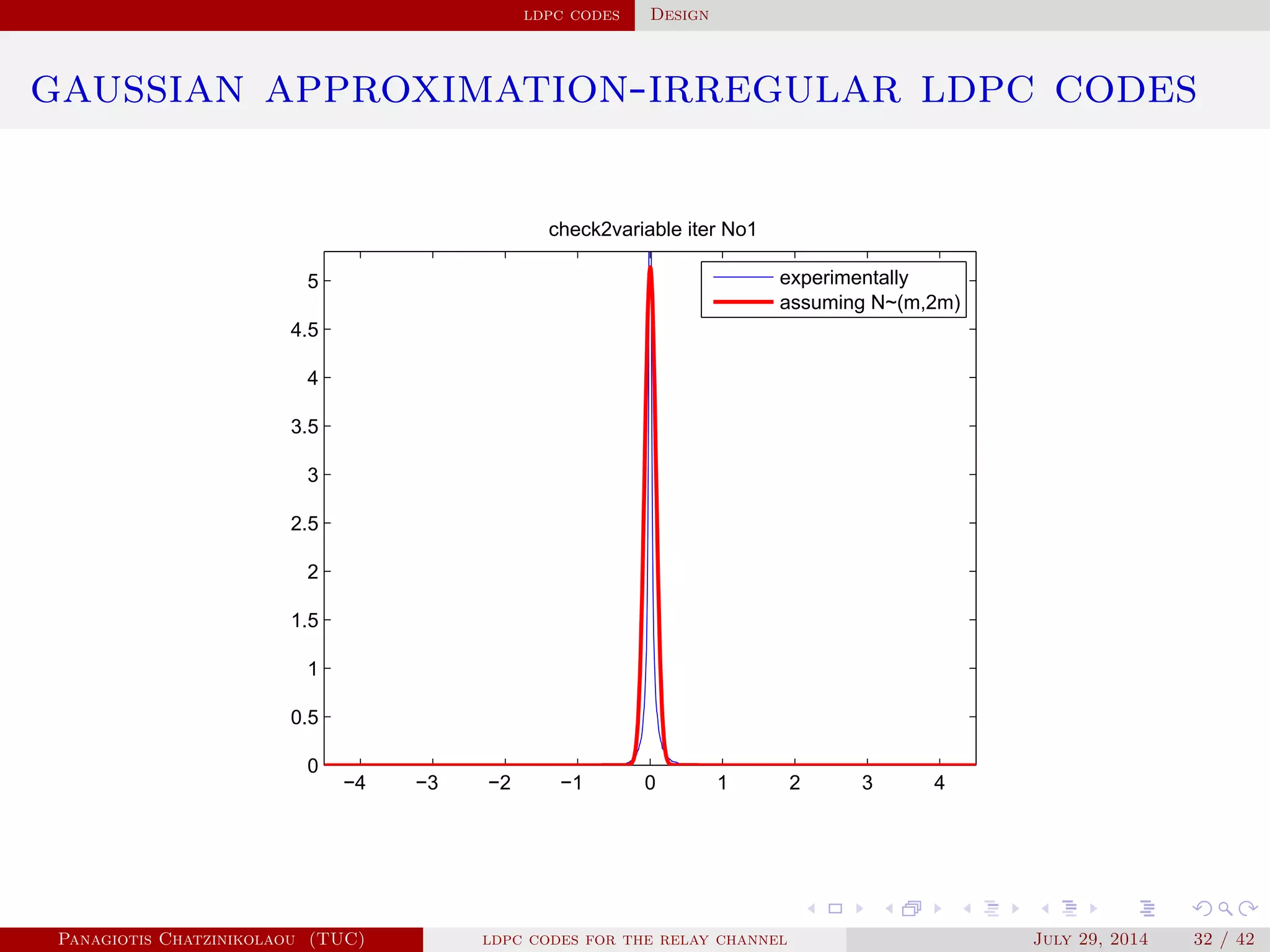
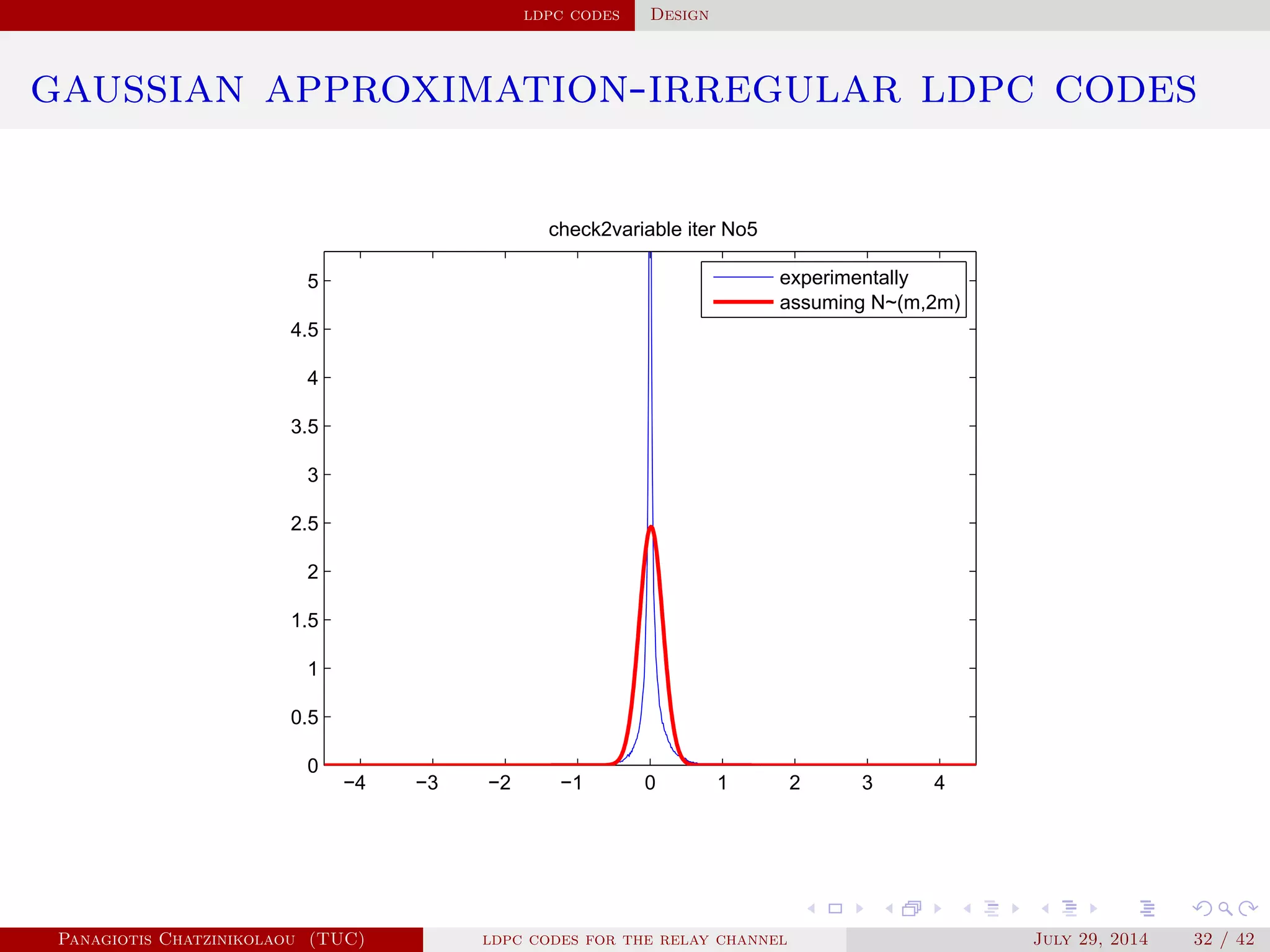
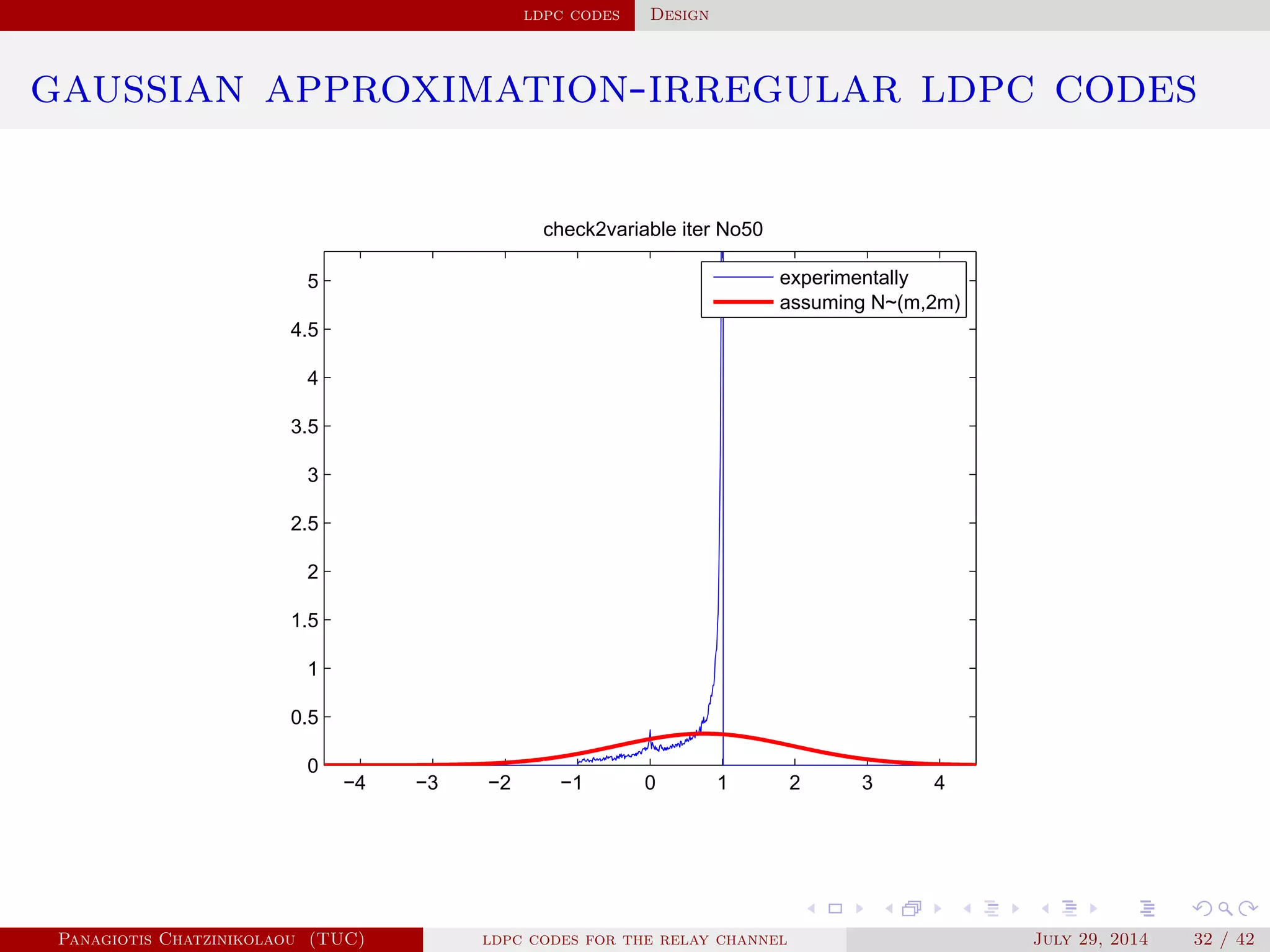
gaussian approximation-irregular ldpc codes
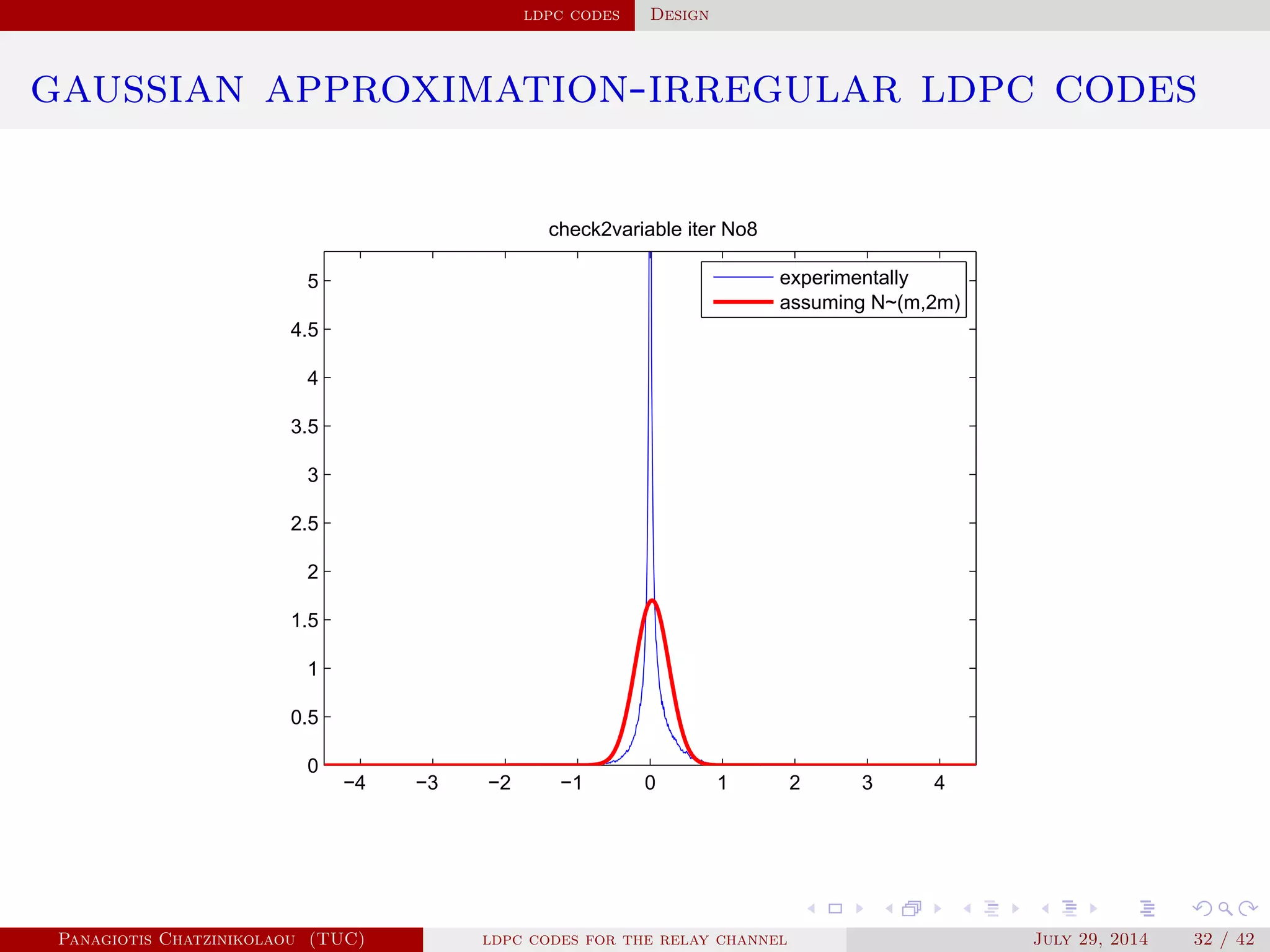
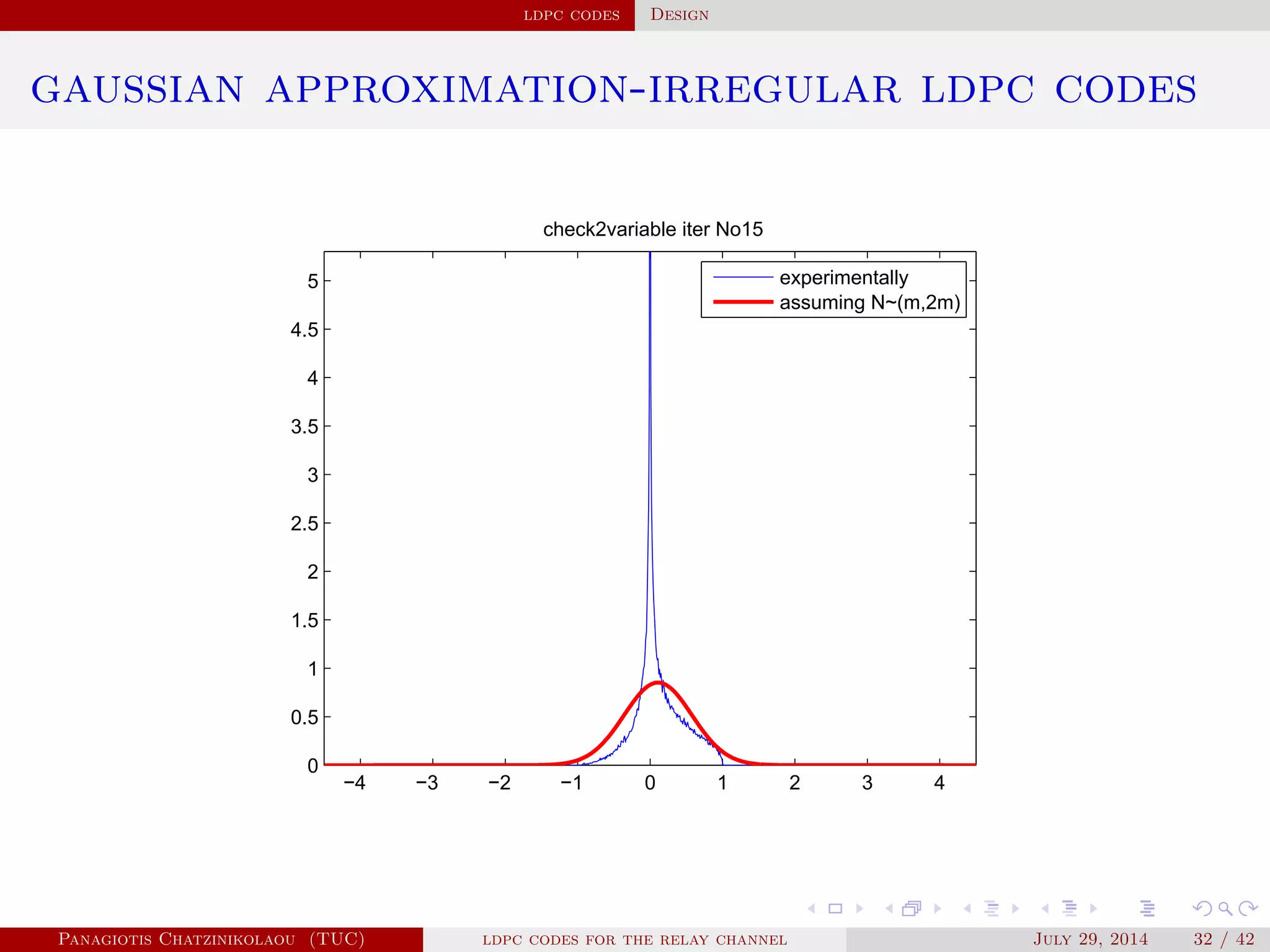
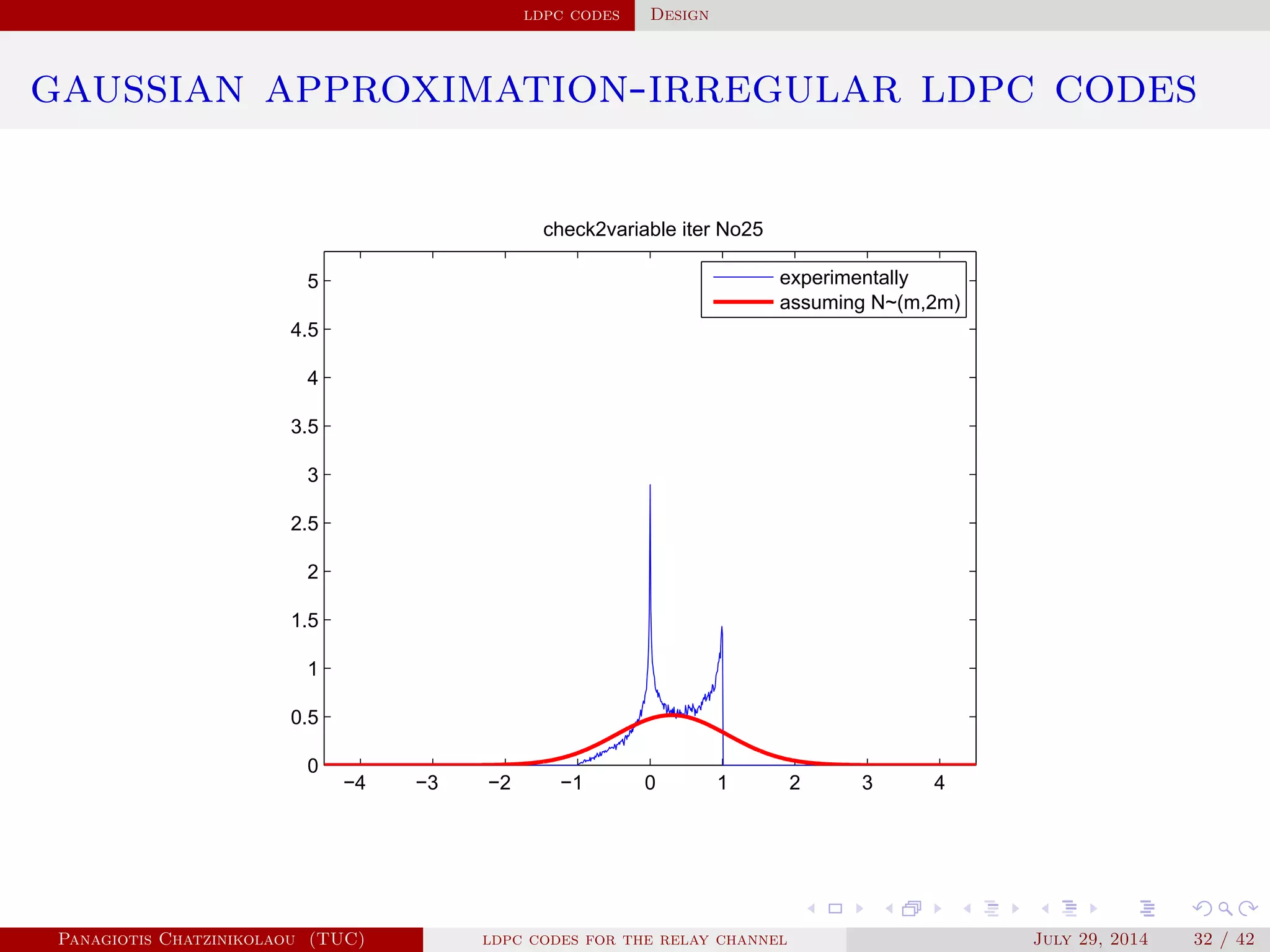
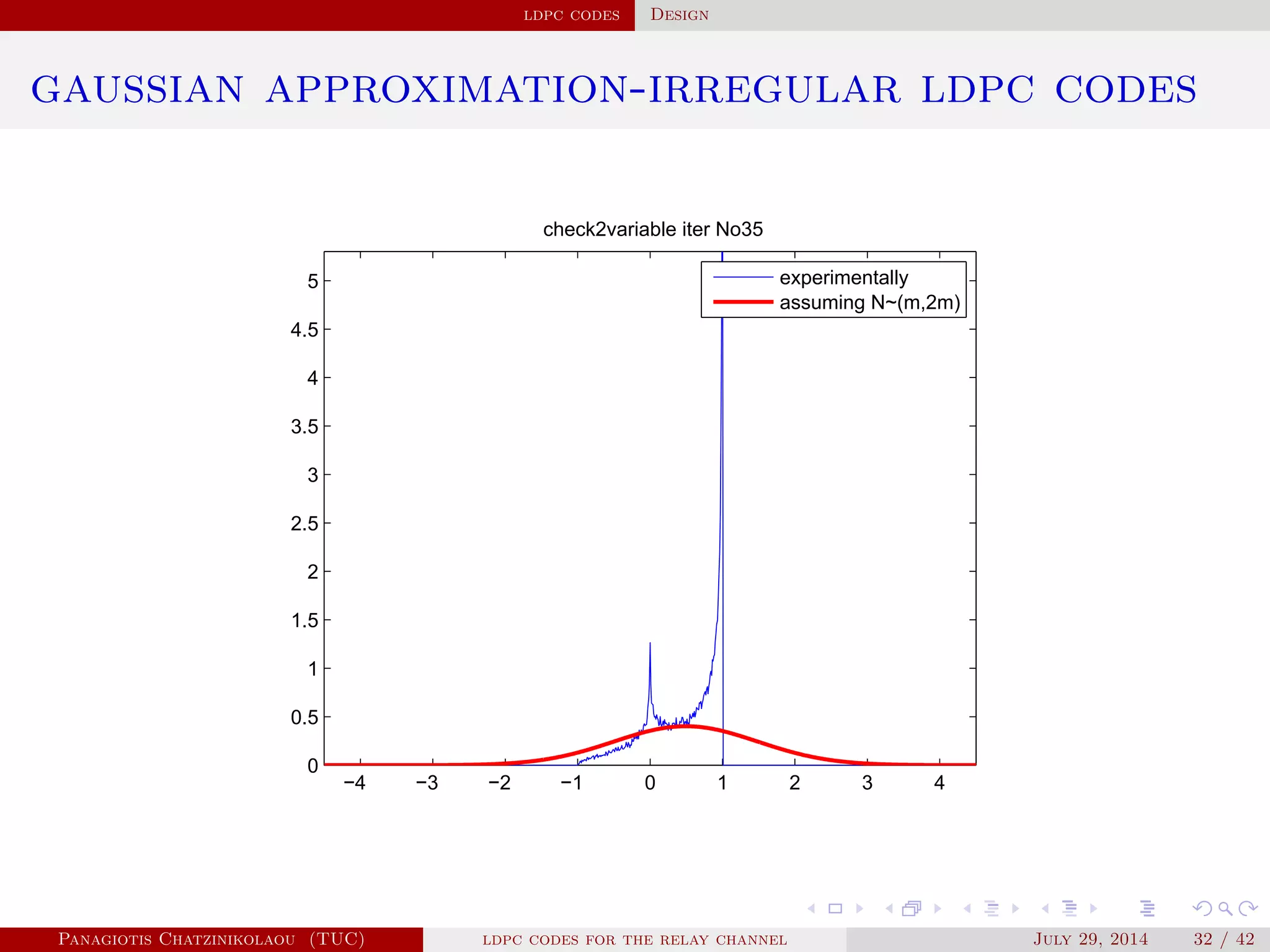
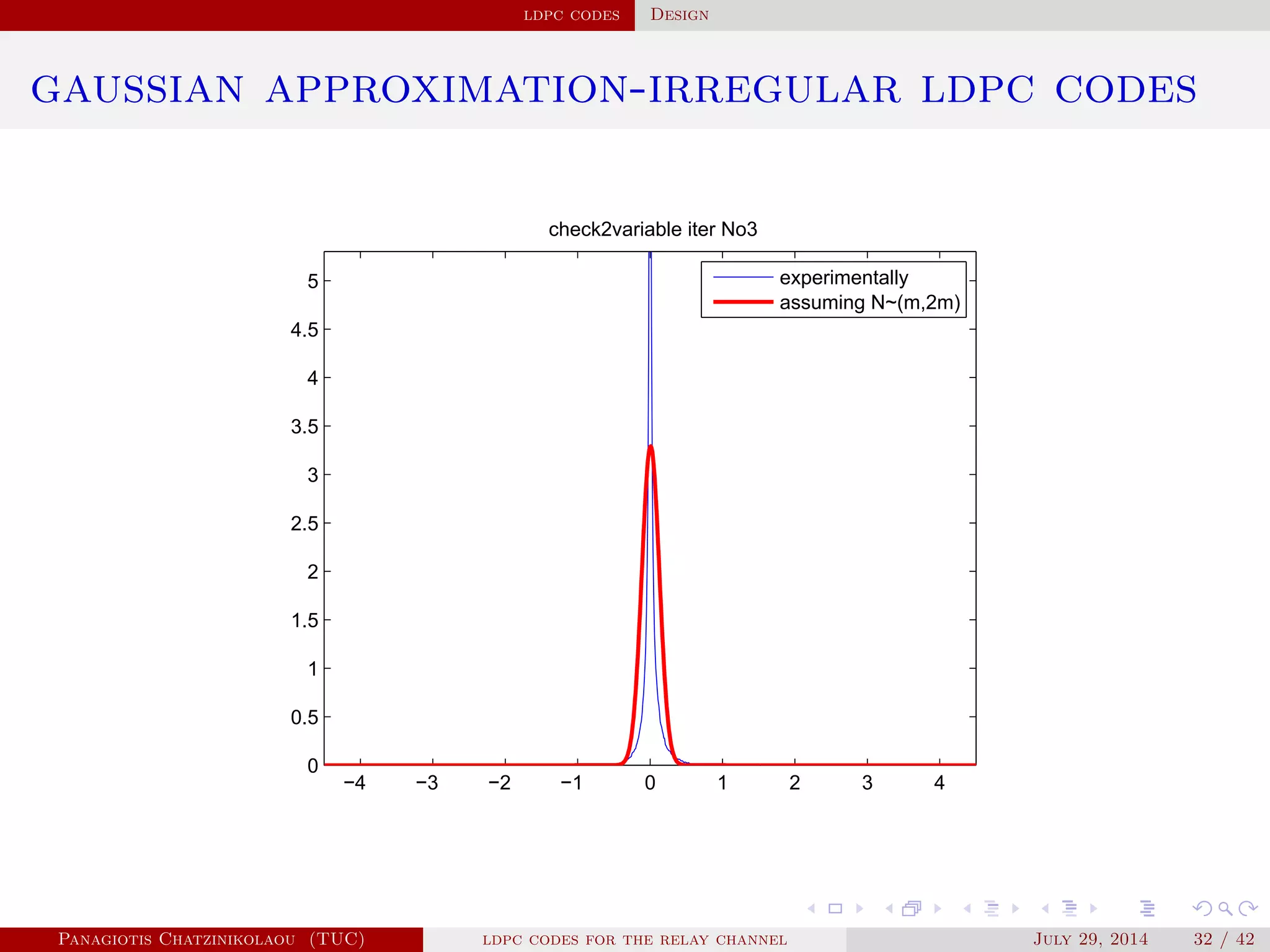
• The threshold in terms of noise variance, is σ∗
= 0,97704. In the following
simulation we use σ = 0,9441 < σ∗
.
−20 −10 0 10 20 30 40 50
0
0.05
0.1
0.15
0.2
Initial pdf−irregular−n=20000
experimentally
assuming N~(m,2m)
Panagiotis Chatzinikolaou (TUC) ldpc codes for the relay channel July 29, 2014 32 / 42
ldpc codes Design
gaussian approximation-irregular ldpc codes
−20 −10 0 10 20 30 40 50
0
0.05
0.1
0.15
0.2
variable2check iter No1
experimentally
assuming N~(m,2m)
GMM prediction
Panagiotis Chatzinikolaou (TUC) ldpc codes for the relay channel July 29, 2014 32 / 42
ldpc codes Design
gaussian approximation-irregular ldpc codes
−20 −10 0 10 20 30 40 50
0
0.05
0.1
0.15
0.2
variable2check iter No3
experimentally
assuming N~(m,2m)
GMM prediction
Panagiotis Chatzinikolaou (TUC) ldpc codes for the relay channel July 29, 2014 32 / 42
ldpc codes Design
gaussian approximation-irregular ldpc codes
−20 −10 0 10 20 30 40 50
0
0.05
0.1
0.15
0.2
variable2check iter No5
experimentally
assuming N~(m,2m)
GMM prediction
Panagiotis Chatzinikolaou (TUC) ldpc codes for the relay channel July 29, 2014 32 / 42
ldpc codes Design
gaussian approximation-irregular ldpc codes
−20 −10 0 10 20 30 40 50
0
0.05
0.1
0.15
0.2
variable2check iter No8
experimentally
assuming N~(m,2m)
GMM prediction
Panagiotis Chatzinikolaou (TUC) ldpc codes for the relay channel July 29, 2014 32 / 42
ldpc codes Design
gaussian approximation-irregular ldpc codes
−20 −10 0 10 20 30 40 50
0
0.05
0.1
0.15
0.2
variable2check iter No15
experimentally
assuming N~(m,2m)
GMM prediction
Panagiotis Chatzinikolaou (TUC) ldpc codes for the relay channel July 29, 2014 32 / 42
ldpc codes Design
gaussian approximation-irregular ldpc codes
−20 −10 0 10 20 30 40 50
0
0.05
0.1
0.15
0.2
variable2check iter No25
experimentally
assuming N~(m,2m)
GMM prediction
Panagiotis Chatzinikolaou (TUC) ldpc codes for the relay channel July 29, 2014 32 / 42
ldpc codes Design
gaussian approximation-irregular ldpc codes
−20 −10 0 10 20 30 40 50
0
0.05
0.1
0.15
0.2
variable2check iter No35
experimentally
assuming N~(m,2m)
GMM prediction
Panagiotis Chatzinikolaou (TUC) ldpc codes for the relay channel July 29, 2014 32 / 42
ldpc codes Design
gaussian approximation-irregular ldpc codes
−20 −10 0 10 20 30 40 50
0
0.05
0.1
0.15
0.2
variable2check iter No50
experimentally
assuming N~(m,2m)
GMM prediction
Panagiotis Chatzinikolaou (TUC) ldpc codes for the relay channel July 29, 2014 32 / 42
ldpc codes Design
gaussian approximation-irregular ldpc codes
−4 −3 −2 −1 0 1 2 3 4
0
0.5
1
1.5
2
2.5
3
3.5
4
4.5
5
check2variable iter No1
experimentally
assuming N~(m,2m)
Panagiotis Chatzinikolaou (TUC) ldpc codes for the relay channel July 29, 2014 32 / 42
ldpc codes Design
gaussian approximation-irregular ldpc codes
−4 −3 −2 −1 0 1 2 3 4
0
0.5
1
1.5
2
2.5
3
3.5
4
4.5
5
check2variable iter No3
experimentally
assuming N~(m,2m)
Panagiotis Chatzinikolaou (TUC) ldpc codes for the relay channel July 29, 2014 32 / 42
ldpc codes Design
gaussian approximation-irregular ldpc codes
−4 −3 −2 −1 0 1 2 3 4
0
0.5
1
1.5
2
2.5
3
3.5
4
4.5
5
check2variable iter No5
experimentally
assuming N~(m,2m)
Panagiotis Chatzinikolaou (TUC) ldpc codes for the relay channel July 29, 2014 32 / 42
ldpc codes Design
gaussian approximation-irregular ldpc codes
−4 −3 −2 −1 0 1 2 3 4
0
0.5
1
1.5
2
2.5
3
3.5
4
4.5
5
check2variable iter No8
experimentally
assuming N~(m,2m)
Panagiotis Chatzinikolaou (TUC) ldpc codes for the relay channel July 29, 2014 32 / 42
ldpc codes Design
gaussian approximation-irregular ldpc codes
−4 −3 −2 −1 0 1 2 3 4
0
0.5
1
1.5
2
2.5
3
3.5
4
4.5
5
check2variable iter No15
experimentally
assuming N~(m,2m)
Panagiotis Chatzinikolaou (TUC) ldpc codes for the relay channel July 29, 2014 32 / 42
ldpc codes Design
gaussian approximation-irregular ldpc codes
−4 −3 −2 −1 0 1 2 3 4
0
0.5
1
1.5
2
2.5
3
3.5
4
4.5
5
check2variable iter No25
experimentally
assuming N~(m,2m)
Panagiotis Chatzinikolaou (TUC) ldpc codes for the relay channel July 29, 2014 32 / 42
ldpc codes Design
gaussian approximation-irregular ldpc codes
−4 −3 −2 −1 0 1 2 3 4
0
0.5
1
1.5
2
2.5
3
3.5
4
4.5
5
check2variable iter No35
experimentally
assuming N~(m,2m)
Panagiotis Chatzinikolaou (TUC) ldpc codes for the relay channel July 29, 2014 32 / 42
ldpc codes Design
gaussian approximation-irregular ldpc codes
−4 −3 −2 −1 0 1 2 3 4
0
0.5
1
1.5
2
2.5
3
3.5
4
4.5
5
check2variable iter No50
experimentally
assuming N~(m,2m)
Panagiotis Chatzinikolaou (TUC) ldpc codes for the relay channel July 29, 2014 32 / 42
ldpc codes Construction
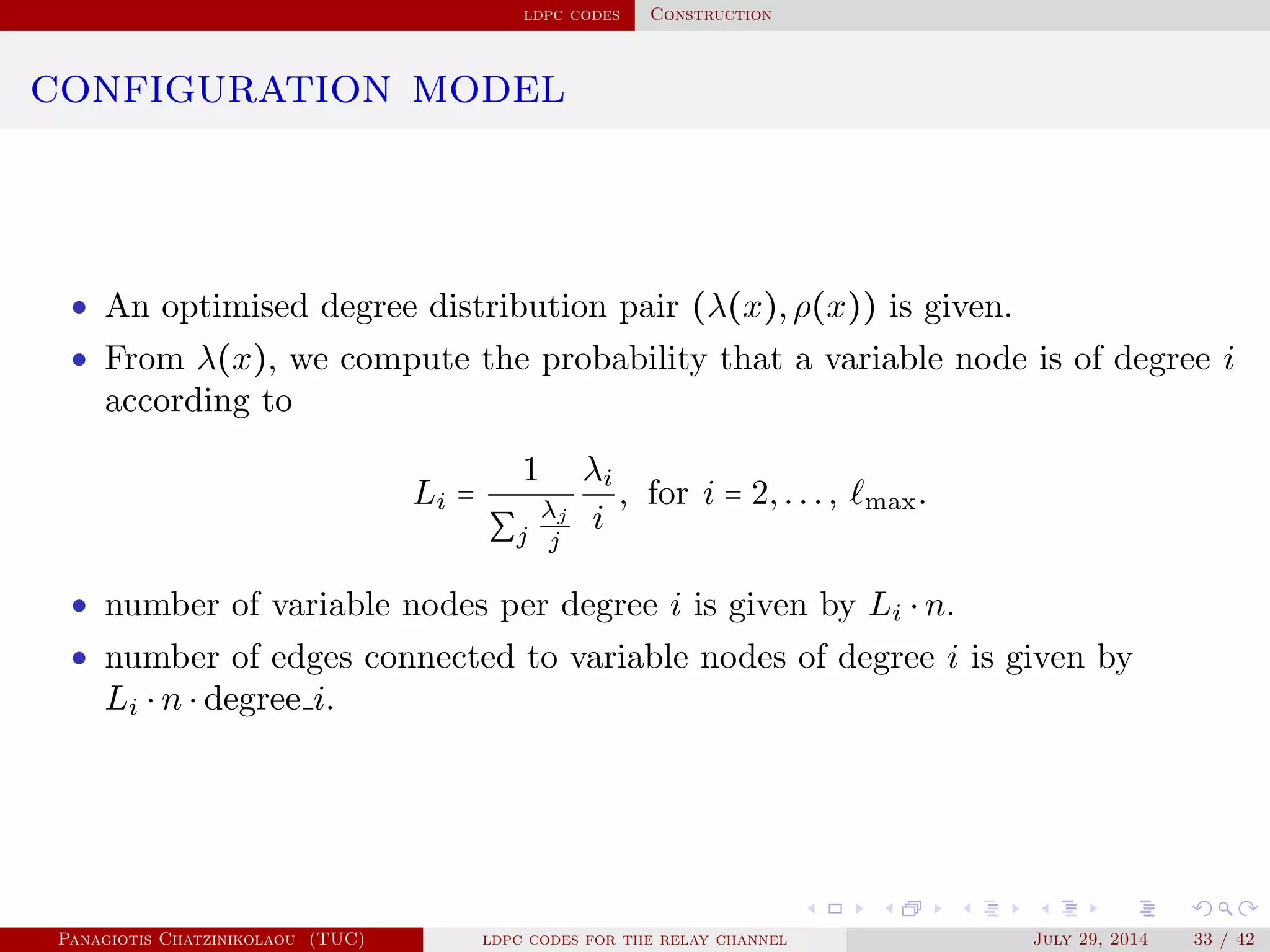
configuration model
• An optimised degree distribution pair (λ(x),ρ(x)) is given.
• From λ(x), we compute the probability that a variable node is of degree i
according to
Li =
1
∑j
λj
j
λi
i
, for i = 2,..., max.
• number of variable nodes per degree i is given by Li ⋅ n.
• number of edges connected to variable nodes of degree i is given by
Li ⋅ n ⋅ degree i.
Panagiotis Chatzinikolaou (TUC) ldpc codes for the relay channel July 29, 2014 33 / 42
ldpc codes Construction
configuration model
• “Generate” n variable nodes and m check nodes with their sockets.
• Label the variable and check node sockets separately with the set
[Λ′
(1)] = {1,...,∑i iΛi}.
.
.
.
.
.
.
v1
v2
vn
C2
C1
C m
v3
C3
1
2
3
4
5
6
7
1
2
.
.
.
total_edges
total_edges
.
.
.
.
.
.
total edges is the last socket (edge) which is equal to the total number of
edges (= ∑i iΛi).
Panagiotis Chatzinikolaou (TUC) ldpc codes for the relay channel July 29, 2014 33 / 42
ldpc codes Construction
configuration model
• Pick a permutation π on [Λ′
(1)] at random with uniform probability
from the set of all (∑i iΛi)! such permutations.
• Let π be a permutation on [Λ′
(1)]. Connect i-th variable node edge
socket with π(i)-th check node edge socket.
.
.
.
.
.
.
v1
v2
vn
C2
C1
C m
v3
C3
1
2
3
4
5
6
7
total_edges
.
.
.
π(1)
π(2)
π(3)
• Put “1” in the appropriate position of H.
Panagiotis Chatzinikolaou (TUC) ldpc codes for the relay channel July 29, 2014 33 / 42
bilayer ldpc codes Relay Channel model
relay channel
1 For the source-relay link, x ∈ C, with parity-check matrix H such that
Hx = 0.
2 rate(C) ≤ rate(source → relay). Hence, relay decodes x.
3 rate(C) > rate(source → destination). Hence, destination cannot decode x.
4 The parity-check matrix of Cbilayer denoted by Hbilayer is given by
Hbilayer = [
H
H1
], Hbilayer ⋅ x = [
0
p
],
where H1 is the upper layer of the bilayer graph.
5 Finally, rate(Cbilayer) ≤ rate(source → destination) and, therefore,
destination decodes x using Hbilayer and parity vector p sent by the relay.
Panagiotis Chatzinikolaou (TUC) ldpc codes for the relay channel July 29, 2014 34 / 42
bilayer ldpc codes Relay Channel model
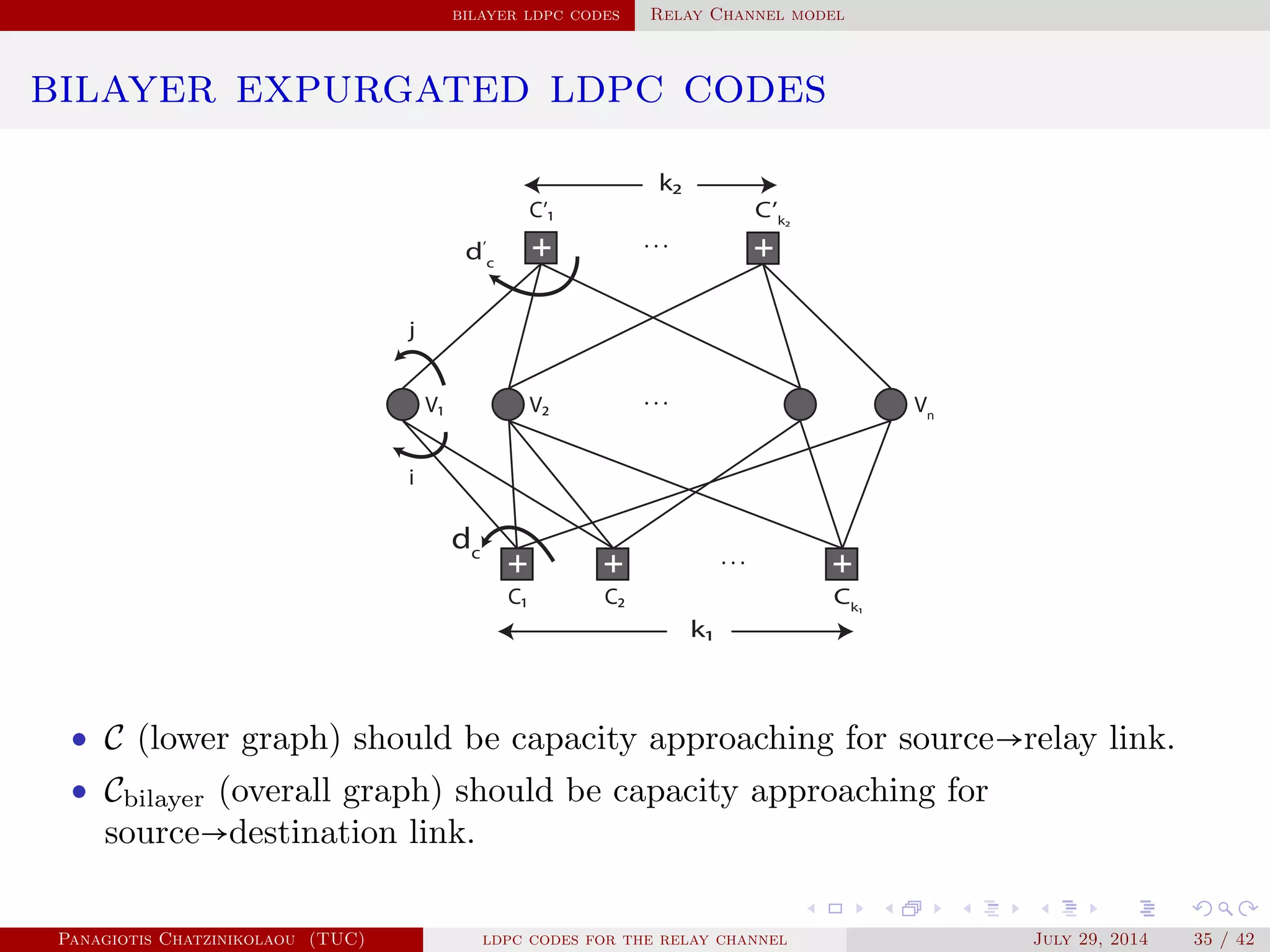
bilayer expurgated ldpc codes
. . .
. . .
. . .
k1
k2
dc
d’
c
j
i
C1 C2 Ck1
C’1 C’k2
V1 V2 Vn
• C (lower graph) should be capacity approaching for source→relay link.
• Cbilayer (overall graph) should be capacity approaching for
source→destination link.
Panagiotis Chatzinikolaou (TUC) ldpc codes for the relay channel July 29, 2014 35 / 42
bilayer ldpc codes Relay Channel model
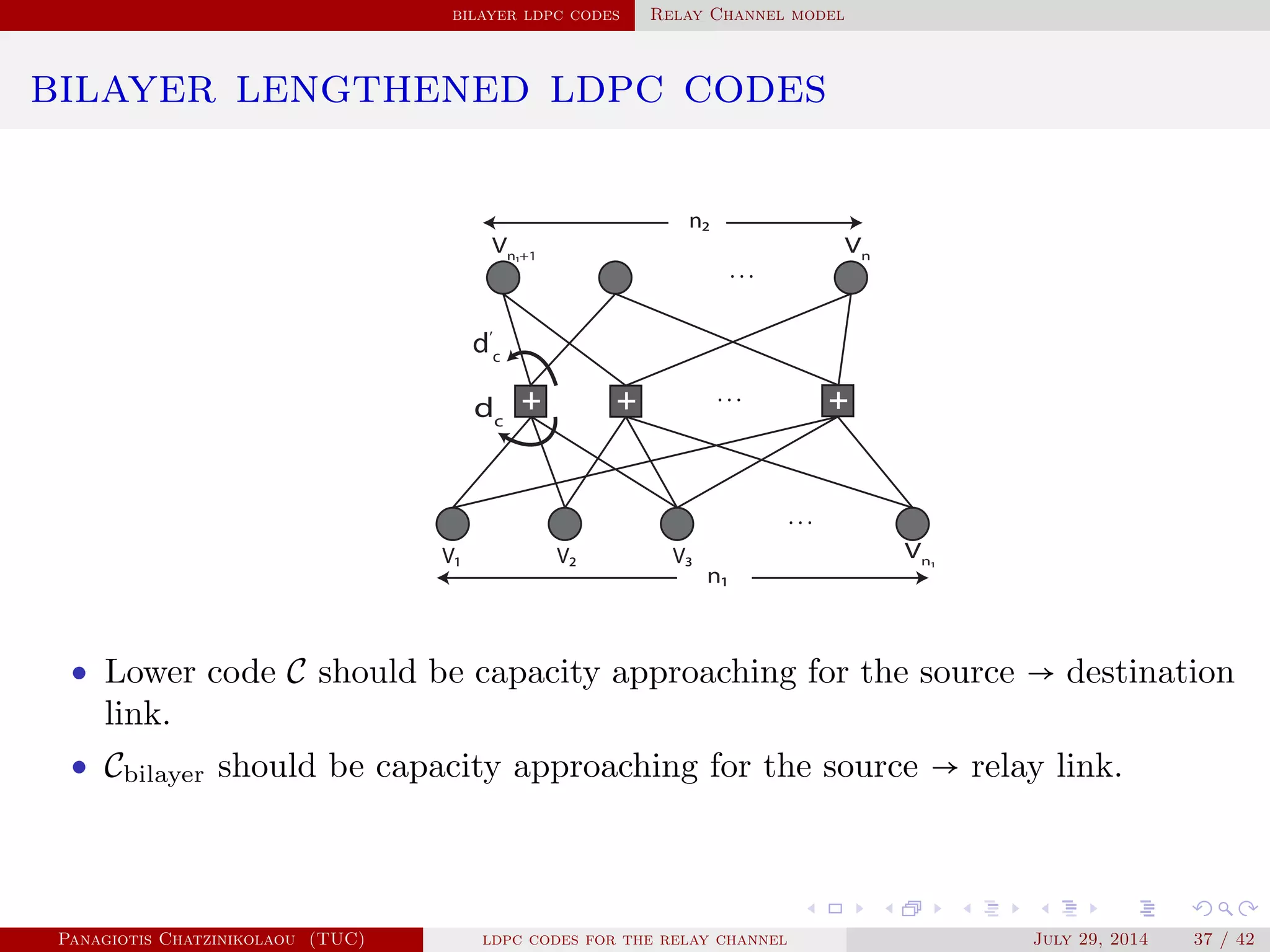
bilayer lengthened ldpc codes
1 For the source-relay link, x ∈ Cbilayer, with parity-check matrix Hbilayer
such that Hbilayerx = 0.
2 rate(C) ≤ rate(source → relay). Hence, relay decodes x over the bilayer
graph.
3 rate(C) > rate(source → destination). Hence, destination cannot decode x.
4 The parity-check matrix of Cbilayer denoted by Hbilayer is given by
Hbilayer = [H H1],
where H1 is the upper layer of the bilayer graph.
5 The relay forwards to the destination the upper n2 variable nodes.
Destination removes the upper variable nodes, reducing the resulting
code’s rate and decodes the lower graph.
Panagiotis Chatzinikolaou (TUC) ldpc codes for the relay channel July 29, 2014 36 / 42
bilayer ldpc codes Relay Channel model
bilayer lengthened ldpc codes
. . .
. . .
. . .
n1
n2
dc
d’
c
V1 V2 Vn1V3
Vn1+1
Vn
• Lower code C should be capacity approaching for the source → destination
link.
• Cbilayer should be capacity approaching for the source → relay link.
Panagiotis Chatzinikolaou (TUC) ldpc codes for the relay channel July 29, 2014 37 / 42
bilayer ldpc codes Decoding
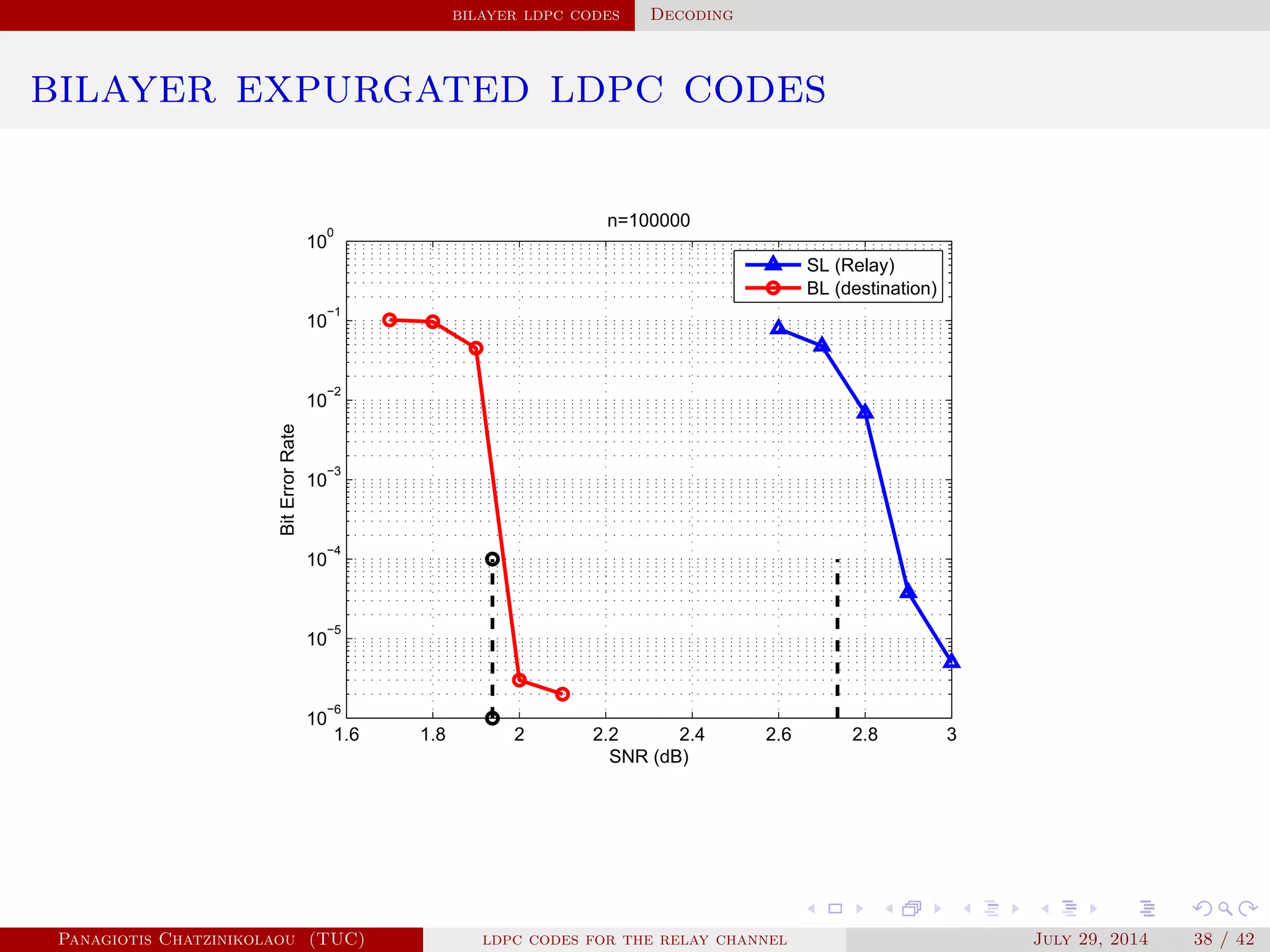
bilayer expurgated ldpc codes
1.6 1.8 2 2.2 2.4 2.6 2.8 3
10
−6
10
−5
10
−4
10
−3
10
−2
10
−1
10
0
SNR (dB)
BitErrorRate
n=100000
SL (Relay)
BL (destination)
Panagiotis Chatzinikolaou (TUC) ldpc codes for the relay channel July 29, 2014 38 / 42
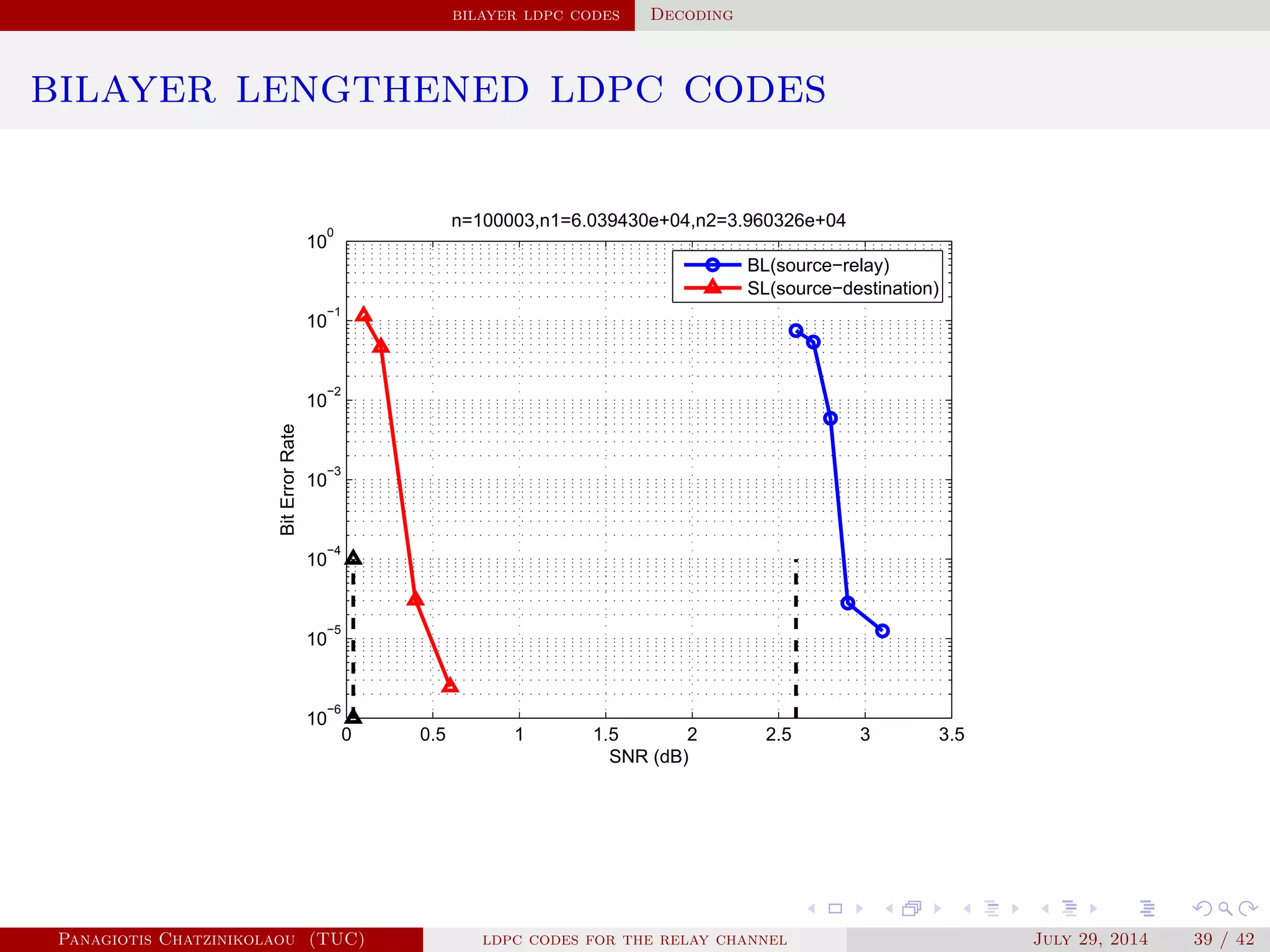
bilayer ldpc codes Decoding
bilayer lengthened ldpc codes
0 0.5 1 1.5 2 2.5 3 3.5
10
−6
10
−5
10
−4
10
−3
10
−2
10
−1
10
0
SNR (dB)
BitErrorRate
n=100003,n1=6.039430e+04,n2=3.960326e+04
BL(source−relay)
SL(source−destination)
Panagiotis Chatzinikolaou (TUC) ldpc codes for the relay channel July 29, 2014 39 / 42
bilayer ldpc codes Design
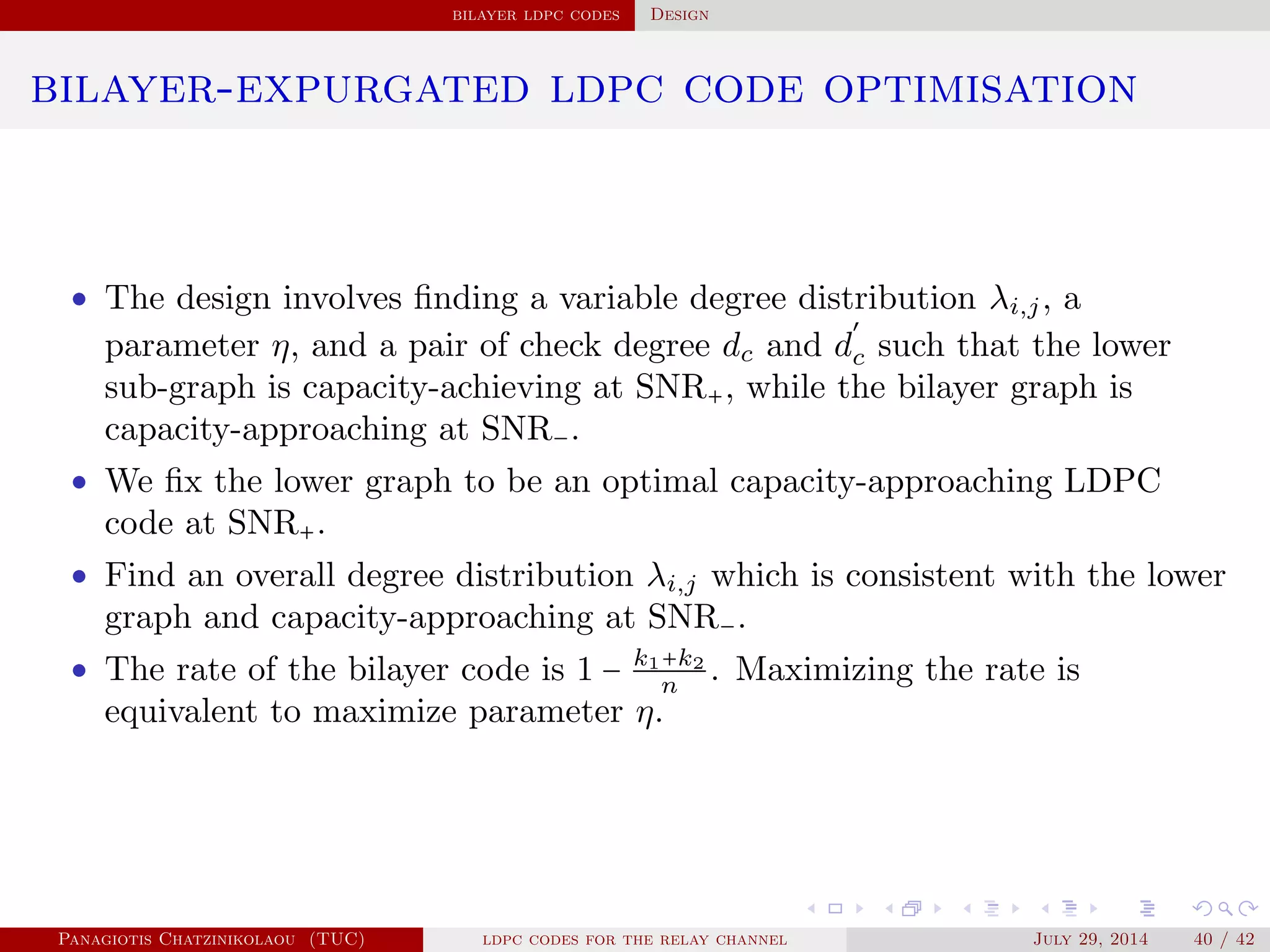
bilayer-expurgated ldpc code optimisation
• The design involves finding a variable degree distribution λi,j, a
parameter η, and a pair of check degree dc and d
′
c such that the lower
sub-graph is capacity-achieving at SNR+, while the bilayer graph is
capacity-approaching at SNR−.
• We fix the lower graph to be an optimal capacity-approaching LDPC
code at SNR+.
• Find an overall degree distribution λi,j which is consistent with the lower
graph and capacity-approaching at SNR−.
• The rate of the bilayer code is 1 − k1+k2
n
. Maximizing the rate is
equivalent to maximize parameter η.
Panagiotis Chatzinikolaou (TUC) ldpc codes for the relay channel July 29, 2014 40 / 42
bilayer ldpc codes Design
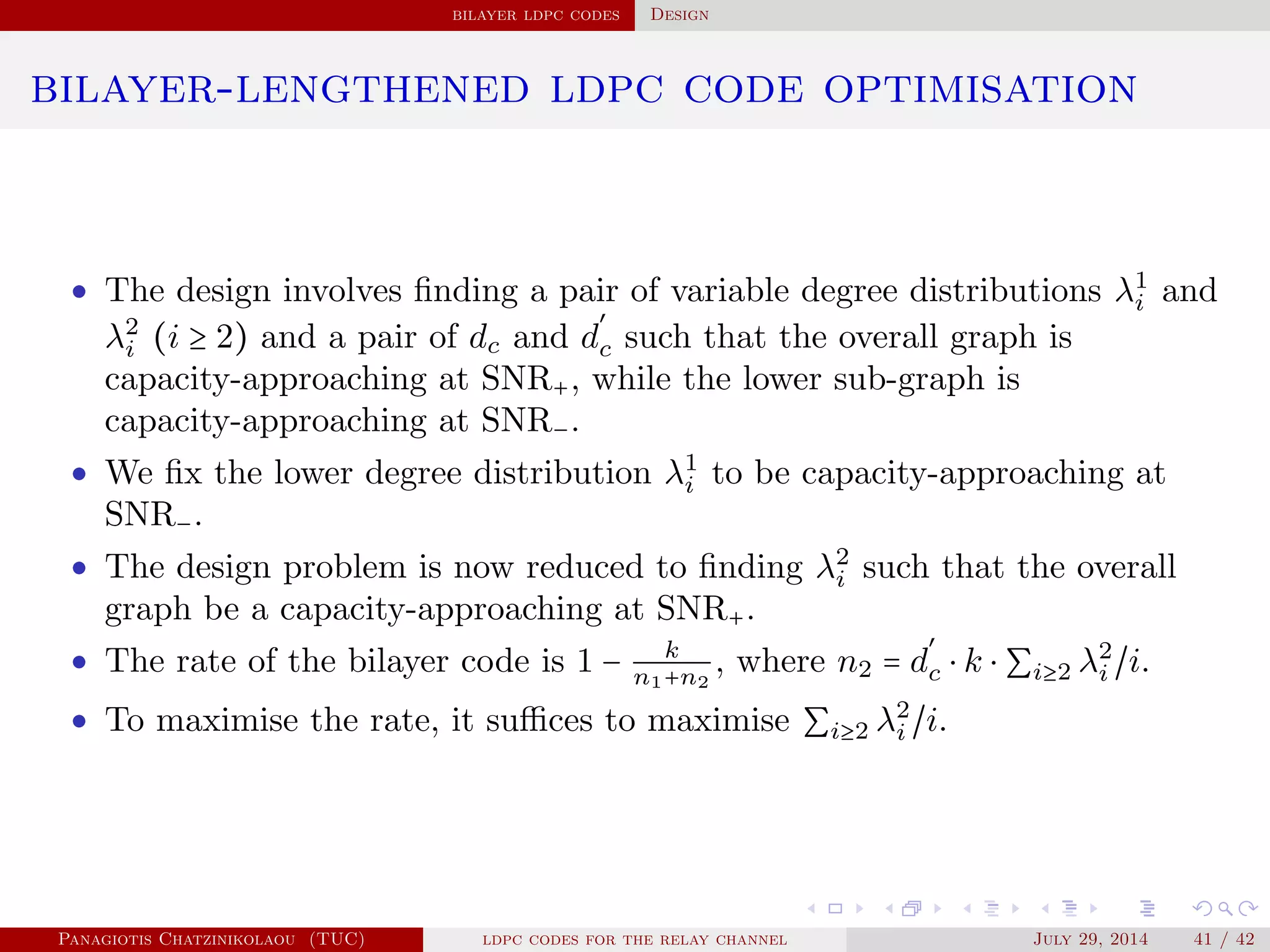
bilayer-lengthened ldpc code optimisation
• The design involves finding a pair of variable degree distributions λ1
i and
λ2
i (i ≥ 2) and a pair of dc and d
′
c such that the overall graph is
capacity-approaching at SNR+, while the lower sub-graph is
capacity-approaching at SNR−.
• We fix the lower degree distribution λ1
i to be capacity-approaching at
SNR−.
• The design problem is now reduced to finding λ2
i such that the overall
graph be a capacity-approaching at SNR+.
• The rate of the bilayer code is 1 − k
n1+n2
, where n2 = d
′
c ⋅ k ⋅ ∑i≥2 λ2
i /i.
• To maximise the rate, it suffices to maximise ∑i≥2 λ2
i /i.
Panagiotis Chatzinikolaou (TUC) ldpc codes for the relay channel July 29, 2014 41 / 42
bilayer ldpc codes Construction
bilayer expurgated construction
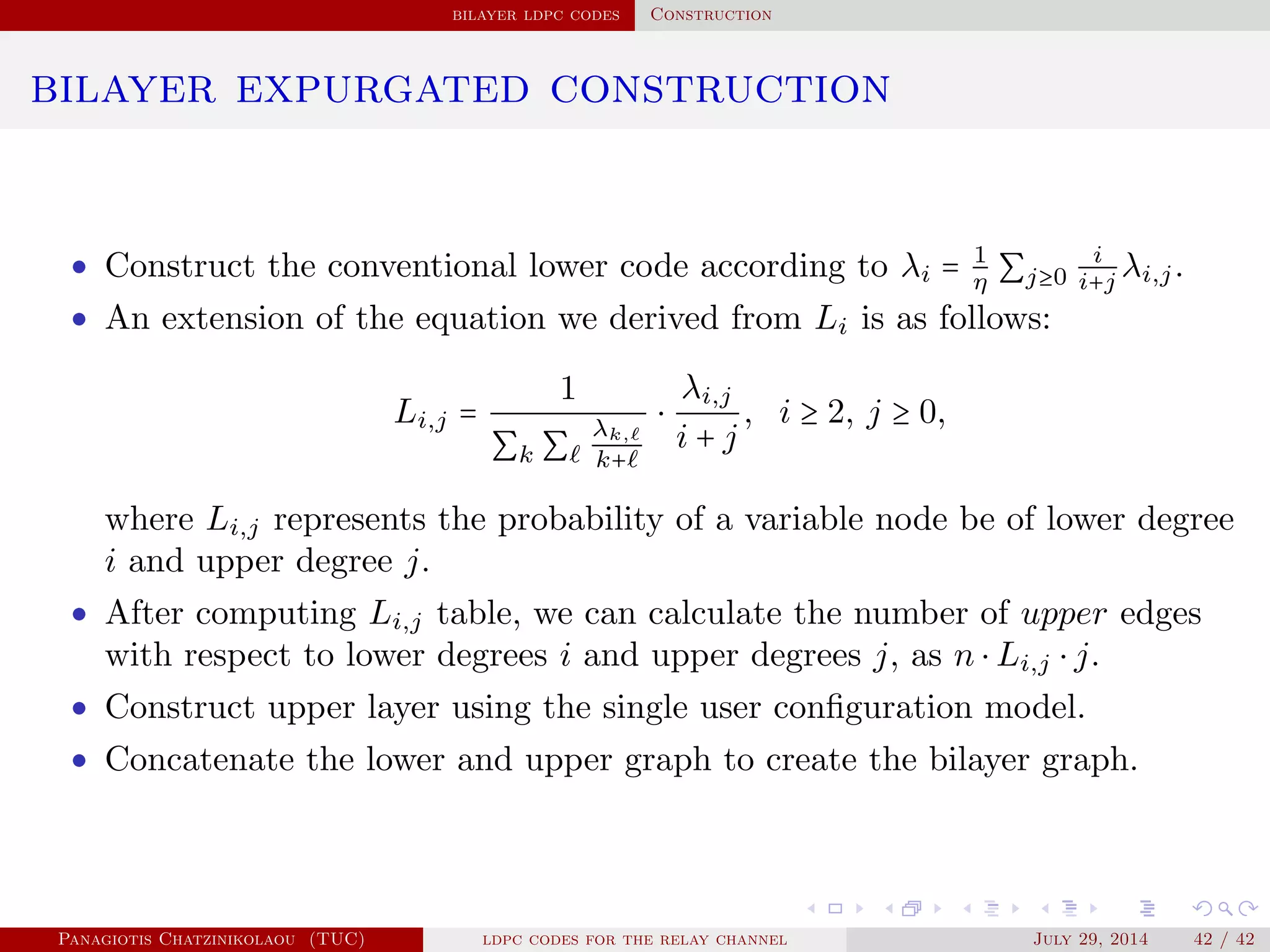
• Construct the conventional lower code according to λi = 1
η ∑j≥0
i
i+j
λi,j.
• An extension of the equation we derived from Li is as follows:
Li,j =
1
∑k ∑
λk,
k+
⋅
λi,j
i + j
, i ≥ 2, j ≥ 0,
where Li,j represents the probability of a variable node be of lower degree
i and upper degree j.
• After computing Li,j table, we can calculate the number of upper edges
with respect to lower degrees i and upper degrees j, as n ⋅ Li,j ⋅ j.
• Construct upper layer using the single user configuration model.
• Concatenate the lower and upper graph to create the bilayer graph.
Panagiotis Chatzinikolaou (TUC) ldpc codes for the relay channel July 29, 2014 42 / 42
conclusion
LDPC codes:
1 have low decoding complexity;
2 capacity-approaching in several scenarios;
3 strong design tools.
Panagiotis Chatzinikolaou (TUC) ldpc codes for the relay channel July 29, 2014 42 / 42
Thank You!
Panagiotis Chatzinikolaou (TUC) ldpc codes for the relay channel July 29, 2014 42 / 42

Thesis_Presentation

  • 1.
    low-density parity-check codesfor the relay channel Panagiotis Chatzinikolaou Telecommunications Division Technical University of Crete July 29, 2014 Panagiotis Chatzinikolaou (TUC) ldpc codes for the relay channel July 29, 2014 0 / 42
  • 2.
    outline 1 ldpc codes Introduction Decoding Design Construction 2bilayer ldpc codes Relay Channel model Decoding Design Construction Panagiotis Chatzinikolaou (TUC) ldpc codes for the relay channel July 29, 2014 0 / 42
  • 3.
    ldpc codes Introduction channelcoding Source encoder Channel decoder sgn( ) Destination u {0,1}k {0,1}n c m {LLRs} L {LLRs} ûChannel Channel {0,1}k • The channel encoder maps each vector u ∈ {0,1}k , representing the information message, to longer vectors c ∈ {0,1}n , known as codewords. • The transmitted symbols may be corrupted in some way by the channel, and it is the function of the channel decoder to use the added redundancy to determine the corresponding k information bits. Panagiotis Chatzinikolaou (TUC) ldpc codes for the relay channel July 29, 2014 1 / 42
  • 4.
    ldpc codes Introduction ldpccodes • An LDPC code C(n,k) is defined as the nullspace of its own parity-check matrix, i.e., C = {c ∈ {0,1}n H(n−k)×ncT = 0}. • LDPC codes are linear block codes whose parity-check matrices are sparse. • Parity-check matrices of linear block codes can be visualized by Tanner Graphs. Panagiotis Chatzinikolaou (TUC) ldpc codes for the relay channel July 29, 2014 2 / 42
  • 5.
    ldpc codes Introduction ldpccodes • If we associate each column of H with a variable node, each row of H with a check node and connect variable node j with check node i iff Hij = 1, we can represent each LDPC code as a graph. • Consider the following parity-check matrix: H = x1 x2 x3 x4 x5 x6 x7 x8 x9 x10 ⎡ ⎢ ⎢ ⎢ ⎢ ⎢ ⎢ ⎢ ⎢ ⎣ ⎤ ⎥ ⎥ ⎥ ⎥ ⎥ ⎥ ⎥ ⎥ ⎦ c1 1 0 1 1 1 0 1 1 0 0 c2 0 1 1 0 0 1 1 0 1 1 c3 1 1 0 1 1 1 0 1 0 0 c4 0 1 1 0 1 0 1 0 1 1 c5 1 0 0 1 0 1 0 1 1 1 . Panagiotis Chatzinikolaou (TUC) ldpc codes for the relay channel July 29, 2014 3 / 42
  • 6.
    ldpc codes Introduction ldpccodes • The associated Tanner graph is depicted below: (3,6)-regular ldpc code Panagiotis Chatzinikolaou (TUC) ldpc codes for the relay channel July 29, 2014 4 / 42
  • 7.
    ldpc codes Introduction degreedistributions • Regular codes have constant column and row weights. • Irregular codes have column and row weights which are chosen according to some distribution. • Variable/Check node degree distributions from a node perspective. Λ(x) = max ∑ i≥2 Λixi , P(x) = rmax ∑ i≥2 Pixi , where Λi/Pi is the number of variable/check nodes of degree i. • Observe that ∑i Λi = n and ∑i Pi = n(1 − r) ≜ m where r ≜ k n is the design rate of the code. Panagiotis Chatzinikolaou (TUC) ldpc codes for the relay channel July 29, 2014 5 / 42
  • 8.
    ldpc codes Introduction degreedistributions • We define normalized variable/check node degree distributions from a node perspective as L(x) = Λ(x) Λ(1) = max ∑ i≥2 Lixi , R(x) = P(x) P(1) = rmax ∑ i≥2 Rixi . • Variable/Check node degree distributions from an edge perspective λ(x) = Λ ′ (x) Λ′ (1) = max ∑ i≥2 λixi−1 , ρ(x) = R ′ (x) R′ (1) = rmax ∑ i≥2 ρixi−1 , where λi,ρi denote the fraction of edges connected to nodes with degree i. Panagiotis Chatzinikolaou (TUC) ldpc codes for the relay channel July 29, 2014 6 / 42
  • 9.
    ldpc codes Introduction example •λ(x) = 6 29 x + 15 29 x2 + 8 29 x3 , ρ(x) = 4 29 x3 + 5 29 x4 + 6 29 x5 + 14 29 x6 . irregular ldpc code Panagiotis Chatzinikolaou (TUC) ldpc codes for the relay channel July 29, 2014 7 / 42
  • 10.
    ldpc codes Introduction degreedistributions • Given the degree distribution of an LDPC code and its number of edges E = Λ ′ (1) = P ′ (1) the number of variable nodes n is n = E ∑ i≥2 λi i = E ∫ 1 0 λ(x)dx, and the number of check nodes m is m = E ∑ i≥2 ρi i = E ∫ 1 0 ρ(x)dx. • The design rate is given by r(λ,ρ) ≜ 1 − m n = 1 − ∫ 1 0 ρ(x) ∫ 1 0 λ(x) = 1 − ∑i≥2 ρi i ∑i≥2 λi i . Panagiotis Chatzinikolaou (TUC) ldpc codes for the relay channel July 29, 2014 8 / 42
  • 11.
    ldpc codes Introduction codeensemble • Sets of codes that share certain characteristics or properties are called code ensembles. • For sufficiently long codes, the error probability of each code in a (λ(x), ρ(x)) ensemble, is “very close” to the average performance of the ensemble (concentration theory). Panagiotis Chatzinikolaou (TUC) ldpc codes for the relay channel July 29, 2014 9 / 42
  • 12.
    ldpc codes Decoding factorgraphs • Factor graphs are a way to represent graphically the factorization of a function. • Consider a function f that can be factorised as follows: f(x1,...,x7) = f1(x1,x2,x3)f2(x1,x4)f3(x1,x6,x7)f4(x4,x5)f5(x4)f6(x2). • Assume that we wish to compute marginal f(x1) then, f(x1) = ∑ ∼x1 f(x1,...,x7) = ∑ ∼x1 f1f2f3f4f5f6. • By brute force method f(x1) computation requires O( X 7 ) operations. Panagiotis Chatzinikolaou (TUC) ldpc codes for the relay channel July 29, 2014 10 / 42
  • 13.
    ldpc codes Decoding factorgraphs • Applying the factorisation and the distributive law we get f(x1) = ∑ x2,...,x7 f1(x1,x2,x3)f2(x1,x4)f3(x1,x6,x7)f4(x4,x5)f5(x4)f6(x2) = [∑ x2 (f6(x2)∑ x3 f1(x1,x2,x3))][∑ x4 (f5(x4)f2(x1,x4) ∑ x5 f4(x4,x5))][ ∑ x6,x7 f3(x1,x6,x7)], reducing complexity to O( X 3 ) ! • Likewise for f(xi), i = 2,...,7. Panagiotis Chatzinikolaou (TUC) ldpc codes for the relay channel July 29, 2014 11 / 42
  • 14.
    ldpc codes Decoding factorgraphs • Consider the aforementioned function and its factorization. We associate with this factorization a factor graph as follows. • For the aforementioned function f, we associate a variable node (circle) with each variable and a factor node (square) with each factor. • Connect a variable node to a factor node by an edge if, and only if, the corresponding variable appears in this factor. Panagiotis Chatzinikolaou (TUC) ldpc codes for the relay channel July 29, 2014 12 / 42
  • 15.
    ldpc codes Decoding marginalizationon factor graphs • Initial Step: ⋆ Leaf variable nodes send 1. ⋆ Leaf factor nodes send their corresponding function. • Message Passing Rules: . . . . . . . . . . . . variable/check node rules Panagiotis Chatzinikolaou (TUC) ldpc codes for the relay channel July 29, 2014 13 / 42
  • 16.
    ldpc codes Decoding singlemessage passing-example • We will apply the message passing rules on the factor graph of f(x1). Panagiotis Chatzinikolaou (TUC) ldpc codes for the relay channel July 29, 2014 14 / 42
  • 17.
    ldpc codes Decoding singlemessage passing-example-step 1 Panagiotis Chatzinikolaou (TUC) ldpc codes for the relay channel July 29, 2014 14 / 42
  • 18.
    ldpc codes Decoding singlemessage passing-example-step 2 Panagiotis Chatzinikolaou (TUC) ldpc codes for the relay channel July 29, 2014 14 / 42
  • 19.
    ldpc codes Decoding singlemessage passing-example-step 3 Panagiotis Chatzinikolaou (TUC) ldpc codes for the relay channel July 29, 2014 14 / 42
  • 20.
    ldpc codes Decoding singlemessage passing-example-step 4 Panagiotis Chatzinikolaou (TUC) ldpc codes for the relay channel July 29, 2014 14 / 42
  • 21.
    ldpc codes Decoding singlemessage passing-example-step 5 Panagiotis Chatzinikolaou (TUC) ldpc codes for the relay channel July 29, 2014 14 / 42
  • 22.
    ldpc codes Decoding beliefpropagation algorithm • All marginals can be computed simultaneously on a single tree, if we allow message passing to both directions. Panagiotis Chatzinikolaou (TUC) ldpc codes for the relay channel July 29, 2014 15 / 42
  • 23.
    ldpc codes Decoding beliefpropagation algorithm-step 1 Panagiotis Chatzinikolaou (TUC) ldpc codes for the relay channel July 29, 2014 15 / 42
  • 24.
    ldpc codes Decoding beliefpropagation algorithm-step 2 Panagiotis Chatzinikolaou (TUC) ldpc codes for the relay channel July 29, 2014 15 / 42
  • 25.
    ldpc codes Decoding beliefpropagation algorithm-step 3 Panagiotis Chatzinikolaou (TUC) ldpc codes for the relay channel July 29, 2014 15 / 42
  • 26.
    ldpc codes Decoding beliefpropagation algorithm-step 4 Panagiotis Chatzinikolaou (TUC) ldpc codes for the relay channel July 29, 2014 15 / 42
  • 27.
    ldpc codes Decoding beliefpropagation algorithm-step 5 Panagiotis Chatzinikolaou (TUC) ldpc codes for the relay channel July 29, 2014 15 / 42
  • 28.
    ldpc codes Decoding beliefpropagation algorithm-step 6 Panagiotis Chatzinikolaou (TUC) ldpc codes for the relay channel July 29, 2014 15 / 42
  • 29.
    ldpc codes Decoding beliefpropagation algorithm-step 7 Panagiotis Chatzinikolaou (TUC) ldpc codes for the relay channel July 29, 2014 15 / 42
  • 30.
    ldpc codes Decoding bi-awgnchannel + • It is convenient to use log-likelihood ratios for messages; i.e., L ≜ ln P(X = +1/y) P(X = −1/y) = 2y σ2 . Panagiotis Chatzinikolaou (TUC) ldpc codes for the relay channel July 29, 2014 16 / 42
  • 31.
    ldpc codes Decoding mapdecoding • MAP decoding rule for a codeword bit is given by ˆxi MAP (y) = arg max xi∈{±1} pXi/Y(xi/y) = ⋯ (uniform codewords, bayes, memoryless channel) = arg max xi∈{±1} ∑ ∼xi (∏ j pYj /Xj (yj/xj))1x∈C(H). • BP algorithm provides exact bit-wise MAP decoding on cycle free graphs. Panagiotis Chatzinikolaou (TUC) ldpc codes for the relay channel July 29, 2014 17 / 42
  • 32.
    ldpc codes Decoding beliefpropagation decoding • Messages are log-likelihood ratios (LLRs). • Variable node update: ... • Check node update: ... out = ch + K ∑ k=1 k. out = 2 ⋅ tanh−1 ( J ∏ j=1 tanh( j/2)). Panagiotis Chatzinikolaou (TUC) ldpc codes for the relay channel July 29, 2014 18 / 42
  • 33.
    ldpc codes Decoding beliefpropagation decoding-example Figure: Initialisation. Panagiotis Chatzinikolaou (TUC) ldpc codes for the relay channel July 29, 2014 19 / 42
  • 34.
    ldpc codes Decoding beliefpropagation decoding-round 1 Panagiotis Chatzinikolaou (TUC) ldpc codes for the relay channel July 29, 2014 19 / 42
  • 35.
    ldpc codes Decoding beliefpropagation decoding-round 1 Panagiotis Chatzinikolaou (TUC) ldpc codes for the relay channel July 29, 2014 19 / 42
  • 36.
    ldpc codes Decoding biterror rate using bp decoding 0.4 0.6 0.8 1 1.2 1.4 1.6 1.8 2 2.2 10 −6 10 −5 10 −4 10 −3 10 −2 10 −1 10 0 Eb/N0 (dB) BitErrorRate Regular vs Irregular Regular, n=20000 Irregular, n=20000 Figure: Bit Error Rate of a (3, 6) − regular and a concentrated irregular LDPC code with same block length over BI-AWGN channel. Panagiotis Chatzinikolaou (TUC) ldpc codes for the relay channel July 29, 2014 20 / 42
  • 37.
    ldpc codes Decoding beliefpropagation decoding for the bec • Variable node update: If all incoming messages are erasures, then the outgoing message is an erasure. Otherwise, the outgoing message is equal to the common value. • Check node update: If any incoming message is an erasure, then the outgoing message is an erasure. Otherwise, the outgoing message is the mod-2 summation of the incoming messages. X Y 1 1 1 1 0 1 0 1 0 Panagiotis Chatzinikolaou (TUC) ldpc codes for the relay channel July 29, 2014 21 / 42
  • 38.
    ldpc codes Design densityevolution • In the limit of infinite block length: 1 DE can predict the performance of a (λ(x), ρ(x)) ensemble under BP decoding using only the degree distributions of the code. 2 We assume cycle-free graphs. • Under certain symmetry conditions, the convergence behaviour of the decoder is independent of the transmitted codeword. 1 For the BEC we can assume that the all-zero codeword was transmitted. 2 For the BIAWGN we can assume that the all-one codeword was transmitted. Panagiotis Chatzinikolaou (TUC) ldpc codes for the relay channel July 29, 2014 22 / 42
  • 39.
    ldpc codes Design densityevolution for the bec • DE tracks the mean variable-to-check message erasure probability of error for each round of BP. • The evolution of the expected fraction of erasure messages emitted in the -th iteration, call it x , is given by x = ⋅ λ(1 − ρ(1 − x −1)). • The threshold ∗ is defined as the maximum such that x →∞ → 0. • There is a stability condition that must satisfied in order x converges to 0. Panagiotis Chatzinikolaou (TUC) ldpc codes for the relay channel July 29, 2014 23 / 42
  • 40.
    ldpc codes Design densityevolution for the bi-awgn channel • We need to track messages’ densities instead of a single parameter. • The check node message update rule can be rewritten as m( ) cv = γ−1⎛ ⎝ dc−1 ∑ i=1 γ(m( ) vic) ⎞ ⎠ , where γ(x) = (γ1(x),γ2(x)) ≜ (sgn(x),−lntanh x 2 ). • Let P and Q denote the shorthand notations for the densities of random variables m ( ) vc and m ( ) cv respectively. • Let Γ denote the density transformation corresponding to γ(x), i.e., given a random variable Z ∈ R with density fZ(z), the density of γ(Z) is fγ(Z)(γ1(z),γ2(z)) = Γ(fZ(z)). • The density of m ( ) cv is: Q = Γ−1 (Γ(P ) ⋆ ⋯ ⋆ Γ(P ) (i−1) ). Panagiotis Chatzinikolaou (TUC) ldpc codes for the relay channel July 29, 2014 24 / 42
  • 41.
    ldpc codes Design densityevolution for the bi-awgn channel • P0 denotes the density of the r.v. describing the channel. P0 ≡ N( 2 σ2 , 4 σ2 ). • The density of the messages emanating from variable nodes at -th iteration is P( +1) = P0 ⊗ ∑ j≥2 λj ⎛ ⎝ Γ−1⎛ ⎝ ∑ i≥2 ρiΓ(P )⋆(i−1)⎞ ⎠ Q ⎞ ⎠ ⊗(j−1) . • The average probability of error at round ( + 1) is Pe(P +1) = ∫ 0 −∞ P +1(x) dx. Panagiotis Chatzinikolaou (TUC) ldpc codes for the relay channel July 29, 2014 25 / 42
  • 42.
    ldpc codes Design designusing density evolution • We fix the SNR and the check node degree distribution. • We want to optimise λ(x) = ∑ d i=2 λixi−1 . • The rate of the code is given by r = 1 − ∑i ρi i ∑i λi i . • We maximize the rate of the code while maintaining some constraints 1 λ(1) = 1 and λi ≥ 0, 2 ≤ i ≤ d . 2 the new λ(x) is not significantly different from the old one. 3 the new λ(x) produces smaller probability of error than the old one. • Initially, we choose λ(x) = xd −1 to make the initial rate low. • DE has very high computational complexity. Panagiotis Chatzinikolaou (TUC) ldpc codes for the relay channel July 29, 2014 26 / 42
  • 43.
    ldpc codes Design optimisedldpc code • For the following simulation we used 1200 decoding iterations and block-length 106 . 0.2 0.25 0.3 0.35 0.4 0.45 0.5 10 −6 10 −5 10 −4 10 −3 10 −2 10 −1 10 0 Eb/N0 (dB) BitErrorRate Optimized Irregular, n=1e6 DE threshold Shannon limit Panagiotis Chatzinikolaou (TUC) ldpc codes for the relay channel July 29, 2014 27 / 42
  • 44.
    ldpc codes Design gaussianapproximation • We assume that 1 the Tanner graph of the LDPC code is cycle-free; 2 we transmit the all-one codeword; 3 during each iteration, due to 1, the messages are i.i.d. and, more specifically, they follow the symmetric Gaussian distribution. • Symmetric Gaussian pdf means that the variance σ2 = 2µ. Hence, we only need to track the mean of the densities. • For decoding to converge to a low probability of error, we want µ ( ) v keep increasing with each iteration. Panagiotis Chatzinikolaou (TUC) ldpc codes for the relay channel July 29, 2014 28 / 42
  • 45.
    ldpc codes Design gaussianapproximation • At a variable node of degree i: µ ( ) v,i = µu0 + (i − 1)µ( −1) u . • Averaging over λ(x): µ( ) v = ∑ i≥2 λiµ ( ) v,i . • At a check node of degree j: µ ( ) u,j = φ−1⎛ ⎝ 1 − [1 − φ(µ( ) v )] j−1⎞ ⎠ . • Averaging over ρ(x): µ( ) u = ∑ j≥2 ρjµ ( ) u,j. Panagiotis Chatzinikolaou (TUC) ldpc codes for the relay channel July 29, 2014 29 / 42
  • 46.
    ldpc codes Design gaussianapproximation-regular ldpc codes • We consider a (3,6) LDPC code. The threshold has been found to be σ∗ = 0.8747. We will set firstly the noise variance equal to σ = 0,8511< σ∗ and secondly σ = 0,9411> σ∗ . −10 0 10 20 30 40 50 0 0.05 0.1 0.15 0.2 Initial pdf, regular, n=2000 Density Evolution assuming N~(m,2m) Panagiotis Chatzinikolaou (TUC) ldpc codes for the relay channel July 29, 2014 30 / 42
  • 47.
    ldpc codes Design gaussianapproximation-regular ldpc codes −20 −10 0 10 20 30 40 50 0 0.05 0.1 0.15 0.2 n=2000, variable2check iter No1 LLR magnitude Density Evolution assuming N~(m,2m) Panagiotis Chatzinikolaou (TUC) ldpc codes for the relay channel July 29, 2014 30 / 42
  • 48.
    ldpc codes Design gaussianapproximation-regular ldpc codes −20 −10 0 10 20 30 40 50 0 0.05 0.1 0.15 0.2 n=2000, variable2check iter No3 LLR magnitude Density Evolution assuming N~(m,2m) Panagiotis Chatzinikolaou (TUC) ldpc codes for the relay channel July 29, 2014 30 / 42
  • 49.
    ldpc codes Design gaussianapproximation-regular ldpc codes −20 −10 0 10 20 30 40 50 0 0.05 0.1 0.15 0.2 n=2000, variable2check iter No5 LLR magnitude Density Evolution assuming N~(m,2m) Panagiotis Chatzinikolaou (TUC) ldpc codes for the relay channel July 29, 2014 30 / 42
  • 50.
    ldpc codes Design gaussianapproximation-regular ldpc codes −20 −10 0 10 20 30 40 50 0 0.05 0.1 0.15 0.2 n=2000, variable2check iter No8 LLR magnitude Density Evolution assuming N~(m,2m) Panagiotis Chatzinikolaou (TUC) ldpc codes for the relay channel July 29, 2014 30 / 42
  • 51.
    ldpc codes Design gaussianapproximation-regular ldpc codes −20 −10 0 10 20 30 40 50 0 0.05 0.1 0.15 0.2 n=2000, variable2check iter No15 LLR magnitude Density Evolution assuming N~(m,2m) Panagiotis Chatzinikolaou (TUC) ldpc codes for the relay channel July 29, 2014 30 / 42
  • 52.
    ldpc codes Design gaussianapproximation-regular ldpc codes −20 −10 0 10 20 30 40 50 0 0.05 0.1 0.15 0.2 n=2000, variable2check iter No28 LLR magnitude Density Evolution assuming N~(m,2m) Panagiotis Chatzinikolaou (TUC) ldpc codes for the relay channel July 29, 2014 30 / 42
  • 53.
    ldpc codes Design gaussianapproximation-regular ldpc codes −4 −3 −2 −1 0 1 2 3 4 0 0.5 1 1.5 2 2.5 3 3.5 4 4.5 5 n=2000, check2variable iter No1 LLR magnitude Density Evolution assuming N~(m,2m) Panagiotis Chatzinikolaou (TUC) ldpc codes for the relay channel July 29, 2014 30 / 42
  • 54.
    ldpc codes Design gaussianapproximation-regular ldpc codes −4 −3 −2 −1 0 1 2 3 4 0 0.5 1 1.5 2 2.5 3 3.5 4 4.5 5 n=2000, check2variable iter No3 LLR magnitude Density Evolution assuming N~(m,2m) Panagiotis Chatzinikolaou (TUC) ldpc codes for the relay channel July 29, 2014 30 / 42
  • 55.
    ldpc codes Design gaussianapproximation-regular ldpc codes −4 −3 −2 −1 0 1 2 3 4 0 0.5 1 1.5 2 2.5 3 3.5 4 4.5 5 n=2000, check2variable iter No5 LLR magnitude Density Evolution assuming N~(m,2m) Panagiotis Chatzinikolaou (TUC) ldpc codes for the relay channel July 29, 2014 30 / 42
  • 56.
    ldpc codes Design gaussianapproximation-regular ldpc codes −4 −3 −2 −1 0 1 2 3 4 0 0.5 1 1.5 2 2.5 3 3.5 4 4.5 5 n=2000, check2variable iter No8 LLR magnitude Density Evolution assuming N~(m,2m) Panagiotis Chatzinikolaou (TUC) ldpc codes for the relay channel July 29, 2014 30 / 42
  • 57.
    ldpc codes Design gaussianapproximation-regular ldpc codes −4 −3 −2 −1 0 1 2 3 4 0 0.5 1 1.5 2 2.5 3 3.5 4 4.5 5 n=2000, check2variable iter No15 LLR magnitude Density Evolution assuming N~(m,2m) Panagiotis Chatzinikolaou (TUC) ldpc codes for the relay channel July 29, 2014 30 / 42
  • 58.
    ldpc codes Design gaussianapproximation-regular ldpc codes −4 −3 −2 −1 0 1 2 3 4 0 0.5 1 1.5 2 2.5 3 3.5 4 4.5 5 n=2000, check2variable iter No28 LLR magnitude Density Evolution assuming N~(m,2m) Panagiotis Chatzinikolaou (TUC) ldpc codes for the relay channel July 29, 2014 30 / 42
  • 59.
    ldpc codes Design gaussianapproximation-regular ldpc codes • Above threshold: −10 0 10 20 30 40 50 0 0.05 0.1 0.15 0.2 Initial pdf, regular, n=2000 Density Evolution assuming N~(m,2m) Panagiotis Chatzinikolaou (TUC) ldpc codes for the relay channel July 29, 2014 31 / 42
  • 60.
    ldpc codes Design gaussianapproximation-regular ldpc codes −20 −10 0 10 20 30 40 50 0 0.05 0.1 0.15 0.2 n=2000, variable2check iter No1 LLR magnitude Density Evolution assuming N~(m,2m) Panagiotis Chatzinikolaou (TUC) ldpc codes for the relay channel July 29, 2014 31 / 42
  • 61.
    ldpc codes Design gaussianapproximation-regular ldpc codes −20 −10 0 10 20 30 40 50 0 0.05 0.1 0.15 0.2 n=2000, variable2check iter No3 LLR magnitude Density Evolution assuming N~(m,2m) Panagiotis Chatzinikolaou (TUC) ldpc codes for the relay channel July 29, 2014 31 / 42
  • 62.
    ldpc codes Design gaussianapproximation-regular ldpc codes −20 −10 0 10 20 30 40 50 0 0.05 0.1 0.15 0.2 n=2000, variable2check iter No5 LLR magnitude Density Evolution assuming N~(m,2m) Panagiotis Chatzinikolaou (TUC) ldpc codes for the relay channel July 29, 2014 31 / 42
  • 63.
    ldpc codes Design gaussianapproximation-regular ldpc codes −20 −10 0 10 20 30 40 50 0 0.05 0.1 0.15 0.2 n=2000, variable2check iter No10 LLR magnitude Density Evolution assuming N~(m,2m) Panagiotis Chatzinikolaou (TUC) ldpc codes for the relay channel July 29, 2014 31 / 42
  • 64.
    ldpc codes Design gaussianapproximation-regular ldpc codes −20 −10 0 10 20 30 40 50 0 0.05 0.1 0.15 0.2 n=2000, variable2check iter No15 LLR magnitude Density Evolution assuming N~(m,2m) Panagiotis Chatzinikolaou (TUC) ldpc codes for the relay channel July 29, 2014 31 / 42
  • 65.
    ldpc codes Design gaussianapproximation-regular ldpc codes −20 −10 0 10 20 30 40 50 0 0.05 0.1 0.15 0.2 n=2000, variable2check iter No50 LLR magnitude Density Evolution assuming N~(m,2m) Panagiotis Chatzinikolaou (TUC) ldpc codes for the relay channel July 29, 2014 31 / 42
  • 66.
    ldpc codes Design gaussianapproximation-regular ldpc codes −20 −10 0 10 20 30 40 50 0 0.05 0.1 0.15 0.2 n=2000, variable2check iter No80 LLR magnitude Density Evolution assuming N~(m,2m) Panagiotis Chatzinikolaou (TUC) ldpc codes for the relay channel July 29, 2014 31 / 42
  • 67.
    ldpc codes Design gaussianapproximation-regular ldpc codes −4 −3 −2 −1 0 1 2 3 4 0 0.5 1 1.5 2 2.5 3 3.5 4 4.5 5 n=2000, check2variable iter No1 LLR magnitude Density Evolution assuming N~(m,2m) Panagiotis Chatzinikolaou (TUC) ldpc codes for the relay channel July 29, 2014 31 / 42
  • 68.
    ldpc codes Design gaussianapproximation-regular ldpc codes −4 −3 −2 −1 0 1 2 3 4 0 0.5 1 1.5 2 2.5 3 3.5 4 4.5 5 n=2000, check2variable iter No3 LLR magnitude Density Evolution assuming N~(m,2m) Panagiotis Chatzinikolaou (TUC) ldpc codes for the relay channel July 29, 2014 31 / 42
  • 69.
    ldpc codes Design gaussianapproximation-regular ldpc codes −4 −3 −2 −1 0 1 2 3 4 0 0.5 1 1.5 2 2.5 3 3.5 4 4.5 5 n=2000, check2variable iter No5 LLR magnitude Density Evolution assuming N~(m,2m) Panagiotis Chatzinikolaou (TUC) ldpc codes for the relay channel July 29, 2014 31 / 42
  • 70.
    ldpc codes Design gaussianapproximation-regular ldpc codes −4 −3 −2 −1 0 1 2 3 4 0 0.5 1 1.5 2 2.5 3 3.5 4 4.5 5 n=2000, check2variable iter No10 LLR magnitude Density Evolution assuming N~(m,2m) Panagiotis Chatzinikolaou (TUC) ldpc codes for the relay channel July 29, 2014 31 / 42
  • 71.
    ldpc codes Design gaussianapproximation-regular ldpc codes −4 −3 −2 −1 0 1 2 3 4 0 0.5 1 1.5 2 2.5 3 3.5 4 4.5 5 n=2000, check2variable iter No15 LLR magnitude Density Evolution assuming N~(m,2m) Panagiotis Chatzinikolaou (TUC) ldpc codes for the relay channel July 29, 2014 31 / 42
  • 72.
    ldpc codes Design gaussianapproximation-regular ldpc codes −4 −3 −2 −1 0 1 2 3 4 0 0.5 1 1.5 2 2.5 3 3.5 4 4.5 5 n=2000, check2variable iter No50 LLR magnitude Density Evolution assuming N~(m,2m) Panagiotis Chatzinikolaou (TUC) ldpc codes for the relay channel July 29, 2014 31 / 42
  • 73.
    ldpc codes Design gaussianapproximation-regular ldpc codes −4 −3 −2 −1 0 1 2 3 4 0 0.5 1 1.5 2 2.5 3 3.5 4 4.5 5 n=2000, check2variable iter No80 LLR magnitude Density Evolution assuming N~(m,2m) Panagiotis Chatzinikolaou (TUC) ldpc codes for the relay channel July 29, 2014 31 / 42
  • 74.
    ldpc codes Design gaussianapproximation-irregular ldpc codes • The threshold in terms of noise variance, is σ∗ = 0,97704. In the following simulation we use σ = 0,9441 < σ∗ . −20 −10 0 10 20 30 40 50 0 0.05 0.1 0.15 0.2 Initial pdf−irregular−n=20000 experimentally assuming N~(m,2m) Panagiotis Chatzinikolaou (TUC) ldpc codes for the relay channel July 29, 2014 32 / 42
  • 75.
    ldpc codes Design gaussianapproximation-irregular ldpc codes −20 −10 0 10 20 30 40 50 0 0.05 0.1 0.15 0.2 variable2check iter No1 experimentally assuming N~(m,2m) GMM prediction Panagiotis Chatzinikolaou (TUC) ldpc codes for the relay channel July 29, 2014 32 / 42
  • 76.
    ldpc codes Design gaussianapproximation-irregular ldpc codes −20 −10 0 10 20 30 40 50 0 0.05 0.1 0.15 0.2 variable2check iter No3 experimentally assuming N~(m,2m) GMM prediction Panagiotis Chatzinikolaou (TUC) ldpc codes for the relay channel July 29, 2014 32 / 42
  • 77.
    ldpc codes Design gaussianapproximation-irregular ldpc codes −20 −10 0 10 20 30 40 50 0 0.05 0.1 0.15 0.2 variable2check iter No5 experimentally assuming N~(m,2m) GMM prediction Panagiotis Chatzinikolaou (TUC) ldpc codes for the relay channel July 29, 2014 32 / 42
  • 78.
    ldpc codes Design gaussianapproximation-irregular ldpc codes −20 −10 0 10 20 30 40 50 0 0.05 0.1 0.15 0.2 variable2check iter No8 experimentally assuming N~(m,2m) GMM prediction Panagiotis Chatzinikolaou (TUC) ldpc codes for the relay channel July 29, 2014 32 / 42
  • 79.
    ldpc codes Design gaussianapproximation-irregular ldpc codes −20 −10 0 10 20 30 40 50 0 0.05 0.1 0.15 0.2 variable2check iter No15 experimentally assuming N~(m,2m) GMM prediction Panagiotis Chatzinikolaou (TUC) ldpc codes for the relay channel July 29, 2014 32 / 42
  • 80.
    ldpc codes Design gaussianapproximation-irregular ldpc codes −20 −10 0 10 20 30 40 50 0 0.05 0.1 0.15 0.2 variable2check iter No25 experimentally assuming N~(m,2m) GMM prediction Panagiotis Chatzinikolaou (TUC) ldpc codes for the relay channel July 29, 2014 32 / 42
  • 81.
    ldpc codes Design gaussianapproximation-irregular ldpc codes −20 −10 0 10 20 30 40 50 0 0.05 0.1 0.15 0.2 variable2check iter No35 experimentally assuming N~(m,2m) GMM prediction Panagiotis Chatzinikolaou (TUC) ldpc codes for the relay channel July 29, 2014 32 / 42
  • 82.
    ldpc codes Design gaussianapproximation-irregular ldpc codes −20 −10 0 10 20 30 40 50 0 0.05 0.1 0.15 0.2 variable2check iter No50 experimentally assuming N~(m,2m) GMM prediction Panagiotis Chatzinikolaou (TUC) ldpc codes for the relay channel July 29, 2014 32 / 42
  • 83.
    ldpc codes Design gaussianapproximation-irregular ldpc codes −4 −3 −2 −1 0 1 2 3 4 0 0.5 1 1.5 2 2.5 3 3.5 4 4.5 5 check2variable iter No1 experimentally assuming N~(m,2m) Panagiotis Chatzinikolaou (TUC) ldpc codes for the relay channel July 29, 2014 32 / 42
  • 84.
    ldpc codes Design gaussianapproximation-irregular ldpc codes −4 −3 −2 −1 0 1 2 3 4 0 0.5 1 1.5 2 2.5 3 3.5 4 4.5 5 check2variable iter No3 experimentally assuming N~(m,2m) Panagiotis Chatzinikolaou (TUC) ldpc codes for the relay channel July 29, 2014 32 / 42
  • 85.
    ldpc codes Design gaussianapproximation-irregular ldpc codes −4 −3 −2 −1 0 1 2 3 4 0 0.5 1 1.5 2 2.5 3 3.5 4 4.5 5 check2variable iter No5 experimentally assuming N~(m,2m) Panagiotis Chatzinikolaou (TUC) ldpc codes for the relay channel July 29, 2014 32 / 42
  • 86.
    ldpc codes Design gaussianapproximation-irregular ldpc codes −4 −3 −2 −1 0 1 2 3 4 0 0.5 1 1.5 2 2.5 3 3.5 4 4.5 5 check2variable iter No8 experimentally assuming N~(m,2m) Panagiotis Chatzinikolaou (TUC) ldpc codes for the relay channel July 29, 2014 32 / 42
  • 87.
    ldpc codes Design gaussianapproximation-irregular ldpc codes −4 −3 −2 −1 0 1 2 3 4 0 0.5 1 1.5 2 2.5 3 3.5 4 4.5 5 check2variable iter No15 experimentally assuming N~(m,2m) Panagiotis Chatzinikolaou (TUC) ldpc codes for the relay channel July 29, 2014 32 / 42
  • 88.
    ldpc codes Design gaussianapproximation-irregular ldpc codes −4 −3 −2 −1 0 1 2 3 4 0 0.5 1 1.5 2 2.5 3 3.5 4 4.5 5 check2variable iter No25 experimentally assuming N~(m,2m) Panagiotis Chatzinikolaou (TUC) ldpc codes for the relay channel July 29, 2014 32 / 42
  • 89.
    ldpc codes Design gaussianapproximation-irregular ldpc codes −4 −3 −2 −1 0 1 2 3 4 0 0.5 1 1.5 2 2.5 3 3.5 4 4.5 5 check2variable iter No35 experimentally assuming N~(m,2m) Panagiotis Chatzinikolaou (TUC) ldpc codes for the relay channel July 29, 2014 32 / 42
  • 90.
    ldpc codes Design gaussianapproximation-irregular ldpc codes −4 −3 −2 −1 0 1 2 3 4 0 0.5 1 1.5 2 2.5 3 3.5 4 4.5 5 check2variable iter No50 experimentally assuming N~(m,2m) Panagiotis Chatzinikolaou (TUC) ldpc codes for the relay channel July 29, 2014 32 / 42
  • 91.
    ldpc codes Construction configurationmodel • An optimised degree distribution pair (λ(x),ρ(x)) is given. • From λ(x), we compute the probability that a variable node is of degree i according to Li = 1 ∑j λj j λi i , for i = 2,..., max. • number of variable nodes per degree i is given by Li ⋅ n. • number of edges connected to variable nodes of degree i is given by Li ⋅ n ⋅ degree i. Panagiotis Chatzinikolaou (TUC) ldpc codes for the relay channel July 29, 2014 33 / 42
  • 92.
    ldpc codes Construction configurationmodel • “Generate” n variable nodes and m check nodes with their sockets. • Label the variable and check node sockets separately with the set [Λ′ (1)] = {1,...,∑i iΛi}. . . . . . . v1 v2 vn C2 C1 C m v3 C3 1 2 3 4 5 6 7 1 2 . . . total_edges total_edges . . . . . . total edges is the last socket (edge) which is equal to the total number of edges (= ∑i iΛi). Panagiotis Chatzinikolaou (TUC) ldpc codes for the relay channel July 29, 2014 33 / 42
  • 93.
    ldpc codes Construction configurationmodel • Pick a permutation π on [Λ′ (1)] at random with uniform probability from the set of all (∑i iΛi)! such permutations. • Let π be a permutation on [Λ′ (1)]. Connect i-th variable node edge socket with π(i)-th check node edge socket. . . . . . . v1 v2 vn C2 C1 C m v3 C3 1 2 3 4 5 6 7 total_edges . . . π(1) π(2) π(3) • Put “1” in the appropriate position of H. Panagiotis Chatzinikolaou (TUC) ldpc codes for the relay channel July 29, 2014 33 / 42
  • 94.
    bilayer ldpc codesRelay Channel model relay channel 1 For the source-relay link, x ∈ C, with parity-check matrix H such that Hx = 0. 2 rate(C) ≤ rate(source → relay). Hence, relay decodes x. 3 rate(C) > rate(source → destination). Hence, destination cannot decode x. 4 The parity-check matrix of Cbilayer denoted by Hbilayer is given by Hbilayer = [ H H1 ], Hbilayer ⋅ x = [ 0 p ], where H1 is the upper layer of the bilayer graph. 5 Finally, rate(Cbilayer) ≤ rate(source → destination) and, therefore, destination decodes x using Hbilayer and parity vector p sent by the relay. Panagiotis Chatzinikolaou (TUC) ldpc codes for the relay channel July 29, 2014 34 / 42
  • 95.
    bilayer ldpc codesRelay Channel model bilayer expurgated ldpc codes . . . . . . . . . k1 k2 dc d’ c j i C1 C2 Ck1 C’1 C’k2 V1 V2 Vn • C (lower graph) should be capacity approaching for source→relay link. • Cbilayer (overall graph) should be capacity approaching for source→destination link. Panagiotis Chatzinikolaou (TUC) ldpc codes for the relay channel July 29, 2014 35 / 42
  • 96.
    bilayer ldpc codesRelay Channel model bilayer lengthened ldpc codes 1 For the source-relay link, x ∈ Cbilayer, with parity-check matrix Hbilayer such that Hbilayerx = 0. 2 rate(C) ≤ rate(source → relay). Hence, relay decodes x over the bilayer graph. 3 rate(C) > rate(source → destination). Hence, destination cannot decode x. 4 The parity-check matrix of Cbilayer denoted by Hbilayer is given by Hbilayer = [H H1], where H1 is the upper layer of the bilayer graph. 5 The relay forwards to the destination the upper n2 variable nodes. Destination removes the upper variable nodes, reducing the resulting code’s rate and decodes the lower graph. Panagiotis Chatzinikolaou (TUC) ldpc codes for the relay channel July 29, 2014 36 / 42
  • 97.
    bilayer ldpc codesRelay Channel model bilayer lengthened ldpc codes . . . . . . . . . n1 n2 dc d’ c V1 V2 Vn1V3 Vn1+1 Vn • Lower code C should be capacity approaching for the source → destination link. • Cbilayer should be capacity approaching for the source → relay link. Panagiotis Chatzinikolaou (TUC) ldpc codes for the relay channel July 29, 2014 37 / 42
  • 98.
    bilayer ldpc codesDecoding bilayer expurgated ldpc codes 1.6 1.8 2 2.2 2.4 2.6 2.8 3 10 −6 10 −5 10 −4 10 −3 10 −2 10 −1 10 0 SNR (dB) BitErrorRate n=100000 SL (Relay) BL (destination) Panagiotis Chatzinikolaou (TUC) ldpc codes for the relay channel July 29, 2014 38 / 42
  • 99.
    bilayer ldpc codesDecoding bilayer lengthened ldpc codes 0 0.5 1 1.5 2 2.5 3 3.5 10 −6 10 −5 10 −4 10 −3 10 −2 10 −1 10 0 SNR (dB) BitErrorRate n=100003,n1=6.039430e+04,n2=3.960326e+04 BL(source−relay) SL(source−destination) Panagiotis Chatzinikolaou (TUC) ldpc codes for the relay channel July 29, 2014 39 / 42
  • 100.
    bilayer ldpc codesDesign bilayer-expurgated ldpc code optimisation • The design involves finding a variable degree distribution λi,j, a parameter η, and a pair of check degree dc and d ′ c such that the lower sub-graph is capacity-achieving at SNR+, while the bilayer graph is capacity-approaching at SNR−. • We fix the lower graph to be an optimal capacity-approaching LDPC code at SNR+. • Find an overall degree distribution λi,j which is consistent with the lower graph and capacity-approaching at SNR−. • The rate of the bilayer code is 1 − k1+k2 n . Maximizing the rate is equivalent to maximize parameter η. Panagiotis Chatzinikolaou (TUC) ldpc codes for the relay channel July 29, 2014 40 / 42
  • 101.
    bilayer ldpc codesDesign bilayer-lengthened ldpc code optimisation • The design involves finding a pair of variable degree distributions λ1 i and λ2 i (i ≥ 2) and a pair of dc and d ′ c such that the overall graph is capacity-approaching at SNR+, while the lower sub-graph is capacity-approaching at SNR−. • We fix the lower degree distribution λ1 i to be capacity-approaching at SNR−. • The design problem is now reduced to finding λ2 i such that the overall graph be a capacity-approaching at SNR+. • The rate of the bilayer code is 1 − k n1+n2 , where n2 = d ′ c ⋅ k ⋅ ∑i≥2 λ2 i /i. • To maximise the rate, it suffices to maximise ∑i≥2 λ2 i /i. Panagiotis Chatzinikolaou (TUC) ldpc codes for the relay channel July 29, 2014 41 / 42
  • 102.
    bilayer ldpc codesConstruction bilayer expurgated construction • Construct the conventional lower code according to λi = 1 η ∑j≥0 i i+j λi,j. • An extension of the equation we derived from Li is as follows: Li,j = 1 ∑k ∑ λk, k+ ⋅ λi,j i + j , i ≥ 2, j ≥ 0, where Li,j represents the probability of a variable node be of lower degree i and upper degree j. • After computing Li,j table, we can calculate the number of upper edges with respect to lower degrees i and upper degrees j, as n ⋅ Li,j ⋅ j. • Construct upper layer using the single user configuration model. • Concatenate the lower and upper graph to create the bilayer graph. Panagiotis Chatzinikolaou (TUC) ldpc codes for the relay channel July 29, 2014 42 / 42
  • 103.
    conclusion LDPC codes: 1 havelow decoding complexity; 2 capacity-approaching in several scenarios; 3 strong design tools. Panagiotis Chatzinikolaou (TUC) ldpc codes for the relay channel July 29, 2014 42 / 42
  • 104.
    Thank You! Panagiotis Chatzinikolaou(TUC) ldpc codes for the relay channel July 29, 2014 42 / 42