BITS Pil i
                                     Pilani
                                   Pilani Campus


Lecture 9 – Fi t Law for Control Mass
L t         First L f C t l M
First Law for Control Mass
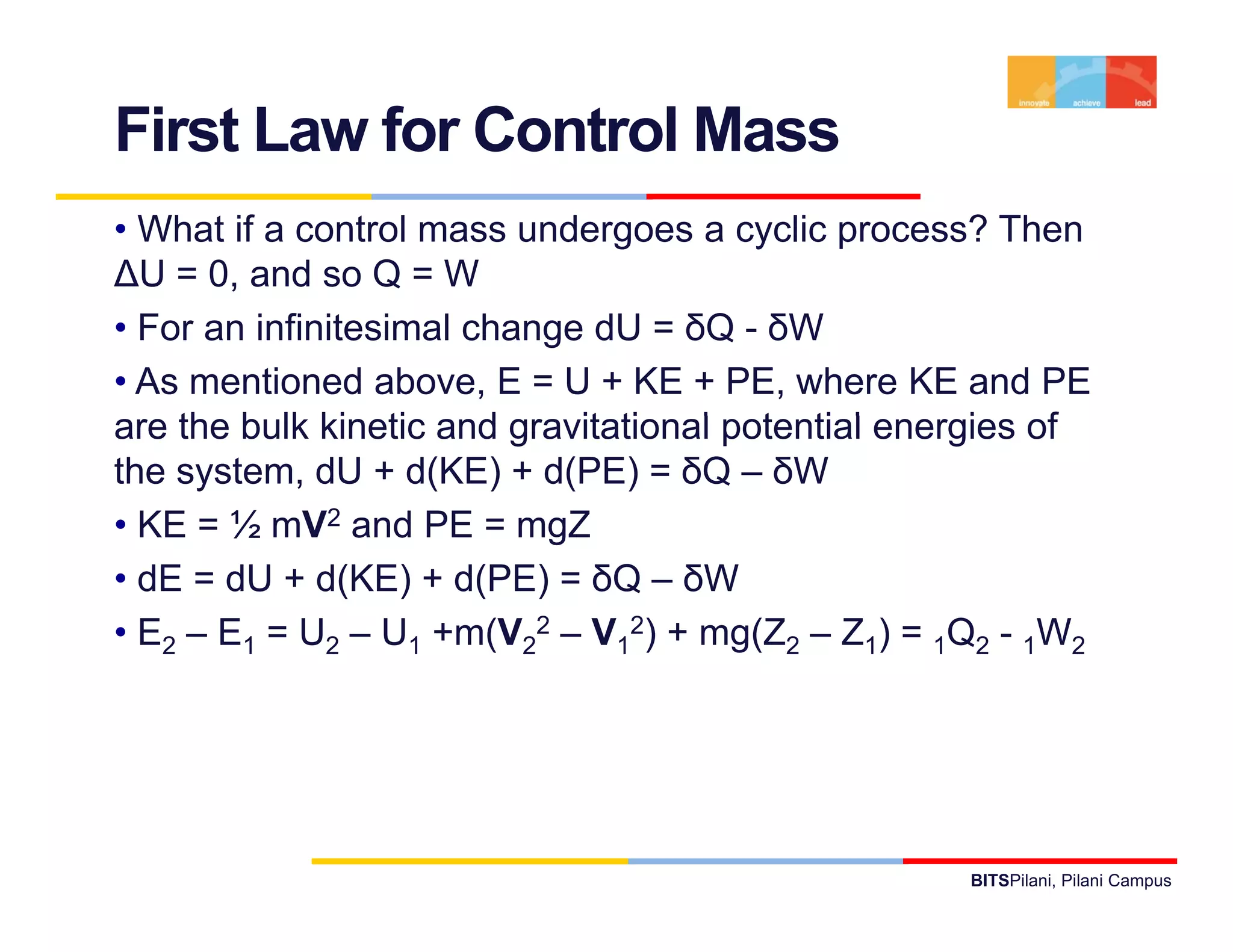
As seen above, for a closed system
∆U = U2 – U1 = - 1W2 (adiabatic, Q = 0).
∆U = U2 – U1 = 1Q2 (W = 0)
What if both work and heat terms present? Since U is a
state function
∆U = U2 – U1 = 1Q2 - 1W2
More generally since there may also changes in kinetic
energy of the system, and its potential energy in the
gravitational field, we use the total energy E = U + KE + PE,
and write
∆E = E2 – E1 = 1Q2 - 1W2, the conservation of energy
principle extended to include thermodynamic variables and
p
processes
Strictly, we must indicate the path also for W and Q
                                                    BITSPilani, Pilani Campus
First Law for Control Mass
• What if a control mass undergoes a cyclic process? Then
∆U = 0, and so Q = W
• For an infinitesimal change dU = δQ - δW
• As mentioned above, E = U + KE + PE, where KE and PE
are th bulk ki ti and gravitational potential energies of
    the b lk kinetic d       it ti  l t ti l        i    f
the system, dU + d(KE) + d(PE) = δQ – δW
• KE = ½ mV2 and PE = mgZ
• dE = dU + d(KE) + d(PE) = δQ – δW
• E2 – E1 = U2 – U1 +m(V22 – V12) + mg(Z2 – Z1) = 1Q2 - 1W2


                                                   BITSPilani, Pilani Campus
Internal Energy U
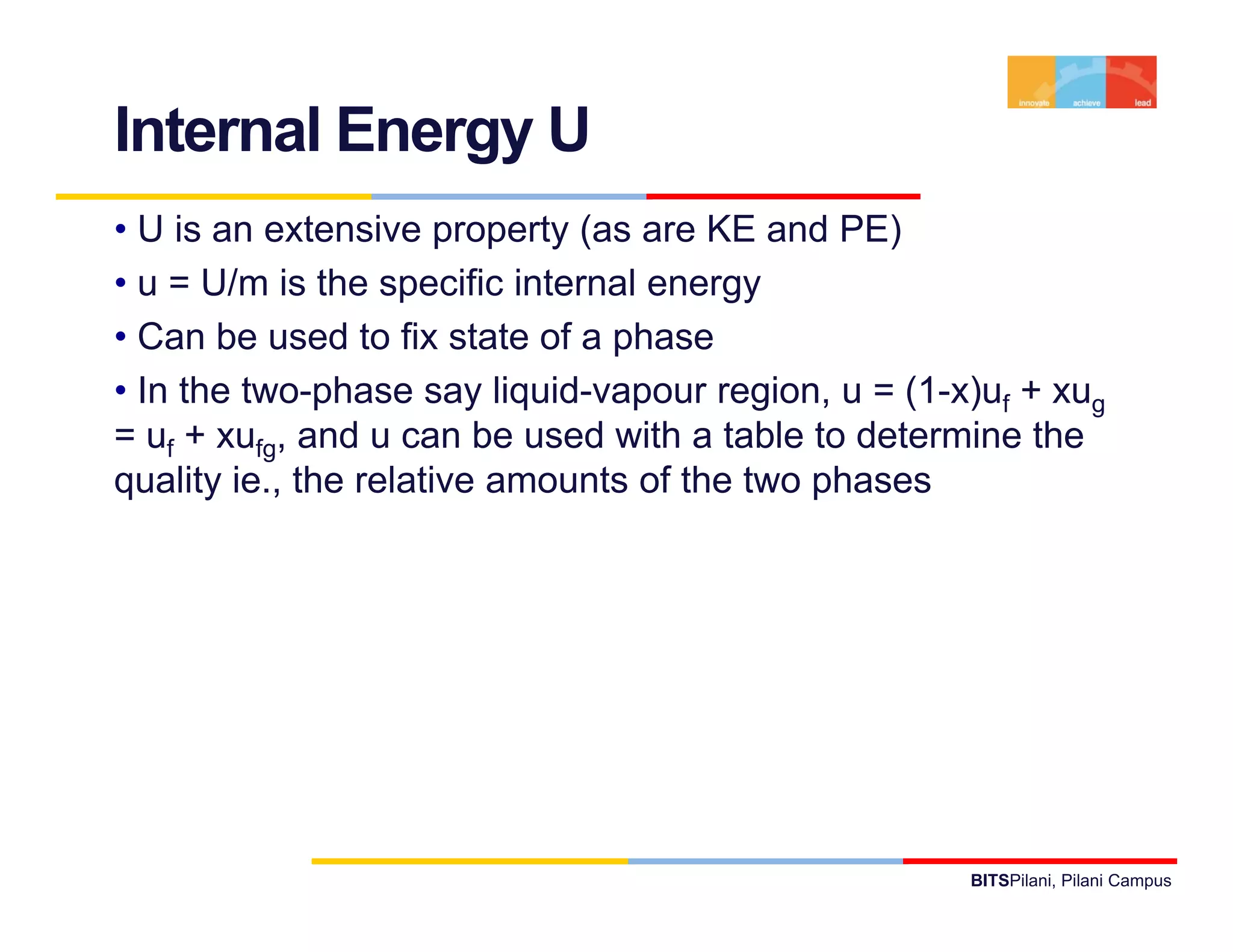
• U is an extensive property (as are KE and PE)
• u = U/m is the specific internal energy
                    p                  gy
• Can be used to fix state of a phase
• In the two-phase say liquid-vapour region, u = (1-x)uf + xug
= uf + xufg, and u can be used with a table to determine the
quality ie., the relative amounts of the two phases


                                                     BITSPilani, Pilani Campus
Problem Analysis

• Identify system, sketch diagram, show forces, and heat and
work flows

• Identify (fix) the initial state and the final state
                             state,

• Characterize the process

• Sketch the process schematically

• Identify the thermodynamic model to be used
         y            y

• What is the analysis to be done?

• What is the solution technique?

                                                         BITSPilani, Pilani Campus
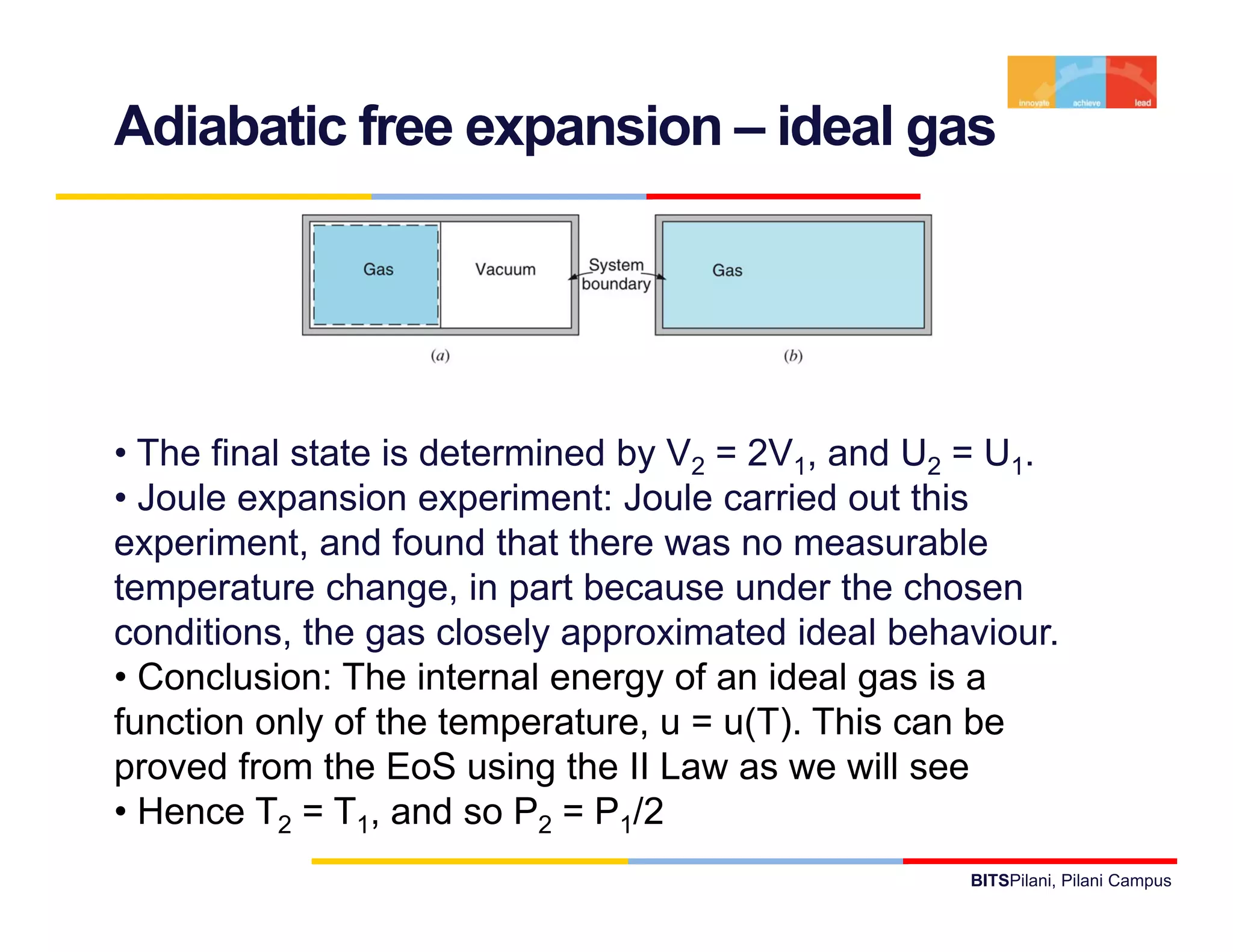
Adiabatic free expansion


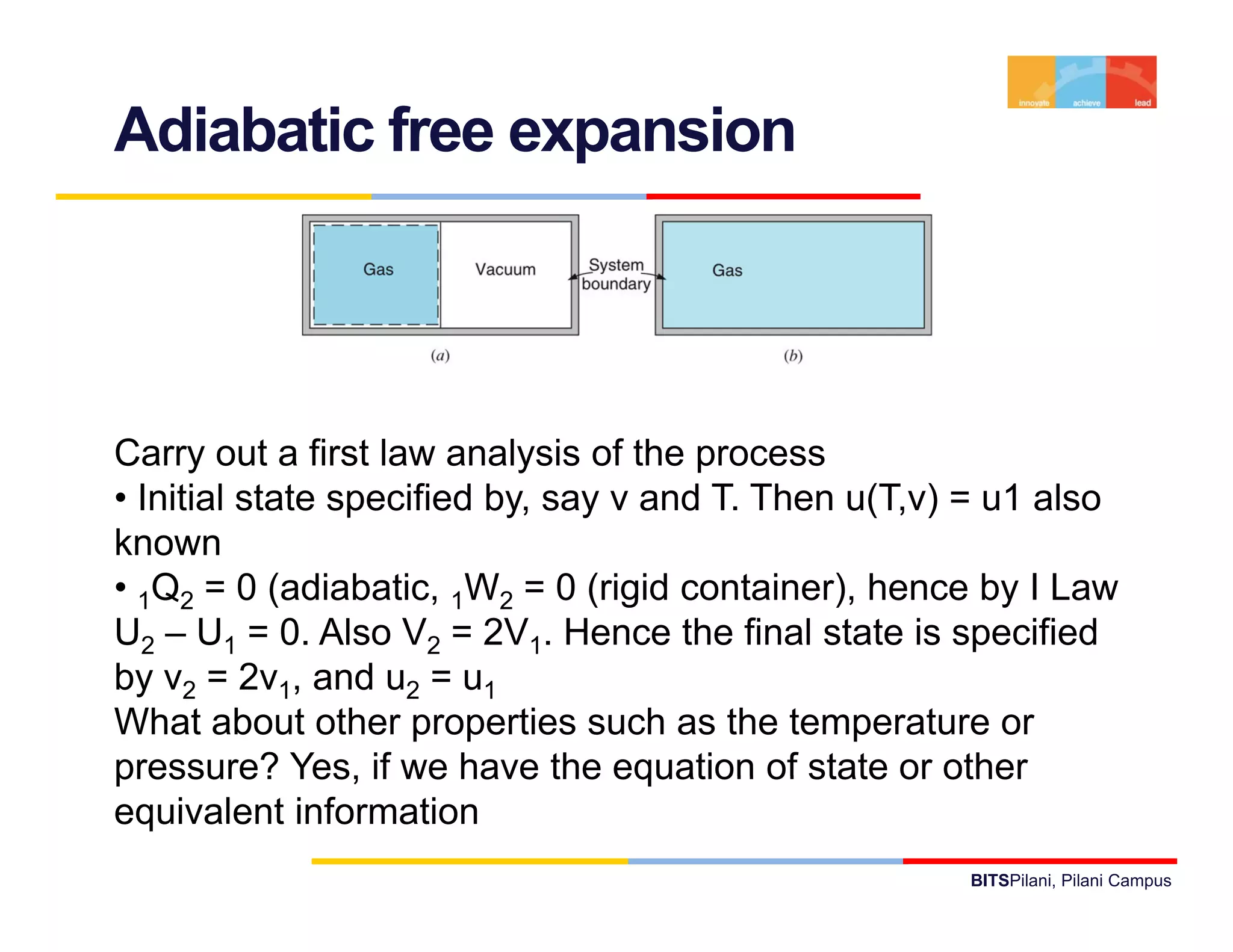
Carry out a first law analysis of the process
• Initial state specified by, say v and T. Then u(T,v) = u1 also
known
• 1Q2 = 0 (adiabatic, 1W2 = 0 (rigid container), hence by I Law
U2 – U1 = 0. Also V2 = 2V1. Hence the final state is specified
by v2 = 2v1, and u2 = u1
What about other properties such as the temperature or
pressure? Yes, if we have the equation of state or other
equivalent information
                                                      BITSPilani, Pilani Campus
Adiabatic free expansion – ideal gas


• The final state is determined by V2 = 2V1, and U2 = U1.
• Joule expansion experiment: Joule carried out this
experiment,
experiment and found that there was no measurable
temperature change, in part because under the chosen
conditions, the gas closely approximated ideal behaviour.
• Conclusion: The internal energy of an ideal gas is a
function only of the temperature, u = u(T). This can be
proved from the EoS using the II Law as we will see
• Hence T2 = T1, and so P2 = P1/2
                                                   BITSPilani, Pilani Campus
Constant Pressure Expansion
For the isobaric conversion of saturated liquid water at 100º
C to saturated vapour at the same temperature, find the
heat required per unit mass.
• The control mass is 1kg of water, in a piston-cylinder, with
the pressure set at 101 3 kPa Draw a schematic sketch
                      101.3 kPa.
• All properties of the initial and final states are fixed, and
can be read from the steam tables. Sketch the processp
• The process is isobaric, sketch it in the P-v plane (or the T-
v plane)
• Th thermodynamic model i th eos i t b l f
  The th       d      i      d l is the      in tabular form
• Analyse the system using the I Law
• Look up the internal energy values and the specific
                                  values,
volumes. Compute the work done, and thence the heat
                                                       BITSPilani, Pilani Campus
Constant Pressure Expansion - Enthalpy
• 1w2 = Psat(vg – vf), with Psat = 101.325 kPa = P1 = P2
• u2 – u1 = ug – uf
• 1q2 = ug – uf + Psat(vg – vf) = (u + Pv)2 – (u + Pv)1 (true for
any constant pressure process for a control mass).
• Define the enthalpy H = U + PV, an extensive state
function with dimensions of energy
• 1q2 = h2 – h1 where h is the enthalpy per unit mass and is
                                                    mass,
tabulated
• It is useful to define the enthalpy H, since the combination
U + PV appears naturally here. It will also arise in the
discussion of flow work


                                                        BITSPilani, Pilani Campus
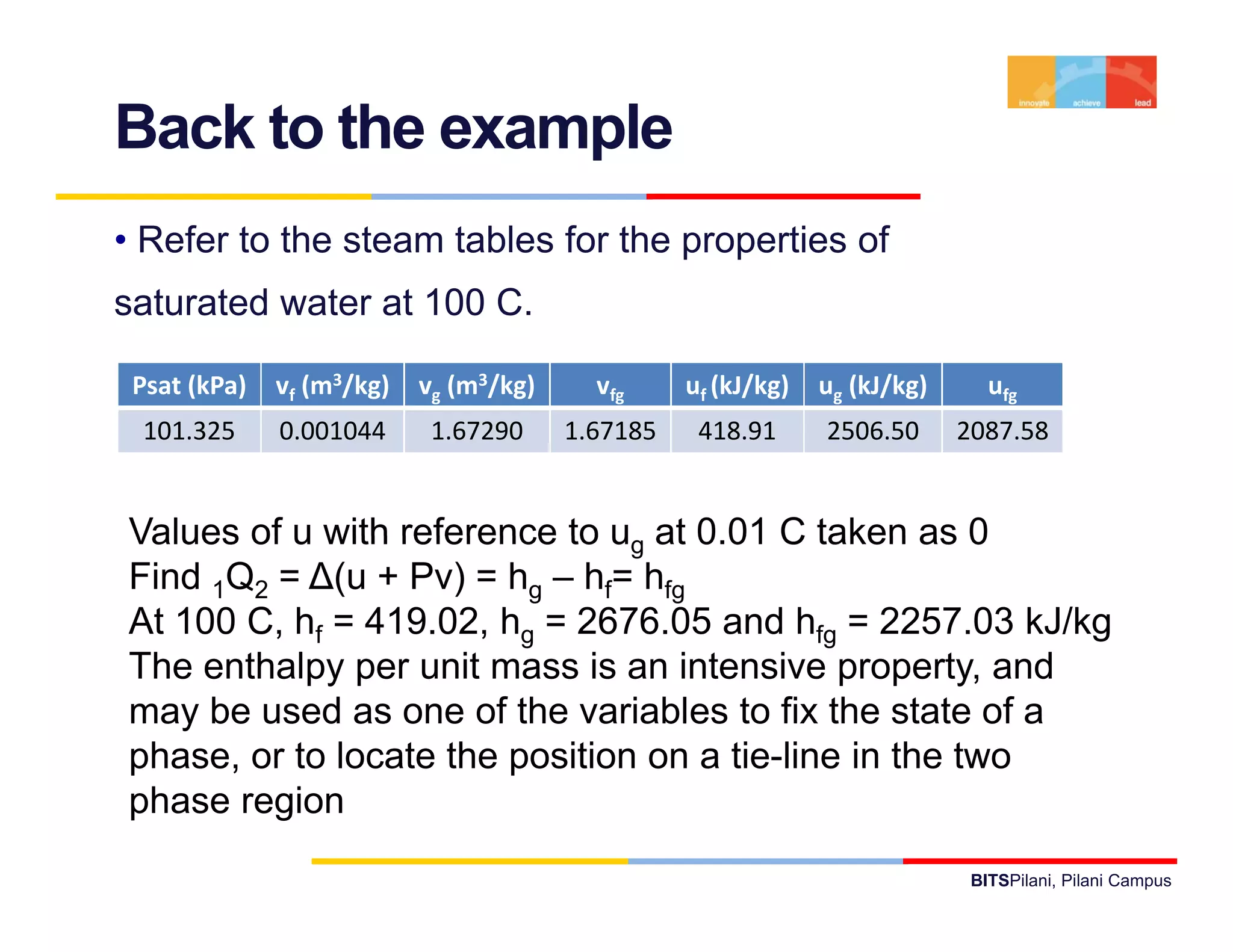
Back to the example
• Refer to the steam tables for the properties of
saturated water at 100 C
                       C.

 Psat (kPa)   vf (m3/kg)   vg (m3/kg)     vfg     uf (kJ/kg)   ug (kJ/kg)      ufg
 101.325      0.001044      1.67290     1.67185    418.91      2506.50      2087.58


Values of u with reference to ug at 0.01 C taken as 0
                                    0 01
Find 1Q2 = ∆(u + Pv) = hg – hf= hfg
At 100 C, hf = 419.02, hg = 2676.05 and hfg = 2257.03 kJ/kg
The th l
Th enthalpy per unit mass i an i t
                     it      is    intensive property, and
                                          i          t    d
may be used as one of the variables to fix the state of a
phase, or to locate the position on a tie-line in the two
phase region
                                                                             BITSPilani, Pilani Campus
Specific Heat
• Specific Heat C = 1/m (δQ/δT)

• Since Q path dependent, or δQ inexact, must specify the
path, or conditions

• Specific heat at constant volume Cv = 1/m (δQ/δT)V, which
for a simple compressible substance may be written as Cv =
1/m (∂U/∂T)V = (∂u/∂T)v

• Specific heat at constant pressure CP = 1/m (δQ/δT)P,
which for a simple compressible substance may be written
as CP = 1/m (∂H/∂T)P = (∂h/∂T)P
                                                    BITSPilani, Pilani Campus
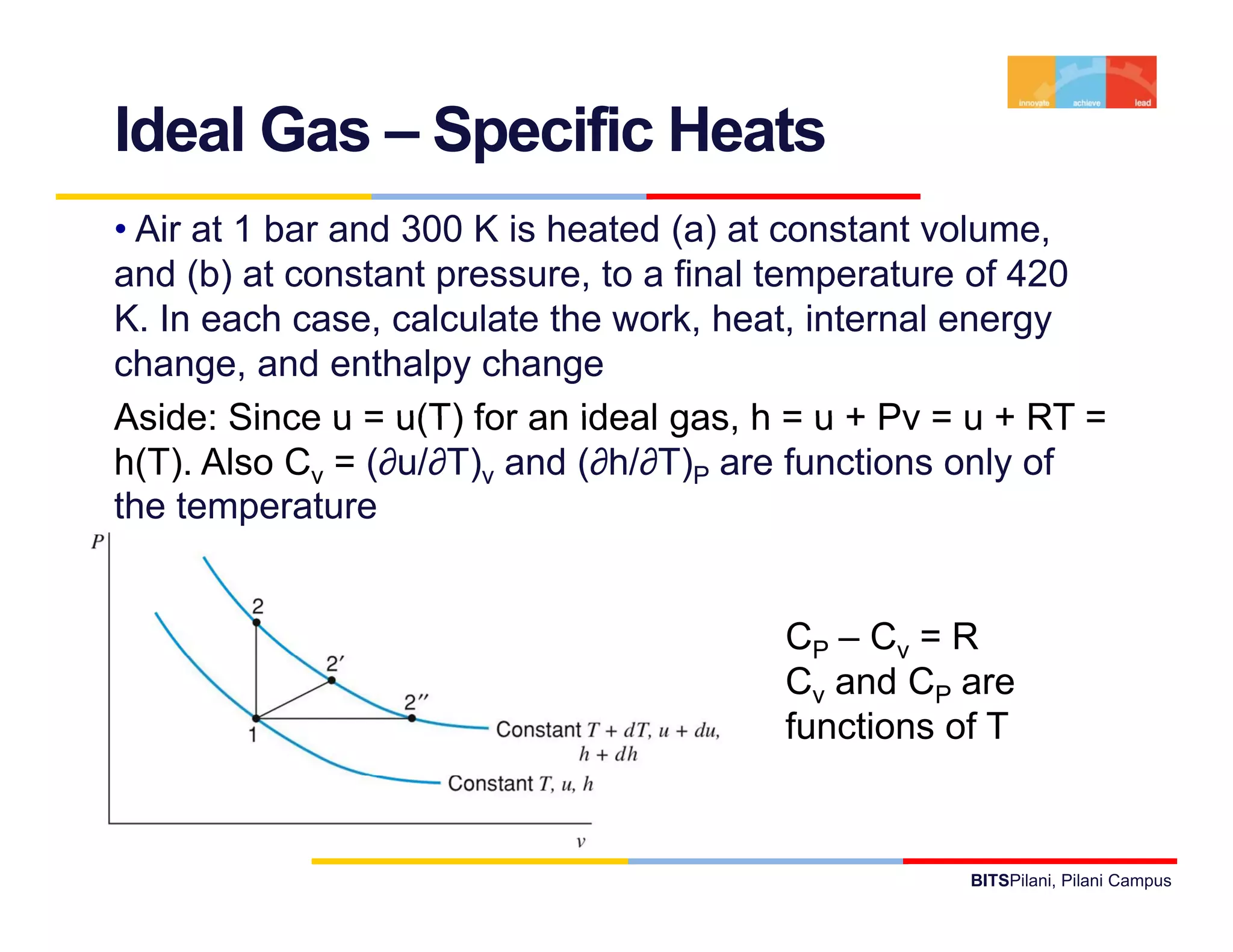
Ideal Gas – Specific Heats
• Air at 1 bar and 300 K is heated (a) at constant volume,
and (b) at constant pressure, to a final temperature of 420
K. In each case, calculate the work, heat, internal energy
change, and enthalpy change
Aside: Since u = u(T) for an ideal gas h = u + Pv = u + RT =
                                   gas,
h(T). Also Cv = (∂u/∂T)v and (∂h/∂T)P are functions only of
the temperature


                                        CP – Cv = R
                                        Cv and CP are
                                        functions of T


                                                   BITSPilani, Pilani Campus
Ideal Gas Example (contd.)
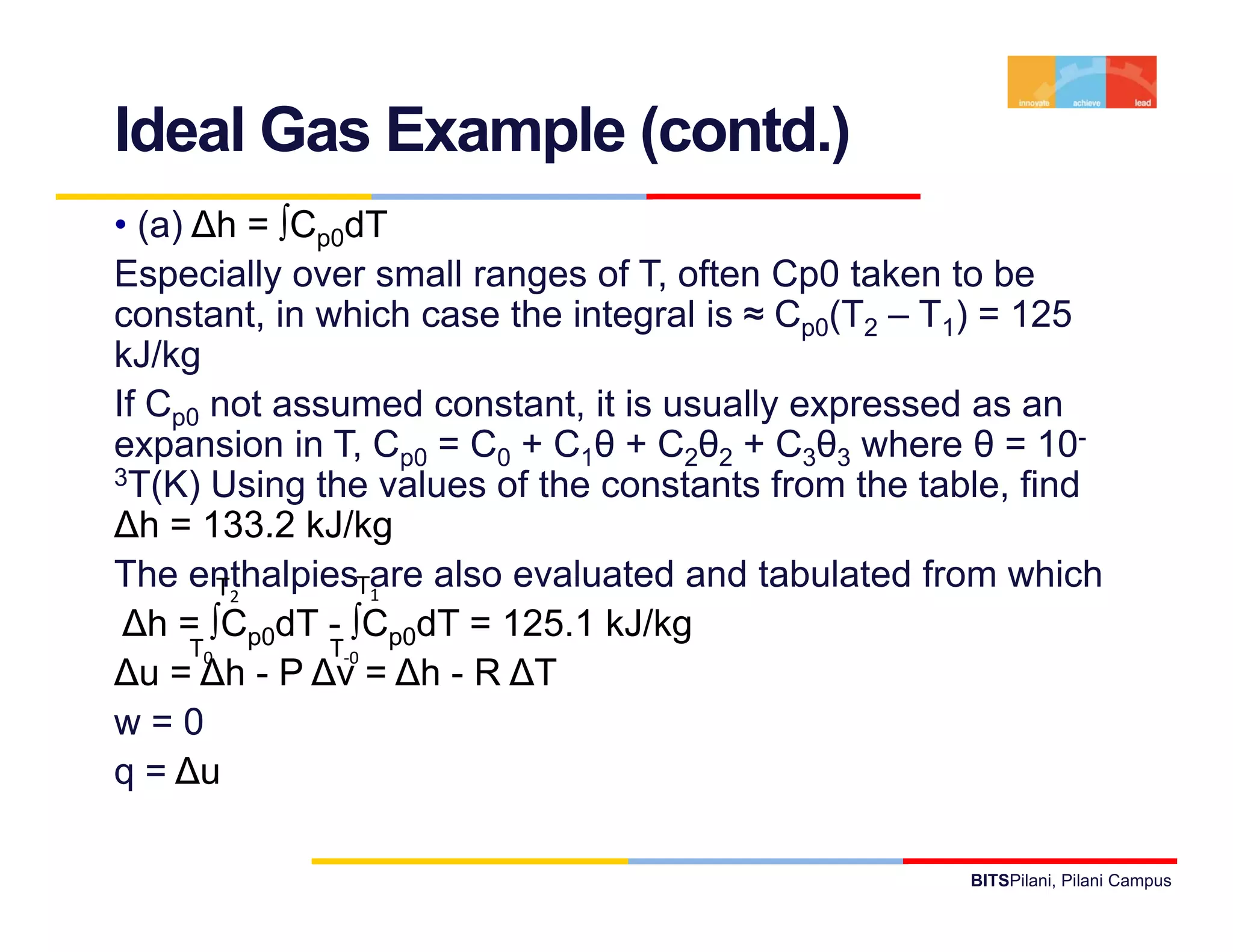
• (a) ∆h = ∫Cp0dT
Especially over small ranges of T, often Cp0 taken to be
constant, in which case the integral is ≈ Cp0(T2 – T1) = 125
kJ/kg
If Cp0 not assumed constant, it is usually expressed as an
expansion in T, Cp0 = C0 + C1θ + C2θ2 + C3θ3 where θ = 10-
3T(K) Using the values of the constants from the table, find

∆h = 133.2 kJ/kg
The enthalpiesTare also evaluated and tabulated from which
         T2       1
 ∆h = ∫Cp0dT - ∫Cp0dT = 125.1 kJ/kg
      T0      T‐0
                0
∆u = ∆h - P ∆v = ∆h - R ∆T
w=0
q = ∆u

                                                   BITSPilani, Pilani Campus
Ideal Gas Example (contd.)
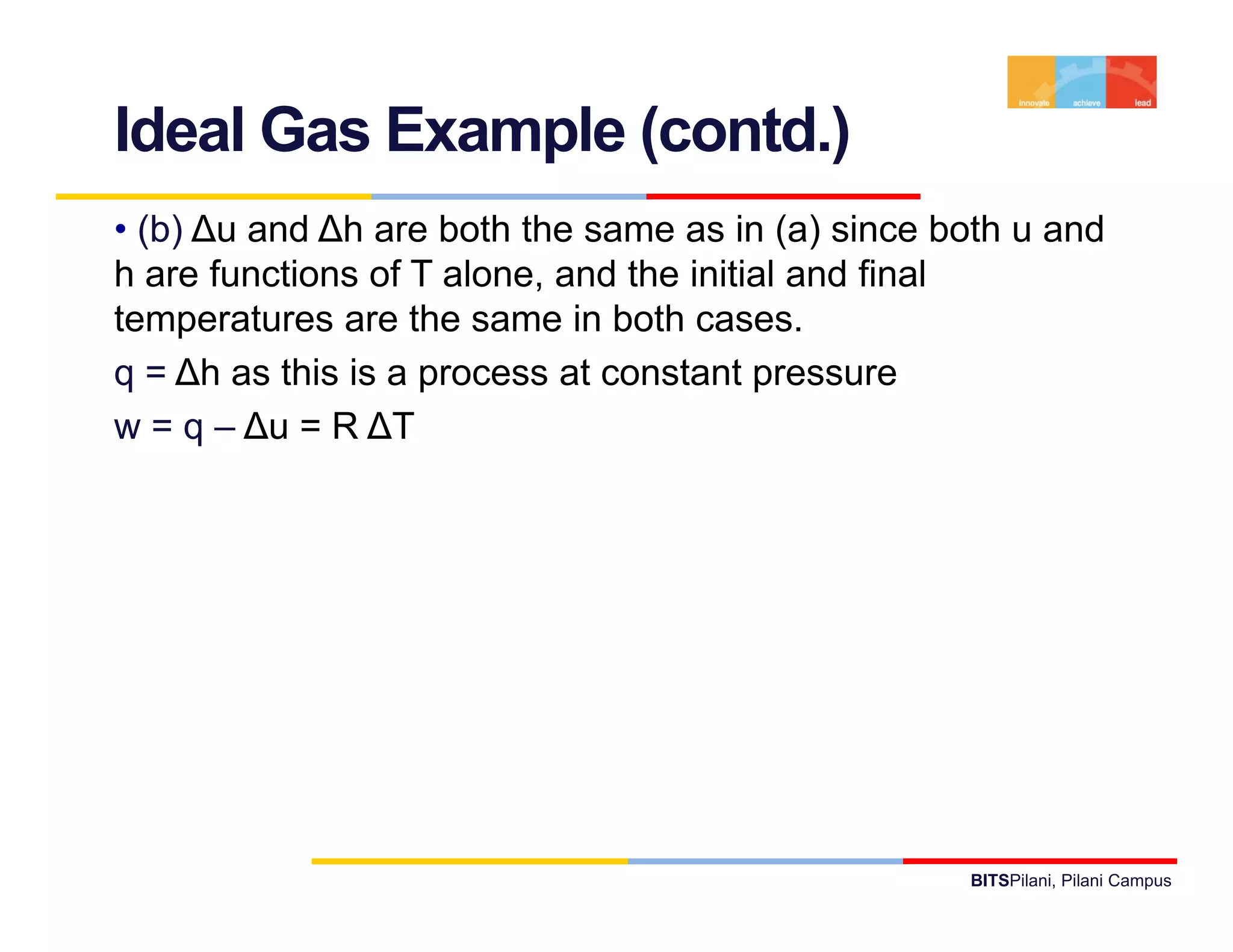
• (b) ∆u and ∆h are both the same as in (a) since both u and
h are functions of T alone, and the initial and final
temperatures are the same in both cases.
q = ∆h as this is a process at constant pressure
w = q – ∆ = R ∆T
         ∆u


                                                   BITSPilani, Pilani Campus
Liquids and Solids
• Estimate the change in internal energy u and enthalpy h
for liquid water when it is taken from the saturated liquid at
20 C to (a) 20 C and 500 kPa, (b) 40 C and 2000 kPa
Solids, and liquids away from the critical point, are highly
incompressible,
incompressible and so dv ≈ 0 is an excellent approximation
                                                approximation.
Also, the heat capacities at constant pressure and at
constant volume are virtually the same, say C.
Hence du ≈ C dT, and dh = du + d(Pv) ≈ C dT + vdP
Taking C and v as constant, one has
∆u
∆ ≈ C ∆T and ∆h ≈ C ∆T + v ∆P
         ∆T, d
(a) ∆u ≈ 0, ∆h ≈ vf ∆P ≈ 0.5 kJ/kg
(b) ∆u ≈ C ∆T = 84 kJ/kg, ∆h ≈ C ∆T + vf ∆P = 86 kJ/kg
                     kJ/kg

                                                     BITSPilani, Pilani Campus
Example
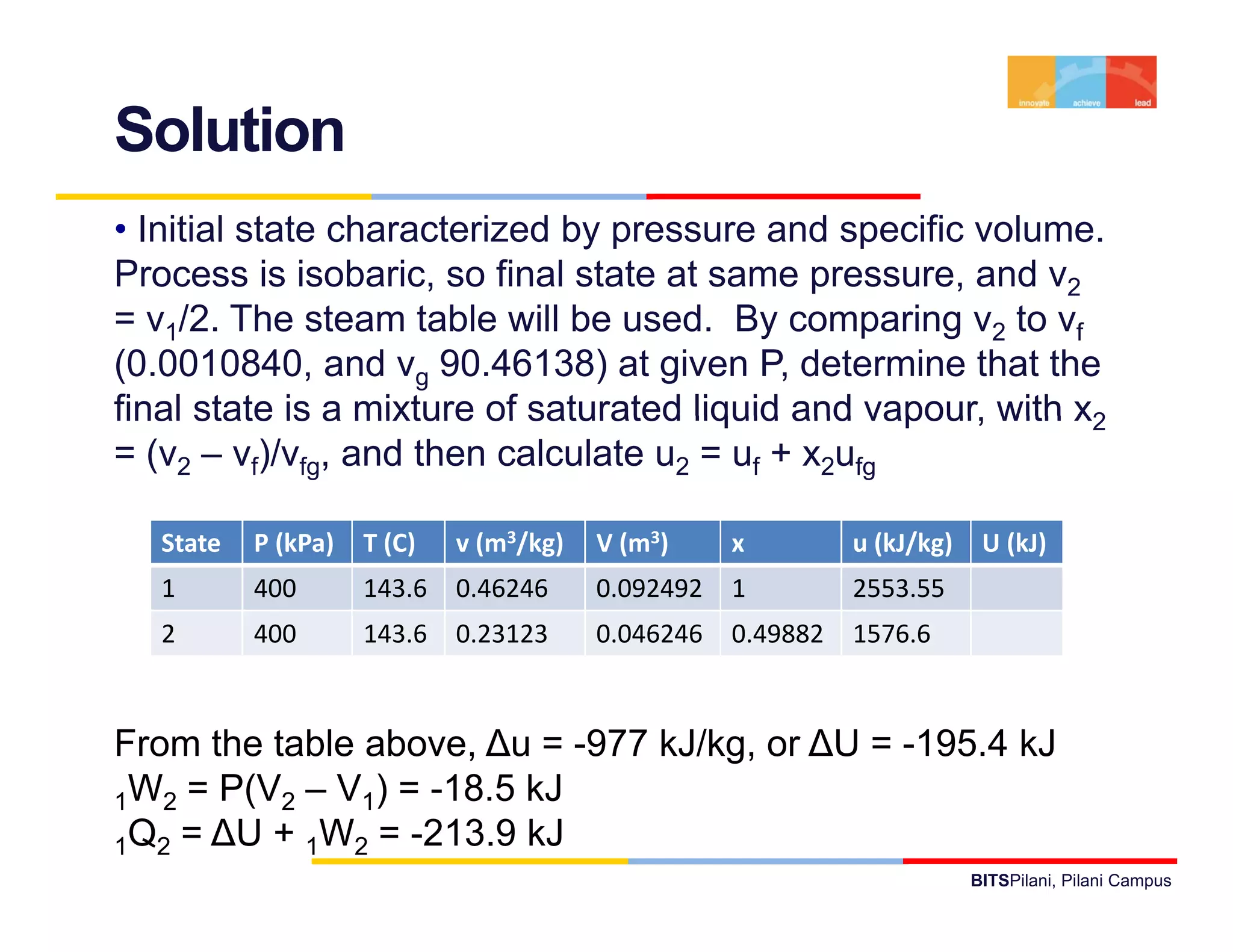
• A constant pressure piston-cylinder assembly
contains 0 20 kg water as saturated vapour at 400 kPa
         0.20                                     kPa.
It is now cooled so that the water occupies half of the
original volume. Fi d Q i th process
  i i l l        Find in the


                                                     BITSPilani, Pilani Campus
Solution
• Initial state characterized by pressure and specific volume.
Process is isobaric, so final state at same pressure, and v2
= v1/2. The steam table will be used. By comparing v2 to vf
(0.0010840, and vg 90.46138) at given P, determine that the
final state is a mixture of saturated liquid and vapour with x2
                                                  vapour,
= (v2 – vf)/vfg, and then calculate u2 = uf + x2ufg

   State
   St t    P (kP )
             (kPa)   T (C)
                     T (C)   v (m3/k )
                               ( /kg)    V ( 3)
                                         V (m       x         u (kJ/kg)
                                                                (kJ/k )    U (kJ)
                                                                           U (kJ)
   1       400       143.6   0.46246     0.092492   1         2553.55
   2       400       143.6   0.23123     0.046246   0.49882   1576.6


From the table above, ∆u = -977 kJ/kg, or ∆U = -195.4 kJ
1W2 = P(V2 – V1) = -18.5 kJ
                    18 5
1Q2 = ∆U + 1W2 = -213.9 kJ
                                                                          BITSPilani, Pilani Campus
Example
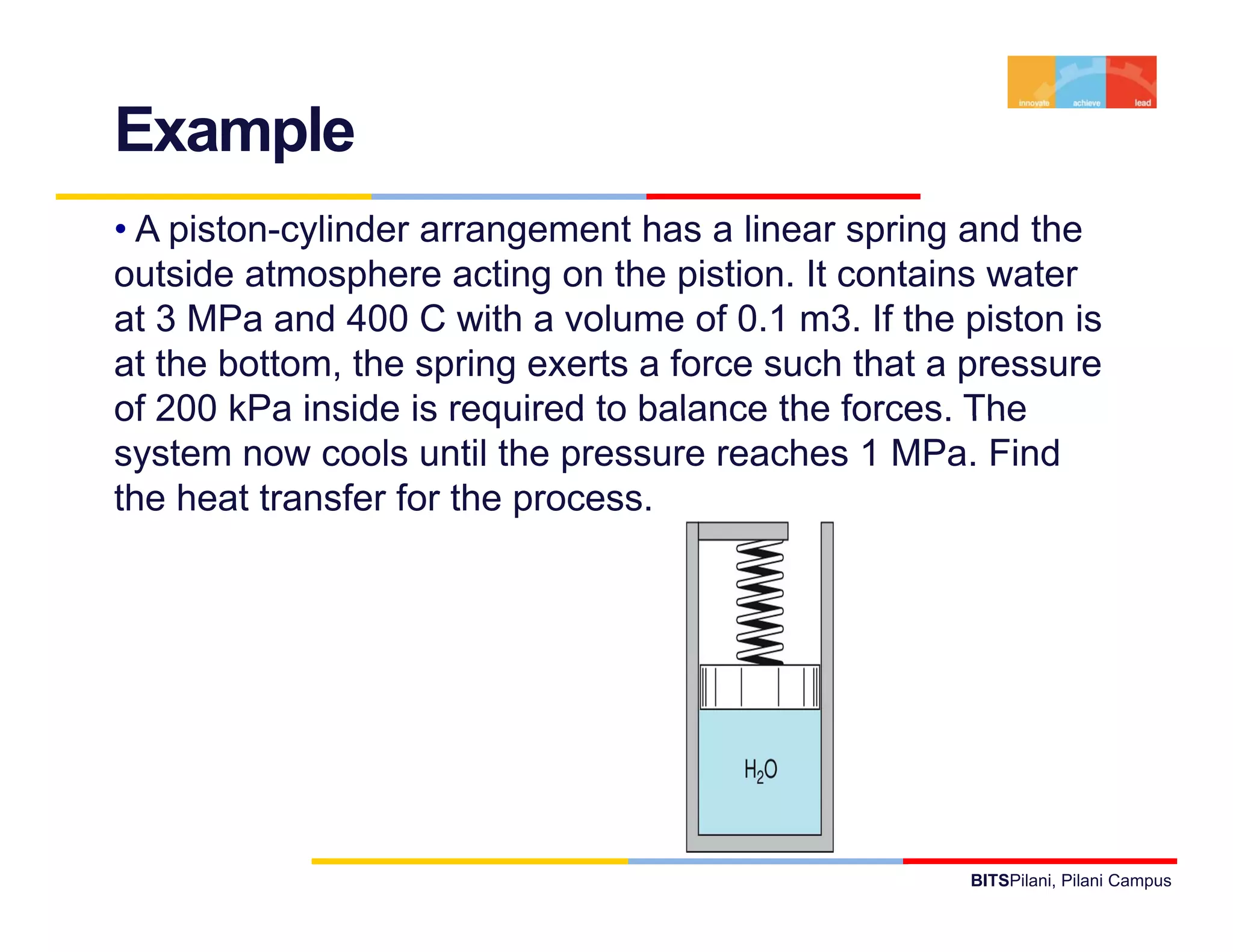
• A piston-cylinder arrangement has a linear spring and the
outside atmosphere acting on the pistion. It contains water
at 3 MPa and 400 C with a volume of 0.1 m3. If the piston is
at the bottom, the spring exerts a force such that a pressure
of 200 kPa inside is required to balance the forces The
                                             forces.
system now cools until the pressure reaches 1 MPa. Find
the heat transfer for the process.


                                                    BITSPilani, Pilani Campus
Solution
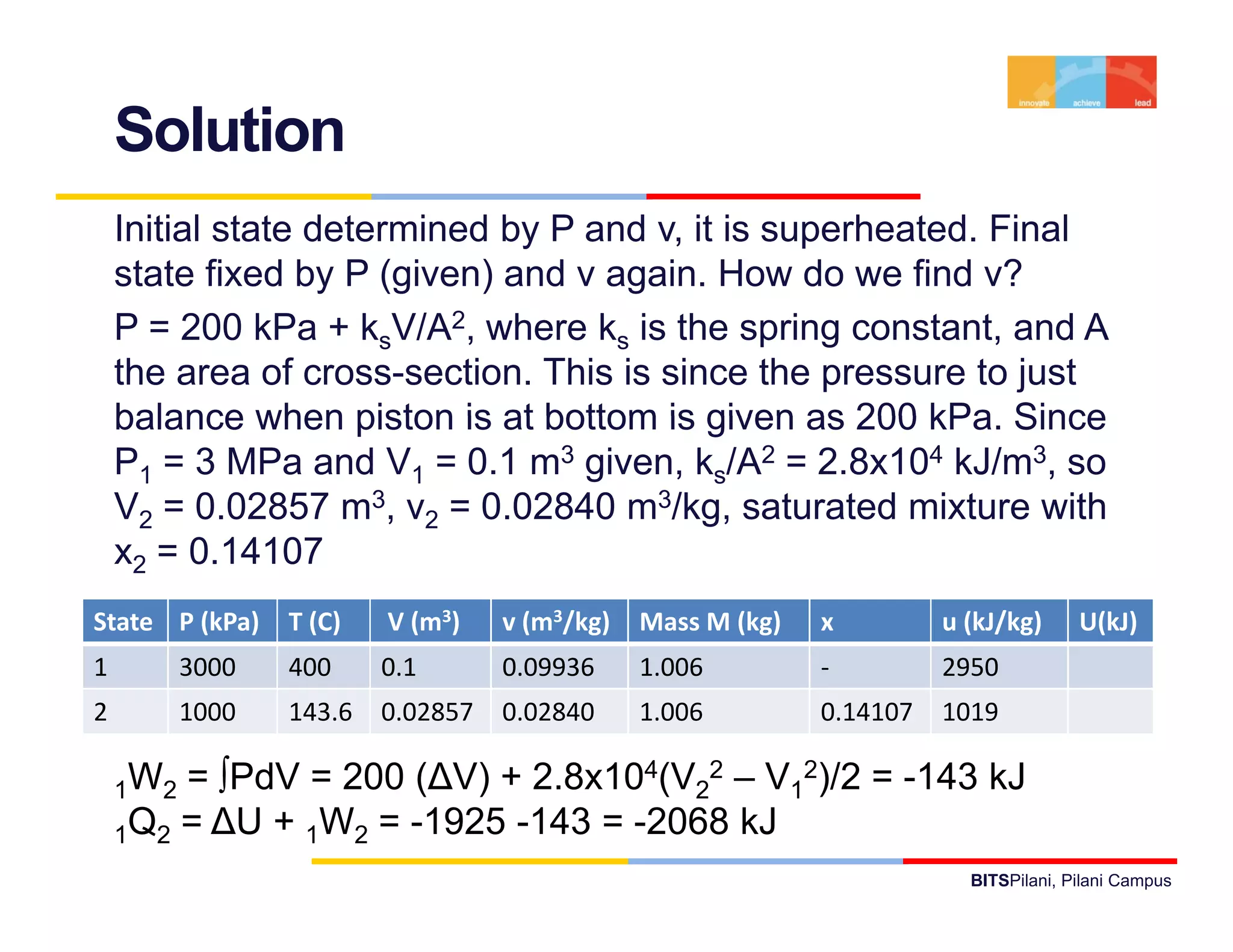
    Initial state determined by P and v, it is superheated. Final
    state fixed by P (given) and v again. How do we find v?
    P = 200 kPa + ksV/A2, where ks is the spring constant, and A
    the area of cross-section. This is since the pressure to just
    balance when piston is at bottom is given as 200 kPa Since
                                                        kPa.
    P1 = 3 MPa and V1 = 0.1 m3 given, ks/A2 = 2.8x10⁴ kJ/m3, so
    V2 = 0.02857 m3, v2 = 0.02840 m3/kg, saturated mixture with
    x2 = 0.14107
State P (kPa)    T (C)   V (m3)    v (m3/kg)   Mass M (kg)   x         u (kJ/kg)      U(kJ)
1         3000   400     0.1       0.09936     1.006         ‐         2950
2         1000   143.6   0.02857   0.02840     1.006         0.14107   1019

    1W2 = ∫PdV = 200 (∆V) + 2 8x10⁴(V22 – V12)/2 = -143 kJ
                            2.8x10                  143
    1Q2 = ∆U + 1W2 = -1925 -143 = -2068 kJ
                                                                         BITSPilani, Pilani Campus

Thermodynamics lecture 9

  • 1.
    BITS Pil i Pilani Pilani Campus Lecture 9 – Fi t Law for Control Mass L t First L f C t l M
  • 2.
    First Law forControl Mass As seen above, for a closed system ∆U = U2 – U1 = - 1W2 (adiabatic, Q = 0). ∆U = U2 – U1 = 1Q2 (W = 0) What if both work and heat terms present? Since U is a state function ∆U = U2 – U1 = 1Q2 - 1W2 More generally since there may also changes in kinetic energy of the system, and its potential energy in the gravitational field, we use the total energy E = U + KE + PE, and write ∆E = E2 – E1 = 1Q2 - 1W2, the conservation of energy principle extended to include thermodynamic variables and p processes Strictly, we must indicate the path also for W and Q BITSPilani, Pilani Campus
  • 3.
    First Law forControl Mass • What if a control mass undergoes a cyclic process? Then ∆U = 0, and so Q = W • For an infinitesimal change dU = δQ - δW • As mentioned above, E = U + KE + PE, where KE and PE are th bulk ki ti and gravitational potential energies of the b lk kinetic d it ti l t ti l i f the system, dU + d(KE) + d(PE) = δQ – δW • KE = ½ mV2 and PE = mgZ • dE = dU + d(KE) + d(PE) = δQ – δW • E2 – E1 = U2 – U1 +m(V22 – V12) + mg(Z2 – Z1) = 1Q2 - 1W2 BITSPilani, Pilani Campus
  • 4.
    Internal Energy U •U is an extensive property (as are KE and PE) • u = U/m is the specific internal energy p gy • Can be used to fix state of a phase • In the two-phase say liquid-vapour region, u = (1-x)uf + xug = uf + xufg, and u can be used with a table to determine the quality ie., the relative amounts of the two phases BITSPilani, Pilani Campus
  • 5.
    Problem Analysis • Identifysystem, sketch diagram, show forces, and heat and work flows • Identify (fix) the initial state and the final state state, • Characterize the process • Sketch the process schematically • Identify the thermodynamic model to be used y y • What is the analysis to be done? • What is the solution technique? BITSPilani, Pilani Campus
  • 6.
    Adiabatic free expansion Carryout a first law analysis of the process • Initial state specified by, say v and T. Then u(T,v) = u1 also known • 1Q2 = 0 (adiabatic, 1W2 = 0 (rigid container), hence by I Law U2 – U1 = 0. Also V2 = 2V1. Hence the final state is specified by v2 = 2v1, and u2 = u1 What about other properties such as the temperature or pressure? Yes, if we have the equation of state or other equivalent information BITSPilani, Pilani Campus
  • 7.
    Adiabatic free expansion– ideal gas • The final state is determined by V2 = 2V1, and U2 = U1. • Joule expansion experiment: Joule carried out this experiment, experiment and found that there was no measurable temperature change, in part because under the chosen conditions, the gas closely approximated ideal behaviour. • Conclusion: The internal energy of an ideal gas is a function only of the temperature, u = u(T). This can be proved from the EoS using the II Law as we will see • Hence T2 = T1, and so P2 = P1/2 BITSPilani, Pilani Campus
  • 8.
    Constant Pressure Expansion Forthe isobaric conversion of saturated liquid water at 100º C to saturated vapour at the same temperature, find the heat required per unit mass. • The control mass is 1kg of water, in a piston-cylinder, with the pressure set at 101 3 kPa Draw a schematic sketch 101.3 kPa. • All properties of the initial and final states are fixed, and can be read from the steam tables. Sketch the processp • The process is isobaric, sketch it in the P-v plane (or the T- v plane) • Th thermodynamic model i th eos i t b l f The th d i d l is the in tabular form • Analyse the system using the I Law • Look up the internal energy values and the specific values, volumes. Compute the work done, and thence the heat BITSPilani, Pilani Campus
  • 9.
    Constant Pressure Expansion- Enthalpy • 1w2 = Psat(vg – vf), with Psat = 101.325 kPa = P1 = P2 • u2 – u1 = ug – uf • 1q2 = ug – uf + Psat(vg – vf) = (u + Pv)2 – (u + Pv)1 (true for any constant pressure process for a control mass). • Define the enthalpy H = U + PV, an extensive state function with dimensions of energy • 1q2 = h2 – h1 where h is the enthalpy per unit mass and is mass, tabulated • It is useful to define the enthalpy H, since the combination U + PV appears naturally here. It will also arise in the discussion of flow work BITSPilani, Pilani Campus
  • 10.
    Back to theexample • Refer to the steam tables for the properties of saturated water at 100 C C. Psat (kPa) vf (m3/kg) vg (m3/kg) vfg uf (kJ/kg) ug (kJ/kg) ufg 101.325 0.001044 1.67290 1.67185 418.91 2506.50 2087.58 Values of u with reference to ug at 0.01 C taken as 0 0 01 Find 1Q2 = ∆(u + Pv) = hg – hf= hfg At 100 C, hf = 419.02, hg = 2676.05 and hfg = 2257.03 kJ/kg The th l Th enthalpy per unit mass i an i t it is intensive property, and i t d may be used as one of the variables to fix the state of a phase, or to locate the position on a tie-line in the two phase region BITSPilani, Pilani Campus
  • 11.
    Specific Heat • SpecificHeat C = 1/m (δQ/δT) • Since Q path dependent, or δQ inexact, must specify the path, or conditions • Specific heat at constant volume Cv = 1/m (δQ/δT)V, which for a simple compressible substance may be written as Cv = 1/m (∂U/∂T)V = (∂u/∂T)v • Specific heat at constant pressure CP = 1/m (δQ/δT)P, which for a simple compressible substance may be written as CP = 1/m (∂H/∂T)P = (∂h/∂T)P BITSPilani, Pilani Campus
  • 12.
    Ideal Gas –Specific Heats • Air at 1 bar and 300 K is heated (a) at constant volume, and (b) at constant pressure, to a final temperature of 420 K. In each case, calculate the work, heat, internal energy change, and enthalpy change Aside: Since u = u(T) for an ideal gas h = u + Pv = u + RT = gas, h(T). Also Cv = (∂u/∂T)v and (∂h/∂T)P are functions only of the temperature CP – Cv = R Cv and CP are functions of T BITSPilani, Pilani Campus
  • 13.
    Ideal Gas Example(contd.) • (a) ∆h = ∫Cp0dT Especially over small ranges of T, often Cp0 taken to be constant, in which case the integral is ≈ Cp0(T2 – T1) = 125 kJ/kg If Cp0 not assumed constant, it is usually expressed as an expansion in T, Cp0 = C0 + C1θ + C2θ2 + C3θ3 where θ = 10- 3T(K) Using the values of the constants from the table, find ∆h = 133.2 kJ/kg The enthalpiesTare also evaluated and tabulated from which T2 1 ∆h = ∫Cp0dT - ∫Cp0dT = 125.1 kJ/kg T0 T‐0 0 ∆u = ∆h - P ∆v = ∆h - R ∆T w=0 q = ∆u BITSPilani, Pilani Campus
  • 14.
    Ideal Gas Example(contd.) • (b) ∆u and ∆h are both the same as in (a) since both u and h are functions of T alone, and the initial and final temperatures are the same in both cases. q = ∆h as this is a process at constant pressure w = q – ∆ = R ∆T ∆u BITSPilani, Pilani Campus
  • 15.
    Liquids and Solids •Estimate the change in internal energy u and enthalpy h for liquid water when it is taken from the saturated liquid at 20 C to (a) 20 C and 500 kPa, (b) 40 C and 2000 kPa Solids, and liquids away from the critical point, are highly incompressible, incompressible and so dv ≈ 0 is an excellent approximation approximation. Also, the heat capacities at constant pressure and at constant volume are virtually the same, say C. Hence du ≈ C dT, and dh = du + d(Pv) ≈ C dT + vdP Taking C and v as constant, one has ∆u ∆ ≈ C ∆T and ∆h ≈ C ∆T + v ∆P ∆T, d (a) ∆u ≈ 0, ∆h ≈ vf ∆P ≈ 0.5 kJ/kg (b) ∆u ≈ C ∆T = 84 kJ/kg, ∆h ≈ C ∆T + vf ∆P = 86 kJ/kg kJ/kg BITSPilani, Pilani Campus
  • 16.
    Example • A constantpressure piston-cylinder assembly contains 0 20 kg water as saturated vapour at 400 kPa 0.20 kPa. It is now cooled so that the water occupies half of the original volume. Fi d Q i th process i i l l Find in the BITSPilani, Pilani Campus
  • 17.
    Solution • Initial statecharacterized by pressure and specific volume. Process is isobaric, so final state at same pressure, and v2 = v1/2. The steam table will be used. By comparing v2 to vf (0.0010840, and vg 90.46138) at given P, determine that the final state is a mixture of saturated liquid and vapour with x2 vapour, = (v2 – vf)/vfg, and then calculate u2 = uf + x2ufg State St t P (kP ) (kPa) T (C) T (C) v (m3/k ) ( /kg) V ( 3) V (m x u (kJ/kg) (kJ/k ) U (kJ) U (kJ) 1 400 143.6 0.46246 0.092492 1 2553.55 2 400 143.6 0.23123 0.046246 0.49882 1576.6 From the table above, ∆u = -977 kJ/kg, or ∆U = -195.4 kJ 1W2 = P(V2 – V1) = -18.5 kJ 18 5 1Q2 = ∆U + 1W2 = -213.9 kJ BITSPilani, Pilani Campus
  • 18.
    Example • A piston-cylinderarrangement has a linear spring and the outside atmosphere acting on the pistion. It contains water at 3 MPa and 400 C with a volume of 0.1 m3. If the piston is at the bottom, the spring exerts a force such that a pressure of 200 kPa inside is required to balance the forces The forces. system now cools until the pressure reaches 1 MPa. Find the heat transfer for the process. BITSPilani, Pilani Campus
  • 19.
    Solution Initial state determined by P and v, it is superheated. Final state fixed by P (given) and v again. How do we find v? P = 200 kPa + ksV/A2, where ks is the spring constant, and A the area of cross-section. This is since the pressure to just balance when piston is at bottom is given as 200 kPa Since kPa. P1 = 3 MPa and V1 = 0.1 m3 given, ks/A2 = 2.8x10⁴ kJ/m3, so V2 = 0.02857 m3, v2 = 0.02840 m3/kg, saturated mixture with x2 = 0.14107 State P (kPa) T (C) V (m3) v (m3/kg) Mass M (kg) x u (kJ/kg) U(kJ) 1 3000 400 0.1 0.09936 1.006 ‐ 2950 2 1000 143.6 0.02857 0.02840 1.006 0.14107 1019 1W2 = ∫PdV = 200 (∆V) + 2 8x10⁴(V22 – V12)/2 = -143 kJ 2.8x10 143 1Q2 = ∆U + 1W2 = -1925 -143 = -2068 kJ BITSPilani, Pilani Campus