THERMO-ANALYTICAL
TECHNIQUES
Presented by,
Miss. Sanmati Dilip Shete.
M . Pharm first year ,
Department Of Quality Assurance
Rajarambapu college of Pharmacy, kasegaon
11/20/2017
1
INTRODUCTION
 Thermo-analytical methods occupy a prominent
position.
 There are many analytical methods wherein use of
thermal coefficient involved
 They do not provide analytical information
11/20/2017
2
DIFFERENCE BETWEEN THERMO-ANALYTICAL
TECHNIQUES ANDANALYTICALTECHNIQUES
11/20/2017
3
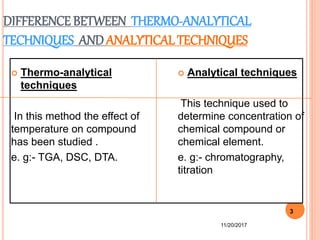
 Thermo-analytical
techniques
In this method the effect of
temperature on compound
has been studied .
e. g:- TGA, DSC, DTA.
 Analytical techniques
This technique used to
determine concentration of
chemical compound or
chemical element.
e. g:- chromatography,
titration
CLASSIFICATION
11/20/2017
4
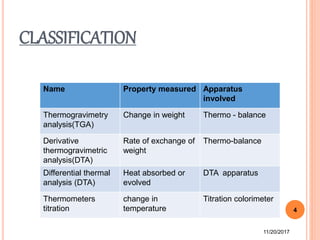
Name Property measured Apparatus
involved
Thermogravimetry
analysis(TGA)
Change in weight Thermo - balance
Derivative
thermogravimetric
analysis(DTA)
Rate of exchange of
weight
Thermo-balance
Differential thermal
analysis (DTA)
Heat absorbed or
evolved
DTA apparatus
Thermometers
titration
change in
temperature
Titration colorimeter
TGA
 TGA means thermogravimetric analysis.
 In gravimetric analysis, ignition or heating of a
precipitate or residue is carried out on a burner or in
oven at fixed temperature .(100º-200ºC)
 This method, though satisfactory in determining the
final change at the highest temperature
 This method not give any idea of the intermediate
formed or obtained at varying temperature of flame
11/20/2017
5
PRINCIPLE:
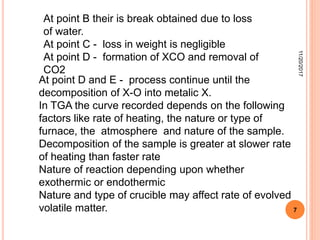
This can be illustrated by taking a
hypothetical compound XCO32H2O
and heating it in a linearly programed
furnace and recording the loss in
weight by thermo balance. When loss
in weight verses increasing
temperature plotted the graph will
obtained as follow :
It will be evident that at point A their is
loss water molecule
At point B their is break obtained due
to loss of water.
At point C - loss in weight is negligible
At point D - formation of XCO and
removal of CO2
11/20/2017
6
At point D and E - process continue until the
decomposition of X-O into metalic X.
In TGA the curve recorded depends on the following
factors like rate of heating, the nature or type of
furnace, the atmosphere and nature of the sample.
Decomposition of the sample is greater at slower rate
of heating than faster rate
Nature of reaction depending upon whether
exothermic or endothermic
Nature and type of crucible may affect rate of evolved
volatile matter.
At point B their is break obtained due to loss
of water.
At point C - loss in weight is negligible
At point D - formation of XCO and removal of
CO2
11/20/2017
7
INSTRUMENTATION
11/20/2017
8
11/20/2017
9
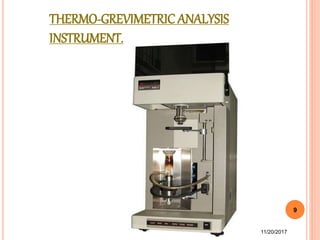
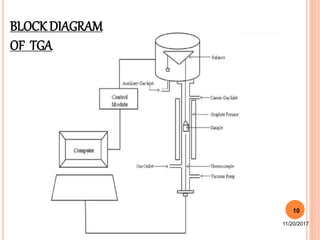
THERMO-GREVIMETRIC ANALYSIS
INSTRUMENT.
11/20/2017
10
BLOCKDIAGRAM
OF TGA
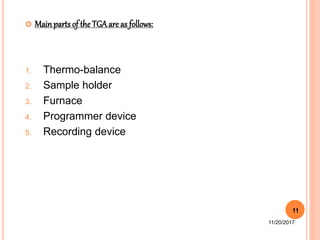
 Mainparts of the TGAare as follows:
1. Thermo-balance
2. Sample holder
3. Furnace
4. Programmer device
5. Recording device
11/20/2017
11
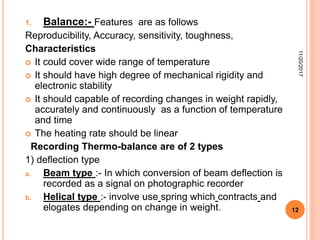
1. Balance:- Features are as follows
Reproducibility, Accuracy, sensitivity, toughness,
Characteristics
 It could cover wide range of temperature
 It should have high degree of mechanical rigidity and
electronic stability
 It should capable of recording changes in weight rapidly,
accurately and continuously as a function of temperature
and time
 The heating rate should be linear
Recording Thermo-balance are of 2 types
1) deflection type
a. Beam type :- In which conversion of beam deflection is
recorded as a signal on photographic recorder
b. Helical type :- involve use spring which contracts and
elogates depending on change in weight.
11/20/2017
12
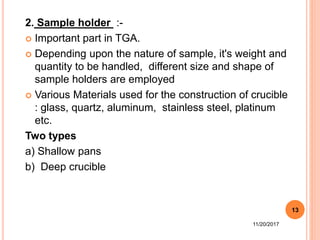
2. Sample holder :-
 Important part in TGA.
 Depending upon the nature of sample, it's weight and
quantity to be handled, different size and shape of
sample holders are employed
 Various Materials used for the construction of crucible
: glass, quartz, aluminum, stainless steel, platinum
etc.
Two types
a) Shallow pans
b) Deep crucible
11/20/2017
13
3. Furnace :-
 These are made from high quality metal and vary in
shape and size
 Temperature :-1000º-2000ºC or by temperature control
panel
 Linear and fixed temperature maintained by use of
thermocouples
4 . Furnace temperature programmer :-
These controls gradual rise in temperature at a fixed rate
Device has course and fine control kinds which maintain
the temperature
5.Recorder :-
Having strip and pen mechanism w.
Electrical supply duly amplified is fed to recorder chart
Speed variable.
11/20/2017
14
APPLICATION
1)Stability studies
2)Oxidation and Combustion reaction
3) Combined Operation [ TGA with mass
spectroscopy]
4)Pharmacokinetics Studies
11/20/2017
15
FACTORS AFFECTINGTHERMO-
GRAVIMETRIC RESULTS
1. Instrumental factor.
2. Characteristics of sample.
11/20/2017
16
1)Instrumental factor :-
These include various aspects of instruments like
furnace heating, recording of changes on chart, furnace
atmosphere, sample holder and its geometry means
deep crucible and shallow pan.
11/20/2017
17
2)Characteristics of Sample :-
Important factors about the sample are:
Wt. Of sample
Particle size of sample
Nature of evolved gas
Thermal conductivity of sample
Heat of decomposition of the reaction
11/20/2017
18
11/20/2017
19

Thermoanalytical Techniques

  • 1.
    THERMO-ANALYTICAL TECHNIQUES Presented by, Miss. SanmatiDilip Shete. M . Pharm first year , Department Of Quality Assurance Rajarambapu college of Pharmacy, kasegaon 11/20/2017 1
  • 2.
    INTRODUCTION  Thermo-analytical methodsoccupy a prominent position.  There are many analytical methods wherein use of thermal coefficient involved  They do not provide analytical information 11/20/2017 2
  • 3.
    DIFFERENCE BETWEEN THERMO-ANALYTICAL TECHNIQUESANDANALYTICALTECHNIQUES 11/20/2017 3  Thermo-analytical techniques In this method the effect of temperature on compound has been studied . e. g:- TGA, DSC, DTA.  Analytical techniques This technique used to determine concentration of chemical compound or chemical element. e. g:- chromatography, titration
  • 4.
    CLASSIFICATION 11/20/2017 4 Name Property measuredApparatus involved Thermogravimetry analysis(TGA) Change in weight Thermo - balance Derivative thermogravimetric analysis(DTA) Rate of exchange of weight Thermo-balance Differential thermal analysis (DTA) Heat absorbed or evolved DTA apparatus Thermometers titration change in temperature Titration colorimeter
  • 5.
    TGA  TGA meansthermogravimetric analysis.  In gravimetric analysis, ignition or heating of a precipitate or residue is carried out on a burner or in oven at fixed temperature .(100º-200ºC)  This method, though satisfactory in determining the final change at the highest temperature  This method not give any idea of the intermediate formed or obtained at varying temperature of flame 11/20/2017 5
  • 6.
    PRINCIPLE: This can beillustrated by taking a hypothetical compound XCO32H2O and heating it in a linearly programed furnace and recording the loss in weight by thermo balance. When loss in weight verses increasing temperature plotted the graph will obtained as follow : It will be evident that at point A their is loss water molecule At point B their is break obtained due to loss of water. At point C - loss in weight is negligible At point D - formation of XCO and removal of CO2 11/20/2017 6
  • 7.
    At point Dand E - process continue until the decomposition of X-O into metalic X. In TGA the curve recorded depends on the following factors like rate of heating, the nature or type of furnace, the atmosphere and nature of the sample. Decomposition of the sample is greater at slower rate of heating than faster rate Nature of reaction depending upon whether exothermic or endothermic Nature and type of crucible may affect rate of evolved volatile matter. At point B their is break obtained due to loss of water. At point C - loss in weight is negligible At point D - formation of XCO and removal of CO2 11/20/2017 7
  • 8.
  • 9.
  • 10.
  • 11.
     Mainparts ofthe TGAare as follows: 1. Thermo-balance 2. Sample holder 3. Furnace 4. Programmer device 5. Recording device 11/20/2017 11
  • 12.
    1. Balance:- Featuresare as follows Reproducibility, Accuracy, sensitivity, toughness, Characteristics  It could cover wide range of temperature  It should have high degree of mechanical rigidity and electronic stability  It should capable of recording changes in weight rapidly, accurately and continuously as a function of temperature and time  The heating rate should be linear Recording Thermo-balance are of 2 types 1) deflection type a. Beam type :- In which conversion of beam deflection is recorded as a signal on photographic recorder b. Helical type :- involve use spring which contracts and elogates depending on change in weight. 11/20/2017 12
  • 13.
    2. Sample holder:-  Important part in TGA.  Depending upon the nature of sample, it's weight and quantity to be handled, different size and shape of sample holders are employed  Various Materials used for the construction of crucible : glass, quartz, aluminum, stainless steel, platinum etc. Two types a) Shallow pans b) Deep crucible 11/20/2017 13
  • 14.
    3. Furnace :- These are made from high quality metal and vary in shape and size  Temperature :-1000º-2000ºC or by temperature control panel  Linear and fixed temperature maintained by use of thermocouples 4 . Furnace temperature programmer :- These controls gradual rise in temperature at a fixed rate Device has course and fine control kinds which maintain the temperature 5.Recorder :- Having strip and pen mechanism w. Electrical supply duly amplified is fed to recorder chart Speed variable. 11/20/2017 14
  • 15.
    APPLICATION 1)Stability studies 2)Oxidation andCombustion reaction 3) Combined Operation [ TGA with mass spectroscopy] 4)Pharmacokinetics Studies 11/20/2017 15
  • 16.
    FACTORS AFFECTINGTHERMO- GRAVIMETRIC RESULTS 1.Instrumental factor. 2. Characteristics of sample. 11/20/2017 16
  • 17.
    1)Instrumental factor :- Theseinclude various aspects of instruments like furnace heating, recording of changes on chart, furnace atmosphere, sample holder and its geometry means deep crucible and shallow pan. 11/20/2017 17
  • 18.
    2)Characteristics of Sample:- Important factors about the sample are: Wt. Of sample Particle size of sample Nature of evolved gas Thermal conductivity of sample Heat of decomposition of the reaction 11/20/2017 18
  • 19.