Cloning
 It is a process for making numerous copies of
organisms or cells or of individual genes which
are genetically identical.
 It refers to the transfer of somatic cell’s nucleus
into an ovum, which then grows into an embryo
History
 1952
Thomas J. King and Robert Briggs
Northern leopard frogs
 1962:
John Gurdon
South African frogs
Early Frog Experiments
(gurdon’s Method)
 John Gurdon began cloning experiments using non-
embryonic cells
 Cells from intestinal lining of tadpoles
 Exposed a frog egg to ultraviolet light, which
destroyed its nucleus
 Removed the nucleus from the tadpole intestinal
cell and implanted it in the enucleated egg
 Egg grew into a tadpole that was genetically identical
to the DNA-donating tadpole
iMpact of gurdon’s research
 Gurdon’s experiments captured the attention of
the scientific community
 Tools and techniques he developed for nuclear
transfer are still used today
 1963- J. B. S. Haldane, in describing Gurdon’s
results, became one of the first to use the word
clone in reference to animals
 1964:
F.C. Steward cloned Carrot
 1969: First gene isolation
 1972: First recombinant DNA molecule
 1977: Mouse
 1983:
Nuclear transfer
 1984:
Steen Willadsen
Cloned a sheep from embryo cells
 1986:
Nucleus of an adult cell can also be used
 1996:
Ian Wilmut
Villainous sheep "Dolly"
Types of Cloning
 Cloning is of three types which are as follows
(1) Recombinant DNA technology or DNA
cloning
(2) Reproductive cloning
(3) Therapeutc cloning
Recombinant DNA
technology or DNA cloning
 DNA cloning, Molecular cloning, Gene cloning
 The production of exact copies (clones) of a
particular gene or DNA sequence using genetic
engineering techniques.
Reproductive Cloning
 Technology to produce a genetically identical
organism or an animal with the same nuclear
DNA as an existing, or even an extinct, animal.
 An embryo is produced through the removal
and transfer of nuclear material in a cell, and the
use of a growth medium
to manipulate that cell
into undergoing mitosis.
 Cloning animals for
research
 Cloning endangered
species
In order to expand
population
 Cloning extinct species
To research their behavior
and other characteristics
Sheep
Goats
Cows
Mice
Pigs
Cats
Rabbits
gaur
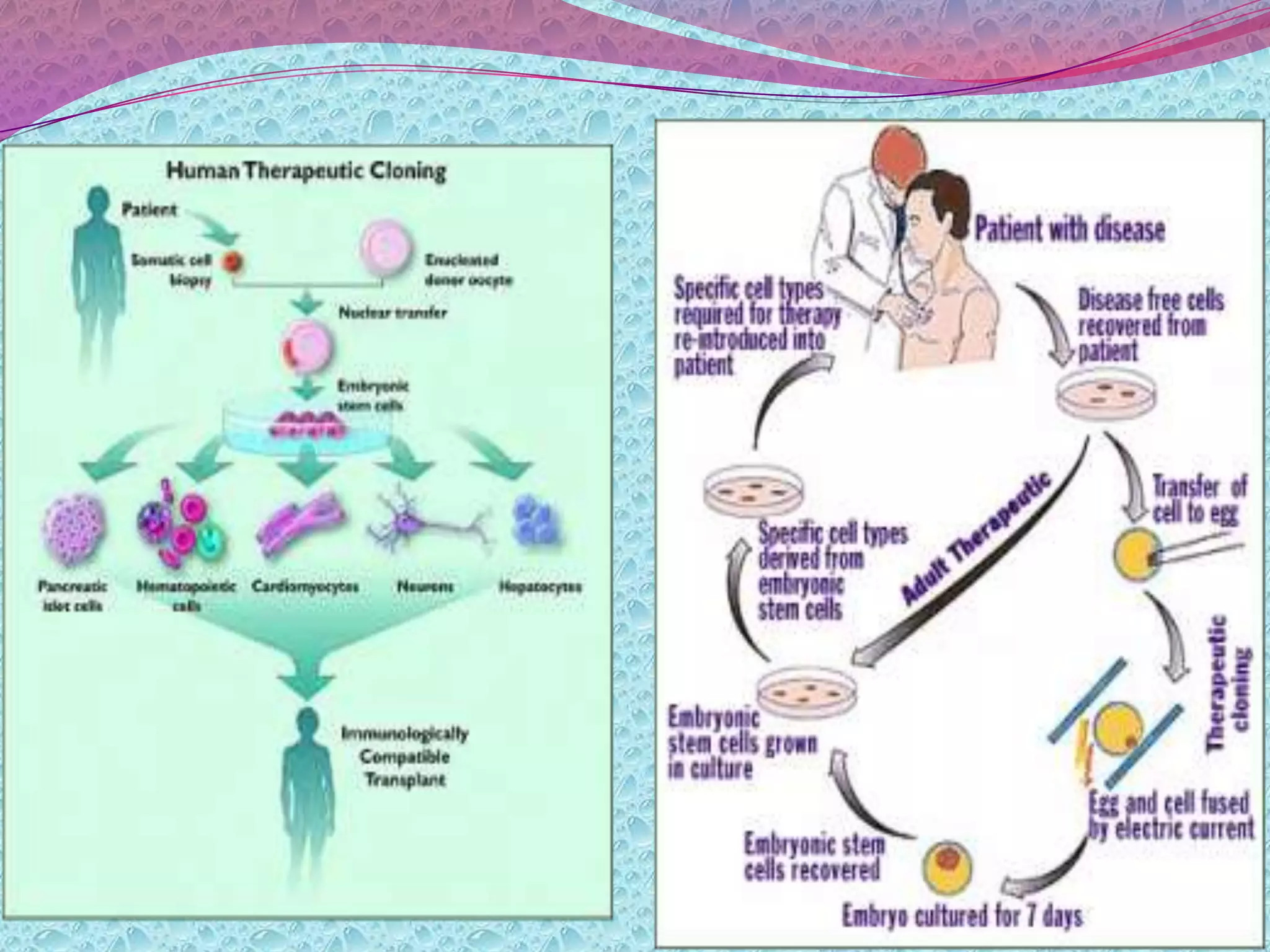
Therapeutic Cloning
 Embryo cloning
 Nuclear transplantation of a patient’s own cells
to make an oocyte from which immune-
compatible cells (especially stem cells) can be
derived for transplant.
 Not cloned humans or animals
 Stem cells harvested at the stage of blastocyst
How is Therapeutic Cloning
Performed?
Somatic Cell Nuclear Transfer
Somatic cell
Nuclear
Transfer
SCNT Process (1)
Remove the nucleus
from an unfertilized
egg cell (A).
(Done under a
microscope.)
Suction pipette (B)
Glass needle (C)
SCNT Process (2)
Gently push the glass
needle through the
tough shell that
surrounds the egg cell.
SCNT process (3)
The egg cell’s nucleus
(A) has been released
outside of the egg.
What remains is an
“enucleated” egg (B).
SCNT process (4)
•Inject the nucleus (at arrow)
from a donor cell into the
enucleated egg cell.
• Ease the tip of the glass
needle deep into the
enucleated egg cell.
Then, deposit the donor
nucleus.
SCNT process (5)
 After completing the
nuclear transfer, the
unfertilized egg cell is
“activated” using a
chemical or electrical
treatment that
stimulates cellular
division.
SCNT process (6)
 The proliferating cells
form a structure called a
blastocyst within days. It
is roughly the same size
as the egg cell.
The right-hand image shows
the blastocyst “hatching”
Difference B/W
Fertilization & SCNT
Fertilization = two set of chromosomes
one from sperm and one from egg
SCNT = two set of chromosomes
both from somatic cell as egg’s nucleus has
been removed
3 goals of therapeutic
cloning by SCNT in humans
 Use embryo as source for ES cells
 Use ES cells to generate an organ
 In this case the organ generated will carry cells
with the same genetic markers as the patient
(recipient)
 Correct genetic error in ESC in blastula stage
What Are Stem Cells?
Stem cells are the raw material from which
all of the body’s mature, differentiated cells
are made. Stem cells give rise to brain
cells, nerve cells, heart cells, pancreatic
cells, etc.
Special characteristics
of ALL stem cells
 Self-renewal (proliferation)- the ability of a
stem cell to clone itself indefinitely by cell
division.
 Relocation and Differentiation are abilities of
stem cells to “migrate” to where they’re
needed in the body and specialize into a
particular type of mature cell
What’s so special about
Stem Cells?
 They have the potential to replace cell tissue
that has been damaged or destroyed by severe
illnesses.
 They can replicate themselves over and over
for a very long time.
 Understanding how stem cells develop into
healthy and diseased cells will assist the search
for cures.
Two Kinds of Stem Cells
 Embryonic (also called “pluripotent”) stem
cells (ESC) are capable of developing into all the
cell types of the body.
 Adult stem cells are less versatile and more
difficult to identify, isolate, and purify.
Stem cells have been found in the blood, bone
marrow, liver, kidney, cornea, dental
pulp, umbilical cord, brain, skin, muscle, salivary
gland .
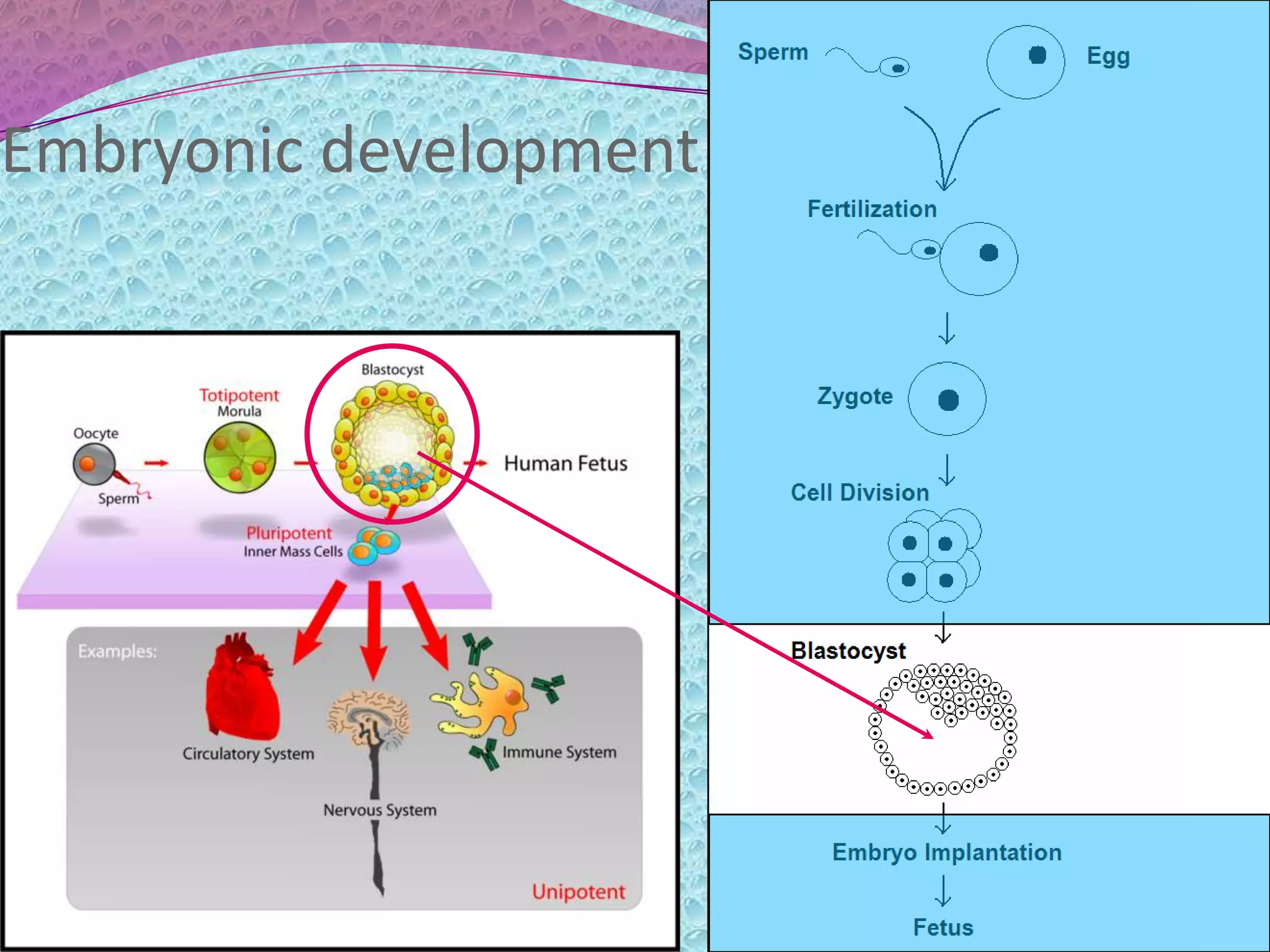
Embryonic development
ESCs are
pluripotent
They retain the
ability to
develop into
nearly any
cell type
Benefits of Therapeutic
cloning
 Organ transplant alternative
 Leukemia
 Degenerative Diseases
 Spinal cord repair
 Skin grafts
Organ Transplant
Pitfalls of therapeutic
cloning
Practical and Technical Issues
Ethical Issues
Practical Issues
 Some immune rejection may occur- WHY?
 About 1% of the DNA in the clone will NOT
be identical to donor cell (patient)
 It will be identical to egg cell used in SCNT
 REASON: mitochonrial DNA in eggs
 Human mitochondria carry about 13
genes, some of which code for surface
proteins
 Large number of eggs needed for SCNT
 To harvest large number of eggs:
 Excessive hormone treatment of females
 Surgery to retrieve eggs
 Both can be harmful to female human
 Cow/pig females may be used
 Cow/pig eggs will carry species-specific
mitochondrial genes
 Steadiness of stem cells
Ethical issues
 Religion
 Law
 Moral values
 Destruction of Embryo
 Killing of life
Therapeutic cloning
Therapeutic cloning

Therapeutic cloning

  • 2.
    Cloning  It isa process for making numerous copies of organisms or cells or of individual genes which are genetically identical.  It refers to the transfer of somatic cell’s nucleus into an ovum, which then grows into an embryo
  • 3.
    History  1952 Thomas J.King and Robert Briggs Northern leopard frogs  1962: John Gurdon South African frogs
  • 4.
    Early Frog Experiments (gurdon’sMethod)  John Gurdon began cloning experiments using non- embryonic cells  Cells from intestinal lining of tadpoles  Exposed a frog egg to ultraviolet light, which destroyed its nucleus  Removed the nucleus from the tadpole intestinal cell and implanted it in the enucleated egg  Egg grew into a tadpole that was genetically identical to the DNA-donating tadpole
  • 5.
    iMpact of gurdon’sresearch  Gurdon’s experiments captured the attention of the scientific community  Tools and techniques he developed for nuclear transfer are still used today  1963- J. B. S. Haldane, in describing Gurdon’s results, became one of the first to use the word clone in reference to animals
  • 6.
     1964: F.C. Stewardcloned Carrot  1969: First gene isolation  1972: First recombinant DNA molecule  1977: Mouse  1983: Nuclear transfer
  • 7.
     1984: Steen Willadsen Cloneda sheep from embryo cells  1986: Nucleus of an adult cell can also be used  1996: Ian Wilmut Villainous sheep "Dolly"
  • 8.
    Types of Cloning Cloning is of three types which are as follows (1) Recombinant DNA technology or DNA cloning (2) Reproductive cloning (3) Therapeutc cloning
  • 9.
    Recombinant DNA technology orDNA cloning  DNA cloning, Molecular cloning, Gene cloning  The production of exact copies (clones) of a particular gene or DNA sequence using genetic engineering techniques.
  • 13.
    Reproductive Cloning  Technologyto produce a genetically identical organism or an animal with the same nuclear DNA as an existing, or even an extinct, animal.  An embryo is produced through the removal and transfer of nuclear material in a cell, and the use of a growth medium to manipulate that cell into undergoing mitosis.
  • 16.
     Cloning animalsfor research  Cloning endangered species In order to expand population  Cloning extinct species To research their behavior and other characteristics
  • 17.
  • 18.
    Therapeutic Cloning  Embryocloning  Nuclear transplantation of a patient’s own cells to make an oocyte from which immune- compatible cells (especially stem cells) can be derived for transplant.  Not cloned humans or animals  Stem cells harvested at the stage of blastocyst
  • 19.
    How is TherapeuticCloning Performed? Somatic Cell Nuclear Transfer Somatic cell Nuclear Transfer
  • 21.
    SCNT Process (1) Removethe nucleus from an unfertilized egg cell (A). (Done under a microscope.) Suction pipette (B) Glass needle (C)
  • 22.
    SCNT Process (2) Gentlypush the glass needle through the tough shell that surrounds the egg cell.
  • 23.
    SCNT process (3) Theegg cell’s nucleus (A) has been released outside of the egg. What remains is an “enucleated” egg (B).
  • 24.
    SCNT process (4) •Injectthe nucleus (at arrow) from a donor cell into the enucleated egg cell. • Ease the tip of the glass needle deep into the enucleated egg cell. Then, deposit the donor nucleus.
  • 25.
    SCNT process (5) After completing the nuclear transfer, the unfertilized egg cell is “activated” using a chemical or electrical treatment that stimulates cellular division.
  • 26.
    SCNT process (6) The proliferating cells form a structure called a blastocyst within days. It is roughly the same size as the egg cell. The right-hand image shows the blastocyst “hatching”
  • 27.
    Difference B/W Fertilization &SCNT Fertilization = two set of chromosomes one from sperm and one from egg SCNT = two set of chromosomes both from somatic cell as egg’s nucleus has been removed
  • 31.
    3 goals oftherapeutic cloning by SCNT in humans  Use embryo as source for ES cells  Use ES cells to generate an organ  In this case the organ generated will carry cells with the same genetic markers as the patient (recipient)  Correct genetic error in ESC in blastula stage
  • 32.
    What Are StemCells? Stem cells are the raw material from which all of the body’s mature, differentiated cells are made. Stem cells give rise to brain cells, nerve cells, heart cells, pancreatic cells, etc.
  • 33.
    Special characteristics of ALLstem cells  Self-renewal (proliferation)- the ability of a stem cell to clone itself indefinitely by cell division.  Relocation and Differentiation are abilities of stem cells to “migrate” to where they’re needed in the body and specialize into a particular type of mature cell
  • 34.
    What’s so specialabout Stem Cells?  They have the potential to replace cell tissue that has been damaged or destroyed by severe illnesses.  They can replicate themselves over and over for a very long time.  Understanding how stem cells develop into healthy and diseased cells will assist the search for cures.
  • 35.
    Two Kinds ofStem Cells  Embryonic (also called “pluripotent”) stem cells (ESC) are capable of developing into all the cell types of the body.  Adult stem cells are less versatile and more difficult to identify, isolate, and purify. Stem cells have been found in the blood, bone marrow, liver, kidney, cornea, dental pulp, umbilical cord, brain, skin, muscle, salivary gland .
  • 37.
  • 38.
    ESCs are pluripotent They retainthe ability to develop into nearly any cell type
  • 39.
    Benefits of Therapeutic cloning Organ transplant alternative  Leukemia  Degenerative Diseases  Spinal cord repair  Skin grafts
  • 40.
  • 42.
    Pitfalls of therapeutic cloning Practicaland Technical Issues Ethical Issues
  • 43.
    Practical Issues  Someimmune rejection may occur- WHY?  About 1% of the DNA in the clone will NOT be identical to donor cell (patient)  It will be identical to egg cell used in SCNT  REASON: mitochonrial DNA in eggs  Human mitochondria carry about 13 genes, some of which code for surface proteins
  • 44.
     Large numberof eggs needed for SCNT  To harvest large number of eggs:  Excessive hormone treatment of females  Surgery to retrieve eggs  Both can be harmful to female human  Cow/pig females may be used  Cow/pig eggs will carry species-specific mitochondrial genes  Steadiness of stem cells
  • 45.
    Ethical issues  Religion Law  Moral values  Destruction of Embryo  Killing of life