The Ultimate Guide to Modern
Business Payment Processing
Solutions
The Payment Exchange
Payment processing solutions are systems and technologies that enable businesses to accept and
manage payments from customers seamlessly. These solutions include mechanisms for handling
credit and debit cards, online wallets, QR code payments, and even mobile payment options.
Importance
In today’s fast-paced digital world, businesses rely on efficient payment processing to provide
convenience to customers, improve cash flow, and ensure secure transactions. Without robust
solutions, companies risk losing customers to competitors offering more modern payment
options.
Role in Modern Businesses
Payment processing solutions are the backbone of e-commerce, retail, and service industries.
They help businesses:
● Streamline Transactions: Simplify payment workflows, reducing errors.
● Enhance Security: Protect sensitive financial data with encryption and fraud
prevention.
● Improve Accessibility: Enable customers to pay through their preferred methods,
boosting satisfaction.
Evolution of Payment Processing
Timeline: From Cash to Digital Payments
1. Barter System → Cash (Ancient Era)
○ Key Milestone: The introduction of coins and paper currency revolutionized trade by creating a standard medium of
exchange.
○ Significance: Simplified transactions compared to the barter system.
2. Cash → Cheques (17th Century)
○ Key Milestone: The rise of cheques allowed people to make payments without carrying large amounts of cash.
○ Significance: Improved security and convenience in trade.
3. Cheques → Credit Cards (Mid-20th Century)
○ Key Milestone: The launch of the first modern credit card (Diners Club, 1950) provided a cashless payment alternative.
○ Significance: Enabled consumers to make purchases now and pay later, spurring economic growth.
4. Credit Cards → Digital Payments (21st Century)
○ Key Milestone: The rise of online banking, mobile payment apps, and technologies like QR codes, Near Field
Communication (NFC), and blockchain.
○ Significance: Facilitated instant, secure, and global transactions with minimal effort.
Key Features of Modern Payment Systems
1. Seamless Integration
Modern payment systems integrate effortlessly with e-commerce platforms, accounting software, and CRMs, ensuring smooth
business operations without technical disruptions.
2. Multi-Currency Support
They support transactions in various currencies, enabling businesses to operate globally and cater to diverse customer bases.
3. Enhanced Security
Features like encryption, tokenization, and fraud detection protect sensitive financial data and reduce the risk of cyber attacks,
building trust among customers.
4. Omni-Channel Support
These systems work across multiple sales channels, including in-store, online, and mobile, offering a unified customer experience.
5. Real-Time Analytics
Advanced reporting tools provide instant insights into transaction data, helping businesses track performance, identify trends, and
make informed decisions.
Benefits of Advanced Payment Solutions
1. Faster Transactions
Advanced payment solutions streamline the payment process, reducing transaction times and ensuring swift transfers.
2. Improved Customer Experience
Seamless and secure payment options enhance customer satisfaction, encouraging repeat business and loyalty.
3. Global Reach
Expand your business horizon with payment solutions that support multiple currencies and international transactions.
4. Reduced Fraud Risks
With robust security features, these solutions minimize fraud risks, keeping your business and customers safe.
5. Cost-Effective
Save on operational costs with efficient, automated payment systems that eliminate the need for manual processing.
Implement advanced payment solutions today to drive growth and stay ahead in a competitive market!
Challenges in Payment Processing
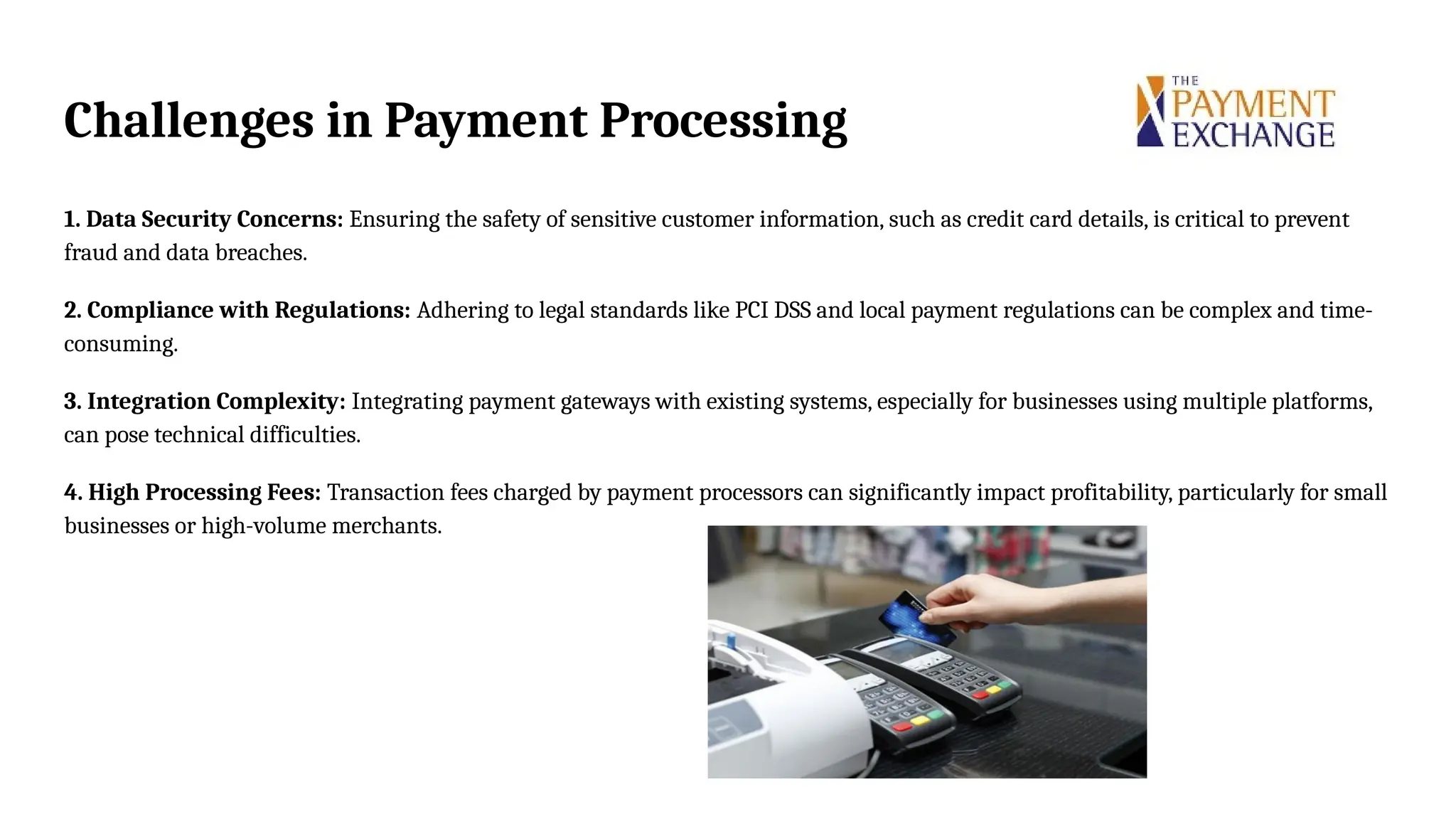
1. Data Security Concerns: Ensuring the safety of sensitive customer information, such as credit card details, is critical to prevent
fraud and data breaches.
2. Compliance with Regulations: Adhering to legal standards like PCI DSS and local payment regulations can be complex and time-
consuming.
3. Integration Complexity: Integrating payment gateways with existing systems, especially for businesses using multiple platforms,
can pose technical difficulties.
4. High Processing Fees: Transaction fees charged by payment processors can significantly impact profitability, particularly for small
businesses or high-volume merchants.
Future Trends in Payments
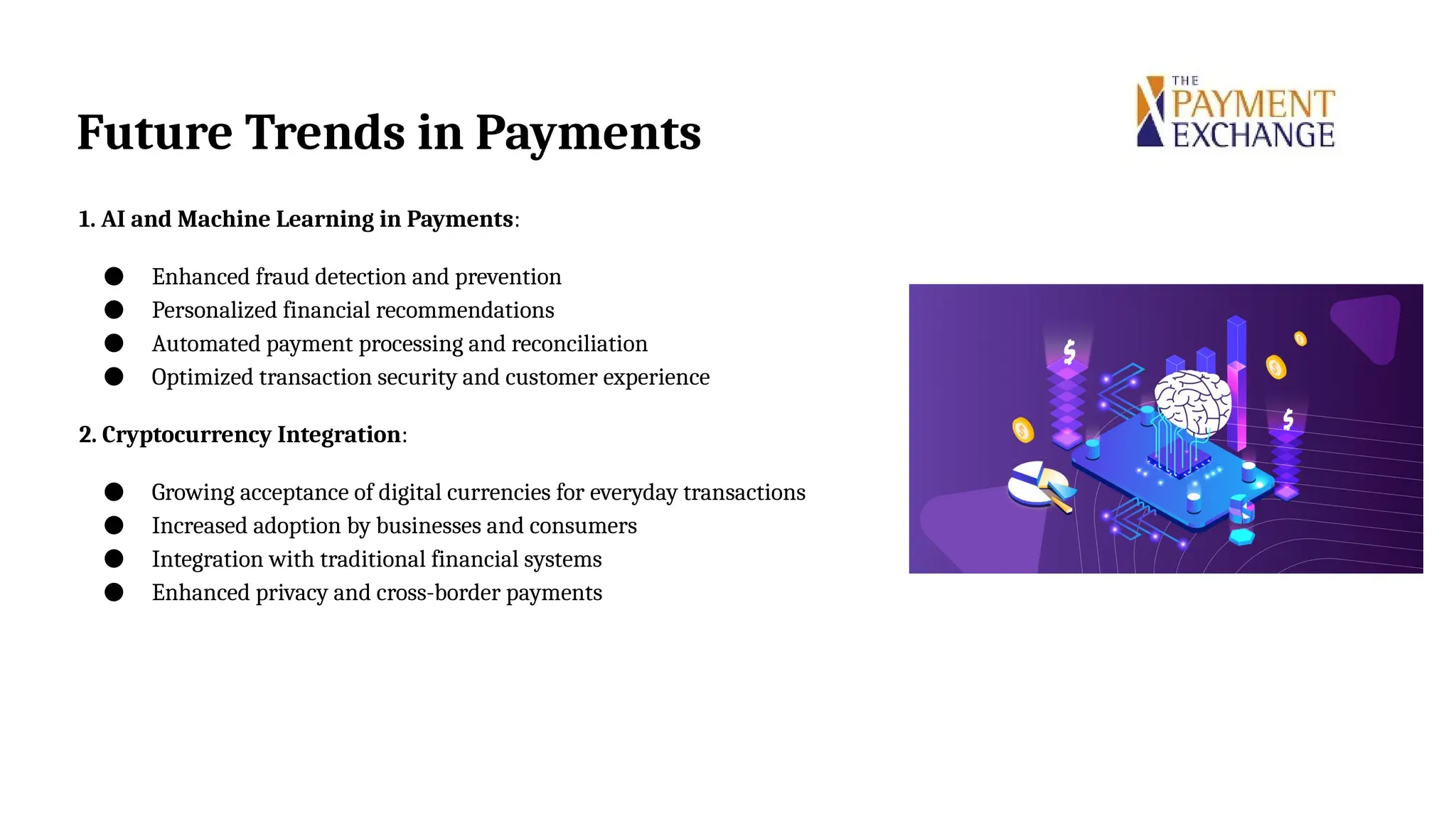
1. AI and Machine Learning in Payments:
● Enhanced fraud detection and prevention
● Personalized financial recommendations
● Automated payment processing and reconciliation
● Optimized transaction security and customer experience
2. Cryptocurrency Integration:
● Growing acceptance of digital currencies for everyday transactions
● Increased adoption by businesses and consumers
● Integration with traditional financial systems
● Enhanced privacy and cross-border payments
3. Biometric Payments:
● Use of facial recognition, fingerprints, and voice for secure
payments
● Convenient and seamless authentication processes
● Increased trust and security in financial transactions
● Reduced reliance on passwords and PINs
4. IoT and Voice-Based Payments:
● Payments through connected devices like wearables, smart
speakers, and home appliances
● Voice-activated payment systems for hands-free transactions
● Integration with personal assistants (e.g., Alexa, Google
Assistant)
● Increased convenience and ease in making purchases
Future Trends in Payments
Conclusion
In today's fast-paced business world, staying competitive requires constant adaptation and improvement. One of the most crucial
aspects of this transformation is adopting modern payment solutions. By upgrading your payment processing system, you can
significantly enhance your business operations, streamline transactions, and offer a better experience for your customers.
Modern payment systems bring a range of benefits that traditional methods simply can't match. These solutions improve efficiency by
enabling faster and more secure transactions, reducing the risk of errors, and allowing for easier management of payments. With
automated processes and real-time updates, your business can save valuable time and resources that would otherwise be spent on
manual tasks.
Moreover, by providing seamless payment experiences, you can boost customer satisfaction. Consumers today expect flexibility,
convenience, and security when making payments. A modern payment system can offer various payment methods—such as
credit/debit cards, mobile wallets, and digital currencies catering to a wider range of preferences. This not only makes transactions
easier but also helps build trust with your customer base.
Thank You!
Visit Now at: https://thepayx.com/

The Ultimate Guide to Modern Business Payment Processing Solutions

  • 1.
    The Ultimate Guideto Modern Business Payment Processing Solutions The Payment Exchange
  • 2.
    Payment processing solutionsare systems and technologies that enable businesses to accept and manage payments from customers seamlessly. These solutions include mechanisms for handling credit and debit cards, online wallets, QR code payments, and even mobile payment options. Importance In today’s fast-paced digital world, businesses rely on efficient payment processing to provide convenience to customers, improve cash flow, and ensure secure transactions. Without robust solutions, companies risk losing customers to competitors offering more modern payment options. Role in Modern Businesses Payment processing solutions are the backbone of e-commerce, retail, and service industries. They help businesses: ● Streamline Transactions: Simplify payment workflows, reducing errors. ● Enhance Security: Protect sensitive financial data with encryption and fraud prevention. ● Improve Accessibility: Enable customers to pay through their preferred methods, boosting satisfaction.
  • 3.
    Evolution of PaymentProcessing Timeline: From Cash to Digital Payments 1. Barter System → Cash (Ancient Era) ○ Key Milestone: The introduction of coins and paper currency revolutionized trade by creating a standard medium of exchange. ○ Significance: Simplified transactions compared to the barter system. 2. Cash → Cheques (17th Century) ○ Key Milestone: The rise of cheques allowed people to make payments without carrying large amounts of cash. ○ Significance: Improved security and convenience in trade. 3. Cheques → Credit Cards (Mid-20th Century) ○ Key Milestone: The launch of the first modern credit card (Diners Club, 1950) provided a cashless payment alternative. ○ Significance: Enabled consumers to make purchases now and pay later, spurring economic growth. 4. Credit Cards → Digital Payments (21st Century) ○ Key Milestone: The rise of online banking, mobile payment apps, and technologies like QR codes, Near Field Communication (NFC), and blockchain. ○ Significance: Facilitated instant, secure, and global transactions with minimal effort.
  • 4.
    Key Features ofModern Payment Systems 1. Seamless Integration Modern payment systems integrate effortlessly with e-commerce platforms, accounting software, and CRMs, ensuring smooth business operations without technical disruptions. 2. Multi-Currency Support They support transactions in various currencies, enabling businesses to operate globally and cater to diverse customer bases. 3. Enhanced Security Features like encryption, tokenization, and fraud detection protect sensitive financial data and reduce the risk of cyber attacks, building trust among customers. 4. Omni-Channel Support These systems work across multiple sales channels, including in-store, online, and mobile, offering a unified customer experience. 5. Real-Time Analytics Advanced reporting tools provide instant insights into transaction data, helping businesses track performance, identify trends, and make informed decisions.
  • 5.
    Benefits of AdvancedPayment Solutions 1. Faster Transactions Advanced payment solutions streamline the payment process, reducing transaction times and ensuring swift transfers. 2. Improved Customer Experience Seamless and secure payment options enhance customer satisfaction, encouraging repeat business and loyalty. 3. Global Reach Expand your business horizon with payment solutions that support multiple currencies and international transactions. 4. Reduced Fraud Risks With robust security features, these solutions minimize fraud risks, keeping your business and customers safe. 5. Cost-Effective Save on operational costs with efficient, automated payment systems that eliminate the need for manual processing. Implement advanced payment solutions today to drive growth and stay ahead in a competitive market!
  • 6.
    Challenges in PaymentProcessing 1. Data Security Concerns: Ensuring the safety of sensitive customer information, such as credit card details, is critical to prevent fraud and data breaches. 2. Compliance with Regulations: Adhering to legal standards like PCI DSS and local payment regulations can be complex and time- consuming. 3. Integration Complexity: Integrating payment gateways with existing systems, especially for businesses using multiple platforms, can pose technical difficulties. 4. High Processing Fees: Transaction fees charged by payment processors can significantly impact profitability, particularly for small businesses or high-volume merchants.
  • 7.
    Future Trends inPayments 1. AI and Machine Learning in Payments: ● Enhanced fraud detection and prevention ● Personalized financial recommendations ● Automated payment processing and reconciliation ● Optimized transaction security and customer experience 2. Cryptocurrency Integration: ● Growing acceptance of digital currencies for everyday transactions ● Increased adoption by businesses and consumers ● Integration with traditional financial systems ● Enhanced privacy and cross-border payments
  • 8.
    3. Biometric Payments: ●Use of facial recognition, fingerprints, and voice for secure payments ● Convenient and seamless authentication processes ● Increased trust and security in financial transactions ● Reduced reliance on passwords and PINs 4. IoT and Voice-Based Payments: ● Payments through connected devices like wearables, smart speakers, and home appliances ● Voice-activated payment systems for hands-free transactions ● Integration with personal assistants (e.g., Alexa, Google Assistant) ● Increased convenience and ease in making purchases Future Trends in Payments
  • 9.
    Conclusion In today's fast-pacedbusiness world, staying competitive requires constant adaptation and improvement. One of the most crucial aspects of this transformation is adopting modern payment solutions. By upgrading your payment processing system, you can significantly enhance your business operations, streamline transactions, and offer a better experience for your customers. Modern payment systems bring a range of benefits that traditional methods simply can't match. These solutions improve efficiency by enabling faster and more secure transactions, reducing the risk of errors, and allowing for easier management of payments. With automated processes and real-time updates, your business can save valuable time and resources that would otherwise be spent on manual tasks. Moreover, by providing seamless payment experiences, you can boost customer satisfaction. Consumers today expect flexibility, convenience, and security when making payments. A modern payment system can offer various payment methods—such as credit/debit cards, mobile wallets, and digital currencies catering to a wider range of preferences. This not only makes transactions easier but also helps build trust with your customer base.
  • 10.
    Thank You! Visit Nowat: https://thepayx.com/