LEARNING OBJECTIVES
At theend of this chapter, each learner will be able to:
1. explain the trifocalization law that restructured the Philippine Educational system;
2. determine the basic functions and powers of the Department of Education (DepEd), Commission on
Higher Education (CHED), and the Technical Education and Skills Development Authority (TESDA);
3. distinguish the vision and mission of DepEd, CHED, and TESDA;
4. discuss current educational reforms such as the Basic Education Sector Reform
Agenda, K-12 Law and the institutionalization of Philippine Qualifications Framework; and
5. draw the implications of the current educational reforms in the governance of schools as well as in the
quality of teaching and learning process
Basic Structure ofthe Philippine Educational System
The basic structure of the Philippine educational system has undergone changes across time. In this section, the
discussion of the present structure begins with the basic education Department of Education) followed by tertiary
education (Commission on Higher Education), then the middle level education (Technical Education and Skills
Development Authority).
Part of the reforms outlined by the Congressional Commission on Education in 1992 is the triocalization approach
in the management of the education sector. This paved the way for the creation of three (3) governing bodies or
departments in the education sector as follows:
1. Department of Education (DepEd) - responsible for the basic education from pre-school to senior high school;
2. Commission on Higher Education (CHED) - responsible for the tertiary and graduate education; and
3. Technical Education and Skills Development Authority (TESDA) - responsible for the Technical
Vocational Education and Training (TVET) and middle level education.
5.
The creation ofthe Commission on Higher Education by R.A. No. 7722 and of
the Technical Education and Skills Development Authority (R.A. No. 7796)
separated these entities from the Department of Education (formerly known as
Department of Education Culture and Sports - DECS) where they originally
belonged. The purpose of which is to decongest the very broad functions and
management of DECS and to ensure greater efficiency and effectiveness of its
operations.
Basic Structure of the Philippine Educational System
Republic Act No.9155
The Governance of Basic Education Act is made possible through the passage of Republic
Act No.
9155 which was promulgated on August 11, 2001. The Act is otherwise known as
"Governance of Basi Education Act of 2001".
This Act renamed the agency from Department of Education, Culture, and Sports (DECS) to
Department of Education (DepEd). The Act stipulates that governance of basic education
shall begin at the national level to the field offices.
The Department of Education (DepEd)
8.
The Act outlinesthe strategic review and reorganization of the Department of
Education (DepEd), defining new roles within the department. It emphasizes that
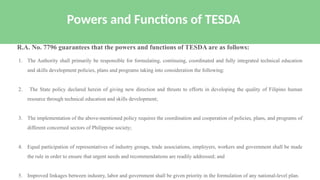
governance of basic education starts at the national level and extends down to
regional, divisional, school, and learning center levels, where policies are adapted
to local needs. The Act encourages local initiatives to improve education quality
and ensures that the values and needs of school communities are reflected in
educational programs. Schools and learning centers are empowered to make
decisions that best serve their learners.
Governance of Basic Education
9.
According to R.A.No. 9155, the Department of Education (DepEd) is the principal government
agency responsible for education and manpower development. It is vested with authority,
accountability, and responsibility for ensuring access to, promoting equity in, and improving the
quality of basic education in the Philippines. In general, the Department is primarily responsible
for the:
1. Formulation, planning, implementation and coordination of the policies, standards,
regulations, plans, programmes, and projects in areas of formal and non-formal education.
2. Supervision of all basic education institutions, both public and private, and provides for the
establishment and maintenance of a complete, adequate, and integrated system of education
relevant to the goals of national development.
Basic Functions of the DepEd
10.
1. Formulating nationaleducational policies.
2. Formulating the national basic education plan.
3. Promulgating national educational standards.
4. Monitoring and assessing national learning outcomes.
5. Undertaking national educational research and studies.
6. Enhancing the employment status, professional competence, welfare and working conditions of all
personnel of the department.
7. Enhancing the total development of learners through local and national programmes and/or projects.
In a more specific sense, the DepEd is accountable and
responsible for:
11.
Early chidhood education,which was institutionalized part of the educational ladder, shall be
a shared responsibility of the DepEd and the Department of Social Welfare and
Development.
Moreover, through the passage of R.A. No. 9155 that restructured the former Department of
Education, Culture, and Sports (DECS), the cultural concerns of the department was handed
over to the National Commission for Culture and the Arts (NCCA). On the other hand, the
sports concern was given to the Philippine Sports Commission (PSC).
Early Childhood Education and the Promotion of
Culture and Sports
A vision isthe ideal state of life that a person or organization pursues to achieve. The
condition to which DepEd envisions to realize is enshrined in this vision: "We dream of
Filipinos who passionately love their country and whose values and competencies
enable them to realize potential and contribute meaningfully to building the nation. As a
learner-centered public institution, the Department of Education continuously improves
itself to better serve its stakeholders (DepEd website, 2016).
Vision of the DepEd
14.
It is themission of the department to protect and promote the right of every Filipino to
quality, equitable, culture-based, and complete basic education where: "Learners learn
in a child friendly, gender sensitive, and safe and motivating environment. Teachers
facilitate learning and constantly nurture every learner. Administrators and staff, as
stewards of the institution, ensure an enabling and supportive environment for effective
learning to happen. Family, community and other stakeholders are actively engaged and
share responsibility for developing lifelong learners (DepEd website, 2016).
Mission of the DepEd
15.
There are fourcore values that define the ideals and graduate attributes of the DepEd. The concrete
manifestations of these values are clearly defined in the Division Memorandum No. 35, s. 2016 of the Division of
Baguio City as follows:
1. Maka-Diyos - reverence for all faiths demonstrated through (a) Expressing one's spiritual beliefs while
respecting the spiritual beliefs of others; and (b) Showing adherence to ethical principles by upholding truth.
2. Maka-Tao - development and importance of character by (a) Showing sensitivity to individual, social, and
cultural differences; and (b) Demonstrating contributions toward solidarity.
3. Maka-Kalikasan - profound respect and love for the environment by caring for the environment and utilizing
resources wisely, judiciously and economically.
4. Makabansa - genuine service to the country and one's community by demonstrating pride in being a Filipino,
exercises the rights and responsibilities of a Filipino Citizen; and (b) Demonstrates appropriate behavior in
carrying out activities in the school, community, and country.
Core Values of the DepEd
16.
Section 2 ofR.A. No. 9155
specifies that the governance policies of the Department of Education (DepEd) are implemented at the
regional, divisional, school, and learning center levels, collectively known as field offices. These field
offices are located in 17 regions, 157 provincial and city school divisions, and 2,227 school districts, each
with designated leaders such as Regional Directors, Schools Division Superintendents, and Public School
District Supervisors. The regional offices play a key role in monitoring, assessing, and evaluating learning
outcomes, enforcing standards, and providing technical support to divisions and schools. They also
contribute to region-wide policy development, quality assurance, regulation of private and non-government
schools, and administrative services, including payroll, in-service training, legal counseling, and validating
the Basic Education Information System (BELS).
Field Offices of the DepEd and Their
Functions
17.
1. Instructional Leadershipand Supervision- Ensure quality teaching and learning processes.
2. Administrative and Budgetary Support- Oversee management of resources and budgeting for schools.
3. Technical Support Services- Provide assistance for educational programs and initiatives.
4. Quality Assurance- Monitor and evaluate the effectiveness of educational services.
5. Resource Services- Manage resources such as school supplies, library hubs, and BEIS management.
6. Extension/Community Services- Support and implement community engagement programs.
Functions of the Schools Division Offices
Under the regional field ofices are the DepED Schools Division Offices. The Schools Division
Offices perform:
18.
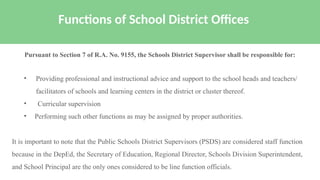
• Providing professionaland instructional advice and support to the school heads and teachers/
facilitators of schools and learning centers in the district or cluster thereof.
• Curricular supervision
• Performing such other functions as may be assigned by proper authorities.
It is important to note that the Public Schools District Supervisors (PSDS) are considered staff function
because in the DepEd, the Secretary of Education, Regional Director, Schools Division Superintendent,
and School Principal are the only ones considered to be line function officials.
Functions of School District Offices
Pursuant to Section 7 of R.A. No. 9155, the Schools District Supervisor shall be responsible for:
19.
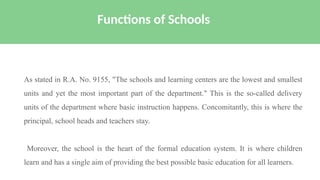
As stated inR.A. No. 9155, "The schools and learning centers are the lowest and smallest
units and yet the most important part of the department." This is the so-called delivery
units of the department where basic instruction happens. Concomitantly, this is where the
principal, school heads and teachers stay.
Moreover, the school is the heart of the formal education system. It is where children
learn and has a single aim of providing the best possible basic education for all learners.
Functions of Schools
20.
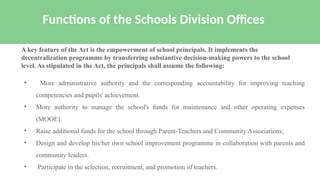
• More administrativeauthority and the corresponding accountability for improving teaching
competencies and pupils' achievement.
• More authority to manage the school's funds for maintenance and other operating expenses
(MOOE)
• Raise additional funds for the school through Parent-Teachers and Community Associations;
• Design and develop his/her own school improvement programme in collaboration with parents and
community leaders.
• Participate in the selection, recruitment, and promotion of teachers.
Functions of the Schools Division Offices
A key feature of the Act is the empowerment of school principals. It implements the
decentralization programme by transferring substantive decision-making powers to the school
level. As stipulated in the Act, the principals shall assume the following:
21.
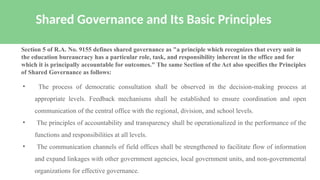
• The processof democratic consultation shall be observed in the decision-making process at
appropriate levels. Feedback mechanisms shall be established to ensure coordination and open
communication of the central office with the regional, division, and school levels.
• The principles of accountability and transparency shall be operationalized in the performance of the
functions and responsibilities at all levels.
• The communication channels of field offices shall be strengthened to facilitate flow of information
and expand linkages with other government agencies, local government units, and non-governmental
organizations for effective governance.
Shared Governance and Its Basic Principles
Section 5 of R.A. No. 9155 defines shared governance as "a principle which recognizes that every unit in
the education bureaucracy has a particular role, task, and responsibility inherent in the office and for
which it is principally accountable for outcomes." The same Section of the Act also specifies the Principles
of Shared Governance as follows:
22.
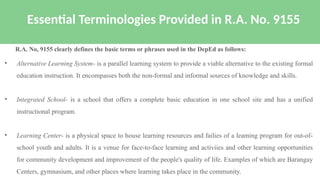
• Alternative LearningSystem- is a parallel learning system to provide a viable alternative to the existing formal
education instruction. It encompasses both the non-formal and informal sources of knowledge and skills.
• Integrated School- is a school that offers a complete basic education in one school site and has a unified
instructional program.
• Learning Center- is a physical space to house learning resources and failies of a leaming program for out-of-
school youth and adults. It is a venue for face-to-face learning and activiies and other learning opportunities
for community development and improvement of the people's quality of life. Examples of which are Barangay
Centers, gymnasium, and other places where learning takes place in the community.
Essential Terminologies Provided in R.A. No. 9155
R.A. No, 9155 clearly defines the basic terms or phrases used in the DepEd as follows:
23.
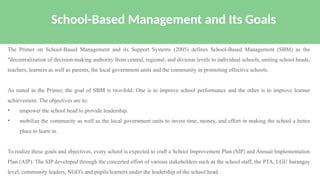
The Primer onSchool-Based Management and its Support Systems (2005) defines School-Based Management (SBM) as the
"decentralization of decision-making authority from central, regional, and division levels to individual schools, uniting school heads,
teachers, learners as well as parents, the local government units and the community in promoting effective schools.
As stated in the Primer, the goal of SBM is two-fold. One is to improve school performance and the other is to improve learner
achievement. The objectives are to:
• empower the school head to provide leadership.
• mobilize the community as well as the local government units to invest time, money, and effort in making the school a better
place to learn in.
To realize these goals and objectives, every school is expected to craft a School Improvement Plan (SIP) and Annual Implementation
Plan (AIP). The SIP developed through the concerted effort of various stakeholders such as the school staff, the PTA, LGU barangay
level, community leaders, NGO's and pupils/learners under the leadership of the school head.
School-Based Management and Its Goals
24.
According to Sec1.2 of Rule 1 IRR of R.A. No. 9155, the school
heads are tasked to perform two functions. One is to exercise
instructional leadership and the other is to perform sound
administrative management of the school.
Roles of the School Heads under SBM
R.A. No. 7722otherwise known as Higher Education Act of 1994 created the Commission on
Higher Education (CHED). The Commission was established in May 18, 1994 and it is the
governing body covering both public and private higher education institutions as well as degree-
granting programs in all tertiary and graduate educational institutions in the Philippines. The
Commission is independent and separate from the Department of Education, Culture and Sports
(DECS), and attached to the Office of the President for administrative purposes only. Its coverage is
both public and private institutions of higher and graduate education as well as degree-granting
programs in all post-secondary educational institutions, public and private.
Republic Act. No. 7722
to become thekey leader of the Philippine Higher Education System effectively working
in partnership with other major higher education stakeholders in building the country's
human capital and innovation capacity toward the development of a Filipino Nation as a
responsible member of the international community.
Vision of the CHED
29.
A. Promote relevantand quality higher education (i.e. higher education institutions and programs are at par with
international standards and graduates and professionals are highly competent and recognized in the international arena)
B. Ensure that quality higher education is accessible to all who seek it particularly those who may not be able to afford it;
C. Guarantee and protect academic freedom for continuing intellectual growth, advancement of learning and research,
development of responsible and effective leadership, education of high level professionals, and enrichment of historical
and cultural heritages; and
D. Commit to moral ascendancy that eradicates corrupt practices, institutionalizes transparency and accountability and
encourages participatory governance in the Commission and the sub-sector.
Mission of the CHED
30.
The foregoing visionand mission is in line with the national government's commitment to
transformational leadership that puts education as the central strategy for investing in the
Filipino people, reducing poverty, and building national competitiveness in pursuance of
Republic Act No. 7722.
31.
SUCs are underthe supervision of CHED because the Chairperson of the SUCs Board of Regents is
the CHED chairman or one of his/her commissioners. As stated in the Act, "state-supported
institutions of higher learning shall gear their programs to national, regional or local development
plans.”
This expressed provision of the law aligns all curricular programs of state funded higher educational
institutions so that they can contribute in the national, regional, and local goals. Moreover, this is a
way of ensuring that government expenditures of SUCs are utilized in accordance with the priority
programs, thrusts, and directions of the national government.
CHED and State Universities and Colleges (SUCs)
32.
1. formulate andrecommend development plans, policies, priorities, and programs on higher education and
research;
2. formulate and recommend development plans, policies, priorities and programs on research;
3. recommend to the executive and legislative branches, priorities and grants on higher education and research;
4. set minimum standards for programs and institutions of higher learning recommended by panels of experts in
the field and subject to public hearing, and enforce the same;
5. monitor and evaluate the performance of programs and institutions of higher learning for appropriate
incentives as well as the imposition of sanctions such as, but not limited to, diminution or withdrawal of
subsidy, recommendation on the downgrading or withdrawal of accreditation, program termination or school
closure;
Mandates of the CHED
In consonance with Section 8 of R.A. No. 7722, the CHED has the following powers and
functions:
33.
6. identify, supportand develop potential centers of excellence in program areas needed for the development of world-class
scholarship, nation building; and national development;
7. recommend to the Department of Budget and Management the budgets of public institutions of higher learning as well as
general guidelines for the use of their income;
8. rationalize programs and institutions of higher learning and set standards, policies and guidelines for the creation of new
ones as well as the conversion or elevation of schools to institutions of higher learning, subject to budgetary limitations and
the number of institutions of higher learning in the province or region where creation, conversion or elevation is sought to
be made;
9. develop criteria for allocating additional resources such as research and program development grants, scholarships, and
other similar programs: Provided, That these shall not detract from the fiscal autonomy already enjoyed by colleges and
universities;
10. direct or redirect purposive research by institutions of higher learning to meet the needs of agro-industrialization and
development;
Mandates of the CHED
34.
11. devise andimplement resource development schemes;
12.administer the Higher Education Development Fund, as described in Section 10 hereunder, which will
promote the purposes of higher education;
13.review the charters of institutions of higher learning and state universities and colleges including the
chairmanship and membership of their governing bodies and recommend appropriate measures as basis
for necessary action;
14. promulgate such rules and regulations and exercise such other powers and functions as may be
necessary to carry out effectively the purpose and objectives. of this Act; and
15.perform such other functions as may be necessary for its effective operations and for the continued
enhancement, growth or development of higher education.
Mandates of the CHED
35.
Academic freedom isnot an absolute right of HEIs. As stipulated in the Act, "the
Commission shall not abridge the curricular freedom of the individual educational
institutions except for: (a) minimum unit requirements for specific academic programs;
(b) general education distribution requirements as may be determined by the
Commission; and (c) specific professional subjects as may be stipulated by the various
licensing entities. No academic or curricular restriction shall be made upon private
educational institutions which are not required for chartered state colleges and
universities."
CHED Control of Academic Freedom Among
HEls
36.
The comission recognizesaccreditaion as a vehice for ensuring quairyaniy a rein the coun Quality education obtained through continuous growth and
development is primarily a responsity of all educational institutions. This is part of their commitment to the state and to the Filipinos in general.
To encourage HEIs to submit themselves for accreditation, R.A. No. 1122 declares that the
"Commission shall provide incentives to institutions of higher learning (public and private), whoe programs are accredited or whose needs are for
accreditation purposes." This expressed provision of the Act is refected in the efforts of the Commission to provide subsidies to public and private
HEls that have obtained level 4 accredited status in their programs. In SUCs for example, universities having highest accreditation status are given
priority in the budgetary allocation because accreditation is one of the criteria in normative financing or CHED budget allocation criteria.
To encourage voluntary accreditation, CHED issued CMO No. 1, s. 2005 titled “Revised policies and Guidelines on voluntary accreditation aid of
Quality and Excellence in Higher Education.” The issuance of this order encourages the use of voluntary non-governmental accreditation systems in
aid of the exercise of its regulatory functions. The CHED will promote a policy environment which supports the accreditation's non-governmental and
voluntary character and protects the integrity of the accreditation process (CMO No. 1 s. 2005).
Accreditation of HEls
The Technical Educationand Skills Development Authority (TESDA) was established
through the enactment of Republic Act No: 7796 otherwise known as the Technical Education
and Skills Development Act of 1994. As stated in the Act, it "aims to encourage full
participation and mobilization of the indusiry, labor, local government units, and technical-
vocational education and training (TVET) institutions in the skills development of the
country's human resources." The creation of TESDA is consistent with the siate s policy to
provide relevant, accessible, high quality, and efficient technical education and skills
development in support of the development of high quality Filipino middle-level.
Republic Act No. 7796
39.
A significant featureof the aforementioned Act was the integration of the functions of the
former National Manpower and Youth Council (NMYC), the Bureau of Technical-Vocational
Education of the department of education, culture and sports (BTVE-DECS), and the office
of apprenticeship of the department of labor and employment (DOLE). In short, the merging
of these offices gave birth to TESDA.
Creation of TESDA
to become theleading partner in the development of the Filipino workforce with world-class
competence and positive work values. On the other hand, its mission is to provide direction,
policies, programs, and standards toward quality technical education and skill development.
Vision of TESDA
42.
. to providedirection, policies, programs, and standards toward quality technical education and
skill development
Mission of TESDA
43.
1. The Authorityshall primarily be responsible for formulating, continuing, coordinated and fully integrated technical education
and skills development policies, plans and programs taking into consideration the following:
2. The State policy declared herein of giving new direction and thrusts to efforts in developing the quality of Filipino human
resource through technical education and skills development;
3. The implementation of the above-mentioned policy requires the coordination and cooperation of policies, plans, and programs of
different concerned sectors of Philippine society;
4. Equal participation of representatives of industry groups, trade associations, employers, workers and government shall be made
the rule in order to ensure that urgent needs and recommendations are readily addressed; and
5. Improved linkages between industry, labor and government shall be given priority in the formulation of any national-level plan.
Powers and Functions of TESDA
R.A. No. 7796 guarantees that the powers and functions of TESDA are as follows:
44.
1. secondary schoolgraduates or drop-outs.
2. college undergraduates and graduates.
3. unemployed persons who are actively looking for work.
4. former overseas workers who tend to turn to TVET for either aditional skils or a change in career paths.
5. those who are already in the labour market and need to upgrade or develop new competencies to enhance chances for
employment and/or improve productivity.
Potential Clients of TESDA
Pursuant to the provision of R.A. No. 7796, the Technical Vocational education and training
offered by TESDA is a post-secondary and non-degree technical vocational education and training.
The potential beneficiaries of this middle level manpower skills development are as follows:
45.
TESDA website (2015)defines the Philippine TVET Qualification and Certification
System (PTQCS) is a quality-assured structure used for giving recognition to the
attainment of competences (knowledge, skills, attitudes and values) along the middle-
level skilled occupations. It is the process of determining the qualification level of a
person and giving recognition to the attainment of competencies in that particular level.
Philippine TVET Qualifications and
Certification System
46.
TESDA website (2015)defines competency assessment of qualification and certification as the
process of collecting evidence and making judgments on whether competency has been achieved. t
focuses on assessing an individual's skills, knowledge, attitude and work values relative to a unit or
cluster of units of competency.
Assessment is conducted through any of the following evidence-gathering methods: demonstration/
observation with oral questioning, written test, interview, third-party report, portfolio and submission
of work projects. The ones who can apply are learners, workers, skilled people or any individual who
wants to determine his/her qualification level."
Competency Assessment of Qualification
and Certification
47.
TESDA website (2015)specifies that the "National Certificate is issued when a candidate has demonstrated
competence in all units of competency that comprised a Qualification. Certificate of Competency is issued
to individuals who have satisfactorily demonstrated competence in a particular ora cluster of units of
competency.
The NC or COC is valid for five (5) years and the renewal will be under the TESDA. Moreover, the NC
and the COC will bestow graduates with credentials to have middle level skis and wil allow them to have
more chances to be gainfuly employed. NC I and NC I increase chances of employment of learners who
graduate in courses like Agriculture, Electronics, and Trade.
National Certificate (NC) and Certificate of
Competency (COC)