The Talent Identification
and Development Process

Keith Lyons
Running Sport Seminar
London, February 2002
The Challenge that Faces Us
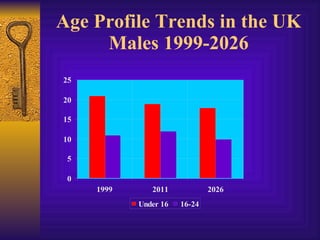
Age Profile Trends in the UK
     Males 1999-2026
 25

 20

 15

 10
% of Population
 5

  0
          1999       2011            2026
                  Under 16   16-24
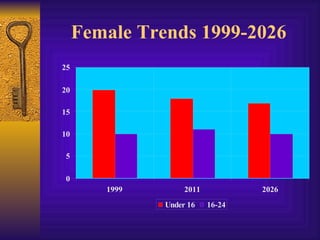
Female Trends 1999-2026
 25

 20

 15

 10
% of Population
 5

  0
             1999        2011           2026
                    Under 16    16-24
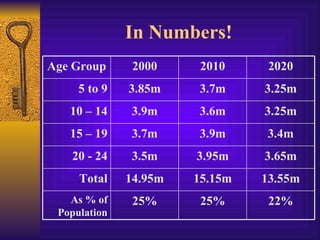
In Numbers!
Age Group      2000     2010     2020
     5 to 9   3.85m    3.7m     3.25m
   10 – 14    3.9m     3.6m     3.25m
   15 – 19    3.7m     3.9m     3.4m
   20 - 24    3.5m     3.95m    3.65m
     Total    14.95m   15.15m   13.55m
   As % of     25%      25%      22%
 Population
Introduction
♦ Clarification of terminology
♦ Contexts
♦ Measurement Issues
♦ Talent Development
♦ Long-term vision and sport system
 building
There is no one correct model for
talent identification and selection. It is
dependent on the complexity of the
sport (from a predictive perspective)
and the infrastructure of the sport at a
local, regional and national level.


                          Debbie Hoare (2001)
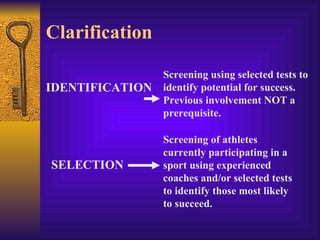
Clarification

                 Screening using selected tests to
IDENTIFICATION   identify potential for success.
                 Previous involvement NOT a
                 prerequisite.

                 Screening of athletes
                 currently participating in a
SELECTION        sport using experienced
                 coaches and/or selected tests
                 to identify those most likely
                 to succeed.
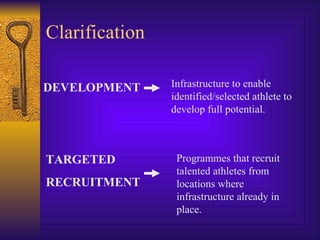
Clarification

DEVELOPMENT     Infrastructure to enable
                identified/selected athlete to
                develop full potential.


TARGETED         Programmes that recruit
                 talented athletes from
RECRUITMENT      locations where
                 infrastructure already in
                 place.
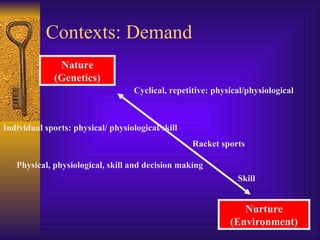
Contexts: Demand
               Nature
              (Genetics)
                                    Cyclical, repetitive: physical/physiological


Individual sports: physical/ physiological/skill
                                                    Racket sports

   Physical, physiological, skill and decision making
                                                                Skill


                                                                 Nurture
                                                              (Environment)
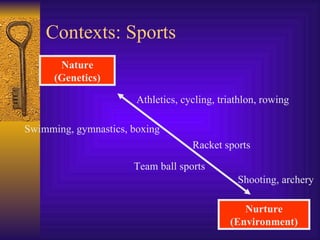
Contexts: Sports
       Nature
      (Genetics)

                       Athletics, cycling, triathlon, rowing

Swimming, gymnastics, boxing
                                    Racket sports
                      Team ball sports
                                               Shooting, archery

                                                Nurture
                                             (Environment)
How much of an athlete’s
performance potential can you
measure in your sport?
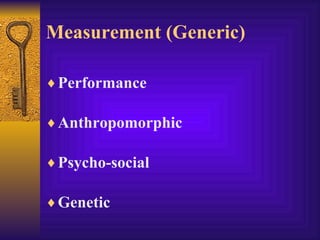
Measurement (Generic)

♦ Performance

♦ Anthropomorphic

♦ Psycho-social

♦ Genetic
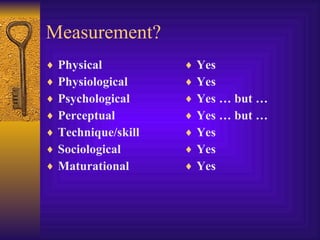
Measurement?
♦ Physical          ♦ Yes
♦ Physiological     ♦ Yes
♦ Psychological     ♦ Yes … but …
♦ Perceptual        ♦ Yes … but …
♦ Technique/skill   ♦ Yes
♦ Sociological      ♦ Yes
♦ Maturational      ♦ Yes
The dynamic of these performance
factors changes over the maturational
  cycle. Performance monitoring will
 enable us to understand more about
              interactions.
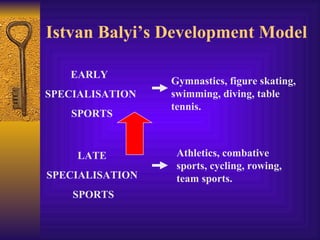
Istvan Balyi’s Development Model

   EARLY
                 Gymnastics, figure skating,
SPECIALISATION   swimming, diving, table
                 tennis.
    SPORTS


    LATE          Athletics, combative
                  sports, cycling, rowing,
SPECIALISATION    team sports.
    SPORTS
It is difficult to envisage a system
of selection that is not linked to
subsequent programmes of
development.


                 Borms (1994)
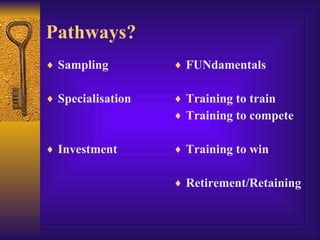
Pathways?
♦ Sampling         ♦ FUNdamentals


♦ Specialisation   ♦ Training to train
                   ♦ Training to compete


♦ Investment       ♦ Training to win


                   ♦ Retirement/Retaining
Long-Term Athlete Development

A specific and well-planned training,
competition and recovery regime will ensure
optimum development throughout an
athlete’s career. Ultimately success comes
from training and performing well over the
long-term rather than winning in the short-
term. There is no short cut to success in
athletic preparation.
                               Balyi (2001)
Sport System Building

Can we develop a sport system
that will encourage co-operation
within and between sports?
Can we develop a comprehensive
curriculum of sport education for
athletes, coaches and parents?
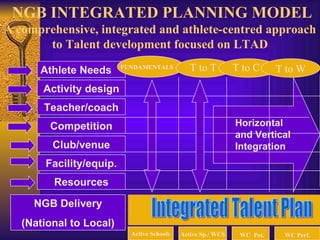
NGB INTEGRATED PLANNING MODEL
A comprehensive, integrated and athlete-centred approach
       to Talent development focused on LTAD

      Athlete Needs      FUNDAMENTALS          T to T         T to C     T to W
       Activity design
       Teacher/coach
        Competition                                           Horizontal
                                                              and Vertical
         Club/venue                                           Integration
       Facility/equip.
         Resources

     NGB Delivery
   (National to Local)
                           Active Schools   Active Sp./ WCS    WC Pot.    WC Perf.
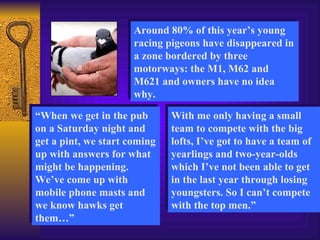
Around 80% of this year’s young
                      racing pigeons have disappeared in
                      a zone bordered by three
                      motorways: the M1, M62 and
                      M621 and owners have no idea
                      why.

“When we get in the pub       With me only having a small
on a Saturday night and       team to compete with the big
get a pint, we start coming   lofts, I’ve got to have a team of
up with answers for what      yearlings and two-year-olds
might be happening.           which I’ve not been able to get
We’ve come up with            in the last year through losing
mobile phone masts and        youngsters. So I can’t compete
we know hawks get             with the top men.”
them…”

The Talent Identification Process

  • 1.
    The Talent Identification andDevelopment Process Keith Lyons Running Sport Seminar London, February 2002
  • 3.
  • 4.
    Age Profile Trendsin the UK Males 1999-2026 25 20 15 10 % of Population 5 0 1999 2011 2026 Under 16 16-24
  • 5.
    Female Trends 1999-2026 25 20 15 10 % of Population 5 0 1999 2011 2026 Under 16 16-24
  • 6.
    In Numbers! Age Group 2000 2010 2020 5 to 9 3.85m 3.7m 3.25m 10 – 14 3.9m 3.6m 3.25m 15 – 19 3.7m 3.9m 3.4m 20 - 24 3.5m 3.95m 3.65m Total 14.95m 15.15m 13.55m As % of 25% 25% 22% Population
  • 7.
    Introduction ♦ Clarification ofterminology ♦ Contexts ♦ Measurement Issues ♦ Talent Development ♦ Long-term vision and sport system building
  • 8.
    There is noone correct model for talent identification and selection. It is dependent on the complexity of the sport (from a predictive perspective) and the infrastructure of the sport at a local, regional and national level. Debbie Hoare (2001)
  • 9.
    Clarification Screening using selected tests to IDENTIFICATION identify potential for success. Previous involvement NOT a prerequisite. Screening of athletes currently participating in a SELECTION sport using experienced coaches and/or selected tests to identify those most likely to succeed.
  • 10.
    Clarification DEVELOPMENT Infrastructure to enable identified/selected athlete to develop full potential. TARGETED Programmes that recruit talented athletes from RECRUITMENT locations where infrastructure already in place.
  • 11.
    Contexts: Demand Nature (Genetics) Cyclical, repetitive: physical/physiological Individual sports: physical/ physiological/skill Racket sports Physical, physiological, skill and decision making Skill Nurture (Environment)
  • 12.
    Contexts: Sports Nature (Genetics) Athletics, cycling, triathlon, rowing Swimming, gymnastics, boxing Racket sports Team ball sports Shooting, archery Nurture (Environment)
  • 13.
    How much ofan athlete’s performance potential can you measure in your sport?
  • 14.
    Measurement (Generic) ♦ Performance ♦Anthropomorphic ♦ Psycho-social ♦ Genetic
  • 15.
    Measurement? ♦ Physical ♦ Yes ♦ Physiological ♦ Yes ♦ Psychological ♦ Yes … but … ♦ Perceptual ♦ Yes … but … ♦ Technique/skill ♦ Yes ♦ Sociological ♦ Yes ♦ Maturational ♦ Yes
  • 16.
    The dynamic ofthese performance factors changes over the maturational cycle. Performance monitoring will enable us to understand more about interactions.
  • 17.
    Istvan Balyi’s DevelopmentModel EARLY Gymnastics, figure skating, SPECIALISATION swimming, diving, table tennis. SPORTS LATE Athletics, combative sports, cycling, rowing, SPECIALISATION team sports. SPORTS
  • 18.
    It is difficultto envisage a system of selection that is not linked to subsequent programmes of development. Borms (1994)
  • 19.
    Pathways? ♦ Sampling ♦ FUNdamentals ♦ Specialisation ♦ Training to train ♦ Training to compete ♦ Investment ♦ Training to win ♦ Retirement/Retaining
  • 20.
    Long-Term Athlete Development Aspecific and well-planned training, competition and recovery regime will ensure optimum development throughout an athlete’s career. Ultimately success comes from training and performing well over the long-term rather than winning in the short- term. There is no short cut to success in athletic preparation. Balyi (2001)
  • 21.
    Sport System Building Canwe develop a sport system that will encourage co-operation within and between sports? Can we develop a comprehensive curriculum of sport education for athletes, coaches and parents?
  • 22.
    NGB INTEGRATED PLANNINGMODEL A comprehensive, integrated and athlete-centred approach to Talent development focused on LTAD Athlete Needs FUNDAMENTALS T to T T to C T to W Activity design Teacher/coach Competition Horizontal and Vertical Club/venue Integration Facility/equip. Resources NGB Delivery (National to Local) Active Schools Active Sp./ WCS WC Pot. WC Perf.
  • 23.
    Around 80% ofthis year’s young racing pigeons have disappeared in a zone bordered by three motorways: the M1, M62 and M621 and owners have no idea why. “When we get in the pub With me only having a small on a Saturday night and team to compete with the big get a pint, we start coming lofts, I’ve got to have a team of up with answers for what yearlings and two-year-olds might be happening. which I’ve not been able to get We’ve come up with in the last year through losing mobile phone masts and youngsters. So I can’t compete we know hawks get with the top men.” them…”