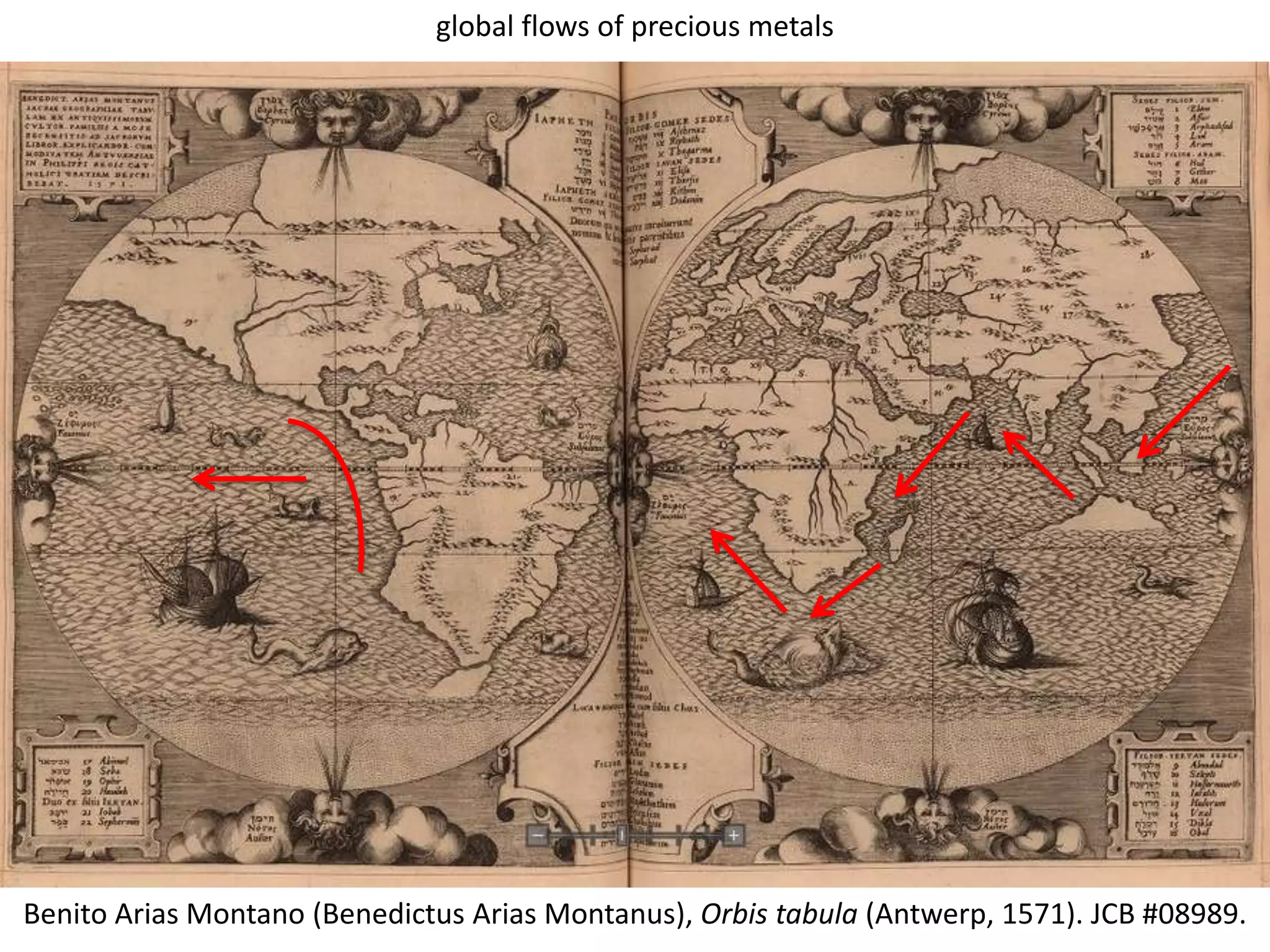
Benito Arias Montano (Benedictus Arias Montanus), Orbis tabula (Antwerp, 1571). JCB #08989.
global flows of precious metals
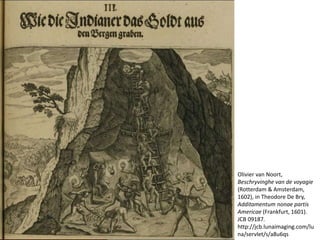
Olivier van Noort,
Beschryvinghe van de voyagie
(Rotterdam & Amsterdam,
1602), in Theodore De Bry,
Additamentum nonae partis
Americae (Frankfurt, 1601).
JCB 09187.
http://jcb.lunaimaging.com/lu
na/servlet/s/a8u6qs
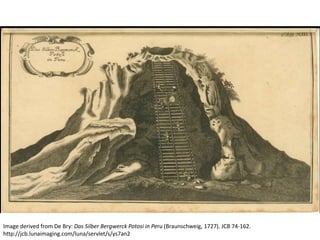
Image derived from De Bry: Das Silber Bergwerck Potosi in Peru (Braunschweig, 1727). JCB 74-162.
http://jcb.lunaimaging.com/luna/servlet/s/ys7an2
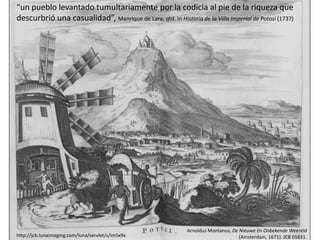
“un pueblo levantado tumultariamente por la codicia al pie de la riqueza que
descurbrió una casualidad”, Manrique de Lara, qtd. in Historia de la Villa Imperial de Potosí (1737)
Arnoldus Montanus, De Nieuwe En Onbekende Weereld
(Amsterdam, 1671). JCB 01631.http://jcb.lunaimaging.com/luna/servlet/s/im5x9x
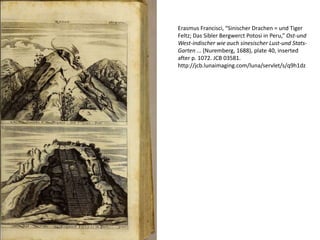
Erasmus Francisci, “Sinischer Drachen = und Tiger
Feltz; Das Sibler Bergwerct Potosi in Peru,” Ost-und
West-indischer wie auch sinesischer Lust-und Stats-
Garten ... (Nuremberg, 1688), plate 40, inserted
after p. 1072. JCB 03581.
http://jcb.lunaimaging.com/luna/servlet/s/q9h1dz
Francisco Quevedo, “Silva a una mina”
¿Qué tierra tan extraña
no te obligó a besar del mar la saña?
¿Cuál alarbe, cuál scita, turco o moro,
mientras al viento y agua obedecías,
por señor no temías?
Mucho te debe el oro
si, después que saliste,
pobre reliquia, del naufragio triste,
en vez de descansar del mar seguro,
a tu codicia hidrópica obediente,
con villano azadón, del cerro duro
sangras las venas del metal luciente.
Francisco López de Gómara, Historia de las Indias
(Constantinople: Ibrahim Mutafarrika, at the
Imperial Press, 1142 [1730]), p. 25. JCB 04407.
http://jcb.lunaimaging.com/luna/servlet/s/32co83
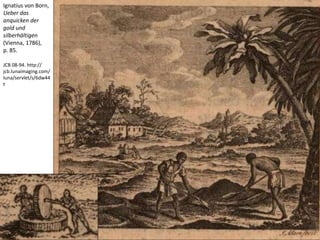
Ignatius von Born,
Ueber das
anquicken der
gold und
silberhältigen
(Vienna, 1786),
p. 85.
JCB 08-94. http://
jcb.lunaimaging.com/
luna/servlet/s/6dw44
t
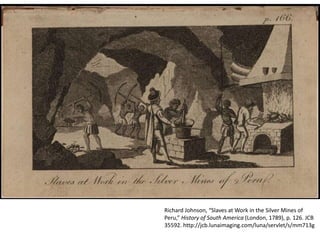
Richard Johnson, “Slaves at Work in the Silver Mines of
Peru,” History of South America (London, 1789), p. 126. JCB
35592. http://jcb.lunaimaging.com/luna/servlet/s/mm713g
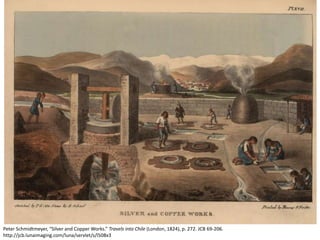
Peter Schmidtmeyer, “Silver and Copper Works.” Travels into Chile (London, 1824), p. 272. JCB 69-206.
http://jcb.lunaimaging.com/luna/servlet/s/l508x3
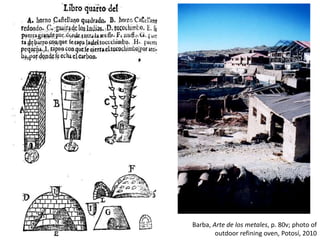
Barba, Arte de los metales, p. 80v; photo of
outdoor refining oven, Potosí, 2010
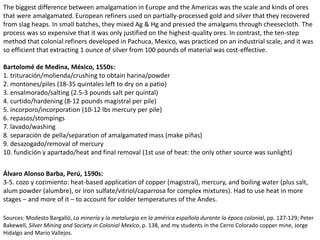
The biggest difference between amalgamation in Europe and the Americas was the scale and kinds of ores
that were amalgamated. European refiners used on partially-processed gold and silver that they recovered
from slag heaps. In small batches, they mixed Ag & Hg and pressed the amalgams through cheesecloth. The
process was so expensive that it was only justified on the highest-quality ores. In contrast, the ten-step
method that colonial refiners developed in Pachuca, Mexico, was practiced on an industrial scale, and it was
so efficient that extracting 1 ounce of silver from 100 pounds of material was cost-effective.
Bartolomé de Medina, México, 1550s:
1. trituración/molienda/crushing to obtain harina/powder
2. montones/piles (18-35 quintales left to dry on a patio)
3. ensalmorado/salting (2.5-3 pounds salt per quintal)
4. curtido/hardening (8-12 pounds magistral per pile)
5. incorporo/incorporation (10-12 lbs mercury per pile)
6. repasos/stompings
7. lavado/washing
8. separación de pella/separation of amalgamated mass (make piñas)
9. desazogado/removal of mercury
10. fundición y apartado/heat and final removal (1st use of heat: the only other source was sunlight)
Álvaro Alonso Barba, Perú, 1590s:
3-5. cozo y cozimiento: heat-based application of copper (magistral), mercury, and boiling water (plus salt,
alum powder (alumbre), or iron sulfate/vitriol/caparrosa for complex mixtures). Had to use heat in more
stages – and more of it – to account for colder temperatures of the Andes.
Sources: Modesto Bargalló, La minería y la metalurgia en la américa española durante la época colonial, pp. 127-129; Peter
Bakewell, Silver Mining and Society in Colonial Mexico, p. 138, and my students in the Cerro Colorado copper mine, Jorge
Hidalgo and Mario Vallejos.
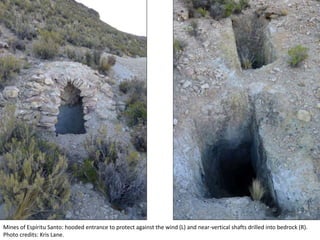
Mines of Espíritu Santo: hooded entrance to protect against the wind (L) and near-vertical shafts drilled into bedrock (R).
Photo credits: Kris Lane.
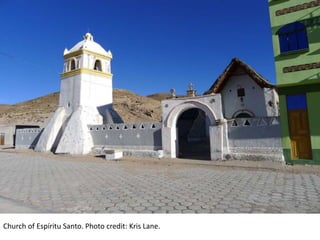
Church of Espíritu Santo. Photo credit: Kris Lane.

The Science of Silver

  • 1.
    Benito Arias Montano(Benedictus Arias Montanus), Orbis tabula (Antwerp, 1571). JCB #08989. global flows of precious metals
  • 2.
    Olivier van Noort, Beschryvinghevan de voyagie (Rotterdam & Amsterdam, 1602), in Theodore De Bry, Additamentum nonae partis Americae (Frankfurt, 1601). JCB 09187. http://jcb.lunaimaging.com/lu na/servlet/s/a8u6qs
  • 3.
    Image derived fromDe Bry: Das Silber Bergwerck Potosi in Peru (Braunschweig, 1727). JCB 74-162. http://jcb.lunaimaging.com/luna/servlet/s/ys7an2
  • 4.
    “un pueblo levantadotumultariamente por la codicia al pie de la riqueza que descurbrió una casualidad”, Manrique de Lara, qtd. in Historia de la Villa Imperial de Potosí (1737) Arnoldus Montanus, De Nieuwe En Onbekende Weereld (Amsterdam, 1671). JCB 01631.http://jcb.lunaimaging.com/luna/servlet/s/im5x9x
  • 5.
    Erasmus Francisci, “SinischerDrachen = und Tiger Feltz; Das Sibler Bergwerct Potosi in Peru,” Ost-und West-indischer wie auch sinesischer Lust-und Stats- Garten ... (Nuremberg, 1688), plate 40, inserted after p. 1072. JCB 03581. http://jcb.lunaimaging.com/luna/servlet/s/q9h1dz
  • 6.
    Francisco Quevedo, “Silvaa una mina” ¿Qué tierra tan extraña no te obligó a besar del mar la saña? ¿Cuál alarbe, cuál scita, turco o moro, mientras al viento y agua obedecías, por señor no temías? Mucho te debe el oro si, después que saliste, pobre reliquia, del naufragio triste, en vez de descansar del mar seguro, a tu codicia hidrópica obediente, con villano azadón, del cerro duro sangras las venas del metal luciente. Francisco López de Gómara, Historia de las Indias (Constantinople: Ibrahim Mutafarrika, at the Imperial Press, 1142 [1730]), p. 25. JCB 04407. http://jcb.lunaimaging.com/luna/servlet/s/32co83
  • 7.
    Ignatius von Born, Ueberdas anquicken der gold und silberhältigen (Vienna, 1786), p. 85. JCB 08-94. http:// jcb.lunaimaging.com/ luna/servlet/s/6dw44 t
  • 8.
    Richard Johnson, “Slavesat Work in the Silver Mines of Peru,” History of South America (London, 1789), p. 126. JCB 35592. http://jcb.lunaimaging.com/luna/servlet/s/mm713g
  • 9.
    Peter Schmidtmeyer, “Silverand Copper Works.” Travels into Chile (London, 1824), p. 272. JCB 69-206. http://jcb.lunaimaging.com/luna/servlet/s/l508x3
  • 10.
    Barba, Arte delos metales, p. 80v; photo of outdoor refining oven, Potosí, 2010
  • 11.
    The biggest differencebetween amalgamation in Europe and the Americas was the scale and kinds of ores that were amalgamated. European refiners used on partially-processed gold and silver that they recovered from slag heaps. In small batches, they mixed Ag & Hg and pressed the amalgams through cheesecloth. The process was so expensive that it was only justified on the highest-quality ores. In contrast, the ten-step method that colonial refiners developed in Pachuca, Mexico, was practiced on an industrial scale, and it was so efficient that extracting 1 ounce of silver from 100 pounds of material was cost-effective. Bartolomé de Medina, México, 1550s: 1. trituración/molienda/crushing to obtain harina/powder 2. montones/piles (18-35 quintales left to dry on a patio) 3. ensalmorado/salting (2.5-3 pounds salt per quintal) 4. curtido/hardening (8-12 pounds magistral per pile) 5. incorporo/incorporation (10-12 lbs mercury per pile) 6. repasos/stompings 7. lavado/washing 8. separación de pella/separation of amalgamated mass (make piñas) 9. desazogado/removal of mercury 10. fundición y apartado/heat and final removal (1st use of heat: the only other source was sunlight) Álvaro Alonso Barba, Perú, 1590s: 3-5. cozo y cozimiento: heat-based application of copper (magistral), mercury, and boiling water (plus salt, alum powder (alumbre), or iron sulfate/vitriol/caparrosa for complex mixtures). Had to use heat in more stages – and more of it – to account for colder temperatures of the Andes. Sources: Modesto Bargalló, La minería y la metalurgia en la américa española durante la época colonial, pp. 127-129; Peter Bakewell, Silver Mining and Society in Colonial Mexico, p. 138, and my students in the Cerro Colorado copper mine, Jorge Hidalgo and Mario Vallejos.
  • 12.
    Mines of EspírituSanto: hooded entrance to protect against the wind (L) and near-vertical shafts drilled into bedrock (R). Photo credits: Kris Lane.
  • 13.
    Church of EspírituSanto. Photo credit: Kris Lane.