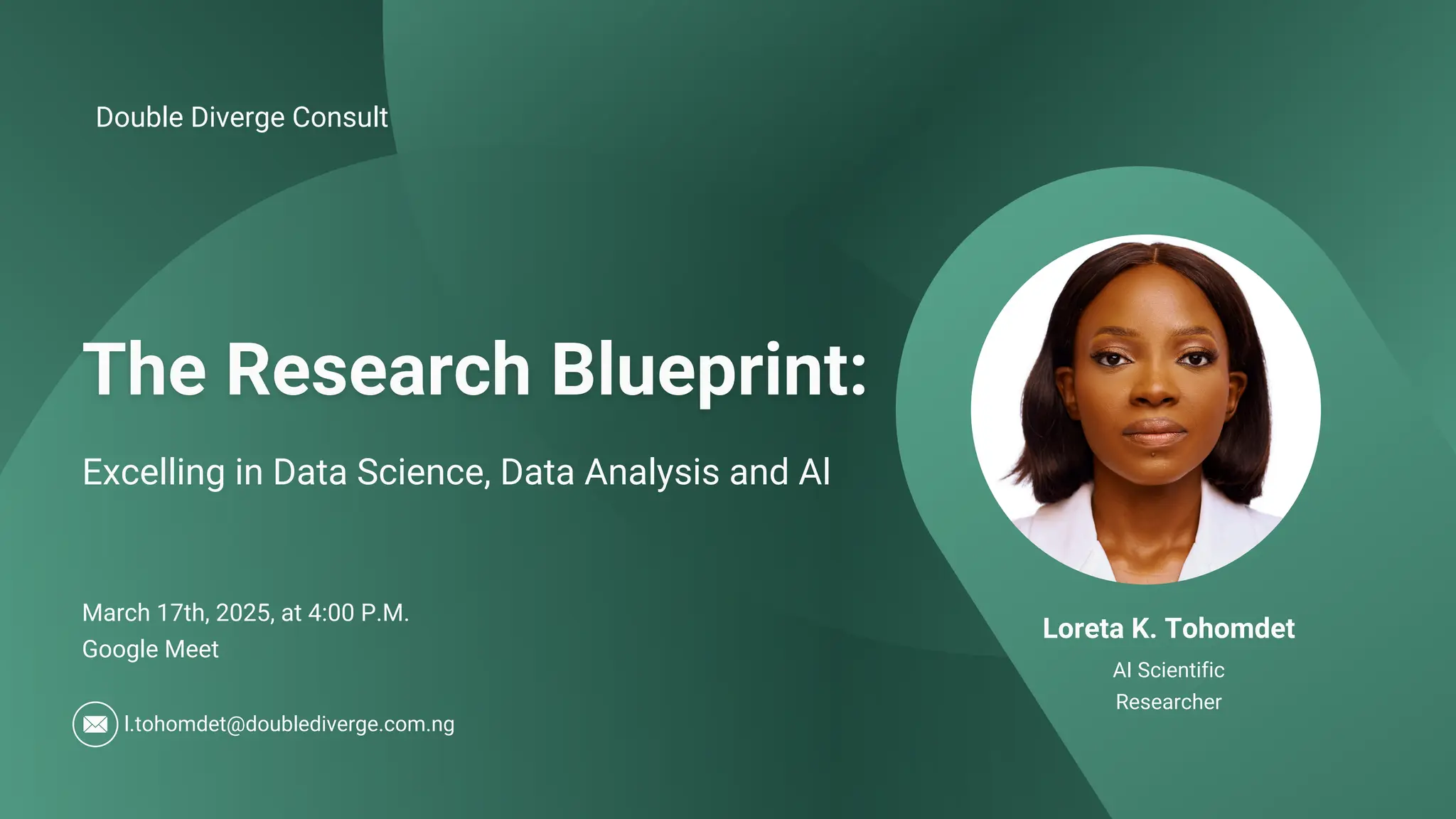
Double Diverge Consult
l.tohomdet@doublediverge.com.ng
Excelling in Data Science, Data Analysis and Al
Loreta K. Tohomdet
AI Scientific
Researcher
March 17th, 2025, at 4:00 P.M.
Google Meet
Webinar Ground
Rules
While waiting for others to come in,
here are some rules and reminders to
keep in mind.
Please mute your mics during the
session
Raise your e-hand to answer or ask a
question
Do not use abusive words on anyone
1.
Core Topics
for
Discussion
What we're learning about
Research Blueprint
Understanding Core Concepts
The Research Process Blueprint
Key Skills for Excellence
Tools and Technologies
Ethical Considerations and Best Practices
2.
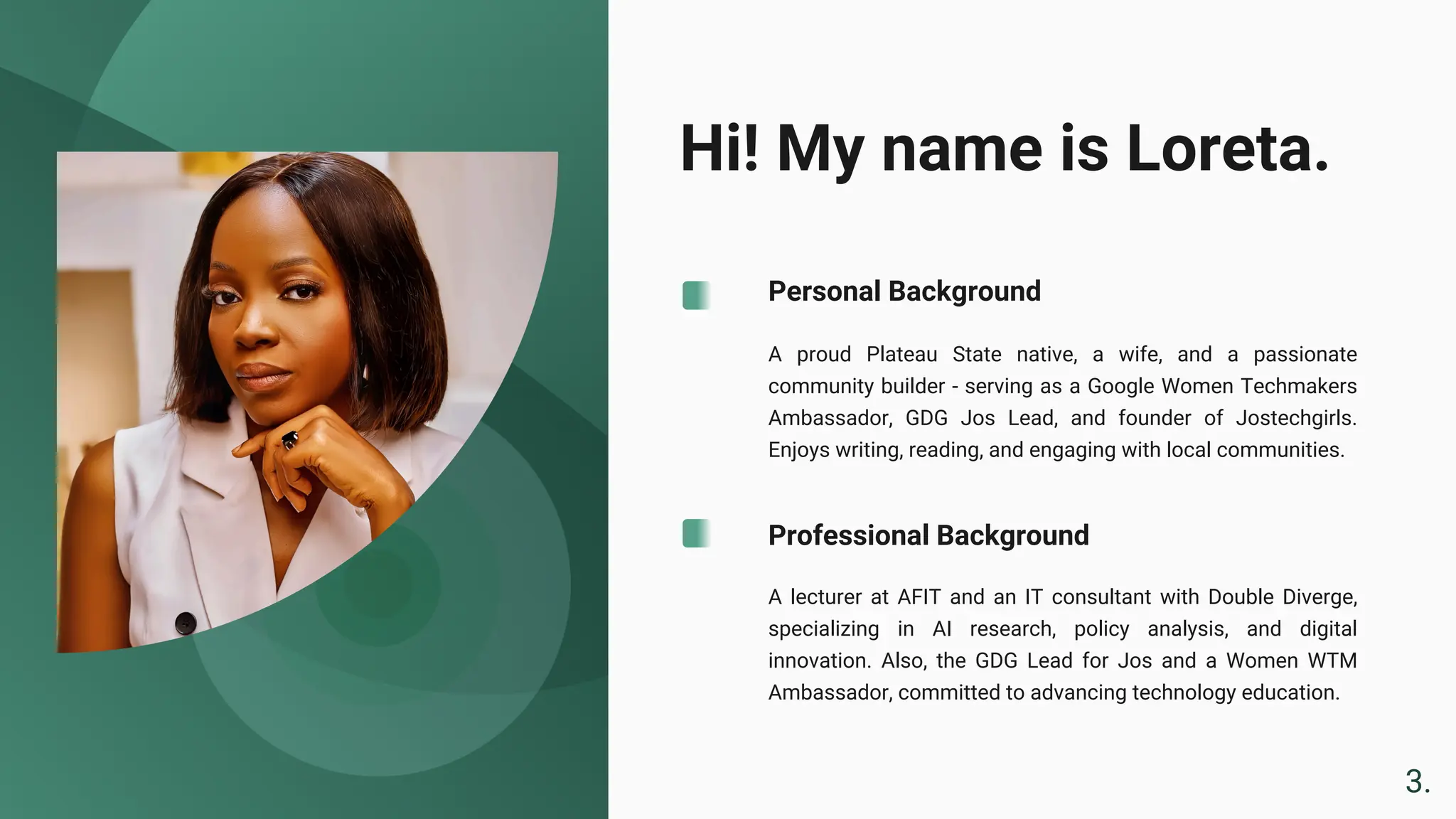
Hi! My name is Loreta.
A lecturer at AFIT and an IT consultant with Double Diverge,
specializing in AI research, policy analysis, and digital
innovation. Also, the GDG Lead for Jos and a Women WTM
Ambassador, committed to advancing technology education.
A proud Plateau State native, a wife, and a passionate
community builder - serving as a Google Women Techmakers
Ambassador, GDG Jos Lead, and founder of Jostechgirls.
Enjoys writing, reading, and engaging with local communities.
Personal Background
Professional Background
3.
INTRODUCTION
In today's world, data drives decision-making across industries. Understanding
and mastering Data Science, Data Analysis, and AI are crucial for solving complex
problems, enhancing efficiency, and unlocking new possibilities.
Objective: This presentation will provide a structured guide to excelling in these
fields, covering key skills, tools, research processes, and best practices.
4.
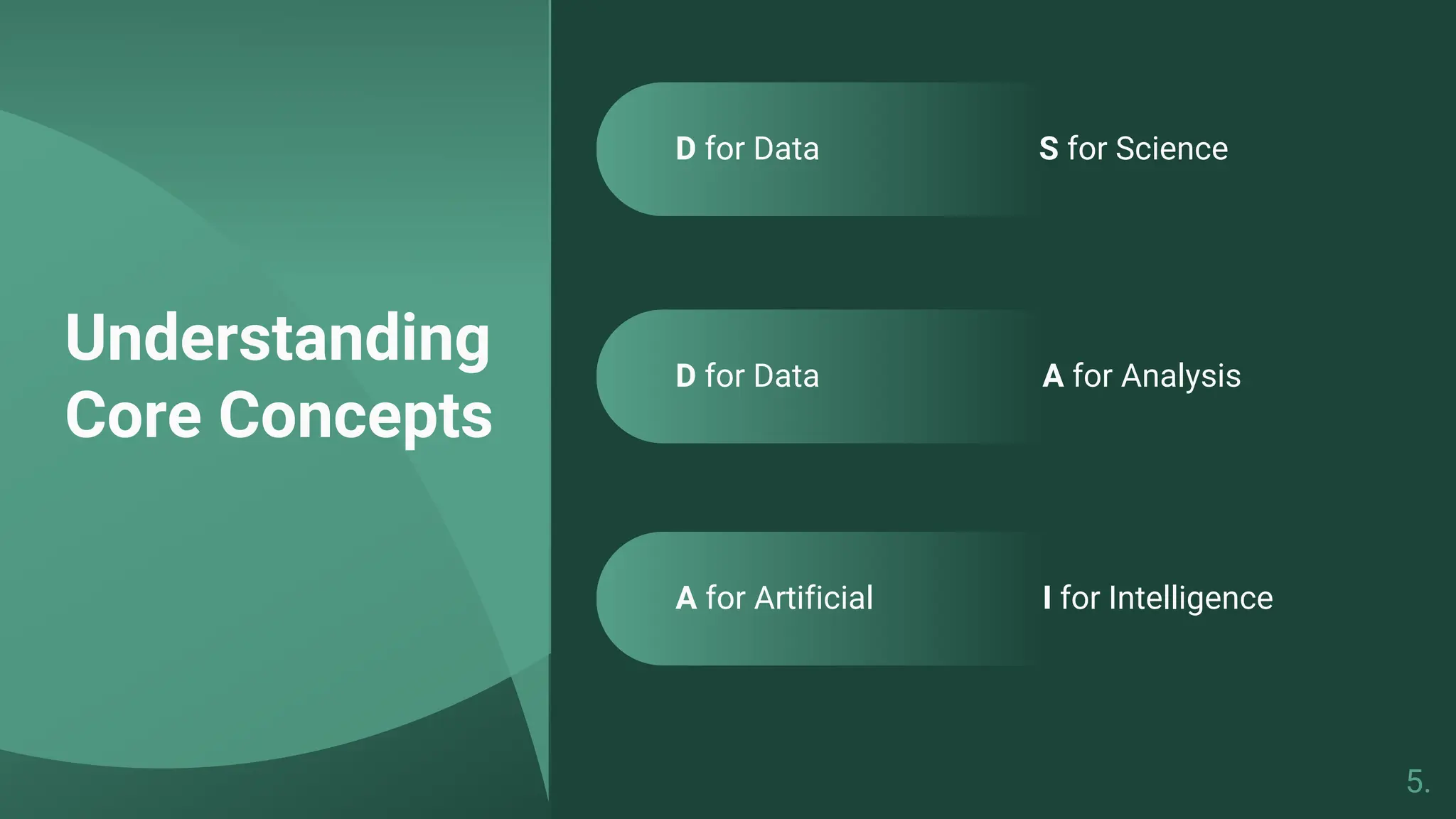
Understanding
Core Concepts
D for Data
D for Data
A for Artificial
S for Science
A for Analysis
I for Intelligence
5.
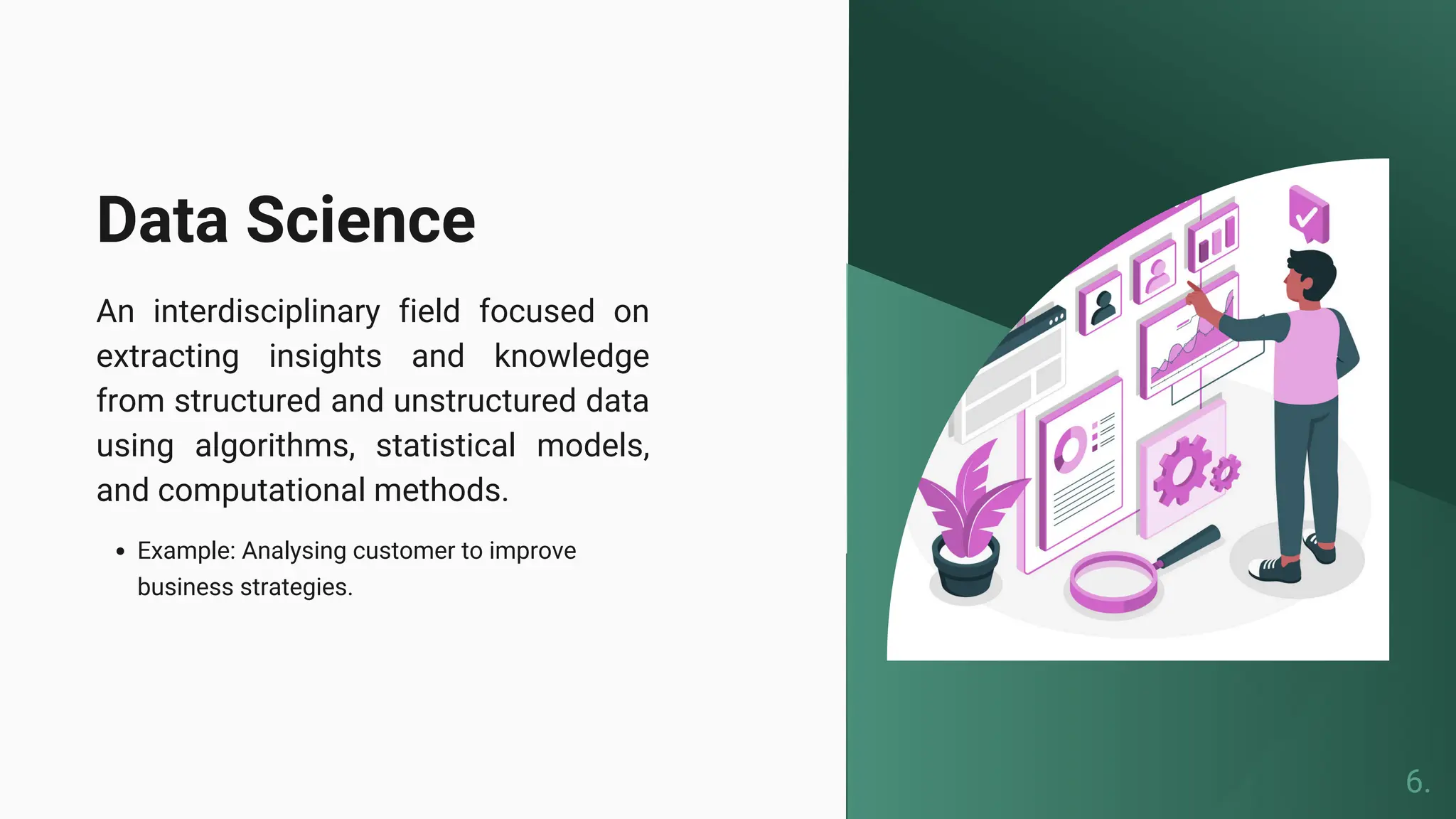
Data Science
An interdisciplinary field focused on
extracting insights and knowledge
from structured and unstructured data
using algorithms, statistical models,
and computational methods.
Example: Analysing customer to improve
business strategies.
6.
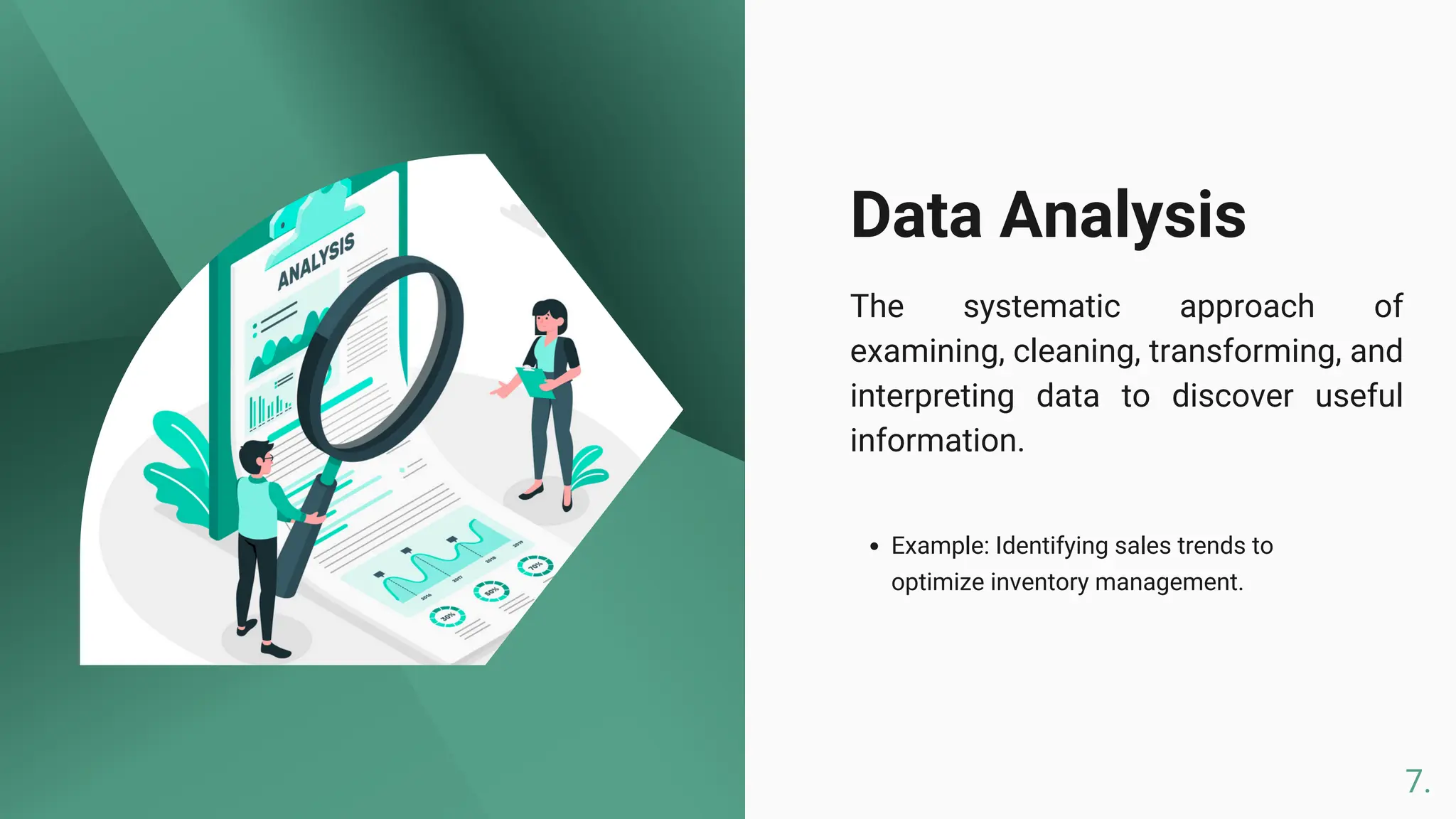
Data Analysis
The systematic approach of
examining, cleaning, transforming, and
interpreting data to discover useful
information.
Example: Identifying sales trends to
optimize inventory management.
7.
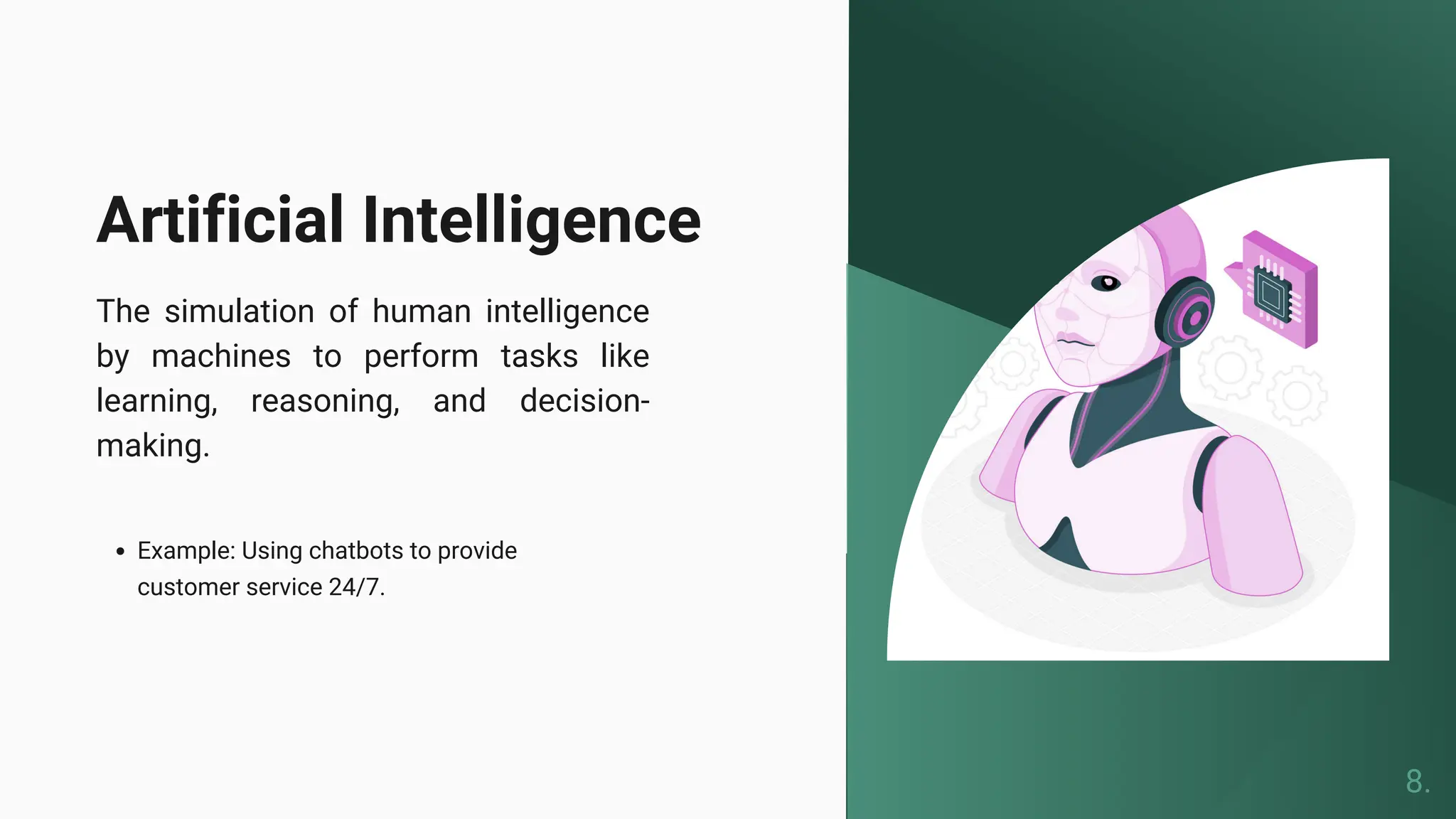
Artificial Intelligence
The simulation of human intelligence
by machines to perform tasks like
learning, reasoning, and decision-
making.
Example: Using chatbots to provide
customer service 24/7.
8.
Think & Apply
How can understanding these three fields together improve decision-making in
a business setting?
Its time for you to think and apply!
9.
— Clive Humby
"Data is the new oil."
10.
Key Skills for Excellence
Skills you require and Why it matters!
11.
Programming Proficiency:
Master languages like Python (for data manipulation), R
(for statistical computing), and SQL (for database
management).
Statistical Analysis &
Mathematics:
Understand core concepts like linear algebra, probability,
regression analysis, and hypothesis testing.
12.
Data Visualization:
Present insights clearly using tools like Tableau, Power
BI, and libraries like Matplotlib and Seaborn.
Machine Learning & AI
Frameworks:
Gain expertise in frameworks like TensorFlow (for deep
learning), Scikit-learn (for traditional ML), and PyTorch
(for advanced research).
13.
— W. Edwards Deming
"Without data, you're just another
person with an opinion."
14.
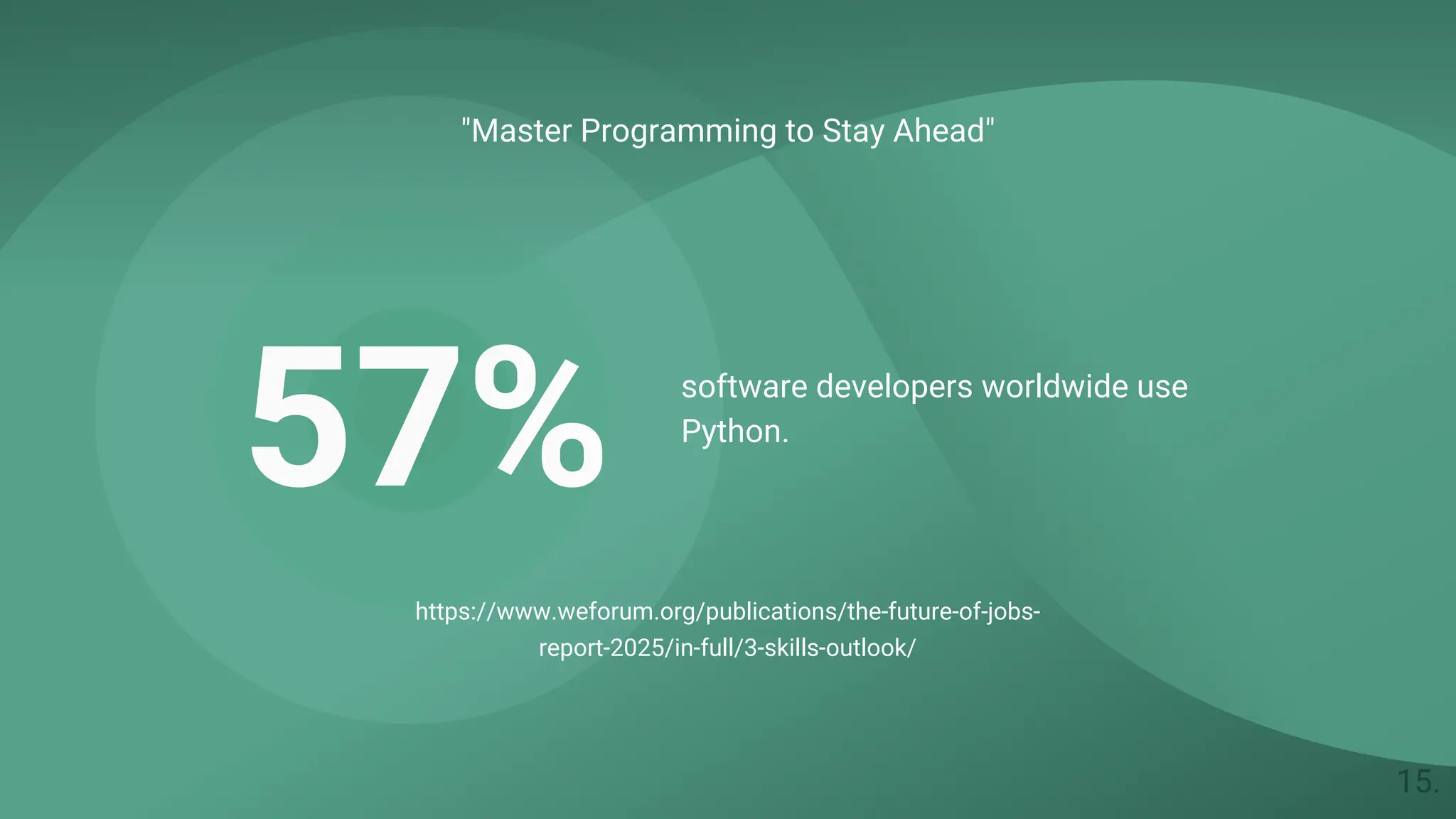
"Master Programming to Stay Ahead"
57% software developers worldwide use
Python. ​
https://www.weforum.org/publications/the-future-of-jobs-
report-2025/in-full/3-skills-outlook/
15.
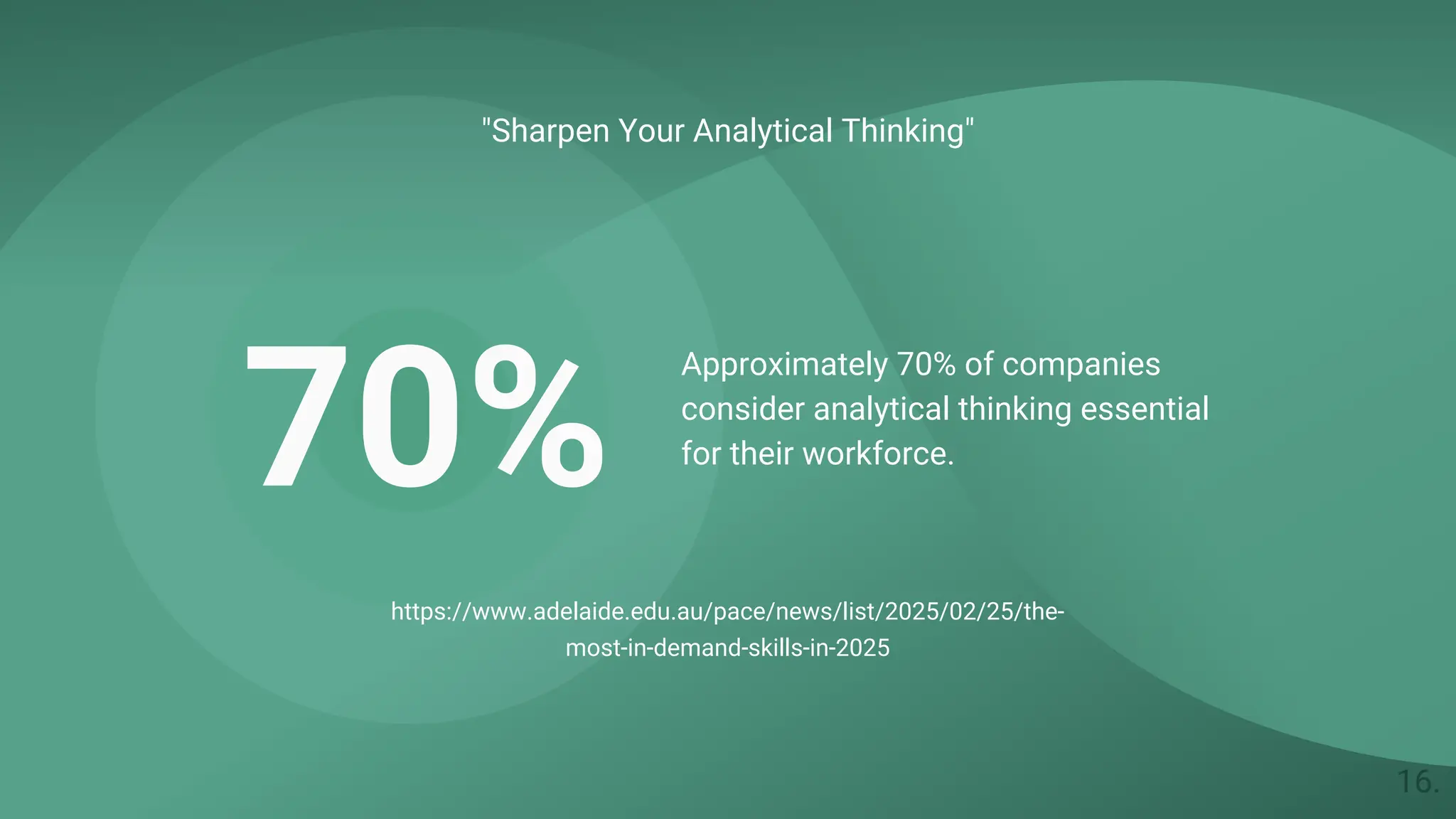
"Sharpen Your Analytical Thinking"
70%
Approximately 70% of companies
consider analytical thinking essential
for their workforce. ​
https://www.adelaide.edu.au/pace/news/list/2025/02/25/the-
most-in-demand-skills-in-2025
16.
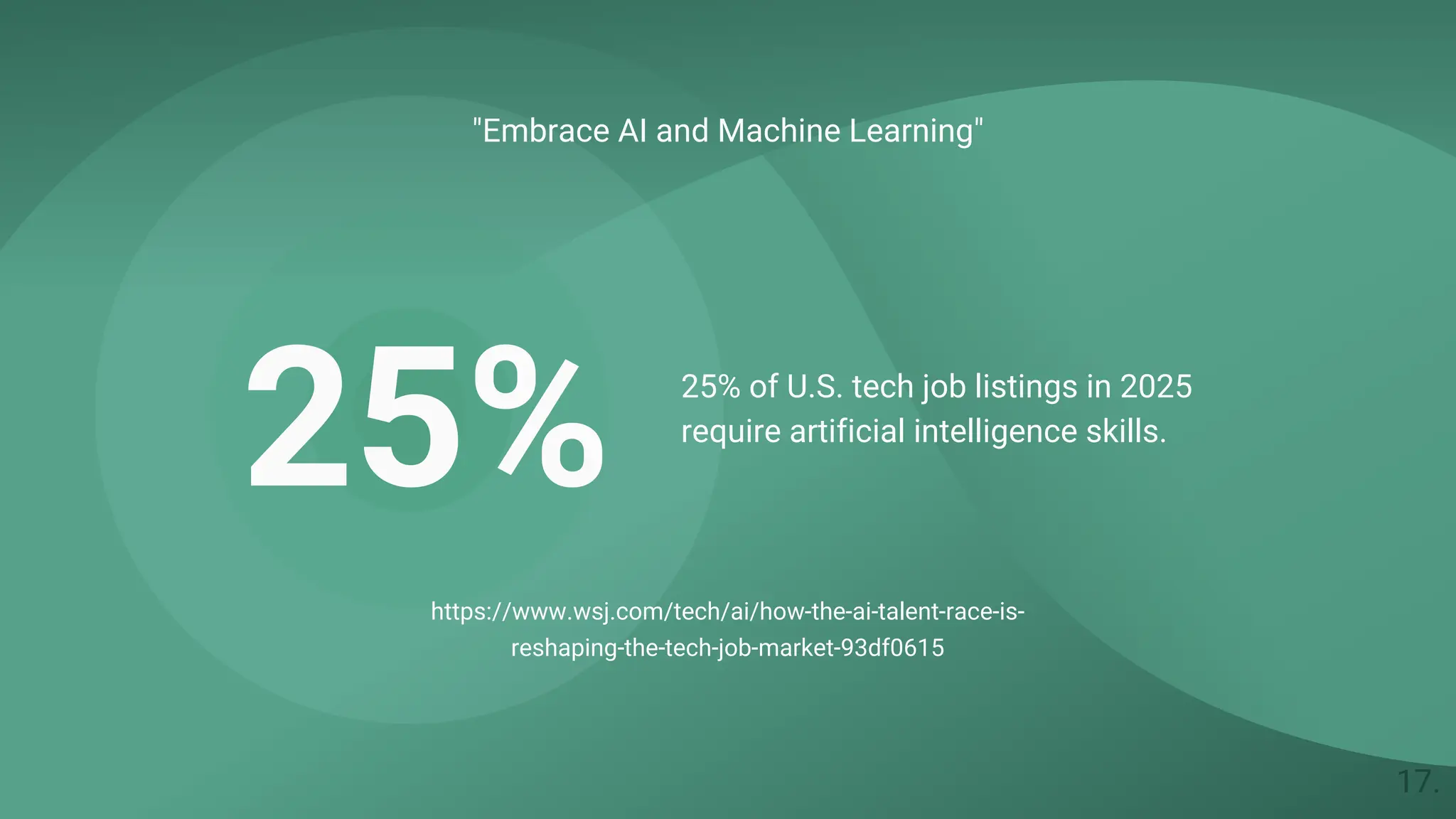
"Embrace AI and Machine Learning"
25% 25% of U.S. tech job listings in 2025
require artificial intelligence skills. ​
https://www.wsj.com/tech/ai/how-the-ai-talent-race-is-
reshaping-the-tech-job-market-93df0615
17.
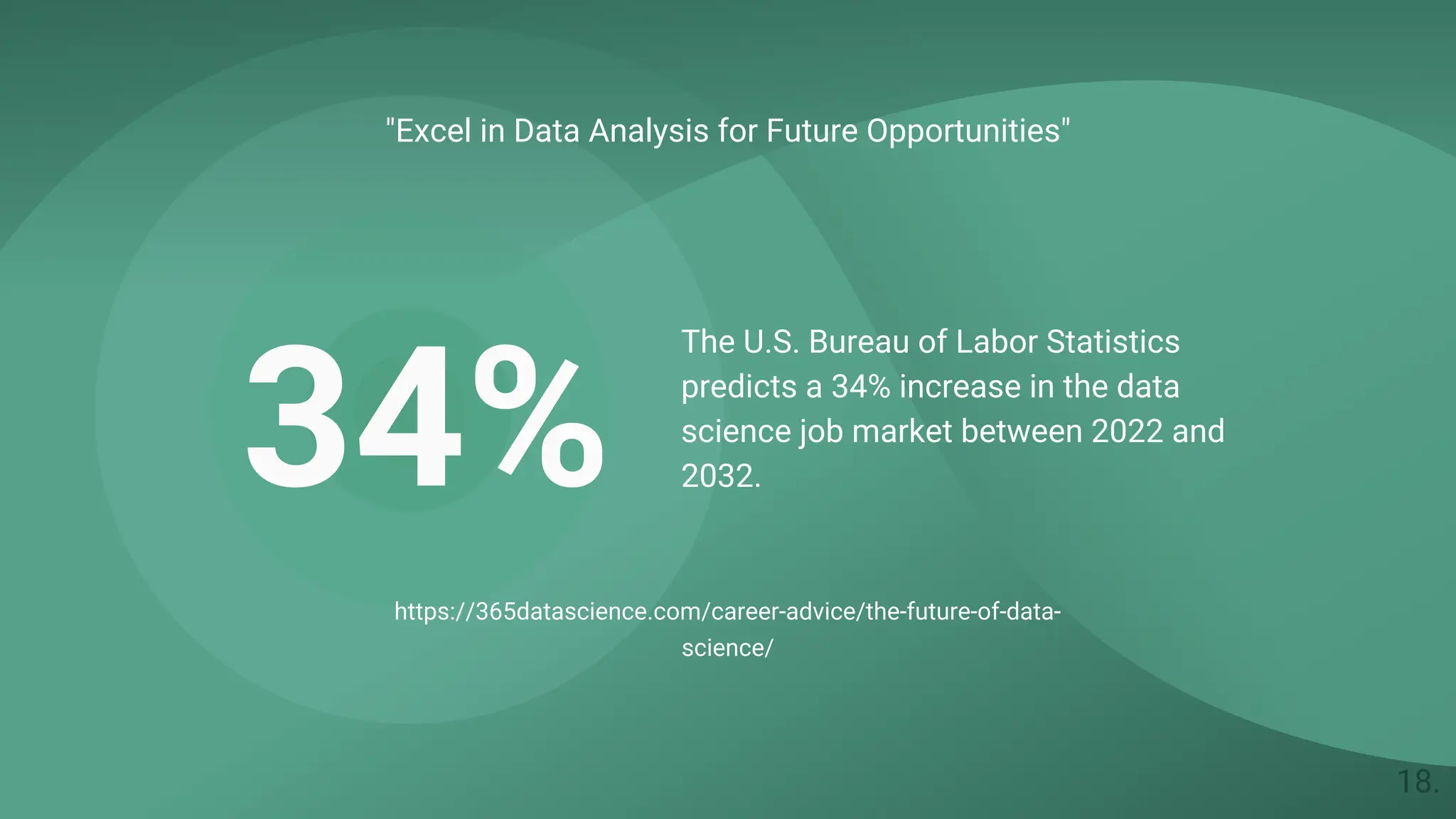
"Excel in Data Analysis for Future Opportunities"
34%
The U.S. Bureau of Labor Statistics
predicts a 34% increase in the data
science job market between 2022 and
2032. ​
https://365datascience.com/career-advice/the-future-of-data-
science/
18.
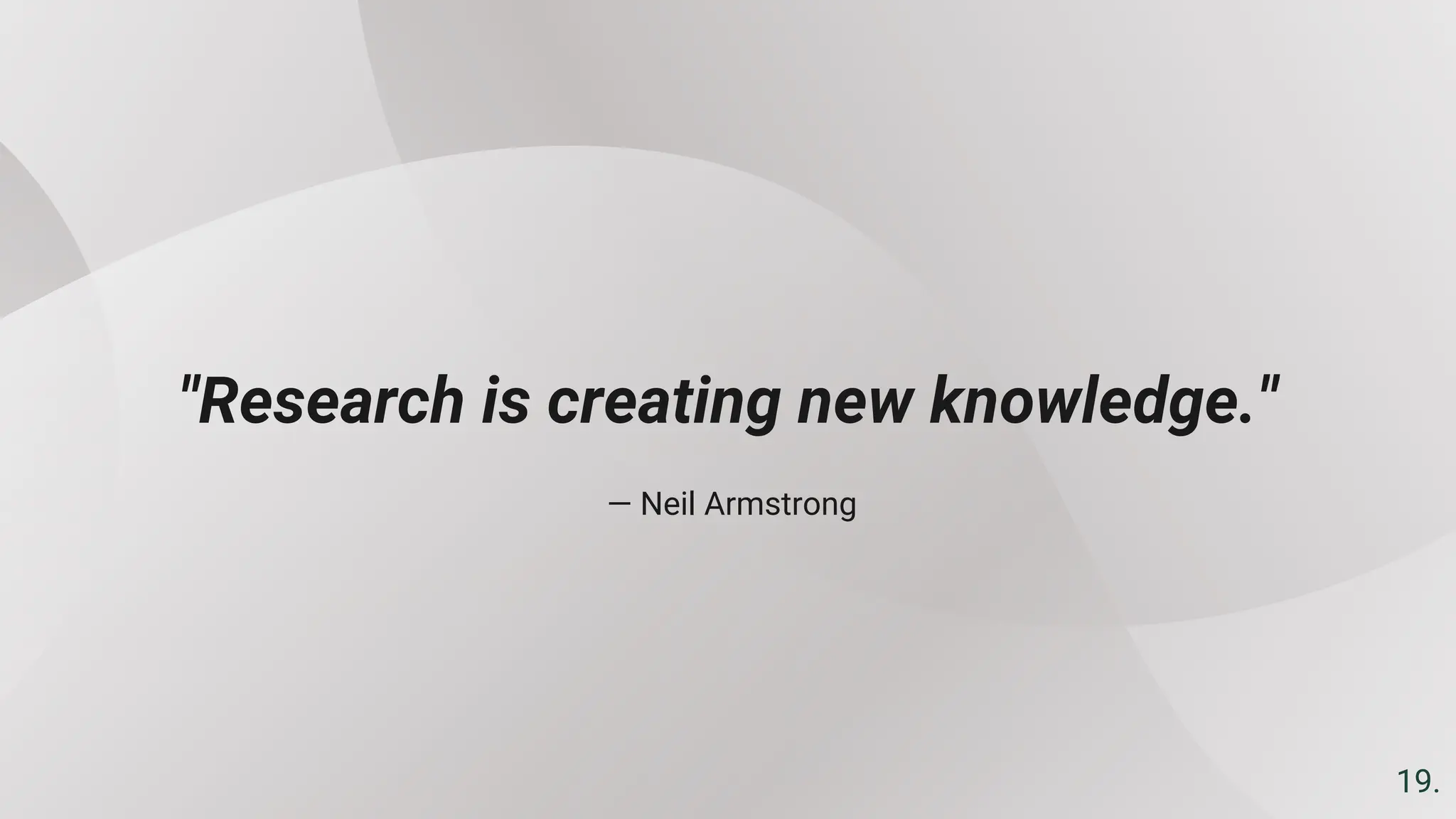
— Neil Armstrong
"Research is creating new knowledge."
19.
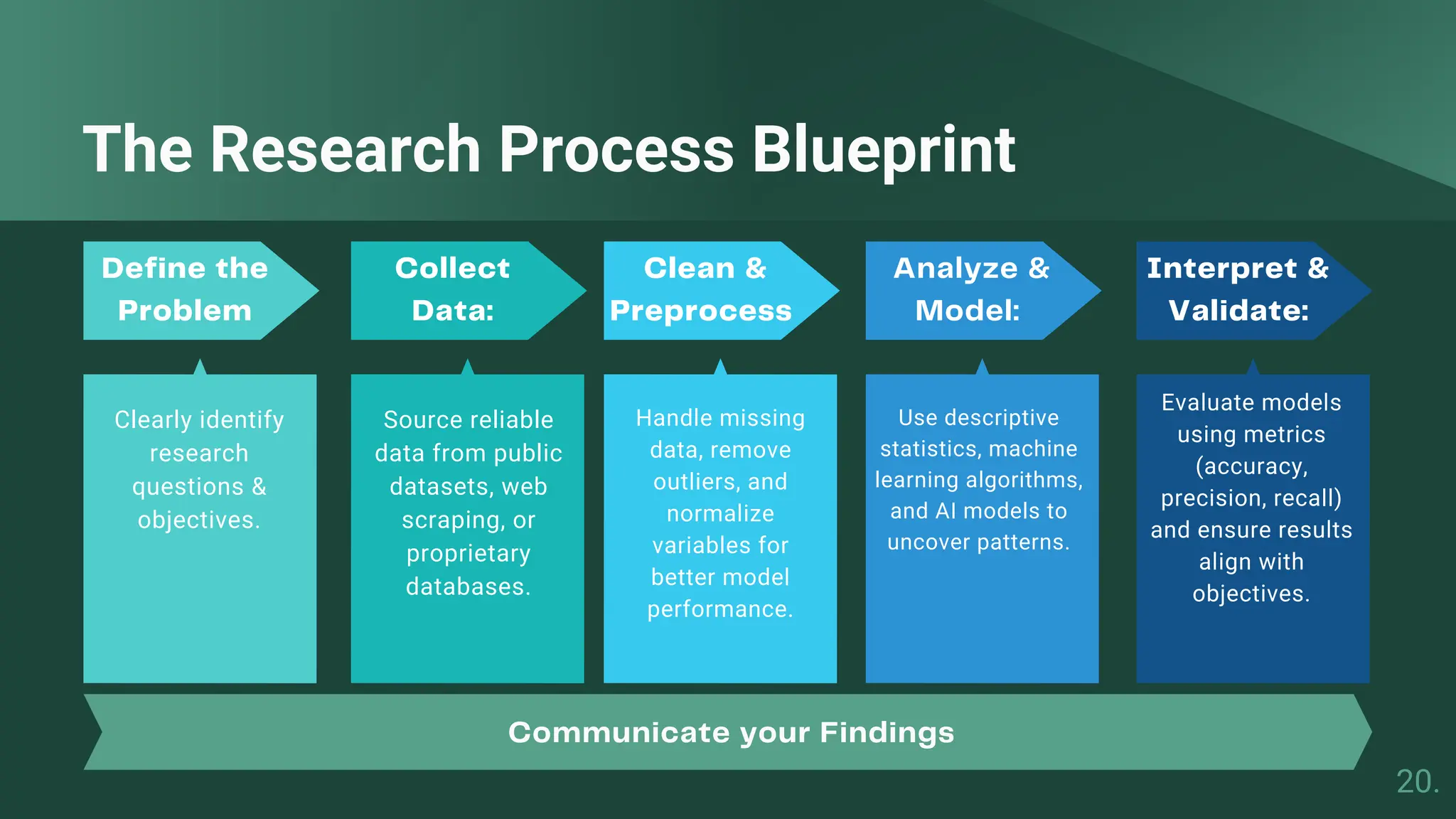
The Research Process Blueprint
Define the
Problem
Collect
Data:
Clean &
Preprocess
Analyze &
Model:
Interpret &
Validate:
Clearly identify
research
questions &
objectives.
Source reliable
data from public
datasets, web
scraping, or
proprietary
databases.
Handle missing
data, remove
outliers, and
normalize
variables for
better model
performance.
Evaluate models
using metrics
(accuracy,
precision, recall)
and ensure results
align with
objectives.
Use descriptive
statistics, machine
learning algorithms,
and AI models to
uncover patterns.
Communicate your Findings
20.
​
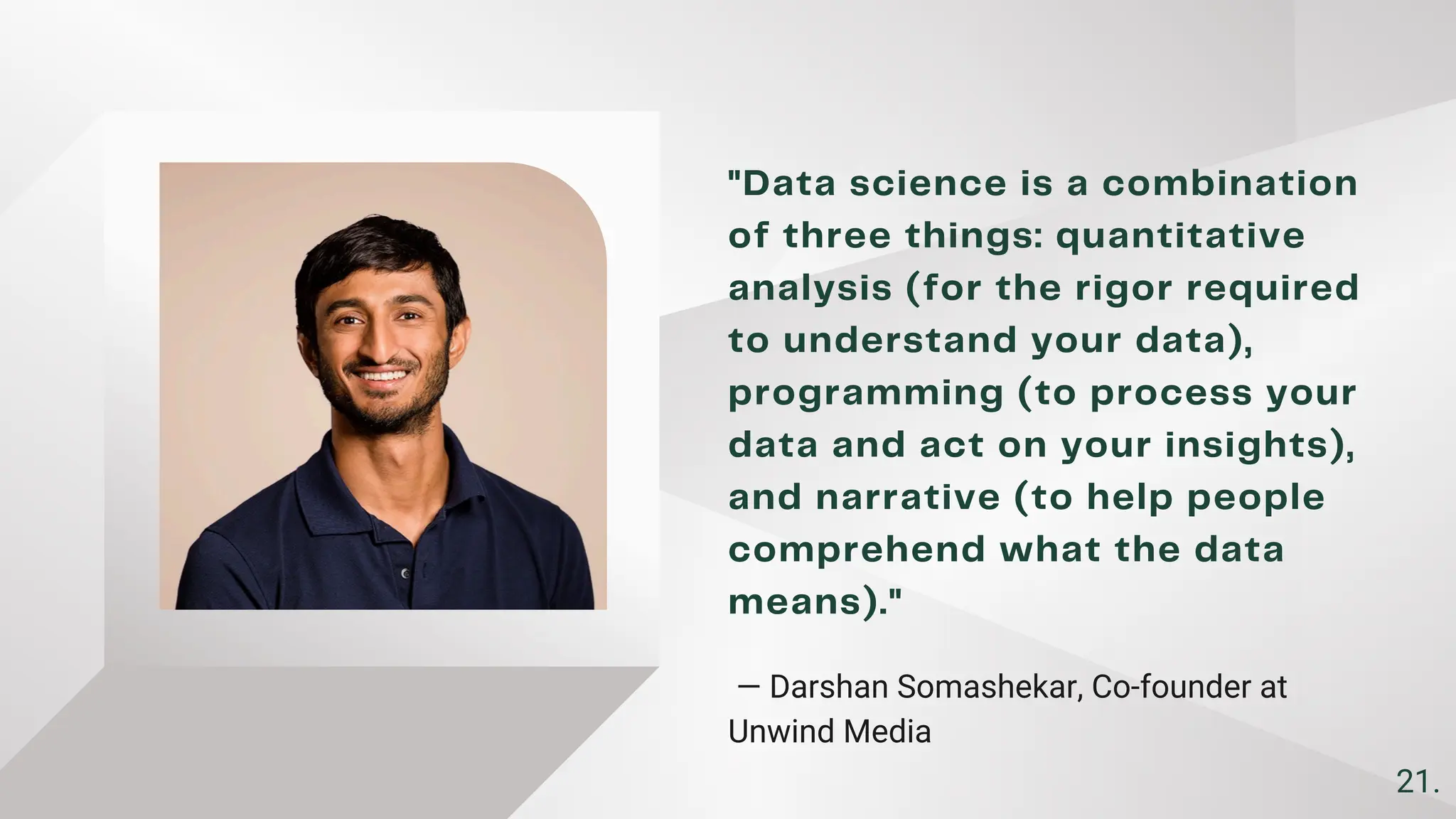
"Data science is a combination
of three things: quantitative
analysis (for the rigor required
to understand your data),
programming (to process your
data and act on your insights),
and narrative (to help people
comprehend what the data
means)."
— Darshan Somashekar, Co-founder at
Unwind Media ​
21.
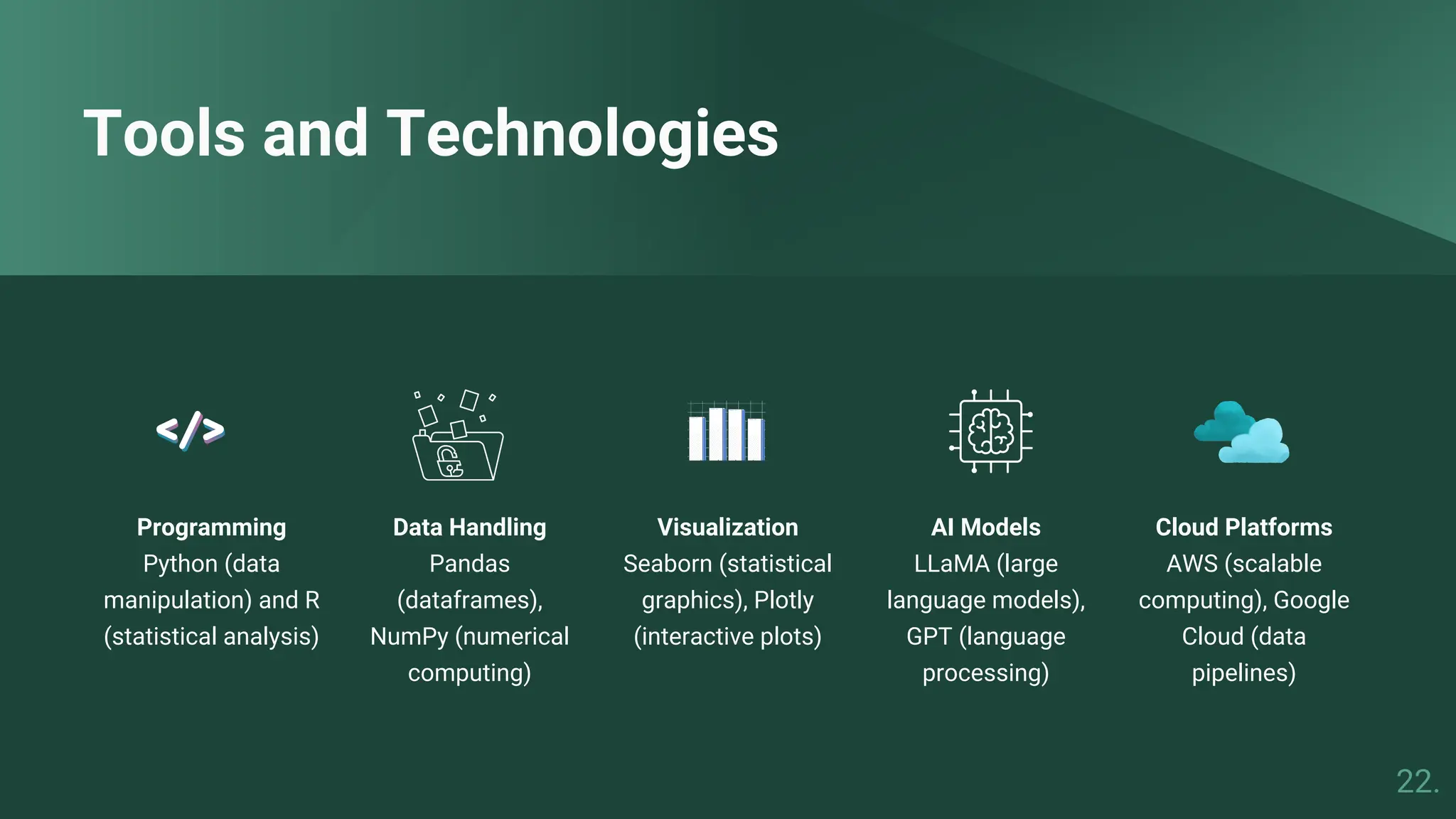
Programming
Python (data
manipulation) and R
(statistical analysis)
Data Handling
Pandas
(dataframes),
NumPy (numerical
computing)
Visualization
Seaborn (statistical
graphics), Plotly
(interactive plots)
AI Models
LLaMA (large
language models),
GPT (language
processing)
Cloud Platforms
AWS (scalable
computing), Google
Cloud (data
pipelines)
Tools and Technologies
22.
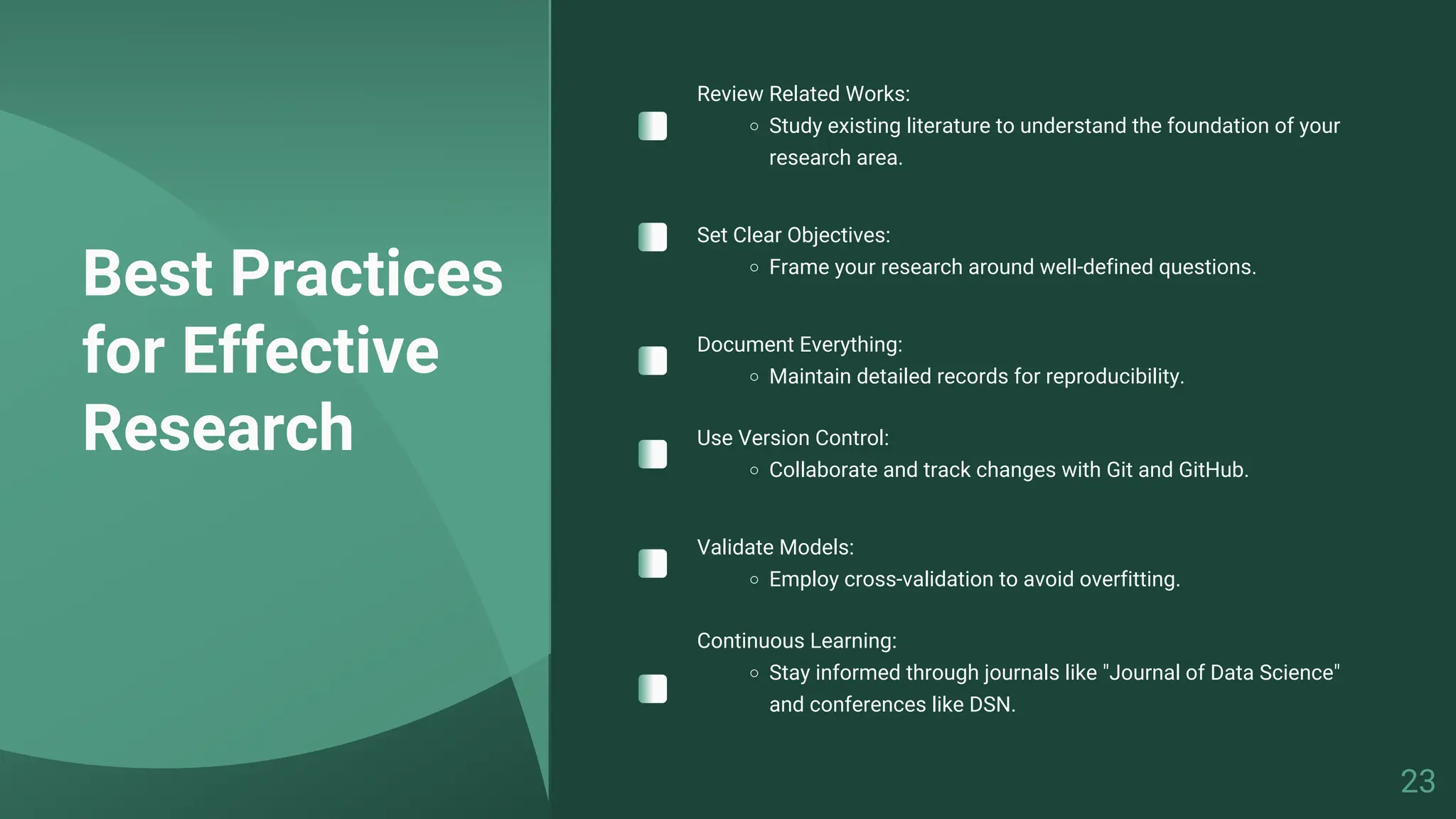
Best Practices
for Effective
Research
Review Related Works:
Study existing literature to understand the foundation of your
research area.
Set Clear Objectives:
Frame your research around well-defined questions.
Document Everything:
Maintain detailed records for reproducibility.
Use Version Control:
Collaborate and track changes with Git and GitHub.
Validate Models:
Employ cross-validation to avoid overfitting.
Continuous Learning:
Stay informed through journals like "Journal of Data Science"
and conferences like DSN.
23
— Voltaire
"With great power comes great
responsibility."
24.
Ethical
Considerations
in Data
Science & AI
Data Privacy: Ensure compliance with
regulations like GDPR.
Bias Mitigation: Regularly audit
models for fairness.
Transparency: Use interpretable
models and provide explanations.
Responsible AI: Avoid harm and
prioritize user well-being.
25.
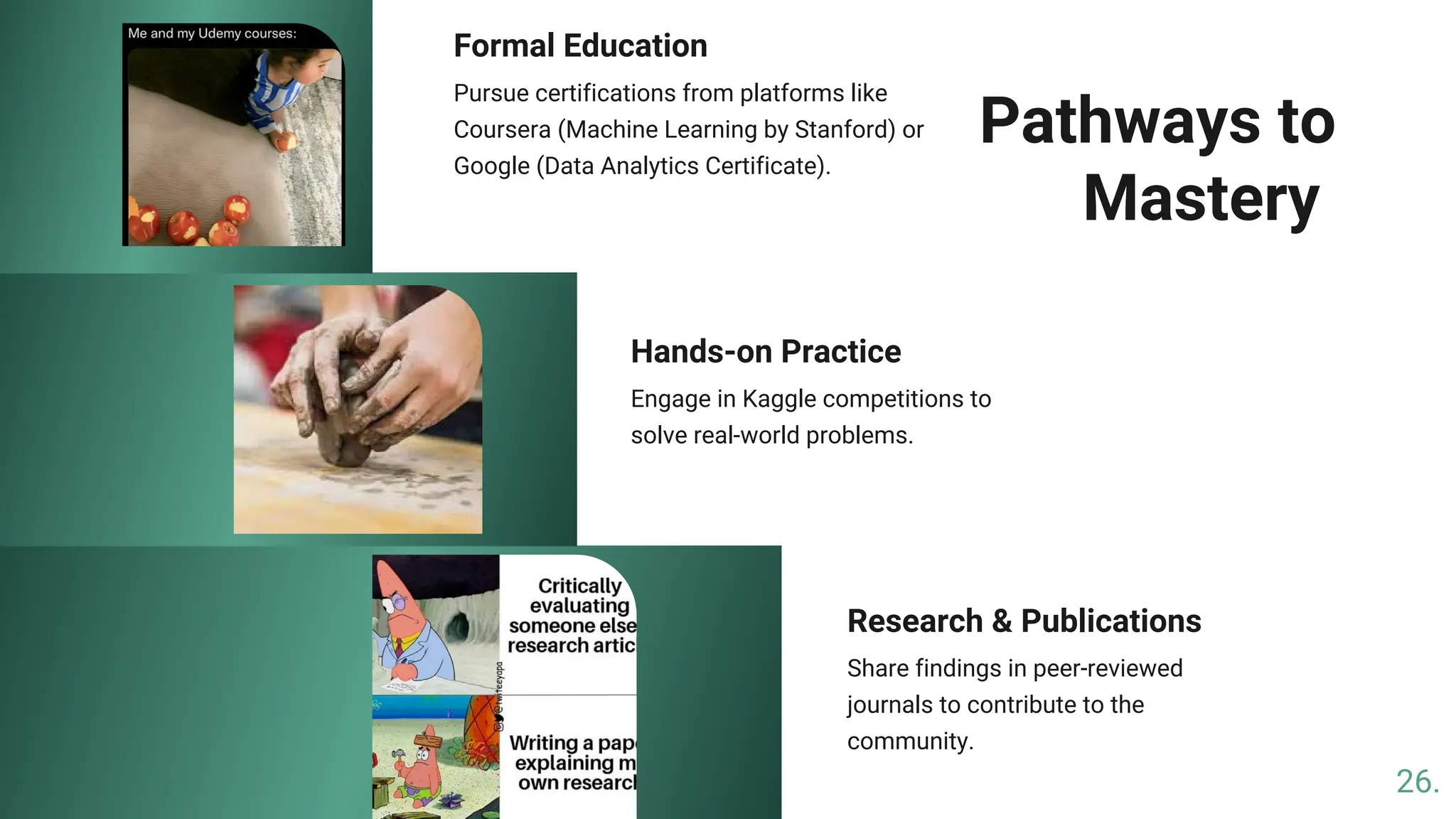
Formal Education
Pursue certifications from platforms like
Coursera (Machine Learning by Stanford) or
Google (Data Analytics Certificate).
Hands-on Practice
Engage in Kaggle competitions to
solve real-world problems.
Research & Publications
Share findings in peer-reviewed
journals to contribute to the
community.
Pathways to
Mastery
26.
Future Trends
in Data
Science & AI
AutoML: Automated model
development and deployment.
Federated Learning: Collaborative model
training without sharing data.
AI-Augmented Research: AI tools assisting
human researchers.
Explainable AI (XAI): Enhanced
transparency in complex AI systems.
27.
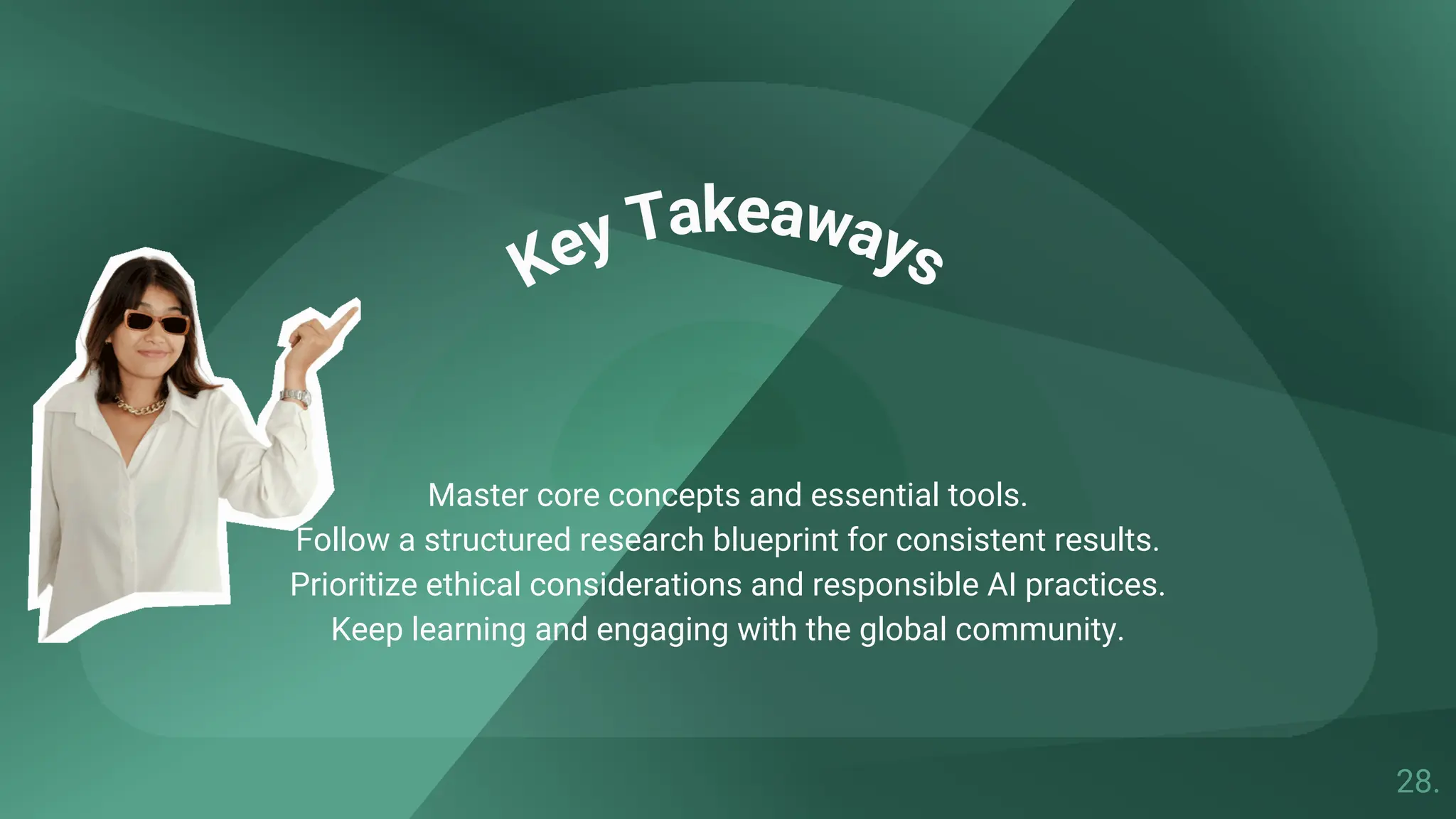
Key Takeaways
Master core concepts and essential tools.
Follow a structured research blueprint for consistent results.
Prioritize ethical considerations and responsible AI practices.
Keep learning and engaging with the global community.
28.
— Tohomdet
"Data is a powerful tool - but its true
value lies in how we collect, analyze,
and use it responsibly to shape a
better future."
29.
Resources &
Reference
"Data Science from Scratch" by Joel
Grus
1.
Artificial Intelligence: A Guide for
Thinking Humans" by Melanie Mitchell
2.
https://www.weforum.org/publications/the-future-of-jobs-report-
2025/in-full/3-skills-outlook/
https://www.adelaide.edu.au/pace/news/list/2025/02/25/the-most-in-
demand-skills-in-2025
https://www.wsj.com/tech/ai/how-the-ai-talent-race-is-reshaping-the-
tech-job-market-93df0615
https://365datascience.com/career-advice/the-future-of-data-science/
Mathew, D.E., Ebem, D.U., Ikegwu, A.C. et al. Recent Emerging
Techniques in Explainable Artificial Intelligence to Enhance the
Interpretable and Understanding of AI Models for Human. Neural
Process Lett 57, 16 (2025). https://doi.org/10.1007/s11063-025-11732-
2
Lopez-Ramos, L. M., Leiser, F., Rastogi, A., Hicks, S., Strumke, I., Madai,
V. I., Budig, T., Sunyaev, A., & Hilbert, A. (2024). Interplay between
federated learning and explainable artificial intelligence: A scoping
review. On behalf of the VALIDATE consortium.
https://www.wired.com/story/combining-ai-and-crispr-will-be-
transformational/
30.
Thank you for
listening!
Feel free to DM me your
questions any time:
@loretatohomdet@gmail.com
31.

The Research Blueprint: Excelling in Data science, Data Analysis and AI

  • 1.
    Double Diverge Consult l.tohomdet@doublediverge.com.ng Excellingin Data Science, Data Analysis and Al Loreta K. Tohomdet AI Scientific Researcher March 17th, 2025, at 4:00 P.M. Google Meet
  • 2.
    Webinar Ground Rules While waitingfor others to come in, here are some rules and reminders to keep in mind. Please mute your mics during the session Raise your e-hand to answer or ask a question Do not use abusive words on anyone 1.
  • 3.
    Core Topics for Discussion What we'relearning about Research Blueprint Understanding Core Concepts The Research Process Blueprint Key Skills for Excellence Tools and Technologies Ethical Considerations and Best Practices 2.
  • 4.
    Hi! My nameis Loreta. A lecturer at AFIT and an IT consultant with Double Diverge, specializing in AI research, policy analysis, and digital innovation. Also, the GDG Lead for Jos and a Women WTM Ambassador, committed to advancing technology education. A proud Plateau State native, a wife, and a passionate community builder - serving as a Google Women Techmakers Ambassador, GDG Jos Lead, and founder of Jostechgirls. Enjoys writing, reading, and engaging with local communities. Personal Background Professional Background 3.
  • 5.
    INTRODUCTION In today's world,data drives decision-making across industries. Understanding and mastering Data Science, Data Analysis, and AI are crucial for solving complex problems, enhancing efficiency, and unlocking new possibilities. Objective: This presentation will provide a structured guide to excelling in these fields, covering key skills, tools, research processes, and best practices. 4.
  • 6.
    Understanding Core Concepts D forData D for Data A for Artificial S for Science A for Analysis I for Intelligence 5.
  • 7.
    Data Science An interdisciplinaryfield focused on extracting insights and knowledge from structured and unstructured data using algorithms, statistical models, and computational methods. Example: Analysing customer to improve business strategies. 6.
  • 8.
    Data Analysis The systematicapproach of examining, cleaning, transforming, and interpreting data to discover useful information. Example: Identifying sales trends to optimize inventory management. 7.
  • 9.
    Artificial Intelligence The simulationof human intelligence by machines to perform tasks like learning, reasoning, and decision- making. Example: Using chatbots to provide customer service 24/7. 8.
  • 10.
    Think & Apply Howcan understanding these three fields together improve decision-making in a business setting? Its time for you to think and apply! 9.
  • 11.
    — Clive Humby "Datais the new oil." 10.
  • 12.
    Key Skills forExcellence Skills you require and Why it matters! 11.
  • 13.
    Programming Proficiency: Master languageslike Python (for data manipulation), R (for statistical computing), and SQL (for database management). Statistical Analysis & Mathematics: Understand core concepts like linear algebra, probability, regression analysis, and hypothesis testing. 12.
  • 14.
    Data Visualization: Present insightsclearly using tools like Tableau, Power BI, and libraries like Matplotlib and Seaborn. Machine Learning & AI Frameworks: Gain expertise in frameworks like TensorFlow (for deep learning), Scikit-learn (for traditional ML), and PyTorch (for advanced research). 13.
  • 15.
    — W. EdwardsDeming "Without data, you're just another person with an opinion." 14.
  • 16.
    "Master Programming toStay Ahead" 57% software developers worldwide use Python. ​ https://www.weforum.org/publications/the-future-of-jobs- report-2025/in-full/3-skills-outlook/ 15.
  • 17.
    "Sharpen Your AnalyticalThinking" 70% Approximately 70% of companies consider analytical thinking essential for their workforce. ​ https://www.adelaide.edu.au/pace/news/list/2025/02/25/the- most-in-demand-skills-in-2025 16.
  • 18.
    "Embrace AI andMachine Learning" 25% 25% of U.S. tech job listings in 2025 require artificial intelligence skills. ​ https://www.wsj.com/tech/ai/how-the-ai-talent-race-is- reshaping-the-tech-job-market-93df0615 17.
  • 19.
    "Excel in DataAnalysis for Future Opportunities" 34% The U.S. Bureau of Labor Statistics predicts a 34% increase in the data science job market between 2022 and 2032. ​ https://365datascience.com/career-advice/the-future-of-data- science/ 18.
  • 20.
    — Neil Armstrong "Researchis creating new knowledge." 19.
  • 21.
    The Research ProcessBlueprint Define the Problem Collect Data: Clean & Preprocess Analyze & Model: Interpret & Validate: Clearly identify research questions & objectives. Source reliable data from public datasets, web scraping, or proprietary databases. Handle missing data, remove outliers, and normalize variables for better model performance. Evaluate models using metrics (accuracy, precision, recall) and ensure results align with objectives. Use descriptive statistics, machine learning algorithms, and AI models to uncover patterns. Communicate your Findings 20.
  • 22.
    ​ "Data science isa combination of three things: quantitative analysis (for the rigor required to understand your data), programming (to process your data and act on your insights), and narrative (to help people comprehend what the data means)." — Darshan Somashekar, Co-founder at Unwind Media ​ 21.
  • 23.
    Programming Python (data manipulation) andR (statistical analysis) Data Handling Pandas (dataframes), NumPy (numerical computing) Visualization Seaborn (statistical graphics), Plotly (interactive plots) AI Models LLaMA (large language models), GPT (language processing) Cloud Platforms AWS (scalable computing), Google Cloud (data pipelines) Tools and Technologies 22.
  • 24.
    Best Practices for Effective Research ReviewRelated Works: Study existing literature to understand the foundation of your research area. Set Clear Objectives: Frame your research around well-defined questions. Document Everything: Maintain detailed records for reproducibility. Use Version Control: Collaborate and track changes with Git and GitHub. Validate Models: Employ cross-validation to avoid overfitting. Continuous Learning: Stay informed through journals like "Journal of Data Science" and conferences like DSN. 23
  • 25.
    — Voltaire "With greatpower comes great responsibility." 24.
  • 26.
    Ethical Considerations in Data Science &AI Data Privacy: Ensure compliance with regulations like GDPR. Bias Mitigation: Regularly audit models for fairness. Transparency: Use interpretable models and provide explanations. Responsible AI: Avoid harm and prioritize user well-being. 25.
  • 27.
    Formal Education Pursue certificationsfrom platforms like Coursera (Machine Learning by Stanford) or Google (Data Analytics Certificate). Hands-on Practice Engage in Kaggle competitions to solve real-world problems. Research & Publications Share findings in peer-reviewed journals to contribute to the community. Pathways to Mastery 26.
  • 28.
    Future Trends in Data Science& AI AutoML: Automated model development and deployment. Federated Learning: Collaborative model training without sharing data. AI-Augmented Research: AI tools assisting human researchers. Explainable AI (XAI): Enhanced transparency in complex AI systems. 27.
  • 29.
    Key Takeaways Master coreconcepts and essential tools. Follow a structured research blueprint for consistent results. Prioritize ethical considerations and responsible AI practices. Keep learning and engaging with the global community. 28.
  • 30.
    — Tohomdet "Data isa powerful tool - but its true value lies in how we collect, analyze, and use it responsibly to shape a better future." 29.
  • 31.
    Resources & Reference "Data Sciencefrom Scratch" by Joel Grus 1. Artificial Intelligence: A Guide for Thinking Humans" by Melanie Mitchell 2. https://www.weforum.org/publications/the-future-of-jobs-report- 2025/in-full/3-skills-outlook/ https://www.adelaide.edu.au/pace/news/list/2025/02/25/the-most-in- demand-skills-in-2025 https://www.wsj.com/tech/ai/how-the-ai-talent-race-is-reshaping-the- tech-job-market-93df0615 https://365datascience.com/career-advice/the-future-of-data-science/ Mathew, D.E., Ebem, D.U., Ikegwu, A.C. et al. Recent Emerging Techniques in Explainable Artificial Intelligence to Enhance the Interpretable and Understanding of AI Models for Human. Neural Process Lett 57, 16 (2025). https://doi.org/10.1007/s11063-025-11732- 2 Lopez-Ramos, L. M., Leiser, F., Rastogi, A., Hicks, S., Strumke, I., Madai, V. I., Budig, T., Sunyaev, A., & Hilbert, A. (2024). Interplay between federated learning and explainable artificial intelligence: A scoping review. On behalf of the VALIDATE consortium. https://www.wired.com/story/combining-ai-and-crispr-will-be- transformational/ 30.
  • 32.
    Thank you for listening! Feelfree to DM me your questions any time: @loretatohomdet@gmail.com 31.