The Power ofTech
Comm
How andWhereWe Impact the Bottom Line
Sharon Burton
Thank you for attending!
▪ Sharon Burton
▪ I solve post-sales customer experience problems
▪ Research how people feel about product instructions
▪ Support clients in creating better product instructions
▪ And fixing the workflow
▪ Teach communication at various universities
▪ These slides will go up on SlideShare tomorrow
▪ sharon@sharonburton.com
▪ Twitter: sharonburton
Where is the data from?
▪ I’m pulling data from different places
▪ Including my own work
▪ I have references at the end for you
How it’s always been
This may sound familiar
Technical Documentation
No one reads the
product
instructions
Customers will
just call support
anyway
A Good ProductTM
doesn’t need docs
▪ We fought to be in engineering
▪ They didn’t think of us as part of
the product
▪ Often, no one knows how docs
get done
▪ No one told us about
upcoming projects
Technical Documentation
Can this look
prettier?
We can’t tell them
that
Why won’t a
brochure be
enough?
▪ We moved to Marketing
▪ They didn’t think of us as part of
the product or the marketing
collateral
▪ Often, no one knows how docs
get done
▪ No one told us about
upcoming projects
We’re in theWildWest
It’s all changing as I speak
Content is king
And Queen
And the whole
royal court
▪ Marketing has discovered
content
▪ Customers want content
▪ We have that
▪ We have lots of that
▪ How do we connect what we
do to what the company
needs?
Sales
It starts here
Sales funnel
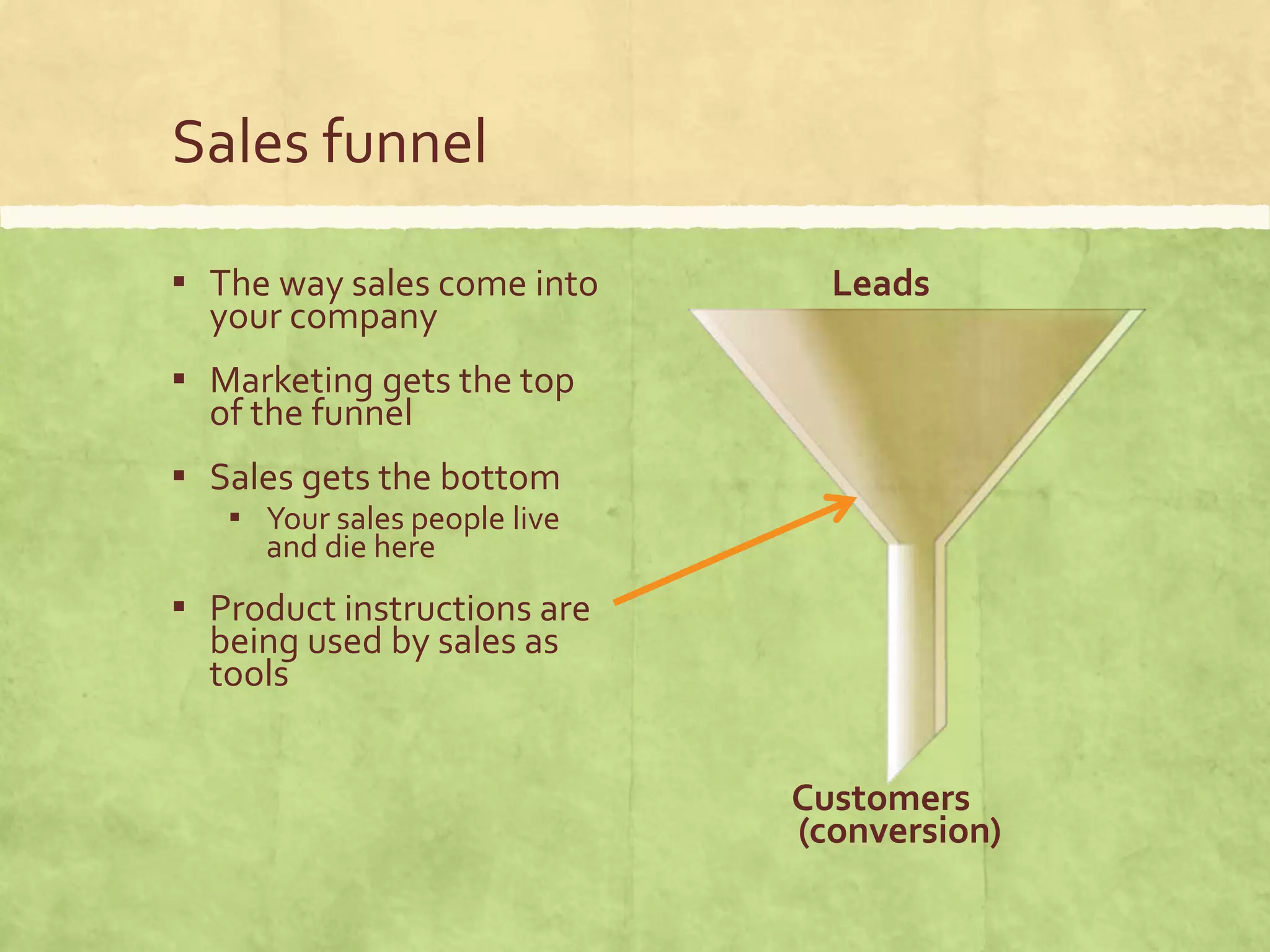
▪ The way sales come into
your company
▪ Marketing gets the top
of the funnel
▪ Sales gets the bottom
▪ Your sales people live
and die here
▪ Product instructions are
being used by sales as
tools
Leads
Customers
(conversion)
Sales funnel
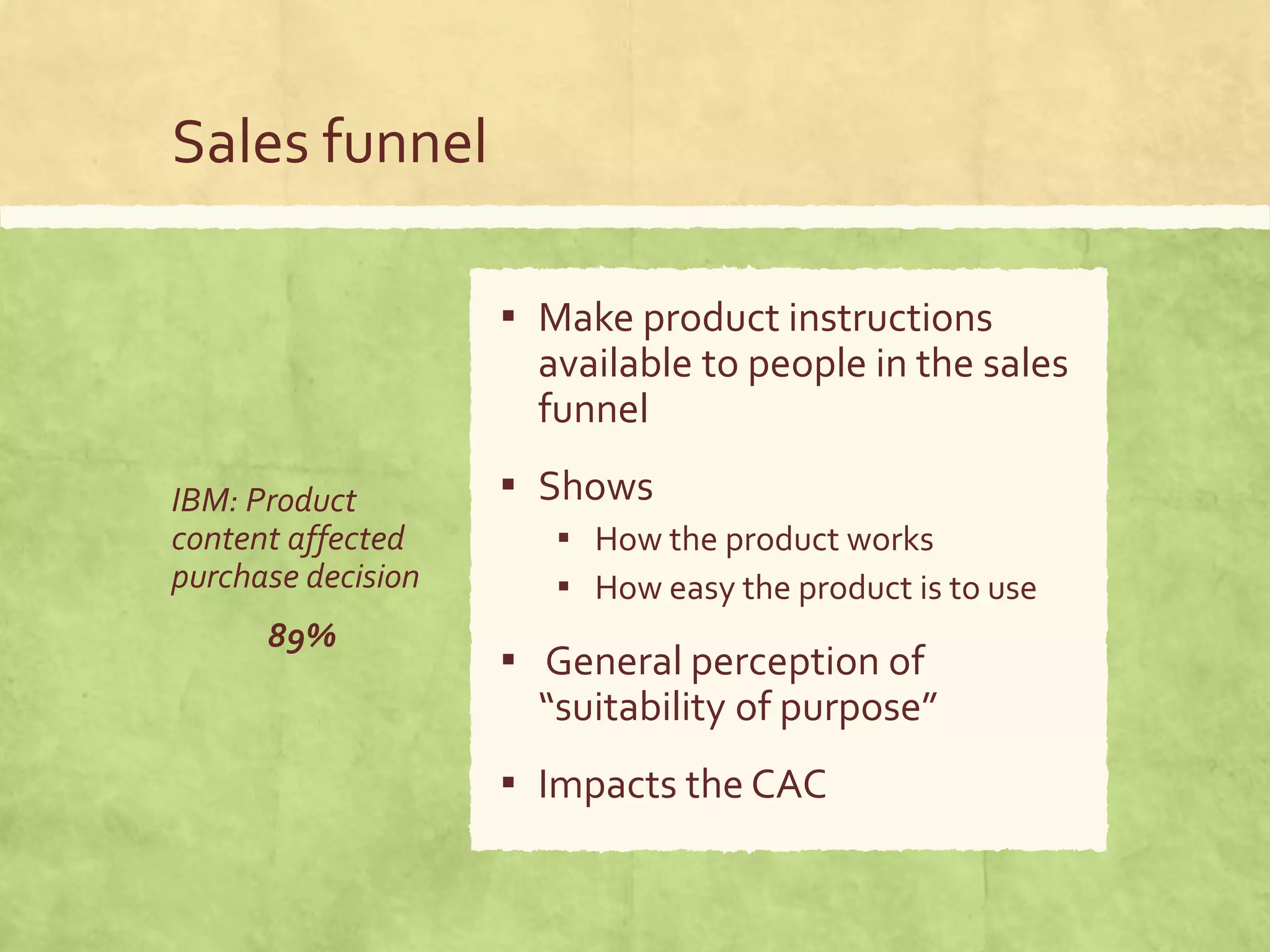
IBM: Product
content affected
purchase decision
89%
▪ Make product instructions
available to people in the sales
funnel
▪ Shows
▪ How the product works
▪ How easy the product is to use
▪ General perception of
“suitability of purpose”
▪ Impacts the CAC
Getting customers is expensive
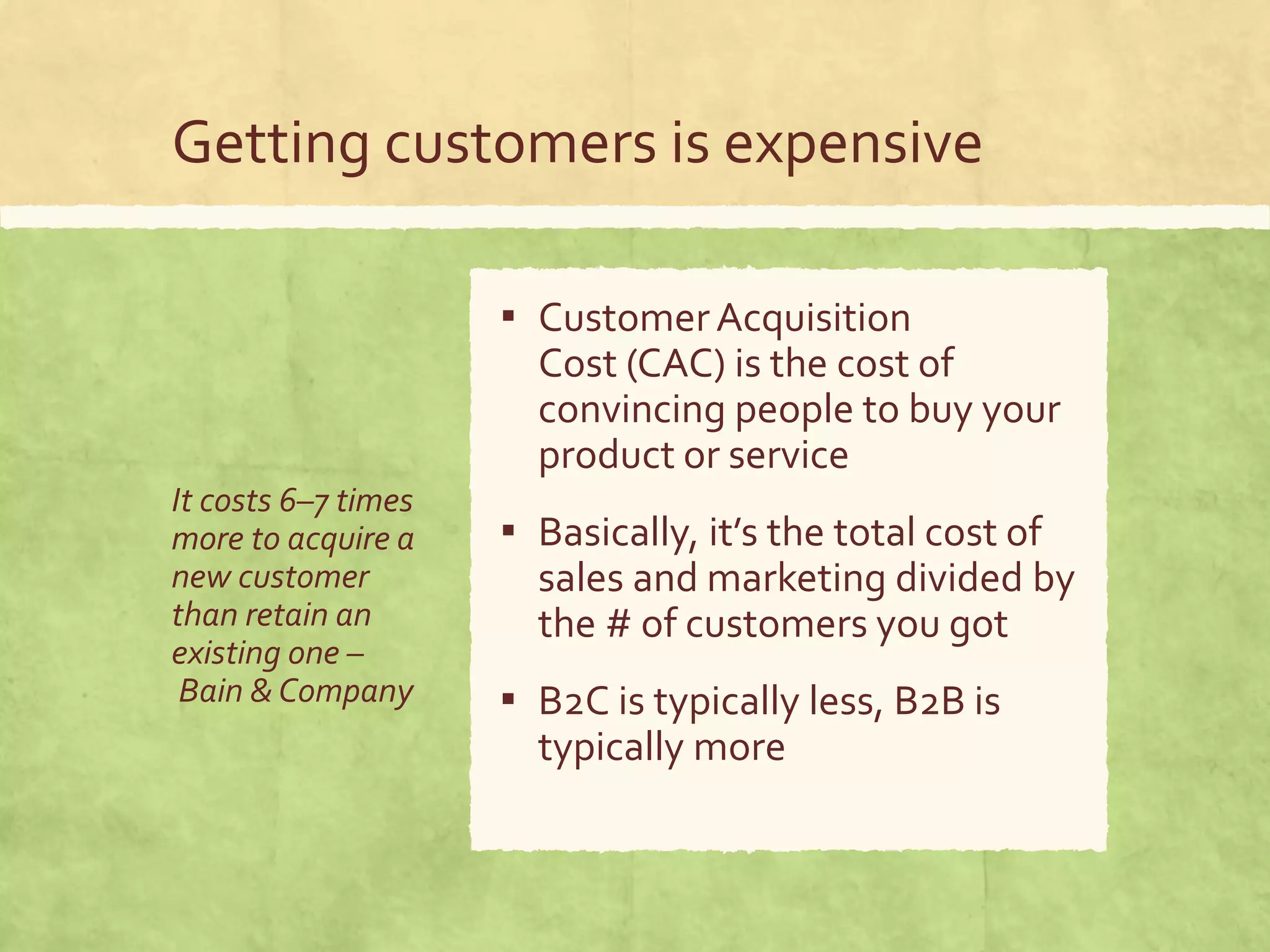
It costs 6–7 times
more to acquire a
new customer
than retain an
existing one –
Bain & Company
▪ CustomerAcquisition
Cost (CAC) is the cost of
convincing people to buy your
product or service
▪ Basically, it’s the total cost of
sales and marketing divided by
the # of customers you got
▪ B2C is typically less, B2B is
typically more
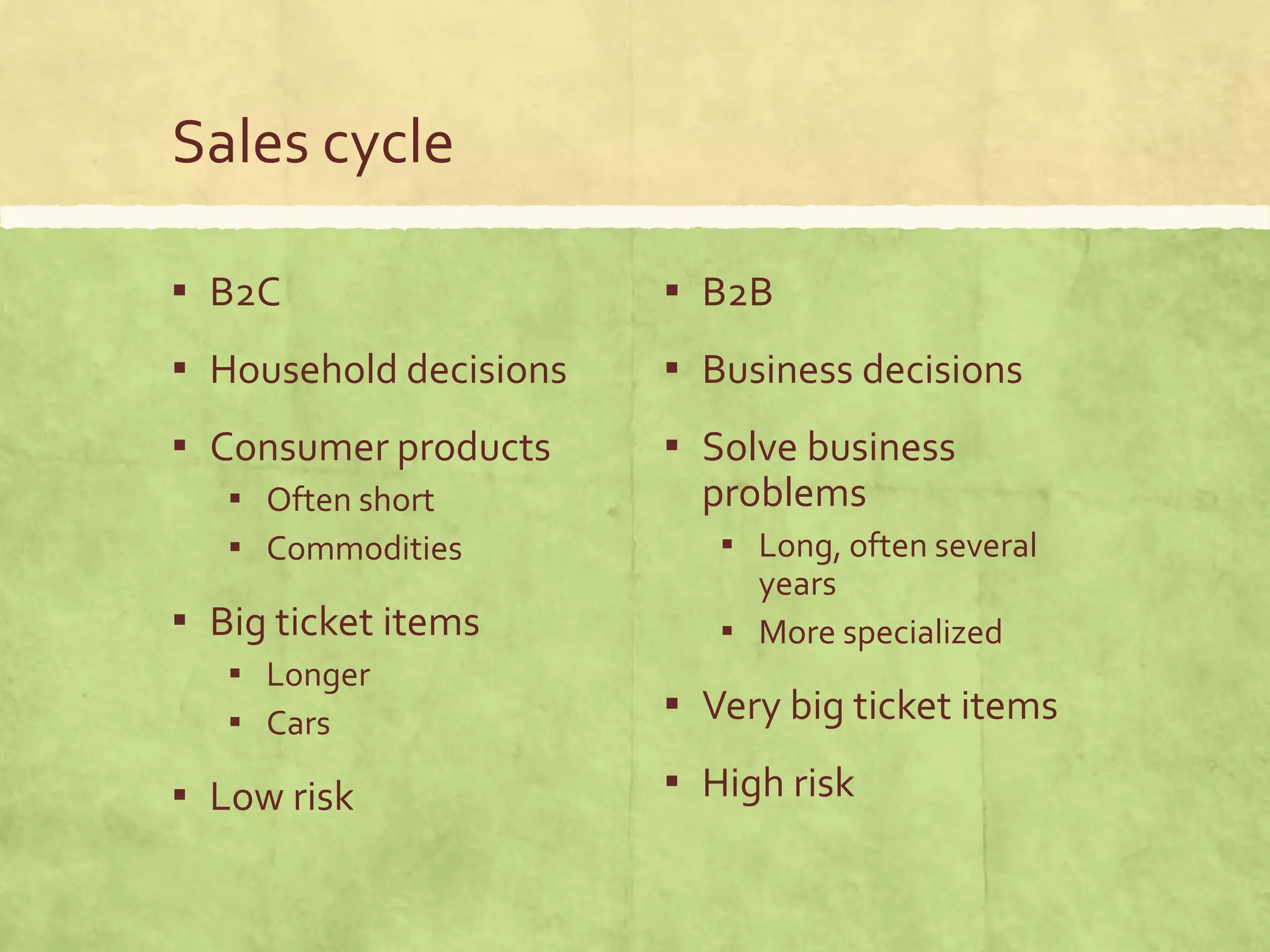
Sales cycle
▪ B2C
▪ Household decisions
▪ Consumer products
▪ Often short
▪ Commodities
▪ Big ticket items
▪ Longer
▪ Cars
▪ Low risk
▪ B2B
▪ Business decisions
▪ Solve business
problems
▪ Long, often several
years
▪ More specialized
▪ Very big ticket items
▪ High risk
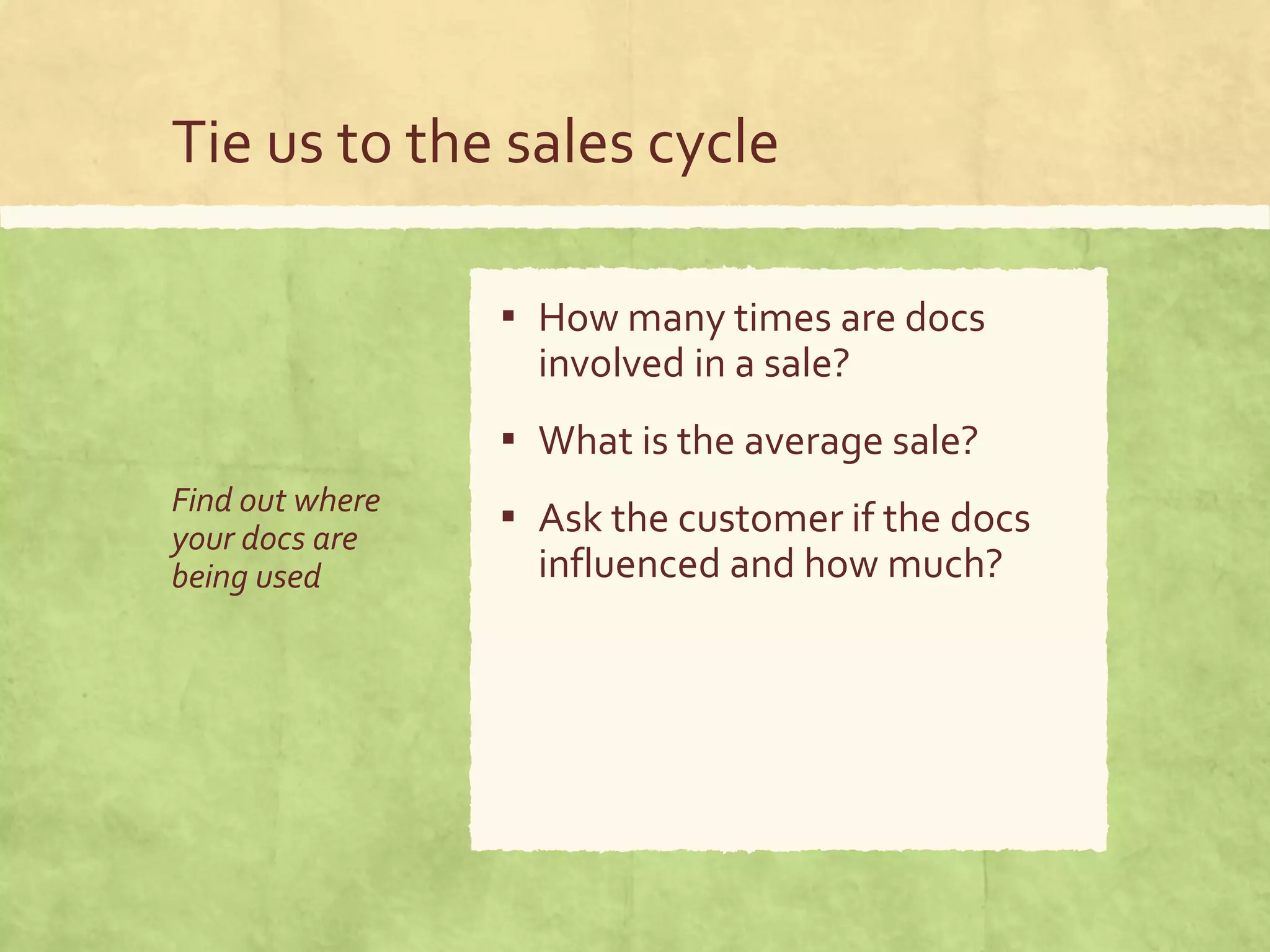
Tie us to the sales cycle
Find out where
your docs are
being used
▪ How many times are docs
involved in a sale?
▪ What is the average sale?
▪ Ask the customer if the docs
influenced and how much?
Post sales
Our work starts after the sale is made
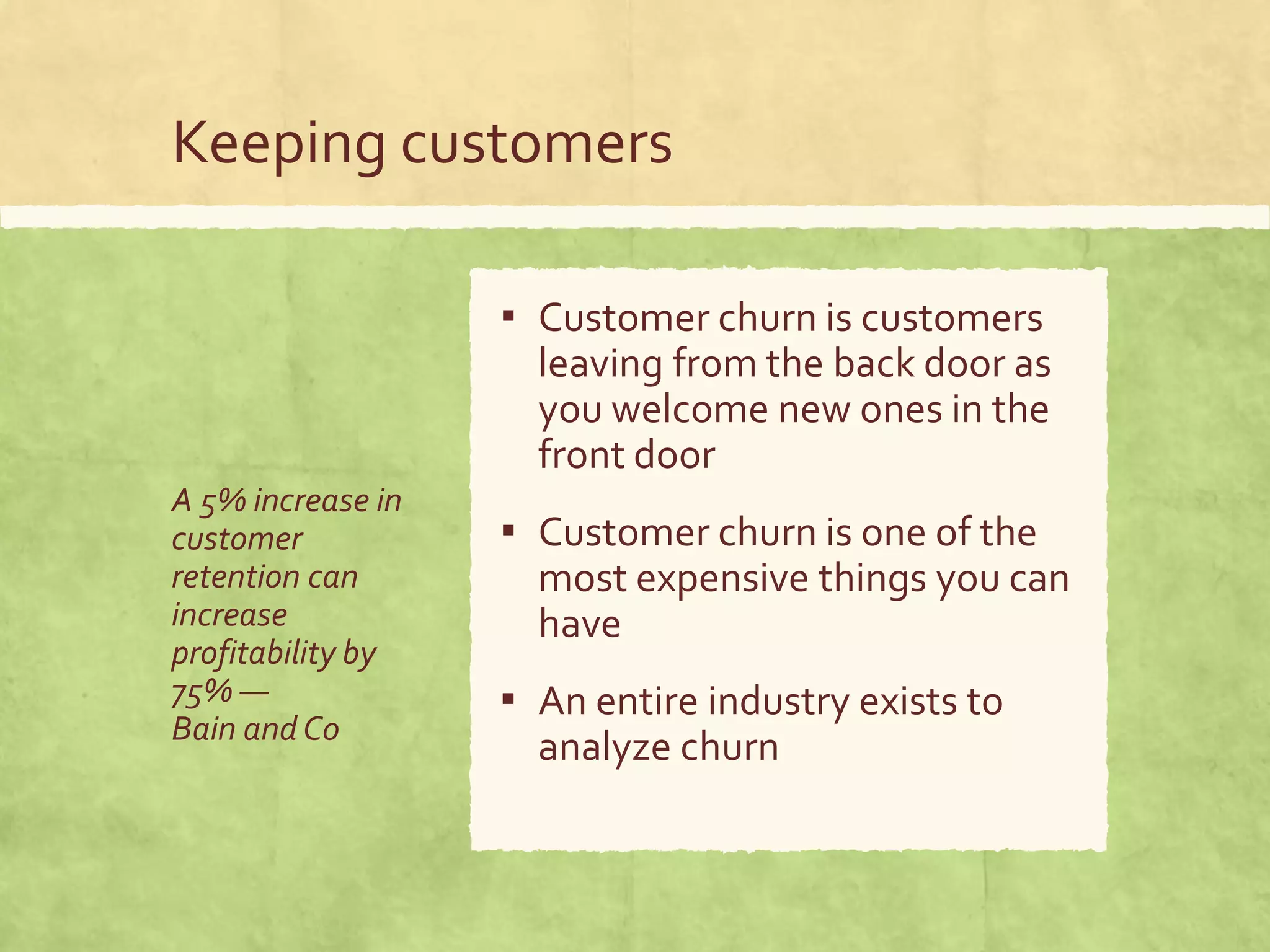
Keeping customers
A 5% increase in
customer
retention can
increase
profitability by
75% —
Bain andCo
▪ Customer churn is customers
leaving from the back door as
you welcome new ones in the
front door
▪ Customer churn is one of the
most expensive things you can
have
▪ An entire industry exists to
analyze churn
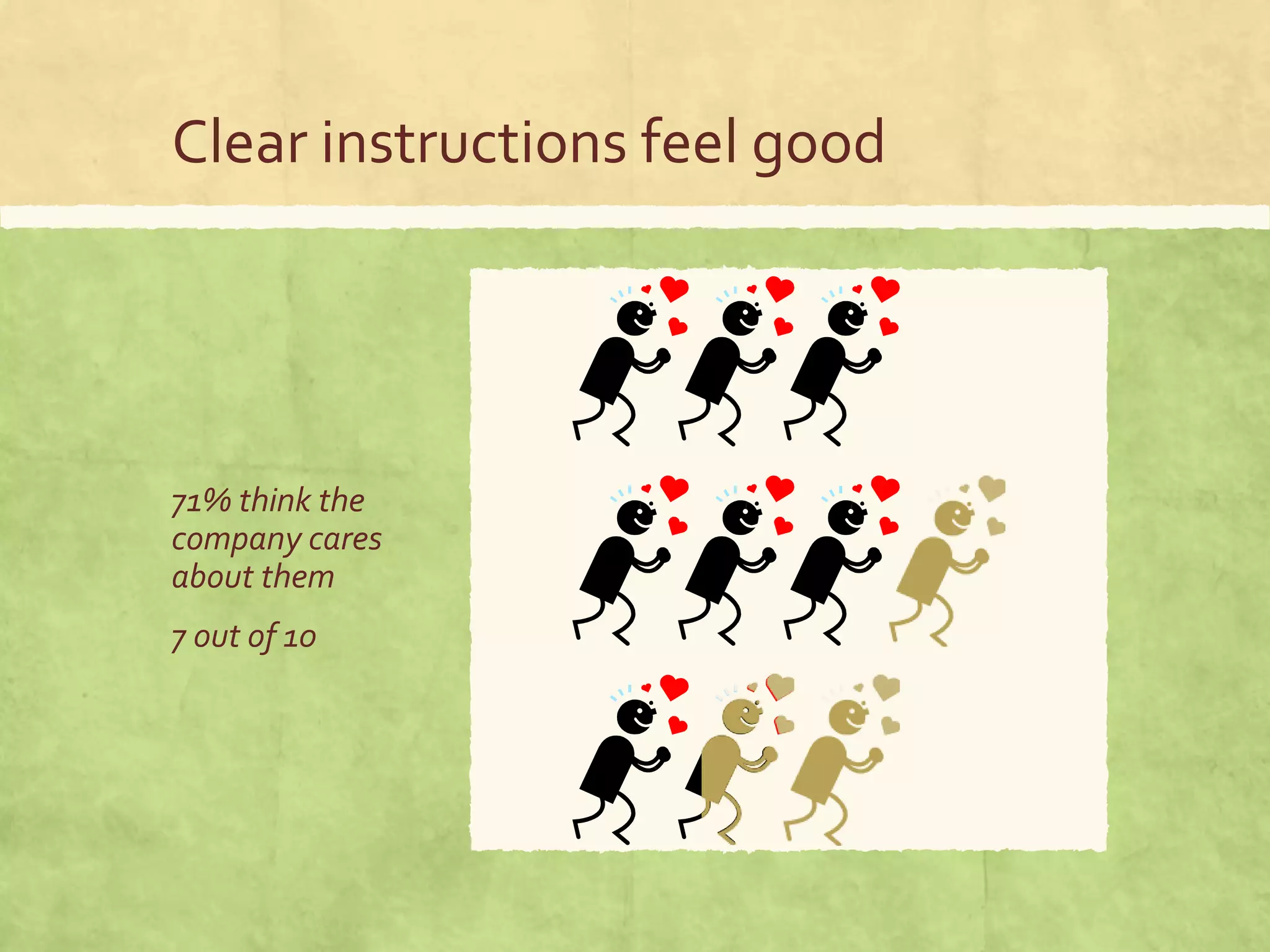
Clear instructions feel good
71% think the
company cares
about them
7 out of 10
Customer churn
IBM: Affects
product
satisfaction
92%
▪ Customers who can use the
product use the product
▪ They don’t leave and purchase
someone else
▪ Clear product instructions
reduce customer churn
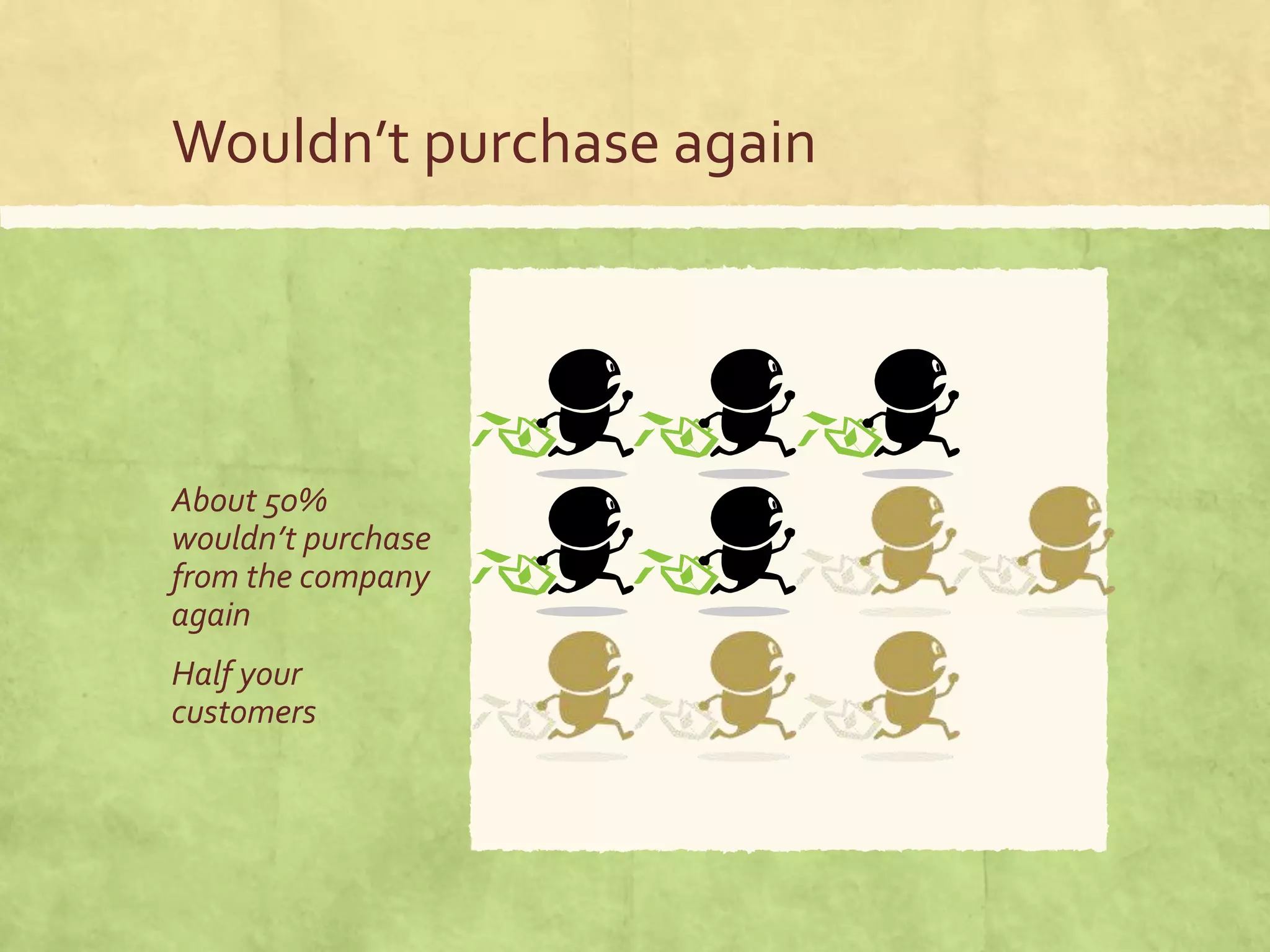
Wouldn’t purchase again
About 50%
wouldn’t purchase
from the company
again
Half your
customers
Return rate
Returns have
increased 21
percent since
2007, according to
an Accenture
research report
(Dec 2011)
▪ 5% of returns are related to
actual product defects
▪ 27% reflect “buyer’s remorse”
▪ 68% of returned products are
“NoTrouble Found”
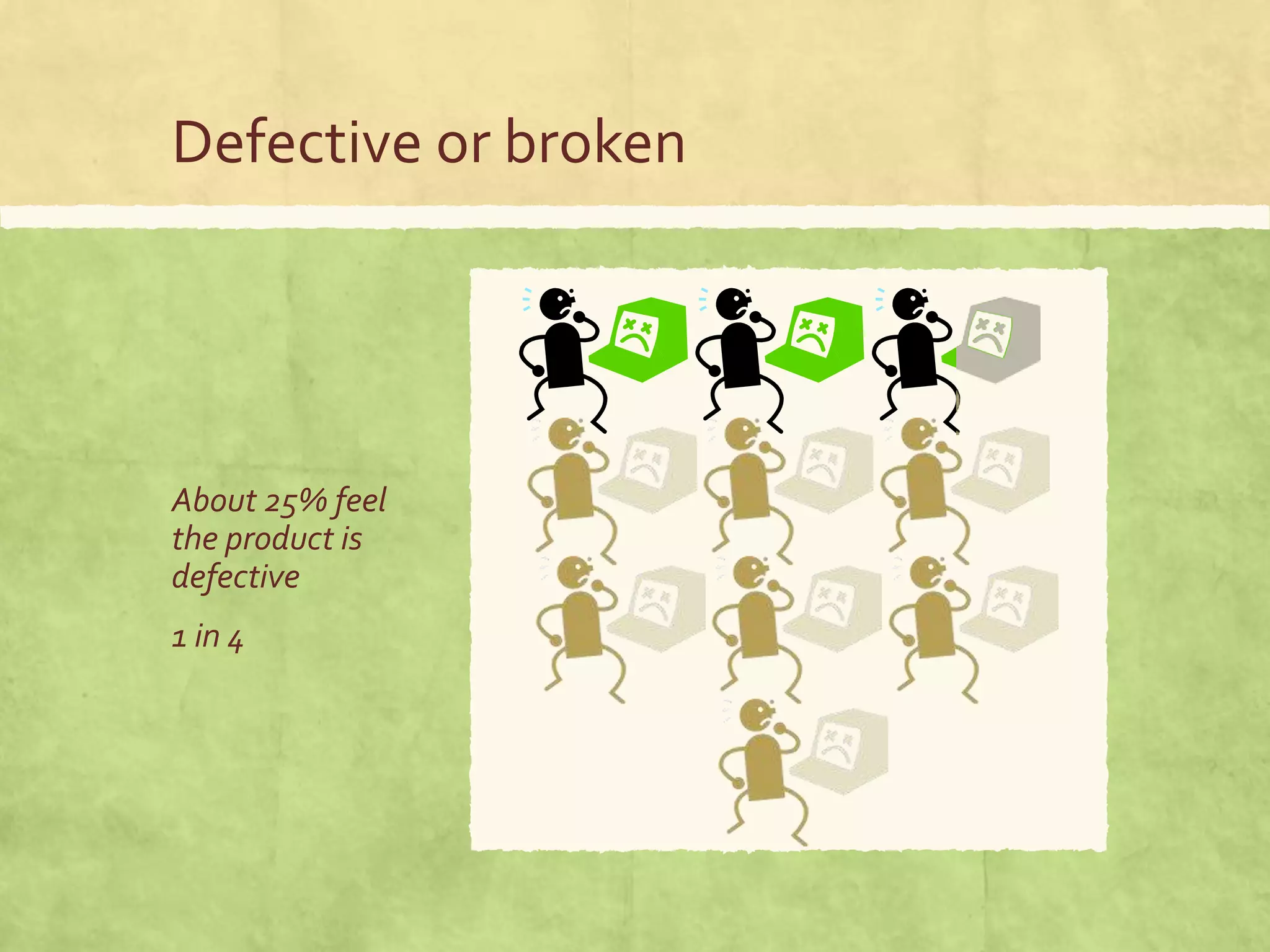
Defective or broken
About 25% feel
the product is
defective
1 in 4
Customer LifetimeValue (CLV)
The probability of
selling to an
existing customer
is 60 – 70%.The
probability of
selling to a new
prospect is 5-20%
—Marketing
Metrics
▪ Existing customers are already
engaged with your products or
services
▪ They have a lower cost to keep
▪ They should buy more stuff
▪ Higher monetary value to the
business
Clear instructions and lifetime value
IBM: Clear
instructions add
to the product
quality
97%
▪ Increased perception of
product quality
▪ If this is good, more of this is also
good
▪ Who wants to buy low quality
products?
▪ Who can afford that?
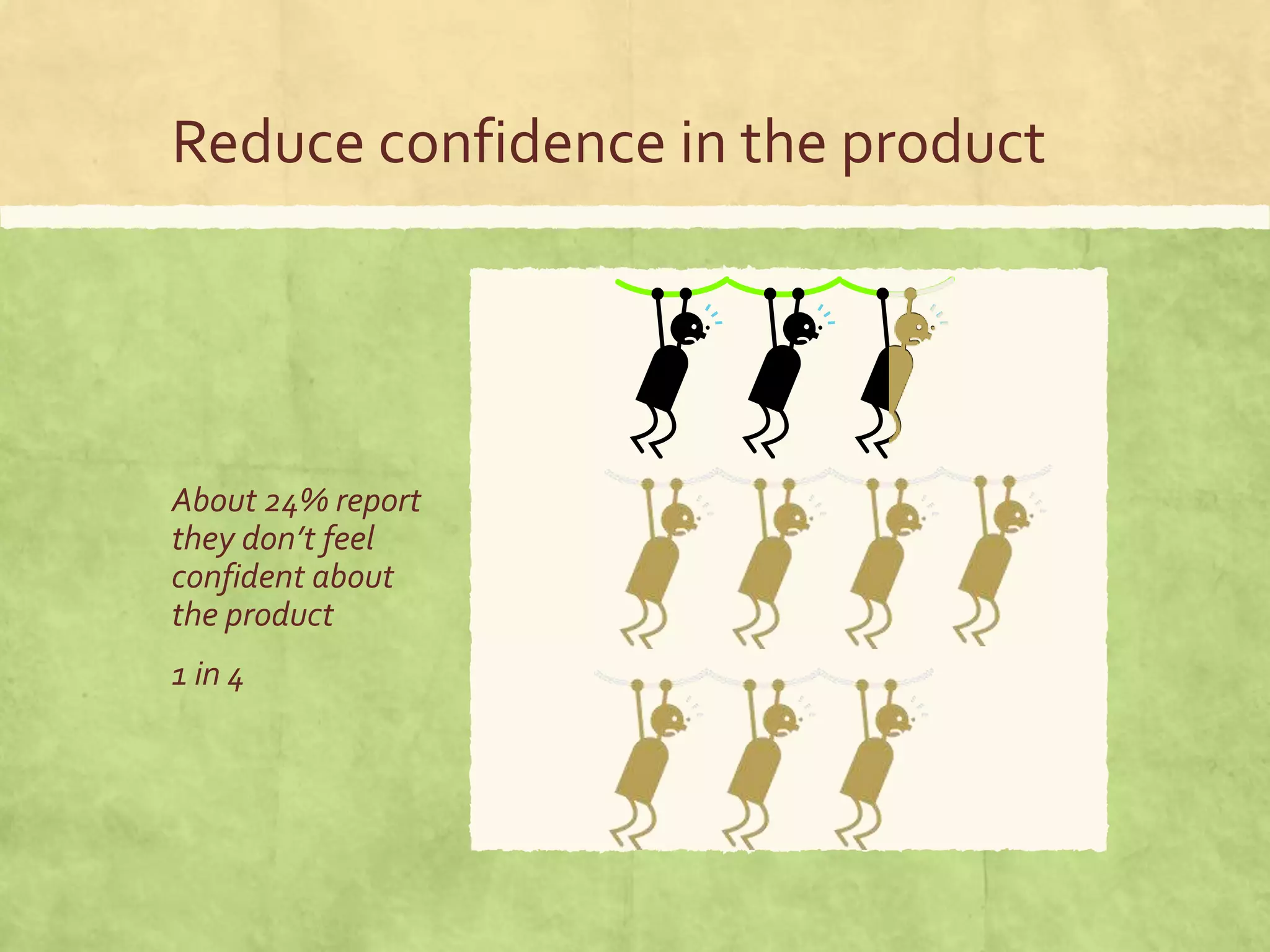
Reduce confidence in the product
About 24% report
they don’t feel
confident about
the product
1 in 4
Out of box experience (OOB)
The averageU.S.
consumer spends
20 minutes trying
to make a device
work before giving
up and returning it
to the seller—
2006 study by
Dutch scientist
Elke den Ouden
▪ The feelings when you open
the box
▪ Printers have set up docs right
there
▪ Apple product are pretty
▪ Can reduce customer support
▪ Give people that feeling of
competence
▪ Or totally destroy it with bad
instructions
Use product instructions
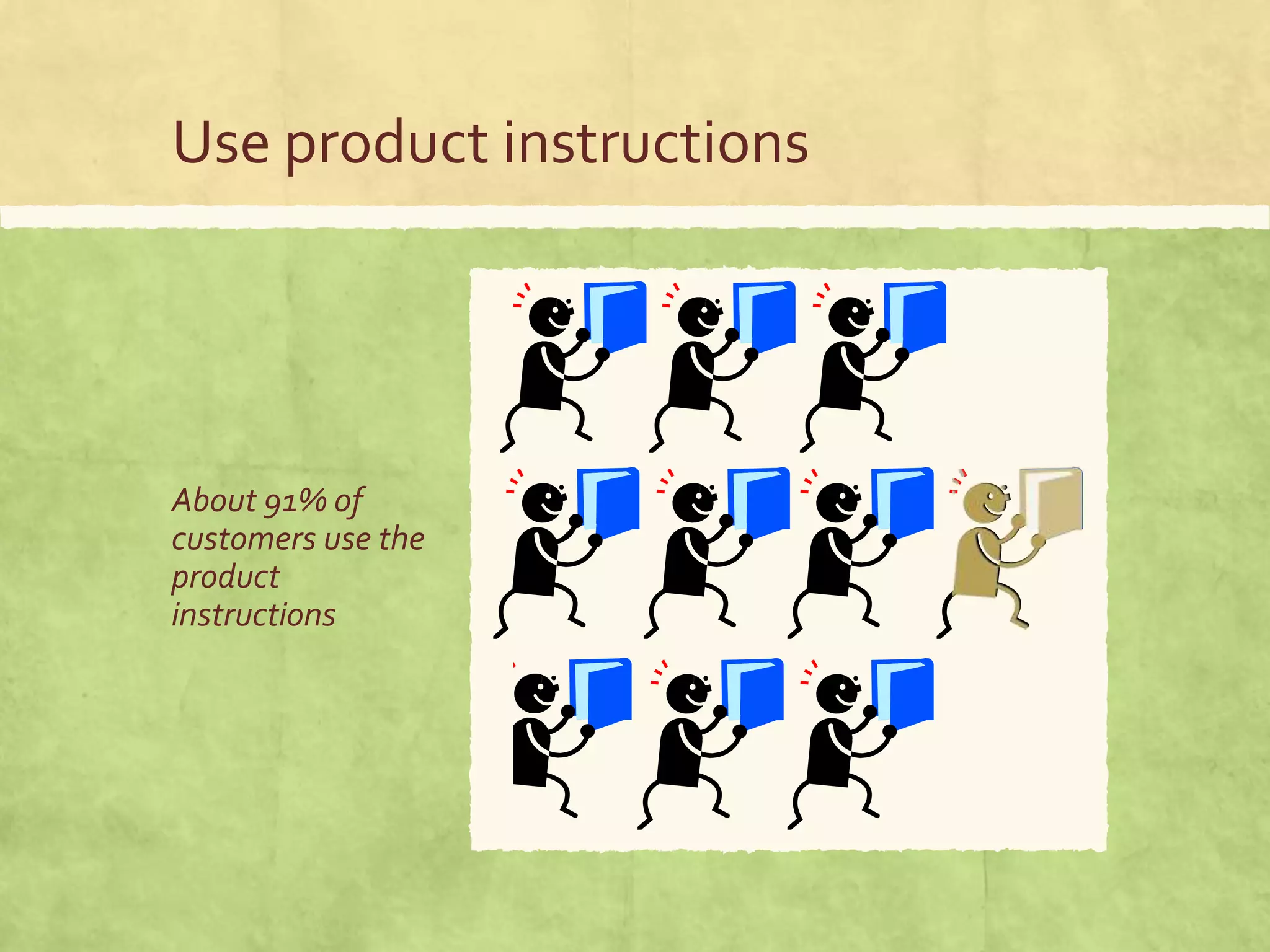
About 91% of
customers use the
product
instructions
Corporate iniatives
Other places we belong
Customer experience
81% of companies
…delivering
customer experience
excellence are
outperforming their
competitors —
Peppers and
Rogers, 2009
Customer
Experience Maturity
Monitor
▪ Customer experience is the
outcome of all of the touch
points that your customer has
with your organization *
▪ The perception that customers
have across all of their
interactions with your
organization *
▪ It’s a customer-centric view of
your company from every
touch point
* From Customer Experience Overview, 2011, BruceTempkin
and Jeanne Bliss
Customer experience is a big deal
Product
instructions are a
critical part of the
customer
experience. If
customers can’t
use the product, it
impacts the
bottom line —
Sharon Burton
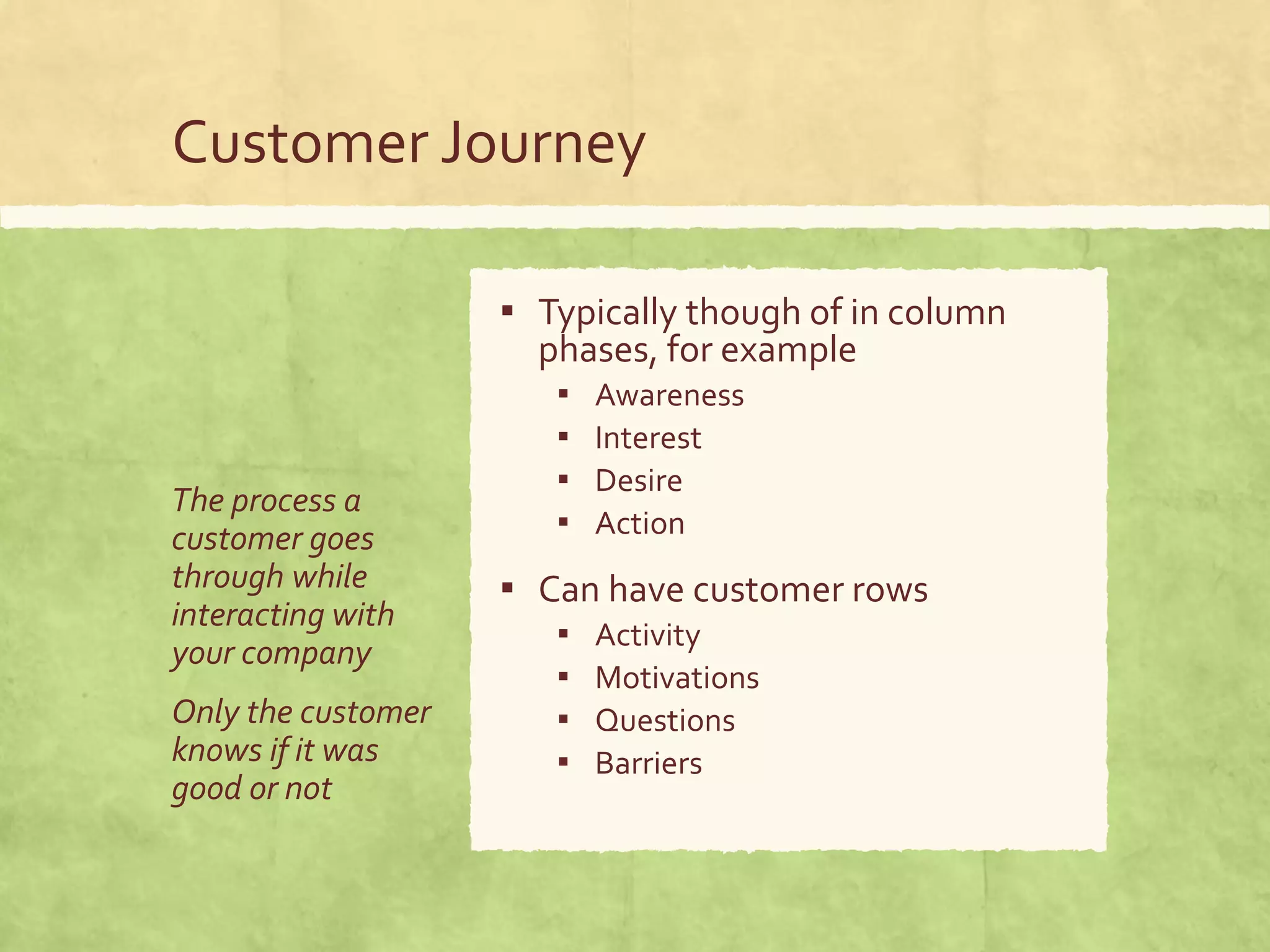
▪ Product instructions are the
central to the post-sales
customer experience
▪ Technical communication is a
subset of customer experience
▪ We have so much in common
▪ Tech comm is concerned with
the post-sales part
Customer Journey
The process a
customer goes
through while
interacting with
your company
Only the customer
knows if it was
good or not
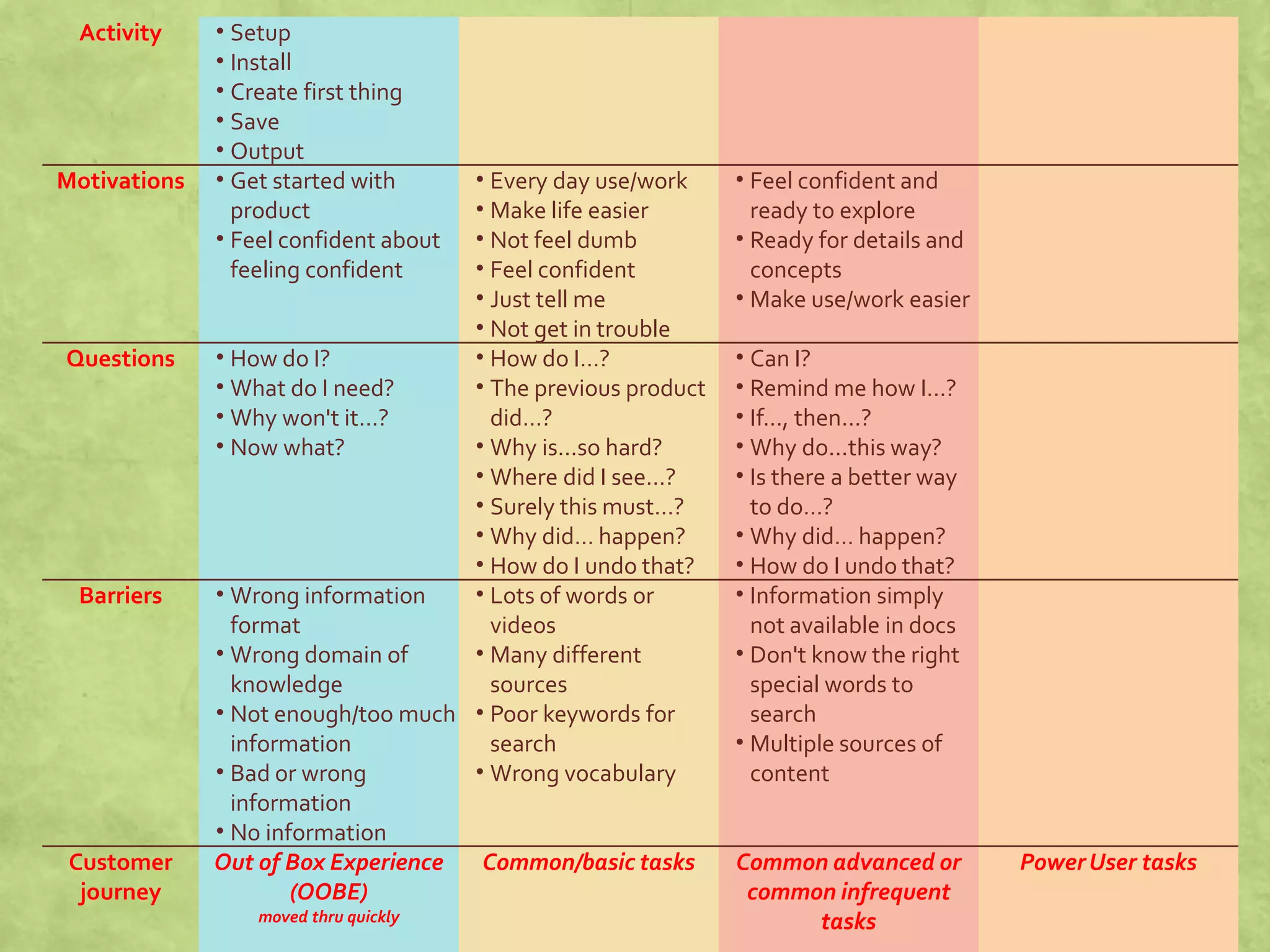
▪ Typically though of in column
phases, for example
▪ Awareness
▪ Interest
▪ Desire
▪ Action
▪ Can have customer rows
▪ Activity
▪ Motivations
▪ Questions
▪ Barriers
Activity • Setup
• Install
• Create first thing
• Save
• Output
Motivations • Get started with
product
• Feel confident about
feeling confident
• Every day use/work
• Make life easier
• Not feel dumb
• Feel confident
• Just tell me
• Not get in trouble
• Feel confident and
ready to explore
• Ready for details and
concepts
• Make use/work easier
Questions • How do I?
• What do I need?
• Why won't it…?
• Now what?
• How do I…?
• The previous product
did…?
• Why is…so hard?
• Where did I see…?
• Surely this must…?
• Why did… happen?
• How do I undo that?
• Can I?
• Remind me how I…?
• If…, then…?
• Why do…this way?
• Is there a better way
to do…?
• Why did… happen?
• How do I undo that?
Barriers • Wrong information
format
• Wrong domain of
knowledge
• Not enough/too much
information
• Bad or wrong
information
• No information
• Lots of words or
videos
• Many different
sources
• Poor keywords for
search
• Wrong vocabulary
• Information simply
not available in docs
• Don't know the right
special words to
search
• Multiple sources of
content
Customer
journey
Out of Box Experience
(OOBE)
moved thru quickly
Common/basic tasks Common advanced or
common infrequent
tasks
PowerUser tasks
Activity • Setup
• Install
• Create first thing
• Save
• Output
Motivations • Get started with
product
• Feel confident about
feeling confident
• Every day use/work
• Make life easier
• Not feel dumb
• Feel confident
• Just tell me
• Not get in trouble
• Feel confident and
ready to explore
• Ready for details and
concepts
• Make use/work easier
Questions • How do I?
• What do I need?
• Why won't it…?
• Now what?
• How do I…?
• The previous product
did…?
• Why is…so hard?
• Where did I see…?
• Surely this must…?
• Why did… happen?
• How do I undo that?
• Can I?
• Remind me how I…?
• If…, then…?
• Why do…this way?
• Is there a better way
to do…?
• Why did… happen?
• How do I undo that?
Barriers • Wrong information
format
• Wrong domain of
knowledge
• Not enough/too much
information
• Bad or wrong
information
• No information
• Lots of words or
videos
• Many different
sources
• Poor keywords for
search
• Wrong vocabulary
• Information simply
not available in docs
• Don't know the right
special words to
search
• Multiple sources of
content
Customer
journey
Out of Box Experience
(OOBE)
moved thru quickly
Common/basic tasks Common advanced or
common infrequent
tasks
PowerUser tasks
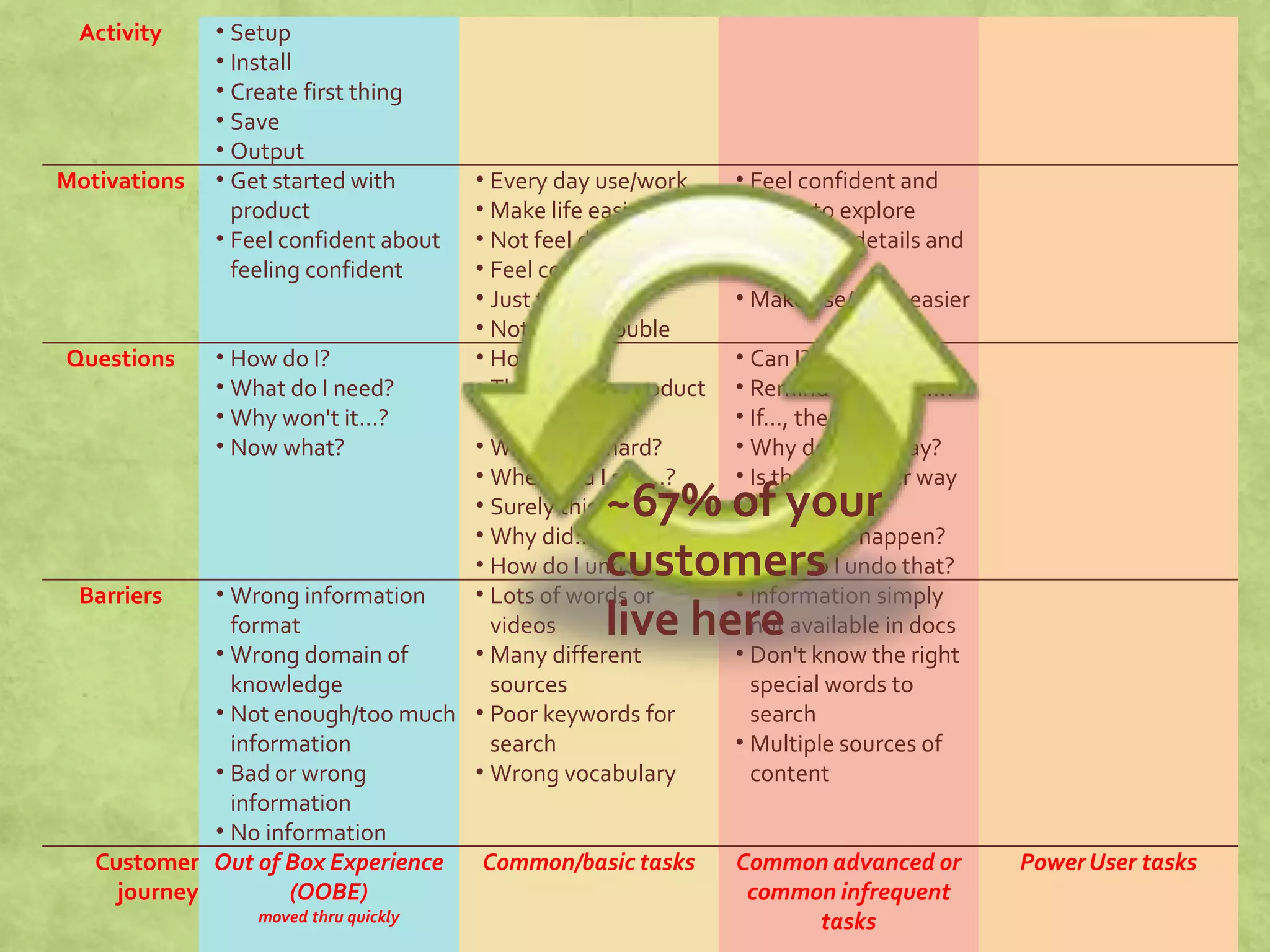
~67% of your
customers
live here
Touchpoints
The places where
a customer
interacts with
your company in
some manner
during the
customer journey
Attended and
unattended
▪ Touchpoints include:
▪ Letters
▪ Knowledgebase
▪ Support
▪ Website
▪ Product content
▪ Exposes internal processes
▪ Attended vs unattended
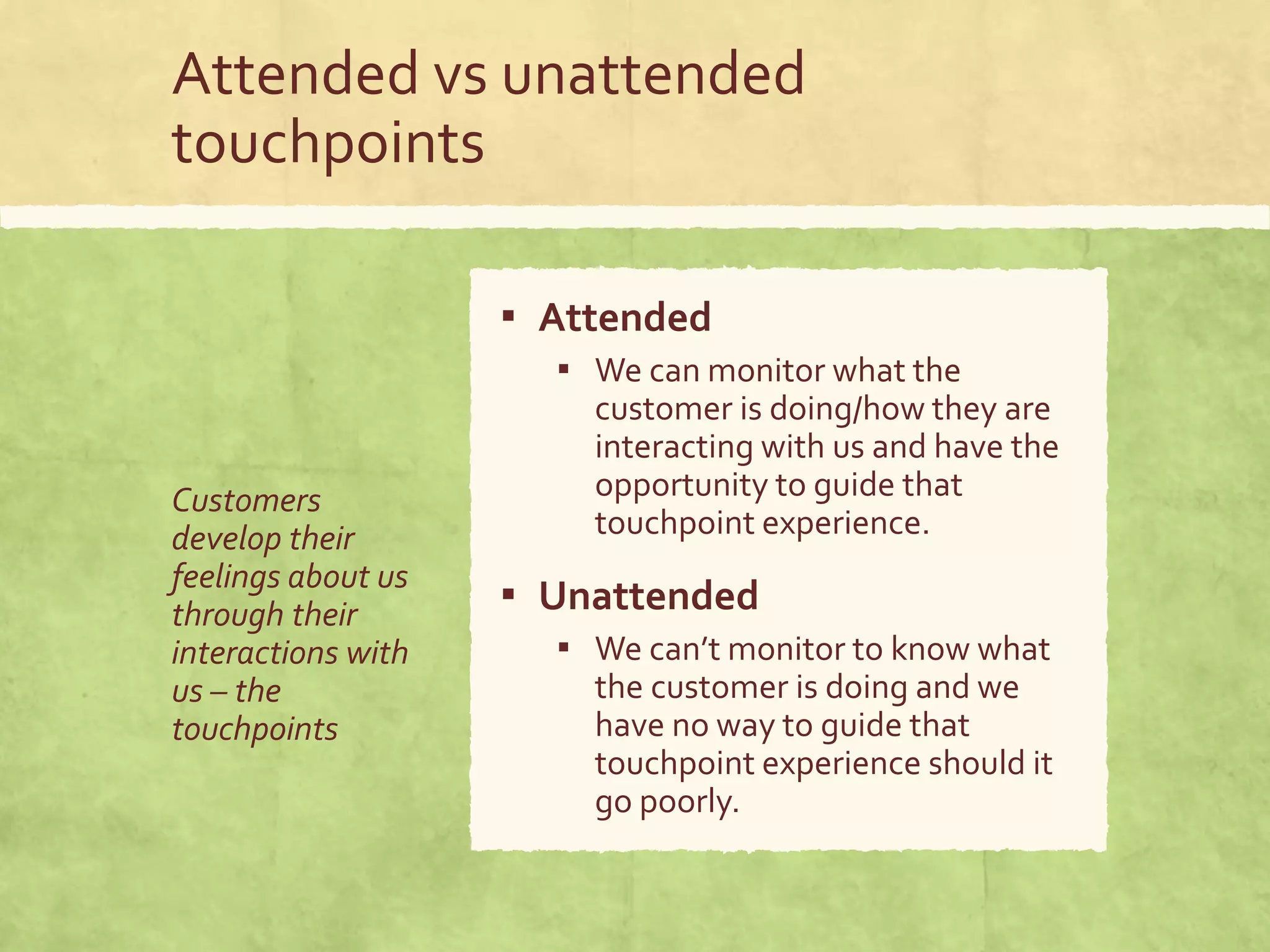
Attended vs unattended
touchpoints
Customers
develop their
feelings about us
through their
interactions with
us – the
touchpoints
▪ Attended
▪ We can monitor what the
customer is doing/how they are
interacting with us and have the
opportunity to guide that
touchpoint experience.
▪ Unattended
▪ We can’t monitor to know what
the customer is doing and we
have no way to guide that
touchpoint experience should it
go poorly.
Most of our content is unattended
We often throw
something over
the wall and hope
for the best
▪ We need data for unattended
touchpoints
▪ Google Analytics
▪ Website
▪ Product instructions
▪ Other tools help here, too
▪ Might also be good to allow
ratings and comments
Customer ecosystem
The entire system
the customer is
involved in during
a journey
Including internal
stuff the customer
never sees
▪ Nothing happens in a vacuum
▪ Customer touchpoints are the
tips of icebergs
▪ Processes internal to your
company “bubble up” to
touchpoints
▪ Often, entire groups have no
idea of their customer impact
Customer ecosystems
Mapping out a
journey to an
ecosystem
potentially
identifies
unknown
customer impact
▪ Sort of like root cause analysis
▪ But deeper and more
systematic
▪ Allows people to see groups
who have customer impact
several levels up from where
they are making decisions
▪ These groups may be very happy
with how they’re doing
▪ But the customer isn’t
What does this mean for our
content?
▪ In most companies, we don’t
really know how content gets
created and distributed
▪ Or what is involved in that
creation or distribution
▪ And what barriers that may
create for our customers
▪ We need to know this
▪ We need the ecosystem
mapped out to show our
integration
We may be
delighted with our
content
Our customer may
not be delighted
The customer
wins
Measurements
How do start showing our value?
Customer Satisfaction Survey
Your company
cares deeply
about what the
customers think
Get docs in there
▪ Your company probably has a
Customer Experience program
▪ May be called the “Voice of the
Customer”
▪ Find them
▪ Bring them chocolates
▪ Annual survey
▪ Get a few questions on that
▪ About the value of the docs
▪ Don’t ask if it’s all spelled
correctly or if the grammar is
good
Net Promoter Score (NPS)
“How likely is it
that you would
recommend
[company
name/product/
service] to a friend
or colleague?”
▪ Intended behavior metric
▪ Scale 0 to 10
▪ Associates loyalty to future
behavior
Group Score Feelings
Promoters 9 or 10 Loyal
Passives 7 or 8 Generally
satisfied
Detractors 0 to 6 Unhappy
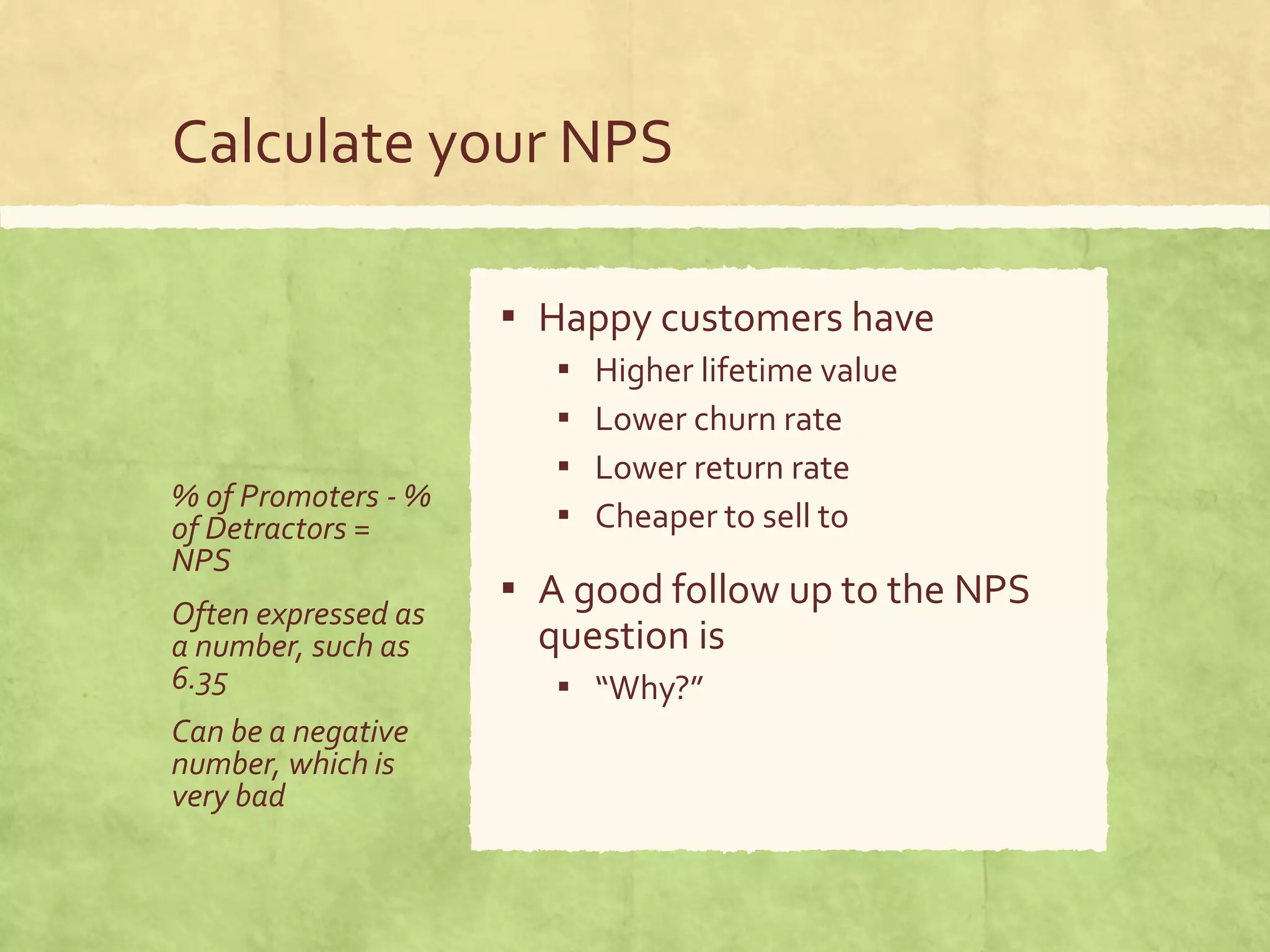
Calculate your NPS
% of Promoters - %
of Detractors =
NPS
Often expressed as
a number, such as
6.35
Can be a negative
number, which is
very bad
▪ Happy customers have
▪ Higher lifetime value
▪ Lower churn rate
▪ Lower return rate
▪ Cheaper to sell to
▪ A good follow up to the NPS
question is
▪ “Why?”
Can we use this elsewhere?
“How likely is it
that you would
recommend our
instructions [or
content] to a
friend or
colleague?”
▪ Measure the intended
behavior for your content
▪ Use the same scale and
measurements as the rest of
the NPS
▪ If your content isn’t as high (or
is higher) as the rest of your
NPS
▪ That’s something to look at
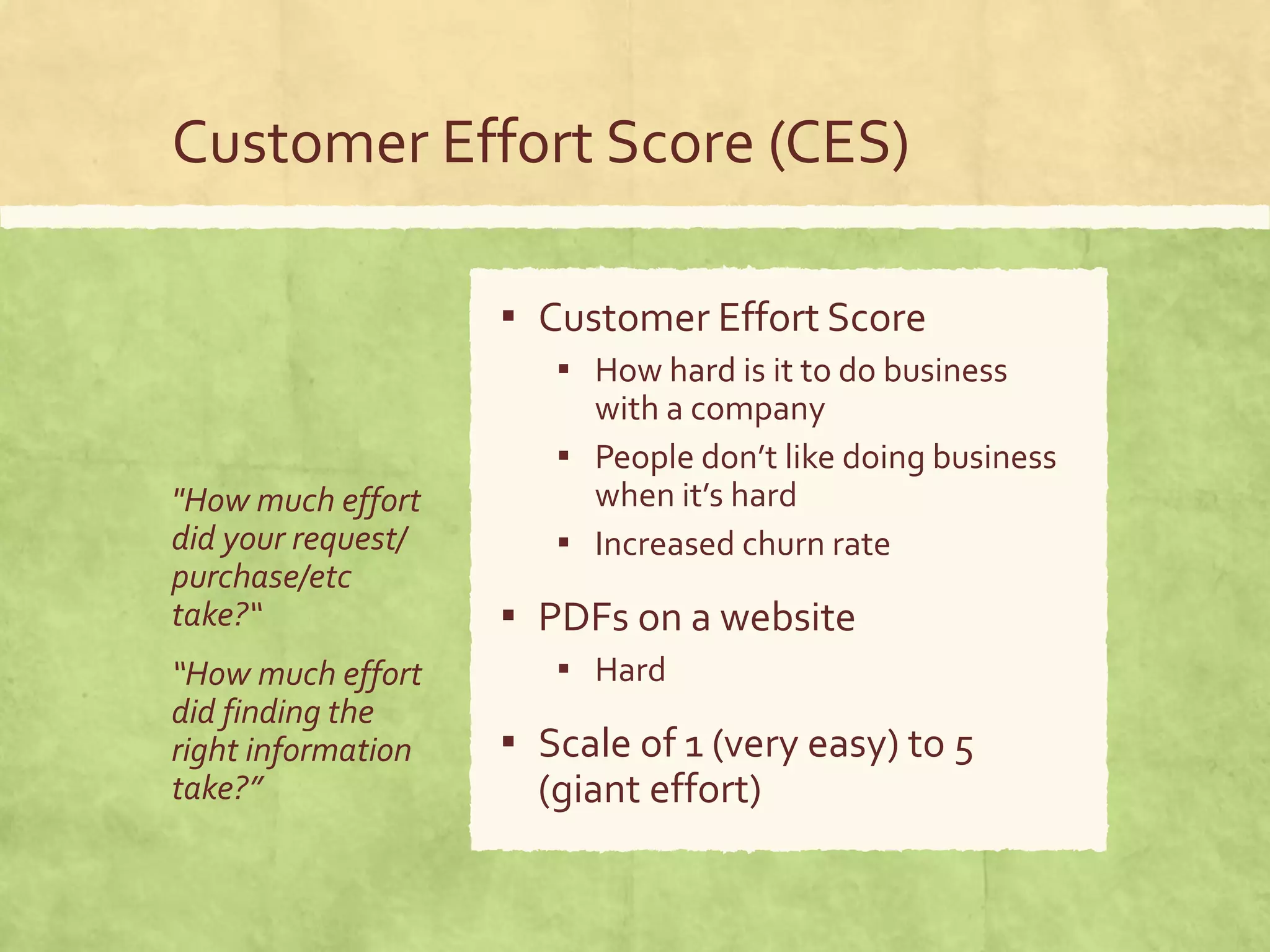
Customer Effort Score (CES)
"How much effort
did your request/
purchase/etc
take?“
“How much effort
did finding the
right information
take?”
▪ Customer Effort Score
▪ How hard is it to do business
with a company
▪ People don’t like doing business
when it’s hard
▪ Increased churn rate
▪ PDFs on a website
▪ Hard
▪ Scale of 1 (very easy) to 5
(giant effort)
Resources
Some resources to
start making the
case for your
environment
▪ Customer Journey maps
http://bit.ly/18ioSuH
http://bit.ly/1B5koC3
▪ Sharon Burton
http://bit.ly/1NdeAga
▪ Webworks
http://bit.ly/1wRXKZX
▪ I can’t release the IBM data
▪ I know. I’m bummed, too.
Questions?
sharon@sharonburton.com
Twitter: sharonburton

The Power of Technical Communication: How and Where We Impact the Bottom Line
  • 1.
    The Power ofTech Comm HowandWhereWe Impact the Bottom Line Sharon Burton
  • 2.
    Thank you forattending! ▪ Sharon Burton ▪ I solve post-sales customer experience problems ▪ Research how people feel about product instructions ▪ Support clients in creating better product instructions ▪ And fixing the workflow ▪ Teach communication at various universities ▪ These slides will go up on SlideShare tomorrow ▪ sharon@sharonburton.com ▪ Twitter: sharonburton
  • 3.
    Where is thedata from? ▪ I’m pulling data from different places ▪ Including my own work ▪ I have references at the end for you
  • 4.
    How it’s alwaysbeen This may sound familiar
  • 5.
    Technical Documentation No onereads the product instructions Customers will just call support anyway A Good ProductTM doesn’t need docs ▪ We fought to be in engineering ▪ They didn’t think of us as part of the product ▪ Often, no one knows how docs get done ▪ No one told us about upcoming projects
  • 6.
    Technical Documentation Can thislook prettier? We can’t tell them that Why won’t a brochure be enough? ▪ We moved to Marketing ▪ They didn’t think of us as part of the product or the marketing collateral ▪ Often, no one knows how docs get done ▪ No one told us about upcoming projects
  • 7.
    We’re in theWildWest It’sall changing as I speak
  • 8.
    Content is king AndQueen And the whole royal court ▪ Marketing has discovered content ▪ Customers want content ▪ We have that ▪ We have lots of that ▪ How do we connect what we do to what the company needs?
  • 9.
  • 10.
    Sales funnel ▪ Theway sales come into your company ▪ Marketing gets the top of the funnel ▪ Sales gets the bottom ▪ Your sales people live and die here ▪ Product instructions are being used by sales as tools Leads Customers (conversion)
  • 11.
    Sales funnel IBM: Product contentaffected purchase decision 89% ▪ Make product instructions available to people in the sales funnel ▪ Shows ▪ How the product works ▪ How easy the product is to use ▪ General perception of “suitability of purpose” ▪ Impacts the CAC
  • 12.
    Getting customers isexpensive It costs 6–7 times more to acquire a new customer than retain an existing one – Bain & Company ▪ CustomerAcquisition Cost (CAC) is the cost of convincing people to buy your product or service ▪ Basically, it’s the total cost of sales and marketing divided by the # of customers you got ▪ B2C is typically less, B2B is typically more
  • 13.
    Sales cycle ▪ B2C ▪Household decisions ▪ Consumer products ▪ Often short ▪ Commodities ▪ Big ticket items ▪ Longer ▪ Cars ▪ Low risk ▪ B2B ▪ Business decisions ▪ Solve business problems ▪ Long, often several years ▪ More specialized ▪ Very big ticket items ▪ High risk
  • 14.
    Tie us tothe sales cycle Find out where your docs are being used ▪ How many times are docs involved in a sale? ▪ What is the average sale? ▪ Ask the customer if the docs influenced and how much?
  • 15.
    Post sales Our workstarts after the sale is made
  • 16.
    Keeping customers A 5%increase in customer retention can increase profitability by 75% — Bain andCo ▪ Customer churn is customers leaving from the back door as you welcome new ones in the front door ▪ Customer churn is one of the most expensive things you can have ▪ An entire industry exists to analyze churn
  • 17.
    Clear instructions feelgood 71% think the company cares about them 7 out of 10
  • 18.
    Customer churn IBM: Affects product satisfaction 92% ▪Customers who can use the product use the product ▪ They don’t leave and purchase someone else ▪ Clear product instructions reduce customer churn
  • 19.
    Wouldn’t purchase again About50% wouldn’t purchase from the company again Half your customers
  • 20.
    Return rate Returns have increased21 percent since 2007, according to an Accenture research report (Dec 2011) ▪ 5% of returns are related to actual product defects ▪ 27% reflect “buyer’s remorse” ▪ 68% of returned products are “NoTrouble Found”
  • 21.
    Defective or broken About25% feel the product is defective 1 in 4
  • 22.
    Customer LifetimeValue (CLV) Theprobability of selling to an existing customer is 60 – 70%.The probability of selling to a new prospect is 5-20% —Marketing Metrics ▪ Existing customers are already engaged with your products or services ▪ They have a lower cost to keep ▪ They should buy more stuff ▪ Higher monetary value to the business
  • 23.
    Clear instructions andlifetime value IBM: Clear instructions add to the product quality 97% ▪ Increased perception of product quality ▪ If this is good, more of this is also good ▪ Who wants to buy low quality products? ▪ Who can afford that?
  • 24.
    Reduce confidence inthe product About 24% report they don’t feel confident about the product 1 in 4
  • 25.
    Out of boxexperience (OOB) The averageU.S. consumer spends 20 minutes trying to make a device work before giving up and returning it to the seller— 2006 study by Dutch scientist Elke den Ouden ▪ The feelings when you open the box ▪ Printers have set up docs right there ▪ Apple product are pretty ▪ Can reduce customer support ▪ Give people that feeling of competence ▪ Or totally destroy it with bad instructions
  • 26.
    Use product instructions About91% of customers use the product instructions
  • 27.
  • 28.
    Customer experience 81% ofcompanies …delivering customer experience excellence are outperforming their competitors — Peppers and Rogers, 2009 Customer Experience Maturity Monitor ▪ Customer experience is the outcome of all of the touch points that your customer has with your organization * ▪ The perception that customers have across all of their interactions with your organization * ▪ It’s a customer-centric view of your company from every touch point * From Customer Experience Overview, 2011, BruceTempkin and Jeanne Bliss
  • 29.
    Customer experience isa big deal Product instructions are a critical part of the customer experience. If customers can’t use the product, it impacts the bottom line — Sharon Burton ▪ Product instructions are the central to the post-sales customer experience ▪ Technical communication is a subset of customer experience ▪ We have so much in common ▪ Tech comm is concerned with the post-sales part
  • 30.
    Customer Journey The processa customer goes through while interacting with your company Only the customer knows if it was good or not ▪ Typically though of in column phases, for example ▪ Awareness ▪ Interest ▪ Desire ▪ Action ▪ Can have customer rows ▪ Activity ▪ Motivations ▪ Questions ▪ Barriers
  • 31.
    Activity • Setup •Install • Create first thing • Save • Output Motivations • Get started with product • Feel confident about feeling confident • Every day use/work • Make life easier • Not feel dumb • Feel confident • Just tell me • Not get in trouble • Feel confident and ready to explore • Ready for details and concepts • Make use/work easier Questions • How do I? • What do I need? • Why won't it…? • Now what? • How do I…? • The previous product did…? • Why is…so hard? • Where did I see…? • Surely this must…? • Why did… happen? • How do I undo that? • Can I? • Remind me how I…? • If…, then…? • Why do…this way? • Is there a better way to do…? • Why did… happen? • How do I undo that? Barriers • Wrong information format • Wrong domain of knowledge • Not enough/too much information • Bad or wrong information • No information • Lots of words or videos • Many different sources • Poor keywords for search • Wrong vocabulary • Information simply not available in docs • Don't know the right special words to search • Multiple sources of content Customer journey Out of Box Experience (OOBE) moved thru quickly Common/basic tasks Common advanced or common infrequent tasks PowerUser tasks
  • 32.
    Activity • Setup •Install • Create first thing • Save • Output Motivations • Get started with product • Feel confident about feeling confident • Every day use/work • Make life easier • Not feel dumb • Feel confident • Just tell me • Not get in trouble • Feel confident and ready to explore • Ready for details and concepts • Make use/work easier Questions • How do I? • What do I need? • Why won't it…? • Now what? • How do I…? • The previous product did…? • Why is…so hard? • Where did I see…? • Surely this must…? • Why did… happen? • How do I undo that? • Can I? • Remind me how I…? • If…, then…? • Why do…this way? • Is there a better way to do…? • Why did… happen? • How do I undo that? Barriers • Wrong information format • Wrong domain of knowledge • Not enough/too much information • Bad or wrong information • No information • Lots of words or videos • Many different sources • Poor keywords for search • Wrong vocabulary • Information simply not available in docs • Don't know the right special words to search • Multiple sources of content Customer journey Out of Box Experience (OOBE) moved thru quickly Common/basic tasks Common advanced or common infrequent tasks PowerUser tasks ~67% of your customers live here
  • 33.
    Touchpoints The places where acustomer interacts with your company in some manner during the customer journey Attended and unattended ▪ Touchpoints include: ▪ Letters ▪ Knowledgebase ▪ Support ▪ Website ▪ Product content ▪ Exposes internal processes ▪ Attended vs unattended
  • 34.
    Attended vs unattended touchpoints Customers developtheir feelings about us through their interactions with us – the touchpoints ▪ Attended ▪ We can monitor what the customer is doing/how they are interacting with us and have the opportunity to guide that touchpoint experience. ▪ Unattended ▪ We can’t monitor to know what the customer is doing and we have no way to guide that touchpoint experience should it go poorly.
  • 35.
    Most of ourcontent is unattended We often throw something over the wall and hope for the best ▪ We need data for unattended touchpoints ▪ Google Analytics ▪ Website ▪ Product instructions ▪ Other tools help here, too ▪ Might also be good to allow ratings and comments
  • 36.
    Customer ecosystem The entiresystem the customer is involved in during a journey Including internal stuff the customer never sees ▪ Nothing happens in a vacuum ▪ Customer touchpoints are the tips of icebergs ▪ Processes internal to your company “bubble up” to touchpoints ▪ Often, entire groups have no idea of their customer impact
  • 37.
    Customer ecosystems Mapping outa journey to an ecosystem potentially identifies unknown customer impact ▪ Sort of like root cause analysis ▪ But deeper and more systematic ▪ Allows people to see groups who have customer impact several levels up from where they are making decisions ▪ These groups may be very happy with how they’re doing ▪ But the customer isn’t
  • 38.
    What does thismean for our content? ▪ In most companies, we don’t really know how content gets created and distributed ▪ Or what is involved in that creation or distribution ▪ And what barriers that may create for our customers ▪ We need to know this ▪ We need the ecosystem mapped out to show our integration We may be delighted with our content Our customer may not be delighted The customer wins
  • 39.
    Measurements How do startshowing our value?
  • 40.
    Customer Satisfaction Survey Yourcompany cares deeply about what the customers think Get docs in there ▪ Your company probably has a Customer Experience program ▪ May be called the “Voice of the Customer” ▪ Find them ▪ Bring them chocolates ▪ Annual survey ▪ Get a few questions on that ▪ About the value of the docs ▪ Don’t ask if it’s all spelled correctly or if the grammar is good
  • 41.
    Net Promoter Score(NPS) “How likely is it that you would recommend [company name/product/ service] to a friend or colleague?” ▪ Intended behavior metric ▪ Scale 0 to 10 ▪ Associates loyalty to future behavior Group Score Feelings Promoters 9 or 10 Loyal Passives 7 or 8 Generally satisfied Detractors 0 to 6 Unhappy
  • 42.
    Calculate your NPS %of Promoters - % of Detractors = NPS Often expressed as a number, such as 6.35 Can be a negative number, which is very bad ▪ Happy customers have ▪ Higher lifetime value ▪ Lower churn rate ▪ Lower return rate ▪ Cheaper to sell to ▪ A good follow up to the NPS question is ▪ “Why?”
  • 43.
    Can we usethis elsewhere? “How likely is it that you would recommend our instructions [or content] to a friend or colleague?” ▪ Measure the intended behavior for your content ▪ Use the same scale and measurements as the rest of the NPS ▪ If your content isn’t as high (or is higher) as the rest of your NPS ▪ That’s something to look at
  • 44.
    Customer Effort Score(CES) "How much effort did your request/ purchase/etc take?“ “How much effort did finding the right information take?” ▪ Customer Effort Score ▪ How hard is it to do business with a company ▪ People don’t like doing business when it’s hard ▪ Increased churn rate ▪ PDFs on a website ▪ Hard ▪ Scale of 1 (very easy) to 5 (giant effort)
  • 45.
    Resources Some resources to startmaking the case for your environment ▪ Customer Journey maps http://bit.ly/18ioSuH http://bit.ly/1B5koC3 ▪ Sharon Burton http://bit.ly/1NdeAga ▪ Webworks http://bit.ly/1wRXKZX ▪ I can’t release the IBM data ▪ I know. I’m bummed, too.
  • 46.