JOHAN LINÅKER, PHD
The Open Source Way of Working
aka. How do you create and
collaborate with a community?
https://hbr.org/2020/01/when-community-becomes-your-competitive-advantage
Community <> Ecosystem
A Shared Mission
and Purpose
• Communicate where you want to go and ”Why are we
coming together?”
– Vision, Mission, and Goals
• Communicate how you want to get there
– Roadmap
• Foster a sense of belonging among community
members and anchor vision and roadmap with them
– Ask for input and feedback
• Listen to community’s feedback and join discussions
– React quick and friendly
• Evangelize, Advocate, Market!
– Define target audience and identify channels
– Plan and produce content
– Optimize Social Media
– Attend, arrange and present at events,
meetups, conferences, hackathons...
Enable easy and effective
consumption of data & SW
• Accessible APIs and code repositories
– Accessible and user-friendly landing pages
and infrastructure (Gitlab/Github)
• Up-to-date and easy-to-follow documentation
– Dedicate time, think about target audience
• Time-to-Hello-world minimized
– Let externals trial-run documentation
• Open, transparent and searchable ticket, support and
communication channels
– Synchronous (e.g., IRC) – cf. Slack!
– Asynchrounous (e.g., Discourse)
– Issue-tracker (e.g., Github, Jira, Bugzilla)
– What channels are needed for what
conversations? Don’t overcomplicate!
• Physical meeting opportunities
– Meetups, DevSummits, Hackathons
Enable easy and effective
contribution to data & SW
• Collaborative development = Collaboration on development
– E.g., Assign issues, tag beginner-issues, include
community in debugging processes, invite to
discussions and decision-making
• Understandable and simplified contribution process
– Common infrastructure for all projects
– Inclusive contribution guidelines for both
technical and non-technical contributions
• Possibility to report, discuss and act on issues like bug
reports and feature requests
– Issue-tracker (e.g., Github, Jira, Bugzilla)
• Discussions and conversations on backlog and community-
relevant topics done via open, transparent and generally
accepted community communication channels
– Synchronous (e.g., IRC) – cf. Slack!
– Asynchrounous (e.g., Discourse)
– Dedicated time in budget for teams
– Internal training in infrastructure
Intrinsic and extrinsic
incentives and rewards
• Identify and consider how to satisfy different motives
– E.g., influence, feedback, meet use-cases
• Contributions and accomplishments are highlighted
and applauded openly
– Proactive and reactive mindset in teams
• Swag can be a personal and easy sign of
appriciation
– E.g., T-shirts, hoodies, stickers
• Contributors should be given a sense of satisfaction
and recognition
– Community members as extended team
members
• Both technical and non-technical contributions
should be considered
– Active tracking of all types of
contributions
Carefully crafted
accountability
• Clear and easy-to-follow process for code review
and contributions
– Accessible and understandable
contribution guidelines and process
documentation
– E.g., Step-by-step process for
submitting a PR via Github, Information
on what is expected in a Pull
Request/Contribution
• Information on decision process and governance
of community
– Project documentation of governance
hierarchy (e.g., boards, committees,
working groups)
– Community charters and statuts
– Open meetings, minutes or meeting
digests
Healthy, diverse participation
driven by good leadership
• Exercise Leadership before Control
– Default to open (where appropriate)
– Be inclusive and active
– Lead by example and set expectations
• Code of Conduct clearly stated and how it is enforced
– Needs to be advocated and enforced
• Open and inclusive discussions in communication
– Community members as extended team
members, i.e., more than end-users
– Continuous reflection
• New users are made welcome and presented to
community resources
– Onboarding process and/or welcoming
message
– Mentor and support newcomers
– Reactive mindset among teams
Open, objective,
governance and evolution
• Community members feel that they have an active
part and say on the development
– Define and publish open governance
model
– Don’t overcomplicate or overgovern
– Formalize groups where community
members can have a say (e.g., working
groups, user committees) – if needed
• They are given a sense of ownership and
responsibility
– Delegation of tasks and issues
• Requires an inclusive leadership
– Mindset among teams
• Opportunities for community members to provide
feedback
– Active and inclusive discussions on
communication channels
Open and goal-driven
metrics and evaulations
• Have a clear and common understanding of goals
and what value means
– Talk to community members, i.e., end-
users and stakeholders
– Define goals and value per use-case
• Create chain of logic from contribution to impact
– Link operational and impact metrics
• Focus on the whole picture
– Don’t zoom in on single metrics
• Consider qualitative knowledge about community
– Use metrics as input to discussions
• Iterate and optimize
– Refine and validate metrics
• Analyze, evaluate and react
– Analyze changes and react if needed
Challenges with going Open
Transparency of Work
• Showing up one’s work openly and transparent
for knowns and unknows may imply...
– Sense of embarresment
– Sense of responsibility
– Sense of accountability
• On the other hand…
– Opportunity to get feedback and learn from
others
– Sense of pride
– Quality often becomes better
– Public and personal CV
– OSS Licence → Use at own risk
• Management and organizational support pivotal
Resource Availability
• Time for community work,
– Community work not seen as a
part of business goals by
managers
– Community work not seen as a
part of team goals by
developers
• Management and developers need to
set community goals aligning with
business and team goals
Creating an Open Mindset
●
Switching from a closed to an open
and collaborative mindset
– ”Not what I signed up for”
– ”Why should I answer that
question?”
– ”I’m busy”
●
May feel as unnessecary overhead
doing discussions online with
colleagues sitting on other side of
table
●
Striking a balance on what to do online
and offline
●
Consider community members both as
customers/end-users and collegues
●
People and organizations from
outside the company are
prioritizing your work
●
Customer-driven and
collaborative development!
●
External opinions does not have
to imply the final say
●
Part of an overall requirements
engineering process
External Impact on
Priorities
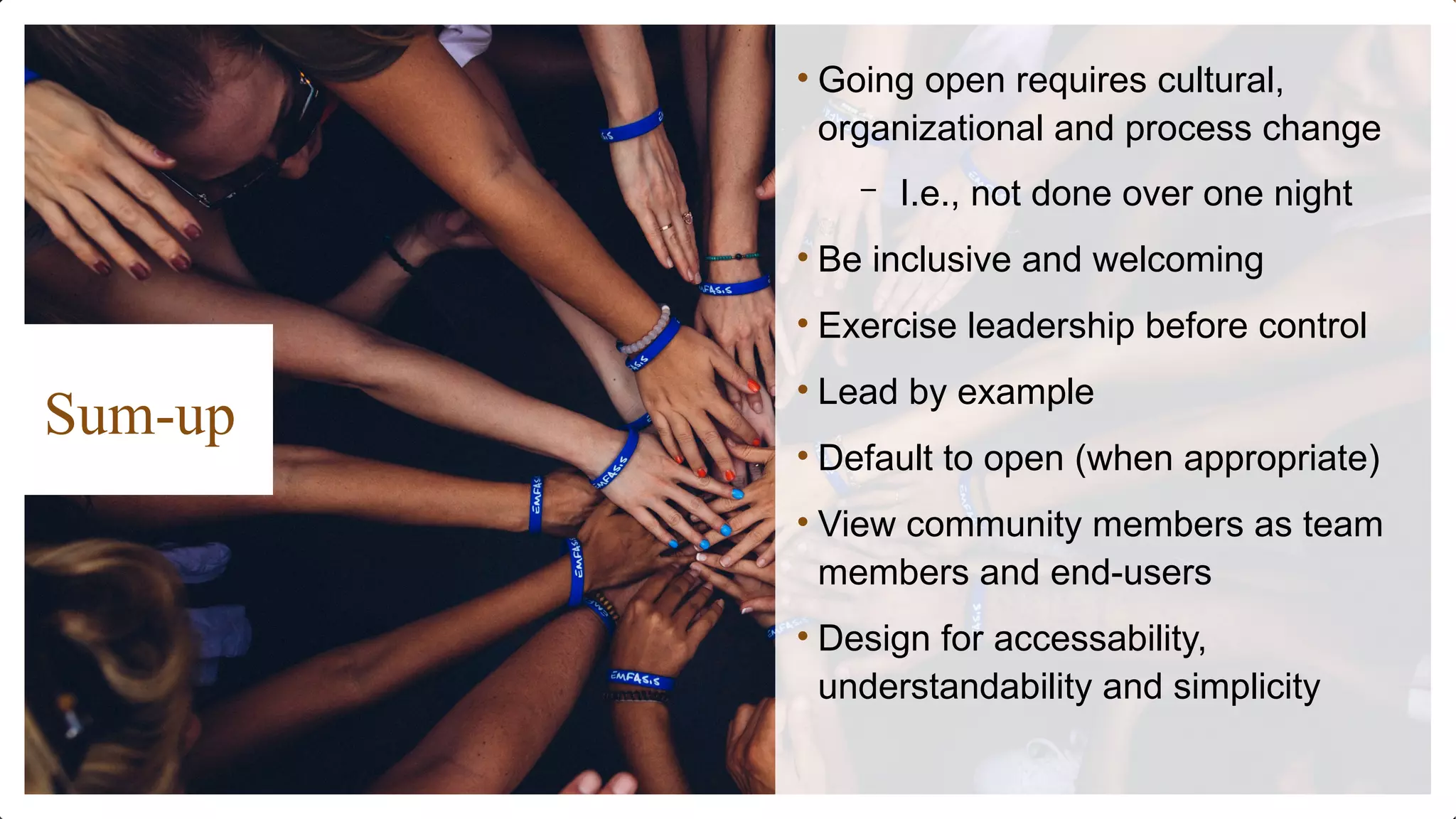
Sum-up
• Going open requires cultural,
organizational and process change
– I.e., not done over one night
• Be inclusive and welcoming
• Exercise leadership before control
• Lead by example
• Default to open (when appropriate)
• View community members as team
members and end-users
• Design for accessability,
understandability and simplicity
The Open Source Way of Working

The Open Source Way of Working

  • 1.
    JOHAN LINÅKER, PHD TheOpen Source Way of Working
  • 2.
    aka. How doyou create and collaborate with a community? https://hbr.org/2020/01/when-community-becomes-your-competitive-advantage
  • 3.
  • 4.
    A Shared Mission andPurpose • Communicate where you want to go and ”Why are we coming together?” – Vision, Mission, and Goals • Communicate how you want to get there – Roadmap • Foster a sense of belonging among community members and anchor vision and roadmap with them – Ask for input and feedback • Listen to community’s feedback and join discussions – React quick and friendly • Evangelize, Advocate, Market! – Define target audience and identify channels – Plan and produce content – Optimize Social Media – Attend, arrange and present at events, meetups, conferences, hackathons...
  • 5.
    Enable easy andeffective consumption of data & SW • Accessible APIs and code repositories – Accessible and user-friendly landing pages and infrastructure (Gitlab/Github) • Up-to-date and easy-to-follow documentation – Dedicate time, think about target audience • Time-to-Hello-world minimized – Let externals trial-run documentation • Open, transparent and searchable ticket, support and communication channels – Synchronous (e.g., IRC) – cf. Slack! – Asynchrounous (e.g., Discourse) – Issue-tracker (e.g., Github, Jira, Bugzilla) – What channels are needed for what conversations? Don’t overcomplicate! • Physical meeting opportunities – Meetups, DevSummits, Hackathons
  • 6.
    Enable easy andeffective contribution to data & SW • Collaborative development = Collaboration on development – E.g., Assign issues, tag beginner-issues, include community in debugging processes, invite to discussions and decision-making • Understandable and simplified contribution process – Common infrastructure for all projects – Inclusive contribution guidelines for both technical and non-technical contributions • Possibility to report, discuss and act on issues like bug reports and feature requests – Issue-tracker (e.g., Github, Jira, Bugzilla) • Discussions and conversations on backlog and community- relevant topics done via open, transparent and generally accepted community communication channels – Synchronous (e.g., IRC) – cf. Slack! – Asynchrounous (e.g., Discourse) – Dedicated time in budget for teams – Internal training in infrastructure
  • 7.
    Intrinsic and extrinsic incentivesand rewards • Identify and consider how to satisfy different motives – E.g., influence, feedback, meet use-cases • Contributions and accomplishments are highlighted and applauded openly – Proactive and reactive mindset in teams • Swag can be a personal and easy sign of appriciation – E.g., T-shirts, hoodies, stickers • Contributors should be given a sense of satisfaction and recognition – Community members as extended team members • Both technical and non-technical contributions should be considered – Active tracking of all types of contributions
  • 8.
    Carefully crafted accountability • Clearand easy-to-follow process for code review and contributions – Accessible and understandable contribution guidelines and process documentation – E.g., Step-by-step process for submitting a PR via Github, Information on what is expected in a Pull Request/Contribution • Information on decision process and governance of community – Project documentation of governance hierarchy (e.g., boards, committees, working groups) – Community charters and statuts – Open meetings, minutes or meeting digests
  • 9.
    Healthy, diverse participation drivenby good leadership • Exercise Leadership before Control – Default to open (where appropriate) – Be inclusive and active – Lead by example and set expectations • Code of Conduct clearly stated and how it is enforced – Needs to be advocated and enforced • Open and inclusive discussions in communication – Community members as extended team members, i.e., more than end-users – Continuous reflection • New users are made welcome and presented to community resources – Onboarding process and/or welcoming message – Mentor and support newcomers – Reactive mindset among teams
  • 10.
    Open, objective, governance andevolution • Community members feel that they have an active part and say on the development – Define and publish open governance model – Don’t overcomplicate or overgovern – Formalize groups where community members can have a say (e.g., working groups, user committees) – if needed • They are given a sense of ownership and responsibility – Delegation of tasks and issues • Requires an inclusive leadership – Mindset among teams • Opportunities for community members to provide feedback – Active and inclusive discussions on communication channels
  • 11.
    Open and goal-driven metricsand evaulations • Have a clear and common understanding of goals and what value means – Talk to community members, i.e., end- users and stakeholders – Define goals and value per use-case • Create chain of logic from contribution to impact – Link operational and impact metrics • Focus on the whole picture – Don’t zoom in on single metrics • Consider qualitative knowledge about community – Use metrics as input to discussions • Iterate and optimize – Refine and validate metrics • Analyze, evaluate and react – Analyze changes and react if needed
  • 12.
  • 13.
    Transparency of Work •Showing up one’s work openly and transparent for knowns and unknows may imply... – Sense of embarresment – Sense of responsibility – Sense of accountability • On the other hand… – Opportunity to get feedback and learn from others – Sense of pride – Quality often becomes better – Public and personal CV – OSS Licence → Use at own risk • Management and organizational support pivotal
  • 14.
    Resource Availability • Timefor community work, – Community work not seen as a part of business goals by managers – Community work not seen as a part of team goals by developers • Management and developers need to set community goals aligning with business and team goals
  • 15.
    Creating an OpenMindset ● Switching from a closed to an open and collaborative mindset – ”Not what I signed up for” – ”Why should I answer that question?” – ”I’m busy” ● May feel as unnessecary overhead doing discussions online with colleagues sitting on other side of table ● Striking a balance on what to do online and offline ● Consider community members both as customers/end-users and collegues
  • 16.
    ● People and organizationsfrom outside the company are prioritizing your work ● Customer-driven and collaborative development! ● External opinions does not have to imply the final say ● Part of an overall requirements engineering process External Impact on Priorities
  • 17.
    Sum-up • Going openrequires cultural, organizational and process change – I.e., not done over one night • Be inclusive and welcoming • Exercise leadership before control • Lead by example • Default to open (when appropriate) • View community members as team members and end-users • Design for accessability, understandability and simplicity