






DO I NEED ETHICS?
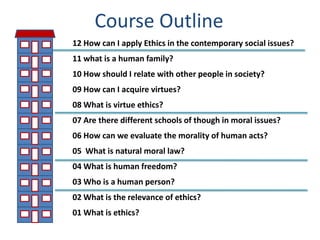
Course Outline12 How can I apply Ethics in the contemporary social issues?11 what is a human family? 10 How should I relate with other people in society? 09 How can I acquire virtues? 08 What is virtue ethics?07 Are there different schools of though in moral issues? 06 How can we evaluate the morality of human acts? 05  What is natural moral law? 04 What is human freedom? 03 Who is a human person?02 What is the relevance of ethics?01 What is ethics?
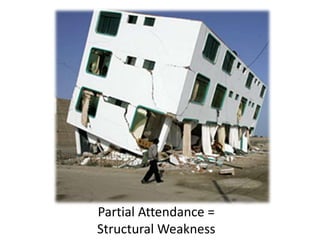
FullAttendance=StrongBuilding
Partial Attendance = Structural Weakness
Human person. Topic 2
VERY PERSONAL
SEARCHING
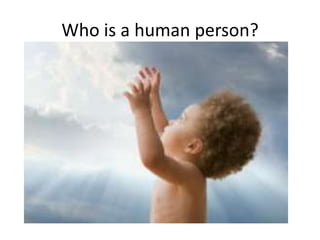
Who is a human person?
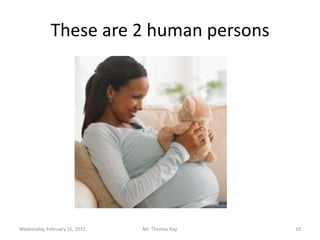
These are 2 human persons Tuesday, February 15, 2011Mr. Thomas Raji 10
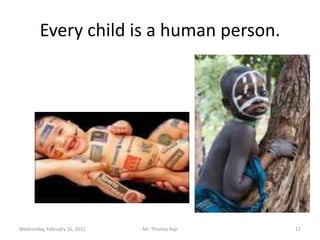
Every child is a human person.Tuesday, February 15, 2011Mr. Thomas Raji 11
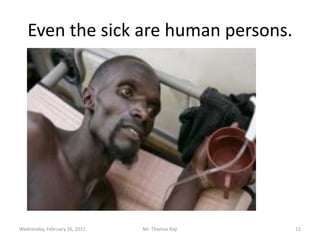
Even the sick are human persons.Tuesday, February 15, 2011Mr. Thomas Raji 12
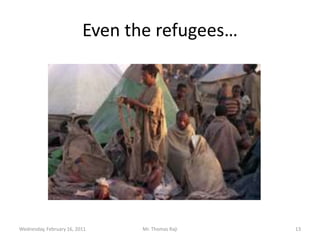
Even the refugees…Tuesday, February 15, 2011Mr. Thomas Raji 13
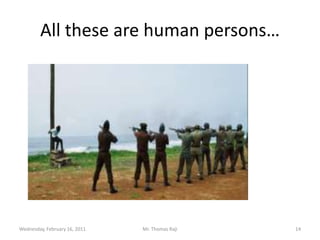
All these are human persons… Tuesday, February 15, 2011Mr. Thomas Raji 14
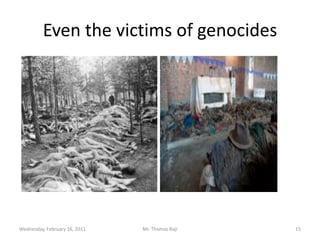
Even the victims of genocides Tuesday, February 15, 2011Mr. Thomas Raji 15
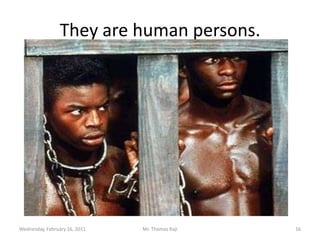
They are human persons. Tuesday, February 15, 2011Mr. Thomas Raji 16
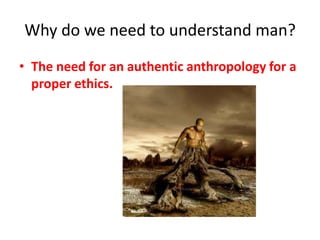
Why do we need to understand man?The need for an authentic anthropology for a proper ethics.
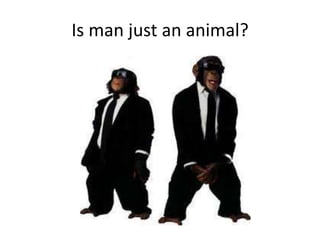
Is man just an animal?
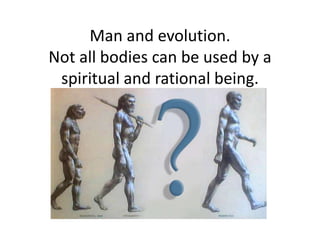
Man and evolution.Not all bodies can be used by a spiritual and rational being.
Tuesday, February 15, 2011Mr. Thomas Raji 20QuestionWhat is.. Who is the human person?
Defining EthicsThink and write your own definition of human person in your notesShare / compare your definition with the people seated close to youRewrite your definition of human person in your notes with any new ideas you may have gained by sharing your knowledge
Who/what is the human person?Tuesday, February 15, 2011Mr. Thomas Raji 22
Human person:Rational being composed of the corporeal element (soma) and the psyche (the soul). The human nature is what is common to all individuals. Man is a true microcosmos with a value surpassing that of the inanimate cosmos. Material is from the material, i.e. the body is from the parents, and the rational part (soul) is from the creator because it cannot be divided and neither can it come from matter because it is immaterial. The powers of the soul are two the intellect and the will. The proper object of the intellect is the truth and the will the good.
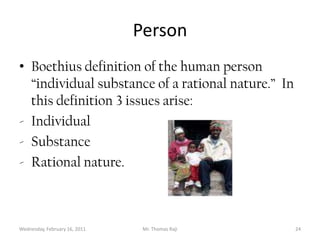
Tuesday, February 15, 2011Mr. Thomas Raji 24PersonBoethius definition of the human person “individual substance of a rational nature.”  In this definition 3 issues arise:Individual
Substance
Rational nature.Tuesday, February 15, 2011Mr. Thomas Raji 25IndividualityOne. In material beings the principle of individuation is matter.Responsible (able to respond) for the decisions one makes. Individuality has the connotation of freedom. It has the implication of rights and duties.
Tuesday, February 15, 2011Mr. Thomas Raji 26SubstanceThis comes from two words. Sub- stance. What can stand on its own.  It means that it is not an accidental perfection but goes to the core of the being. The souls can subsist on its own as explained earlier.The concept of “self” is evident. The knowledge that you exist.In simpler terms one discovers that he exists, more than that that he is aware of his existence with all the sentiments, feelings etc(concept of self) and in addition that others exists. Thus there are two things the knowledge of existing and the knower
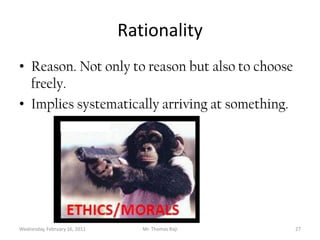
Tuesday, February 15, 2011Mr. Thomas Raji 27RationalityReason. Not only to reason but also to choose freely.Implies systematically arriving at something.
Tuesday, February 15, 2011Mr. Thomas Raji 28NatureThe term nature is what is common to a member of a certain species. What is common to the species housefly is not common to the species elephant. This therefore means that the nature of elephant is not the same as housefly. The principle of non contradiction is all too evident here.
Tuesday, February 15, 2011Mr. Thomas Raji 29Human natureNature refers to what a thing is. For example the nature of a car is that it has: an engine, wheels, and the body.A human person has the nature of a human being.
Human nature with in the universe. The cosmos.Vegetative life; nutrition, growth and reproduction. Sentient life; external senses and internal senses- imagination, memory and common sense.  Intellectual life; truth and Good. Moral life.
Triadic structureThe personal level
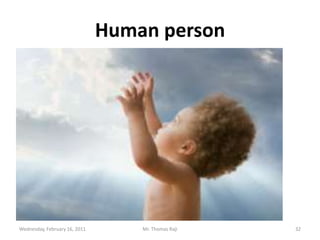
Human personTuesday, February 15, 2011Mr. Thomas Raji 32
Matter and form Is a human person purely matter?Is the human person purely form?
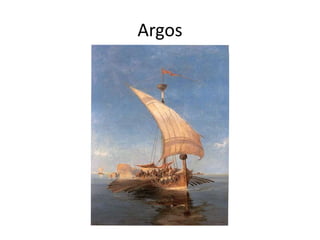
Argos
Hylomorphic anthropologyThe soul is the source of unity in the human person. The person is not just the body or the soul…Each person is unique, irreplaceable, unrepeatable, with dignity.
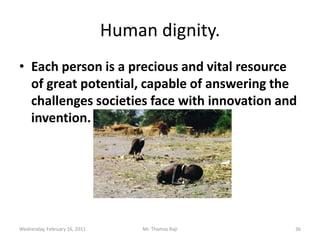
Human dignity.Each person is a precious and vital resource of great potential, capable of answering the challenges societies face with innovation and invention.Tuesday, February 15, 2011Mr. Thomas Raji 36
Tuesday, February 15, 2011Mr. Thomas Raji 37The existence of other human beingsThe human being discovers that he is not an isolated verse. That one exists with other rational beings. A  person is born in a family. Thus the first and basic unit of society is this the family. If one fights the family one actually fights society. If one changes the notion of the family one is endangering society.  This was explained in Introduction to Ethics.
Tuesday, February 15, 2011Mr. Thomas Raji 38Inter-subjective natureDue to the fact that man discovers that one exists with others, by default s(he) wants to share that oneness. This brings about the inter-subjectivity of man. You perceive oneself, other perceive you and you get your perception from others.
Tuesday, February 15, 2011Mr. Thomas Raji 39Need to educate the spiritual facultiesThere is need to educate the intellect and the will. This education has to be holistic and not limited to a particular facet. Education, which comes from the word e-ducere means to bring out the brightest part of the human person. In this particular case to make the real qualities of a human being shine out.
Tuesday, February 15, 2011Mr. Thomas Raji 40EducationEducation of the intellect.  The education of the intellect can be through informal or formal means. The formal means of education is given through specific channels cum environment. Informal education is what one gets outside the normal systematic channels for example from the environment.Education of the will is through the forming of habits. This formation has to be in the good not evil.
Tuesday, February 15, 2011Mr. Thomas Raji 41The real education of the will entails the formation of positive habits (i.e. intellectual, concupiscible and irascible appetites), virtues as opposed to vices.The education of the will and the intellect is a life long process.Habit has been termed as second nature because it is the actualization of what is to be truly human.
Tuesday, February 15, 2011Mr. Thomas Raji 42Analysis of the human person leads one to deduce the followingSpirituality. Transcends the material, the here and now to eternity.Emergence: The communication with others does not follow animal sentiments,  it a decision of ones free will and when communication with others it is a decision of the self.Somaticity: That one is a living material person.Trancedence- One sets goals , freely and man wants to achieve these goals. When these goals are attained there is satisfaction (Masslow hierarchy of needs)
Tuesday, February 15, 2011Mr. Thomas Raji 43DignityDignity means worth or value.The person is the most valuable being in comparison to the material universe.
Tuesday, February 15, 2011Mr. Thomas Raji 44ConclusionThe human person is made up of body and spiritual soul with intellect and will; because of this we can say that the person is dignified in the most radical sense.Each person is unique. Ones dignity lies precisely in this, that one is a human person and therefore this is the basis of human rights.
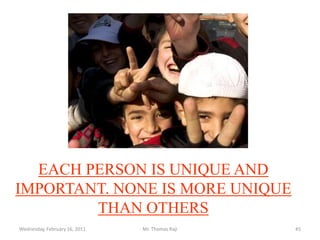
Tuesday, February 15, 2011Mr. Thomas Raji 45EACH PERSON IS UNIQUE AND IMPORTANT. NONE IS MORE UNIQUE THAN OTHERS
PERSONAL DEVELOPMENTPROJECT
Ex nihilo nihil fit- from nothing, nothing comesParents are not the transcendental cause of their children.
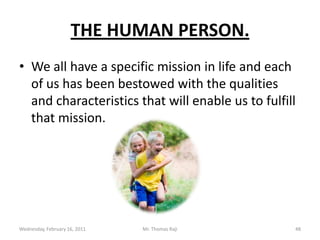
THE HUMAN PERSON.We all have a specific mission in life and each of us has been bestowed with the qualities and characteristics that will enable us to fulfill that mission.  Tuesday, February 15, 2011Mr. Thomas Raji 48
Tuesday, February 15, 2011Mr. Thomas Raji 49In 1999, the World Youth Alliance was founded in New York City at the United Nations. At a conference on Population and Development, thirty two young people were brought into the negotiations and given the floor. They stated that they represented all three billion of the world’s youth, and demanded the following: abortion as a human right, sexual rights for children, and a deletion of parents’ rights. At a conference convened to discuss the needs of the world’s people, basic needs including access to clean water, sanitation, education, nutrition, health care, and employment were not addressed. 
Tuesday, February 15, 2011Mr. Thomas Raji 50As a reaction of conscience, Anna Halpine and a few others went back into the assembly the next morning and distributed flyers which stated that these young people did not represent all the youth of the world. She called for a discussion on topics addressing basic human rights and necessities. The statement was well-received by many delegations and she was requested to maintain a permanent presence at the United Nations, as well as to work with young people from the delegates’ countries....
We the people of all nations in solidarity with one another believe that every human being has an intrinsic and inalienable dignity that begins at conception and extending through our natural lives. This dignity the most precious endowment of the human person, is inviolable...  Tuesday, February 15, 2011Mr. Thomas Raji 51

The human person_topic_2

  • 1.
    DO I NEEDETHICS?
  • 2.
    Course Outline12 Howcan I apply Ethics in the contemporary social issues?11 what is a human family? 10 How should I relate with other people in society? 09 How can I acquire virtues? 08 What is virtue ethics?07 Are there different schools of though in moral issues? 06 How can we evaluate the morality of human acts? 05 What is natural moral law? 04 What is human freedom? 03 Who is a human person?02 What is the relevance of ethics?01 What is ethics?
  • 3.
  • 4.
    Partial Attendance =Structural Weakness
  • 5.
  • 7.
  • 8.
  • 9.
    Who is ahuman person?
  • 10.
    These are 2human persons Tuesday, February 15, 2011Mr. Thomas Raji 10
  • 11.
    Every child isa human person.Tuesday, February 15, 2011Mr. Thomas Raji 11
  • 12.
    Even the sickare human persons.Tuesday, February 15, 2011Mr. Thomas Raji 12
  • 13.
    Even the refugees…Tuesday,February 15, 2011Mr. Thomas Raji 13
  • 14.
    All these arehuman persons… Tuesday, February 15, 2011Mr. Thomas Raji 14
  • 15.
    Even the victimsof genocides Tuesday, February 15, 2011Mr. Thomas Raji 15
  • 16.
    They are humanpersons. Tuesday, February 15, 2011Mr. Thomas Raji 16
  • 17.
    Why do weneed to understand man?The need for an authentic anthropology for a proper ethics.
  • 18.
    Is man justan animal?
  • 19.
    Man and evolution.Notall bodies can be used by a spiritual and rational being.
  • 20.
    Tuesday, February 15,2011Mr. Thomas Raji 20QuestionWhat is.. Who is the human person?
  • 21.
    Defining EthicsThink andwrite your own definition of human person in your notesShare / compare your definition with the people seated close to youRewrite your definition of human person in your notes with any new ideas you may have gained by sharing your knowledge
  • 22.
    Who/what is thehuman person?Tuesday, February 15, 2011Mr. Thomas Raji 22
  • 23.
    Human person:Rational beingcomposed of the corporeal element (soma) and the psyche (the soul). The human nature is what is common to all individuals. Man is a true microcosmos with a value surpassing that of the inanimate cosmos. Material is from the material, i.e. the body is from the parents, and the rational part (soul) is from the creator because it cannot be divided and neither can it come from matter because it is immaterial. The powers of the soul are two the intellect and the will. The proper object of the intellect is the truth and the will the good.
  • 24.
    Tuesday, February 15,2011Mr. Thomas Raji 24PersonBoethius definition of the human person “individual substance of a rational nature.” In this definition 3 issues arise:Individual
  • 25.
  • 26.
    Rational nature.Tuesday, February15, 2011Mr. Thomas Raji 25IndividualityOne. In material beings the principle of individuation is matter.Responsible (able to respond) for the decisions one makes. Individuality has the connotation of freedom. It has the implication of rights and duties.
  • 27.
    Tuesday, February 15,2011Mr. Thomas Raji 26SubstanceThis comes from two words. Sub- stance. What can stand on its own. It means that it is not an accidental perfection but goes to the core of the being. The souls can subsist on its own as explained earlier.The concept of “self” is evident. The knowledge that you exist.In simpler terms one discovers that he exists, more than that that he is aware of his existence with all the sentiments, feelings etc(concept of self) and in addition that others exists. Thus there are two things the knowledge of existing and the knower
  • 28.
    Tuesday, February 15,2011Mr. Thomas Raji 27RationalityReason. Not only to reason but also to choose freely.Implies systematically arriving at something.
  • 29.
    Tuesday, February 15,2011Mr. Thomas Raji 28NatureThe term nature is what is common to a member of a certain species. What is common to the species housefly is not common to the species elephant. This therefore means that the nature of elephant is not the same as housefly. The principle of non contradiction is all too evident here.
  • 30.
    Tuesday, February 15,2011Mr. Thomas Raji 29Human natureNature refers to what a thing is. For example the nature of a car is that it has: an engine, wheels, and the body.A human person has the nature of a human being.
  • 31.
    Human nature within the universe. The cosmos.Vegetative life; nutrition, growth and reproduction. Sentient life; external senses and internal senses- imagination, memory and common sense. Intellectual life; truth and Good. Moral life.
  • 32.
  • 33.
    Human personTuesday, February15, 2011Mr. Thomas Raji 32
  • 34.
    Matter and formIs a human person purely matter?Is the human person purely form?
  • 35.
  • 36.
    Hylomorphic anthropologyThe soulis the source of unity in the human person. The person is not just the body or the soul…Each person is unique, irreplaceable, unrepeatable, with dignity.
  • 37.
    Human dignity.Each personis a precious and vital resource of great potential, capable of answering the challenges societies face with innovation and invention.Tuesday, February 15, 2011Mr. Thomas Raji 36
  • 38.
    Tuesday, February 15,2011Mr. Thomas Raji 37The existence of other human beingsThe human being discovers that he is not an isolated verse. That one exists with other rational beings. A person is born in a family. Thus the first and basic unit of society is this the family. If one fights the family one actually fights society. If one changes the notion of the family one is endangering society. This was explained in Introduction to Ethics.
  • 39.
    Tuesday, February 15,2011Mr. Thomas Raji 38Inter-subjective natureDue to the fact that man discovers that one exists with others, by default s(he) wants to share that oneness. This brings about the inter-subjectivity of man. You perceive oneself, other perceive you and you get your perception from others.
  • 40.
    Tuesday, February 15,2011Mr. Thomas Raji 39Need to educate the spiritual facultiesThere is need to educate the intellect and the will. This education has to be holistic and not limited to a particular facet. Education, which comes from the word e-ducere means to bring out the brightest part of the human person. In this particular case to make the real qualities of a human being shine out.
  • 41.
    Tuesday, February 15,2011Mr. Thomas Raji 40EducationEducation of the intellect. The education of the intellect can be through informal or formal means. The formal means of education is given through specific channels cum environment. Informal education is what one gets outside the normal systematic channels for example from the environment.Education of the will is through the forming of habits. This formation has to be in the good not evil.
  • 42.
    Tuesday, February 15,2011Mr. Thomas Raji 41The real education of the will entails the formation of positive habits (i.e. intellectual, concupiscible and irascible appetites), virtues as opposed to vices.The education of the will and the intellect is a life long process.Habit has been termed as second nature because it is the actualization of what is to be truly human.
  • 43.
    Tuesday, February 15,2011Mr. Thomas Raji 42Analysis of the human person leads one to deduce the followingSpirituality. Transcends the material, the here and now to eternity.Emergence: The communication with others does not follow animal sentiments, it a decision of ones free will and when communication with others it is a decision of the self.Somaticity: That one is a living material person.Trancedence- One sets goals , freely and man wants to achieve these goals. When these goals are attained there is satisfaction (Masslow hierarchy of needs)
  • 44.
    Tuesday, February 15,2011Mr. Thomas Raji 43DignityDignity means worth or value.The person is the most valuable being in comparison to the material universe.
  • 45.
    Tuesday, February 15,2011Mr. Thomas Raji 44ConclusionThe human person is made up of body and spiritual soul with intellect and will; because of this we can say that the person is dignified in the most radical sense.Each person is unique. Ones dignity lies precisely in this, that one is a human person and therefore this is the basis of human rights.
  • 46.
    Tuesday, February 15,2011Mr. Thomas Raji 45EACH PERSON IS UNIQUE AND IMPORTANT. NONE IS MORE UNIQUE THAN OTHERS
  • 47.
  • 48.
    Ex nihilo nihilfit- from nothing, nothing comesParents are not the transcendental cause of their children.
  • 49.
    THE HUMAN PERSON.Weall have a specific mission in life and each of us has been bestowed with the qualities and characteristics that will enable us to fulfill that mission. Tuesday, February 15, 2011Mr. Thomas Raji 48
  • 50.
    Tuesday, February 15,2011Mr. Thomas Raji 49In 1999, the World Youth Alliance was founded in New York City at the United Nations. At a conference on Population and Development, thirty two young people were brought into the negotiations and given the floor. They stated that they represented all three billion of the world’s youth, and demanded the following: abortion as a human right, sexual rights for children, and a deletion of parents’ rights. At a conference convened to discuss the needs of the world’s people, basic needs including access to clean water, sanitation, education, nutrition, health care, and employment were not addressed. 
  • 51.
    Tuesday, February 15,2011Mr. Thomas Raji 50As a reaction of conscience, Anna Halpine and a few others went back into the assembly the next morning and distributed flyers which stated that these young people did not represent all the youth of the world. She called for a discussion on topics addressing basic human rights and necessities. The statement was well-received by many delegations and she was requested to maintain a permanent presence at the United Nations, as well as to work with young people from the delegates’ countries....
  • 52.
    We the peopleof all nations in solidarity with one another believe that every human being has an intrinsic and inalienable dignity that begins at conception and extending through our natural lives. This dignity the most precious endowment of the human person, is inviolable... Tuesday, February 15, 2011Mr. Thomas Raji 51

Editor's Notes

  • #15 Political ethics
  • #16 Cultural ethics…
  • #31 By cosmos we denote the order in the universe or the cosmos where it extends from the tiniest particle to the entire universe. In some way the human person lies within this order, though as we can infer from the human nature man can overcome as well as control majority of this laws.