February 19, 2015
The FDA and industry: A
recipe for collaborating
in the New Health
Economy
PwC
About this report
As part of its Improving America’s
Health series, PwC has periodically
surveyed industry executives on their
relationship with the FDA.
In summer 2014, PwC’s Health
Research Institute and Biocom polled
100 senior executives on issues such
as regulations, the development of new
therapies, and patient engagement.
1000 adult consumers were also
surveyed about their views of the FDA,
the pharmaceutical/life sciences
industry and consumer access to
therapies.
Slide 2
The FDA and industry: A recipe for collaborating in the New Health Economy
PwC
Key findings
Slide 3
Executives say that the FDA has become a more
communicative and open partner
Executives understand that balancing innovation and risk
comes with tradeoffs
Industry attitudes are shifting when it comes to determinations
of value
Consumers want more engagement from both the FDA and
industry4
1
2
3
The FDA and industry: A recipe for collaborating in the New Health Economy
PwC
21st Century R&D vs. the Current
Paradigm
Slide 4
PwC
An evolving regulatory process
Slide 5
Source: 2014 HRI Pharmaceutical and Life Sciences Executive Survey
The FDA and industry: A recipe for collaborating in the New Health Economy
PwC
The FDA’s budget relies heavily on industry fees
Slide 6
Source: 2014 HRI Pharmaceutical and Life Sciences Executive Survey
The FDA and industry: A recipe for collaborating in the New Health Economy
PwC
The FDA’s standard review times have decreased
Slide 7
The FDA and industry: A recipe for collaborating in the New Health Economy
PwC
Priority reviews have also improved
Slide 8
The FDA and industry: A recipe for collaborating in the New Health Economy
PwC
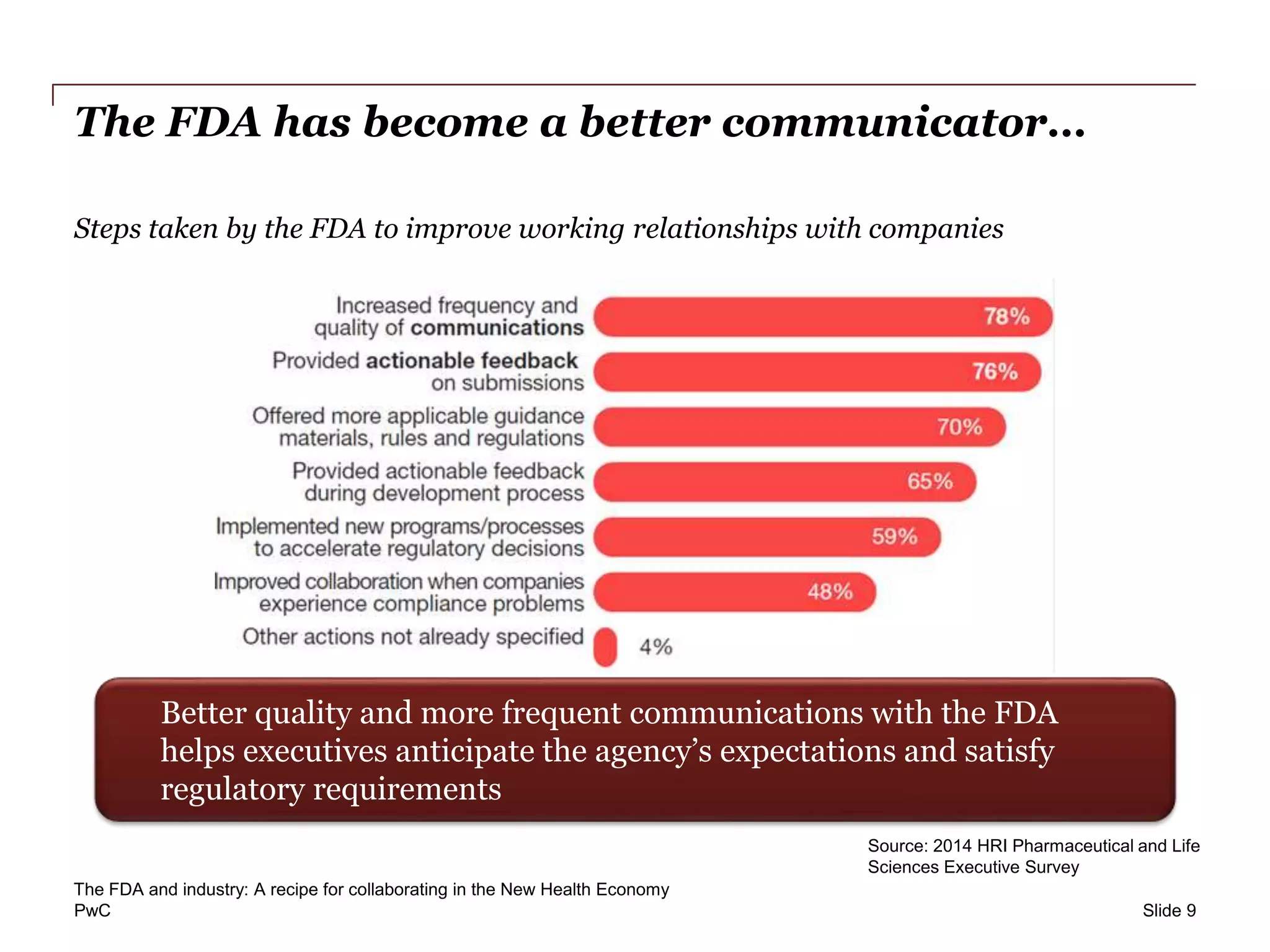
The FDA has become a better communicator…
Steps taken by the FDA to improve working relationships with companies
Slide 9
Source: 2014 HRI Pharmaceutical and Life
Sciences Executive Survey
Better quality and more frequent communications with the FDA
helps executives anticipate the agency’s expectations and satisfy
regulatory requirements
The FDA and industry: A recipe for collaborating in the New Health Economy
PwC
But executives still question the value of user fees
Areas that executives believe have improved the most as a result of increased
PDUFA/MDUFA fees
Slide 10
Just 32% thought the fees they paid have resulted in shorter review
times and only 34% think the fees help accelerate innovation
Source: 2014 HRI Pharmaceutical and Life
Sciences Executive SurveyThe FDA and industry: A recipe for collaborating in the New Health Economy
PwC
Industry wants the FDA to prioritize innovation
Areas that executives believe have improved the most as a result of increased
PDUFA/MDUFA fees
Slide 11
Only 34% of executives
think user fees help
accelerate innovation
Source: 2014 HRI Pharmaceutical and Life
Sciences Executive Survey
User fees accelerate innovation
The FDA and industry: A recipe for collaborating in the New Health Economy
PwC
Experts say…
Slide 12
“Science is advancing so quickly, it’s difficult for
any single organization to stay on top
of everything. We need a system in the 21st
century that allows regulators to access the
scientific expertise they need, both internally
and externally, in a timely manner.”
- Stacy Holdsworth, senior advisor of US
regulatory policy and strategy at Eli Lilly &
Company
The FDA and industry: A recipe for collaborating in the New Health Economy
PwC
Experts say…
Slide 13
- Andrew von Eschenbach, former FDA
commissioner
“You have to recognize that the user fee program
is only addressing the review cycle and that’s
not the issue. Review is only one piece. You need
a much broader view. The issue is the process
from the very beginning of development to the
post market. And the FDA influences that entire
process.”
The FDA and industry: A recipe for collaborating in the New Health Economy
PwC
Experts say…
Slide 14
- Fred Hassan, former CEO of Schering-
Plough who now serves as a managing
director at Warburg Pincus
“The FDA needs to be part of the innovation
engine. I don’t think they currently see that as a
primary role”
The FDA and industry: A recipe for collaborating in the New Health Economy
PwC
Changes are already being implemented
Slide 15
Executives are less
familiar with new
programs
Familiarity with accelerated approval programs
The FDA and industry: A recipe for collaborating in the New Health Economy
Source: 2014 HRI Pharmaceutical and Life
Sciences Executive Survey
PwC
Case Study: Breakthrough Therapies
Impact of new review models on the market
Slide 16
PwC
Case study: Breakthrough therapies
Slide 17
“I’m talking to the FDA every week about IMBRUVICA. My
experience with the FDA, as part of that process, has been
overwhelmingly positive. That doesn’t mean issues never
arise, but I’m happy because my expectation of the FDA is
that we can work through those issues and get them
resolved, before they become larger issues.”
The FDA and industry: A recipe for collaborating in the New Health Economy
PwC
Case study: Breakthrough therapies
Slide 18
“I’m talking to the FDA every week about IMBRUVICA. My
experience with the FDA, as part of that process, has been
overwhelmingly positive. That doesn’t mean issues never
arise, but I’m happy because my expectation of the FDA is
that we can work through those issues and get them
resolved, before they become larger issues.”
- Urte Gayko, senior vice president of global
regulatory affairs at Pharmacyclics on her
experience managing Imbruvica, a
breakthrough therapy drug
The FDA and industry: A recipe for collaborating in the New Health Economy
PwC
Case study: Breakthrough therapies
Slide 19
“It does seem to be changing the way the agency is doing
things. If this is a promising direction, we need to ask what
else needs to change along with it. The breakthrough
process is focused on drug review and approval but there
are other things that need to get done at the same time such
as review of good manufacturing processes.”
- Mark McClellan, former FDA commissioner
and current senior fellow and director of the
Health Care Innovation and Value Initiative
at the Brookings Institution
The FDA and industry: A recipe for collaborating in the New Health Economy
PwC
Rebalancing Risk vs. Innovation
Slide 20
PwC
Consumers are willing to take on more risk
Slide 21
Respondents
overwhelmingly agreed that
patients with life-
threatening conditions
should be able to access
experimental therapies.
The FDA and industry: A recipe for collaborating in the New Health Economy
Source: 2014 HRI Pharmaceutical and Life
Sciences Consumer Survey
PwC
Executives support consumers’ desire for access
Slide 22
77% of executives agree that
consumers willing to assume
grater risks should have
access to experimental
therapies.
The FDA and industry: A recipe for collaborating in the New Health Economy
Source: 2014 HRI Pharmaceutical and Life
Sciences Executive Survey
PwC
But speedier access may require new thinking
Slide 23
“We’re looking at outcomes data and how it
should influence regulatory decisions.”
“Quickness to market is clearly a basic
principle. With that comes an even greater
need for post-market surveillance.”
- Stacy Holdsworth, senior advisor of US regulatory
policy and strategy at Eli Lilly & Company
- Ray Woosley, president emeritus of the Critical Path
Institute and founder of CredibleMeds – an
organization focused on safe medication use.
The FDA and industry: A recipe for collaborating in the New Health Economy
PwC
The Value Factor
Slide 24
PwC
Experts say…
Slide 25
“We don’t want to squelch innovation, but tell
me what I'm getting for my healthcare costs.
Show me that these new technologies are
superior.”
- Scott Josephs, national medical officer at
Cigna Corp. at an Advanced Medical
Technology Association meeting on October
2014
The FDA and industry: A recipe for collaborating in the New Health Economy
PwC
Executives attitudes are shifting on value
Slide 26
The FDA and industry: A recipe for collaborating in the New Health Economy
PwC
Global experiences may shape industry views on
value
Slide 27
HRI’s survey
suggests
harmonization of
regulatory
requirements would
make it easier, and
faster, to bring a
new drug to market
worldwide.
Source: 2014 HRI Pharmaceutical and Life Sciences Executive Survey
The FDA and industry: A recipe for collaborating in the New Health Economy
PwC
Cost is not
considered
at all
Only if a
patient
asks
To a
lesser
degree
To some
degree
To a
significant
degree
Cost is a top consideration for prescribers
This matters to
consumers, who
rank a physician’s
recommendation as
the most important
factor that
influences their
treatment decisions,
followed by their
own out-of-pocket
costs.
1% 2% 5% 38% 54%
Is cost a factor when deciding whether or not to prescribe a drug?
The FDA and industry: A recipe for collaborating in the New Health Economy Source: 2014 HRI Clinician Survey
Slide 28
PwC
Cost-conscious consumers also seek value
Slide 29
% of Americans deciding not to purchase
medical services due to cost
Willingness to pay more for a
personalized medical product
The FDA and industry: A recipe for collaborating in the New Health Economy
Source: 2014 HRI Pharmaceutical and Life
Sciences Consumer Survey
PwC
Bringing in the Consumer
Slide 30
PwC
Experts say…
Slide 31
“Today’s consumers make decisions in
conjunction with medical authority, not because
of a medical authority.”
- Ido Hadari, CEO of Treato, in an interview
with HRI
The FDA and industry: A recipe for collaborating in the New Health Economy
PwC
Experts say…
Slide 32
“Having a seat at the table is important, but how
do you make sure the patient perspective can be
turned into data points that can inform and
influence the review process? We’re talking
about quickly moving from a lofty goal of
making patients part of the system to a very
technical conversation about how to make it
happen.”
- Cecilia Arradaza, Executive Director of the
Milken Institute, which includes FasterCures -
an organization focused on speeding medical
innovation
The FDA and industry: A recipe for collaborating in the New Health Economy
PwC
Experts say…
Slide 33
“I’ve told industry that patients can contribute
to the conversation. That the patient voice is
important earlier in the process, such as how
clinical trials are designed.”
- Diane Dorman, vice president of public
policy for the National Organization for Rare
Disorders
The FDA and industry: A recipe for collaborating in the New Health Economy
PwC
Experts say…
Slide 34
“No patient community has ever done this and it
sets the stage for new partnerships with the
FDA.”
- Pat Furlong, founding president and CEO of
Parent Project Muscular Dystrophy,
explained how her group created the first
patient centered guidance document on
clinical trial design.
The FDA and industry: A recipe for collaborating in the New Health Economy
PwC
Case Study: Priority review vouchers
Innovative methods to promote research in rare
diseases
Slide 35
PwC
“The question isn’t how to get a drug approved.
The question is how you get a private company
to make the drug in the first place.”
Case study: Priority review vouchers
Slide 36
- Nancy Goodman, founder and executive
director of Kids V Cancer, a patient
organization that promotes pediatric cancer
research.
The FDA and industry: A recipe for collaborating in the New Health Economy
PwC
Future Considerations
Slide 37
PwC
Future considerations
Slide 38
Prioritize consumer input
Demonstrate value to regulators and purchasers
Seek new alliances
Pursue new opportunities to minimize risk and accelerate access
Enrich the dialogue
The FDA and industry: A recipe for collaborating in the New Health Economy
PwC
Future considerations
Slide 39
Prioritize consumer input
Companies should seek out consumers’ views,
diligently incorporate their input at every stage and
share this information with the FDA.
The FDA and industry: A recipe for collaborating in the New Health Economy
PwC
Future considerations
Slide 40
Demonstrate value to regulators and purchasers
Manufacturers will need to demonstrate value over
existing therapies as both purchasers and consumers
look for products that meet their needs.
The FDA and industry: A recipe for collaborating in the New Health Economy
PwC
Future considerations
Slide 41
Seek new alliances
A greater reliance on public-private partnerships
could provide a forum for the exchange of ideas. For
instance, the Medical Device Innovation Consortium
coordinates efforts of industry and regulators to
develop new tools, methods and technologies.
The FDA and industry: A recipe for collaborating in the New Health Economy
PwC
Future considerations
Slide 42
Pursue new opportunities to minimize risk and
accelerate access
Pharmaceutical and life sciences companies should
partner with the FDA to facilitate early access to
experimental drugs for eligible patients with
articulated risks. Continued investment in new tools
and technology, such as biomarkers, may help
manufacturers and regulators assess risk more
accurately and quickly.
The FDA and industry: A recipe for collaborating in the New Health Economy
PwC
Future considerations
Slide 43
Enrich the dialogue
Communicate more often and effectively with the
FDA. Doing so will allow companies to build stronger
relationships with agency officials, including the
reviewers tracking their products. These interactions
can help companies understand the agency’s thinking
and compile stronger applications to avoid multiple
review rounds.
The FDA and industry: A recipe for collaborating in the New Health Economy
PwC
Questions?
Slide 44
PwC
Contacts
Slide 45
The FDA and industry: A recipe for collaborating in the New Health Economy
Michael Mentesana
Principal, Pharmaceutical and Life Sciences
(646) 471-2268
michael.mentesana@us.pwc.com
Chandresh Harjivan
Principal, Pharmaceutical and Life Sciences
(202) 756-1710
chan.harjivan@us.pwc.com
Bobby Clark
Senior Manager, Health Research Institute
(202) 312-7947
robert.j.clark@us.pwc.com
Thank you
2015 PricewaterhouseCoopers LLP. All rights reserved. PwC refers to the United States
member firm, and may sometimes refer to the PwC network. Each member firm is a separate
legal entity. Please see www.pwc.com/structure for further details.
To download a full copy of The FDA and Industry: A recipe for
collaborating in the New Health Economy, please visit our
site:
http://www.pwc.com/us/hripharmalifesciencesfda

The FDA and industry: A recipe for collaborating in the New Health Economy

  • 1.
    February 19, 2015 TheFDA and industry: A recipe for collaborating in the New Health Economy
  • 2.
    PwC About this report Aspart of its Improving America’s Health series, PwC has periodically surveyed industry executives on their relationship with the FDA. In summer 2014, PwC’s Health Research Institute and Biocom polled 100 senior executives on issues such as regulations, the development of new therapies, and patient engagement. 1000 adult consumers were also surveyed about their views of the FDA, the pharmaceutical/life sciences industry and consumer access to therapies. Slide 2 The FDA and industry: A recipe for collaborating in the New Health Economy
  • 3.
    PwC Key findings Slide 3 Executivessay that the FDA has become a more communicative and open partner Executives understand that balancing innovation and risk comes with tradeoffs Industry attitudes are shifting when it comes to determinations of value Consumers want more engagement from both the FDA and industry4 1 2 3 The FDA and industry: A recipe for collaborating in the New Health Economy
  • 4.
    PwC 21st Century R&Dvs. the Current Paradigm Slide 4
  • 5.
    PwC An evolving regulatoryprocess Slide 5 Source: 2014 HRI Pharmaceutical and Life Sciences Executive Survey The FDA and industry: A recipe for collaborating in the New Health Economy
  • 6.
    PwC The FDA’s budgetrelies heavily on industry fees Slide 6 Source: 2014 HRI Pharmaceutical and Life Sciences Executive Survey The FDA and industry: A recipe for collaborating in the New Health Economy
  • 7.
    PwC The FDA’s standardreview times have decreased Slide 7 The FDA and industry: A recipe for collaborating in the New Health Economy
  • 8.
    PwC Priority reviews havealso improved Slide 8 The FDA and industry: A recipe for collaborating in the New Health Economy
  • 9.
    PwC The FDA hasbecome a better communicator… Steps taken by the FDA to improve working relationships with companies Slide 9 Source: 2014 HRI Pharmaceutical and Life Sciences Executive Survey Better quality and more frequent communications with the FDA helps executives anticipate the agency’s expectations and satisfy regulatory requirements The FDA and industry: A recipe for collaborating in the New Health Economy
  • 10.
    PwC But executives stillquestion the value of user fees Areas that executives believe have improved the most as a result of increased PDUFA/MDUFA fees Slide 10 Just 32% thought the fees they paid have resulted in shorter review times and only 34% think the fees help accelerate innovation Source: 2014 HRI Pharmaceutical and Life Sciences Executive SurveyThe FDA and industry: A recipe for collaborating in the New Health Economy
  • 11.
    PwC Industry wants theFDA to prioritize innovation Areas that executives believe have improved the most as a result of increased PDUFA/MDUFA fees Slide 11 Only 34% of executives think user fees help accelerate innovation Source: 2014 HRI Pharmaceutical and Life Sciences Executive Survey User fees accelerate innovation The FDA and industry: A recipe for collaborating in the New Health Economy
  • 12.
    PwC Experts say… Slide 12 “Scienceis advancing so quickly, it’s difficult for any single organization to stay on top of everything. We need a system in the 21st century that allows regulators to access the scientific expertise they need, both internally and externally, in a timely manner.” - Stacy Holdsworth, senior advisor of US regulatory policy and strategy at Eli Lilly & Company The FDA and industry: A recipe for collaborating in the New Health Economy
  • 13.
    PwC Experts say… Slide 13 -Andrew von Eschenbach, former FDA commissioner “You have to recognize that the user fee program is only addressing the review cycle and that’s not the issue. Review is only one piece. You need a much broader view. The issue is the process from the very beginning of development to the post market. And the FDA influences that entire process.” The FDA and industry: A recipe for collaborating in the New Health Economy
  • 14.
    PwC Experts say… Slide 14 -Fred Hassan, former CEO of Schering- Plough who now serves as a managing director at Warburg Pincus “The FDA needs to be part of the innovation engine. I don’t think they currently see that as a primary role” The FDA and industry: A recipe for collaborating in the New Health Economy
  • 15.
    PwC Changes are alreadybeing implemented Slide 15 Executives are less familiar with new programs Familiarity with accelerated approval programs The FDA and industry: A recipe for collaborating in the New Health Economy Source: 2014 HRI Pharmaceutical and Life Sciences Executive Survey
  • 16.
    PwC Case Study: BreakthroughTherapies Impact of new review models on the market Slide 16
  • 17.
    PwC Case study: Breakthroughtherapies Slide 17 “I’m talking to the FDA every week about IMBRUVICA. My experience with the FDA, as part of that process, has been overwhelmingly positive. That doesn’t mean issues never arise, but I’m happy because my expectation of the FDA is that we can work through those issues and get them resolved, before they become larger issues.” The FDA and industry: A recipe for collaborating in the New Health Economy
  • 18.
    PwC Case study: Breakthroughtherapies Slide 18 “I’m talking to the FDA every week about IMBRUVICA. My experience with the FDA, as part of that process, has been overwhelmingly positive. That doesn’t mean issues never arise, but I’m happy because my expectation of the FDA is that we can work through those issues and get them resolved, before they become larger issues.” - Urte Gayko, senior vice president of global regulatory affairs at Pharmacyclics on her experience managing Imbruvica, a breakthrough therapy drug The FDA and industry: A recipe for collaborating in the New Health Economy
  • 19.
    PwC Case study: Breakthroughtherapies Slide 19 “It does seem to be changing the way the agency is doing things. If this is a promising direction, we need to ask what else needs to change along with it. The breakthrough process is focused on drug review and approval but there are other things that need to get done at the same time such as review of good manufacturing processes.” - Mark McClellan, former FDA commissioner and current senior fellow and director of the Health Care Innovation and Value Initiative at the Brookings Institution The FDA and industry: A recipe for collaborating in the New Health Economy
  • 20.
    PwC Rebalancing Risk vs.Innovation Slide 20
  • 21.
    PwC Consumers are willingto take on more risk Slide 21 Respondents overwhelmingly agreed that patients with life- threatening conditions should be able to access experimental therapies. The FDA and industry: A recipe for collaborating in the New Health Economy Source: 2014 HRI Pharmaceutical and Life Sciences Consumer Survey
  • 22.
    PwC Executives support consumers’desire for access Slide 22 77% of executives agree that consumers willing to assume grater risks should have access to experimental therapies. The FDA and industry: A recipe for collaborating in the New Health Economy Source: 2014 HRI Pharmaceutical and Life Sciences Executive Survey
  • 23.
    PwC But speedier accessmay require new thinking Slide 23 “We’re looking at outcomes data and how it should influence regulatory decisions.” “Quickness to market is clearly a basic principle. With that comes an even greater need for post-market surveillance.” - Stacy Holdsworth, senior advisor of US regulatory policy and strategy at Eli Lilly & Company - Ray Woosley, president emeritus of the Critical Path Institute and founder of CredibleMeds – an organization focused on safe medication use. The FDA and industry: A recipe for collaborating in the New Health Economy
  • 24.
  • 25.
    PwC Experts say… Slide 25 “Wedon’t want to squelch innovation, but tell me what I'm getting for my healthcare costs. Show me that these new technologies are superior.” - Scott Josephs, national medical officer at Cigna Corp. at an Advanced Medical Technology Association meeting on October 2014 The FDA and industry: A recipe for collaborating in the New Health Economy
  • 26.
    PwC Executives attitudes areshifting on value Slide 26 The FDA and industry: A recipe for collaborating in the New Health Economy
  • 27.
    PwC Global experiences mayshape industry views on value Slide 27 HRI’s survey suggests harmonization of regulatory requirements would make it easier, and faster, to bring a new drug to market worldwide. Source: 2014 HRI Pharmaceutical and Life Sciences Executive Survey The FDA and industry: A recipe for collaborating in the New Health Economy
  • 28.
    PwC Cost is not considered atall Only if a patient asks To a lesser degree To some degree To a significant degree Cost is a top consideration for prescribers This matters to consumers, who rank a physician’s recommendation as the most important factor that influences their treatment decisions, followed by their own out-of-pocket costs. 1% 2% 5% 38% 54% Is cost a factor when deciding whether or not to prescribe a drug? The FDA and industry: A recipe for collaborating in the New Health Economy Source: 2014 HRI Clinician Survey Slide 28
  • 29.
    PwC Cost-conscious consumers alsoseek value Slide 29 % of Americans deciding not to purchase medical services due to cost Willingness to pay more for a personalized medical product The FDA and industry: A recipe for collaborating in the New Health Economy Source: 2014 HRI Pharmaceutical and Life Sciences Consumer Survey
  • 30.
    PwC Bringing in theConsumer Slide 30
  • 31.
    PwC Experts say… Slide 31 “Today’sconsumers make decisions in conjunction with medical authority, not because of a medical authority.” - Ido Hadari, CEO of Treato, in an interview with HRI The FDA and industry: A recipe for collaborating in the New Health Economy
  • 32.
    PwC Experts say… Slide 32 “Havinga seat at the table is important, but how do you make sure the patient perspective can be turned into data points that can inform and influence the review process? We’re talking about quickly moving from a lofty goal of making patients part of the system to a very technical conversation about how to make it happen.” - Cecilia Arradaza, Executive Director of the Milken Institute, which includes FasterCures - an organization focused on speeding medical innovation The FDA and industry: A recipe for collaborating in the New Health Economy
  • 33.
    PwC Experts say… Slide 33 “I’vetold industry that patients can contribute to the conversation. That the patient voice is important earlier in the process, such as how clinical trials are designed.” - Diane Dorman, vice president of public policy for the National Organization for Rare Disorders The FDA and industry: A recipe for collaborating in the New Health Economy
  • 34.
    PwC Experts say… Slide 34 “Nopatient community has ever done this and it sets the stage for new partnerships with the FDA.” - Pat Furlong, founding president and CEO of Parent Project Muscular Dystrophy, explained how her group created the first patient centered guidance document on clinical trial design. The FDA and industry: A recipe for collaborating in the New Health Economy
  • 35.
    PwC Case Study: Priorityreview vouchers Innovative methods to promote research in rare diseases Slide 35
  • 36.
    PwC “The question isn’thow to get a drug approved. The question is how you get a private company to make the drug in the first place.” Case study: Priority review vouchers Slide 36 - Nancy Goodman, founder and executive director of Kids V Cancer, a patient organization that promotes pediatric cancer research. The FDA and industry: A recipe for collaborating in the New Health Economy
  • 37.
  • 38.
    PwC Future considerations Slide 38 Prioritizeconsumer input Demonstrate value to regulators and purchasers Seek new alliances Pursue new opportunities to minimize risk and accelerate access Enrich the dialogue The FDA and industry: A recipe for collaborating in the New Health Economy
  • 39.
    PwC Future considerations Slide 39 Prioritizeconsumer input Companies should seek out consumers’ views, diligently incorporate their input at every stage and share this information with the FDA. The FDA and industry: A recipe for collaborating in the New Health Economy
  • 40.
    PwC Future considerations Slide 40 Demonstratevalue to regulators and purchasers Manufacturers will need to demonstrate value over existing therapies as both purchasers and consumers look for products that meet their needs. The FDA and industry: A recipe for collaborating in the New Health Economy
  • 41.
    PwC Future considerations Slide 41 Seeknew alliances A greater reliance on public-private partnerships could provide a forum for the exchange of ideas. For instance, the Medical Device Innovation Consortium coordinates efforts of industry and regulators to develop new tools, methods and technologies. The FDA and industry: A recipe for collaborating in the New Health Economy
  • 42.
    PwC Future considerations Slide 42 Pursuenew opportunities to minimize risk and accelerate access Pharmaceutical and life sciences companies should partner with the FDA to facilitate early access to experimental drugs for eligible patients with articulated risks. Continued investment in new tools and technology, such as biomarkers, may help manufacturers and regulators assess risk more accurately and quickly. The FDA and industry: A recipe for collaborating in the New Health Economy
  • 43.
    PwC Future considerations Slide 43 Enrichthe dialogue Communicate more often and effectively with the FDA. Doing so will allow companies to build stronger relationships with agency officials, including the reviewers tracking their products. These interactions can help companies understand the agency’s thinking and compile stronger applications to avoid multiple review rounds. The FDA and industry: A recipe for collaborating in the New Health Economy
  • 44.
  • 45.
    PwC Contacts Slide 45 The FDAand industry: A recipe for collaborating in the New Health Economy Michael Mentesana Principal, Pharmaceutical and Life Sciences (646) 471-2268 michael.mentesana@us.pwc.com Chandresh Harjivan Principal, Pharmaceutical and Life Sciences (202) 756-1710 chan.harjivan@us.pwc.com Bobby Clark Senior Manager, Health Research Institute (202) 312-7947 robert.j.clark@us.pwc.com
  • 46.
    Thank you 2015 PricewaterhouseCoopersLLP. All rights reserved. PwC refers to the United States member firm, and may sometimes refer to the PwC network. Each member firm is a separate legal entity. Please see www.pwc.com/structure for further details. To download a full copy of The FDA and Industry: A recipe for collaborating in the New Health Economy, please visit our site: http://www.pwc.com/us/hripharmalifesciencesfda

Editor's Notes