Chapter 1
The Ethical Dimension
Of Human Existence
objective
1
Identify the ethical aspect of human
life and the scope of the ethical
thinking;
2
Define and explain the terms that
are relevant to ethical thinking; and
3
Evaluate the difficulties that are
involved in maintaining certain
commonly-held notions on ethics.
The Ethical Dimension Of Human Exist
ence
3
introduction
In August 2007, newspapers reported what seemed to be yet another
sad incident of fraternity violence. Cris Anthony Mendez, a twenty-year-old
student of the University of the Philippines (UP), was rushed to the hospital in
the early morning hours, unconscious with large bruises on his chest, back,
and legs. He passed away that morning, and the subsequent autopsy report
strongly suggests that his physical injuries were most probably the result of
“hazing” (the term colloquially used to refer to initiation rites in which
neophytes may be subjected to various forms of physical abuse).
Pondering on the death of Cris, we may find ourselves asking questions such
as:
• What is the value of one’s life?
• What exactly were thee wrongs done to Cris by his so-called fraternity
brothers?
• Is there any good to fraternities?
These questions that concern good and bad, or right and wrong-and
these are questions concerning value-are the kind of questions that we deal
with in ethics.
2024
The Ethical Dimension Of Human Exist
ence
4
VALUE
Ethics
• matters such as good thing that we should
pursue and the bad thing that we should avoid;
• the right ways in which we could or we should
act and the wrong ways of acting
• study about determining the grounds for the
values with particular and significance to
human life
2024
The Ethical Dimension Of Human Exist
ence
5
o Recognizing the notion of
 good and bad
 right and wrong
2024
Clarifications and
Terminology
The Ethical Dimension Of Human Exist
ence
6
AESTHETICS
o Derived from the
Greek word aesthetics
(sense of feeling)
o Judgements of
personal approval; and
disapproval that we
make about what we
see, hear or taste.
ETIQUETTE
o Concerned with right
and wrong actions but
those which are not
quite grave enough to
belong to discussion
on ethics.
2024
TECHNIQUE AND
TECHNICAL
o Came from the Greek
word techne
Kinds of Valuation
Aesthetic valuation
- good or bad in art and beauty.
Etiquette valuation
- polite and impolite behaviour..
Technical valuation
- the right and wrong way or method of doing
things.
The Ethical Dimension Of Human Exist
ence
7
o The second point of clarification is on the use of words “ethics” and “morals.”
o Would include cognates such as
 ethical
 unethical
 immoral
 amoral
 morality, and so on
2024
o We should be careful particularly on the use of the word “not” when applied to the words of “moral” or
“ethical” as this can be ambiguous.
The term “morals”…
- may be used to refer to specific beliefs or attitudes that people have or to describe acts that people
perform.
- an individual’s personal conduct
But..
- if he falls short of behaving properly, this can be described as immoral
suggest a more rational aspect
- “moral judgement”
- “moral reasoning”
Ethics and Morals
The Ethical Dimension Of Human Exist
ence
8
The term “ethics” …
- can be spoken of as the discipline of studying
- understanding ideal human behavior
- ideal ways of thinking.
- ethics is acknowledged as intellectual discipline belonging to philosophy
- acceptable behavior = ethical
- unacceptable behavior = unethical
- in a given field, we have the term “professional ethics”
 e.g., legal ethics for the proper comportment of lawyers and other people in the
legal profession
 medical ethics for doctors and nurses
 media ethics for writers and reporters
2024
Ethics and Morals
The Ethical Dimension Of Human Exist
ence
9
o “philosophy”
- is rooted in the Greek words that translate to ”love of wisdom” (philia is the noun often translated into
English as some for of “friendship” or “love,” while, sophia is the noun often translated into English as “wisdom”).
- had been first used by thinkers to refer from their striving to better understand reality in a maintained
and systematic manner.
- started among the ancient Greeks around two and half thousand years ago, when certain people in the
Mediterranean made the mental effort of trying to make sense of the world and in human life in a unique way
- empirical sciences such as biology or the social sciences such as psychology.
- Philosophy remains as the unique discipline that asks significant questions that other fields are unable to
address.
The different branches or area of philosophy correspond to some of these questions, generally stated as follows;
 metaphysics wonders as to what constitutes the whole of reality;
 epistemology asks what is our basis for determining what we know;
 axiology refers broadly to the value of beauty, and is often divided into
a. aesthetics, which concerns itself with the value of beauty
b. and ethics , which concerns itself with the value of human action
2024
Ethics and Morals
The Ethical Dimension Of Human Exist
ence
10
DESCRIPTIVE ETHICS:
o Definition: Reports how people, especially
groups, make moral valuations.
o Approach: No judgment for or against
these valuations.
o Examples: Historians studying moral
standards over time, anthropologists
exploring diverse moral standards across
cultures.
NORMATIVE ETHICS:
2024
Descriptive and Normative
o Definition: Examines what should be
considered the right way of acting.
o Approach: Philosophical or moral
theological exploration.
o Examples: Utilitarianism – An ethical theory
that evaluates actions based on their
outcomes or consequences..
The Ethical Dimension Of Human Exist
ence
11
2024
Issue, Decision, Judgement,
and Dilemma
1. Moral Issue:
Definition: Situations requiring moral valuation.
Example: Inability to afford an item, contemplating stealing, involving the ethical question of
property respect.
2. Moral Decision:
Definition: Occurs when faced with a choice of actions in a situation.
Example: Choosing not to take something unpaid for.
3. Moral Judgment:
Definition: Assessment made by an observer regarding the actions or behavior of someone.
Example: Friend stealing from a store, observer assessing and declaring it as morally wrong. Role:
Involves passing a moral evaluation on the actions of others.
4. Moral Dilemma:
Definition: Complex situation involving a choice between two goods or the lesser of two evils.
Example: Mother torn between feeding her hungry child (good) and recognizing that stealing is
wrong (ethical dilemma).
The Ethical Dimension Of Human Exist
ence
12
o The study of ethics is interested in why certain ways of
acting are considered acceptable while others are
unacceptable.
o Fear of punishment and desire for reward can provide
a reason for acting in a certain way, but they are not
determinants of rightness or wrongness.
o The question of why we make moral judgments can
bring us to another level of thinking beyond superficial
discussions of rewards and punishments.
o Moral valuations can be based on principles, which are
rationally established grounds for justifying and
maintaining moral decisions and judgments.
o Principles can be maintained based on different
reasons, such as a sense of fair play or a respect for
the importance and validity of testing.
o Ethical thinkers have contributed to the development
of ethical frameworks and frameworks, which inform
ethical judgments. By studying ethical frameworks,
ethical thinkers can strengthen their moral judgments.
2024
Reasoning
Sources of
Authority
- The standards of valuation of
ethics are imposed by a
higher authority that
commands our obedience.
The Ethical Dimension Of Human Exist
ence
14
1. Authority of the Law
2024
• Law is one’s guide to ethical behavior set by a country or even barangays, where its
people are obligated to obey its laws and ordinances (Positive Law - the different rules
and regulations that are put forward by an authority figure that requires compliance)
• Enforced by way of a system of sanctions administered through persons and
institutions, which all help compel us to obey
• Making the law as the basis of ethics provides the benefit of providing us with an
objective standard that is applicable to all
a. The Prohibitive Nature of Law
• Ethics in law is solely from the negative perspective by constraining us from
performing acts that we should not do rather than the aspect of good, in
which we could and should do even without the law’s requirement
The Ethical Dimension Of Human Exist
ence
15
1. Authority of the Law
2024
b. Ethics Beyond Legal Compliance
• There are certain actions that are not forbidden by the law, but are ethically
questionable to the people.
Example:
• Recall the story of a toddler who had been run over by a couple of vehicles.
While there were many passers-by who witnessed what had happened, for
quite a long while, no one did anything to help. The child later died in the
hospital. The law does not oblige people to help others in need, so none of
these passers-by were guilty of breaking any law. However, many people
reacting to this sad news report share a sense that those passers-by were
somewhat ethically culpable in their negligence.
Deontology
• An ethical theory by Immanuel Kant that uses rules to distinguish the right
from the wrong, such as the law.
The Ethical Dimension Of Human Exist
ence
16
2024
2. Authority of One’s Religion
Divine Command Theory
• The divinity (God, Allah, or Supreme Being) commands and obliges one to
obey their Creator and determines morality.
• There are persons and texts believed to be linked to the Divine that an
individual must listen to in order to discover how the Divine wants her to act
• Unlike the law, religion is not simply prohibitive but also provides ideal actions
to pursue.
Example:
​
​
Proverbs 19:17: “Whoever is kind to the poor lends to the LORD, and he
will reward them for what they have done.”
• Although religion as the basis of ethics provides us with a set of commands as
well as inspires and compels our obedience in a way nothing else can,
however, multiple problems are present:
The Ethical Dimension Of Human Exist
ence
17
2024
2. Authority of One’s Religion
a. Multiplicity of Religions
• There are hundreds of religions present in the world and each faith demands
differently from another which often results in conflicting ethical standards.
Example:
- One religion permits the consumption of a type of food while the other
forbids it.
b.Difference in interpretations:
• One requires the believer to clarify her understanding of the connection
between ethics and the divine
• Multiple interpretations may be made by different believers thus, causing
conflicts in beliefs in the same religion
Example:
- In Plato’s dialogue titled “Euthyphro”, Socrates states, “Perhaps we shall
learn better, my friend. For consider: is the holy loved by the gods because it
is holy? Or is it holy because it is loved by the gods“
The Ethical Dimension Of Human Exist
ence
18
2024
2. Authority of One’s Religion
c. Non-believers of God
• One would not have to think in terms of obeying God in order to abide by such
ethical standards
• If religion is the basis of one’s morality, will they be considered to have no
moral code?
Natural Law
• An ethical theory by Thomas Aquinas stating humans are born with morals that
guide the behavior
The Ethical Dimension Of Human Exist
ence
19
2024
3. Authority of One’s Own Culture
• Different societies and their cultures show that there are different aesthetical,
religious, etiquette, ways of thinking and valuing that are different from our own
• What is ethically acceptable or unacceptable depends on which culture one is from
(Cultural relativism) due to each culture’s different experiences
• By taking one’s culture as the standard, we are provided a basis for our valuations
• Having different cultures teach us to be tolerant of others from different cultures,
as we realize that we are in no position to judge whether the ethical thought or
practice of another culture is acceptable or unacceptable
• Our own culture’s moral code is neither superior nor inferior to any other,
promoting a sense of humility and provides us the standard that are appropriate
and applicable to us.
The Ethical Dimension Of Human Exist
ence
20
2024
3. Authority of One’s Own Culture
a. Reality of Difference
• We cannot say which moral code is the right one
• Is it a case where the presence of disagreements mean that there are no right
or wrong answers?
b.We are in no position to render any kind of judgment on the practices of another
culture
• We are in no position to judge on the practices of another culture by our own
culture’s standards but rather using the standards of their own
c. We are in no position to render any kind of judgment on the practices of even our
own culture
• If our culture was the basis for determining what is right and wrong, we would
be unable to say that something within our cultural practice was problematic
because we take our culture to be the standard for making such judgments
The Ethical Dimension Of Human Exist
ence
21
2024
3. Authority of One’s Own Culture
• Cultural relativism renders us incapable of discerning about the values we may
wish to maintain as we are forced to simply accept whatever culture gives us.
• The ability to determine one’s culture becomes more and more questionable as we
live in a transcultural society
“My father is from Pampanga and my mother is from Leyte, and I was brought up in
Metro Manila: What is my culture? On one hand, let us say that my father is American and
my mother is Filipina, and was brought up in San Diego, California, but am currently
studying in a university in the Philippines: What am I supposed to take as "my culture"?”
Sense of the
self
Three Theories about ethics that
center on the self
• Subjectivism
• Psychological egoism
• Ethical egoism
The Ethical Dimension Of Human Exist
ence
23
Subjectivism
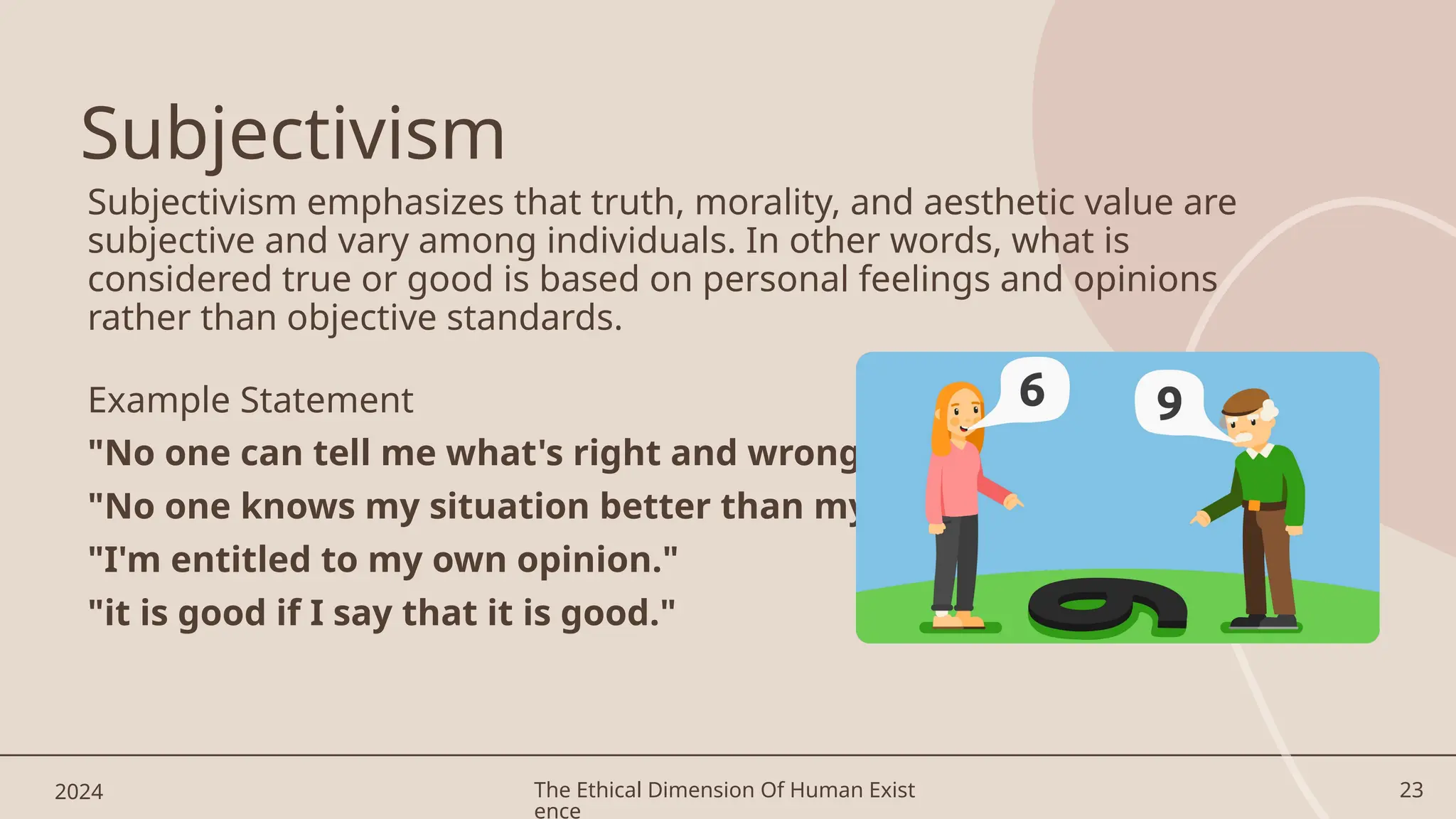
Subjectivism emphasizes that truth, morality, and aesthetic value are
subjective and vary among individuals. In other words, what is
considered true or good is based on personal feelings and opinions
rather than objective standards.
Example Statement
"No one can tell me what's right and wrong."
"No one knows my situation better than myself."
"I'm entitled to my own opinion."
"it is good if I say that it is good."
2024
presentation title 24
20XX
• Subjectivity
• Objectivity
Moral Relativism
Believing that what is moraly right or wrong
depends in individual or cultural perspective
The Ethical Dimension Of Human Exist
ence
25
Psychological egoism
Psychological egoism is the idea that individuals always act in their own self-interest, driven by
the pursuit of personal pleasure or avoidance of pain. According to this theory, every action,
even seemingly altruistic ones, is ultimately motivated by a desire for one's own well-being. In
other words, psychological egoism suggests that people are inherently selfish in their
motivations, believing that even acts of apparent selflessness are, deep down, driven by a
desire for personal satisfaction or happiness.
Examples
Helping Others:
• Scenario: A person helps a friend move to a new apartment.
Doing Chores at Home:
• Scenario: Someone helps with household chores.
Sharing Snacks:
• Scenario: Someone shares their snacks with a friend
2024
The Ethical Dimension Of Human Exist
ence
26
Ethical Egoism
• Ethical Egoism:
Definition: Advocates making one's own interests the overriding concern.
Distinguishing Factor: Differs from psychological egoism by not assuming all actions are
inherently self-serving.
Central Tenet: Individuals should prioritize their own well-being without allowing other
concerns, such as the welfare of others, to detract from this pursuit.
Ethical Egoism does not reject moral rules or considerations altogether. While it prioritizes self-
interest, it does not advocate for actions that violate fundamental moral principles or infringe
upon the rights of others.
.
2024
thank you
Group 1
Santiago, Kathleen Kate I.
Aquino, Irene
Manait, Dexter C,
Camlian, Yusef T.
Jauhari, Mohammad Sali S.

The Ethical Dimension Of Human Existence .pptx

  • 1.
    Chapter 1 The EthicalDimension Of Human Existence
  • 2.
    objective 1 Identify the ethicalaspect of human life and the scope of the ethical thinking; 2 Define and explain the terms that are relevant to ethical thinking; and 3 Evaluate the difficulties that are involved in maintaining certain commonly-held notions on ethics.
  • 3.
    The Ethical DimensionOf Human Exist ence 3 introduction In August 2007, newspapers reported what seemed to be yet another sad incident of fraternity violence. Cris Anthony Mendez, a twenty-year-old student of the University of the Philippines (UP), was rushed to the hospital in the early morning hours, unconscious with large bruises on his chest, back, and legs. He passed away that morning, and the subsequent autopsy report strongly suggests that his physical injuries were most probably the result of “hazing” (the term colloquially used to refer to initiation rites in which neophytes may be subjected to various forms of physical abuse). Pondering on the death of Cris, we may find ourselves asking questions such as: • What is the value of one’s life? • What exactly were thee wrongs done to Cris by his so-called fraternity brothers? • Is there any good to fraternities? These questions that concern good and bad, or right and wrong-and these are questions concerning value-are the kind of questions that we deal with in ethics. 2024
  • 4.
    The Ethical DimensionOf Human Exist ence 4 VALUE Ethics • matters such as good thing that we should pursue and the bad thing that we should avoid; • the right ways in which we could or we should act and the wrong ways of acting • study about determining the grounds for the values with particular and significance to human life 2024
  • 5.
    The Ethical DimensionOf Human Exist ence 5 o Recognizing the notion of  good and bad  right and wrong 2024 Clarifications and Terminology
  • 6.
    The Ethical DimensionOf Human Exist ence 6 AESTHETICS o Derived from the Greek word aesthetics (sense of feeling) o Judgements of personal approval; and disapproval that we make about what we see, hear or taste. ETIQUETTE o Concerned with right and wrong actions but those which are not quite grave enough to belong to discussion on ethics. 2024 TECHNIQUE AND TECHNICAL o Came from the Greek word techne Kinds of Valuation Aesthetic valuation - good or bad in art and beauty. Etiquette valuation - polite and impolite behaviour.. Technical valuation - the right and wrong way or method of doing things.
  • 7.
    The Ethical DimensionOf Human Exist ence 7 o The second point of clarification is on the use of words “ethics” and “morals.” o Would include cognates such as  ethical  unethical  immoral  amoral  morality, and so on 2024 o We should be careful particularly on the use of the word “not” when applied to the words of “moral” or “ethical” as this can be ambiguous. The term “morals”… - may be used to refer to specific beliefs or attitudes that people have or to describe acts that people perform. - an individual’s personal conduct But.. - if he falls short of behaving properly, this can be described as immoral suggest a more rational aspect - “moral judgement” - “moral reasoning” Ethics and Morals
  • 8.
    The Ethical DimensionOf Human Exist ence 8 The term “ethics” … - can be spoken of as the discipline of studying - understanding ideal human behavior - ideal ways of thinking. - ethics is acknowledged as intellectual discipline belonging to philosophy - acceptable behavior = ethical - unacceptable behavior = unethical - in a given field, we have the term “professional ethics”  e.g., legal ethics for the proper comportment of lawyers and other people in the legal profession  medical ethics for doctors and nurses  media ethics for writers and reporters 2024 Ethics and Morals
  • 9.
    The Ethical DimensionOf Human Exist ence 9 o “philosophy” - is rooted in the Greek words that translate to ”love of wisdom” (philia is the noun often translated into English as some for of “friendship” or “love,” while, sophia is the noun often translated into English as “wisdom”). - had been first used by thinkers to refer from their striving to better understand reality in a maintained and systematic manner. - started among the ancient Greeks around two and half thousand years ago, when certain people in the Mediterranean made the mental effort of trying to make sense of the world and in human life in a unique way - empirical sciences such as biology or the social sciences such as psychology. - Philosophy remains as the unique discipline that asks significant questions that other fields are unable to address. The different branches or area of philosophy correspond to some of these questions, generally stated as follows;  metaphysics wonders as to what constitutes the whole of reality;  epistemology asks what is our basis for determining what we know;  axiology refers broadly to the value of beauty, and is often divided into a. aesthetics, which concerns itself with the value of beauty b. and ethics , which concerns itself with the value of human action 2024 Ethics and Morals
  • 10.
    The Ethical DimensionOf Human Exist ence 10 DESCRIPTIVE ETHICS: o Definition: Reports how people, especially groups, make moral valuations. o Approach: No judgment for or against these valuations. o Examples: Historians studying moral standards over time, anthropologists exploring diverse moral standards across cultures. NORMATIVE ETHICS: 2024 Descriptive and Normative o Definition: Examines what should be considered the right way of acting. o Approach: Philosophical or moral theological exploration. o Examples: Utilitarianism – An ethical theory that evaluates actions based on their outcomes or consequences..
  • 11.
    The Ethical DimensionOf Human Exist ence 11 2024 Issue, Decision, Judgement, and Dilemma 1. Moral Issue: Definition: Situations requiring moral valuation. Example: Inability to afford an item, contemplating stealing, involving the ethical question of property respect. 2. Moral Decision: Definition: Occurs when faced with a choice of actions in a situation. Example: Choosing not to take something unpaid for. 3. Moral Judgment: Definition: Assessment made by an observer regarding the actions or behavior of someone. Example: Friend stealing from a store, observer assessing and declaring it as morally wrong. Role: Involves passing a moral evaluation on the actions of others. 4. Moral Dilemma: Definition: Complex situation involving a choice between two goods or the lesser of two evils. Example: Mother torn between feeding her hungry child (good) and recognizing that stealing is wrong (ethical dilemma).
  • 12.
    The Ethical DimensionOf Human Exist ence 12 o The study of ethics is interested in why certain ways of acting are considered acceptable while others are unacceptable. o Fear of punishment and desire for reward can provide a reason for acting in a certain way, but they are not determinants of rightness or wrongness. o The question of why we make moral judgments can bring us to another level of thinking beyond superficial discussions of rewards and punishments. o Moral valuations can be based on principles, which are rationally established grounds for justifying and maintaining moral decisions and judgments. o Principles can be maintained based on different reasons, such as a sense of fair play or a respect for the importance and validity of testing. o Ethical thinkers have contributed to the development of ethical frameworks and frameworks, which inform ethical judgments. By studying ethical frameworks, ethical thinkers can strengthen their moral judgments. 2024 Reasoning
  • 13.
    Sources of Authority - Thestandards of valuation of ethics are imposed by a higher authority that commands our obedience.
  • 14.
    The Ethical DimensionOf Human Exist ence 14 1. Authority of the Law 2024 • Law is one’s guide to ethical behavior set by a country or even barangays, where its people are obligated to obey its laws and ordinances (Positive Law - the different rules and regulations that are put forward by an authority figure that requires compliance) • Enforced by way of a system of sanctions administered through persons and institutions, which all help compel us to obey • Making the law as the basis of ethics provides the benefit of providing us with an objective standard that is applicable to all a. The Prohibitive Nature of Law • Ethics in law is solely from the negative perspective by constraining us from performing acts that we should not do rather than the aspect of good, in which we could and should do even without the law’s requirement
  • 15.
    The Ethical DimensionOf Human Exist ence 15 1. Authority of the Law 2024 b. Ethics Beyond Legal Compliance • There are certain actions that are not forbidden by the law, but are ethically questionable to the people. Example: • Recall the story of a toddler who had been run over by a couple of vehicles. While there were many passers-by who witnessed what had happened, for quite a long while, no one did anything to help. The child later died in the hospital. The law does not oblige people to help others in need, so none of these passers-by were guilty of breaking any law. However, many people reacting to this sad news report share a sense that those passers-by were somewhat ethically culpable in their negligence. Deontology • An ethical theory by Immanuel Kant that uses rules to distinguish the right from the wrong, such as the law.
  • 16.
    The Ethical DimensionOf Human Exist ence 16 2024 2. Authority of One’s Religion Divine Command Theory • The divinity (God, Allah, or Supreme Being) commands and obliges one to obey their Creator and determines morality. • There are persons and texts believed to be linked to the Divine that an individual must listen to in order to discover how the Divine wants her to act • Unlike the law, religion is not simply prohibitive but also provides ideal actions to pursue. Example: ​ ​ Proverbs 19:17: “Whoever is kind to the poor lends to the LORD, and he will reward them for what they have done.” • Although religion as the basis of ethics provides us with a set of commands as well as inspires and compels our obedience in a way nothing else can, however, multiple problems are present:
  • 17.
    The Ethical DimensionOf Human Exist ence 17 2024 2. Authority of One’s Religion a. Multiplicity of Religions • There are hundreds of religions present in the world and each faith demands differently from another which often results in conflicting ethical standards. Example: - One religion permits the consumption of a type of food while the other forbids it. b.Difference in interpretations: • One requires the believer to clarify her understanding of the connection between ethics and the divine • Multiple interpretations may be made by different believers thus, causing conflicts in beliefs in the same religion Example: - In Plato’s dialogue titled “Euthyphro”, Socrates states, “Perhaps we shall learn better, my friend. For consider: is the holy loved by the gods because it is holy? Or is it holy because it is loved by the gods“
  • 18.
    The Ethical DimensionOf Human Exist ence 18 2024 2. Authority of One’s Religion c. Non-believers of God • One would not have to think in terms of obeying God in order to abide by such ethical standards • If religion is the basis of one’s morality, will they be considered to have no moral code? Natural Law • An ethical theory by Thomas Aquinas stating humans are born with morals that guide the behavior
  • 19.
    The Ethical DimensionOf Human Exist ence 19 2024 3. Authority of One’s Own Culture • Different societies and their cultures show that there are different aesthetical, religious, etiquette, ways of thinking and valuing that are different from our own • What is ethically acceptable or unacceptable depends on which culture one is from (Cultural relativism) due to each culture’s different experiences • By taking one’s culture as the standard, we are provided a basis for our valuations • Having different cultures teach us to be tolerant of others from different cultures, as we realize that we are in no position to judge whether the ethical thought or practice of another culture is acceptable or unacceptable • Our own culture’s moral code is neither superior nor inferior to any other, promoting a sense of humility and provides us the standard that are appropriate and applicable to us.
  • 20.
    The Ethical DimensionOf Human Exist ence 20 2024 3. Authority of One’s Own Culture a. Reality of Difference • We cannot say which moral code is the right one • Is it a case where the presence of disagreements mean that there are no right or wrong answers? b.We are in no position to render any kind of judgment on the practices of another culture • We are in no position to judge on the practices of another culture by our own culture’s standards but rather using the standards of their own c. We are in no position to render any kind of judgment on the practices of even our own culture • If our culture was the basis for determining what is right and wrong, we would be unable to say that something within our cultural practice was problematic because we take our culture to be the standard for making such judgments
  • 21.
    The Ethical DimensionOf Human Exist ence 21 2024 3. Authority of One’s Own Culture • Cultural relativism renders us incapable of discerning about the values we may wish to maintain as we are forced to simply accept whatever culture gives us. • The ability to determine one’s culture becomes more and more questionable as we live in a transcultural society “My father is from Pampanga and my mother is from Leyte, and I was brought up in Metro Manila: What is my culture? On one hand, let us say that my father is American and my mother is Filipina, and was brought up in San Diego, California, but am currently studying in a university in the Philippines: What am I supposed to take as "my culture"?”
  • 22.
    Sense of the self ThreeTheories about ethics that center on the self • Subjectivism • Psychological egoism • Ethical egoism
  • 23.
    The Ethical DimensionOf Human Exist ence 23 Subjectivism Subjectivism emphasizes that truth, morality, and aesthetic value are subjective and vary among individuals. In other words, what is considered true or good is based on personal feelings and opinions rather than objective standards. Example Statement "No one can tell me what's right and wrong." "No one knows my situation better than myself." "I'm entitled to my own opinion." "it is good if I say that it is good." 2024
  • 24.
    presentation title 24 20XX •Subjectivity • Objectivity Moral Relativism Believing that what is moraly right or wrong depends in individual or cultural perspective
  • 25.
    The Ethical DimensionOf Human Exist ence 25 Psychological egoism Psychological egoism is the idea that individuals always act in their own self-interest, driven by the pursuit of personal pleasure or avoidance of pain. According to this theory, every action, even seemingly altruistic ones, is ultimately motivated by a desire for one's own well-being. In other words, psychological egoism suggests that people are inherently selfish in their motivations, believing that even acts of apparent selflessness are, deep down, driven by a desire for personal satisfaction or happiness. Examples Helping Others: • Scenario: A person helps a friend move to a new apartment. Doing Chores at Home: • Scenario: Someone helps with household chores. Sharing Snacks: • Scenario: Someone shares their snacks with a friend 2024
  • 26.
    The Ethical DimensionOf Human Exist ence 26 Ethical Egoism • Ethical Egoism: Definition: Advocates making one's own interests the overriding concern. Distinguishing Factor: Differs from psychological egoism by not assuming all actions are inherently self-serving. Central Tenet: Individuals should prioritize their own well-being without allowing other concerns, such as the welfare of others, to detract from this pursuit. Ethical Egoism does not reject moral rules or considerations altogether. While it prioritizes self- interest, it does not advocate for actions that violate fundamental moral principles or infringe upon the rights of others. . 2024
  • 27.
    thank you Group 1 Santiago,Kathleen Kate I. Aquino, Irene Manait, Dexter C, Camlian, Yusef T. Jauhari, Mohammad Sali S.