Subject: World Economy
Country: Canada
Student: Abdurashdova Yulduz
Population
The current population of Canada is 40,276,815 as
of Sunday, November 23, 2025, based on Worldometer's
elaboration of the latest United Nations data1
.
Canada 2025 population is estimated at 40,126,723 people
at mid-year.
Canada population is equivalent to 0.49% of the total
world population.
Canada ranks number 38 in the list of countries (and
dependencies) by population.
The population density in Canada is 4 per Km² (11 people
per mi²).
The total land area is 9,093,510 Km² (3,511,022 sq. miles).
80.16% of the population is urban (32,164,167 people in
2025)
The median age in Canada is 40.6 years.
https://www.worldometers.info/world-population/
canada-population/#google_vignette
GDP
Currently GDP of Canada is 2.24 trillion US dollars. It is ranked 9th
in the world. GDP per capita
is 61 thousand USD and GDP by Purchasing Power Parity is 2.7 trillion dollars.
https://data.worldbank.org/indicator/NY.GDP.PCAP.KN?locations=CA
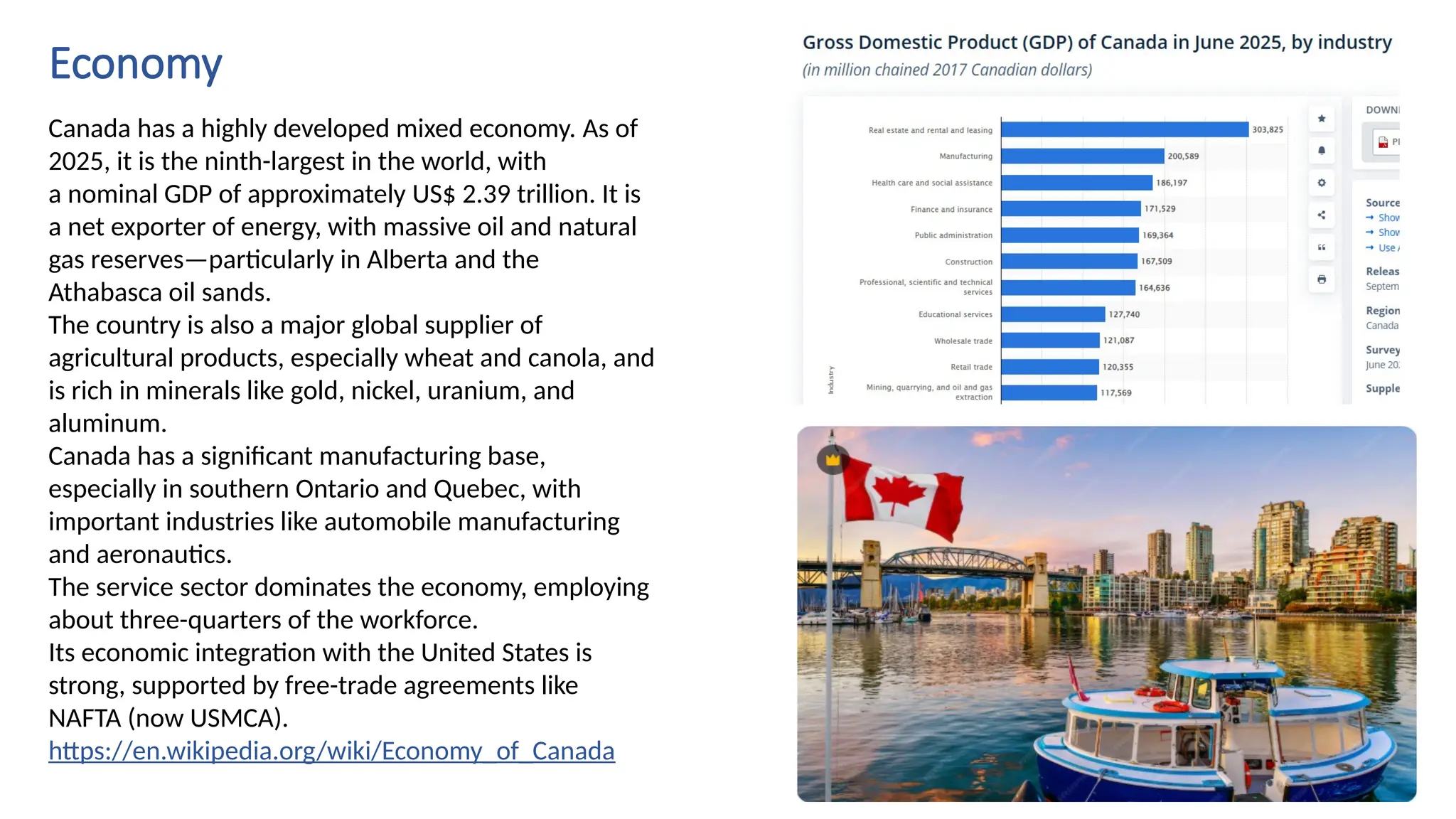
Economy
Canada has a highly developed mixed economy. As of
2025, it is the ninth-largest in the world, with
a nominal GDP of approximately US$ 2.39 trillion. It is
a net exporter of energy, with massive oil and natural
gas reserves—particularly in Alberta and the
Athabasca oil sands.
The country is also a major global supplier of
agricultural products, especially wheat and canola, and
is rich in minerals like gold, nickel, uranium, and
aluminum.
Canada has a significant manufacturing base,
especially in southern Ontario and Quebec, with
important industries like automobile manufacturing
and aeronautics.
The service sector dominates the economy, employing
about three-quarters of the workforce.
Its economic integration with the United States is
strong, supported by free-trade agreements like
NAFTA (now USMCA).
https://en.wikipedia.org/wiki/Economy_of_Canada
The services sector is a significant component of Canada's economy, contributing approximately 70
percent to the nation's Gross Domestic Product (GDP).This sector encompasses a wide range of
industries, including retail, finance, real estate, education, health care, and tourism.
The industry section also has huge contribution to GDP, adding up to 22.4 percent.
The share of agriculture, forestry and fishery all together is 1.8 percent
https://data.worldbank.org/indicator/NY.GDP.PCAP.KN?locations=CA
Key drivers of growth
•Natural resources (oil, gas, minerals, forestry)
•Large service sector (finance, real estate, tech, healthcare)
•Strong trade relationship with the United States (USMCA)
•High immigration increasing labor force and consumption
•Manufacturing sector (autos, aerospace, machinery)
•Construction and real estate development
•Stable political system and strong financial institutions
Export
https://atlas.hks.harvard.edu/countries/124/export-basket
Import
https://atlas.hks.harvard.edu/countries/
In 2023, Canada imported a total of $531B, making it one of the largest importers in the world.
During the last five reported years, the imports of Canada have increased significantly. The most
recent imports are led by Motor Vehicles and Parts ($142.0B), Machinery ($90.2B), Electrical and
Electronic Equipment ($86.4B), Mineral Fuels and Refined Petroleum Products ($43.7B), and
Precious Metals and Stones ($19.4B). The most common origins of the imports of Canada are the
United States ($277B), China ($66B), Mexico ($34B), Germany ($18.4B), and Japan ($15.2B).
https://atlas.hks.harvard.edu/countries/124/export-basket
Trade openness(%)
The latest value from 2024 is 65.18 percent, a decline from 66.63 percent in 2023. In comparison, the
world average is 92.80 percent, based on data from 133 countries. Historically, the average for Canada
from 1961 to 2024 is 56.56 percent. The minimum value, 35.33 percent, was reached in 1963 while the
maximum of 82.77 percent was recorded in 2000.
https://www.theglobaleconomy.com/Canada/trade_openness/
Inflation rate
The headline inflation rate in Canada fell to 2.2% in October of 2025 from 2.4% in the previous month,
loosely converging toward the 2% threshold in the near term as projected in the Bank of Canada's
baseline scenario. Gasoline prices sank by 9.4% from the previous year, picking up from the 4.1%
deflation rate last month as the persistent view of an oversupplied global crude oil market pressured
prices in the sector. Consequently, transportation inflation slowed to 0.7% from 1.7%. Price growth
also eased for food (3.4% vs 3.8% in September) due to lower price growth for food preparations
(3.2%), while inflation also eased for shelter (2.5% vs 2.6%). In the meantime, costs of cellular services
jumped by 7.7% to record their first increase in over two years amid price hikes by several major
wireless providers.
https://tradingeconomics.com/canada/inflation-cpi
Unemployment rate
The unemployment rate in Canada fell to 6.9% in October of 2025 from the four-year high of 7.1% in
the previous month, compared with market expectations that it would remain unchanged at 7.1%.
National employment increased by a net 66,600 jobs to 21,015,300, extending the jump from the
previous month and contrasting sharply with bets that it would drop slightly. Meanwhile, the number
of unemployed individuals fell by 49,200 to 1,557,300. Joblessness was lower for core-aged men (-0.2
percentage points to 6%) and was little changed for core-aged women (5.7%). In the meantime, the
youth unemployment rate fell by 0.6% to 14.1% for its first decline since February. In turn, long-term
unemployment was at 21.3% of the jobless population, comparable to the ratio from the
corresponding period of the previous year.
https://tradingeconomics.com/canada/unemployment-rate
External debt
External Debt in Canada decreased to 4580973 CAD Million in the second quarter of 2025 from
4642332 CAD Million in the first quarter of 2025. External Debt in Canada averaged 1544097.80
CAD Million from 1990 until 2025, reaching an all time high of 4642332.00 CAD Million in the
first quarter of 2025 and a record low of 354800.00 CAD Million in the first quarter of 1990.
https://tradingeconomics.com/canada/external-debt
Membership in trade blocks
1.World Trade Organization (WTO)
Members: 160+ countries worldwide.
Why it matters: Gives Canada stable, rules-based access to global markets
and protects Canadian exporters through international trade rules.
2. CUSMA (Canada–United States–Mexico Agreement)
Members: Canada, United States, Mexico.
Why it matters: Covers Canada’s largest trading partners; supports integrated
supply chains, manufacturing jobs, and tariff-free trade in North America.
3. CETA (Canada–EU Comprehensive Economic and Trade Agreement)
Members: Canada + 27 EU countries (e.g., Germany, France, Italy, Spain).
Why it matters: Eliminates most tariffs and opens a massive consumer
market, boosting exports, investment, and opportunities for Canadian
companies in Europe
4. CPTPP (Comprehensive
and Progressive
Agreement for Trans-
Pacific Partnership)
Members: Canada, Japan,
Australia, New Zealand,
Singapore, Vietnam,
Malaysia, Brunei, Chile,
Peru, Mexico.
Why it matters: Expands
access to fast-growing Asia-
Pacific markets, diversifies
trade away from reliance on
the U.S., and reduces tariffs
on a wide range of goods.
The free trade agreements of
Canada represents Canada's
cooperation in multinational
trade pacts and plays a large role in
the Canadian economy. Canada is
regularly described as a
trading nation, considering its total
trade is worth more than two-thirds
of its GDP (the second highest level
in the G7 after Germany). Of that
total trade, roughly 75% is done
with countries that are part of
free trade agreements with Canada
—primarily the United States
through the
Canada–United States–Mexico Agr
eement
(CUSMA), and its predecessor the
North American Free Trade Agreem
ent
(NAFTA).
Free trade agreements of Canada
https://en.wikipedia.org/wiki/Free_trade_agreements_of_Canada
Obstacles
Canada faces several significant obstacles in the global economy, most of which are linked to structural
weaknesses at home and increasing uncertainty abroad. One of the biggest challenges is the country’s
heavy reliance on the United States for trade. With roughly three-quarters of Canadian goods exports going
to the U.S., any shift in American trade policy—such as rising tariffs or protectionist measures—can quickly
weaken Canada’s export performance. Reports from Global Affairs Canada highlight how recent U.S. trade
actions have already created volatility in Canada’s export outlook (https://international.canada.ca).
Another major obstacle is Canada’s persistent productivity weakness. OECD analyses show that Canada’s
productivity growth has trailed behind other advanced economies for years due to low business
investment, limited adoption of advanced technologies, and barriers to interprovincial trade and labour
mobility. These constraints make it difficult for Canadian firms to scale and compete internationally,
particularly in sectors beyond natural resources (
https://www.oecd.org/en/publications/oecd-economic-surveys-canada-2025_28f9e02c-en.html).
Domestic conditions also pose challenges. Housing affordability remains a pressing issue, with high
household debt levels exposing consumers and the broader financial system to economic shocks. The
combination of elevated real estate prices, slow housing construction relative to population growth, and
leverage among households limits domestic demand and reduces economic flexibility. The OECD and Bank
of Canada both note that these internal vulnerabilities can amplify the effects of global downturns (
https://www.bankofcanada.ca).
Future outlook
“Trade uncertainty, rising protectionism, and geopolitical
flashpoints are making it harder for companies to plan, invest,
and grow.” – Business Council of Canada
The survey found that 64% of CEOs expect the Canadian economy to weaken over the next six
months — a cautionary sign. Business Council of Canada
Deloitte Canada — via its chief economist Dawn Desjardins — recently expressed a more
optimistic, yet cautious, view: although 2025 is marked by uncertainty, “several encouraging
factors”‌(including favourable interest-rate conditions and stabilizing trade dynamics) could allow
Canada to avoid recession and see modest growth.
Uzbekistan concludes bilateral negotiations with
Canada and Panama on WTO accession
https://daryo.uz/en/2025/11/06/uzbekistan-concludes-bilateral-negotiations-with-canada-and-panama-on-wto-accession/
Thank you for your
attention

The Economy of Canada and its analysis.pptx

  • 1.
    Subject: World Economy Country:Canada Student: Abdurashdova Yulduz
  • 2.
    Population The current populationof Canada is 40,276,815 as of Sunday, November 23, 2025, based on Worldometer's elaboration of the latest United Nations data1 . Canada 2025 population is estimated at 40,126,723 people at mid-year. Canada population is equivalent to 0.49% of the total world population. Canada ranks number 38 in the list of countries (and dependencies) by population. The population density in Canada is 4 per Km² (11 people per mi²). The total land area is 9,093,510 Km² (3,511,022 sq. miles). 80.16% of the population is urban (32,164,167 people in 2025) The median age in Canada is 40.6 years. https://www.worldometers.info/world-population/ canada-population/#google_vignette
  • 3.
    GDP Currently GDP ofCanada is 2.24 trillion US dollars. It is ranked 9th in the world. GDP per capita is 61 thousand USD and GDP by Purchasing Power Parity is 2.7 trillion dollars. https://data.worldbank.org/indicator/NY.GDP.PCAP.KN?locations=CA
  • 4.
    Economy Canada has ahighly developed mixed economy. As of 2025, it is the ninth-largest in the world, with a nominal GDP of approximately US$ 2.39 trillion. It is a net exporter of energy, with massive oil and natural gas reserves—particularly in Alberta and the Athabasca oil sands. The country is also a major global supplier of agricultural products, especially wheat and canola, and is rich in minerals like gold, nickel, uranium, and aluminum. Canada has a significant manufacturing base, especially in southern Ontario and Quebec, with important industries like automobile manufacturing and aeronautics. The service sector dominates the economy, employing about three-quarters of the workforce. Its economic integration with the United States is strong, supported by free-trade agreements like NAFTA (now USMCA). https://en.wikipedia.org/wiki/Economy_of_Canada
  • 5.
    The services sectoris a significant component of Canada's economy, contributing approximately 70 percent to the nation's Gross Domestic Product (GDP).This sector encompasses a wide range of industries, including retail, finance, real estate, education, health care, and tourism. The industry section also has huge contribution to GDP, adding up to 22.4 percent. The share of agriculture, forestry and fishery all together is 1.8 percent https://data.worldbank.org/indicator/NY.GDP.PCAP.KN?locations=CA
  • 6.
    Key drivers ofgrowth •Natural resources (oil, gas, minerals, forestry) •Large service sector (finance, real estate, tech, healthcare) •Strong trade relationship with the United States (USMCA) •High immigration increasing labor force and consumption •Manufacturing sector (autos, aerospace, machinery) •Construction and real estate development •Stable political system and strong financial institutions
  • 7.
  • 8.
  • 9.
    In 2023, Canadaimported a total of $531B, making it one of the largest importers in the world. During the last five reported years, the imports of Canada have increased significantly. The most recent imports are led by Motor Vehicles and Parts ($142.0B), Machinery ($90.2B), Electrical and Electronic Equipment ($86.4B), Mineral Fuels and Refined Petroleum Products ($43.7B), and Precious Metals and Stones ($19.4B). The most common origins of the imports of Canada are the United States ($277B), China ($66B), Mexico ($34B), Germany ($18.4B), and Japan ($15.2B). https://atlas.hks.harvard.edu/countries/124/export-basket
  • 10.
    Trade openness(%) The latestvalue from 2024 is 65.18 percent, a decline from 66.63 percent in 2023. In comparison, the world average is 92.80 percent, based on data from 133 countries. Historically, the average for Canada from 1961 to 2024 is 56.56 percent. The minimum value, 35.33 percent, was reached in 1963 while the maximum of 82.77 percent was recorded in 2000. https://www.theglobaleconomy.com/Canada/trade_openness/
  • 11.
    Inflation rate The headlineinflation rate in Canada fell to 2.2% in October of 2025 from 2.4% in the previous month, loosely converging toward the 2% threshold in the near term as projected in the Bank of Canada's baseline scenario. Gasoline prices sank by 9.4% from the previous year, picking up from the 4.1% deflation rate last month as the persistent view of an oversupplied global crude oil market pressured prices in the sector. Consequently, transportation inflation slowed to 0.7% from 1.7%. Price growth also eased for food (3.4% vs 3.8% in September) due to lower price growth for food preparations (3.2%), while inflation also eased for shelter (2.5% vs 2.6%). In the meantime, costs of cellular services jumped by 7.7% to record their first increase in over two years amid price hikes by several major wireless providers. https://tradingeconomics.com/canada/inflation-cpi
  • 12.
    Unemployment rate The unemploymentrate in Canada fell to 6.9% in October of 2025 from the four-year high of 7.1% in the previous month, compared with market expectations that it would remain unchanged at 7.1%. National employment increased by a net 66,600 jobs to 21,015,300, extending the jump from the previous month and contrasting sharply with bets that it would drop slightly. Meanwhile, the number of unemployed individuals fell by 49,200 to 1,557,300. Joblessness was lower for core-aged men (-0.2 percentage points to 6%) and was little changed for core-aged women (5.7%). In the meantime, the youth unemployment rate fell by 0.6% to 14.1% for its first decline since February. In turn, long-term unemployment was at 21.3% of the jobless population, comparable to the ratio from the corresponding period of the previous year. https://tradingeconomics.com/canada/unemployment-rate
  • 13.
    External debt External Debtin Canada decreased to 4580973 CAD Million in the second quarter of 2025 from 4642332 CAD Million in the first quarter of 2025. External Debt in Canada averaged 1544097.80 CAD Million from 1990 until 2025, reaching an all time high of 4642332.00 CAD Million in the first quarter of 2025 and a record low of 354800.00 CAD Million in the first quarter of 1990. https://tradingeconomics.com/canada/external-debt
  • 14.
    Membership in tradeblocks 1.World Trade Organization (WTO) Members: 160+ countries worldwide. Why it matters: Gives Canada stable, rules-based access to global markets and protects Canadian exporters through international trade rules.
  • 15.
    2. CUSMA (Canada–UnitedStates–Mexico Agreement) Members: Canada, United States, Mexico. Why it matters: Covers Canada’s largest trading partners; supports integrated supply chains, manufacturing jobs, and tariff-free trade in North America.
  • 16.
    3. CETA (Canada–EUComprehensive Economic and Trade Agreement) Members: Canada + 27 EU countries (e.g., Germany, France, Italy, Spain). Why it matters: Eliminates most tariffs and opens a massive consumer market, boosting exports, investment, and opportunities for Canadian companies in Europe
  • 17.
    4. CPTPP (Comprehensive andProgressive Agreement for Trans- Pacific Partnership) Members: Canada, Japan, Australia, New Zealand, Singapore, Vietnam, Malaysia, Brunei, Chile, Peru, Mexico. Why it matters: Expands access to fast-growing Asia- Pacific markets, diversifies trade away from reliance on the U.S., and reduces tariffs on a wide range of goods.
  • 18.
    The free tradeagreements of Canada represents Canada's cooperation in multinational trade pacts and plays a large role in the Canadian economy. Canada is regularly described as a trading nation, considering its total trade is worth more than two-thirds of its GDP (the second highest level in the G7 after Germany). Of that total trade, roughly 75% is done with countries that are part of free trade agreements with Canada —primarily the United States through the Canada–United States–Mexico Agr eement (CUSMA), and its predecessor the North American Free Trade Agreem ent (NAFTA). Free trade agreements of Canada https://en.wikipedia.org/wiki/Free_trade_agreements_of_Canada
  • 19.
    Obstacles Canada faces severalsignificant obstacles in the global economy, most of which are linked to structural weaknesses at home and increasing uncertainty abroad. One of the biggest challenges is the country’s heavy reliance on the United States for trade. With roughly three-quarters of Canadian goods exports going to the U.S., any shift in American trade policy—such as rising tariffs or protectionist measures—can quickly weaken Canada’s export performance. Reports from Global Affairs Canada highlight how recent U.S. trade actions have already created volatility in Canada’s export outlook (https://international.canada.ca). Another major obstacle is Canada’s persistent productivity weakness. OECD analyses show that Canada’s productivity growth has trailed behind other advanced economies for years due to low business investment, limited adoption of advanced technologies, and barriers to interprovincial trade and labour mobility. These constraints make it difficult for Canadian firms to scale and compete internationally, particularly in sectors beyond natural resources ( https://www.oecd.org/en/publications/oecd-economic-surveys-canada-2025_28f9e02c-en.html). Domestic conditions also pose challenges. Housing affordability remains a pressing issue, with high household debt levels exposing consumers and the broader financial system to economic shocks. The combination of elevated real estate prices, slow housing construction relative to population growth, and leverage among households limits domestic demand and reduces economic flexibility. The OECD and Bank of Canada both note that these internal vulnerabilities can amplify the effects of global downturns ( https://www.bankofcanada.ca).
  • 20.
    Future outlook “Trade uncertainty,rising protectionism, and geopolitical flashpoints are making it harder for companies to plan, invest, and grow.” – Business Council of Canada The survey found that 64% of CEOs expect the Canadian economy to weaken over the next six months — a cautionary sign. Business Council of Canada Deloitte Canada — via its chief economist Dawn Desjardins — recently expressed a more optimistic, yet cautious, view: although 2025 is marked by uncertainty, “several encouraging factors”‌(including favourable interest-rate conditions and stabilizing trade dynamics) could allow Canada to avoid recession and see modest growth.
  • 21.
    Uzbekistan concludes bilateralnegotiations with Canada and Panama on WTO accession https://daryo.uz/en/2025/11/06/uzbekistan-concludes-bilateral-negotiations-with-canada-and-panama-on-wto-accession/
  • 22.
    Thank you foryour attention