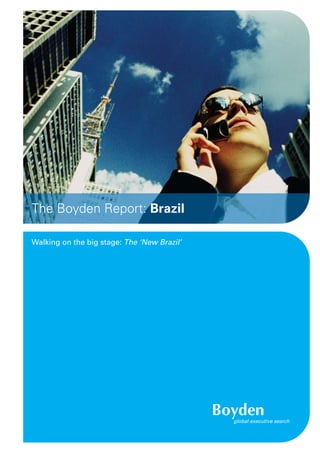
The Boyden Report: Brazil

Walking on the big stage: The ‘New Brazil’
The Boyden Report


Welcome to the latest edition of The Boyden Report,
a series designed to provide a deeper understanding
of the global market for talent.
                      At Boyden, we work closely with global companies to
                      craft their executive strategy. But that strategy must be
                      continuously re-evaluated. What works in one region
                      may not be effective in another. Each market has its
                      own management dynamics.

                      The Boyden Report is designed to help you navigate
                      this complexity in the ever-changing global market for
                      talent. Each report will provide you with the context
                      to make sustainable strategic decisions about your
                      executive team. Our series includes reports on India,
                      China, and Latin America. You can find these by visiting
                      our website at www.boyden.com.

                      In this report, we look at another key market that is
                      emerging as one of the fastest growing economies in
                      the world – Brazil.

                      There is suddenly a sense of real excitement about
                      this market. Perhaps seen as the laggard amongst
                      the ‘BRICs,’ Brazil is now recognised not only as a
                      sporting venue – hosting the World Cup in 2014 and
                      the Olympics in 2016 – but as a serious business
                      opportunity. Brazil has benefited from globalisation,
                      without suffering the consequences experienced by
                      other countries in the global recession. In fact, many of
                      the executives we talk to on a daily basis told us that
                      Brazil was the ‘safe port in a storm’.

                      In this report, we explore how Brazil came to be an
                      unlikely ‘global hero’ and what this means for growth
                      prospects in the near future.
Contents


Part 1: Brazil’s time has come

Introduction
“Brazil is a ‘serious country’”
Global growth prospects in Brazil
Barriers to growth – real or perceived?
New Brazil in a new global context

Part 2: Avoiding sand: New Brazil’s solid foundations

Foundations of rock, not BRIC
Economic diversity
A robust financial system
Transparency and stability support a greater role in the G20
A well-managed economy
A battle-hardened executive class

Part 3: New Brazil’s opportunity drivers

The consumer market
Brazil’s emergence as an energy superpower
Construction and infrastructure

Part 4: The Boyden View: Hiring in Brazil

Understanding ‘O jeitinho brasileiro’
The Boyden View on hiring in Brazil

Appendix


3
Introduction


A significant shift in Brazil’s global stature is underway. Yet, remarkably
little has been published about the country since the financial crisis
threw Brazil’s considerable strengths into relief. Here, we present the
views and insights of senior business executives – the majority of
whom lead Brazilian subsidiaries of multinationals – to hear why they
believe Brazil is now walking on the big stage.

                                                       Participants in our research include the following
 The view ‘from the ground’:                           business leaders, whom we sincerely thank for
 the Boyden perspective                                generously sharing their time and personal
                                                       perspectives:

 The Boyden office in Brazil is witnessing the     •	 Luiz	Calil,	President of Caterpillar Brazil – winner of
 daily transformation of Brazil. John Murray,         ‘Best Company to work for’ in Brazil, in the 2009 Great
 Partner and head of Boyden Brazil says,              Place to Work Institute rankings
 “I never before witnessed such optimism here      •	 Francisco	Itzaina, CBE, President – South America of
 as I do today”.                                      Rolls–Royce International
                                                   •	 Gaetano	Crupi, President & General Manager in Brazil
 Will Penney, a long-term Partner in the country      of Abbott, a global, broad-based healthcare company,
 observes that, “Brazilians always used to joke       devoted to the discovery, development, manufacture,
 that they lived in the eternal ‘country of the       and marketing of pharmaceuticals and medical
 future,’ but it seems that our ‘future’ has now      products, including nutritionals, medical devices, and
 arrived”.                                            diagnostics. The acquisition of Solvay Pharmaceuticals
                                                      is part of a strategic plan to diversify and grow their
 Other partners, Sönke Böge, Joel Garbi,              presence in emerging markets including Brazil
 and José Pedro Rossi are seeing a flood of        •	 Mark	Pitt, President of Sherwin Williams in Brazil.
 international and local investment, including        Sherwin Williams is the largest producer of paints
 mid-sized German manufacturers, retail and           and coatings in the United States. It is an $8 billion
 consumer companies, and local investment             multinational, with 80 branches in Brazil
 into infrastructure and ports. Chris Corcoran,    •	 Klaus	Pavel, President of Aachen-Laurensberger
 Partner at Boyden Brazil and former President        Rennverein (Chio), largest horse show in the
 of Goodyear subsidiaries in Brazil, Mexico,          world; Chairman of RNA Automation, an international
 and Chile sums up this sense of boundless            manufacturing company based in Germany; Founder of
 opportunity when he says “Brazil is truly the        FUNDACAO PAVEL, a large social project in Brazil caring
 place to be”.                                        for and educating children; Consul of the Federal
                                                      Republic of Brazil. Mr. Pavel was brought up in Brazil
                                                   •	 Chris	Wall, Business Specialist for Brazil, UK
                                                      Trade and Investment
                                                   •	 Richard	Taylor, CEO of Taylorenergies Business
                                                      Development; Chairman of CleanStar Brasil Bioenergia
                                                      Ltda; former President of BP in Brazil and founding
                                                      Director of the International Business Academy for
                                                      Development delivering executive education between
                                                      the UK, Brazil & China

                                                       Boyden is proud to be able to present views ‘from the
                                                       ground’ in Brazil and to spread the sense of opportunity
                                                       and momentum that is so palpable across the country.


                                                   4
Part 1:

   Brazil’s time has come

   “I see Brazil as a fantastic country in the future.
   I wish I was thirty again. I think it’s a place to
   be. It has come of age”.
   Francisco Itzaina
   President – South America of Rolls-Royce International


The ‘sleeping giant’ is awake at last. For many years             “Brazil is a ‘serious country’”
business commentators have seen enormous potential
in Brazil, but there has been a sense of disappointment           President Lula’s words, spoken when travelling in
that realising this has been hampered by economic                 Europe in late 2009, were not just the words of a proud
and political instability. In 2006, Goldman Sachs, the            President campaigning for greater global recognition.
creator of the ‘BRIC’ moniker went so far as to raise             Brazil has fundamental economic strengths. It has a
the question, “Should Brazil still be part of the BRICs?”         vast and growing consumer market, it is rich in valuable
The answer today is a resounding “Yes”. The World                 commodities such as soya, iron and oil, and it has the
Economic Forum’s Competitiveness Report 2009–2010                 world’s largest freshwater resources. Furthermore,
shows that Brazil has advanced eight positions in the             Brazil is a world leader in clean fuel technologies such
WEF’s ranking since the previous year, overcoming                 as ethanol and biofuel. Its land could support three
Russia for the first time and partially closing the gap           times more agricultural activity than it does today. With
with India and China. The extent to which Brazil has, in          the world’s fuel and food resources increasingly under
fact, broken away from other BRIC countries is explored           threat, Brazil is in a strong long-term position.
more fully in Part 2 of this report.

From an international perspective, events over the                  	 Did	you	know?
last two to three years have reset the conventional
view of ‘success’, exposing cracks in the Western                   1. Brazil had the world’s best-performing major
world’s financial systems and leaving governments to                	 currency	against	the	US	dollar	in	2009,	with	a	36		
ponder vast debt levels. In retrospect, Brazil’s stability,         	 percent	advance,	according	to	Bloomberg
economic viability, and political solidity are viewed from
a different perspective. Not one bank has collapsed, nor            2.	 Brazil	was	home	to	the	world’s	largest	IPO	in	2009.		
has any major corporation been bankrupted. Not one                  	 Santander	Brasil’s	IPO	valued	the	bank’s	Brazilian		
centavo has gone into propping up the financial system,             	 subsidiary	at	more	than	the	whole	of	Deutsche	Bank		
and a rapidly executed tax-break package from the                       worldwide
government minimised the effect of global recession
on consumer spending. As Chris Wall, UK Trade                       3. São Paulo is among the world’s top five futures and
and Investment’s expert on Brazil says, “In previous                	 options	markets,	by	volume	traded
financial crises, it’s been the case that when the United
States caught a cold, Brazil caught the flu. For the first          4. Brazil was home to the world’s fastest-growing car
time ever, the United States has caught the flu and                 	 market	in	2007-2009
Brazil has had the sniffles”.
                                                                    5. Brazil was a major source of stability for
                                                                       multinationals in the global recession that started
                                                                    	 in	2007.	Revenues	generated	in	Brazil	were	used	by		
                                                                       a number of multinationals to ‘shore up the
                                                                       balance sheet‘


                                                              5
Part 1: Brazil’s time has come


But the New Brazil has more than just relative                   more links with Brazil”. The US is now concerned that
strengths. It has a sophisticated and durable financial          its commercial links with Brazil are small. Many would
system, a proven and stable democracy, a sustainable             believe that Brazil and the US are doing great trade
future – based, in part, on significant oil discoveries in       but they are not. There is a lot of effort from the US to
the Santos Basin – and an impressive cadre of business           really focus on Brazil, either via a bilateral agreement
leaders and managers who withstood past turbulence               or by tailoring a bilateral agreement that can be more
and joined the business world’s executive elite.                 meaningful to the United States and Brazil taking into
                                                                 consideration the constraints of MERCOSUL”.
Brazil’s financial system is supported by BM&F
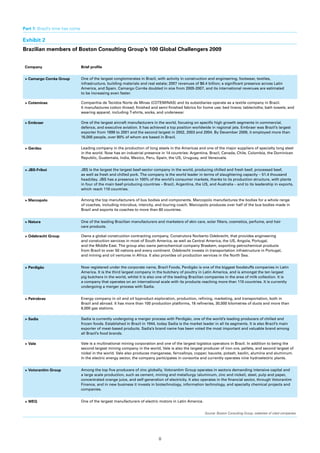
BOVESPA – the second largest stock exchange in                   Exhibit 1 shows that out of the 50 largest companies
the Americas after the NYSE; one of the largest and              in Brazil, nearly 30 percent are headquartered in
most liquid foreign exchange markets in the world;               Europe, nearly 60 percent are headquartered in Brazil
and foreign reserves standing at $200 billion. Brazil            or elsewhere in the region and just 10 percent are
has a low inflation economy, interest rates that slightly        headquartered in the United States.
fluctuate around the 8 percent mark, a successful
regulatory model and investment grade government                 This chart shows that it is not only foreign multinationals
bonds. Its financial independence is marked by the fact          that are prospering in Brazil. The number of ‘home-
that in 2009 it was a net creditor to the IMF.                   grown’ multinationals is increasing, attracting attention
                                                                 not only to Brazil’s corporate capabilities, but also to
Brazil’s ‘battle-hardened’ management class, trained             the opportunities for global growth among foreign
in a previously volatile business environment, is able           multinationals. As Luis Calil, President of Caterpillar
to cope with economic issues that would severely                 Brazil says, “Brazilian companies are prospering across
challenge executives in more mature markets. As Chris            the world. They are exporting because they see their
Wall says, for most executives, the global recession             fortune in getting products out to different countries”.
that started in 2007 did not look like a true ‘crisis’           Companies such as Embraer, Brazil Foods, and JBS, to
from a Brazilian perspective: “Most executives will              name just a few, are serious global players. Of Boston
say, ‘What crisis?’ Don’t forget that we were living             Consulting Group’s 2009 Global Challenger’s list, 14 of
through repeated crises in the nineteen eighties and             the 100 top global challengers come from Brazil, details
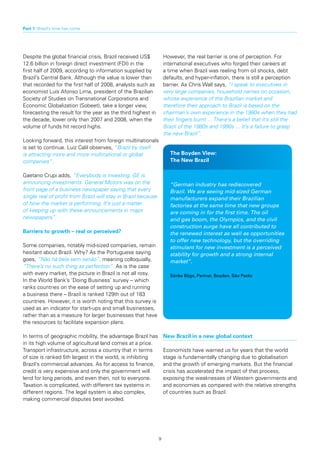
nineteen nineties. What started off in the early eighties        of which are shown in Exhibit 2.
as twenty five percent per month inflation, by the early
nineties was three percent a day. That is a crisis”. It
is somewhat telling therefore, that the CEOs of the                 The Boyden View:
subsidiaries of the top 20 multinationals in Brazil are             The battle-hardened management class
all Brazilian.

                                                                    “In my 45 years in Brazil, I have never seen
Global	growth	prospects	in	Brazil
                                                                    the Brazilian executive more in demand. When
                                                                    we were completing a search for a member
The World Bank predicts that if Brazil continues on its
                                                                    of the Board of Directors of a major American
current path, it will move from being the tenth largest
                                                                    Fortune 500 company, our client stipulated
economy in the world to the fifth largest by 2016.
                                                                    that the candidate must be a Brazilian. The
Francisco Itzaina says, quite simply, “Any company
                                                                    reason was they wanted someone on the
that wants to be global, that is serious about its future
                                                                    board who could visualise the world through
growth prospects, has to be in Brazil”.
                                                                    the eyes of an emerging market and who
                                                                    succeeded in guiding their businesses through
Historically, European businesses have taken advantage
                                                                    the repeated ups and downs of the Brazilian
of strong cultural links with Brazil, leaving the US to
                                                                    market over the last fifteen years. You will see
play ‘catch up’. As Gartano Crupi, President & General
                                                                    more Brazilians on international boards in the
Manager of Abbott, observes, “Spain has been
                                                                    coming years”.
investing in Brazil – look at telecoms and banking – and
Italy is a major player in the automobile industry and
                                                                    John deMarmon Murray, Partner, Boyden, São Paolo
in utilities. I think China is looking into making major
investment in Brazil, and France is trying to create


                                                             6
Part 1: Brazil’s time has come

Exhibit 1
The 50 largest companies in Brazil (by sales figures for 2008)                                       22 out of 50 are foreign multinationals
                                                                                                     5 are Brazilian challengers


         Company                    City/State               Business	Field                 Sales                                  Country

 1       Petrobras                  Rio de Janeiro, RJ       Petroleum and Energy           38,441
 2       BR Distribuidora           Rio de Janeiro, RJ       Wholesale (fuel)               10,567
 3       Telemar                    Rio de Janeiro, RJ       Telecommunications              6,311
 4       Telefónica                 São Paulo, SP            Telecommunications              5,699                                    Spain
 5       Ambev                      São Paulo, SP            Beer and drinks                 5,344
 6       Ipiranga                   Rio de Janeiro, RJ       Wholesale (Fuel)                5,060
 7       Volkswagen                 São Bernardo, SP         Automobiles                     4,791                                 Germany
 8       Shell                      Rio de Janeiro, RJ       Wholesale (Fuel)                4,382                             UK/Holland
 9       General Motors             São Caetano, SP          Automobiles                     4,131                                       US
 10      Brasil Telecom             Brasilia, DF             Telecommunications              3,913
 11      Bunge Food                 Gaspar, SC               Food and Drink                  3,866                                 Argentina
 12      Pão de Açucar              São Paulo, SP            Retailer                        3,858
 13      Vale do Rio Doce           Rio de Janeiro, RJ       Mining                          3,628
 14      Carrefour                  São Paulo, SP            Retailer                        3,628                                   France
 15      Brasken                    Camaçari, BA             Petrochemical                   3,345
 16      Esso                       Rio de Janeiro, RJ       Wholesale (Fuel)                3,192                                       US
 17      Texaco                     Rio de Janeiro, RJ       Wholesale (Fuel)                3,175                                       US
 18      Embratel                   Rio de Janeiro, RJ       Telecommunications              3,167                                   Mexico
 19      Cargill                    São Paulo, SP            Food and Drink                  3,163                                       US
 20      Eletropaulo                São Paulo, SP            Utilities (Electricity)         3,056
 21      Nestle                     São Paulo, SP            Food and Drink                  2,916                             Switzerland
 22      FIAT                       Betim, MG                Automobiles                     2,813                                      Italy
 23      CEMIG                      Belo Horizonte           Utilities (Electricity)         2,649
 24      C.S.N.                     Rio de Janeiro, RJ       Iron and Steel                  2,573
 25      VARIG                      Porto Alegre, RS         Transportation (Air Carrier)    2,375
 26      Unilever                   São Paulo, SP            Pharmacy and Hygiene            2,319                             UK/Holland
 27      Souza Cruz                 Rio de Janeiro, RJ       Tobacco                         2,284                                       UK
 28      Embraer                    São José Campos, SP      Airplanes                       2,243
 29      Gerdau                     Porto Alegre, RS         Iron and Steel                  2,206
 30      Usiminas                   Belo Horizonte, MG       Iron and Steel                  2,200                            Brazil/Japan
 31      Itaipu                     Brasilia, DF             Utilities (Electricity)         2,184                         Brazil/Paraguay
 32      REFAP                      Canoas, RS               Petrochemical                   2,131
 33      Casas Bahia                São Caetano do Sul, SP   Retailer                        2,112
 34      AGIP                       São Paulo, SP            Utilities                       2,108                                      Italy
 35      Correios                   Brasília, DF             Postal Service                  2,074
 36      DaimlerChrysler            São Bernardo, SP         Automobiles                     2,022                                 Germany
 37      Sadia                      Concórdia, SC            Food                            1,966
 38      Light                      Rio de Janeiro, RJ       Utilities (Electricity)         1,891                                   France
 39      Copesul                    Triunfo, RS              Petrochemical                   1,891
 40      Ford                       São Bernardo, SP         Automobiles                     1,890                                       US
 41      Vivo                       São Paulo, SP            Telecommunications              1,870                          Portugal/Spain
 42      Furnas                     Rio de Janeiro, RJ       Utilities (Electricity)         1,757
 43      Bunge Fertilizers          São Paulo, SP            Fertilizers                     1,725                                 Bermuda
 44      CPFL                       Campinas, SP             Utilities (Electricity)         1,576
 45      Cosipa                     São Paulo, SP            Iron and Steel                  1,573
 46      Nokia                      Manaus, AM               Electronics                     1,550                                   Finland
 47      Sabesp                     São Paulo, SP            Utilities (Water & Sewage)      1,515
 48      Perdigão                   São Paulo, SP            Food                            1,483
 49      Basf                       São Bernardo, SP         Chemicals                       1,461                                 Germany
 50      Copersucar                 São Paulo, SP            Wholesale (Sugar & Alcohol)     1,448

Source: Exame, Brazil’s Business & Economy Magazine


                                                                              7
Part 1: Brazil’s time has come

Exhibit 2
Brazilian	members	of	Boston	Consulting	Group’s	100	Global	Challengers	2009


 Company                         Brief profile


 >	Camargo	Corrêa	Group          One of the largest conglomerates in Brazil, with activity in construction and engineering, footwear, textiles,
                                 infrastructure, building materials and real estate; 2007 revenues of $6.4 billion; a significant presence across Latin
                                 America, and Spain. Camargo Corrêa doubled in size from 2005-2007, and its international revenues are estimated
                                 to be increasing even faster.

 > Coteminas                     Companhia de Tecidos Norte de Minas (COTEMINAS) and its subsidiaries operate as a textile company in Brazil.
                                 It manufactures cotton thread; finished and semi-finished fabrics for home use; bed linens; tablecloths; bath towels; and
                                 wearing apparel, including T-shirts, socks, and underwear.

 > Embraer                       One of the largest aircraft manufacturers in the world, focusing on specific high growth segments in commercial,
                                 defence, and executive aviation. It has achieved a top position worldwide in regional jets. Embraer was Brazil’s largest
                                 exporter from 1999 to 2001 and the second largest in 2002, 2003 and 2004. By December 2009, it employed more than
                                 16,000 people, over 90% of whom are based in Brazil.

 >	Gerdau                        Leading company in the production of long steels in the Americas and one of the major suppliers of specialty long steel
                                 in the world. Now has an industrial presence in 14 countries: Argentina, Brazil, Canada, Chile, Colombia, the Dominican
                                 Republic, Guatemala, India, Mexico, Peru, Spain, the US, Uruguay, and Venezuela.


 >	JBS-Friboi                    JBS is the largest the largest beef-sector company in the world, producing chilled and fresh beef, processed beef,
                                 as well as fresh and chilled pork. The company is the world leader in terms of slaughtering capacity – 51.4 thousand
                                 head/day. JBS has a presence in 100% of the world’s consumer markets, thanks to its production structure, with plants
                                 in four of the main beef-producing countries – Brazil, Argentina, the US, and Australia – and to its leadership in exports,
                                 which reach 110 countries.

 >	Marcopolo                     Among the top manufacturers of bus bodies and components. Marcopolo manufactures the bodies for a whole range
                                 of coaches, including microbus, intercity, and touring coach. Marcopolo produces over half of the bus bodies made in
                                 Brazil and exports its coaches to more than 60 countries.


 > Natura                        One of the leading Brazilian manufacturers and marketers of skin care, solar filters, cosmetics, perfume, and hair
                                 care products.

 >	Odebrecht	Group               Owns a global construction contracting company, Construtora Norberto Odebrecht, that provides engineering
                                 and constuction services in most of South America, as well as Central America, the US, Angola, Portugal,
                                 and the Middle East. The group also owns petrochemical company Braskem, exporting petrochemical products
                                 from Brazil to over 50 nations and every continent. Odebrecht invests in transportation infrastructure in Portugal,
                                 and mining and oil ventures in Africa. It also provides oil production services in the North Sea.


 > Perdigão                      Now registered under the corporate name, Brazil Foods, Perdigão is one of the biggest foodstuffs companies in Latin
                                 America. It is the third largest company in the butchery of poultry in Latin America, and is amongst the ten largest
                                 pig butchers in the world, whilst it is also one of the leading Brazilian companies in the area of milk collection. It is
                                 a company that operates on an international scale with its products reaching more than 110 countries. It is currently
                                 undergoing a merger process with Sadia.


 > Petrobras                     Energy company in oil and oil byproduct exploration, production, refining, marketing, and transportation, both in
                                 Brazil and abroad. It has more than 100 production platforms, 16 refineries, 30,000 kilometres of ducts and more than
                                 6,000 gas stations.

 > Sadia                         Sadia is currently undergoing a merger process with Perdigão, one of the world’s leading producers of chilled and
                                 frozen foods. Established in Brazil in 1944, today Sadia is the market leader in all its segments. It is also Brazil’s main
                                 exporter of meat-based products. Sadia’s brand name has been voted the most important and valuable brand among
                                 all Brazil’s food brands.

 > Vale                          Vale is a multinational mining corporation and one of the largest logistics operators in Brazil. In addition to being the
                                 second-largest mining company in the world, Vale is also the largest producer of iron ore, pellets, and second largest of
                                 nickel in the world. Vale also produces manganese, ferroalloys, copper, bauxite, potash, kaolin, alumina and aluminum.
                                 In the electric energy sector, the company participates in consortia and currently operates nine hydroelectric plants.


 >	Votorantim	Group              Among the top five producers of zinc globally, Votorantim Group operates in sectors demanding intensive capital and
                                 a large scale production, such as cement, mining and metallurgy (aluminum, zinc and nickel), steel, pulp and paper,
                                 concentrated orange juice, and self-generation of electricity. It also operates in the financial sector, through Votorantim
                                 Finance, and in new business it invests in biotechnology, information technology, and specialty chemical projects and
                                 companies.


 >	WEG                           One of the largest manufacturers of electric motors in Latin America.


                                                                                                          Source: Boston Consulting Group; websites of cited companies.


                                                                              8
Part 1: Brazil’s time has come


Despite the global financial crisis, Brazil received US$            However, the real barrier is one of perception. For
12.6 billion in foreign direct investment (FDI) in the              international executives who forged their careers at
first half of 2009, according to information supplied by            a time when Brazil was reeling from oil shocks, debt
Brazil’s Central Bank. Although the value is lower than             defaults, and hyper-inflation, there is still a perception
that recorded for the first half of 2008, analysts such as          barrier. As Chris Wall says, “I speak to executives in
economist Luís Afonso Lima, president of the Brazilian              very large companies, household names on occasion,
Society of Studies on Transnational Corporations and                whose experience of the Brazilian market and
Economic Globalization (Sobeet), take a longer view,                therefore their approach to Brazil is based on the
forecasting the result for the year as the third highest in         chairman’s own experience in the 1980s when they had
the decade, lower only than 2007 and 2008, when the                 their fingers burnt ... There’s a belief that it’s still the
volume of funds hit record highs.                                   Brazil of the 1980s and 1990s ... It’s a failure to grasp
                                                                    the new Brazil”.
Looking forward, this interest from foreign multinationals
is set to continue. Luiz Calil observes, “Brazil by itself
is attracting more and more multinational or global                    The Boyden View:
companies”.                                                            The New Brazil

Gaetano Crupi adds, “Everybody is investing. GE is
announcing investments. General Motors was on the                      “German industry has rediscovered
front page of a business newspaper saying that every                   Brazil. We are seeing mid-sized German
single real of profit from Brazil will stay in Brazil because          manufacturers expand their Brazilian
of how the market is performing. It’s just a matter                    factories at the same time that new groups
of keeping up with these announcements in major                        are coming in for the first time. The oil
newspapers”.                                                           and gas boom, the Olympics, and the civil
                                                                       construction surge have all contributed to
Barriers	to	growth	–	real	or	perceived?                                the renewed interest as well as opportunities
                                                                       to offer new technology, but the overriding
Some companies, notably mid-sized companies, remain                    stimulant for new investment is a perceived
hesitant about Brazil. Why? As the Portuguese saying                   stability for growth and a strong internal
goes, “Não há bela sem senão”, meaning colloquially,                   market”.
“There’s no such thing as perfection”. As is the case
with every market, the picture in Brazil is not all rosy.              Sönke Böge, Partner, Boyden, São Paolo
In the World Bank’s ‘Doing Business’ survey – which
ranks countries on the ease of setting up and running
a business there – Brazil is ranked 129th out of 183
countries. However, it is worth noting that this survey is
used as an indicator for start-ups and small businesses,
rather than as a measure for larger businesses that have
the resources to facilitate expansion plans.

In terms of geographic mobility, the advantage Brazil has           New Brazil in a new global context
in its high volume of agricultural land comes at a price.
Transport infrastructure, across a country that in terms            Economists have warned us for years that the world
of size is ranked 5th largest in the world, is inhibiting           stage is fundamentally changing due to globalisation
Brazil’s commercial advances. As for access to finance,             and the growth of emerging markets. But the financial
credit is very expensive and only the government will               crisis has accelerated the impact of that process,
lend for long periods, and even then, not to everyone.              exposing the weaknesses of Western governments and
Taxation is complicated, with different tax systems in              and economies as compared with the relative strengths
different regions. The legal system is also complex,                of countries such as Brazil.
making commercial disputes best avoided.


                                                                9
Part 1: Brazil’s time has come


According to politicians, business leaders and other              In terms of financial management, Chris Wall notes,
drivers of opinion, Brazil is expected to emerge from             “Europe has tended to sit in judgment on Latin America
the global recession in better economic shape than                in the past. Brazilians are very aware of the irony of
most of the other G20 countries. As Richard Taylor,               that now”.
CEO of Taylorenergies Business Development says
“The G20 is now the main global forum for international           It is clear then that Brazil has focused on strengthening
economic development and Brazil is seen as one of                 its domestic position, rather than pursuing a strategy that
its leaders”. Francisco Itzaina observes that, “Brazil is         involved international risk. In the next section we explore
becoming an international player. It’s globalising its own        how the foundations of the country have been made
economy”. The New Brazil is a different place, and the            secure, the phenomena driving major opportunities for
attitude of business leaders and politicians around the           multinationals, and the dynamics of hiring, retaining and
world around is changing.                                         developing senior executives in the New Brazil.


 “Europe has tended to sit in judgment
 on Latin America in the past. Brazilians
 are very aware of the irony of that now”.
 Chris Wall, Business Specialist for Brazil, to UK Trade
 and Investment.


                                                             10
Part 2:

   Avoiding sand:
   New Brazil’s solid foundations
   Foundations	of	rock,	not	BRIC

   “Brazil is at a different level of development, on the development curve,
   than the other BRIC countries,” says	Francisco	Itzaina,	President	–	South	
   America	of	Rolls-Royce	International.


Lumped together in the ‘BRICs’ (Brazil, Russia, India             security and predictability to expatriate families, often
and China), Brazil’s advantages can be overlooked,                the top priority for executives on the ‘global fast track’.
such as its more sophisticated social systems, and
infrastructure, political stability, and democratic               Politically, Brazil has achieved stability in the form
participation in politics, cultural and religious unity,          of a robust, established democratic republic. “Brazil
linguistic homogeny and economic stability and                    has become now, I wouldn’t say ‘mature’, but it has
diversity. The ‘BRIC’ acronym itself is a Western                 embarked upon maturity in terms of its democracy and
construct which can be counter-productive in linking              the relative consolidation of the strength of its
Brazil with other emerging markets that carry greater             political institutions”, comments Mark Pitt, President
political and economic risk.                                      of Sherwin Williams.

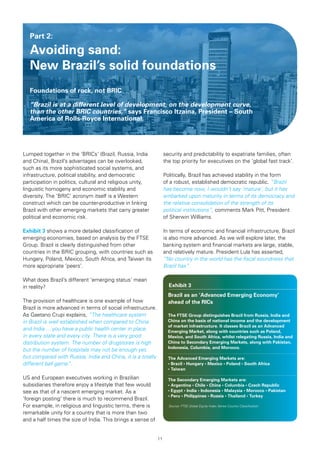
Exhibit 3 shows a more detailed classification of                 In terms of economic and financial infrastructure, Brazil
emerging economies, based on analysis by the FTSE                 is also more advanced. As we will explore later, the
Group. Brazil is clearly distinguished from other                 banking system and financial markets are large, stable,
countries in the BRIC grouping, with countries such as            and relatively mature. President Lula has asserted,
Hungary, Poland, Mexico, South Africa, and Taiwan its             “No country in the world has the fiscal soundness that
more appropriate ‘peers’.                                         Brazil has”.

What does Brazil’s different ‘emerging status’ mean
in reality?                                                         Exhibit 3
                                                                    Brazil as an ‘Advanced Emerging Economy’
The provision of healthcare is one example of how                   ahead	of	the	RICs
Brazil is more advanced in terms of social infrastructure.
As Gaetano Crupi explains, “The healthcare system                   The	FTSE	Group	distinguishes	Brazil	from	Russia,	India	and	
in Brazil is well established when compared to China                China on the basis of national income and the development
                                                                    of	market	infrastructure.	It	classes	Brazil	as	an	Advanced	
and India ... you have a public health center in place              Emerging	Market,	along	with	countries	such	as	Poland,	
in every state and every city. There is a very good                 Mexico,	and	South	Africa,	whilst	relegating	Russia,	India	and	
distribution system. The number of drugstores is high               China	to	Secondary	Emerging	Markets,	along	with	Pakistan,	
                                                                    Indonesia,	Columbia,	and	Morocco.
but the number of hospitals may not be enough yet,
but compared with Russia, India and China, it is a totally          The	Advanced	Emerging	Markets	are:
different ball game”.                                               •	Brazil	•	Hungary	•	Mexico	•	Poland	•	South	Africa	
                                                                    •	Taiwan

US and European executives working in Brazilian                     The	Secondary	Emerging	Markets	are:
subsidiaries therefore enjoy a lifestyle that few would             •	Argentina	•	Chile	•	China	•	Columbia	•	Czech	Republic	
see as that of a nascent emerging market. As a                      •	Egypt	•	India	•	Indonesia	•	Malaysia	•	Morocco	•	Pakistan	
                                                                    •	Peru	•	Philippines	•	Russia	•	Thailand	•	Turkey
‘foreign posting’ there is much to recommend Brazil.
For example, in religious and linguistic terms, there is            Source: FTSE Global Equity Index Series Country Classification

remarkable unity for a country that is more than two
and a half times the size of India. This brings a sense of


                                                             11
Part 2: Avoiding sand: New Brazil’s solid foundations


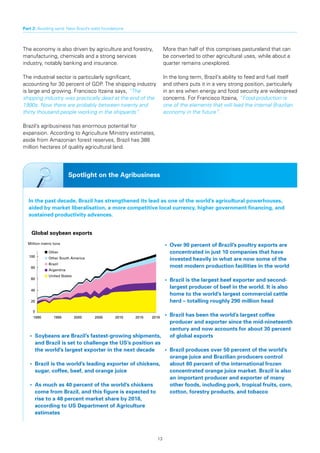
Economic diversity                                      Exhibit 4
                                                        Economic activity and diversity across Brazil
“There really is a high degree of economic
diversity. And I think that is really one
of the strengths during a crisis”, says
Richard Taylor.

Perhaps the most significant advantage
Brazil has over its emerging market
‘competitors’ is the diversity of its
economy, shown in Exhibit 4. While
commodities and natural resources are
important, the Brazilian economy does not
rely on just one or two key industry sectors
to fuel growth.

Brazil’s natural resources are considerable.
Oil revenues are set to multiply as the
‘pre-salt’ potential of the Santos Basin is
exploited. Brazil’s iron ore, manganese,
bauxite, nickel, uranium, gemstones, wood,
and aluminium resources are also significant.
These resources are fuelling industrial
growth around the world. As Gaetano Crupi
says, “China needs commodities and many
commodities are coming from Brazil”.

Brazil’s diverse industries range from
automobiles, steel, and petrochemicals to
                                                        Source: University of Texas, Austin, USA
computers, aircraft, and consumer durables.


                       Spotlight on the Aviation Business
                       Two success stories in the Brazilian Aviation industry: Embraer and Azul


   Embraer is a major success story in aviation. Since privatisation in 1994 Embraer has turned itself into
   the	world’s	biggest	manufacturer	of	mid-range	passenger	jets.	Some	96	percent	of	the	company’s	
   revenue	now	comes	from	exports	to	commercial	airlines	in	China,	India,	Poland,	Britain	and	the	US.	

   But	it	is	not	the	only	success	story	in	aviation.	Richard	Taylor	cites	the	amazing	growth	story	of	Azul,	
   the	low	cost	airline,	as	a	good	example	of	“an organisation where they think that the opportunities and
   the scale of the opportunity in Brazil more than offset the challenges of working here”. Azul was set up
   by	a	Brazilian-born	US	citizen.	By	June	2009,	six	months	after	beginning	operations,	Azul	had	the	third	
   largest	market	share	of	the	Brazilian	domestic	airline	market,	after	TAM	and	Gol	Airlines.	


                                                                      12
Part 2: Avoiding sand: New Brazil’s solid foundations


The economy is also driven by agriculture and forestry,               More than half of this comprises pastureland that can
manufacturing, chemicals and a strong services                        be converted to other agricultural uses, while about a
industry, notably banking and insurance.                              quarter remains unexplored.

The industrial sector is particularly significant,                    In the long term, Brazil’s ability to feed and fuel itself
accounting for 30 percent of GDP. The shipping industry               and others puts it in a very strong position, particularly
is large and growing. Francisco Itzaina says, “The                    in an era when energy and food security are widespread
shipping industry was practically dead at the end of the              concerns. For Francisco Itzaina, “Food production is
1990s. Now there are probably between twenty and                      one of the elements that will lead the internal Brazilian
thirty thousand people working in the shipyards”.                     economy in the future”.

Brazil’s agribusiness has enormous potential for
expansion. According to Agriculture Ministry estimates,
aside from Amazonian forest reserves, Brazil has 388
million hectares of quality agricultural land.


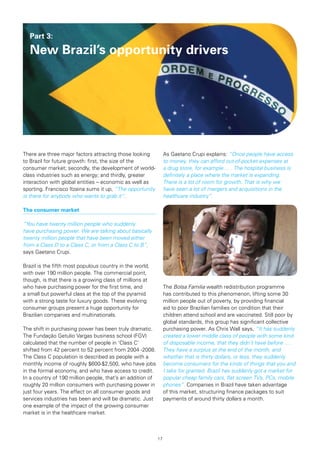
                          Spotlight on the Agribusiness


   In	the	past	decade,	Brazil	has	strengthened	its	lead	as	one	of	the	world’s	agricultural	powerhouses,	
   aided	by	market	liberalisation,	a	more	competitive	local	currency,	higher	government	financing,	and	
   sustained productivity advances.


    Global	soybean	exports
  Million metric tons
                                                                      •	 Over	90	percent	of	Brazil’s	poultry	exports	are
              Other                                                      concentrated in just 10 companies that have
   100        Other South America                                        invested heavily in what are now some of the
              Brazil
    80                                                                   most modern production facilities in the world
              Argentina
              United States
    60                                                                •	 Brazil	is	the	largest	beef	exporter	and	second-	
                                                                      	 largest	producer	of	beef	in	the	world.	It	is	also		
    40
                                                                         home to the world’s largest commercial cattle
    20                                                                   herd – totalling roughly 290 million head
     0
     1990        1995         2000   2005       2010
                                                           •	 Brazil	has	been	the	world’s	largest	coffee		 	
                                                        2015   2019
                                                              producer and exporter since the mid-nineteenth
                                                              century and now accounts for about 30 percent
   •	 Soybeans	are	Brazil’s	fastest-growing	shipments,		 of global exports
      and Brazil is set to challenge the US’s position as
      the world’s largest exporter in the next decade      •	 Brazil	produces	over	50	percent	of	the	world’s		
                                                              orange juice and Brazilian producers control
   •	 Brazil	is	the	world’s	leading	exporter	of	chickens,		 about 80 percent of the international frozen
   	 sugar,	coffee,	beef,	and	orange	juice                 	 concentrated	orange	juice	market.	Brazil	is	also		
                                                              an important producer and exporter of many
   •	 As	much	as	40	percent	of	the	world’s	chickens		      	 other	foods,	including	pork,	tropical	fruits,	corn,		
   	 come	from	Brazil,	and	this	figure	is	expected	to      	 cotton,	forestry	products,	and	tobacco
   	 rise	to	a	48	percent	market	share	by	2018,
      according to US Department of Agriculture
      estimates


                                                                 13
Part 2: Avoiding sand: New Brazil’s solid foundations


A robust financial system                                         To give one example, before the 2007 global financial
                                                                  crisis took hold, the hedge fund industry in Brazil was
“During the entire world economic crisis – and this is            growing at a staggering pace, from $92 billion in 2002
a very strong signal – during the entire crisis there was         to $750 billion by the end of 2007. The pool of talent
not one single financial institution that went bankrupt in        reflects this: there are an estimated 142 private equity
Brazil. Not one”, says Gaetano Crupi.                             and venture capital fund managers who manage 181
                                                                  funds with investments in over 500 local companies in
Brazil’s financial services market is today one of the            a broad range of sectors.
most developed among the emerging economies.
                                                                  Transparency and stability support
The strength of Brazil’s financial institutions goes              a	greater	role	in	the	G20
back to the mid-1990s when the country confronted
its own successive economic crises. This set in                   Brazil’s banking system is unusually transparent. The
motion fundamental changes in economic policy and                 bank settlement system operates in real time, so all
performance.                                                      banks know their cash positions at any given moment
                                                                  and the central bank has an overall picture of the
Since then, the entire financial services system has              liquidity in the system. As Gaetano Crupi explains,
developed substantially, particularly in the last few             “This is a huge advantage not only for the government,
years: foreign exchange, mutual funds, hedge funds,               but for companies and individuals doing business. From
credit and bond markets have all thrived amid Brazil’s            an IT perspective in the banking system, there is no
economic growth and stability.                                    faster and better process system in the world in terms
                                                                  of cashing a cheque today and putting it in your account
                                                                  in thirty-five minutes the same day”.
   The Boyden View: Executive Search in a multi-
   faceted emerging economy
                                                                  Another unusually transparent area of the system is in
                                                                  the fund management arena. All onshore funds must
                                                                  provide daily liquidity reports to Brazil’s Securities
   “The COO of a global food ingredients
                                                                  and Exchange Commission (the Comissão de Valores
   company asked me about the availability of
                                                                  Mobiliários-CVM), disclosing the net asset value of their
   world-class executive talent in Brazil. His firm
                                                                  funds, albeit with a 48-hour delay. At the end of every
   is now investing here and upgrading its local
                                                                  month funds disclose what they were holding 90 days
   management team. The answer was easy: in the
                                                                  ago. The data is freely available to everyone on the
   last twenty years Brazil has developed a superb
                                                                  CVM’s website. The hedge fund industry is also subject
   talent pool. Of course finding and hiring the
                                                                  to the same regulation, making Brazilian hedge funds
   best person is always a challenge, but there are
                                                                  unusually transparent.
   lots of professionals out there who are well-
   schooled, balanced, versatile, and with solid
                                                                  Other elements of regulation have helped stabilise the
   leadership skills.
                                                                  system. A key reason for the sector’s resilience is a
                                                                  high capitalization requirement – the minimum capital
   These days it is rare for an international
                                                                  adequacy requirement in Brazil is 11%, compared
   company to have expatriate managers, unless
                                                                  with 8% under the Basel regulations that other banks
   it is just part of plan to develop a particular
                                                                  around the world follow. New rules for publicly-traded
   individual. Talent is nicely distributed across
                                                                  companies brought in by the São Paulo stock exchange
   the main sectors of the Brazilian economy, and
                                                                  (BOVESPA) in 2002 have benefitted equity investors,
   when there is a momentary supply/demand
                                                                  with fair treatment of minority stakeholders enshrined
   disequilibrium, talent flows easily between the
                                                                  in law; under current guidelines it is illegal to issue
   sectors”.
                                                                  shares that pay out different amounts to different
                                                                  holders in the event of a takeover.
   William Penney, Managing Director,
   Boyden, São Paolo
                                                                  In the light of its successful regulatory model, Brazil is
                                                                  seeking a greater role in global reforms being discussed
                                                                  under the auspices of the G20.


                                                             14
Part 2: Avoiding sand: New Brazil’s solid foundations


It has specifically requested from the IMF greater
                                                               The Boyden View:
involvement in global regulatory discussions and is
                                                               Brazilian	Financial	Services	talent
seeking an enhanced leadership role in the Fund itself.

There will be many opportunities for growth within
                                                               “The Brazilian Financial Service market is strong,
the financial services sector. Gaetano Crupi sees
                                                               and largely ignored the financial crisis that
a number of specific opportunities arising: “Brazil
                                                               disturbed the developed world. This market is
will retain a very strong financial services industry.
                                                               dominated by large national banks that already
Commercial and investment banks are strengthening,
                                                               hold positions amongst the largest international
and I think associated with that, solid engineering
                                                               banks. Major international banks are also present
and infrastructure will be needed ... It is likely that
                                                               in Brazil and their positive performance has,
mortgages are going to regain some buoyancy and I
                                                               in fact, helped improve the worldwide results
believe that European business leaders are looking at
                                                               reported from the head office.
Brazil more closely than they have ever before”.

                                                               The Brazilian currency, the Real, has been strong
                                                               and has also contributed to the confidence and
                                                               credibility of Brazil amongst foreign investors.
                                                               This confidence has grown as investors realised
                                                               the Brazilian banking regulations are and have
                                                               been strong and effective in keeping the Brazilian
                                                               banks out of trouble. With this said, the financial
                                                               market is healthy and active, presenting excellent
                                                               opportunities for specialised talent”.

                                                               José Pedro Rossi, Partner and Head of Financial
                                                               Services Practice, Boyden, São Paolo


                        Spotlight on the financial ecosystem in Brazil


  •	 Brazilian	banks	–	both	private	and	public	–	rank	among	the	largest	in	the	region.	For	example,	Itau	Unibanco	is		
  	 Latin	America’s	largest	bank,	the	ninth	largest	bank	in	the	Americas,	and	the	12th	largest	bank	in	the	world.	At		
  	 the	end	of	March	2009,	Brazil’s	banking	system	was	larger	in	terms	of	market	capitalization	than	the	UK’s	and		
     that of every other EU member country
  •	 The	Brazilian	foreign	exchange	market	–	in	both	spot	and	derivatives	trading	–	is	large	and	liquid,	which	makes		
  	 the	Real	one	of	the	most	traded	emerging	market	currencies
  •	 Brazilian	investment	funds	–	notably,	the	country’s	pension	funds	–	are	significant	players	in	the	asset		 	
  	 management	industry,	with	nearly	R$1.2	trillion	(US$515.6	billion)	under	management,	or	about	40	percent	of		
  	 Brazil’s	GDP	
  •	 Brazil’s	pension	fund	industry	was	the	eighth	largest	in	the	world	at	the	end	of	2008
  •	 São	Paulo’s	futures	and	options	market	is	one	of	the	five	largest	in	the	world	by	volume	traded
  •	 The	BM&F	BOVESPA	is	Latin	America’s	leading	stock	exchange	and	the	second	largest	in	the	Americas	after	the		
  	 NYSE.	It	offers	a	broad	range	of	financial	products	for	trading	equity	and	commodity-based	derivatives


      Source: Boston Consulting Group, October 2009


                                                          15
Part 3: Avoiding sand: New Brazil’s solid foundations


A well-managed economy                                              In addition, Brazilian executives’ ability to navigate
                                                                    the complexities of the taxation system and certain
“It was Lula’s predecessor who stabilised the currency              elements of government bureaucracy makes them more
and Lula came to power intent on steering the economy               effective in multinational organisations abroad, despite
in the same solid way,” says Chris Wall.                            barriers that would seem insurmountable to others.
                                                                    Francisco Itzaina also suggests that multinationals
Perhaps burned by experiences in the past, Brazil’s                 have used Brazil as a training ground for management,
leader has recognised that common sense and good                    when he says, “There is a good reason why a lot of the
brains are more important than political leaning, when              multinational companies that have been operating here
it comes to running the economy. When President Lula                for years are sending their executives to be trained in
took over from Cardoso in 2002, he did not change the               Brazil”.
economic team.
                                                                    Not only are Brazilians highly skilled in handling external
As Gaetano Crupi puts it: “He is a very intelligent man.            complexity and economic volatility, they are also
He never changed the leadership of the economic                     technically valued. As Mark Pitt comments, “Brazil has
team. He kept the president of the Central Bank and                 been able to export a lot of executives, especially in
he didn’t bring on any ill-prepared people. He surrounds            the manufacturing and finance areas ... (for) engineers
himself with smart people”.                                         coming out of school, Brazil is probably as good as
                                                                    Korea, China, India”.
In the thick of the global crisis, the government kept
consumer spending up with tax breaks on cars,                       This is, in part due to an entrenched culture of aspiration
household electrical goods, and construction materials.             in the country, a diverse economy that has been
                                                                    fostering technical expertise in different areas, from
The current administration has also opened up a                     agriculture to hydro-electricity over many decades and
dialogue with the business community. As Mark Pitt                  world-class universities in São Paulo and Rio de Janeiro.
says, “The current President does talk to business, is
sensitive to the issues, and listens to business leaders.           In conclusion, the foundations are strong: political
He doesn’t always react the way business wants but,                 and financial stability, economic diversity, and strong
there is a much broader and deeper dialogue than ever               leadership throughout government and private
existed before and I think that will probably continue              organisations. But it is the powerful forces that are
with the next President”.                                           driving the New Brazil that are claiming the attention of
                                                                    multinationals across the world.
The Brazilian government has steered its way
through the global economic crisis and beyond.
Although many in Brazil and abroad question the
Lula government’s prolific public sector spending, for
many the government have demonstrated a long-term
commitment to managing a stable, robust economy and
reducing its debt burden.

A battle-hardened executive class

“Anyone today who is thirty-five or over has cut his
teeth in dreadful times in Brazil. They don’t take the
stability that they have now for granted and they are not
going to,” says Chris Wall.

Brazilian executives have been forced to grow and
adapt in extraordinary economic circumstances,
something which gives them a depth of experience,
adaptability, and flexibility that is not necessarily shared
by their more sheltered European and US counterparts.


                                                               16
Part 3:

  New Brazil’s opportunity drivers


There are three major factors attracting those looking           As Gaetano Crupi explains: “Once people have access
to Brazil for future growth: first, the size of the              to money, they can afford out-of-pocket expenses at
consumer market; secondly, the development of world-             a drug store, for example ... . The hospital business is
class industries such as energy; and thirdly, greater            definitely a place where the market is expanding.
interaction with global entities – economic as well as           There is a lot of room for growth. That is why we
sporting. Francisco Itzaina sums it up, “The opportunity         have seen a lot of mergers and acquisitions in the
is there for anybody who wants to grab it”.                      healthcare industry”.

The	consumer	market

“You have twenty million people who suddenly
have purchasing power. We are talking about basically
twenty million people that have been moved either
from a Class D to a Class C, or from a Class C to B”,
says Gaetano Crupi.

Brazil is the fifth most populous country in the world,
with over 190 million people. The commercial point,
though, is that there is a growing class of millions at
who have purchasing power for the first time, and                The Bolsa Familia wealth redistribution programme
a small but powerful class at the top of the pyramid             has contributed to this phenomenon, lifting some 30
with a strong taste for luxury goods. These evolving             million people out of poverty, by providing financial
consumer groups present a huge opportunity for                   aid to poor Brazilian families on condition that their
Brazilian companies and multinationals.                          children attend school and are vaccinated. Still poor by
                                                                 global standards, this group has significant collective
The shift in purchasing power has been truly dramatic.           purchasing power. As Chris Wall says, “It has suddenly
The Fundação Getulio Vargas business school (FGV)                created a lower middle class of people with some kind
calculated that the number of people in ‘Class C’                of disposable income, that they didn’t have before ... .
shifted from 42 percent to 52 percent from 2004 -2008.           They have a surplus at the end of the month, and
The Class C population is described as people with a             whether that is thirty dollars, or less, they suddenly
monthly income of roughly $600-$2,500, who have jobs             become consumers for the kinds of things that you and
in the formal economy, and who have access to credit.            I take for granted. Brazil has suddenly got a market for
In a country of 190 million people, that’s an addition of        popular cheap family cars, flat screen TVs, PCs, mobile
roughly 20 million consumers with purchasing power in            phones”. Companies in Brazil have taken advantage
just four years. The effect on all consumer goods and            of this market, structuring finance packages to suit
services industries has been and will be dramatic. Just          payments of around thirty dollars a month.
one example of the impact of the growing consumer
market is in the healthcare market.


                                                            17
Part 3: Avoiding sand: New Brazil’s solid foundations


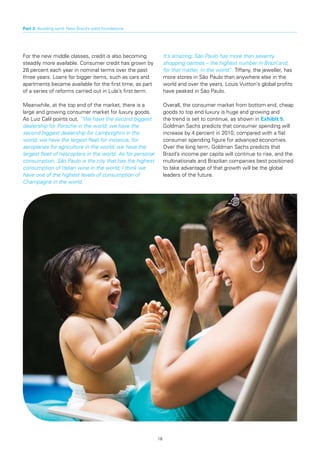
For the new middle classes, credit is also becoming               It’s amazing; São Paulo has more than seventy
steadily more available. Consumer credit has grown by             shopping centres – the highest number in Brazil and,
28 percent each year in nominal terms over the past               for that matter, in the world”. Tiffany, the jeweller, has
three years. Loans for bigger items, such as cars and             more stores in São Paulo than anywhere else in the
apartments became available for the first time, as part           world and over the years, Louis Vuitton’s global profits
of a series of reforms carried out in Lula’s first term.          have peaked in São Paulo.

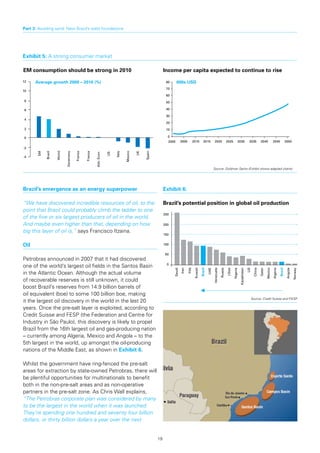
Meanwhile, at the top end of the market, there is a               Overall, the consumer market from bottom end, cheap
large and growing consumer market for luxury goods.               goods to top end luxury is huge and growing and
As Luiz Calil points out, “We have the second biggest             the trend is set to continue, as shown in Exhibit 5.
dealership for Porsche in the world; we have the                  Goldman Sachs predicts that consumer spending will
second biggest dealership for Lamborghini in the                  increase by 4 percent in 2010, compared with a flat
world; we have the largest fleet for instance, for                consumer spending figure for advanced economies.
aeroplanes for agriculture in the world; we have the              Over the long term, Goldman Sachs predicts that
largest fleet of helicopters in the world. As for personal        Brazil’s income per capita will continue to rise, and the
consumption, São Paulo is the city that has the highest           multinationals and Brazilian companies best positioned
consumption of Italian wine in the world; I think we              to take advantage of that growth will be the global
have one of the highest levels of consumption of                  leaders of the future.
Champagne in the world.


                                                             18
Part 3: Avoiding sand: New Brazil’s solid foundations


Exhibit 5: A strong consumer market

EM	consumption	should	be	strong	in	2010                                                                        Income	per	capita	expected	to	continue	to	rise
12    Average growth 2009 – 2010 (%)                                                                            80      000s USD
                                                                                                                70
10
                                                                                                                60
 8                                                                                                              50

 6                                                                                                              40

                                                                                                                30
 4
                                                                                                                20
 2                                                                                                              10

 0                                                                                                               0
                                                                                                                 2000        2005          2010         2015         2020                2025          2030              2035         2040            2045               2050

-2
                                                                      USA
       EM

            Brazil


                     World


                             Geramany

                                        France


                                                 France


                                                                            Italy


                                                                                    Mexico


                                                                                             UK


                                                                                                  Spain
                                                          Adv. Econ


-4


                                                                                                                                                                    Source: Goldman Sachs (Exhibit shows adapted charts)


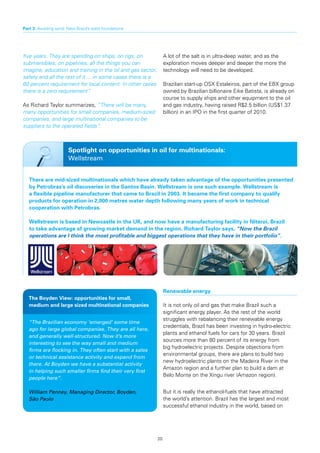
Brazil’s emergence as an energy superpower                                                                     Exhibit	6:	

“We have discovered incredible resources of oil, to the                                                        Brazil’s potential position in global oil production
point that Brazil could probably climb the ladder to one
                                                                                                               250
of the five or six largest producers of oil in the world.
And maybe even higher than that, depending on how                                                              200

big this layer of oil is,” says Francisco Itzaina.
                                                                                                               150


Oil                                                                                                            100


                                                                                                                50
Petrobras announced in 2007 that it had discovered
                                                                                                                 0
one of the world’s largest oil fields in the Santos Basin
                                                                                                                     Saudi
                                                                                                                             Iran

                                                                                                                                    Iraq

                                                                                                                                            Kuwait

                                                                                                                                                     Brazil

                                                                                                                                                              UAE
                                                                                                                                                                    Venezuela

                                                                                                                                                                                Russia

                                                                                                                                                                                         Libya

                                                                                                                                                                                                 Nigeria
                                                                                                                                                                                                           Kazakhstan

                                                                                                                                                                                                                        US

                                                                                                                                                                                                                             China

                                                                                                                                                                                                                                     Qatar

                                                                                                                                                                                                                                             Mexico
                                                                                                                                                                                                                                                      Algeria

                                                                                                                                                                                                                                                                Brazil

                                                                                                                                                                                                                                                                          Angola

                                                                                                                                                                                                                                                                                   Norway
in the Atlantic Ocean. Although the actual volume
of recoverable reserves is still unknown, it could
boost Brazil’s reserves from 14.9 billion barrels of
oil equivalent (boe) to some 100 billion boe, making
                                                                                                                                                                                                                         Source: Credit Suisse and FIESP
it the largest oil discovery in the world in the last 20
years. Once the pre-salt layer is exploited, according to
Credit Suisse and FESP (the Federation and Centre for
Industry in São Paulo), this discovery is likely to propel
Brazil from the 16th largest oil and gas-producing nation
– currently among Algeria, Mexico and Angola – to the
5th largest in the world, up amongst the oil-producing
nations of the Middle East, as shown in Exhibit	6.

Whilst the government have ring-fenced the pre-salt
areas for extraction by state-owned Petrobras, there will
be plentiful opportunities for multinationals to benefit
both in the non-pre-salt areas and as non-operative
partners in the pre-salt zone. As Chris Wall explains,
“The Petrobras corporate plan was considered by many
to be the largest in the world when it was launched.
They’re spending one hundred and seventy four billion
dollars, or thirty billion dollars a year over the next


                                                                                                          19
Part 3: Avoiding sand: New Brazil’s solid foundations


five years. They are spending on ships, on rigs, on               A lot of the salt is in ultra-deep water, and as the
submersibles, on pipelines, all the things you can                exploration moves deeper and deeper the more the
imagine, education and training in the oil and gas sector,        technology will need to be developed.
safety and all the rest of it ... in some cases there is a
60 percent requirement for local content. In other cases          Brazilian start-up OSX Estaleiros, part of the EBX group
there is a zero requirement”.                                     owned by Brazilian billionaire Eike Batista, is already on
                                                                  course to supply ships and other equipment to the oil
As Richard Taylor summarizes, “There will be many,                and gas industry, having raised R$2.5 billion (US$1.37
many opportunities for small companies, medium-sized              billion) in an IPO in the first quarter of 2010.
companies, and large multinational companies to be
suppliers to the operated fields”.


                       Spotlight on opportunities in oil for multinationals:
                       Wellstream


   There	are	mid-sized	multinationals	which	have	already	taken	advantage	of	the	opportunities	presented	
   by	Petrobras’s	oil	discoveries	in	the	Santos	Basin.	Wellstream	is	one	such	example.	Wellstream	is	
   a	flexible	pipeline	manufacturer	that	came	to	Brazil	in	2003.	It	became	the	first	company	to	qualify	
   products	for	operation	in	2,000	metres	water	depth	following	many	years	of	work	in	technical	
   cooperation with Petrobras.

   Wellstream	is	based	in	Newcastle	in	the	UK,	and	now	have	a	manufacturing	facility	in	Niteroi,	Brazil	
   to	take	advantage	of	growing	market	demand	in	the	region.	Richard	Taylor	says,	“Now the Brazil
   operations are I think the most profitable and biggest operations that they have in their portfolio”.


                                                                  Renewable energy
   The	Boyden	View:	opportunities	for	small,	
   medium and large sized multinational companies                 It is not only oil and gas that make Brazil such a
                                                                  significant energy player. As the rest of the world
                                                                  struggles with rebalancing their renewable energy
   “The Brazilian economy ‘emerged’ some time
                                                                  credentials, Brazil has been investing in hydro-electric
   ago for large global companies. They are all here,
                                                                  plants and ethanol fuels for cars for 30 years. Brazil
   and generally well-structured. Now it’s more
                                                                  sources more than 80 percent of its energy from
   interesting to see the way small and medium
                                                                  big hydroelectric projects. Despite objections from
   firms are flocking in. They often start with a sales
                                                                  environmental groups, there are plans to build two
   or technical assistance activity and expand from
                                                                  new hydroelectric plants on the Madeira River in the
   there. At Boyden we have a substantial activity
                                                                  Amazon region and a further plan to build a dam at
   in helping such smaller firms find their very first
                                                                  Belo Monte on the Xingu river (Amazon region).
   people here”.

   William Penney, Managing Director, Boyden,                     But it is really the ethanol-fuels that have attracted
   São Paolo                                                      the world’s attention. Brazil has the largest and most
                                                                  successful ethanol industry in the world, based on


                                                             20
Part 3: Avoiding sand: New Brazil’s solid foundations


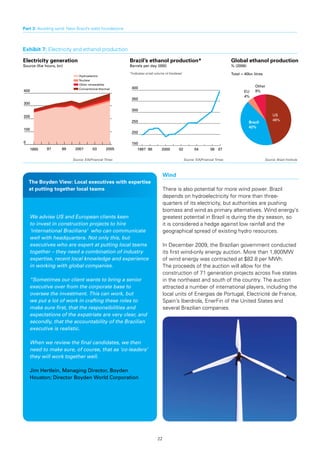
home-grown sugar cane, not on food grains as in many              and cheaper. Definitely Brazil will become a leader in
other countries.                                                  that area”.

Following the oil shocks of the ‘70s, which doubled               Brazilian innovation has enabled flex-fuel technology
Brazil’s import bill within a year and triggered                  to become workable and affordable. The Brazilian
uncontrolled inflation, the government made mandatory             subsidiaries of Bosch Magneti Marelli and Delphi
the use of ethanol blends with gasoline. Last year, 94            Automotive Systems have been instrumental in
percent of all new cars were ‘flex-fuel’, with engines            developing flex-fuel technology.
that allow for either gasoline or ethanol or any choice
of the two, depending on the driver’s choice. Brazil is           The latest innovation within the Brazilian flexible-fuel
now the world’s largest ethanol exporter and its second           technology is the development of flex-fuel motorcycles,
largest ethanol producer after the United States, as              with the first flex motorcycle launched by Honda in
shown in Exhibit	7.                                               March 2009.

As Richard Taylor says, “Brazil has reached a world               There are big opportunities for growth and investment
leadership position here ... it will probably be at the           in this area.
forefront of new innovations as well”. Francisco Itzaina
echoes this when he says ,“You find this country                  George Soros invested $800 million in ethanol
leading the world in sustainable energy technology.               distilleries through a local subsidiary, Adecoagro; the
Many things that are being done today are an incubator            Cargill Group bought 63 percent of Cevasa, the largest
for the technology that will change the years ahead”.             ethanol plant in Brazil; and the US’s Global Foods will
                                                                  invest US$1 billion to construct ethanol plants. Richard
Gaetano Crupi notes, “Brazil has more patent protection           Taylor points out that there is “a big opportunity to have
filings in energy and agriculture than pharmaceuticals            more bio components in trains, buses and electricity
or any other area. So there is a lot of investment there          generation equipment”. Most public transport is
and there is a lot of technology and it is getting cleaner        running on fossil fuels, but could be run on biodiesel.


                                                             21
Part 3: Avoiding sand: New Brazil’s solid foundations


Exhibit	7:	Electricity and ethanol production

Electricity generation                                  Brazil’s ethanol production*                                         Global	ethanol	production
Source (Kw hours, bn)                                   Barrels per day (000)                                                % (2006)
                                                        *Indicates small volume of biodiesel                                 Total = 40bn litres
                              Hydroelectric
                              Nuclear
                              Other renewables
                                                         400                                                                               Other
                              Conventional thermal
400                                                                                                                                 EU     8%
                                                                                                                                    4%
                                                         350
300
                                                         300
200                                                                                                                                                     US
                                                         250                                                                                            46%
                                                                                                                                        Brazil
                                                                                                                                        42%
100
                                                         200

0                                                        150
    1995    97      99     2001        03       2005         1997 98          2000        02          04         06 07

                          Source: EIA/Financial Times                                          Source: EIA/Financial Times                         Source: Brazil Institute


                                                                                Wind
    The	Boyden	View:	Local	executives	with	expertise	
    at putting together local teams                                             There is also potential for more wind power. Brazil
                                                                                depends on hydroelectricity for more than three-
                                                                                quarters of its electricity, but authorities are pushing
                                                                                biomass and wind as primary alternatives. Wind energy’s
    We advise US and European clients keen                                      greatest potential in Brazil is during the dry season, so
    to invest in construction projects to hire                                  it is considered a hedge against low rainfall and the
    ‘international Brazilians’ who can communicate                              geographical spread of existing hydro resources.
    well with headquarters. Not only this, but
    executives who are expert at putting local teams                            In December 2009, the Brazilian government conducted
    together – they need a combination of industry                              its first wind-only energy auction. More than 1,800MW
    expertise, recent local knowledge and experience                            of wind energy was contracted at $82.8 per MWh.
    in working with global companies.                                           The proceeds of the auction will allow for the
                                                                                construction of 71 generation projects across five states
    “Sometimes our client wants to bring a senior                               in the northeast and south of the country. The auction
    executive over from the corporate base to                                   attracted a number of international players, including the
    oversee the investment. This can work, but                                  local units of Energias de Portugal, Electricité de France,
    we put a lot of work in crafting these roles to                             Spain’s Iberdrola, EnerFin of the United States and
    make sure first, that the responsibilities and                              several Brazilian companies.
    expectations of the expatriate are very clear, and
    secondly, that the accountability of the Brazilian
    executive is realistic.

    When we review the final candidates, we then
    need to make sure, of course, that as ‘co-leaders’
    they will work together well.

    Jim Hertlein, Managing Director, Boyden
    Houston; Director Boyden World Corporation


                                                                           22
Part 3: Avoiding sand: New Brazil’s solid foundations


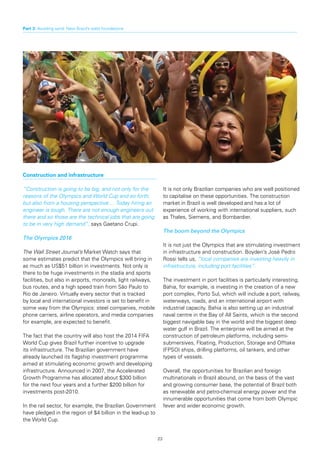
Construction and infrastructure

“Construction is going to be big, and not only for the              It is not only Brazilian companies who are well positioned
reasons of the Olympics and World Cup and so forth,                 to capitalise on these opportunities. The construction
but also from a housing perspective.... Today hiring an             market in Brazil is well developed and has a lot of
engineer is tough. There are not enough engineers out               experience of working with international suppliers, such
there and so those are the technical jobs that are going            as Thales, Siemens, and Bombardier.
to be in very high demand”, says Gaetano Crupi.
                                                                    The boom beyond the Olympics
The Olympics 2016
                                                                    It is not just the Olympics that are stimulating investment
The Wall Street Journal’s Market Watch says that                    in infrastructure and construction. Boyden’s José Pedro
some estimates predict that the Olympics will bring in              Rossi tells us, “local companies are investing heavily in
as much as US$51 billion in investments. Not only is                infrastructure, including port facilities”.
there to be huge investments in the stadia and sports
facilities, but also in airports, monorails, light railways,        The investment in port facilities is particularly interesting.
bus routes, and a high speed train from São Paulo to                Bahia, for example, is investing in the creation of a new
Rio de Janeiro. Virtually every sector that is tracked              port complex, Porto Sul, which will include a port, railway,
by local and international investors is set to benefit in           waterways, roads, and an international airport with
some way from the Olympics: steel companies, mobile                 industrial capacity. Bahia is also setting up an industrial
phone carriers, airline operators, and media companies              naval centre in the Bay of All Saints, which is the second
for example, are expected to benefit.                               biggest navigable bay in the world and the biggest deep
                                                                    water gulf in Brazil. The enterprise will be aimed at the
The fact that the country will also host the 2014 FIFA              construction of petroleum platforms, including semi-
World Cup gives Brazil further incentive to upgrade                 submersives, Floating, Production, Storage and Offtake
its infrastructure. The Brazilian government have                   (FPSO) ships, drilling platforms, oil tankers, and other
already launched its flagship investment programme                  types of vessels.
aimed at stimulating economic growth and developing
infrastructure. Announced in 2007, the Accelerated                  Overall, the opportunities for Brazilian and foreign
Growth Programme has allocated about $300 billion                   multinationals in Brazil abound, on the basis of the vast
for the next four years and a further $200 billion for              and growing consumer base, the potential of Brazil both
investments post-2010.                                              as renewable and petro-chemical energy power and the
                                                                    innumerable opportunities that come from both Olympic
In the rail sector, for example, the Brazilian Government           fever and wider economic growth.
have pledged in the region of $4 billion in the lead-up to
the World Cup.


                                                               23
Part 4:

   The Boyden View: Hiring in Brazil
   Understanding ‘o jeitinho brasileiro’

   “Egos flourish in a different way in different
   parts of the world”.
   Francisco Itzaina
   President – South America of Rolls-Royce International


In order to understand talent in Brazil, one has to               and Italian are still spoken alongside Portuguese.
understand “o jeitinho brasileiro” – meaning the                  Gaetano Crupi points out that, “During the military
Brazilian Way. The Brazilian Way is a unique formula,             years, France was the one really hosting all the
redolent with European and immigrant influence,                   philosophers and thought leaders from Brazil. So that
morphed into its own unique South American form.                  link always existed”.
As Chris Wall says, “Brazil is mixture of Germans and
Italians and Spanish and Portuguese and Arabs from                Chris Wall calls Europe Brazil’s ‘muse’: “Brazil tends
the Middle East, not forgetting the huge population of            to look towards Europe much more than it tends to
Brazilians who are descended from the slaves which                look towards the United States as its muse in industrial
were brought over from Africa to work on the sugar                development culturally and commercially”.
plantations, and the large population in São Paulo which
is descended from Japanese immigrants. All mixed up               The relationship with the US is interesting.
together, all the result of waves of immigration over             An Economist article suggests that Brazil and the
the last 100 to 130 years”. São Paulo is the largest              United States have more in common than they realise,
Italian city in the world, for example: home to 6 million         with the relationship involving egos in a different
Italians, whereas the entire metropolitan area of Rome,           way. As Gaetano Crupi puts it, “Brazil does not like
the largest city in Italy itself, is home to a maximum            the ‘young child syndrome’, they do not want to be
estimate of 3.7 million people, according to the OECD.            dependent on the US”.

The entrepreneurial spirit is strong. Chris Wall observes         So, to take Francisco Itzaina’s axiom, that “egos
“There is this drive. Don’t forget it’s the new world             flourish in a different way in different parts of the
– people whose immediate relatives left Europe for                world”, drawing upon Brazil’s executive talent means
Brazil, took a risk, and so they tend to be people who            understanding what makes egos flourish in different
have grown up in a culture of ‘can do’. And a culture             contexts, cultures, and regions.
of ‘yes, my parents might have been poor, but I am
going to be better’”. Klaus Pavel, Chairman of Aachen-            Next, we share insights from senior executives and
Laurensberger Rennverein, makes the contrast with                 Boyden professionals on how to go about hiring
Europe: “My impression is that there is quite a strong            talented executives in Brazil and the skills that are
entrepreneurial culture, maybe more there than in                 strategically and tactically important.
Europe, where my impression is that it is suffering from
so much regulation”.                                              1 The multi-sensory imperative

However, the cultural link with Europe is powerful.               The first thing for foreign executives in multinationals
About 54 percent (103 million) of Brazilians are mainly           who are hoping to expand their Brazilian subsidiaries
of European origin, descendants of immigrants from                and need to find the right talent, is to travel to Brazil to
Portugal, Italy, Spain, Germany and Eastern Europe.               get a feel for the jeitinho brasileiro. Francisco Itzaina
South of São Paulo, in the rich agricultural region, there        advises: “The first thing to do is get on a plane and
exist European-style standards of living, where German            come over here, in order to understand everything.


                                                             24
Part 4: The Boyden view on hiring in Brazil


That cultural distance – it has to be bridged. There is          The Fundação Dom Cabral/Columbia Law School survey
nothing better than the direct exploration of a country          on the top 20 Brazilian multinationals shows that top
for you to know that you have to be there, understand            multinationals realise that home-grown talent is best:
how it all works”.                                               all 20 CEOs are Brazilian. Only five of the 157 board
                                                                 members are non-Brazilian (3%). Eight of the top 20 say
2	Invest	in	home-grown	talent,	not	expatriates                   that they speak Spanish or English as well as Portuguese.
                                                                 John Murray adds, “You want a good manager? We will
The quality of home-grown talent is there. As Klaus              find you an executive who understands – don’t bring one
Pavel says, “There are excellent executives in Brazil,           down, hire one locally”.
there is very good education, good universities: they
don’t have to come from overseas necessarily. They               3 Understand the benefits that are
have good resources in Brazil as far as management is            meaningful locally
concerned”.
                                                                 Brazilian perks are somewhat different in Brazil to
Skills have expanded over the last decade, with most             elsewhere in the world. Cars, for example, are still
Brazilians now speaking a number of languages, for               important, as Francisco Itzaina explains: “Recognition
example. “The abilities of most Brazilians have grown            for all people is an important issue, the car that you
tremendously over the years,” observes Francisco                 give somebody, you know cars in Brazil are still an
Itzaina. “When I first came to Brazil thirty-four years          important factor”.
ago, it was difficult to hire anybody off the street that
was bilingual. Today, practically every kid you talk to          He also touches on the world of golf and why it has a
nowadays speaks English”. Mark Pitt adds that home               different status value in Brazil: “There are various aspects
grown talent has the advantage of being more stable              that are different from other parts of the world. In the US
and less likely to head back home: “Companies that               you go play golf anywhere, for not too high a fee. In Brazil
have been successful over the long run, most of them             you have to be a member of a country club and most
pepper the structure with local talent. They have                of the time you have to pay fees of maybe 135 to 160
evolved from the tendency to put in expats. They have            Brazilian Reais an hour. All of these make a difference”.
got that continuity in management development over
decades”. Brazilians understand the Brazilian way.               In general, benefits packages for expat executives still
They have their own networks. It demonstrates that               need to be bigger in Brazil than in European or ‘home’
your company is investing locally. As John Murray says,          countries. Klaus Pavel explains, “Packages are much
“They should know how government works here.                     bigger because you get the house and you get the
They should have their own contacts and their own                servants and you get a couple of cars, if you are talking
networking. That is something the expat can                      about high level management and I think you get more
never have”.                                                     benefits over in Brazil than you get in Germany”.

                                                                 4 Use the power of job titles and big brands

                                                                 In Brazil, job titles and big brand names have status value.
                                                                 As Chris Wall observes, “There is a desire to have a title.
                                                                 Which is what we sometimes call the hard subjects,
                                                                 engineering, dentistry, medicine – the labels. These are
                                                                 taken tremendously seriously in Brazil. And to be able to
                                                                 work in a company that is a world name, or a household
                                                                 name ... there is this ambition to get a foothold to work
                                                                 for either one of these global companies, or for a Brazilian
                                                                 company that is competing with them”.

                                                                 5	Use	a	personal	approach,	and	concentrate	on	
                                                                 relationship-building

                                                                 A significant difference between the Anglo-Saxon
                                                                 and the Brazilian way is in the importance of personal
                                                                 relationships and informal networks in doing business.


                                                            25
Part 4: The Boyden view on hiring in Brazil


As Mark Pitt describes, “In the US, communication                 6	Rigour	is	paramount:	don’t	be	seduced	by	the	
is pretty much canned and electronic. People will                 tactile approach
depend a lot on very formal networks to get things
done. I think there is an awareness now that informal             The softer relationship is crucial, but make no
communication and networking are important get                    mistake: it does not mean that Brazilians are any
things done more quickly”. The temptation to                      less professional. Chris Wall shares his experience:
communicate at arm’s length should be avoided, as                 “Brazilians are quite formal in business. They come to
Chris Wall says; “There is a Brazilian way of doing               meetings supremely well prepared on your business,
things which is Latin, which is tactile, which is to do           your website, your product, who else you are selling
with building up relationships, not to do with hands              to ... a certain formality which comes straight from
off ... Brazilians do business with people they                   business school. But they do business with you
consider friends”.                                                because you have ‘hugged each other’ in a manner of
                                                                  speaking. That is the drinks, the dinner, talking about
Richard Taylor describes the frustration that can                 each other’s families, meeting the family. I suppose one
be encountered by people used to an Anglo-                        of the dangers is to be seduced into the tactile part and
Saxon approach: “A lot more time is spent building                think that I will forget about the formality. Don’t. You
relationships. It can be quite frustrating for someone            have to get that right”.
who is more used to a US-style approach of organising
a meeting, expecting an outcome from that meeting                 7	The	warmth	must	extend	to	the	factory	floor
and going home with a contract. It takes time to build
the relationship, and it’s a little more pronounced here”.        Being good at relationships is not just about being good
                                                                  with other senior executives. Luiz Calil describes how
In summary, it is about a ‘softer relationship’, as Luiz          he aims to create a ‘second home’ for employees,
Calil puts it: “Our people work hard and they are very            “We want to be the second home of our people,
professional, but at the same time they create an                 generating an environment where people feel they are
atmosphere where you can have a softer relationship.              in their second house. We generate an environment
Very sincere, very open”.                                         to care about the safety of people working in the
                                                                  operation. We provide a great place for people
                                                                  to develop”.


                                                             26
Part 4: The Boyden view on hiring in Brazil


This is clearly an approach that works; Caterpillar was           it means that you may not necessarily be able to link
voted best company to work for in Brazil in 2009.                 performance with reward, and that is extremely important
                                                                  for productivity”.
Francisco Itzaina echoes the idea of creating a home
away from home, when he talks about the importance                9	Ability	to	communicate	with	the	Headquarters
of bringing in the families at all levels: “I’ve had
situations in the past where I had direct command                 For the executive in the multinational, a skill is needed in
over thousands of people, and in those cases, you                 communicating between the two worlds of the Brazilian
have a very close approach to the people. You know,               reality and the corporate Headquarters. As Mark Pitt
bringing the families together once a year, all that has a        says, “if you are talking about American companies,
tremendous importance. I’ve seen the same in the US,              you need an executive that can translate or articulate
but it’s different, there are cultural elements”.                 the challenges and the quirks of the Brazilian market
It is a “management presence by walking around”                   to the US executive team”. Boyden’s John Murray
that works, according to Gaetano Crupi.                           echoes Mark Pitt: “The executive has got to have skills
                                                                  in communicating within multinational organisations. You
Personal relationships at every level are more important          don’t want to let a prima donna loose in Brazil. You need
in Brazil than elsewhere, as Mark Pitt describes:                 somebody who already has experience in making sure
“In countries like Brazil, you have got to go a little bit        that the Headquarters are well-informed all the time. If he
further in terms of feedback, people expect more face             has worked abroad in one of these offices then it makes
to face contact than in Europe or in the US”.                     him even stronger”. John Murray adds that the MBA
                                                                  qualification can be valuable, because it demonstrates an
8	Flexibility                                                     ability to adapt in an international environment: “A foreign
                                                                  MBA shows that the executive can adapt, that he has
There are significant structural and ethical challenges           been abroad, he has studied abroad and he has got the
in doing business in Brazil. Executives therefore need            language skills”.
to have a certain flexibility about them in order to get
things done well. Klaus Pavel describes this: “The                10	Maximise	the	Brazilian	talent	you	
Brazilians are very, very flexible and a German manager,          already have
for example, who adopts an ‘official’ approach, has
to learn that you have to be flexible in order to be              In the global recession, financial capital from Brazil
successful in Brazil. That is very, very important, yes”.         was used to ‘shore up the balance sheet’ by many
Mark Pitt describes firstly the ethical complications that        multinationals. Whether or not in a global recession,
make flexibility critical: “[You need] an executive that          human capital should also be maximised across the
can execute on the ground with all the restrictions that          global company. Use Brazilians to train other teams,
exist in Brazil, but can execute according to the rules           increase productivity and enhance rotation programmes
of an American company”. Secondly, he describes the               in order to pluralize their expertise internationally. Brazilian
regional complexity that makes flexibility so necessary.          executives are on the big stage and have much to
“Brazil is a large and complex country, very similar to           impart to their global colleagues.
the US in that sense, and like the US, you cannot be
successful just with a national plan, you have to have a          In	conclusion
plan that is broken up by region. Some regions in Brazil
are so different that things you apply in one region              “You have got to have an executive that is sharp,
aren’t applicable in others”.                                     can make decisions, but at the same time is smooth,
                                                                  is somebody enjoyable to talk to, is someone that
The mandatory salary increase also presents a                     believes in a win-win approach” – so Gaetano Crupi
challenge to senior executives, again forcing a more              sums up the talents required of the best senior
flexible approach. Gaetano Crupi explains the challenge           executives in Brazil. Finding such people is no mean
this presents to rewarding good performance:                      feat. This is why Boyden and others have experienced
“Brazil has an annual, mandatory salary increase. This is         teams on the ground in São Paulo and Rio de Janeiro,
a huge challenge – how do you reward salary increase              with strong networks, helping the world’s best
with performance when you know that you are going                 companies find the strongest talent to head up their
to have a mandatory salary increase that everyone will            expansion in Brazil.
get, regardless of performance, and that is usually a
little bit over inflation? That is a big challenge because


                                                             27
Appendix


About the report
This report was developed by Boyden World Corporation in collaboration with the strategic
research and consulting group Lighthouse Global (www.lighthouseglobal.eu.com). Special
thanks go to Dan Margolis, at business and financial communications firm FD (www.fd.com),
for his perspective and support. The content was created from a combination of primary and
secondary data sources, and a series of interviews with business leaders and experts, including:

•	 Luiz	Calil,	President	of	Caterpillar,	Brazil	
•	 Francisco	Itzaina,	President	–	South	America	of	Rolls-Royce	International
•	 Gaetano	Crupi,	General	Manager	of	Abbott	in	Brazil	
•	 Mark	Pitt,	President	of	Sherwin	Williams	in	Brazil	
•	 Klaus	Pavel,	Chairman	of	the	Aachen-Laurensberger	Rennverein	
•	 Chris	Wall,	Business	Specialist	for	Brazil	at	UK	Trade	and	Investment
•	 Richard	Taylor,	CEO	of	Taylorenergies	Business	Development,	Chairman	of	CleanStar	Brasil		
   Bioenergia Ltda, former President of British Petroleum in Brazil and founding Director of the
   International Business Academy for Development delivering executive education between the
   UK, Brazil and China

The Boyden Reports
Other reports in this series:
The Boyden Report: India – The Sun Rises on the Indian Executive
The Boyden Report: China – Exploding the Myths in China
The Boyden Report: Latin America – Multi-latinas drive Latin America’s Destiny

Sources
•	 Banco	Central	do Brazil
•	 Federation	of	Industries	of	the	State	of	São	Paulo	(FIESP)
•	 Exame
•	 IBGE,	Instituto	Brasileiro	de	Geografia	e	Estatística
•	 Goldman	Sachs	
•	 Boston	Consulting	Group
•	 United	Nations	Conference	on	Trade	and	Development
•	 The	Financial	Times
•	 The	Economist
•	 Wall	Street	Journal
•	 USA	Census	Bureau
•	 CIA	World	Factbook
•	 University	of	Austin,	Texas
•	 Trusted	Sources	Research	and	Networks

About Boyden
Boyden is a global leader in the executive search industry with more than 70 offices in over
40 countries. Founded in 1946, Boyden specializes in high-level executive search, interim
management, and human capital consulting across a broad spectrum of industries.

For further information and to access additional articles, papers and research from Boyden,
visit www.boyden.com


                                 28
www.boyden.com


 |   Europe   Middle East   Africa   |   The Americas   |   Asia   Pacific   |