ENGLISH FOR YOUNG LEARNERS (EYL) /
TEACHING ENGLISH TO YOUNG LEARNERS
(TEYL)
By:
Sri Supiah Cahyati, M.Pd
English Education Study Program
STKIP Siliwangi
2017
Session 1
• Syllabus (see Attachment)
• Project (see Attachment)
• Some Terms in Teaching English
Some Terms in Teaching English
TESL (Teaching English as a Second Language) :
Learning of English by immigrants to a country where English is the native
language.
Ex : Korean child moved to Australia is an ESL learner in her English class.
TEFL (Teaching English as a Foreign Language):
Learning of English by students in a country where English is
not the native language.
Ex: Children are learning English at school, university,
or a language school in their own country.
• Teacher as a role model
• Daily conversation (classroom language) as exposure
to the students.
• Students tend to imitate the teacher.
Using English as a Means of
Communication to Students
Good morning everybody how are
you? (I’m fine)
Good morning everybody how are
you?
(I’m fine)
Good morning to you,
Good morning everybody how are
you?
(I’m fine)
1 Good Morning
1 Alphabet Song
A B C D E F G
H I J K L M N O P
Q R S T U V
W X Y and Z
Now I know my
ABC
Next time won’t
you sing with me
A B C D E F G
H I J K L M N
O P Q R S T U
V W X Y Z
Session 2
• Characteristics of Young Language Learners
• Some Myths and Misconception about SL/FL
Learning
• Skills should be Taught First in TEYL
Characteristics of Young Learners
(Pinter, 2006)
• Children are at pre-school/in the first couple of
years of schooling.
• Generally they have a holistic approach to
language, which means that they understand
meaningful messages but cannot analyze
language yet.
• They have lower levels of awareness about
themselves as language learners as well as
about process of learning.
• They have limited reading & writing skills even
in their first language.
• Generally, they are more concerned about
themselves than others.
• They have a limited knowledge about the world.
• They enjoy fantasy, imagination, & movement.
VYLs (under 7) YLs (7-12)
• Acquire through hearing and
experiencing lots of English, in much the
same way they acquire L1
• Learn things through playing; they are
not consciously trying to learn new
words or phrases – for them it’s
incidental
• Love playing with language sounds,
imitating, and making funny noises
• Not able to organize their learning
• Not able to read or write in L1;
important to recycle language through
talk and play
• Their grammar will develop gradually on
its own when exposed to lots of English
in context
• Are learning to read and write in L1
• Are developing as thinkers
• Understand the difference between the
real and the imaginary
• Can plan and organize how best to carry
out an activity
• Can work with others and learn from
others
• Can be reliable and take responsibility
for class activities and routines
For more information, see: Slattery, M., & Willis, J. (2001). English
for primary teachers. Oxford: Oxford University Press.
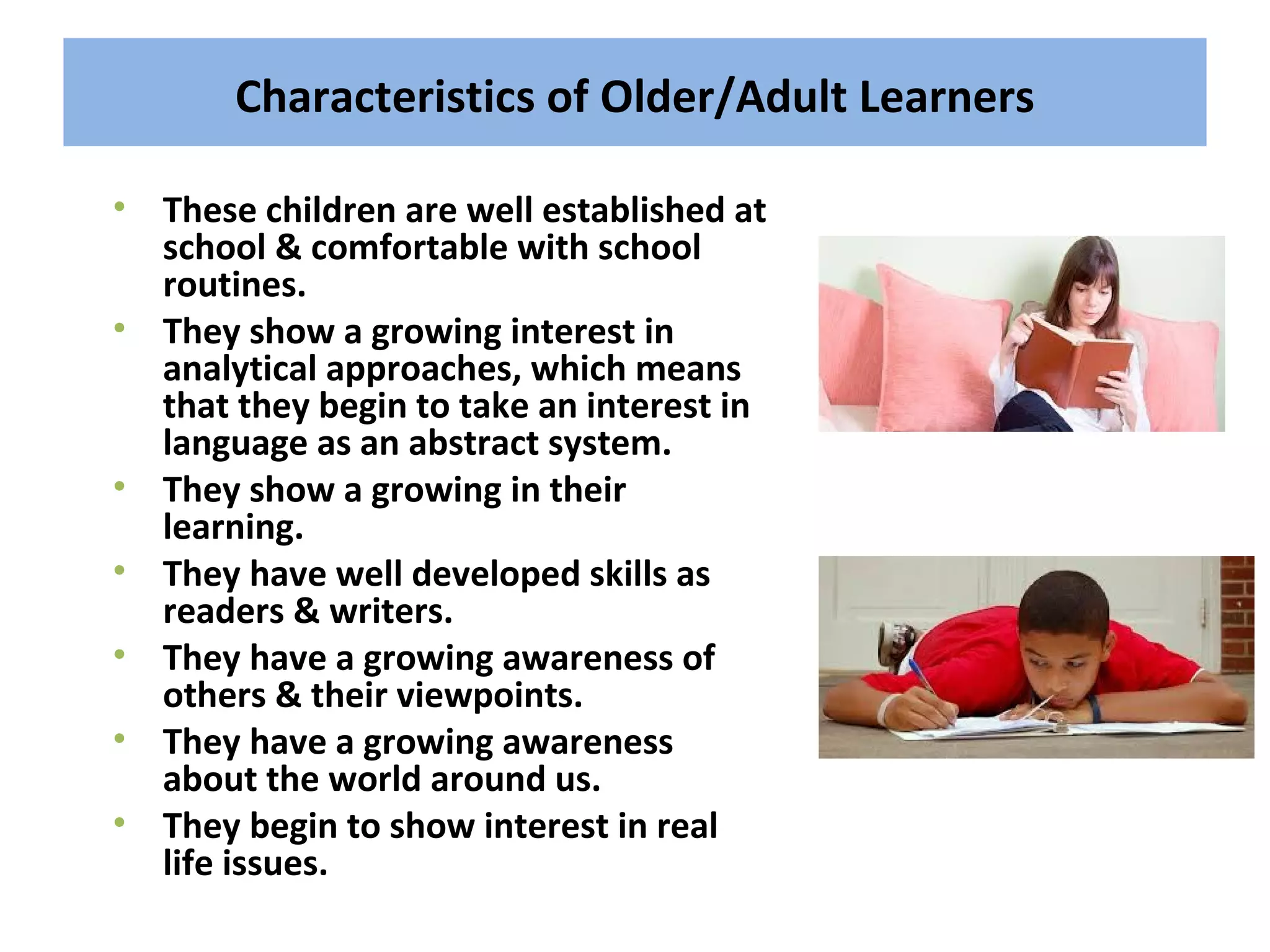
Characteristics of Older/Adult Learners
• These children are well established at
school & comfortable with school
routines.
• They show a growing interest in
analytical approaches, which means
that they begin to take an interest in
language as an abstract system.
• They show a growing in their
learning.
• They have well developed skills as
readers & writers.
• They have a growing awareness of
others & their viewpoints.
• They have a growing awareness
about the world around us.
• They begin to show interest in real
life issues.
Misconceptions in teaching approach to younger learners
can lead to failure
(Musthafa, 2000)
• Teacher tend to approach the teaching-learning process & employ teaching
methods & techniques for the teaching English to young learners in an
exactly the same way as they would teach adult learners.
• Actually, children have their own culture & learning preferences. They learn
by way of physical activities that embedded in their daily life, they have a
relatively short attention span, & they learn with the motive of meeting
immediate goals (here & now principle)
Some myths and misconceptions about
second/foreign language learning
(Musthafa: 2000)
A. Children learn second/foreign languages
quickly & easily.
Adolescents & adults perform better than
young children under controlled conditions,
except pronunciation. Young children do not
have access to the memory techniques &
other strategies that more experiences
learners use in acquiring vocabulary & in
learning grammatical rules. Children are
more likely to be shy & embarrassed around
peers that are adults.
Some myths and misconceptions about
second/foreign language learning
(Musthafa: 2000)
B. The younger the child, the more skilled in acquiring an L2/FL
Oyama (in Pinter, 2006) found that the earlier a learner begins a
second language, the more native like the accent he/she developed.
An early start for “foreign” language learners makes a long sequence
of instruction leading to potential communicative proficiency possible
& enables children to view L2 learning & related cultural insight as
normal & integral.
Beginning language instruction gives children more exposure to the
language.
Some myths and misconceptions about
second/foreign language learning
(Musthafa: 2000)
C. The more time students spend in an
L2/FL context, the quicker they learn
the language.
The increased exposure to English does
not necessarily speed the acquisition of
English. Children with exposure to the
home language & to English acquire
English language skills equivalent to
those acquired by children who have
been in English-only program.
Some myths and misconceptions about
second/foreign language learning
(Musthafa: 2000)
D. Children have acquired an L2/FL once they can speak it
For school-aged children, proficiency in face-to-face
communication does not imply proficiency in the more
complex academic language needed to engage in many
classroom activities. Children may have language problems
in reading & writing that are not apparent if their oral
abilities are used to gauge their English proficiency.
Some myths and misconceptions about
second/foreign language learning
(Musthafa: 2000)
E. All children learn an L2/FL in the same way
Some children are outgoing, sociable & learn the second language
quickly, they do not worry about mistakes, but use limited resources to
generate input from native speakers. Other children are shy & quite,
they learn by listening & watching, they say little, for fear of making a
mistake. Children are likely to be more responsive to a teacher who
affirms the values of the home culture.
Skills should be taught in TEYL
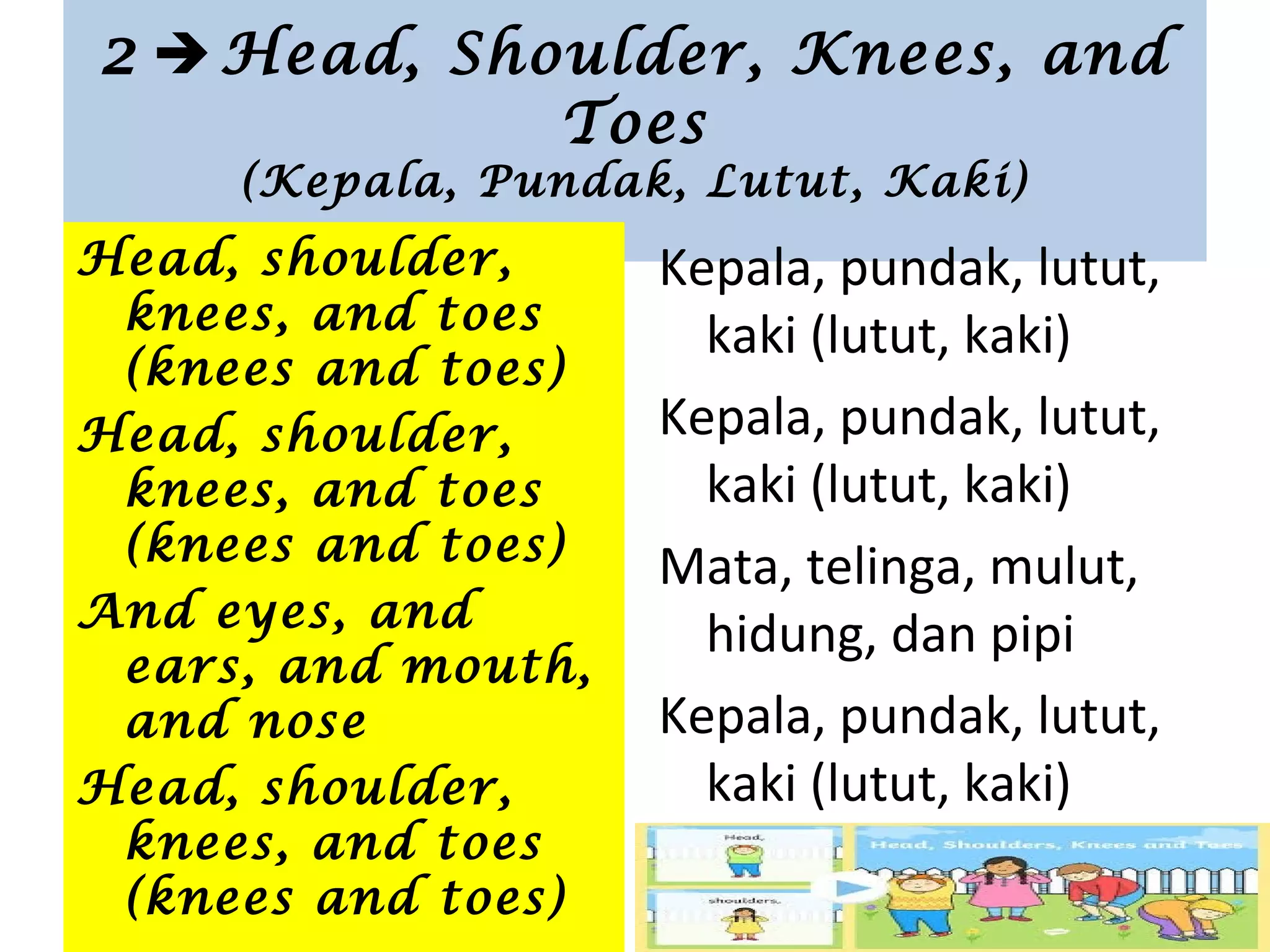
2  Head, Shoulder, Knees, and
Toes
(Kepala, Pundak, Lutut, Kaki)
Kepala, pundak, lutut,
kaki (lutut, kaki)
Kepala, pundak, lutut,
kaki (lutut, kaki)
Mata, telinga, mulut,
hidung, dan pipi
Kepala, pundak, lutut,
kaki (lutut, kaki)
Head, shoulder,
knees, and toes
(knees and toes)
Head, shoulder,
knees, and toes
(knees and toes)
And eyes, and
ears, and mouth,
and nose
Head, shoulder,
knees, and toes
(knees and toes)
Days
(Nama-Nama Hari)
Senin, Selasa,
Rabu, Kamis,
Jumat, Sabtu, Minggu
Itu nama-nama hari
Sunday, Monday,
Tuesday,
Wednesday,
Thursday, Friday,
Saturday
=> (2x)
Session 3
• Basic Concepts of Language Teaching
• Mutiple Intelligences
• Theories of Children Learning Development
• TEYL in Indonesia Context
(Assignment: Identifying English teaching-learning
for YL, the name of the school, the book used, the
way the teacher teach, the assignment given)
How to teach English
in Classroom Context
Discussion
How to be a good teacher?
How to describe learning and teaching?
How to teach across age levels?
 Teaching children,
Teaching teens,
Teaching adults
How to plan lessons?
Workshop: Teaching Materials and supplementary
How to be a good teacher?
A. How should teachers give instruction?
B. Who should talk in class?
A. What makes a good teacher?
Source: Private language School students in Britain (Harmer, 2004)
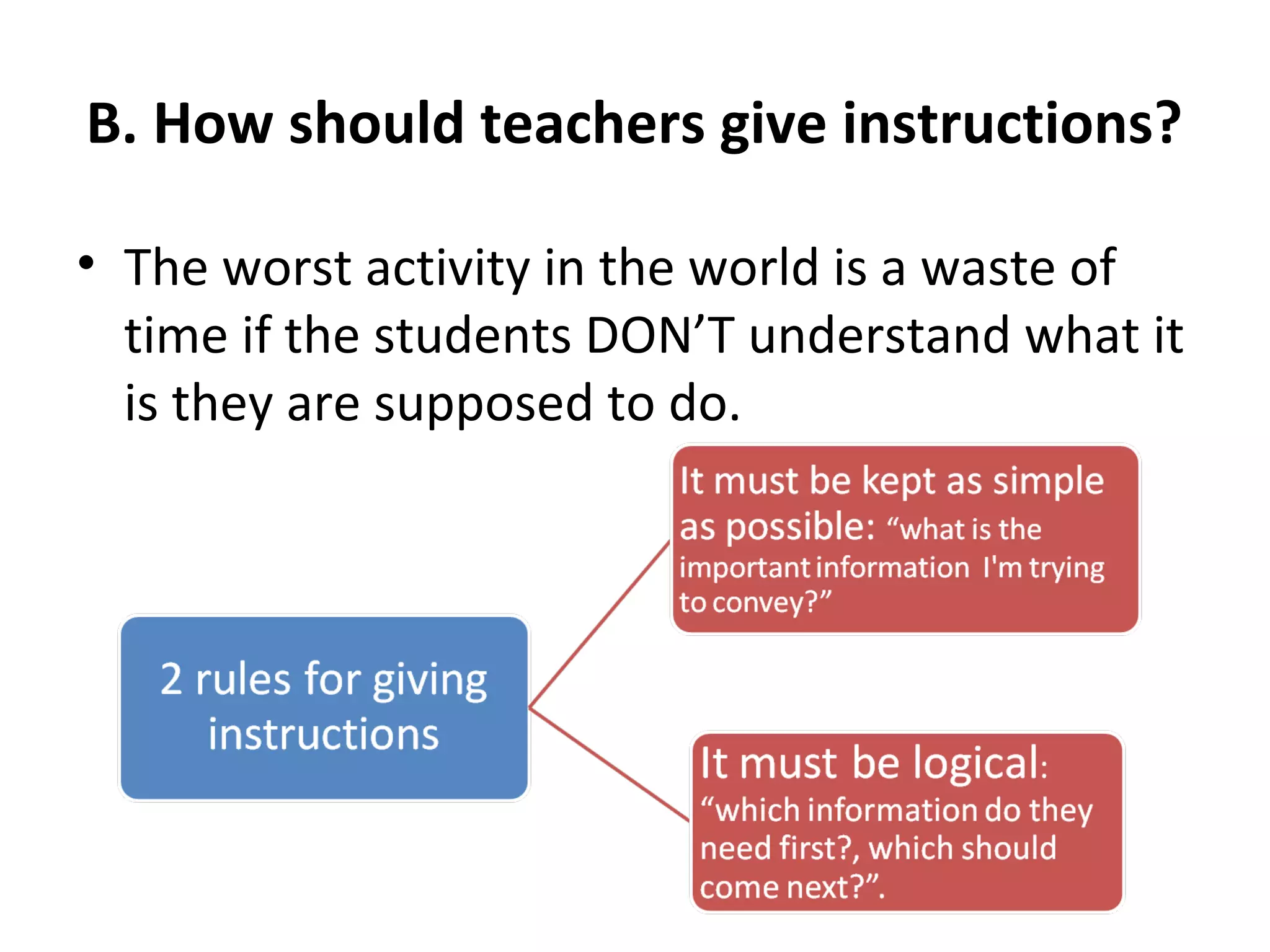
B. How should teachers give instructions?
• The worst activity in the world is a waste of
time if the students DON’T understand what it
is they are supposed to do.
C. Who should talk in class?
TTT (Teacher Talking Time) -- STT (Student Talking Time)
Students are the people who need practice, in other words, not the
teacher .
A good teacher maximizes STT and minimizes TTT
How is TTT ineffective?
when the teacher’s voice drones on and on day after day and
where she/he hardly ever hear the students say anything /apply the
lesson – TTT is considered over-used and not very attractive.
When TTT is EFFECTIVE?
when the T knows the rough-tune language to students’ level 
The Ss get a change to hear the language which is certainly above
their own productive level, but they can more or less understand!
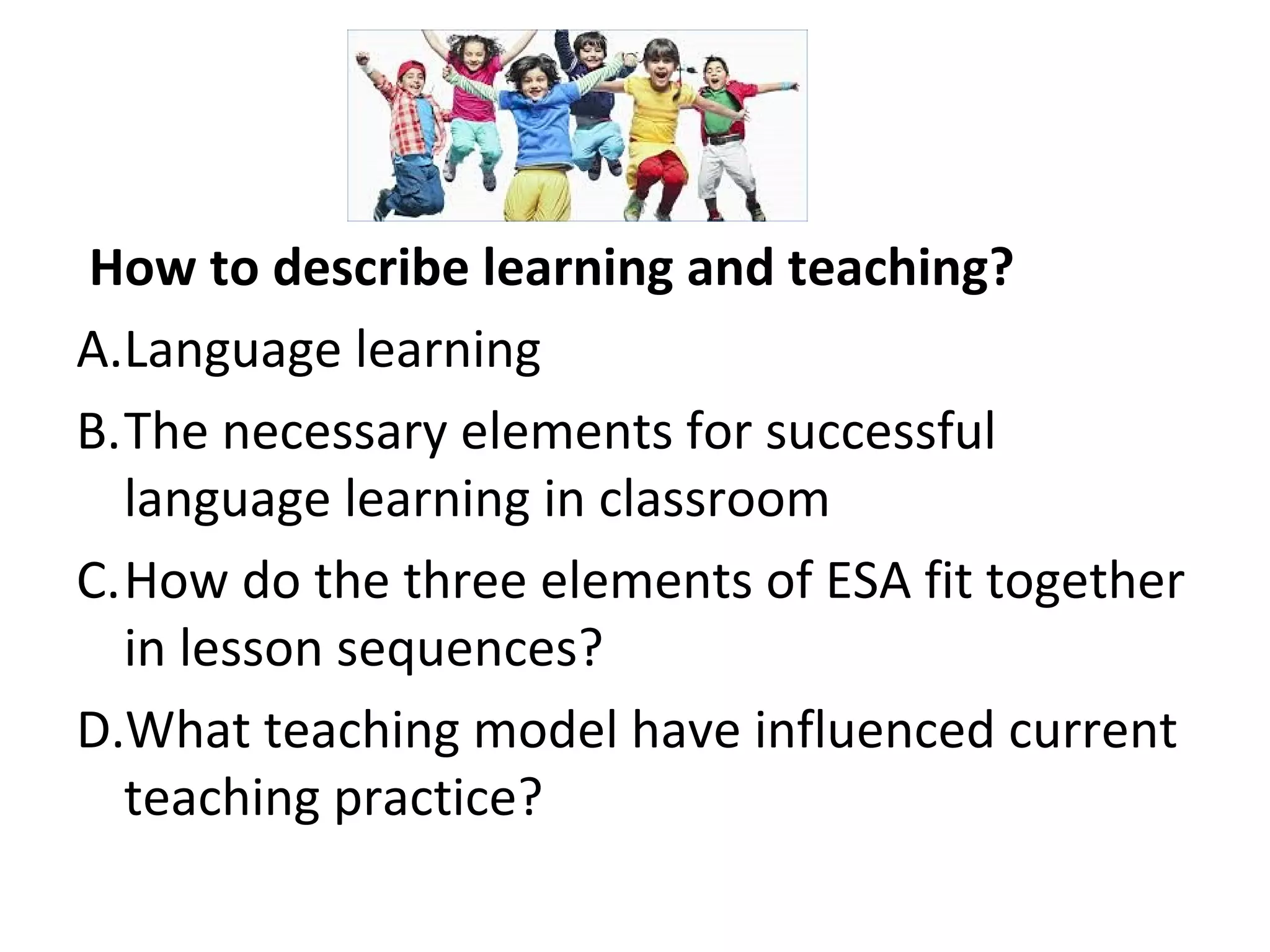
How to describe learning and teaching?
A.Language learning
B.The necessary elements for successful
language learning in classroom
C.How do the three elements of ESA fit together
in lesson sequences?
D.What teaching model have influenced current
teaching practice?
What do we know about language learning?
•The students are usually exposed to language which
they more or less understand even if they can’t
produce the language spontaneously themselves.
•They are motivated to learn language in order to be
able to communicate.
•The students have opportunities to use the language
they are learning (they need to be motivated, be
exposed to language, given chances to use it)
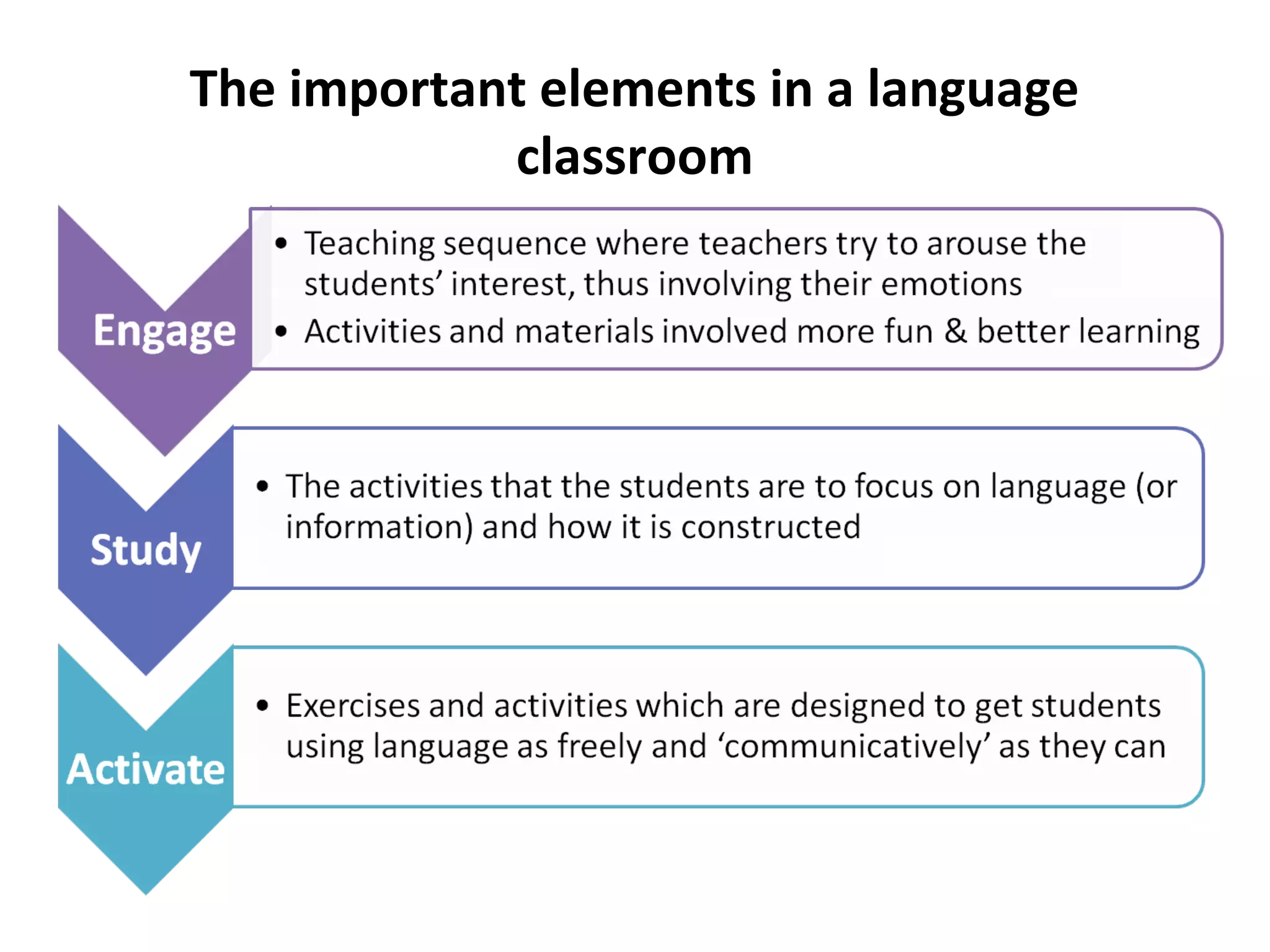
The important elements in a language
classroom: ESA
The important elements in a language
classroom
Teaching Models which have influenced
current teaching practice
Teaching Across Age Levels
Five Categories in Teaching Children
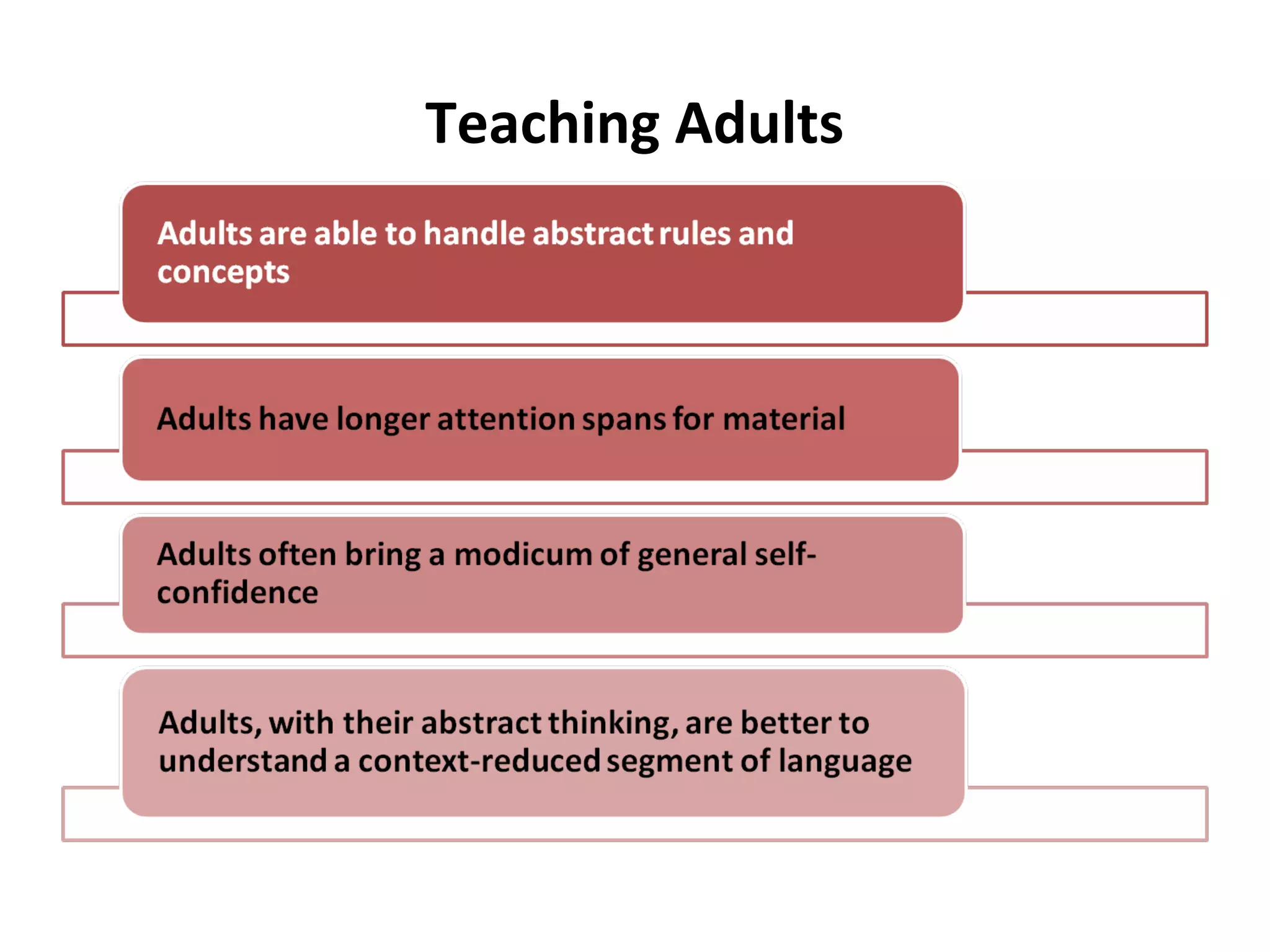
Teaching Adults
Teaching Teens
The “Terrible teens” are an age of transition,
confusion, self-consciousness, growing, and
changing bodies and minds.
Teens are in between childhood and
adulthood, therefore a very special set of
considerations applies to teaching them (Brown,
2001).
• Complex problems can be solved with logical thinking
• Attention spans are lengthening as a result of intellectual
maturation
• Varieties of sensory input are still important
• Factors surrounding ego, self-image, and self-esteem are at
their pinnacle
• Secondary school students are of course becoming
increasingly adultlike in their ability to make those
occasional diversions from the “here and now” context.
Harmer (2005); Brown (2001)
Basic Concepts of Language Teaching
What can go wrong?
• We do not give the children space to
notice.
• They do what we want them to do.
• They do not try for themselves.
• They do not experiment enough.
• They are unsuccessful.
• They do not make links.
• Motivation
• Willing to make mistakes
• Good at guessing
• Making accurate prediction
Factors influencing successful in language learning
(Brewster, Ellis, Grard, 2003)
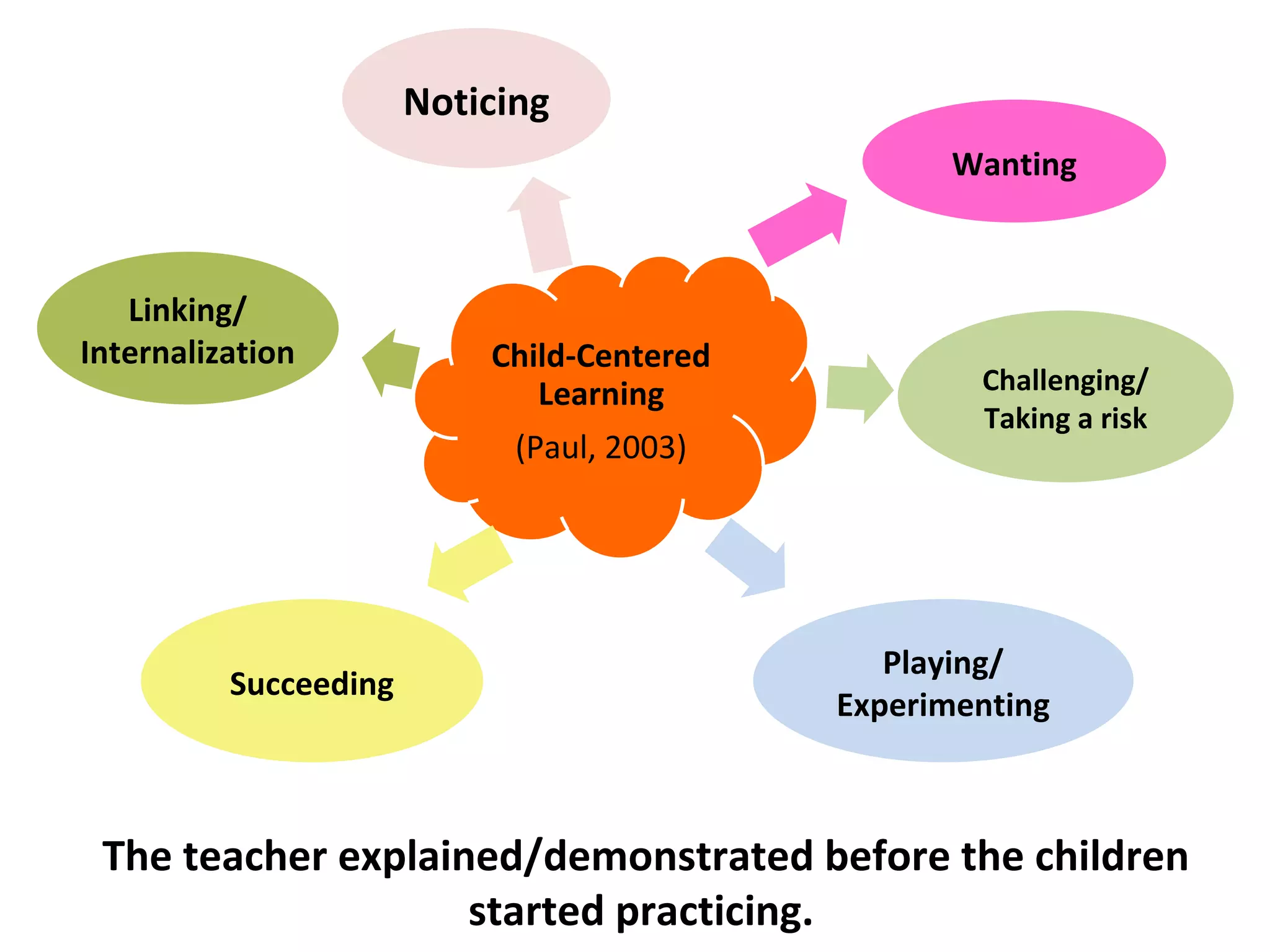
Child-Centered
Learning
(Paul, 2003)
Noticing
Playing/
Experimenting
Challenging/
Taking a risk
Wanting
Succeeding
Linking/
Internalization
The teacher explained/demonstrated before the children
started practicing.
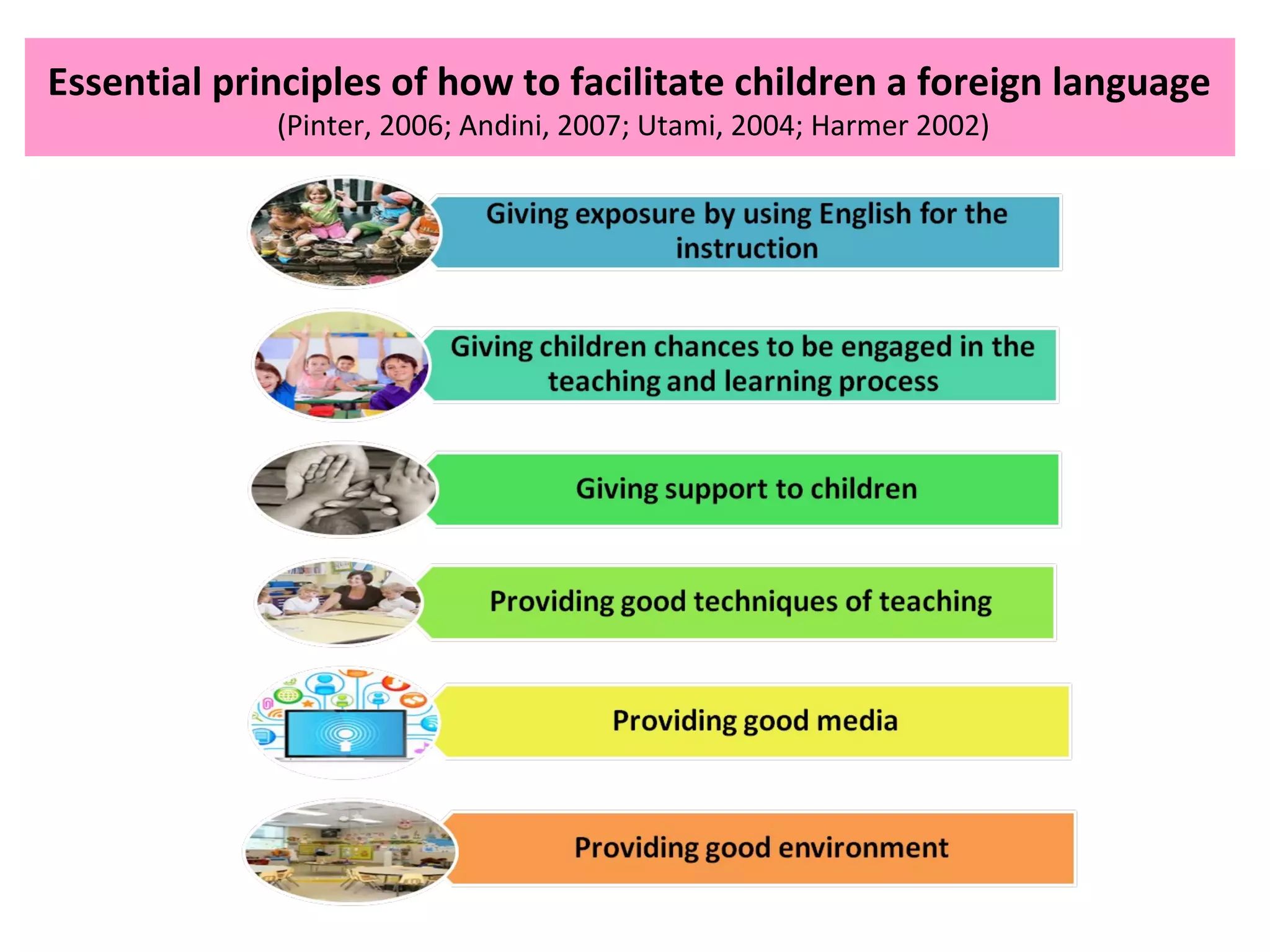
Essential principles of how to facilitate children a foreign language
(Pinter, 2006; Andini, 2007; Utami, 2004; Harmer 2002)
L1 Environment L2 Environment
• Language highly
contextualized
• In the real world the
language used is authentic
• Learner highly motivated
• Language more
decontextualized
• In the classroom the
language used tends to be
artificial
• Learners may not be highly
motivated
Although children may use similar
processes for acquiring L1 and L2,
the environment for L1 and L2
acquisition can be quite different
(Brewster, Ellis & Girard, 2004).
Therefore, it is important to remember that an early start alone will not necessarily improve
children’s ability to learn English. It is also very important that L2 instruction include language
structures that are presented within a context that is meaningful and communicative.
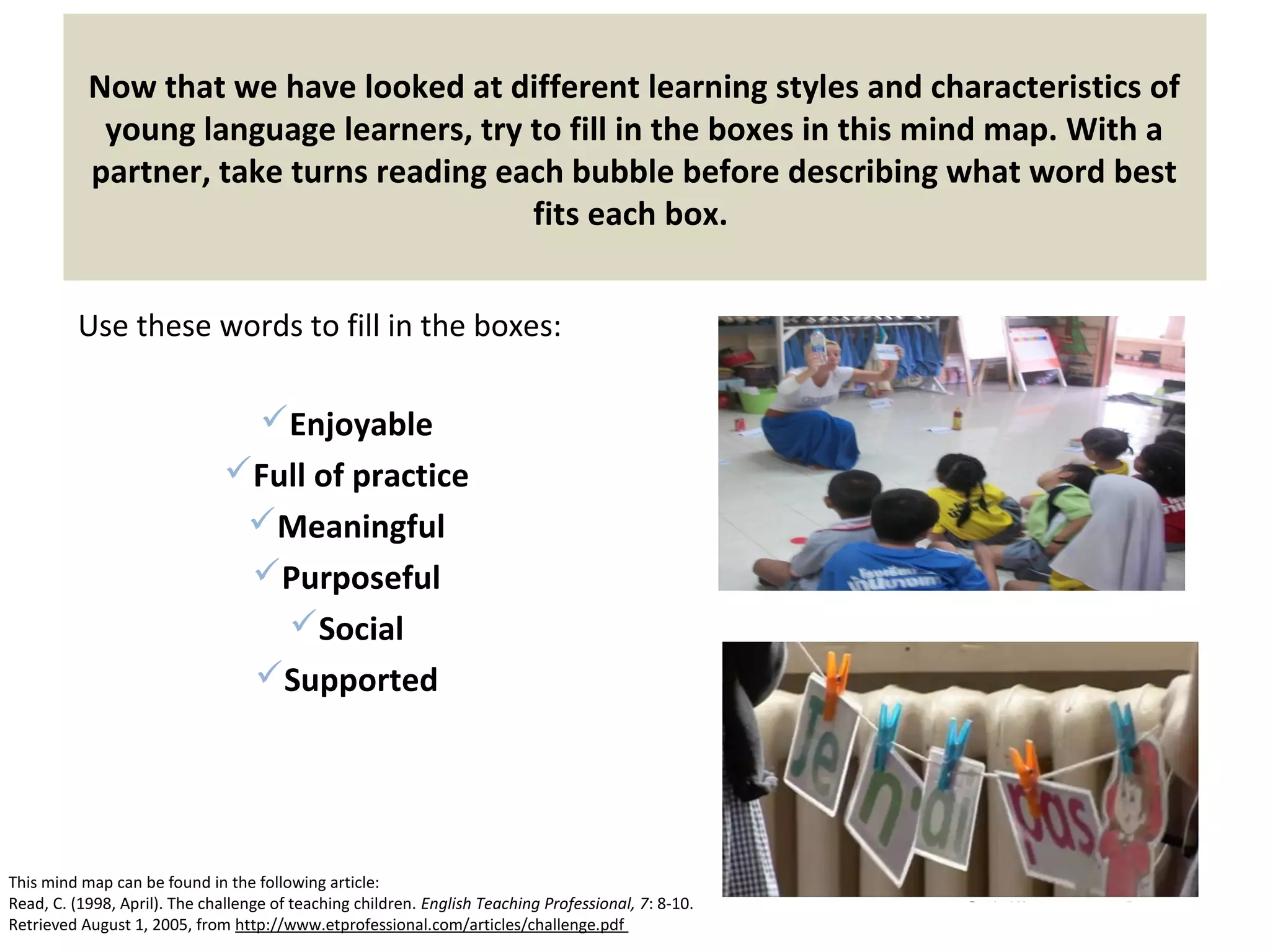
Now that we have looked at different learning styles and characteristics of
young language learners, try to fill in the boxes in this mind map. With a
partner, take turns reading each bubble before describing what word best
fits each box.
Use these words to fill in the boxes:
Enjoyable
Full of practice
Meaningful
Purposeful
Social
Supported
This mind map can be found in the following article:
Read, C. (1998, April). The challenge of teaching children. English Teaching Professional, 7: 8-10.
Retrieved August 1, 2005, from http://www.etprofessional.com/articles/challenge.pdf
Teaching implication
Teacher should be sensitive,
open to the needs and
interests of various age
groups, and continually
monitor their changing needs.
Multiple Intelligences
&
Implication to EYL Class
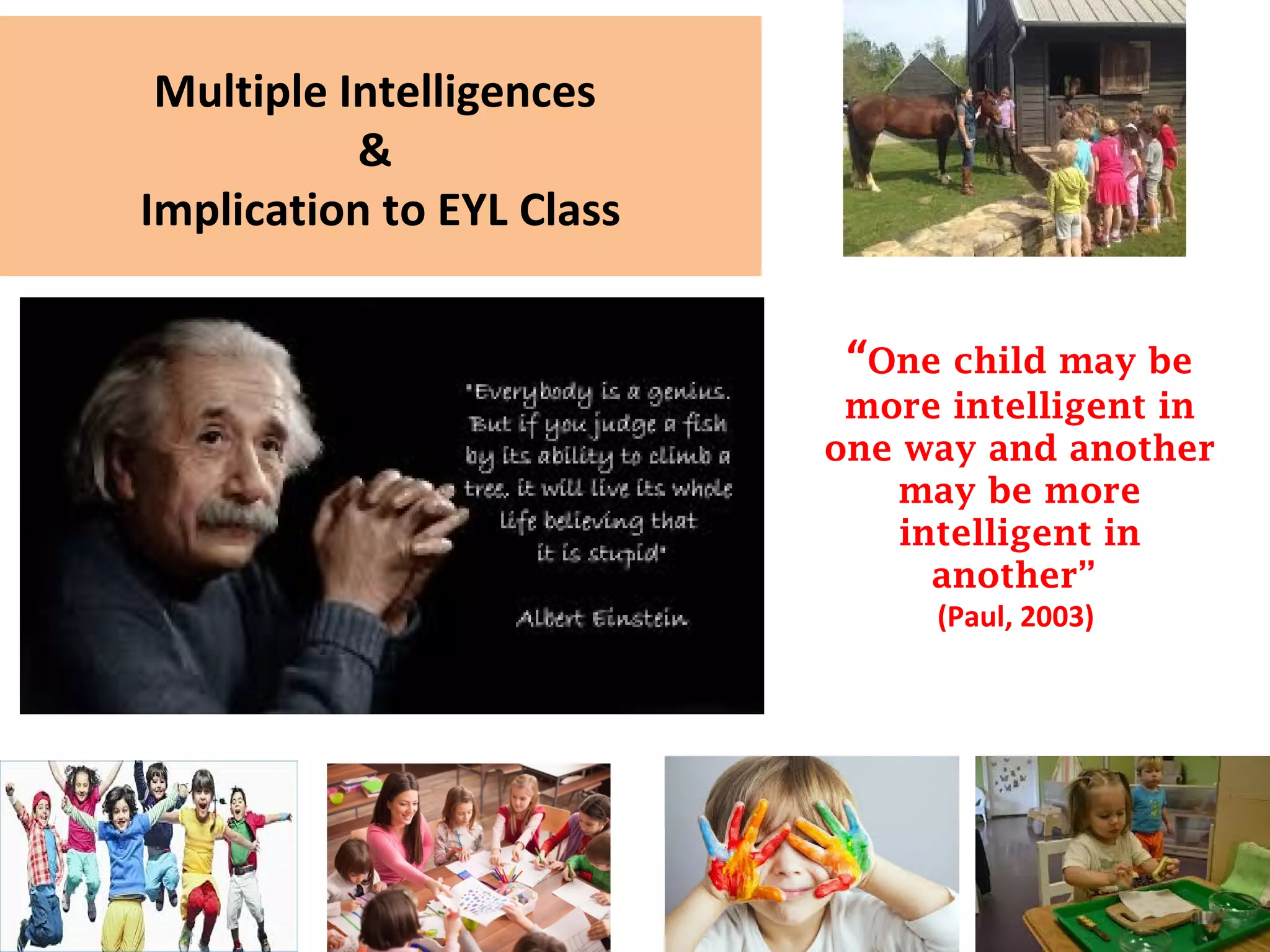
“One child may be
more intelligent in
one way and another
may be more
intelligent in
another”
(Paul, 2003)
Multiple Intelligences
&
Implication to EYL Class
For teachers (responsibility):
To learn about the different learning styles or
intelligences to cater every type of learners in the
classrooms.
Multiple Intelligences
(from different sources)
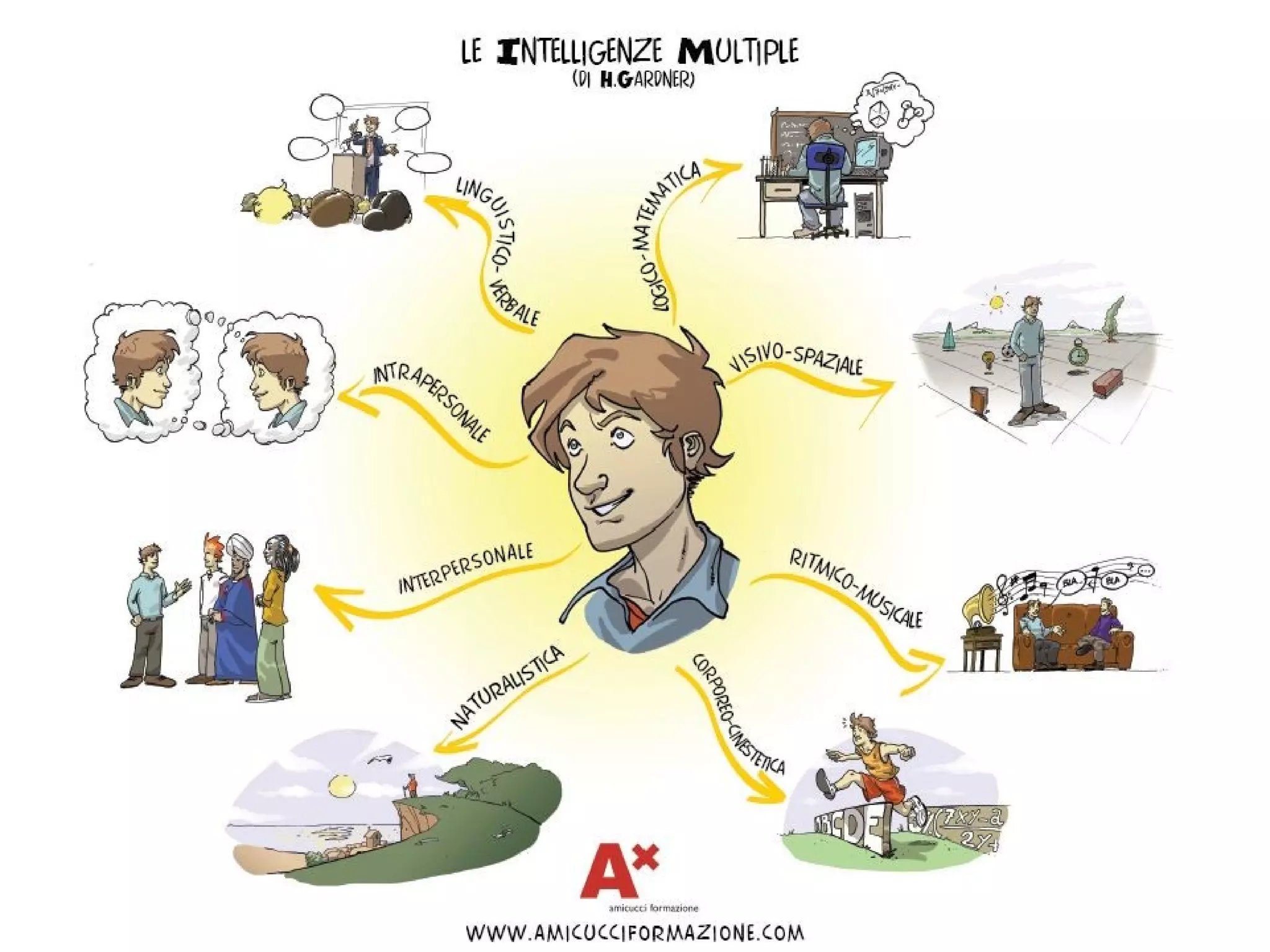
1. Linguistic :
• Express oneself
• Understand what others
are trying to say through
words
Teacher centered explanations
• Essays and written reportsEssays and written reports
• Reading selectionsReading selections
Book based grammar and
language function
explanations
• Gap-fill exercisesGap-fill exercises
2. Logical/mathematical :
• Understand and manipulate
numbers
• See cause and effect
relationship
Multiple Intelligences
(from different sources)
Grammar categorizing activitiesGrammar categorizing activities
•Grammar rules study and
inductive explanations
•Error recognitionError recognition
•Correcting work based on
teacher indications
•Develop mind-mapsDevelop mind-maps and
other vocabulary chartsvocabulary charts
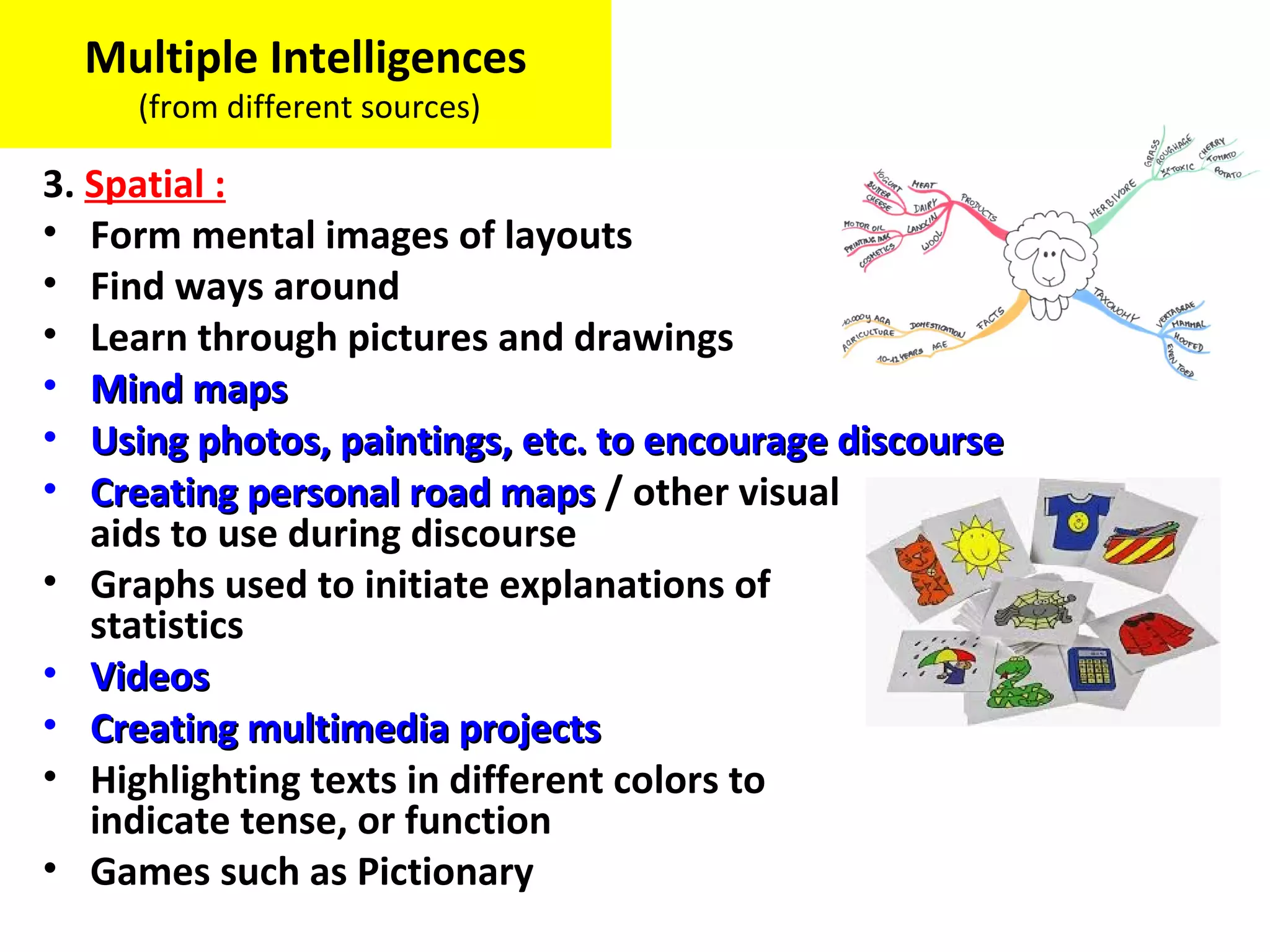
3. Spatial :
• Form mental images of layouts
• Find ways around
• Learn through pictures and drawings
• Mind mapsMind maps
• Using photos, paintings, etc. to encourage discourseUsing photos, paintings, etc. to encourage discourse
• Creating personal road mapsCreating personal road maps / other visual
aids to use during discourse
• Graphs used to initiate explanations of
statistics
• VideosVideos
• Creating multimedia projectsCreating multimedia projects
• Highlighting texts in different colors to
indicate tense, or function
• Games such as Pictionary
Multiple Intelligences
(from different sources)
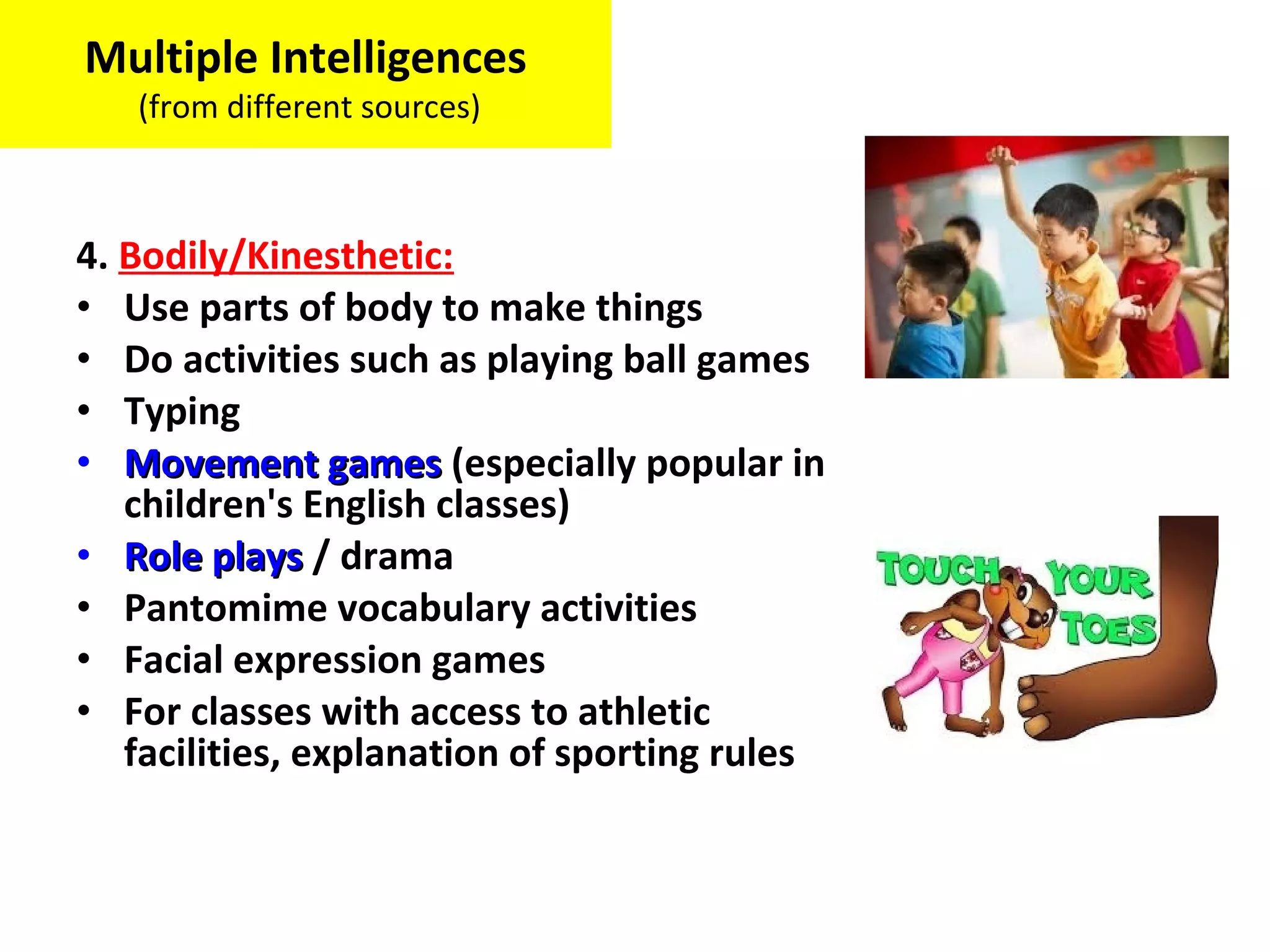
4. Bodily/Kinesthetic:
• Use parts of body to make things
• Do activities such as playing ball games
• Typing
• Movement gamesMovement games (especially popular in
children's English classes)
• Role playsRole plays / drama
• Pantomime vocabulary activities
• Facial expression games
• For classes with access to athletic
facilities, explanation of sporting rules
Multiple Intelligences
(from different sources)
5. Musical :
• Produce and recognize
songs
• Play around with
melodies
• Singing
• Composing rhythm
• Adapting/modifying song
Multiple Intelligences
(from different sources)
3Rainbow
(Pelangi)
Rainbow, rainbow
How beautiful you are
Red, yellow, and green
In the blue blue sky
Your creator is great
I wonder who is it
Rainbow rainbow
The creation of God
?
3 I Love Everybody
(Aku Sayang Ibu )
?
One and one
I love my mommy
Two and two
I love my daddy
Three and three
I love brother, sister
One and two and three
I love everybody
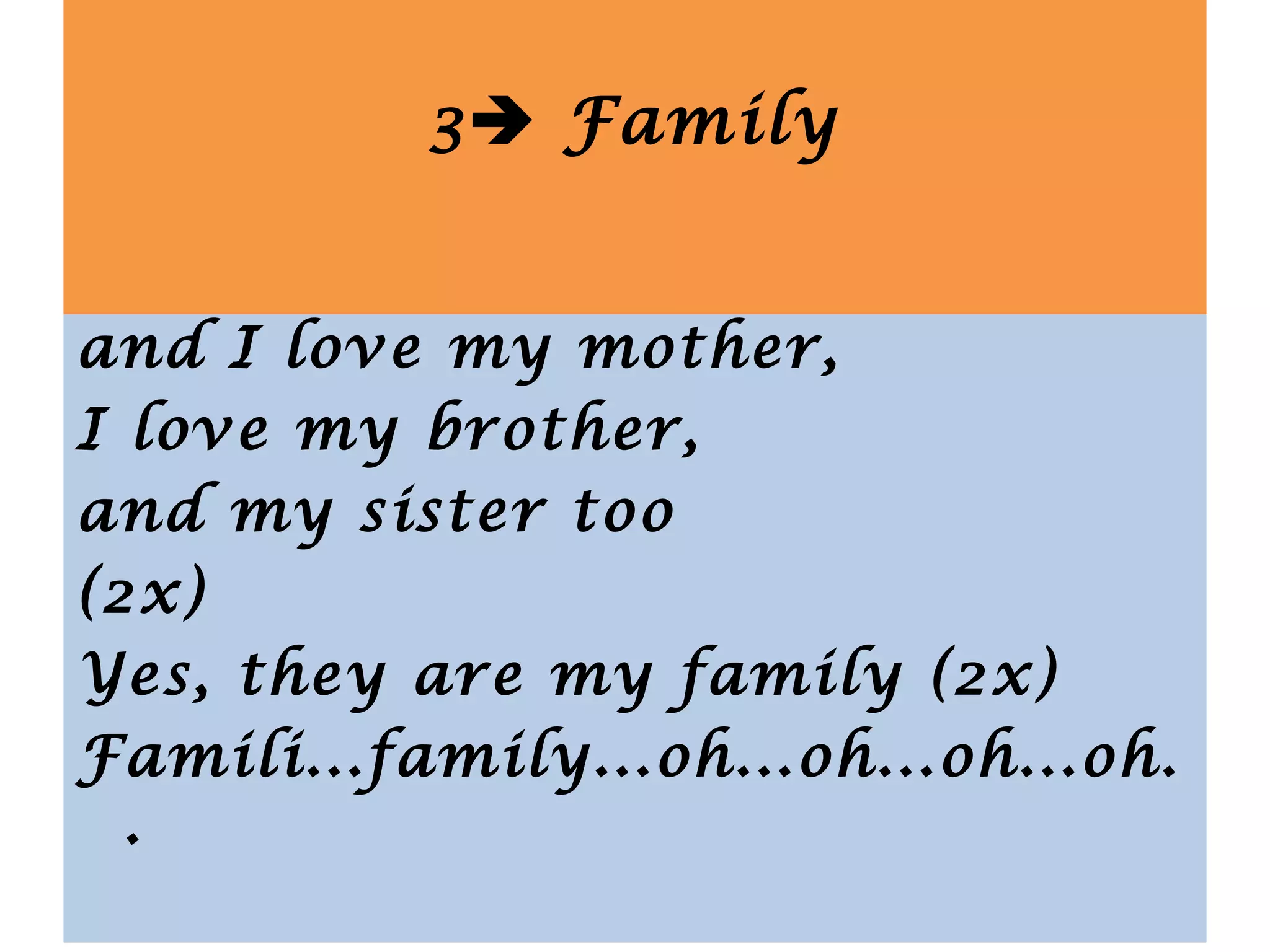
I love my father,
and I love my mother,
I love my brother,
and my sister too
(2x)
Yes, they are my family (2x)
Famili...family...oh...oh...oh...oh.
.
3 Family
3 Little Teapot
(Teko Kecil )
Aku teko kecil yang
mungil
Ini gagangku dan
corongku
Bila mendidih, aku
bersiul (tuiiiiit)
Miringkan aku dan
tuangkan
I’m a little
teapot, short
and stout
Here is my
handle, here is
my spout
When I get my
steam up then I
shout (tweeeeet)
Tip me over and
pour me out
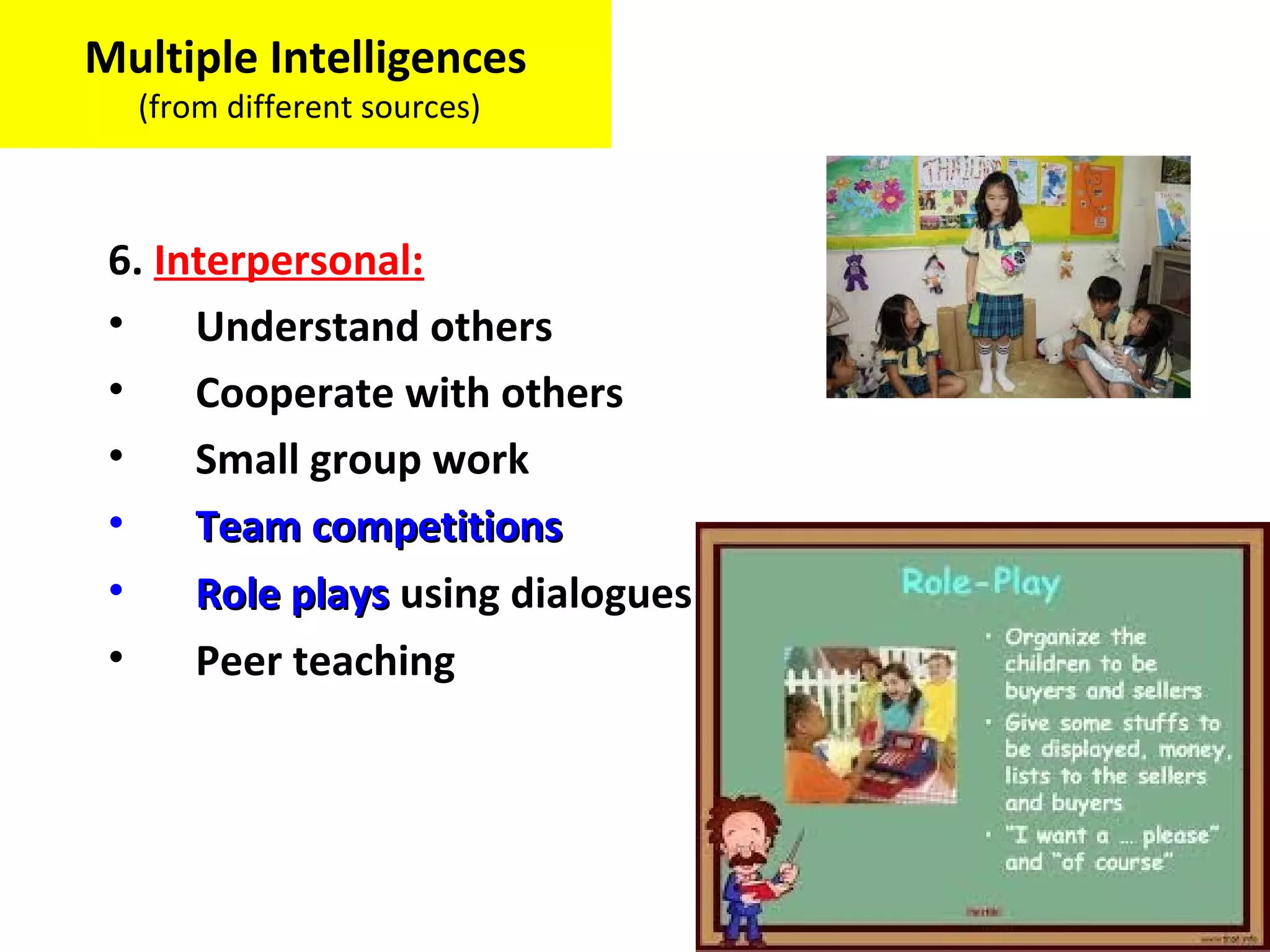
6. Interpersonal:
• Understand others
• Cooperate with others
• Small group work
• Team competitionsTeam competitions
• Role playsRole plays using dialogues
• Peer teaching
Multiple Intelligences
(from different sources)
7. Intrapersonal:
• Understand ourselves
• Know similarities and differences
from others
• Deal with emotions
• Writing in logs and diaries
• Estimating learning strengths,
weaknesses, progress over time
• Understanding learner objectivesUnderstanding learner objectives
• Speaking about one's personal
history with confidence
Multiple Intelligences
(from different sources)
8. Naturalist :
• Recognize species of plants
• Characterize different animals
• Relate to natural world
• Exploring outdoors but in English
• Shopping and other field trips
• Collecting plants to learn appropriate
vocabulary
Multiple Intelligences
(from different sources)
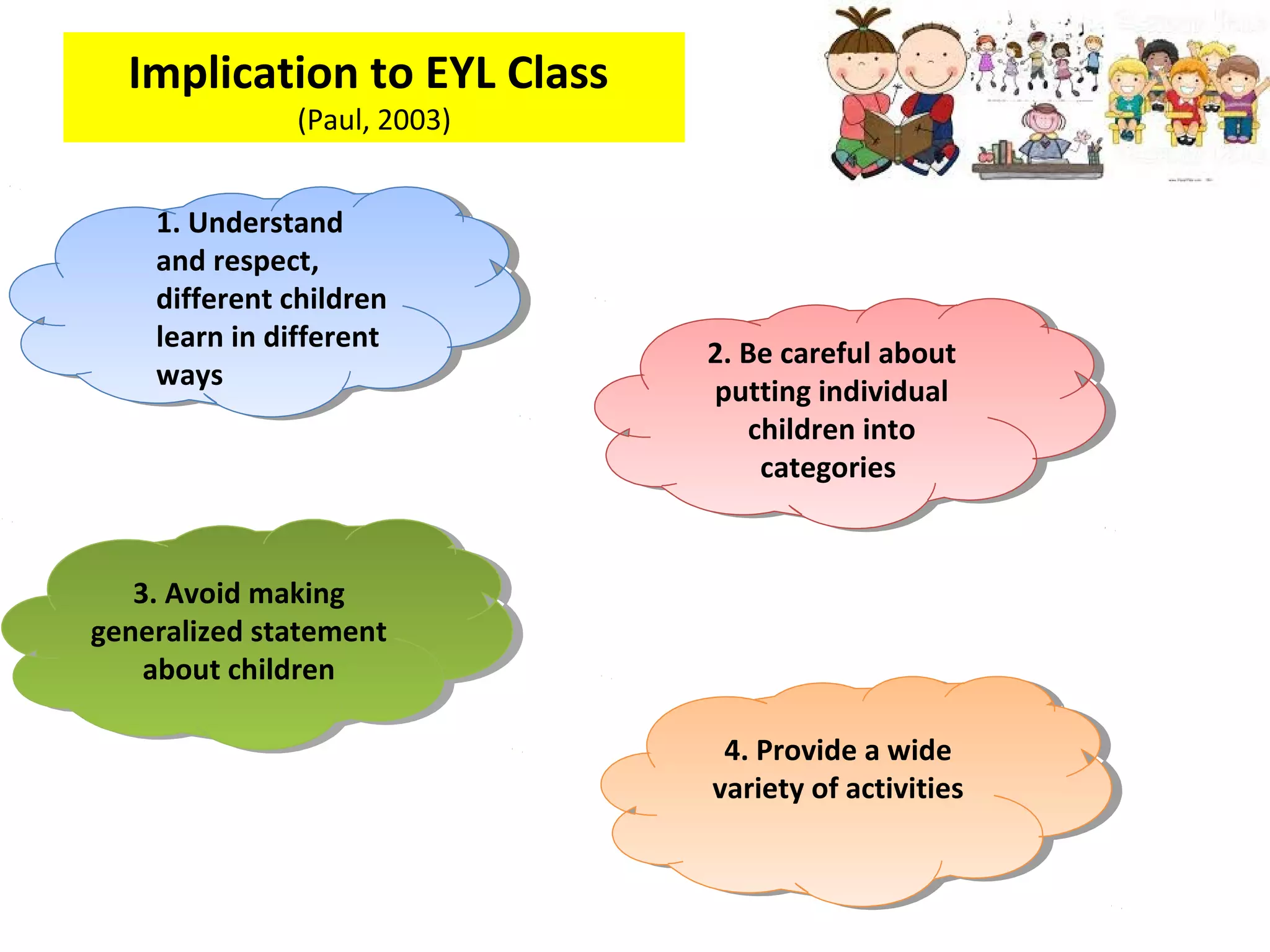
Implication to EYL Class
(Paul, 2003)
1. Understand
and respect,
different children
learn in different
ways
1. Understand
and respect,
different children
learn in different
ways
2. Be careful about
putting individual
children into
categories
2. Be careful about
putting individual
children into
categories
3. Avoid making
generalized statement
about children
3. Avoid making
generalized statement
about children
4. Provide a wide
variety of activities
4. Provide a wide
variety of activities
“Exposure to English”:
How much children hear &
how often they have
opportunity to interact in
English.
It’s important that
opportunities are created in
the classroom for children to
be exposed to natural
language & to interact with
each other
The implication:
Teachers’ competencies
in terms of their
proficiency in English to
provide the necessary
exposure to the language,
and their methodology to
offer appropriate tasks &
activities for children to
communicate in a variety
ways.
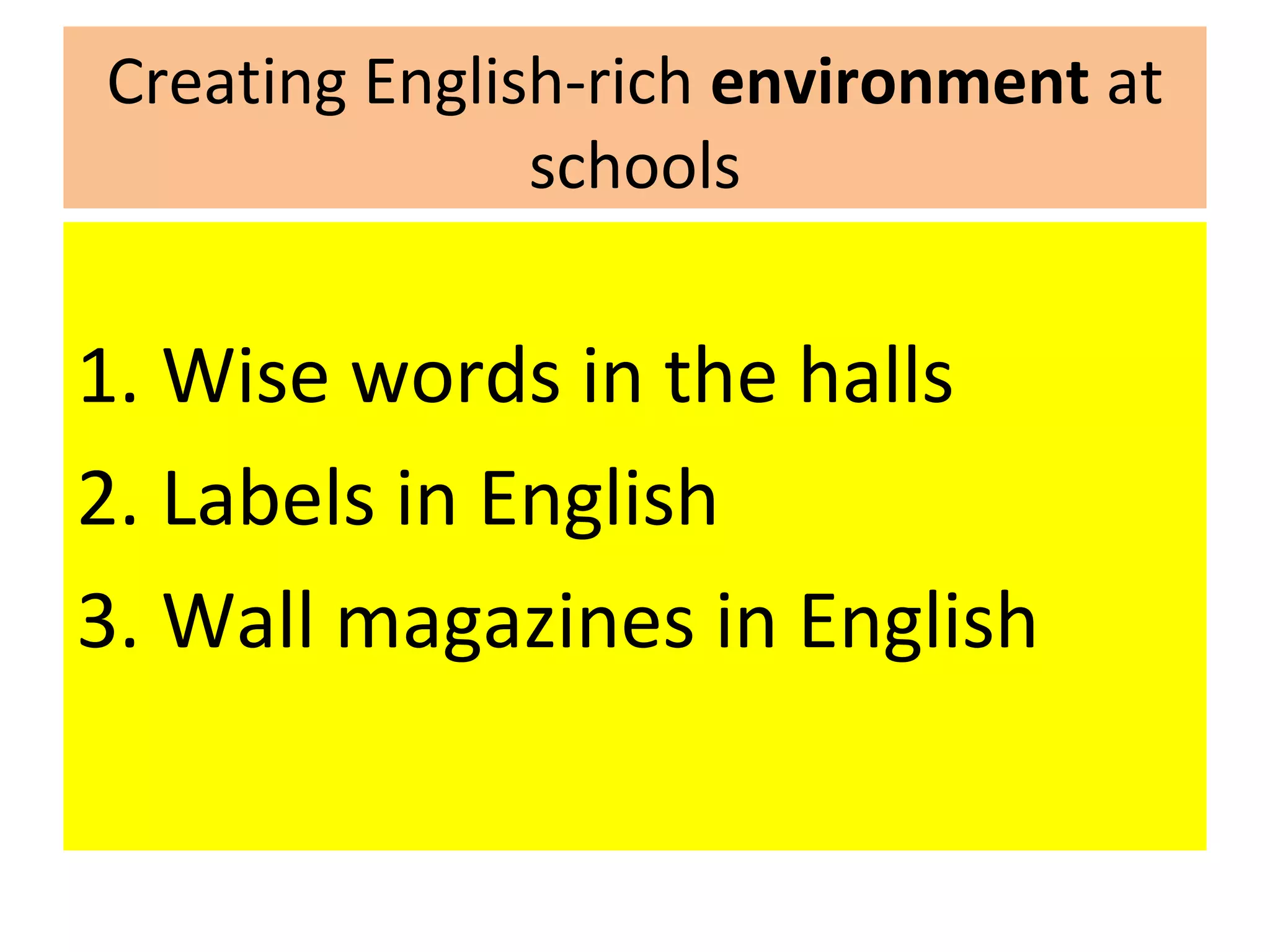
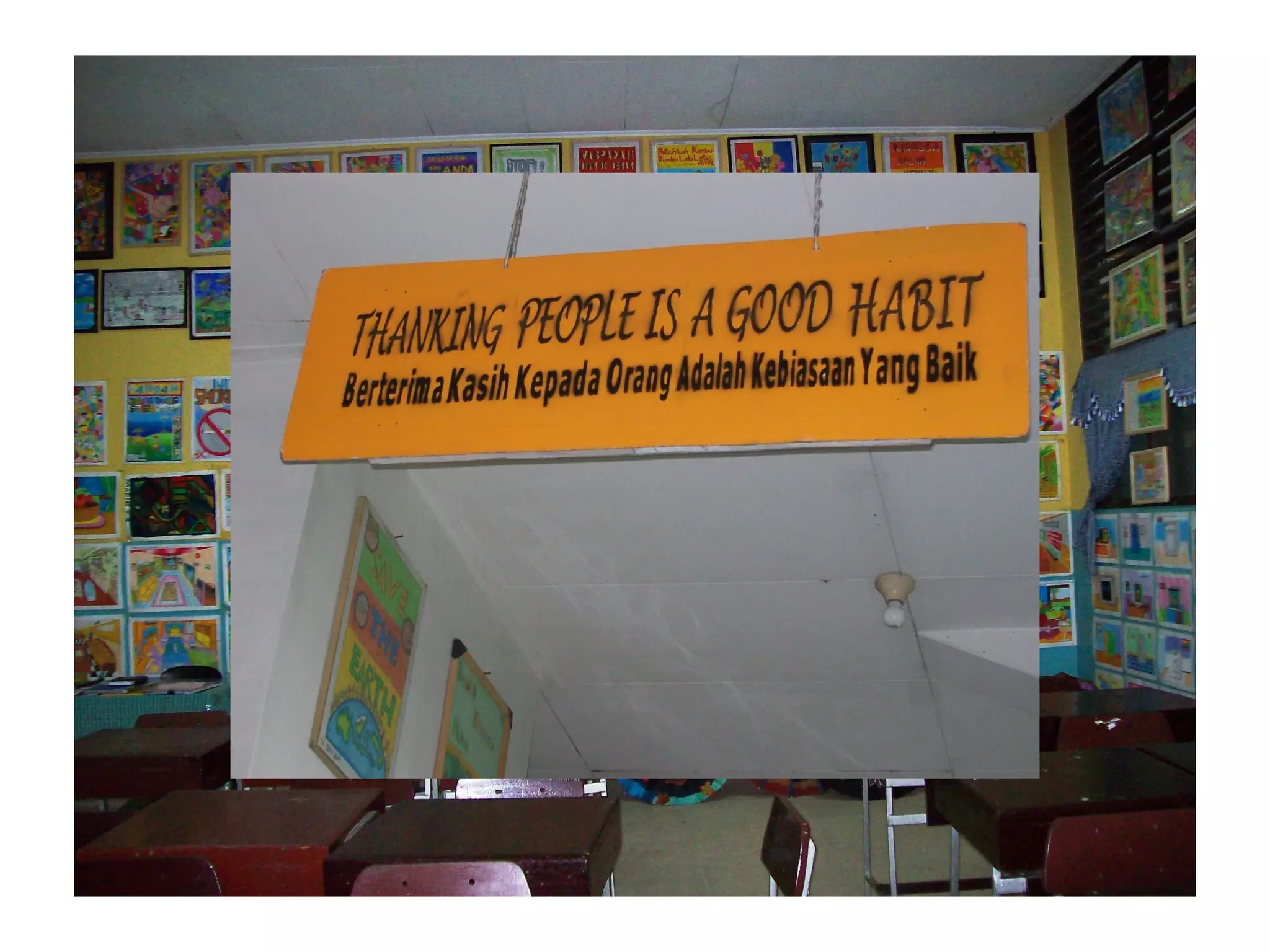
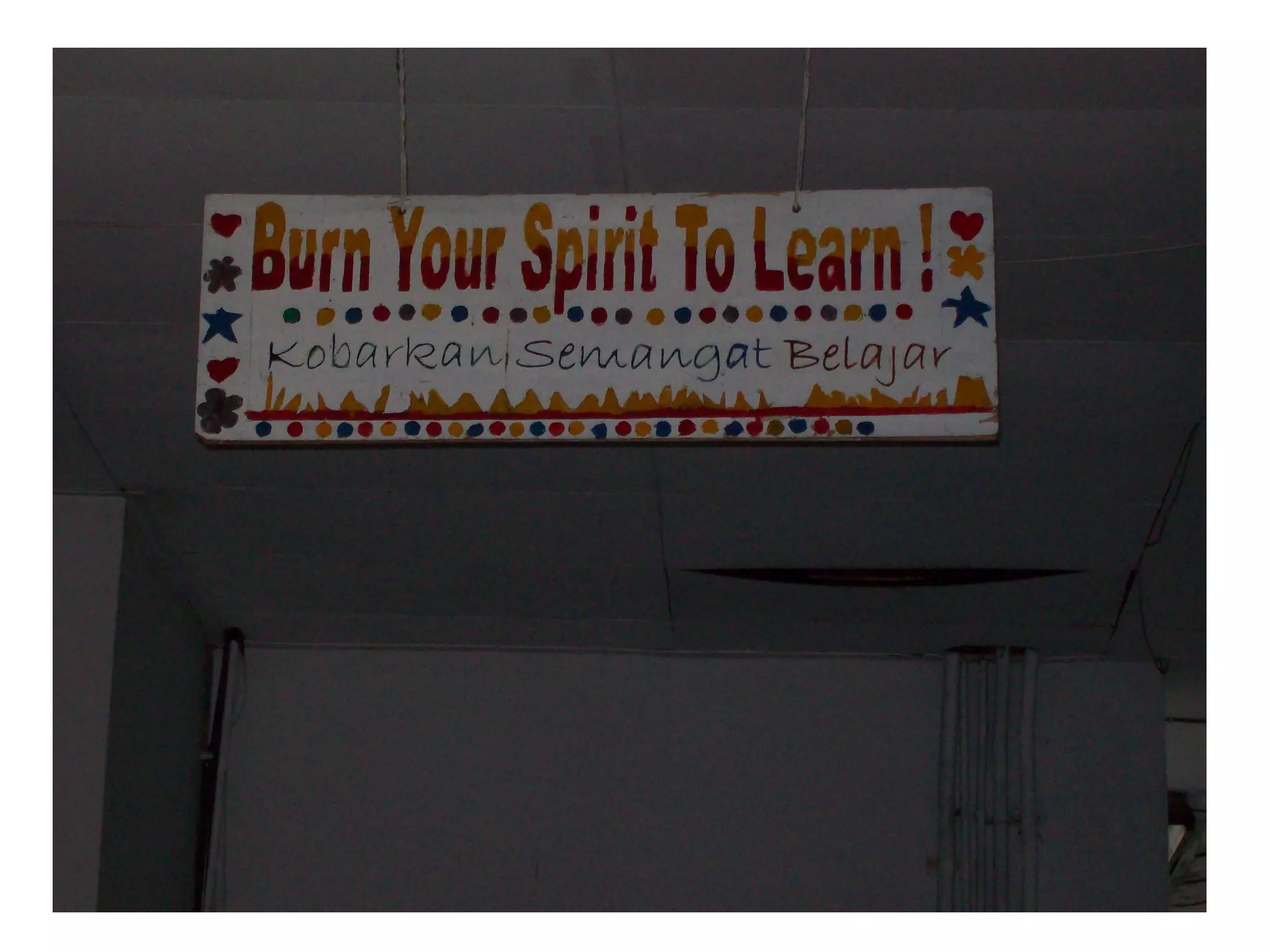
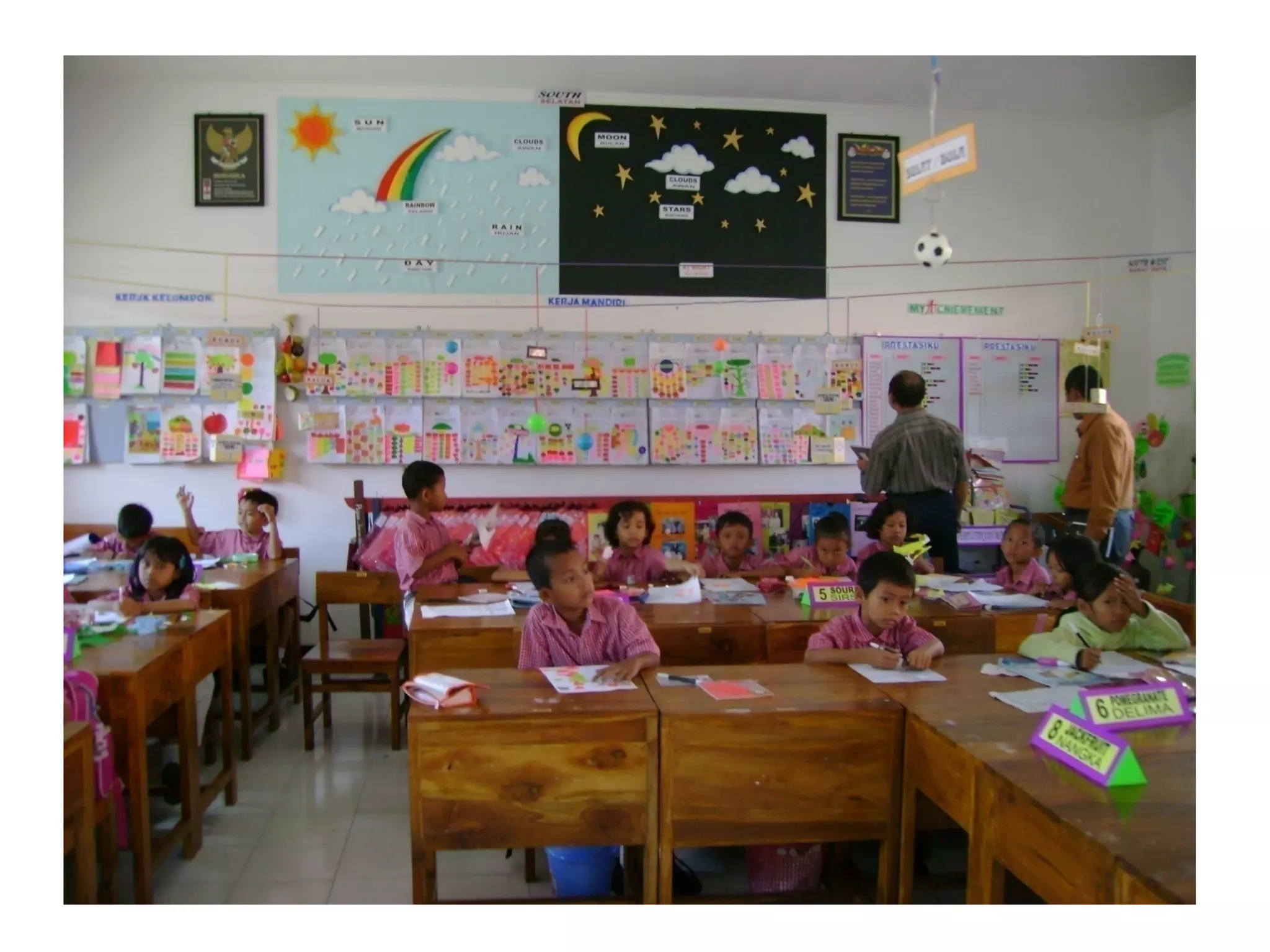
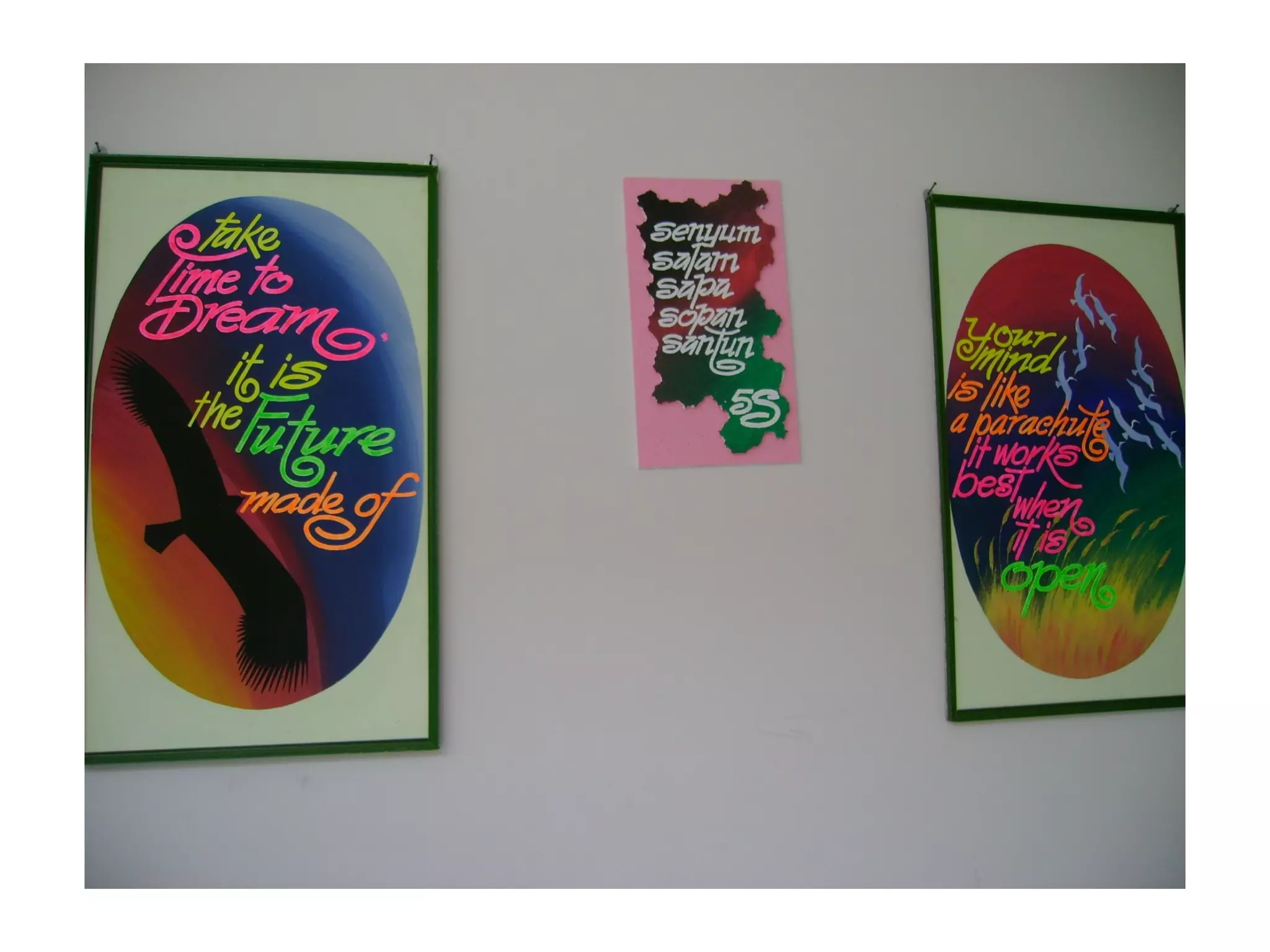
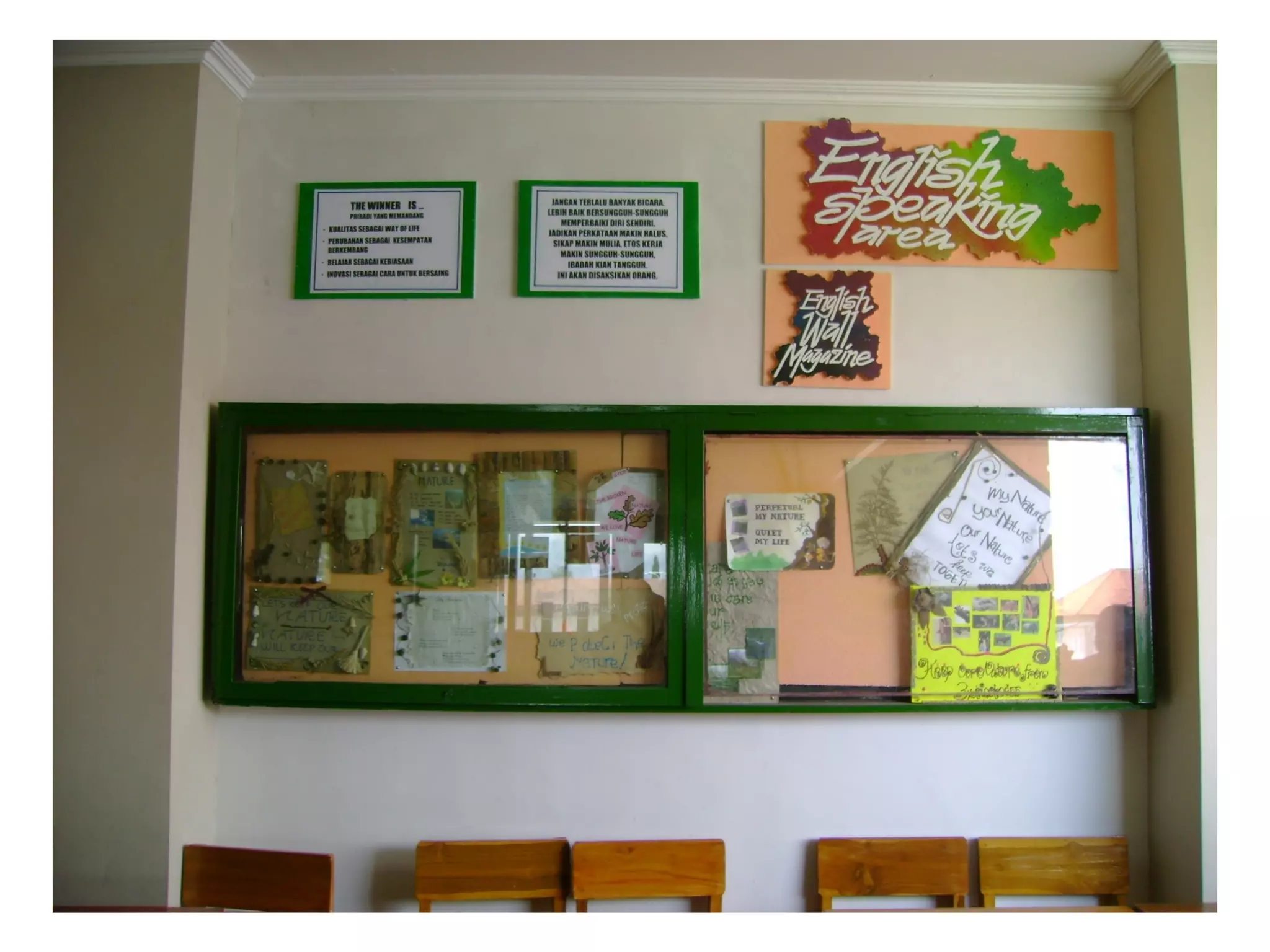
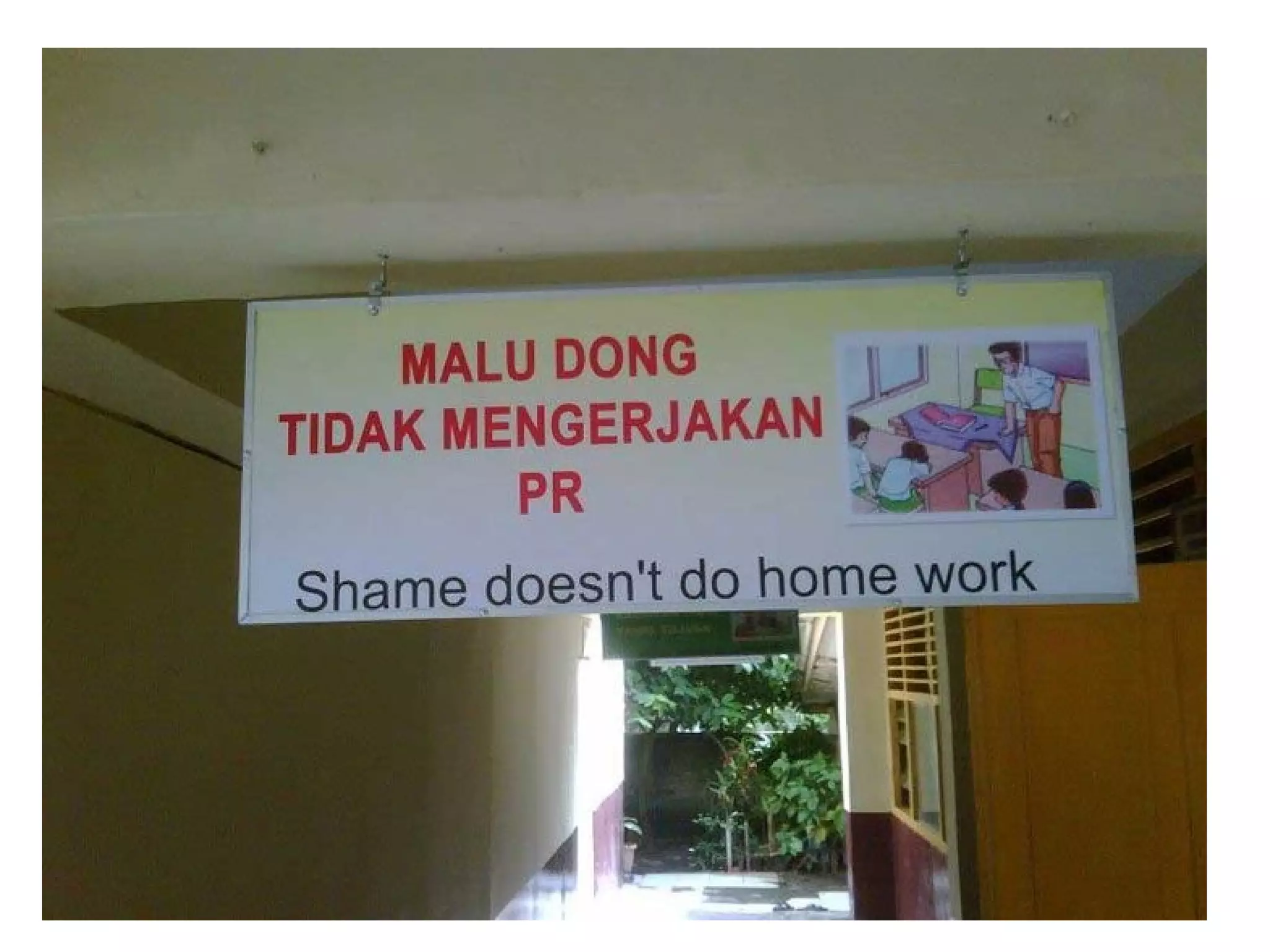
Creating English-rich environment at
schools
1. Wise words in the halls
2. Labels in English
3. Wall magazines in English
Always check the spelling!
MATERI
PEMBELAJARA
N ANAK USIA
Materi usia 0 – 3 tahun:
• Pengenalan diri sendiri (Pengembangan konsep diri)
• Pengenalan perasaan (perkembangan emosi)
• Pengenalan tentang orang lain (perkembangan
sosial)
• Pengenalan berbagai gerak (perkembangan fisik)
• Mengembangkan komunikasi (perkembangan
bahasa)
• Keterampilan berfikir
(perkembangan kognitif)
Materi usia 3 tahun ke atas:
• Keaksaraan (peningkatan kosa kata & bahasa,
kesadaran phonologui, wawasan p[engetahuan,
percakapan, memahami buku-buku & teks lainnya.
• Konsep Matematika (pengenalan angka-angka, pola-
pola & hubungan, geometri & kesadaran ruang,
pengukuran, pengumpulan data, pengorganisasian &
mempresentasikannya.
• Pengetahuan alam (objek fisik, kehidupan, bumi &
lingkungan)
• Pengetahuan sosial (tempat hidup
orang banyak, bekerja, berinteraksi)
Materi usia 3 tahun ke atas:
• Seni (tari, musik, bermain peran, menggambar &
melukis)
• Teknologi (alat-alat & penggunaan operasi dasar)
• Keterampilan proses (pengamatan & eksplorasi,
eksperimen, pemecahan masalah, koneksi,
pengorganisasian, komunikasi & informasi)
Hal penting bagi orang tua:
•Peka terhadap perbedaan kemampuan
masing-masing anak
•Terbuka terhadap perubahan anak
•Pendampingan dan penghargaan yang
tepat.
•Kecerdasan tidak ditentukan oleh gen
namun lebih banyak ditentukan oleh
perlakuan/lingkungan.
Noble, Professional & Global EducatorNoble, Professional & Global Educator
•Bermain.
•Bercerita
•Bernyanyi
•Bercakap (dialog dan tanya jawab)
•Piknik
•Praktik langsung
•Bermain peran (sosio-drama)
•Penugasan
Theories of Children Learning Development
(Mooney, 2000)
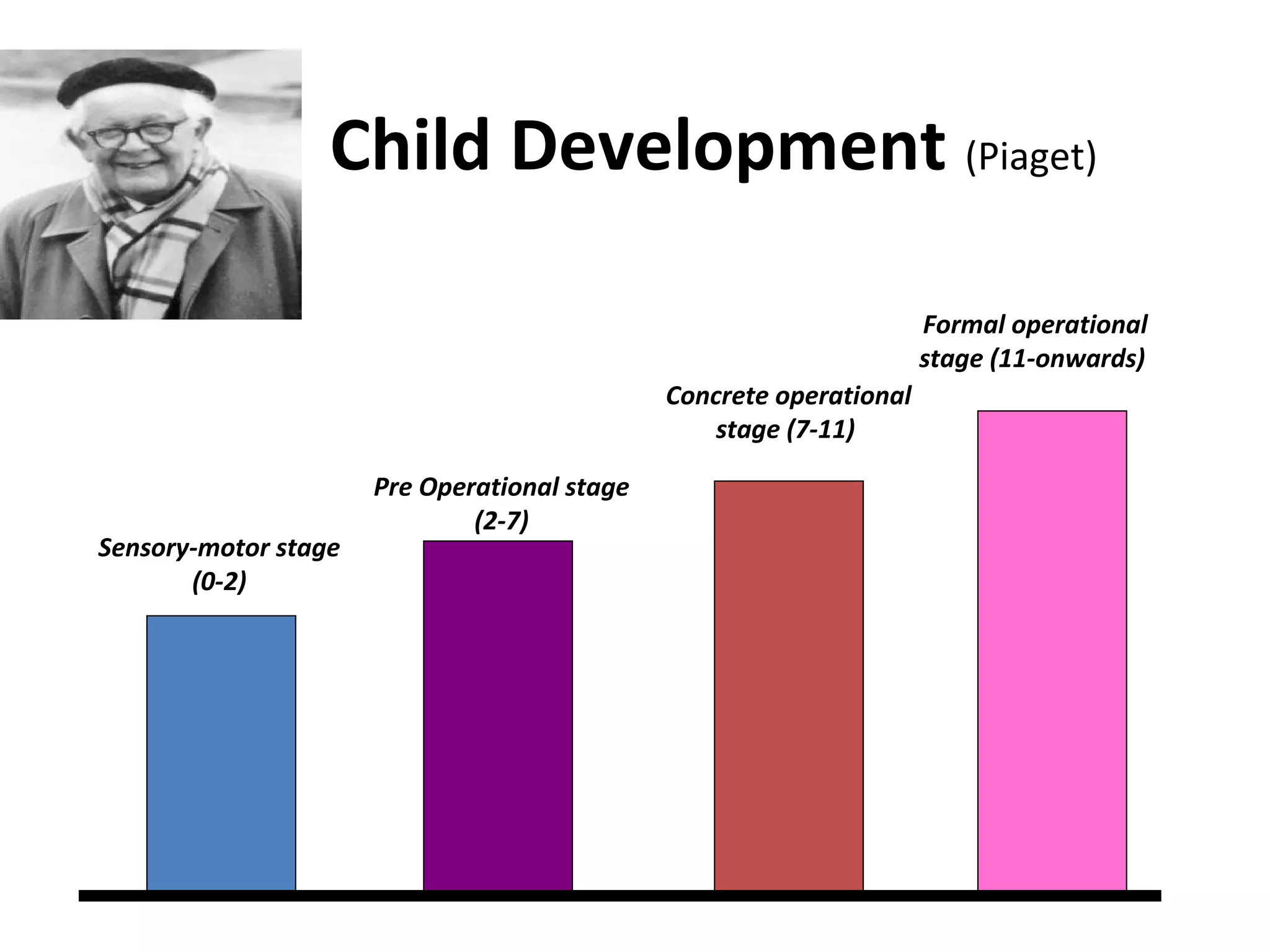
Child Development (Piaget)
Sensory-motor stage
(0-2)
Pre Operational stage
(2-7)
Concrete operational
stage (7-11)
Formal operational
stage (11-onwards)
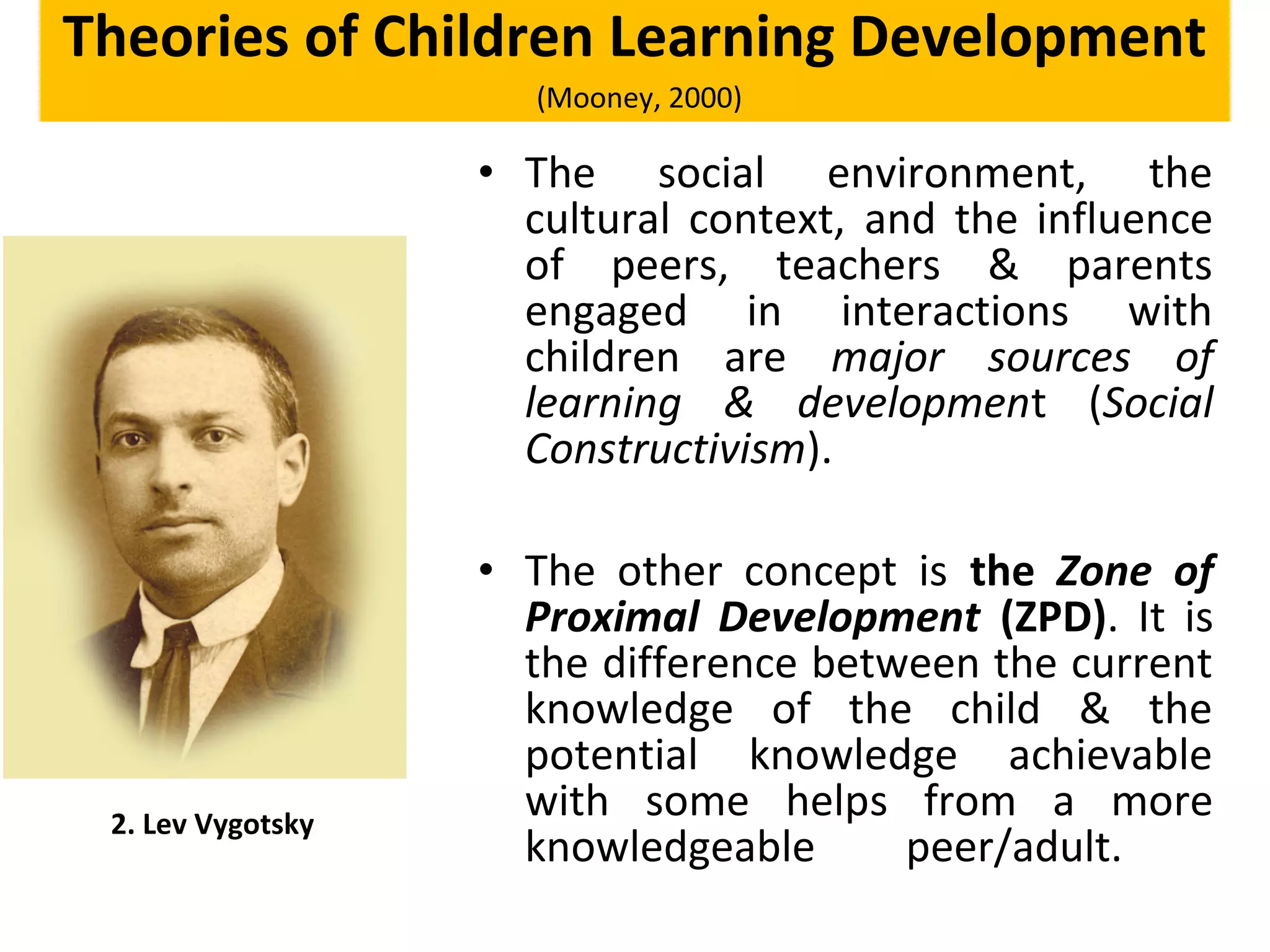
• The social environment, the
cultural context, and the influence
of peers, teachers & parents
engaged in interactions with
children are major sources of
learning & development (Social
Constructivism).
• The other concept is the Zone of
Proximal Development (ZPD). It is
the difference between the current
knowledge of the child & the
potential knowledge achievable
with some helps from a more
knowledgeable peer/adult.
2. Lev Vygotsky
Theories of Children Learning Development
(Mooney, 2000)
“Scaffolding: helping children to
learn by offering systematic support”
Theories of Children Learning Development
(Mooney, 2000)
3. Jerome Bruner
“The social environment, i.e. social
interaction with parents & teacher
can make a difference in terms of
offering unique, enriching
experiences. “
“When assessing children’s
intelligent, it had no unitary
character, rather, it manifested
itself in many different ways in
different children (multiple
intelligences). The types of
intelligences are linguistic,
logico-mathematical, musical,
spatial, bodily/kinesthetic,
interpersonal, intrapersonal,
and natural. “
4. Howard Gardner
Theories of Children Learning Development
(Mooney, 2000)
“Children often produced
language that they could not
have heard in natural
interaction with others
(Universal Grammar)”
5. Noam Chomsky
Theories of Children Learning Development
(Mooney, 2000)
“Brain plasticity was only
conducive to language learning
until puberty (Critical period
hypothesis). Children below 11-
12, who are given advantageous
learning circumstances, such as
plenty of input & interaction in
an English environment, are
more likely to acquire English to
native levels without an accent”6. Eric Lenneberg
Theories of Children Learning Development
(Mooney, 2000)
Theories of Children Learning Development
(Mooney, 2000)
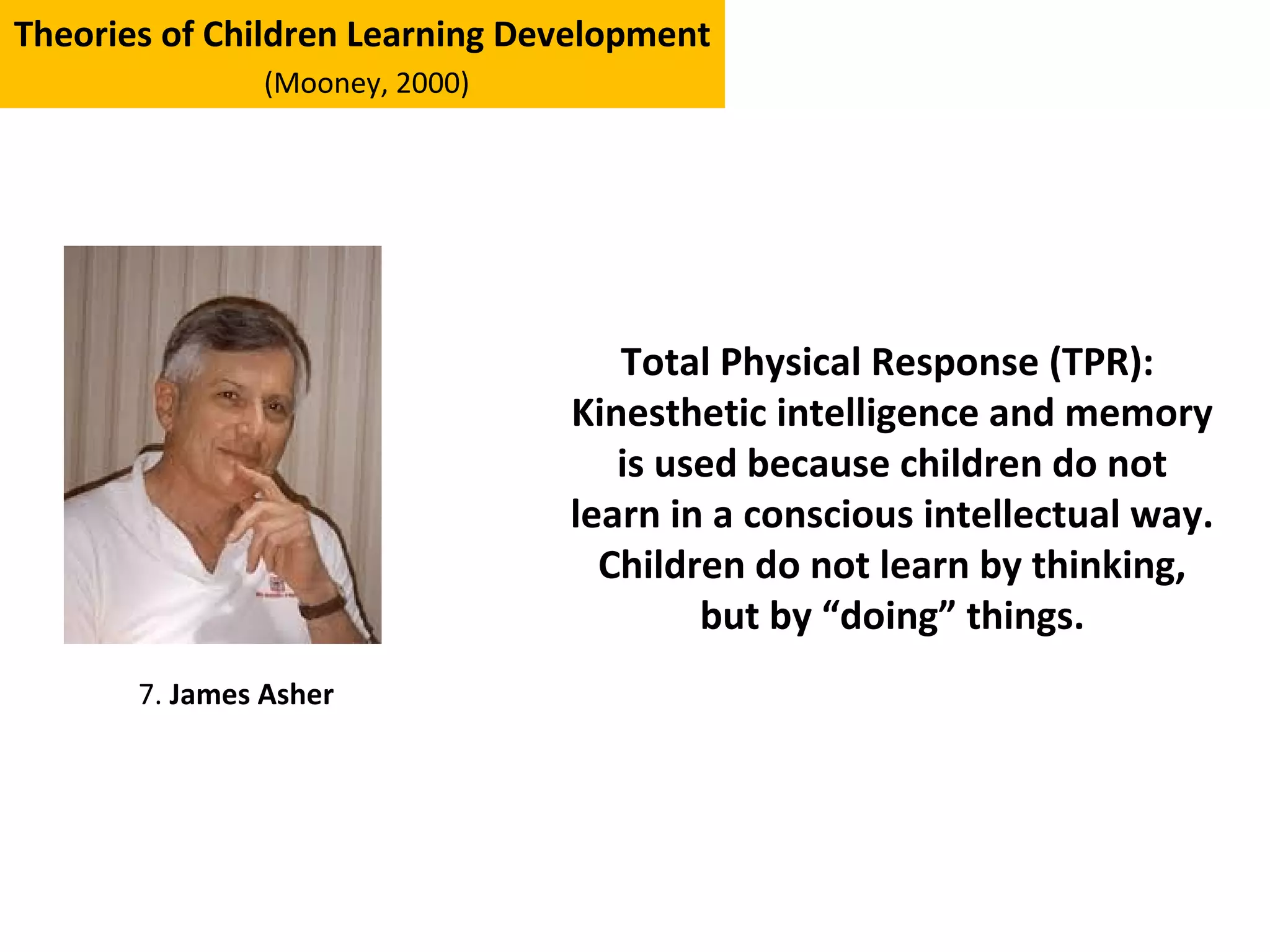
7. James Asher
Total Physical Response (TPR):
Kinesthetic intelligence and memory
is used because children do not
learn in a conscious intellectual way.
Children do not learn by thinking,
but by “doing” things.
8. Krashen & Terrell
The Input Hipothesis
Theories of Children Learning Development
(Mooney, 2000)
Stephen Krashen
Spoken fluency in second language is not taught
directly. Rather the ability to speak fluently and easily in
a second language emerges by itself, after a sufficient
amount of competence has been acquired through
input.
We acquire (not learn) language by understanding input
that is a little beyond our current level of (acquired)
competence. Listening comprehension and reading are
the primary importance in the language program, and
the ability to speak (or write) fluently in a second
language will come on its own with time. Speaking
ability "emerges" after the acquirer has built up
competence through comprehending input.
Tracey Terrel
Input Hypothesis (Cont.)
The Major Points On the Input Hypothesis are:
It relates to
acquisition, not to
learning;
Spoken fluency
emerges gradually
and is not taught
directly
We acquire by
understanding
language a bit
beyond our
current level of
competence.
This is done with
the help of
context
When caretakers
talk to acquirers
so that the
acquirers
understand the
message, input
automatically
contains "i+1", the
grammatical
structures the
acquirer is "ready"
to acquire
• Whatever helps comprehension is
important
• Vocabulary is important. With
more vocabulary, there will be
more comprehension, and there
will be more acquisition.
• In giving input, in talking to
students, the teacher needs to be
concerned primarily with whether
the students understand the
message.
Input Hypothesis (Cont.)
The implications for classroom practice
• Education should be child
centered.
• Education must be both
active & interactive.
• Education must involve the
social world of the child
and the community.
Theories of Children Learning Development
(Mooney, 2000)
9. John Dewey
• Plan purposeful
curriculum.
• Make sense of the
world for children.
• “It’s fun” is not
enough.
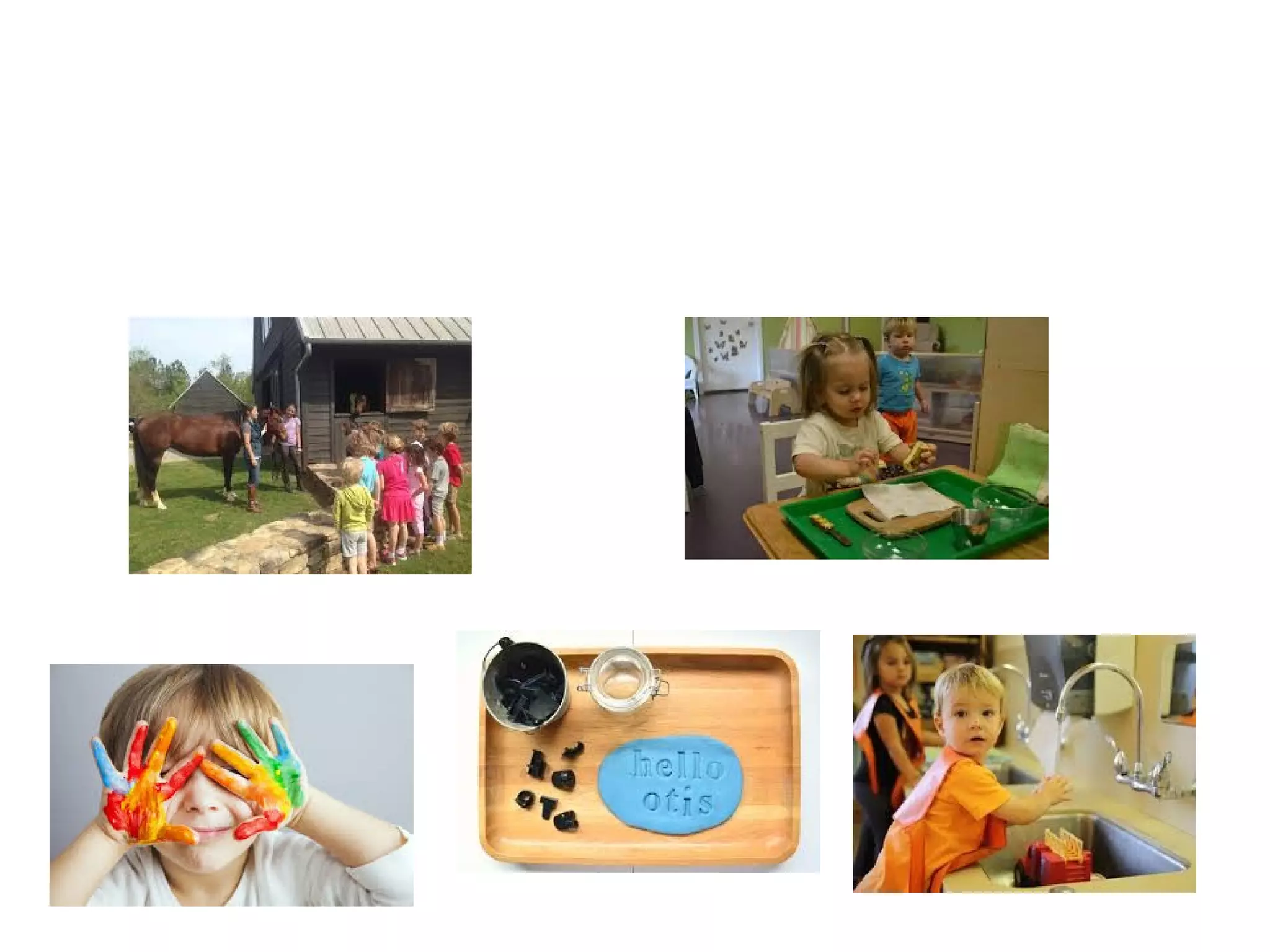
• Children learn language and other
significant life skills, without
conscious effort, from the
environments where they spend their
time.
• Children learn best through sensory
experiences, by doing & through
repetition.
• Children are capable of great
concentration when they are
surrounded by many interesting
things to do & given the time and
freedom to do them.
• Children need more physical activity.
Theories of Children Learning Development
(Mooney, 2000)
10. Maria Montessori
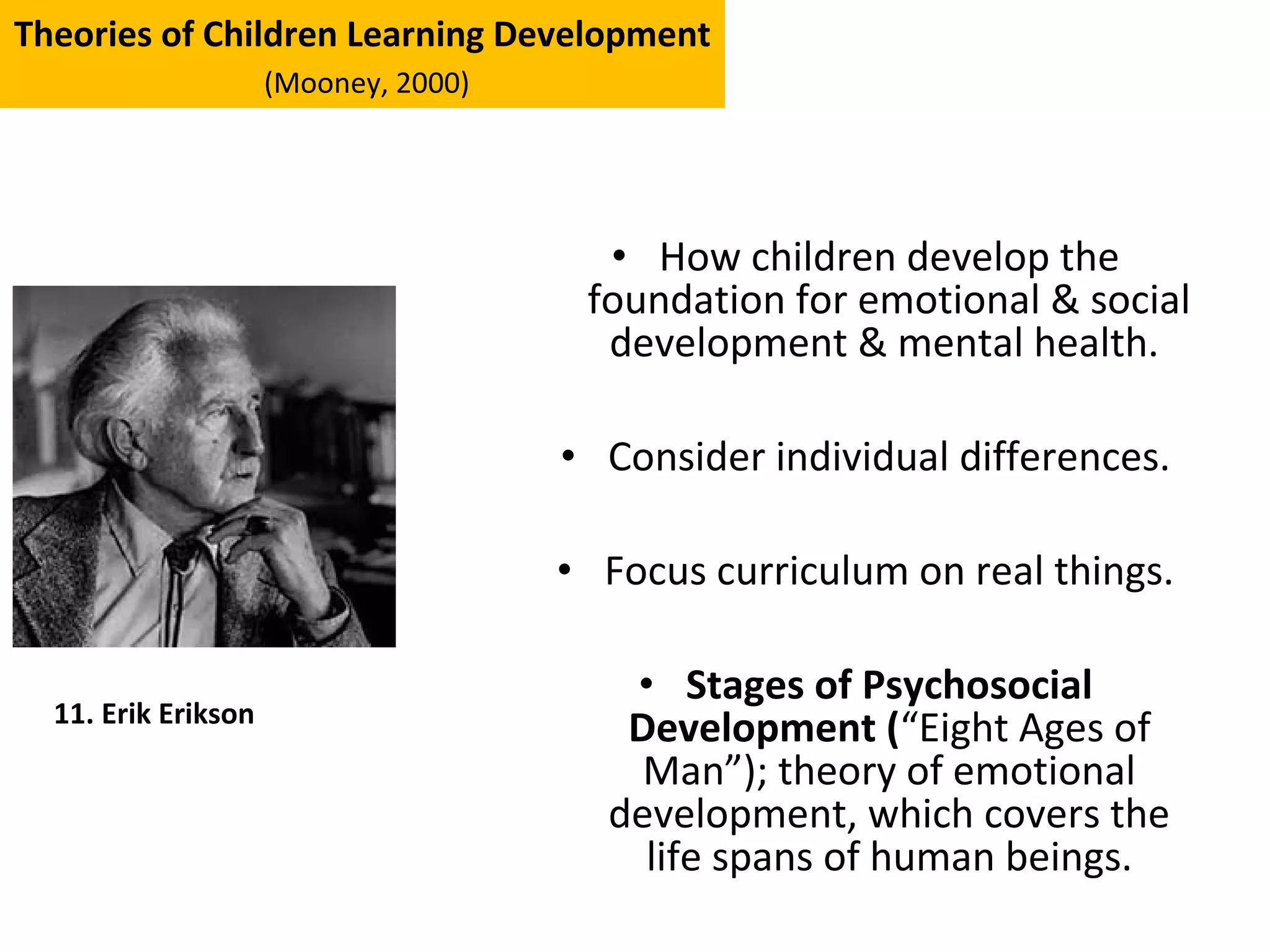
• How children develop the
foundation for emotional & social
development & mental health.
• Consider individual differences.
• Focus curriculum on real things.
• Stages of Psychosocial
Development (“Eight Ages of
Man”); theory of emotional
development, which covers the
life spans of human beings.
11. Erik Erikson
Theories of Children Learning Development
(Mooney, 2000)
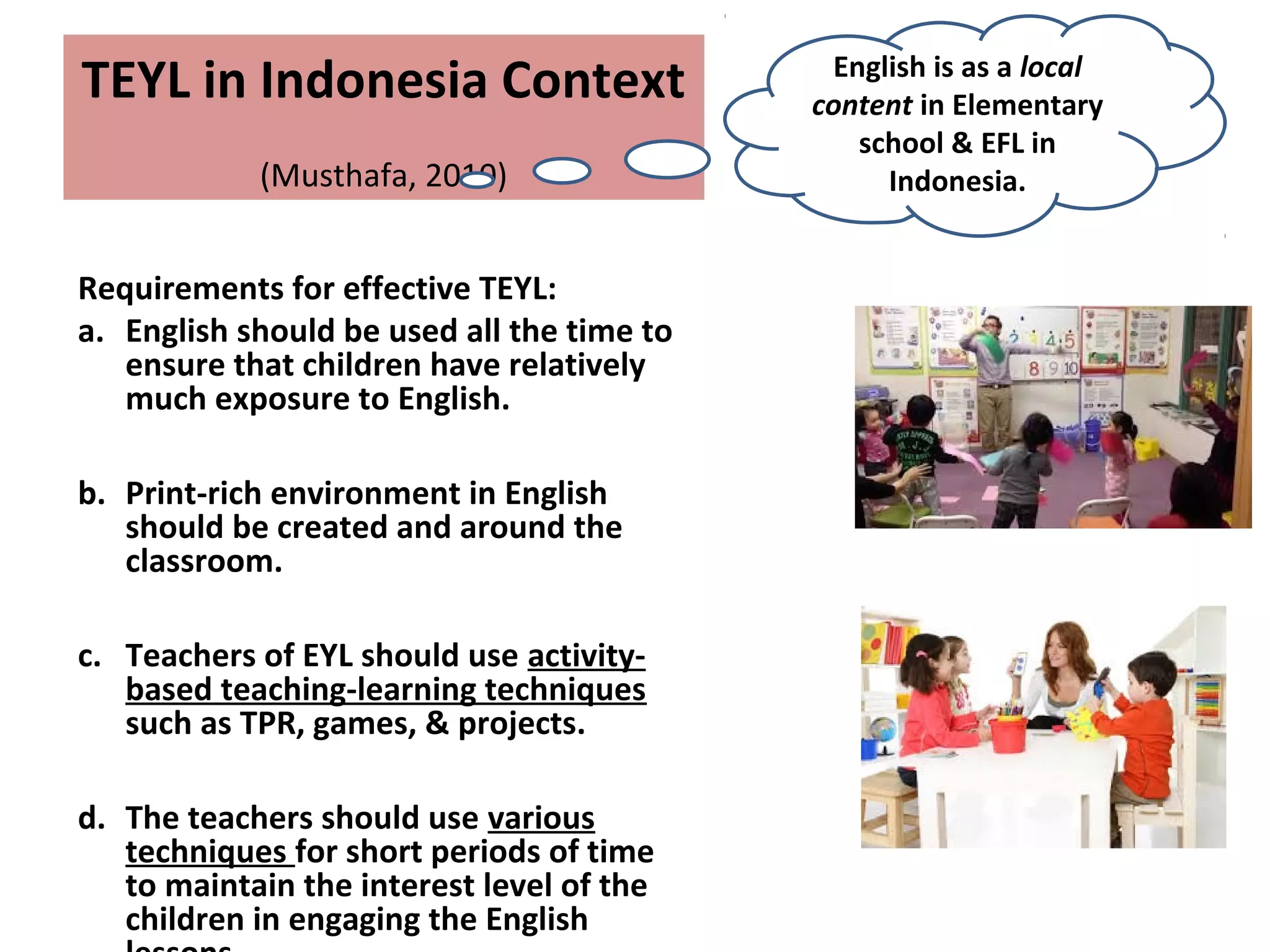
TEYL in Indonesia Context
(Musthafa, 2010)
Requirements for effective TEYL:
a. English should be used all the time to
ensure that children have relatively
much exposure to English.
b. Print-rich environment in English
should be created and around the
classroom.
c. Teachers of EYL should use activity-
based teaching-learning techniques
such as TPR, games, & projects.
d. The teachers should use various
techniques for short periods of time
to maintain the interest level of the
children in engaging the English
English is as a local
content in Elementary
school & EFL in
Indonesia.
e. The teachers should focus on functional
English for vocabulary development & for
immediate fulfillment of communicative
needs of the learners.
f. The teachers should reiterate often to
ensure the acquisition of English
expressions/vocabulary items.
g. The teachers should provide useful,
acquisition-promoting routines.
h. The teachers should have a good command
of English & have an ability to act as a role
model to the learners they teach.
TEYL in Indonesia Context
(Musthafa, 2010)
a. No exact curriculum/lesson plan
for teachers to teach EYL
conducted by the government in
Indonesia.
b. The English teachers in primary
schools are confuse of how to
conduct a good lesson plan.
c. The stage is not clear enough to
achieve the lesson’s objectives
which are appropriate with the
level of the students.
The Problem of
EYL in Indonesia Context
(Fadilah, 2017)
Session 4
• Instructions in Organizing the Classroom
• Teaching Vocabulary & Grammar
Teacher’s Instructions in Organizing the
Classroom
1. Pre-activities:
a. Greetings:
Good morning, students.
Good afternoon, everybody.
b. Do the prayer
before we start let’s pray together.
LET’S SING A SONG
Good morning every body, how are you?
(I’m fine)
Good morning every body, how are you?
(I’m fine)
Good morning to you, Good morning to you,
Good morning every body, how are you?
(I’m fine)
=> Just fine / I’m good
Teacher’s Instructions in Organizing the Classroom
(Classroom Language)
- Let’s call the roll.
- Let’s take the register.
- Let’s check to see who is here.
- Is anyone away?
- Is everybody here?
- Who is missing?
b. Checking attendance
- Arrange the classroom
- Sing a song
- Say a rhyme
- Play a game
c. Ways of starting lessons
2. Main-activity:
- I’m waiting for you to be quiet
- Stop talking & be quiet.
- Let’ s begin our lesson now
- Is everybody ready to start?
- Open your book at page...
- Is there any questions?
- Do you understand?
- Do you get it?
- Are you with me?
Daily Conversation in
Classroom
• Listen!
• Repeat!
• Sit down
• Work in pairs
• Raise your hand
• May I borrow your pen?
• May I go to the toilet ?
• How do you say ……. In English?
• Make a line
• Close the door.
• Come forward, please.
• Open the book
Teacher’s Instructions in Organizing the Classroom
(Classroom Language)
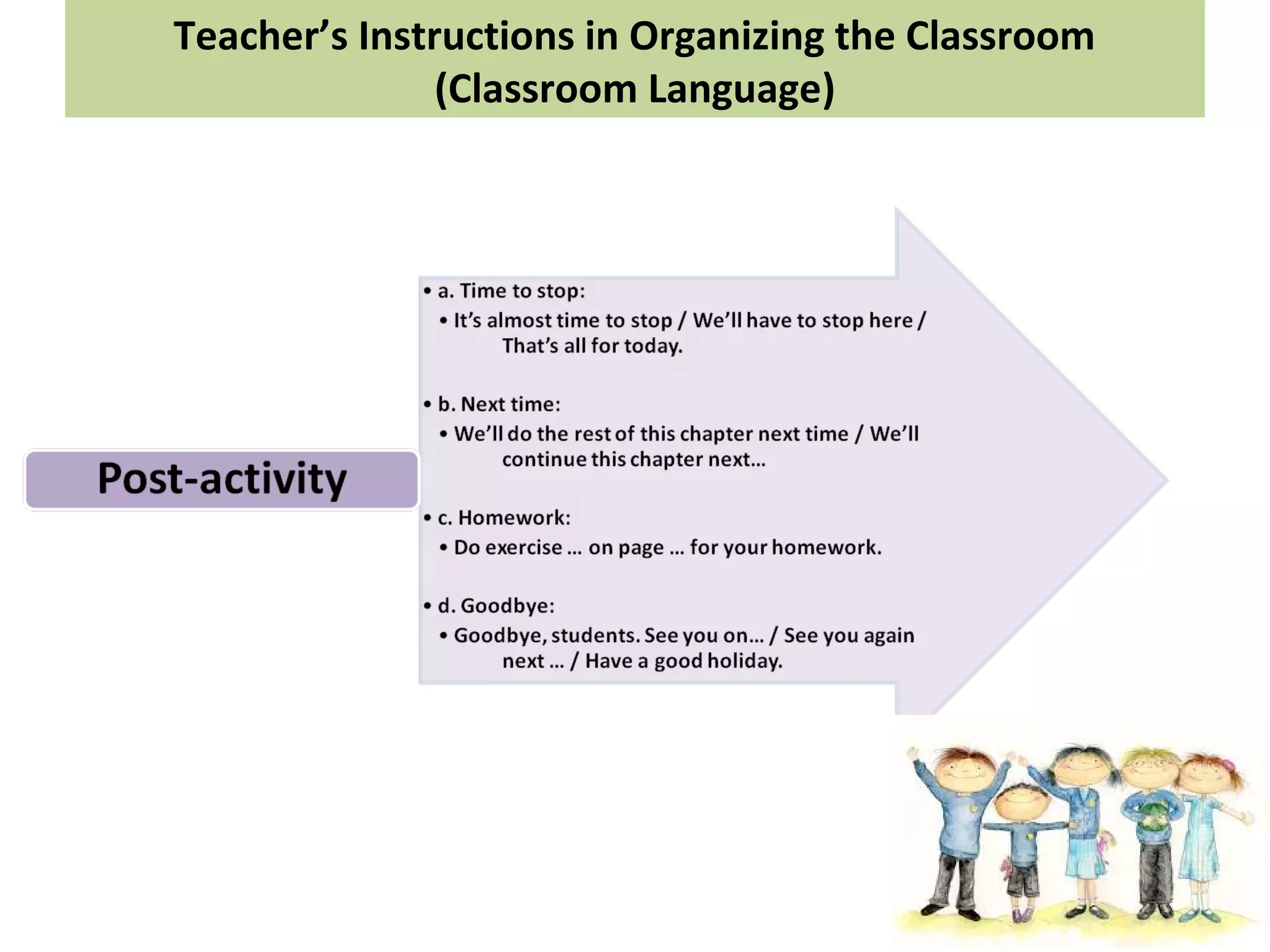
3. Post-activity:
a. That’s all for today.
b. Goodbye, students.
c. See you on…
d. See you again tomorrow
e. Have a good holiday.
• Good Bye
• Bye
• See you again
• See you tomorrow
• Thanks for coming
• Have a good day
• Have a nice day
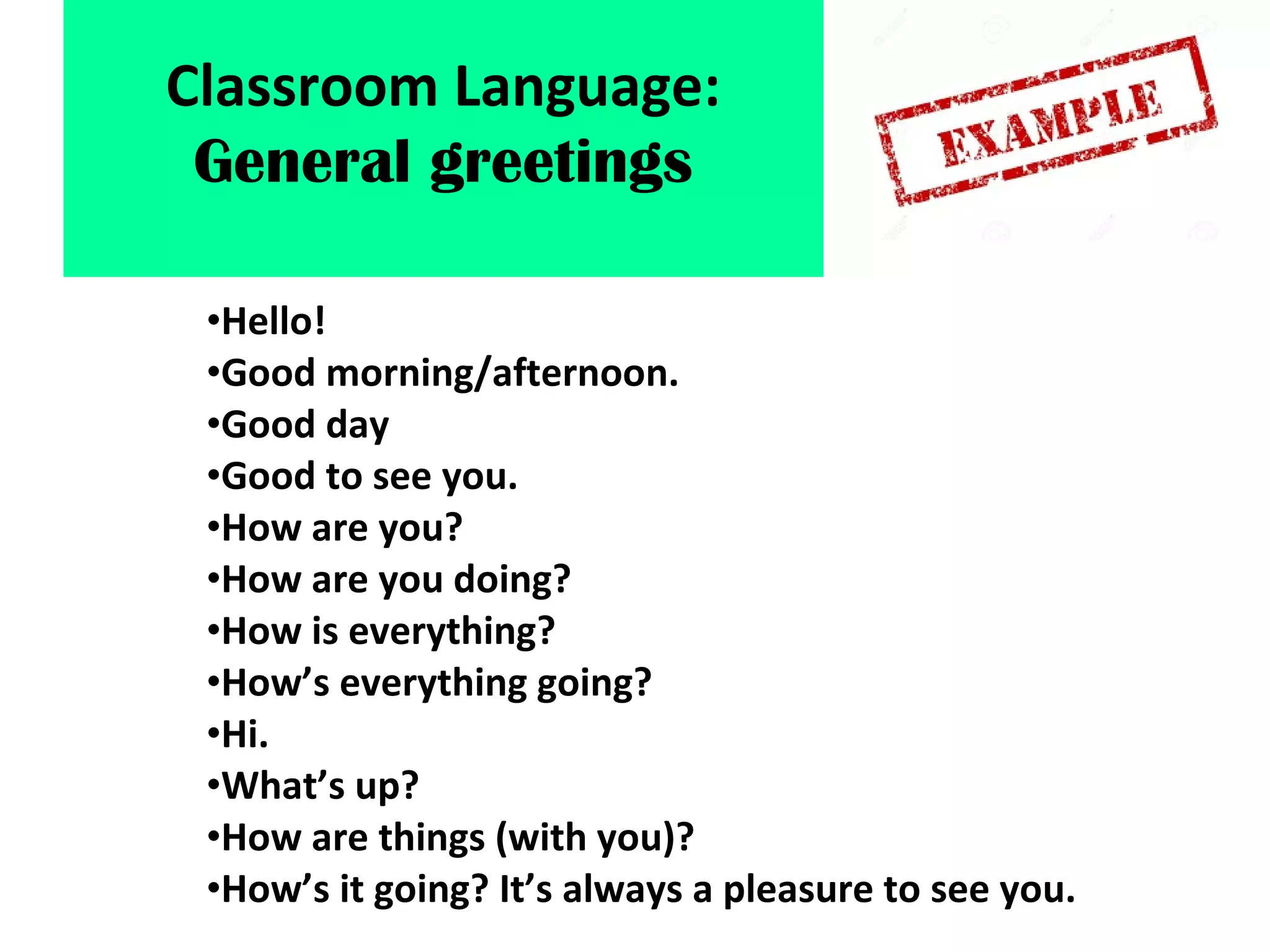
Classroom language:
General Closing
•Hello!
•Good morning/afternoon.
•Good day
•Good to see you.
•How are you?
•How are you doing?
•How is everything?
•How’s everything going?
•Hi.
•What’s up?
•How are things (with you)?
•How’s it going? It’s always a pleasure to see you.
Classroom Language:
General greetings
•Listen to me, please.
•Trace the words on the paper.
•Color the pictures/objects.
•Draw a butterfly on the
paper.
•Glue it on the colored paper.
•Stick it on the board.
•Cut this paper out carefully.
•Don’t speak too loud.
•Don’t say it anymore, it’s not
good.
•Sit down on the mat, please.
•Put your things in your bag.
•Cut and paste this paper
please.
•Take off your bag children.
• Let’s sing and dance
together!
•Don’t play with your chair, it’s
dangerous!
•Come forward and hit the
board.
•Touch something red!
•Let’s make a big/small circle.
•Take out your color pencils.
Classroom Language:
Teacher’s Instructions
– What’s your name?
– How old are you?
– Are you happy now?
– Are you sad?
– Are you hungry?
– Are you tired?
– Have you done your home work?
– How’s your weekend?
– How’s your long holiday?
– Do you understand?
– Is that clear enough?
– Do you listen to me?
– Can you write (it/that) to me?
– Can you come forward?
– Are you with me?
– Can you repeat after me?
– Would you like to read for us?
– Can you draw the ship?
– Can you color the pictures?
– What color is your bag?
– What’s your favorite color?
– What’s your favorite food/drink?
– What’s your favorite number?
– How many… have you got?
– What time do you get up/go to
bed?
– What time do you finish at
school?
– When is your birthday?
– Where do you live?
Classroom Language:
Teacher’s Questions (1)
– Do you like…?
– Can you say that again?
– Can you give it back to me?
– Can you put the rubbish into the
trash bin?
– Can you cut this paper out?
– Can you stick this paper on the
board?
– Can you fold the paper into two
sides?
– Can you move your chair a little?
– Can you sit next to him/her?
– Who likes going to the zoo?
– Can you tell me about your work?
– Can you stand up?
– Can you touch your finger on
your nose?
– Can you touch something
green?
– Who feeds a pet?
– Who likes singing?
– Who had a big breakfast this
morning?
– Who is your favorite hero?
– Who can answer me?
– Whose pen is this?
– What does your father do?
– Who wants to be an astronaut?
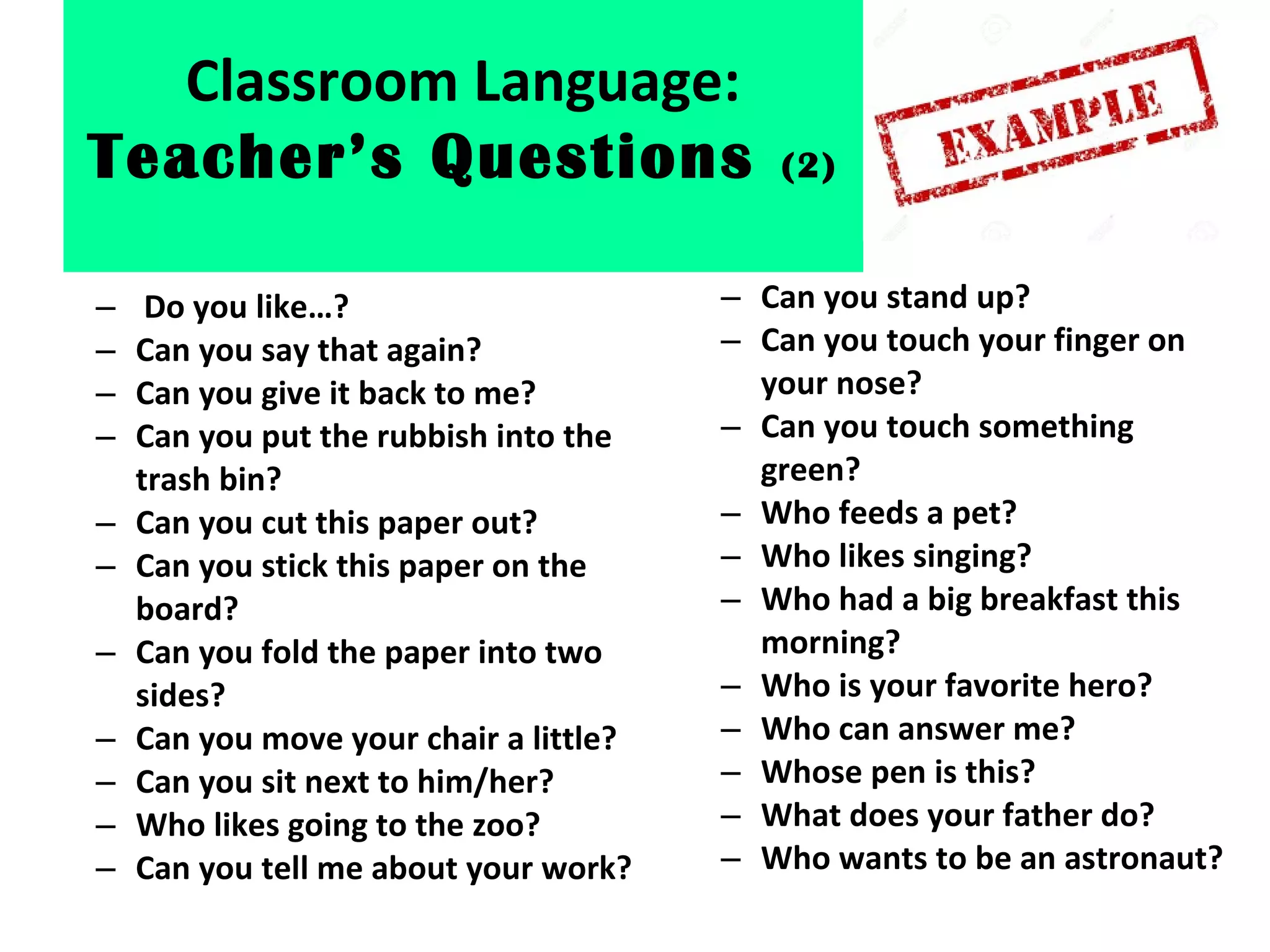
Classroom Language:
Teacher’s Questions (2)
MOTIVATING EXPRESSIONS
• That’s good!
• You’re right!
•Good work!
•Great!
•That’s it!
•Excellent!
•Good remembering!
•Keep on trying!
•Keep up the good work!
•I’m so happy to see you again.
•That kinds of work makes me happy.
Motivating Expressions:
Teaching vocabulary and grammar
Vocabulary & grammar should be taught
& learnt together. It’s better if grammar
is noticed & learnt from meaning-
focused input, children need to be able
to see the relationship between form &
function.
Teacher should provide lots of meaningful
practice, recycling, & guidance in attending to
language form. So children will learn grammar
in a holistic way.
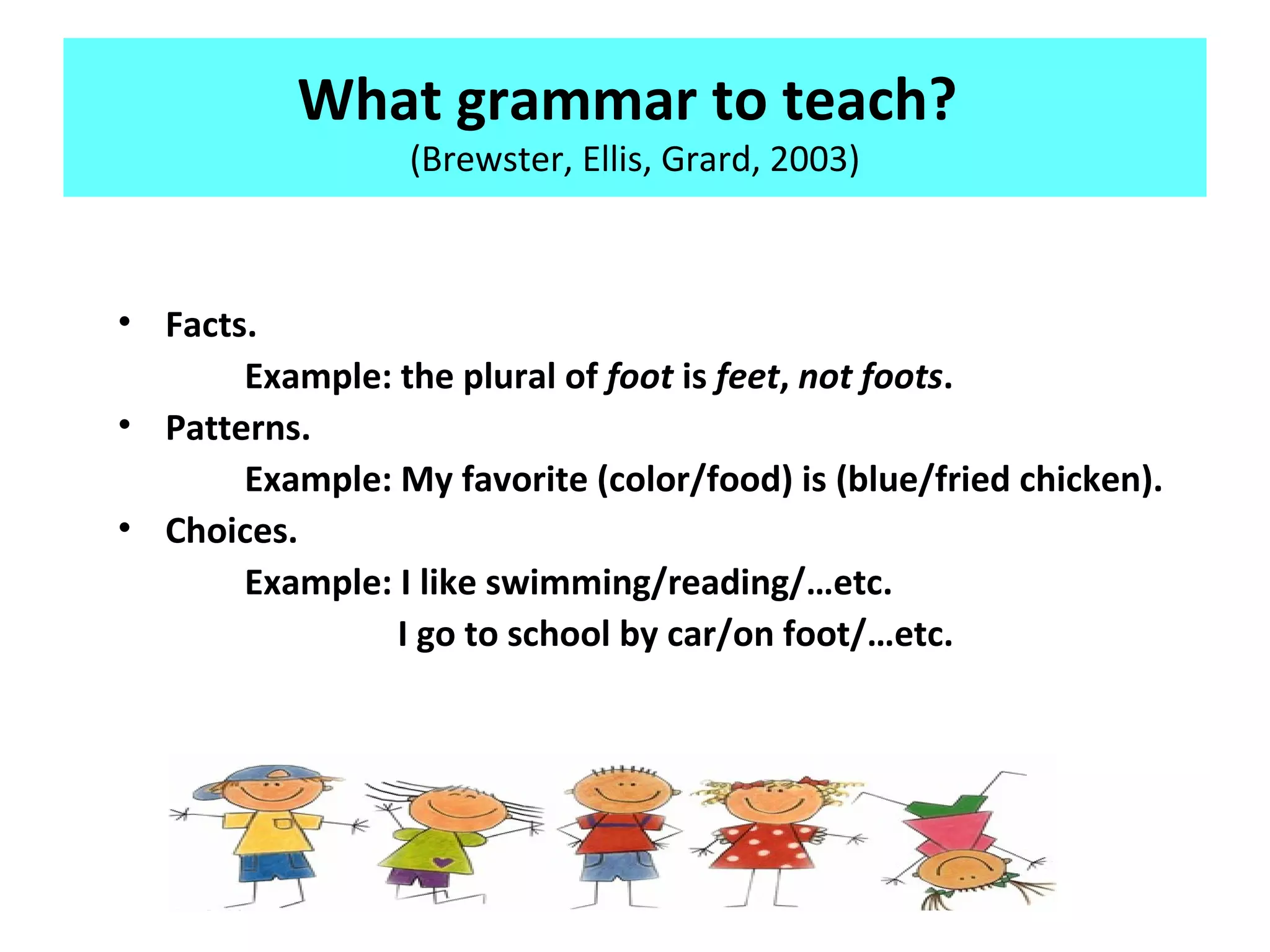
What grammar to teach?
(Brewster, Ellis, Grard, 2003)
• Facts.
Example: the plural of foot is feet, not foots.
• Patterns.
Example: My favorite (color/food) is (blue/fried chicken).
• Choices.
Example: I like swimming/reading/…etc.
I go to school by car/on foot/…etc.
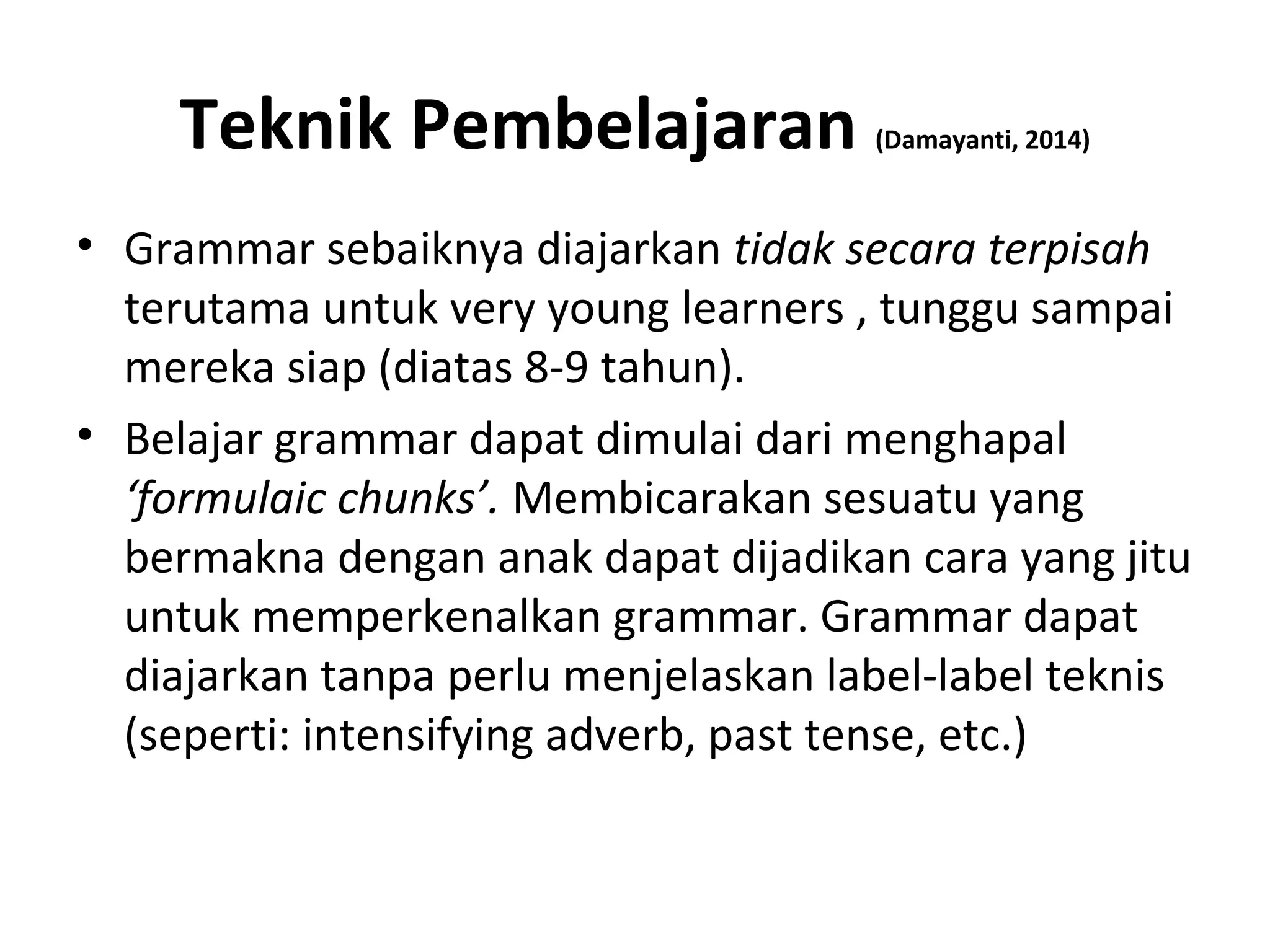
Teknik Pembelajaran (Damayanti, 2014)
• Grammar sebaiknya diajarkan tidak secara terpisah
terutama untuk very young learners , tunggu sampai
mereka siap (diatas 8-9 tahun).
• Belajar grammar dapat dimulai dari menghapal
‘formulaic chunks’. Membicarakan sesuatu yang
bermakna dengan anak dapat dijadikan cara yang jitu
untuk memperkenalkan grammar. Grammar dapat
diajarkan tanpa perlu menjelaskan label-label teknis
(seperti: intensifying adverb, past tense, etc.)
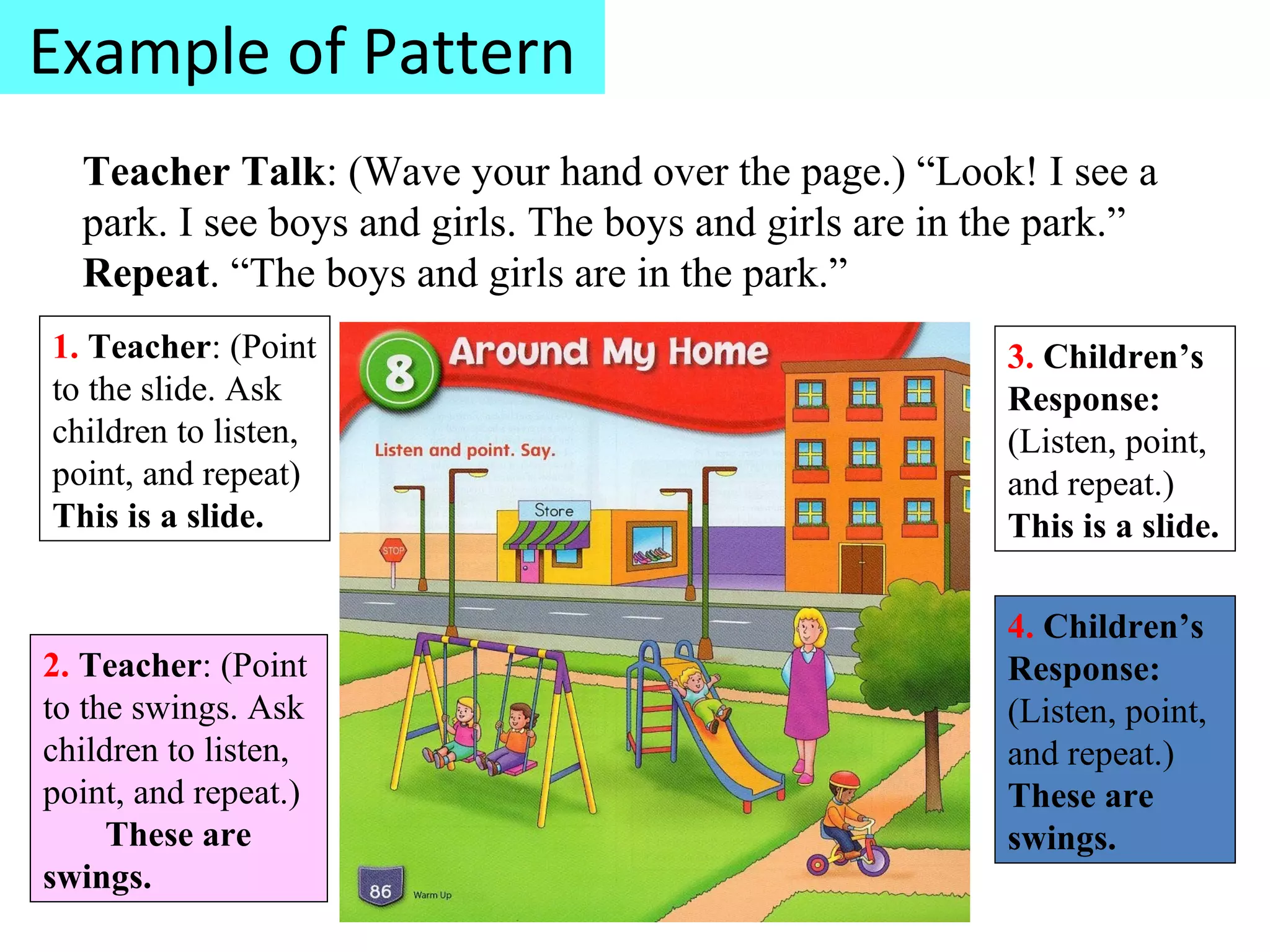
Example of Pattern
Teacher Talk: (Wave your hand over the page.) “Look! I see a
park. I see boys and girls. The boys and girls are in the park.”
Repeat. “The boys and girls are in the park.”
1. Teacher: (Point
to the slide. Ask
children to listen,
point, and repeat)
This is a slide.
3. Children’s
Response:
(Listen, point,
and repeat.)
This is a slide.
2. Teacher: (Point
to the swings. Ask
children to listen,
point, and repeat.)
These are
swings.
4. Children’s
Response:
(Listen, point,
and repeat.)
These are
swings.
Teaching using Story Telling
Purposes :
•To expose children to more language.
•To revise language/vocabulary.
•To present new language.
•To practice listening, speaking, reading,
writing.
•To extend/enrich children’s language
Assessment activities
(Brewster, Ellis, Grard, 2003):
• Listen/read, then change from singular to plural, etc.
• Fill in gaps with the correct grammatical/vocabulary item.
• Correct grammatical/vocabulary mistakes in sentence.
• Correct the word order in a sentence.
• Read/listen to lists of words & classifying them.
• Sequence time expressions, such as: today, yesterday,
tomorrow.
• Use picture prompts to contrast things using comparatives,
tenses, etc.
4 BINGO (=>
spelling)
There was a farmer had a dog and Bingo was it’s name..o..
B…I…N…G…O… B…I…N…G…O B…I…N…G…O
And Bingo was it’s name … o…
There was a farmer had a dog and Bingo was it’s name..o..
(clap)…I…N…G…O, (clap)…I…N…G…O, (clap)…I…N…G…O
And Bingo was it’s name … o…
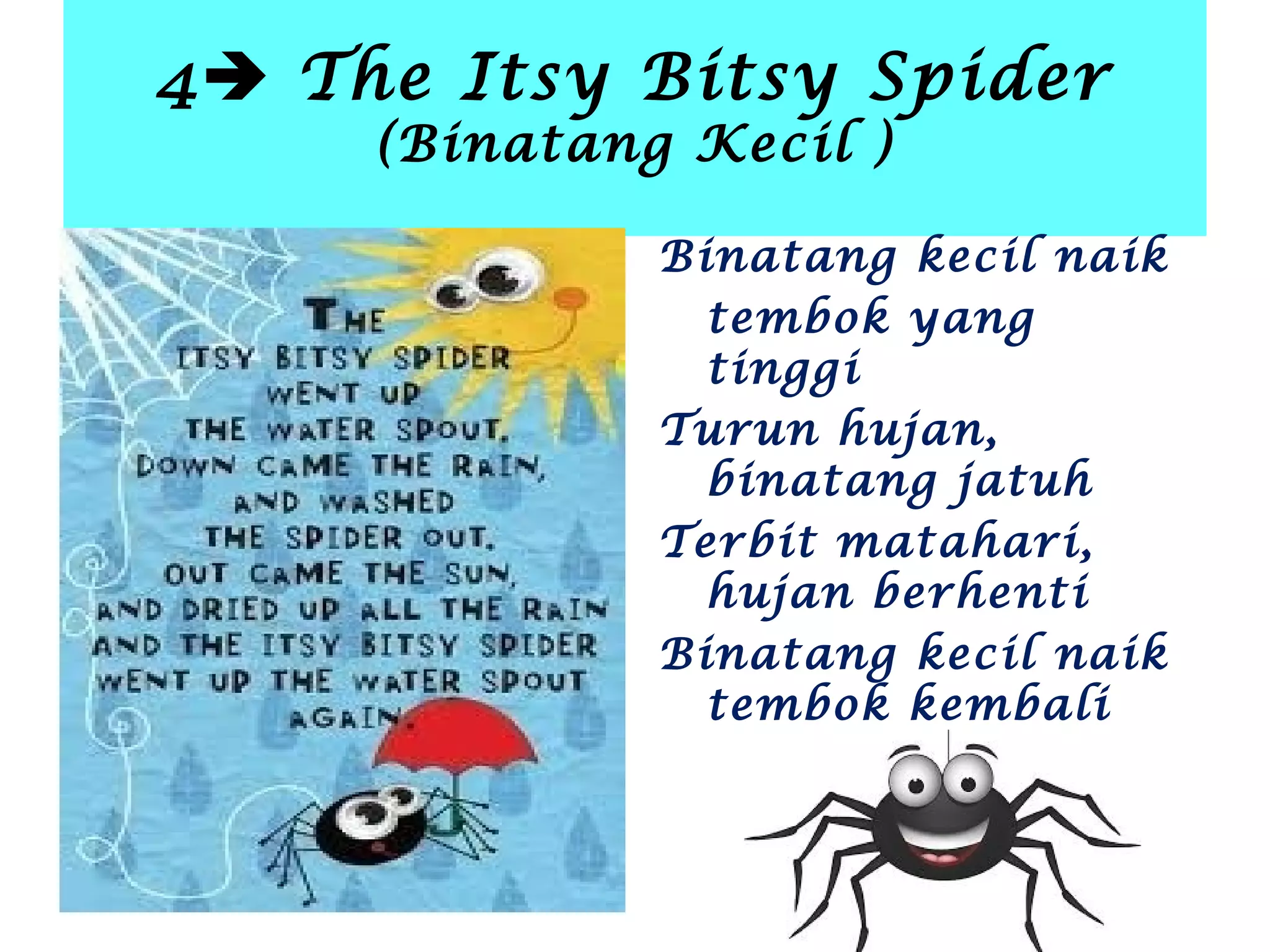
4 The Itsy Bitsy Spider
(Binatang Kecil )
Binatang kecil naik
tembok yang
tinggi
Turun hujan,
binatang jatuh
Terbit matahari,
hujan berhenti
Binatang kecil naik
tembok kembali
Session 5
• Teaching Listening & Speaking
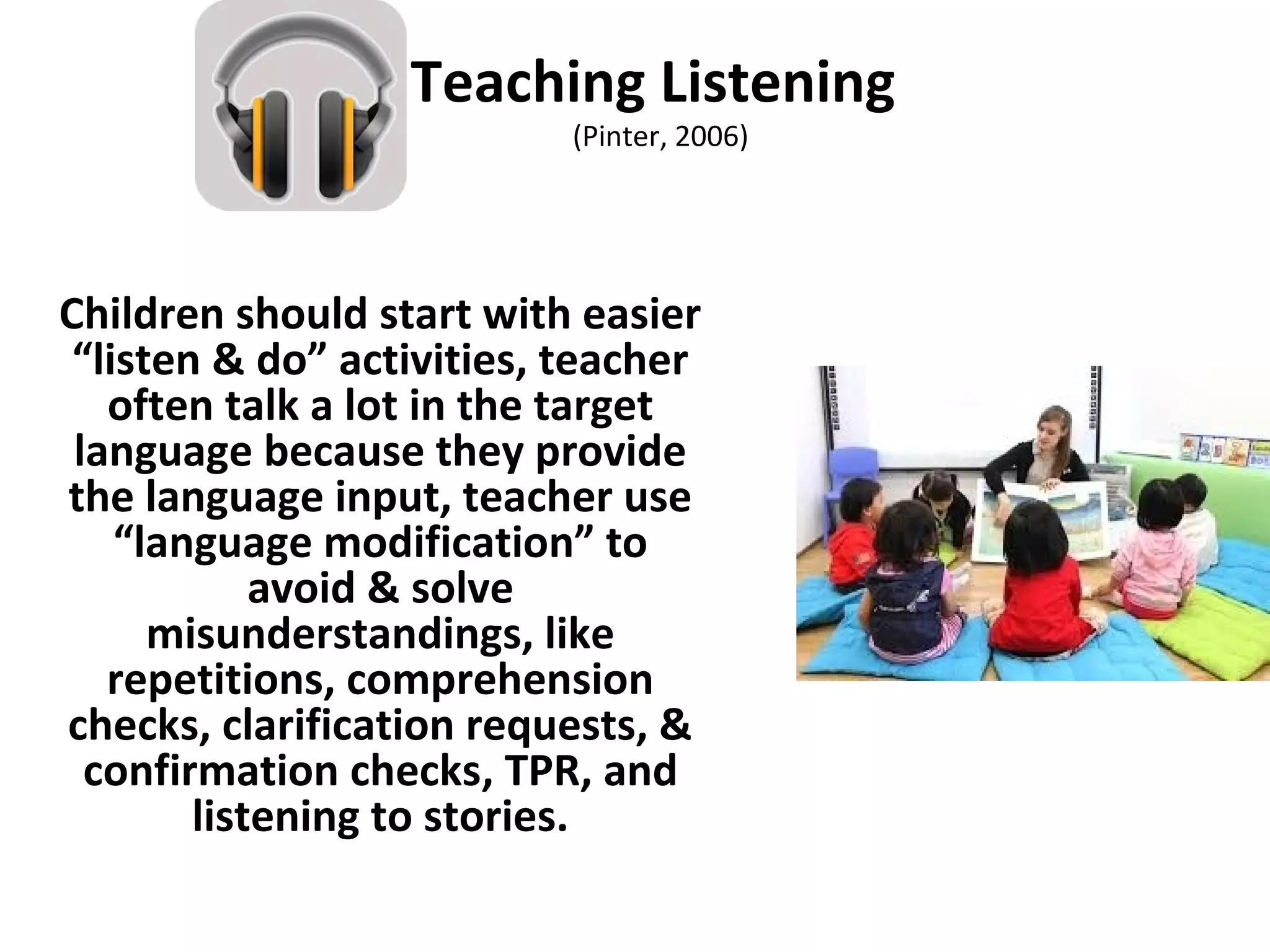
Teaching Listening
(Pinter, 2006)
Children should start with easier
“listen & do” activities, teacher
often talk a lot in the target
language because they provide
the language input, teacher use
“language modification” to
avoid & solve
misunderstandings, like
repetitions, comprehension
checks, clarification requests, &
confirmation checks, TPR, and
listening to stories.
Teaching Tips
(Slattery & Willis, 2001)
Support children’s early efforts in speaking by:
• Look at what they have done & talk about it,
even if they won’t understand everything you
say. Give your shy pupils more chance to talk to
you individually.
• Waiting for their responses
• Repeating what they say in English
• Frequently summarizing what different pupils
say
• Give children lots of opportunities to speak,
BUT …
Don’t pressure on children to speak if they are
not ready
• Remember: silent children are still likely to be
listening & learning
The Initial Stages In Teaching Speaking
(Brewster, Ellis, Grard, 2003)
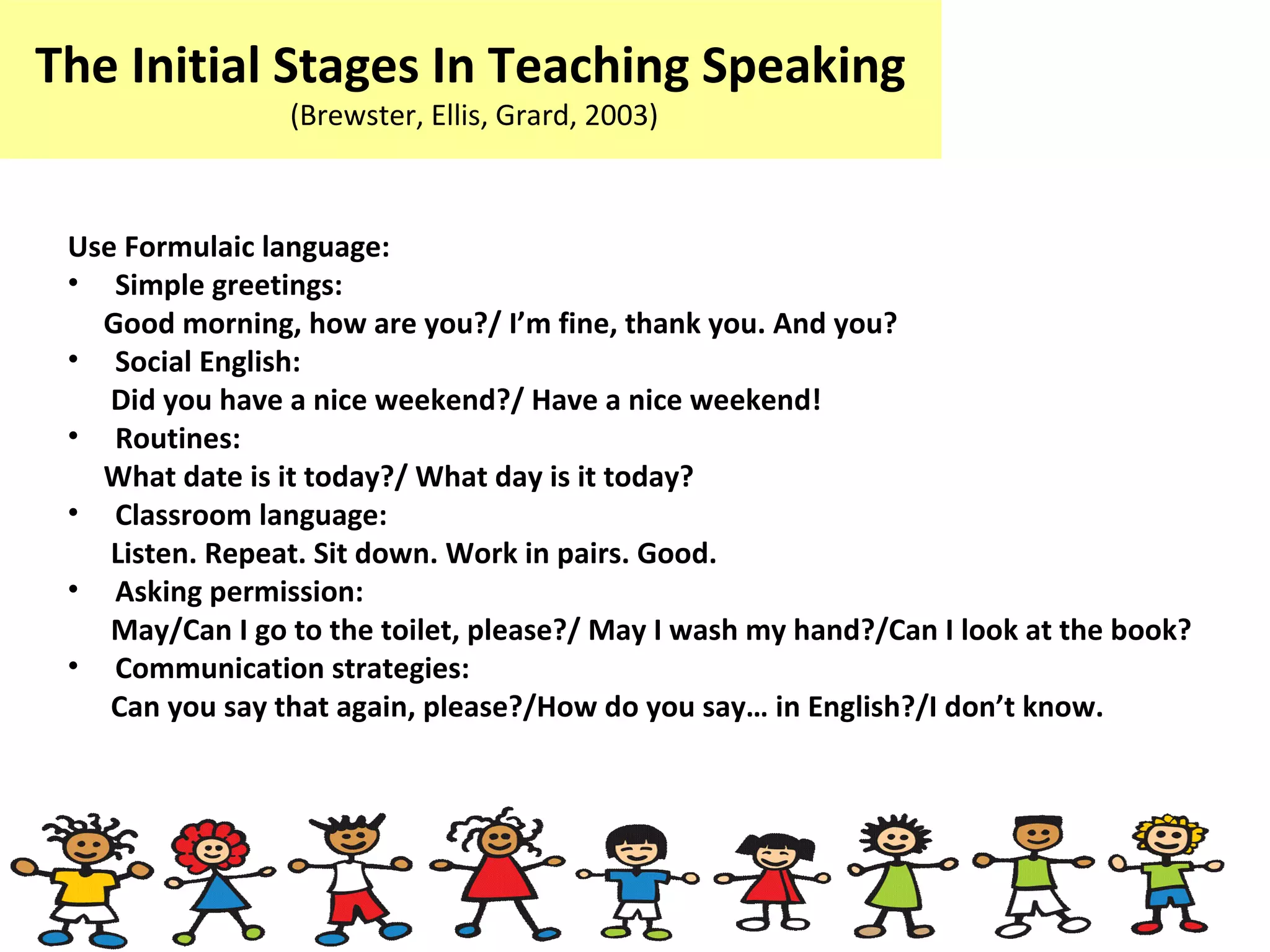
Use Formulaic language:
• Simple greetings:
Good morning, how are you?/ I’m fine, thank you. And you?
• Social English:
Did you have a nice weekend?/ Have a nice weekend!
• Routines:
What date is it today?/ What day is it today?
• Classroom language:
Listen. Repeat. Sit down. Work in pairs. Good.
• Asking permission:
May/Can I go to the toilet, please?/ May I wash my hand?/Can I look at the book?
• Communication strategies:
Can you say that again, please?/How do you say… in English?/I don’t know.
We can help our pupils understand what
we say in English:
• With our tone of voice, eye contact.
• By using gestures, facial
expressions, pictures/diagrams, real
things.
• By using familiar contexts & topics,
rephrasing what we say in as many
ways as we can, occasional use of
their mother tongue.
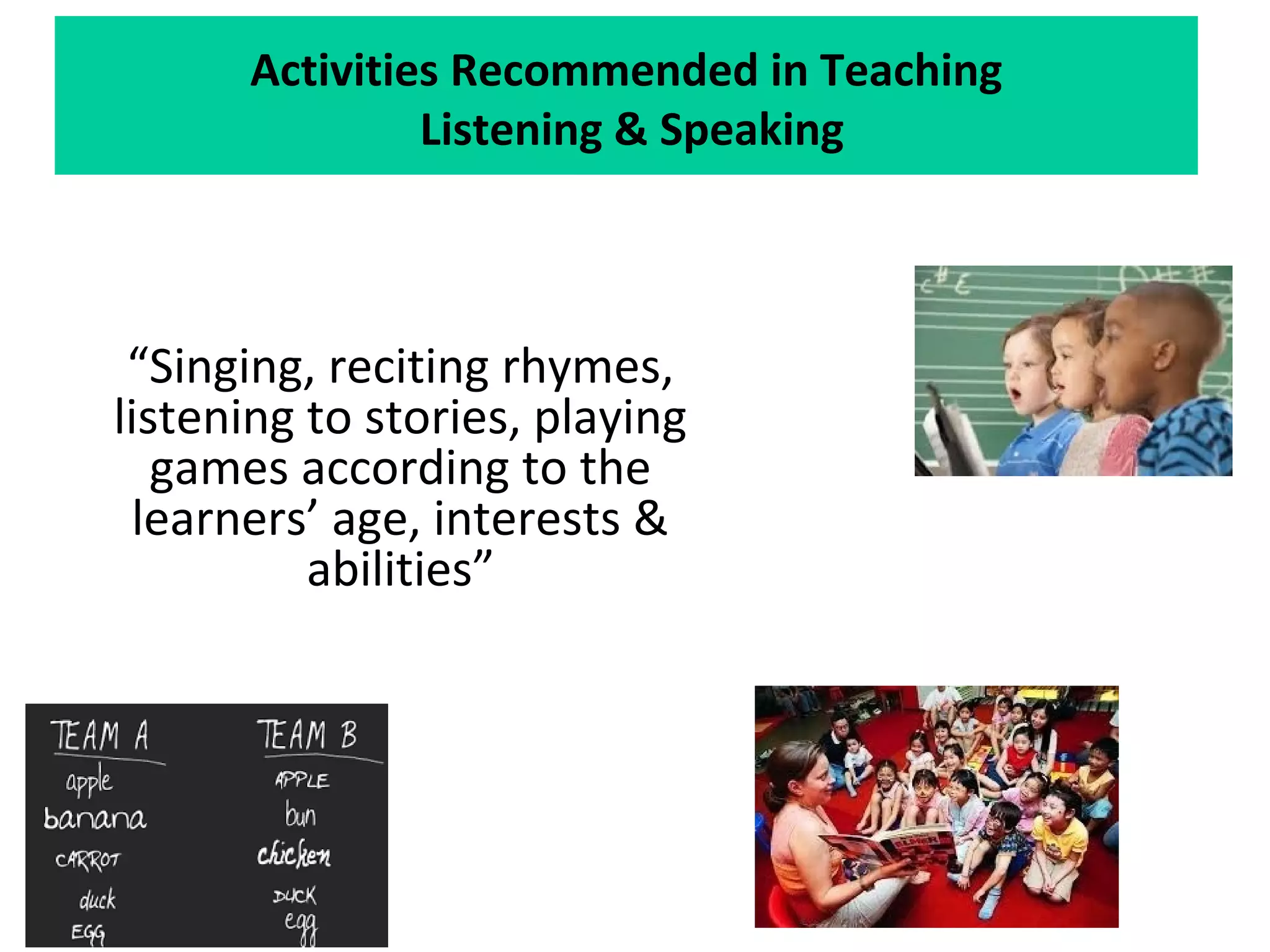
Activities Recommended in Teaching
Listening & Speaking
“Singing, reciting rhymes,
listening to stories, playing
games according to the
learners’ age, interests &
abilities”
5 Ten Little Indian
Boys (=>counting)
One, little two, little three, little
Indian,
Four, little five, little six, little
Indian,
Seven, little eight, little nine, little
Indian,
Ten, little Indian boys
Ten, little nine, little eight, little
Indian,
Seven, little six, little five, little
Indian,
Four, little three, little two, little
Indian,
5 Ten
Aeroplanes(=>counting)
One, little two, little three, little aeroplanes,
Four, little five, little six, little aeroplanes,
Seven, little eight, little nine, little
aeroplanes,
Ten aeroplanes flying high
Ten, little nine, little eight, little aeroplanes,
Seven, little six, little five, little aeroplanes,
Four, little three, little two, little aeroplanes,
One aeroplane flying high
Five little ducks went out one day
Over the hills and far away
Mother duck said: “quack quack quack quack”
But only four little ducks came back
Four little ducks went out one day
Over the hills and far away
Mother duck said: “quack quack quack quack”
But only three little ducks came back
5Little Ducks (1)
Three little ducks went out one day
Over the hills and far away
Mother duck said: “quack quack quack quack”
But only two little ducks came back
Two little ducks went out one day
Over the hills and far away
Mother duck said: “quack quack quack quack”
But only one little duck came back
5Little Ducks (2)
One little duck went out one day
Over the hills and far away
Mother duck said: “quack quack quack quack”
But none of those little ducks came back
Mother duck, she, went out one day
Over the hills and far away
Mother duck said: “quack quack quack quack”
And all of those little ducks came back
5Little Ducks (3)
Session 6
• Teaching of Reading & Writing
Teaching Reading and writing
(Pinter, 2006):
“It would be controversial to introduce
reading & writing in a second language
to children who are not yet literate in
their first language.”
“Reading & writing are usually taught in
parallel because children who begin to read
enjoy writing too. Children can only benefit
from phonics training if the meaning of the
words makes sense to them.”
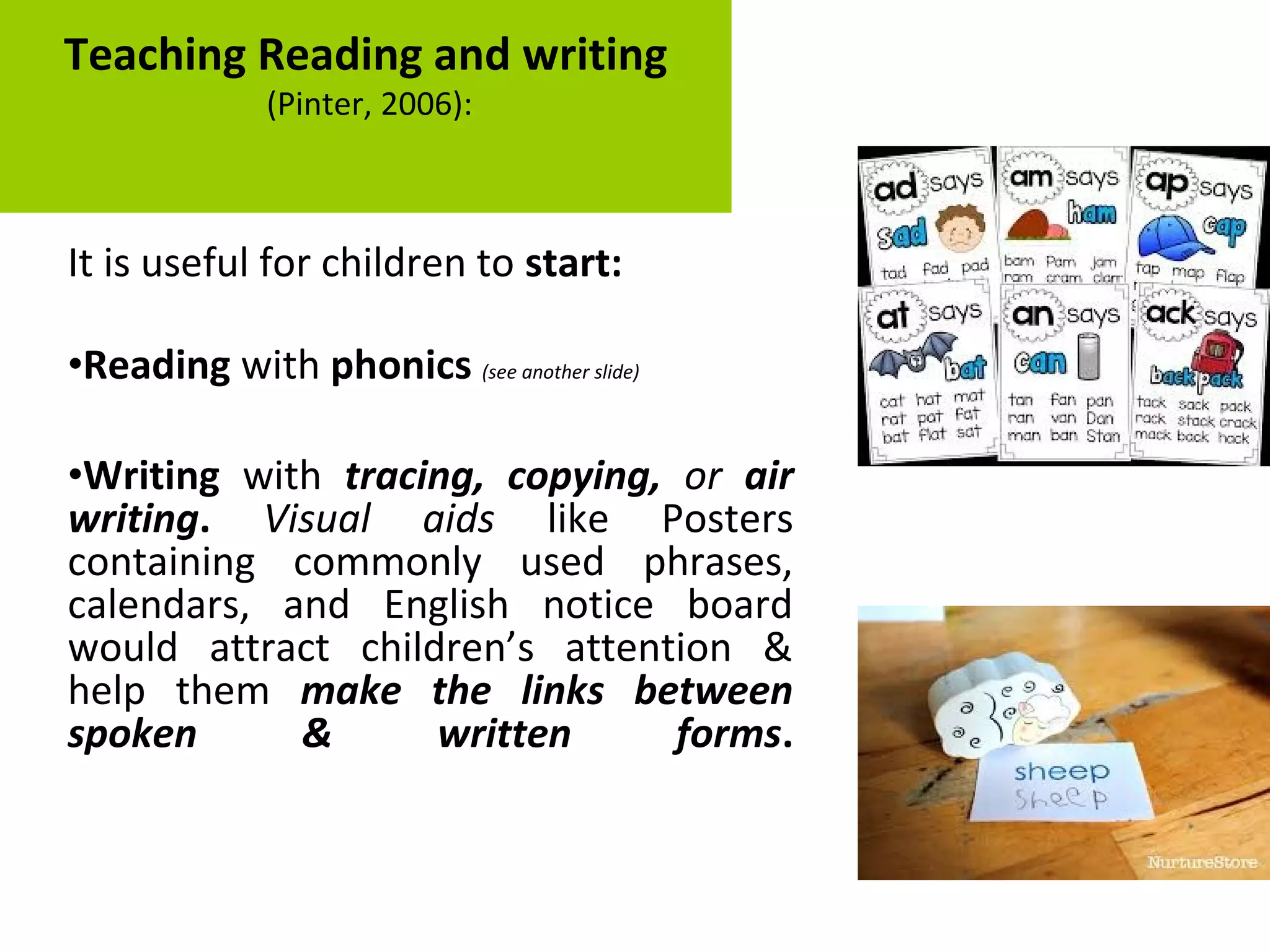
It is useful for children to start:
•Reading with phonics (see another slide)
•Writing with tracing, copying, or air
writing. Visual aids like Posters
containing commonly used phrases,
calendars, and English notice board
would attract children’s attention &
help them make the links between
spoken & written forms.
Teaching Reading and writing
(Pinter, 2006):
Slattery & Willis (2001)
- All children listen from birth & naturally acquire speech
- All children have to learn how to read & write
- If children’s mother tongue is written in Roman script, you
can use a teaching method that focuses on meaning from the
beginning
- If children have a mother tongue that is not based on Roman
script, then you will have to spend some more time on
sounds, letter shape & word recognition
- Meaning is the most important element in reading just as it
is in listening
- So, reading comes before writing.
Priorities when teaching reading & writing
(Slattery & Willis, 2001)
• Focus on meaning
• Word recognition
• Making the connection between familiar sounds &
written words/phrases
• Naming the letters of the alphabet
• Predicting the pronunciation of a written word
Teaching reading & writing
using cards
Reading
 Matching words/phrases with
pictures
 Labelling pictures/objects
 Predicting from initial sounds
 Re-arranging jumbled letters
to make a word
 Classifying words into sets
 Ordering sentences in the
correct sequence
 Guessing the missing word
 Games that involve
recognizing words & meaning
Writing
 Copy/write from memory the
word/phrase that matches
 Write a label
 Finish the word st…
 Write the whole word
 Copy/write the names of all
the people in the story
 Copy/write out the story in
the right order
 Copy the phrase/sentence
putting in the missing word
 Bingo, writing races
6 If You’re Happy and You
Know it
(Jika kau suka hati)
?
If you’re happy and you know it
clap your hands (clap clap)
(2x)
If you’re happy and you know it
Then your face will surely show it
If you’re happy and you know it
clap your hands (clap clap)
⇒ Stomp your feet
⇒ Nod your head/Say hurray
⇒ Do all three (clap, stomp, nod/say hurray)
Session 7
Mid Test
Session 8
• Lesson Plan of TEYL
How to plan Lesson?
• Lesson plan gives the lesson framework, an overall
shape.
• Good teachers are flexible and respond creatively
to what happens in the classroom, but they also
need to have thought ahead, have a destination
they want their students to reach, and know how
they are going to get there.
• What are the aims of a plan?
a good plan needs to reflect coherence and variety
The ideal compromise is to plan a lesson that has an internal
coherence but which nevertheless allows the students to do
different things.
A number of important questions before
teacher starts to plan an activity:
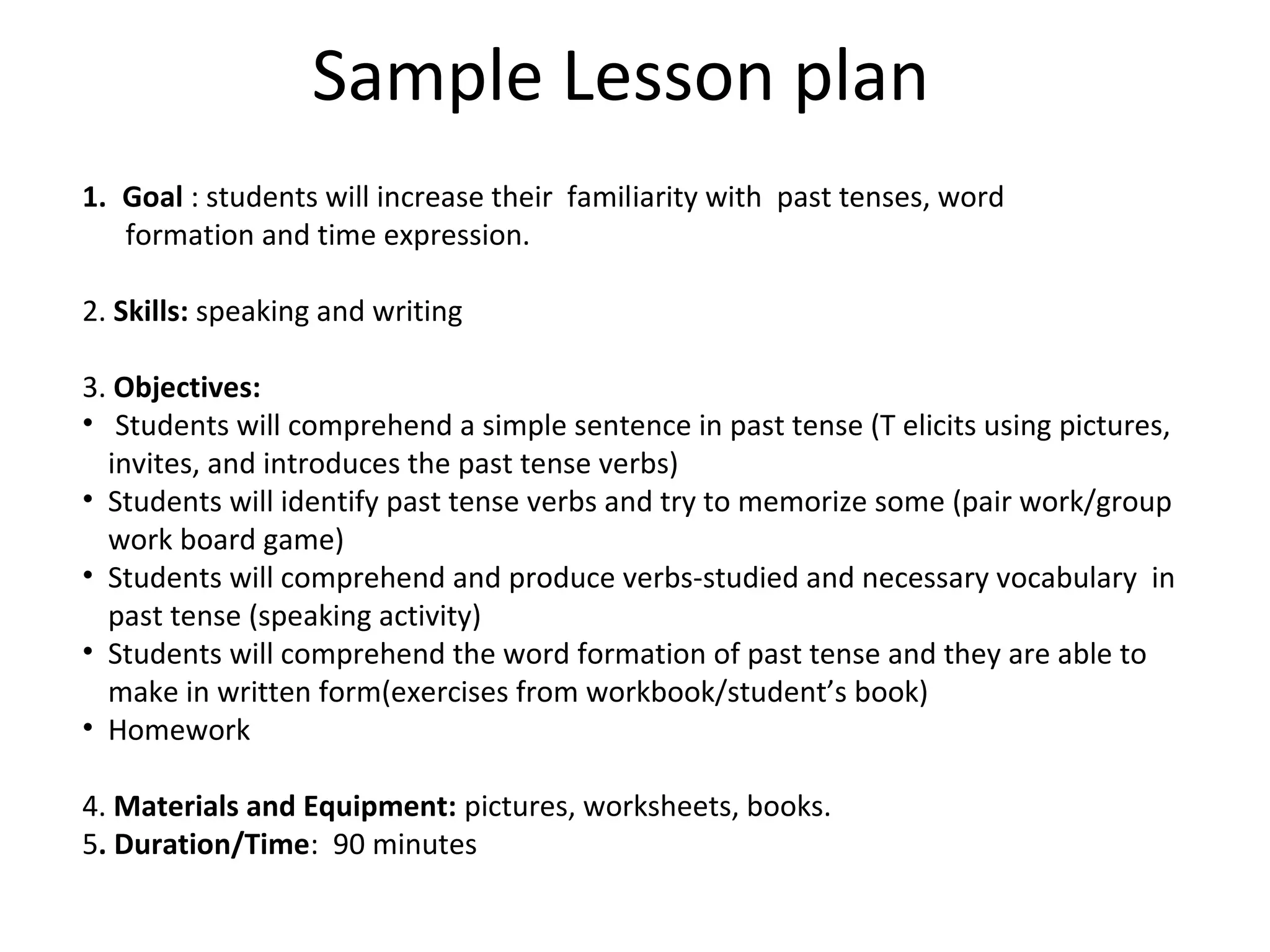
Sample Lesson plan
1. Goal : students will increase their familiarity with past tenses, word
formation and time expression.
2. Skills: speaking and writing
3. Objectives:
• Students will comprehend a simple sentence in past tense (T elicits using pictures,
invites, and introduces the past tense verbs)
• Students will identify past tense verbs and try to memorize some (pair work/group
work board game)
• Students will comprehend and produce verbs-studied and necessary vocabulary in
past tense (speaking activity)
• Students will comprehend the word formation of past tense and they are able to
make in written form(exercises from workbook/student’s book)
• Homework
4. Materials and Equipment: pictures, worksheets, books.
5. Duration/Time: 90 minutes
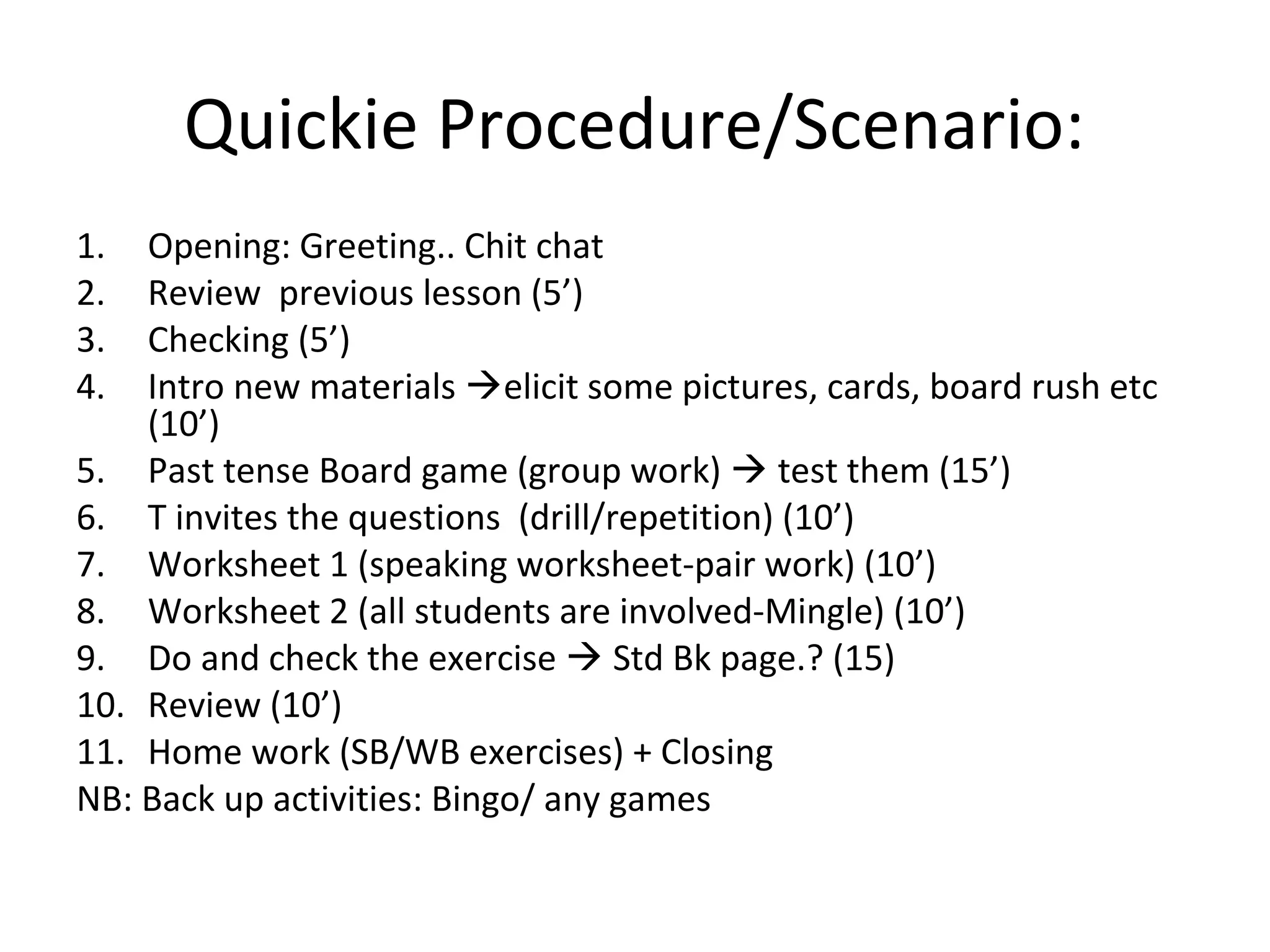
Quickie Procedure/Scenario:
1. Opening: Greeting.. Chit chat
2. Review previous lesson (5’)
3. Checking (5’)
4. Intro new materials elicit some pictures, cards, board rush etc
(10’)
5. Past tense Board game (group work)  test them (15’)
6. T invites the questions (drill/repetition) (10’)
7. Worksheet 1 (speaking worksheet-pair work) (10’)
8. Worksheet 2 (all students are involved-Mingle) (10’)
9. Do and check the exercise  Std Bk page.? (15)
10. Review (10’)
11. Home work (SB/WB exercises) + Closing
NB: Back up activities: Bingo/ any games
A Lesson Plan of TEYL
(Paul, 2003)
Child-centered Learning:
– Noticing
– Wanting
– Challenging/taking a risk
– Playing/experimenting
– Succeeding
– Linking/Internalization
Teacher-centered
• We can plan a lesson
carefully
• We can use time effectively
• We can teach clearly and
logically
• The children behave well
and do not chat so much.
• The children enjoy
themselves
• They learn naturally and
actively
• They are spontaneous
• Their eyes shine brightly
Child-centered
What can go wrong?
• We do not give the children space to notice
• They do what we want them to do
• They do not try for themselves
• They do not experiment enough
• They are unsuccessful
• They do not make links
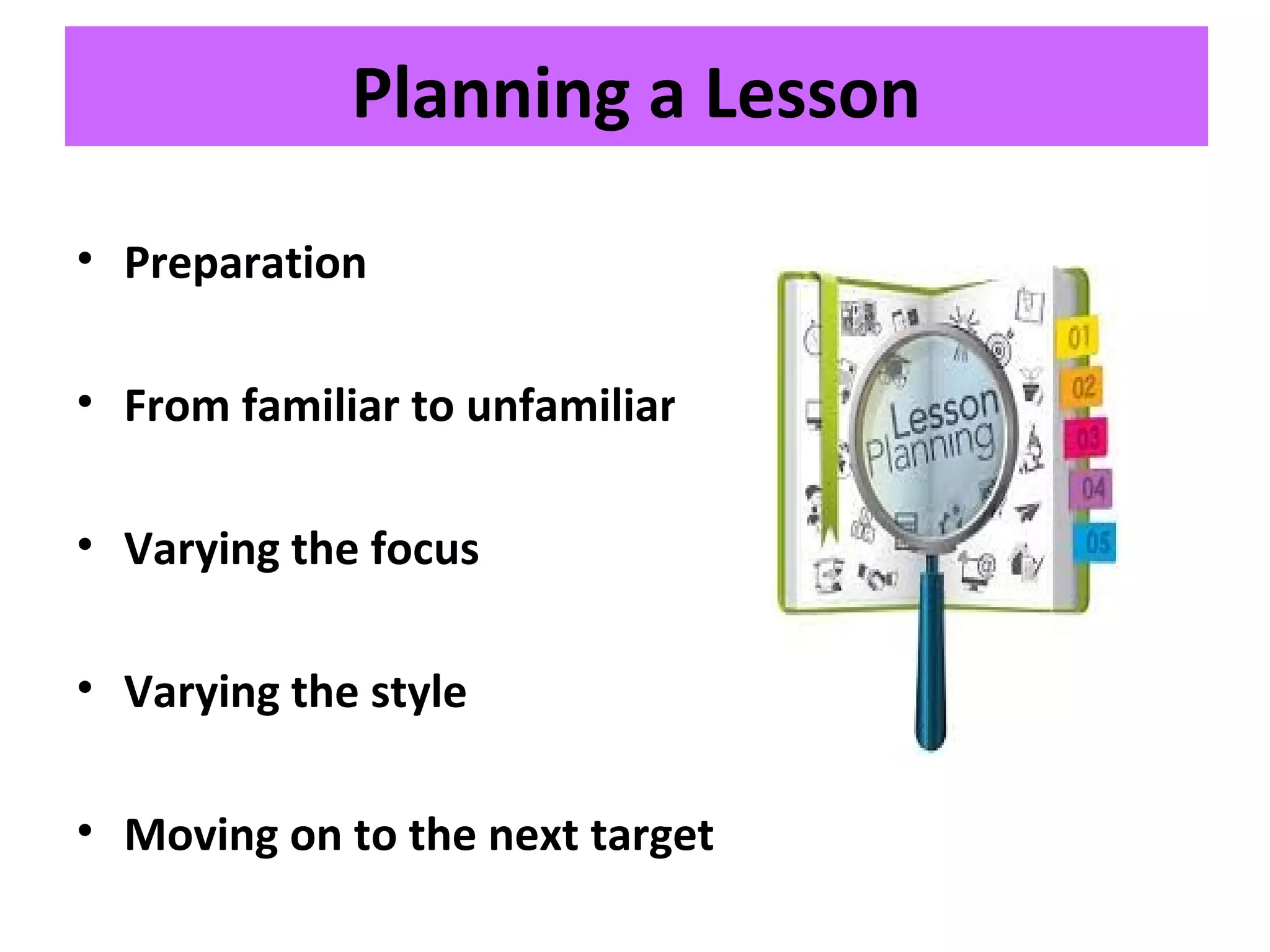
Planning a Lesson
• Preparation
• From familiar to unfamiliar
• Varying the focus
• Varying the style
• Moving on to the next target
Techniques
- Repetition
- Introducing new
words
- Introducing new
patterns
- Creating a need
Organization
One-to-one, pairs,
and groups
Routines
Scoring systems
Homework
LEARNING CONDITIONS
• Plenty of exposure
• Lots of repetition and routine
• Friendly environment
• No compulsion of communication—based on
desire
• Unlimited time
• Parent and child do things together
8 Old Mc Donald’s Farm (1)
Old Mc Donald had a farm (ee i ee i oh)
And on his farm he had a duck (ee i ee i oh)
With a quack quack here and a quack quack
there
Here quack there quack
Everywhere a quack quack
Old Mc Donald had a farm (ee i ee i oh)
8 Old Mc Donald’s Farm (2)
Old Mc Donald had a farm (ee i ee i oh)
And on his farm he had a cow (ee i ee i oh)
With a moo moo here and a moo moo there
Here moo there moo
Everywhere a moo moo
Quack quack here and a quack quack
there
Here quack there quack
Everywhere a quack quack
Old Mc Donald had a farm (ee i ee i oh)
8 Old Mc Donald’s Farm (3)
Old Mc Donald had a farm (ee i ee i oh)
And on his farm he had a pig (ee i ee i oh)
With an oink oink here and an oink oink
there
Here oink there oink
Everywhere an oink oink
Moo moo here and a moo moo there
everywhere moo moo
Quack quack here and a quack quack
there
Everywhere quack quack
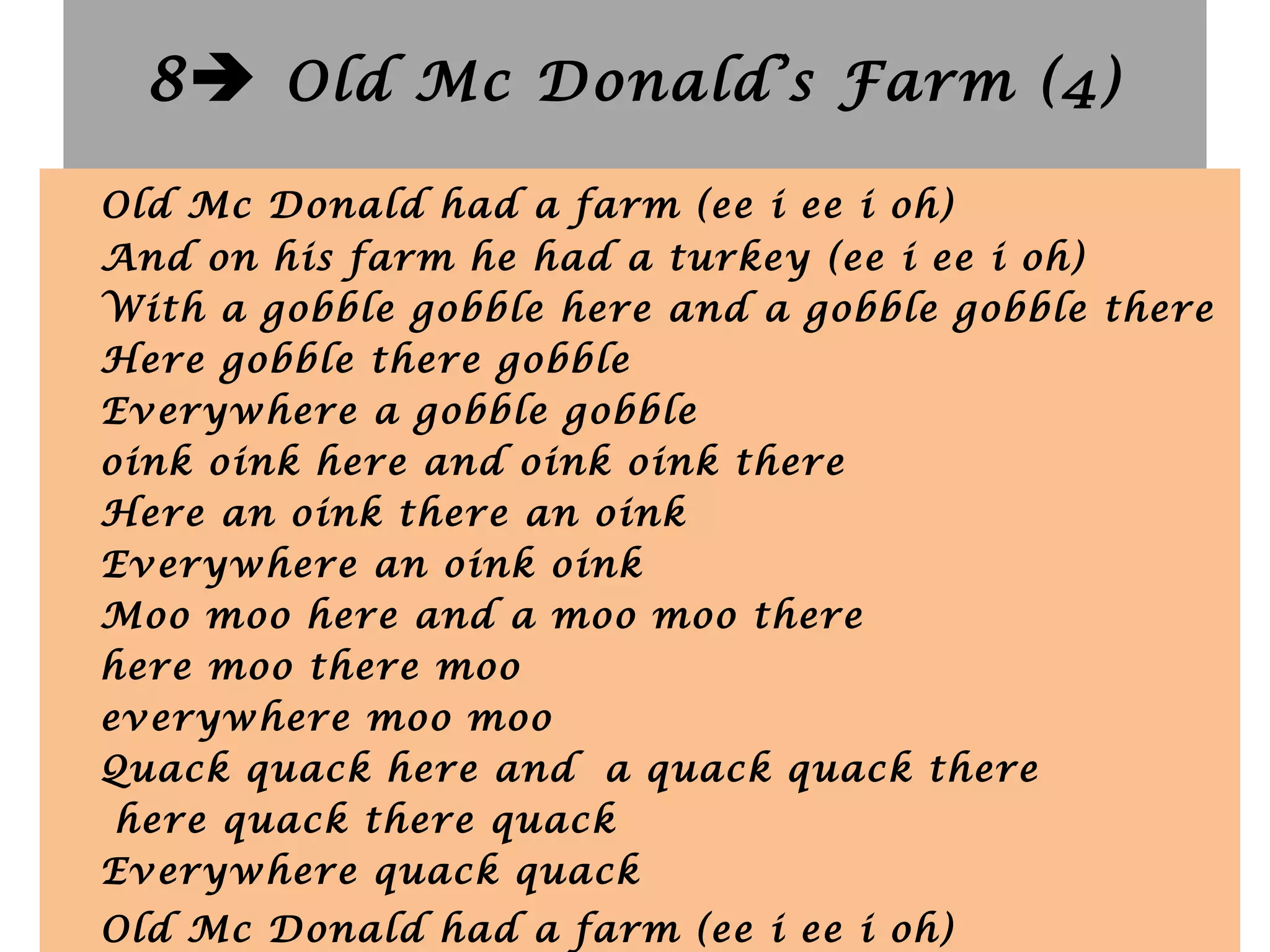
8 Old Mc Donald’s Farm (4)
Old Mc Donald had a farm (ee i ee i oh)
And on his farm he had a turkey (ee i ee i oh)
With a gobble gobble here and a gobble gobble there
Here gobble there gobble
Everywhere a gobble gobble
oink oink here and oink oink there
Here an oink there an oink
Everywhere an oink oink
Moo moo here and a moo moo there
here moo there moo
everywhere moo moo
Quack quack here and a quack quack there
here quack there quack
Everywhere quack quack
Old Mc Donald had a farm (ee i ee i oh)
Session 8
• Recommended Activities in Teaching
Listening, Speaking, Reading & Writing
• Assessing Young Learners
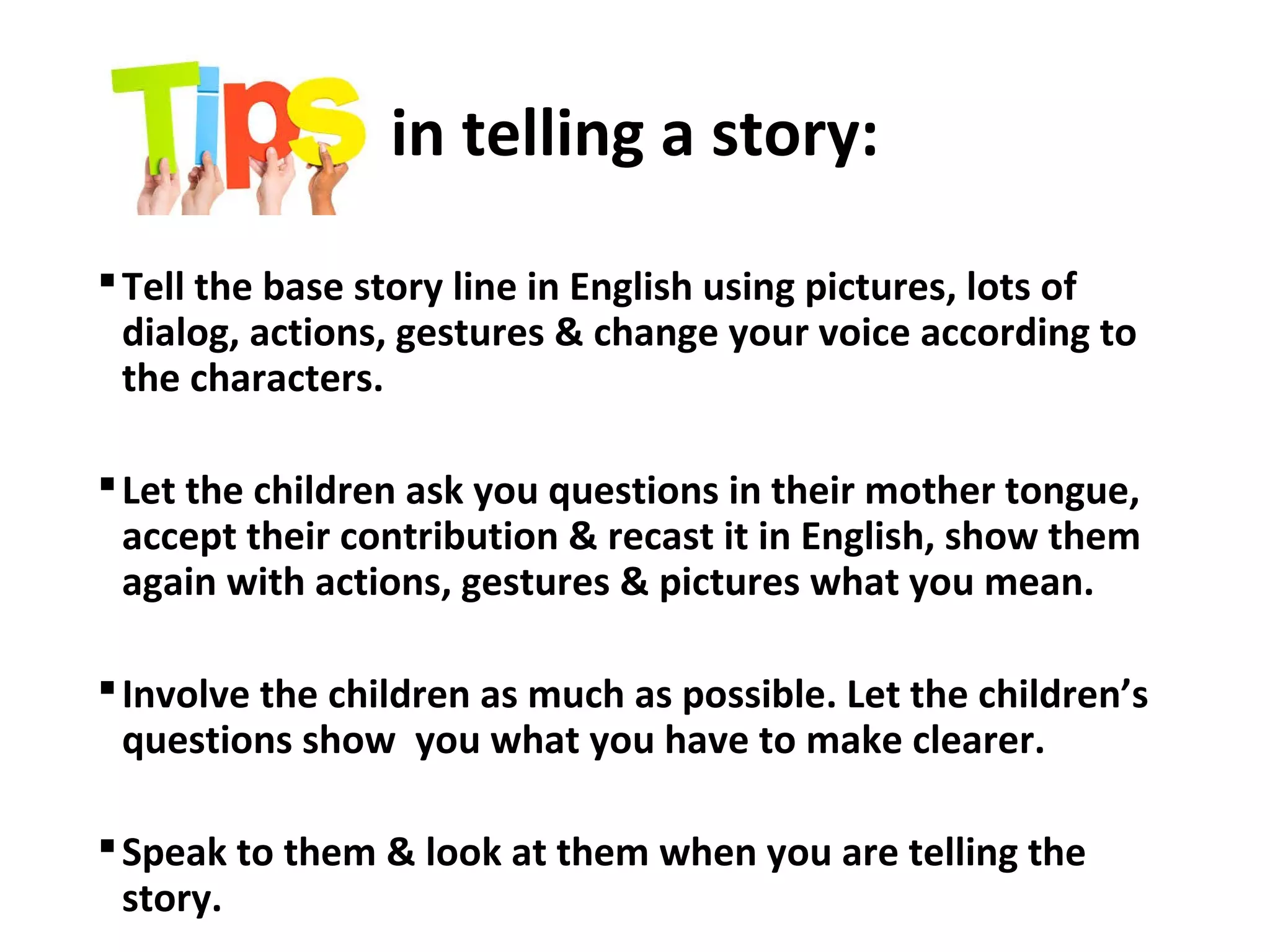
in telling a story:
Tell the base story line in English using pictures, lots of
dialog, actions, gestures & change your voice according to
the characters.
Let the children ask you questions in their mother tongue,
accept their contribution & recast it in English, show them
again with actions, gestures & pictures what you mean.
Involve the children as much as possible. Let the children’s
questions show you what you have to make clearer.
Speak to them & look at them when you are telling the
story.
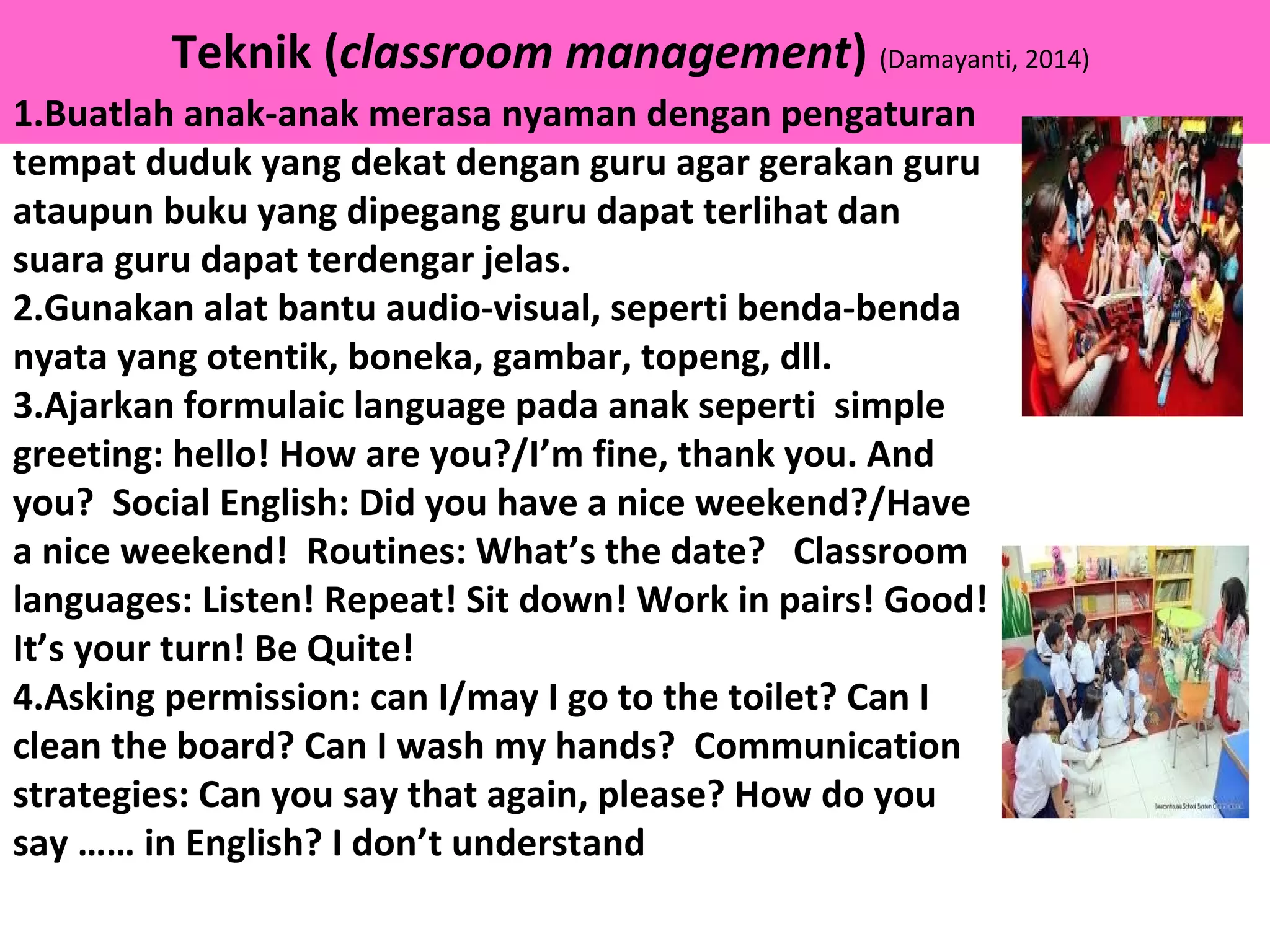
Teknik (classroom management) (Damayanti, 2014)
1.Buatlah anak-anak merasa nyaman dengan pengaturan
tempat duduk yang dekat dengan guru agar gerakan guru
ataupun buku yang dipegang guru dapat terlihat dan
suara guru dapat terdengar jelas.
2.Gunakan alat bantu audio-visual, seperti benda-benda
nyata yang otentik, boneka, gambar, topeng, dll.
3.Ajarkan formulaic language pada anak seperti simple
greeting: hello! How are you?/I’m fine, thank you. And
you? Social English: Did you have a nice weekend?/Have
a nice weekend! Routines: What’s the date? Classroom
languages: Listen! Repeat! Sit down! Work in pairs! Good!
It’s your turn! Be Quite!
4.Asking permission: can I/may I go to the toilet? Can I
clean the board? Can I wash my hands? Communication
strategies: Can you say that again, please? How do you
say …… in English? I don’t understand
Storytelling with young learners
(Wright, 1995)
Why stories?
Stories are :
Motivating for children
Interesting and enjoyable
A rich source of language and
experiences
A source of natural, authentic
language
Why stories?
Stories offer:
A connection to the children’s life and interests
Language in meaningful contexts
Multiple possibilities for activities involving
multimodality
Insights into the culture of the author/s
A structure/plot that can be followed and often a
natural repetition of vocabulary and structure
Opportunities developing reading/ listening skills
A way to develop children’s attention spans
A way to develop a lifelong love for reading and
books
So children…..
Want to listen
Listen with a purpose and become involved in
meaningful communication
Develop learning strategies (not all is
understandable, searching for meaning,
predicting and guessing strategies)
Become aware of the general “feel” and sound
of the L2
Develop general learning (issues/topics linked
to other curriculum subjects), cognitive skills
and creative thinking
How to choose a story
A story should always be interests and
developmental level of the child
For young learners a story should have:
A clear story line
Plenty of repetition
Helpful illustrations
Opportunities for joining in
At a level where children can understand
most of it (with appropriate help)
Linked with a topic you are working on
(curriculum)
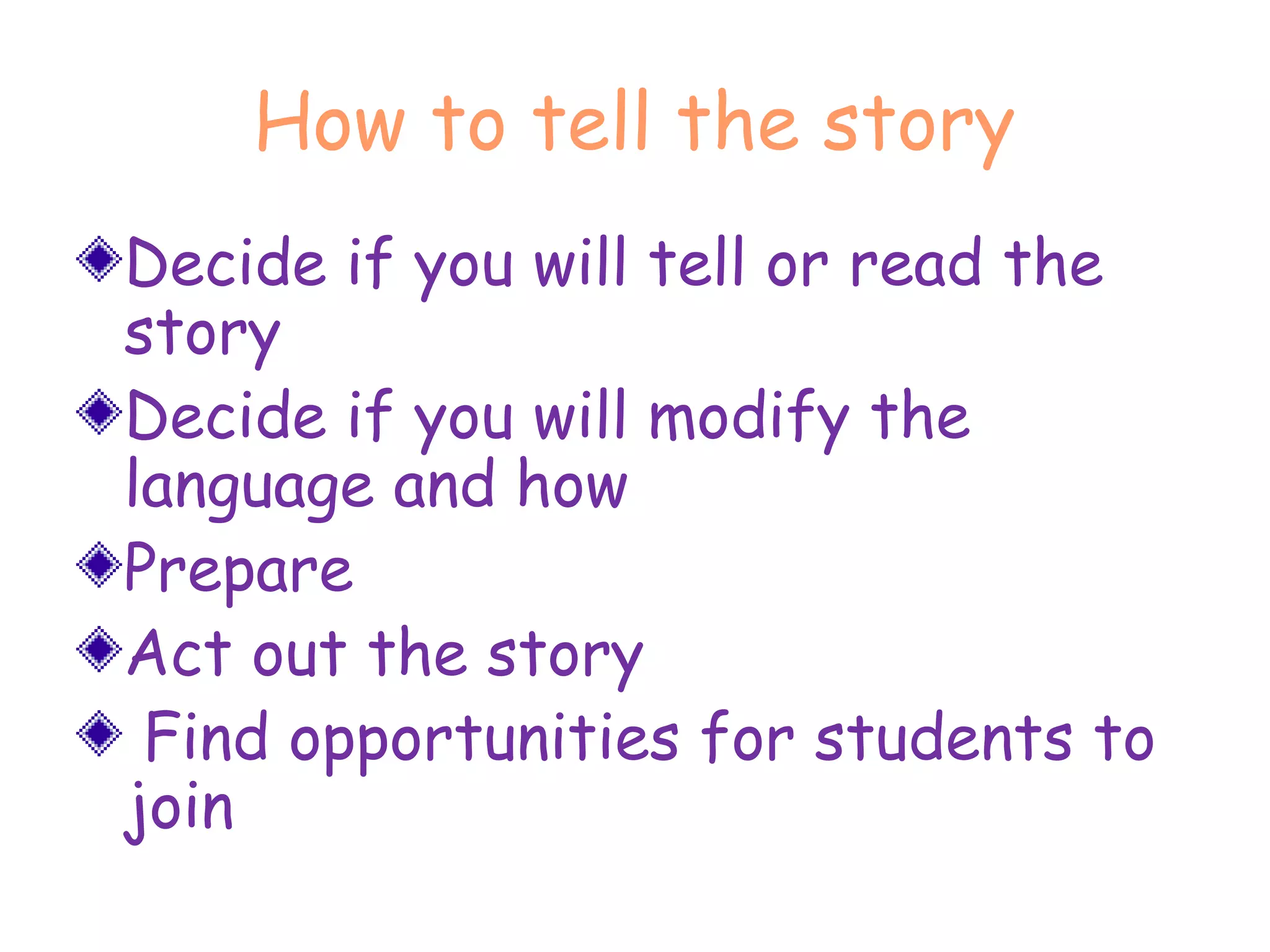
How to tell the story
Decide if you will tell or read the
story
Decide if you will modify the
language and how
Prepare
Act out the story
Find opportunities for students to
join
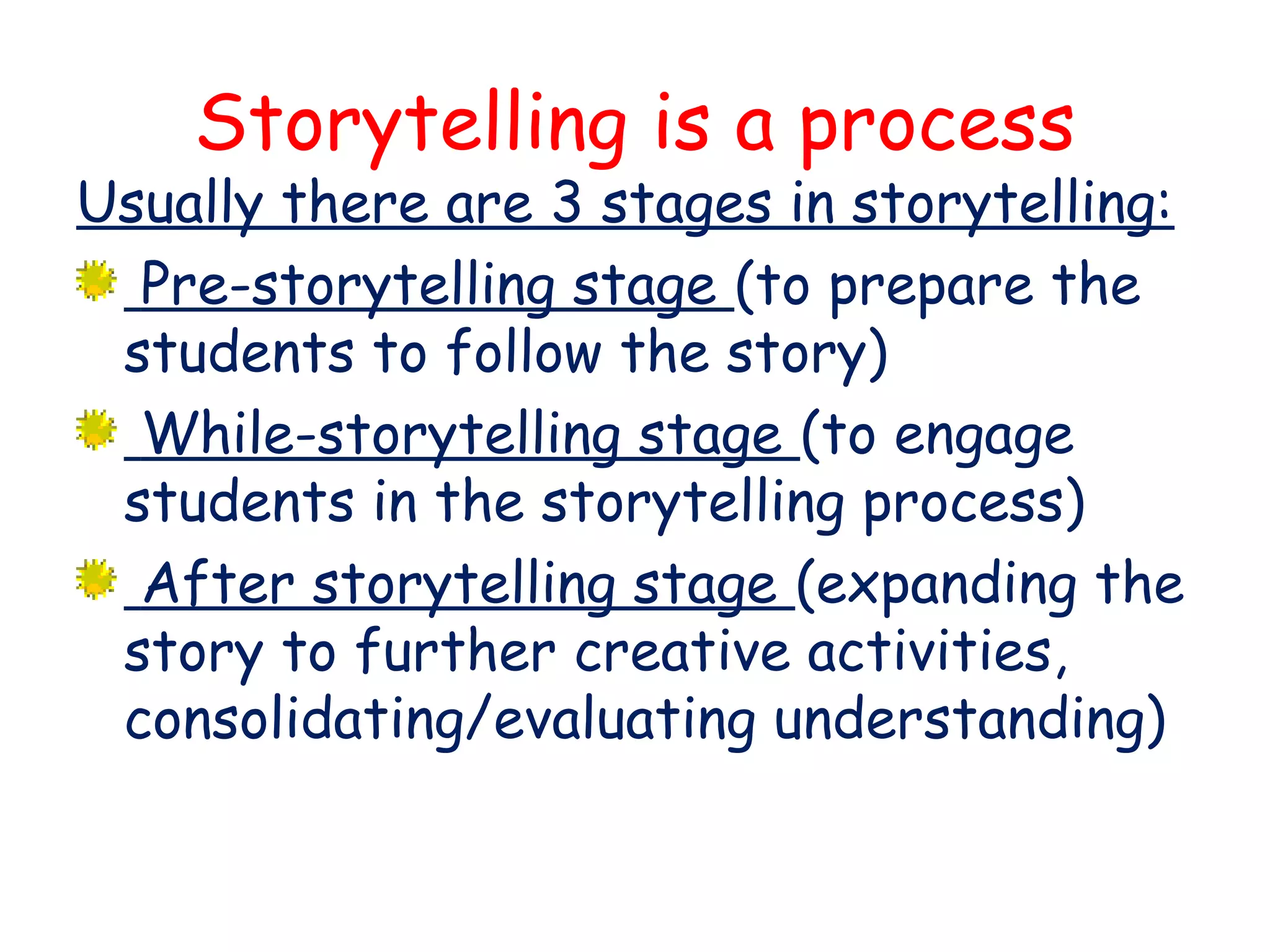
Storytelling is a process
Usually there are 3 stages in storytelling:
Pre-storytelling stage (to prepare the
students to follow the story)
While-storytelling stage (to engage
students in the storytelling process)
After storytelling stage (expanding the
story to further creative activities,
consolidating/evaluating understanding)
Storytelling activities:
Pre-storytelling for young
learners
Pre-teach key vocabulary
Use a song connected to
theme
Introduce and talk about the
main characters
Storytelling activities:
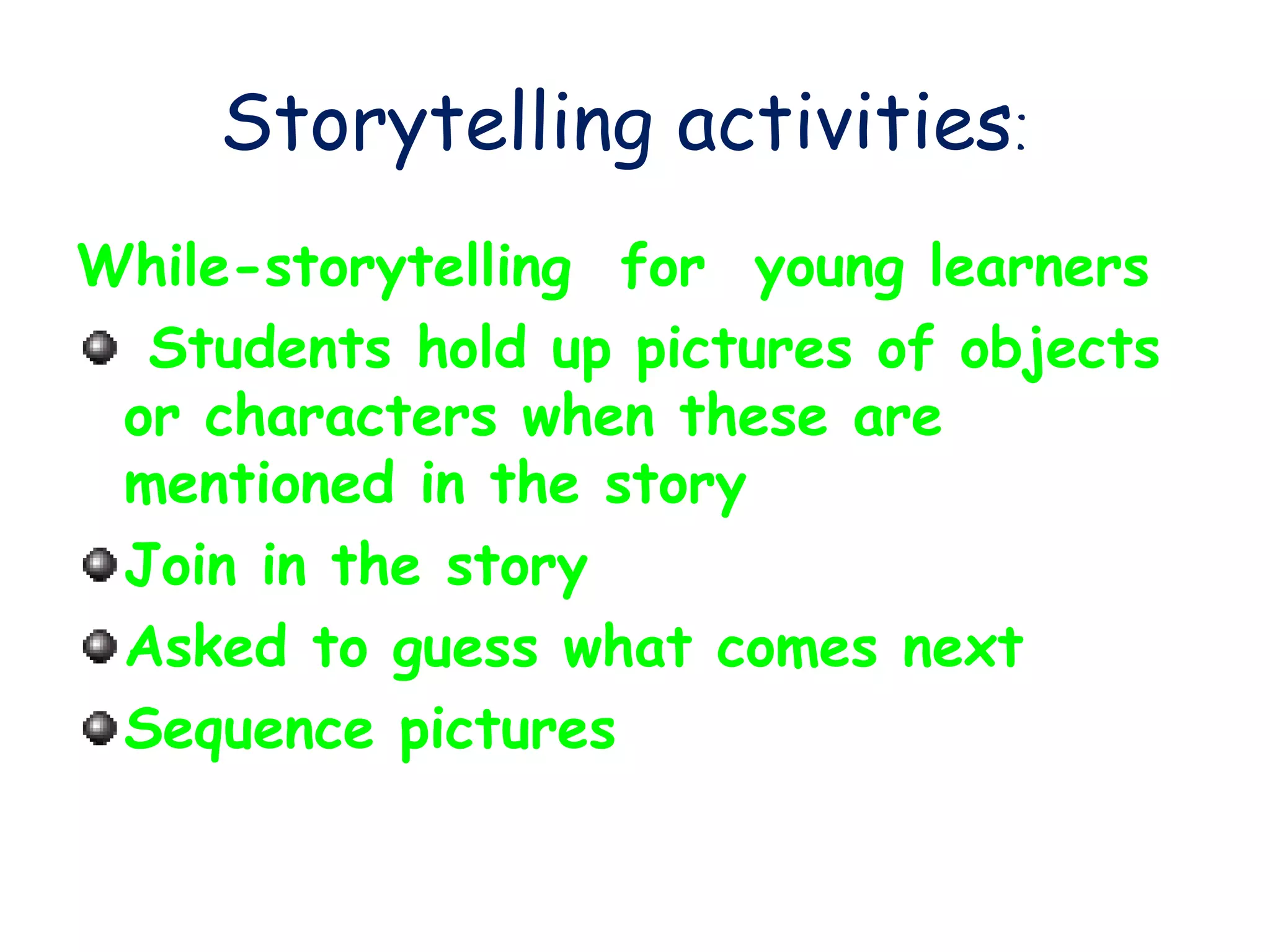
While-storytelling for young learners
Students hold up pictures of objects
or characters when these are
mentioned in the story
Join in the story
Asked to guess what comes next
Sequence pictures
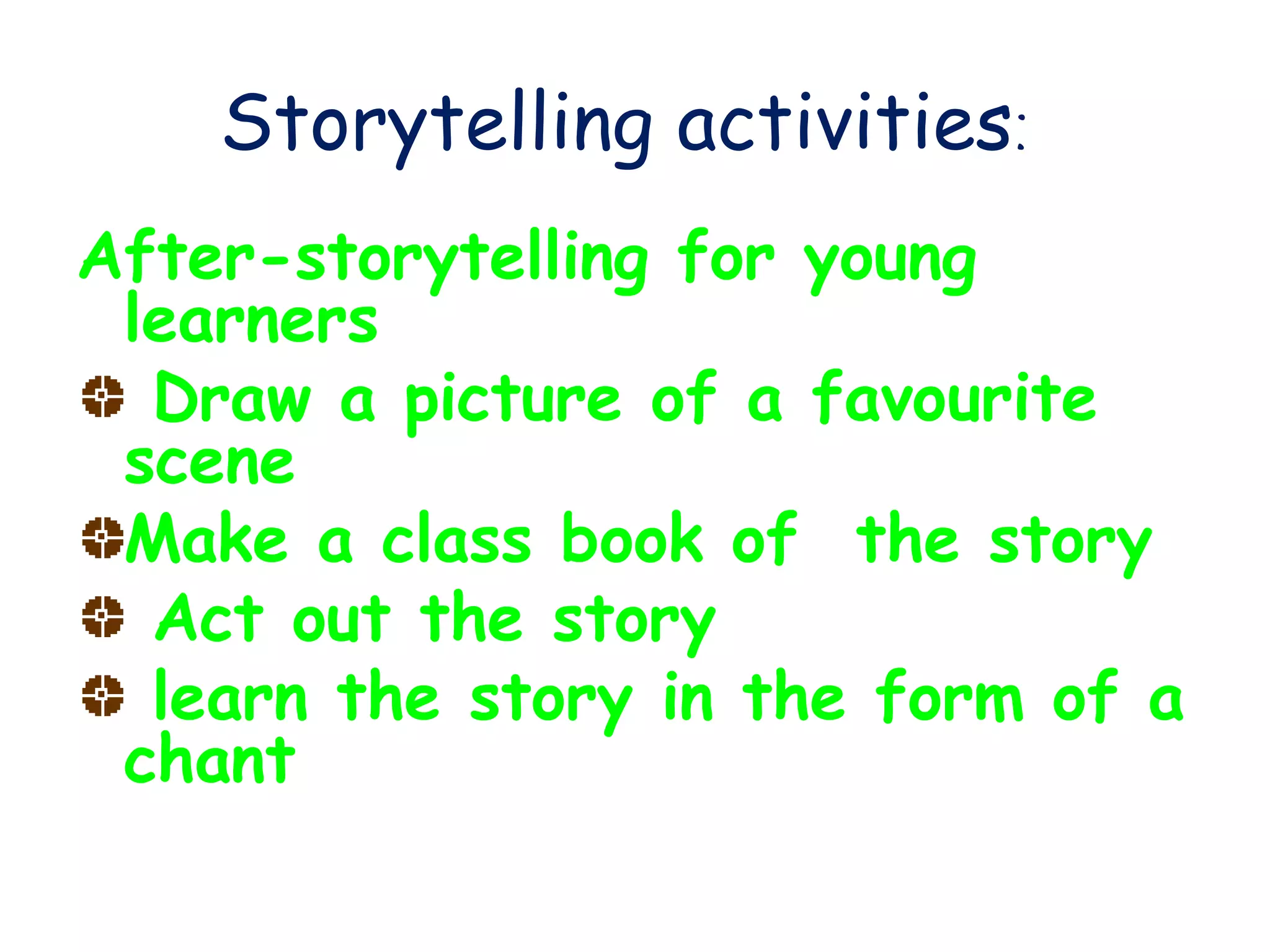
Storytelling activities:
After-storytelling for young
learners
Draw a picture of a favourite
scene
Make a class book of the story
Act out the story
learn the story in the form of a
chant
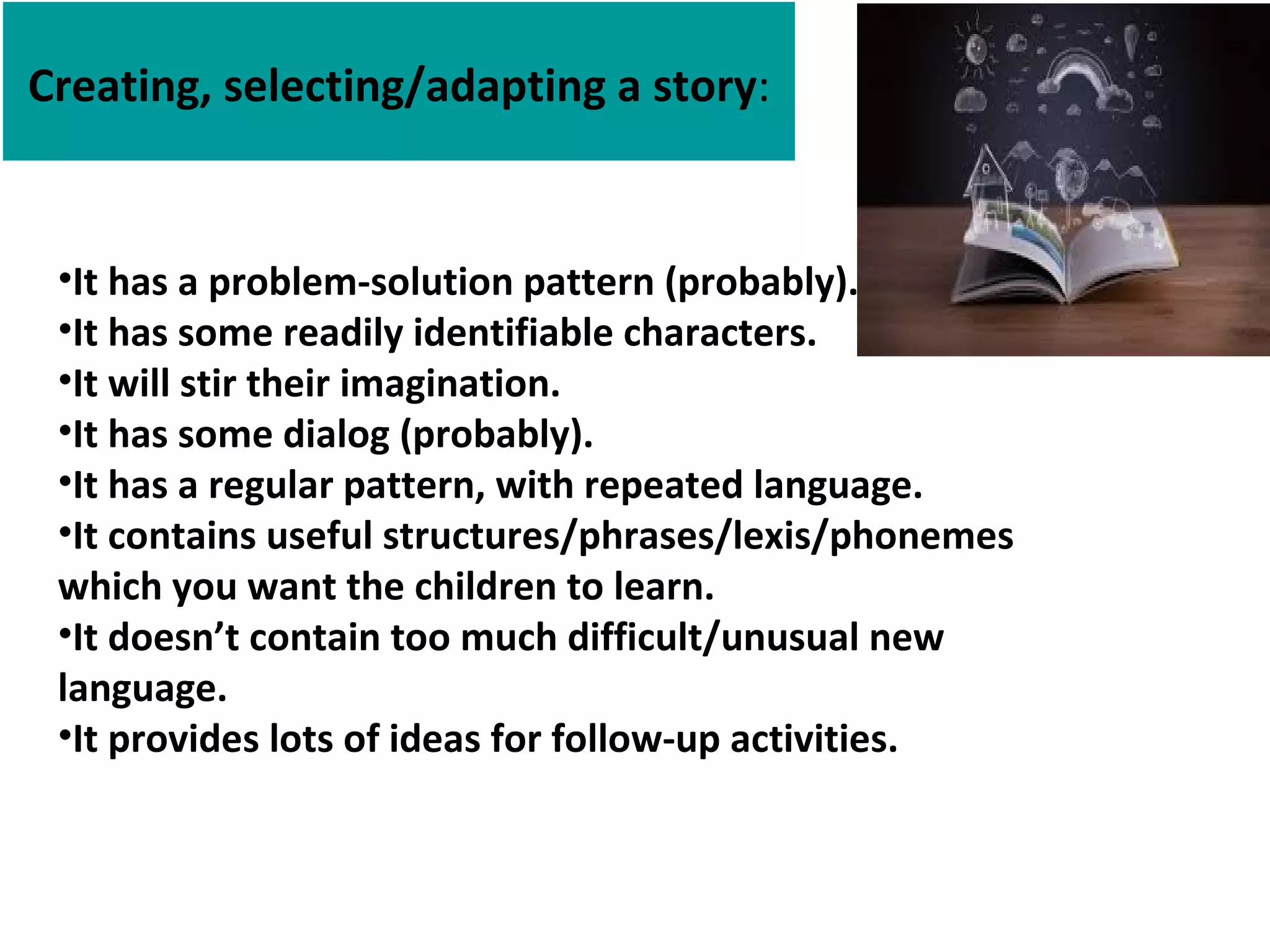
Creating, selecting/adapting a story:
•It has a problem-solution pattern (probably).
•It has some readily identifiable characters.
•It will stir their imagination.
•It has some dialog (probably).
•It has a regular pattern, with repeated language.
•It contains useful structures/phrases/lexis/phonemes
which you want the children to learn.
•It doesn’t contain too much difficult/unusual new
language.
•It provides lots of ideas for follow-up activities.
“The Four Friends” “The Dove”
Examples of Story Telling
(with subtitle)
The four friends.FLV
Aesop's Fables The Ant _ The Dove - YouTube.FLV
“The Fox & The Sick Lion”
(without subtitle) Without picture (mp3)
• See the folder
The Fox and the Sick Lion.3GP
“The Unpredictable Impact” of Stories
for Young Learners
•Si Kancil
•Cinderella
•Tinker Bell
•Marsha and the Bear
•Upin dan Ipin
•Sopo dan Jarwo
•Pada Zaman Dahulu
•Dora the Explorer
•...?
Teaching-Learning through Games, Songs &
Stories (Paul, 2003)
• When playing, singing, & learning are
integrated into a total learning
experience, the combination is very
powerful.
• Games & songs help children reach their
full potential as learners.
• Games provide a nonthreatening
environment for coping with new
learning.
Teaching-Learning through
Songs
• Songs add a whole dimension to
children’s classes & make it easier for
the children to remember words &
pattern & natural chunks of language.
• Songs can add feeling & rhythm to
language practice that might otherwise
be flat, help children remember things
more easily, & draw children more
deeply into a lesson.
• Songs should have catchy
melody/adapting popular songs.
• Saying rhymes & singing song can
practice pronunciation, stress, and
intonation.
Teaching-Learning through Games (Lewis & Bedson, 1999)
• Games are fun and children like to play
them. It is “rousers” wake a class up or
“settlers” calm a class down.
• Safety is a matter of control.
• In a language game children can employ
their language skills, it is a healthy challenge
to a child’s analytical thought.
• Integrating games into the syllabus.
• Play different games from lesson to lesson.
• Always end an activity when the fun is still
at its peak.
• Determine the language level.
Play different games
Assessing Games & Songs
1. Are the children involved?
• Is the activity clear to understand & use?
• Does the activity keep the children’s interest until the
end?
2. Are the children learning?
• Do the children practice English enough?
• Can the activity be integrated into a planned course?
3. Are the children active?
• How much initiative do the children have?
• Can the children do the activity without too much
explanation from us?
Assessing Young Language Learners
The use of traditional methods is problematic because:
Traditional “paper & pencil test” (like filling in
gaps in sentences, answering multiple choice
questions/translating vocabulary lists) often do not
work because such isolated exercises do not show
what children know & can do with confidence (The
negative washback effect of test). It would
discourage children & cause them to lose their
motivation to learn English.
TRADITIONAL ASSESSMENTS
•One-shot standardized exams
•Timed, multiple-choice format
•Decontextualized test items
•Scores suffice for feedback
•Norm-referenced scores
•Focus on the ‘right’ answer
•Non-interactive performance
•Fosters extrinsic motivation
Assessment techniques which are appropriate to
measure the children progress:
1
2
3
1
4
ALTERNATIVE ASSESSMENT
•Continuous long-term assessment
•Untimed, free-response format
•Contextualized communicative tasks
•Formative, interactive feedback
•Criterion-referenced scores
•Open-ended, creative answers
•Interactive performance
Examples:
• Portfolio assessment
• Structured assessment
• activities/tasks
• Projects
• Self-assessment
• Peer-assessment
• Learner-developed
assessment tasks
• Take-home tasks
• Observation
• Conferencing
Child-friendly Assessment:
Definisi Evaluasi:
• Proses pengumpulan informasi untuk mengetahui
sejauh mana program pembelajaran bahasa telah
berhasil mencapai tujuannya (Ioannou-Georgiou & Pavlou,
2003)
• Berbagai macam permasalahan yang berkenaan
dengan pendidikan bahasa dan memberikan
penilaian terhadapnya (Cameron, 2001).
• Menjaring informasi mengenai pengetahuan,
kemampuan, pemahaman, sikap dan motivasi
anak-anak (Ioannou-Georgiou & Pavlou, 2003)
TESTING:
Salah satu alat asesmen yang
biasanya berupa paper-pencil
test
TESTING:
Salah satu alat asesmen yang
biasanya berupa paper-pencil
test
Asssessment:Asssessment:
• Portofolio bahasa adalah koleksi sampel pekerjaan
yang dihasilkan oleh anak dalam jangka waktu
tertentu
• Sampel ini dapat berupa:
• Pekerjaan tertulis
• Gambar
• Proyek
• Catatan buku yang telah dibaca
• Hasil tes
• Catatan self-assessment
• Komentar orang tua dan guru
WHAT IS ASSESSMENT?
• It is a general term which includes
all methods used to gather
information about children`s
knowledge, ability, understanding,
atitudes and motivation (Ioannou-
Georgiou,& Pavlou, 2003).
• It refers to collecting information &
making judgments on a learner’s
knowledge (Brindley in Linse, 2005).
WHY ASSESS YOUNG
CHILDREN?
• To monitor an aid children’s progress
• To provide children with evidence of
their progress and enhance
motivation
• To monitor your performance and
plan future work
• To provide information for parents,
collegues and school authorities
WHAT DO WE ASSESS?
•Skill developments :
listening, speaking, reading,
writing, integrated skills
•Learning how to learn
•Attitudes
•Behavioural and social skills
HOW DO WE ASSESS CHILDREN?
Portfolio Assessment Traditional Test
Structured Assessment
Activities/Task
Leaner Developed Assessment
Test
Projects Take Home Tasks
Self Assessment Observation
Peer Assessment C0nferencing
Assessing Young Learners
(Cameron, 2001; Linse, 2005)
I. Introduction
II. Discussion
A. Issues in Assessing Children’s Language Learning
B. Key Concepts in Assessment
C. Authentic Assessment
D. Principles of Language Assessment
E. Assessing Language Ability in the Classroom
F. Use of Assessment Information
III. Conclusion
INTRODUCTION
Assessing young learners ≠ other FL learners
Consideration on some significant factors:
* Age
* Cognitive development
* Content of language learning
* Methods of teaching
* Aims
* Different language theories
Cohen (1994)
* What language ability would you like to assess?
* Who are your intended respondents?
* Why are you choosing to measure these abilities and not others?
* How are you going to construct your assessment instruments?
* When? How often will assessments takes place?
* Where?
* Through what process? Deals with the procedures of assessment
* For whom are the results on the language assessment measures
intended?
A. Issues in Assessing Children’s Language Learning
Rea Dickens and Rixon’s study in 1999
“the relationship between assessment and learning”
- Mismatch between curricular aims, pedagogy and
test content
- The assessment neglected language and social
awareness
- Most frequently method was paper and pencil test
(single items of vocabulary and grammar rather
than spontaneous speaking)
written test is much easier rather than spoken of
language
Assessment – testing – evaluation
Assessment  looks at what individuals and groups of
learners can do
Evaluation  concern entire educational program and not just
specific learners and is much wider in scope
Test  one technique or method of assessment
B. Key Concepts in Assessment
TEST
EVALUATION
ASSESSMENT
Formative and Summative Assessment
Formative
- Aims to inform on-going teaching and learning
- It is formative if it used to adapt teaching and learning
to meet students needs.
- Techniques: teacher observation, classroom
discussion, portfolios, tests, homework
Summative
- Aims to measure or summarize what a student
has grasped
- Occurs at the end of course or unit of instruction
- Examples: final exams
Criterion-referenced & Norm-referenced Assessment
Norm-referenced assessment
- Purpose  to place children along mathematical
continuum in rank order
- Score interpretation is related to mean,
median, standard deviation, etc
Criterion-referenced assessment
-Purpose  to give the children feedback, in the
forms of grades on specific course
or lesson objectives
-Examples: criterion used to assess child’s speaking
skills in a sic level scale on which they
place each learner
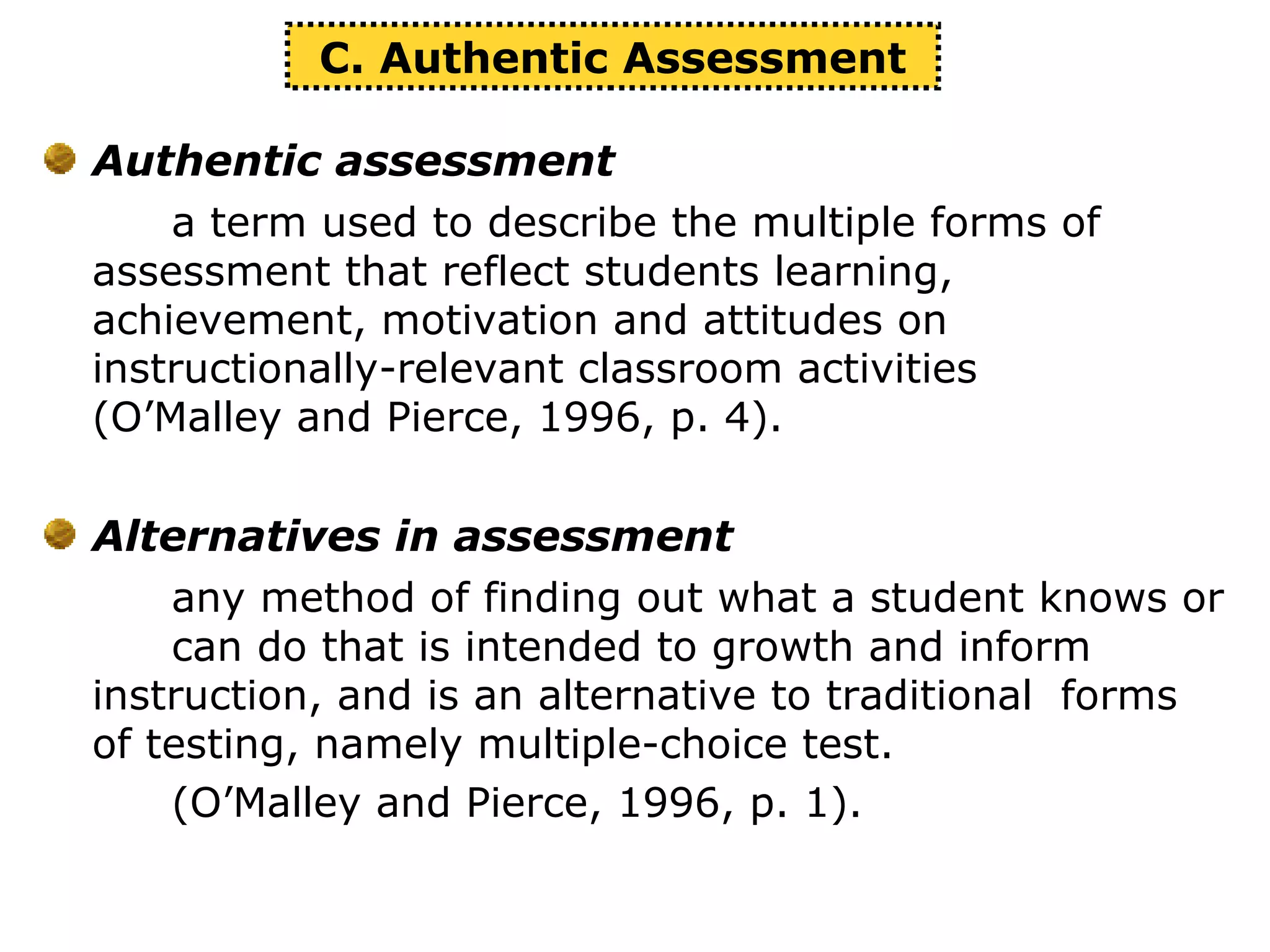
Authentic assessment
a term used to describe the multiple forms of
assessment that reflect students learning,
achievement, motivation and attitudes on
instructionally-relevant classroom activities
(O’Malley and Pierce, 1996, p. 4).
Alternatives in assessment
any method of finding out what a student knows or
can do that is intended to growth and inform
instruction, and is an alternative to traditional forms
of testing, namely multiple-choice test.
(O’Malley and Pierce, 1996, p. 1).
C. Authentic Assessment
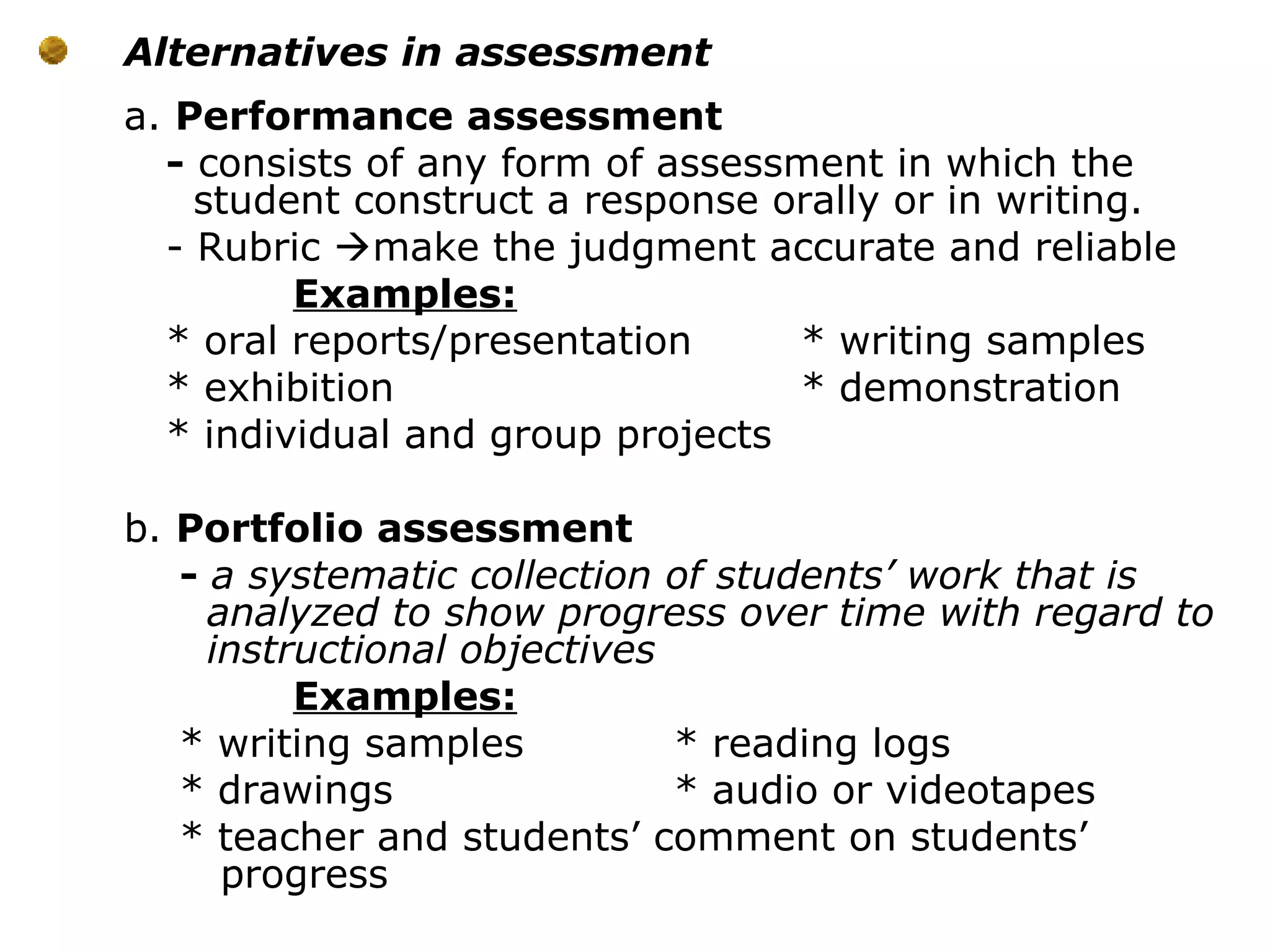
Alternatives in assessment
a. Performance assessment
- consists of any form of assessment in which the
student construct a response orally or in writing.
- Rubric make the judgment accurate and reliable
Examples:
* oral reports/presentation * writing samples
* exhibition * demonstration
* individual and group projects
b. Portfolio assessment
- a systematic collection of students’ work that is
analyzed to show progress over time with regard to
instructional objectives
Examples:
* writing samples * reading logs
* drawings * audio or videotapes
* teacher and students’ comment on students’
progress
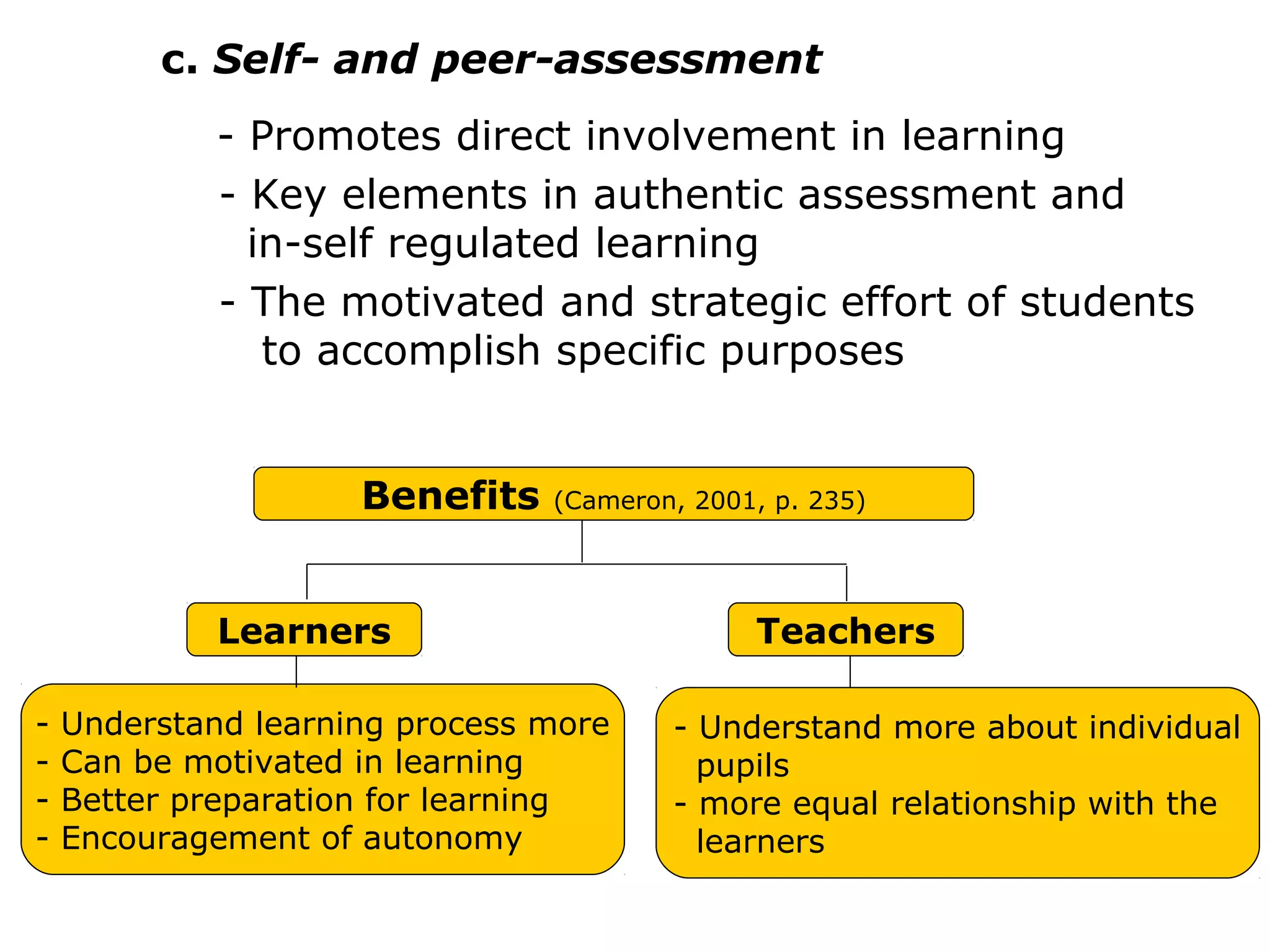
c. Self- and peer-assessment
- Promotes direct involvement in learning
- Key elements in authentic assessment and
in-self regulated learning
- The motivated and strategic effort of students
to accomplish specific purposes
Benefits (Cameron, 2001, p. 235)
Learners Teachers
- Understand learning process more
- Can be motivated in learning
- Better preparation for learning
- Encouragement of autonomy
- Understand more about individual
pupils
- more equal relationship with the
learners
Techniques for assessing young learners:
1. Checklists
2. Self Assessment Activities
3. Short Questionnaires
4. Short Assessment Activities
5. Anecdotal Observation sheet
6. Review of pupils’ workbooks and tasks
7. Pictures and storybooks
8. Formal assessments
9. Journal
a. Validity
whether the assessment instrument actually
measures what it purports to measure
b. Reliability
consistent and dependable
whether assessment produce the same result if it
were taken by the same pupils on different
occasions
c. Practicality
assessment is not excessively and relatively easy
to administer and has a scoring/evaluation
procedure that is specific and time efficient
D. Principles of Language Assessment
(Brown, 2004; Cohen, 1994; O’Malley and Pierce, 1996):
Principles in assessing children’ language
learning (Cameron,2001, p. 218-221)
a. Assessment should be seen from a learning-
centered perspective
b. Assessment should support learning and teaching
c. Assessment is more than testing
d. Assessment should be congruent with learning
e. Children and parents should understand
assessment issues
f. Fairness
Listening Skill
 Two main components in listening assessment for
young learners:
a. Phonemic awareness (Example)
b. Listening comprehension (Example)
Speaking Skill
 Can be assessed by asking questions and engaging
young learners in conversations.
 Use of rubric (holistic or analytic)
Example
E. Assessing Language Skills in Classroom
Reading Skill
 Teachers also tend to assess students’ ability to
comprehend written text when they assess
students’ reading skill
 Techniques:
a. Comprehension questions
 used to determine children’s understanding on
reading passage
b. Story Map (graphic summary of a story)
Story Elements Map Sequence of Events Story Map
Chronicles of the story
(what took first, second, etc)
Describe different part-elements
of a story especially in setting,
characters, conflict and resolution
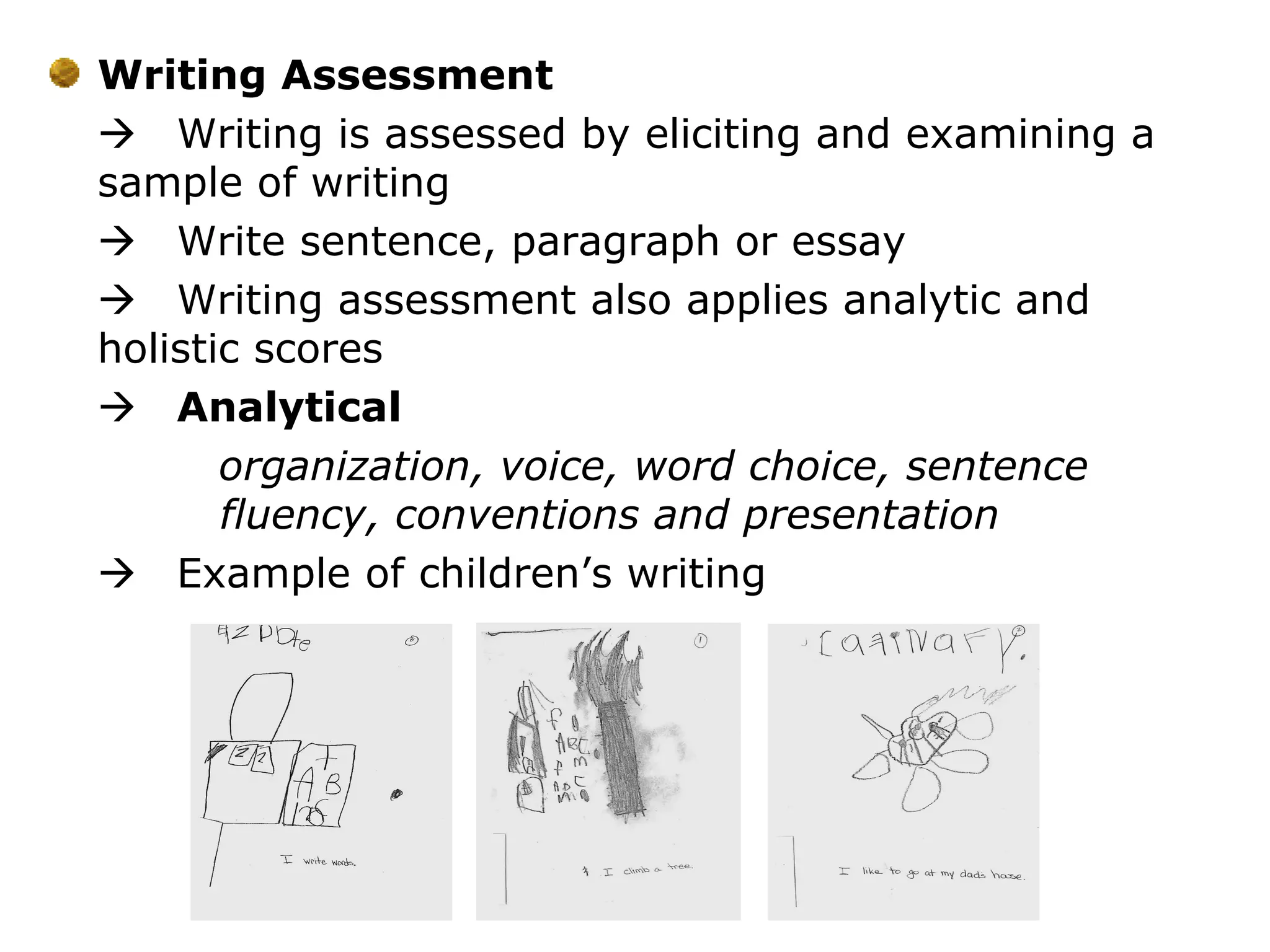
Writing Assessment
 Writing is assessed by eliciting and examining a
sample of writing
 Write sentence, paragraph or essay
 Writing assessment also applies analytic and
holistic scores
 Analytical
organization, voice, word choice, sentence
fluency, conventions and presentation
 Example of children’s writing
Stakeholders:
* Teachers
* Schools administrators
* Children
* Parents
F. Use of Assessment Information
CONCLUSION
Assessment practices not merely intended to accomplish
teaching process of the teacher, but it has other significance
contribution in teaching and learning process.
Teacher should have a comprehensive understanding on how
to assess their students appropriately and accurately
(considering principles and using multiple alternatives in
assessment)
Assessment activities in Listening
(Brewster, Ellis, Grard, 2003):
• Listen & discriminate between sound
• Listen & point to things/follow instruction
• Listen & select the appropriate pictures
• Listen to a description & draw/color a picture
• Listen to a description & label a picture
• Listen & match 2 pictures/a word & a picture
• Listen & sequence pictures, words/sentences.
• Listen to a description/story & tick items on a
simple chart
• Listen & complete gaps in words/sentences.
• Listen & select the correct response (multiple
choice)
Assessment activities in Speaking
(Brewster, Ellis, Grard, 2003):
• Listen & repeat words that rhyme/have the
same/opposite meanings.
• Listen & repeat only things which are true.
• Sing a song, say a rhyme/poem memory.
• Do pair work tasks.
• Speak from picture prompts.
• Finish off a sentence.
• Pass on a telephone message.
• Play a guessing game.
• Listen to a story, sequence pictures
& retell the story.
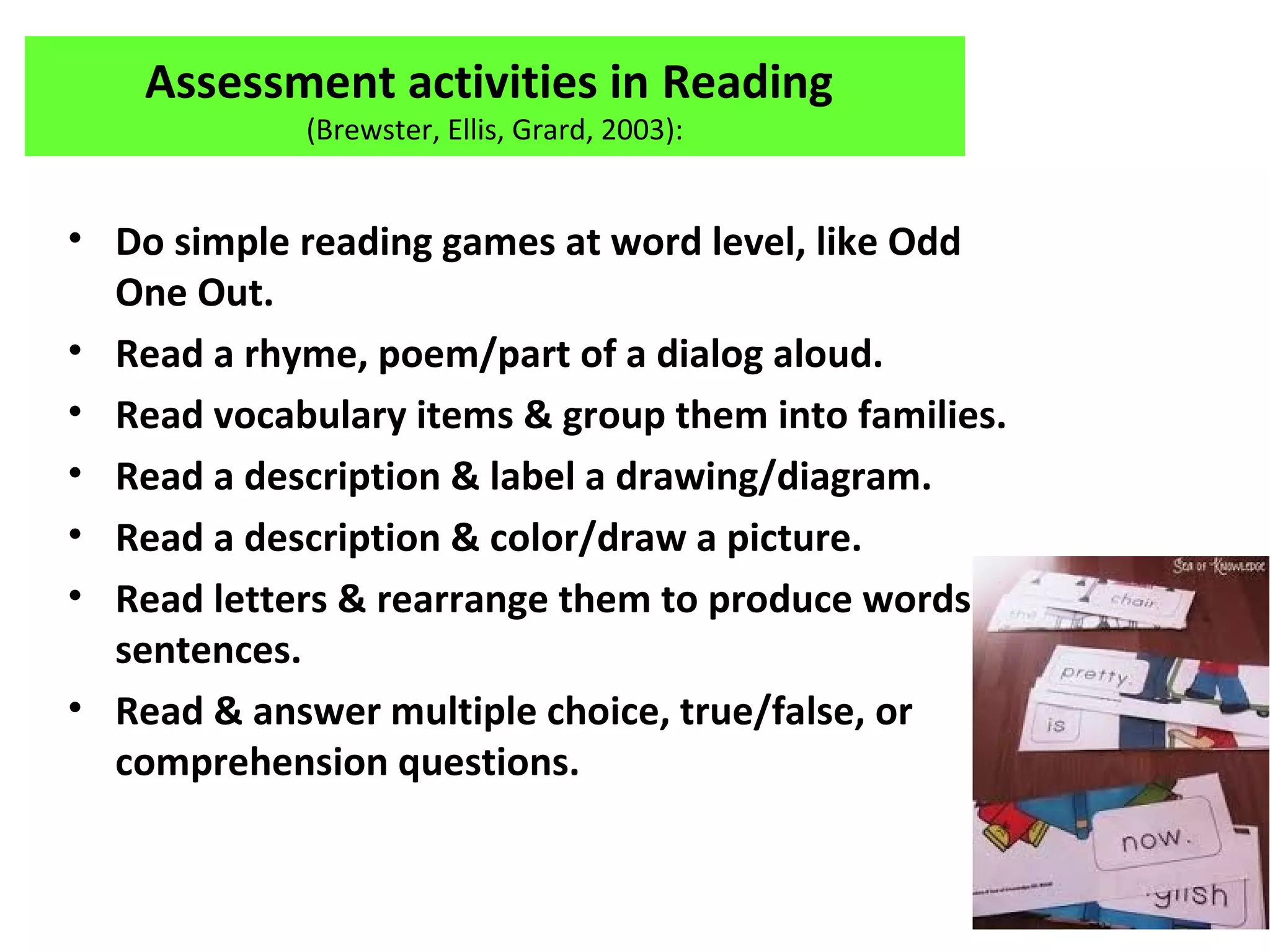
Assessment activities in Reading
(Brewster, Ellis, Grard, 2003):
• Do simple reading games at word level, like Odd
One Out.
• Read a rhyme, poem/part of a dialog aloud.
• Read vocabulary items & group them into families.
• Read a description & label a drawing/diagram.
• Read a description & color/draw a picture.
• Read letters & rearrange them to produce words
sentences.
• Read & answer multiple choice, true/false, or
comprehension questions.
Assessment activities in Writing
(Brewster, Ellis, Grard, 2003):
• Rearrange & copy: letters to spell a word.
• Read a description & write labels/captions for
pictures.
• Complete a crossword.
• Fill in gaps in sentences to test grammar/vocabulary.
• Write speech bubbles for characters from a
story/dialogue.
• Transfer simple notes on a chart into sentences.
• Answer simple questions in written form.
• Correct mistake in a sentence/text.
• Write sentences from picture prompts.
Worksheet for YL.pdf
HOW TO GIVE FEEDBACK
• Feedback can be given in a variety of ways :
individually to each child, to groups of children,
or the whole class. Can also be given in the
form of self correction or peer feedback.
• One of the best way to give feedback is
through conferencing with the children when
you disccus the result of the assessment.
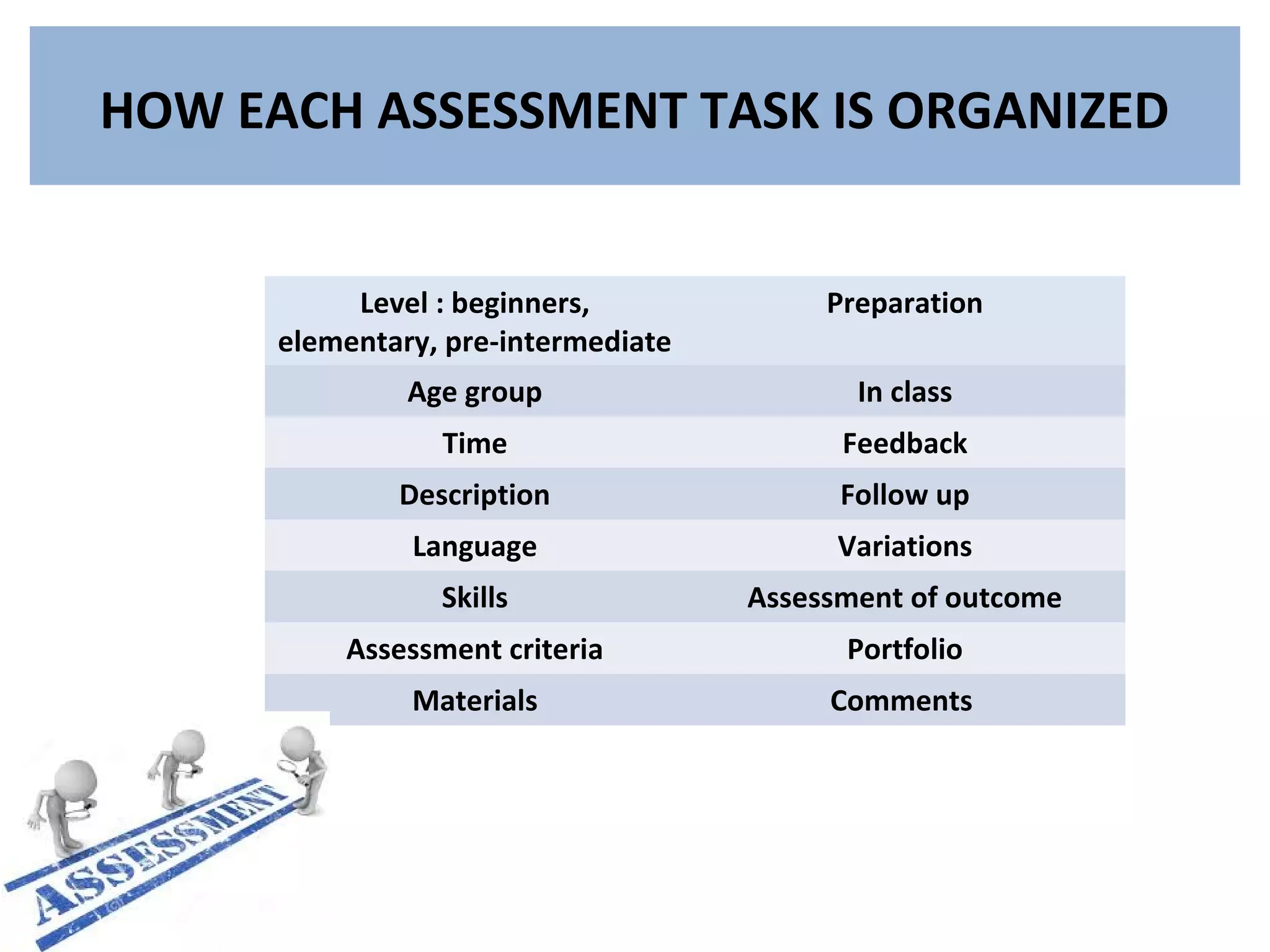
HOW EACH ASSESSMENT TASK IS ORGANIZED
Level : beginners,
elementary, pre-intermediate
Preparation
Age group In class
Time Feedback
Description Follow up
Language Variations
Skills Assessment of outcome
Assessment criteria Portfolio
Materials Comments
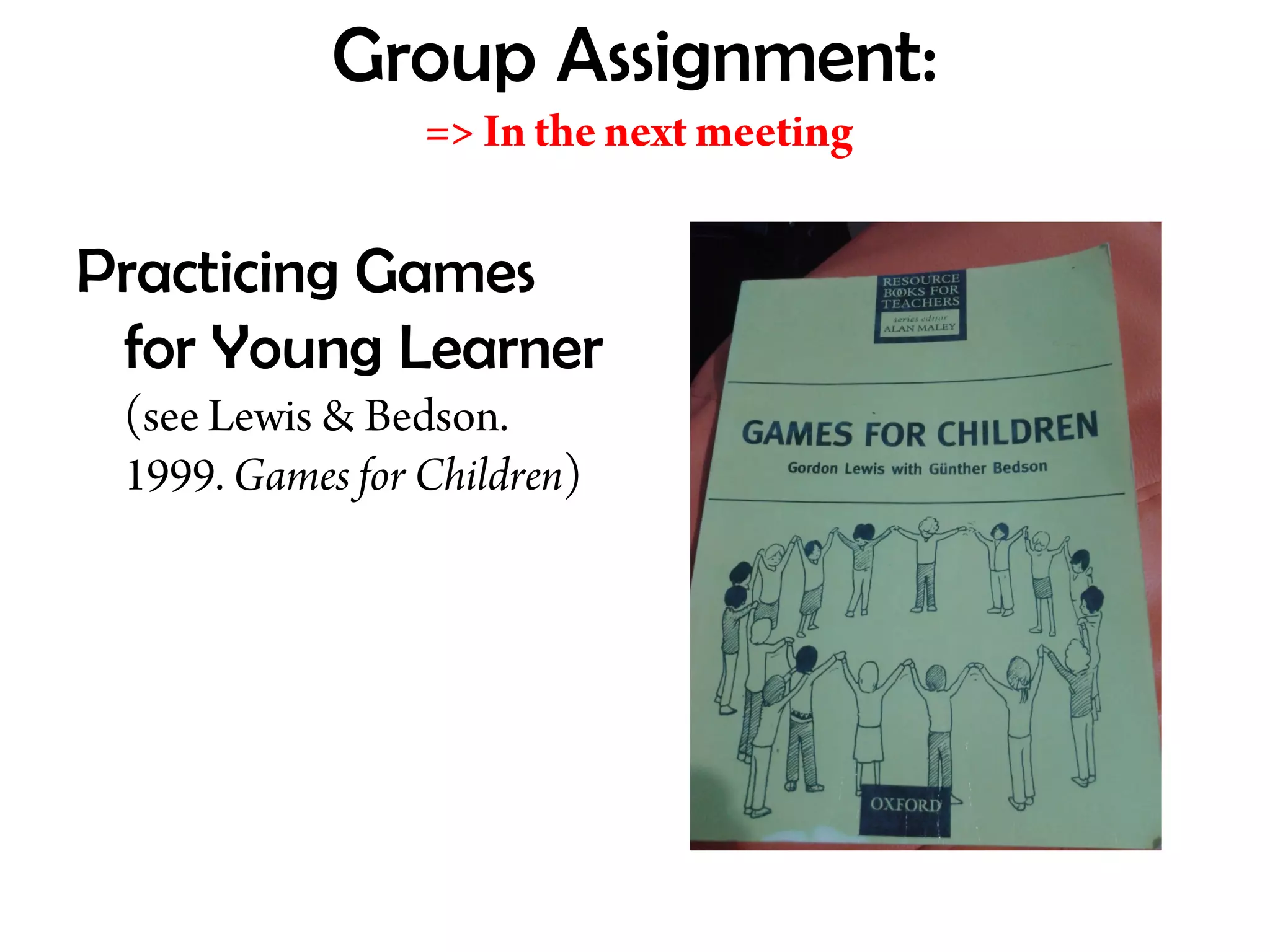
Group Assignment:
=> In the next meeting
Practicing Games
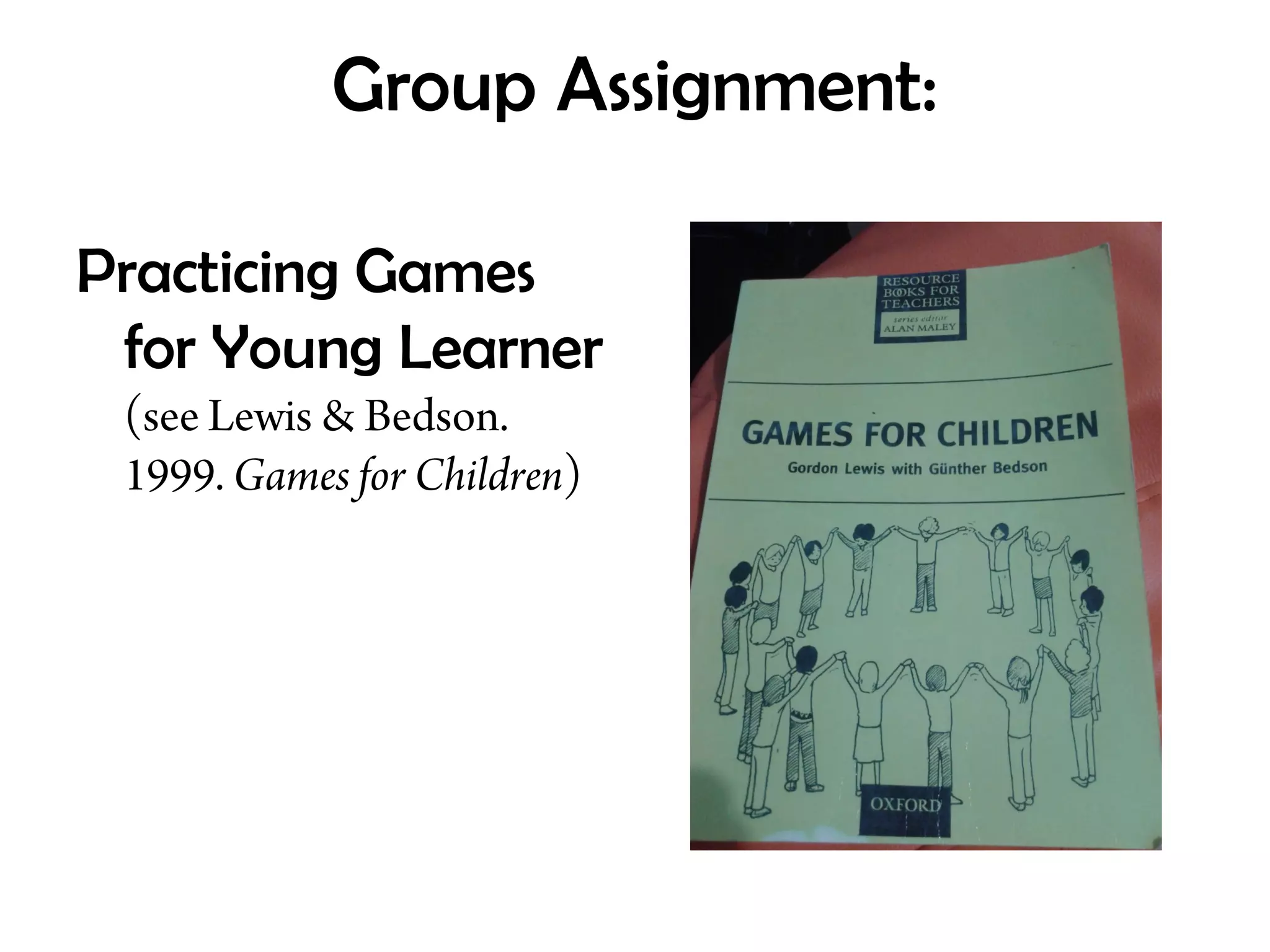
for Young Learner
(see Lewis & Bedson.
1999. Games for Children)
Or...
Practicing TPR (Total Physical Response) using
Song & Game:
• “Hokey Pokey” song
You put your right hand in,
You put your right hand out,
You put your right hand in,
And you shake it all about,
You do the hokey pokey
and you turn yourself around
That’s what it's all about.
HOCKEY POKEY SONG (1)
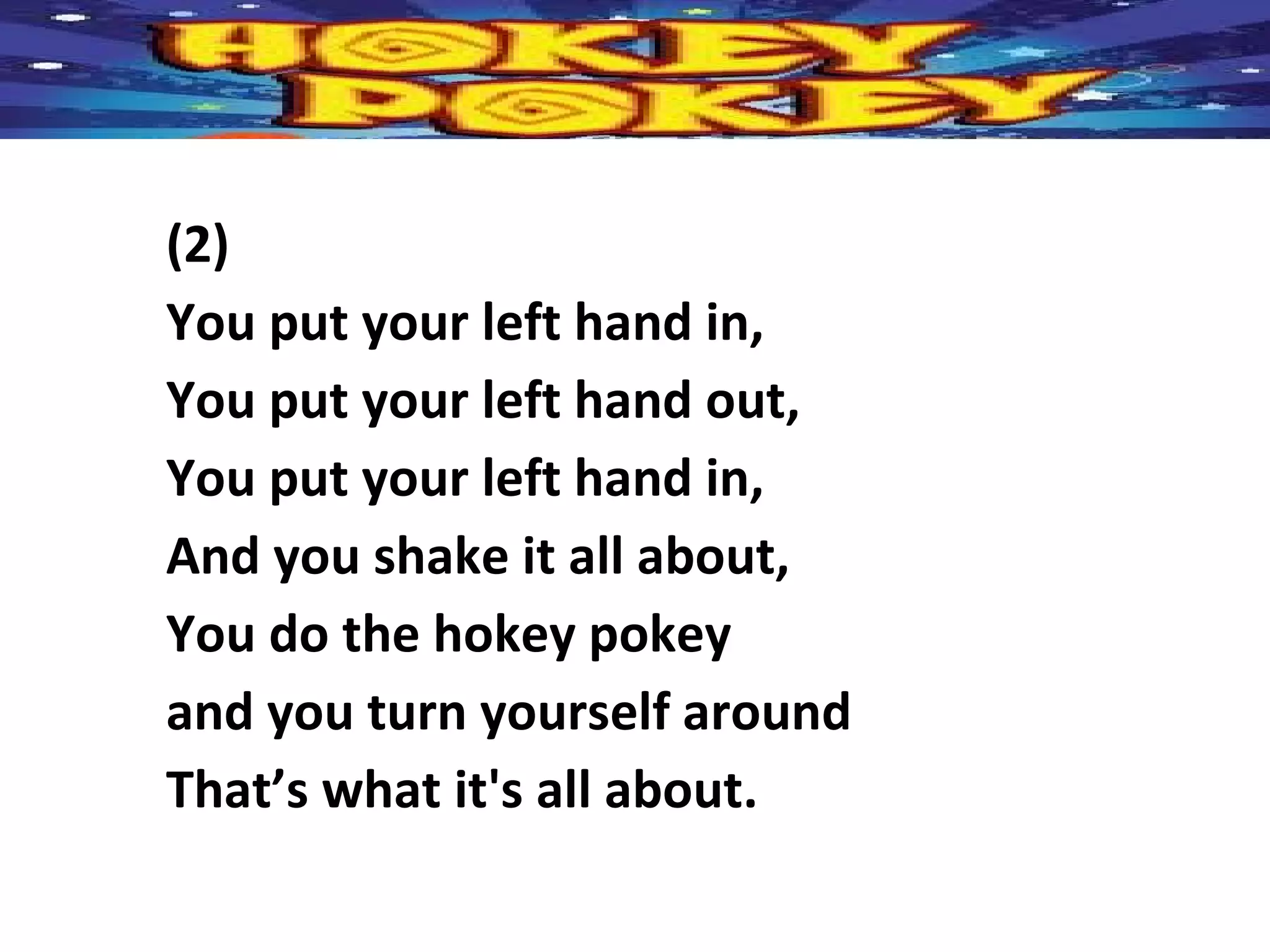
(2)
You put your left hand in,
You put your left hand out,
You put your left hand in,
And you shake it all about,
You do the hokey pokey
and you turn yourself around
That’s what it's all about.
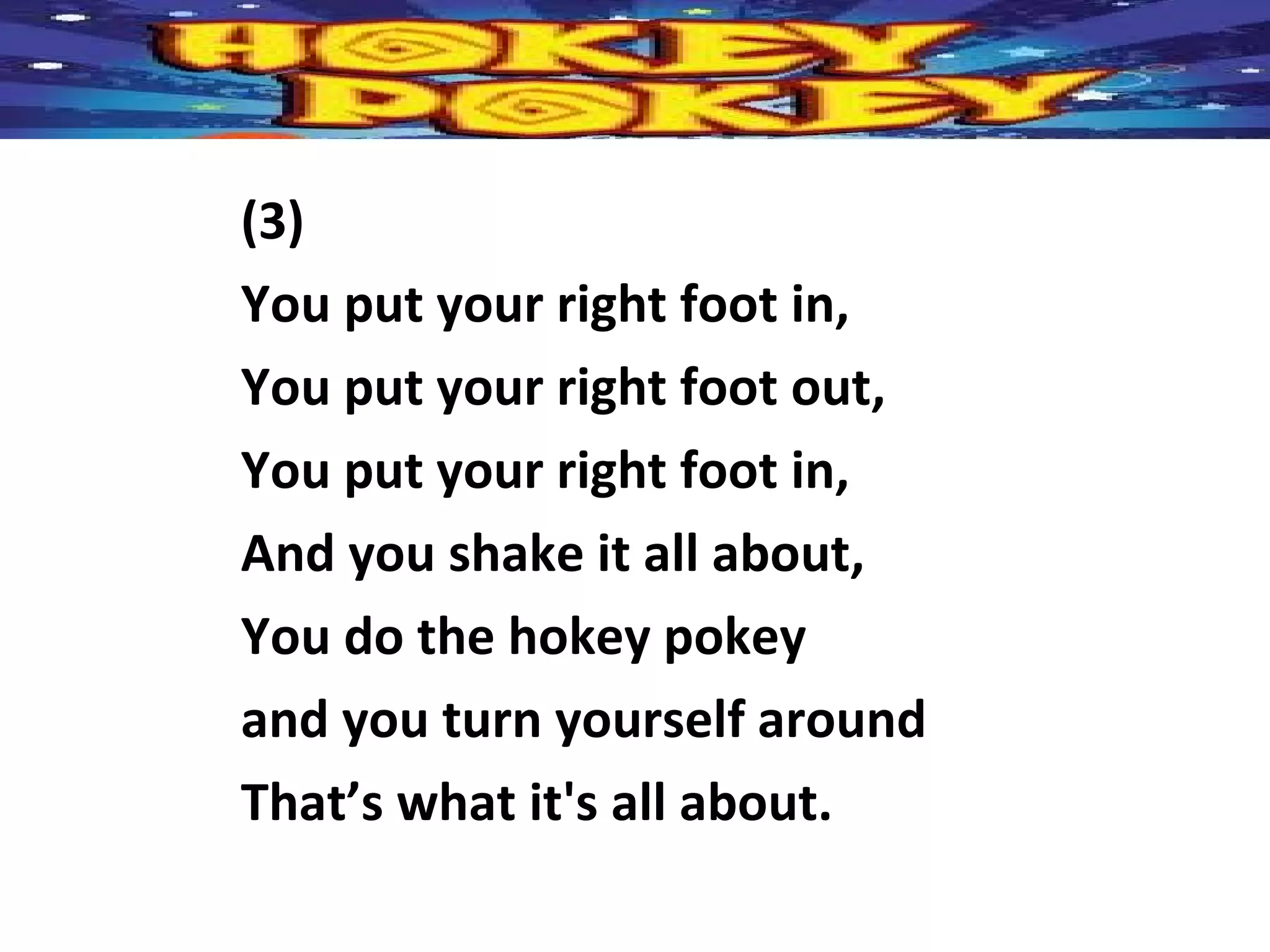
(3)
You put your right foot in,
You put your right foot out,
You put your right foot in,
And you shake it all about,
You do the hokey pokey
and you turn yourself around
That’s what it's all about.
(4)
You put your left foot in,
You put your left foot out,
You put your left foot in,
And you shake it all about,
You do the hokey pokey
and you turn yourself around
That’s what it's all about.
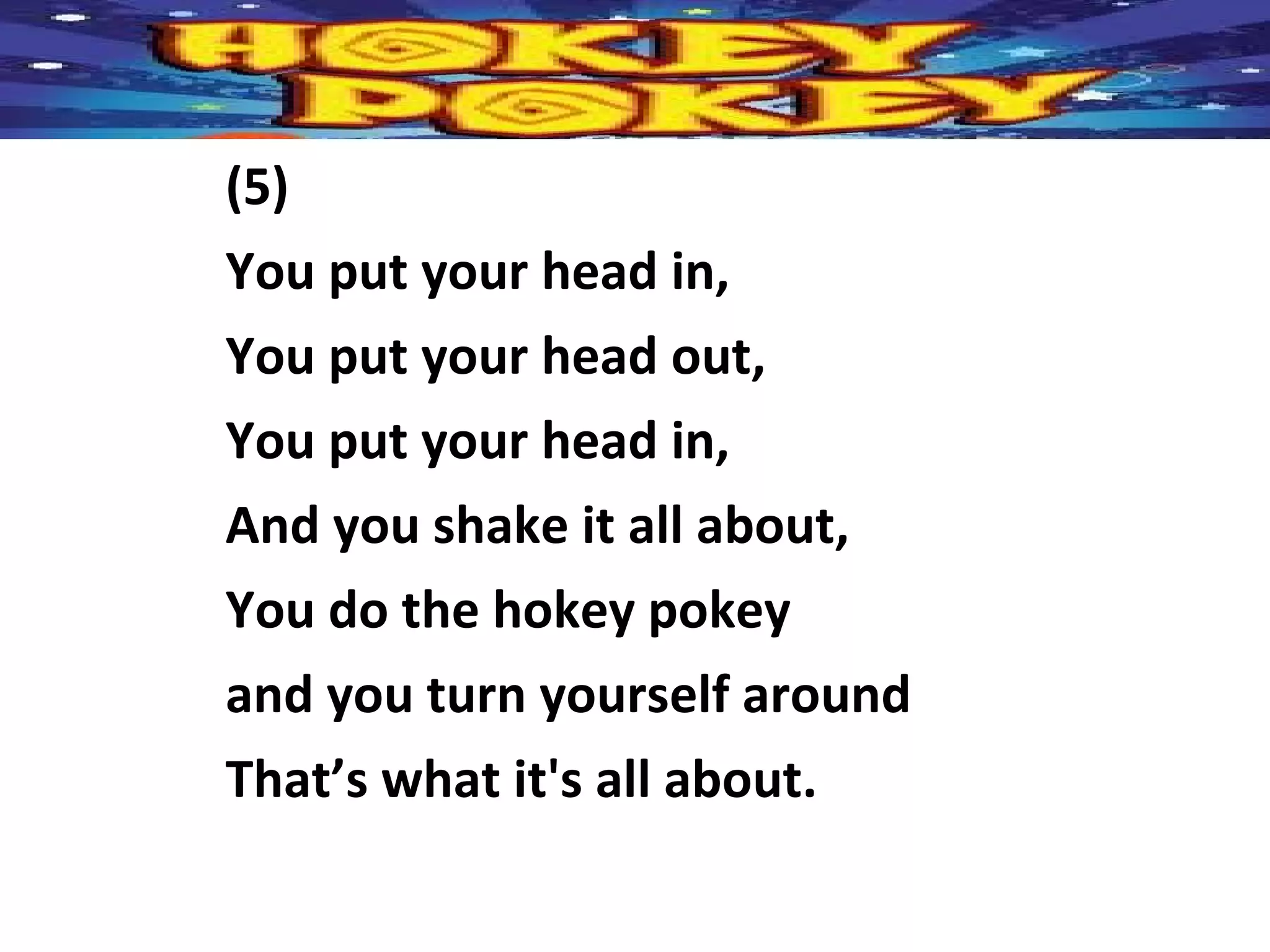
(5)
You put your head in,
You put your head out,
You put your head in,
And you shake it all about,
You do the hokey pokey
and you turn yourself around
That’s what it's all about.
Session 9 - 10
• Materials for Young Learners Classroom
• Teaching Media for Young Learners
• Children with Special Needs
• What If (Classroom Management)
• Preparing the EYL’s Project
Analyzing
Materials for
Young
Learners
Classroom
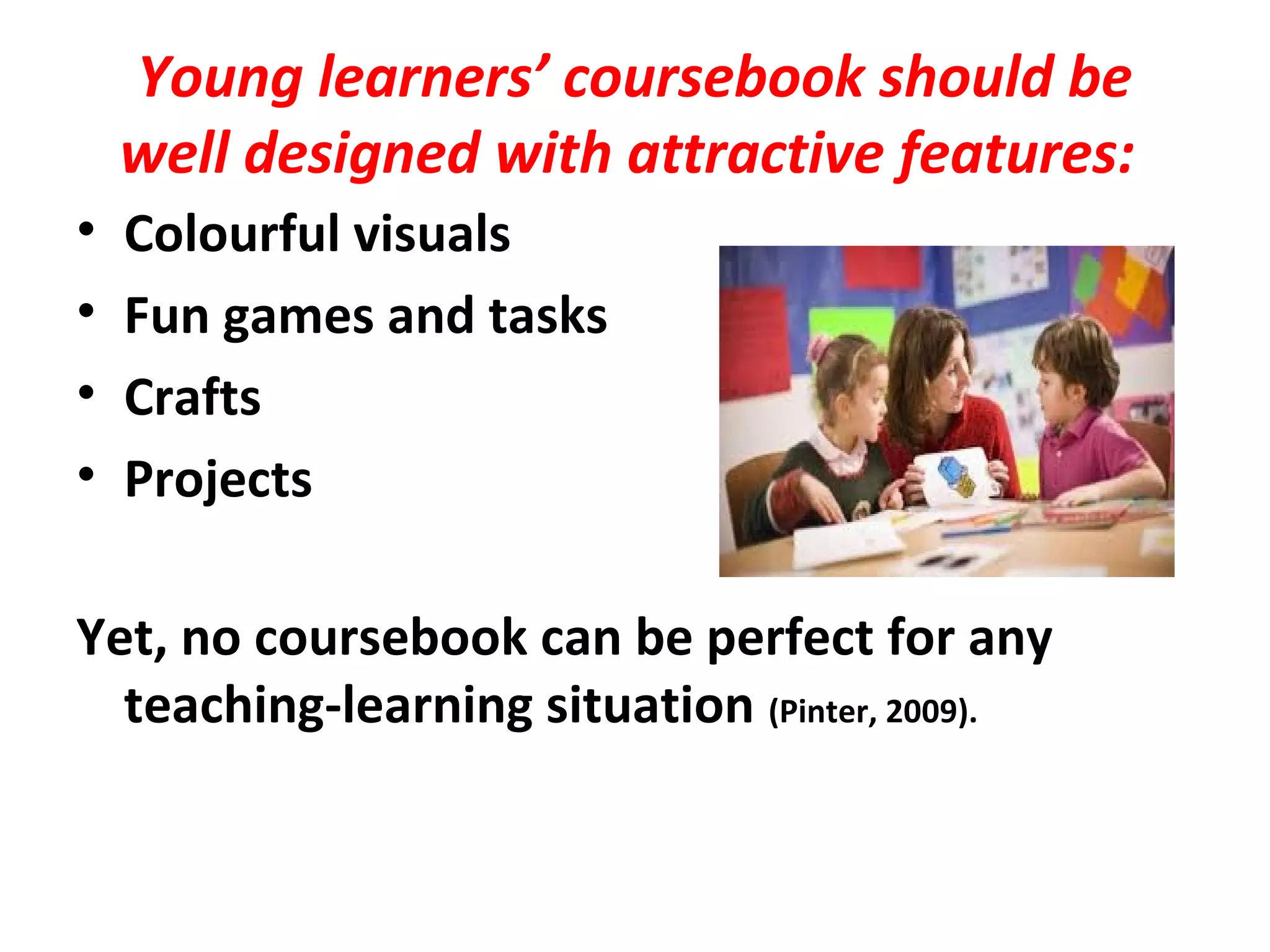
Young learners’ coursebook should be
well designed with attractive features:
• Colourful visuals
• Fun games and tasks
• Crafts
• Projects
Yet, no coursebook can be perfect for any
teaching-learning situation (Pinter, 2009).
The Amazing Brain
• Experience shapes the brain
• Emotions and learning
• Memory is multi-sensory
• Making sense of meaning
Children with Special Needs
(Linse, 2005):
• Dyslexia: difficulty with words.
• ADD: Attention Deficit Disorder
• ADHD: Attention Deficit Hyperactivity
Disorder
Symptoms:
•fails to give close attention to
details/makes careless mistakes.
•may have poorly formed
letters/words/messy writing.
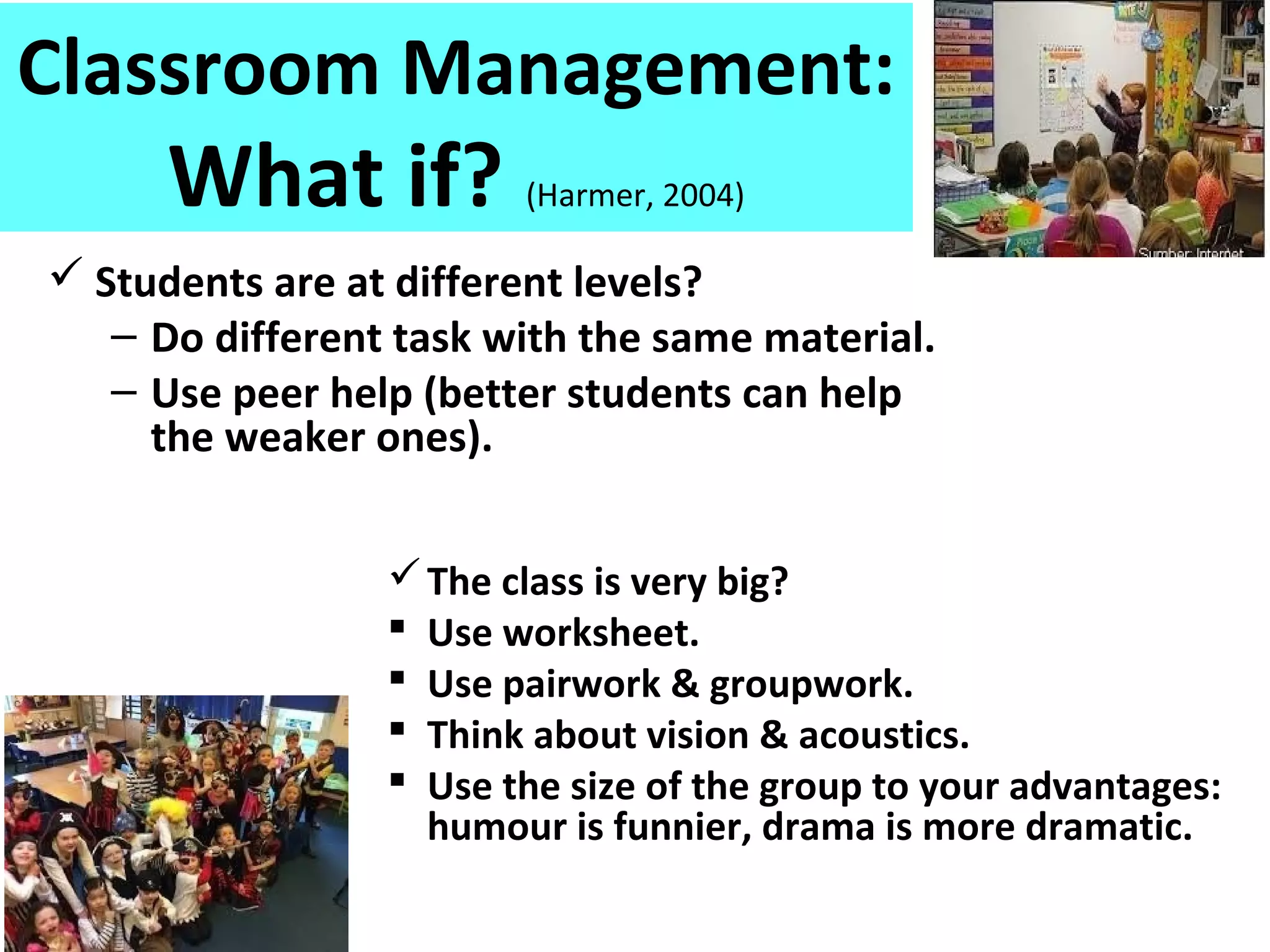
Classroom Management:
What if? (Harmer, 2004)
 Students are at different levels?
– Do different task with the same material.
– Use peer help (better students can help
the weaker ones).
The class is very big?
 Use worksheet.
 Use pairwork & groupwork.
 Think about vision & acoustics.
 Use the size of the group to your advantages:
humour is funnier, drama is more dramatic.
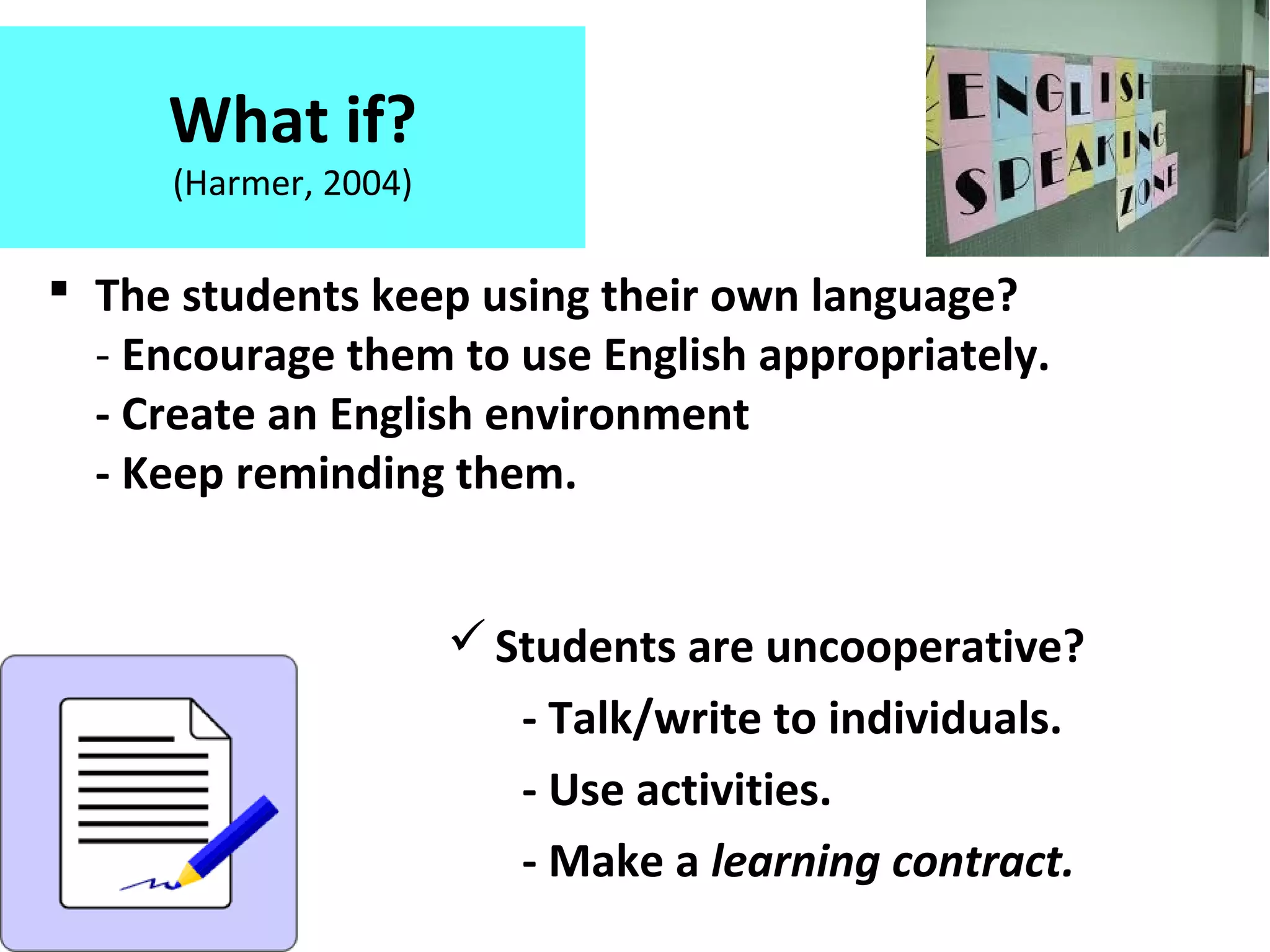
What if?
(Harmer, 2004)
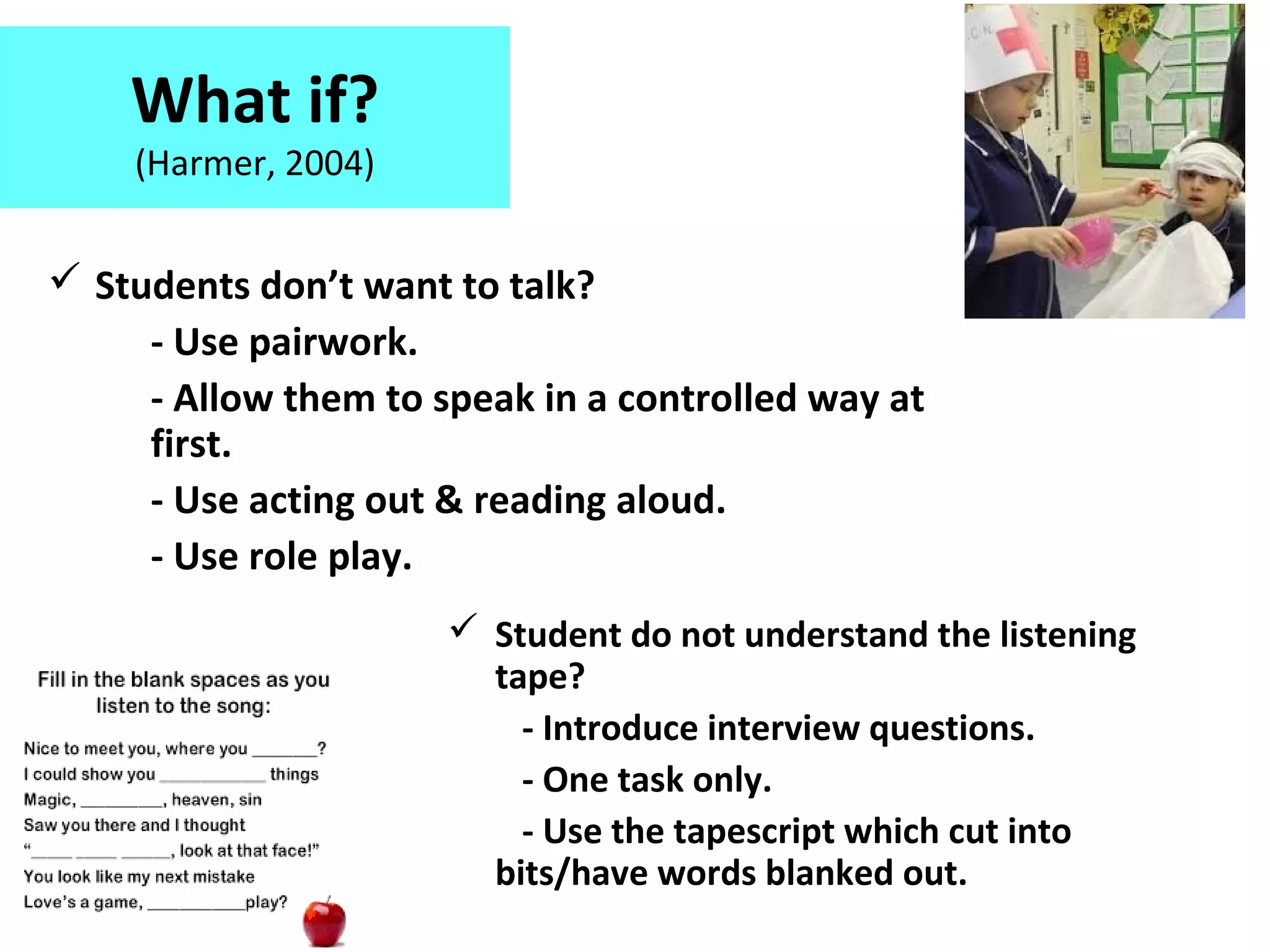
 The students keep using their own language?
- Encourage them to use English appropriately.
- Create an English environment
- Keep reminding them.
Students are uncooperative?
- Talk/write to individuals.
- Use activities.
- Make a learning contract.
What if?
(Harmer, 2004)
 Students don’t want to talk?
- Use pairwork.
- Allow them to speak in a controlled way at
first.
- Use acting out & reading aloud.
- Use role play.
 Student do not understand the listening
tape?
- Introduce interview questions.
- One task only.
- Use the tapescript which cut into
bits/have words blanked out.
10Twinkle Twinkle Little
Stars
(Bintang Kecil)
Twinkle twinkle little stars
How I wonder what you are
Up above the world so high
Like a diamond in the sky
Twinkle twinkle little stars
Who makes you there as you are
?
1, 2 I love you
3, 4 let’s count some more
5, 6 get your kicks
7, 8 cause counting is great
9, 10 numbers are our friends
Let’s count them all again
101, 2 I Love You
Where is the mouse?
The mouse is in the house
Where is the cat?
The cat is in the hat
Where is the fish?
The fish is in the dish
Where are you?
I’m in the classroom
Chorus:
In, on, under,
In front of, behind,
next to, between
11In, On, Under (1)
Where is the bear?
The bear is on the chair
Where is the snake?
The snake is on the cake
Where is the guitar?
The guitar is on the car
Where are you?
I’m on a chair too
11In, On, Under (2)
Chorus:
In, on, under,
In front of, behind,
next to, between
Where is the fox?
The fox is under the box
Where is the train?
The train is under the
aeroplane
Where is the rose?
The rose is under the nose
Where are you?
We’re under the moon
Chorus:
In, on, under,
In front of, behind,
next to, between
11In, On, Under (3)
Chorus:
In, on, under,
In front of, behind,
next to, between
Where is the D?
The D is in front of the C
Where is the C?
The C is behind the D
Where is the E?
The E is next to the D
Where are you?
I’m between M and W
Chorus:
In, on, under,
In front of, behind,
next to, between
11In, On, Under (4)
Chorus:
In, on, under,
In front of, behind,
next to, between
12Parts of the House
There’s a living room
In my new small house
There’s a dining room
In my new small house
There’s a kitchen in my house,
There’s a bedroom in my house,
There’s a bathroom in my house,
It’s a small
house after all
(3x)
It’s a small small
house
12  Fruit
(pronunciation)
Water melon, water melon,
Pineaple, pineaple,
Banana, banana (2x)
Papaya, papaya.
Session 11-12
- Preparing the EYL’s Project
- Group Assignment Practicing
TPR (Total Physical Response)
using “Hokey Pokey” song /
“Simon Says” Game
Group Assignment:
Practicing Games
for Young Learner
(see Lewis & Bedson.
1999. Games for Children)
GROUP ASSIGNMENT
Practicing TPR (Total Physical Response) using
Song & Game:
• “Hokey Pokey” song
You put your right hand in,
You put your right hand out,
You put your right hand in,
And you shake it all about,
You do the hokey pokey
and you turn yourself around
That’s what it's all about.
HOCKEY POKEY SONG (1)
(2)
You put your left hand in,
You put your left hand out,
You put your left hand in,
And you shake it all about,
You do the hokey pokey
and you turn yourself around
That’s what it's all about.
(3)
You put your right foot in,
You put your right foot out,
You put your right foot in,
And you shake it all about,
You do the hokey pokey
and you turn yourself around
That’s what it's all about.
(4)
You put your left foot in,
You put your left foot out,
You put your left foot in,
And you shake it all about,
You do the hokey pokey
and you turn yourself around
That’s what it's all about.
(5)
You put your head in,
You put your head out,
You put your head in,
And you shake it all about,
You do the hokey pokey
and you turn yourself around
That’s what it's all about.
Session 13
• Wise words & Movie Appreciation
LAST …
(BUT NOT LEAST)
LAST …
(BUT NOT LEAST)
Session 14
Final Test
“Jika anak dibesarkan dengan celaan, ia belajar
memaki;
Jika anak dibesarkan dengan permusuhan, ia
belajar menentang;
Jika anak dibesarkan dengan cemoohan, ia belajar
rendah diri;
Jika anak dibesarkan dengan toleransi, ia belajar
jadi penyabar;
Jika anak dibesarkan dengan dorongan, ia belajar
percaya diri;
Jika anak dibesarkan dengan pujian, ia belajar
menghargai;
Jika anak dibesarkan dengan kasih sayang dan
persahabatan, ia akan terbiasa berpendirian”
(Dorothy Law Nolte).
Elemen-elemen Penting dalam
Pembelajaran
Inspiring Movies:
See the videos
“Making Differences”
Nasehat untuk guru
Session 14
• Review
• Submit the EYL’s Project
• Brewster, Jean; Ellis, Gail; Grard, Dennis. 2003.The Primary English Teacher’s
Guide (New Edition). England: Penguin English.
• Damayanti, ika lestari. 2007. Menumbuhkan Minat Belajar Bahasa Inggris pada
Anak Usia Dini melalui Storytelling. Makalah dipresentasikan dalam acara
seminar dan lokakarya English Language Teaching for Young Learners tanggal 24
Februari 2004. Bandung: Balai Bahasa Universitas Pendidikan Indonesia.
• Fadilah, Rahmi. 2017. Madeline Hunter’s Lesson Plan as Alternative Model for
TEYL. Proceedings in English Conference at STKIP Pasundan.
• Hainstock, Elizabeth G. 1999. Metode Pengajaran Montessori untuk Anak Pra-
Sekolah. Jakarta:…
• Harmer, Jeremy. 2004. How to Teach English: An Introduction to the Practice of
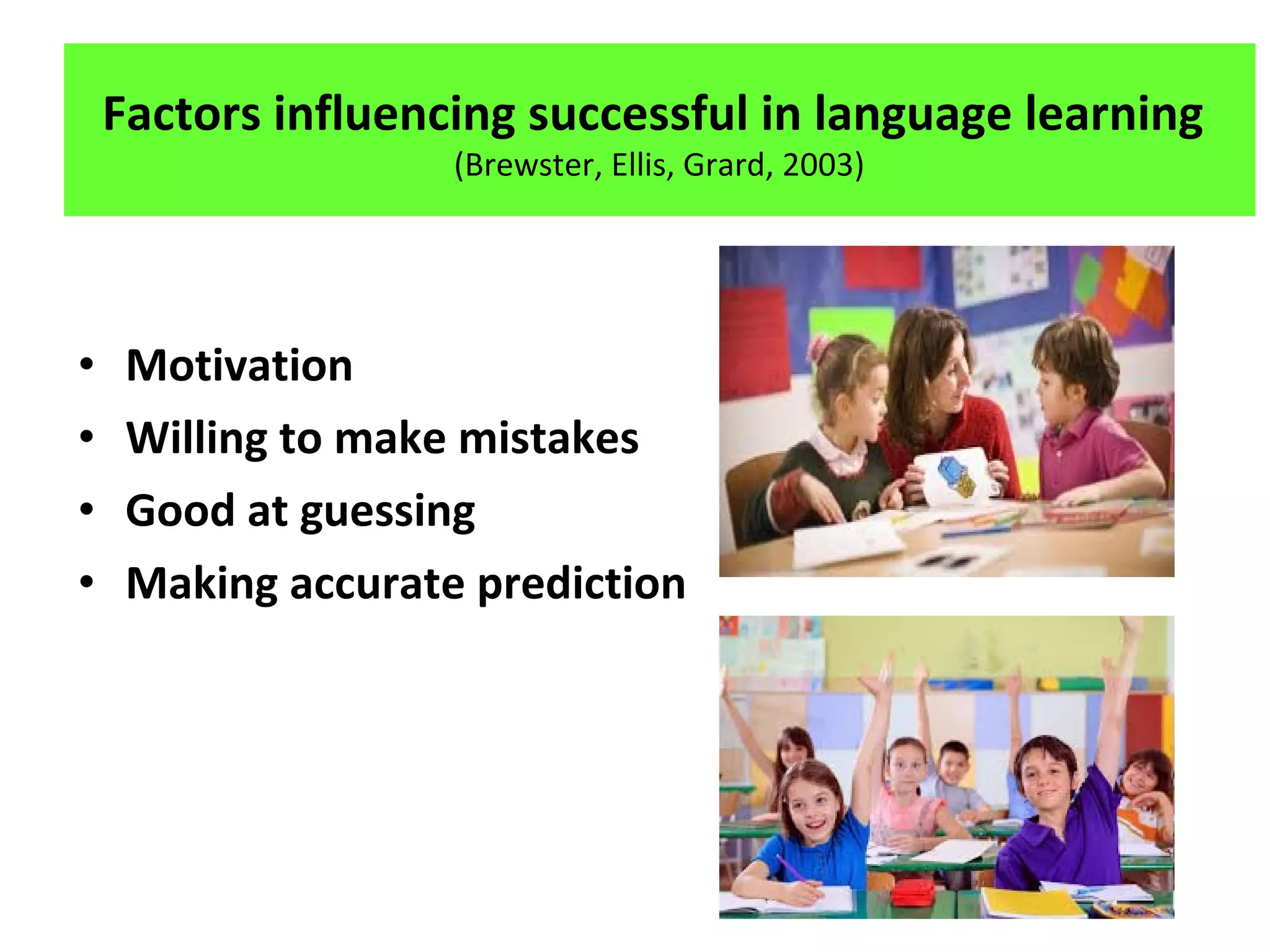
English Language Teaching. England: Longman.
• Ioannou-Georgiou, Sophie & Pavlou, Pavlos. 2003. Assessing Young Learners.
Oxford: Oxford University Press.
• Mooney, Carol Garhart. 2000. Theories of Childhood: An Introduction to Dewey,
Montessori, Erikson, Piaget, and Vygotsky. USA: Redleaf Press.
•Musthafa, Bachrudin. 2000. Teaching English to Young Learners:
Principles & Techniques. Bandung: Pasca Sarjana Universitas Pendidikan
Indonesia.
•---------------------------. 2010. Teaching English to Young Learners: In Indonesia
Context. Jurnal Educationist Vol.IV No.2 Juli 2010.
•Lewis, Gordon & Bedson, Gunther. 1999. Games for Children. Oxford: Oxford
University Press.
•Linse, Coroline T. 2005. Practical English Language Teaching: Young
Learners. New York: McGraw-Hill.
•Paul, David. 2003. Teaching English to Children in Asia. Hongkong;
Longman Asia ELT.
•Pinter, Annamaria. 2006. Teaching Young Language Learners. Oxford:
Oxford University Press.
•Slattery, Mary & Willis, Jane. 2005. English for Primary Teachers: A
Handbook of Activities and Classroom Language. Oxford: Oxford
University Press.
•Internet

TEYL/EYL STKIP Siliwangi 2017

  • 1.
    ENGLISH FOR YOUNGLEARNERS (EYL) / TEACHING ENGLISH TO YOUNG LEARNERS (TEYL) By: Sri Supiah Cahyati, M.Pd English Education Study Program STKIP Siliwangi 2017
  • 2.
    Session 1 • Syllabus(see Attachment) • Project (see Attachment) • Some Terms in Teaching English
  • 3.
    Some Terms inTeaching English TESL (Teaching English as a Second Language) : Learning of English by immigrants to a country where English is the native language. Ex : Korean child moved to Australia is an ESL learner in her English class. TEFL (Teaching English as a Foreign Language): Learning of English by students in a country where English is not the native language. Ex: Children are learning English at school, university, or a language school in their own country.
  • 5.
    • Teacher asa role model • Daily conversation (classroom language) as exposure to the students. • Students tend to imitate the teacher. Using English as a Means of Communication to Students
  • 6.
    Good morning everybodyhow are you? (I’m fine) Good morning everybody how are you? (I’m fine) Good morning to you, Good morning to you, Good morning everybody how are you? (I’m fine) 1 Good Morning
  • 7.
    1 Alphabet Song AB C D E F G H I J K L M N O P Q R S T U V W X Y and Z Now I know my ABC Next time won’t you sing with me A B C D E F G H I J K L M N O P Q R S T U V W X Y Z
  • 8.
    Session 2 • Characteristicsof Young Language Learners • Some Myths and Misconception about SL/FL Learning • Skills should be Taught First in TEYL
  • 9.
    Characteristics of YoungLearners (Pinter, 2006) • Children are at pre-school/in the first couple of years of schooling. • Generally they have a holistic approach to language, which means that they understand meaningful messages but cannot analyze language yet. • They have lower levels of awareness about themselves as language learners as well as about process of learning. • They have limited reading & writing skills even in their first language. • Generally, they are more concerned about themselves than others. • They have a limited knowledge about the world. • They enjoy fantasy, imagination, & movement.
  • 10.
    VYLs (under 7)YLs (7-12) • Acquire through hearing and experiencing lots of English, in much the same way they acquire L1 • Learn things through playing; they are not consciously trying to learn new words or phrases – for them it’s incidental • Love playing with language sounds, imitating, and making funny noises • Not able to organize their learning • Not able to read or write in L1; important to recycle language through talk and play • Their grammar will develop gradually on its own when exposed to lots of English in context • Are learning to read and write in L1 • Are developing as thinkers • Understand the difference between the real and the imaginary • Can plan and organize how best to carry out an activity • Can work with others and learn from others • Can be reliable and take responsibility for class activities and routines For more information, see: Slattery, M., & Willis, J. (2001). English for primary teachers. Oxford: Oxford University Press.
  • 11.
    Characteristics of Older/AdultLearners • These children are well established at school & comfortable with school routines. • They show a growing interest in analytical approaches, which means that they begin to take an interest in language as an abstract system. • They show a growing in their learning. • They have well developed skills as readers & writers. • They have a growing awareness of others & their viewpoints. • They have a growing awareness about the world around us. • They begin to show interest in real life issues.
  • 12.
    Misconceptions in teachingapproach to younger learners can lead to failure (Musthafa, 2000) • Teacher tend to approach the teaching-learning process & employ teaching methods & techniques for the teaching English to young learners in an exactly the same way as they would teach adult learners. • Actually, children have their own culture & learning preferences. They learn by way of physical activities that embedded in their daily life, they have a relatively short attention span, & they learn with the motive of meeting immediate goals (here & now principle)
  • 13.
    Some myths andmisconceptions about second/foreign language learning (Musthafa: 2000) A. Children learn second/foreign languages quickly & easily. Adolescents & adults perform better than young children under controlled conditions, except pronunciation. Young children do not have access to the memory techniques & other strategies that more experiences learners use in acquiring vocabulary & in learning grammatical rules. Children are more likely to be shy & embarrassed around peers that are adults.
  • 14.
    Some myths andmisconceptions about second/foreign language learning (Musthafa: 2000) B. The younger the child, the more skilled in acquiring an L2/FL Oyama (in Pinter, 2006) found that the earlier a learner begins a second language, the more native like the accent he/she developed. An early start for “foreign” language learners makes a long sequence of instruction leading to potential communicative proficiency possible & enables children to view L2 learning & related cultural insight as normal & integral. Beginning language instruction gives children more exposure to the language.
  • 15.
    Some myths andmisconceptions about second/foreign language learning (Musthafa: 2000) C. The more time students spend in an L2/FL context, the quicker they learn the language. The increased exposure to English does not necessarily speed the acquisition of English. Children with exposure to the home language & to English acquire English language skills equivalent to those acquired by children who have been in English-only program.
  • 16.
    Some myths andmisconceptions about second/foreign language learning (Musthafa: 2000) D. Children have acquired an L2/FL once they can speak it For school-aged children, proficiency in face-to-face communication does not imply proficiency in the more complex academic language needed to engage in many classroom activities. Children may have language problems in reading & writing that are not apparent if their oral abilities are used to gauge their English proficiency.
  • 17.
    Some myths andmisconceptions about second/foreign language learning (Musthafa: 2000) E. All children learn an L2/FL in the same way Some children are outgoing, sociable & learn the second language quickly, they do not worry about mistakes, but use limited resources to generate input from native speakers. Other children are shy & quite, they learn by listening & watching, they say little, for fear of making a mistake. Children are likely to be more responsive to a teacher who affirms the values of the home culture.
  • 18.
    Skills should betaught in TEYL
  • 19.
    2  Head,Shoulder, Knees, and Toes (Kepala, Pundak, Lutut, Kaki) Kepala, pundak, lutut, kaki (lutut, kaki) Kepala, pundak, lutut, kaki (lutut, kaki) Mata, telinga, mulut, hidung, dan pipi Kepala, pundak, lutut, kaki (lutut, kaki) Head, shoulder, knees, and toes (knees and toes) Head, shoulder, knees, and toes (knees and toes) And eyes, and ears, and mouth, and nose Head, shoulder, knees, and toes (knees and toes)
  • 20.
    Days (Nama-Nama Hari) Senin, Selasa, Rabu,Kamis, Jumat, Sabtu, Minggu Itu nama-nama hari Sunday, Monday, Tuesday, Wednesday, Thursday, Friday, Saturday => (2x)
  • 21.
    Session 3 • BasicConcepts of Language Teaching • Mutiple Intelligences • Theories of Children Learning Development • TEYL in Indonesia Context (Assignment: Identifying English teaching-learning for YL, the name of the school, the book used, the way the teacher teach, the assignment given)
  • 22.
    How to teachEnglish in Classroom Context
  • 23.
    Discussion How to bea good teacher? How to describe learning and teaching? How to teach across age levels?  Teaching children, Teaching teens, Teaching adults How to plan lessons? Workshop: Teaching Materials and supplementary
  • 24.
    How to bea good teacher? A. How should teachers give instruction? B. Who should talk in class?
  • 25.
    A. What makesa good teacher? Source: Private language School students in Britain (Harmer, 2004)
  • 26.
    B. How shouldteachers give instructions? • The worst activity in the world is a waste of time if the students DON’T understand what it is they are supposed to do.
  • 27.
    C. Who shouldtalk in class? TTT (Teacher Talking Time) -- STT (Student Talking Time) Students are the people who need practice, in other words, not the teacher . A good teacher maximizes STT and minimizes TTT How is TTT ineffective? when the teacher’s voice drones on and on day after day and where she/he hardly ever hear the students say anything /apply the lesson – TTT is considered over-used and not very attractive. When TTT is EFFECTIVE? when the T knows the rough-tune language to students’ level  The Ss get a change to hear the language which is certainly above their own productive level, but they can more or less understand!
  • 28.
    How to describelearning and teaching? A.Language learning B.The necessary elements for successful language learning in classroom C.How do the three elements of ESA fit together in lesson sequences? D.What teaching model have influenced current teaching practice?
  • 29.
    What do weknow about language learning? •The students are usually exposed to language which they more or less understand even if they can’t produce the language spontaneously themselves. •They are motivated to learn language in order to be able to communicate. •The students have opportunities to use the language they are learning (they need to be motivated, be exposed to language, given chances to use it)
  • 30.
    The important elementsin a language classroom: ESA
  • 31.
    The important elementsin a language classroom
  • 32.
    Teaching Models whichhave influenced current teaching practice
  • 33.
  • 34.
    Five Categories inTeaching Children
  • 35.
  • 36.
    Teaching Teens The “Terribleteens” are an age of transition, confusion, self-consciousness, growing, and changing bodies and minds. Teens are in between childhood and adulthood, therefore a very special set of considerations applies to teaching them (Brown, 2001).
  • 37.
    • Complex problemscan be solved with logical thinking • Attention spans are lengthening as a result of intellectual maturation • Varieties of sensory input are still important • Factors surrounding ego, self-image, and self-esteem are at their pinnacle • Secondary school students are of course becoming increasingly adultlike in their ability to make those occasional diversions from the “here and now” context. Harmer (2005); Brown (2001)
  • 38.
    Basic Concepts ofLanguage Teaching What can go wrong? • We do not give the children space to notice. • They do what we want them to do. • They do not try for themselves. • They do not experiment enough. • They are unsuccessful. • They do not make links.
  • 39.
    • Motivation • Willingto make mistakes • Good at guessing • Making accurate prediction Factors influencing successful in language learning (Brewster, Ellis, Grard, 2003)
  • 40.
    Child-Centered Learning (Paul, 2003) Noticing Playing/ Experimenting Challenging/ Taking arisk Wanting Succeeding Linking/ Internalization The teacher explained/demonstrated before the children started practicing.
  • 41.
    Essential principles ofhow to facilitate children a foreign language (Pinter, 2006; Andini, 2007; Utami, 2004; Harmer 2002)
  • 42.
    L1 Environment L2Environment • Language highly contextualized • In the real world the language used is authentic • Learner highly motivated • Language more decontextualized • In the classroom the language used tends to be artificial • Learners may not be highly motivated Although children may use similar processes for acquiring L1 and L2, the environment for L1 and L2 acquisition can be quite different (Brewster, Ellis & Girard, 2004). Therefore, it is important to remember that an early start alone will not necessarily improve children’s ability to learn English. It is also very important that L2 instruction include language structures that are presented within a context that is meaningful and communicative.
  • 43.
    Now that wehave looked at different learning styles and characteristics of young language learners, try to fill in the boxes in this mind map. With a partner, take turns reading each bubble before describing what word best fits each box. Use these words to fill in the boxes: Enjoyable Full of practice Meaningful Purposeful Social Supported This mind map can be found in the following article: Read, C. (1998, April). The challenge of teaching children. English Teaching Professional, 7: 8-10. Retrieved August 1, 2005, from http://www.etprofessional.com/articles/challenge.pdf
  • 45.
    Teaching implication Teacher shouldbe sensitive, open to the needs and interests of various age groups, and continually monitor their changing needs.
  • 46.
    Multiple Intelligences & Implication toEYL Class “One child may be more intelligent in one way and another may be more intelligent in another” (Paul, 2003)
  • 47.
    Multiple Intelligences & Implication toEYL Class For teachers (responsibility): To learn about the different learning styles or intelligences to cater every type of learners in the classrooms.
  • 52.
    Multiple Intelligences (from differentsources) 1. Linguistic : • Express oneself • Understand what others are trying to say through words Teacher centered explanations • Essays and written reportsEssays and written reports • Reading selectionsReading selections Book based grammar and language function explanations • Gap-fill exercisesGap-fill exercises
  • 53.
    2. Logical/mathematical : •Understand and manipulate numbers • See cause and effect relationship Multiple Intelligences (from different sources) Grammar categorizing activitiesGrammar categorizing activities •Grammar rules study and inductive explanations •Error recognitionError recognition •Correcting work based on teacher indications •Develop mind-mapsDevelop mind-maps and other vocabulary chartsvocabulary charts
  • 54.
    3. Spatial : •Form mental images of layouts • Find ways around • Learn through pictures and drawings • Mind mapsMind maps • Using photos, paintings, etc. to encourage discourseUsing photos, paintings, etc. to encourage discourse • Creating personal road mapsCreating personal road maps / other visual aids to use during discourse • Graphs used to initiate explanations of statistics • VideosVideos • Creating multimedia projectsCreating multimedia projects • Highlighting texts in different colors to indicate tense, or function • Games such as Pictionary Multiple Intelligences (from different sources)
  • 55.
    4. Bodily/Kinesthetic: • Useparts of body to make things • Do activities such as playing ball games • Typing • Movement gamesMovement games (especially popular in children's English classes) • Role playsRole plays / drama • Pantomime vocabulary activities • Facial expression games • For classes with access to athletic facilities, explanation of sporting rules Multiple Intelligences (from different sources)
  • 56.
    5. Musical : •Produce and recognize songs • Play around with melodies • Singing • Composing rhythm • Adapting/modifying song Multiple Intelligences (from different sources)
  • 57.
    3Rainbow (Pelangi) Rainbow, rainbow How beautifulyou are Red, yellow, and green In the blue blue sky Your creator is great I wonder who is it Rainbow rainbow The creation of God ?
  • 58.
    3 I LoveEverybody (Aku Sayang Ibu ) ? One and one I love my mommy Two and two I love my daddy Three and three I love brother, sister One and two and three I love everybody
  • 59.
    I love myfather, and I love my mother, I love my brother, and my sister too (2x) Yes, they are my family (2x) Famili...family...oh...oh...oh...oh. . 3 Family
  • 60.
    3 Little Teapot (TekoKecil ) Aku teko kecil yang mungil Ini gagangku dan corongku Bila mendidih, aku bersiul (tuiiiiit) Miringkan aku dan tuangkan I’m a little teapot, short and stout Here is my handle, here is my spout When I get my steam up then I shout (tweeeeet) Tip me over and pour me out
  • 61.
    6. Interpersonal: • Understandothers • Cooperate with others • Small group work • Team competitionsTeam competitions • Role playsRole plays using dialogues • Peer teaching Multiple Intelligences (from different sources)
  • 62.
    7. Intrapersonal: • Understandourselves • Know similarities and differences from others • Deal with emotions • Writing in logs and diaries • Estimating learning strengths, weaknesses, progress over time • Understanding learner objectivesUnderstanding learner objectives • Speaking about one's personal history with confidence Multiple Intelligences (from different sources)
  • 63.
    8. Naturalist : •Recognize species of plants • Characterize different animals • Relate to natural world • Exploring outdoors but in English • Shopping and other field trips • Collecting plants to learn appropriate vocabulary Multiple Intelligences (from different sources)
  • 64.
    Implication to EYLClass (Paul, 2003) 1. Understand and respect, different children learn in different ways 1. Understand and respect, different children learn in different ways 2. Be careful about putting individual children into categories 2. Be careful about putting individual children into categories 3. Avoid making generalized statement about children 3. Avoid making generalized statement about children 4. Provide a wide variety of activities 4. Provide a wide variety of activities
  • 65.
    “Exposure to English”: Howmuch children hear & how often they have opportunity to interact in English. It’s important that opportunities are created in the classroom for children to be exposed to natural language & to interact with each other The implication: Teachers’ competencies in terms of their proficiency in English to provide the necessary exposure to the language, and their methodology to offer appropriate tasks & activities for children to communicate in a variety ways.
  • 66.
    Creating English-rich environmentat schools 1. Wise words in the halls 2. Labels in English 3. Wall magazines in English
  • 81.
  • 87.
  • 88.
    Materi usia 0– 3 tahun: • Pengenalan diri sendiri (Pengembangan konsep diri) • Pengenalan perasaan (perkembangan emosi) • Pengenalan tentang orang lain (perkembangan sosial) • Pengenalan berbagai gerak (perkembangan fisik) • Mengembangkan komunikasi (perkembangan bahasa) • Keterampilan berfikir (perkembangan kognitif)
  • 89.
    Materi usia 3tahun ke atas: • Keaksaraan (peningkatan kosa kata & bahasa, kesadaran phonologui, wawasan p[engetahuan, percakapan, memahami buku-buku & teks lainnya. • Konsep Matematika (pengenalan angka-angka, pola- pola & hubungan, geometri & kesadaran ruang, pengukuran, pengumpulan data, pengorganisasian & mempresentasikannya. • Pengetahuan alam (objek fisik, kehidupan, bumi & lingkungan) • Pengetahuan sosial (tempat hidup orang banyak, bekerja, berinteraksi)
  • 90.
    Materi usia 3tahun ke atas: • Seni (tari, musik, bermain peran, menggambar & melukis) • Teknologi (alat-alat & penggunaan operasi dasar) • Keterampilan proses (pengamatan & eksplorasi, eksperimen, pemecahan masalah, koneksi, pengorganisasian, komunikasi & informasi)
  • 91.
    Hal penting bagiorang tua: •Peka terhadap perbedaan kemampuan masing-masing anak •Terbuka terhadap perubahan anak •Pendampingan dan penghargaan yang tepat. •Kecerdasan tidak ditentukan oleh gen namun lebih banyak ditentukan oleh perlakuan/lingkungan.
  • 92.
    Noble, Professional &Global EducatorNoble, Professional & Global Educator •Bermain. •Bercerita •Bernyanyi •Bercakap (dialog dan tanya jawab) •Piknik •Praktik langsung •Bermain peran (sosio-drama) •Penugasan
  • 93.
    Theories of ChildrenLearning Development (Mooney, 2000)
  • 94.
    Child Development (Piaget) Sensory-motorstage (0-2) Pre Operational stage (2-7) Concrete operational stage (7-11) Formal operational stage (11-onwards)
  • 95.
    • The socialenvironment, the cultural context, and the influence of peers, teachers & parents engaged in interactions with children are major sources of learning & development (Social Constructivism). • The other concept is the Zone of Proximal Development (ZPD). It is the difference between the current knowledge of the child & the potential knowledge achievable with some helps from a more knowledgeable peer/adult. 2. Lev Vygotsky Theories of Children Learning Development (Mooney, 2000)
  • 96.
    “Scaffolding: helping childrento learn by offering systematic support” Theories of Children Learning Development (Mooney, 2000) 3. Jerome Bruner “The social environment, i.e. social interaction with parents & teacher can make a difference in terms of offering unique, enriching experiences. “
  • 97.
    “When assessing children’s intelligent,it had no unitary character, rather, it manifested itself in many different ways in different children (multiple intelligences). The types of intelligences are linguistic, logico-mathematical, musical, spatial, bodily/kinesthetic, interpersonal, intrapersonal, and natural. “ 4. Howard Gardner Theories of Children Learning Development (Mooney, 2000)
  • 98.
    “Children often produced languagethat they could not have heard in natural interaction with others (Universal Grammar)” 5. Noam Chomsky Theories of Children Learning Development (Mooney, 2000)
  • 99.
    “Brain plasticity wasonly conducive to language learning until puberty (Critical period hypothesis). Children below 11- 12, who are given advantageous learning circumstances, such as plenty of input & interaction in an English environment, are more likely to acquire English to native levels without an accent”6. Eric Lenneberg Theories of Children Learning Development (Mooney, 2000)
  • 100.
    Theories of ChildrenLearning Development (Mooney, 2000) 7. James Asher Total Physical Response (TPR): Kinesthetic intelligence and memory is used because children do not learn in a conscious intellectual way. Children do not learn by thinking, but by “doing” things.
  • 101.
    8. Krashen &Terrell The Input Hipothesis Theories of Children Learning Development (Mooney, 2000) Stephen Krashen Spoken fluency in second language is not taught directly. Rather the ability to speak fluently and easily in a second language emerges by itself, after a sufficient amount of competence has been acquired through input. We acquire (not learn) language by understanding input that is a little beyond our current level of (acquired) competence. Listening comprehension and reading are the primary importance in the language program, and the ability to speak (or write) fluently in a second language will come on its own with time. Speaking ability "emerges" after the acquirer has built up competence through comprehending input. Tracey Terrel
  • 102.
    Input Hypothesis (Cont.) TheMajor Points On the Input Hypothesis are: It relates to acquisition, not to learning; Spoken fluency emerges gradually and is not taught directly We acquire by understanding language a bit beyond our current level of competence. This is done with the help of context When caretakers talk to acquirers so that the acquirers understand the message, input automatically contains "i+1", the grammatical structures the acquirer is "ready" to acquire
  • 103.
    • Whatever helpscomprehension is important • Vocabulary is important. With more vocabulary, there will be more comprehension, and there will be more acquisition. • In giving input, in talking to students, the teacher needs to be concerned primarily with whether the students understand the message. Input Hypothesis (Cont.) The implications for classroom practice
  • 104.
    • Education shouldbe child centered. • Education must be both active & interactive. • Education must involve the social world of the child and the community. Theories of Children Learning Development (Mooney, 2000) 9. John Dewey • Plan purposeful curriculum. • Make sense of the world for children. • “It’s fun” is not enough.
  • 105.
    • Children learnlanguage and other significant life skills, without conscious effort, from the environments where they spend their time. • Children learn best through sensory experiences, by doing & through repetition. • Children are capable of great concentration when they are surrounded by many interesting things to do & given the time and freedom to do them. • Children need more physical activity. Theories of Children Learning Development (Mooney, 2000) 10. Maria Montessori
  • 107.
    • How childrendevelop the foundation for emotional & social development & mental health. • Consider individual differences. • Focus curriculum on real things. • Stages of Psychosocial Development (“Eight Ages of Man”); theory of emotional development, which covers the life spans of human beings. 11. Erik Erikson Theories of Children Learning Development (Mooney, 2000)
  • 108.
    TEYL in IndonesiaContext (Musthafa, 2010) Requirements for effective TEYL: a. English should be used all the time to ensure that children have relatively much exposure to English. b. Print-rich environment in English should be created and around the classroom. c. Teachers of EYL should use activity- based teaching-learning techniques such as TPR, games, & projects. d. The teachers should use various techniques for short periods of time to maintain the interest level of the children in engaging the English English is as a local content in Elementary school & EFL in Indonesia.
  • 109.
    e. The teachersshould focus on functional English for vocabulary development & for immediate fulfillment of communicative needs of the learners. f. The teachers should reiterate often to ensure the acquisition of English expressions/vocabulary items. g. The teachers should provide useful, acquisition-promoting routines. h. The teachers should have a good command of English & have an ability to act as a role model to the learners they teach. TEYL in Indonesia Context (Musthafa, 2010)
  • 110.
    a. No exactcurriculum/lesson plan for teachers to teach EYL conducted by the government in Indonesia. b. The English teachers in primary schools are confuse of how to conduct a good lesson plan. c. The stage is not clear enough to achieve the lesson’s objectives which are appropriate with the level of the students. The Problem of EYL in Indonesia Context (Fadilah, 2017)
  • 111.
    Session 4 • Instructionsin Organizing the Classroom • Teaching Vocabulary & Grammar
  • 112.
    Teacher’s Instructions inOrganizing the Classroom
  • 113.
    1. Pre-activities: a. Greetings: Goodmorning, students. Good afternoon, everybody. b. Do the prayer before we start let’s pray together.
  • 114.
    LET’S SING ASONG Good morning every body, how are you? (I’m fine) Good morning every body, how are you? (I’m fine) Good morning to you, Good morning to you, Good morning every body, how are you? (I’m fine) => Just fine / I’m good
  • 115.
    Teacher’s Instructions inOrganizing the Classroom (Classroom Language)
  • 116.
    - Let’s callthe roll. - Let’s take the register. - Let’s check to see who is here. - Is anyone away? - Is everybody here? - Who is missing? b. Checking attendance
  • 117.
    - Arrange theclassroom - Sing a song - Say a rhyme - Play a game c. Ways of starting lessons
  • 118.
    2. Main-activity: - I’mwaiting for you to be quiet - Stop talking & be quiet. - Let’ s begin our lesson now - Is everybody ready to start? - Open your book at page... - Is there any questions? - Do you understand? - Do you get it? - Are you with me?
  • 119.
    Daily Conversation in Classroom •Listen! • Repeat! • Sit down • Work in pairs • Raise your hand • May I borrow your pen? • May I go to the toilet ? • How do you say ……. In English? • Make a line • Close the door. • Come forward, please. • Open the book
  • 120.
    Teacher’s Instructions inOrganizing the Classroom (Classroom Language)
  • 121.
    3. Post-activity: a. That’sall for today. b. Goodbye, students. c. See you on… d. See you again tomorrow e. Have a good holiday.
  • 122.
    • Good Bye •Bye • See you again • See you tomorrow • Thanks for coming • Have a good day • Have a nice day Classroom language: General Closing
  • 123.
    •Hello! •Good morning/afternoon. •Good day •Goodto see you. •How are you? •How are you doing? •How is everything? •How’s everything going? •Hi. •What’s up? •How are things (with you)? •How’s it going? It’s always a pleasure to see you. Classroom Language: General greetings
  • 124.
    •Listen to me,please. •Trace the words on the paper. •Color the pictures/objects. •Draw a butterfly on the paper. •Glue it on the colored paper. •Stick it on the board. •Cut this paper out carefully. •Don’t speak too loud. •Don’t say it anymore, it’s not good. •Sit down on the mat, please. •Put your things in your bag. •Cut and paste this paper please. •Take off your bag children. • Let’s sing and dance together! •Don’t play with your chair, it’s dangerous! •Come forward and hit the board. •Touch something red! •Let’s make a big/small circle. •Take out your color pencils. Classroom Language: Teacher’s Instructions
  • 125.
    – What’s yourname? – How old are you? – Are you happy now? – Are you sad? – Are you hungry? – Are you tired? – Have you done your home work? – How’s your weekend? – How’s your long holiday? – Do you understand? – Is that clear enough? – Do you listen to me? – Can you write (it/that) to me? – Can you come forward? – Are you with me? – Can you repeat after me? – Would you like to read for us? – Can you draw the ship? – Can you color the pictures? – What color is your bag? – What’s your favorite color? – What’s your favorite food/drink? – What’s your favorite number? – How many… have you got? – What time do you get up/go to bed? – What time do you finish at school? – When is your birthday? – Where do you live? Classroom Language: Teacher’s Questions (1)
  • 126.
    – Do youlike…? – Can you say that again? – Can you give it back to me? – Can you put the rubbish into the trash bin? – Can you cut this paper out? – Can you stick this paper on the board? – Can you fold the paper into two sides? – Can you move your chair a little? – Can you sit next to him/her? – Who likes going to the zoo? – Can you tell me about your work? – Can you stand up? – Can you touch your finger on your nose? – Can you touch something green? – Who feeds a pet? – Who likes singing? – Who had a big breakfast this morning? – Who is your favorite hero? – Who can answer me? – Whose pen is this? – What does your father do? – Who wants to be an astronaut? Classroom Language: Teacher’s Questions (2)
  • 127.
  • 128.
    • That’s good! •You’re right! •Good work! •Great! •That’s it! •Excellent! •Good remembering! •Keep on trying! •Keep up the good work! •I’m so happy to see you again. •That kinds of work makes me happy. Motivating Expressions:
  • 129.
    Teaching vocabulary andgrammar Vocabulary & grammar should be taught & learnt together. It’s better if grammar is noticed & learnt from meaning- focused input, children need to be able to see the relationship between form & function. Teacher should provide lots of meaningful practice, recycling, & guidance in attending to language form. So children will learn grammar in a holistic way.
  • 130.
    What grammar toteach? (Brewster, Ellis, Grard, 2003) • Facts. Example: the plural of foot is feet, not foots. • Patterns. Example: My favorite (color/food) is (blue/fried chicken). • Choices. Example: I like swimming/reading/…etc. I go to school by car/on foot/…etc.
  • 131.
    Teknik Pembelajaran (Damayanti,2014) • Grammar sebaiknya diajarkan tidak secara terpisah terutama untuk very young learners , tunggu sampai mereka siap (diatas 8-9 tahun). • Belajar grammar dapat dimulai dari menghapal ‘formulaic chunks’. Membicarakan sesuatu yang bermakna dengan anak dapat dijadikan cara yang jitu untuk memperkenalkan grammar. Grammar dapat diajarkan tanpa perlu menjelaskan label-label teknis (seperti: intensifying adverb, past tense, etc.)
  • 132.
    Example of Pattern TeacherTalk: (Wave your hand over the page.) “Look! I see a park. I see boys and girls. The boys and girls are in the park.” Repeat. “The boys and girls are in the park.” 1. Teacher: (Point to the slide. Ask children to listen, point, and repeat) This is a slide. 3. Children’s Response: (Listen, point, and repeat.) This is a slide. 2. Teacher: (Point to the swings. Ask children to listen, point, and repeat.) These are swings. 4. Children’s Response: (Listen, point, and repeat.) These are swings.
  • 133.
    Teaching using StoryTelling Purposes : •To expose children to more language. •To revise language/vocabulary. •To present new language. •To practice listening, speaking, reading, writing. •To extend/enrich children’s language
  • 134.
    Assessment activities (Brewster, Ellis,Grard, 2003): • Listen/read, then change from singular to plural, etc. • Fill in gaps with the correct grammatical/vocabulary item. • Correct grammatical/vocabulary mistakes in sentence. • Correct the word order in a sentence. • Read/listen to lists of words & classifying them. • Sequence time expressions, such as: today, yesterday, tomorrow. • Use picture prompts to contrast things using comparatives, tenses, etc.
  • 135.
    4 BINGO (=> spelling) Therewas a farmer had a dog and Bingo was it’s name..o.. B…I…N…G…O… B…I…N…G…O B…I…N…G…O And Bingo was it’s name … o… There was a farmer had a dog and Bingo was it’s name..o.. (clap)…I…N…G…O, (clap)…I…N…G…O, (clap)…I…N…G…O And Bingo was it’s name … o…
  • 136.
    4 The ItsyBitsy Spider (Binatang Kecil ) Binatang kecil naik tembok yang tinggi Turun hujan, binatang jatuh Terbit matahari, hujan berhenti Binatang kecil naik tembok kembali
  • 137.
    Session 5 • TeachingListening & Speaking
  • 138.
    Teaching Listening (Pinter, 2006) Childrenshould start with easier “listen & do” activities, teacher often talk a lot in the target language because they provide the language input, teacher use “language modification” to avoid & solve misunderstandings, like repetitions, comprehension checks, clarification requests, & confirmation checks, TPR, and listening to stories.
  • 139.
    Teaching Tips (Slattery &Willis, 2001) Support children’s early efforts in speaking by: • Look at what they have done & talk about it, even if they won’t understand everything you say. Give your shy pupils more chance to talk to you individually. • Waiting for their responses • Repeating what they say in English • Frequently summarizing what different pupils say • Give children lots of opportunities to speak, BUT … Don’t pressure on children to speak if they are not ready • Remember: silent children are still likely to be listening & learning
  • 140.
    The Initial StagesIn Teaching Speaking (Brewster, Ellis, Grard, 2003) Use Formulaic language: • Simple greetings: Good morning, how are you?/ I’m fine, thank you. And you? • Social English: Did you have a nice weekend?/ Have a nice weekend! • Routines: What date is it today?/ What day is it today? • Classroom language: Listen. Repeat. Sit down. Work in pairs. Good. • Asking permission: May/Can I go to the toilet, please?/ May I wash my hand?/Can I look at the book? • Communication strategies: Can you say that again, please?/How do you say… in English?/I don’t know.
  • 141.
    We can helpour pupils understand what we say in English: • With our tone of voice, eye contact. • By using gestures, facial expressions, pictures/diagrams, real things. • By using familiar contexts & topics, rephrasing what we say in as many ways as we can, occasional use of their mother tongue.
  • 142.
    Activities Recommended inTeaching Listening & Speaking “Singing, reciting rhymes, listening to stories, playing games according to the learners’ age, interests & abilities”
  • 143.
    5 Ten LittleIndian Boys (=>counting) One, little two, little three, little Indian, Four, little five, little six, little Indian, Seven, little eight, little nine, little Indian, Ten, little Indian boys Ten, little nine, little eight, little Indian, Seven, little six, little five, little Indian, Four, little three, little two, little Indian,
  • 144.
    5 Ten Aeroplanes(=>counting) One, littletwo, little three, little aeroplanes, Four, little five, little six, little aeroplanes, Seven, little eight, little nine, little aeroplanes, Ten aeroplanes flying high Ten, little nine, little eight, little aeroplanes, Seven, little six, little five, little aeroplanes, Four, little three, little two, little aeroplanes, One aeroplane flying high
  • 145.
    Five little duckswent out one day Over the hills and far away Mother duck said: “quack quack quack quack” But only four little ducks came back Four little ducks went out one day Over the hills and far away Mother duck said: “quack quack quack quack” But only three little ducks came back 5Little Ducks (1)
  • 146.
    Three little duckswent out one day Over the hills and far away Mother duck said: “quack quack quack quack” But only two little ducks came back Two little ducks went out one day Over the hills and far away Mother duck said: “quack quack quack quack” But only one little duck came back 5Little Ducks (2)
  • 147.
    One little duckwent out one day Over the hills and far away Mother duck said: “quack quack quack quack” But none of those little ducks came back Mother duck, she, went out one day Over the hills and far away Mother duck said: “quack quack quack quack” And all of those little ducks came back 5Little Ducks (3)
  • 148.
    Session 6 • Teachingof Reading & Writing
  • 149.
    Teaching Reading andwriting (Pinter, 2006): “It would be controversial to introduce reading & writing in a second language to children who are not yet literate in their first language.” “Reading & writing are usually taught in parallel because children who begin to read enjoy writing too. Children can only benefit from phonics training if the meaning of the words makes sense to them.”
  • 150.
    It is usefulfor children to start: •Reading with phonics (see another slide) •Writing with tracing, copying, or air writing. Visual aids like Posters containing commonly used phrases, calendars, and English notice board would attract children’s attention & help them make the links between spoken & written forms. Teaching Reading and writing (Pinter, 2006):
  • 151.
    Slattery & Willis(2001) - All children listen from birth & naturally acquire speech - All children have to learn how to read & write - If children’s mother tongue is written in Roman script, you can use a teaching method that focuses on meaning from the beginning - If children have a mother tongue that is not based on Roman script, then you will have to spend some more time on sounds, letter shape & word recognition - Meaning is the most important element in reading just as it is in listening - So, reading comes before writing.
  • 152.
    Priorities when teachingreading & writing (Slattery & Willis, 2001) • Focus on meaning • Word recognition • Making the connection between familiar sounds & written words/phrases • Naming the letters of the alphabet • Predicting the pronunciation of a written word
  • 153.
    Teaching reading &writing using cards Reading  Matching words/phrases with pictures  Labelling pictures/objects  Predicting from initial sounds  Re-arranging jumbled letters to make a word  Classifying words into sets  Ordering sentences in the correct sequence  Guessing the missing word  Games that involve recognizing words & meaning Writing  Copy/write from memory the word/phrase that matches  Write a label  Finish the word st…  Write the whole word  Copy/write the names of all the people in the story  Copy/write out the story in the right order  Copy the phrase/sentence putting in the missing word  Bingo, writing races
  • 154.
    6 If You’reHappy and You Know it (Jika kau suka hati) ? If you’re happy and you know it clap your hands (clap clap) (2x) If you’re happy and you know it Then your face will surely show it If you’re happy and you know it clap your hands (clap clap) ⇒ Stomp your feet ⇒ Nod your head/Say hurray ⇒ Do all three (clap, stomp, nod/say hurray)
  • 155.
  • 156.
  • 157.
    How to planLesson? • Lesson plan gives the lesson framework, an overall shape. • Good teachers are flexible and respond creatively to what happens in the classroom, but they also need to have thought ahead, have a destination they want their students to reach, and know how they are going to get there. • What are the aims of a plan? a good plan needs to reflect coherence and variety
  • 158.
    The ideal compromiseis to plan a lesson that has an internal coherence but which nevertheless allows the students to do different things.
  • 159.
    A number ofimportant questions before teacher starts to plan an activity:
  • 160.
    Sample Lesson plan 1.Goal : students will increase their familiarity with past tenses, word formation and time expression. 2. Skills: speaking and writing 3. Objectives: • Students will comprehend a simple sentence in past tense (T elicits using pictures, invites, and introduces the past tense verbs) • Students will identify past tense verbs and try to memorize some (pair work/group work board game) • Students will comprehend and produce verbs-studied and necessary vocabulary in past tense (speaking activity) • Students will comprehend the word formation of past tense and they are able to make in written form(exercises from workbook/student’s book) • Homework 4. Materials and Equipment: pictures, worksheets, books. 5. Duration/Time: 90 minutes
  • 161.
    Quickie Procedure/Scenario: 1. Opening:Greeting.. Chit chat 2. Review previous lesson (5’) 3. Checking (5’) 4. Intro new materials elicit some pictures, cards, board rush etc (10’) 5. Past tense Board game (group work)  test them (15’) 6. T invites the questions (drill/repetition) (10’) 7. Worksheet 1 (speaking worksheet-pair work) (10’) 8. Worksheet 2 (all students are involved-Mingle) (10’) 9. Do and check the exercise  Std Bk page.? (15) 10. Review (10’) 11. Home work (SB/WB exercises) + Closing NB: Back up activities: Bingo/ any games
  • 162.
    A Lesson Planof TEYL (Paul, 2003) Child-centered Learning: – Noticing – Wanting – Challenging/taking a risk – Playing/experimenting – Succeeding – Linking/Internalization
  • 163.
    Teacher-centered • We canplan a lesson carefully • We can use time effectively • We can teach clearly and logically • The children behave well and do not chat so much. • The children enjoy themselves • They learn naturally and actively • They are spontaneous • Their eyes shine brightly Child-centered
  • 164.
    What can gowrong? • We do not give the children space to notice • They do what we want them to do • They do not try for themselves • They do not experiment enough • They are unsuccessful • They do not make links
  • 165.
    Planning a Lesson •Preparation • From familiar to unfamiliar • Varying the focus • Varying the style • Moving on to the next target
  • 166.
    Techniques - Repetition - Introducingnew words - Introducing new patterns - Creating a need
  • 167.
  • 168.
    LEARNING CONDITIONS • Plentyof exposure • Lots of repetition and routine • Friendly environment • No compulsion of communication—based on desire • Unlimited time • Parent and child do things together
  • 169.
    8 Old McDonald’s Farm (1) Old Mc Donald had a farm (ee i ee i oh) And on his farm he had a duck (ee i ee i oh) With a quack quack here and a quack quack there Here quack there quack Everywhere a quack quack Old Mc Donald had a farm (ee i ee i oh)
  • 170.
    8 Old McDonald’s Farm (2) Old Mc Donald had a farm (ee i ee i oh) And on his farm he had a cow (ee i ee i oh) With a moo moo here and a moo moo there Here moo there moo Everywhere a moo moo Quack quack here and a quack quack there Here quack there quack Everywhere a quack quack Old Mc Donald had a farm (ee i ee i oh)
  • 171.
    8 Old McDonald’s Farm (3) Old Mc Donald had a farm (ee i ee i oh) And on his farm he had a pig (ee i ee i oh) With an oink oink here and an oink oink there Here oink there oink Everywhere an oink oink Moo moo here and a moo moo there everywhere moo moo Quack quack here and a quack quack there Everywhere quack quack
  • 172.
    8 Old McDonald’s Farm (4) Old Mc Donald had a farm (ee i ee i oh) And on his farm he had a turkey (ee i ee i oh) With a gobble gobble here and a gobble gobble there Here gobble there gobble Everywhere a gobble gobble oink oink here and oink oink there Here an oink there an oink Everywhere an oink oink Moo moo here and a moo moo there here moo there moo everywhere moo moo Quack quack here and a quack quack there here quack there quack Everywhere quack quack Old Mc Donald had a farm (ee i ee i oh)
  • 173.
    Session 8 • RecommendedActivities in Teaching Listening, Speaking, Reading & Writing • Assessing Young Learners
  • 174.
    in telling astory: Tell the base story line in English using pictures, lots of dialog, actions, gestures & change your voice according to the characters. Let the children ask you questions in their mother tongue, accept their contribution & recast it in English, show them again with actions, gestures & pictures what you mean. Involve the children as much as possible. Let the children’s questions show you what you have to make clearer. Speak to them & look at them when you are telling the story.
  • 175.
    Teknik (classroom management)(Damayanti, 2014) 1.Buatlah anak-anak merasa nyaman dengan pengaturan tempat duduk yang dekat dengan guru agar gerakan guru ataupun buku yang dipegang guru dapat terlihat dan suara guru dapat terdengar jelas. 2.Gunakan alat bantu audio-visual, seperti benda-benda nyata yang otentik, boneka, gambar, topeng, dll. 3.Ajarkan formulaic language pada anak seperti simple greeting: hello! How are you?/I’m fine, thank you. And you? Social English: Did you have a nice weekend?/Have a nice weekend! Routines: What’s the date? Classroom languages: Listen! Repeat! Sit down! Work in pairs! Good! It’s your turn! Be Quite! 4.Asking permission: can I/may I go to the toilet? Can I clean the board? Can I wash my hands? Communication strategies: Can you say that again, please? How do you say …… in English? I don’t understand
  • 176.
    Storytelling with younglearners (Wright, 1995)
  • 177.
    Why stories? Stories are: Motivating for children Interesting and enjoyable A rich source of language and experiences A source of natural, authentic language
  • 178.
    Why stories? Stories offer: Aconnection to the children’s life and interests Language in meaningful contexts Multiple possibilities for activities involving multimodality Insights into the culture of the author/s A structure/plot that can be followed and often a natural repetition of vocabulary and structure Opportunities developing reading/ listening skills A way to develop children’s attention spans A way to develop a lifelong love for reading and books
  • 179.
    So children….. Want tolisten Listen with a purpose and become involved in meaningful communication Develop learning strategies (not all is understandable, searching for meaning, predicting and guessing strategies) Become aware of the general “feel” and sound of the L2 Develop general learning (issues/topics linked to other curriculum subjects), cognitive skills and creative thinking
  • 180.
    How to choosea story A story should always be interests and developmental level of the child For young learners a story should have: A clear story line Plenty of repetition Helpful illustrations Opportunities for joining in At a level where children can understand most of it (with appropriate help) Linked with a topic you are working on (curriculum)
  • 181.
    How to tellthe story Decide if you will tell or read the story Decide if you will modify the language and how Prepare Act out the story Find opportunities for students to join
  • 182.
    Storytelling is aprocess Usually there are 3 stages in storytelling: Pre-storytelling stage (to prepare the students to follow the story) While-storytelling stage (to engage students in the storytelling process) After storytelling stage (expanding the story to further creative activities, consolidating/evaluating understanding)
  • 183.
    Storytelling activities: Pre-storytelling foryoung learners Pre-teach key vocabulary Use a song connected to theme Introduce and talk about the main characters
  • 184.
    Storytelling activities: While-storytelling foryoung learners Students hold up pictures of objects or characters when these are mentioned in the story Join in the story Asked to guess what comes next Sequence pictures
  • 185.
    Storytelling activities: After-storytelling foryoung learners Draw a picture of a favourite scene Make a class book of the story Act out the story learn the story in the form of a chant
  • 186.
    Creating, selecting/adapting astory: •It has a problem-solution pattern (probably). •It has some readily identifiable characters. •It will stir their imagination. •It has some dialog (probably). •It has a regular pattern, with repeated language. •It contains useful structures/phrases/lexis/phonemes which you want the children to learn. •It doesn’t contain too much difficult/unusual new language. •It provides lots of ideas for follow-up activities.
  • 187.
    “The Four Friends”“The Dove” Examples of Story Telling (with subtitle) The four friends.FLV Aesop's Fables The Ant _ The Dove - YouTube.FLV
  • 188.
    “The Fox &The Sick Lion” (without subtitle) Without picture (mp3) • See the folder The Fox and the Sick Lion.3GP
  • 189.
    “The Unpredictable Impact”of Stories for Young Learners •Si Kancil •Cinderella •Tinker Bell •Marsha and the Bear •Upin dan Ipin •Sopo dan Jarwo •Pada Zaman Dahulu •Dora the Explorer •...?
  • 190.
    Teaching-Learning through Games,Songs & Stories (Paul, 2003) • When playing, singing, & learning are integrated into a total learning experience, the combination is very powerful. • Games & songs help children reach their full potential as learners. • Games provide a nonthreatening environment for coping with new learning.
  • 191.
    Teaching-Learning through Songs • Songsadd a whole dimension to children’s classes & make it easier for the children to remember words & pattern & natural chunks of language. • Songs can add feeling & rhythm to language practice that might otherwise be flat, help children remember things more easily, & draw children more deeply into a lesson. • Songs should have catchy melody/adapting popular songs. • Saying rhymes & singing song can practice pronunciation, stress, and intonation.
  • 192.
    Teaching-Learning through Games(Lewis & Bedson, 1999) • Games are fun and children like to play them. It is “rousers” wake a class up or “settlers” calm a class down. • Safety is a matter of control. • In a language game children can employ their language skills, it is a healthy challenge to a child’s analytical thought. • Integrating games into the syllabus. • Play different games from lesson to lesson. • Always end an activity when the fun is still at its peak. • Determine the language level.
  • 193.
  • 194.
    Assessing Games &Songs 1. Are the children involved? • Is the activity clear to understand & use? • Does the activity keep the children’s interest until the end? 2. Are the children learning? • Do the children practice English enough? • Can the activity be integrated into a planned course? 3. Are the children active? • How much initiative do the children have? • Can the children do the activity without too much explanation from us?
  • 195.
    Assessing Young LanguageLearners The use of traditional methods is problematic because: Traditional “paper & pencil test” (like filling in gaps in sentences, answering multiple choice questions/translating vocabulary lists) often do not work because such isolated exercises do not show what children know & can do with confidence (The negative washback effect of test). It would discourage children & cause them to lose their motivation to learn English.
  • 196.
    TRADITIONAL ASSESSMENTS •One-shot standardizedexams •Timed, multiple-choice format •Decontextualized test items •Scores suffice for feedback •Norm-referenced scores •Focus on the ‘right’ answer •Non-interactive performance •Fosters extrinsic motivation
  • 197.
    Assessment techniques whichare appropriate to measure the children progress: 1 2 3 1 4
  • 198.
    ALTERNATIVE ASSESSMENT •Continuous long-termassessment •Untimed, free-response format •Contextualized communicative tasks •Formative, interactive feedback •Criterion-referenced scores •Open-ended, creative answers •Interactive performance
  • 199.
    Examples: • Portfolio assessment •Structured assessment • activities/tasks • Projects • Self-assessment • Peer-assessment • Learner-developed assessment tasks • Take-home tasks • Observation • Conferencing
  • 200.
    Child-friendly Assessment: Definisi Evaluasi: •Proses pengumpulan informasi untuk mengetahui sejauh mana program pembelajaran bahasa telah berhasil mencapai tujuannya (Ioannou-Georgiou & Pavlou, 2003) • Berbagai macam permasalahan yang berkenaan dengan pendidikan bahasa dan memberikan penilaian terhadapnya (Cameron, 2001). • Menjaring informasi mengenai pengetahuan, kemampuan, pemahaman, sikap dan motivasi anak-anak (Ioannou-Georgiou & Pavlou, 2003)
  • 201.
    TESTING: Salah satu alatasesmen yang biasanya berupa paper-pencil test TESTING: Salah satu alat asesmen yang biasanya berupa paper-pencil test Asssessment:Asssessment:
  • 202.
    • Portofolio bahasaadalah koleksi sampel pekerjaan yang dihasilkan oleh anak dalam jangka waktu tertentu • Sampel ini dapat berupa: • Pekerjaan tertulis • Gambar • Proyek • Catatan buku yang telah dibaca • Hasil tes • Catatan self-assessment • Komentar orang tua dan guru
  • 203.
    WHAT IS ASSESSMENT? •It is a general term which includes all methods used to gather information about children`s knowledge, ability, understanding, atitudes and motivation (Ioannou- Georgiou,& Pavlou, 2003). • It refers to collecting information & making judgments on a learner’s knowledge (Brindley in Linse, 2005).
  • 204.
    WHY ASSESS YOUNG CHILDREN? •To monitor an aid children’s progress • To provide children with evidence of their progress and enhance motivation • To monitor your performance and plan future work • To provide information for parents, collegues and school authorities
  • 205.
    WHAT DO WEASSESS? •Skill developments : listening, speaking, reading, writing, integrated skills •Learning how to learn •Attitudes •Behavioural and social skills
  • 206.
    HOW DO WEASSESS CHILDREN? Portfolio Assessment Traditional Test Structured Assessment Activities/Task Leaner Developed Assessment Test Projects Take Home Tasks Self Assessment Observation Peer Assessment C0nferencing
  • 207.
  • 208.
    I. Introduction II. Discussion A.Issues in Assessing Children’s Language Learning B. Key Concepts in Assessment C. Authentic Assessment D. Principles of Language Assessment E. Assessing Language Ability in the Classroom F. Use of Assessment Information III. Conclusion
  • 209.
    INTRODUCTION Assessing young learners≠ other FL learners Consideration on some significant factors: * Age * Cognitive development * Content of language learning * Methods of teaching * Aims * Different language theories Cohen (1994) * What language ability would you like to assess? * Who are your intended respondents? * Why are you choosing to measure these abilities and not others? * How are you going to construct your assessment instruments? * When? How often will assessments takes place? * Where? * Through what process? Deals with the procedures of assessment * For whom are the results on the language assessment measures intended?
  • 210.
    A. Issues inAssessing Children’s Language Learning Rea Dickens and Rixon’s study in 1999 “the relationship between assessment and learning” - Mismatch between curricular aims, pedagogy and test content - The assessment neglected language and social awareness - Most frequently method was paper and pencil test (single items of vocabulary and grammar rather than spontaneous speaking) written test is much easier rather than spoken of language
  • 211.
    Assessment – testing– evaluation Assessment  looks at what individuals and groups of learners can do Evaluation  concern entire educational program and not just specific learners and is much wider in scope Test  one technique or method of assessment B. Key Concepts in Assessment TEST EVALUATION ASSESSMENT
  • 212.
    Formative and SummativeAssessment Formative - Aims to inform on-going teaching and learning - It is formative if it used to adapt teaching and learning to meet students needs. - Techniques: teacher observation, classroom discussion, portfolios, tests, homework Summative - Aims to measure or summarize what a student has grasped - Occurs at the end of course or unit of instruction - Examples: final exams
  • 213.
    Criterion-referenced & Norm-referencedAssessment Norm-referenced assessment - Purpose  to place children along mathematical continuum in rank order - Score interpretation is related to mean, median, standard deviation, etc Criterion-referenced assessment -Purpose  to give the children feedback, in the forms of grades on specific course or lesson objectives -Examples: criterion used to assess child’s speaking skills in a sic level scale on which they place each learner
  • 214.
    Authentic assessment a termused to describe the multiple forms of assessment that reflect students learning, achievement, motivation and attitudes on instructionally-relevant classroom activities (O’Malley and Pierce, 1996, p. 4). Alternatives in assessment any method of finding out what a student knows or can do that is intended to growth and inform instruction, and is an alternative to traditional forms of testing, namely multiple-choice test. (O’Malley and Pierce, 1996, p. 1). C. Authentic Assessment
  • 215.
    Alternatives in assessment a.Performance assessment - consists of any form of assessment in which the student construct a response orally or in writing. - Rubric make the judgment accurate and reliable Examples: * oral reports/presentation * writing samples * exhibition * demonstration * individual and group projects b. Portfolio assessment - a systematic collection of students’ work that is analyzed to show progress over time with regard to instructional objectives Examples: * writing samples * reading logs * drawings * audio or videotapes * teacher and students’ comment on students’ progress
  • 216.
    c. Self- andpeer-assessment - Promotes direct involvement in learning - Key elements in authentic assessment and in-self regulated learning - The motivated and strategic effort of students to accomplish specific purposes Benefits (Cameron, 2001, p. 235) Learners Teachers - Understand learning process more - Can be motivated in learning - Better preparation for learning - Encouragement of autonomy - Understand more about individual pupils - more equal relationship with the learners
  • 217.
    Techniques for assessingyoung learners: 1. Checklists 2. Self Assessment Activities 3. Short Questionnaires 4. Short Assessment Activities 5. Anecdotal Observation sheet 6. Review of pupils’ workbooks and tasks 7. Pictures and storybooks 8. Formal assessments 9. Journal
  • 218.
    a. Validity whether theassessment instrument actually measures what it purports to measure b. Reliability consistent and dependable whether assessment produce the same result if it were taken by the same pupils on different occasions c. Practicality assessment is not excessively and relatively easy to administer and has a scoring/evaluation procedure that is specific and time efficient D. Principles of Language Assessment (Brown, 2004; Cohen, 1994; O’Malley and Pierce, 1996):
  • 219.
    Principles in assessingchildren’ language learning (Cameron,2001, p. 218-221) a. Assessment should be seen from a learning- centered perspective b. Assessment should support learning and teaching c. Assessment is more than testing d. Assessment should be congruent with learning e. Children and parents should understand assessment issues f. Fairness
  • 220.
    Listening Skill  Twomain components in listening assessment for young learners: a. Phonemic awareness (Example) b. Listening comprehension (Example) Speaking Skill  Can be assessed by asking questions and engaging young learners in conversations.  Use of rubric (holistic or analytic) Example E. Assessing Language Skills in Classroom
  • 221.
    Reading Skill  Teachersalso tend to assess students’ ability to comprehend written text when they assess students’ reading skill  Techniques: a. Comprehension questions  used to determine children’s understanding on reading passage b. Story Map (graphic summary of a story) Story Elements Map Sequence of Events Story Map Chronicles of the story (what took first, second, etc) Describe different part-elements of a story especially in setting, characters, conflict and resolution
  • 222.
    Writing Assessment  Writingis assessed by eliciting and examining a sample of writing  Write sentence, paragraph or essay  Writing assessment also applies analytic and holistic scores  Analytical organization, voice, word choice, sentence fluency, conventions and presentation  Example of children’s writing
  • 223.
    Stakeholders: * Teachers * Schoolsadministrators * Children * Parents F. Use of Assessment Information
  • 224.
    CONCLUSION Assessment practices notmerely intended to accomplish teaching process of the teacher, but it has other significance contribution in teaching and learning process. Teacher should have a comprehensive understanding on how to assess their students appropriately and accurately (considering principles and using multiple alternatives in assessment)
  • 225.
    Assessment activities inListening (Brewster, Ellis, Grard, 2003): • Listen & discriminate between sound • Listen & point to things/follow instruction • Listen & select the appropriate pictures • Listen to a description & draw/color a picture • Listen to a description & label a picture • Listen & match 2 pictures/a word & a picture • Listen & sequence pictures, words/sentences. • Listen to a description/story & tick items on a simple chart • Listen & complete gaps in words/sentences. • Listen & select the correct response (multiple choice)
  • 226.
    Assessment activities inSpeaking (Brewster, Ellis, Grard, 2003): • Listen & repeat words that rhyme/have the same/opposite meanings. • Listen & repeat only things which are true. • Sing a song, say a rhyme/poem memory. • Do pair work tasks. • Speak from picture prompts. • Finish off a sentence. • Pass on a telephone message. • Play a guessing game. • Listen to a story, sequence pictures & retell the story.
  • 227.
    Assessment activities inReading (Brewster, Ellis, Grard, 2003): • Do simple reading games at word level, like Odd One Out. • Read a rhyme, poem/part of a dialog aloud. • Read vocabulary items & group them into families. • Read a description & label a drawing/diagram. • Read a description & color/draw a picture. • Read letters & rearrange them to produce words sentences. • Read & answer multiple choice, true/false, or comprehension questions.
  • 228.
    Assessment activities inWriting (Brewster, Ellis, Grard, 2003): • Rearrange & copy: letters to spell a word. • Read a description & write labels/captions for pictures. • Complete a crossword. • Fill in gaps in sentences to test grammar/vocabulary. • Write speech bubbles for characters from a story/dialogue. • Transfer simple notes on a chart into sentences. • Answer simple questions in written form. • Correct mistake in a sentence/text. • Write sentences from picture prompts.
  • 229.
  • 230.
    HOW TO GIVEFEEDBACK • Feedback can be given in a variety of ways : individually to each child, to groups of children, or the whole class. Can also be given in the form of self correction or peer feedback. • One of the best way to give feedback is through conferencing with the children when you disccus the result of the assessment.
  • 231.
    HOW EACH ASSESSMENTTASK IS ORGANIZED Level : beginners, elementary, pre-intermediate Preparation Age group In class Time Feedback Description Follow up Language Variations Skills Assessment of outcome Assessment criteria Portfolio Materials Comments
  • 232.
    Group Assignment: => Inthe next meeting Practicing Games for Young Learner (see Lewis & Bedson. 1999. Games for Children)
  • 233.
    Or... Practicing TPR (TotalPhysical Response) using Song & Game: • “Hokey Pokey” song
  • 234.
    You put yourright hand in, You put your right hand out, You put your right hand in, And you shake it all about, You do the hokey pokey and you turn yourself around That’s what it's all about. HOCKEY POKEY SONG (1)
  • 235.
    (2) You put yourleft hand in, You put your left hand out, You put your left hand in, And you shake it all about, You do the hokey pokey and you turn yourself around That’s what it's all about.
  • 236.
    (3) You put yourright foot in, You put your right foot out, You put your right foot in, And you shake it all about, You do the hokey pokey and you turn yourself around That’s what it's all about.
  • 237.
    (4) You put yourleft foot in, You put your left foot out, You put your left foot in, And you shake it all about, You do the hokey pokey and you turn yourself around That’s what it's all about.
  • 238.
    (5) You put yourhead in, You put your head out, You put your head in, And you shake it all about, You do the hokey pokey and you turn yourself around That’s what it's all about.
  • 239.
    Session 9 -10 • Materials for Young Learners Classroom • Teaching Media for Young Learners • Children with Special Needs • What If (Classroom Management) • Preparing the EYL’s Project
  • 240.
  • 241.
    Young learners’ coursebookshould be well designed with attractive features: • Colourful visuals • Fun games and tasks • Crafts • Projects Yet, no coursebook can be perfect for any teaching-learning situation (Pinter, 2009).
  • 258.
    The Amazing Brain •Experience shapes the brain • Emotions and learning • Memory is multi-sensory • Making sense of meaning
  • 259.
    Children with SpecialNeeds (Linse, 2005): • Dyslexia: difficulty with words. • ADD: Attention Deficit Disorder • ADHD: Attention Deficit Hyperactivity Disorder Symptoms: •fails to give close attention to details/makes careless mistakes. •may have poorly formed letters/words/messy writing.
  • 260.
    Classroom Management: What if?(Harmer, 2004)  Students are at different levels? – Do different task with the same material. – Use peer help (better students can help the weaker ones). The class is very big?  Use worksheet.  Use pairwork & groupwork.  Think about vision & acoustics.  Use the size of the group to your advantages: humour is funnier, drama is more dramatic.
  • 261.
    What if? (Harmer, 2004) The students keep using their own language? - Encourage them to use English appropriately. - Create an English environment - Keep reminding them. Students are uncooperative? - Talk/write to individuals. - Use activities. - Make a learning contract.
  • 262.
    What if? (Harmer, 2004) Students don’t want to talk? - Use pairwork. - Allow them to speak in a controlled way at first. - Use acting out & reading aloud. - Use role play.  Student do not understand the listening tape? - Introduce interview questions. - One task only. - Use the tapescript which cut into bits/have words blanked out.
  • 263.
    10Twinkle Twinkle Little Stars (BintangKecil) Twinkle twinkle little stars How I wonder what you are Up above the world so high Like a diamond in the sky Twinkle twinkle little stars Who makes you there as you are ?
  • 264.
    1, 2 Ilove you 3, 4 let’s count some more 5, 6 get your kicks 7, 8 cause counting is great 9, 10 numbers are our friends Let’s count them all again 101, 2 I Love You
  • 265.
    Where is themouse? The mouse is in the house Where is the cat? The cat is in the hat Where is the fish? The fish is in the dish Where are you? I’m in the classroom Chorus: In, on, under, In front of, behind, next to, between 11In, On, Under (1)
  • 266.
    Where is thebear? The bear is on the chair Where is the snake? The snake is on the cake Where is the guitar? The guitar is on the car Where are you? I’m on a chair too 11In, On, Under (2) Chorus: In, on, under, In front of, behind, next to, between
  • 267.
    Where is thefox? The fox is under the box Where is the train? The train is under the aeroplane Where is the rose? The rose is under the nose Where are you? We’re under the moon Chorus: In, on, under, In front of, behind, next to, between 11In, On, Under (3) Chorus: In, on, under, In front of, behind, next to, between
  • 268.
    Where is theD? The D is in front of the C Where is the C? The C is behind the D Where is the E? The E is next to the D Where are you? I’m between M and W Chorus: In, on, under, In front of, behind, next to, between 11In, On, Under (4) Chorus: In, on, under, In front of, behind, next to, between
  • 269.
    12Parts of theHouse There’s a living room In my new small house There’s a dining room In my new small house There’s a kitchen in my house, There’s a bedroom in my house, There’s a bathroom in my house, It’s a small house after all (3x) It’s a small small house
  • 270.
    12  Fruit (pronunciation) Watermelon, water melon, Pineaple, pineaple, Banana, banana (2x) Papaya, papaya.
  • 271.
    Session 11-12 - Preparingthe EYL’s Project - Group Assignment Practicing TPR (Total Physical Response) using “Hokey Pokey” song / “Simon Says” Game
  • 272.
    Group Assignment: Practicing Games forYoung Learner (see Lewis & Bedson. 1999. Games for Children)
  • 273.
    GROUP ASSIGNMENT Practicing TPR(Total Physical Response) using Song & Game: • “Hokey Pokey” song
  • 274.
    You put yourright hand in, You put your right hand out, You put your right hand in, And you shake it all about, You do the hokey pokey and you turn yourself around That’s what it's all about. HOCKEY POKEY SONG (1)
  • 275.
    (2) You put yourleft hand in, You put your left hand out, You put your left hand in, And you shake it all about, You do the hokey pokey and you turn yourself around That’s what it's all about.
  • 276.
    (3) You put yourright foot in, You put your right foot out, You put your right foot in, And you shake it all about, You do the hokey pokey and you turn yourself around That’s what it's all about.
  • 277.
    (4) You put yourleft foot in, You put your left foot out, You put your left foot in, And you shake it all about, You do the hokey pokey and you turn yourself around That’s what it's all about.
  • 278.
    (5) You put yourhead in, You put your head out, You put your head in, And you shake it all about, You do the hokey pokey and you turn yourself around That’s what it's all about.
  • 279.
    Session 13 • Wisewords & Movie Appreciation
  • 280.
    LAST … (BUT NOTLEAST) LAST … (BUT NOT LEAST)
  • 281.
  • 282.
    “Jika anak dibesarkandengan celaan, ia belajar memaki; Jika anak dibesarkan dengan permusuhan, ia belajar menentang; Jika anak dibesarkan dengan cemoohan, ia belajar rendah diri; Jika anak dibesarkan dengan toleransi, ia belajar jadi penyabar; Jika anak dibesarkan dengan dorongan, ia belajar percaya diri; Jika anak dibesarkan dengan pujian, ia belajar menghargai; Jika anak dibesarkan dengan kasih sayang dan persahabatan, ia akan terbiasa berpendirian” (Dorothy Law Nolte). Elemen-elemen Penting dalam Pembelajaran
  • 283.
  • 285.
  • 286.
  • 287.
    Session 14 • Review •Submit the EYL’s Project
  • 288.
    • Brewster, Jean;Ellis, Gail; Grard, Dennis. 2003.The Primary English Teacher’s Guide (New Edition). England: Penguin English. • Damayanti, ika lestari. 2007. Menumbuhkan Minat Belajar Bahasa Inggris pada Anak Usia Dini melalui Storytelling. Makalah dipresentasikan dalam acara seminar dan lokakarya English Language Teaching for Young Learners tanggal 24 Februari 2004. Bandung: Balai Bahasa Universitas Pendidikan Indonesia. • Fadilah, Rahmi. 2017. Madeline Hunter’s Lesson Plan as Alternative Model for TEYL. Proceedings in English Conference at STKIP Pasundan. • Hainstock, Elizabeth G. 1999. Metode Pengajaran Montessori untuk Anak Pra- Sekolah. Jakarta:… • Harmer, Jeremy. 2004. How to Teach English: An Introduction to the Practice of English Language Teaching. England: Longman. • Ioannou-Georgiou, Sophie & Pavlou, Pavlos. 2003. Assessing Young Learners. Oxford: Oxford University Press. • Mooney, Carol Garhart. 2000. Theories of Childhood: An Introduction to Dewey, Montessori, Erikson, Piaget, and Vygotsky. USA: Redleaf Press.
  • 289.
    •Musthafa, Bachrudin. 2000.Teaching English to Young Learners: Principles & Techniques. Bandung: Pasca Sarjana Universitas Pendidikan Indonesia. •---------------------------. 2010. Teaching English to Young Learners: In Indonesia Context. Jurnal Educationist Vol.IV No.2 Juli 2010. •Lewis, Gordon & Bedson, Gunther. 1999. Games for Children. Oxford: Oxford University Press. •Linse, Coroline T. 2005. Practical English Language Teaching: Young Learners. New York: McGraw-Hill. •Paul, David. 2003. Teaching English to Children in Asia. Hongkong; Longman Asia ELT. •Pinter, Annamaria. 2006. Teaching Young Language Learners. Oxford: Oxford University Press. •Slattery, Mary & Willis, Jane. 2005. English for Primary Teachers: A Handbook of Activities and Classroom Language. Oxford: Oxford University Press. •Internet

Editor's Notes

  • #6 Di bagian ini bapa menjelaskan slide diatas. Pada kegiatan ini tidak terjadi interaksi langsung dengan peserta. Peserta hanya memperhatikan bapa.
  • #33 CLT has 2 main strands: language is not just bits of grammar, it also involves language functions such as inviting, agreeing, disagreeing, suggesting etc., which students should learn how to use (formal, informal, tentative, technical etc.)
  • #114 Pada bagiaan ini bapa menjelakan dan membantu peserta untuk melakukan greeting dengan baik. Yang kemudian akan dilanjutkan dengan menyanyi kan lagi GOOD MORNING
  • #115 Pada bagian ini bapa membimbing seluruh peserta untuk menyanyikan lagu. Bapa sebelumnya bisa memberikan contoh terlebih dahulu lalu kemudian meminta seluruh peserta untuk menyanyi bersama. Para pembimbing dapat membantu seluruh peserta agar bernyanyi bersama (note: yang perlu dipersiapkan adalah back soundnya)
  • #117 Di bagian ini bapa menjelaskan slide diatas. Pada kegiatan ini tidak terjadi interaksi langsung dengan peserta. Peserta hanya memperhatikan bapa. Namun bapa bisa juga bisa melatih peserta untuk melafalkan ungakapan-ungkapan diatas.
  • #118 Di bagian ini bapa menjelaskan slide diatas. Pada kegiatan ini tidak terjadi interaksi langsung dengan peserta. Peserta hanya memperhatikan bapa. Bapa perlu menjelaskan bahwa sanya kita akan mempraktekan pengunaan lagu dan game pada kegiatan ini.
  • #119 Di bagian ini bapa menjelaskan slide diatas. Pada kegiatan ini tidak terjadi interaksi langsung dengan peserta. Peserta hanya memperhatikan bapa. Namun bapa bisa juga bisa melatih peserta untuk melafalkan ungakapan-ungkapan diatas.
  • #120 Pada bagian ini bapa membantu para peserta untuk melafalkan seluruh ungkapan dengan baik. Bapa juga perlu unutuk memberikan arti dan fungsi dari ungkapan tersebut.
  • #122 Di bagian ini bapa menjelaskan slide diatas. Pada kegiatan ini tidak terjadi interaksi langsung dengan peserta. Peserta hanya memperhatikan bapa. Namun bapa bisa juga bisa melatih peserta untuk melafalkan ungkapan-ungkapan diatas.
  • #128 Pada slides ini bapa meminta setiap kelompok untuk menyebutkan satu Pujian untuk siswa. (para dosen sudah diberikan satu kata yang kemudian di ajukan kepada anggota kelompoknya) selanjutanya bapa akan menyebutkan kelompok mana saja dengan acak dan kelompok yang dipanggil oleh bapa harus dengan keras dan lantang menyebutkan kata pujian yang mereka miliki.
  • #162 /
  • #234 Pada slides ini bapa menjelaskan secara singkat dan sangat sederhana apa itu TPR. Dilanjutkakn dengan menyangkan tayangn video contoh penerapan TPR. Selanjutnya bapa mejelaskan bahwa kita sekarang kan mempraktekan contoh TPR dengan mengunakan game yang berjudul simon says. Selanjutny bapa memerintahkan selurih dosen untuk menjelaskan dan memraktekan simon says kepada selurih peserta (bagian tubuh yang digunaakan untuk permainin adalah: right hand, left hand, right foot, left foot, dan head)
  • #274 Pada slides ini bapa menjelaskan secara singkat dan sangat sederhana apa itu TPR. Dilanjutkakn dengan menyangkan tayangn video contoh penerapan TPR. Selanjutnya bapa mejelaskan bahwa kita sekarang kan mempraktekan contoh TPR dengan mengunakan game yang berjudul simon says. Selanjutny bapa memerintahkan selurih dosen untuk menjelaskan dan memraktekan simon says kepada selurih peserta (bagian tubuh yang digunaakan untuk permainin adalah: right hand, left hand, right foot, left foot, dan head)