What is Vehicle Homologation
• The process of any official authority granting an approval for something after it
passes the strict rules set by the organisation is known as homologation. The
official authority might be the court of law, a department in the government, an
academic organisation etc.
• Before a vehicle is sold or marketed, its components have to be approved by
multiple official authorities. The procedure for the approval of a vehicle's
components varies from country to country. Different countries have different
standards for verification. The verification of the components before they are sold
together in a vehicle is essential. These necessary checks improve safety while
travelling in the vehicle, protect the environment better and improve the quality of
components and the production process.
Vehicle Homologation in India
• Vehicle homologation is mandatory before the vehicle is sold or
marketed. The procedure of for homologation of a vehicle is as
follows:
• All the components of the vehicle such as lamps, mirrors, tires, engine
etc. are to be tested and verified.
• After the components of the vehicle are verified, the fitting of
components in the vehicle is to be tested. This includes the fitting of
components like the car audio system, electronic sub-assemblies etc.
Cont..
• After the fitting of components in the vehicle is tested and approval is granted for
it, the systems in the vehicle are next. Vehicle systems such as braking, exhaust
emission engine cooling system, fuel supply system, suspension and steering
systems are to be tested for proper working. If they pass the criteria of the tests
conducted, an approval is granted.
• The final test to be conducted before approval is granted to the vehicle for being
sold and marketed is the Whole Vehicle Type Approval (WVTA) test. It is also
known as the 'Vehicle Certification Test'.
Cont…
• Every component of the vehicle that is put to test is verified by the responsible
authority. The authority responsible for granting approval to the specific
component after the verification process is to be chosen by the manufacturer.
The manufacturer will issue a system approval as per each applicable Central
Motor Vehicle Rule (CMVR), 1989. The approval by the responsible authority is
granted depending on whether or not the specific component clears the test
developed by the officially recognised organisation. All the approvals have to be
collected and then is to be determined whether the approval to the vehicle is to
be granted or not.
• The approval granted by the authorities responsible will be valid in all the
countries that will be mentioned in the approval report
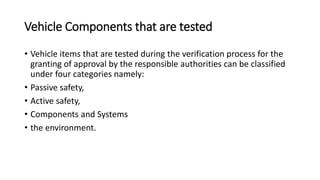
Vehicle Components that are tested
• Vehicle items that are tested during the verification process for the
granting of approval by the responsible authorities can be classified
under four categories namely:
• Passive safety,
• Active safety,
• Components and Systems
• the environment.
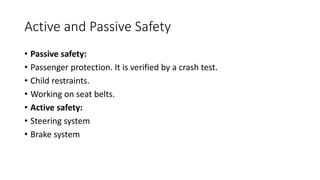
Active and Passive Safety
• Passive safety:
• Passenger protection. It is verified by a crash test.
• Child restraints.
• Working on seat belts.
• Active safety:
• Steering system
• Brake system
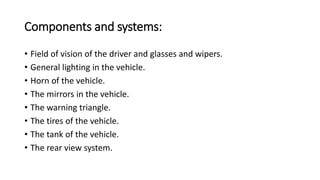
Components and systems:
• Field of vision of the driver and glasses and wipers.
• General lighting in the vehicle.
• Horn of the vehicle.
• The mirrors in the vehicle.
• The warning triangle.
• The tires of the vehicle.
• The tank of the vehicle.
• The rear view system.
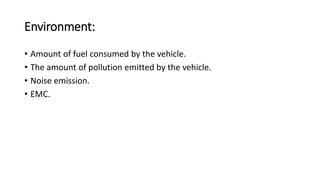
Environment:
• Amount of fuel consumed by the vehicle.
• The amount of pollution emitted by the vehicle.
• Noise emission.
• EMC.
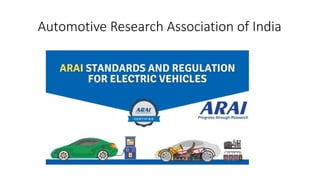
Automotive Research Association of India
What is ARAI and Its Importance for EVs in India?
• Automotive Research Association of India, also known as ARAI was
established in 1966. It is the leading automotive Research and
Development organization of India set up by the Automotive Industry with
the Government of India.
ARAI is an autonomous body affiliated with the Ministry of Heavy
Industries, Government of India. It has been playing a crucial role in
assuring safe, less polluting, more efficient, and reliable vehicles and has
been recognized as a Scientific and Industrial Research Organisation by
many government departments.
Read more here: https://e-vehicleinfo.com/electric-vehicles-in-india-arai-
standards-and-regulation/
ARAI helps Perform the following functions for Electric Vehicles:
/
• Battery Performance and Safety Testing
• Electric Motor Characterization
• Vehicle Performance and Homologation as per CMVR on Chassis Dynamometer
and Test Tracks
• Charger Testing and Certification
• Electric Vehicle Development
• Rechargeable Energy Storage System (REESS) Evaluation using CAE
• Four Poster durability of Electric Vehicle in Climatic Chamber for structural
adequacy, etc.
ARAI Standards for Electric Vehicles & its Chargers
• AIS-038 – Electric Power Train Vehicles-Construction and Functional
Safety Requirements. It includes requirements of a vehicle with
regards to specific requirements for the electric power train and
requirements of a vehicle Rechargeable Electrical Energy Storage
System concerning its safety.
• AIS-039 – Electric Power Train Vehicles–Measurement of Electrical
Energy Consumption. It helps in measuring the consumption of
electric energy by electric vehicles.
Cont..
• AIS-040 – Electric Power Train Vehicles – Method of Measuring the Range. It is a
range test for the electric vehicles
• AIS-041 – Electric Power Train Vehicles – Measurement of Net Power and The
Maximum 30 Minute Power. It helps in the measurement of the net power of the
electric vehicle and explains the working and benefits of the maximum 30-minute
power.
• AIS-049 – Electric Power Train Vehicles – CMVR Type Approval for Electric Power
Train Vehicles. It is a test of grade-ability for electric vehicles.
Why are Standards/Regulations Required for EVs?
• EVs are gaining popularity in the marketplace. Hence, OEMs are obliged to ensure
the safety of the public. With the increase in the use of Electric scooters and
electric cars, it will need ease of use for consumers.
• Robust testing and certification can help to meet both the above-mentioned
objectives. Some of the other reasons for standardization are:
• Social demand, Minimum safety requirements, Performance requirement, Quality
during the product life cycle, Technological advancement, Access to global
markets
•
Category and Type of Approval Required For EVs in India?
• No CMVR certification is required for vehicles falling specification with
250W (30 minutes power of motor) of a maximum speed of 25 kmph.
However, such vehicles need to comply with the following things:
• White reflectors on the front side
• Red reflectors on the rear side
• Brakes
• A vehicle without a battery must weigh below 60kg.
Government Regulation Framework for Electric Vehicles
/
• Some of the global regulations are rolled out by SAE, AIS by CMVR, and UN ECE
Regulations R100 R101 R85 for electric vehicles.
AIS Standards are for electric vehicles in India, Some of the regulations are
• AIS038, 039, 040, 041, 048, and 049.
• AIS038: Requirement for construction and functional safety
• AIS039: Measurement of electrical energy consumption (Wh/km).
• AIS040: Method of measuring the range.
• AIS041: Measurement of net power and maximum 30 min power.
• AIS049: CMVR type approval for EV.

Testing.pptx

  • 1.
    What is VehicleHomologation • The process of any official authority granting an approval for something after it passes the strict rules set by the organisation is known as homologation. The official authority might be the court of law, a department in the government, an academic organisation etc. • Before a vehicle is sold or marketed, its components have to be approved by multiple official authorities. The procedure for the approval of a vehicle's components varies from country to country. Different countries have different standards for verification. The verification of the components before they are sold together in a vehicle is essential. These necessary checks improve safety while travelling in the vehicle, protect the environment better and improve the quality of components and the production process.
  • 2.
    Vehicle Homologation inIndia • Vehicle homologation is mandatory before the vehicle is sold or marketed. The procedure of for homologation of a vehicle is as follows: • All the components of the vehicle such as lamps, mirrors, tires, engine etc. are to be tested and verified. • After the components of the vehicle are verified, the fitting of components in the vehicle is to be tested. This includes the fitting of components like the car audio system, electronic sub-assemblies etc.
  • 3.
    Cont.. • After thefitting of components in the vehicle is tested and approval is granted for it, the systems in the vehicle are next. Vehicle systems such as braking, exhaust emission engine cooling system, fuel supply system, suspension and steering systems are to be tested for proper working. If they pass the criteria of the tests conducted, an approval is granted. • The final test to be conducted before approval is granted to the vehicle for being sold and marketed is the Whole Vehicle Type Approval (WVTA) test. It is also known as the 'Vehicle Certification Test'.
  • 4.
    Cont… • Every componentof the vehicle that is put to test is verified by the responsible authority. The authority responsible for granting approval to the specific component after the verification process is to be chosen by the manufacturer. The manufacturer will issue a system approval as per each applicable Central Motor Vehicle Rule (CMVR), 1989. The approval by the responsible authority is granted depending on whether or not the specific component clears the test developed by the officially recognised organisation. All the approvals have to be collected and then is to be determined whether the approval to the vehicle is to be granted or not. • The approval granted by the authorities responsible will be valid in all the countries that will be mentioned in the approval report
  • 5.
    Vehicle Components thatare tested • Vehicle items that are tested during the verification process for the granting of approval by the responsible authorities can be classified under four categories namely: • Passive safety, • Active safety, • Components and Systems • the environment.
  • 6.
    Active and PassiveSafety • Passive safety: • Passenger protection. It is verified by a crash test. • Child restraints. • Working on seat belts. • Active safety: • Steering system • Brake system
  • 7.
    Components and systems: •Field of vision of the driver and glasses and wipers. • General lighting in the vehicle. • Horn of the vehicle. • The mirrors in the vehicle. • The warning triangle. • The tires of the vehicle. • The tank of the vehicle. • The rear view system.
  • 8.
    Environment: • Amount offuel consumed by the vehicle. • The amount of pollution emitted by the vehicle. • Noise emission. • EMC.
  • 9.
  • 10.
    What is ARAIand Its Importance for EVs in India? • Automotive Research Association of India, also known as ARAI was established in 1966. It is the leading automotive Research and Development organization of India set up by the Automotive Industry with the Government of India. ARAI is an autonomous body affiliated with the Ministry of Heavy Industries, Government of India. It has been playing a crucial role in assuring safe, less polluting, more efficient, and reliable vehicles and has been recognized as a Scientific and Industrial Research Organisation by many government departments. Read more here: https://e-vehicleinfo.com/electric-vehicles-in-india-arai- standards-and-regulation/
  • 11.
    ARAI helps Performthe following functions for Electric Vehicles: / • Battery Performance and Safety Testing • Electric Motor Characterization • Vehicle Performance and Homologation as per CMVR on Chassis Dynamometer and Test Tracks • Charger Testing and Certification • Electric Vehicle Development • Rechargeable Energy Storage System (REESS) Evaluation using CAE • Four Poster durability of Electric Vehicle in Climatic Chamber for structural adequacy, etc.
  • 12.
    ARAI Standards forElectric Vehicles & its Chargers • AIS-038 – Electric Power Train Vehicles-Construction and Functional Safety Requirements. It includes requirements of a vehicle with regards to specific requirements for the electric power train and requirements of a vehicle Rechargeable Electrical Energy Storage System concerning its safety. • AIS-039 – Electric Power Train Vehicles–Measurement of Electrical Energy Consumption. It helps in measuring the consumption of electric energy by electric vehicles.
  • 13.
    Cont.. • AIS-040 –Electric Power Train Vehicles – Method of Measuring the Range. It is a range test for the electric vehicles • AIS-041 – Electric Power Train Vehicles – Measurement of Net Power and The Maximum 30 Minute Power. It helps in the measurement of the net power of the electric vehicle and explains the working and benefits of the maximum 30-minute power. • AIS-049 – Electric Power Train Vehicles – CMVR Type Approval for Electric Power Train Vehicles. It is a test of grade-ability for electric vehicles.
  • 14.
    Why are Standards/RegulationsRequired for EVs? • EVs are gaining popularity in the marketplace. Hence, OEMs are obliged to ensure the safety of the public. With the increase in the use of Electric scooters and electric cars, it will need ease of use for consumers. • Robust testing and certification can help to meet both the above-mentioned objectives. Some of the other reasons for standardization are: • Social demand, Minimum safety requirements, Performance requirement, Quality during the product life cycle, Technological advancement, Access to global markets •
  • 15.
    Category and Typeof Approval Required For EVs in India? • No CMVR certification is required for vehicles falling specification with 250W (30 minutes power of motor) of a maximum speed of 25 kmph. However, such vehicles need to comply with the following things: • White reflectors on the front side • Red reflectors on the rear side • Brakes • A vehicle without a battery must weigh below 60kg.
  • 16.
    Government Regulation Frameworkfor Electric Vehicles / • Some of the global regulations are rolled out by SAE, AIS by CMVR, and UN ECE Regulations R100 R101 R85 for electric vehicles. AIS Standards are for electric vehicles in India, Some of the regulations are • AIS038, 039, 040, 041, 048, and 049. • AIS038: Requirement for construction and functional safety • AIS039: Measurement of electrical energy consumption (Wh/km). • AIS040: Method of measuring the range. • AIS041: Measurement of net power and maximum 30 min power. • AIS049: CMVR type approval for EV.