TESTING SQL
Higher Computing Science
TESTING SQL
• SQL queries should be tested by:
1. producing a table of expected results
2. running the queries and checking that the actual results match the expected
results
EXAMPLE 1
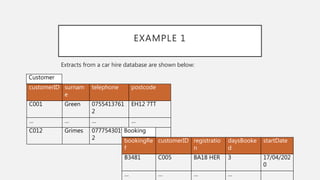
Extracts from a car hire database are shown below:
customerID surnam
e
telephone postcode
C001 Green 0755413761
2
EH12 7TT
… … … …
C012 Grimes 0777543019
2
FK7 4RB
bookingRe
f
customerID registratio
n
daysBooke
d
startDate
B3481 C005 BA18 HER 3 17/04/202
0
… … … …
Customer
Booking
EXAMPLE 1
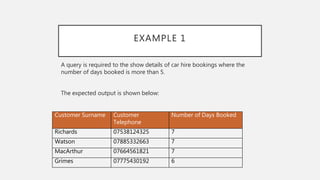
A query is required to the show details of car hire bookings where the
number of days booked is more than 5.
The expected output is shown below:
Customer Surname Customer
Telephone
Number of Days Booked
Richards 07538124325 7
Watson 07885332663 7
MacArthur 07664561821 7
Grimes 07775430192 6
EXAMPLE 1
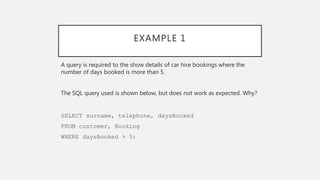
A query is required to the show details of car hire bookings where the
number of days booked is more than 5.
The SQL query used is shown below, but does not work as expected. Why?
SELECT surname, telephone, daysBooked
FROM customer, Booking
WHERE daysBooked > 5;
EXAMPLE 1
A query is required to the show details of car hire bookings where the
number of days booked is more than 5.
The SQL query used is shown below, but does not work as expected. Why?
1. An alias should have been used to display the readable column
headings
2. There should be a JOIN:
AND customer.customerID = booking.customerID
EXAMPLE 1
A query is required to the show details of car hire bookings where the
number of days booked is more than 5.
Correct SQL
SELECT surname AS [Customer Surname], telephone AS
[Customer Telephone], daysBooked AS [Number of Days
Booked]
FROM customer, Booking
WHERE daysBooked > 5
AND customer.customerID = booking.customerID;
EXAMPLE 2
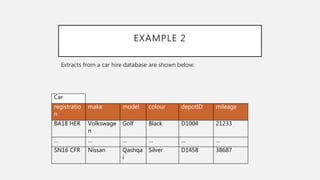
Extracts from a car hire database are shown below:
registratio
n
make model colour depotID mileage
BA18 HER Volkswage
n
Golf Black D1004 21233
… … … … … …
SN16 CFR Nissan Qashqa
i
Silver D1458 38687
Car
EXAMPLE 2
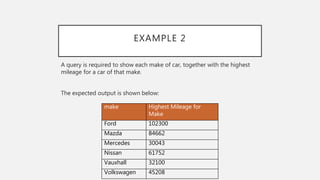
A query is required to show each make of car, together with the highest
mileage for a car of that make.
The expected output is shown below:
make Highest Mileage for
Make
Ford 102300
Mazda 84662
Mercedes 30043
Nissan 61752
Vauxhall 32100
Volkswagen 45208
EXAMPLE 2
A query is required to show each make of car, together with the highest
mileage for a car of that make.
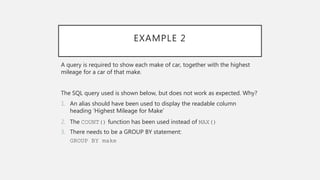
The SQL query used is shown below, but does not work as expected. Why?
SELECT make, COUNT(mileage)
FROM car
ORDER by make ASC;
EXAMPLE 2
A query is required to show each make of car, together with the highest
mileage for a car of that make.
The SQL query used is shown below, but does not work as expected. Why?
1. An alias should have been used to display the readable column
heading ‘Highest Mileage for Make’
2. The COUNT() function has been used instead of MAX()
3. There needs to be a GROUP BY statement:
GROUP BY make
EXAMPLE 2
A query is required to show each make of car, together with the highest
mileage for a car of that make.
Correct SQL
SELECT make, MAX(mileage) AS [Highest Mileage for Make]
FROM car
GROUP BY make
ORDER by make ASC;

Testing SQL

  • 1.
  • 2.
    TESTING SQL • SQLqueries should be tested by: 1. producing a table of expected results 2. running the queries and checking that the actual results match the expected results
  • 3.
    EXAMPLE 1 Extracts froma car hire database are shown below: customerID surnam e telephone postcode C001 Green 0755413761 2 EH12 7TT … … … … C012 Grimes 0777543019 2 FK7 4RB bookingRe f customerID registratio n daysBooke d startDate B3481 C005 BA18 HER 3 17/04/202 0 … … … … Customer Booking
  • 4.
    EXAMPLE 1 A queryis required to the show details of car hire bookings where the number of days booked is more than 5. The expected output is shown below: Customer Surname Customer Telephone Number of Days Booked Richards 07538124325 7 Watson 07885332663 7 MacArthur 07664561821 7 Grimes 07775430192 6
  • 5.
    EXAMPLE 1 A queryis required to the show details of car hire bookings where the number of days booked is more than 5. The SQL query used is shown below, but does not work as expected. Why? SELECT surname, telephone, daysBooked FROM customer, Booking WHERE daysBooked > 5;
  • 6.
    EXAMPLE 1 A queryis required to the show details of car hire bookings where the number of days booked is more than 5. The SQL query used is shown below, but does not work as expected. Why? 1. An alias should have been used to display the readable column headings 2. There should be a JOIN: AND customer.customerID = booking.customerID
  • 7.
    EXAMPLE 1 A queryis required to the show details of car hire bookings where the number of days booked is more than 5. Correct SQL SELECT surname AS [Customer Surname], telephone AS [Customer Telephone], daysBooked AS [Number of Days Booked] FROM customer, Booking WHERE daysBooked > 5 AND customer.customerID = booking.customerID;
  • 8.
    EXAMPLE 2 Extracts froma car hire database are shown below: registratio n make model colour depotID mileage BA18 HER Volkswage n Golf Black D1004 21233 … … … … … … SN16 CFR Nissan Qashqa i Silver D1458 38687 Car
  • 9.
    EXAMPLE 2 A queryis required to show each make of car, together with the highest mileage for a car of that make. The expected output is shown below: make Highest Mileage for Make Ford 102300 Mazda 84662 Mercedes 30043 Nissan 61752 Vauxhall 32100 Volkswagen 45208
  • 10.
    EXAMPLE 2 A queryis required to show each make of car, together with the highest mileage for a car of that make. The SQL query used is shown below, but does not work as expected. Why? SELECT make, COUNT(mileage) FROM car ORDER by make ASC;
  • 11.
    EXAMPLE 2 A queryis required to show each make of car, together with the highest mileage for a car of that make. The SQL query used is shown below, but does not work as expected. Why? 1. An alias should have been used to display the readable column heading ‘Highest Mileage for Make’ 2. The COUNT() function has been used instead of MAX() 3. There needs to be a GROUP BY statement: GROUP BY make
  • 12.
    EXAMPLE 2 A queryis required to show each make of car, together with the highest mileage for a car of that make. Correct SQL SELECT make, MAX(mileage) AS [Highest Mileage for Make] FROM car GROUP BY make ORDER by make ASC;