Elementary Statistics
Chapter 8: Hypothesis
Testing
8.3 Testing a Claim about
a Mean
1
8.1 Basics of Hypothesis Testing
8.2 Testing a Claim about a Proportion
8.3 Testing a Claim About a Mean
8.4 Testing a Claim About a Standard Deviation or Variance
2
Objectives:
• Understand the definitions used in hypothesis testing.
• State the null and alternative hypotheses.
• State the steps used in hypothesis testing.
• Test proportions, using the z test.
• Test means when  is known, using the z test.
• Test means when  is unknown, using the t test.
• Test variances or standard deviations, using the chi-square test.
• Test hypotheses, using confidence intervals.
Chapter 8: Hypothesis Testing
Key Concept: Testing a claim about a
population mean
Objective: Use a formal hypothesis test to
test a claim about a population mean µ.
1. The population standard deviation σ is
not known.
2. The population standard deviation σ is
known.
8.3 Testing a Claim About a Mean
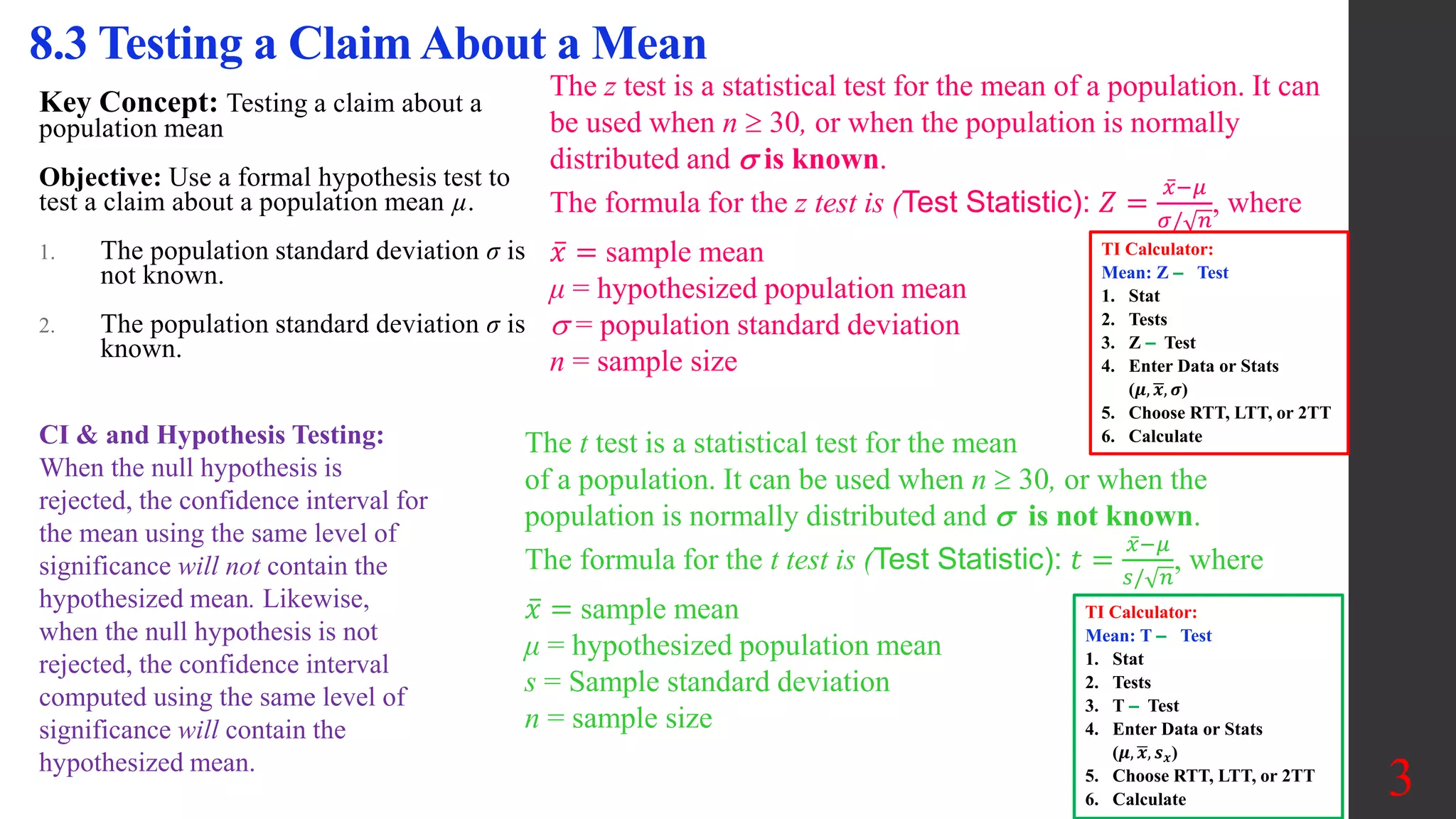
The z test is a statistical test for the mean of a population. It can
be used when n  30, or when the population is normally
distributed and  is known.
The formula for the z test is (Test Statistic): 𝑍 =
𝑥−𝜇
𝜎/ 𝑛
, where
𝑥 = sample mean
μ = hypothesized population mean
 = population standard deviation
n = sample size
The t test is a statistical test for the mean
of a population. It can be used when n  30, or when the
population is normally distributed and  is not known.
The formula for the t test is (Test Statistic): 𝑡 =
𝑥−𝜇
𝑠/ 𝑛
, where
𝑥 = sample mean
μ = hypothesized population mean
s = Sample standard deviation
n = sample size
3
TI Calculator:
Mean: Z ‒ Test
1. Stat
2. Tests
3. Z ‒ Test
4. Enter Data or Stats
(𝝁, 𝒙, 𝝈)
5. Choose RTT, LTT, or 2TT
6. Calculate
TI Calculator:
Mean: T ‒ Test
1. Stat
2. Tests
3. T ‒ Test
4. Enter Data or Stats
(𝝁, 𝒙, 𝒔𝒙)
5. Choose RTT, LTT, or 2TT
6. Calculate
CI & and Hypothesis Testing:
When the null hypothesis is
rejected, the confidence interval for
the mean using the same level of
significance will not contain the
hypothesized mean. Likewise,
when the null hypothesis is not
rejected, the confidence interval
computed using the same level of
significance will contain the
hypothesized mean.
4
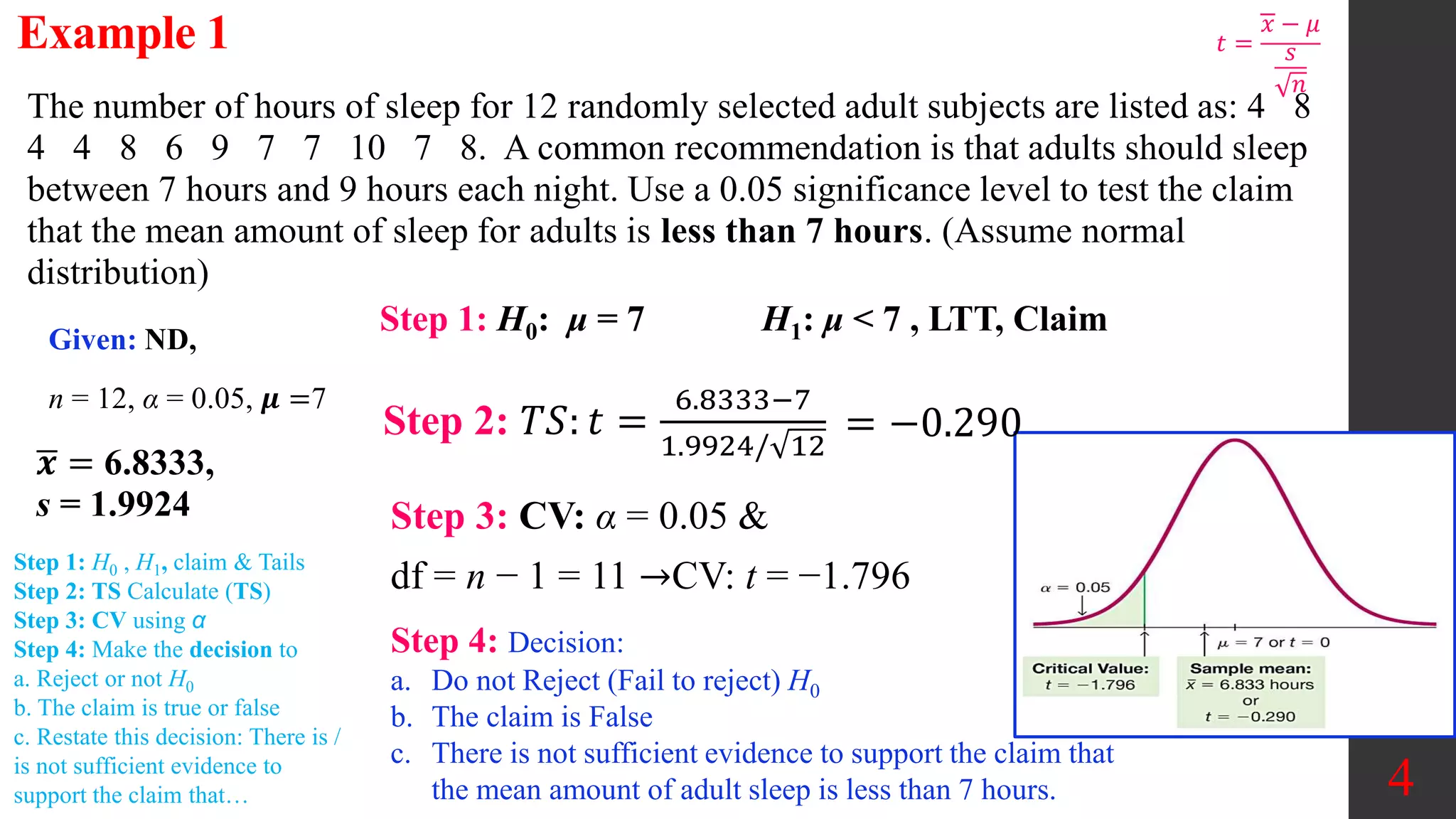
The number of hours of sleep for 12 randomly selected adult subjects are listed as: 4 8
4 4 8 6 9 7 7 10 7 8. A common recommendation is that adults should sleep
between 7 hours and 9 hours each night. Use a 0.05 significance level to test the claim
that the mean amount of sleep for adults is less than 7 hours. (Assume normal
distribution)
Example 1
Step 3: CV: α = 0.05 &
df = n − 1 = 11 →CV: t = −1.796
Step 1: H0: μ = 7 H1: μ < 7 , LTT, Claim
Given: ND,
n = 12, α = 0.05, 𝝁 =7
Step 2: 𝑇𝑆: 𝑡 =
6.8333−7
1.9924/ 12
= −0.290
Step 4: Decision:
a. Do not Reject (Fail to reject) H0
b. The claim is False
c. There is not sufficient evidence to support the claim that
the mean amount of adult sleep is less than 7 hours.
𝑡 =
𝑥 − 𝜇
𝑠
𝑛
𝒙 = 6.8333,
s = 1.9924
Step 1: H0 , H1, claim & Tails
Step 2: TS Calculate (TS)
Step 3: CV using α
Step 4: Make the decision to
a. Reject or not H0
b. The claim is true or false
c. Restate this decision: There is /
is not sufficient evidence to
support the claim that…
The P-Values Method
5
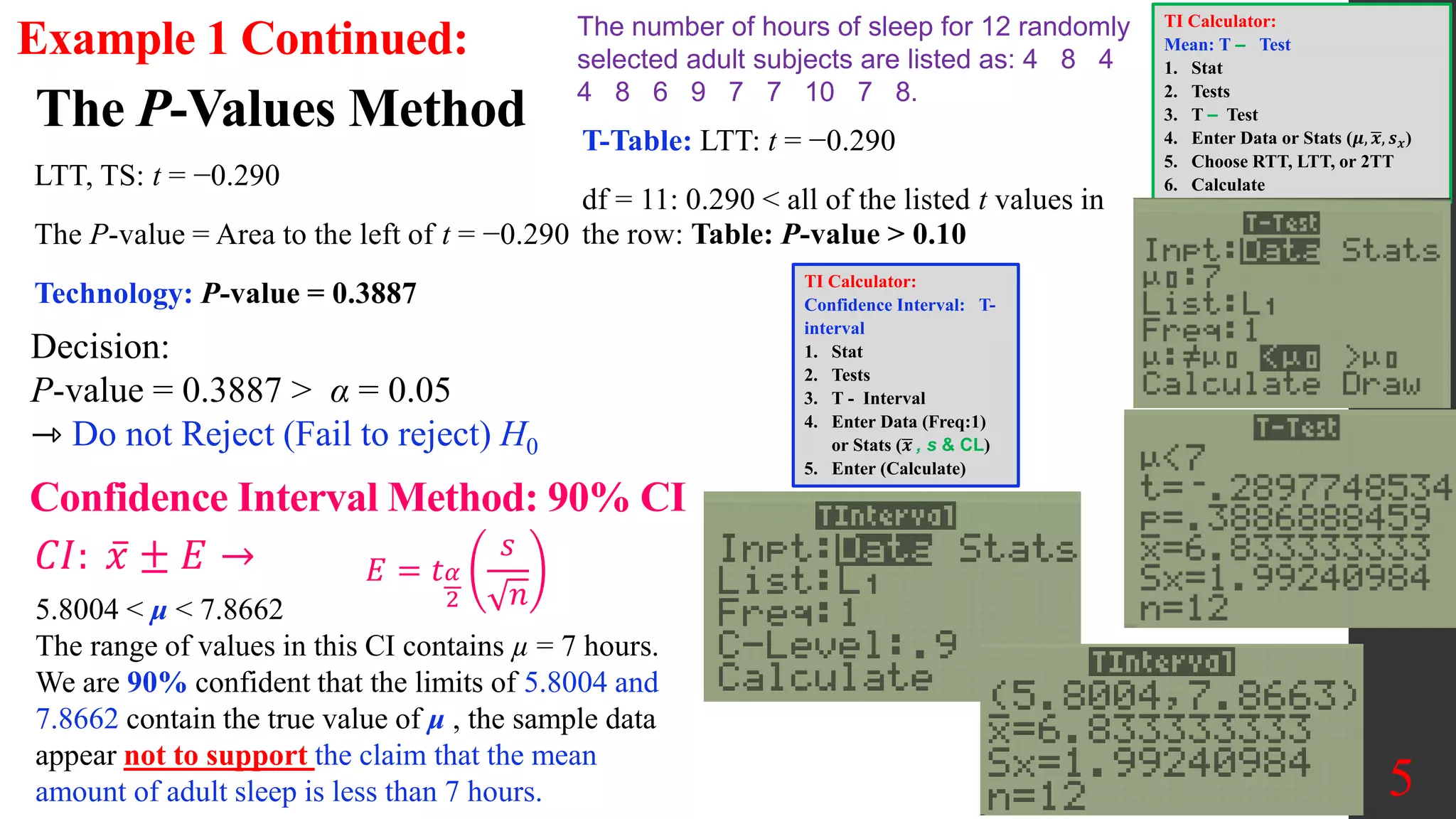
LTT, TS: t = −0.290
The P-value = Area to the left of t = −0.290
Technology: P-value = 0.3887
Decision:
P-value = 0.3887 > α = 0.05
⇾ Do not Reject (Fail to reject) H0
5.8004 < μ < 7.8662
The range of values in this CI contains µ = 7 hours.
We are 90% confident that the limits of 5.8004 and
7.8662 contain the true value of μ , the sample data
appear not to support the claim that the mean
amount of adult sleep is less than 7 hours.
Confidence Interval Method: 90% CI
T-Table: LTT: t = −0.290
df = 11: 0.290 < all of the listed t values in
the row: Table: P-value > 0.10
𝐶𝐼: 𝑥 ± 𝐸 → 𝐸 = 𝑡𝛼
2
𝑠
𝑛
TI Calculator:
Mean: T ‒ Test
1. Stat
2. Tests
3. T ‒ Test
4. Enter Data or Stats (𝝁, 𝒙, 𝒔𝒙)
5. Choose RTT, LTT, or 2TT
6. Calculate
TI Calculator:
Confidence Interval: T-
interval
1. Stat
2. Tests
3. T - Interval
4. Enter Data (Freq:1)
or Stats (𝒙 , s & CL)
5. Enter (Calculate)
Example 1 Continued: The number of hours of sleep for 12 randomly
selected adult subjects are listed as: 4 8 4
4 8 6 9 7 7 10 7 8.
6
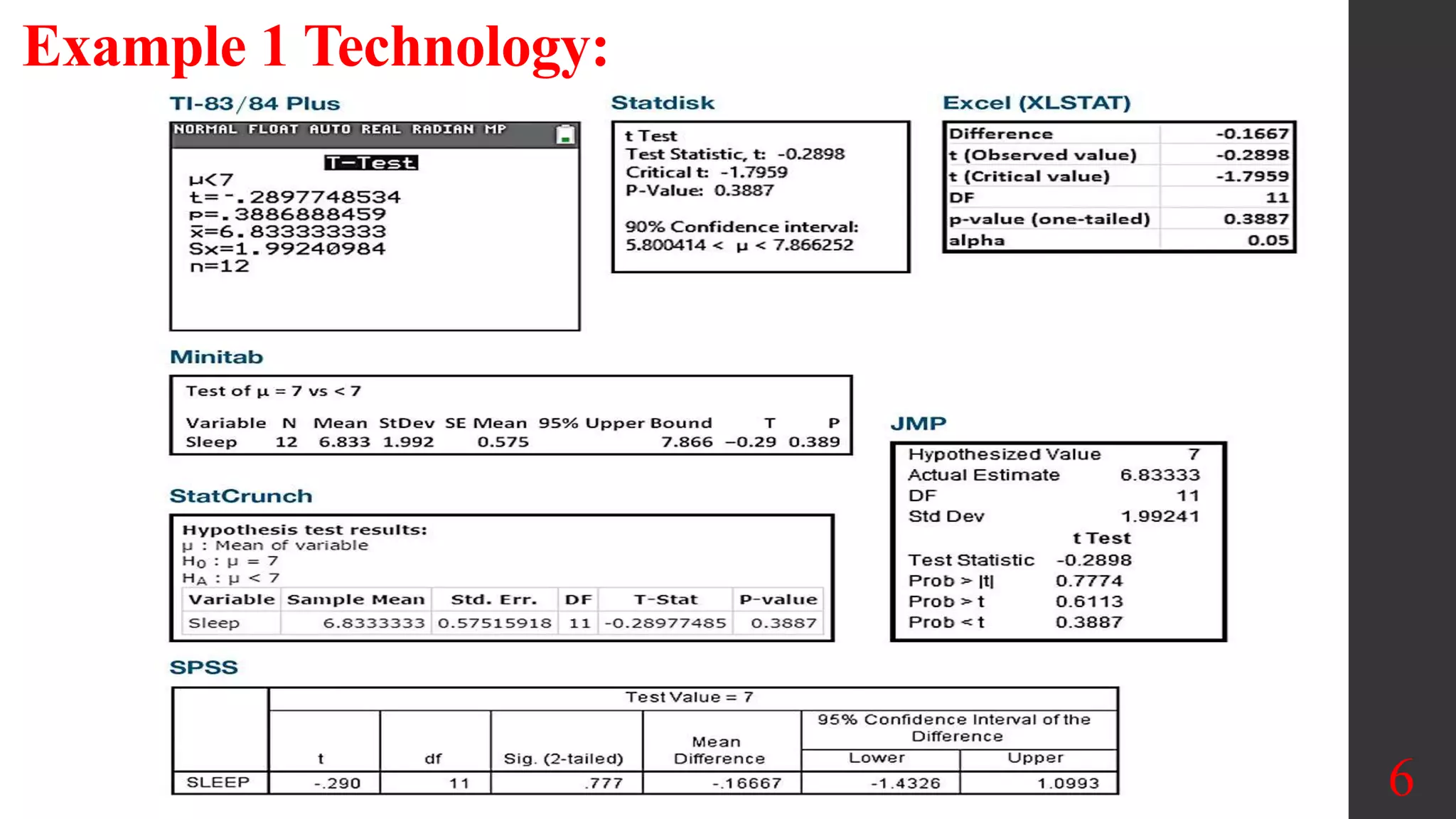
Example 1 Technology:
7
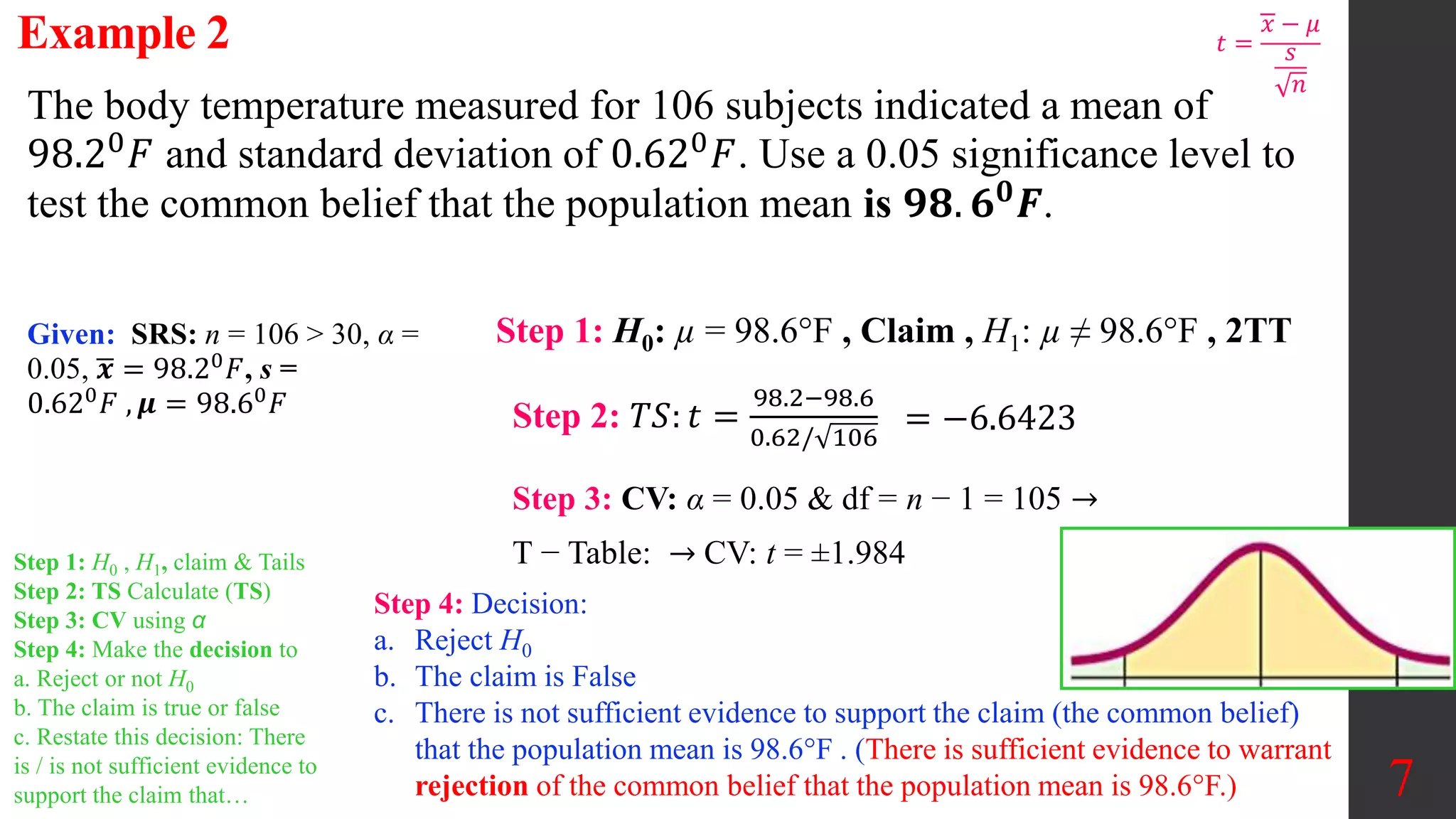
The body temperature measured for 106 subjects indicated a mean of
98.20𝐹 and standard deviation of 0.620𝐹. Use a 0.05 significance level to
test the common belief that the population mean is 𝟗𝟖. 𝟔𝟎
𝑭.
Example 2
Step 3: CV: α = 0.05 & df = n − 1 = 105 →
T − Table: → CV: t = ±1.984
Step 1: H0: µ = 98.6°F , Claim , H1: µ ≠ 98.6°F , 2TT
Given: SRS: n = 106 > 30, α =
0.05, 𝒙 = 98.20𝐹, s =
0.620
𝐹 , 𝝁 = 98.60
𝐹 Step 2: 𝑇𝑆: 𝑡 =
98.2−98.6
0.62/ 106
= −6.6423
Step 4: Decision:
a. Reject H0
b. The claim is False
c. There is not sufficient evidence to support the claim (the common belief)
that the population mean is 98.6°F . (There is sufficient evidence to warrant
rejection of the common belief that the population mean is 98.6°F.)
Step 1: H0 , H1, claim & Tails
Step 2: TS Calculate (TS)
Step 3: CV using α
Step 4: Make the decision to
a. Reject or not H0
b. The claim is true or false
c. Restate this decision: There
is / is not sufficient evidence to
support the claim that…
𝑡 =
𝑥 − 𝜇
𝑠
𝑛
The P-Values Method
8
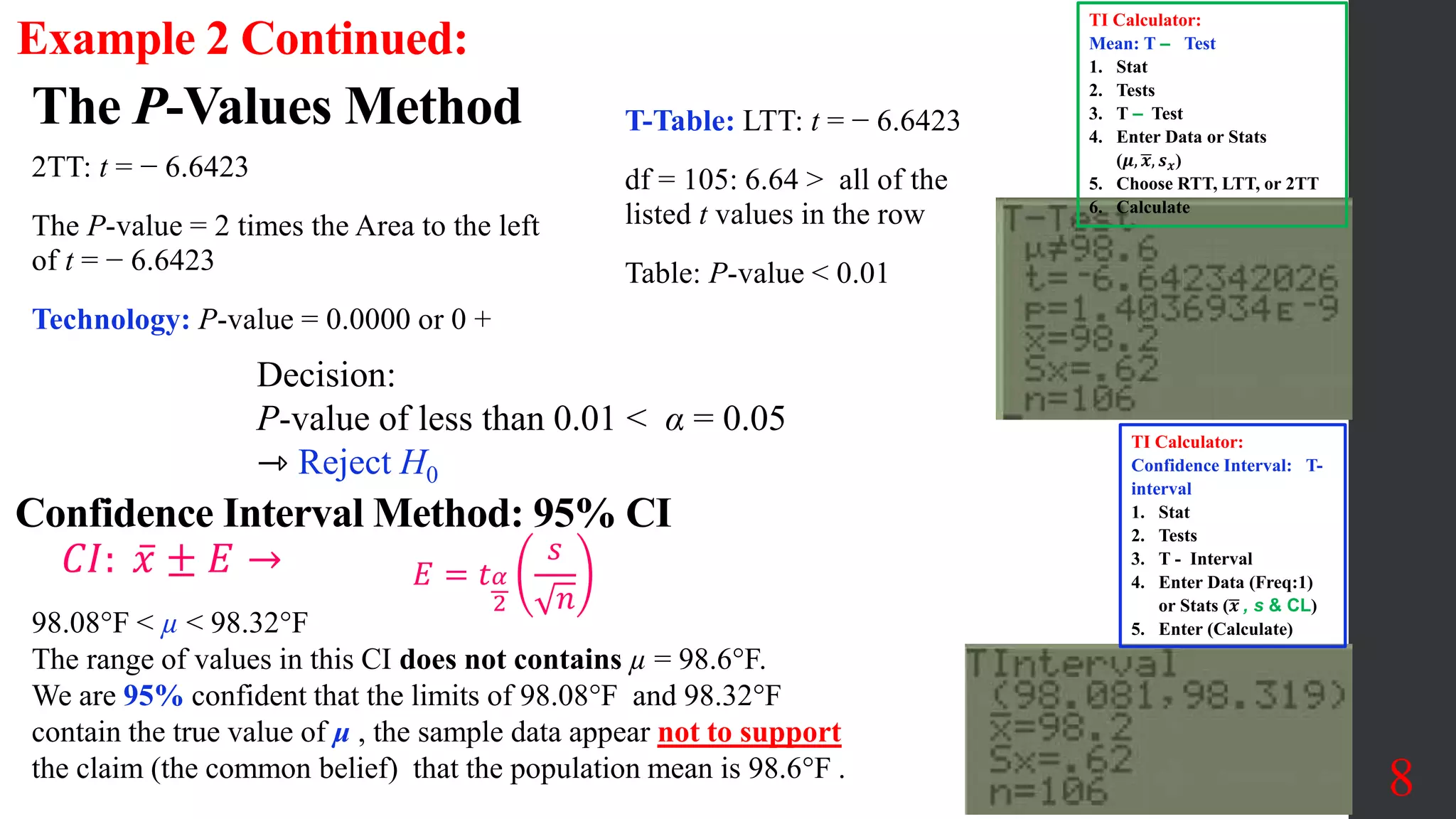
2TT: t = − 6.6423
The P-value = 2 times the Area to the left
of t = − 6.6423
Technology: P-value = 0.0000 or 0 +
Decision:
P-value of less than 0.01 < α = 0.05
⇾ Reject H0
98.08°F < µ < 98.32F
The range of values in this CI does not contains µ = 98.6F.
We are 95% confident that the limits of 98.08°F and 98.32F
contain the true value of μ , the sample data appear not to support
the claim (the common belief) that the population mean is 98.6°F .
Confidence Interval Method: 95% CI
T-Table: LTT: t = − 6.6423
df = 105: 6.64 > all of the
listed t values in the row
Table: P-value < 0.01
TI Calculator:
Mean: T ‒ Test
1. Stat
2. Tests
3. T ‒ Test
4. Enter Data or Stats
(𝝁, 𝒙, 𝒔𝒙)
5. Choose RTT, LTT, or 2TT
6. Calculate
TI Calculator:
Confidence Interval: T-
interval
1. Stat
2. Tests
3. T - Interval
4. Enter Data (Freq:1)
or Stats (𝒙 , s & CL)
5. Enter (Calculate)
𝐶𝐼: 𝑥 ± 𝐸 → 𝐸 = 𝑡𝛼
2
𝑠
𝑛
Example 2 Continued:
9
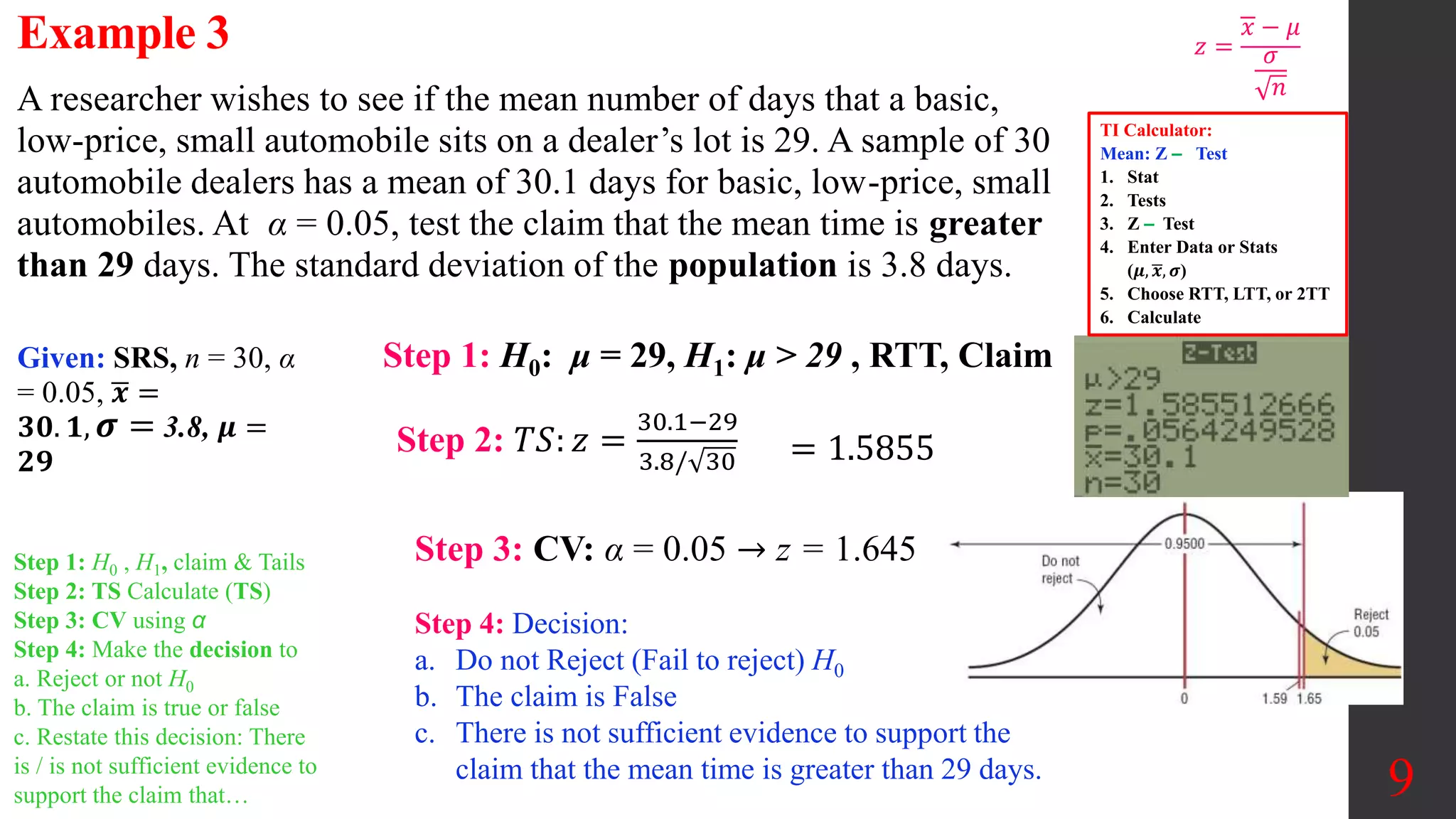
A researcher wishes to see if the mean number of days that a basic,
low-price, small automobile sits on a dealer’s lot is 29. A sample of 30
automobile dealers has a mean of 30.1 days for basic, low-price, small
automobiles. At α = 0.05, test the claim that the mean time is greater
than 29 days. The standard deviation of the population is 3.8 days.
Example 3
Step 3: CV: α = 0.05 → z = 1.645
Step 1: H0: μ = 29, H1: μ > 29 , RTT, Claim
Given: SRS, n = 30, α
= 0.05, 𝒙 =
𝟑𝟎. 𝟏, 𝝈 = 3.8, 𝝁 =
𝟐𝟗
Step 2: 𝑇𝑆: 𝑧 =
30.1−29
3.8/ 30 = 1.5855
Step 4: Decision:
a. Do not Reject (Fail to reject) H0
b. The claim is False
c. There is not sufficient evidence to support the
claim that the mean time is greater than 29 days.
𝑧 =
𝑥 − 𝜇
𝜎
𝑛
Step 1: H0 , H1, claim & Tails
Step 2: TS Calculate (TS)
Step 3: CV using α
Step 4: Make the decision to
a. Reject or not H0
b. The claim is true or false
c. Restate this decision: There
is / is not sufficient evidence to
support the claim that…
TI Calculator:
Mean: Z ‒ Test
1. Stat
2. Tests
3. Z ‒ Test
4. Enter Data or Stats
(𝝁, 𝒙, 𝝈)
5. Choose RTT, LTT, or 2TT
6. Calculate
10
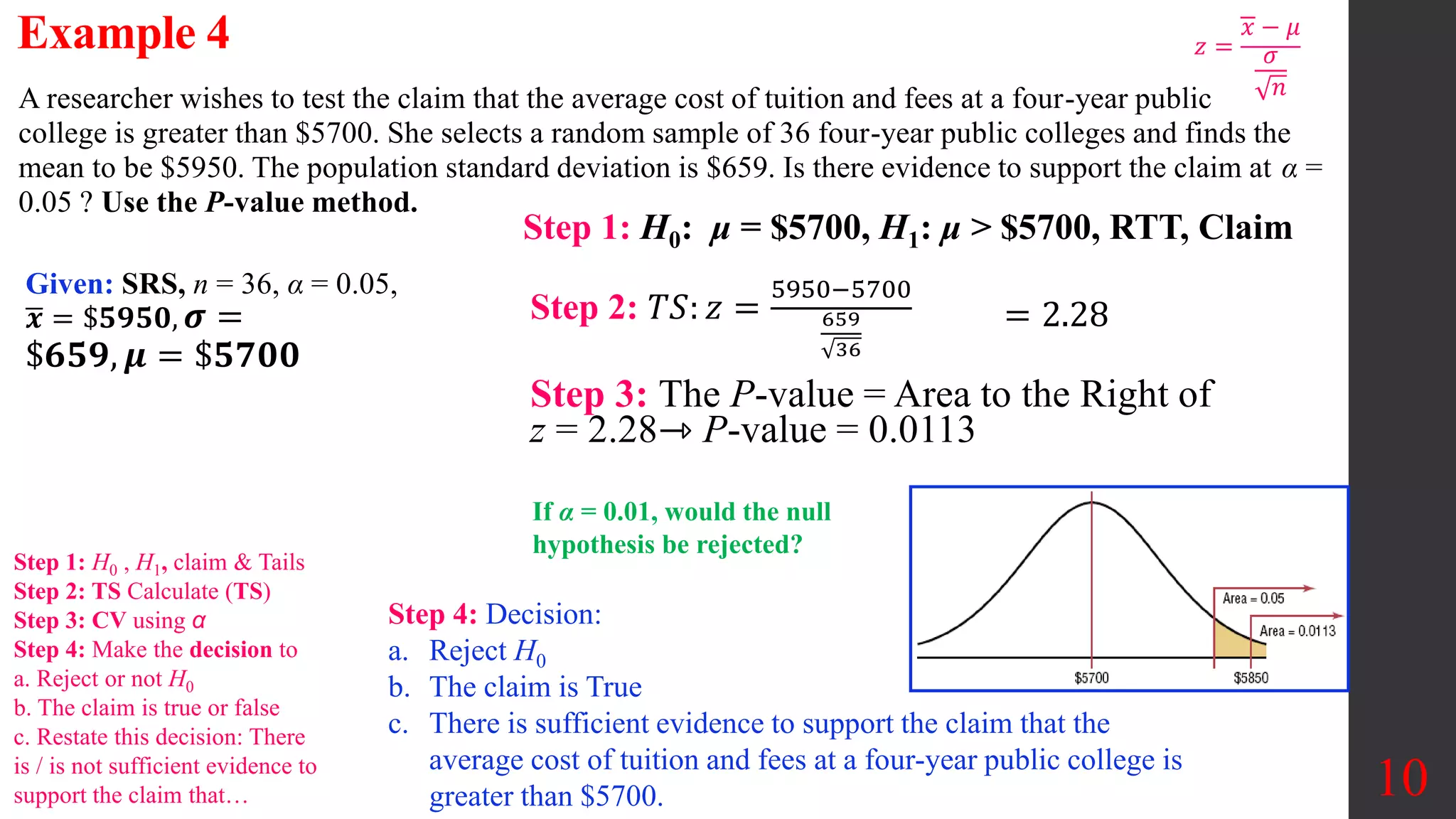
A researcher wishes to test the claim that the average cost of tuition and fees at a four-year public
college is greater than $5700. She selects a random sample of 36 four-year public colleges and finds the
mean to be $5950. The population standard deviation is $659. Is there evidence to support the claim at α =
0.05 ? Use the P-value method.
Example 4
Step 3: The P-value = Area to the Right of
z = 2.28⇾ P-value = 0.0113
Step 1: H0: μ = $5700, H1: μ > $5700, RTT, Claim
Given: SRS, n = 36, α = 0.05,
𝒙 = $𝟓𝟗𝟓𝟎, 𝝈 =
$𝟔𝟓𝟗, 𝝁 = $𝟓𝟕𝟎𝟎
Step 4: Decision:
a. Reject H0
b. The claim is True
c. There is sufficient evidence to support the claim that the
average cost of tuition and fees at a four-year public college is
greater than $5700.
Step 2: 𝑇𝑆: 𝑧 =
5950−5700
659
36
= 2.28
If α = 0.01, would the null
hypothesis be rejected?
Step 1: H0 , H1, claim & Tails
Step 2: TS Calculate (TS)
Step 3: CV using α
Step 4: Make the decision to
a. Reject or not H0
b. The claim is true or false
c. Restate this decision: There
is / is not sufficient evidence to
support the claim that…
𝑧 =
𝑥 − 𝜇
𝜎
𝑛
11
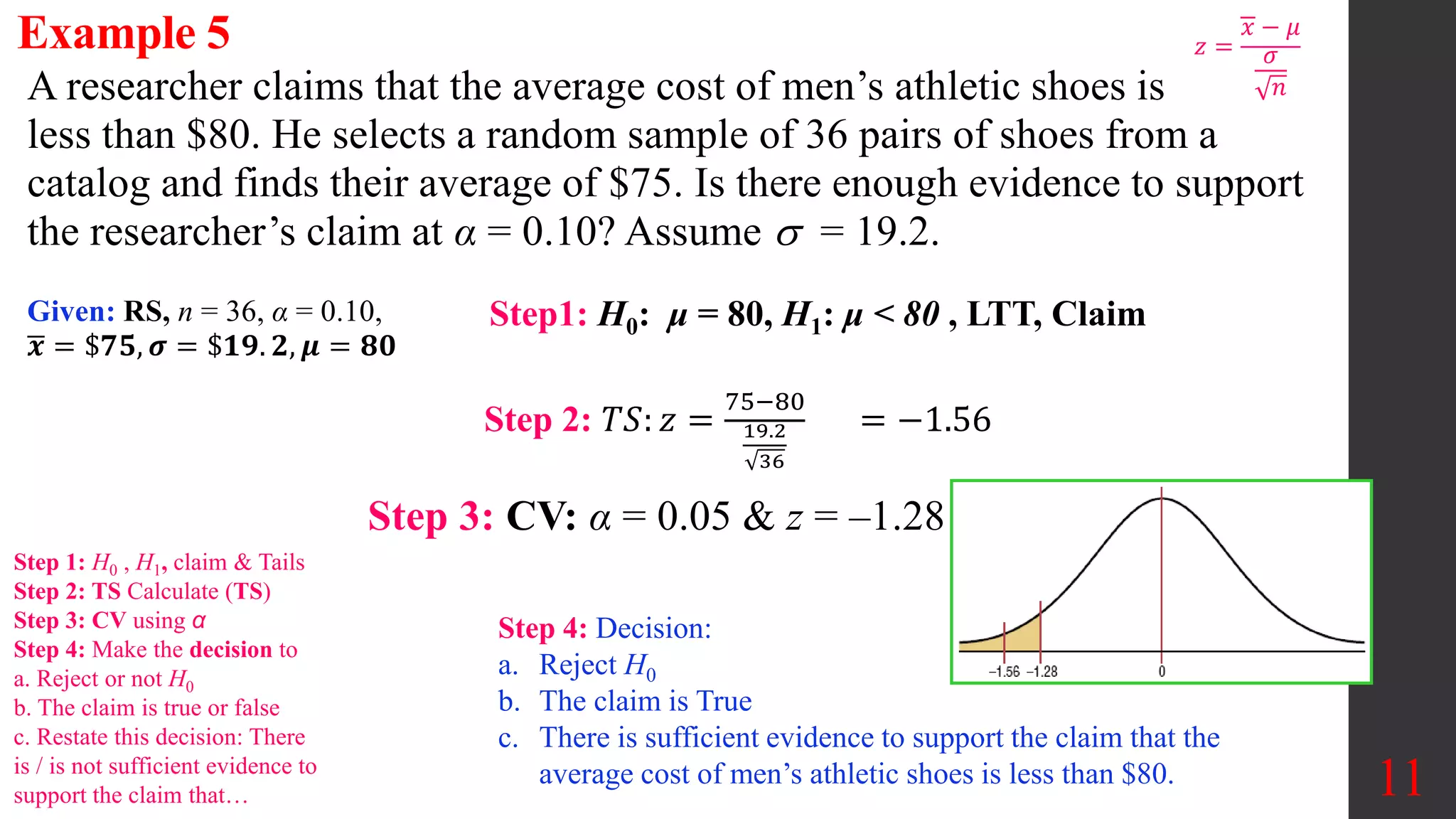
A researcher claims that the average cost of men’s athletic shoes is
less than $80. He selects a random sample of 36 pairs of shoes from a
catalog and finds their average of $75. Is there enough evidence to support
the researcher’s claim at α = 0.10? Assume  = 19.2.
Example 5
Step 3: CV: α = 0.05 & z = –1.28
Step1: H0: μ = 80, H1: μ < 80 , LTT, Claim
Given: RS, n = 36, α = 0.10,
𝒙 = $𝟕𝟓, 𝝈 = $𝟏𝟗. 𝟐, 𝝁 = 𝟖𝟎
Step 4: Decision:
a. Reject H0
b. The claim is True
c. There is sufficient evidence to support the claim that the
average cost of men’s athletic shoes is less than $80.
Step 2: 𝑇𝑆: 𝑧 =
75−80
19.2
36
= −1.56
Step 1: H0 , H1, claim & Tails
Step 2: TS Calculate (TS)
Step 3: CV using α
Step 4: Make the decision to
a. Reject or not H0
b. The claim is true or false
c. Restate this decision: There
is / is not sufficient evidence to
support the claim that…
𝑧 =
𝑥 − 𝜇
𝜎
𝑛
12
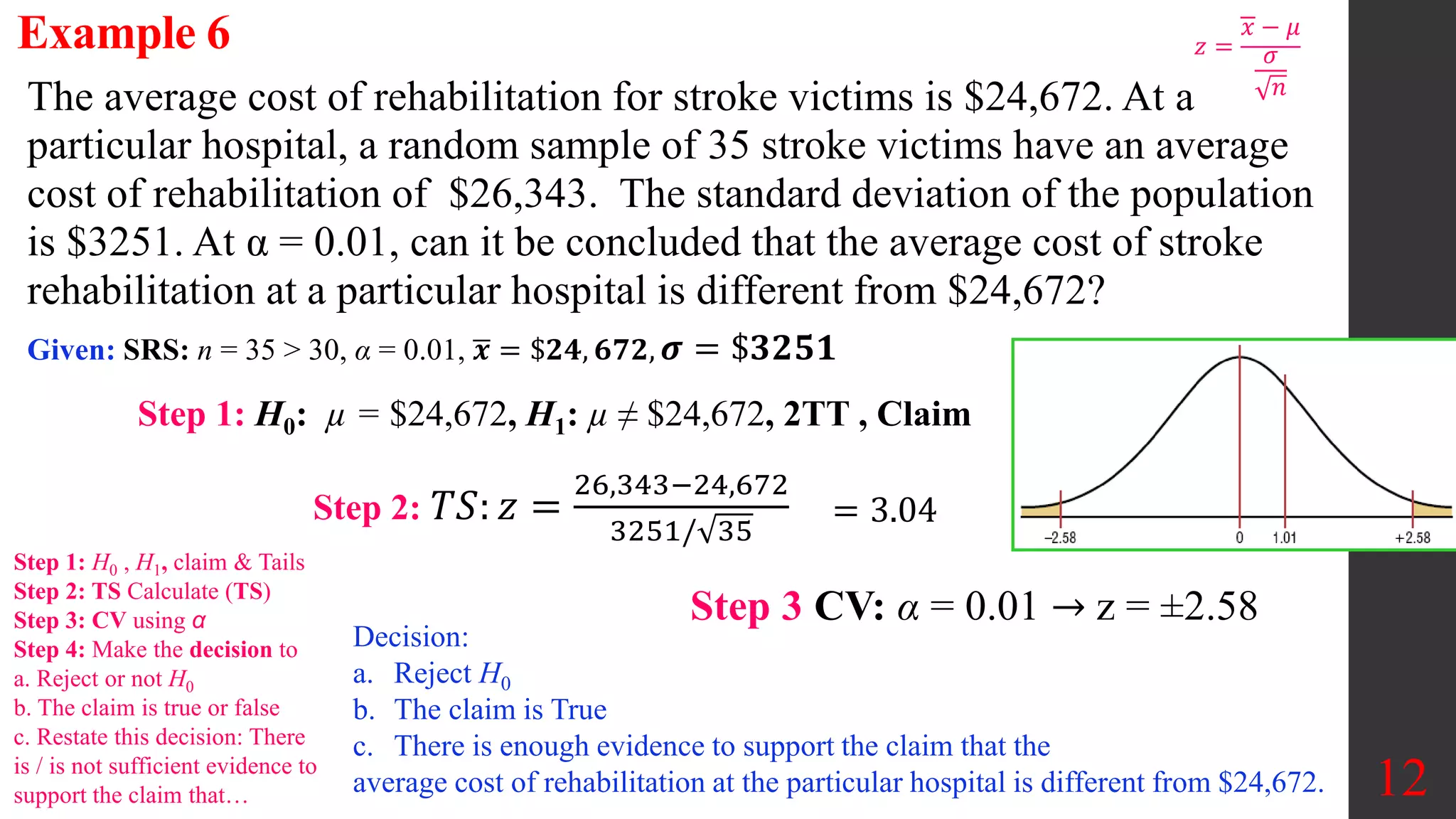
The average cost of rehabilitation for stroke victims is $24,672. At a
particular hospital, a random sample of 35 stroke victims have an average
cost of rehabilitation of $26,343. The standard deviation of the population
is $3251. At α = 0.01, can it be concluded that the average cost of stroke
rehabilitation at a particular hospital is different from $24,672?
Example 6
Step 3 CV: α = 0.01 → z = ±2.58
Step 1: H0: µ = $24,672, H1: µ ≠ $24,672, 2TT , Claim
Given: SRS: n = 35 > 30, α = 0.01, 𝒙 = $𝟐𝟒, 𝟔𝟕𝟐, 𝝈 = $𝟑𝟐𝟓𝟏
Decision:
a. Reject H0
b. The claim is True
c. There is enough evidence to support the claim that the
average cost of rehabilitation at the particular hospital is different from $24,672.
Step 2: 𝑇𝑆: 𝑧 =
26,343−24,672
3251/ 35
= 3.04
Step 1: H0 , H1, claim & Tails
Step 2: TS Calculate (TS)
Step 3: CV using α
Step 4: Make the decision to
a. Reject or not H0
b. The claim is true or false
c. Restate this decision: There
is / is not sufficient evidence to
support the claim that…
𝑧 =
𝑥 − 𝜇
𝜎
𝑛
13
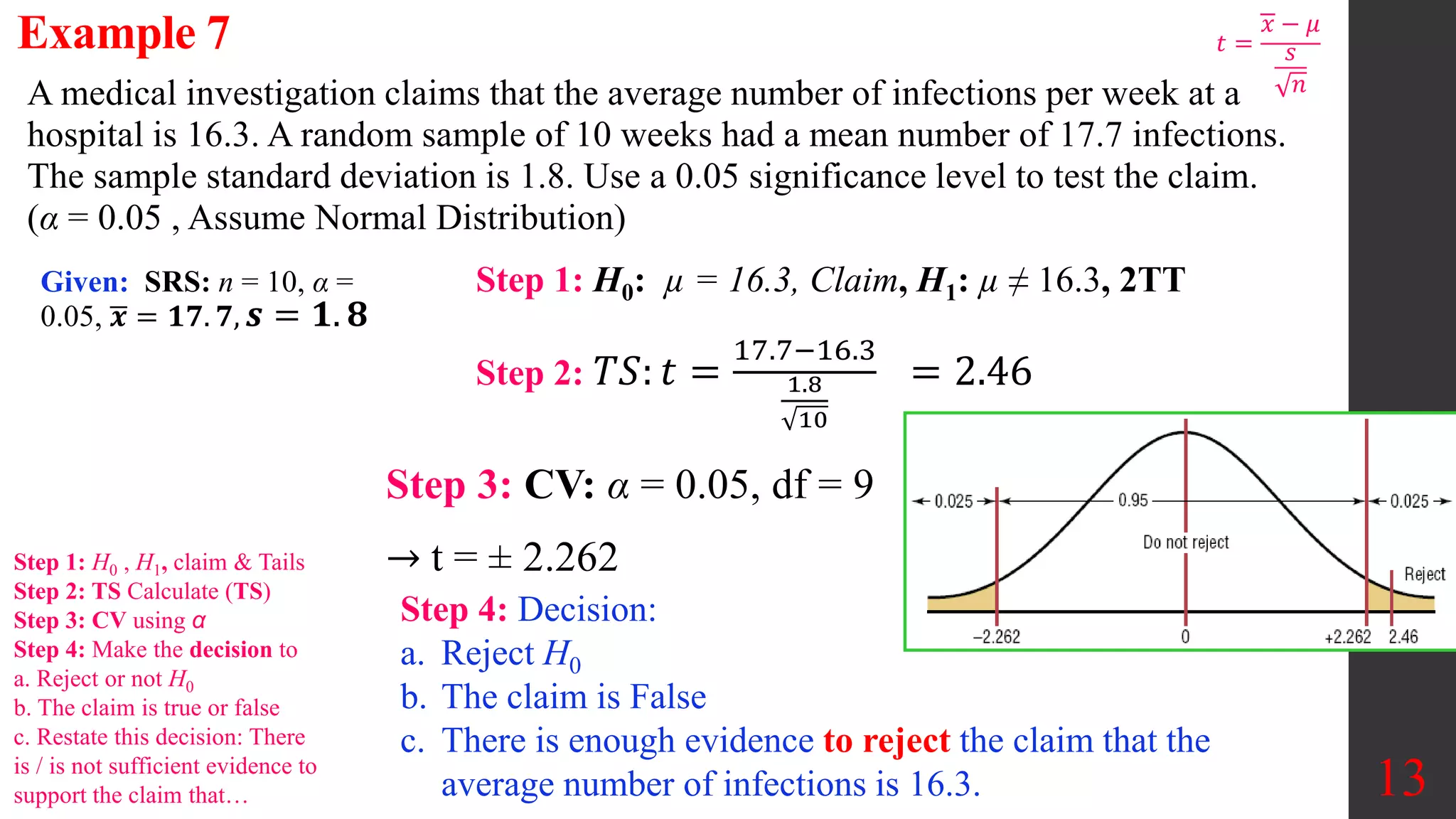
A medical investigation claims that the average number of infections per week at a
hospital is 16.3. A random sample of 10 weeks had a mean number of 17.7 infections.
The sample standard deviation is 1.8. Use a 0.05 significance level to test the claim.
(α = 0.05 , Assume Normal Distribution)
Example 7
Step 3: CV: α = 0.05, df = 9
→ t = ± 2.262
Step 1: H0: µ = 16.3, Claim, H1: µ ≠ 16.3, 2TT
Given: SRS: n = 10, α =
0.05, 𝒙 = 𝟏𝟕. 𝟕, 𝒔 = 𝟏. 𝟖
Step 4: Decision:
a. Reject H0
b. The claim is False
c. There is enough evidence to reject the claim that the
average number of infections is 16.3.
Step 2: 𝑇𝑆: 𝑡 =
17.7−16.3
1.8
10
= 2.46
Step 1: H0 , H1, claim & Tails
Step 2: TS Calculate (TS)
Step 3: CV using α
Step 4: Make the decision to
a. Reject or not H0
b. The claim is true or false
c. Restate this decision: There
is / is not sufficient evidence to
support the claim that…
𝑡 =
𝑥 − 𝜇
𝑠
𝑛
14
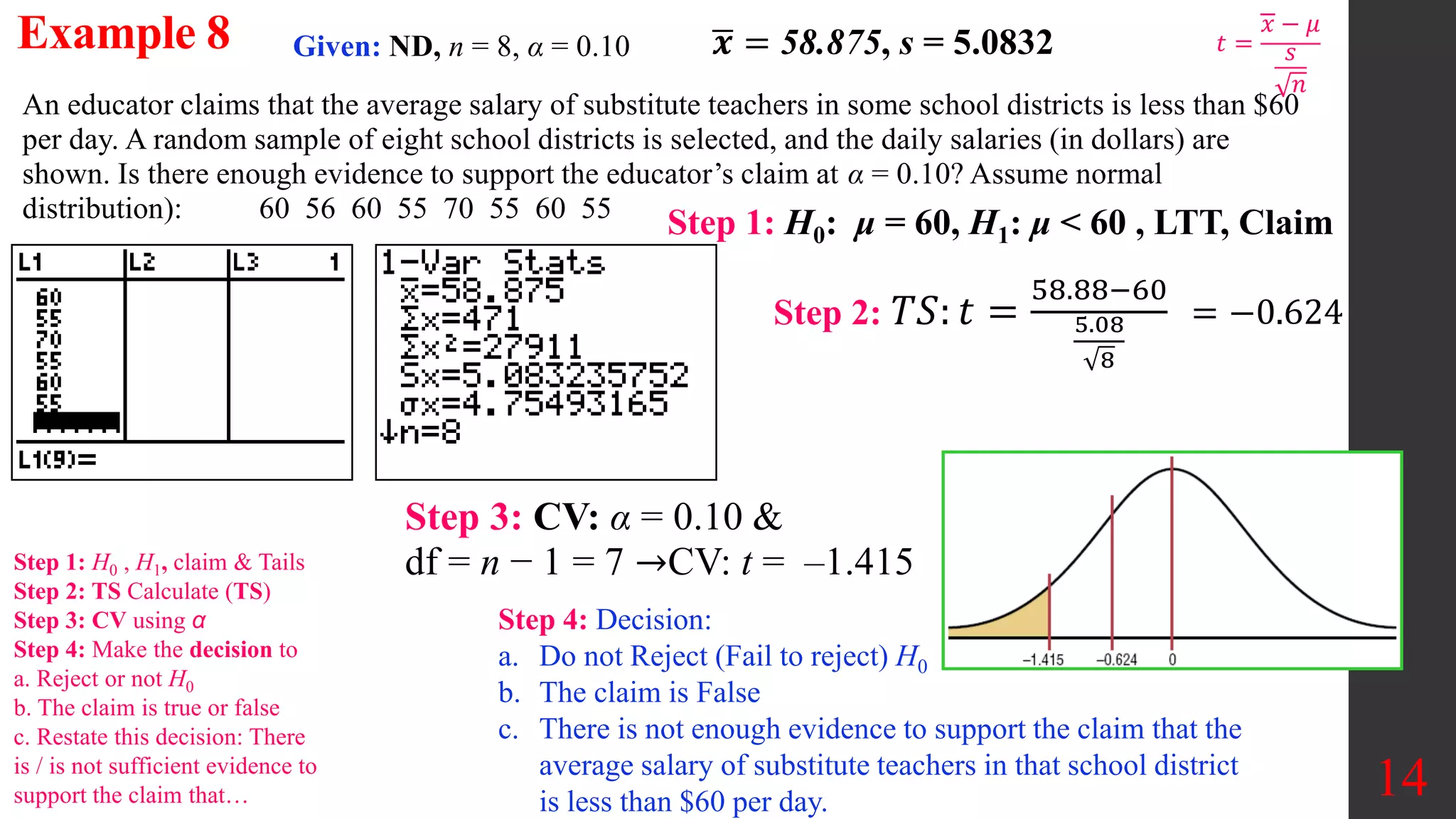
An educator claims that the average salary of substitute teachers in some school districts is less than $60
per day. A random sample of eight school districts is selected, and the daily salaries (in dollars) are
shown. Is there enough evidence to support the educator’s claim at α = 0.10? Assume normal
distribution): 60 56 60 55 70 55 60 55
Example 8
Step 3: CV: α = 0.10 &
df = n − 1 = 7 →CV: t = –1.415
Step 1: H0: μ = 60, H1: μ < 60 , LTT, Claim
Given: ND, n = 8, α = 0.10
Step 4: Decision:
a. Do not Reject (Fail to reject) H0
b. The claim is False
c. There is not enough evidence to support the claim that the
average salary of substitute teachers in that school district
is less than $60 per day.
𝒙 = 58.875, s = 5.0832
Step 2: 𝑇𝑆: 𝑡 =
58.88−60
5.08
8
= −0.624
Step 1: H0 , H1, claim & Tails
Step 2: TS Calculate (TS)
Step 3: CV using α
Step 4: Make the decision to
a. Reject or not H0
b. The claim is true or false
c. Restate this decision: There
is / is not sufficient evidence to
support the claim that…
𝑡 =
𝑥 − 𝜇
𝑠
𝑛
15
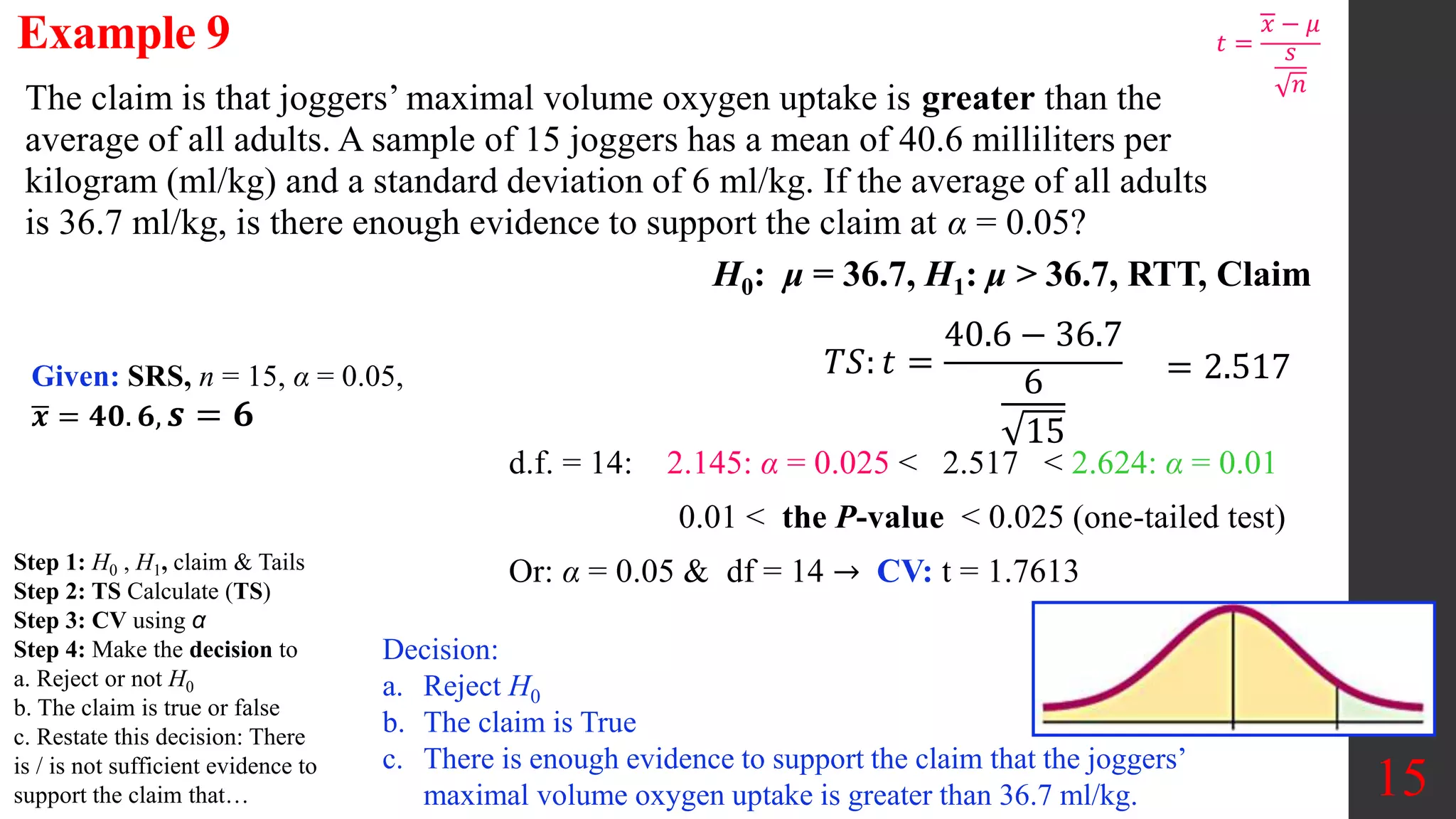
The claim is that joggers’ maximal volume oxygen uptake is greater than the
average of all adults. A sample of 15 joggers has a mean of 40.6 milliliters per
kilogram (ml/kg) and a standard deviation of 6 ml/kg. If the average of all adults
is 36.7 ml/kg, is there enough evidence to support the claim at α = 0.05?
Example 9
H0: μ = 36.7, H1: μ > 36.7, RTT, Claim
Given: SRS, n = 15, α = 0.05,
𝒙 = 𝟒𝟎. 𝟔, 𝒔 = 𝟔
Decision:
a. Reject H0
b. The claim is True
c. There is enough evidence to support the claim that the joggers’
maximal volume oxygen uptake is greater than 36.7 ml/kg.
𝑇𝑆: 𝑡 =
40.6 − 36.7
6
15
= 2.517
d.f. = 14: 2.145: α = 0.025 < 2.517 < 2.624: α = 0.01
0.01 < the P-value < 0.025 (one-tailed test)
Or: α = 0.05 & df = 14 → CV: t = 1.7613
Step 1: H0 , H1, claim & Tails
Step 2: TS Calculate (TS)
Step 3: CV using α
Step 4: Make the decision to
a. Reject or not H0
b. The claim is true or false
c. Restate this decision: There
is / is not sufficient evidence to
support the claim that…
𝑡 =
𝑥 − 𝜇
𝑠
𝑛
16
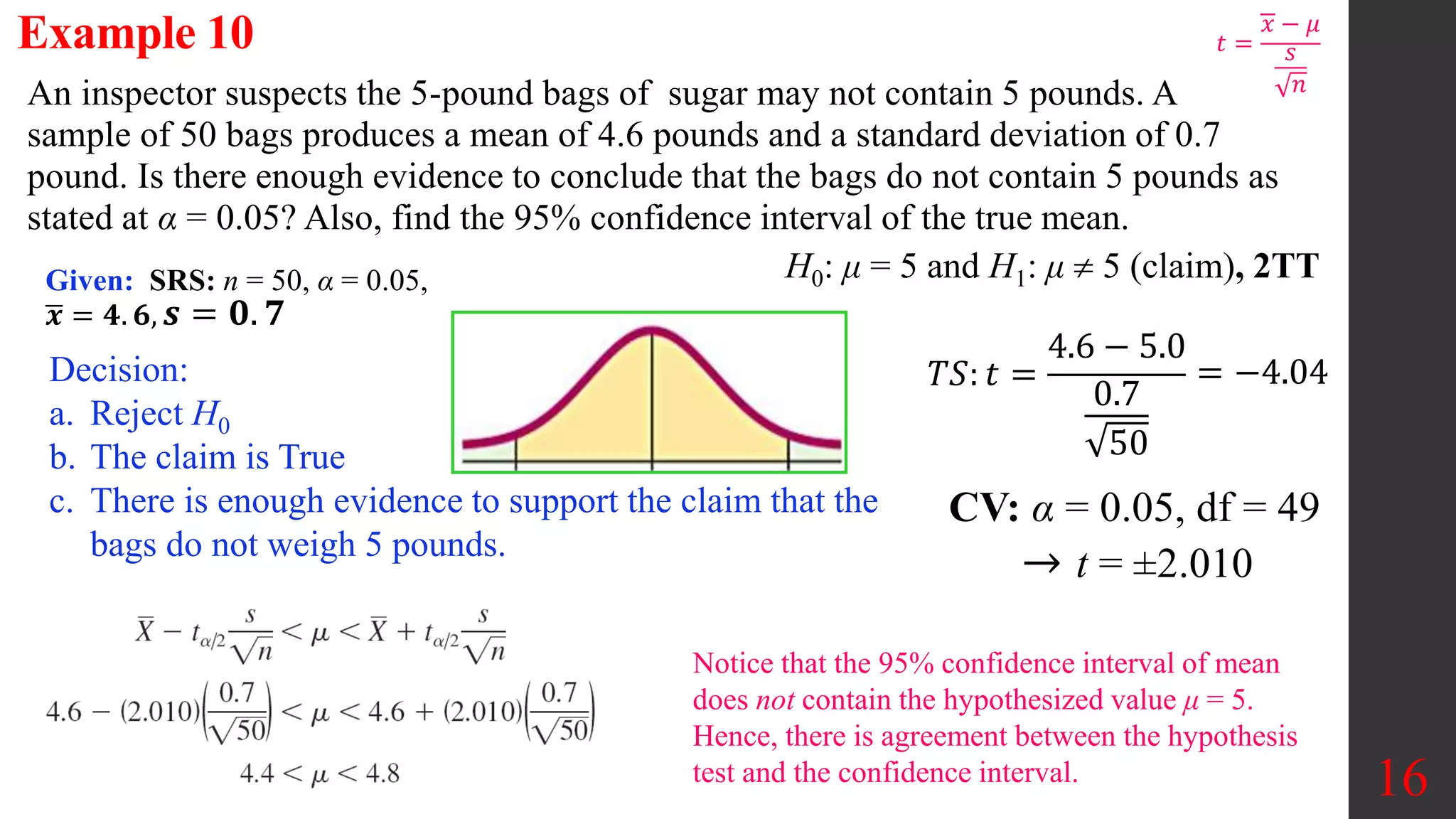
An inspector suspects the 5-pound bags of sugar may not contain 5 pounds. A
sample of 50 bags produces a mean of 4.6 pounds and a standard deviation of 0.7
pound. Is there enough evidence to conclude that the bags do not contain 5 pounds as
stated at α = 0.05? Also, find the 95% confidence interval of the true mean.
Example 10
CV: α = 0.05, df = 49
→ t = ±2.010
H0: μ = 5 and H1: μ  5 (claim), 2TT
Given: SRS: n = 50, α = 0.05,
𝒙 = 𝟒. 𝟔, 𝒔 = 𝟎. 𝟕
Decision:
a. Reject H0
b. The claim is True
c. There is enough evidence to support the claim that the
bags do not weigh 5 pounds.
𝑇𝑆: 𝑡 =
4.6 − 5.0
0.7
50
= −4.04
Notice that the 95% confidence interval of mean
does not contain the hypothesized value μ = 5.
Hence, there is agreement between the hypothesis
test and the confidence interval.
𝑡 =
𝑥 − 𝜇
𝑠
𝑛
Example: Bootstrap Resampling
Listed below is a random sample of times (seconds) of tobacco
use in animated children’s movies. Use a 0.05 significance
level to test the claim that the sample is from a population with
a mean greater than 1 minute, or 60 seconds.
0 223 0 176 0 548 0 37 158
51 0 0 299 37 0 11 0 0 0 0
17
Solution: Requirement Check
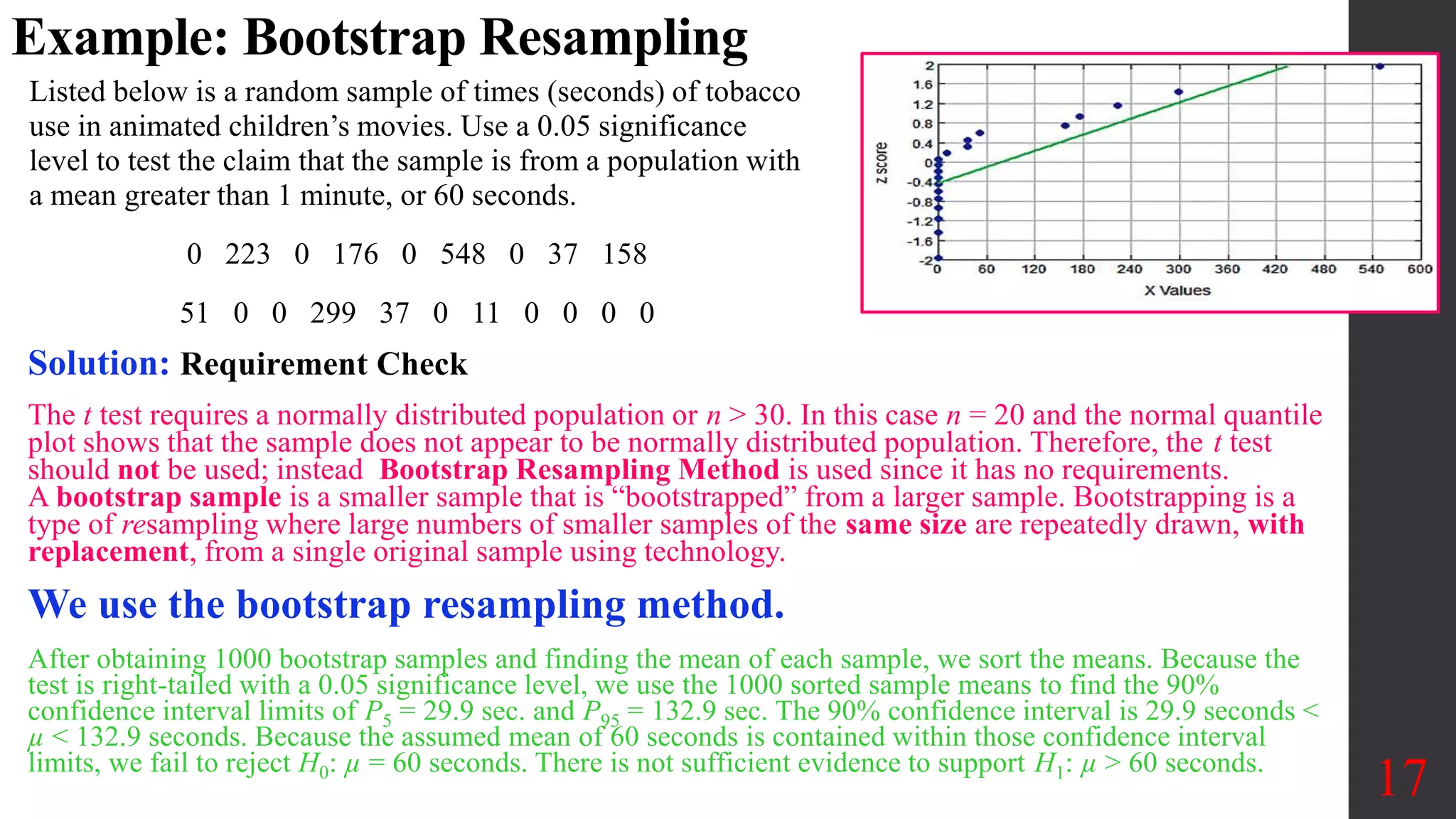
The t test requires a normally distributed population or n > 30. In this case n = 20 and the normal quantile
plot shows that the sample does not appear to be normally distributed population. Therefore, the t test
should not be used; instead Bootstrap Resampling Method is used since it has no requirements.
A bootstrap sample is a smaller sample that is “bootstrapped” from a larger sample. Bootstrapping is a
type of resampling where large numbers of smaller samples of the same size are repeatedly drawn, with
replacement, from a single original sample using technology.
We use the bootstrap resampling method.
After obtaining 1000 bootstrap samples and finding the mean of each sample, we sort the means. Because the
test is right-tailed with a 0.05 significance level, we use the 1000 sorted sample means to find the 90%
confidence interval limits of P5 = 29.9 sec. and P95 = 132.9 sec. The 90% confidence interval is 29.9 seconds <
µ < 132.9 seconds. Because the assumed mean of 60 seconds is contained within those confidence interval
limits, we fail to reject H0: µ = 60 seconds. There is not sufficient evidence to support H1: µ > 60 seconds.

Testing a Claim About a Mean

  • 1.
    Elementary Statistics Chapter 8:Hypothesis Testing 8.3 Testing a Claim about a Mean 1
  • 2.
    8.1 Basics ofHypothesis Testing 8.2 Testing a Claim about a Proportion 8.3 Testing a Claim About a Mean 8.4 Testing a Claim About a Standard Deviation or Variance 2 Objectives: • Understand the definitions used in hypothesis testing. • State the null and alternative hypotheses. • State the steps used in hypothesis testing. • Test proportions, using the z test. • Test means when  is known, using the z test. • Test means when  is unknown, using the t test. • Test variances or standard deviations, using the chi-square test. • Test hypotheses, using confidence intervals. Chapter 8: Hypothesis Testing
  • 3.
    Key Concept: Testinga claim about a population mean Objective: Use a formal hypothesis test to test a claim about a population mean µ. 1. The population standard deviation σ is not known. 2. The population standard deviation σ is known. 8.3 Testing a Claim About a Mean The z test is a statistical test for the mean of a population. It can be used when n  30, or when the population is normally distributed and  is known. The formula for the z test is (Test Statistic): 𝑍 = 𝑥−𝜇 𝜎/ 𝑛 , where 𝑥 = sample mean μ = hypothesized population mean  = population standard deviation n = sample size The t test is a statistical test for the mean of a population. It can be used when n  30, or when the population is normally distributed and  is not known. The formula for the t test is (Test Statistic): 𝑡 = 𝑥−𝜇 𝑠/ 𝑛 , where 𝑥 = sample mean μ = hypothesized population mean s = Sample standard deviation n = sample size 3 TI Calculator: Mean: Z ‒ Test 1. Stat 2. Tests 3. Z ‒ Test 4. Enter Data or Stats (𝝁, 𝒙, 𝝈) 5. Choose RTT, LTT, or 2TT 6. Calculate TI Calculator: Mean: T ‒ Test 1. Stat 2. Tests 3. T ‒ Test 4. Enter Data or Stats (𝝁, 𝒙, 𝒔𝒙) 5. Choose RTT, LTT, or 2TT 6. Calculate CI & and Hypothesis Testing: When the null hypothesis is rejected, the confidence interval for the mean using the same level of significance will not contain the hypothesized mean. Likewise, when the null hypothesis is not rejected, the confidence interval computed using the same level of significance will contain the hypothesized mean.
  • 4.
    4 The number ofhours of sleep for 12 randomly selected adult subjects are listed as: 4 8 4 4 8 6 9 7 7 10 7 8. A common recommendation is that adults should sleep between 7 hours and 9 hours each night. Use a 0.05 significance level to test the claim that the mean amount of sleep for adults is less than 7 hours. (Assume normal distribution) Example 1 Step 3: CV: α = 0.05 & df = n − 1 = 11 →CV: t = −1.796 Step 1: H0: μ = 7 H1: μ < 7 , LTT, Claim Given: ND, n = 12, α = 0.05, 𝝁 =7 Step 2: 𝑇𝑆: 𝑡 = 6.8333−7 1.9924/ 12 = −0.290 Step 4: Decision: a. Do not Reject (Fail to reject) H0 b. The claim is False c. There is not sufficient evidence to support the claim that the mean amount of adult sleep is less than 7 hours. 𝑡 = 𝑥 − 𝜇 𝑠 𝑛 𝒙 = 6.8333, s = 1.9924 Step 1: H0 , H1, claim & Tails Step 2: TS Calculate (TS) Step 3: CV using α Step 4: Make the decision to a. Reject or not H0 b. The claim is true or false c. Restate this decision: There is / is not sufficient evidence to support the claim that…
  • 5.
    The P-Values Method 5 LTT,TS: t = −0.290 The P-value = Area to the left of t = −0.290 Technology: P-value = 0.3887 Decision: P-value = 0.3887 > α = 0.05 ⇾ Do not Reject (Fail to reject) H0 5.8004 < μ < 7.8662 The range of values in this CI contains µ = 7 hours. We are 90% confident that the limits of 5.8004 and 7.8662 contain the true value of μ , the sample data appear not to support the claim that the mean amount of adult sleep is less than 7 hours. Confidence Interval Method: 90% CI T-Table: LTT: t = −0.290 df = 11: 0.290 < all of the listed t values in the row: Table: P-value > 0.10 𝐶𝐼: 𝑥 ± 𝐸 → 𝐸 = 𝑡𝛼 2 𝑠 𝑛 TI Calculator: Mean: T ‒ Test 1. Stat 2. Tests 3. T ‒ Test 4. Enter Data or Stats (𝝁, 𝒙, 𝒔𝒙) 5. Choose RTT, LTT, or 2TT 6. Calculate TI Calculator: Confidence Interval: T- interval 1. Stat 2. Tests 3. T - Interval 4. Enter Data (Freq:1) or Stats (𝒙 , s & CL) 5. Enter (Calculate) Example 1 Continued: The number of hours of sleep for 12 randomly selected adult subjects are listed as: 4 8 4 4 8 6 9 7 7 10 7 8.
  • 6.
  • 7.
    7 The body temperaturemeasured for 106 subjects indicated a mean of 98.20𝐹 and standard deviation of 0.620𝐹. Use a 0.05 significance level to test the common belief that the population mean is 𝟗𝟖. 𝟔𝟎 𝑭. Example 2 Step 3: CV: α = 0.05 & df = n − 1 = 105 → T − Table: → CV: t = ±1.984 Step 1: H0: µ = 98.6°F , Claim , H1: µ ≠ 98.6°F , 2TT Given: SRS: n = 106 > 30, α = 0.05, 𝒙 = 98.20𝐹, s = 0.620 𝐹 , 𝝁 = 98.60 𝐹 Step 2: 𝑇𝑆: 𝑡 = 98.2−98.6 0.62/ 106 = −6.6423 Step 4: Decision: a. Reject H0 b. The claim is False c. There is not sufficient evidence to support the claim (the common belief) that the population mean is 98.6°F . (There is sufficient evidence to warrant rejection of the common belief that the population mean is 98.6°F.) Step 1: H0 , H1, claim & Tails Step 2: TS Calculate (TS) Step 3: CV using α Step 4: Make the decision to a. Reject or not H0 b. The claim is true or false c. Restate this decision: There is / is not sufficient evidence to support the claim that… 𝑡 = 𝑥 − 𝜇 𝑠 𝑛
  • 8.
    The P-Values Method 8 2TT:t = − 6.6423 The P-value = 2 times the Area to the left of t = − 6.6423 Technology: P-value = 0.0000 or 0 + Decision: P-value of less than 0.01 < α = 0.05 ⇾ Reject H0 98.08°F < µ < 98.32F The range of values in this CI does not contains µ = 98.6F. We are 95% confident that the limits of 98.08°F and 98.32F contain the true value of μ , the sample data appear not to support the claim (the common belief) that the population mean is 98.6°F . Confidence Interval Method: 95% CI T-Table: LTT: t = − 6.6423 df = 105: 6.64 > all of the listed t values in the row Table: P-value < 0.01 TI Calculator: Mean: T ‒ Test 1. Stat 2. Tests 3. T ‒ Test 4. Enter Data or Stats (𝝁, 𝒙, 𝒔𝒙) 5. Choose RTT, LTT, or 2TT 6. Calculate TI Calculator: Confidence Interval: T- interval 1. Stat 2. Tests 3. T - Interval 4. Enter Data (Freq:1) or Stats (𝒙 , s & CL) 5. Enter (Calculate) 𝐶𝐼: 𝑥 ± 𝐸 → 𝐸 = 𝑡𝛼 2 𝑠 𝑛 Example 2 Continued:
  • 9.
    9 A researcher wishesto see if the mean number of days that a basic, low-price, small automobile sits on a dealer’s lot is 29. A sample of 30 automobile dealers has a mean of 30.1 days for basic, low-price, small automobiles. At α = 0.05, test the claim that the mean time is greater than 29 days. The standard deviation of the population is 3.8 days. Example 3 Step 3: CV: α = 0.05 → z = 1.645 Step 1: H0: μ = 29, H1: μ > 29 , RTT, Claim Given: SRS, n = 30, α = 0.05, 𝒙 = 𝟑𝟎. 𝟏, 𝝈 = 3.8, 𝝁 = 𝟐𝟗 Step 2: 𝑇𝑆: 𝑧 = 30.1−29 3.8/ 30 = 1.5855 Step 4: Decision: a. Do not Reject (Fail to reject) H0 b. The claim is False c. There is not sufficient evidence to support the claim that the mean time is greater than 29 days. 𝑧 = 𝑥 − 𝜇 𝜎 𝑛 Step 1: H0 , H1, claim & Tails Step 2: TS Calculate (TS) Step 3: CV using α Step 4: Make the decision to a. Reject or not H0 b. The claim is true or false c. Restate this decision: There is / is not sufficient evidence to support the claim that… TI Calculator: Mean: Z ‒ Test 1. Stat 2. Tests 3. Z ‒ Test 4. Enter Data or Stats (𝝁, 𝒙, 𝝈) 5. Choose RTT, LTT, or 2TT 6. Calculate
  • 10.
    10 A researcher wishesto test the claim that the average cost of tuition and fees at a four-year public college is greater than $5700. She selects a random sample of 36 four-year public colleges and finds the mean to be $5950. The population standard deviation is $659. Is there evidence to support the claim at α = 0.05 ? Use the P-value method. Example 4 Step 3: The P-value = Area to the Right of z = 2.28⇾ P-value = 0.0113 Step 1: H0: μ = $5700, H1: μ > $5700, RTT, Claim Given: SRS, n = 36, α = 0.05, 𝒙 = $𝟓𝟗𝟓𝟎, 𝝈 = $𝟔𝟓𝟗, 𝝁 = $𝟓𝟕𝟎𝟎 Step 4: Decision: a. Reject H0 b. The claim is True c. There is sufficient evidence to support the claim that the average cost of tuition and fees at a four-year public college is greater than $5700. Step 2: 𝑇𝑆: 𝑧 = 5950−5700 659 36 = 2.28 If α = 0.01, would the null hypothesis be rejected? Step 1: H0 , H1, claim & Tails Step 2: TS Calculate (TS) Step 3: CV using α Step 4: Make the decision to a. Reject or not H0 b. The claim is true or false c. Restate this decision: There is / is not sufficient evidence to support the claim that… 𝑧 = 𝑥 − 𝜇 𝜎 𝑛
  • 11.
    11 A researcher claimsthat the average cost of men’s athletic shoes is less than $80. He selects a random sample of 36 pairs of shoes from a catalog and finds their average of $75. Is there enough evidence to support the researcher’s claim at α = 0.10? Assume  = 19.2. Example 5 Step 3: CV: α = 0.05 & z = –1.28 Step1: H0: μ = 80, H1: μ < 80 , LTT, Claim Given: RS, n = 36, α = 0.10, 𝒙 = $𝟕𝟓, 𝝈 = $𝟏𝟗. 𝟐, 𝝁 = 𝟖𝟎 Step 4: Decision: a. Reject H0 b. The claim is True c. There is sufficient evidence to support the claim that the average cost of men’s athletic shoes is less than $80. Step 2: 𝑇𝑆: 𝑧 = 75−80 19.2 36 = −1.56 Step 1: H0 , H1, claim & Tails Step 2: TS Calculate (TS) Step 3: CV using α Step 4: Make the decision to a. Reject or not H0 b. The claim is true or false c. Restate this decision: There is / is not sufficient evidence to support the claim that… 𝑧 = 𝑥 − 𝜇 𝜎 𝑛
  • 12.
    12 The average costof rehabilitation for stroke victims is $24,672. At a particular hospital, a random sample of 35 stroke victims have an average cost of rehabilitation of $26,343. The standard deviation of the population is $3251. At α = 0.01, can it be concluded that the average cost of stroke rehabilitation at a particular hospital is different from $24,672? Example 6 Step 3 CV: α = 0.01 → z = ±2.58 Step 1: H0: µ = $24,672, H1: µ ≠ $24,672, 2TT , Claim Given: SRS: n = 35 > 30, α = 0.01, 𝒙 = $𝟐𝟒, 𝟔𝟕𝟐, 𝝈 = $𝟑𝟐𝟓𝟏 Decision: a. Reject H0 b. The claim is True c. There is enough evidence to support the claim that the average cost of rehabilitation at the particular hospital is different from $24,672. Step 2: 𝑇𝑆: 𝑧 = 26,343−24,672 3251/ 35 = 3.04 Step 1: H0 , H1, claim & Tails Step 2: TS Calculate (TS) Step 3: CV using α Step 4: Make the decision to a. Reject or not H0 b. The claim is true or false c. Restate this decision: There is / is not sufficient evidence to support the claim that… 𝑧 = 𝑥 − 𝜇 𝜎 𝑛
  • 13.
    13 A medical investigationclaims that the average number of infections per week at a hospital is 16.3. A random sample of 10 weeks had a mean number of 17.7 infections. The sample standard deviation is 1.8. Use a 0.05 significance level to test the claim. (α = 0.05 , Assume Normal Distribution) Example 7 Step 3: CV: α = 0.05, df = 9 → t = ± 2.262 Step 1: H0: µ = 16.3, Claim, H1: µ ≠ 16.3, 2TT Given: SRS: n = 10, α = 0.05, 𝒙 = 𝟏𝟕. 𝟕, 𝒔 = 𝟏. 𝟖 Step 4: Decision: a. Reject H0 b. The claim is False c. There is enough evidence to reject the claim that the average number of infections is 16.3. Step 2: 𝑇𝑆: 𝑡 = 17.7−16.3 1.8 10 = 2.46 Step 1: H0 , H1, claim & Tails Step 2: TS Calculate (TS) Step 3: CV using α Step 4: Make the decision to a. Reject or not H0 b. The claim is true or false c. Restate this decision: There is / is not sufficient evidence to support the claim that… 𝑡 = 𝑥 − 𝜇 𝑠 𝑛
  • 14.
    14 An educator claimsthat the average salary of substitute teachers in some school districts is less than $60 per day. A random sample of eight school districts is selected, and the daily salaries (in dollars) are shown. Is there enough evidence to support the educator’s claim at α = 0.10? Assume normal distribution): 60 56 60 55 70 55 60 55 Example 8 Step 3: CV: α = 0.10 & df = n − 1 = 7 →CV: t = –1.415 Step 1: H0: μ = 60, H1: μ < 60 , LTT, Claim Given: ND, n = 8, α = 0.10 Step 4: Decision: a. Do not Reject (Fail to reject) H0 b. The claim is False c. There is not enough evidence to support the claim that the average salary of substitute teachers in that school district is less than $60 per day. 𝒙 = 58.875, s = 5.0832 Step 2: 𝑇𝑆: 𝑡 = 58.88−60 5.08 8 = −0.624 Step 1: H0 , H1, claim & Tails Step 2: TS Calculate (TS) Step 3: CV using α Step 4: Make the decision to a. Reject or not H0 b. The claim is true or false c. Restate this decision: There is / is not sufficient evidence to support the claim that… 𝑡 = 𝑥 − 𝜇 𝑠 𝑛
  • 15.
    15 The claim isthat joggers’ maximal volume oxygen uptake is greater than the average of all adults. A sample of 15 joggers has a mean of 40.6 milliliters per kilogram (ml/kg) and a standard deviation of 6 ml/kg. If the average of all adults is 36.7 ml/kg, is there enough evidence to support the claim at α = 0.05? Example 9 H0: μ = 36.7, H1: μ > 36.7, RTT, Claim Given: SRS, n = 15, α = 0.05, 𝒙 = 𝟒𝟎. 𝟔, 𝒔 = 𝟔 Decision: a. Reject H0 b. The claim is True c. There is enough evidence to support the claim that the joggers’ maximal volume oxygen uptake is greater than 36.7 ml/kg. 𝑇𝑆: 𝑡 = 40.6 − 36.7 6 15 = 2.517 d.f. = 14: 2.145: α = 0.025 < 2.517 < 2.624: α = 0.01 0.01 < the P-value < 0.025 (one-tailed test) Or: α = 0.05 & df = 14 → CV: t = 1.7613 Step 1: H0 , H1, claim & Tails Step 2: TS Calculate (TS) Step 3: CV using α Step 4: Make the decision to a. Reject or not H0 b. The claim is true or false c. Restate this decision: There is / is not sufficient evidence to support the claim that… 𝑡 = 𝑥 − 𝜇 𝑠 𝑛
  • 16.
    16 An inspector suspectsthe 5-pound bags of sugar may not contain 5 pounds. A sample of 50 bags produces a mean of 4.6 pounds and a standard deviation of 0.7 pound. Is there enough evidence to conclude that the bags do not contain 5 pounds as stated at α = 0.05? Also, find the 95% confidence interval of the true mean. Example 10 CV: α = 0.05, df = 49 → t = ±2.010 H0: μ = 5 and H1: μ  5 (claim), 2TT Given: SRS: n = 50, α = 0.05, 𝒙 = 𝟒. 𝟔, 𝒔 = 𝟎. 𝟕 Decision: a. Reject H0 b. The claim is True c. There is enough evidence to support the claim that the bags do not weigh 5 pounds. 𝑇𝑆: 𝑡 = 4.6 − 5.0 0.7 50 = −4.04 Notice that the 95% confidence interval of mean does not contain the hypothesized value μ = 5. Hence, there is agreement between the hypothesis test and the confidence interval. 𝑡 = 𝑥 − 𝜇 𝑠 𝑛
  • 17.
    Example: Bootstrap Resampling Listedbelow is a random sample of times (seconds) of tobacco use in animated children’s movies. Use a 0.05 significance level to test the claim that the sample is from a population with a mean greater than 1 minute, or 60 seconds. 0 223 0 176 0 548 0 37 158 51 0 0 299 37 0 11 0 0 0 0 17 Solution: Requirement Check The t test requires a normally distributed population or n > 30. In this case n = 20 and the normal quantile plot shows that the sample does not appear to be normally distributed population. Therefore, the t test should not be used; instead Bootstrap Resampling Method is used since it has no requirements. A bootstrap sample is a smaller sample that is “bootstrapped” from a larger sample. Bootstrapping is a type of resampling where large numbers of smaller samples of the same size are repeatedly drawn, with replacement, from a single original sample using technology. We use the bootstrap resampling method. After obtaining 1000 bootstrap samples and finding the mean of each sample, we sort the means. Because the test is right-tailed with a 0.05 significance level, we use the 1000 sorted sample means to find the 90% confidence interval limits of P5 = 29.9 sec. and P95 = 132.9 sec. The 90% confidence interval is 29.9 seconds < µ < 132.9 seconds. Because the assumed mean of 60 seconds is contained within those confidence interval limits, we fail to reject H0: µ = 60 seconds. There is not sufficient evidence to support H1: µ > 60 seconds.