EIE325: Telecommunication Technologies Maciej Ogorzalek, PolyU, EIE
Telecommunication Technologies
Week 7
Digital and Analogue Modulation
Quantisation
EIE325: Telecommunication Technologies Maciej Ogorzalek, PolyU EIE,
Š Digital data, digital signal
„ NRZ, Manchester, HDB3
Š Digital data, analog signal
„ ASK, FSK, PSK
Š Analog data, digital signal
„ PCM, DM, ADPCM
Š Analog data, analog signal
„ AM, FM, PM
Encoding Techniques
EIE325: Telecommunication Technologies Maciej Ogorzalek, PolyU EIE,
Digital Data, Analog Signal
Š Public telephone system
„ »300Hz to »3400Hz
„ Use modem (modulator-demodulator)
Š Amplitude shift keying (ASK)
Š Frequency shift keying (FSK)
Š Phase shift keying (PSK)
EIE325: Telecommunication Technologies Maciej Ogorzalek, PolyU EIE,
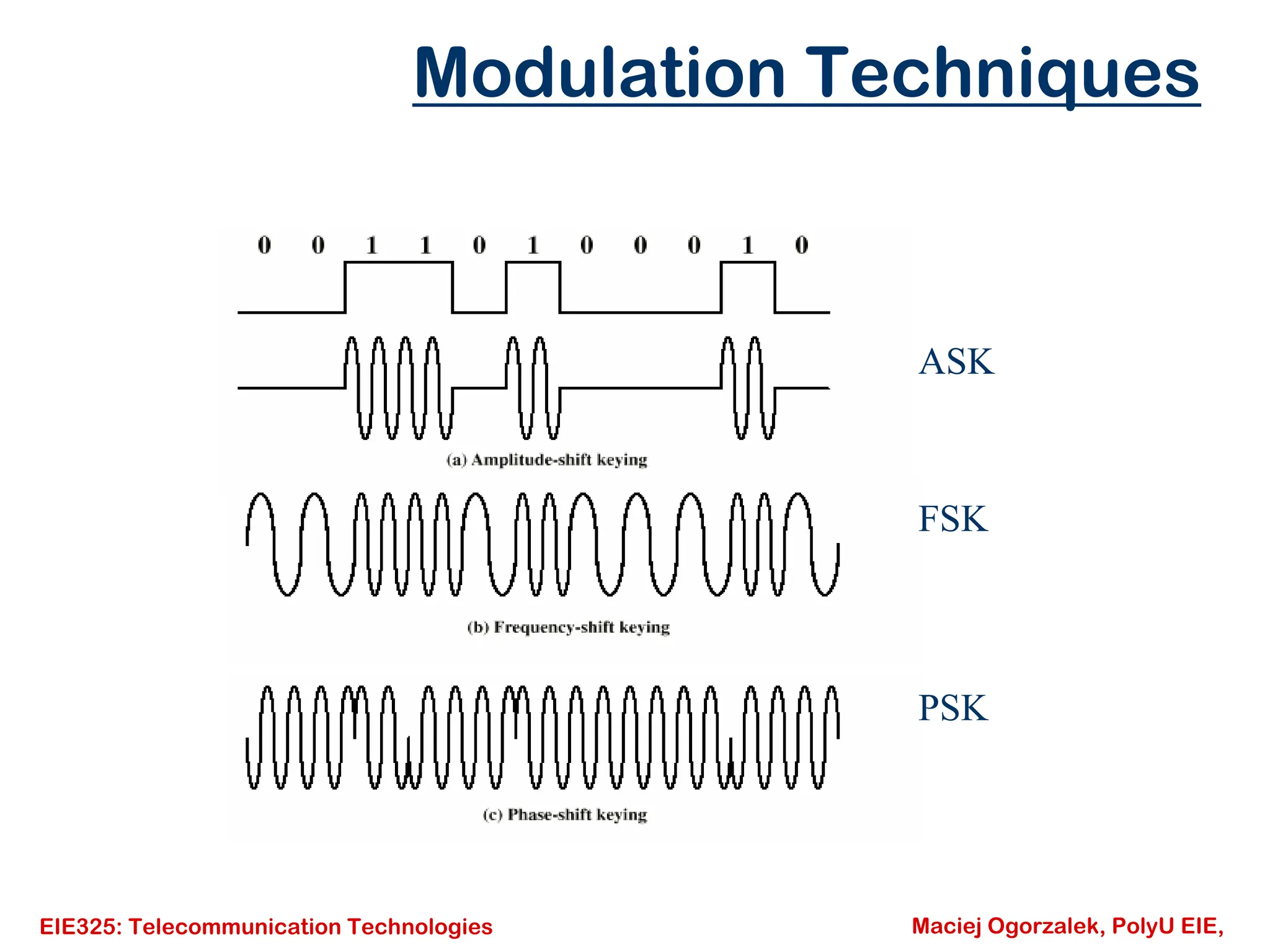
Modulation Techniques
ASK
FSK
PSK
EIE325: Telecommunication Technologies Maciej Ogorzalek, PolyU EIE,
Amplitude Shift Keying
Š Values represented by different amplitudes
of carrier
Š Usually, one amplitude is zero
„ i.e. presence and absence of carrier is used
Š Susceptible to sudden gain changes
Š Inefficient
Š Up to 1200bps on voice grade lines
Š Used over optical fiber
EIE325: Telecommunication Technologies Maciej Ogorzalek, PolyU EIE,
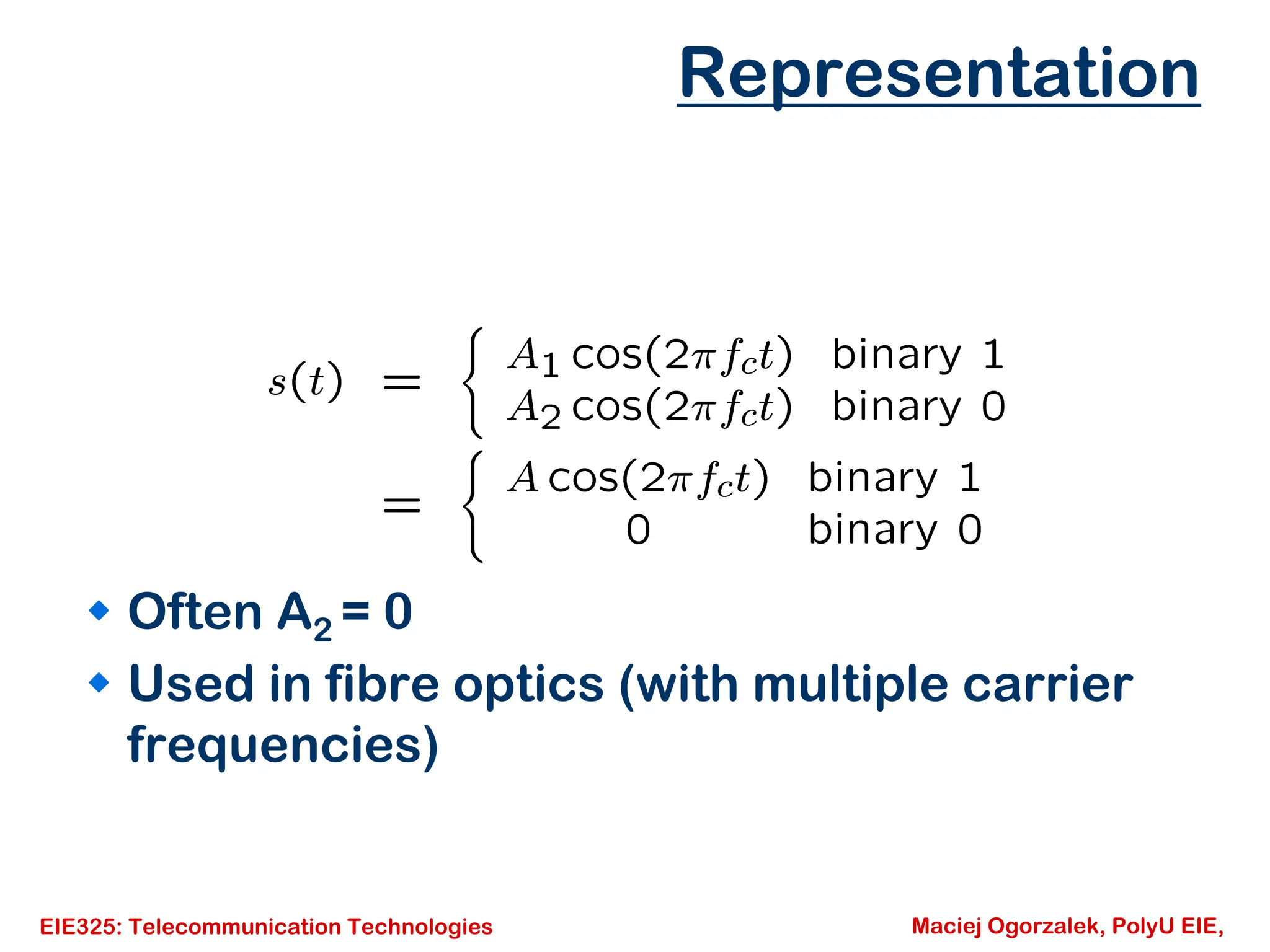
Representation
Š Often A2 = 0
Š Used in fibre optics (with multiple carrier
frequencies)
EIE325: Telecommunication Technologies Maciej Ogorzalek, PolyU EIE,
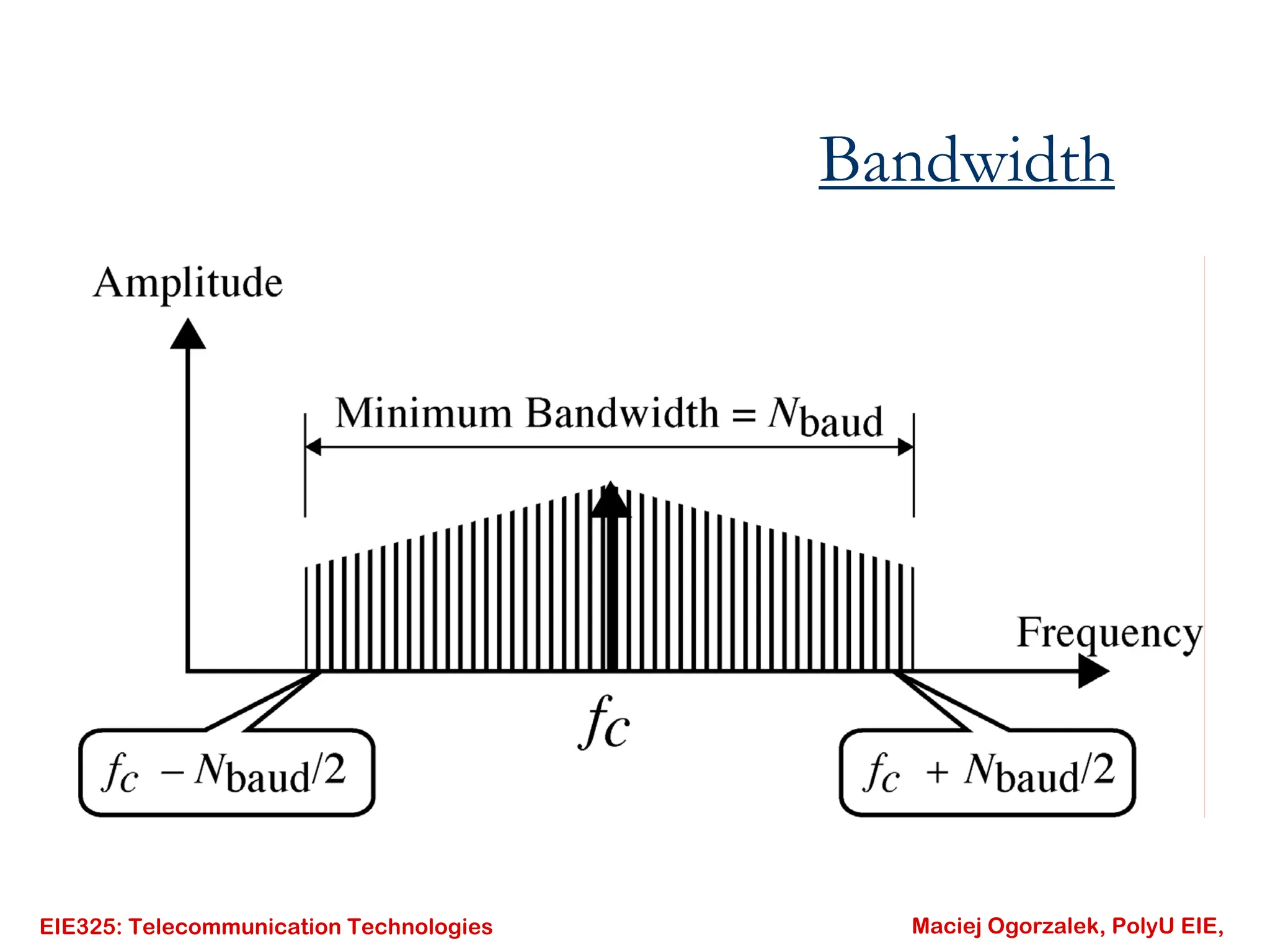
Bandwidth
EIE325: Telecommunication Technologies Maciej Ogorzalek, PolyU EIE,
Frequency Shift Keying
Š Values represented by different
frequencies (near carrier)
Š Less susceptible to error than ASK
Š Up to 1200bps on voice grade lines
Š High frequency radio
Š Even higher frequency on LANs using co-ax
EIE325: Telecommunication Technologies Maciej Ogorzalek, PolyU EIE,
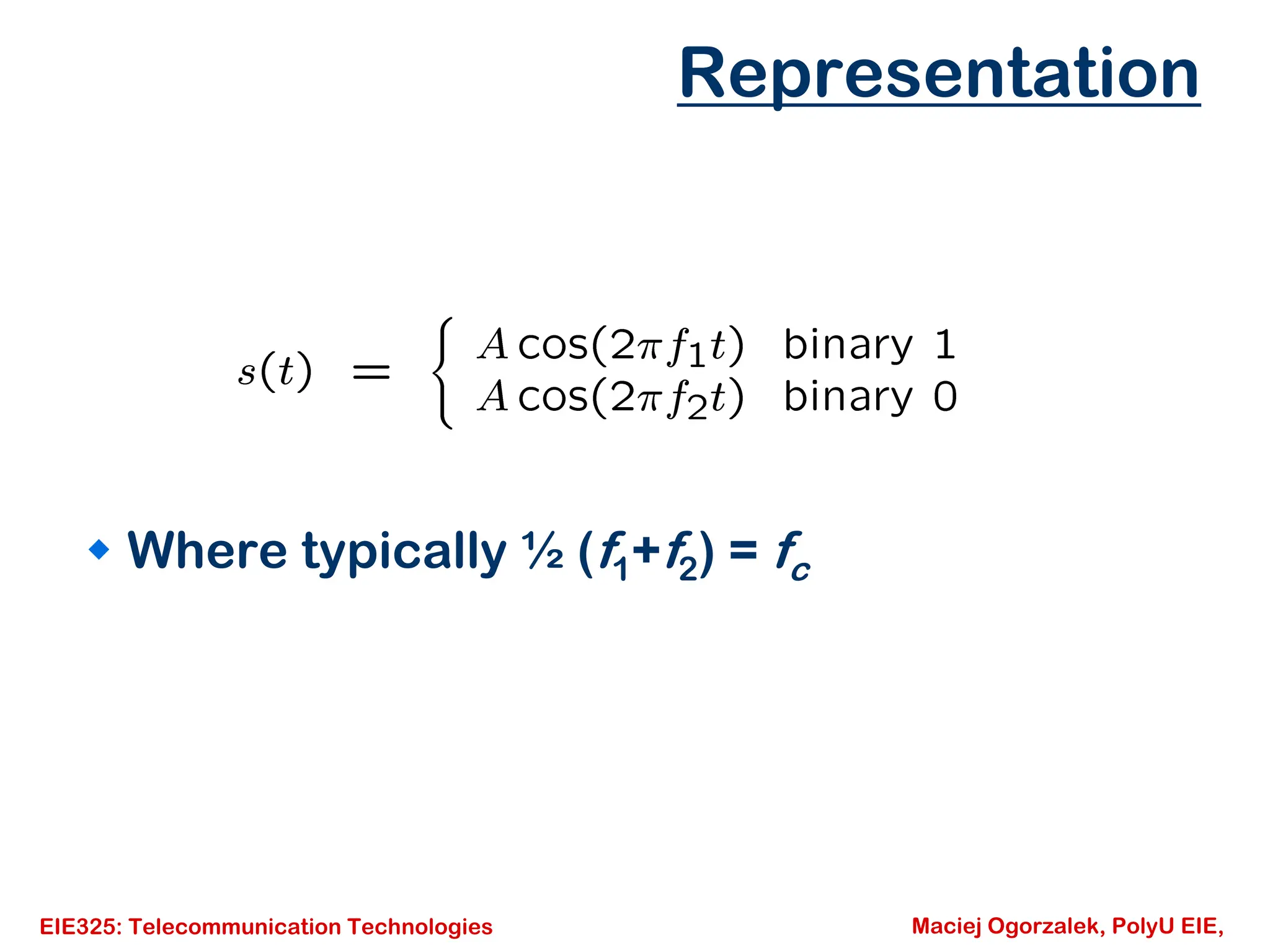
Representation
Š Where typically ½ (f1+f2) = fc
EIE325: Telecommunication Technologies Maciej Ogorzalek, PolyU EIE,
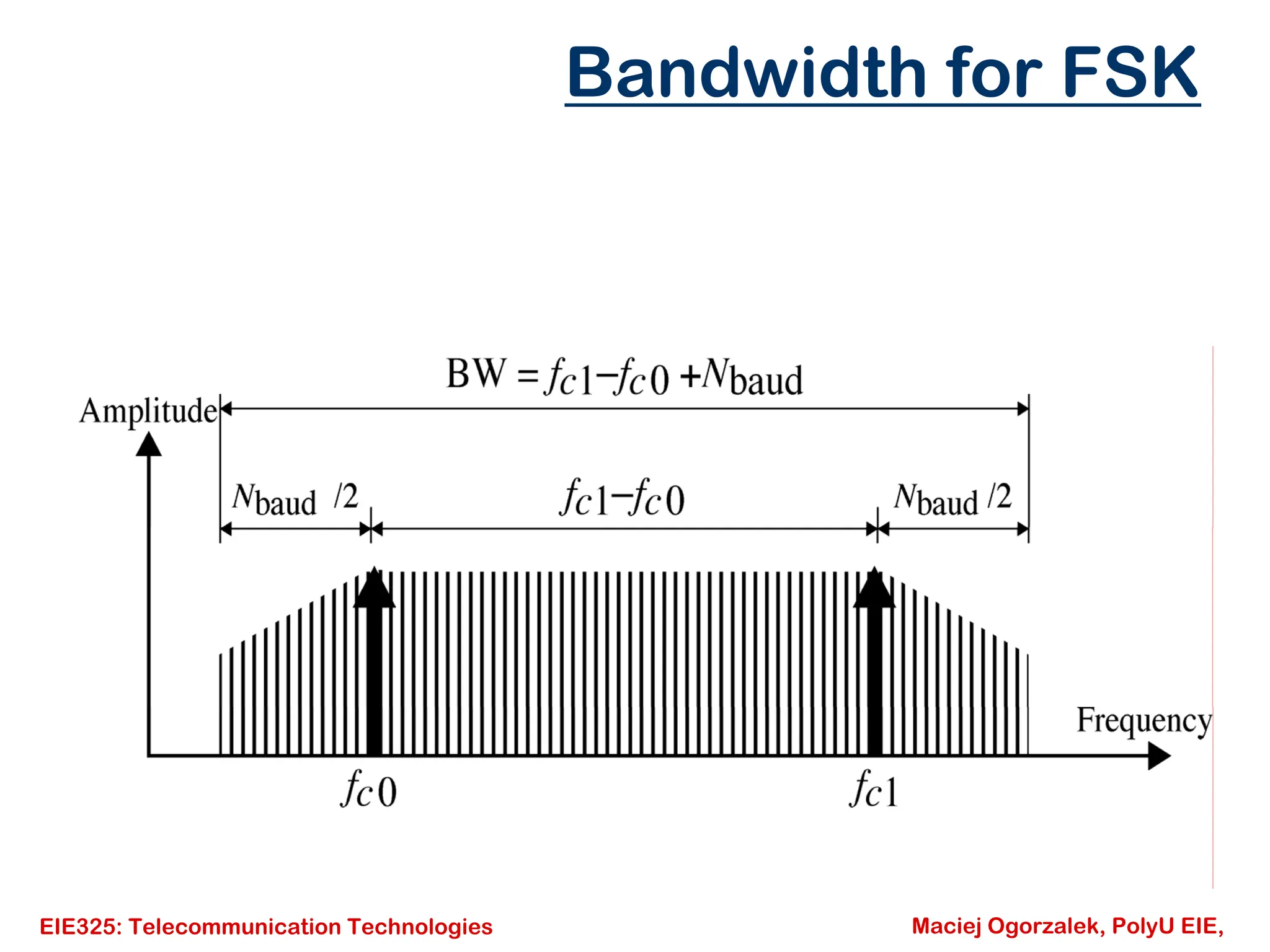
Bandwidth for FSK
EIE325: Telecommunication Technologies Maciej Ogorzalek, PolyU EIE,
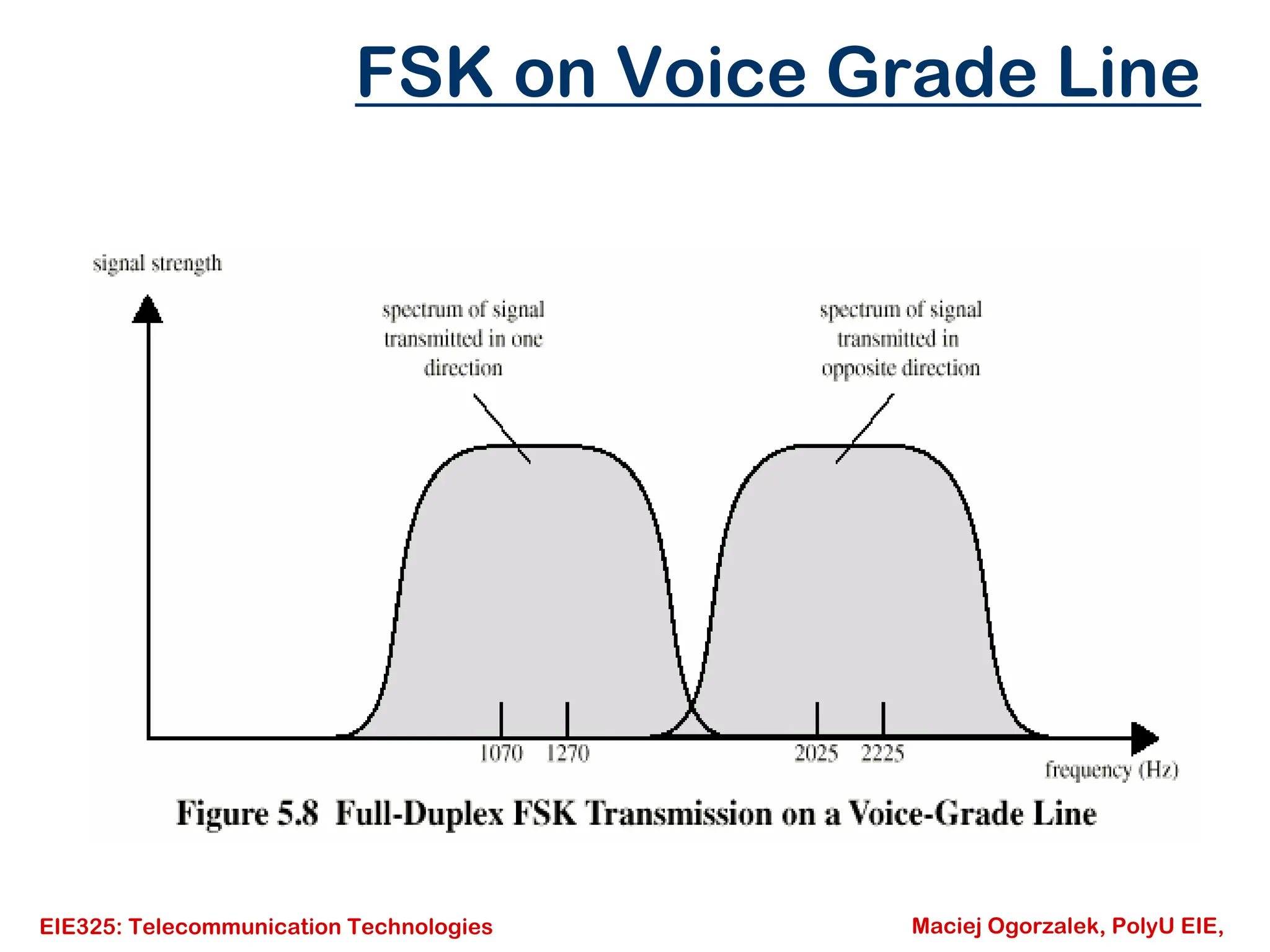
FSK on Voice Grade Line
EIE325: Telecommunication Technologies Maciej Ogorzalek, PolyU EIE,
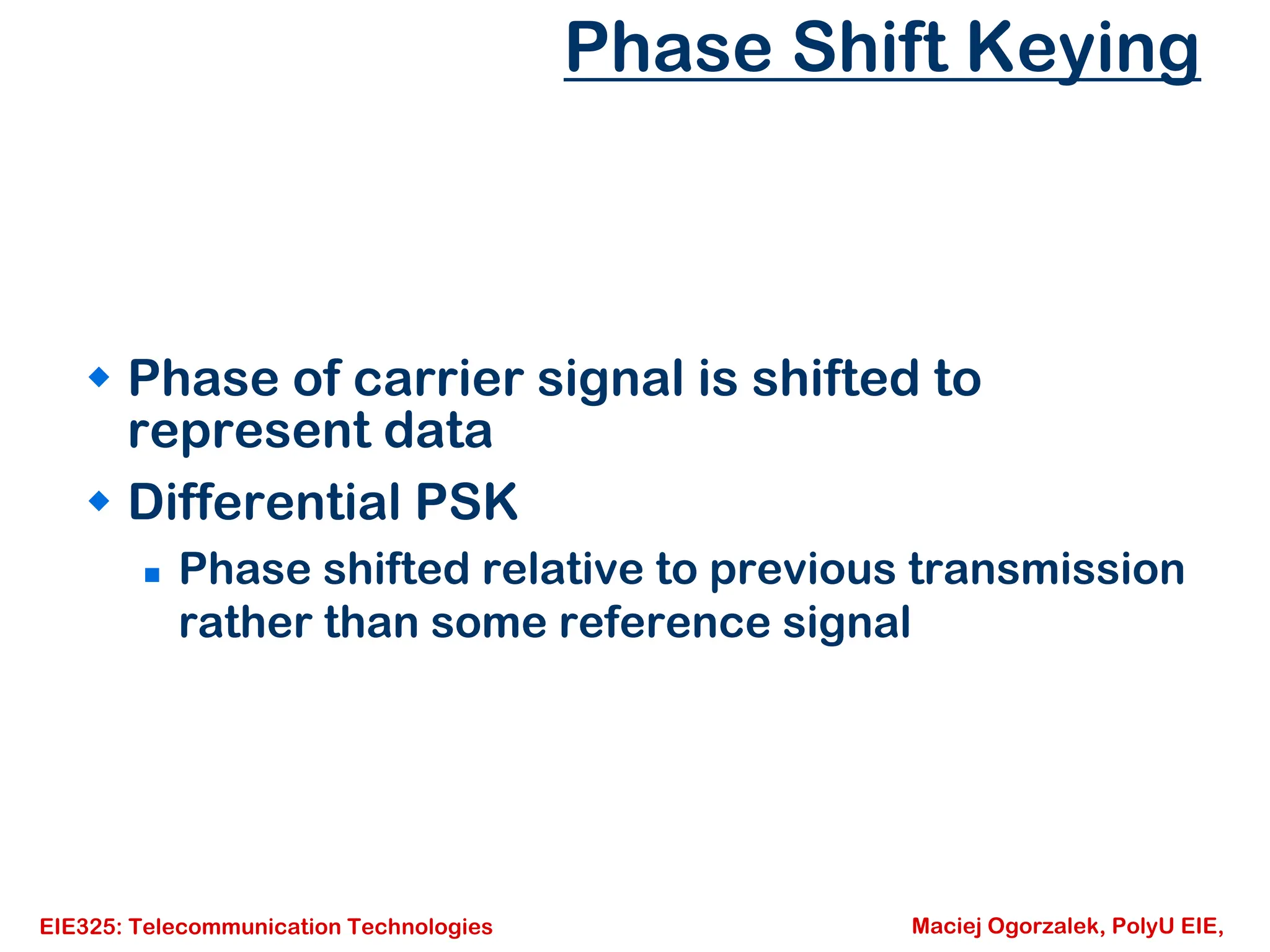
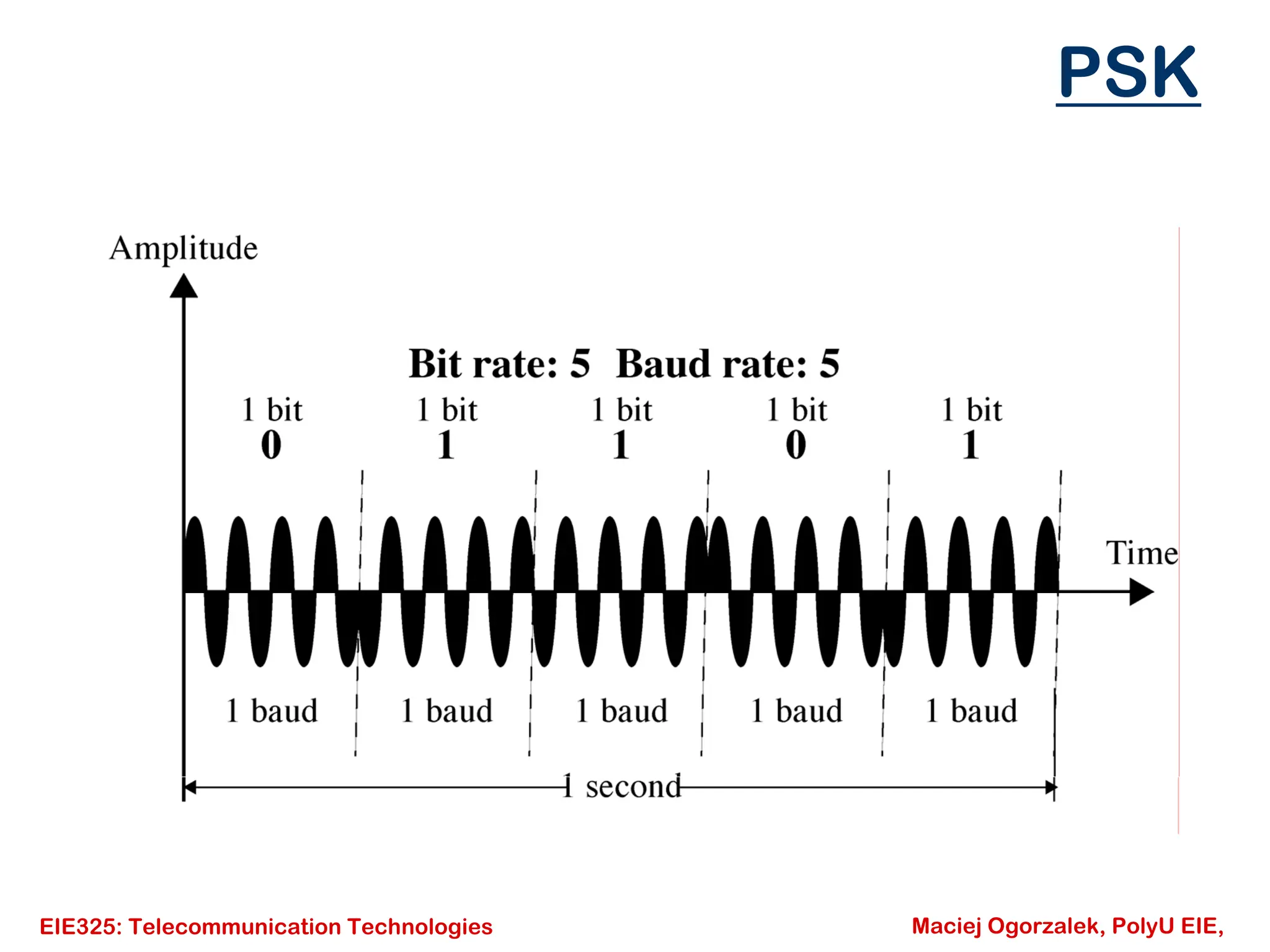
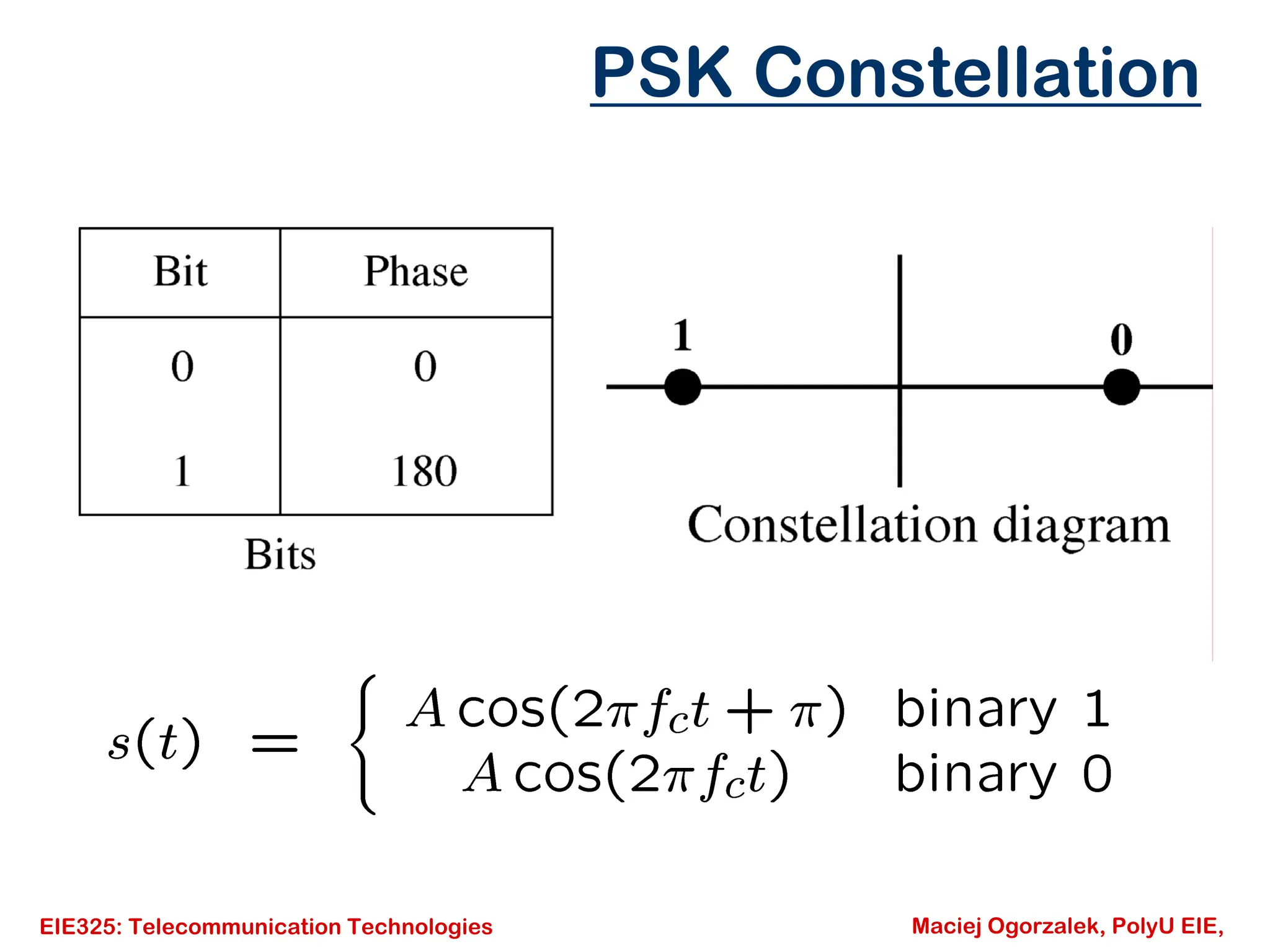
Phase Shift Keying
Š Phase of carrier signal is shifted to
represent data
Š Differential PSK
„ Phase shifted relative to previous transmission
rather than some reference signal
EIE325: Telecommunication Technologies Maciej Ogorzalek, PolyU EIE,
PSK
EIE325: Telecommunication Technologies Maciej Ogorzalek, PolyU EIE,
PSK Constellation
EIE325: Telecommunication Technologies Maciej Ogorzalek, PolyU EIE,
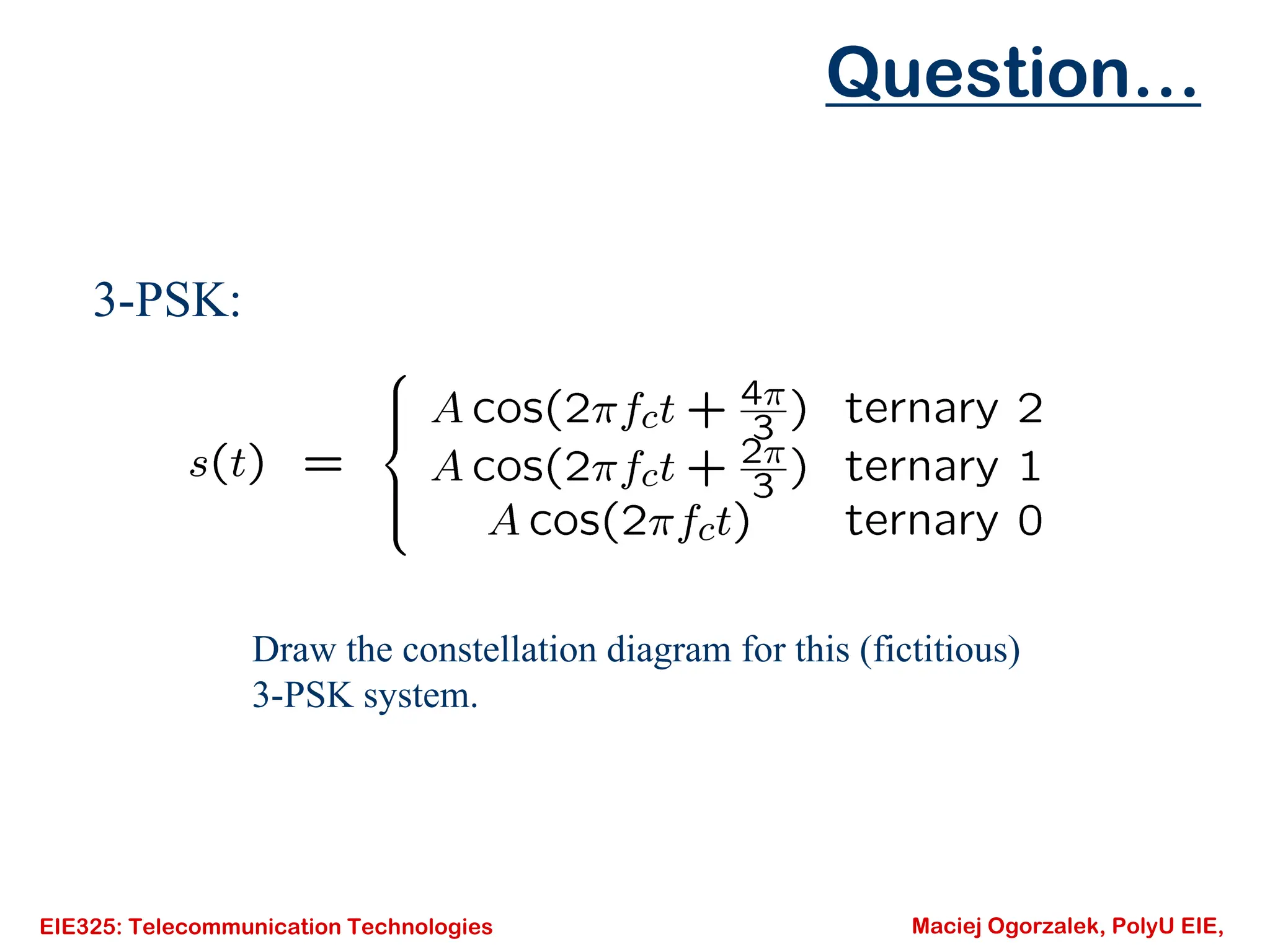
Question…
3-PSK:
Draw the constellation diagram for this (fictitious)
3-PSK system.
EIE325: Telecommunication Technologies Maciej Ogorzalek, PolyU EIE,
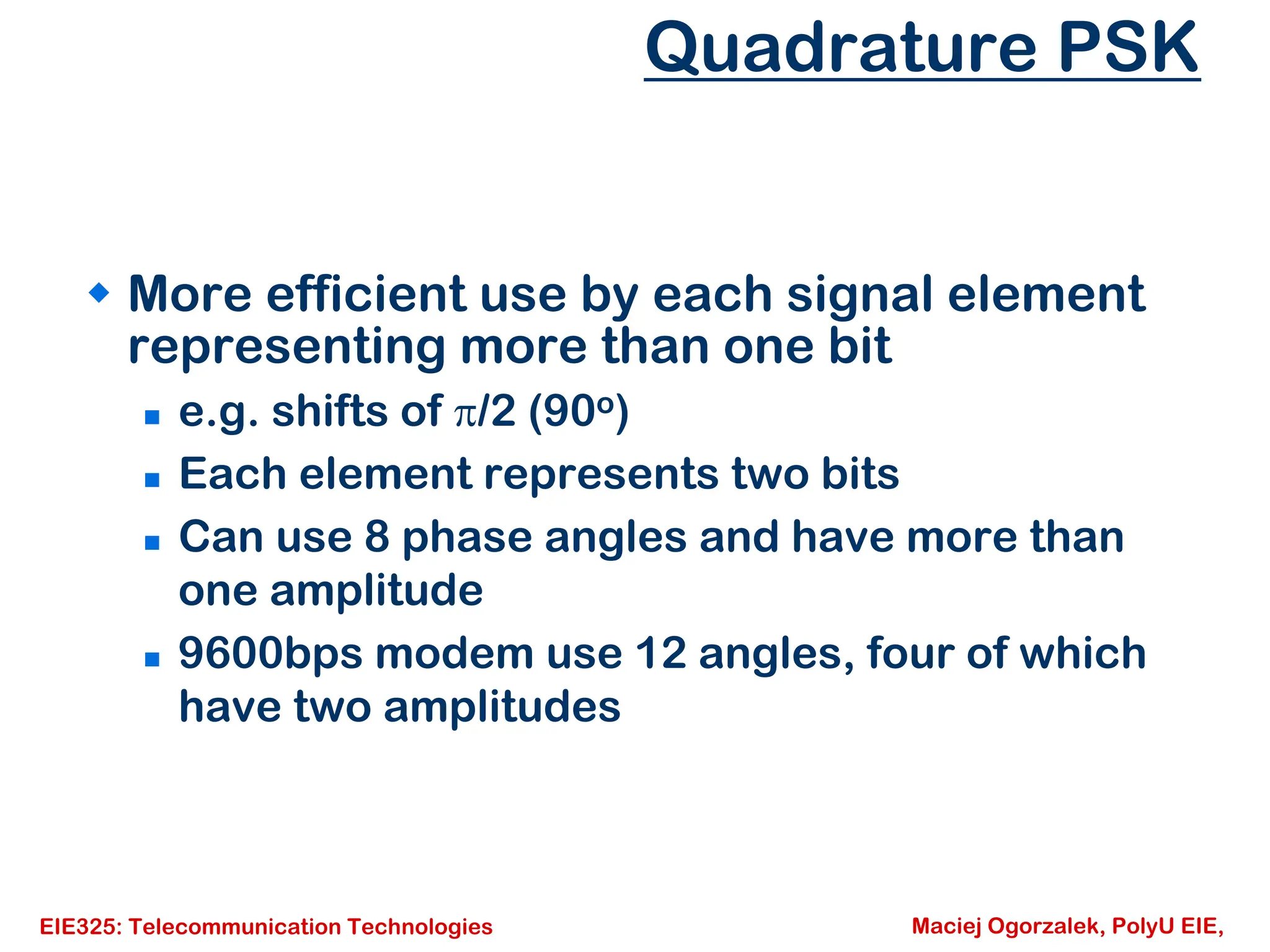
Quadrature PSK
Š More efficient use by each signal element
representing more than one bit
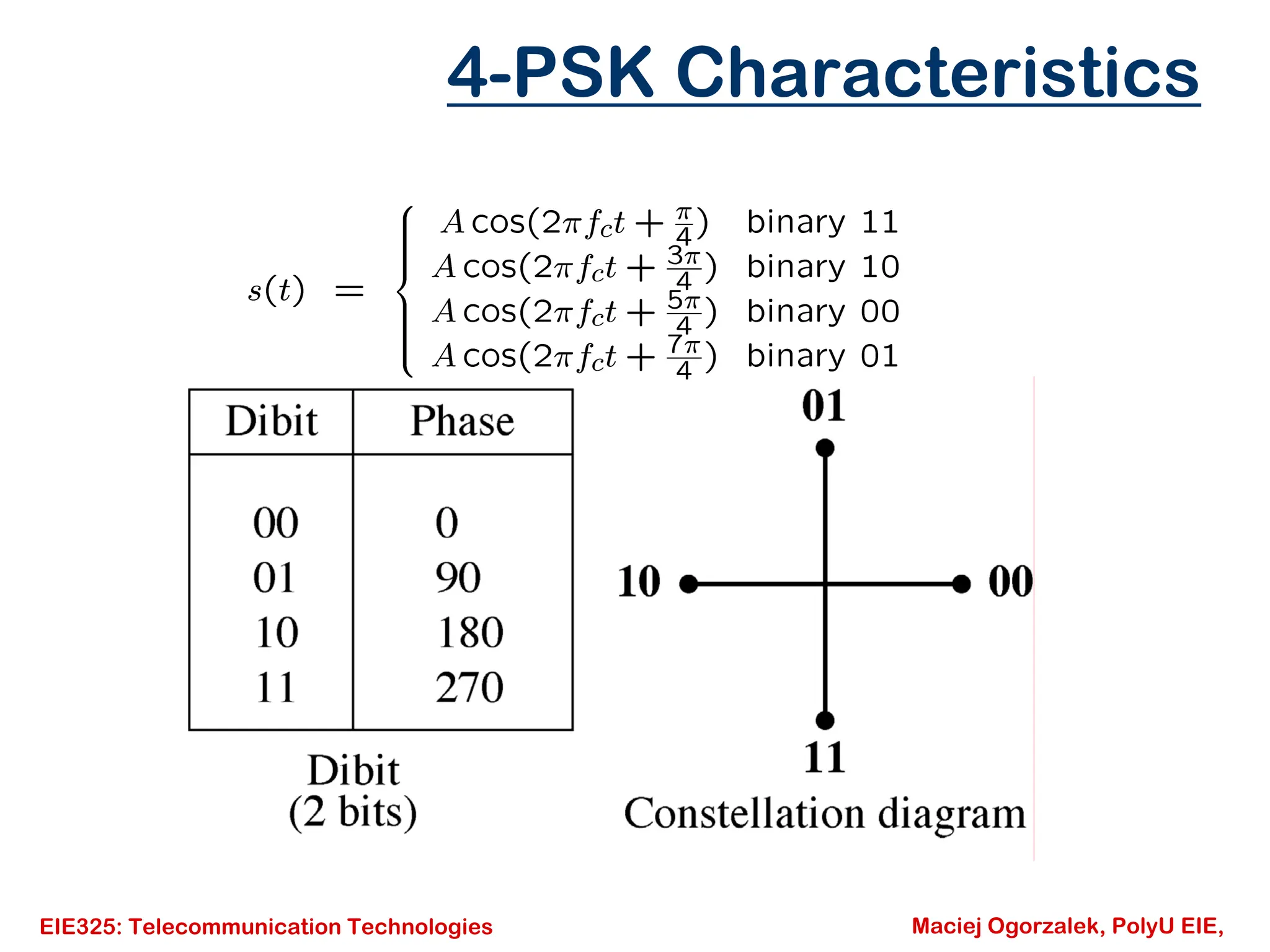
„ e.g. shifts of π/2 (90o)
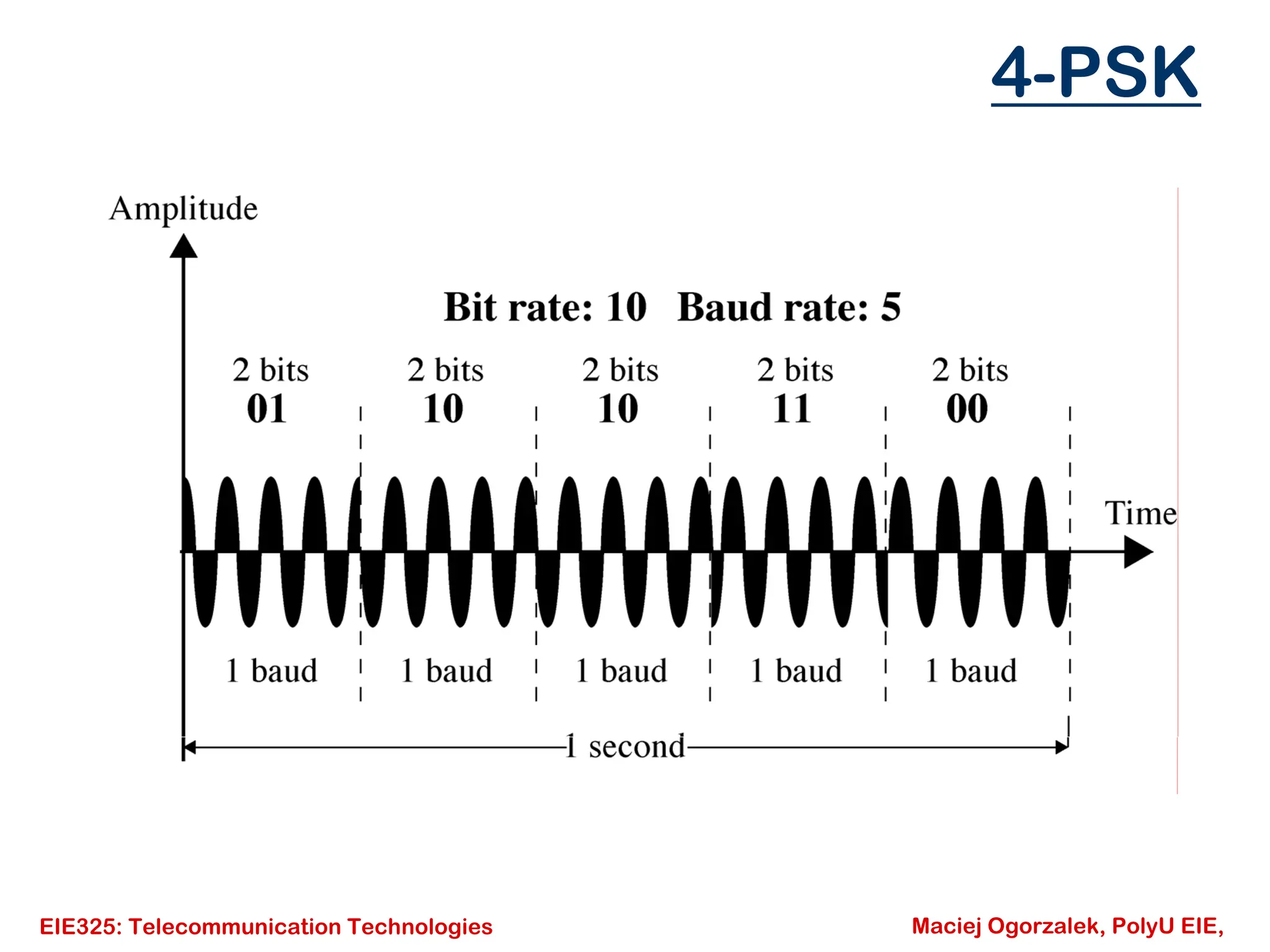
„ Each element represents two bits
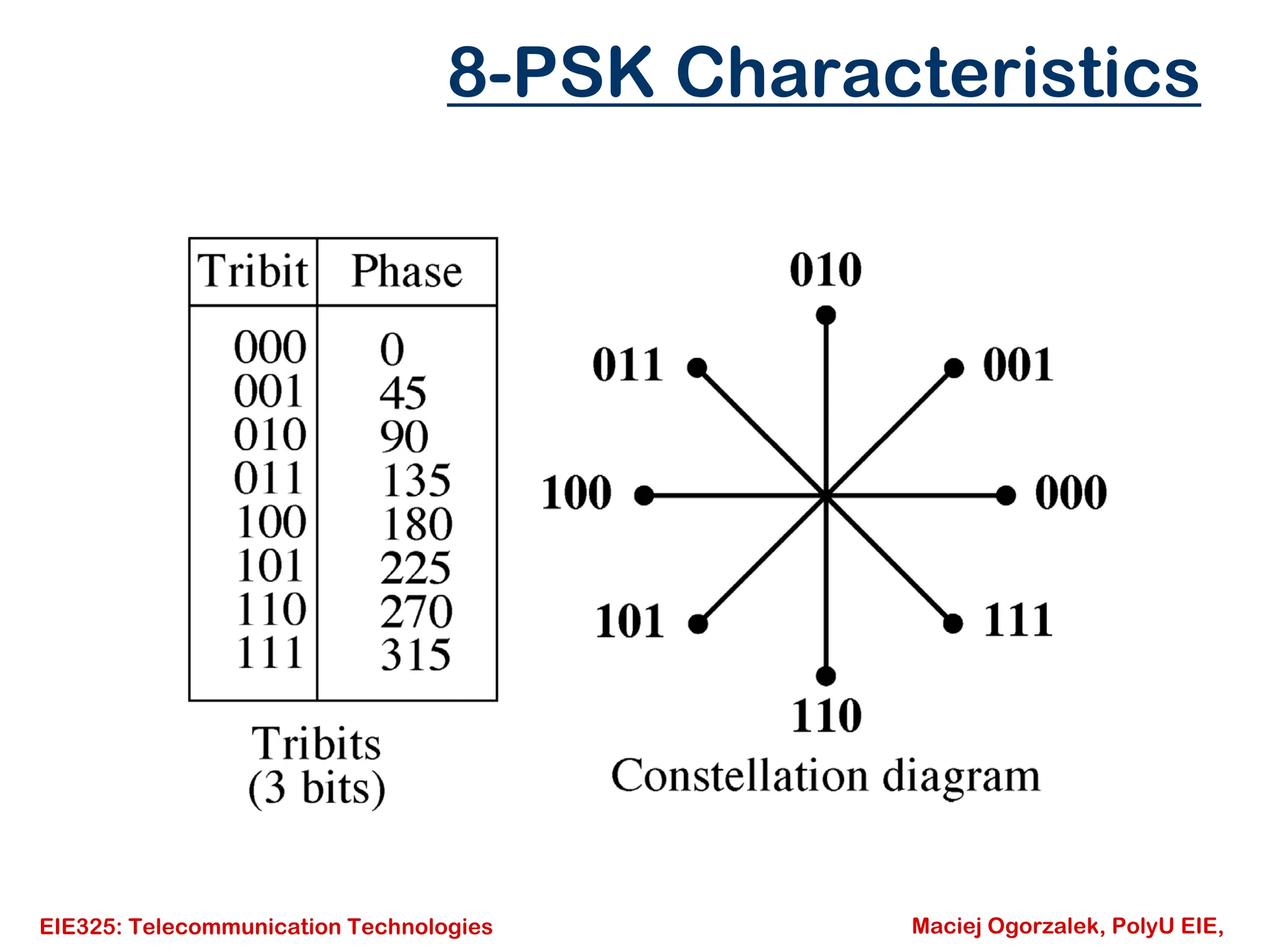
„ Can use 8 phase angles and have more than
one amplitude
„ 9600bps modem use 12 angles, four of which
have two amplitudes
EIE325: Telecommunication Technologies Maciej Ogorzalek, PolyU EIE,
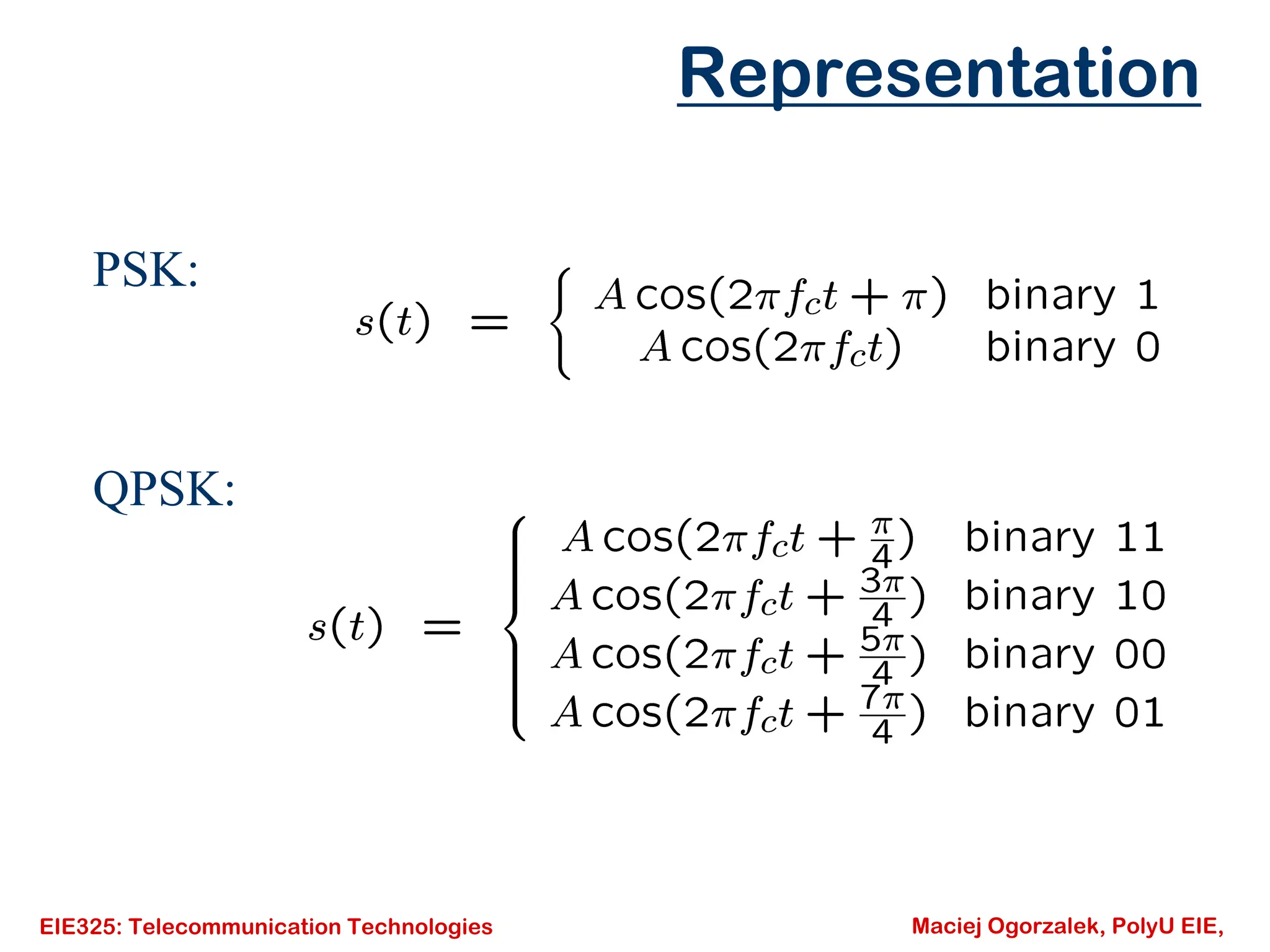
Representation
PSK:
QPSK:
EIE325: Telecommunication Technologies Maciej Ogorzalek, PolyU EIE,
4-PSK
EIE325: Telecommunication Technologies Maciej Ogorzalek, PolyU EIE,
4-PSK Characteristics
EIE325: Telecommunication Technologies Maciej Ogorzalek, PolyU EIE,
8-PSK Characteristics
EIE325: Telecommunication Technologies Maciej Ogorzalek, PolyU EIE,
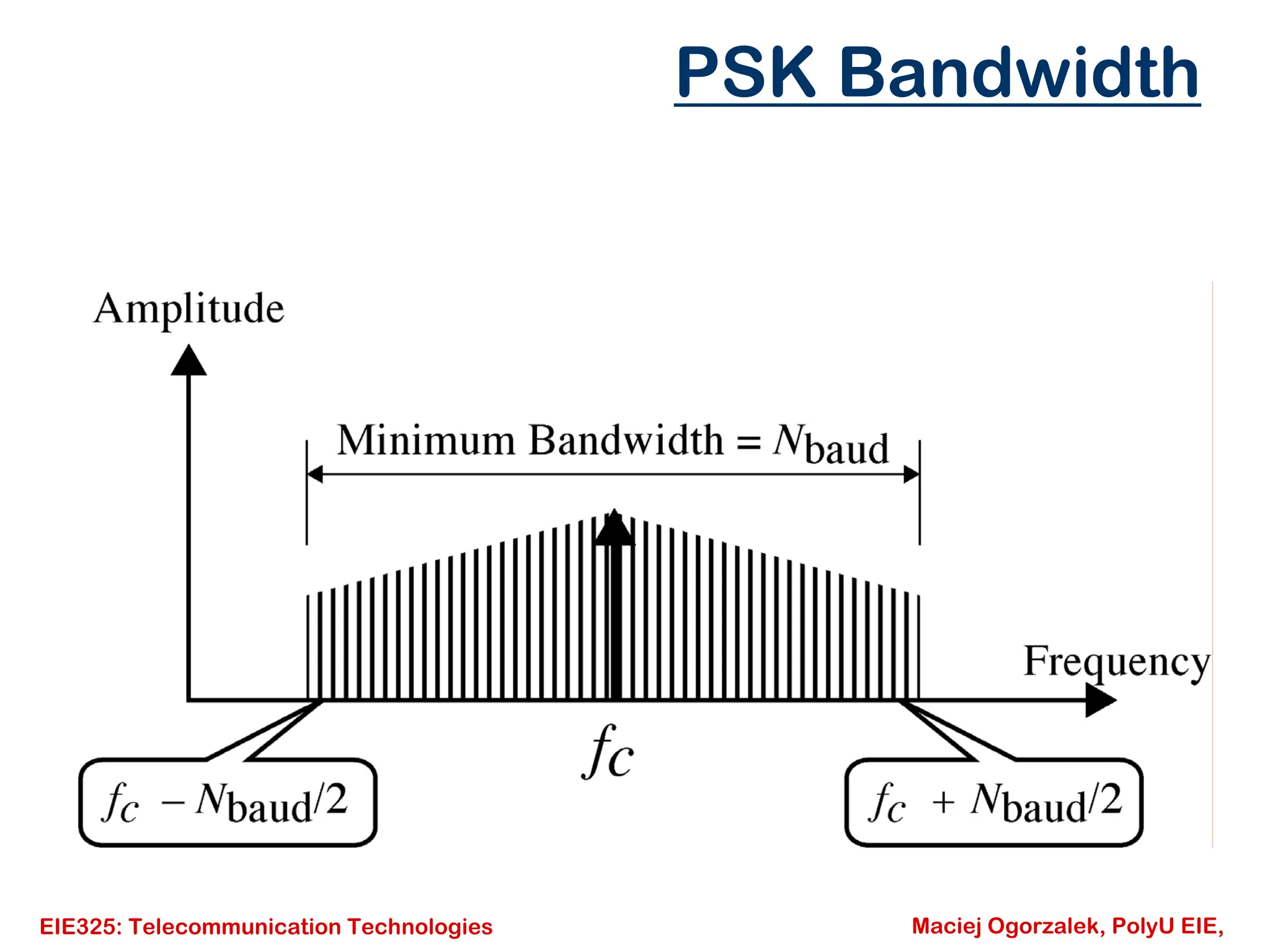
PSK Bandwidth
EIE325: Telecommunication Technologies Maciej Ogorzalek, PolyU EIE,
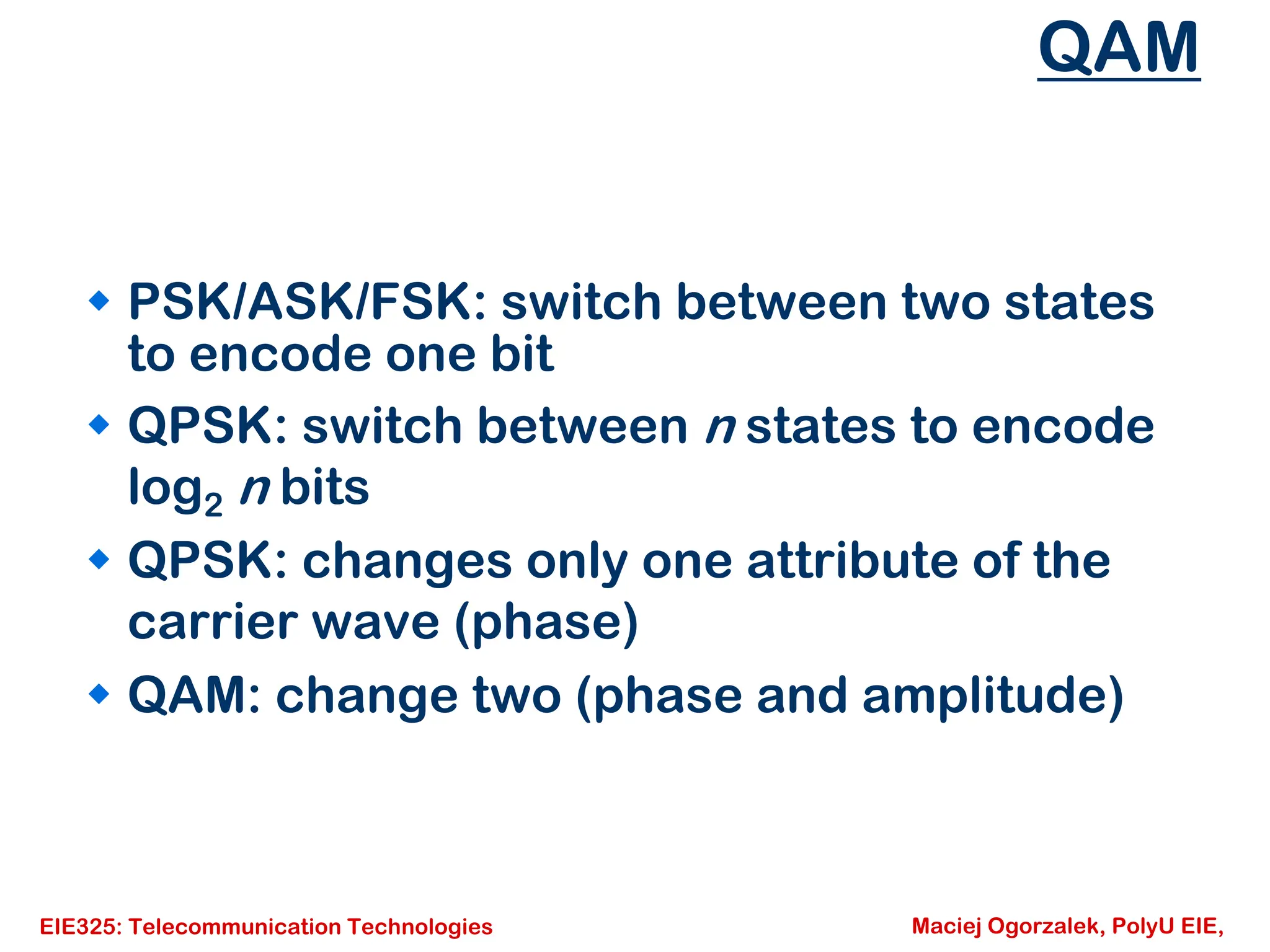
QAM
Š PSK/ASK/FSK: switch between two states
to encode one bit
Š QPSK: switch between n states to encode
log2 n bits
Š QPSK: changes only one attribute of the
carrier wave (phase)
Š QAM: change two (phase and amplitude)
EIE325: Telecommunication Technologies Maciej Ogorzalek, PolyU EIE,
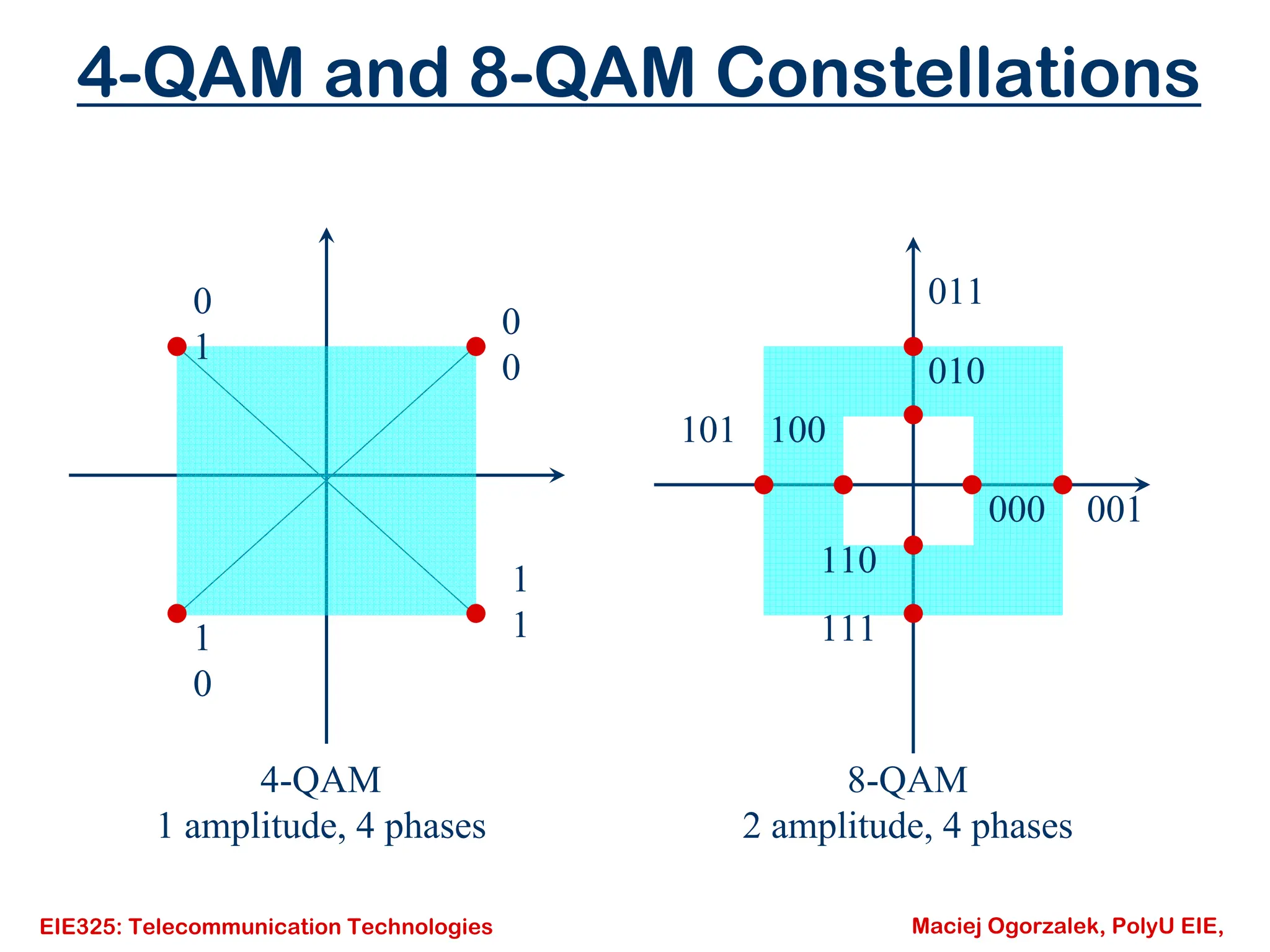
4-QAM and 8-QAM Constellations
0
0
1
1
0
1
1
0
101 100
011
010
000 001
110
111
4-QAM
1 amplitude, 4 phases
8-QAM
2 amplitude, 4 phases
EIE325: Telecommunication Technologies Maciej Ogorzalek, PolyU EIE,
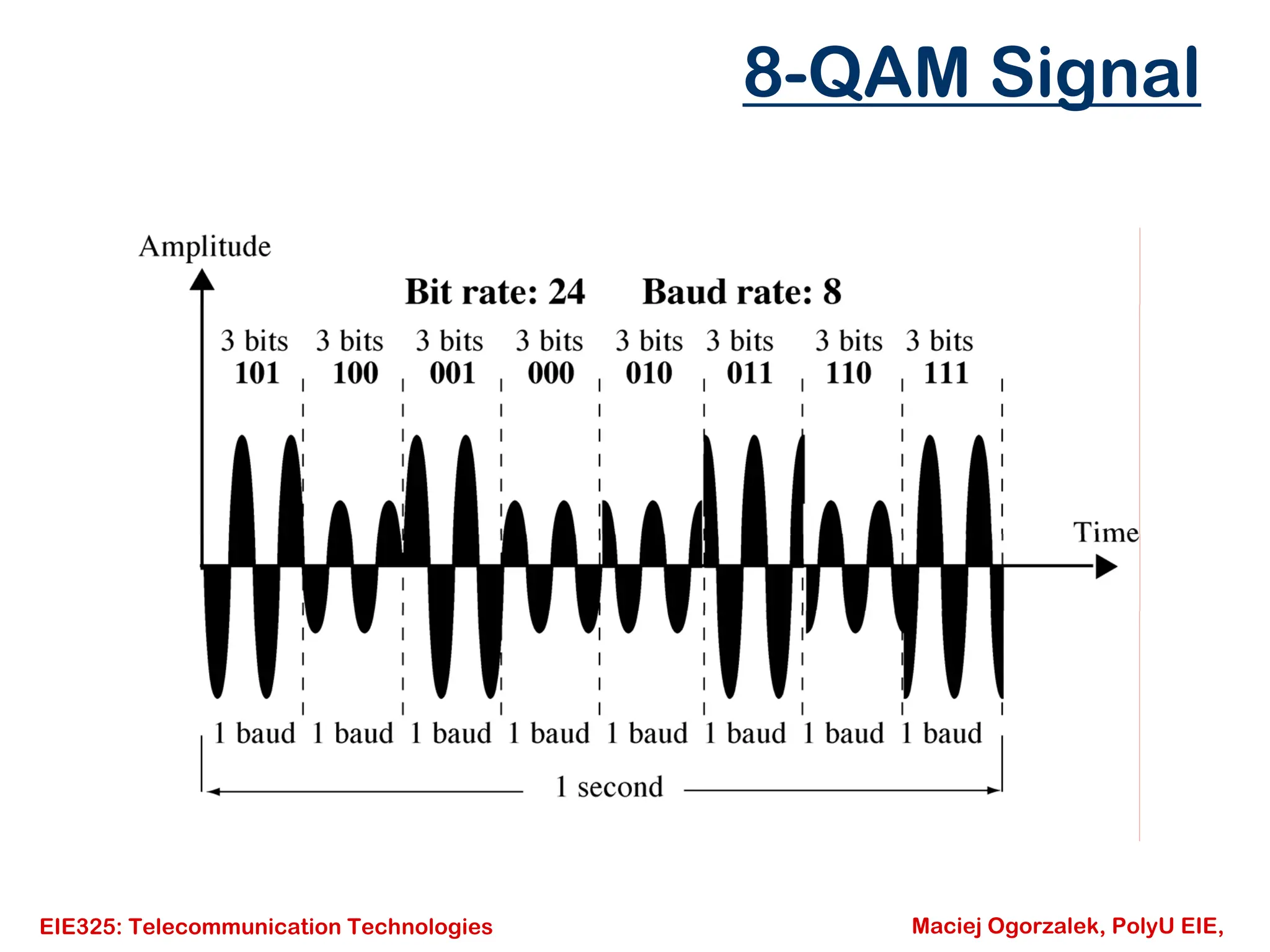
8-QAM Signal
EIE325: Telecommunication Technologies Maciej Ogorzalek, PolyU EIE,
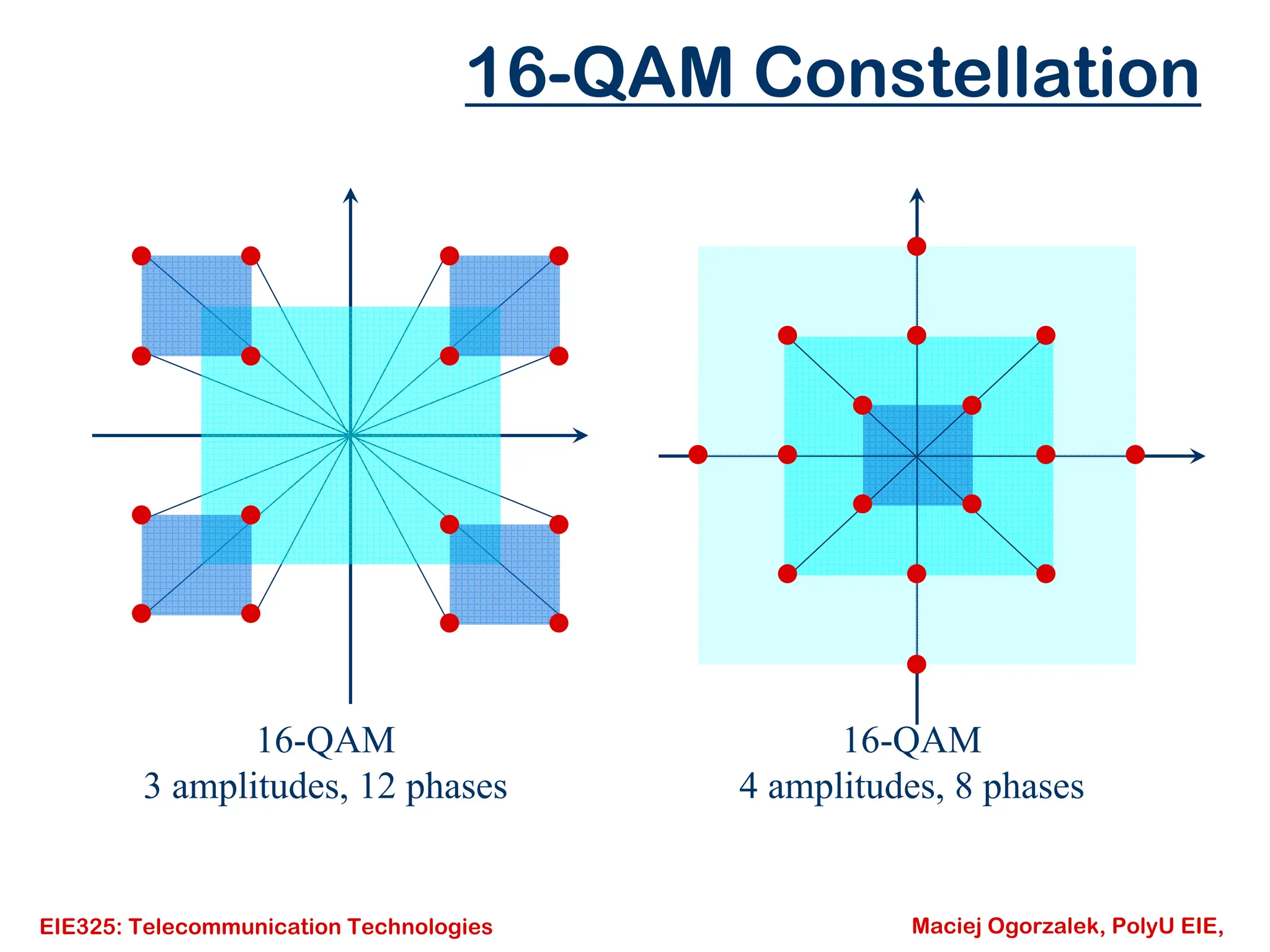
16-QAM Constellation
16-QAM
3 amplitudes, 12 phases
16-QAM
4 amplitudes, 8 phases
EIE325: Telecommunication Technologies Maciej Ogorzalek, PolyU EIE,
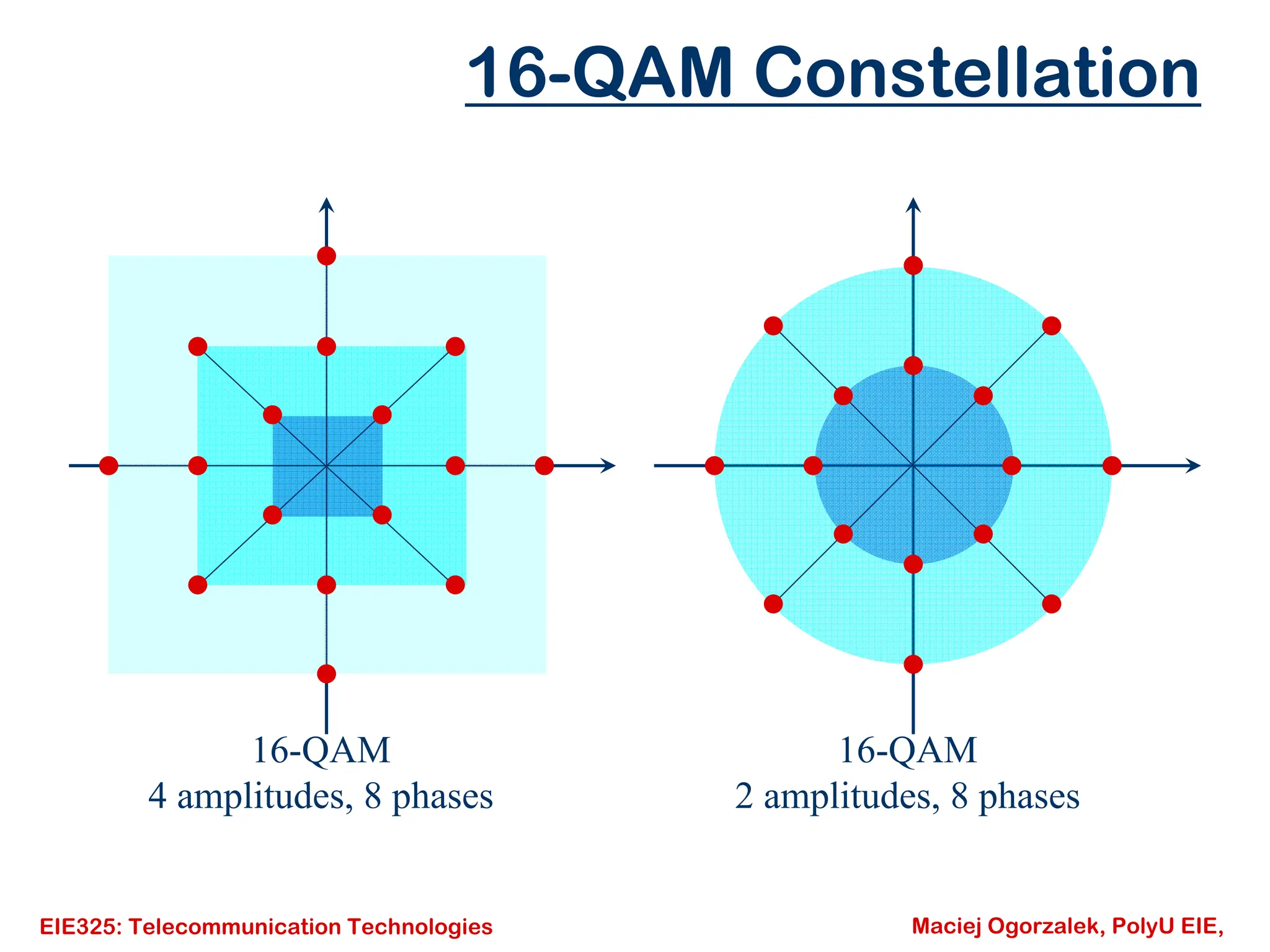
16-QAM Constellation
16-QAM
4 amplitudes, 8 phases
16-QAM
2 amplitudes, 8 phases
EIE325: Telecommunication Technologies Maciej Ogorzalek, PolyU EIE,
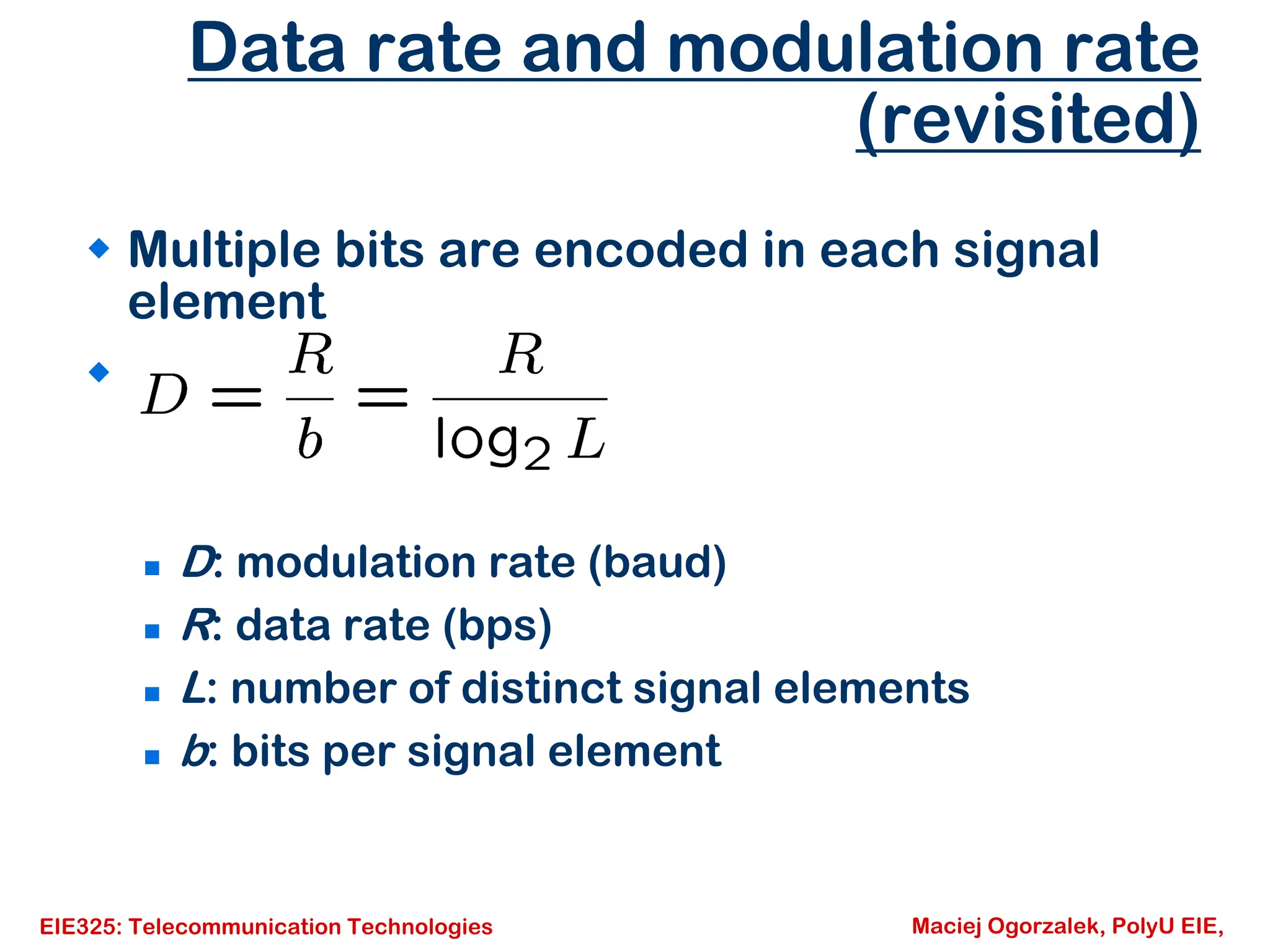
Data rate and modulation rate
(revisited)
Š Multiple bits are encoded in each signal
element
Š
„ D: modulation rate (baud)
„ R: data rate (bps)
„ L: number of distinct signal elements
„ b: bits per signal element
EIE325: Telecommunication Technologies Maciej Ogorzalek, PolyU EIE,
Performance of Digital to Analog
Modulation Schemes
Š Bandwidth
„ ASK and PSK bandwidth directly related to bit
rate
„ FSK bandwidth related to data rate for lower
frequencies, but to offset of modulated
frequency from carrier at high frequencies
„ See text (pg. 146-148) for example
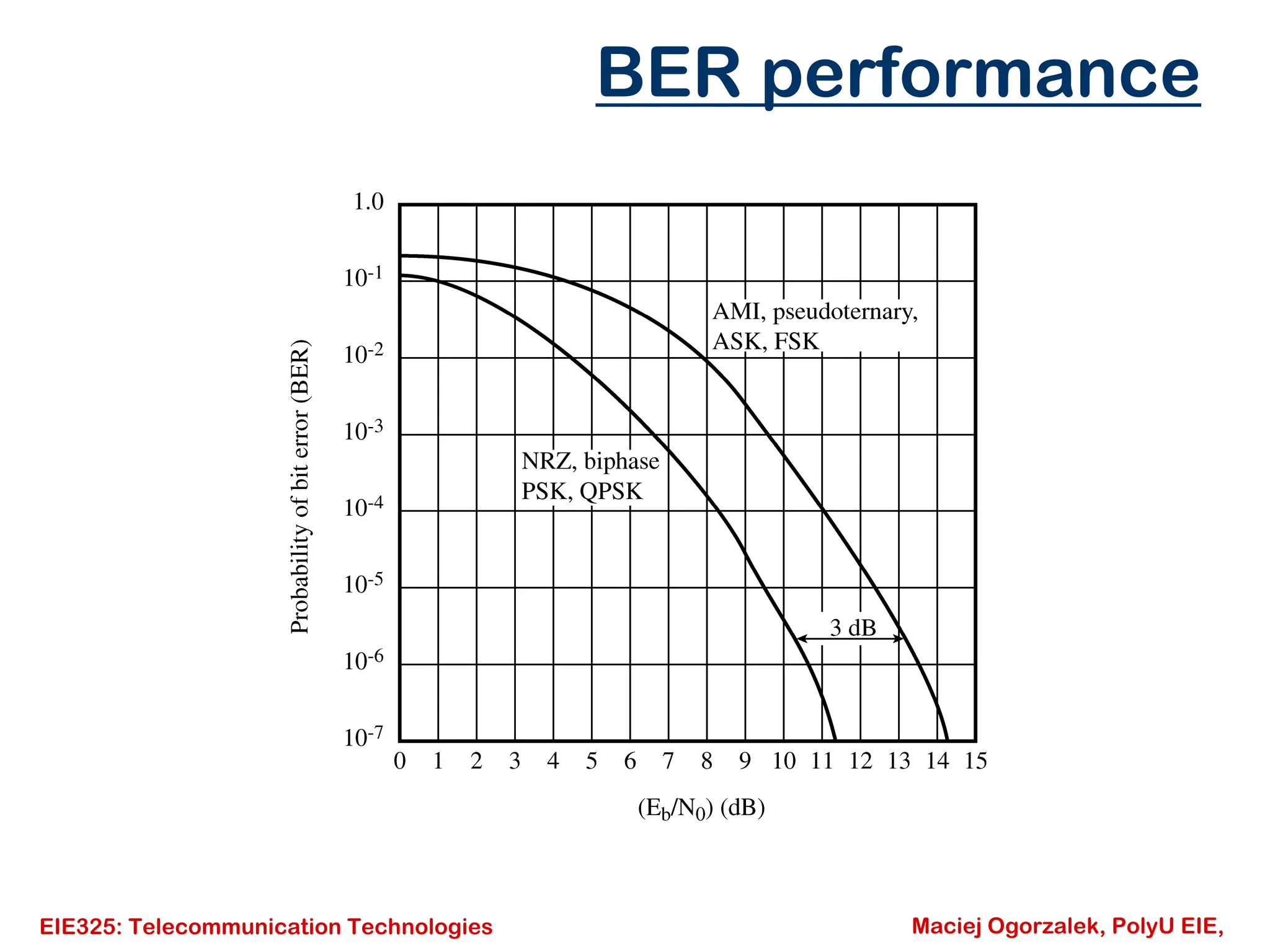
Š In the presence of noise, bit error rate of
PSK and QPSK are about 3dB superior to
ASK and FSK
EIE325: Telecommunication Technologies Maciej Ogorzalek, PolyU EIE,
BER performance
EIE325: Telecommunication Technologies Maciej Ogorzalek, PolyU EIE,
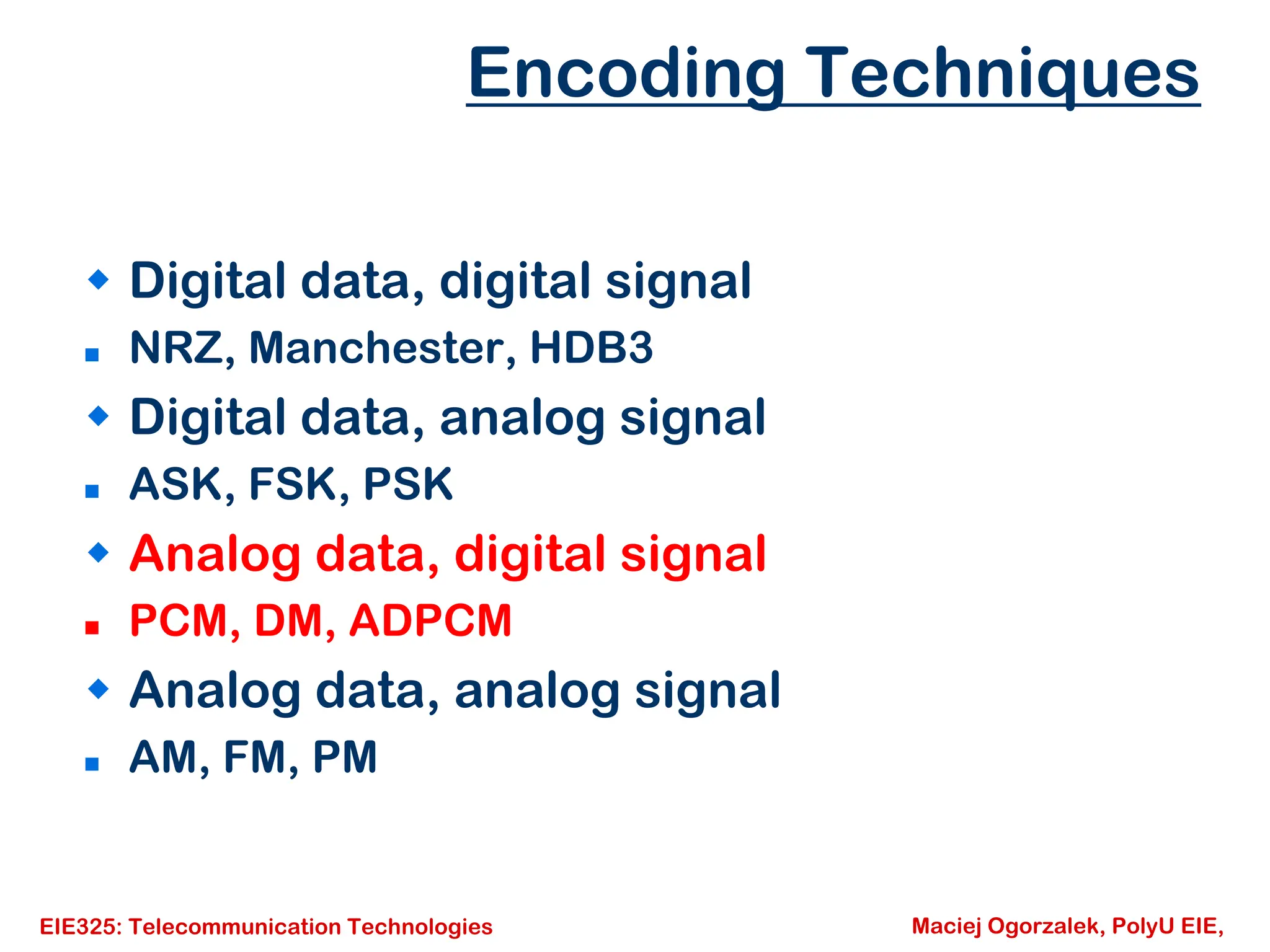
Š Digital data, digital signal
„ NRZ, Manchester, HDB3
Š Digital data, analog signal
„ ASK, FSK, PSK
Š Analog data, digital signal
„ PCM, DM, ADPCM
Š Analog data, analog signal
„ AM, FM, PM
Encoding Techniques
EIE325: Telecommunication Technologies Maciej Ogorzalek, PolyU EIE,
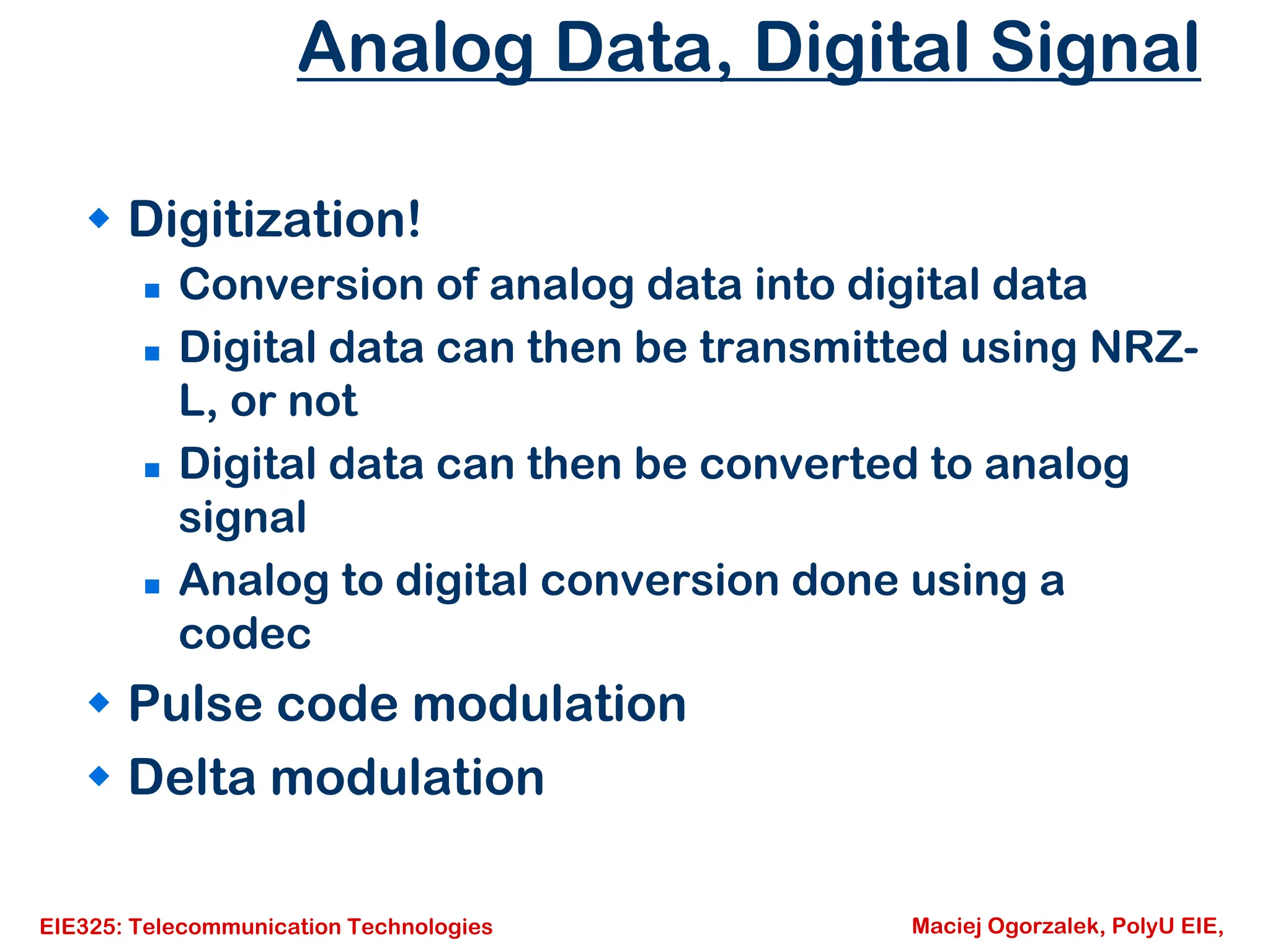
Analog Data, Digital Signal
Š Digitization!
„ Conversion of analog data into digital data
„ Digital data can then be transmitted using NRZ-
L, or not
„ Digital data can then be converted to analog
signal
„ Analog to digital conversion done using a
codec
Š Pulse code modulation
Š Delta modulation
EIE325: Telecommunication Technologies Maciej Ogorzalek, PolyU EIE,
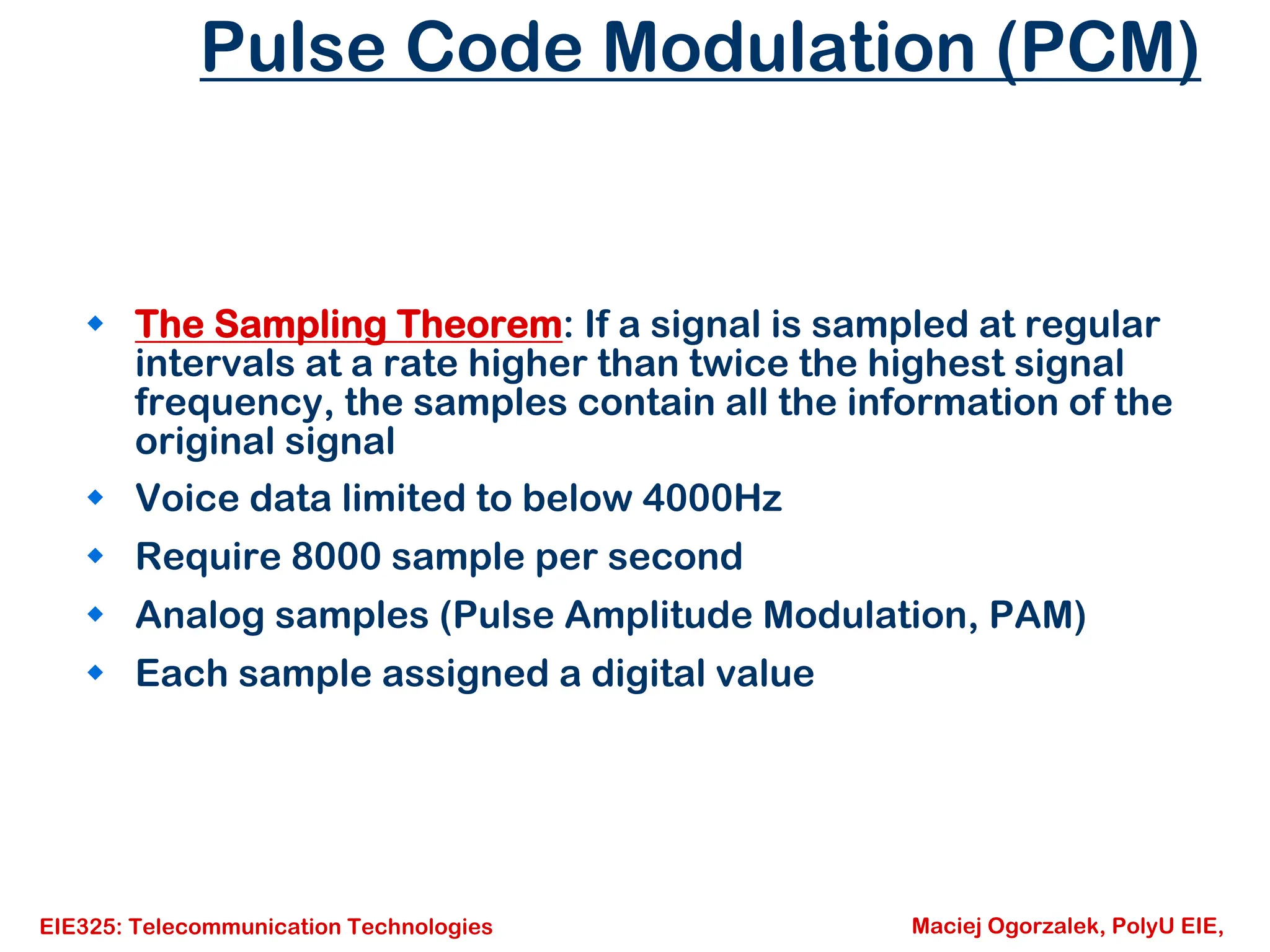
Pulse Code Modulation (PCM)
Š The Sampling Theorem: If a signal is sampled at regular
intervals at a rate higher than twice the highest signal
frequency, the samples contain all the information of the
original signal
Š Voice data limited to below 4000Hz
Š Require 8000 sample per second
Š Analog samples (Pulse Amplitude Modulation, PAM)
Š Each sample assigned a digital value
EIE325: Telecommunication Technologies Maciej Ogorzalek, PolyU EIE,
Pulse Code Modulation (PCM)
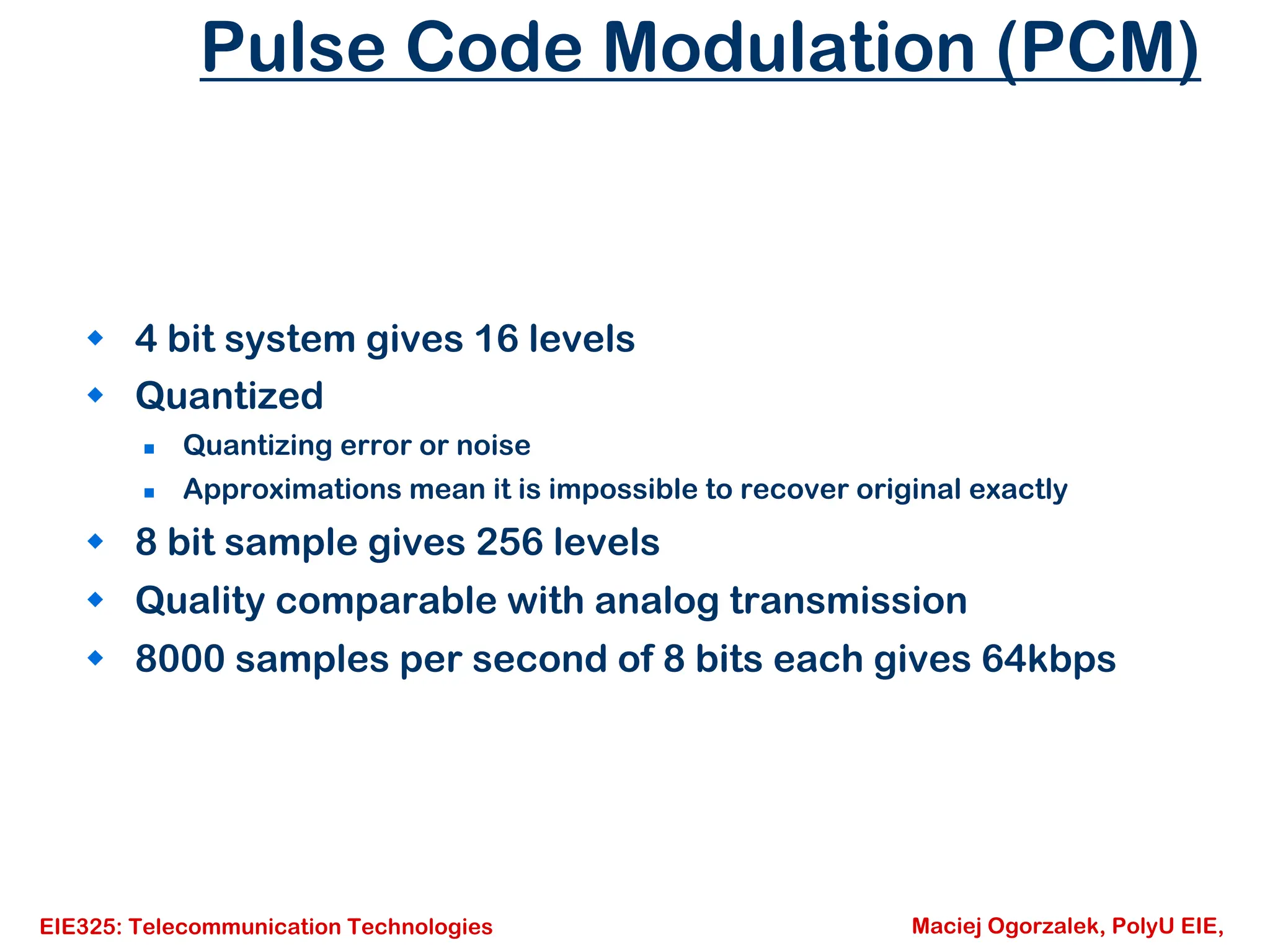
Š 4 bit system gives 16 levels
Š Quantized
„ Quantizing error or noise
„ Approximations mean it is impossible to recover original exactly
Š 8 bit sample gives 256 levels
Š Quality comparable with analog transmission
Š 8000 samples per second of 8 bits each gives 64kbps
EIE325: Telecommunication Technologies Maciej Ogorzalek, PolyU EIE,
Digital takes more bandwidth
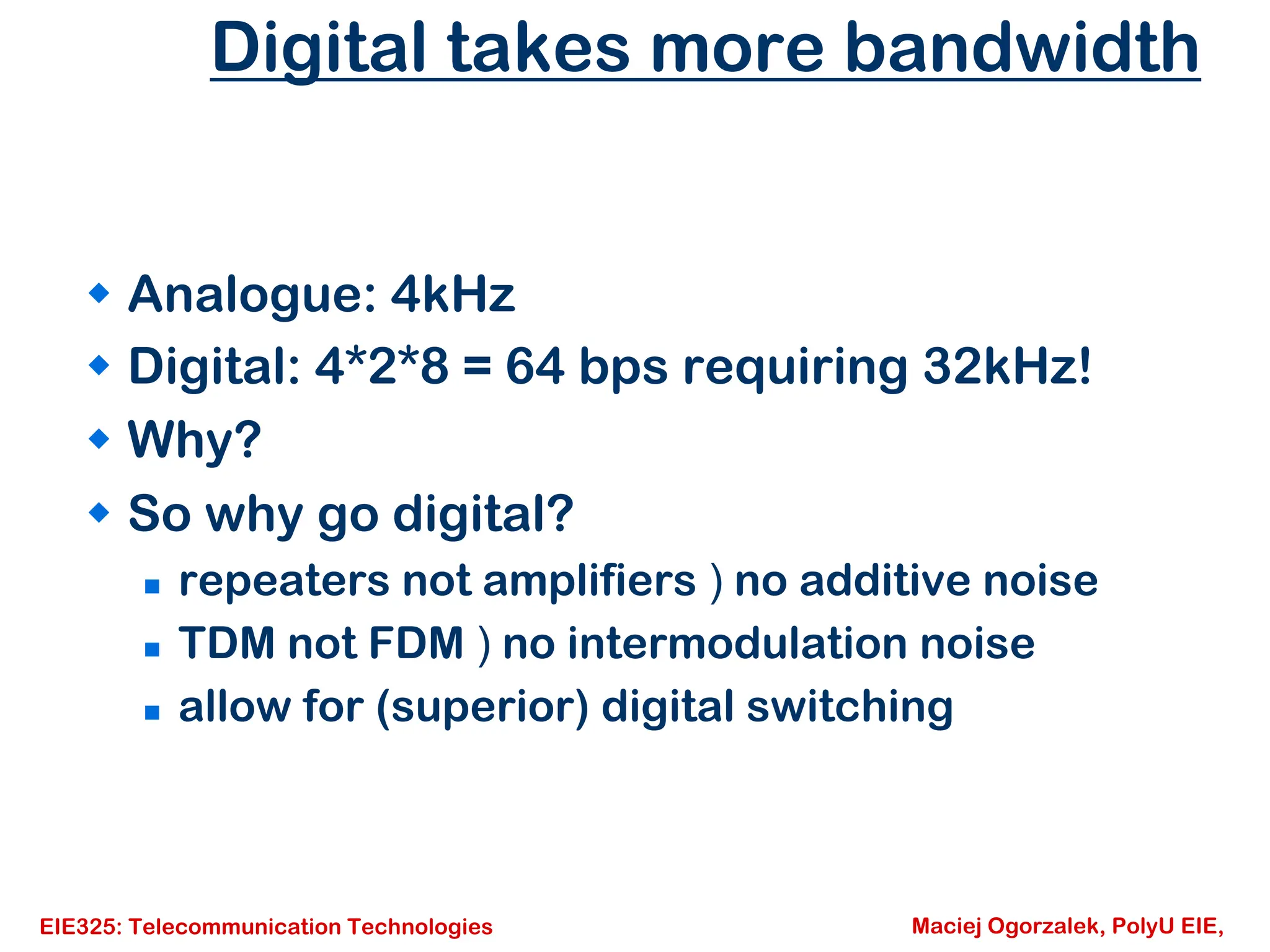
Š Analogue: 4kHz
Š Digital: 4*2*8 = 64 bps requiring 32kHz!
Š Why?
Š So why go digital?
„ repeaters not amplifiers ) no additive noise
„ TDM not FDM ) no intermodulation noise
„ allow for (superior) digital switching
EIE325: Telecommunication Technologies Maciej Ogorzalek, PolyU EIE,
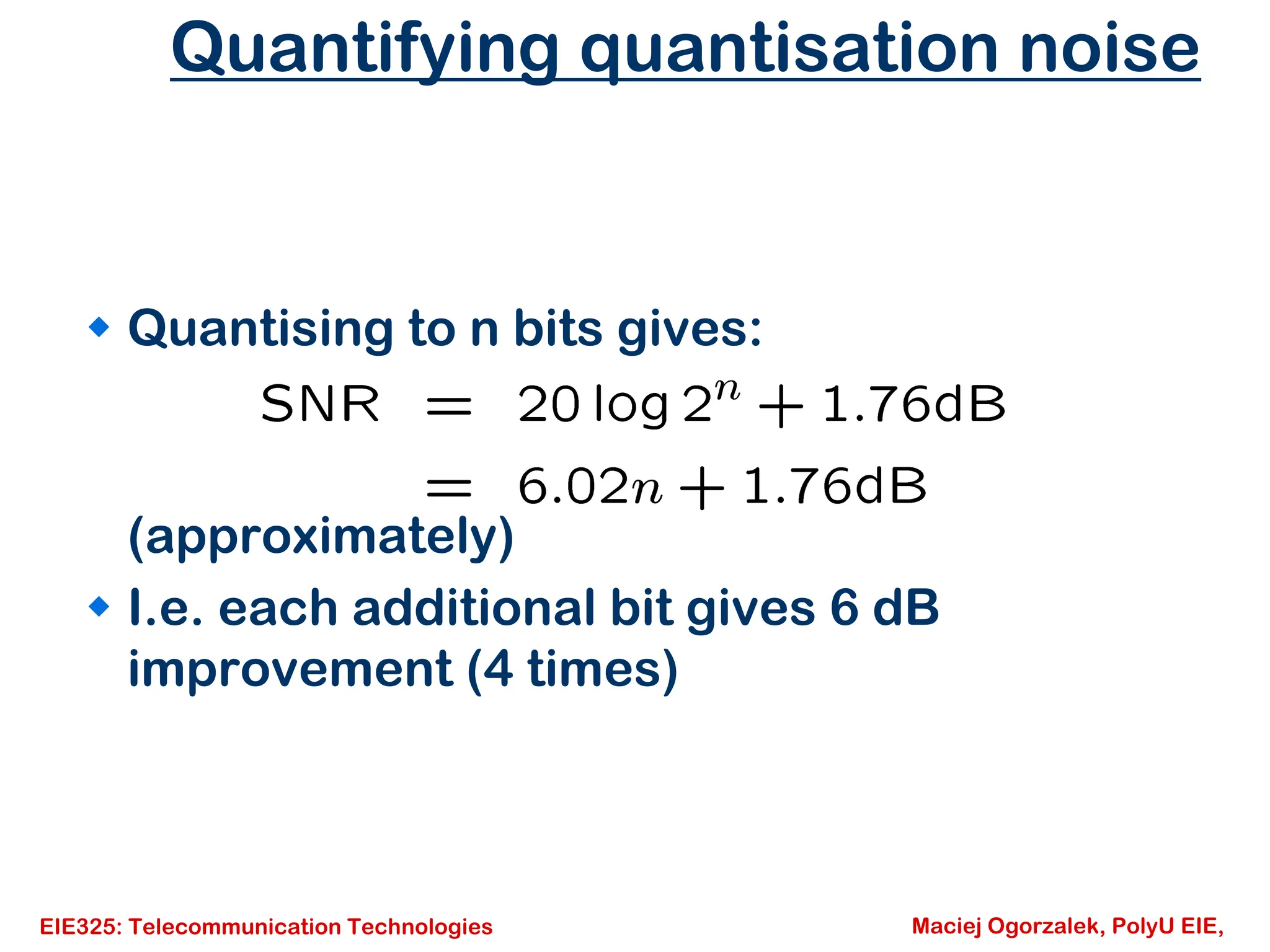
Quantifying quantisation noise
Š Quantising to n bits gives:
(approximately)
Š I.e. each additional bit gives 6 dB
improvement (4 times)
EIE325: Telecommunication Technologies Maciej Ogorzalek, PolyU EIE,
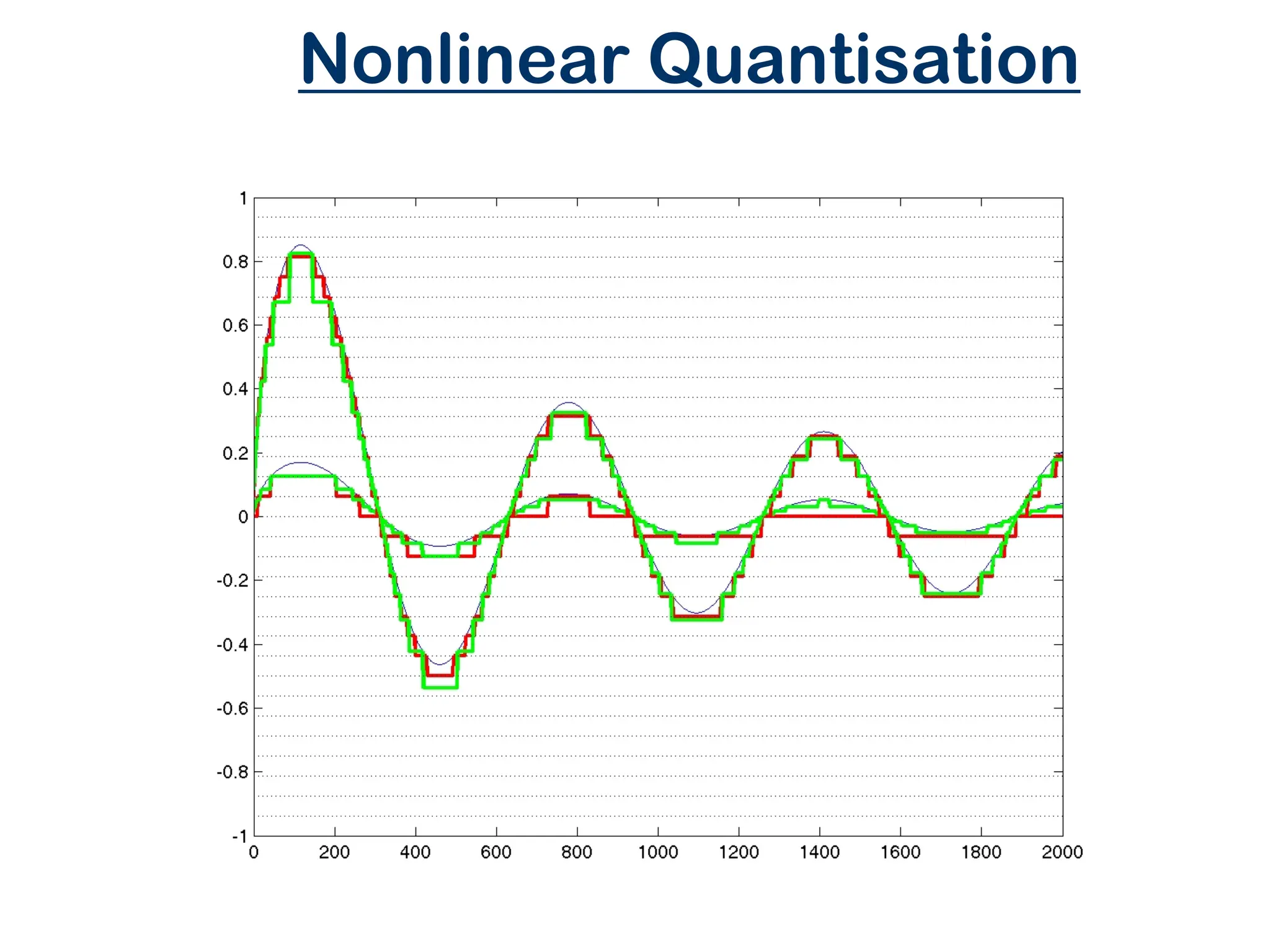
Nonlinear Encoding
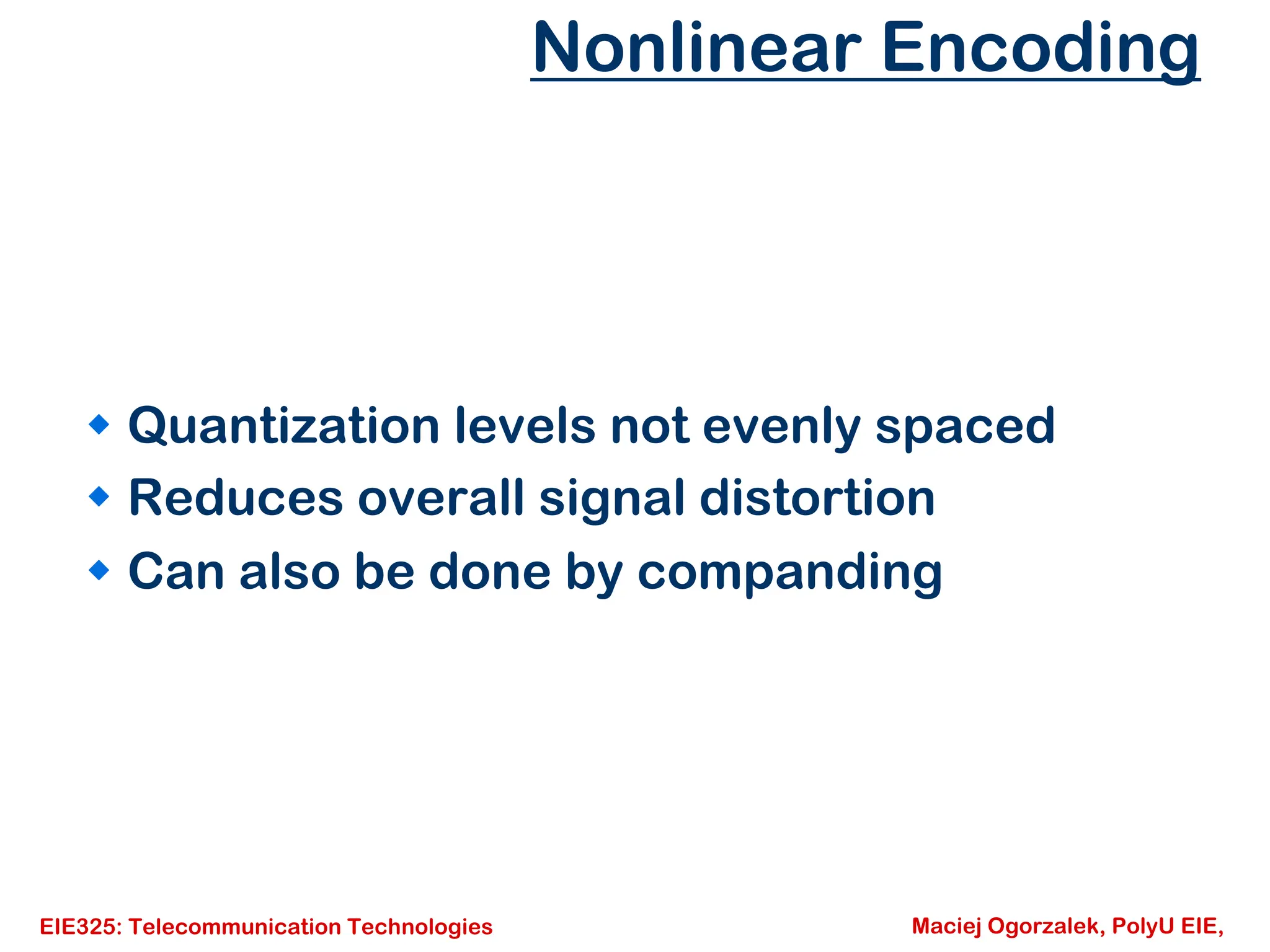
Š Quantization levels not evenly spaced
Š Reduces overall signal distortion
Š Can also be done by companding
Nonlinear Quantisation
EIE325: Telecommunication Technologies Maciej Ogorzalek, PolyU EIE,
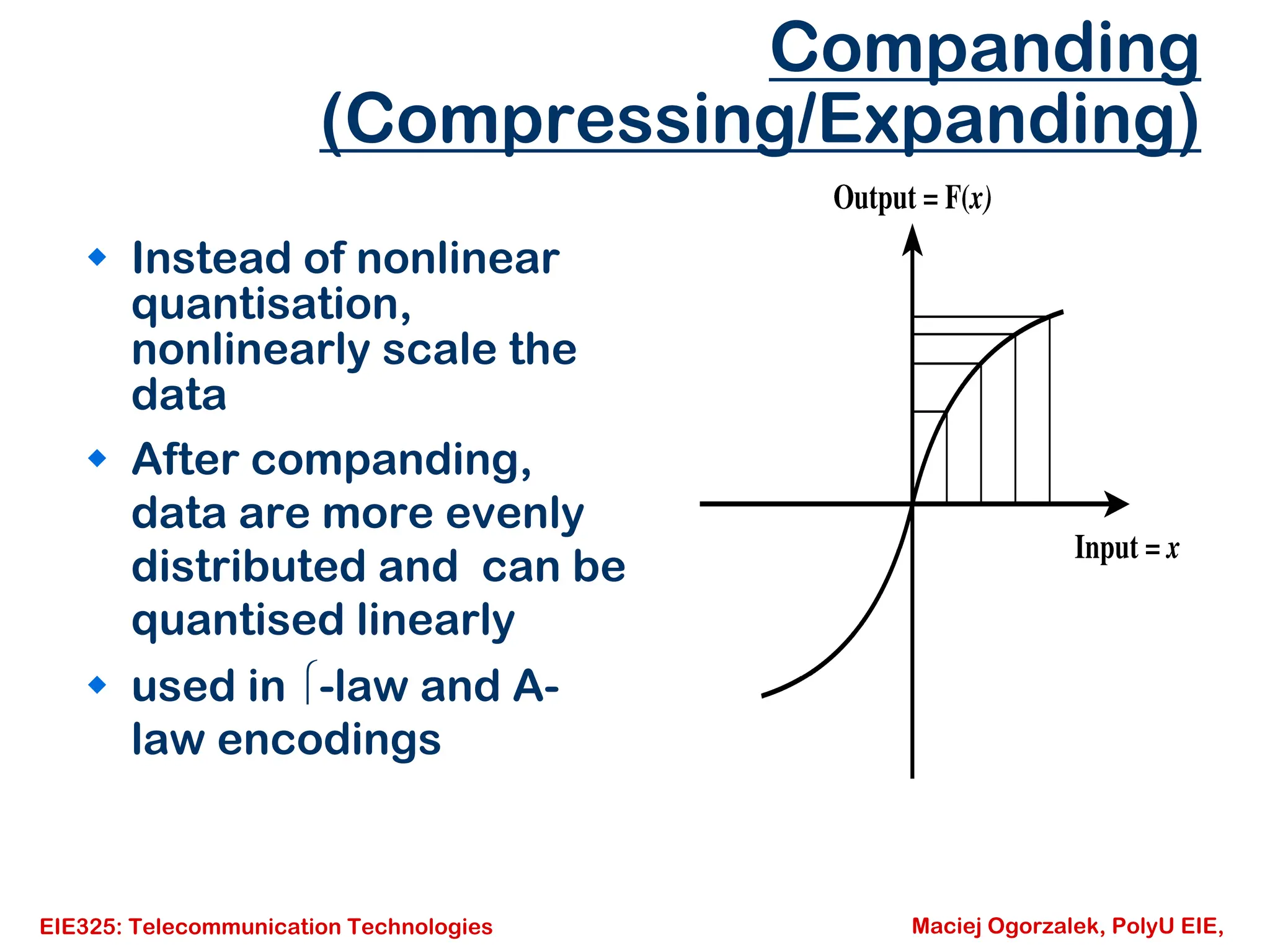
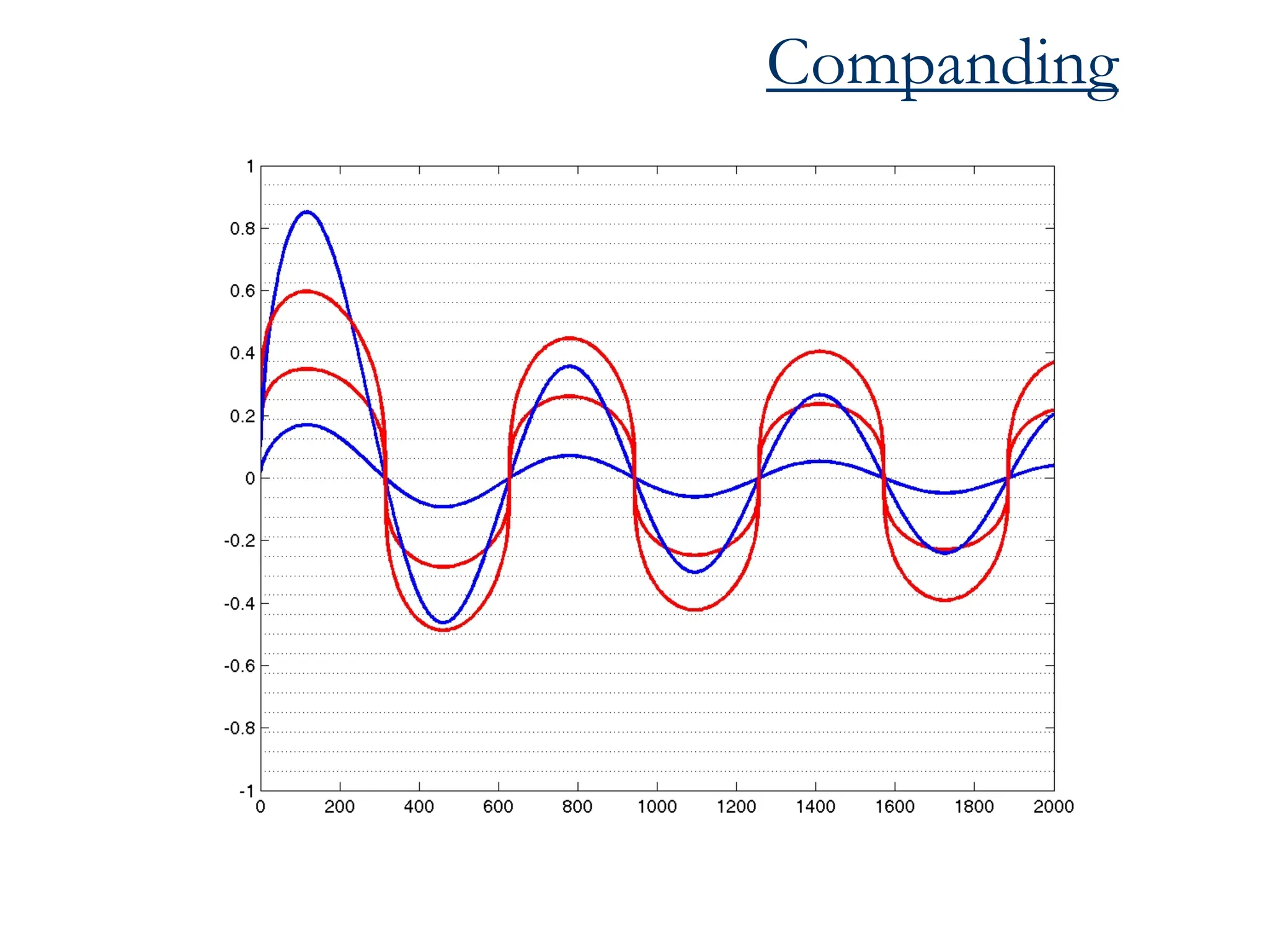
Companding
(Compressing/Expanding)
Š Instead of nonlinear
quantisation,
nonlinearly scale the
data
Š After companding,
data are more evenly
distributed and can be
quantised linearly
Š used in ⎧-law and A-
law encodings
Companding
EIE325: Telecommunication Technologies Maciej Ogorzalek, PolyU EIE,
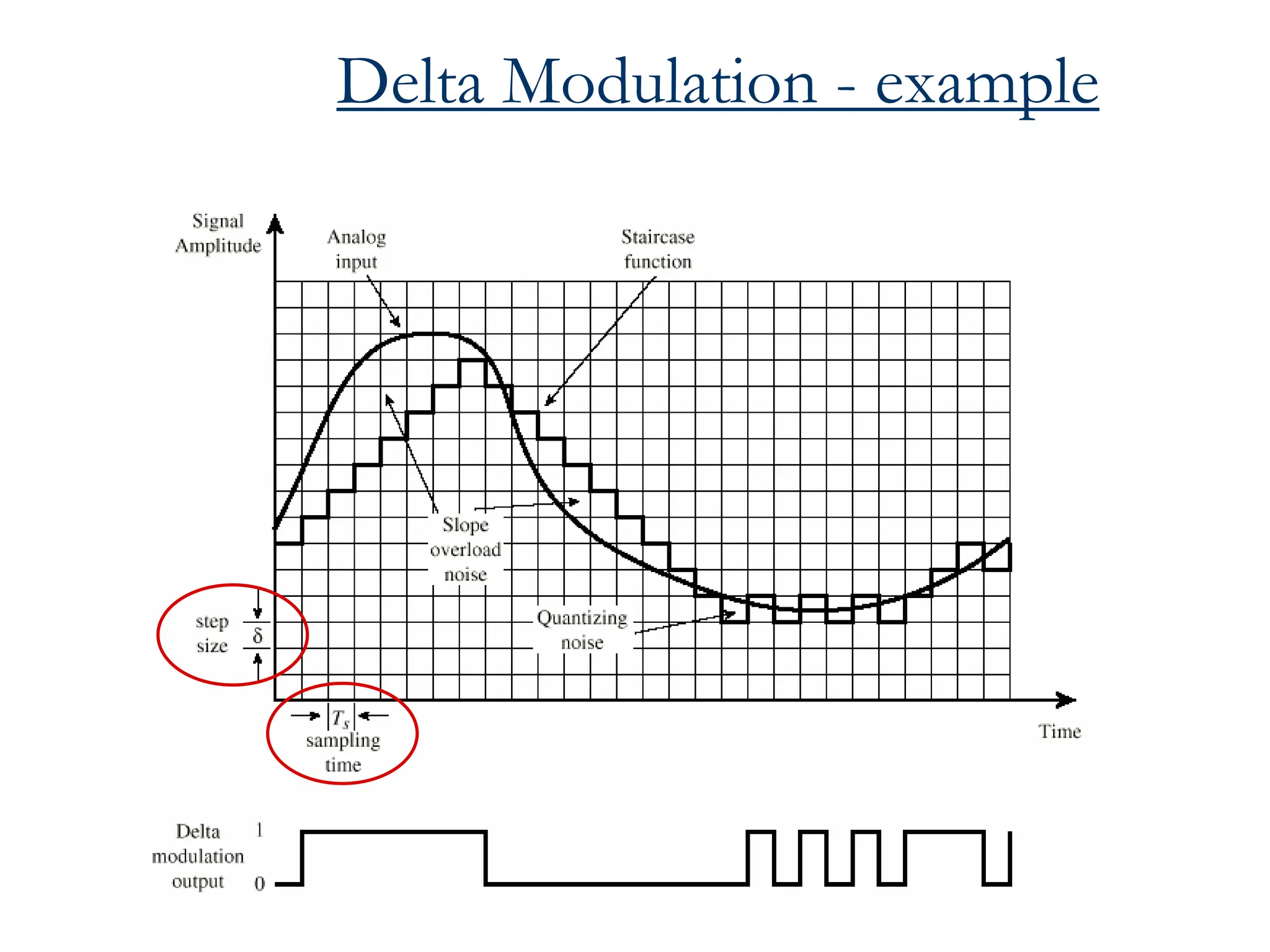
Delta Modulation
Š Analog input is approximated by a staircase
function
Š Move up or down one level (δ) at each
sample interval
Š Binary behavior
„ Function moves up or down at each sample
interval
„ Function may not be stationary!
Delta Modulation - example
EIE325: Telecommunication Technologies Maciej Ogorzalek, PolyU EIE,
Delta Modulation - Performance
Š Good voice reproduction
„ PCM - 128 levels (7 bit)
„ Voice bandwidth 4khz
„ Should be 8000 x 7 = 56kbps for PCM
Š Data compression can improve on this
„ e.g. Interframe coding techniques for video
Š Bad for too fast or too slow changes
EIE325: Telecommunication Technologies Maciej Ogorzalek, PolyU EIE,
In general
Š DM is simpler
Š PCM gives better SNR for same data rate
EIE325: Telecommunication Technologies Maciej Ogorzalek, PolyU EIE,
Š Digital data, digital signal
„ NRZ, Manchester, HDB3
Š Digital data, analog signal
„ ASK, FSK, PSK
Š Analog data, digital signal
„ PCM, DM, ADPCM
Š Analog data, analog signal
„ AM, FM, PM
Encoding Techniques
EIE325: Telecommunication Technologies Maciej Ogorzalek, PolyU EIE,
Analog Data, Analog Signals
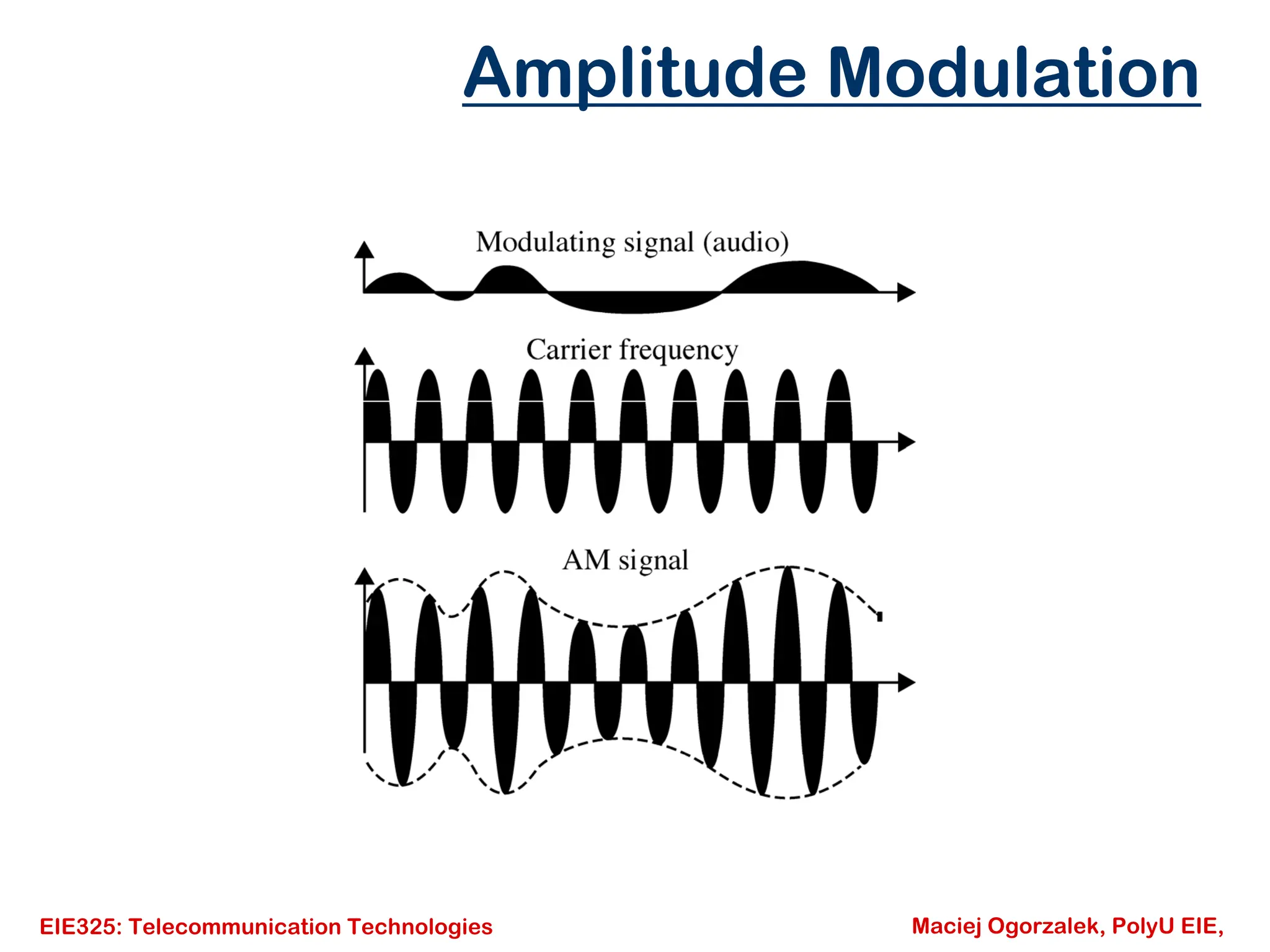
Š Why modulate analog signals?
„ Higher frequency can give more efficient
transmission
„ Permits frequency division multiplexing
Š Types of modulation
„ Amplitude
„ Frequency
„ Phase
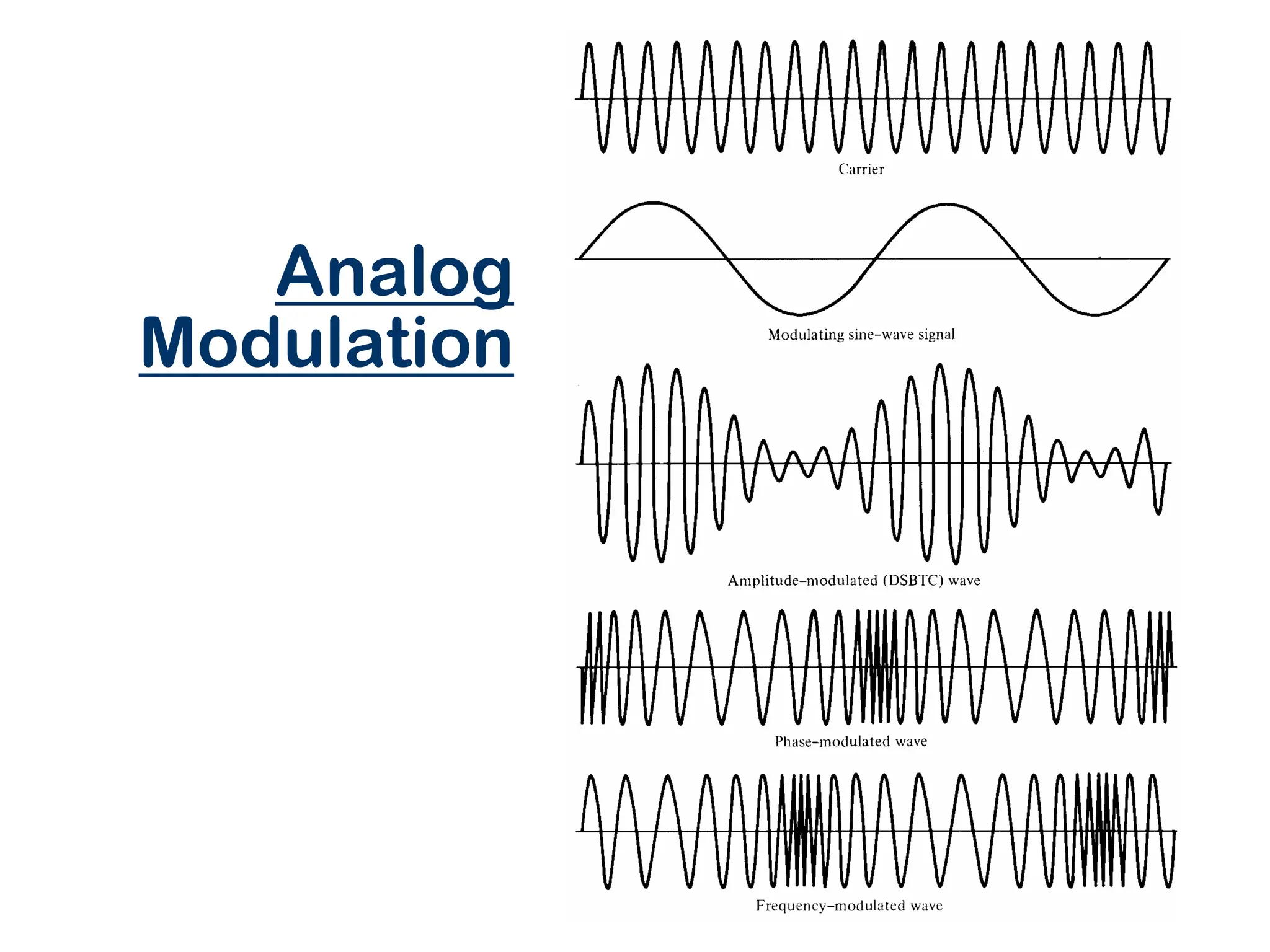
Analog
Modulation
EIE325: Telecommunication Technologies Maciej Ogorzalek, PolyU EIE,
Amplitude Modulation
EIE325: Telecommunication Technologies Maciej Ogorzalek, PolyU EIE,
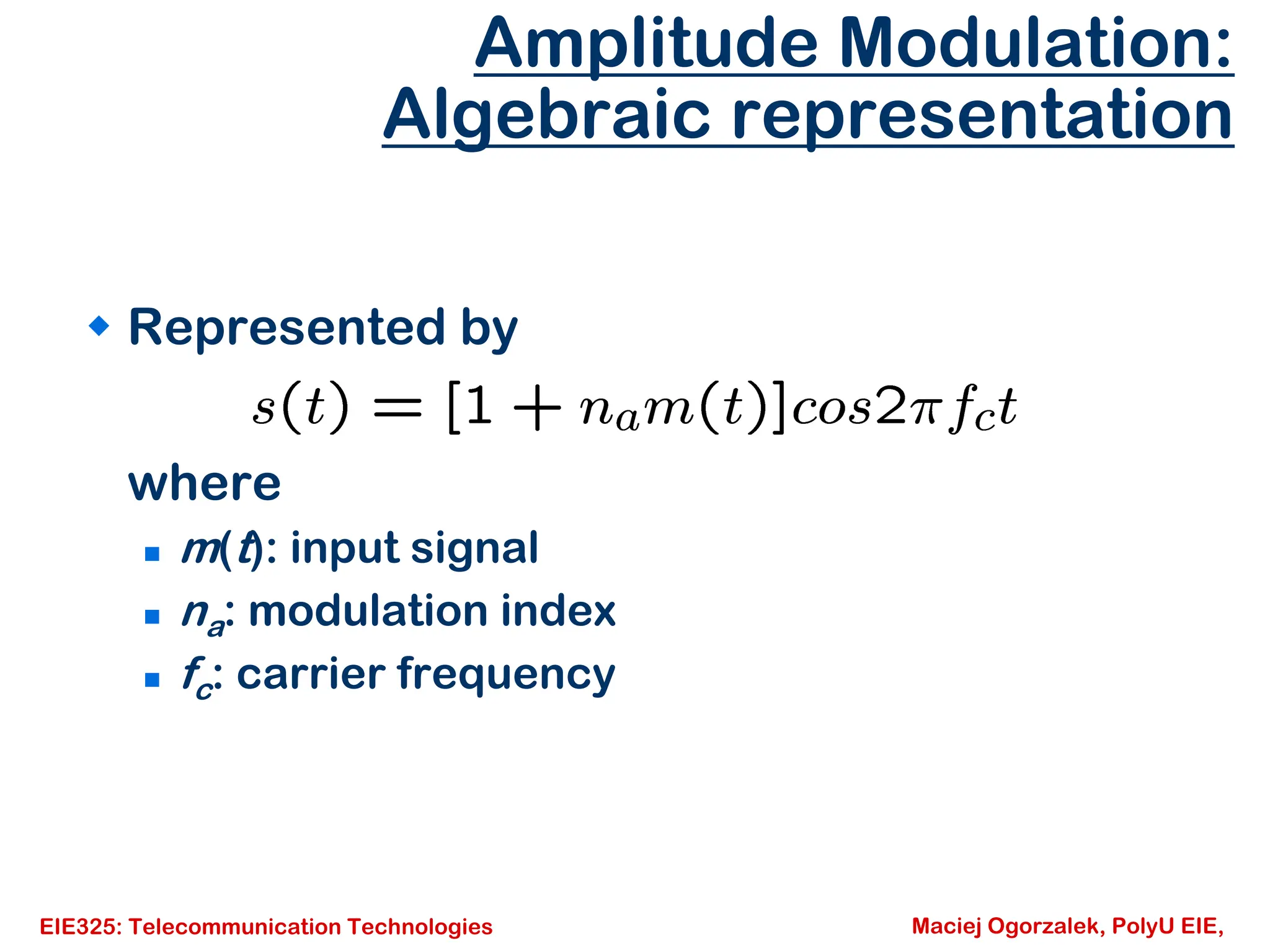
Amplitude Modulation:
Algebraic representation
Š Represented by
where
„ m(t): input signal
„ na: modulation index
„ fc: carrier frequency
EIE325: Telecommunication Technologies Maciej Ogorzalek, PolyU EIE,
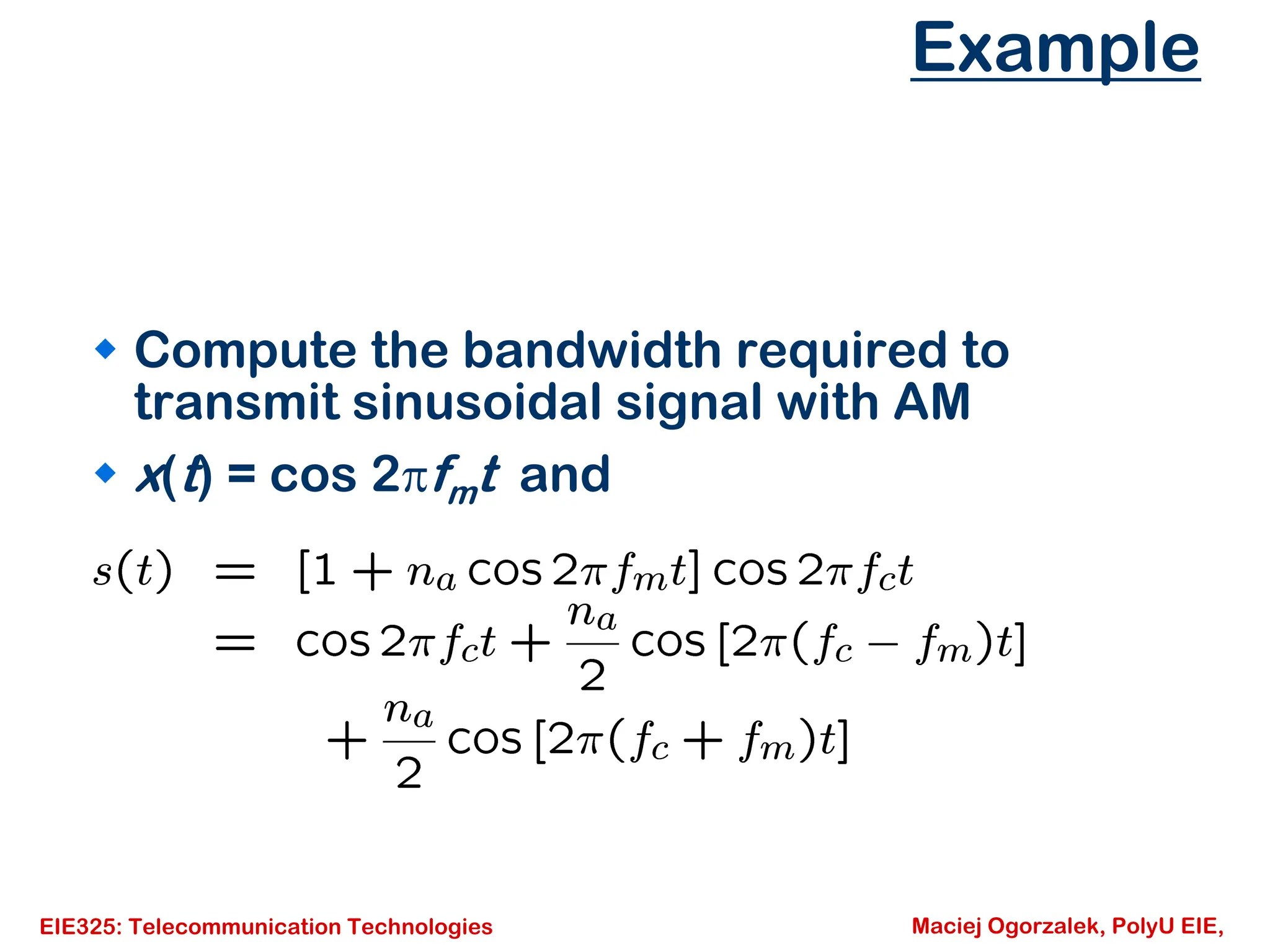
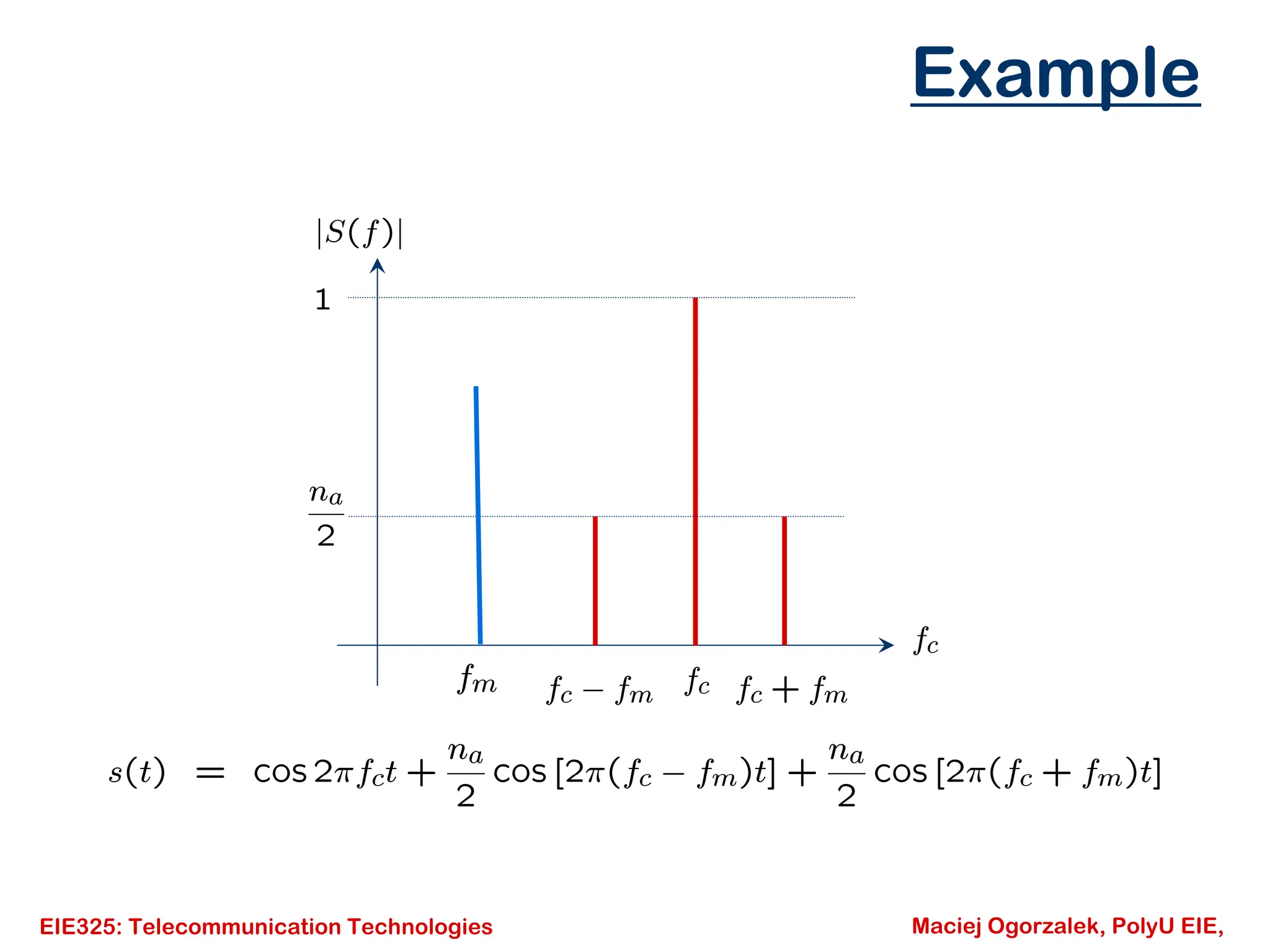
Example
Š Compute the bandwidth required to
transmit sinusoidal signal with AM
Š x(t) = cos 2πfmt and
EIE325: Telecommunication Technologies Maciej Ogorzalek, PolyU EIE,
Example
EIE325: Telecommunication Technologies Maciej Ogorzalek, PolyU EIE,
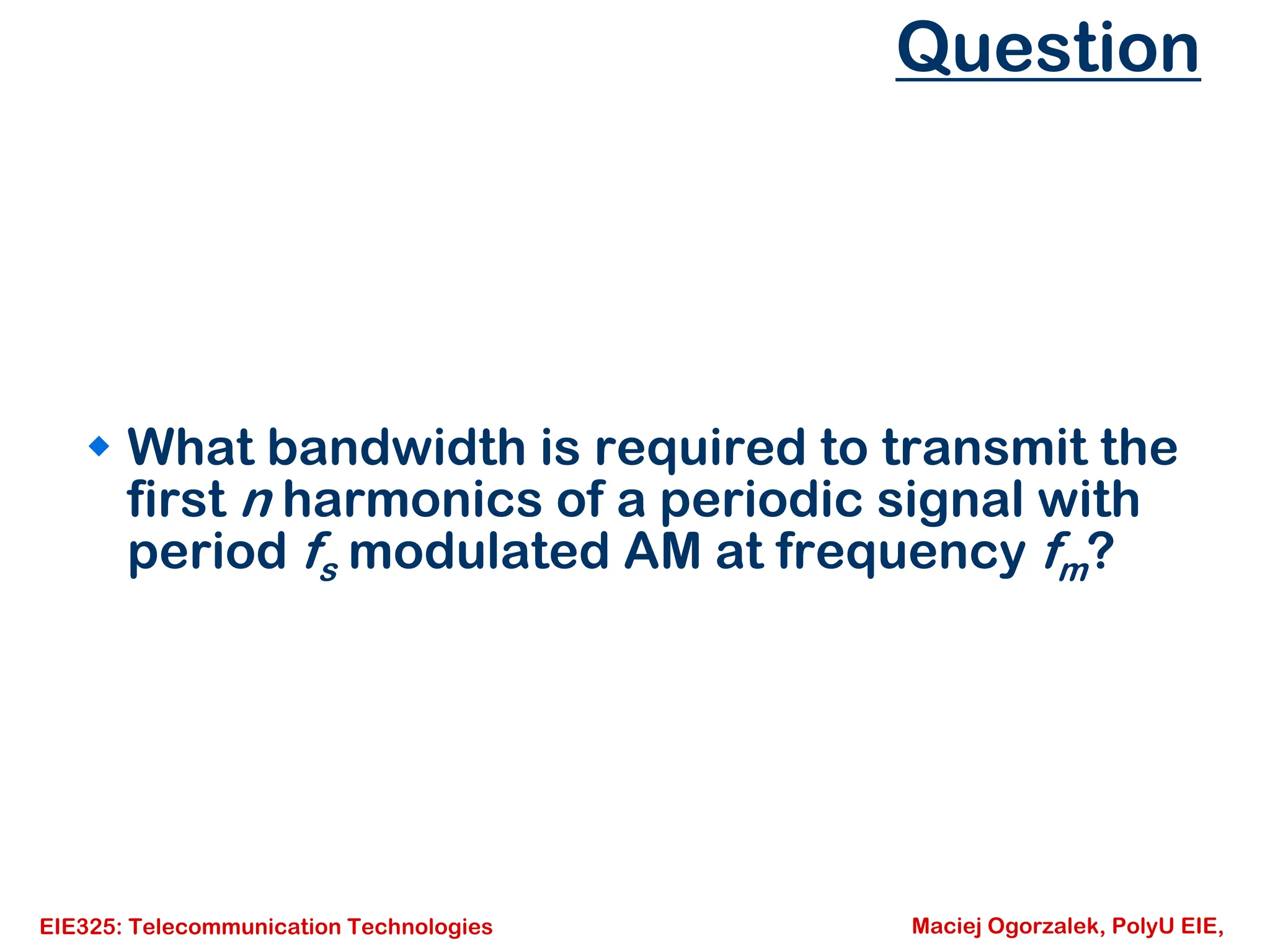
Question
Š What bandwidth is required to transmit the
first n harmonics of a periodic signal with
period fs modulated AM at frequency fm?
EIE325: Telecommunication Technologies Maciej Ogorzalek, PolyU EIE,
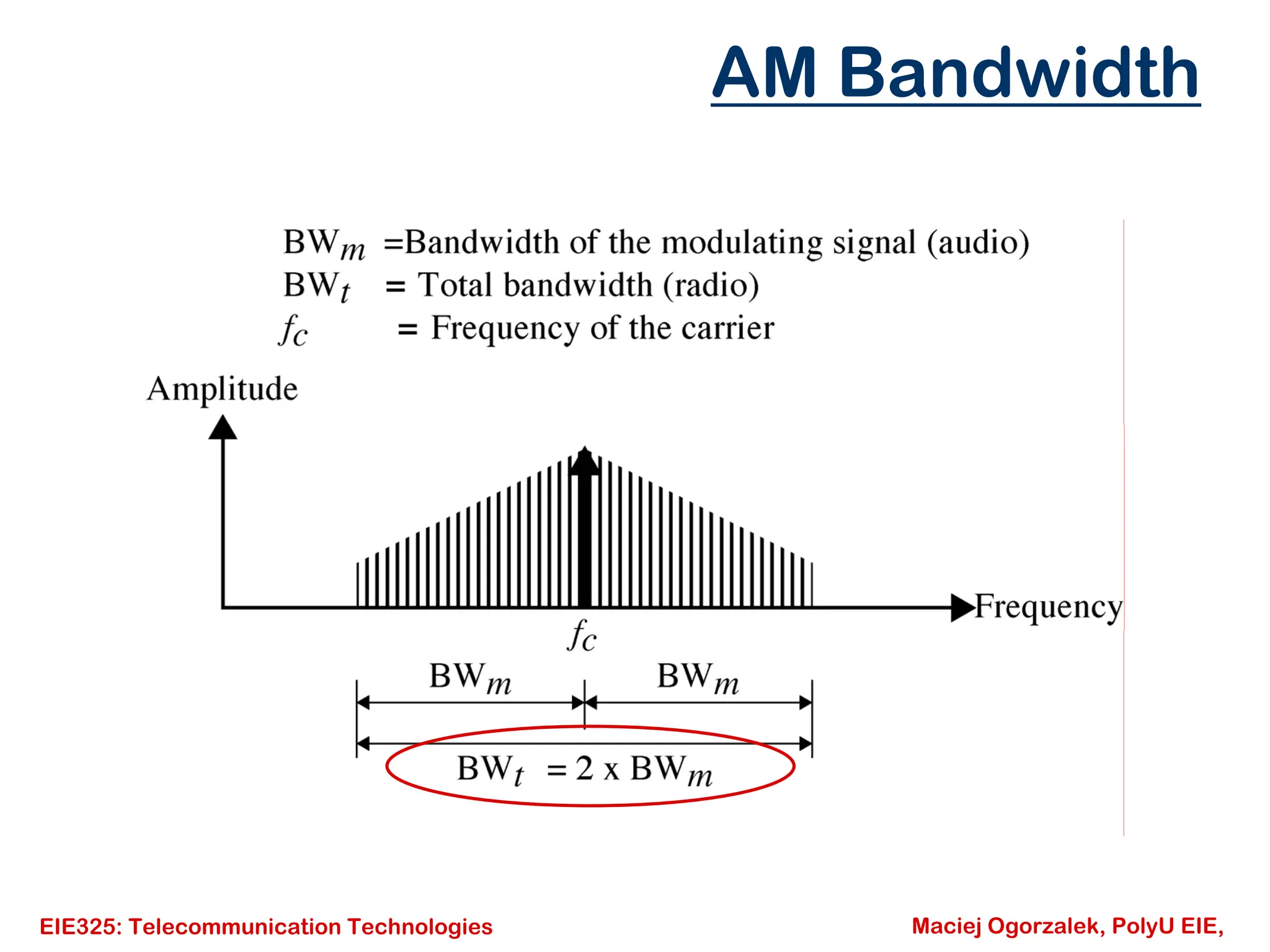
AM Bandwidth
EIE325: Telecommunication Technologies Maciej Ogorzalek, PolyU EIE,
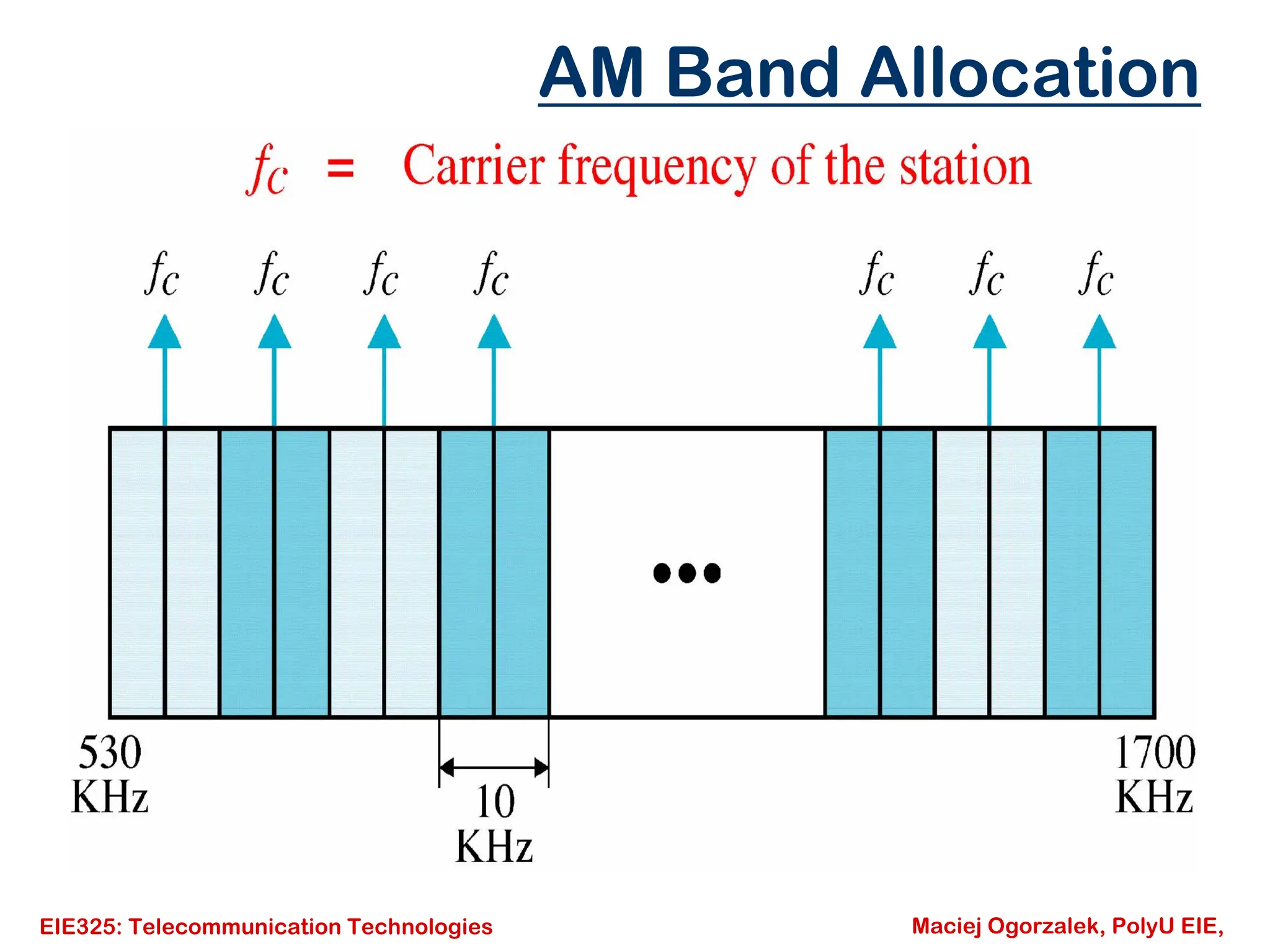
AM Band Allocation
EIE325: Telecommunication Technologies Maciej Ogorzalek, PolyU EIE,
Sidebands
Š Spectrum is carrier (at fc) plus spectrum of
input signal translated to fc and reflected
about fc
Š Upper sideband: |f|>|fc|
Š Lower sideband: |f|<|fc|
Š Single sideband (SSB): sidebands are
duplicates, only send one
EIE325: Telecommunication Technologies Maciej Ogorzalek, PolyU EIE,
DSBSC, DSBTC and VSB
Š DSBTC: Double sideband transmitted
carrier
Š DSBSC: Double sideband suppressed
carrier
Š SSB: Single sideband
Š VSB: Vestigial sideband
EIE325: Telecommunication Technologies Maciej Ogorzalek, PolyU EIE,
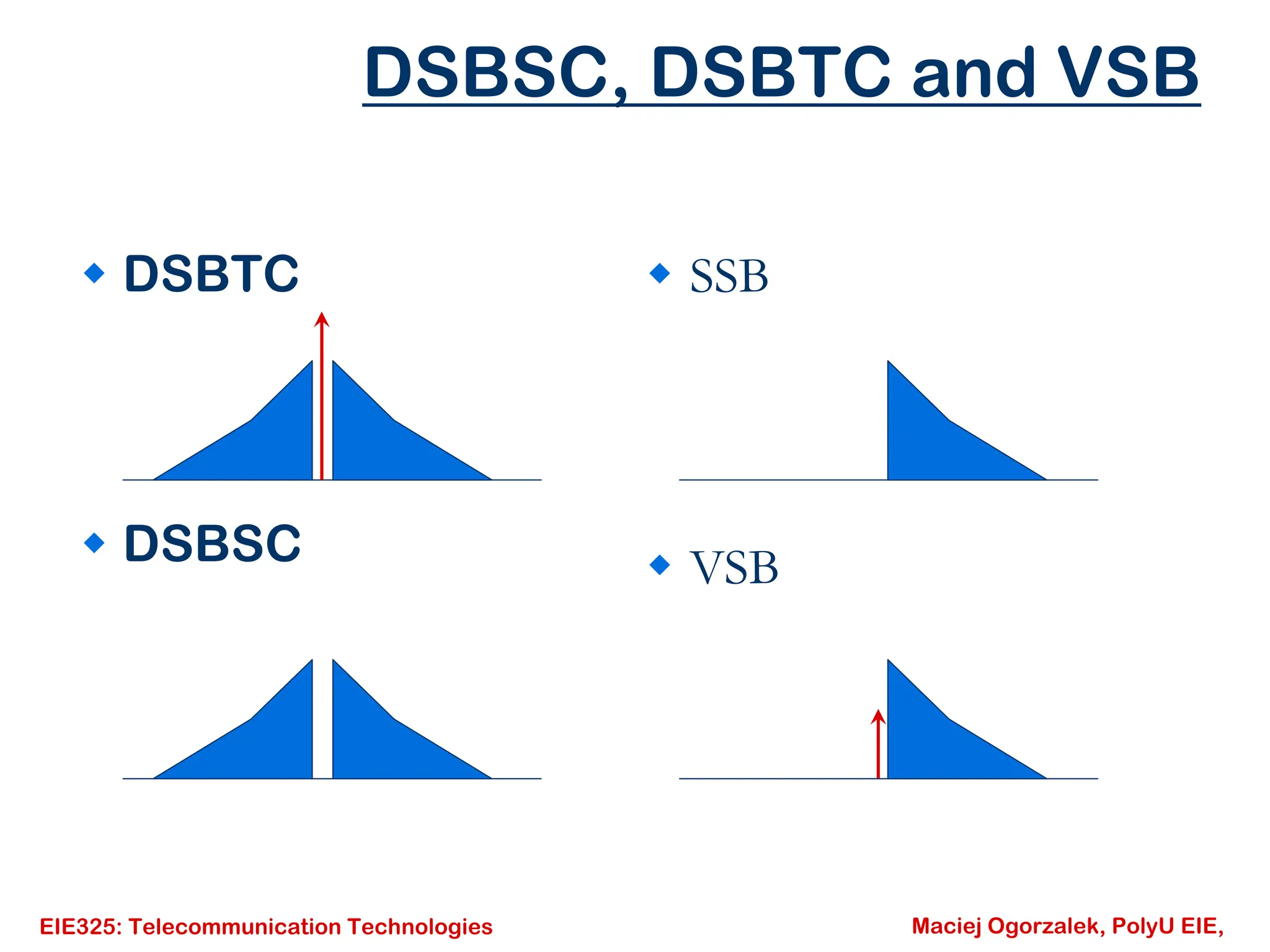
DSBSC, DSBTC and VSB
Š DSBTC
Š DSBSC
Š SSB
Š VSB
EIE325: Telecommunication Technologies Maciej Ogorzalek, PolyU EIE,
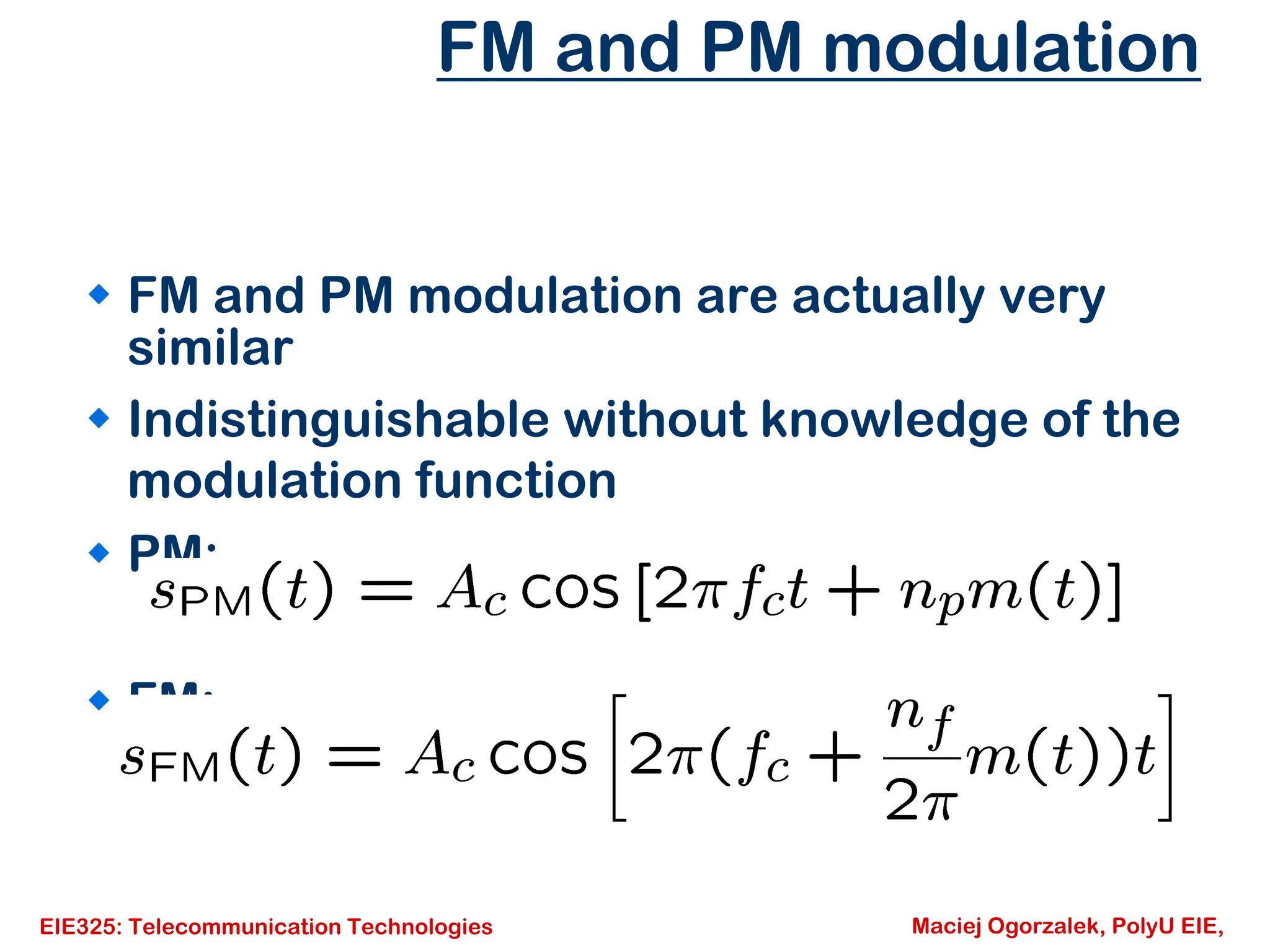
FM and PM modulation
Š FM and PM modulation are actually very
similar
Š Indistinguishable without knowledge of the
modulation function
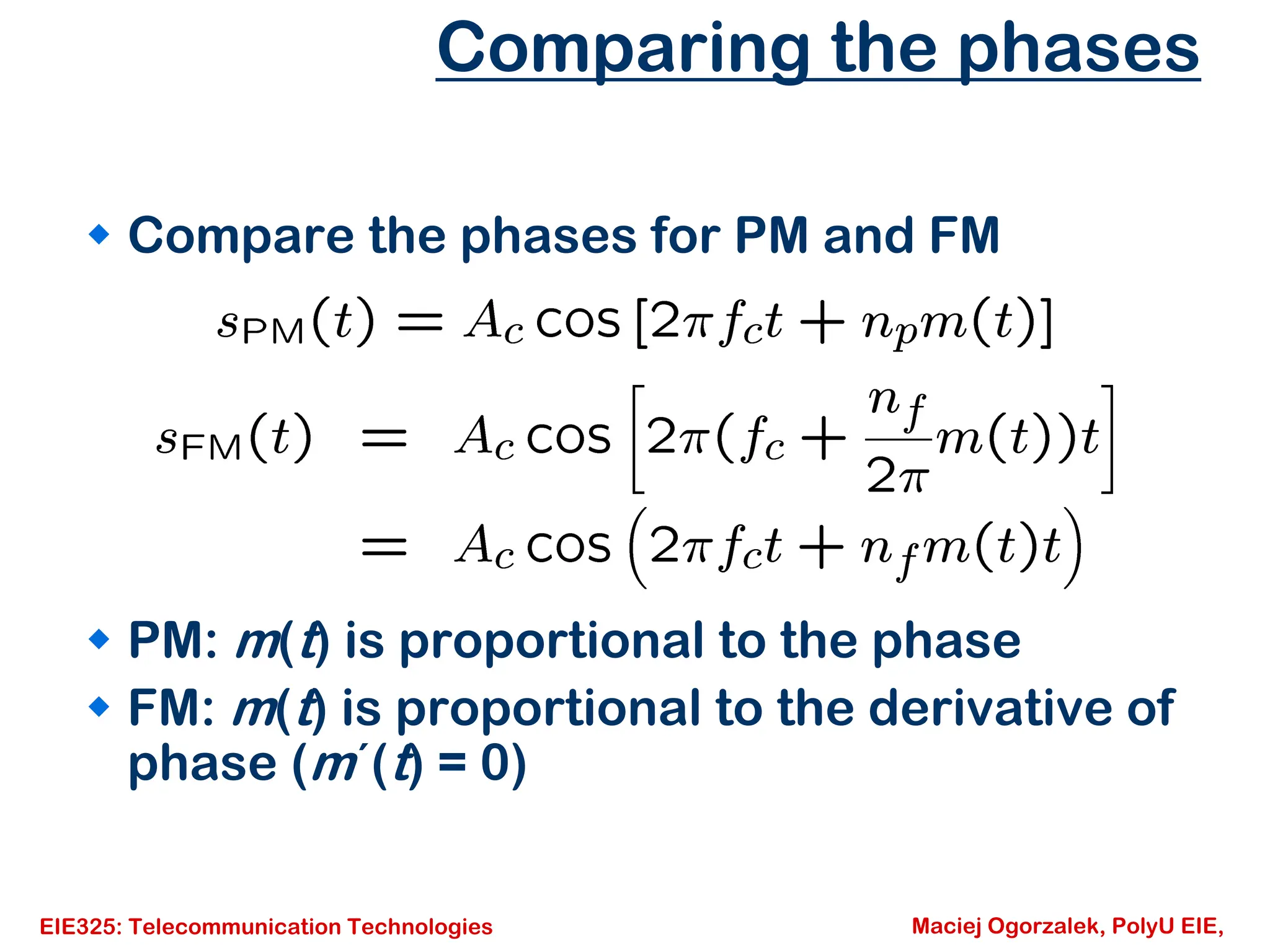
Š PM:
Š FM:
EIE325: Telecommunication Technologies Maciej Ogorzalek, PolyU EIE,
Comparing the phases
Š Compare the phases for PM and FM
Š PM: m(t) is proportional to the phase
Š FM: m(t) is proportional to the derivative of
phase (m΄(t) = 0)
EIE325: Telecommunication Technologies Maciej Ogorzalek, PolyU EIE,
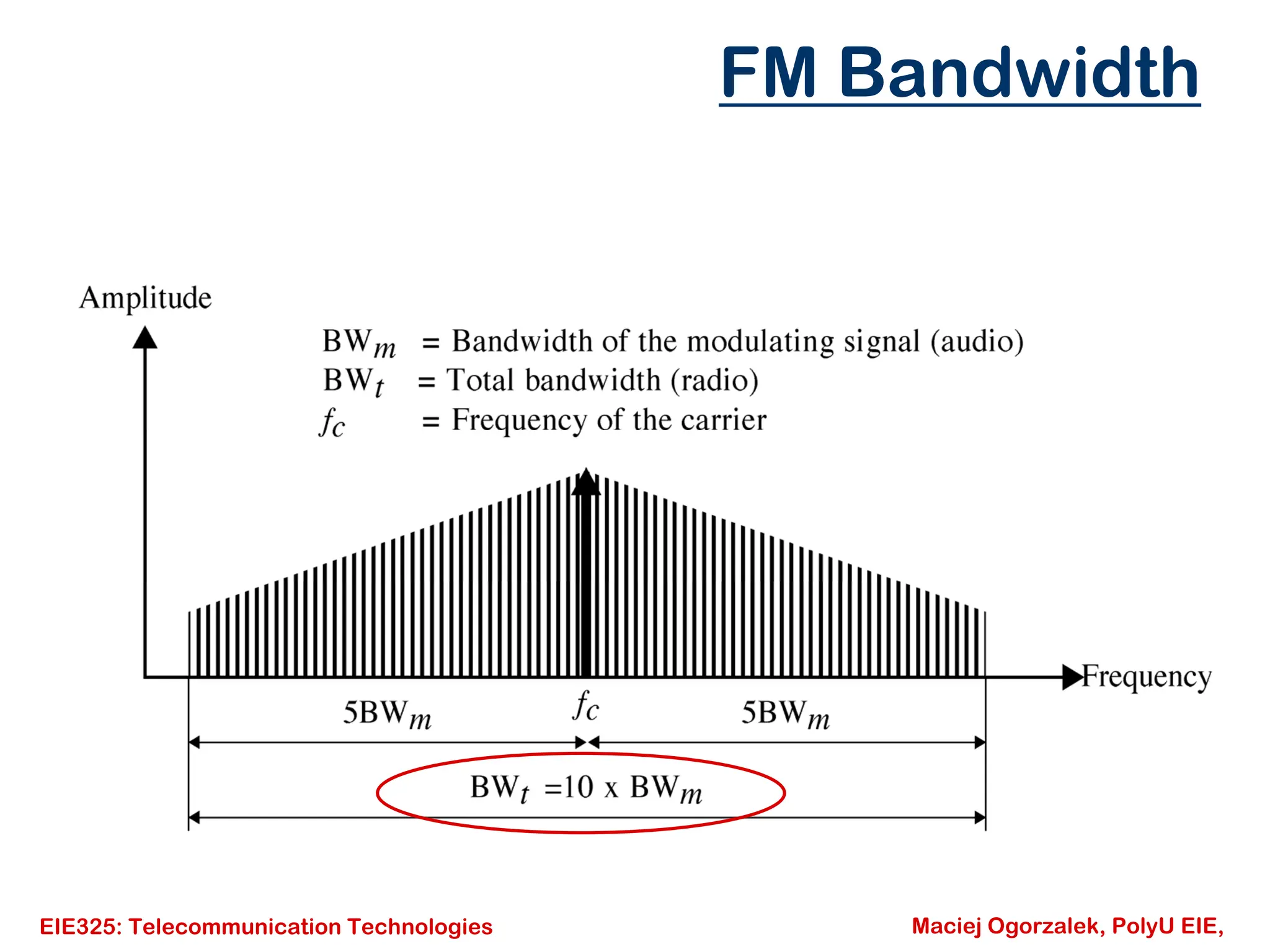
FM Bandwidth
EIE325: Telecommunication Technologies Maciej Ogorzalek, PolyU EIE,
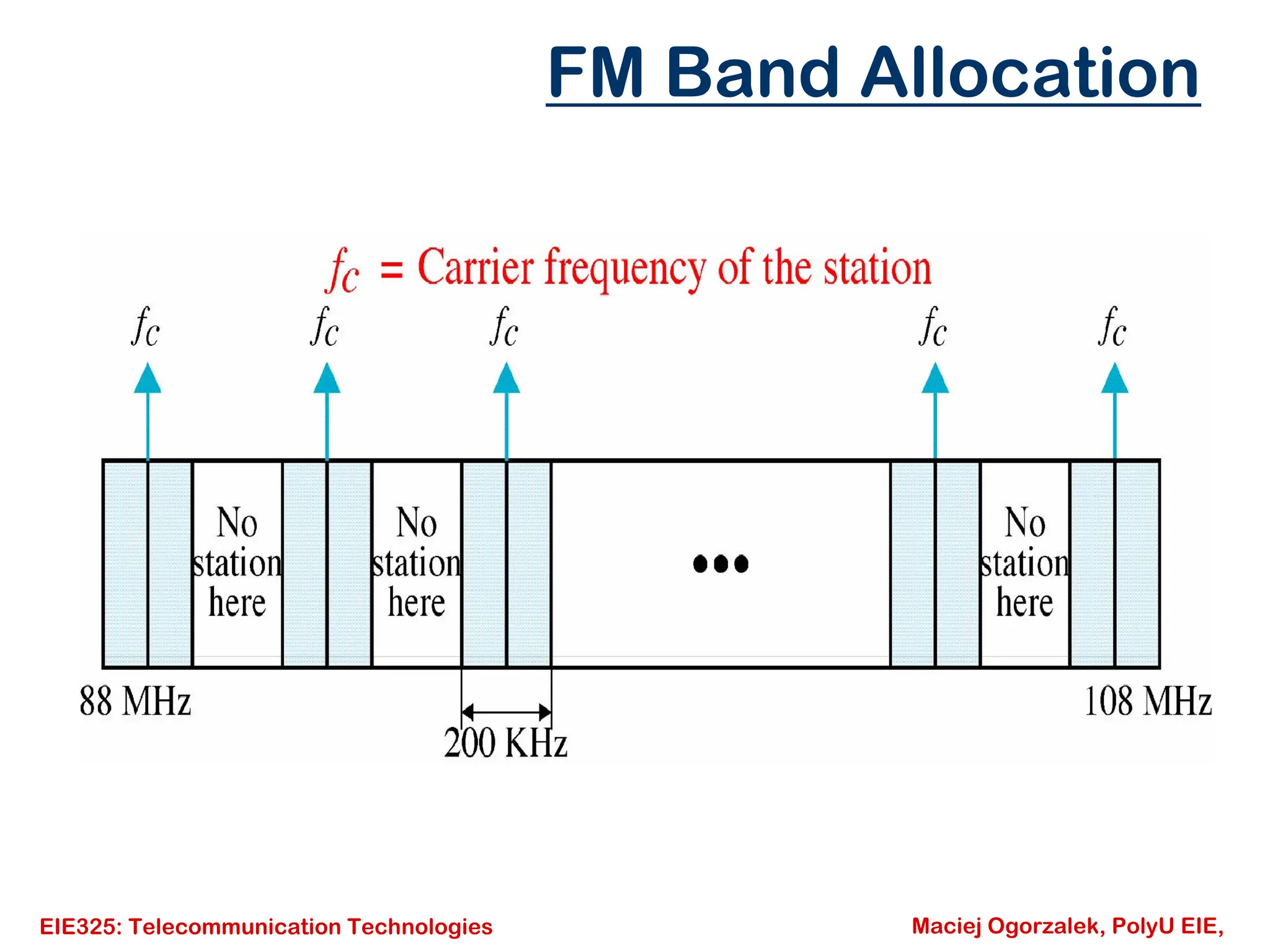
FM Band Allocation
EIE325: Telecommunication Technologies Maciej Ogorzalek, PolyU EIE,
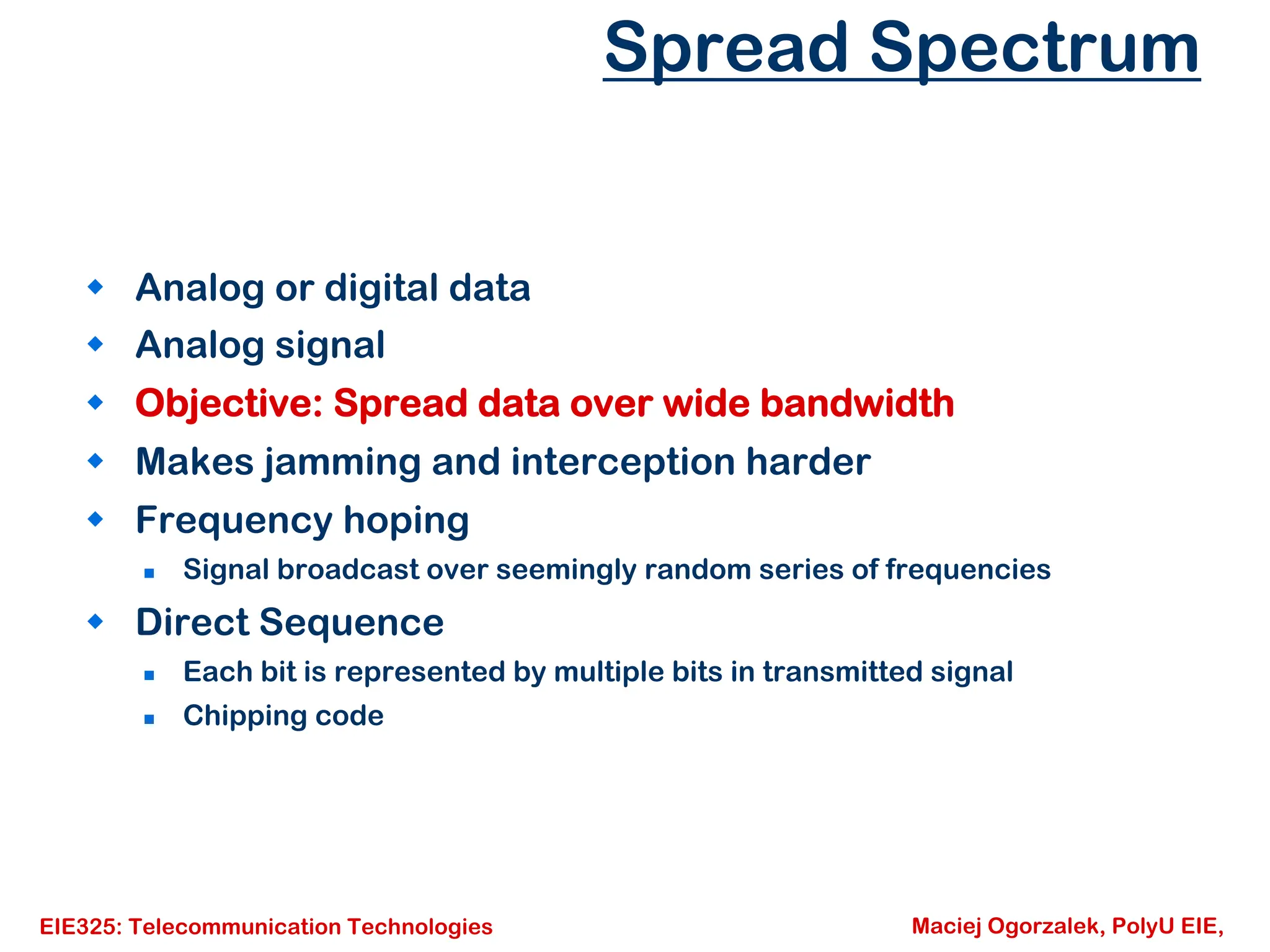
Spread Spectrum
Š Analog or digital data
Š Analog signal
Š Objective: Spread data over wide bandwidth
Š Makes jamming and interception harder
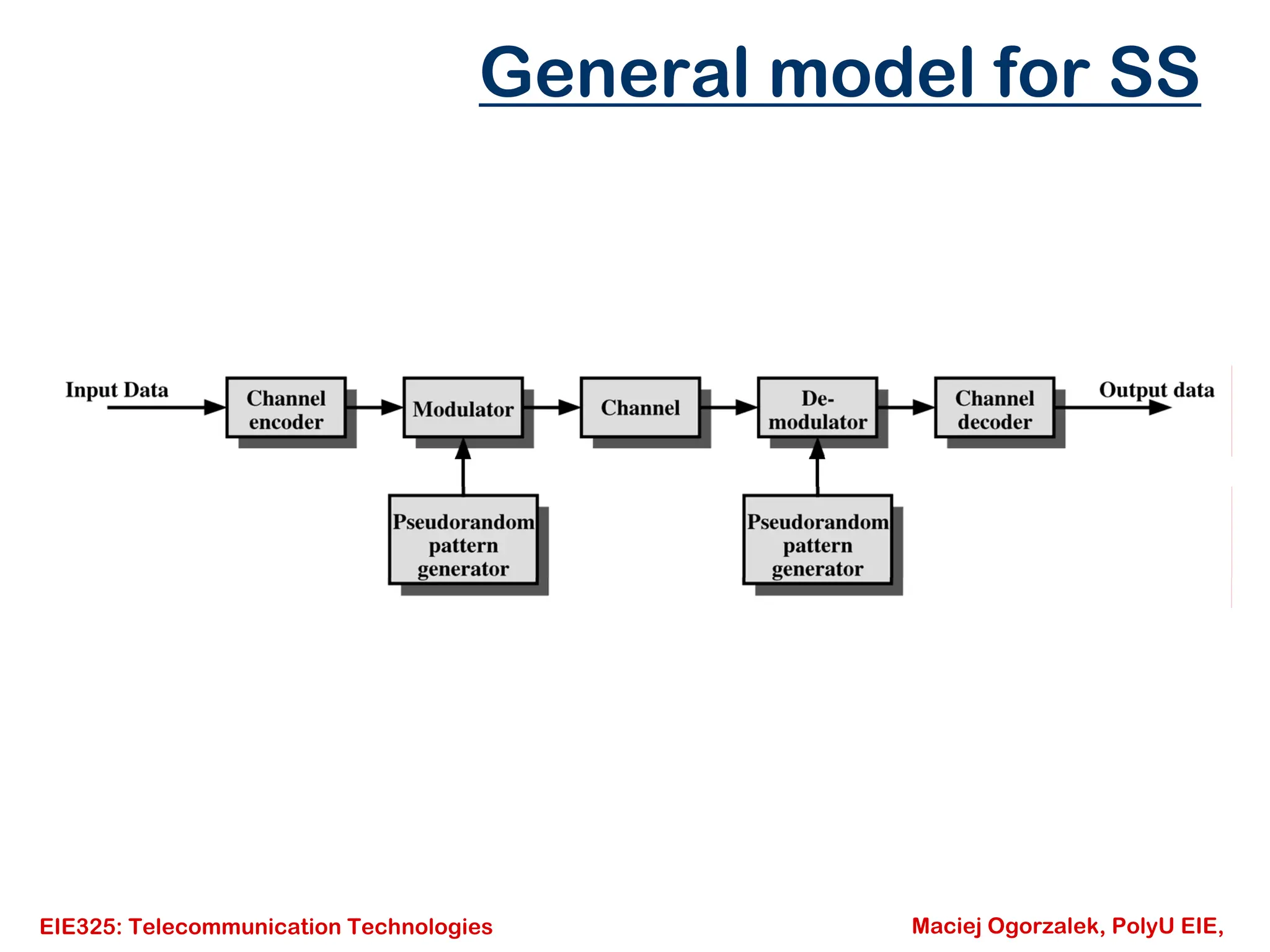
Š Frequency hoping
„ Signal broadcast over seemingly random series of frequencies
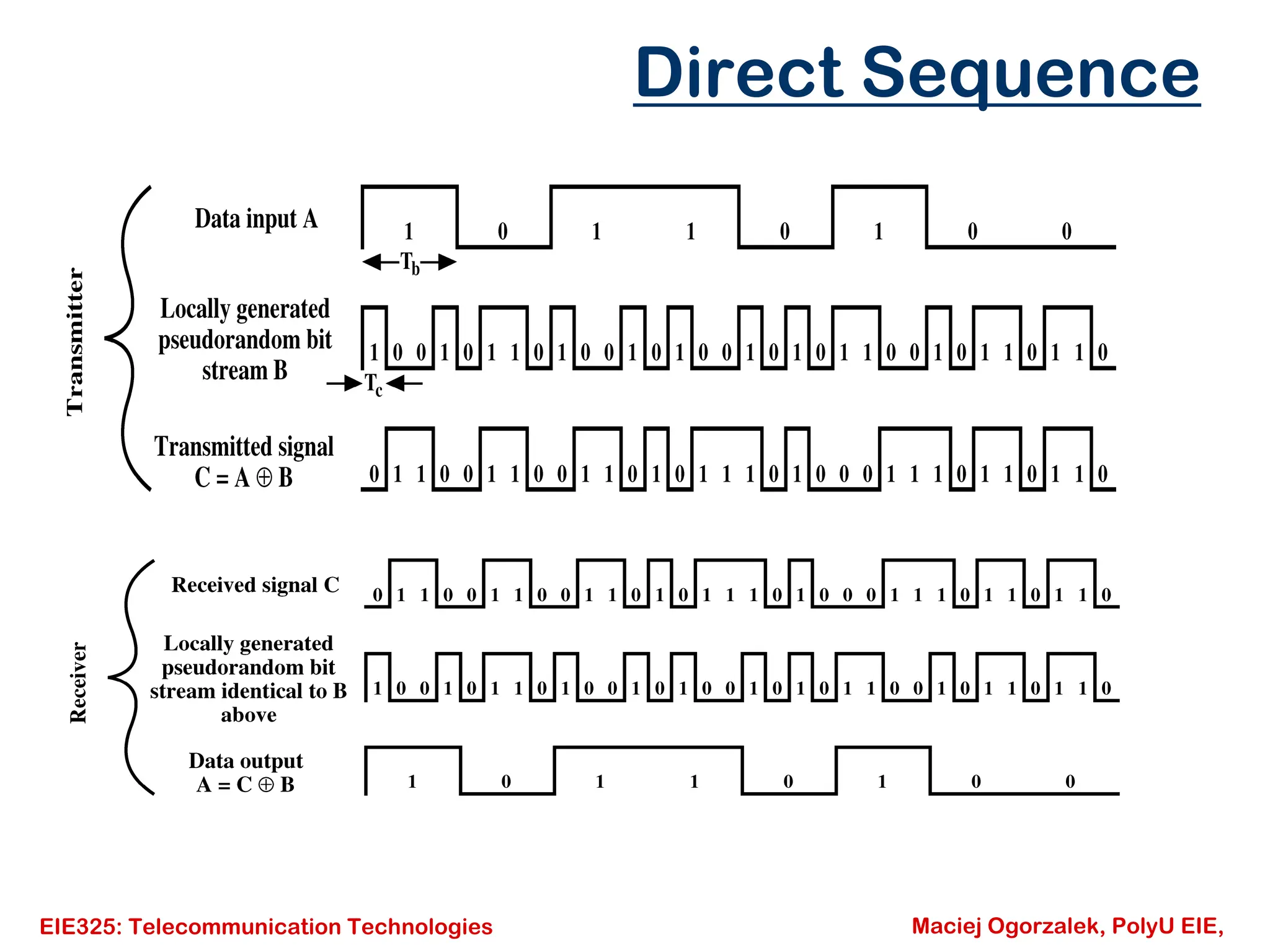
Š Direct Sequence
„ Each bit is represented by multiple bits in transmitted signal
„ Chipping code
EIE325: Telecommunication Technologies Maciej Ogorzalek, PolyU EIE,
General model for SS
EIE325: Telecommunication Technologies Maciej Ogorzalek, PolyU EIE,
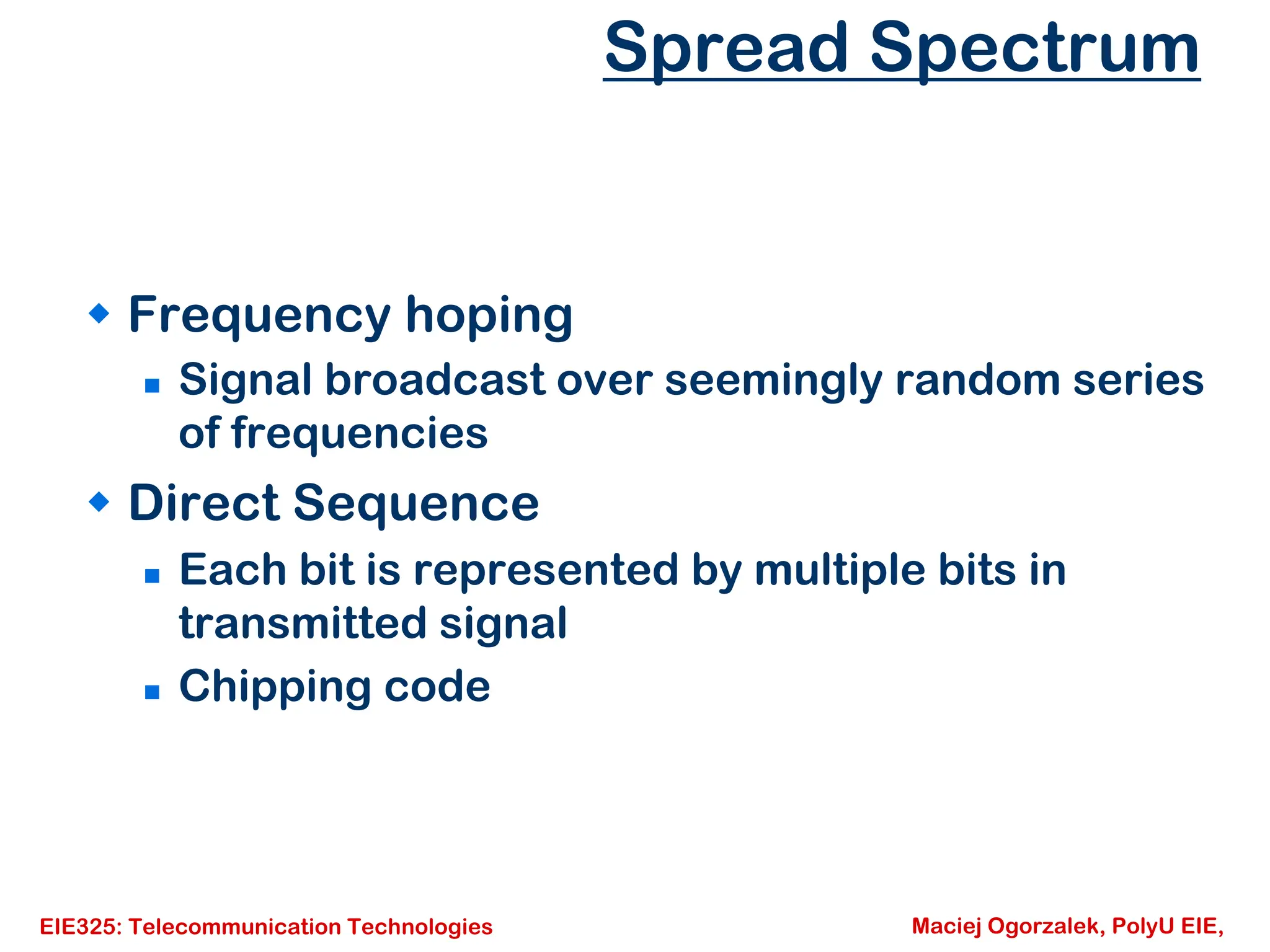
Spread Spectrum
Š Frequency hoping
„ Signal broadcast over seemingly random series
of frequencies
Š Direct Sequence
„ Each bit is represented by multiple bits in
transmitted signal
„ Chipping code
EIE325: Telecommunication Technologies Maciej Ogorzalek, PolyU EIE,
Direct Sequence
EIE325: Telecommunication Technologies Maciej Ogorzalek, PolyU EIE,
Question
Š What is the bandwidth of a digital data
stream encoded with direct sequence
spreading?
EIE325: Telecommunication Technologies Maciej Ogorzalek, PolyU EIE,
Generating noise
Š Need to generate same “noise” at source
and destination
Š Computers are deterministic – generating
true noise is not possible (i.e. no truly
random numbers)
Š May use
„ pseudo-random algorithm
„ predetermined sequences (e.g. Gold
sequences)
„ chaos

Test your knowledge of digital communication systems with our interactive quiz! Explore various aspects of communication technologies and enhance your understanding. Enjoy learning!"

  • 1.
    EIE325: Telecommunication TechnologiesMaciej Ogorzalek, PolyU, EIE Telecommunication Technologies Week 7 Digital and Analogue Modulation Quantisation
  • 2.
    EIE325: Telecommunication TechnologiesMaciej Ogorzalek, PolyU EIE, Š Digital data, digital signal „ NRZ, Manchester, HDB3 Š Digital data, analog signal „ ASK, FSK, PSK Š Analog data, digital signal „ PCM, DM, ADPCM Š Analog data, analog signal „ AM, FM, PM Encoding Techniques
  • 3.
    EIE325: Telecommunication TechnologiesMaciej Ogorzalek, PolyU EIE, Digital Data, Analog Signal Š Public telephone system „ »300Hz to »3400Hz „ Use modem (modulator-demodulator) Š Amplitude shift keying (ASK) Š Frequency shift keying (FSK) Š Phase shift keying (PSK)
  • 4.
    EIE325: Telecommunication TechnologiesMaciej Ogorzalek, PolyU EIE, Modulation Techniques ASK FSK PSK
  • 5.
    EIE325: Telecommunication TechnologiesMaciej Ogorzalek, PolyU EIE, Amplitude Shift Keying Š Values represented by different amplitudes of carrier Š Usually, one amplitude is zero „ i.e. presence and absence of carrier is used Š Susceptible to sudden gain changes Š Inefficient Š Up to 1200bps on voice grade lines Š Used over optical fiber
  • 6.
    EIE325: Telecommunication TechnologiesMaciej Ogorzalek, PolyU EIE, Representation Š Often A2 = 0 Š Used in fibre optics (with multiple carrier frequencies)
  • 7.
    EIE325: Telecommunication TechnologiesMaciej Ogorzalek, PolyU EIE, Bandwidth
  • 8.
    EIE325: Telecommunication TechnologiesMaciej Ogorzalek, PolyU EIE, Frequency Shift Keying Š Values represented by different frequencies (near carrier) Š Less susceptible to error than ASK Š Up to 1200bps on voice grade lines Š High frequency radio Š Even higher frequency on LANs using co-ax
  • 9.
    EIE325: Telecommunication TechnologiesMaciej Ogorzalek, PolyU EIE, Representation Š Where typically ½ (f1+f2) = fc
  • 10.
    EIE325: Telecommunication TechnologiesMaciej Ogorzalek, PolyU EIE, Bandwidth for FSK
  • 11.
    EIE325: Telecommunication TechnologiesMaciej Ogorzalek, PolyU EIE, FSK on Voice Grade Line
  • 12.
    EIE325: Telecommunication TechnologiesMaciej Ogorzalek, PolyU EIE, Phase Shift Keying Š Phase of carrier signal is shifted to represent data Š Differential PSK „ Phase shifted relative to previous transmission rather than some reference signal
  • 13.
    EIE325: Telecommunication TechnologiesMaciej Ogorzalek, PolyU EIE, PSK
  • 14.
    EIE325: Telecommunication TechnologiesMaciej Ogorzalek, PolyU EIE, PSK Constellation
  • 15.
    EIE325: Telecommunication TechnologiesMaciej Ogorzalek, PolyU EIE, Question… 3-PSK: Draw the constellation diagram for this (fictitious) 3-PSK system.
  • 16.
    EIE325: Telecommunication TechnologiesMaciej Ogorzalek, PolyU EIE, Quadrature PSK Š More efficient use by each signal element representing more than one bit „ e.g. shifts of π/2 (90o) „ Each element represents two bits „ Can use 8 phase angles and have more than one amplitude „ 9600bps modem use 12 angles, four of which have two amplitudes
  • 17.
    EIE325: Telecommunication TechnologiesMaciej Ogorzalek, PolyU EIE, Representation PSK: QPSK:
  • 18.
    EIE325: Telecommunication TechnologiesMaciej Ogorzalek, PolyU EIE, 4-PSK
  • 19.
    EIE325: Telecommunication TechnologiesMaciej Ogorzalek, PolyU EIE, 4-PSK Characteristics
  • 20.
    EIE325: Telecommunication TechnologiesMaciej Ogorzalek, PolyU EIE, 8-PSK Characteristics
  • 21.
    EIE325: Telecommunication TechnologiesMaciej Ogorzalek, PolyU EIE, PSK Bandwidth
  • 22.
    EIE325: Telecommunication TechnologiesMaciej Ogorzalek, PolyU EIE, QAM Š PSK/ASK/FSK: switch between two states to encode one bit Š QPSK: switch between n states to encode log2 n bits Š QPSK: changes only one attribute of the carrier wave (phase) Š QAM: change two (phase and amplitude)
  • 23.
    EIE325: Telecommunication TechnologiesMaciej Ogorzalek, PolyU EIE, 4-QAM and 8-QAM Constellations 0 0 1 1 0 1 1 0 101 100 011 010 000 001 110 111 4-QAM 1 amplitude, 4 phases 8-QAM 2 amplitude, 4 phases
  • 24.
    EIE325: Telecommunication TechnologiesMaciej Ogorzalek, PolyU EIE, 8-QAM Signal
  • 25.
    EIE325: Telecommunication TechnologiesMaciej Ogorzalek, PolyU EIE, 16-QAM Constellation 16-QAM 3 amplitudes, 12 phases 16-QAM 4 amplitudes, 8 phases
  • 26.
    EIE325: Telecommunication TechnologiesMaciej Ogorzalek, PolyU EIE, 16-QAM Constellation 16-QAM 4 amplitudes, 8 phases 16-QAM 2 amplitudes, 8 phases
  • 27.
    EIE325: Telecommunication TechnologiesMaciej Ogorzalek, PolyU EIE, Data rate and modulation rate (revisited) Š Multiple bits are encoded in each signal element Š „ D: modulation rate (baud) „ R: data rate (bps) „ L: number of distinct signal elements „ b: bits per signal element
  • 28.
    EIE325: Telecommunication TechnologiesMaciej Ogorzalek, PolyU EIE, Performance of Digital to Analog Modulation Schemes Š Bandwidth „ ASK and PSK bandwidth directly related to bit rate „ FSK bandwidth related to data rate for lower frequencies, but to offset of modulated frequency from carrier at high frequencies „ See text (pg. 146-148) for example Š In the presence of noise, bit error rate of PSK and QPSK are about 3dB superior to ASK and FSK
  • 29.
    EIE325: Telecommunication TechnologiesMaciej Ogorzalek, PolyU EIE, BER performance
  • 30.
    EIE325: Telecommunication TechnologiesMaciej Ogorzalek, PolyU EIE, Š Digital data, digital signal „ NRZ, Manchester, HDB3 Š Digital data, analog signal „ ASK, FSK, PSK Š Analog data, digital signal „ PCM, DM, ADPCM Š Analog data, analog signal „ AM, FM, PM Encoding Techniques
  • 31.
    EIE325: Telecommunication TechnologiesMaciej Ogorzalek, PolyU EIE, Analog Data, Digital Signal Š Digitization! „ Conversion of analog data into digital data „ Digital data can then be transmitted using NRZ- L, or not „ Digital data can then be converted to analog signal „ Analog to digital conversion done using a codec Š Pulse code modulation Š Delta modulation
  • 32.
    EIE325: Telecommunication TechnologiesMaciej Ogorzalek, PolyU EIE, Pulse Code Modulation (PCM) Š The Sampling Theorem: If a signal is sampled at regular intervals at a rate higher than twice the highest signal frequency, the samples contain all the information of the original signal Š Voice data limited to below 4000Hz Š Require 8000 sample per second Š Analog samples (Pulse Amplitude Modulation, PAM) Š Each sample assigned a digital value
  • 33.
    EIE325: Telecommunication TechnologiesMaciej Ogorzalek, PolyU EIE, Pulse Code Modulation (PCM) Š 4 bit system gives 16 levels Š Quantized „ Quantizing error or noise „ Approximations mean it is impossible to recover original exactly Š 8 bit sample gives 256 levels Š Quality comparable with analog transmission Š 8000 samples per second of 8 bits each gives 64kbps
  • 34.
    EIE325: Telecommunication TechnologiesMaciej Ogorzalek, PolyU EIE, Digital takes more bandwidth Š Analogue: 4kHz Š Digital: 4*2*8 = 64 bps requiring 32kHz! Š Why? Š So why go digital? „ repeaters not amplifiers ) no additive noise „ TDM not FDM ) no intermodulation noise „ allow for (superior) digital switching
  • 35.
    EIE325: Telecommunication TechnologiesMaciej Ogorzalek, PolyU EIE, Quantifying quantisation noise Š Quantising to n bits gives: (approximately) Š I.e. each additional bit gives 6 dB improvement (4 times)
  • 36.
    EIE325: Telecommunication TechnologiesMaciej Ogorzalek, PolyU EIE, Nonlinear Encoding Š Quantization levels not evenly spaced Š Reduces overall signal distortion Š Can also be done by companding
  • 37.
  • 38.
    EIE325: Telecommunication TechnologiesMaciej Ogorzalek, PolyU EIE, Companding (Compressing/Expanding) Š Instead of nonlinear quantisation, nonlinearly scale the data Š After companding, data are more evenly distributed and can be quantised linearly Š used in ⎧-law and A- law encodings
  • 39.
  • 40.
    EIE325: Telecommunication TechnologiesMaciej Ogorzalek, PolyU EIE, Delta Modulation Š Analog input is approximated by a staircase function Š Move up or down one level (δ) at each sample interval Š Binary behavior „ Function moves up or down at each sample interval „ Function may not be stationary!
  • 41.
  • 42.
    EIE325: Telecommunication TechnologiesMaciej Ogorzalek, PolyU EIE, Delta Modulation - Performance Š Good voice reproduction „ PCM - 128 levels (7 bit) „ Voice bandwidth 4khz „ Should be 8000 x 7 = 56kbps for PCM Š Data compression can improve on this „ e.g. Interframe coding techniques for video Š Bad for too fast or too slow changes
  • 43.
    EIE325: Telecommunication TechnologiesMaciej Ogorzalek, PolyU EIE, In general Š DM is simpler Š PCM gives better SNR for same data rate
  • 44.
    EIE325: Telecommunication TechnologiesMaciej Ogorzalek, PolyU EIE, Š Digital data, digital signal „ NRZ, Manchester, HDB3 Š Digital data, analog signal „ ASK, FSK, PSK Š Analog data, digital signal „ PCM, DM, ADPCM Š Analog data, analog signal „ AM, FM, PM Encoding Techniques
  • 45.
    EIE325: Telecommunication TechnologiesMaciej Ogorzalek, PolyU EIE, Analog Data, Analog Signals Š Why modulate analog signals? „ Higher frequency can give more efficient transmission „ Permits frequency division multiplexing Š Types of modulation „ Amplitude „ Frequency „ Phase
  • 46.
  • 47.
    EIE325: Telecommunication TechnologiesMaciej Ogorzalek, PolyU EIE, Amplitude Modulation
  • 48.
    EIE325: Telecommunication TechnologiesMaciej Ogorzalek, PolyU EIE, Amplitude Modulation: Algebraic representation Š Represented by where „ m(t): input signal „ na: modulation index „ fc: carrier frequency
  • 49.
    EIE325: Telecommunication TechnologiesMaciej Ogorzalek, PolyU EIE, Example Š Compute the bandwidth required to transmit sinusoidal signal with AM Š x(t) = cos 2πfmt and
  • 50.
    EIE325: Telecommunication TechnologiesMaciej Ogorzalek, PolyU EIE, Example
  • 51.
    EIE325: Telecommunication TechnologiesMaciej Ogorzalek, PolyU EIE, Question Š What bandwidth is required to transmit the first n harmonics of a periodic signal with period fs modulated AM at frequency fm?
  • 52.
    EIE325: Telecommunication TechnologiesMaciej Ogorzalek, PolyU EIE, AM Bandwidth
  • 53.
    EIE325: Telecommunication TechnologiesMaciej Ogorzalek, PolyU EIE, AM Band Allocation
  • 54.
    EIE325: Telecommunication TechnologiesMaciej Ogorzalek, PolyU EIE, Sidebands Š Spectrum is carrier (at fc) plus spectrum of input signal translated to fc and reflected about fc Š Upper sideband: |f|>|fc| Š Lower sideband: |f|<|fc| Š Single sideband (SSB): sidebands are duplicates, only send one
  • 55.
    EIE325: Telecommunication TechnologiesMaciej Ogorzalek, PolyU EIE, DSBSC, DSBTC and VSB Š DSBTC: Double sideband transmitted carrier Š DSBSC: Double sideband suppressed carrier Š SSB: Single sideband Š VSB: Vestigial sideband
  • 56.
    EIE325: Telecommunication TechnologiesMaciej Ogorzalek, PolyU EIE, DSBSC, DSBTC and VSB Š DSBTC Š DSBSC Š SSB Š VSB
  • 57.
    EIE325: Telecommunication TechnologiesMaciej Ogorzalek, PolyU EIE, FM and PM modulation Š FM and PM modulation are actually very similar Š Indistinguishable without knowledge of the modulation function Š PM: Š FM:
  • 58.
    EIE325: Telecommunication TechnologiesMaciej Ogorzalek, PolyU EIE, Comparing the phases Š Compare the phases for PM and FM Š PM: m(t) is proportional to the phase Š FM: m(t) is proportional to the derivative of phase (m΄(t) = 0)
  • 59.
    EIE325: Telecommunication TechnologiesMaciej Ogorzalek, PolyU EIE, FM Bandwidth
  • 60.
    EIE325: Telecommunication TechnologiesMaciej Ogorzalek, PolyU EIE, FM Band Allocation
  • 61.
    EIE325: Telecommunication TechnologiesMaciej Ogorzalek, PolyU EIE, Spread Spectrum Š Analog or digital data Š Analog signal Š Objective: Spread data over wide bandwidth Š Makes jamming and interception harder Š Frequency hoping „ Signal broadcast over seemingly random series of frequencies Š Direct Sequence „ Each bit is represented by multiple bits in transmitted signal „ Chipping code
  • 62.
    EIE325: Telecommunication TechnologiesMaciej Ogorzalek, PolyU EIE, General model for SS
  • 63.
    EIE325: Telecommunication TechnologiesMaciej Ogorzalek, PolyU EIE, Spread Spectrum Š Frequency hoping „ Signal broadcast over seemingly random series of frequencies Š Direct Sequence „ Each bit is represented by multiple bits in transmitted signal „ Chipping code
  • 64.
    EIE325: Telecommunication TechnologiesMaciej Ogorzalek, PolyU EIE, Direct Sequence
  • 65.
    EIE325: Telecommunication TechnologiesMaciej Ogorzalek, PolyU EIE, Question Š What is the bandwidth of a digital data stream encoded with direct sequence spreading?
  • 66.
    EIE325: Telecommunication TechnologiesMaciej Ogorzalek, PolyU EIE, Generating noise Š Need to generate same “noise” at source and destination Š Computers are deterministic – generating true noise is not possible (i.e. no truly random numbers) Š May use „ pseudo-random algorithm „ predetermined sequences (e.g. Gold sequences) „ chaos