Ideas and Terms
Chapter 2
Ideas...
Are your ideas BIG enough?
Ideas are
always
conceived of
by the mind
from reality
● The term idea is derived from the Greek word eidos, which
means “image.”
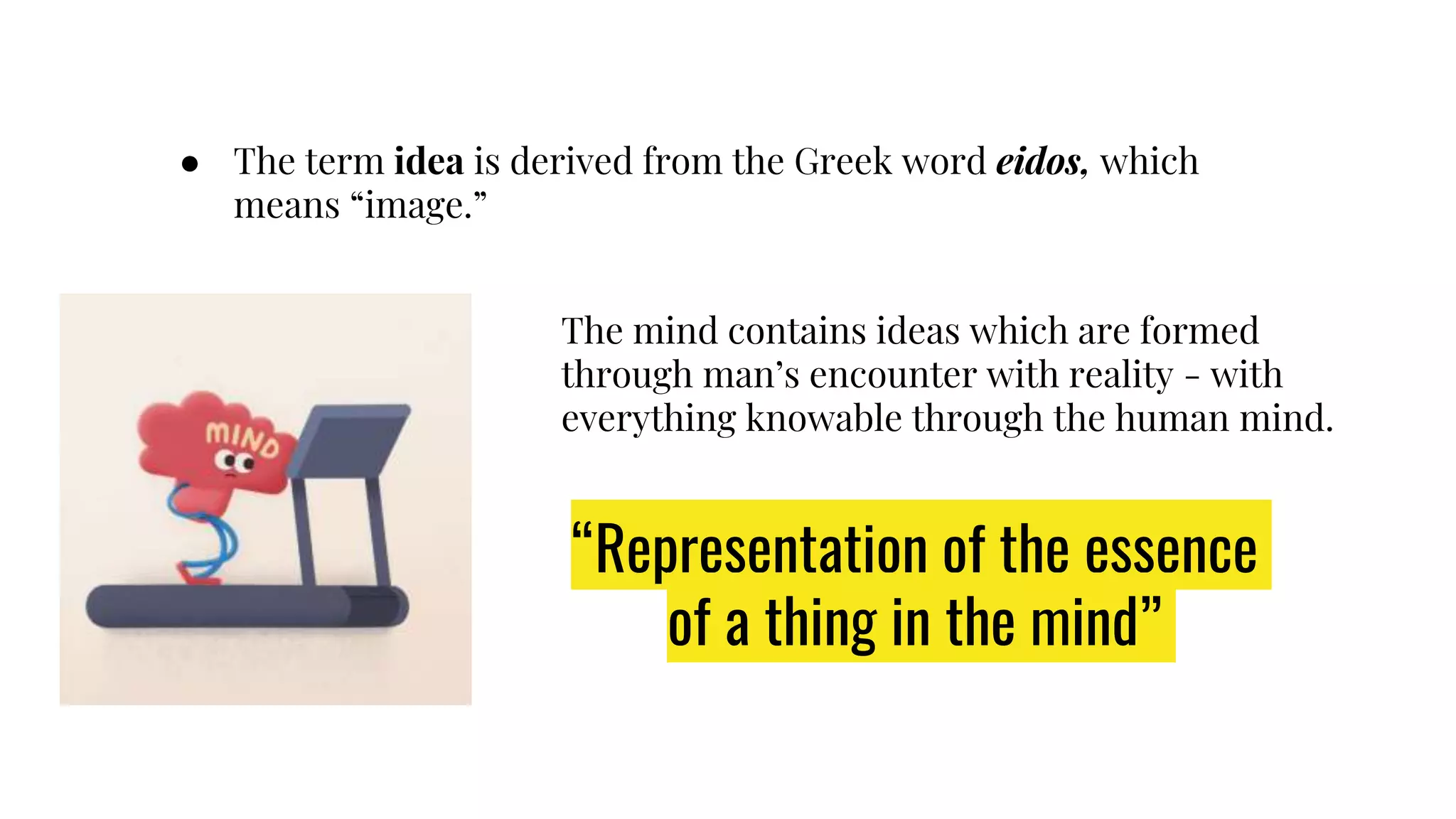
The mind contains ideas which are formed
through man’s encounter with reality - with
everything knowable through the human mind.
“Representation of the essence
of a thing in the mind”
How are IDEAS formed?
“How do the senses help
the intellect form ideas?”
“How do the senses provide the
intellect with ideas?”
“How does simple
apprehension occur?”
?
?
?
?
?
?
1. Sensation
2. Attention
3. Abstraction
4. Reflection
5. Comparison
6. Analysis
7. Synthesis
1. Sensation
● Whatever awareness that comes to man’s external senses, namely: sight,
touch, hearing, taste, and smell, is a product of sensation
Perception- Interpretation of the information brought about by
sensation
2. Attention
The mind attends to what the senses perceive. It fixes its consideration
on multiple objects by the way of partial exclusion, or focuses on a single object
by the way of complete exclusion of all other objects.
3. Abstraction
Is an act by which the mind discerns what the accidental and the
essential notes, features, or aspects of an object are.
Example:
Therefore, the essential features of
an object are those which make up
the essence of the object.
“This small square red
table stands beside a chair”
The table may be small or big,
square or circular, red or brown,
or stand elsewhere but still be a
table.
4. Reflection
● Also called “reflex mental activity”
● It is the turning of the mind upon itself or upon its state or acts
5. Comparison
The mind comes to a direct awareness of the likeness and difference of the
object of attention of which the mind has formed ideas.
6. Analysis
● This is an act through which the mind resolves an idea by means of the
essential notes or features of a particular object.
● The mind investigates those which make up its ideas of a particular object.
7. Synthesis
● This is an act through which the mind puts together two or more ideas as it
makes the essential notes of a single idea
PHANTASM
A concrete and a sensible image drawn by the mind
from a concrete and sensible object.
LOGICAL QUALITIES OF
IDEAS
“2 fundamental qualities of ideas”
Comprehension Refers to the totality of
the essential notes, qualities,
characteristics, or attributes which
the ideas implies.
(Generic Idea)
Extension
(Specific Idea)
Refers to the totality of all the
objects which the idea re[presents
or to which the idea extends its
application
Rules Governing
Comprehension
and Extension
1.
As comprehension
increases, extension
decreases, and vice-
versa.
2.
The extension of
an idea can be increased
or diminished by
retaining, or without
destroying, the idea.
3.
The
comprehension of an
idea is always constant,
whereas the extension of
the idea may change
continually.
Classification of
Ideas
A. Origin
Ideas are classified as either intuitive or derivative
B. Relation
In terms of relation,ideas are classified as IDENTICAL, DIFFERENT,
ASSOCIABLE, or OPPOSED.
IDENTICAL IDEAS
Are those which have the
same comprehension or
extension
Are those which are non-
identical
DIFFERENT IDEAS
ASSOCIABLE IDEAS OPPOSED IDEAS
Are those ideas that are
not mutually exclusive, hence,
can be joined or compound in
the same idea.
Are those which are not
associable
C. Comprehension
In terms of comprehension, ideas are classified as simple, compound, concrete
or abstract
SIMPLE IDEAS
Are those which have
only one note in their
comprehension
Are those which have
more than one note in their
comprehension
COMPUND IDEAS
CONCRETE IDEAS ABSTARCT IDEAS
Are those which
represent something as a subject
together with its determinant
All these ideas represent
their respective determinants as
separate from or not specifically
or concretely assigned to or
identified with a particular
subject
D. Extension
In terms of extension, ideas are classified as singular, universal, particular, or
collective.
SINGULAR IDEAS
Have only one object, or
one note in their extension
Are those which have
many objects in their extension
UNIVERSAL IDEAS
PARTICULAR IDEAS COLLECTIVE IDEAS
Are actually universal
ideas which are taken
indeterminately and partially.
This means that particular ideas
are part of the extension of the
universal idea
Are those which signify a
number of individuals taken as a
unit.
Definition/Nature
of Terms The mind cannot just step up or invest
an idea. This means that for an idea to
be clear, it must always be correlated
with a particular object.
Supposition and Appellation
The
Predicaments
(Categories) and the
Predicament
The Predicables
Various ways or modes of predicating universal concepts
3 Fundamental Components
● Subject
● Copula
● Predicate
Person, things, animal, event, place,
etc.
Is, am, I, was, were, are, etc
Part of a sentence or clause
containing a verb and stating
something about the subject.
Athena is a dancer.
The 5 Predicables
1. GENUS
Expresses a part of the essence of a subject which the subject has in common
with other species belonging to its class.
“Acacia has leaves, trunks, and
branches.”
Leaves, trunks, and branches
2. SPECIES
Expresses the fullness of the essence (whole essence) of a subject
“Man is a thinking being.”
Thinking, human being
3. SPECIFIC DIFFERENCE
(also called “differentia”) Expresses a part of the essence of a subject through
which the subject is distinguish from other species belonging to the same
genus.
“Human Person” “Brute”
Rationality
Whereas a human person is a rational animal, a brute is not.
Thus, rationality is the specific difference between human persons and brute.
4. PROPERTY
Expresses a characteristic or an attribute that is not part of the essence of a
subject, however, must indispensably flow from its (subject) essence.
“Man is a laughing being.”
“Man is a talking animal”
“ Man is the author of technology
and civilization”
Concept
Laughing
Talking
Inventing (as author
of technology and
civilization)
Essence of man
Rationality
These concepts are not necessarily part of the essence of man, but
they all necessarily flow from the rationality (essence) of man.
5. ACCIDENT
Expresses a attribute of a subject that is neither a part nor associated with the
essence of the subject, but is related to the subject only in a contingent
manner or mode.
“This table is round”
“This man is tall”
“His hat is blue.”
CONCEPT
“Round”
“Tall”
“Blue”
Do not determine the essence of their respective subjects.
Definition
Latin (definire) - “to state the limits of” or
“ to enclose within limit”
Definition
In logic, the word definition is taken to mean the
explanation of an idea (or term) based on its content or
use.
2 Kinds of Definition
Nominal Definition
- explains the meaning of a term
by way of considering it (the
term defined) as a name.
BIOLOGY is derived from the word bio,
meaning “life,” and logos, meaning
“study”; hence,
The nominal definition of biology is a
science that studies life.
- derived from the Latin word
nominalis, which means “having
reference to a name.”
Example:
- explains the meaning of a term
by way of recounting the
content of an idea with accuracy
or completeness.
Real Definition Example:
“Man is a rational animal” and
“Man is a dipartite creature of body
and soul.”
In sum, REAL DEFINITION is meant
to give the meaning of the nature
of the thing as signified by the
term;
While, NOMINAL
DEFINITION is meant to
identify or indicate the
thing specified by the
term.
4 Rules of Definition
1. A definition must be clear or exact.
- The definition of the term must neither be narrower nor
wider than the term defined. “Precise”
Example:
“A husband is a man who is united with a woman in lawful wedlock.”
“A ballpen is an instrument used in writing”
2. A definition must be brief.
- Must contain no superfluous words- a definition must not
be verbose.
Example:
“Man is a rational, speaking, mortal, and social animal”
Speaking
Mortal
social
RATIONAL
3. A definition must not contain the term defined either
tacitly or explicitly.
- Must not be circular in order for it to clarify the meaning of
the thing (term) defined (definiendum); the name of the
thing being defined should not be repeated in the definition
(definiens).
VIOLATIONS:
“Political science is a science which is political”
“A body is anything of bodily character.”
4. A definition must be coextensive with the term or thing
defined.
- A definition must be able to distinguish the thing defined
from all other things.
- Have identical extension
- Made convertible
EXAMPLE:
“Man is a rational being”
“Every rational being is a man.”
“ Every man is a rational being.”
“Any rational being is a man”
Terms and Ideas

Terms and Ideas

  • 1.
  • 2.
  • 3.
    Are your ideasBIG enough?
  • 4.
    Ideas are always conceived of bythe mind from reality
  • 5.
    ● The termidea is derived from the Greek word eidos, which means “image.” The mind contains ideas which are formed through man’s encounter with reality - with everything knowable through the human mind. “Representation of the essence of a thing in the mind”
  • 6.
  • 7.
    “How do thesenses help the intellect form ideas?” “How do the senses provide the intellect with ideas?” “How does simple apprehension occur?” ? ? ? ? ? ?
  • 8.
    1. Sensation 2. Attention 3.Abstraction 4. Reflection 5. Comparison 6. Analysis 7. Synthesis
  • 9.
    1. Sensation ● Whateverawareness that comes to man’s external senses, namely: sight, touch, hearing, taste, and smell, is a product of sensation Perception- Interpretation of the information brought about by sensation
  • 11.
    2. Attention The mindattends to what the senses perceive. It fixes its consideration on multiple objects by the way of partial exclusion, or focuses on a single object by the way of complete exclusion of all other objects. 3. Abstraction Is an act by which the mind discerns what the accidental and the essential notes, features, or aspects of an object are.
  • 12.
    Example: Therefore, the essentialfeatures of an object are those which make up the essence of the object. “This small square red table stands beside a chair” The table may be small or big, square or circular, red or brown, or stand elsewhere but still be a table.
  • 13.
    4. Reflection ● Alsocalled “reflex mental activity” ● It is the turning of the mind upon itself or upon its state or acts 5. Comparison The mind comes to a direct awareness of the likeness and difference of the object of attention of which the mind has formed ideas.
  • 14.
    6. Analysis ● Thisis an act through which the mind resolves an idea by means of the essential notes or features of a particular object. ● The mind investigates those which make up its ideas of a particular object. 7. Synthesis ● This is an act through which the mind puts together two or more ideas as it makes the essential notes of a single idea
  • 15.
    PHANTASM A concrete anda sensible image drawn by the mind from a concrete and sensible object.
  • 16.
    LOGICAL QUALITIES OF IDEAS “2fundamental qualities of ideas”
  • 17.
    Comprehension Refers tothe totality of the essential notes, qualities, characteristics, or attributes which the ideas implies. (Generic Idea)
  • 18.
    Extension (Specific Idea) Refers tothe totality of all the objects which the idea re[presents or to which the idea extends its application
  • 19.
  • 20.
    1. As comprehension increases, extension decreases,and vice- versa. 2. The extension of an idea can be increased or diminished by retaining, or without destroying, the idea. 3. The comprehension of an idea is always constant, whereas the extension of the idea may change continually.
  • 21.
  • 22.
    A. Origin Ideas areclassified as either intuitive or derivative
  • 23.
    B. Relation In termsof relation,ideas are classified as IDENTICAL, DIFFERENT, ASSOCIABLE, or OPPOSED.
  • 24.
    IDENTICAL IDEAS Are thosewhich have the same comprehension or extension Are those which are non- identical DIFFERENT IDEAS ASSOCIABLE IDEAS OPPOSED IDEAS Are those ideas that are not mutually exclusive, hence, can be joined or compound in the same idea. Are those which are not associable
  • 25.
    C. Comprehension In termsof comprehension, ideas are classified as simple, compound, concrete or abstract
  • 26.
    SIMPLE IDEAS Are thosewhich have only one note in their comprehension Are those which have more than one note in their comprehension COMPUND IDEAS CONCRETE IDEAS ABSTARCT IDEAS Are those which represent something as a subject together with its determinant All these ideas represent their respective determinants as separate from or not specifically or concretely assigned to or identified with a particular subject
  • 27.
    D. Extension In termsof extension, ideas are classified as singular, universal, particular, or collective.
  • 28.
    SINGULAR IDEAS Have onlyone object, or one note in their extension Are those which have many objects in their extension UNIVERSAL IDEAS PARTICULAR IDEAS COLLECTIVE IDEAS Are actually universal ideas which are taken indeterminately and partially. This means that particular ideas are part of the extension of the universal idea Are those which signify a number of individuals taken as a unit.
  • 29.
    Definition/Nature of Terms Themind cannot just step up or invest an idea. This means that for an idea to be clear, it must always be correlated with a particular object.
  • 43.
  • 50.
  • 55.
    The Predicables Various waysor modes of predicating universal concepts
  • 56.
    3 Fundamental Components ●Subject ● Copula ● Predicate Person, things, animal, event, place, etc. Is, am, I, was, were, are, etc Part of a sentence or clause containing a verb and stating something about the subject.
  • 57.
    Athena is adancer.
  • 58.
  • 59.
    1. GENUS Expresses apart of the essence of a subject which the subject has in common with other species belonging to its class.
  • 60.
    “Acacia has leaves,trunks, and branches.” Leaves, trunks, and branches
  • 61.
    2. SPECIES Expresses thefullness of the essence (whole essence) of a subject
  • 62.
    “Man is athinking being.” Thinking, human being
  • 64.
    3. SPECIFIC DIFFERENCE (alsocalled “differentia”) Expresses a part of the essence of a subject through which the subject is distinguish from other species belonging to the same genus.
  • 65.
    “Human Person” “Brute” Rationality Whereasa human person is a rational animal, a brute is not. Thus, rationality is the specific difference between human persons and brute.
  • 66.
    4. PROPERTY Expresses acharacteristic or an attribute that is not part of the essence of a subject, however, must indispensably flow from its (subject) essence.
  • 67.
    “Man is alaughing being.”
  • 68.
    “Man is atalking animal”
  • 69.
    “ Man isthe author of technology and civilization”
  • 70.
    Concept Laughing Talking Inventing (as author oftechnology and civilization) Essence of man Rationality These concepts are not necessarily part of the essence of man, but they all necessarily flow from the rationality (essence) of man.
  • 71.
    5. ACCIDENT Expresses aattribute of a subject that is neither a part nor associated with the essence of the subject, but is related to the subject only in a contingent manner or mode.
  • 72.
    “This table isround” “This man is tall” “His hat is blue.”
  • 73.
    CONCEPT “Round” “Tall” “Blue” Do not determinethe essence of their respective subjects.
  • 74.
    Definition Latin (definire) -“to state the limits of” or “ to enclose within limit”
  • 75.
    Definition In logic, theword definition is taken to mean the explanation of an idea (or term) based on its content or use.
  • 76.
    2 Kinds ofDefinition
  • 77.
    Nominal Definition - explainsthe meaning of a term by way of considering it (the term defined) as a name. BIOLOGY is derived from the word bio, meaning “life,” and logos, meaning “study”; hence, The nominal definition of biology is a science that studies life. - derived from the Latin word nominalis, which means “having reference to a name.” Example:
  • 78.
    - explains themeaning of a term by way of recounting the content of an idea with accuracy or completeness. Real Definition Example: “Man is a rational animal” and “Man is a dipartite creature of body and soul.”
  • 79.
    In sum, REALDEFINITION is meant to give the meaning of the nature of the thing as signified by the term; While, NOMINAL DEFINITION is meant to identify or indicate the thing specified by the term.
  • 80.
    4 Rules ofDefinition
  • 81.
    1. A definitionmust be clear or exact. - The definition of the term must neither be narrower nor wider than the term defined. “Precise” Example: “A husband is a man who is united with a woman in lawful wedlock.” “A ballpen is an instrument used in writing”
  • 82.
    2. A definitionmust be brief. - Must contain no superfluous words- a definition must not be verbose. Example: “Man is a rational, speaking, mortal, and social animal” Speaking Mortal social RATIONAL
  • 83.
    3. A definitionmust not contain the term defined either tacitly or explicitly. - Must not be circular in order for it to clarify the meaning of the thing (term) defined (definiendum); the name of the thing being defined should not be repeated in the definition (definiens). VIOLATIONS: “Political science is a science which is political” “A body is anything of bodily character.”
  • 84.
    4. A definitionmust be coextensive with the term or thing defined. - A definition must be able to distinguish the thing defined from all other things. - Have identical extension - Made convertible EXAMPLE: “Man is a rational being” “Every rational being is a man.” “ Every man is a rational being.” “Any rational being is a man”