
TEQUILA
Where does tequila come from?
■ Plant?
■ Geographic region?
Tequila
■ Tequila can only be distilled from the sap of the blue agave
plant cores, or pinas grown in five north-central states of
Mexico
– Unlike other distilled spirits, tequila doesn’t come from a grain, nut, fruit,
or vegetable
■ Tequila must contain at least 60% blue agave
– NormaOficial Mexican (NOM) (est. 1970s) specifies how tequila can be
made and the source of the agave
History ofTequila
■ Agave plant or maguey was revered thousands of years ago
■ Pulque
– Drink made from fermenting aguamiel (honey water)
– About 3-4% alcohol
– Considered a gift from the gods by great civilizations of the Americas
■ Spain arrives in 16th century and begin distilling pulque
History ofTequila
■ In 1595, Phillip II banned the planting of grapes to help with import/profit of
Spanish wine and brandy, but didn’t care about agave
■ 1601 – Don Pedro Sanchez deTagle “Father ofTequila” took advantage of
loophole and established first tequila factory in Jalisco, Mexico
– Product was vino de mezcal or mezcal tequila
■ First distilled spirit in the Americas
■ 1873 – tequila officially named after town in central Mexico that wanted to
distinguish their mezcal from others, particularly those in southern Mexico
■ 1903 – first tequila bottling plant was built and tequila bottled
Fun Fact(s):
■ Early distilleries were located in the countryside in the agave
fields, and since drinking glasses were not available where
mezcal was being made, it was served in a bullhorn called a
cuernito or caballito.
– Due to limited supply of horns, a cuernito was shared and
impossible to set down, therefore shots were thrown back
■ Tequila boom occurred 1918
– Doctors prescribed tequila, salt, and lime
■ Another boom of “Mexican whiskey” between 1920 and 1933
History ofTequila
■ Regulations
– 1970s - Norma Oficial Mexican (NOM) established
– specifies how tequila can be made and the source of the agave
■ NOM regulations followed by two actions that guaranteed
international recognition:
– The issuance of the Denomination ofOrigin (DOT)
■ Pertains to geography
– The creation of the Appelation of Control (AOC)
■ Declared the word “tequila” the intellectual property of the
Mexican government
Geography ofTequila
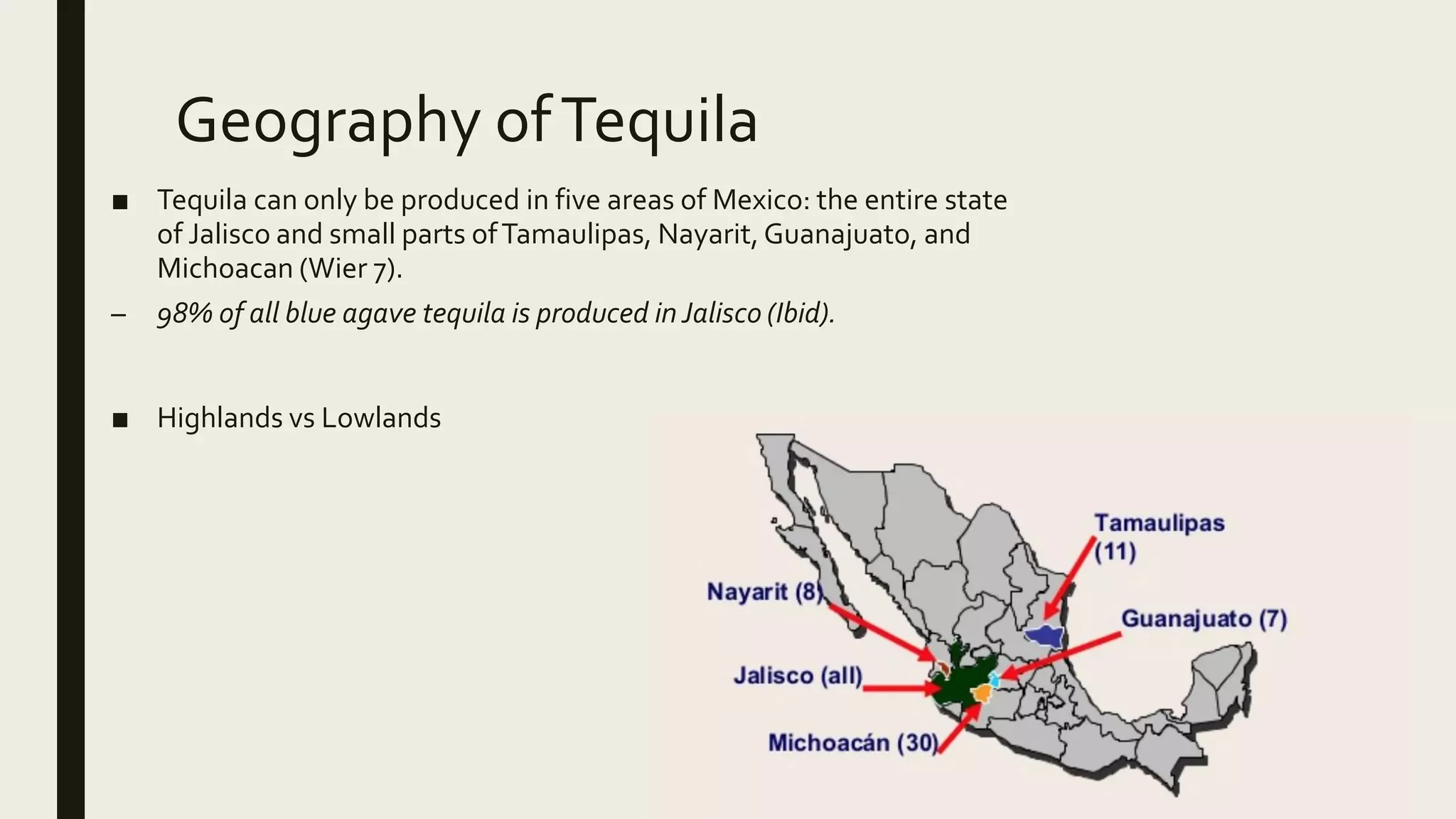
■ Tequila can only be produced in five areas of Mexico: the entire state
of Jalisco and small parts ofTamaulipas, Nayarit, Guanajuato, and
Michoacan (Wier 7).
– 98% of all blue agave tequila is produced in Jalisco (Ibid).
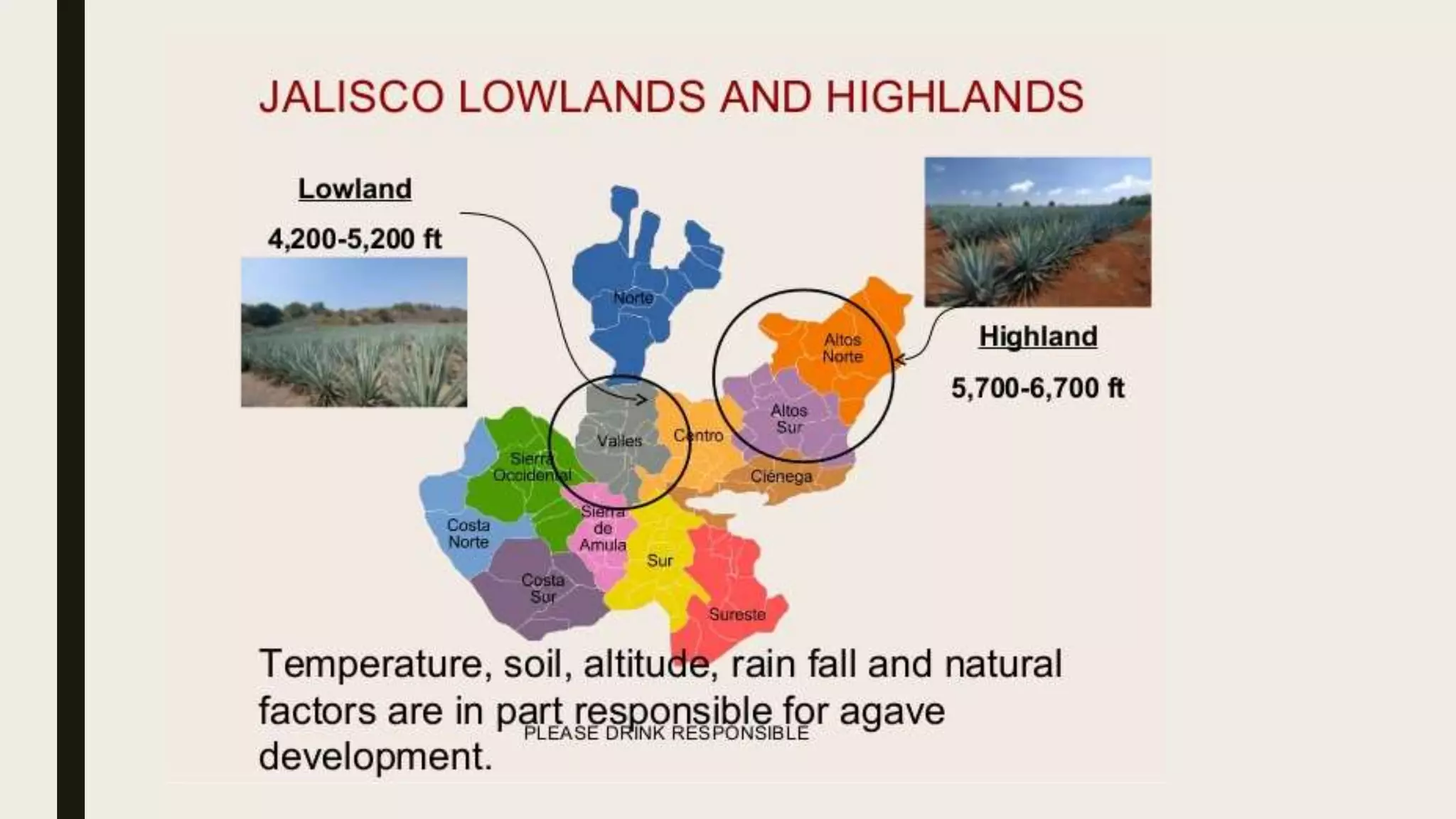
■ Highlands vs Lowlands
Geography ofTequila
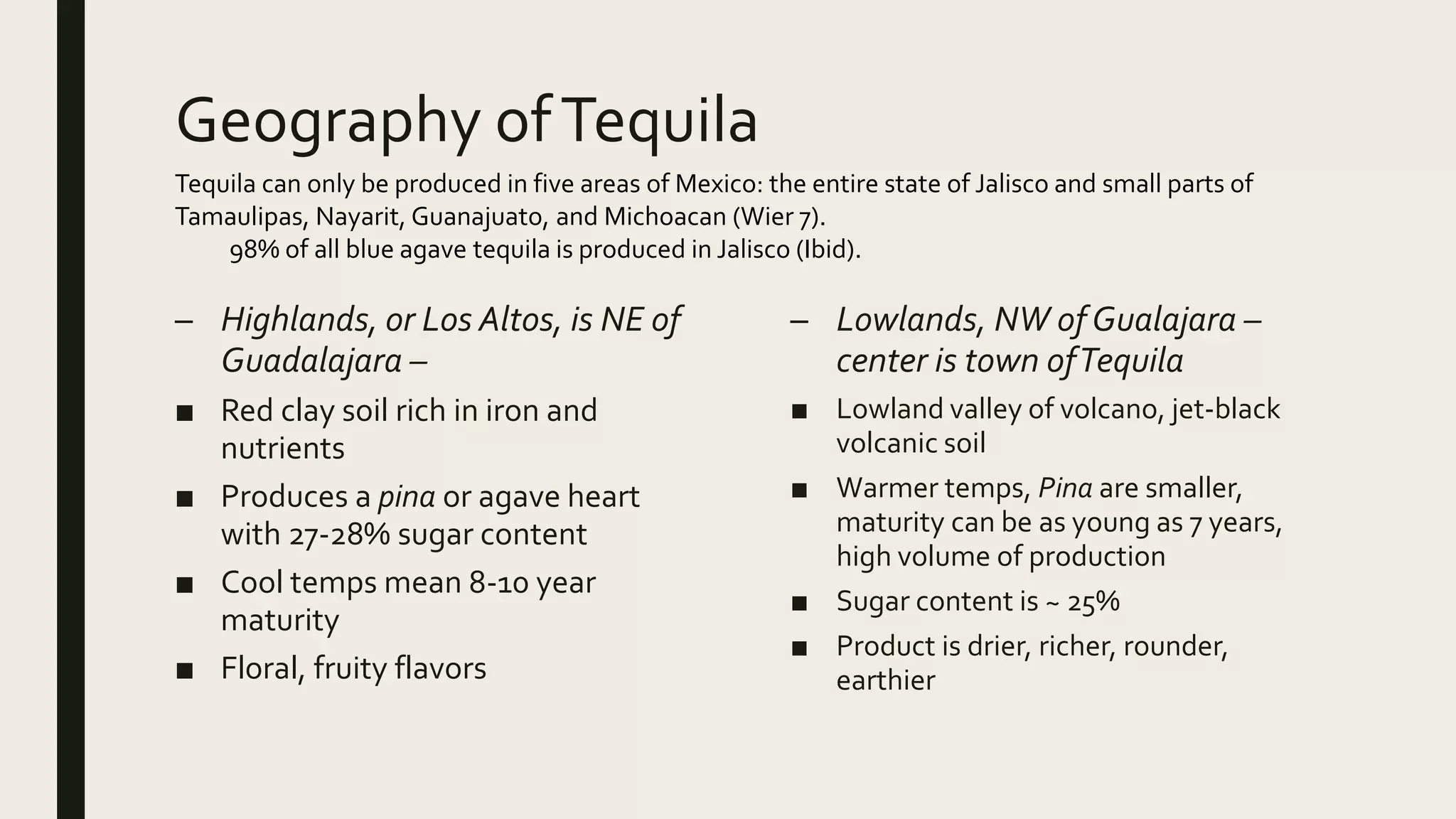
– Highlands, or Los Altos, is NE of
Guadalajara –
■ Red clay soil rich in iron and
nutrients
■ Produces a pina or agave heart
with 27-28% sugar content
■ Cool temps mean 8-10 year
maturity
■ Floral, fruity flavors
– Lowlands, NW ofGualajara –
center is town ofTequila
■ Lowland valley of volcano, jet-black
volcanic soil
■ Warmer temps, Pina are smaller,
maturity can be as young as 7 years,
high volume of production
■ Sugar content is ~ 25%
■ Product is drier, richer, rounder,
earthier
Tequila can only be produced in five areas of Mexico: the entire state of Jalisco and small parts of
Tamaulipas, Nayarit, Guanajuato, and Michoacan (Wier 7).
98% of all blue agave tequila is produced in Jalisco (Ibid).
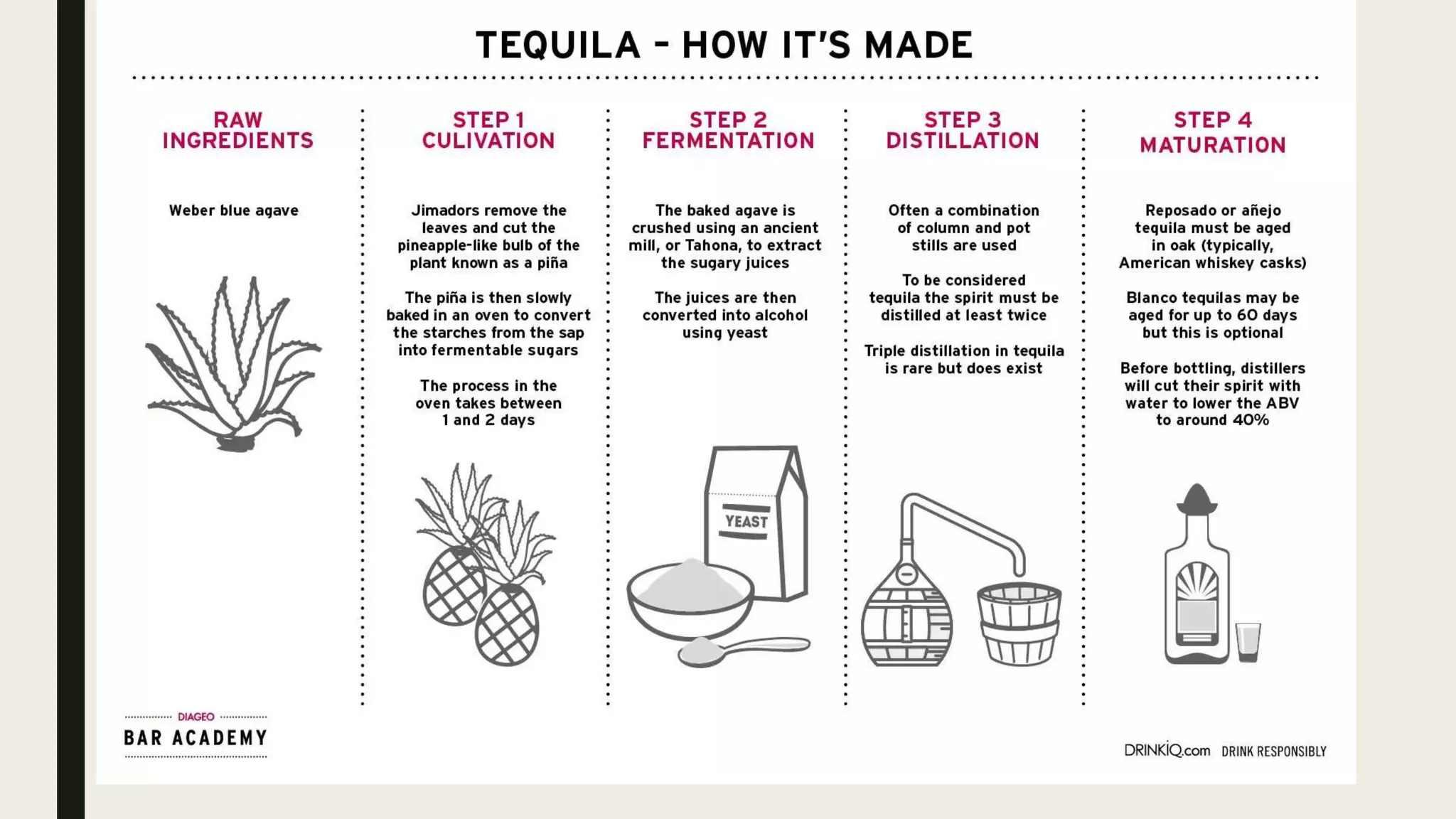
The Process of MakingTequila
■ https://www.youtube.com/watch?v=kxbAbUNiN3I
■ https://youtu.be/vVGQC1rmiTQ
Types ofTequila
■ You can find two types of tequila in stores
– Mixto or “fool’s gold”
■ headache in a bottle
■ “100% agave tequila” needs to be on the label
Types ofTequilas
■ Blanco or white tequila
– Aka plata or silver tequila
– No aging – bottled immediatley after
– Crystal clear and looks like water
■ Reposado
■ Anejo
■ Extra anejo
Types ofTequila
■ Reposado
– Rested tequila
– Aged less than year
– Sits in containers at least 2 months and up to 11 months,30 days
– Oak imparts amber color
– Slightly smoother taste than blanc
Types ofTequila
■ Anejo or aged
– Has to be at least 1 year, but less than 3 years old
– Deep-caramel color
Types ofTequila
■ Extra Anejo
■ Aged 3 years or more
■ Peet, chocolate, caramel, wood notes
■ Pricey
Flights and Pairings
■ Taste
Terms
■ Pina – heart of agave plant
■ Hijuelos, pups, or mecuates – shoots of agave plant
■ Quiote – flower stalk
■ Cogollo – spiky shoot that rises from the center of the plant
■ Jimador – agave harvester
■ Penca – leaf of agave plant
■ Coa – tool used to cut/harvest agave
■ Fabrica – tequila distillery

Tequila

  • 1.
  • 2.
    Where does tequilacome from? ■ Plant? ■ Geographic region?
  • 3.
    Tequila ■ Tequila canonly be distilled from the sap of the blue agave plant cores, or pinas grown in five north-central states of Mexico – Unlike other distilled spirits, tequila doesn’t come from a grain, nut, fruit, or vegetable ■ Tequila must contain at least 60% blue agave – NormaOficial Mexican (NOM) (est. 1970s) specifies how tequila can be made and the source of the agave
  • 4.
    History ofTequila ■ Agaveplant or maguey was revered thousands of years ago ■ Pulque – Drink made from fermenting aguamiel (honey water) – About 3-4% alcohol – Considered a gift from the gods by great civilizations of the Americas ■ Spain arrives in 16th century and begin distilling pulque
  • 5.
    History ofTequila ■ In1595, Phillip II banned the planting of grapes to help with import/profit of Spanish wine and brandy, but didn’t care about agave ■ 1601 – Don Pedro Sanchez deTagle “Father ofTequila” took advantage of loophole and established first tequila factory in Jalisco, Mexico – Product was vino de mezcal or mezcal tequila ■ First distilled spirit in the Americas ■ 1873 – tequila officially named after town in central Mexico that wanted to distinguish their mezcal from others, particularly those in southern Mexico ■ 1903 – first tequila bottling plant was built and tequila bottled
  • 6.
    Fun Fact(s): ■ Earlydistilleries were located in the countryside in the agave fields, and since drinking glasses were not available where mezcal was being made, it was served in a bullhorn called a cuernito or caballito. – Due to limited supply of horns, a cuernito was shared and impossible to set down, therefore shots were thrown back ■ Tequila boom occurred 1918 – Doctors prescribed tequila, salt, and lime ■ Another boom of “Mexican whiskey” between 1920 and 1933
  • 7.
    History ofTequila ■ Regulations –1970s - Norma Oficial Mexican (NOM) established – specifies how tequila can be made and the source of the agave ■ NOM regulations followed by two actions that guaranteed international recognition: – The issuance of the Denomination ofOrigin (DOT) ■ Pertains to geography – The creation of the Appelation of Control (AOC) ■ Declared the word “tequila” the intellectual property of the Mexican government
  • 8.
    Geography ofTequila ■ Tequilacan only be produced in five areas of Mexico: the entire state of Jalisco and small parts ofTamaulipas, Nayarit, Guanajuato, and Michoacan (Wier 7). – 98% of all blue agave tequila is produced in Jalisco (Ibid). ■ Highlands vs Lowlands
  • 10.
    Geography ofTequila – Highlands,or Los Altos, is NE of Guadalajara – ■ Red clay soil rich in iron and nutrients ■ Produces a pina or agave heart with 27-28% sugar content ■ Cool temps mean 8-10 year maturity ■ Floral, fruity flavors – Lowlands, NW ofGualajara – center is town ofTequila ■ Lowland valley of volcano, jet-black volcanic soil ■ Warmer temps, Pina are smaller, maturity can be as young as 7 years, high volume of production ■ Sugar content is ~ 25% ■ Product is drier, richer, rounder, earthier Tequila can only be produced in five areas of Mexico: the entire state of Jalisco and small parts of Tamaulipas, Nayarit, Guanajuato, and Michoacan (Wier 7). 98% of all blue agave tequila is produced in Jalisco (Ibid).
  • 11.
    The Process ofMakingTequila
  • 14.
  • 15.
    Types ofTequila ■ Youcan find two types of tequila in stores – Mixto or “fool’s gold” ■ headache in a bottle ■ “100% agave tequila” needs to be on the label
  • 16.
    Types ofTequilas ■ Blancoor white tequila – Aka plata or silver tequila – No aging – bottled immediatley after – Crystal clear and looks like water ■ Reposado ■ Anejo ■ Extra anejo
  • 17.
    Types ofTequila ■ Reposado –Rested tequila – Aged less than year – Sits in containers at least 2 months and up to 11 months,30 days – Oak imparts amber color – Slightly smoother taste than blanc
  • 18.
    Types ofTequila ■ Anejoor aged – Has to be at least 1 year, but less than 3 years old – Deep-caramel color
  • 19.
    Types ofTequila ■ ExtraAnejo ■ Aged 3 years or more ■ Peet, chocolate, caramel, wood notes ■ Pricey
  • 20.
  • 21.
    Terms ■ Pina –heart of agave plant ■ Hijuelos, pups, or mecuates – shoots of agave plant ■ Quiote – flower stalk ■ Cogollo – spiky shoot that rises from the center of the plant ■ Jimador – agave harvester ■ Penca – leaf of agave plant ■ Coa – tool used to cut/harvest agave ■ Fabrica – tequila distillery

Editor's Notes

  • #4 Often mistaken as being part of cactus family, but related to lily family and to some aloe plants (Weir, 2). “Tequila can only be produced in five areas of Mexico: the entire state of Jalisco and small parts of Tamaulipas, Nayarit, Guanajuato, and Michoacan (Wier 7).” 98% of all blue agave tequila is produced in Jalisco (Ibid).
  • #7 1918- Spanish flu
  • #8 https://www.diffordsguide.com/g/1084/tequila/regulatory-bodies
  • #12 Tequila is the only spirit that contains a whole life cycle (Weir 10). Once the heart of the agave is dug up, the plant dies.