Tense and Definiteness
By: Ana Isabel Alzate Rodas
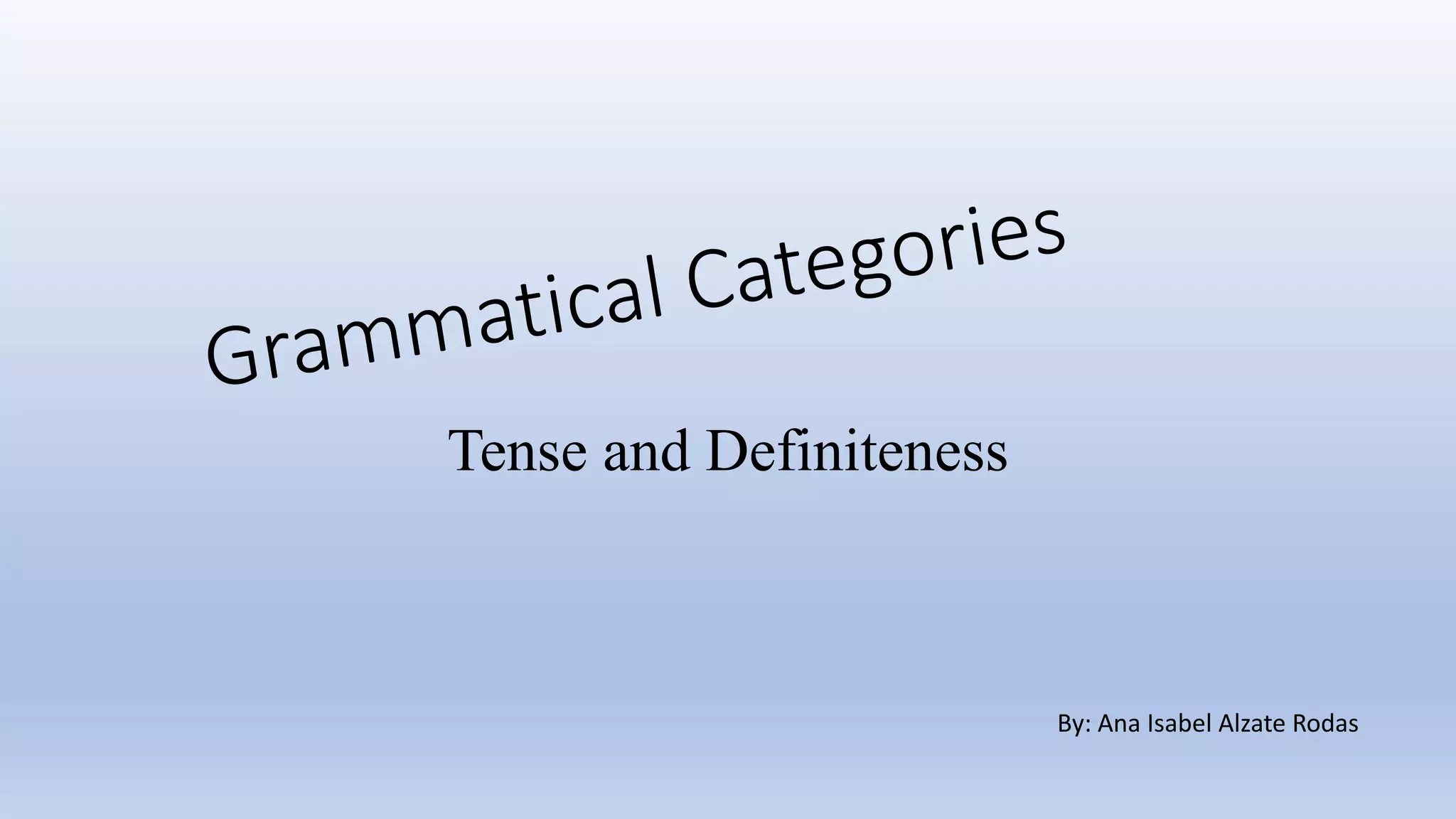
Tense:
This category is related to the verb; is the linguistic indication of the time of an
action.
Tense establishes a relation: it indicates the time of an event in respect to the
moment of speaking.
Past Now Future
e.g.:
I went to the park. I will go to the park.
She worked outside. She will work outside.
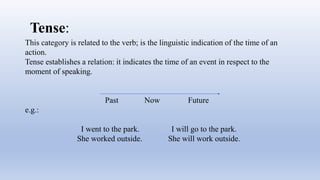
The only tense distinction expressed inflectionally in English is that between present
and past, as in walk/walked or sing/sung, even though it is conventional to talk about a
three-way distinction between past, present, and future tense.
Present tense: the present is used for the expression of a number of other types of
temporal and non temporal situations.
e.g.: I walk to work every morning, she likes seafood.
Past tense: the uses of the past tense are more unified; it denotes a past time distinct
from the present moment.
e.g.: My uncle visited Spain last summer, I went to the store yesterday.
Future tense: the future tense is expressed by a variety of periphrases as well as by the
inflected simple tense.
e.g.: I will cook rice tomorrow, I will be moving next week.
Definiteness:
The concepts of definiteness an indefiniteness are simple:
Definite denotes a referent which is known, familiar, or identified to the speaker and
hearer.
e.g.: define article the
For something previously mention: yesterday, I read a book, the book was about
religion.
For a unique or fixed referent: the Prime Minister.
For a generic referent: I like the house.
For something which is part of the immediate socio-physical context or generally
known: the phone, the head, the sun.
For something identified by a modifying expression either preceding or following
the noun: the white horse, the big house.
For converting a proper noun to a common noun: the England he knew, the
Shakespeare of our times.
Indefinite denotes a referent which is novel, unfamiliar, or not known.
e.g.: indefinite article a/an
For something mentioned for the first time: I´ve got a car, I eat an apple.
For something which cannot or need not be identified: (I want) a friend.
For a generic referent: (He is) a teacher.
Equivalent to ‘any’ : a (any) good book.
Equivalent to ‘one’ : a week or two.
For converting a proper noun to a common noun: a virtual Mozart, a real Einstein.
Reference:
Brinton, L. J., & Brinton, D. (2010). ‘Grammatical categories and word classes’,
Chapter 5 in The Linguistic Structure of Modern English. Amsterdam: John
Benjamins Publishing Co. pp. 113-142. Recovered
fromhttp://bibliotecavirtual.unad.edu.co:2051/login.aspx?direct=true&db=e000xww
&AN=333441&lang=es&site=ehost-live&ebv=EB&ppid=pp_113

Tense and Definiteness.

  • 1.
    Tense and Definiteness By:Ana Isabel Alzate Rodas
  • 2.
    Tense: This category isrelated to the verb; is the linguistic indication of the time of an action. Tense establishes a relation: it indicates the time of an event in respect to the moment of speaking. Past Now Future e.g.: I went to the park. I will go to the park. She worked outside. She will work outside.
  • 3.
    The only tensedistinction expressed inflectionally in English is that between present and past, as in walk/walked or sing/sung, even though it is conventional to talk about a three-way distinction between past, present, and future tense. Present tense: the present is used for the expression of a number of other types of temporal and non temporal situations. e.g.: I walk to work every morning, she likes seafood. Past tense: the uses of the past tense are more unified; it denotes a past time distinct from the present moment. e.g.: My uncle visited Spain last summer, I went to the store yesterday. Future tense: the future tense is expressed by a variety of periphrases as well as by the inflected simple tense. e.g.: I will cook rice tomorrow, I will be moving next week.
  • 4.
    Definiteness: The concepts ofdefiniteness an indefiniteness are simple: Definite denotes a referent which is known, familiar, or identified to the speaker and hearer. e.g.: define article the For something previously mention: yesterday, I read a book, the book was about religion. For a unique or fixed referent: the Prime Minister. For a generic referent: I like the house. For something which is part of the immediate socio-physical context or generally known: the phone, the head, the sun. For something identified by a modifying expression either preceding or following the noun: the white horse, the big house. For converting a proper noun to a common noun: the England he knew, the Shakespeare of our times.
  • 5.
    Indefinite denotes areferent which is novel, unfamiliar, or not known. e.g.: indefinite article a/an For something mentioned for the first time: I´ve got a car, I eat an apple. For something which cannot or need not be identified: (I want) a friend. For a generic referent: (He is) a teacher. Equivalent to ‘any’ : a (any) good book. Equivalent to ‘one’ : a week or two. For converting a proper noun to a common noun: a virtual Mozart, a real Einstein.
  • 6.
    Reference: Brinton, L. J.,& Brinton, D. (2010). ‘Grammatical categories and word classes’, Chapter 5 in The Linguistic Structure of Modern English. Amsterdam: John Benjamins Publishing Co. pp. 113-142. Recovered fromhttp://bibliotecavirtual.unad.edu.co:2051/login.aspx?direct=true&db=e000xww &AN=333441&lang=es&site=ehost-live&ebv=EB&ppid=pp_113