1
Evolution of MOT Frameworks
To Create Value through Technology Innovation
Prepared by:
Dr. Chulho Park
Vice President
Strategic Business Insights
cpark@sbi-i.com
October 2015
2
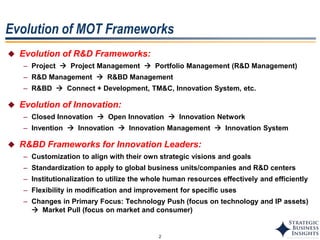
Evolution of MOT Frameworks
 Evolution of R&D Frameworks:
– Project  Project Management  Portfolio Management (R&D Management)
– R&D Management  R&BD Management
– R&BD  Connect + Development, TM&C, Innovation System, etc.
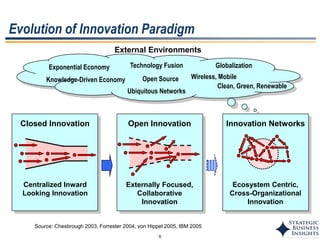
 Evolution of Innovation:
– Closed Innovation  Open Innovation  Innovation Network
– Invention  Innovation  Innovation Management  Innovation System
 R&BD Frameworks for Innovation Leaders:
– Customization to align with their own strategic visions and goals
– Standardization to apply to global business units/companies and R&D centers
– Institutionalization to utilize the whole human resources effectively and efficiently
– Flexibility in modification and improvement for specific uses
– Changes in Primary Focus: Technology Push (focus on technology and IP assets)
 Market Pull (focus on market and consumer)
3
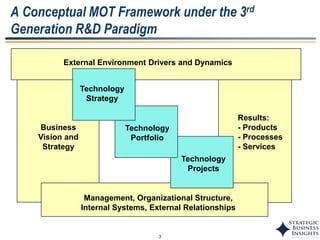
A Conceptual MOT Framework under the 3rd
Generation R&D Paradigm
External Environment Drivers and Dynamics
Business
Vision and
Strategy
Management, Organizational Structure,
Internal Systems, External Relationships
Results:
- Products
- Processes
- Services
Technology
Projects
Technology
Portfolio
Technology
Strategy
4
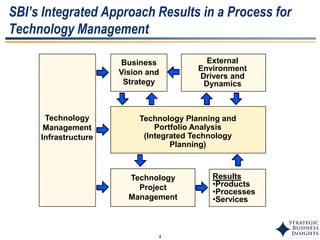
SBI’s Integrated Approach Results in a Process for
Technology Management
Business
Vision and
Strategy
External
Environment
Drivers and
Dynamics
Results
•Products
•Processes
•Services
Technology
Management
Infrastructure
Technology Planning and
Portfolio Analysis
(Integrated Technology
Planning)
Technology
Project
Management
5
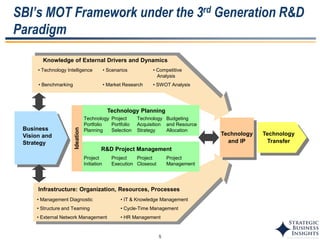
SBI’s MOT Framework under the 3rd Generation R&D
Paradigm
Knowledge of External Drivers and Dynamics
Infrastructure: Organization, Resources, Processes
Technology Planning
R&D Project Management
Business
Vision and
Strategy
• Benchmarking
• Scenarios
• Market Research
• Competitive
Analysis
Technology
Portfolio
Planning
Project
Portfolio
Selection
Budgeting
and Resource
Allocation
Project
Initiation
Project
Execution
Project
Management
• Management Diagnostic
• Structure and Teaming
• HR Management
• IT & Knowledge Management
• Cycle-Time Management
• External Network Management
Ideation
Technology
Acquisition
Strategy
Project
Closeout
• SWOT Analysis
• Technology Intelligence
Technology
Transfer
Technology
and IP
6
Evolution of Innovation Paradigm
Source: Chesbrough 2003, Forrester 2004, von Hippel 2005, IBM 2005
Closed Innovation Innovation NetworksOpen Innovation
Centralized Inward
Looking Innovation
Externally Focused,
Collaborative
Innovation
Ecosystem Centric,
Cross-Organizational
Innovation
External Environments
Ubiquitous Networks
Exponential Economy
Knowledge-Driven Economy
GlobalizationTechnology Fusion
Clean, Green, Renewable
Open Source Wireless, Mobile
7
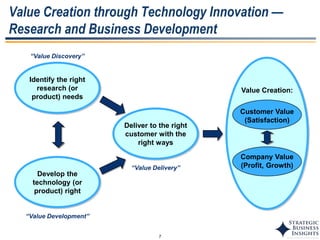
Value Creation through Technology Innovation —
Research and Business Development
Identify the right
research (or
product) needs
“Value Discovery”
Develop the
technology (or
product) right
“Value Development”
Value Creation:
Customer Value
(Satisfaction)
Company Value
(Profit, Growth)
Deliver to the right
customer with the
right ways
“Value Delivery”
8
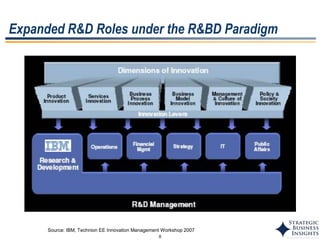
R&D Role in Innovation—a Lever of Multiple Effects
Source: IBM, Technion EE Innovation Management Workshop 2007
Expanded R&D Roles under the R&BD Paradigm
9
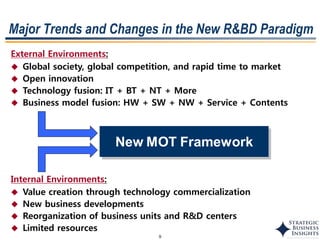
Major Trends and Changes in the New R&BD Paradigm
External Environments:
 Global society, global competition, and rapid time to market
 Open innovation
 Technology fusion: IT + BT + NT + More
 Business model fusion: HW + SW + NW + Service + Contents
Internal Environments:
 Value creation through technology commercialization
 New business developments
 Reorganization of business units and R&D centers
 Limited resources
New MOT Framework
10
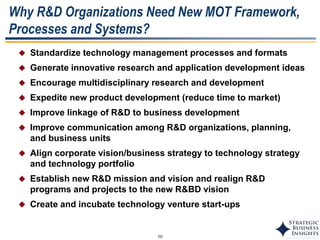
Why R&D Organizations Need New MOT Framework,
Processes and Systems?
 Standardize technology management processes and formats
 Generate innovative research and application development ideas
 Encourage multidisciplinary research and development
 Expedite new product development (reduce time to market)
 Improve linkage of R&D to business development
 Improve communication among R&D organizations, planning,
and business units
 Align corporate vision/business strategy to technology strategy
and technology portfolio
 Establish new R&D mission and vision and realign R&D
programs and projects to the new R&BD vision
 Create and incubate technology venture start-ups
11
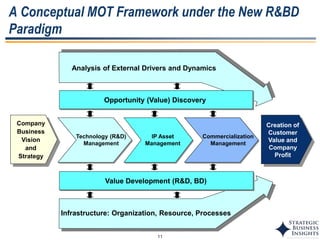
A Conceptual MOT Framework under the New R&BD
Paradigm
Infrastructure: Organization, Resource, Processes
Analysis of External Drivers and Dynamics
Commercialization
Management
IP Asset
Management
Technology (R&D)
Management
Company
Business
Vision
and
Strategy
Opportunity (Value) Discovery
Value Development (R&D, BD)
Creation of
Customer
Value and
Company
Profit
12
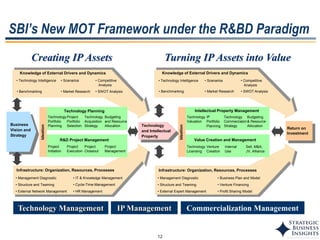
SBI’s New MOT Framework under the R&BD Paradigm
Knowledge of External Drivers and Dynamics
Infrastructure: Organization, Resources, Processes
Technology Planning
R&D Project Management
Business
Vision and
Strategy
• Benchmarking
• Scenarios
• Market Research
• Competitive
Analysis
Technology
Portfolio
Planning
Project
Portfolio
Selection
Budgeting
and Resource
Allocation
Project
Initiation
Project
Execution
Project
Management
• Management Diagnostic
• Structure and Teaming
• HR Management
• IT & Knowledge Management
• Cycle-Time Management
• External Network Management
Ideation
Technology
Acquisition
Strategy
Project
Closeout
• SWOT Analysis
• Technology Intelligence
Knowledge of External Drivers and Dynamics
Infrastructure: Organization, Resources, Processes
• Benchmarking
• Scenarios
• Market Research
• Competitive
Analysis
• Management Diagnostic
• Structure and Teaming
• Profit Sharing Model
• Business Plan and Model
• Venture Financing
• External Expert Management
• SWOT Analysis
• Technology Intelligence
Intellectual Property Management
Value Creation and Management
Technology
Valuation
IP
Portfolio
Planning
Budgeting
& Resource
Allocation
Technology
Licensing
Venture
Creation
Sell, M&A,
JV, Alliance
Ideation
Technology
Commercialzn
Strategy
Internal
Use
Return on
Investment
Technology
and Intellectual
Property
Creating IP Assets Turning IP Assets into Value
Technology Management Commercialization ManagementIP Management
13
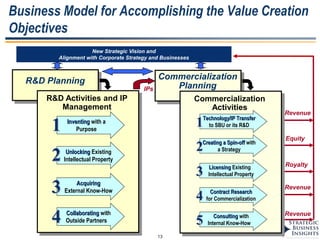
New Strategic Vision and
Alignment with Corporate Strategy and Businesses
Business Model for Accomplishing the Value Creation
Objectives
R&D Activities and IP
Management
R&D Planning
UnlockingUnlocking Existing
Intellectual Property22
InventingInventing with a
Purpose11
AcquiringAcquiring
External Know-How33
CollaboratingCollaborating with
Outside Partners44
UnlockingUnlocking Existing
Intellectual Property22
InventingInventing with a
Purpose11
AcquiringAcquiring
External Know-How33
CollaboratingCollaborating with
Outside Partners44
Commercialization
Activities
Commercialization
Planning
Royalty
Equity
Revenue
IPs
Revenue
LicensingLicensing Existing
Intellectual Property33
Creating a SpinCreating a Spin--offoff with
a Strategy22
Contract ResearchContract Research
for Commercializationfor Commercialization44
ConsultingConsulting with
Internal Know-How55
Technology/IP TransferTechnology/IP Transfer
to SBU or its R&D11
LicensingLicensing Existing
Intellectual Property33 LicensingLicensing Existing
Intellectual Property33
Creating a SpinCreating a Spin--offoff with
a Strategy22Creating a SpinCreating a Spin--offoff with
a Strategy22
Contract ResearchContract Research
for Commercializationfor Commercialization44 Contract ResearchContract Research
for Commercializationfor Commercialization44
ConsultingConsulting with
Internal Know-How55 ConsultingConsulting with
Internal Know-How55
Technology/IP TransferTechnology/IP Transfer
to SBU or its R&D11Technology/IP TransferTechnology/IP Transfer
to SBU or its R&D11
Revenue
14
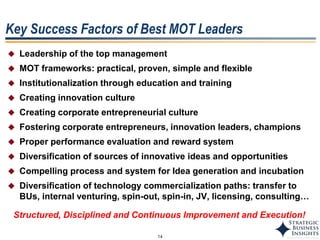
 Leadership of the top management
 MOT frameworks: practical, proven, simple and flexible
 Institutionalization through education and training
 Creating innovation culture
 Creating corporate entrepreneurial culture
 Fostering corporate entrepreneurs, innovation leaders, champions
 Proper performance evaluation and reward system
 Diversification of sources of innovative ideas and opportunities
 Compelling process and system for Idea generation and incubation
 Diversification of technology commercialization paths: transfer to
BUs, internal venturing, spin-out, spin-in, JV, licensing, consulting…
Key Success Factors of Best MOT Leaders
Structured, Disciplined and Continuous Improvement and Execution!

Technology Management Frameworks

  • 1.
    1 Evolution of MOTFrameworks To Create Value through Technology Innovation Prepared by: Dr. Chulho Park Vice President Strategic Business Insights cpark@sbi-i.com October 2015
  • 2.
    2 Evolution of MOTFrameworks  Evolution of R&D Frameworks: – Project  Project Management  Portfolio Management (R&D Management) – R&D Management  R&BD Management – R&BD  Connect + Development, TM&C, Innovation System, etc.  Evolution of Innovation: – Closed Innovation  Open Innovation  Innovation Network – Invention  Innovation  Innovation Management  Innovation System  R&BD Frameworks for Innovation Leaders: – Customization to align with their own strategic visions and goals – Standardization to apply to global business units/companies and R&D centers – Institutionalization to utilize the whole human resources effectively and efficiently – Flexibility in modification and improvement for specific uses – Changes in Primary Focus: Technology Push (focus on technology and IP assets)  Market Pull (focus on market and consumer)
  • 3.
    3 A Conceptual MOTFramework under the 3rd Generation R&D Paradigm External Environment Drivers and Dynamics Business Vision and Strategy Management, Organizational Structure, Internal Systems, External Relationships Results: - Products - Processes - Services Technology Projects Technology Portfolio Technology Strategy
  • 4.
    4 SBI’s Integrated ApproachResults in a Process for Technology Management Business Vision and Strategy External Environment Drivers and Dynamics Results •Products •Processes •Services Technology Management Infrastructure Technology Planning and Portfolio Analysis (Integrated Technology Planning) Technology Project Management
  • 5.
    5 SBI’s MOT Frameworkunder the 3rd Generation R&D Paradigm Knowledge of External Drivers and Dynamics Infrastructure: Organization, Resources, Processes Technology Planning R&D Project Management Business Vision and Strategy • Benchmarking • Scenarios • Market Research • Competitive Analysis Technology Portfolio Planning Project Portfolio Selection Budgeting and Resource Allocation Project Initiation Project Execution Project Management • Management Diagnostic • Structure and Teaming • HR Management • IT & Knowledge Management • Cycle-Time Management • External Network Management Ideation Technology Acquisition Strategy Project Closeout • SWOT Analysis • Technology Intelligence Technology Transfer Technology and IP
  • 6.
    6 Evolution of InnovationParadigm Source: Chesbrough 2003, Forrester 2004, von Hippel 2005, IBM 2005 Closed Innovation Innovation NetworksOpen Innovation Centralized Inward Looking Innovation Externally Focused, Collaborative Innovation Ecosystem Centric, Cross-Organizational Innovation External Environments Ubiquitous Networks Exponential Economy Knowledge-Driven Economy GlobalizationTechnology Fusion Clean, Green, Renewable Open Source Wireless, Mobile
  • 7.
    7 Value Creation throughTechnology Innovation — Research and Business Development Identify the right research (or product) needs “Value Discovery” Develop the technology (or product) right “Value Development” Value Creation: Customer Value (Satisfaction) Company Value (Profit, Growth) Deliver to the right customer with the right ways “Value Delivery”
  • 8.
    8 R&D Role inInnovation—a Lever of Multiple Effects Source: IBM, Technion EE Innovation Management Workshop 2007 Expanded R&D Roles under the R&BD Paradigm
  • 9.
    9 Major Trends andChanges in the New R&BD Paradigm External Environments:  Global society, global competition, and rapid time to market  Open innovation  Technology fusion: IT + BT + NT + More  Business model fusion: HW + SW + NW + Service + Contents Internal Environments:  Value creation through technology commercialization  New business developments  Reorganization of business units and R&D centers  Limited resources New MOT Framework
  • 10.
    10 Why R&D OrganizationsNeed New MOT Framework, Processes and Systems?  Standardize technology management processes and formats  Generate innovative research and application development ideas  Encourage multidisciplinary research and development  Expedite new product development (reduce time to market)  Improve linkage of R&D to business development  Improve communication among R&D organizations, planning, and business units  Align corporate vision/business strategy to technology strategy and technology portfolio  Establish new R&D mission and vision and realign R&D programs and projects to the new R&BD vision  Create and incubate technology venture start-ups
  • 11.
    11 A Conceptual MOTFramework under the New R&BD Paradigm Infrastructure: Organization, Resource, Processes Analysis of External Drivers and Dynamics Commercialization Management IP Asset Management Technology (R&D) Management Company Business Vision and Strategy Opportunity (Value) Discovery Value Development (R&D, BD) Creation of Customer Value and Company Profit
  • 12.
    12 SBI’s New MOTFramework under the R&BD Paradigm Knowledge of External Drivers and Dynamics Infrastructure: Organization, Resources, Processes Technology Planning R&D Project Management Business Vision and Strategy • Benchmarking • Scenarios • Market Research • Competitive Analysis Technology Portfolio Planning Project Portfolio Selection Budgeting and Resource Allocation Project Initiation Project Execution Project Management • Management Diagnostic • Structure and Teaming • HR Management • IT & Knowledge Management • Cycle-Time Management • External Network Management Ideation Technology Acquisition Strategy Project Closeout • SWOT Analysis • Technology Intelligence Knowledge of External Drivers and Dynamics Infrastructure: Organization, Resources, Processes • Benchmarking • Scenarios • Market Research • Competitive Analysis • Management Diagnostic • Structure and Teaming • Profit Sharing Model • Business Plan and Model • Venture Financing • External Expert Management • SWOT Analysis • Technology Intelligence Intellectual Property Management Value Creation and Management Technology Valuation IP Portfolio Planning Budgeting & Resource Allocation Technology Licensing Venture Creation Sell, M&A, JV, Alliance Ideation Technology Commercialzn Strategy Internal Use Return on Investment Technology and Intellectual Property Creating IP Assets Turning IP Assets into Value Technology Management Commercialization ManagementIP Management
  • 13.
    13 New Strategic Visionand Alignment with Corporate Strategy and Businesses Business Model for Accomplishing the Value Creation Objectives R&D Activities and IP Management R&D Planning UnlockingUnlocking Existing Intellectual Property22 InventingInventing with a Purpose11 AcquiringAcquiring External Know-How33 CollaboratingCollaborating with Outside Partners44 UnlockingUnlocking Existing Intellectual Property22 InventingInventing with a Purpose11 AcquiringAcquiring External Know-How33 CollaboratingCollaborating with Outside Partners44 Commercialization Activities Commercialization Planning Royalty Equity Revenue IPs Revenue LicensingLicensing Existing Intellectual Property33 Creating a SpinCreating a Spin--offoff with a Strategy22 Contract ResearchContract Research for Commercializationfor Commercialization44 ConsultingConsulting with Internal Know-How55 Technology/IP TransferTechnology/IP Transfer to SBU or its R&D11 LicensingLicensing Existing Intellectual Property33 LicensingLicensing Existing Intellectual Property33 Creating a SpinCreating a Spin--offoff with a Strategy22Creating a SpinCreating a Spin--offoff with a Strategy22 Contract ResearchContract Research for Commercializationfor Commercialization44 Contract ResearchContract Research for Commercializationfor Commercialization44 ConsultingConsulting with Internal Know-How55 ConsultingConsulting with Internal Know-How55 Technology/IP TransferTechnology/IP Transfer to SBU or its R&D11Technology/IP TransferTechnology/IP Transfer to SBU or its R&D11 Revenue
  • 14.
    14  Leadership ofthe top management  MOT frameworks: practical, proven, simple and flexible  Institutionalization through education and training  Creating innovation culture  Creating corporate entrepreneurial culture  Fostering corporate entrepreneurs, innovation leaders, champions  Proper performance evaluation and reward system  Diversification of sources of innovative ideas and opportunities  Compelling process and system for Idea generation and incubation  Diversification of technology commercialization paths: transfer to BUs, internal venturing, spin-out, spin-in, JV, licensing, consulting… Key Success Factors of Best MOT Leaders Structured, Disciplined and Continuous Improvement and Execution!