Technology Write upSamples
Sample 1
SaaS based property management software company
6 ways in which AI and ML are transforming the property management
business
In the hyper connected world that we live in, artificial intelligence (AI) and machine learning
(ML) have made their presence felt in our daily life, right from image tag suggestions from
Facebook to product recommendations on Amazon and the voice assistants like Siri and Alexa.
But can AI and ML have a similar impact on property management? Is it the next frontier in the
natural progression towards a technology driven property management industry?
Property management companies–small or big; are gravitating towards technology for better
property management. The global property management software market is expected to post a
CAGR of almost 5% during the period 2018-2022. In such a competitive market, offering a
phenomenal customer experience could well be a differentiating factor for your business, and
this is where AI and ML can make a difference.
Data is everywhere, and we continue to create more of it as we move to smart phones and
smarter homes, but AI (artificial intelligence) can help us derive insights from this data to offer
unmatched customer experience in the property management industry. ML (Machine Learning)
can develop predictive and analytical models for financial data and investment opportunities in
the real-estate market.
Based on the current trends in the industry, it is safe to predict that AI- ML will have a deep
impact on the property management sector. A few ways in which AI, ML driven technology is
making its presence felt are -
1. Voice Assistants enabled rent payment and request submissions
By the end of 2020 there will be 4.2 billion digital voice assistants in use around the world. This
presents a tremendous opportunity for property management companies to improve customer
experience. Residents could pay rent, raise requests, book amenities and check status of their
invoices via voice enabled digital assistants. The voice assistant can notify residents about
upcoming due dates, customize marketing messages based on their preferences, and offer an
intuitive experience to the resident. Voice assistant enabled homes are already on the offer in the
USA and its only time before it will become a regular feature in rental accommodations world-
wide.
2. Chat Bot enabled self-service portals for prospects and residents
2.
Chat Bots havebecome a popular customer service solution in multiple businesses worldwide.
Property management companies can utilize AI powered chat bots to resolve common queries of
prospects and residents and direct them to relevant links or executives for a personalized
experience. AI powered bots are more than just pre-fed question-and-answer sets. These bots can
iterate and learn from data to reduce the call inflow volume, traditionally directed towards
property managers or customer support and assist residents or prospects find solutions at their
convenience.
3. Multi-lingual interfaces for better user adoption
Of the total 7.8 billion population of the world, a little over 1 billion speak English and only 33%
of them consider English as their native language. As the internet penetration grows across the
world, it will be essential to offer multi-lingual portals or interfaces for easier user adoption.
Property management web portals or apps with in-built translation capabilities can help residents
adopt these apps and portals faster. It will also improve the overall customer experience and have
minimum errors in communication and general dealings.
4. Predictive lead scoring
AI can be included in the sales process of the property management company to create customer
intelligence driven marketing signals and improve conversions. AI can generate a lead score
based on the prospect’s activity and nurture them with the right messaging to enable leads to take
the desired next steps. A property management company can prioritize responses based on the
lead scoring and maximize returns by converting leads to residents faster.
5. Customer insight based marketing
Retain residents and convert more prospects by utilizing the AI driven analysis of consumer
trends. Marketing and Sales departments adopting AI for tasks like pricing and prediction of
likelihood to buy witnessed a revenue increase of 6 to 10% in various industries. Property
management can expect to see similar returns by including AI in their backend solution. An
integrated platform that can have centralized data for AI prediction can offer better results. Use
data to create personalized marketing campaigns and track their performance. Property managers
can have dashboards that surface important communication around a prospect as you interact
with them and have an automated daily task list to ensure all tasks are completed.
6. Financial predictive models for greater returns on investments
AI and ML will not only improve efficiency in operational tasks but will also change the way
investment and financial decisions are taken in the long run. Real-estate has traditionally been
high-risk investment and driven by subjective assessments. With the capabilities of machine
learning, we can develop analytical models which can prove vital in making investment related
decisions. AI-ML can recognize relationships and patterns in large amounts of data and derive
insights that could accurately predict the returns on investments over a period.
3.
The impact oftechnology continues to grow in the property management sector. Including latest
technology in the business will help property management companies stay ahead of the
competition while improving internal collaboration, data management, and overall efficiency.
Technological advancements in AI and ML can help property management companies improve
transaction speed, identify suitable investment opportunities, create personalized contracts,
develop intelligent building services management and improve data transparency and
standardization of processes.
Sample 2
Future Trends in PropTech
PropTech businesses are upbeat about the growth in the sector and most believe that real estate
companies will increase spending on PropTech solutions. In the next two years, PropTech
expects significant digital disruption in several areas like - Real-time asset performance data,
building optimization, transactions and customer data. At the heart of these future trends will be
the customer experience and responsible businesses.
Of all the upcoming trends in Proptech a few technologies will have an overarching effect on the
real-estate and the way they function.
Conversational AI and ML
AI will move beyond chat bots and static question and answer. Enabled by conversational AI,
these assistants would be built for purpose, have a rich set of capabilities, and be integrated into
the end-to-end process landscape of the enterprise. They can also simultaneously act as an
important interface within the entire real estate ecosystem. Service desk automation and
conversational AI can enable companies to design and deliver an experience that provides low
error rates, faster responses, and 24*7 availability.
Machine Learning is being used in analytics and prediction. The machine, based on the advanced
system of probability, can make predictions and decisions. Another area where machine learning
is used is the AI field of Natural Language Processing (NLP). ML is used to help machines
understand the nuances in human language, and to learn to respond in a way that a particular
audience is likely to understand.
One of the major barriers to greater use for–AI, ML, and technologies like computer visions are
fears around data security. As companies work towards improving data security and privacy,
4.
these technologies willmake inroads in the real-estate segment. Secure cloud solutions, PAAS
(Platform as a Service) and SAAS (Software as a Service) will lead the way in making these
technologies accessible.
Smart Homes
According to a BitCom Research, 31% will consider smart home as decision driver for next flat
or house and 19% will pay more rent for space equipped with smart home applications. ( line
drawing with icons)
As the renters demographic get younger, they are looking for easy technology enabled solutions
for work and home. Smart homes that use IOT and smart voice assistants like Alexa for regular
tasks will be seen as an important advantage in the coming years and property management
companies should focus on including more technology enabled services in customer service,
property maintenance and property security.
Homes with sensors for optimal utilization of resources - water and electricity, device enabled
security and voice enabled property maintenance services like rent notification, amenities
booking and maintenance requests will see greater adoption in the near future.
IOT—Internet of Things
IOT refers to any device that can connect to the internet, and it is predicted that the number of
connected devices will grow to 29 billion by 2022. Many individual electronic devices are
already communicating, and this will grow as we make our homes and commercial spaces
smarter. Advanced analytics based on the ‘big data’ collected by numerous devices like sensors,
switches, lightbulbs, voice assistants, phones, TVs etc. will be the next wave in data driven smart
buildings.
IoT also enables the development of Building Information Modelling (BIM) technology, which
is a digital simulation or model of a property. Such simulations will help in various aspects of
property management, security and maintenance.
Drones in PropTech
The real estate industry is currently the second biggest user of commercial drones (after
photography). Currently, these are used in due diligence and site inspections. “Drones can survey
potential sites and conduct inspections quickly, increasing the efficiency of site selection,
inspections, regular maintenance and more. They can also reduce risks by ensuring all parties
have more comprehensive information about a property.” (Welles, 2018).
In the future, as the way people travel and interact with real-estate changes, it will change the
way PropTech is used. Apart from inspections, drones can be useful in security of extensive
properties like multi-family apartments, commercial or vacation rentals. Similarly, drone enabled
5.
maintenance could bescheduled in the property management software to improve regular
maintenance of sky scrapers.
Smart buildings
A green building is a new normal. As sustainability and climate change become important
drivers for the way we live and work, the need for smart buildings will only continue to grow.
For a building to be efficient it is important to consciously manage basic building services inputs
(air, water, power, transport) and outputs (emissions, sewage and refuse)
There is an expectation from both users and investors that buildings will operate efficiently from
both a cost and functional perspective. In theory, if operational costs are lower, then it offered a
more competitive total occupation price to occupants, and better returns are available to
investors.
Driven by government policies, business commitments and the savings achieved from efficient
use of resources, there will be a motivation for designing efficient and tech enabled living and
working spaces. Innovative building automation and energy management systems that maximize
comfort, environmental quality, and sustainability requirements are at the heart of smart
buildings. As technological advances continue, we are getting close to seeing unmanned, robotic
buildings engaging in such activities as 3D printing or warehousing. The next generation of
smart buildings will be run remotely.
Smart Cities
Smart cities encapsulate an urban development vision that integrates multiple information and
communication technology to manage city’s assets like information systems, schools, libraries,
transportation systems, hospitals, power plants, water supply networks, waste management, law
enforcement and other community services. Through the use of sensors integrated with real-time
monitoring system and data collected from users and devices, a smart city tries to offer an
improved quality of life and superior efficiencies at a city level.
Blockchain
Blockchain is a DLT-based technology and business practice built on peer-to-peer
transaction data held in a packet of information (a block). This allows systems to create and
develop a permanent ledger of historical transactions and power a current ownership register.
Crypto currency is one of the first applications of Blockchain and significant developments in the
creation and use of crypto-currency in recent times could usher in a new revolution. It could lead
to an alternative method of transacting, recording, pricing and owning real-estate. Blockchain
could also offer a repository through which data protection is more easily enforced. However a
word of caution here, as there is a lot that needs to be done in the field of Blockchain to make it
more appealing to the masses.
Other Technologies
6.
A few otherinnovations and technologies in real-estate that are making a mark include
expansion of 5G network, modular construction, 3D printing and robotics and smart materials.
Modular construction can involve assembly of standardized block. They may be empty boxes
fitted out on site, complete with internal fittings and floorings. A pre-fabricated home could
bring in standardization, efficiency, and economies to scale.
Similarly, 3D printed homes have the potential to reduce the amount of labor required and
reducing the cost and time required for construction.
A lot of start-ups are working in smart materials that can help improve the health and wellness of
residents while keeping the building efficient.
Such innovative materials and construction techniques could herald a novel way of construction
and management of real-estate in the long run.
“Automation will address many inefficiencies that exist in the property sector. The challenge
with Big Data & analytics is that as we collect more and more information, we need to constantly
consider ‘why are we collecting this data.’ For those organizations that are truly customer
focused, this will become a differentiator.” Jonathan Hannam–Managing Director, Taronga
Group.
Sample 3
How creating a WordPress plugin helps
businesses
WordPress today powers nearly 40% of the internet. Businesses big and small are using WordPress to
create a competitive online business environment. The extendibility that the WordPress plugins offer
makes it popular among developers and businesses alike. But each business model is unique and so are
its requirements. What if you can’t find a plugin that you need? Can creating a WordPress plugin be the
answer?
The short answer is yes.
What is the difference between off the Self and Custom WordPress
Plugins?
7.
With over 50,000plugins available in WordPress, you have a ready solution for most of the
requirements. However, when a business is scaling or is operating in a niche market, then off-the-shelf
plugins might not offer the solution that your business needs. It is in times like these that creating a
custom WordPress plugin can be a game changer for your business or market segment.
The biggest advantage of building a custom WordPress plugin is that it is not just solving a technical
problem but is enabling you to solve a business problem which will result in ease of business and overall
growth.
How creating a WordPress plugin helps business
An online business is all about customer experience. A great experience always translates into good
business and hence you would want it to be seamless and simple. Right from a contact form to creating
a full-fledged e-com store, a wordpress plugin can provide amazing extendibility and make your website
a true lead magnet.
Let us look at how creating a WordPress plugin helps you achieve all this and more.
Simplify business processes
Businesses need a lot of real-time data, especially relating to inventory or product delivery status.
Having such information embedded in the backend helps reduce human intervention, make the
customer experience seamless and reduce redundancies in work. As a business solution development
company, we develop custom WordPress plugins based on customers’ business and the end goal they
want to achieve.
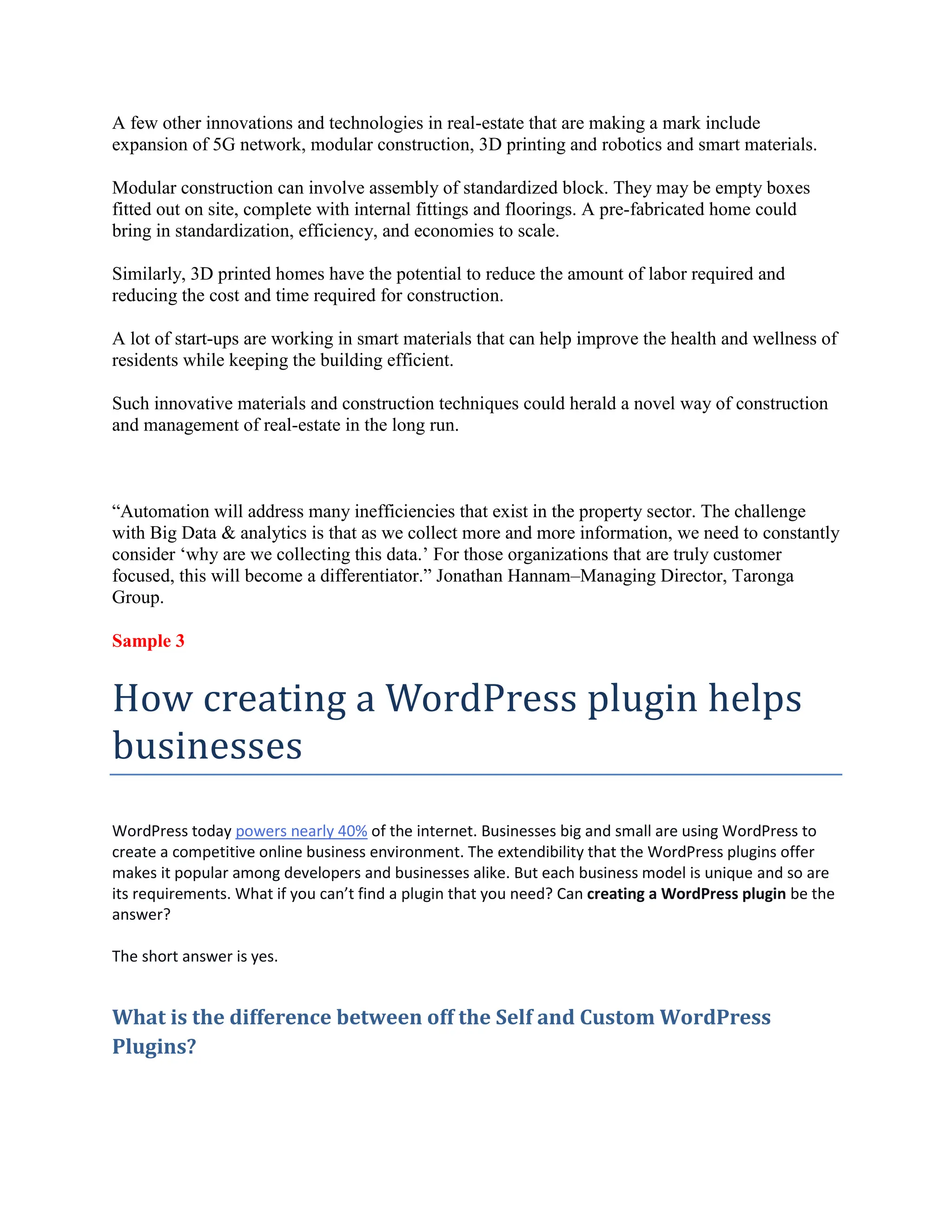
For Example, we can build a customized shipping plugin that can enable end-users to place bulk orders
for various shipping addresses in a single order. So while a regular e-com site would expect the end-user
to create multiple orders for multiple locations, a custom wordpress plugin can offer a simplified
solution that saves time and effort. BizMo Tech implemented this solution for one of our Australian
clients. Know more about it in our case study. [ Link to case study]
Tech-driven differentiator
As most business websites are developed using similar platforms or plugin’s, the customer experience is
similar. In a world of similarities, your business stands out with a custom plugin. If your business can
8.
offer an automatedsolution for repetitive tasks or intelligent suggestions that make a customer’s buying
decision easy, then it will be a tech-driven differentiator that makes your business stand out.
Can improve customer experience
Customers no longer base their loyalty on price or quality. Customer experience is equally important for
them. According to research, 86% of buyers will pay more for a great customer experience. Almost 46%
of businesses are investing more in customer experience. A businesses digital solution that focuses on
improving the customer experience is more likely to improve customer satisfaction, increase up-selling
and achieve greater customer retention.
Taking forward the earlier example, we managed to improve the customer experience for our Australian
client, thereby strengthening their positioning in the market. The multiple destination, split shipping
plugin acted as a differentiator for this brand. [Link to case study]
Can help grow revenue
A plugin is not just something that improves a website's functionality. It is a technical solution to solve a
business problem. Creating a WordPress plugin helps you solve that niche problem that your customers
or your team might be facing. Solving a customer problem improves customer experience and solving a
team problem will help improve lead to delivery time. In both situations, the resulting effect is business
growth.
For our Australian client, using this plugin, helped them reduce buyer effort and attract huge bulk
bookings which otherwise was not preferred by the end user. This helped our client gain new customers
and grow revenue along with market share. [ Link to case study]
Every business needs growth drivers that can help them scale. If the drivers are tech-driven and
customized to the business needs, then the solutions are sustainable. A business problem is not one-
size-fits-all and hence the solutions too cannot be off the shelf. Creating a WordPress plugin too is a
solution that should not be looked at in isolation. A consultancy firm that understands the business
strategy and works on creating tech-driven solutions that will help businesses grow will recommend a
custom plugin that is aligned to the businesses growth plans.
If you are looking for a custom solution for your business, connect with us
[Contact Form]
9.
Sample 4
7 StepsChecklist for online presence of small business
A quick guide to help small businesses get on with online marketing
When was the last time you checked yellow pages or a telephone directory to know about local
businesses? Probably never in the last ten years! The greater penetration of mobile phones, growing
market share of smart phones and better network connectivity have changed the way we search for
things and even buy them. When there is such a shift in the way businesses are searched for or
purchased from, the vendors can hardly afford to stay traditional. We look at seven important steps for
a small business to undertake while revamping their online presence.
Is online the place for your business – If this question has crossed your mind, chances are you didn’t
know the following facts. 81% of consumers conduct research online before making a purchase. 70% of
mobile searchers call a business directly from Search. Almost 90% of small business owners confirm that
online marketing has helped them get new customers. So, whatever your business, having digital
marketing in your mix is always beneficial. Depending on the segment that you are in, the budget or
spread of digital marketing will vary, but online marketing is here to stay and small businesses need to
be there to attract the right audience.
10.
Asses your targetaudience- If you have past data to rely on then understand your audience and
segment them based on age, demographic, interests etc. If your physical store is new, ask your walk-in
audience for their feedback. Check out where in the digital space is your competition? If you have a
website, see where the traffic is coming from. This data about your audience will help you understand
the right places to invest in. For eg: If you are a restaurant, you might figure out that your audience
prefers take-away and offering a discount on referral’s during weekdays will help increase your revenue.
You can even increase the ad spend to reach more audience if you know your top referral sites. If you
are a new business and planning to start with online marketing, then such data will help you figure out
your audience presence online and based on that you could start with one or two popular network.
Audit your channels – If you have been doing a half-hearted effort on the online marketing front, then
it’s time to audit the channels. Figure out which work for you and which don’t. If a channel isn’t helping
you, you could even consider closing the same. Check if you have been posting regularly and what is the
reach you have garnered? Can it be increased with some dedicated time for social media marketing? Is
Google Adwords a good fit for you? These questions need to be answered before plunging head first
into online marketing. Do check the speed of your website. A slow loading website translates to loss in
business as online customers today are impatient.
Message and Media – Gone are the days when just a status update was enough to sustain your online
marketing effort. The marketing posts from a business need to have a strong call to action, sharable
images and attention grabbing headlines. Online audience is impatient. A study suggested that a one
second delay is page load leads to 7% loss in conversions. Make your message interesting and engaging.
Include lead generation forms, Ask for feedback and opinions, Always keep an eye on competition and
do an evaluation of what can be improved.
Optimize the landing pages- Landing pages are the pages where a user is taken once he clicks on an
advertisement, or a post or a tweet. Make sure the landing page is relevant and offers what your
advertisement promotes. Do ensure that the landing page offers the conversion that it seeks by good
images, crisp messages and requires no further clicks by the user or there could be a loss in translation.
Use automation tools to get the job done – Managing a small business means doing a lot of things
hand’s on. Add to it the online marketing process and at times things can get too overwhelming. Try and
figure out automation tools that will help you with timely messaging. There are many tools available in
the market that can ease up the pressure in terms of posting like Buffer, HootSuite, Co-schedule etc. You
could also hire a freelance marketer to ensure you get the job done professionally and within budget.
Utilize Google – Google Analytics helps monitor a lot of online marketing effort and that too for free.
Keep a track of your business performance online using analytics. Set goals in analytics and monitor your
progress in achieving those goals. The reports also segment the traffic in –paid, organic, social media
referrals while giving you a channel wise break-up of traffic. If you run any promotions online the click-
through rate and conversions for the same too can be analysed with Google.
11.
Running a full-fledgedbusiness, while doing online marketing can seem like a mammoth task, however
these tips will help you gain some semblance and put you on the right track towards establishing your
digital media marketing presence and growing your business online.
![With over 50,000 plugins available in WordPress, you have a ready solution for most of the
requirements. However, when a business is scaling or is operating in a niche market, then off-the-shelf
plugins might not offer the solution that your business needs. It is in times like these that creating a
custom WordPress plugin can be a game changer for your business or market segment.
The biggest advantage of building a custom WordPress plugin is that it is not just solving a technical
problem but is enabling you to solve a business problem which will result in ease of business and overall
growth.
How creating a WordPress plugin helps business
An online business is all about customer experience. A great experience always translates into good
business and hence you would want it to be seamless and simple. Right from a contact form to creating
a full-fledged e-com store, a wordpress plugin can provide amazing extendibility and make your website
a true lead magnet.
Let us look at how creating a WordPress plugin helps you achieve all this and more.
Simplify business processes
Businesses need a lot of real-time data, especially relating to inventory or product delivery status.
Having such information embedded in the backend helps reduce human intervention, make the
customer experience seamless and reduce redundancies in work. As a business solution development
company, we develop custom WordPress plugins based on customers’ business and the end goal they
want to achieve.
For Example, we can build a customized shipping plugin that can enable end-users to place bulk orders
for various shipping addresses in a single order. So while a regular e-com site would expect the end-user
to create multiple orders for multiple locations, a custom wordpress plugin can offer a simplified
solution that saves time and effort. BizMo Tech implemented this solution for one of our Australian
clients. Know more about it in our case study. [ Link to case study]
Tech-driven differentiator
As most business websites are developed using similar platforms or plugin’s, the customer experience is
similar. In a world of similarities, your business stands out with a custom plugin. If your business can](https://image.slidesharecdn.com/technologywriteupsamplesnew1-250217084924-14a02cde/75/Technology-blog-content-Samples_new-1-pdf-7-2048.jpg)
![offer an automated solution for repetitive tasks or intelligent suggestions that make a customer’s buying
decision easy, then it will be a tech-driven differentiator that makes your business stand out.
Can improve customer experience
Customers no longer base their loyalty on price or quality. Customer experience is equally important for
them. According to research, 86% of buyers will pay more for a great customer experience. Almost 46%
of businesses are investing more in customer experience. A businesses digital solution that focuses on
improving the customer experience is more likely to improve customer satisfaction, increase up-selling
and achieve greater customer retention.
Taking forward the earlier example, we managed to improve the customer experience for our Australian
client, thereby strengthening their positioning in the market. The multiple destination, split shipping
plugin acted as a differentiator for this brand. [Link to case study]
Can help grow revenue
A plugin is not just something that improves a website's functionality. It is a technical solution to solve a
business problem. Creating a WordPress plugin helps you solve that niche problem that your customers
or your team might be facing. Solving a customer problem improves customer experience and solving a
team problem will help improve lead to delivery time. In both situations, the resulting effect is business
growth.
For our Australian client, using this plugin, helped them reduce buyer effort and attract huge bulk
bookings which otherwise was not preferred by the end user. This helped our client gain new customers
and grow revenue along with market share. [ Link to case study]
Every business needs growth drivers that can help them scale. If the drivers are tech-driven and
customized to the business needs, then the solutions are sustainable. A business problem is not one-
size-fits-all and hence the solutions too cannot be off the shelf. Creating a WordPress plugin too is a
solution that should not be looked at in isolation. A consultancy firm that understands the business
strategy and works on creating tech-driven solutions that will help businesses grow will recommend a
custom plugin that is aligned to the businesses growth plans.
If you are looking for a custom solution for your business, connect with us
[Contact Form]](https://image.slidesharecdn.com/technologywriteupsamplesnew1-250217084924-14a02cde/75/Technology-blog-content-Samples_new-1-pdf-8-2048.jpg)




![Vibe Coding vs. Spec-Driven Development [Free Meetup]](https://cdn.slidesharecdn.com/ss_thumbnails/vibecodingvsspecdrivendevelopment-251209105622-43f455e7-thumbnail.jpg?width=640&height=640&fit=bounds)